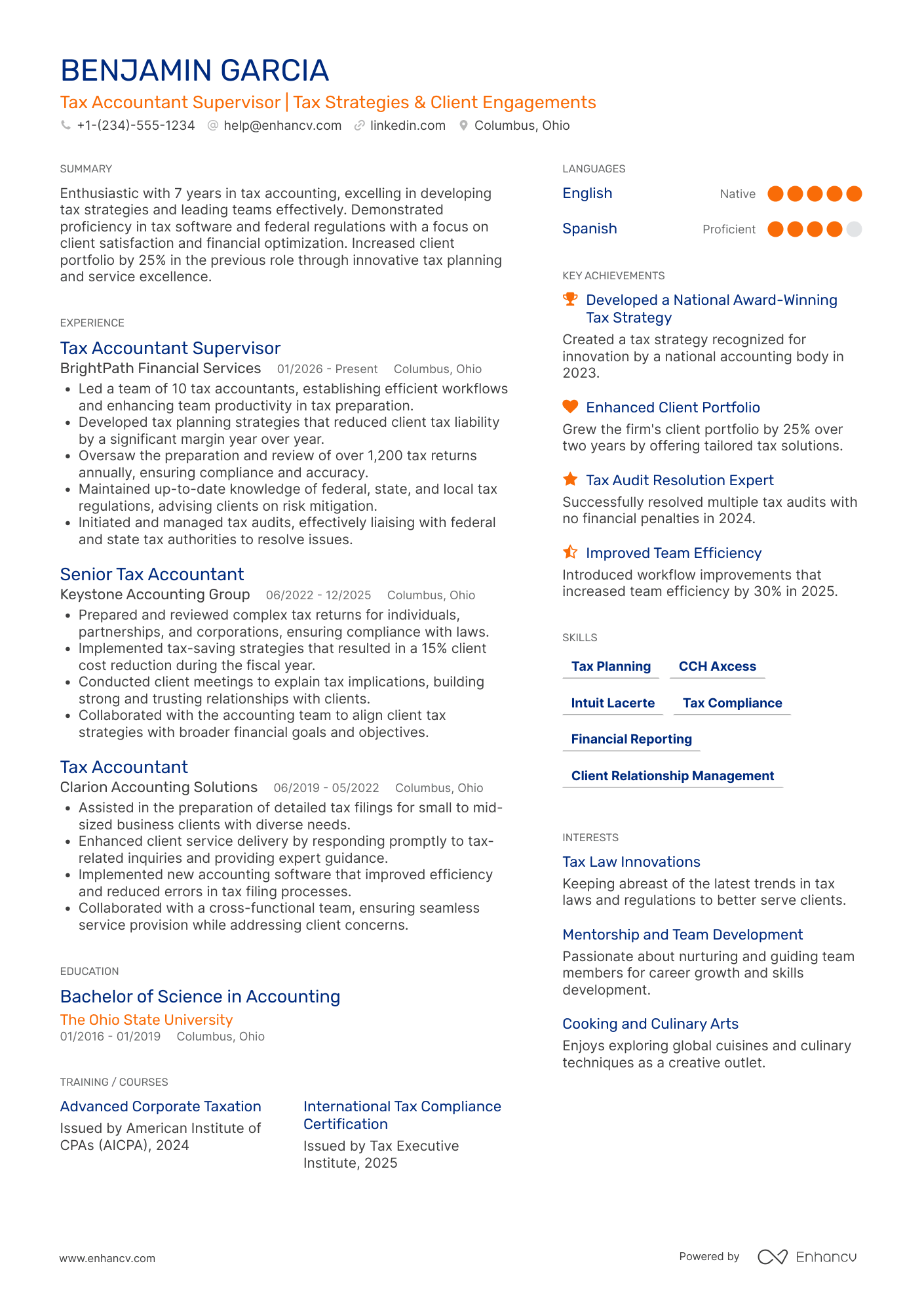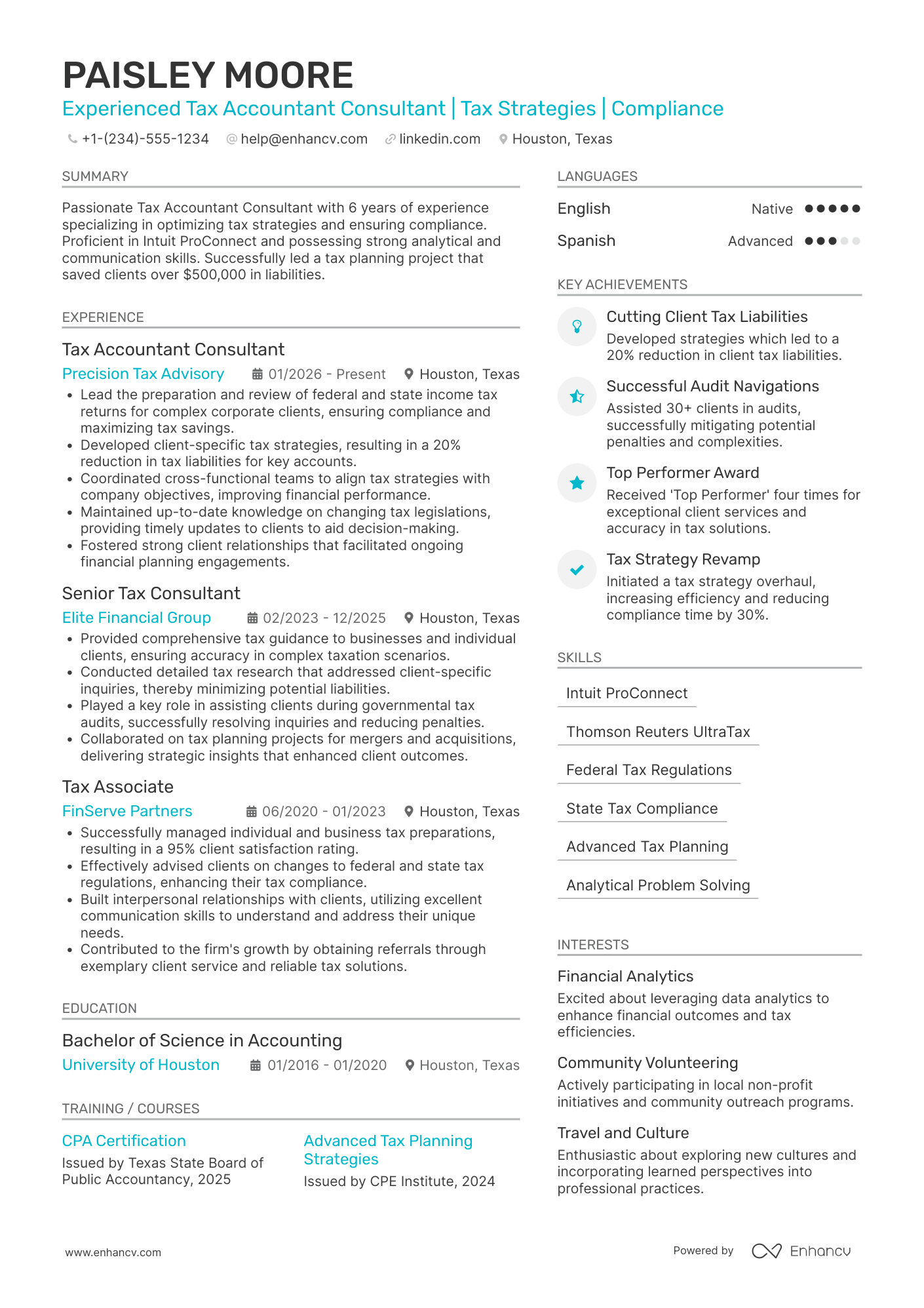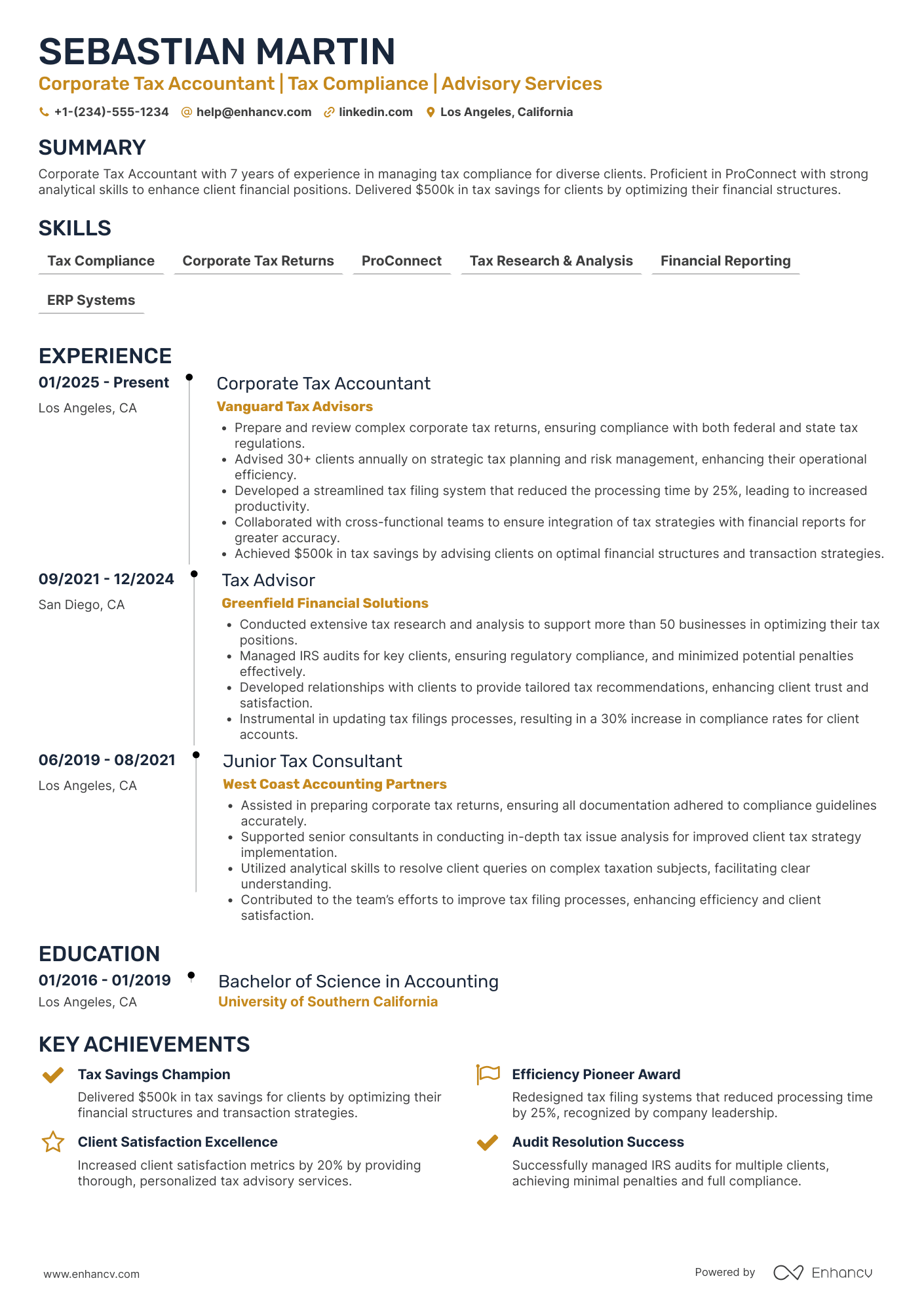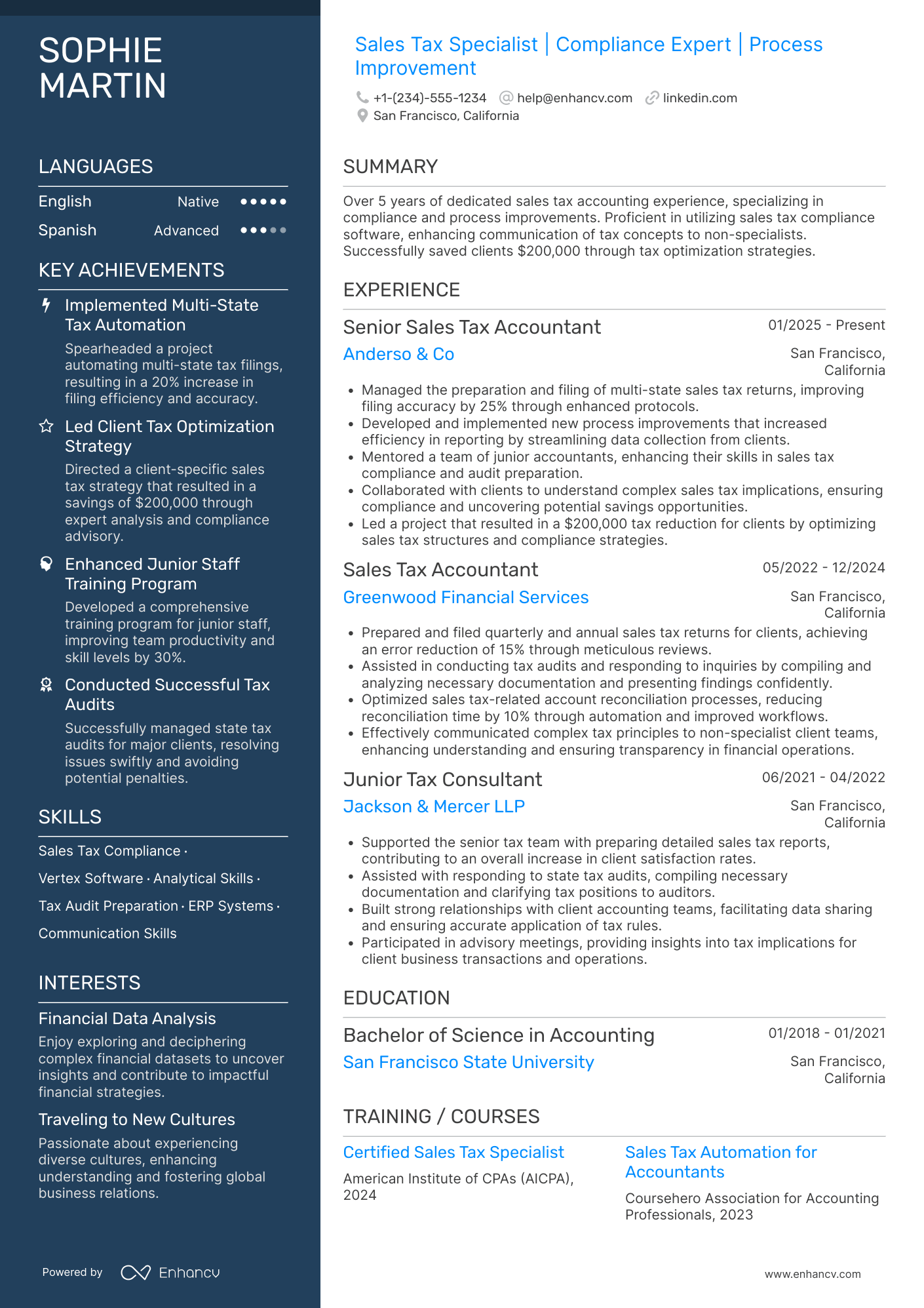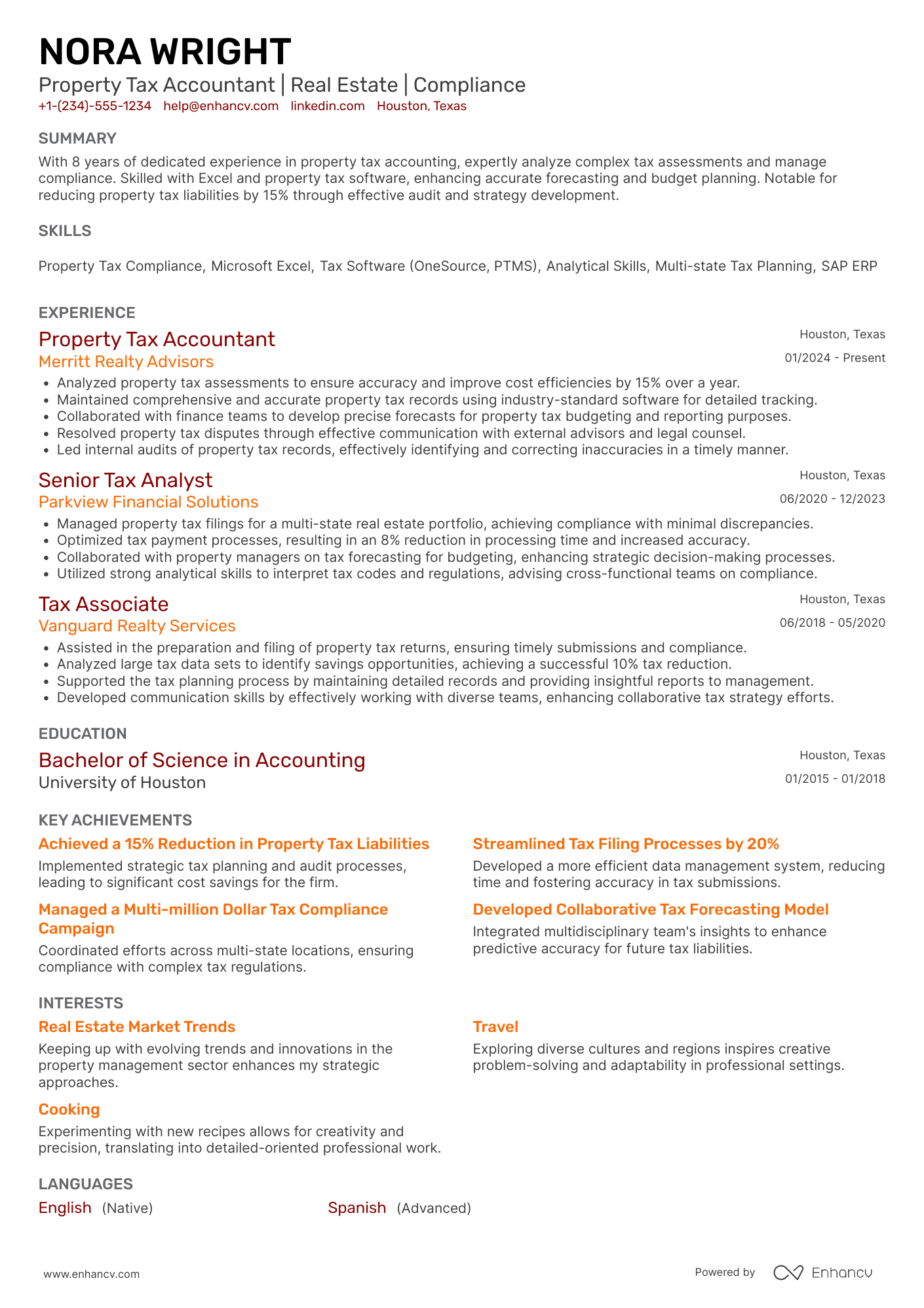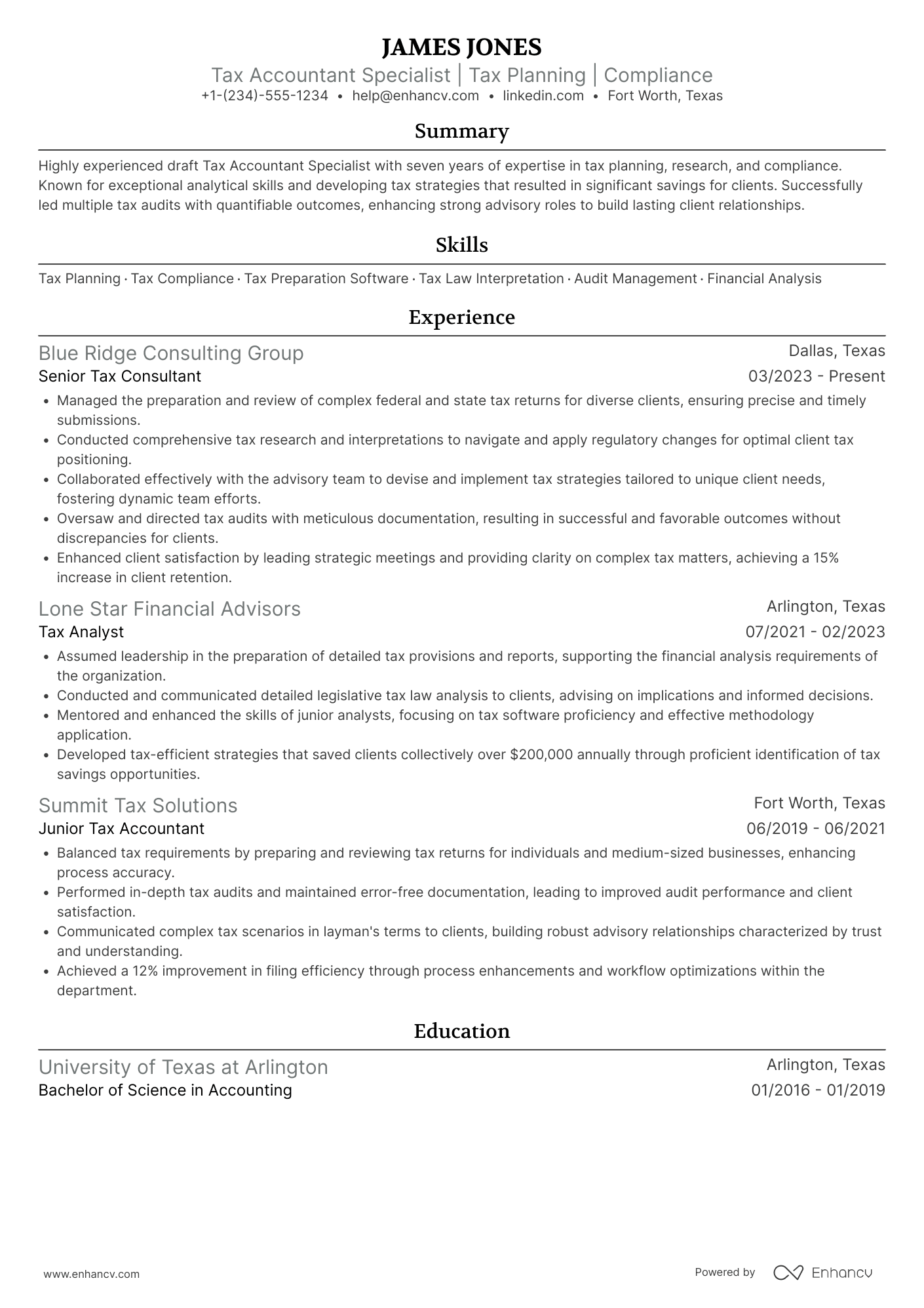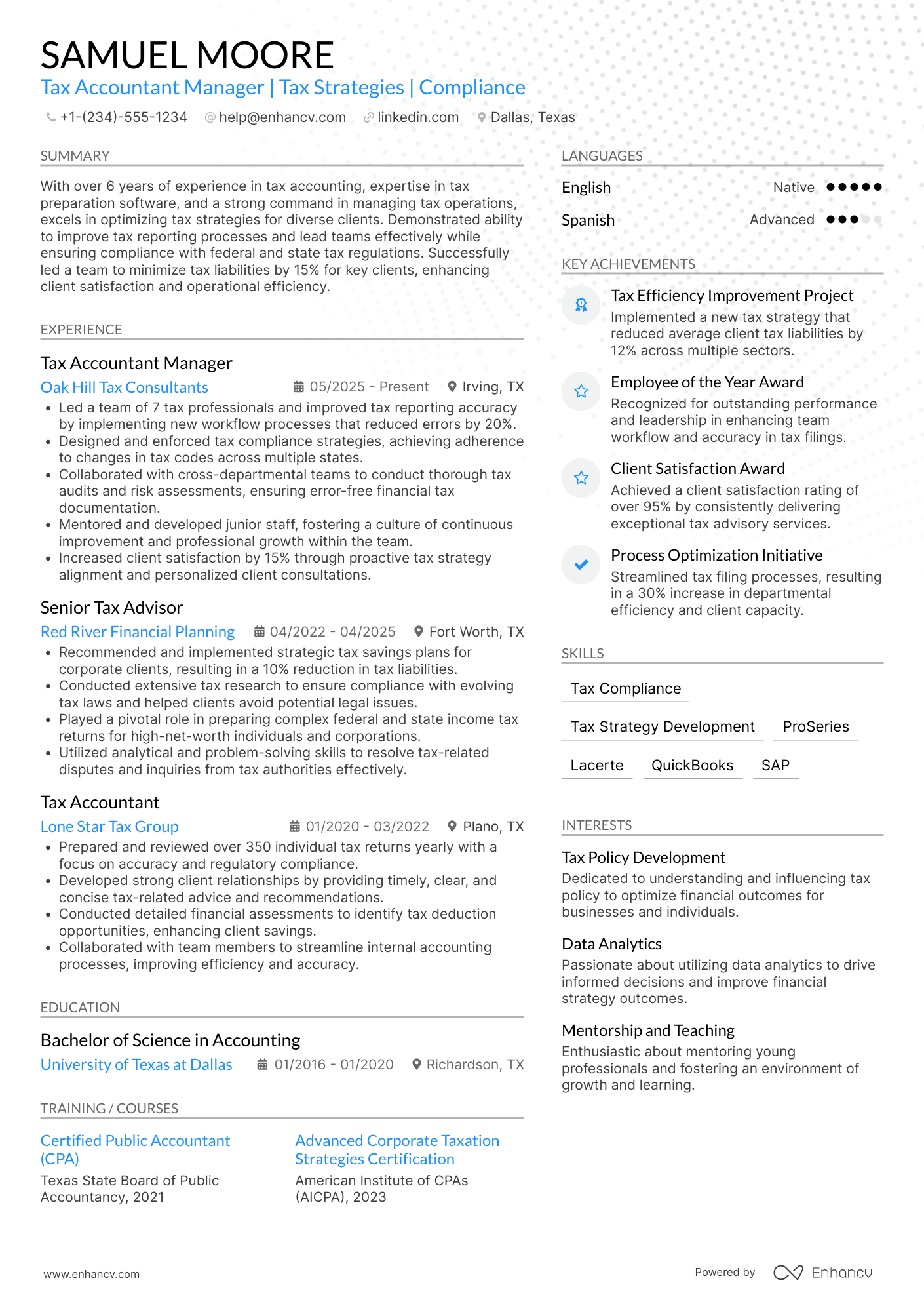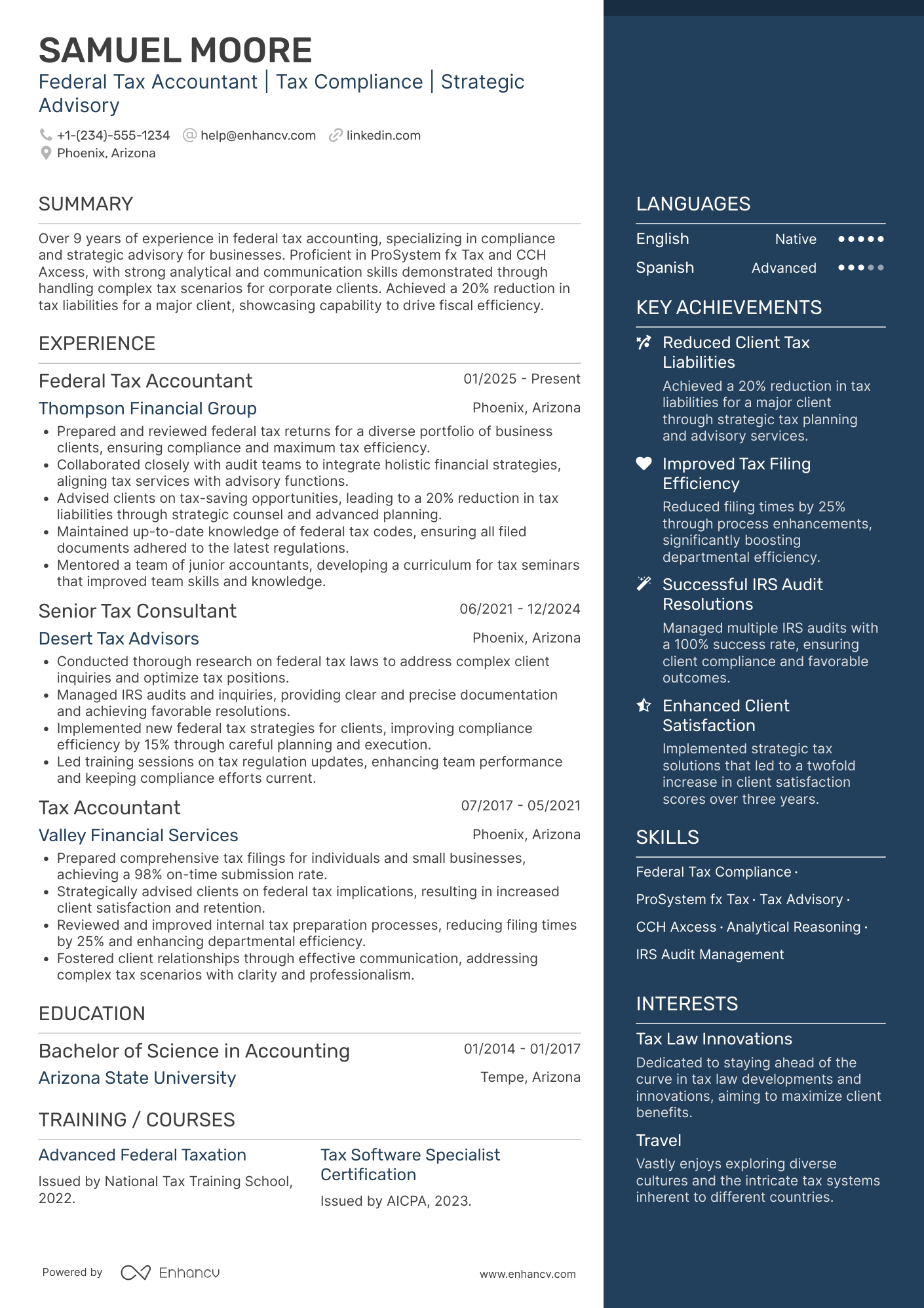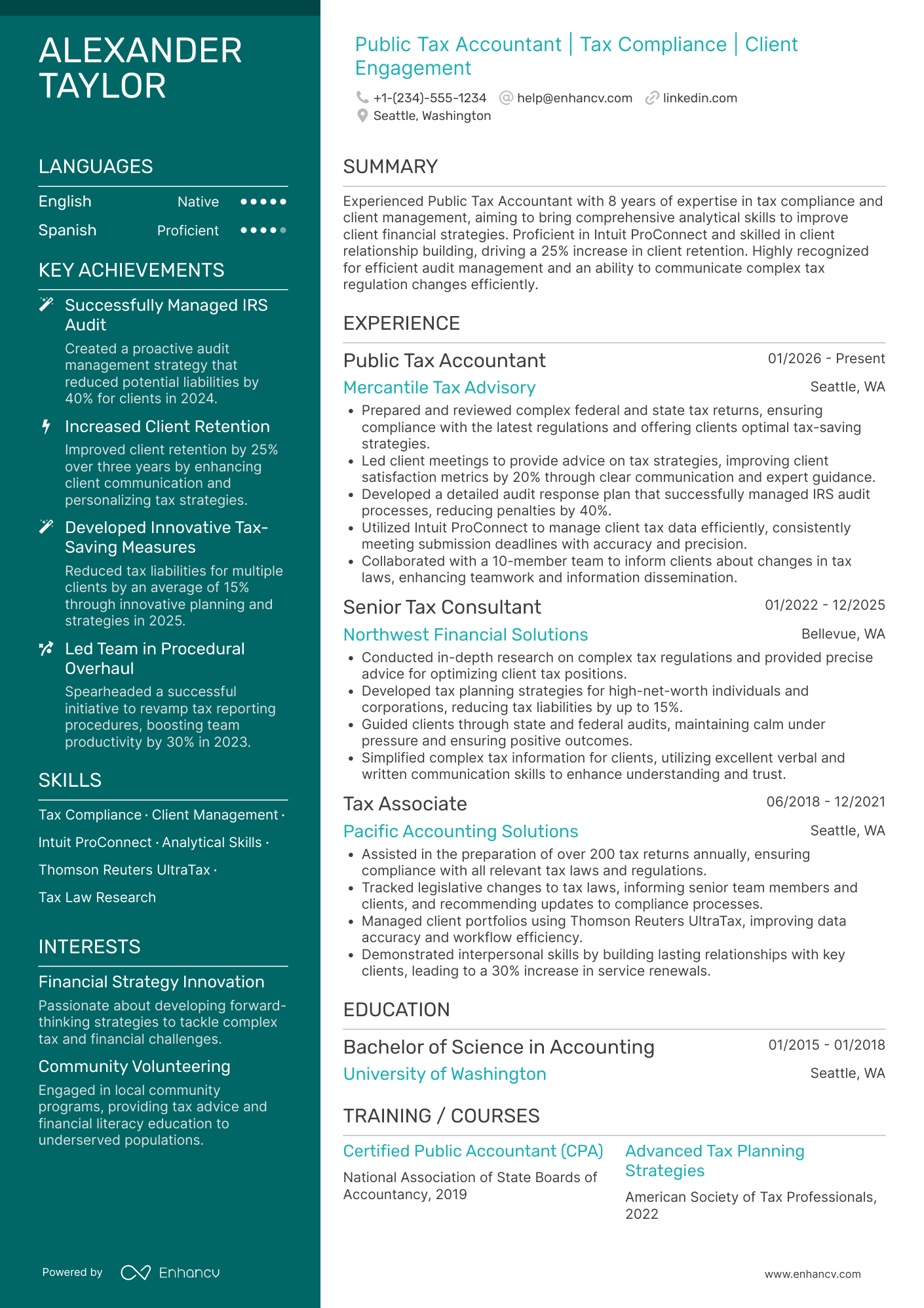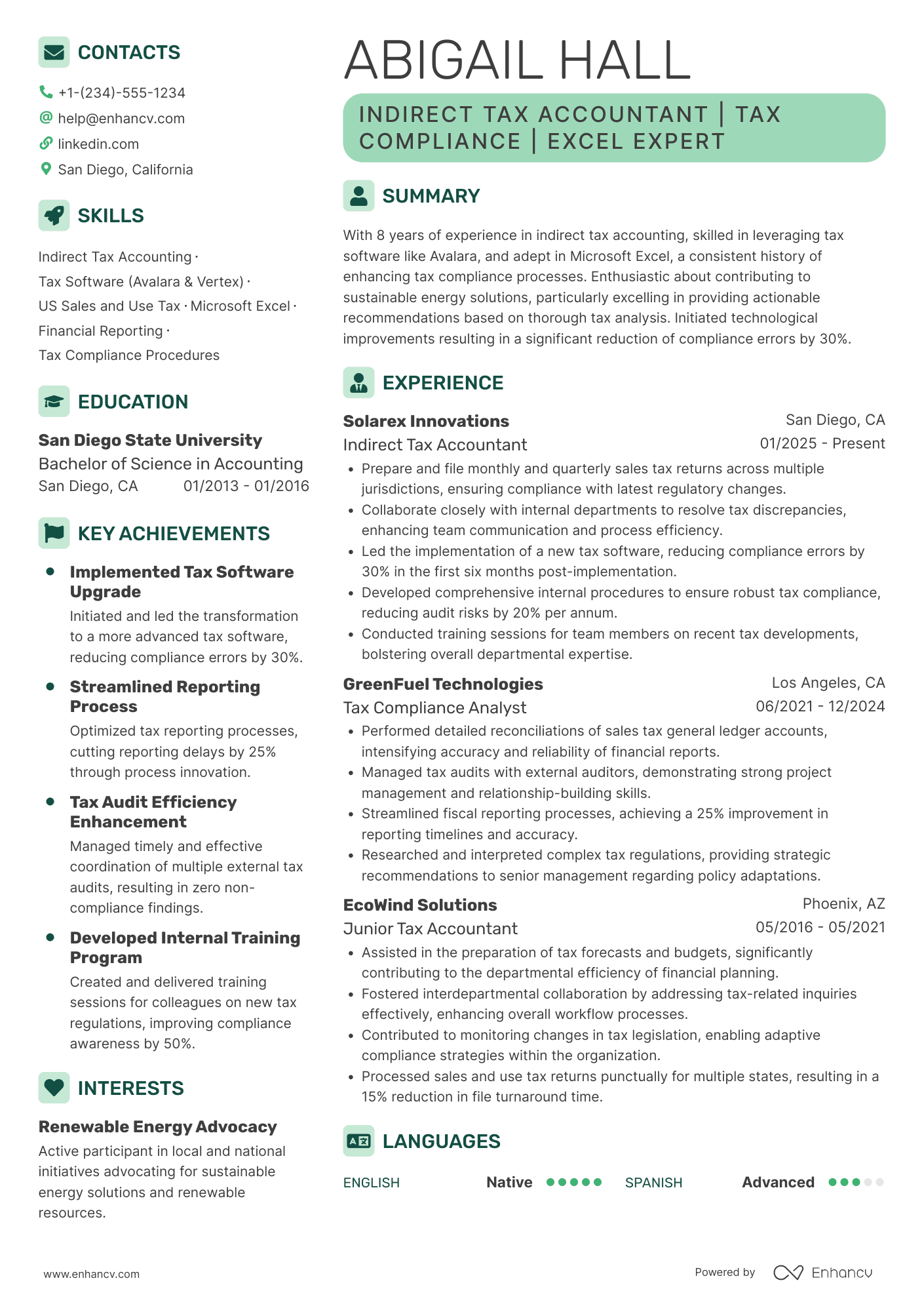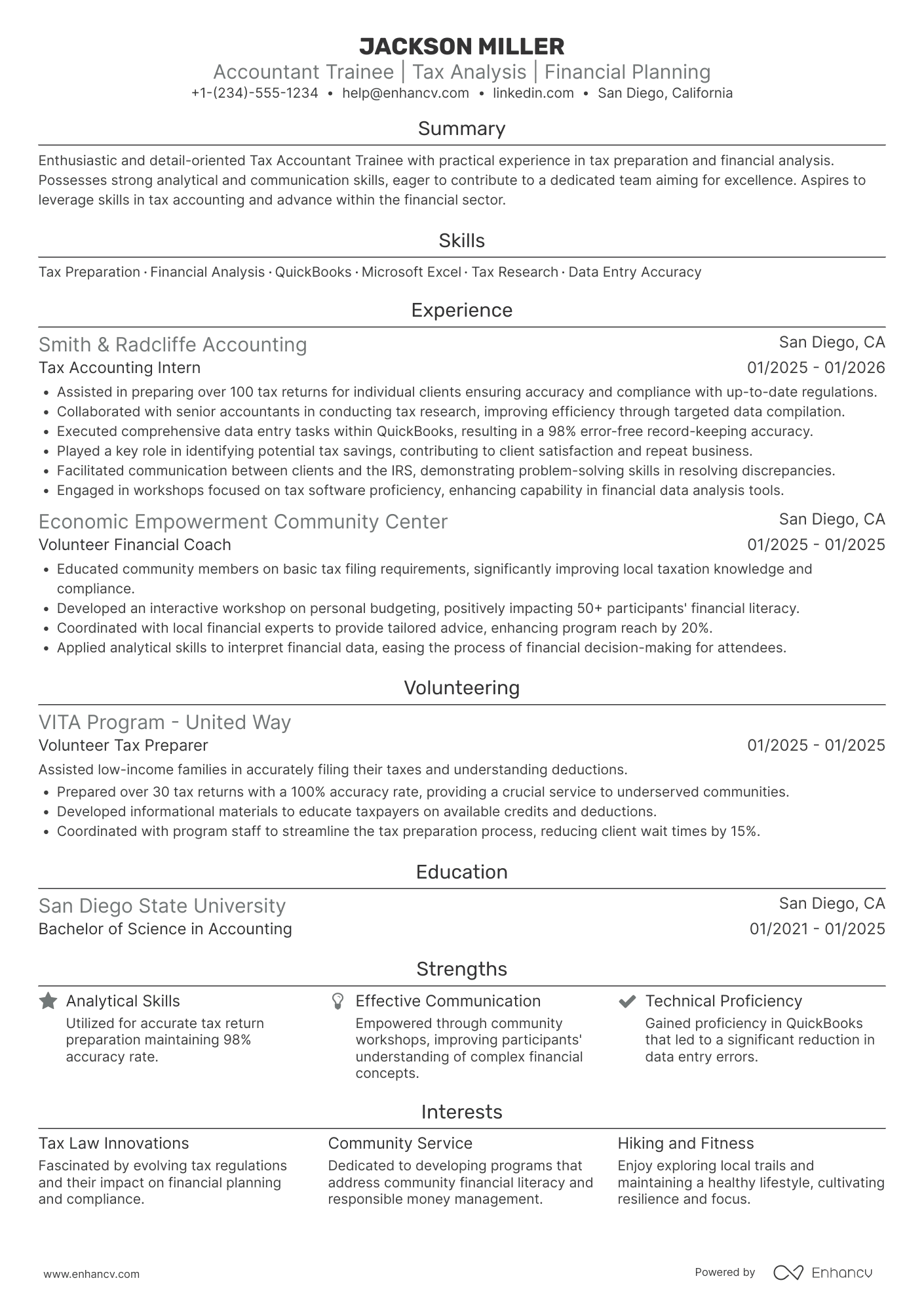
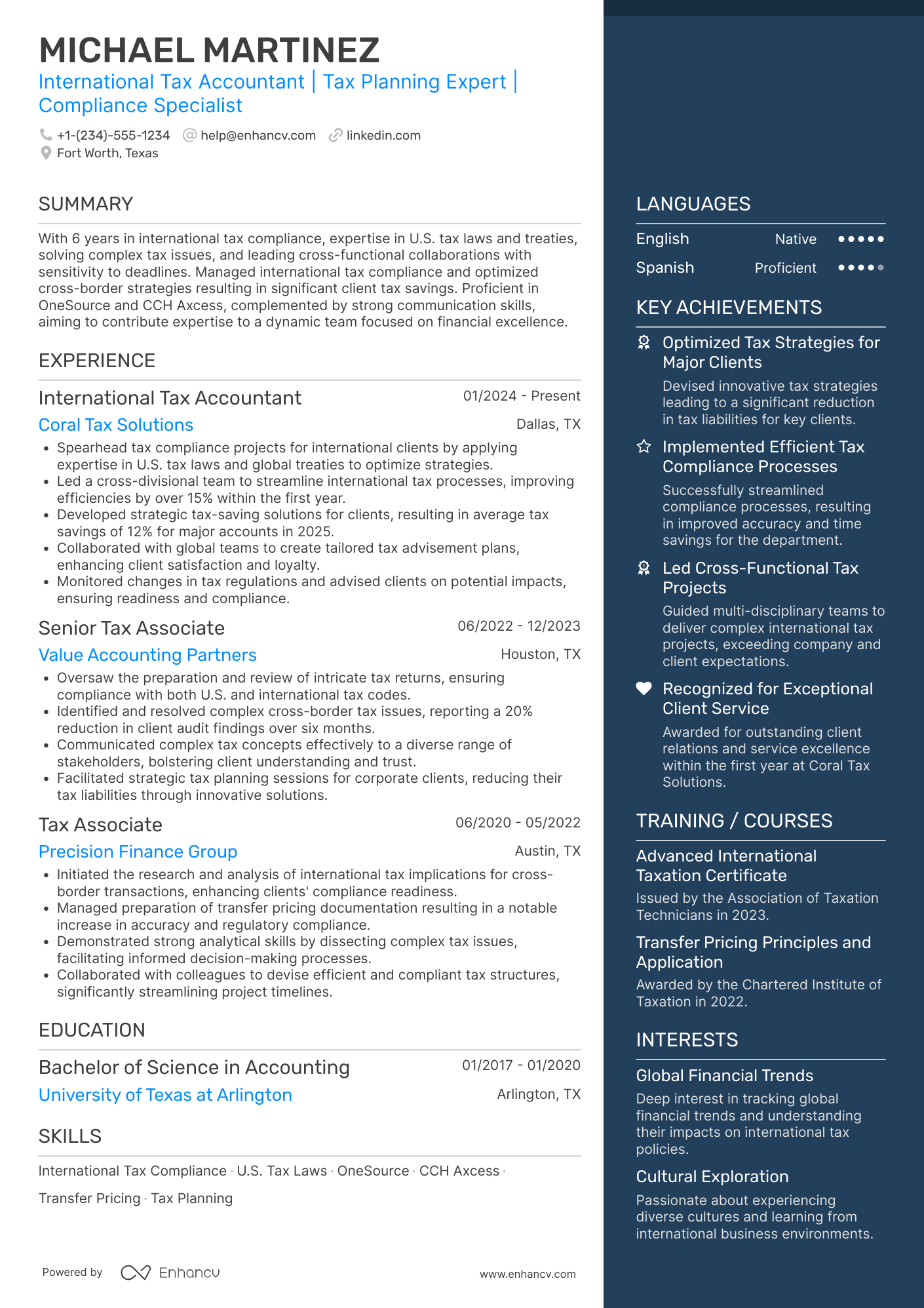
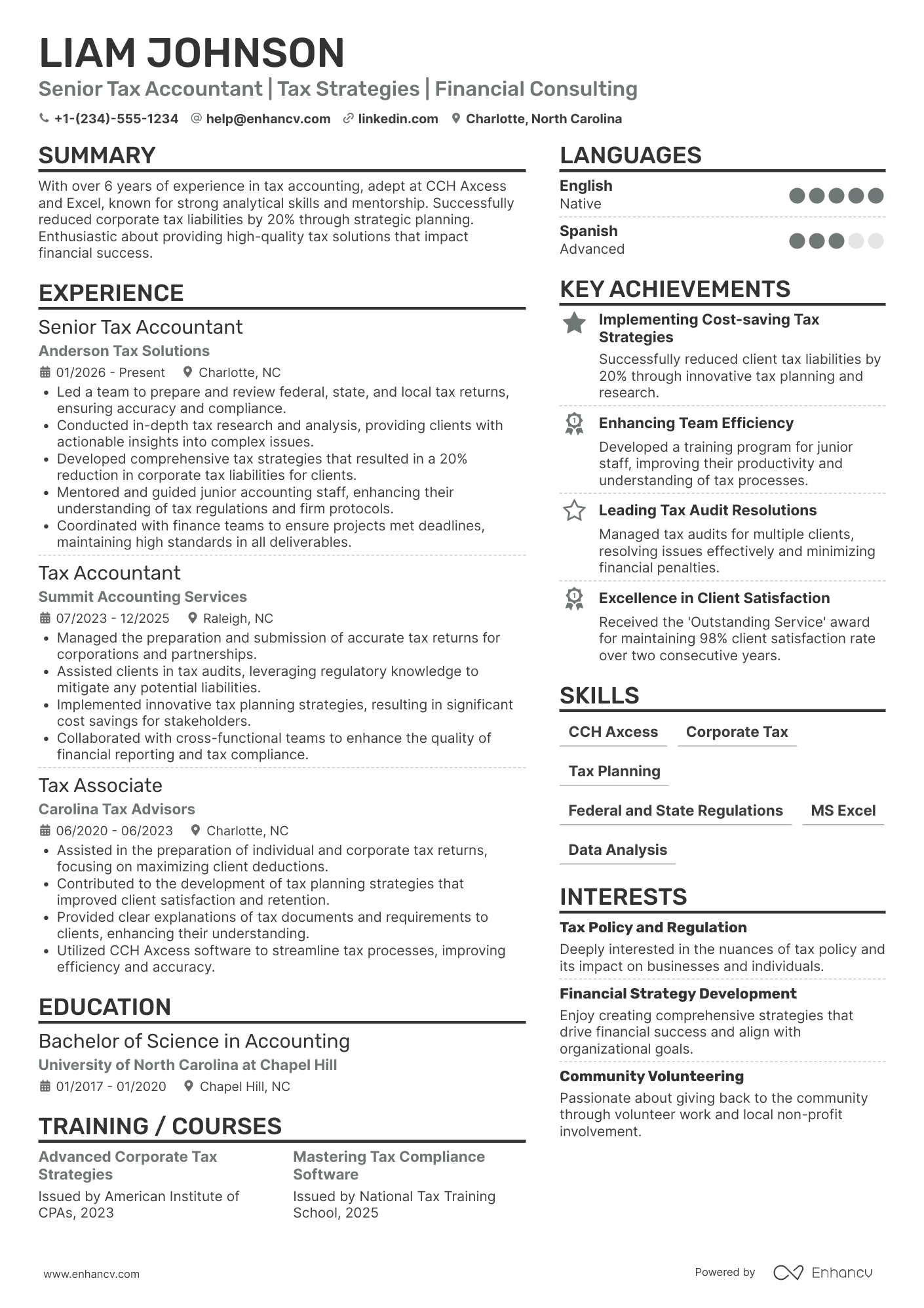
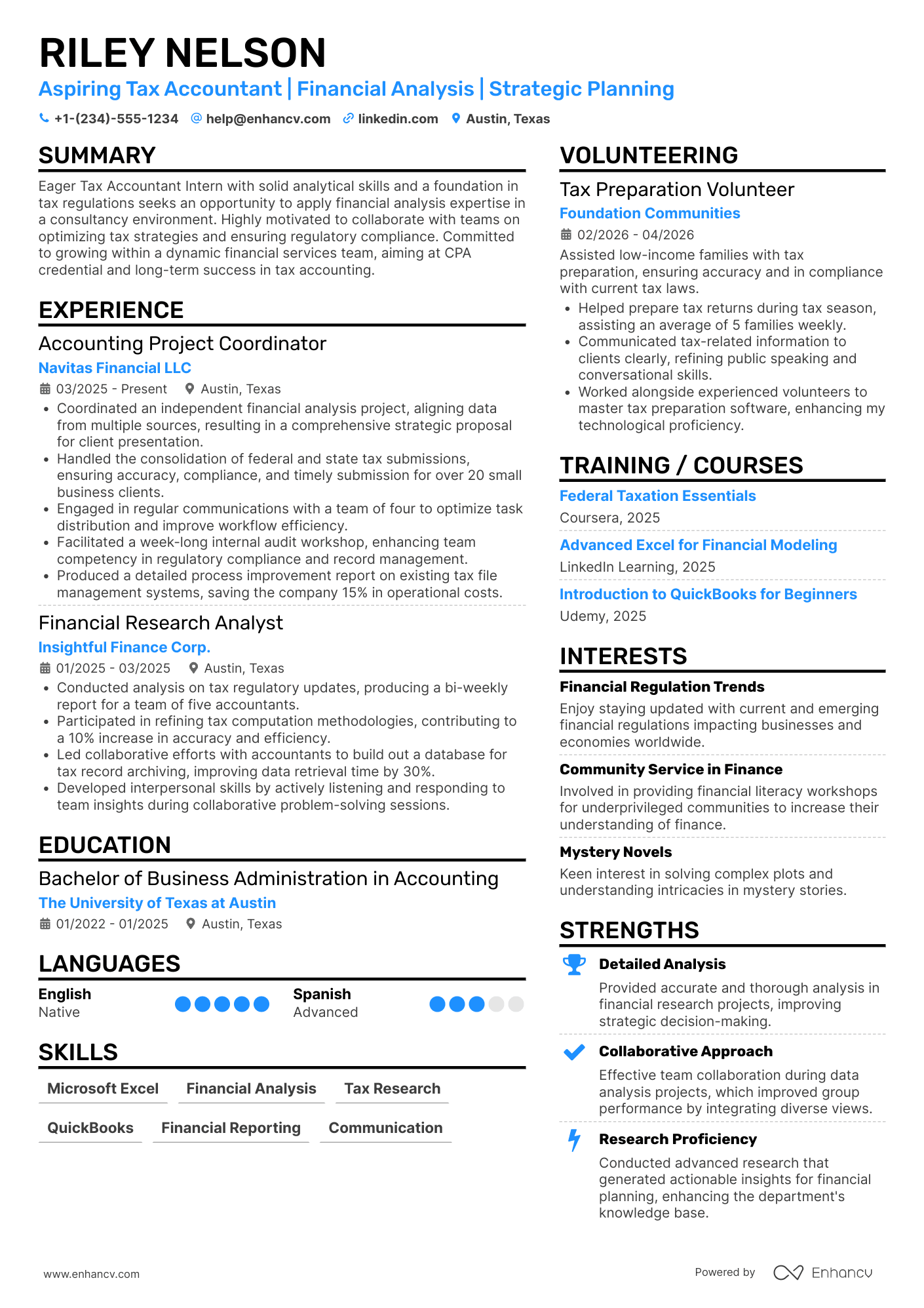
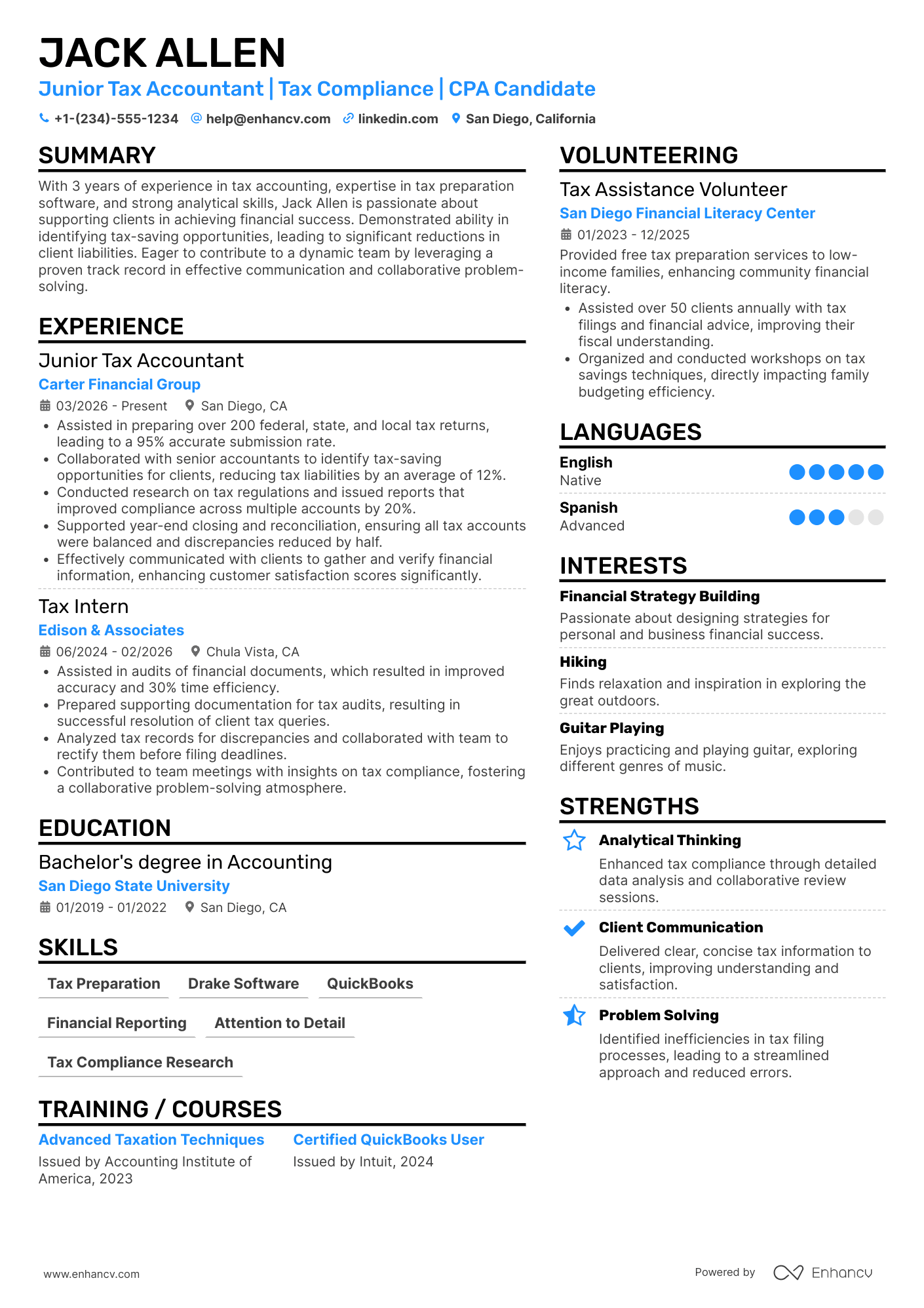
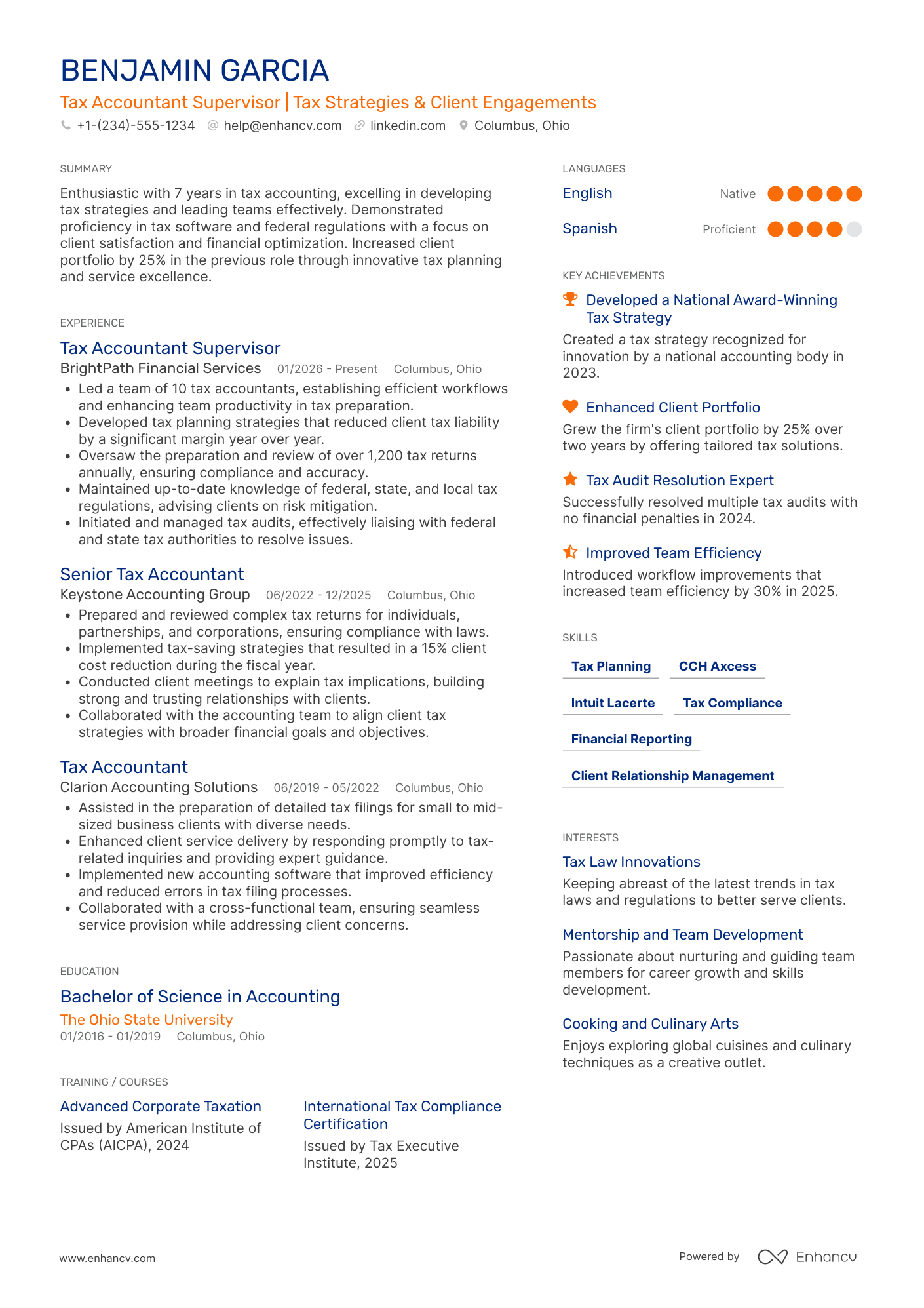
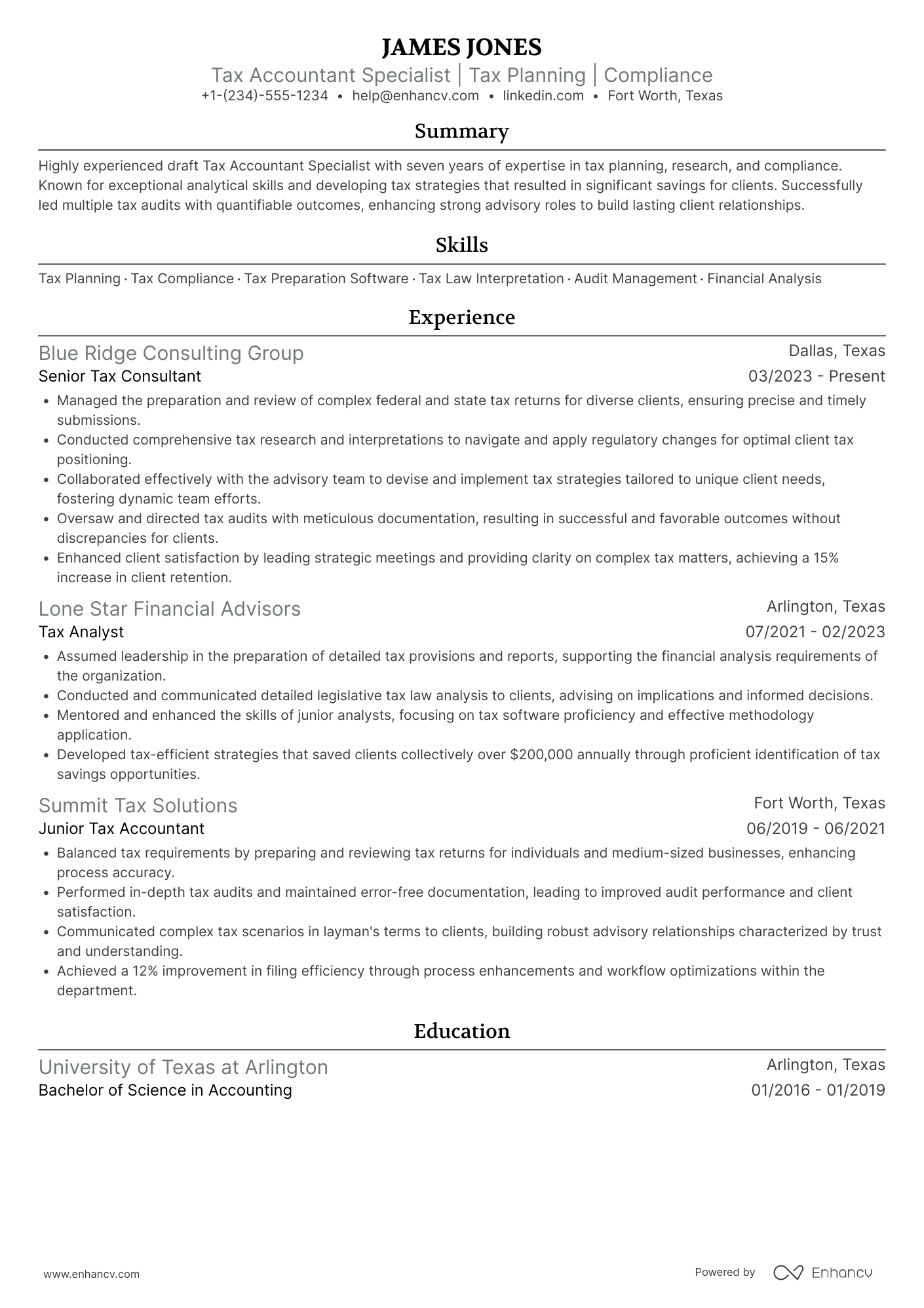
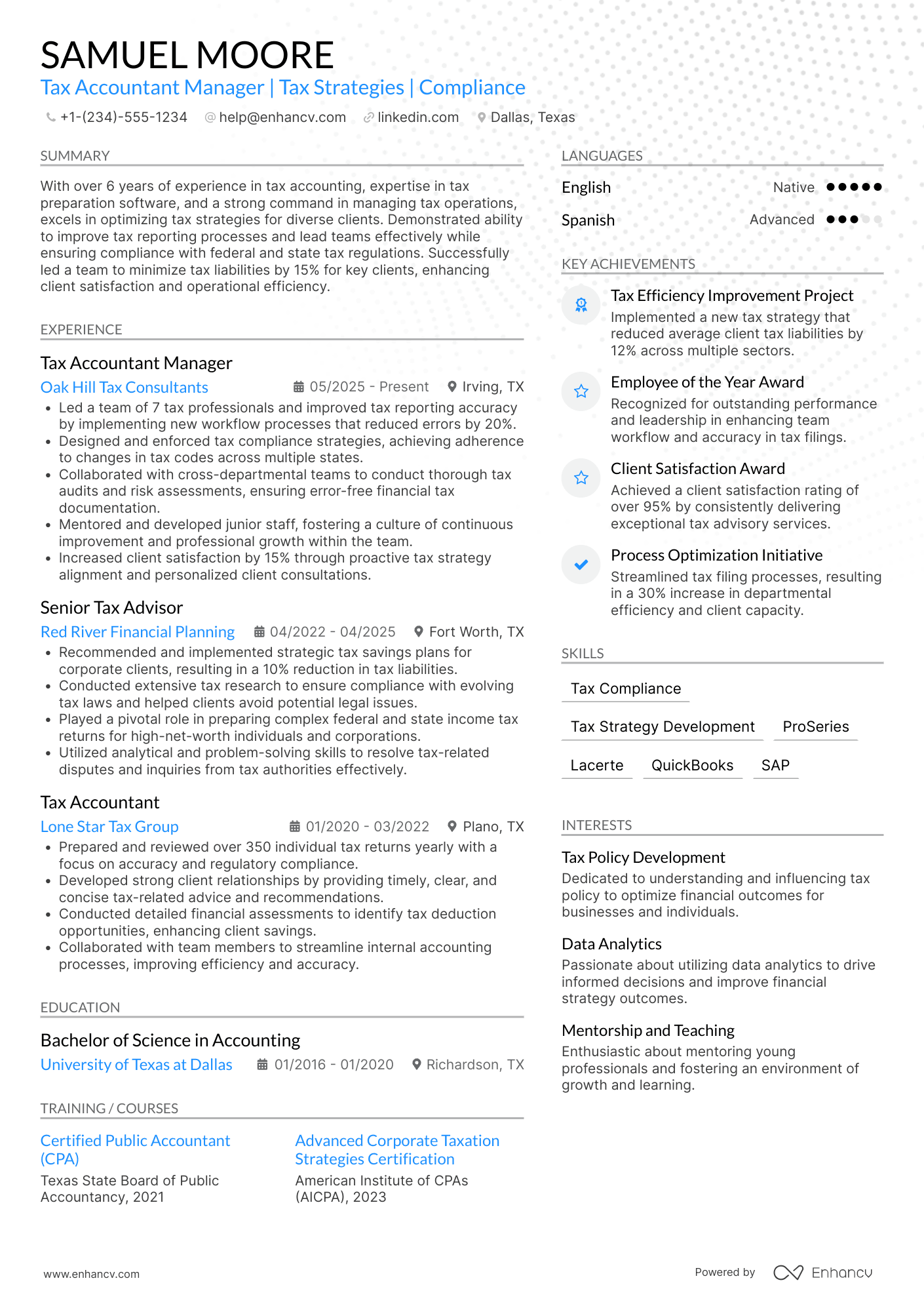
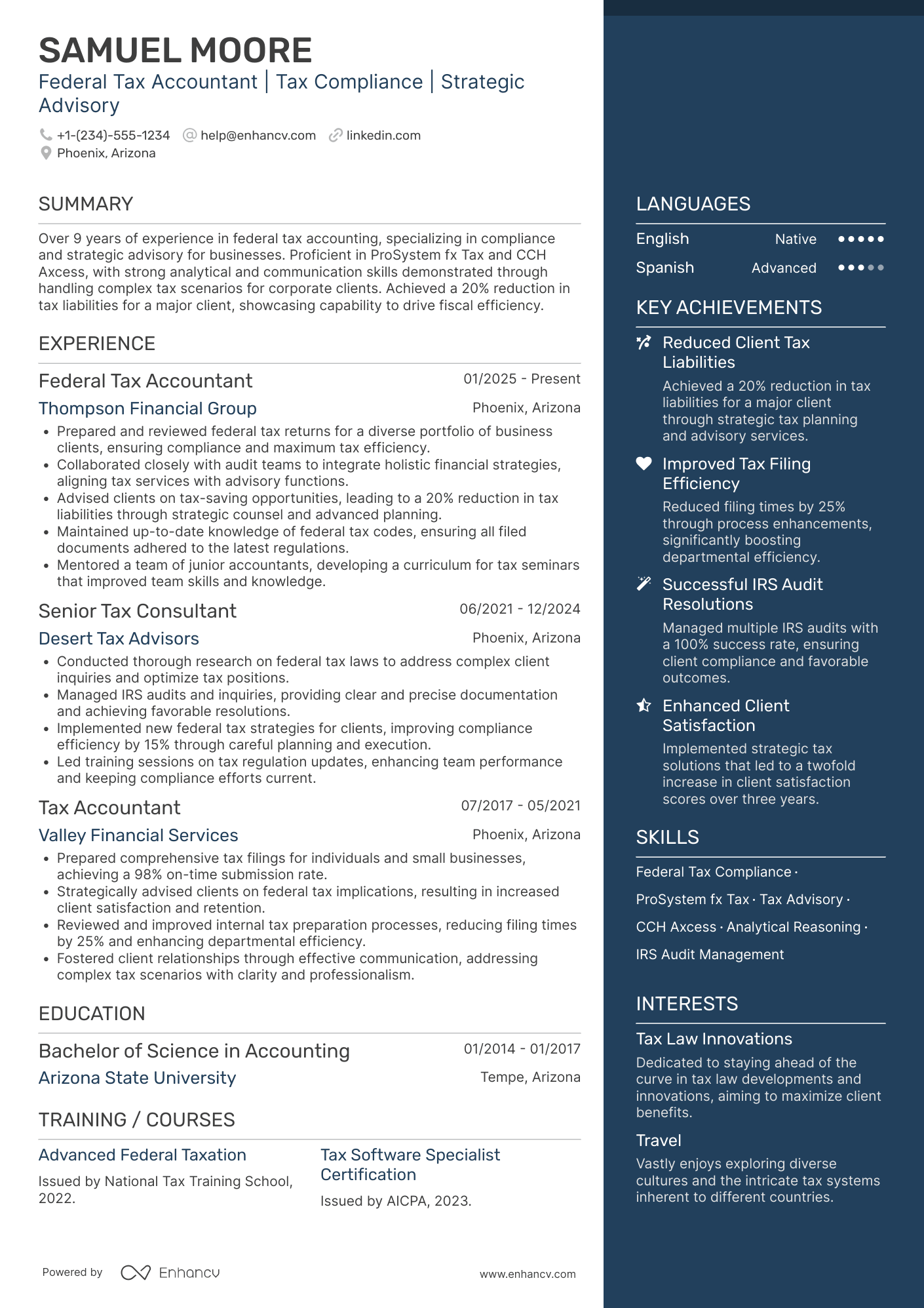
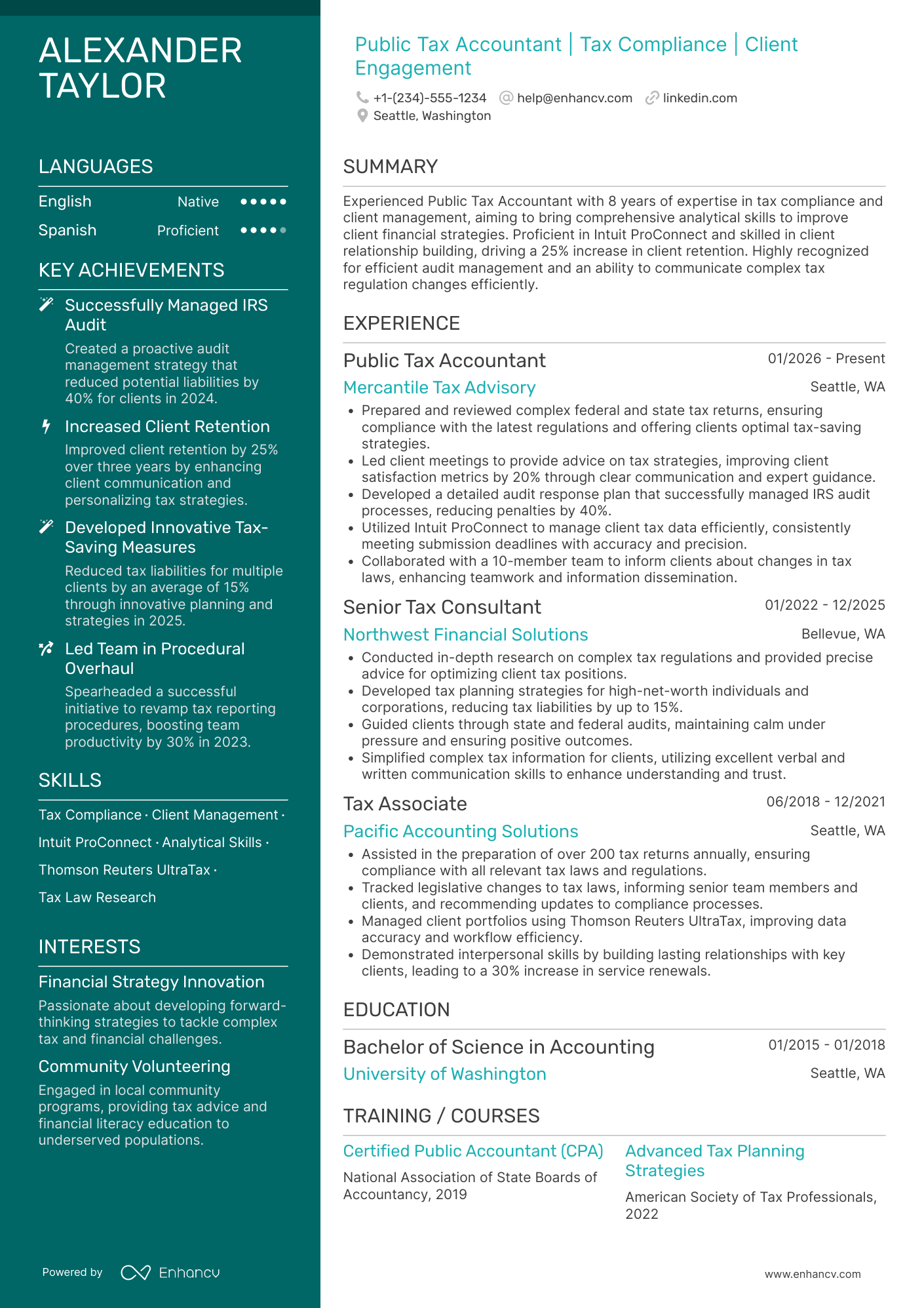
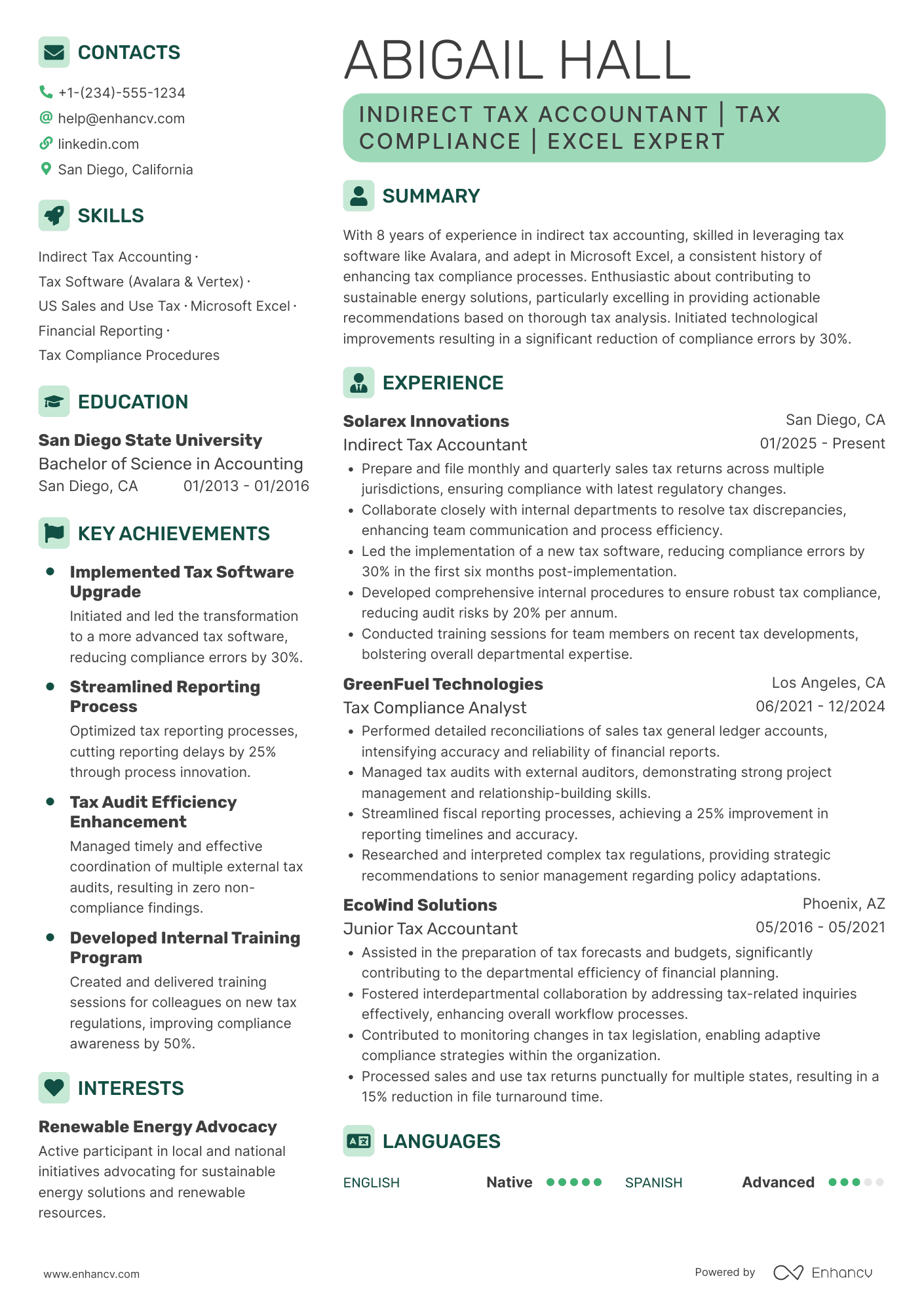
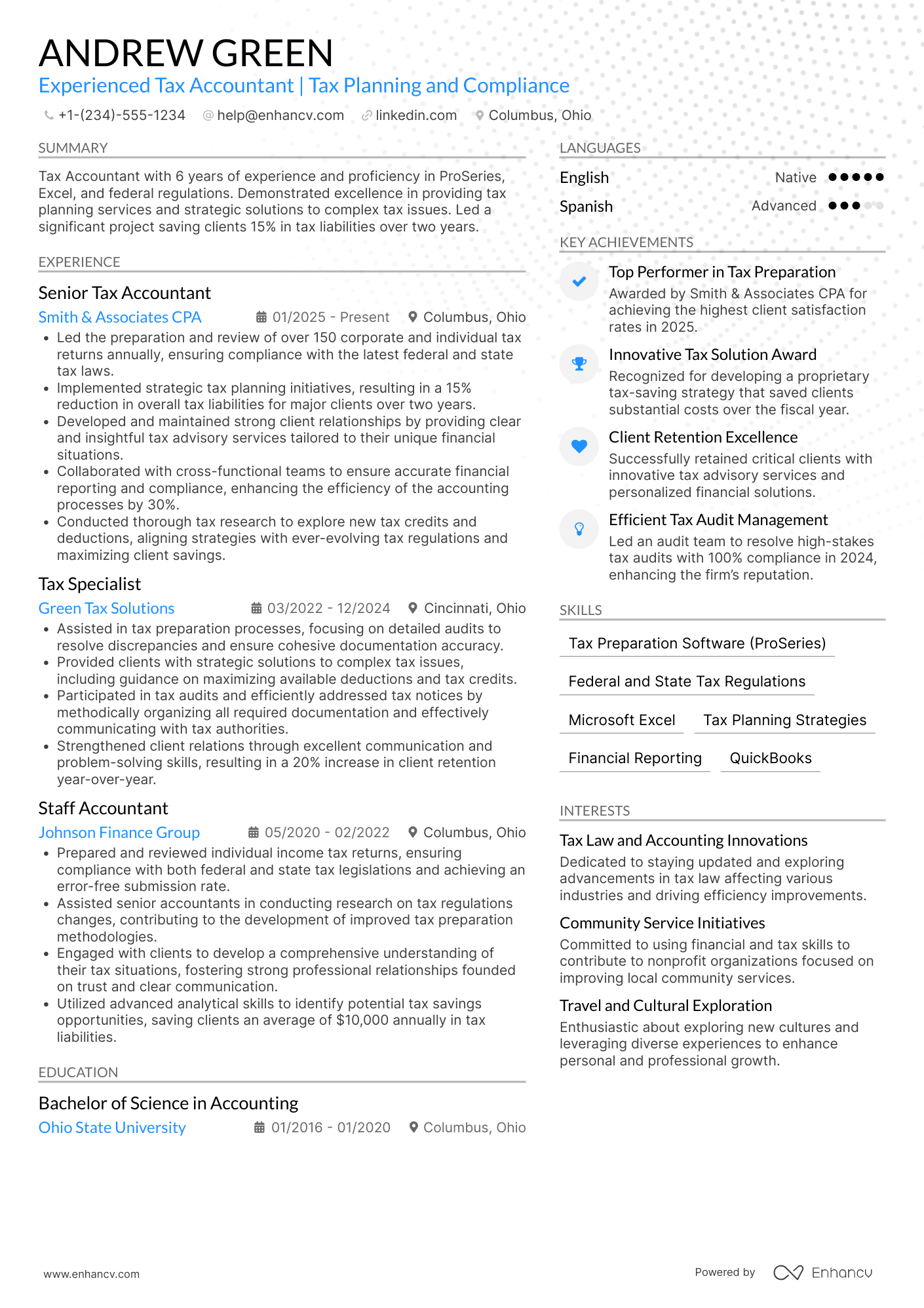
Most tax accountant resume drafts fail because they read like task checklists and bury results in dense blocks. That format gets filtered by ATS software and missed in rapid recruiter scans, especially when applicant volume is high.
Whatever this resume claims, a controller or tax partner will also read the letter next to it — our tax accountant cover letter guide covers how to introduce the same wins in plain language without restating the bullets.
A strong resume shows what changed because of your work, not just what you used. If you're unsure where to begin, learning how to write a resume that highlights impact is essential. You should highlight audit-ready filings, reduced penalties, accelerated close timelines, improved effective tax rates, managed multi-entity compliance, and delivered clean workpapers with minimal review notes.

Key takeaways
- Quantify every experience bullet with filing volumes, dollar savings, or error reduction rates.
- Tailor resume language to mirror each job posting's exact tools and compliance frameworks.
- Use reverse-chronological format for experienced tax accountants and hybrid format for career changers.
- Demonstrate skills through measurable outcomes in your summary and experience sections, not standalone lists.
- Include certifications like CPA or Enrolled Agent prominently—they carry significant weight with hiring managers.
- Entry-level candidates should highlight VITA returns, tax clinic work, and software proficiency with quantified results.
- Build and refine your tax accountant resume faster with Enhancv to keep every section focused and role-aligned.
Job market snapshot for tax accountants
We analyzed 260 recent tax accountant job ads across major US job boards. These numbers help you understand skills in demand, top companies hiring, industry demand at a glance.
What level of experience employers are looking for tax accountants
| Years of Experience | Percentage found in job ads |
|---|---|
| 1–2 years | 9.2% (24) |
| 3–4 years | 7.7% (20) |
| 5–6 years | 6.5% (17) |
| 7–8 years | 2.7% (7) |
| 9–10 years | 1.2% (3) |
| 10+ years | 1.2% (3) |
| Not specified | 72.3% (188) |
Tax accountant ads by area of specialization (industry)
| Industry (Area) | Percentage found in job ads |
|---|---|
| Finance & Banking | 76.2% (198) |
| Education | 10.8% (28) |
| Healthcare | 3.8% (10) |
Top companies hiring tax accountants
| Company | Percentage found in job ads |
|---|---|
| KPMG | 18.8% (49) |
| Martin Midstream Partners L.P. | 6.2% (16) |
Role overview stats
These tables show the most common responsibilities and employment types for tax accountant roles. Use them to align your resume with what employers expect and to understand how the role is structured across the market.
Day-to-day activities and top responsibilities for a tax accountant
| Responsibility | Percentage found in job ads |
|---|---|
| Microsoft excel | 33.8% (88) |
| Excel | 26.9% (70) |
| Microsoft word | 23.8% (62) |
| Accounting | 20.8% (54) |
| Microsoft outlook | 20.0% (52) |
| High net-worth individuals | 18.8% (49) |
| Microsoft teams | 18.8% (49) |
| Income tax software | 17.7% (46) |
| Microsoft office | 17.7% (46) |
| Partnership taxation | 16.9% (44) |
| Multi-state taxation | 15.8% (41) |
| Tax compliance | 13.5% (35) |
Type of employment (remote vs on-site vs hybrid)
| Employment type | Percentage found in job ads |
|---|---|
| On-site | 71.2% (185) |
| Hybrid | 21.5% (56) |
| Remote | 7.3% (19) |
How to format a tax accountant resume
Recruiters hiring tax accountants prioritize technical tax knowledge, compliance accuracy, and the ability to manage filing deadlines across multiple jurisdictions. A clean, well-organized resume format ensures these signals—along with relevant software proficiency and quantified outcomes—are immediately visible to both applicant tracking systems and hiring managers.

I have significant experience in this role—which format should I use?
Use a reverse-chronological format to present your deepest and most recent tax accounting experience first. Do:
- Lead each role entry with your scope of responsibility, including client portfolio size, entity types, and jurisdictions managed.
- Highlight proficiency in role-specific tools and domains such as Thomson Reuters UltraTax, CCH Axcess, ASC 740 provisions, multi-state compliance, and IRS audit representation.
- Quantify outcomes tied to tax savings delivered, error reduction, filing accuracy rates, or process improvements.
- Prepared and reviewed 350+ federal and multi-state corporate tax returns annually, identifying $1.2M in cumulative tax savings through R&D credit optimization and fixed asset reclassification.
I'm junior or switching into this role—what format works best?
A hybrid format works best, letting you lead with core tax skills and certifications before presenting your work or transitional experience. Do:
- Place a dedicated skills section near the top featuring tax preparation software, relevant coursework, and certifications such as CPA eligibility or Enrolled Agent status.
- Include internships, volunteer tax preparation (such as VITA programs), or academic projects involving tax research, return preparation, or compliance analysis.
- Connect every listed skill or project to a specific action and a measurable or observable result.
- Multi-state sales tax compliance (skill) → reconciled nexus obligations across 12 states for a mid-size e-commerce client during an internship (action) → reduced estimated penalty exposure by 40% ahead of quarterly filing deadlines (result).
Why not use a functional resume?
A functional format strips away the timeline and context that hiring managers need to verify your hands-on tax compliance experience, making it difficult to assess which skills you've actually applied in a professional setting. A functional resume may be acceptable if you're transitioning from a related finance or bookkeeping role into tax accounting and have limited direct tax experience—but only if every listed skill is tied to a specific project, engagement, or measurable outcome rather than presented as a standalone claim.
Once you've established a clean, readable format, the next step is determining which sections to include so each one serves a clear purpose on your resume.
What sections should go on a tax accountant resume
Recruiters expect a tax accountant resume to show tax compliance expertise, accuracy, and measurable results across filings, audits, and client work. Knowing exactly what to put on a resume helps you prioritize the right details. Use this structure for maximum clarity:
- Header
- Summary
- Experience
- Skills
- Projects
- Education
- Certifications
- Optional sections: Awards, Publications, Languages
Strong experience bullets should emphasize filing volume and complexity, dollar impact, error reduction, audit outcomes, and process improvements you delivered.
Is your resume good enough?
Drop your resume here or choose a file. PDF & DOCX only. Max 2MB file size.
Now that you’ve organized the essential resume components, the next step is learning how to write your tax accountant resume experience so those details translate into clear, role-relevant impact.
How to write your tax accountant resume experience
The experience section is where you prove you've delivered real results—through tax preparation, compliance work, advisory services, and the tools and methods you used to accomplish them. Hiring managers prioritize demonstrated impact over descriptive task lists, so every bullet should connect what you did to a measurable outcome. Building a targeted resume ensures each entry speaks directly to what the employer is looking for.
Each entry should include:
- Job title
- Company and location (or remote)
- Dates of employment (month and year)
Three to five concise bullet points showing what you owned, how you executed, and what outcomes you delivered:
- Ownership scope: the tax engagements, client portfolios, filing categories, entity types, or compliance areas you were directly accountable for as a tax accountant.
- Execution approach: the tax software, research databases, regulatory frameworks, analytical methods, or review processes you used to prepare returns, identify exposures, and deliver advisory recommendations.
- Value improved: changes to filing accuracy, audit readiness, tax liability reduction, compliance turnaround time, or risk mitigation that resulted from your work.
- Collaboration context: how you partnered with clients, internal audit teams, controllers, legal counsel, or regulatory agencies to resolve tax matters and align on reporting obligations.
- Impact delivered: outcomes expressed through reduced liabilities, recovered credits, successful audit defenses, process efficiencies, or revenue retained—framed as results rather than activities.
Experience bullet formula
A tax accountant experience example
✅ Right example - modern, quantified, specific.
Senior Tax Accountant
Redwood Logistics Group | Chicago, IL
2022–Present
Mid-market third-party logistics provider with multi-state operations and $250M+ annual revenue.
- Led federal and multi-state income tax compliance for twelve entities using CCH Axcess Tax and Workpapers, cutting return prep cycle time by 22% through standardized workpapers and review checklists.
- Automated quarterly provision workflows in OneSource Tax Provision and Excel Power Query, reducing close time by three business days and lowering provision-to-return true-up variance from 6.1% to 1.8%.
- Reconciled book-to-tax differences and fixed asset depreciation using Oracle NetSuite, Fixed Assets CS, and Alteryx, eliminating 95% of recurring reconciliation exceptions flagged by internal audit.
- Partnered with finance leadership and external auditors to support two nexus studies and a state apportionment methodology update, reducing estimated state tax exposure by $410K and improving documentation for audit readiness.
- Managed IRS and state notices in CCH Axcess and SharePoint, resolving twenty-six cases with a 92% first-response acceptance rate and avoiding $68K in penalties and interest.
Now that you've seen what a strong experience entry looks like, let's break down how to adjust yours based on the specific job you're applying for.
How to tailor your tax accountant resume experience
Recruiters evaluate your tax accountant resume through both applicant tracking systems and manual review. Tailoring your resume to the job description ensures your qualifications stand out in both rounds.
Ways to tailor your tax accountant experience:
- Match specific tax software and ERP systems named in the posting.
- Mirror the exact compliance standards or regulatory frameworks referenced.
- Use the same terminology for filing processes or reporting methodologies.
- Reflect KPIs like accuracy rates or turnaround times the employer prioritizes.
- Highlight industry-specific tax experience such as corporate or nonprofit sectors.
- Emphasize multistate or international tax knowledge when the role requires it.
- Align your work with collaboration models like cross-functional audit teams.
- Showcase familiarity with IRS regulations or jurisdiction-specific codes mentioned.
Tailoring means aligning your real accomplishments with what the employer needs—not forcing disconnected keywords into your experience bullets.
Resume tailoring examples for tax accountant
| Job description excerpt | Untailored | Tailored |
|---|---|---|
| Prepare and review federal and multi-state corporate tax returns using OneSource Tax Provision, ensuring compliance with ASC 740. | Prepared tax returns and helped with compliance tasks. | Prepared and reviewed federal and multi-state corporate tax returns for 12 entities using OneSource Tax Provision, ensuring full compliance with ASC 740 reporting standards. |
| Manage quarterly estimated tax payments and assist with IRS and state audit responses, including documentation of tax positions under FIN 48. | Assisted with audits and handled various tax-related duties. | Managed quarterly estimated tax payments across seven jurisdictions and supported IRS audit responses by documenting and defending tax positions under FIN 48, resulting in zero adjusted findings over two audit cycles. |
| Conduct tax research on federal and state legislative changes and present actionable recommendations to senior leadership to minimize effective tax rate. | Did research on tax topics and communicated findings to the team. | Researched federal and state legislative changes—including TCJA provisions and state conformity updates—and delivered quarterly briefings to senior leadership with recommendations that reduced the effective tax rate by 1.8%. |
Once you’ve aligned your experience with the specific tax accounting role, the next step is to quantify your achievements so employers can quickly see the impact of your work.
How to quantify your tax accountant achievements
Quantifying your achievements shows how your work improves accuracy, compliance, and turnaround time. Focus on returns filed, dollars saved, error rates, audit outcomes, close timelines, and volume handled across clients, entities, and jurisdictions.
Quantifying examples for tax accountant
| Metric | Example |
|---|---|
| Cycle time | "Cut corporate return prep time from twelve to eight days by standardizing workpapers and using Thomson Reuters UltraTax CS templates across fifteen entities." |
| Accuracy rate | "Reduced e-file rejections from 3.2% to 0.6% by tightening diagnostics, validating Social Security numbers, and reconciling K-1 inputs before submission." |
| Tax savings | "Identified and documented $420,000 in federal and state tax savings by applying bonus depreciation and credit carryforwards for a $18M manufacturing client." |
| Compliance risk | "Lowered late-filing incidents from nine to one per year by implementing a deadline tracker in Microsoft Excel and weekly status reviews with client controllers." |
| Volume handled | "Prepared and reviewed 165 individual and small business returns in a ten-week season while maintaining a 98% on-time delivery rate in CCH Axcess Tax." |
Turn your everyday tasks into measurable, recruiter-ready resume bullets in seconds with Enhancv's Bullet Point Generator.
Once you've crafted strong bullet points for your experience section, it's equally important to highlight the specific hard and soft skills that qualify you for a tax accountant role.
How to list your hard and soft skills on a tax accountant resume
Your skills section shows you can prepare compliant returns, reduce tax exposure, and support audits, and recruiters and an ATS (applicant tracking system) scan this section for role keywords—aim for mostly hard skills with a smaller set of job-specific soft skills. tax accountant roles require a blend of:
- Product strategy and discovery skills
- Data, analytics, and experimentation skills
- Delivery, execution, and go-to-market discipline
- Soft skills
Your skills section should be:
- Scannable (bullet-style grouping).
- Relevant to the job post.
- Backed by proof in experience bullets.
- Updated with current tools.
Place your skills section:
- Above experience if you're junior or switching careers.
- Below experience if you're mid/senior with strong achievements.

Hard skills
- Federal and state compliance
- Corporate, partnership, individual returns
- ASC 740 tax provision
- Multistate apportionment, nexus
- Sales and use tax
- Payroll tax filings
- IRS and state notices
- Audit support and documentation
- Tax research and memos
- Depreciation, fixed assets
- QuickBooks, NetSuite, SAP
- Excel, Power Query, pivot tables
Soft skills
- Explain tax positions to nonfinance partners
- Translate guidance into filing actions
- Prioritize deadlines across entities
- Own return-to-review workflow
- Flag risks and propose mitigations
- Ask targeted questions in intake
- Coordinate with auditors and legal
- Write clear, defensible memos
- Resolve notices with persistence
- Maintain confidentiality and discretion
How to show your tax accountant skills in context
Skills shouldn't live only in a bulleted list on your resume. Explore curated examples of resume skills to see how top candidates present their qualifications effectively.
They should be demonstrated in:
- Your summary (high-level professional identity)
- Your experience (proof through outcomes)
Here's what that looks like in practice.
Summary example
Senior tax accountant with 10+ years in corporate tax compliance and multistate reporting. Skilled in ASC 740 provisions, Thomson Reuters ONESOURCE, and cross-functional collaboration. Reduced quarterly close cycle by 30% through streamlined tax workflows.
- Reflects senior-level expertise clearly
- Names industry-standard tools
- Leads with a measurable outcome
- Highlights cross-functional collaboration
Experience example
Senior Tax Accountant
Meridian Financial Group | Chicago, IL
June 2018–Present
- Prepared federal and multistate returns for 12 entities using ONESOURCE, cutting filing errors by 45% year over year.
- Partnered with FP&A and legal teams to streamline ASC 740 provisions, reducing quarter-end close time by five days.
- Led tax audit defense efforts across three IRS cycles, recovering $1.2M in contested deductions through detailed documentation.
- Every bullet includes measurable proof
- Skills surface naturally through outcomes
Once you’ve demonstrated your tax accountant strengths through specific, results-focused examples, the next step is to apply that same approach to building a tax accountant resume with no experience.
How do I write a tax accountant resume with no experience
Even without full-time experience, you can demonstrate readiness through relevant projects and academic work. Our guide on writing a resume without work experience walks you through the process step by step. Consider highlighting:
- VITA volunteer tax preparation
- IRS Taxpayer Advocate casework
- University tax clinic engagement
- Personal tax return portfolio
- Tax research memos and citations
- Bookkeeping and reconciliation projects
- Internship in accounting department
- QuickBooks Online certification practice
Focus on:
- Tax forms handled and volumes
- Research sources and documentation
- Software used: Excel, QuickBooks Online
- Accuracy rates and review outcomes
Resume format tip for entry-level tax accountant
Use a skills-based resume format because it highlights tax software, forms, and projects when you lack full-time tax accountant experience. Do:
- Lead with a "Tax accountant skills" section.
- List tax forms you've prepared or reviewed.
- Add tools used: Excel, QuickBooks Online.
- Quantify outputs: returns, hours, error rate.
- Include coursework tied to tax topics.
- Prepared twenty VITA returns using IRS Publication 4012 and Excel checklists, achieving a 98% first-pass review rate and zero rejected e-files.
Since your education section carries the most weight when you're entering the field without professional experience, presenting it effectively is essential.
How to list your education on a tax accountant resume
Your education section lets hiring teams confirm you hold the foundational accounting knowledge a tax accountant needs. It validates your academic background quickly and efficiently.
Include:
- Degree name
- Institution
- Location
- Graduation year
- Relevant coursework (for juniors or entry-level candidates)
- Honors & GPA (if 3.5 or higher)
Skip month and day details—list the graduation year only.
Here's a strong education entry for a tax accountant resume.
Example education entry
Bachelor of Science in Accounting
University of Illinois at Urbana-Champaign, Champaign, IL
Graduated 2021
GPA: 3.7/4.0
- Relevant Coursework: Federal Income Taxation, Corporate Tax Strategy, Auditing Principles, Advanced Financial Accounting
- Honors: Dean's List (six semesters), Beta Alpha Psi Honor Society
How to list your certifications on a tax accountant resume
Certifications on your resume show your commitment to learning, your proficiency with tax tools and standards, and your relevance in a changing tax environment as a tax accountant.
Include:
- Certificate name
- Issuing organization
- Year
- Optional: credential ID or URL
- Place certifications below education when your degree is recent and more relevant than older or general certifications.
- Place certifications above education when they're recent, highly relevant to tax accounting, or required for the roles you target.
Best certifications for your tax accountant resume
Certified Public Accountant (CPA) Enrolled Agent (EA) Certified Management Accountant (CMA) Chartered Global Management Accountant (CGMA) IRS Annual Filing Season Program (AFSP) Record of Completion Certified Internal Auditor (CIA) QuickBooks Certified ProAdvisor
Once you’ve positioned your credentials where hiring managers can spot them quickly, you’re ready to write your tax accountant resume summary to frame those qualifications in a clear, high-impact opening.
How to write your tax accountant resume summary
Your resume summary is the first thing a recruiter reads. A sharp, specific opening signals you understand tax accounting and deserve a closer look.
Keep it to three to four lines, with:
- Your title and total years of tax accounting experience.
- Domain focus, such as corporate tax, individual returns, or multistate compliance.
- Core tools like QuickBooks, Drake Tax, UltraTax CS, or SAP.
- One or two measurable wins, such as savings identified or error rates reduced.
- Soft skills tied to outcomes, like client communication that improved retention.

PRO TIP
At this level, emphasize technical skills, relevant tools, and early contributions that show real impact. Highlight specific tax domains you've worked in. Avoid vague phrases like "hard worker" or "passionate about numbers." Recruiters want proof of what you can do, not motivation statements.
Example summary for a tax accountant
Detail-oriented tax accountant with three years of experience in individual and small-business returns. Proficient in Drake Tax and QuickBooks. Reduced filing errors by 18% through improved review workflows.
Optimize your resume summary and objective for ATS
Drop your resume here or choose a file.
PDF & DOCX only. Max 2MB file size.
Now that you've crafted a summary that highlights your strongest qualifications, make sure the header above it presents your contact details clearly so recruiters can actually reach you.
What to include in a tax accountant resume header
A resume header lists your key contact and identity details, and it boosts visibility, credibility, and recruiter screening for a tax accountant role.
Essential resume header elements
- Full name
- Tailored job title and headline
- Location
- Phone number
- Professional email
- GitHub link
- Portfolio link
A LinkedIn link lets recruiters confirm your titles, dates, and credentials fast, which speeds up screening.
Don't include a photo on a tax accountant resume unless the role is explicitly front-facing or appearance-dependent.
Match your header job title to the posting and add a tax-focused headline that reflects your specialization and years of experience.
Tax accountant resume header
Jordan Lee
Tax Accountant | Individual and Small Business Tax Compliance
Austin, TX
(512) 555-01XX
your.name@enhancv.com github.com/yourname yourwebsite.com linkedin.com/in/yourname
Once your contact details and professional identifiers are set at the top, add targeted additional sections to reinforce your qualifications and support the experience and skills that follow.
Additional sections for tax accountant resumes
When your core qualifications match other candidates, additional sections can set you apart by showcasing role-specific credibility and expertise.
- Languages
- Professional affiliations (e.g., AICPA, state CPA societies)
- Tax-related publications or articles
- Continuing professional education
- Volunteer tax preparation (e.g., VITA program)
- Industry conferences and speaking engagements
Once you've strengthened your resume with relevant additional sections, the next step is pairing it with a cover letter that adds even more context to your candidacy.
Do tax accountant resumes need a cover letter
A cover letter isn't required for a tax accountant, but it helps in competitive roles or firms that expect one. If you're unfamiliar with the format, understanding what a cover letter is and how it complements your resume is a good starting point. It can make a difference when your resume needs context, or when the hiring team compares similar qualifications.
Use a cover letter to add detail your resume can't:
- Explain role and team fit by matching your tax accountant experience to the firm's client mix, workflow, and busy season demands.
- Highlight one or two relevant projects or outcomes, such as reduced filing errors, faster close cycles, or improved compliance processes.
- Show understanding of the business context by referencing the firm's industries, entity types, and the users of your work, such as partners and clients.
- Address career transitions or non-obvious experience by connecting prior roles to tax accountant work, including transferable tools, processes, and client communication.
Drop your resume here or choose a file.
PDF & DOCX only. Max 2MB file size.
Whether you include a cover letter or not, using AI to improve your tax accountant resume helps you strengthen the document employers review first.
Using AI to improve your tax accountant resume
AI can sharpen your resume's clarity, structure, and impact. It helps tighten language and highlight measurable results. But overuse kills authenticity. Once your content is clear and role-aligned, step away from AI. If you're wondering which AI is best for writing resumes, the answer depends on how you use it—as a refinement tool, not a ghostwriter.
Here are 10 practical prompts to strengthen specific sections of your tax accountant resume:
Strengthen summary focus
Quantify experience bullets
Tighten bullet clarity
Align skills section
Improve certification details
Refine project descriptions
Target education relevance
Remove vague language
Fix keyword gaps
Eliminate redundant content
Conclusion
A strong tax accountant resume shows measurable outcomes, role-specific skills, and a clear structure. It highlights tax compliance, tax planning, research, and client communication with results like reduced errors, faster closes, and audit-ready files.
Keep each section easy to scan, with consistent titles and focused bullet points. This approach shows you can deliver accurate work now and adapt to evolving regulations and tools in the hiring market.
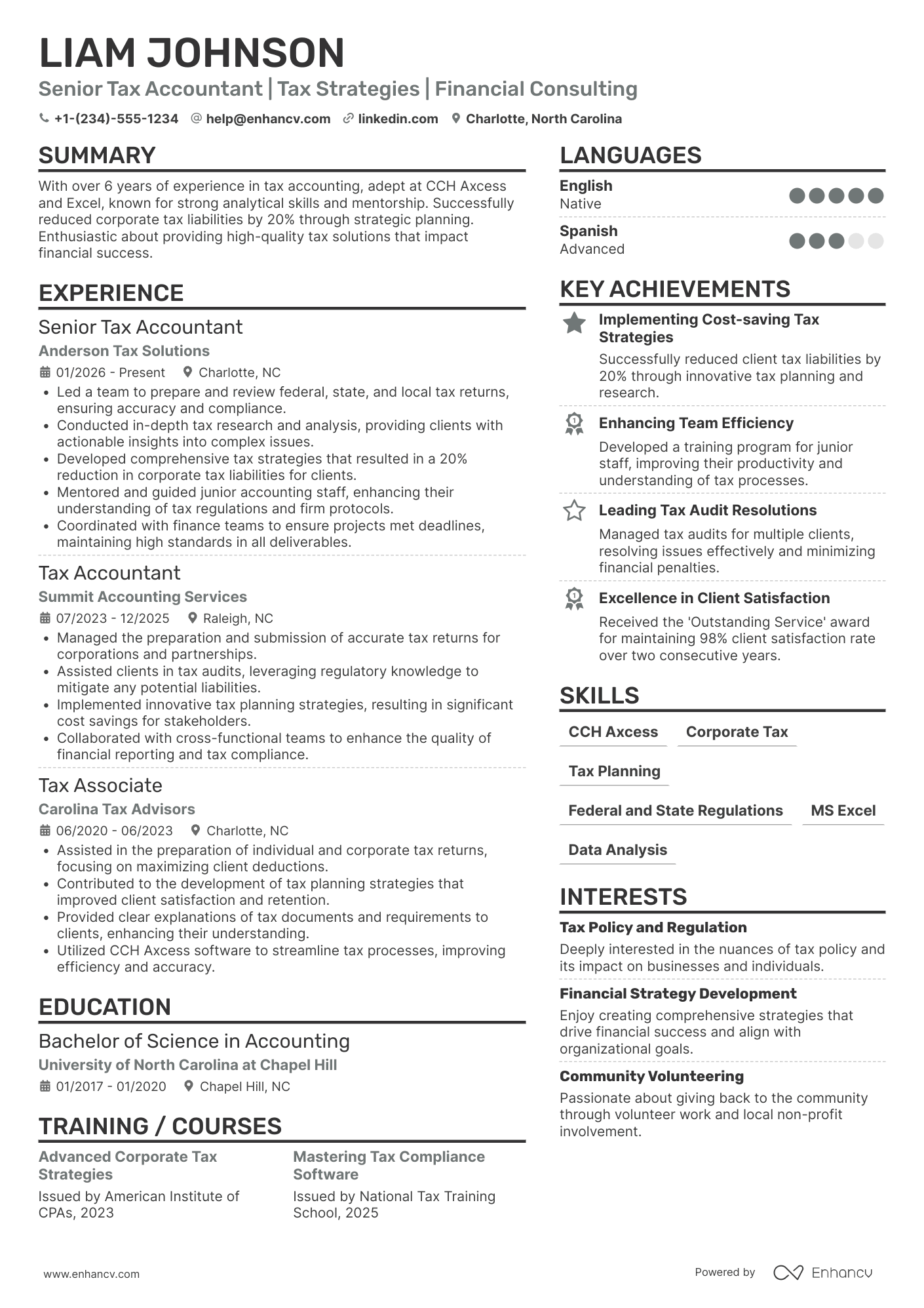
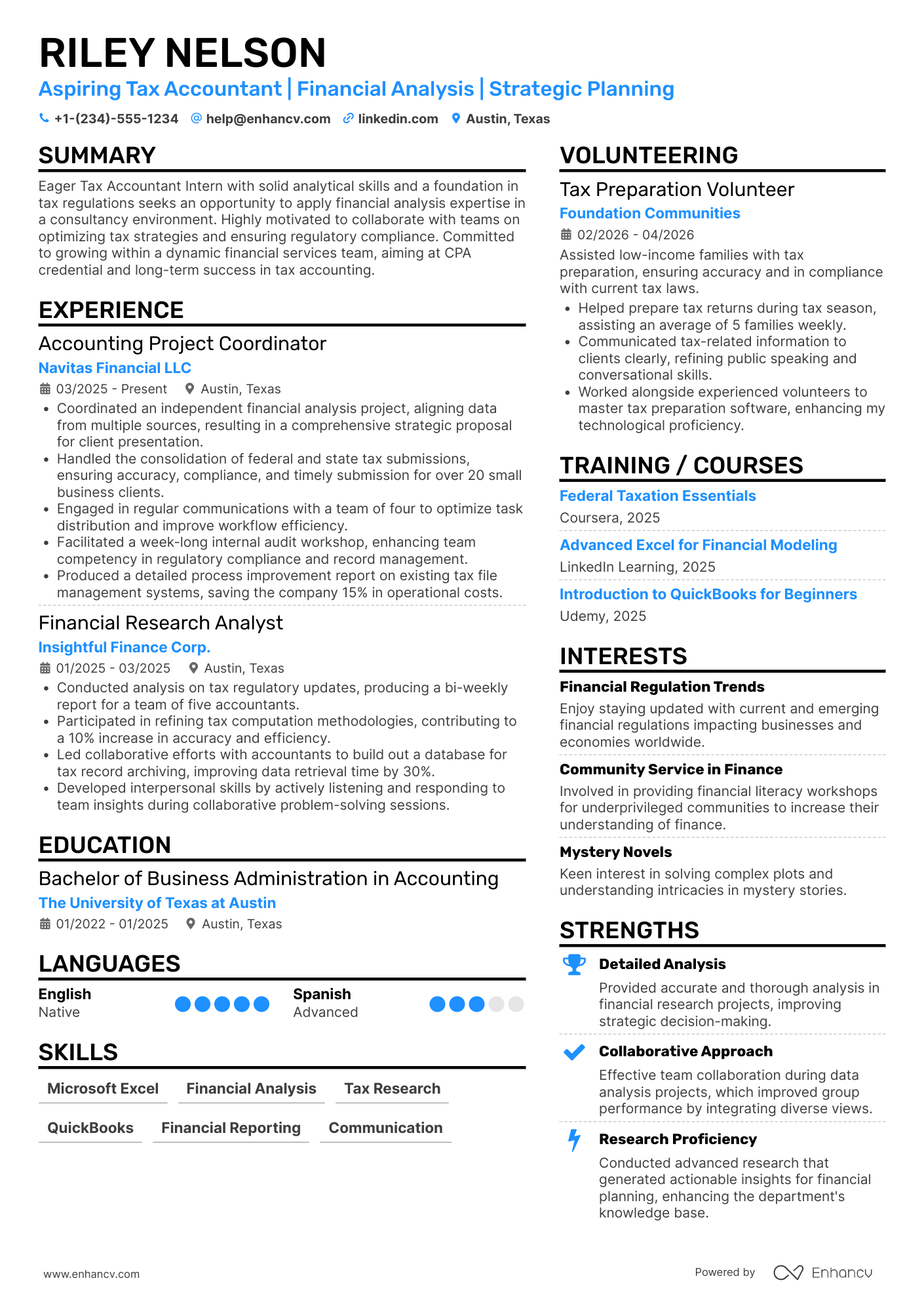
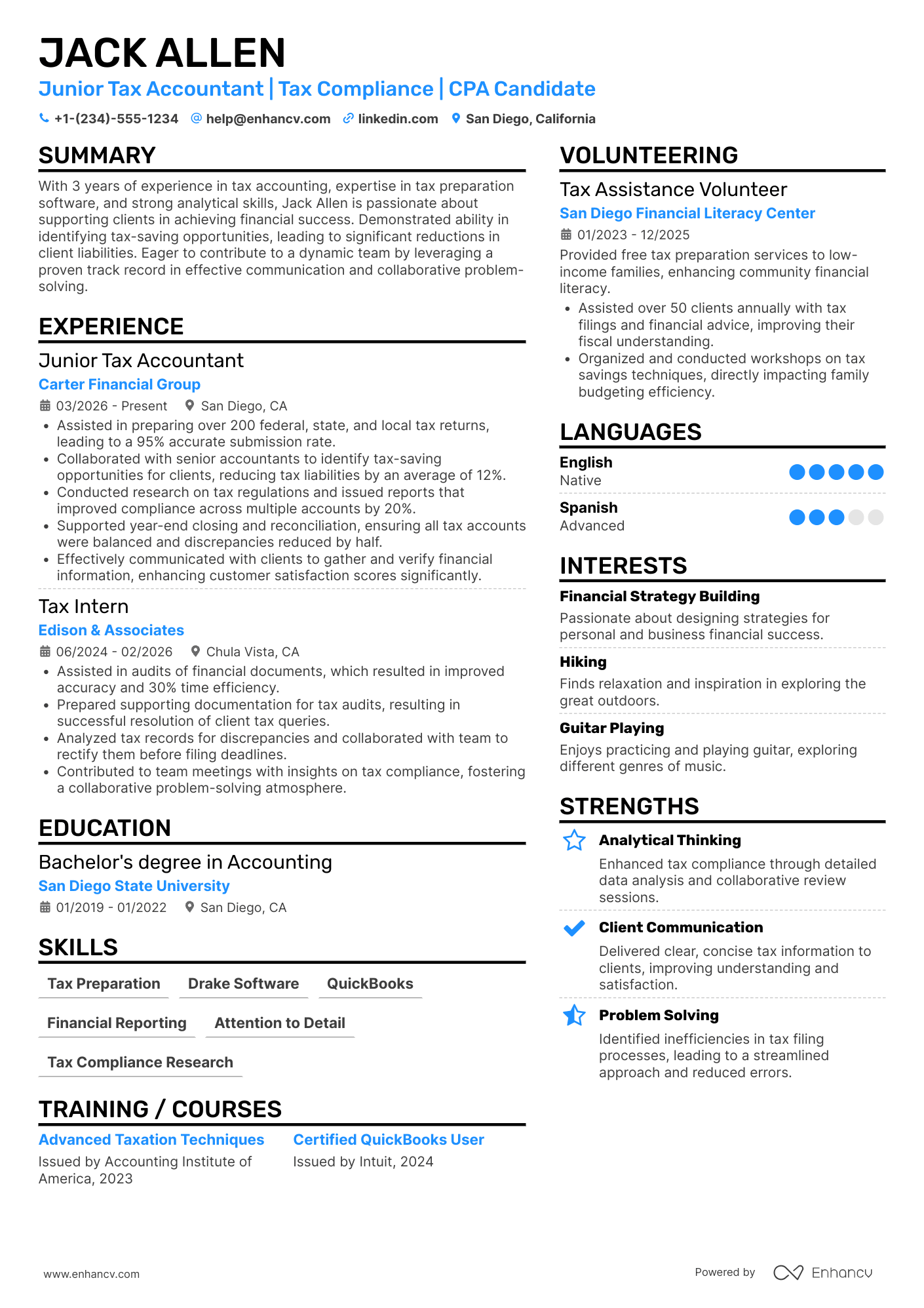
Tax Accountant resume examples
By Experience
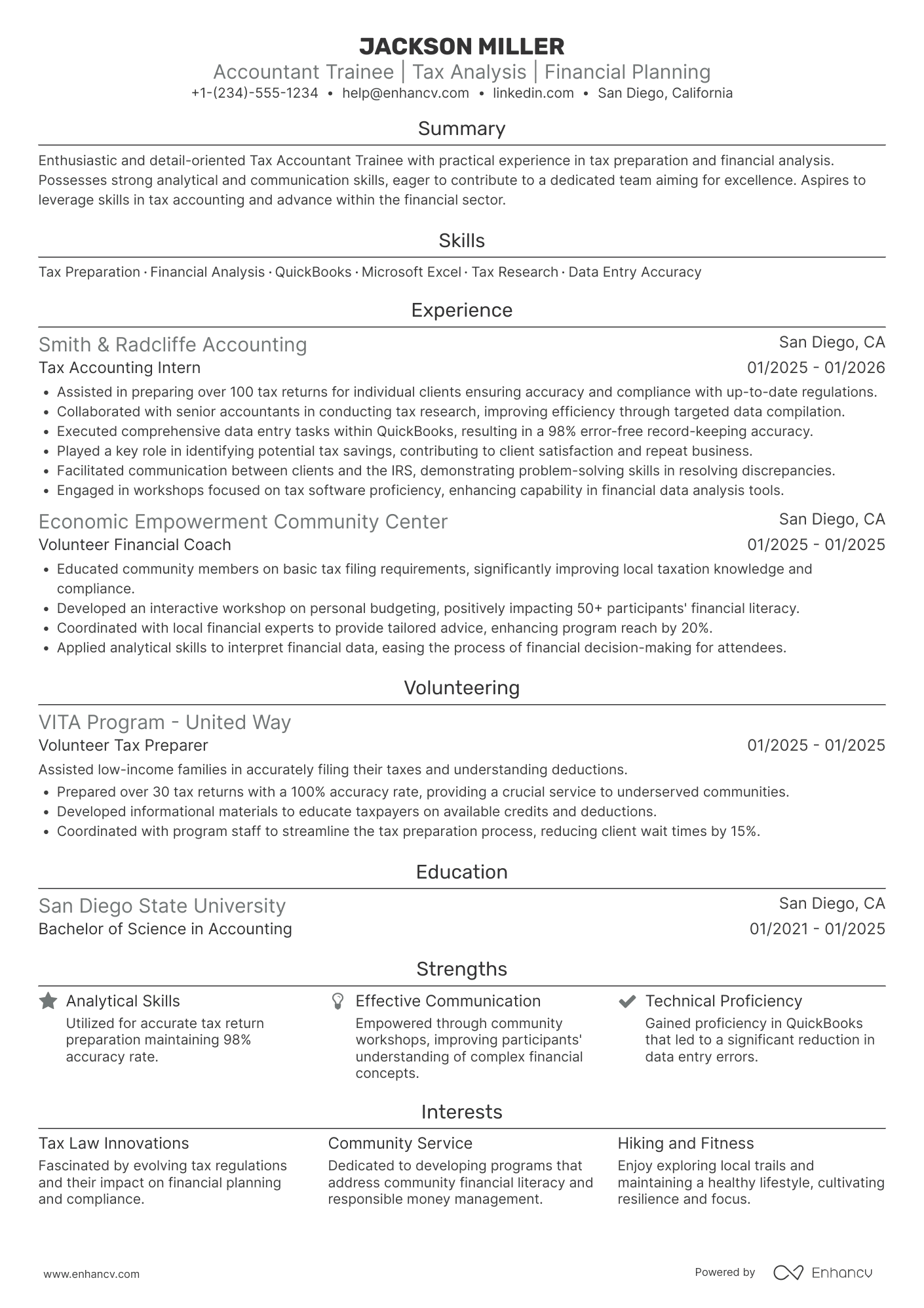
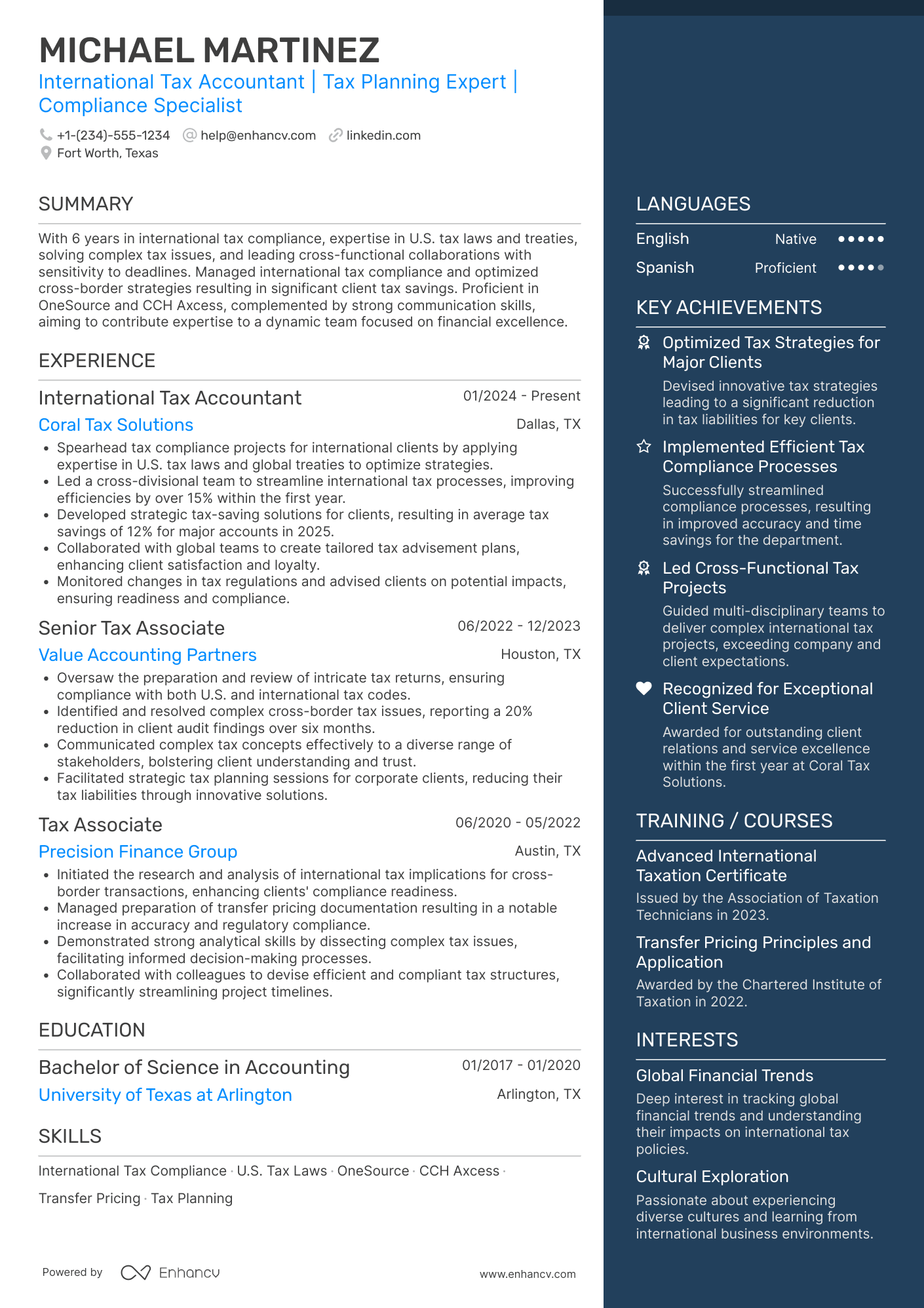
By Role