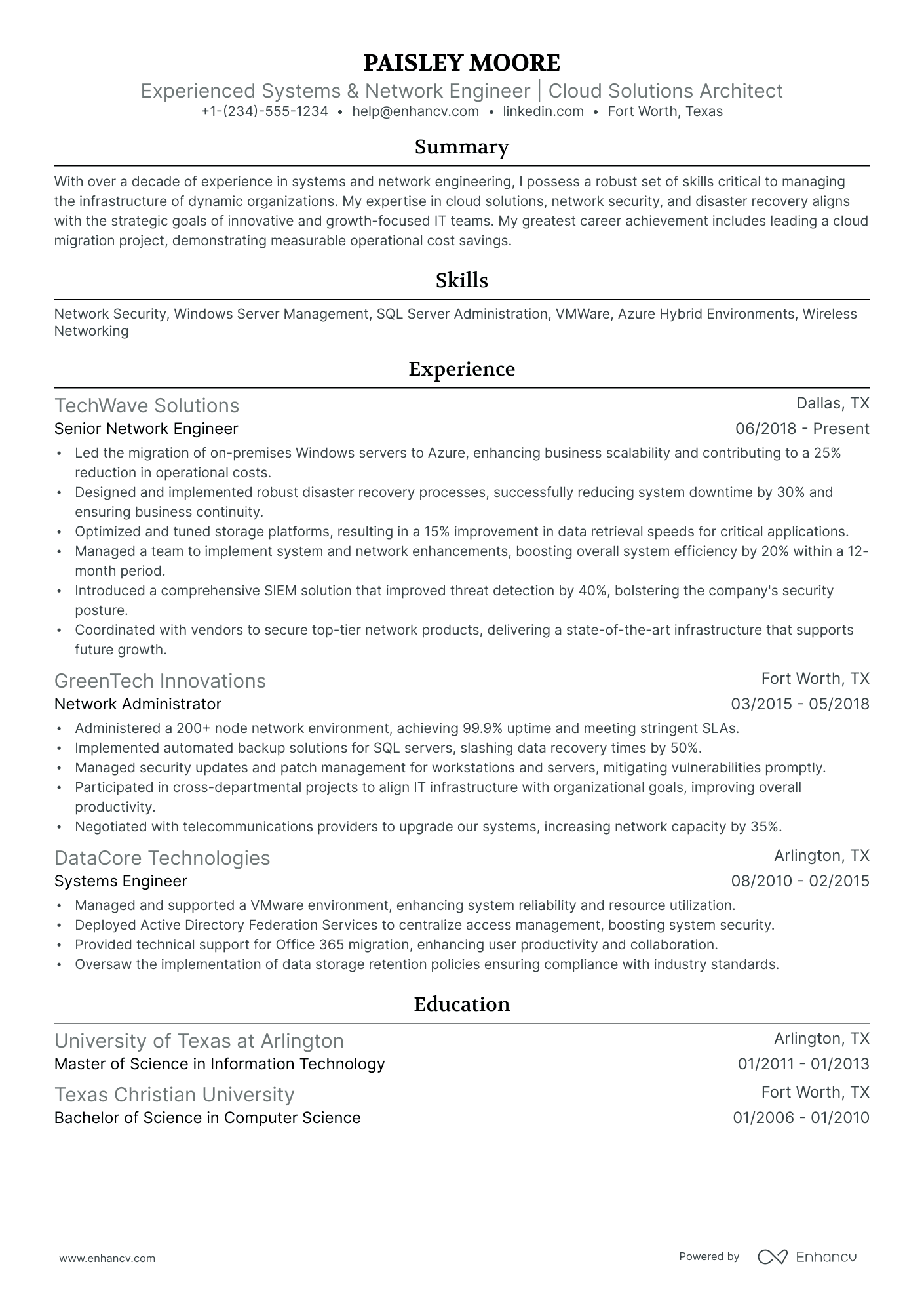
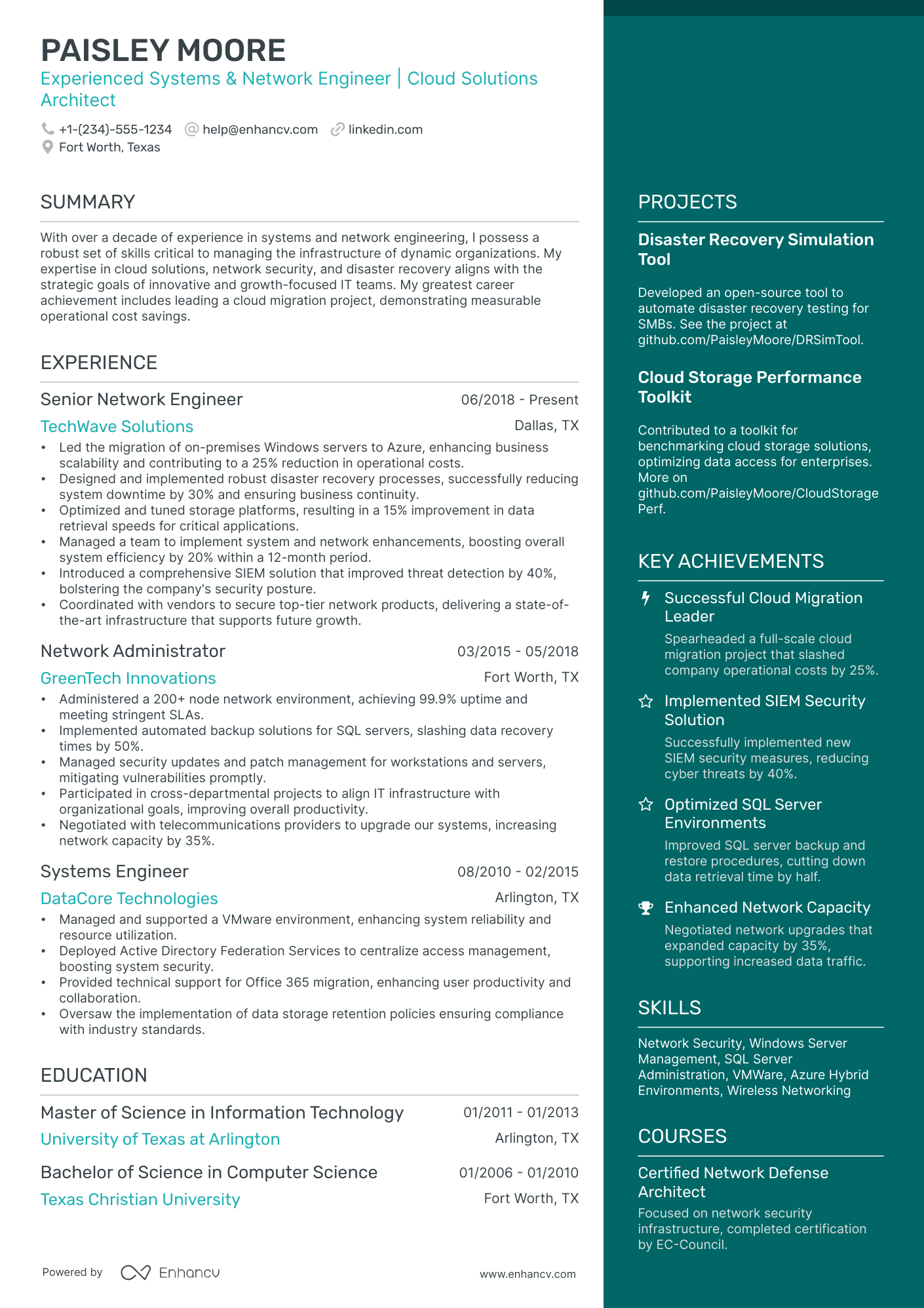
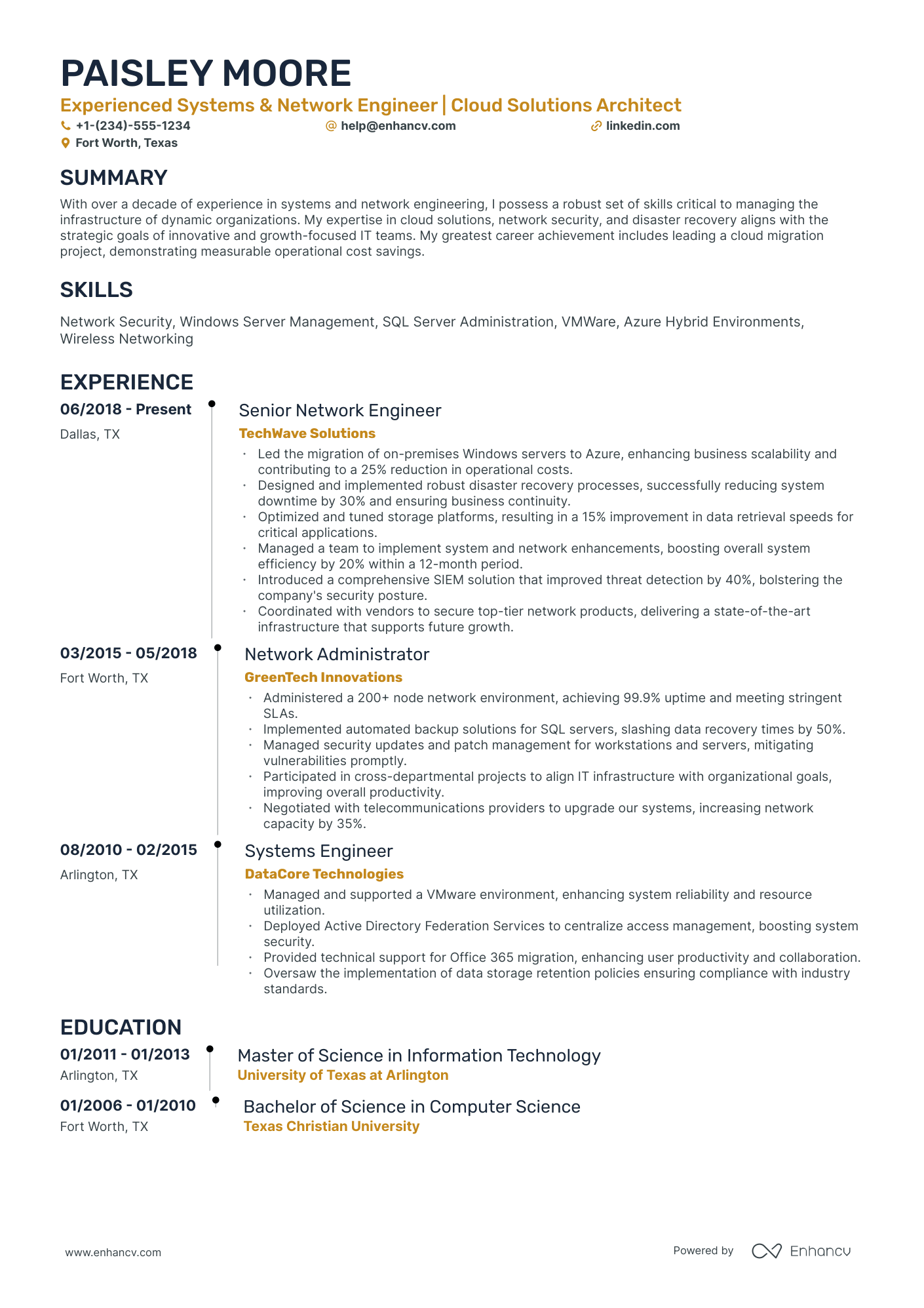
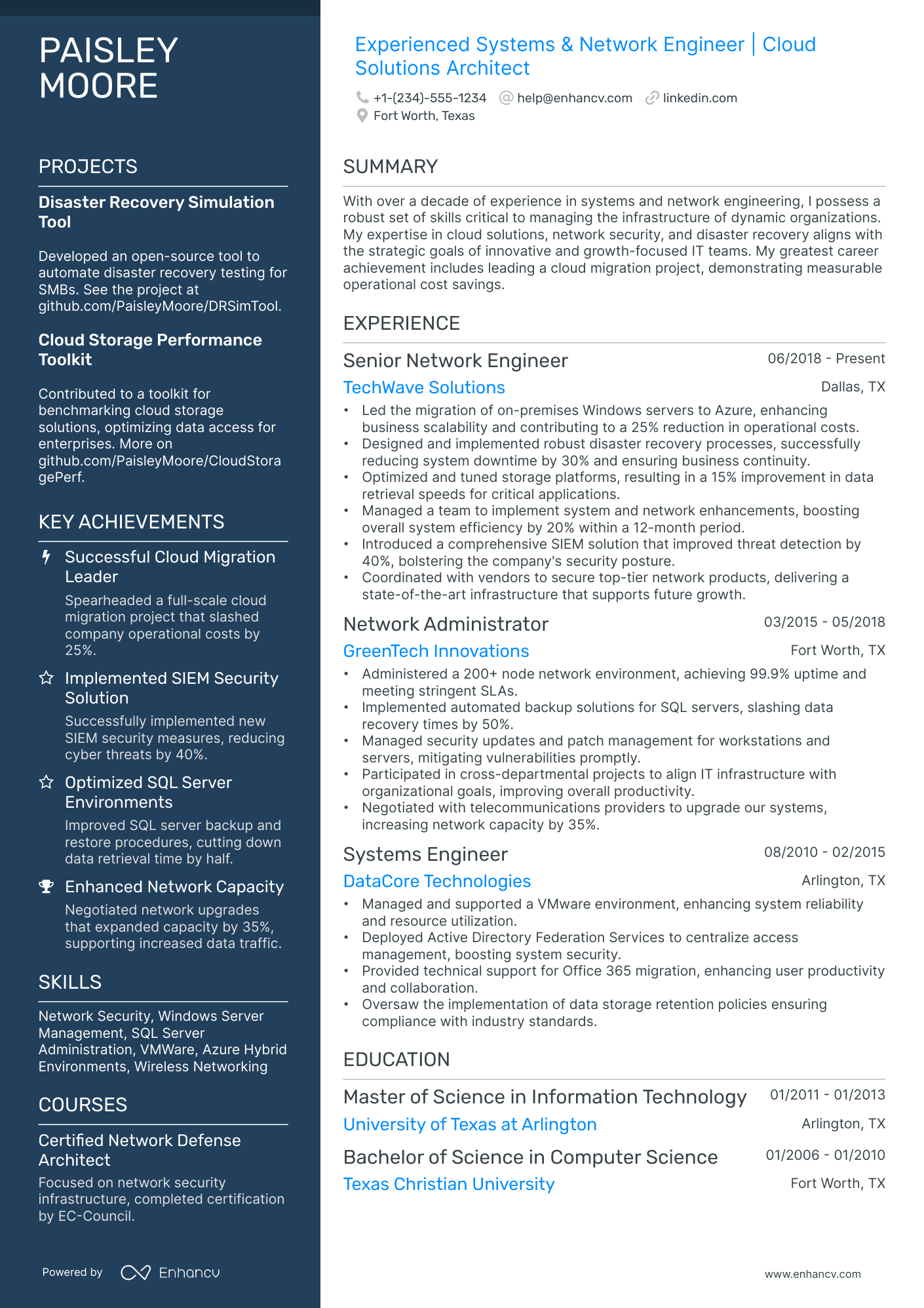
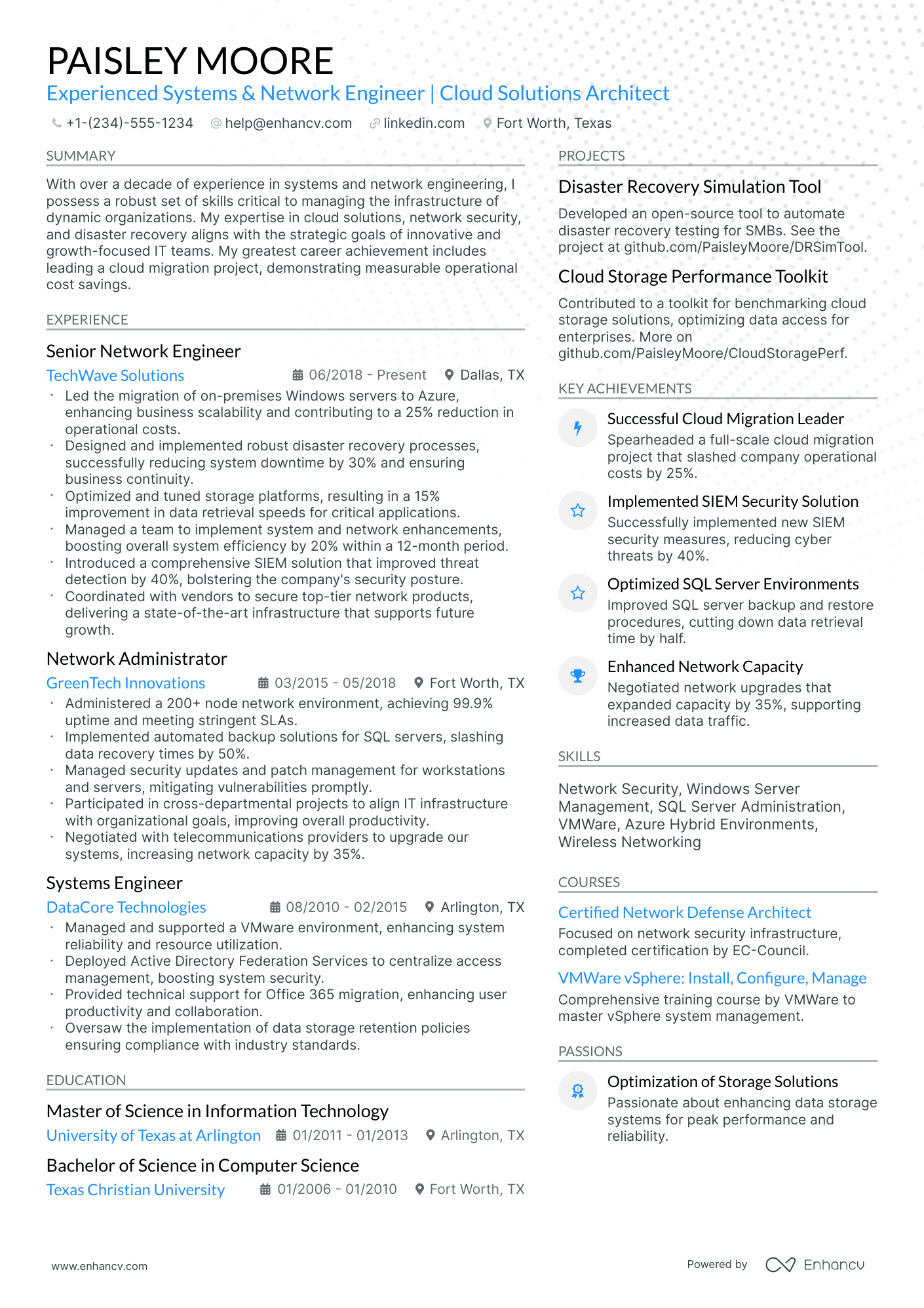
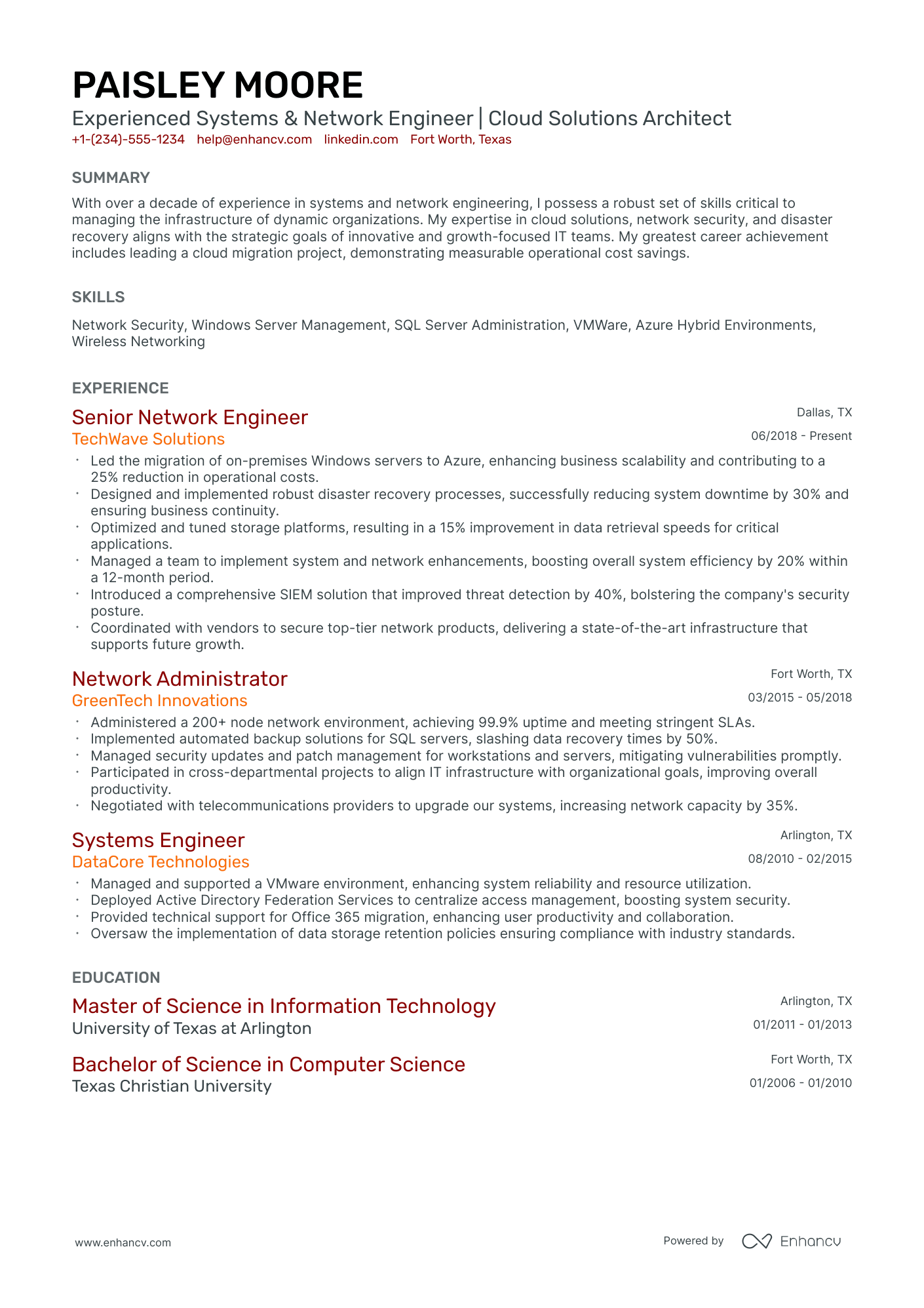
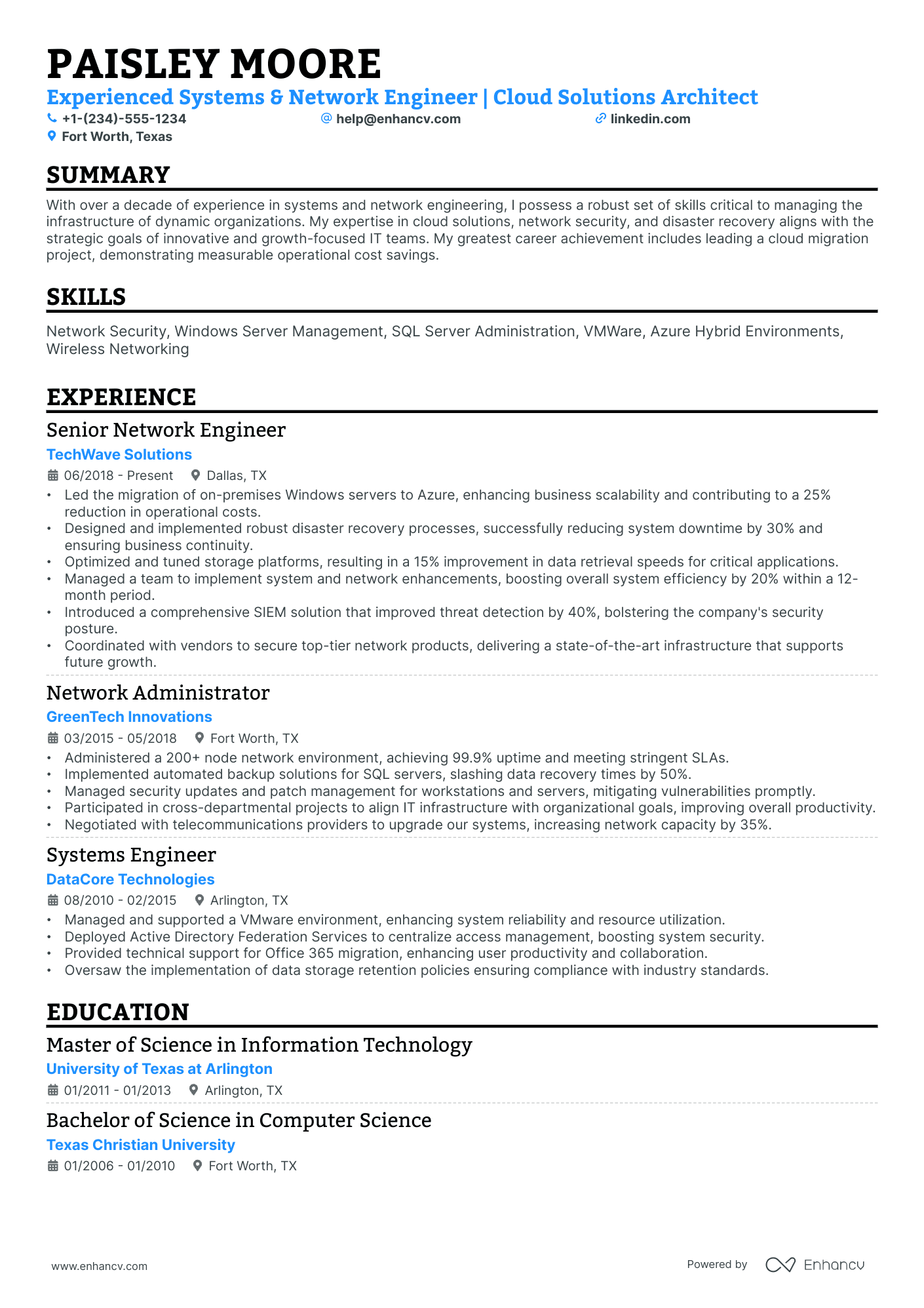
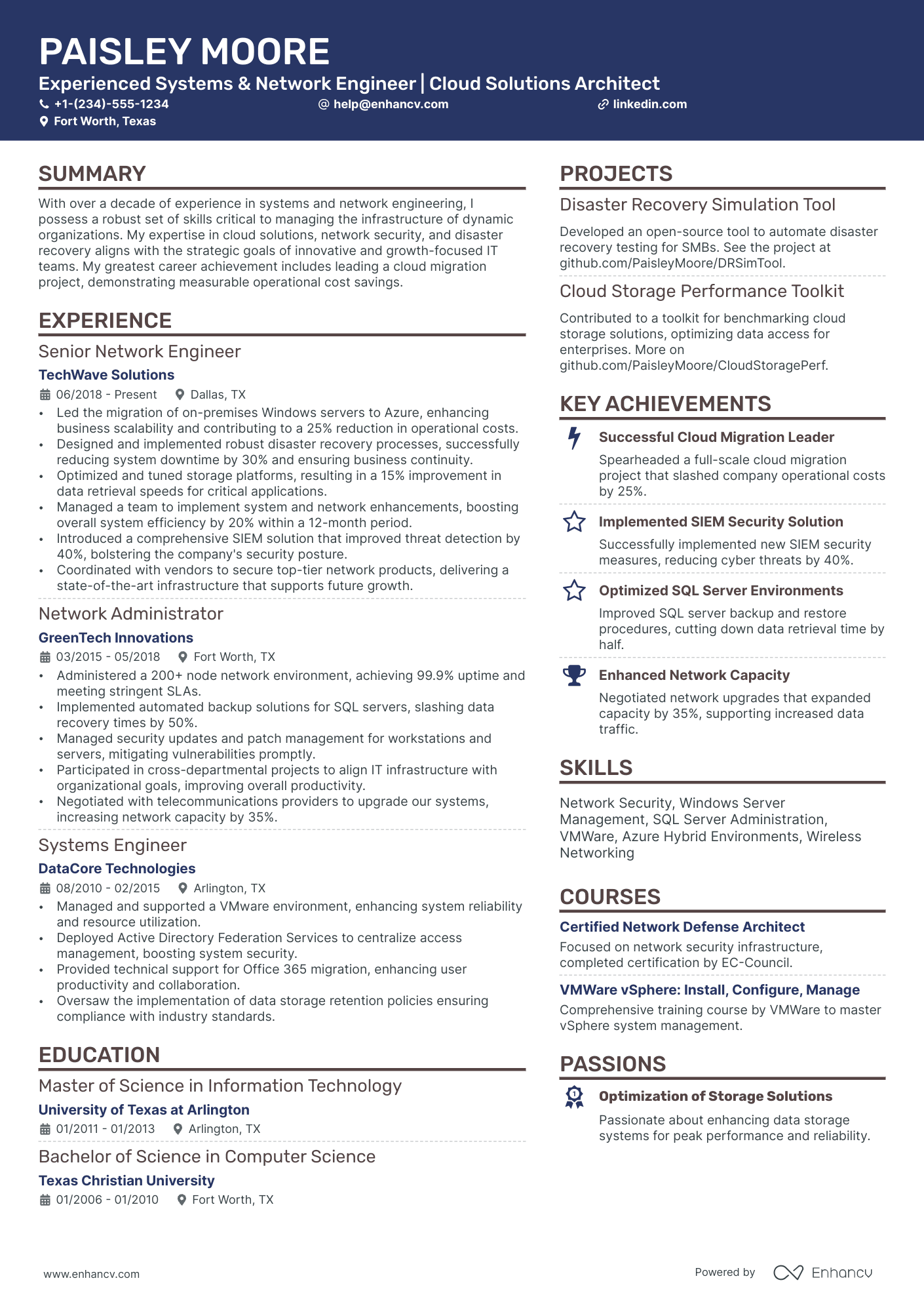
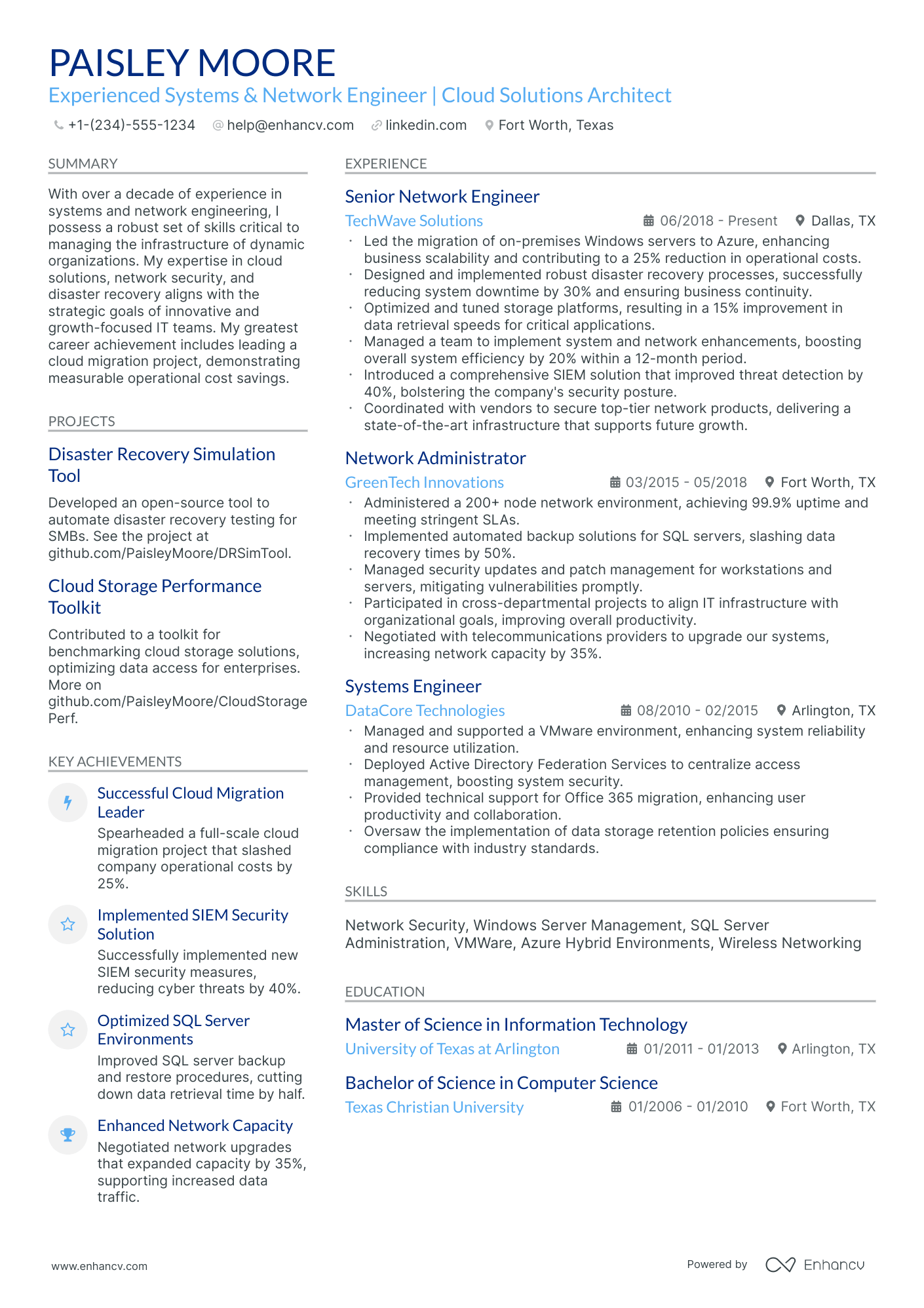
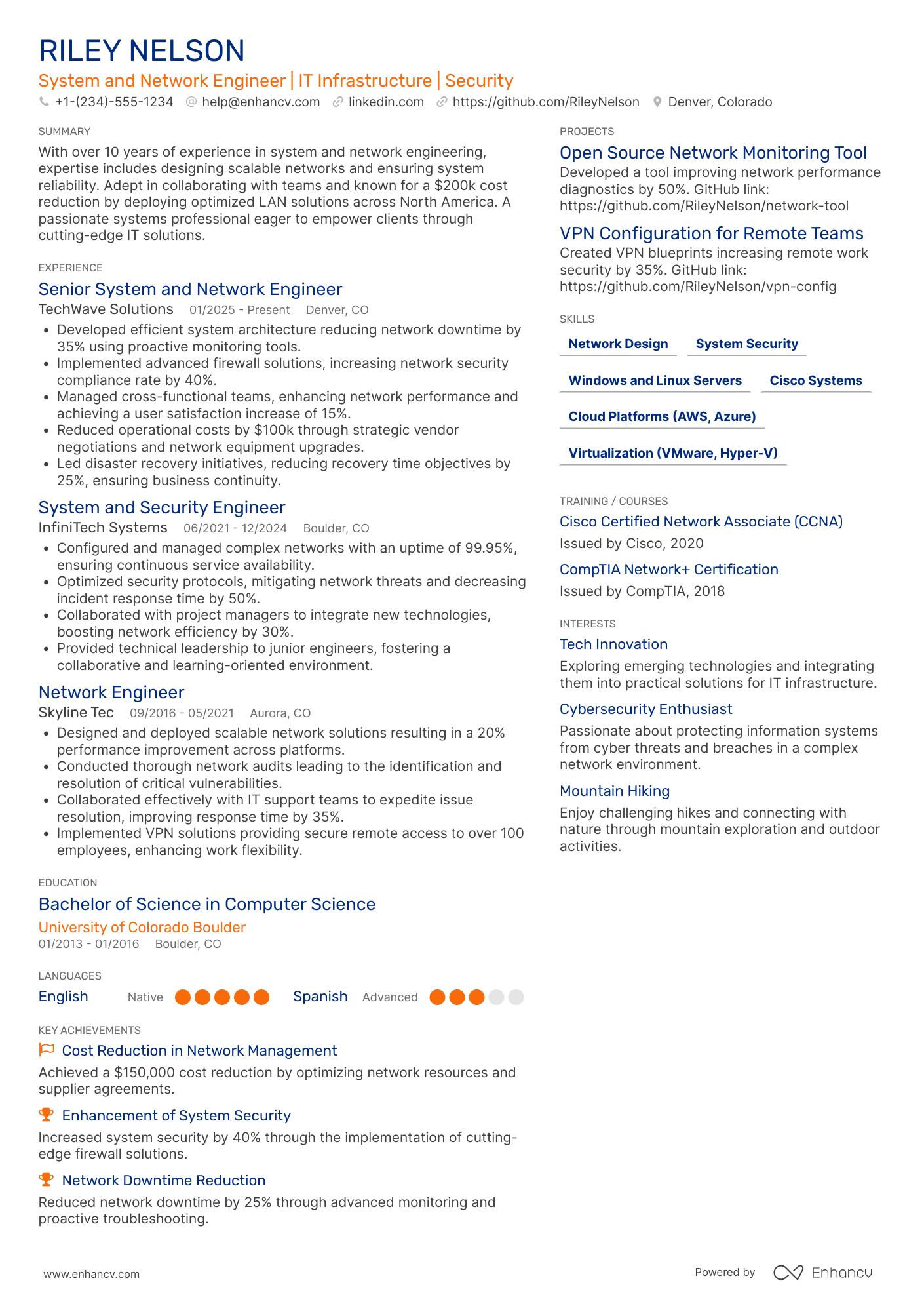
System and network engineer resume guides often fail because they read like tool inventories, so the system and network engineer resume doesn't surface impact in seconds. That hurts in applicant tracking system screening, fast recruiter scans, and crowded pipelines.
A strong resume shows what changed because of you, not what you touched. Knowing how to make your resume stand out starts with highlighting uptime gains, incident reductions, latency improvements, patch compliance, migration cutovers delivered on schedule, cost savings, and scale supported across sites and users.

Key takeaways
- Quantify uptime, latency, cost savings, and incident reductions instead of listing tools you've used.
- Use reverse-chronological format for experienced engineers and hybrid format for career changers.
- Tailor every experience bullet to match the job posting's specific platforms and protocols.
- Show each skill in context within your summary and experience, not just in an isolated list.
- Lab projects with documented results can replace professional experience on entry-level resumes.
- Place certifications like CCNA or CompTIA Network+ near education to speed up recruiter verification.
- Use Enhancv to turn routine infrastructure tasks into measurable, recruiter-ready resume bullets.
How to format a system and network engineer resume
Recruiters evaluating system and network engineer resumes prioritize hands-on technical breadth across infrastructure domains—firewalls, routing protocols, server administration, cloud platforms—alongside evidence of troubleshooting ability and uptime accountability. Choosing the right resume format determines how quickly a hiring manager can locate these signals, so structure matters for both human readers and applicant tracking systems.

I have significant experience in this role—which format should I use?
Use a reverse-chronological format to present your infrastructure experience in a clear, linear timeline that highlights growing technical scope and system ownership. Do:
- Lead each role entry with the scale of your environment—number of servers managed, network segments overseen, or sites supported—to establish scope and ownership immediately.
- List role-specific tools and platforms (Cisco IOS, VMware vSphere, AWS VPC, Active Directory, SIEM solutions) within each position rather than in an isolated skills block, so reviewers see applied competency.
- Quantify outcomes tied to reliability, performance, or cost—uptime percentages, incident resolution times, migration completions, or budget savings.
I'm junior or switching into this role—what format works best?
A hybrid format works best because it lets you lead with a targeted skills section while still showing a chronological work or project history that gives recruiters context. Do:
- Place a focused technical skills section near the top, grouping competencies by domain (networking, systems administration, security, cloud) so ATS parsers and recruiters find keywords fast.
- Include lab projects, homelab builds, internships, or freelance IT support work in a dedicated projects or experience section to demonstrate hands-on exposure to real infrastructure tasks.
- Connect every listed skill to a concrete action and a measurable or observable result so reviewers see capability, not just familiarity.
Why not use a functional resume?
A functional format strips away the chronological context that hiring managers rely on to verify where and when you applied your networking and systems skills, making it difficult to assess real-world competency depth.
- A functional resume may be acceptable if you're transitioning from a help desk or desktop support role into network engineering and have limited directly titled experience—but only if you anchor every listed skill to a specific project, lab environment, or measurable outcome rather than presenting skills in isolation.
With your layout and structure in place, the next step is filling it with the right sections to highlight your qualifications effectively.
What sections should go on a system and network engineer resume
Recruiters expect a system and network engineer resume to show clear ownership of infrastructure, uptime, security, and incident response across real environments. Understanding which resume sections to include ensures maximum clarity.
Use this structure:
- Header
- Summary
- Experience
- Skills
- Projects
- Education
- Certifications
- Optional sections: Open-source work, leadership, languages
Strong experience bullets should emphasize measurable impact, reliability and security outcomes, environment scope, and results tied to performance, cost, and incident reduction.
Is your resume good enough?
Drop your resume here or choose a file. PDF & DOCX only. Max 2MB file size.
Once you’ve organized your resume with the right structure, the next step is writing your system and network engineer experience section so it fits that framework and highlights your impact.
How to write your system and network engineer resume experience
Your experience section should spotlight infrastructure you've built, maintained, or improved—along with the network protocols, system platforms, and automation tools you used to deliver measurable results. Hiring managers prioritize demonstrated impact on uptime, security, and performance over descriptive task lists that simply restate job duties. Writing a targeted resume that aligns each bullet with the role's priorities is key to standing out.
Each entry should include:
- Job title
- Company and location (or remote)
- Dates of employment (month and year)
Three to five concise bullet points showing what you owned, how you executed, and what outcomes you delivered:
- Ownership scope: the networks, server environments, cloud infrastructure, or enterprise systems you were directly accountable for—including the scale of users, endpoints, or sites you supported as a system and network engineer.
- Execution approach: the specific platforms, protocols, monitoring tools, configuration management frameworks, or security methodologies you applied to diagnose issues, deploy solutions, and maintain system and network reliability.
- Value improved: the changes you drove in network uptime, system performance, latency, patch compliance, disaster recovery readiness, or security posture that tied directly to your system and network engineering responsibilities.
- Collaboration context: how you partnered with security teams, DevOps engineers, helpdesk staff, vendors, or business stakeholders to align infrastructure decisions with organizational needs and service-level requirements.
- Impact delivered: the concrete outcomes your work produced—expressed through improvements in reliability, capacity, incident response, cost optimization, or business continuity rather than routine activity descriptions.
Experience bullet formula
A system and network engineer experience example
✅ Right example - modern, quantified, specific.
Systems and Network Engineer
NorthBridge Health | Austin, TX
2022–Present
Regional healthcare network supporting 3,500 employees across nine clinics and two data centers with hybrid cloud infrastructure.
- Modernized core network by migrating from legacy spanning tree protocol to a Cisco Catalyst and Nexus design using Open Shortest Path First and Virtual PortChannel, cutting peak-hour latency by 28% and eliminating recurring loop incidents.
- Automated provisioning and compliance checks with Ansible, Terraform, and GitHub Actions for firewall, switch, and virtual private network changes, reducing change lead time from three days to six hours and lowering configuration drift incidents by 45%.
- Hardened perimeter and segmentation by deploying Palo Alto Networks next-generation firewalls, implementing Zero Trust Network Access with Okta, and standardizing Transport Layer Security policies, reducing high-severity security findings by 60% in two audit cycles.
- Improved availability by tuning monitoring and alerting in Datadog and Prometheus, adding synthetic checks for Domain Name System and Border Gateway Protocol health, and partnering with application engineers to resolve root causes, increasing network uptime from 99.85% to 99.97%.
- Led a cross-functional cutover for a new clinic—coordinating internet service provider circuits, Meraki wireless, and Voice over Internet Protocol quality of service—bringing the site online two weeks early and supporting 420 new users with zero critical post-launch tickets.
Now that you've seen how a strong experience section comes together, let's look at how to adapt yours to match the specific job you're targeting.
How to tailor your system and network engineer resume experience
Recruiters evaluate your system and network engineer resume through both human review and applicant tracking systems (ATS). Tailoring your resume to the job description increases your chances of passing both screenings.
Ways to tailor your system and network engineer experience:
- Match specific networking tools and platforms listed in the job description.
- Mirror the exact protocols and standards the posting references.
- Use the same terminology for monitoring and troubleshooting methodologies.
- Reflect uptime or performance benchmarks the role prioritizes.
- Highlight security and compliance frameworks relevant to the industry.
- Include infrastructure automation or orchestration tools the employer names.
- Emphasize collaboration with cross-functional teams if the posting requires it.
- Reference relevant certifications or vendor-specific technologies the role demands.
Tailoring means aligning your real accomplishments with what the employer needs rather than forcing disconnected keywords into your experience.
Resume tailoring examples for system and network engineer
| Job description excerpt | Untailored | Tailored |
|---|---|---|
| "Configure and maintain Cisco routers, switches, and firewalls across enterprise LAN/WAN environments. Monitor network performance using SolarWinds and resolve outages within SLA targets." | Managed network equipment and resolved issues as they came up. | Configured and maintained Cisco routers, switches, and ASA firewalls across a 12-site LAN/WAN environment, using SolarWinds to monitor performance and consistently resolving outages within 99.9% SLA targets. |
| "Administer Windows Server and Linux (RHEL) environments, including Active Directory, Group Policy, DNS, and DHCP. Automate routine tasks using PowerShell and Bash scripting to reduce manual workload." | Handled server administration tasks and helped with automation projects. | Administered 200+ Windows Server 2019 and RHEL 8 systems, managing Active Directory, Group Policy, DNS, and DHCP services while writing PowerShell and Bash scripts that automated patching and account provisioning, cutting manual workload by 35%. |
| "Design and implement VMware vSphere virtualization solutions. Perform capacity planning, disaster recovery testing, and maintain backup systems using Veeam to ensure business continuity." | Worked with virtual machines and supported backup processes for the team. | Designed and deployed VMware vSphere clusters hosting 150+ virtual machines, conducted quarterly disaster recovery testing, and managed Veeam backup jobs that achieved a 15-minute RPO, ensuring uninterrupted business continuity across all production systems. |
Once your experience aligns with the role’s priorities, the next step is to quantify your system and network engineer achievements so hiring teams can see the impact behind that fit.
How to quantify your system and network engineer achievements
Quantifying your achievements proves business impact beyond "kept things running." Focus on uptime, latency, packet loss, incident volume, patch compliance, cost savings, and delivery speed across the environments you own.
Quantifying examples for system and network engineer
| Metric | Example |
|---|---|
| Availability | "Raised core services uptime from 99.5% to 99.95% by tuning HAProxy health checks and implementing active-active failover across two data centers." |
| Latency | "Cut WAN latency 38% (42 ms to 26 ms) by redesigning OSPF areas and enabling QoS for VoIP on Cisco Catalyst switches." |
| Incident reduction | "Reduced Sev-1 network incidents 45% in six months by standardizing firewall rules, adding NetFlow monitoring, and tightening change windows." |
| Security compliance | "Improved critical patch compliance from 62% to 96% across 210 Linux servers using Ansible playbooks and weekly vulnerability scans." |
| Cost efficiency | "Lowered monthly cloud egress spend 22% ($18K to $14K) by optimizing routing, enabling caching, and consolidating VPN tunnels." |
Turn your everyday tasks into measurable, recruiter-ready resume bullets in seconds with Enhancv's Bullet Point Generator.
With strong bullet points in place, the next step is ensuring your skills section clearly presents the technical and interpersonal strengths hiring managers expect from a system and network engineer.
How to list your hard and soft skills on a system and network engineer resume
Your skills section shows you can keep infrastructure reliable and secure, and recruiters and an ATS (applicant tracking system) scan this section to confirm role fit fast—aim for a mix heavy on hard skills, supported by role-specific soft skills. system and network engineer roles require a blend of:
- Product strategy and discovery skills.
- Data, analytics, and experimentation skills.
- Delivery, execution, and go-to-market discipline.
- Soft skills.
Your skills section should be:
- Scannable (bullet-style grouping).
- Relevant to the job post.
- Backed by proof in experience bullets.
- Updated with current tools.
Place your skills section:
- Above experience if you're junior or switching careers.
- Below experience if you're mid/senior with strong achievements.

Hard skills
- TCP/IP, DNS, DHCP
- Routing, switching, VLANs
- BGP, OSPF, VRRP
- Firewalls, NAT, VPNs
- Network monitoring, SNMP, NetFlow
- Wireshark, tcpdump
- Linux administration
- Windows Server, Active Directory
- Virtualization: VMware, Hyper-V
- Cloud networking: AWS, Azure
- Infrastructure as code: Terraform, Ansible
- Incident response, root cause analysis
Soft skills
- Translate requirements into designs
- Write clear runbooks and diagrams
- Communicate incidents and impact
- Coordinate changes with stakeholders
- Prioritize work by risk and urgency
- Troubleshoot under time pressure
- Escalate early with context
- Own issues through resolution
- Challenge assumptions with data
- Mentor peers on standards
- Document decisions and trade-offs
- Improve processes after outages
How to show your system and network engineer skills in context
Skills shouldn't live only in a bulleted list on your resume. Explore resume skills examples to see how top candidates weave competencies throughout their documents.
They should be demonstrated in:
- Your summary (high-level professional identity)
- Your experience (proof through outcomes)
Here's what that looks like in practice.
Summary example
Senior system and network engineer with 10+ years securing enterprise infrastructure across healthcare environments. Skilled in Cisco, VMware, and ITIL-driven operations. Reduced network downtime by 42% through proactive monitoring and cross-team incident response planning.
- Reflects senior-level expertise clearly
- Names industry-relevant tools and frameworks
- Quantifies impact with a strong metric
- Highlights collaboration as a soft skill
Experience example
Senior System and Network Engineer
Helios Medical Technologies | Denver, CO
March 2019–January 2024
- Redesigned the core network architecture using Cisco Nexus switches, cutting latency by 28% across 12 clinic locations.
- Partnered with the security team to deploy Palo Alto firewalls, reducing intrusion attempts by 63% within six months.
- Migrated 140 on-premise servers to a VMware vSphere hybrid cloud environment, saving $210K in annual infrastructure costs.
- Every bullet includes measurable proof.
- Skills appear naturally within real achievements.
Once you’ve tied your technical strengths to concrete outcomes, the next step is to apply that same approach to a system and network engineer resume when you have no experience.
How do I write a system and network engineer resume with no experience
Even without full-time experience, you can demonstrate readiness through projects and self-directed learning. Our guide on building a resume without work experience walks you through the process step by step. Consider showcasing:
- Home lab Active Directory domain
- Packet Tracer network simulations
- GitHub automation scripts with Ansible
- VirtualBox Windows and Linux builds
- Help desk ticketing volunteer work
- Wireshark packet captures and reports
- Azure free-tier virtual networks
- CompTIA Network+ hands-on labs
Focus on:
- Documented lab topology and configs
- Scripting results with GitHub links
- Troubleshooting evidence and metrics
- Security baselines and hardening steps
Resume format tip for entry-level system and network engineer
Use a combination resume format because it highlights projects and skills first, while still showing work history, even if it's unrelated. Do:
- Lead with a Projects section.
- List lab scope, tools, and outcomes.
- Add links to GitHub and diagrams.
- Quantify uptime, latency, or time saved.
- Mirror keywords from job postings.
- Built a home lab Active Directory domain with Windows Server, DNS, and Group Policy; automated user provisioning with PowerShell, cutting onboarding time by 60%.
Once you've structured your resume around transferable skills and relevant projects, the next step is presenting your education in a way that reinforces your technical qualifications.
How to list your education on a system and network engineer resume
Your education section helps hiring teams confirm you have the foundational knowledge needed for a system and network engineer role. It validates technical training and academic preparation.
Include:
- Degree name
- Institution
- Location
- Graduation year
- Relevant coursework (for juniors or entry-level candidates)
- Honors & GPA (if 3.5 or higher)
Skip month and day details—list the graduation year only.
Here's a strong education entry tailored for a system and network engineer resume.
Example education entry
Bachelor of Science in Computer Networking and Systems Administration
Rochester Institute of Technology, Rochester, NY
Graduated 2021
GPA: 3.7/4.0
- Relevant Coursework: Network Security, Operating Systems, TCP/IP Architecture, Cloud Infrastructure, and Database Administration
- Honors: Dean's List (six semesters), Magna Cum Laude
How to list your certifications on a system and network engineer resume
Certifications on your resume show a system and network engineer stays committed to learning, masters key tools, and meets current industry expectations for secure, reliable infrastructure.
Include:
- Certificate name
- Issuing organization
- Year
- Optional: credential ID or URL
- Place certifications below education when they're older, less relevant, or you already have strong recent system and network engineer experience.
- Place certifications above education when they're recent, highly relevant, or required for the system and network engineer roles you target.
Best certifications for your system and network engineer resume
- Cisco Certified Network Associate (CCNA)
- Cisco Certified Network Professional (CCNP) Enterprise
- CompTIA Network+
- CompTIA Security+
- Microsoft Certified: Windows Server Hybrid Administrator Associate
- AWS Certified Advanced Networking—Specialty
- ITIL 4 Foundation
Once you’ve positioned your credentials where recruiters can quickly verify them, shift to your system and network engineer resume summary to show how those qualifications translate into impact.
How to write your system and network engineer resume summary
Your resume summary is the first thing a recruiter reads. A strong one instantly signals you have the right skills and experience for a system and network engineer role.
Keep it to three to four lines, with:
- Your title and total years of relevant experience.
- The domain or industry you've worked in, such as enterprise IT or cloud infrastructure.
- Core tools and technologies like Cisco IOS, VMware, Active Directory, or TCP/IP.
- One or two measurable achievements, such as uptime improvements or incident reduction.
- Soft skills tied to real outcomes, like cross-team collaboration that shortened deployment cycles.

PRO TIP
At this level, emphasize technical breadth, hands-on skills, and early wins that show initiative. Quantify results wherever possible, even from internships or lab projects. Avoid vague phrases like "passionate team player" or "fast learner." Replace them with specific tools you've used and problems you've solved.
Example summary for a system and network engineer
System and network engineer with three years of experience managing enterprise LAN/WAN infrastructure. Reduced network downtime by 32% through proactive monitoring with SolarWinds and Cisco IOS upgrades across 12 office locations.
Optimize your resume summary and objective for ATS
Drop your resume here or choose a file.
PDF & DOCX only. Max 2MB file size.
Now that your summary captures your strongest qualifications, make sure your header presents the essential contact and professional details recruiters need to reach you.
What to include in a system and network engineer resume header
A resume header lists your key identifiers and contact details, helping system and network engineer candidates boost visibility, build credibility, and pass recruiter screening fast.
Essential resume header elements
- Full name
- Tailored job title and headline
- Location
- Phone number
- Professional email
- GitHub link
- Portfolio link
A LinkedIn link lets recruiters confirm roles, dates, and scope quickly, which supports faster screening decisions.
Don't include a photo on a system and network engineer resume unless the role is explicitly front-facing or appearance-dependent.
Use a clear, keyword-matched job title, keep links short, and place all contact details on one or two lines for quick scanning.
Example
System and network engineer resume header
Jordan Taylor
System and Network Engineer | Windows Server, Cisco, AWS, Network Security
Austin, TX
(512) 555-01XX
jordan.taylor@enhancv.com
github.com/jordantaylor
jordantaylor.com
linkedin.com/in/jordantaylor
Once your header clearly presents your identity and contact details, add optional resume sections to reinforce your qualifications with relevant supporting information.
Additional sections for system and network engineer resumes
Extra resume sections help you stand out when your core qualifications match other candidates, adding role-specific credibility and depth.
- Certifications (e.g., CCNA, CompTIA Network+, AWS Solutions Architect)
- Technical projects
- Publications
- Languages — listing language skills on your resume can be especially valuable for roles supporting global infrastructure or multilingual teams.
- Professional affiliations
- Hobbies and interests
- Volunteering
Once you've strengthened your resume with relevant additional sections, it's worth pairing it with a well-crafted cover letter to maximize your impact.
Do system and network engineer resumes need a cover letter
A cover letter isn't required for a system and network engineer, but it helps in competitive roles or teams with strict hiring expectations. If you're unsure what a cover letter is or when it adds value, it can make a difference when your resume needs context, or when you want to show clear alignment.
Use a cover letter when it adds details your resume can't:
- Explain role or team fit: Connect your strengths to the team's environment, such as hybrid cloud, on-call rotations, or regulated networks.
- Highlight one or two relevant projects or outcomes: Share a measurable result, like reduced incident time, improved uptime, or faster provisioning through automation.
- Show understanding of the product, users, or business context: Describe how your infrastructure choices support reliability, cost controls, or customer impact.
- Address career transitions or non-obvious experience: Clarify a shift from help desk, security, or development, and tie it to system and network engineer work.
Drop your resume here or choose a file.
PDF & DOCX only. Max 2MB file size.
Once you’ve decided whether to include a cover letter, use AI to sharpen your system and network engineer resume so it communicates your value clearly and consistently.
Using AI to improve your system and network engineer resume
AI can sharpen your resume's clarity, structure, and impact. It helps refine phrasing and highlight measurable results. But overuse strips authenticity. Once your content reads clearly and aligns with the role, step away from AI. For practical prompt ideas, check out our guide on ChatGPT resume writing.
Here are ten practical prompts to strengthen specific sections of your system and network engineer resume:
Strengthen your summary
Quantify experience bullets
Tailor skills section
Improve action verbs
Refine project descriptions
Align with job posting
Tighten certification details
Clarify education entries
Remove redundant phrasing
Check role-specific tone
Conclusion
A strong system and network engineer resume proves impact with measurable outcomes, role-specific skills, and a clear structure. Lead with results like uptime gains, faster incident response, lower latency, reduced costs, and fewer escalations.
Keep each section easy to scan, and tie every skill to real work and outcomes. That approach shows you’re ready for today’s hiring market and near-future needs in reliability, security, and automation.