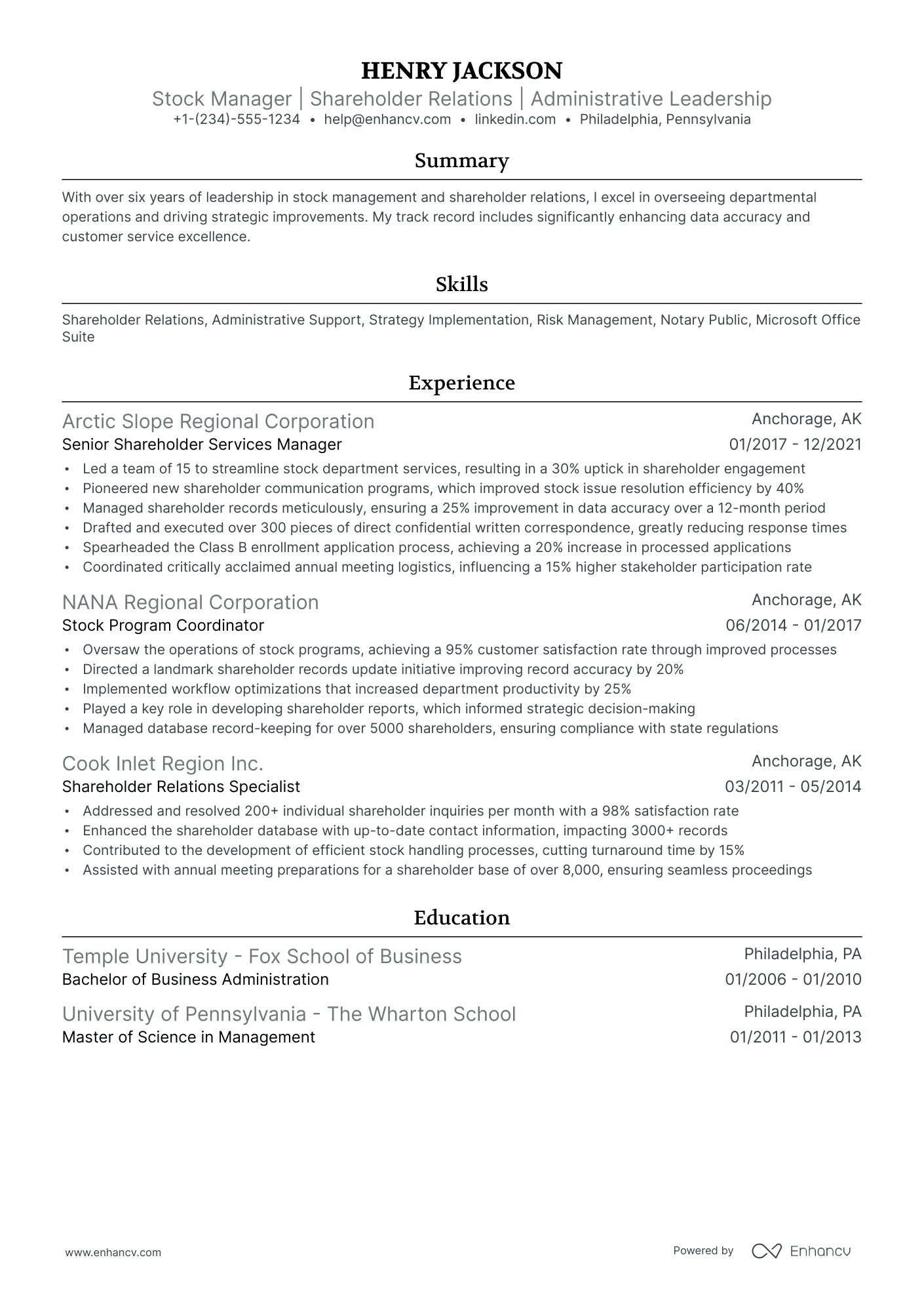
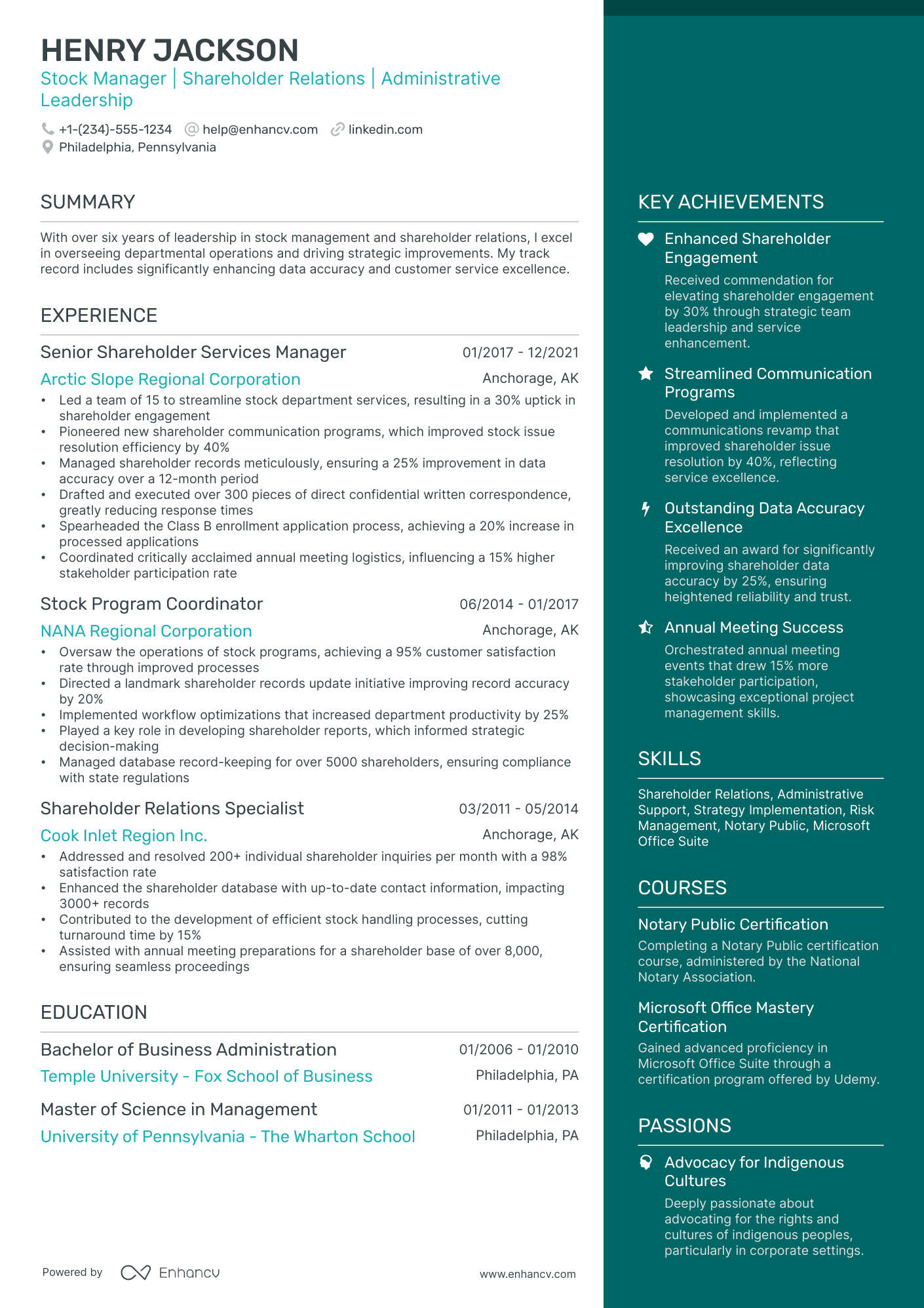
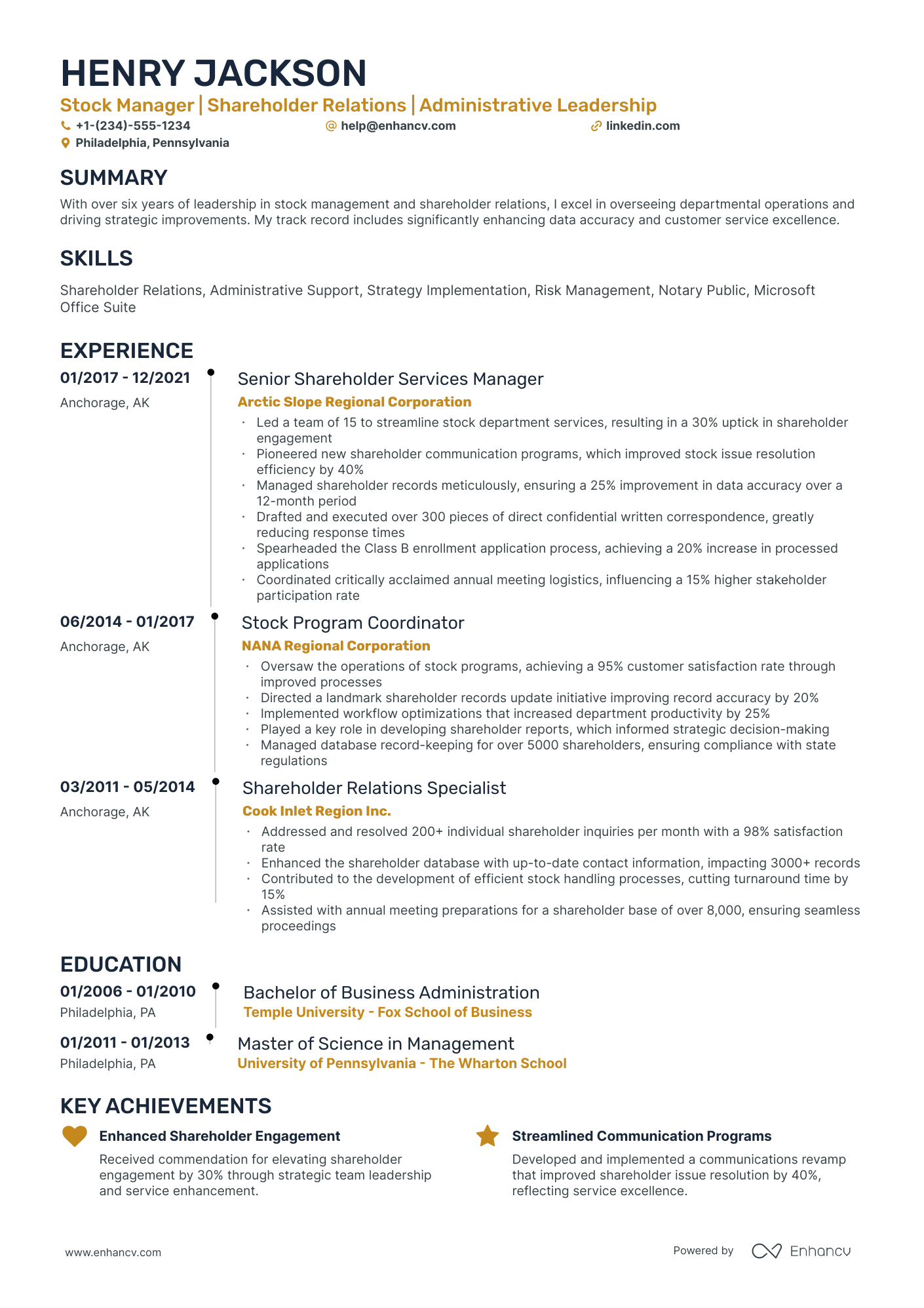
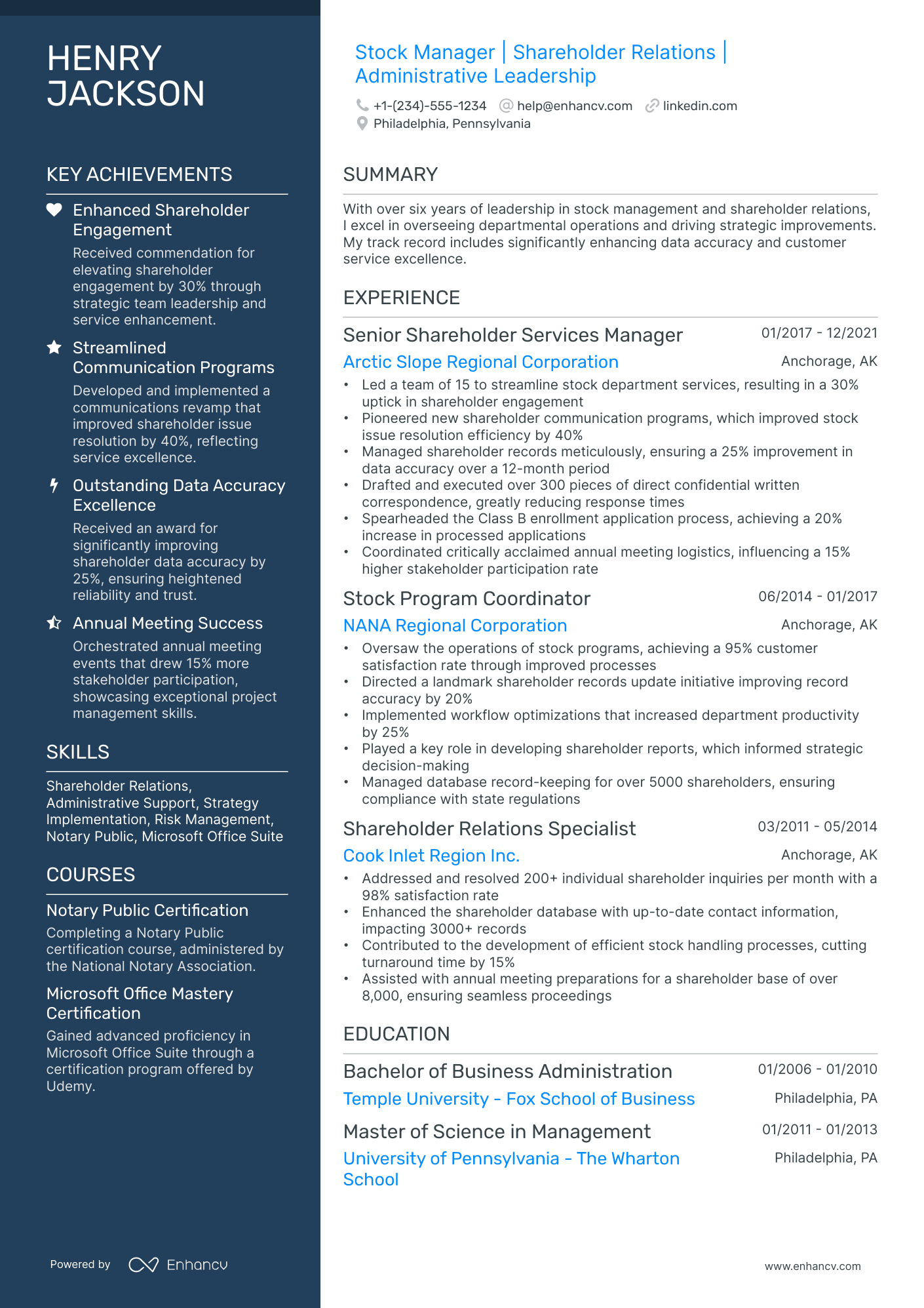
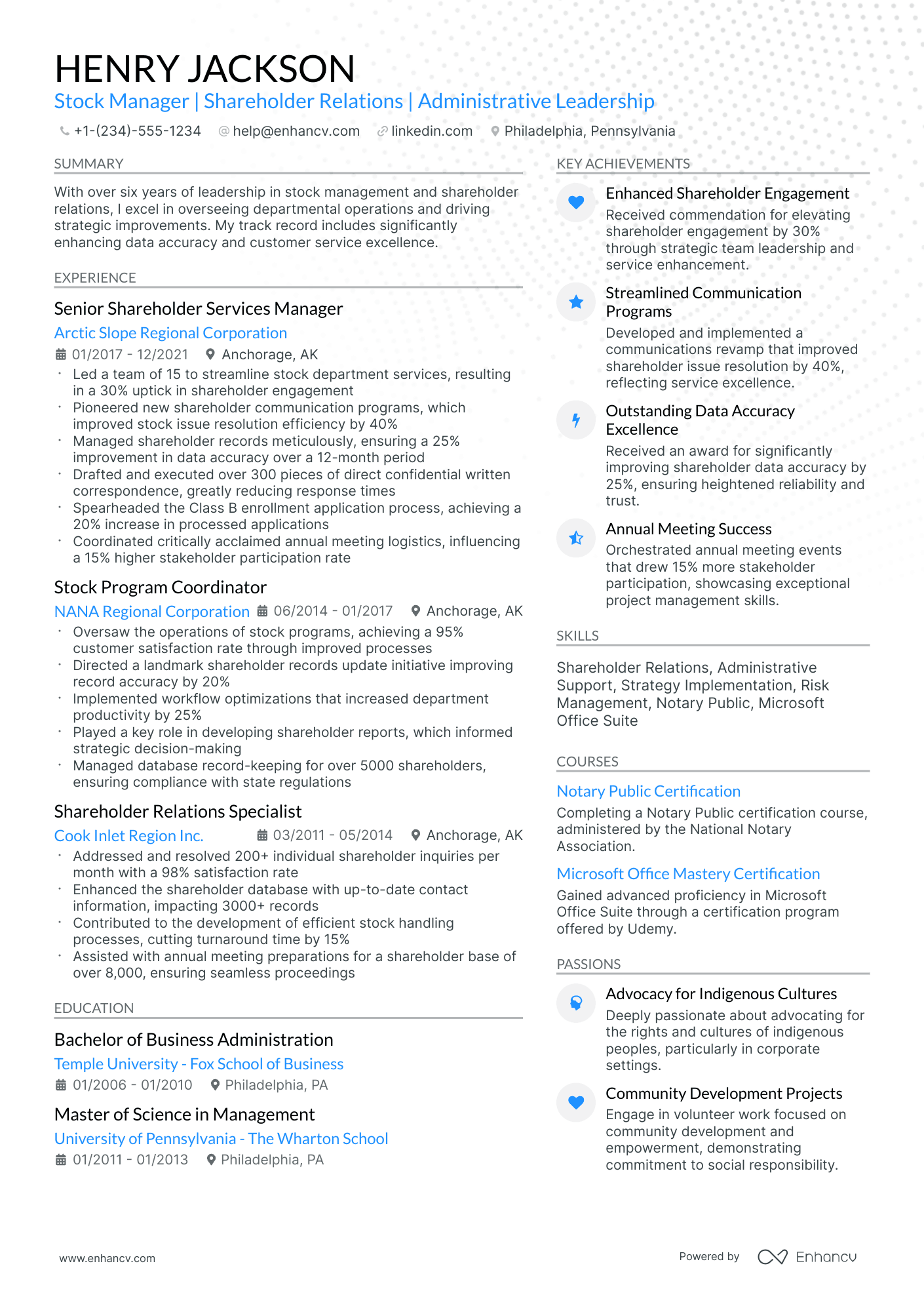
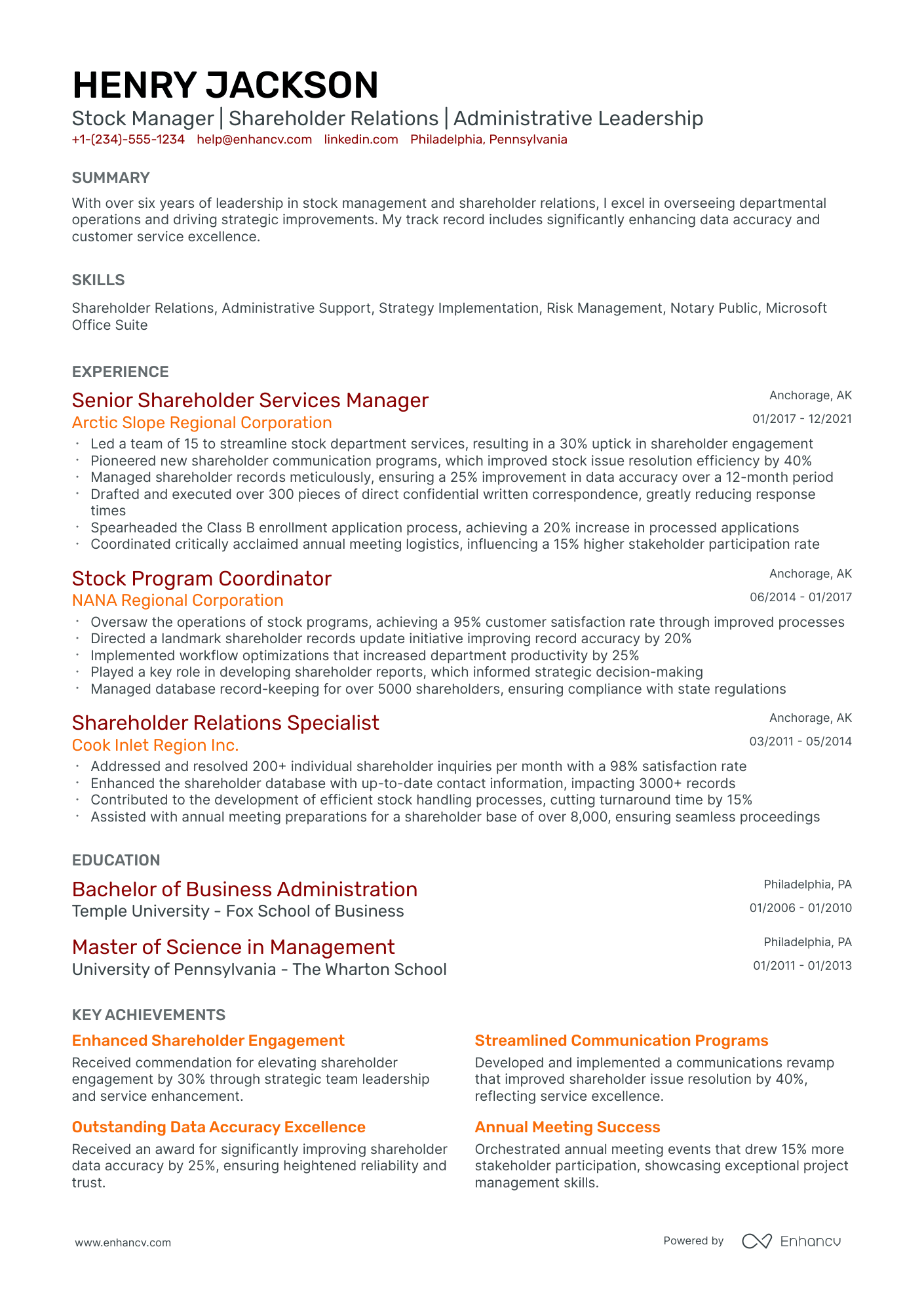
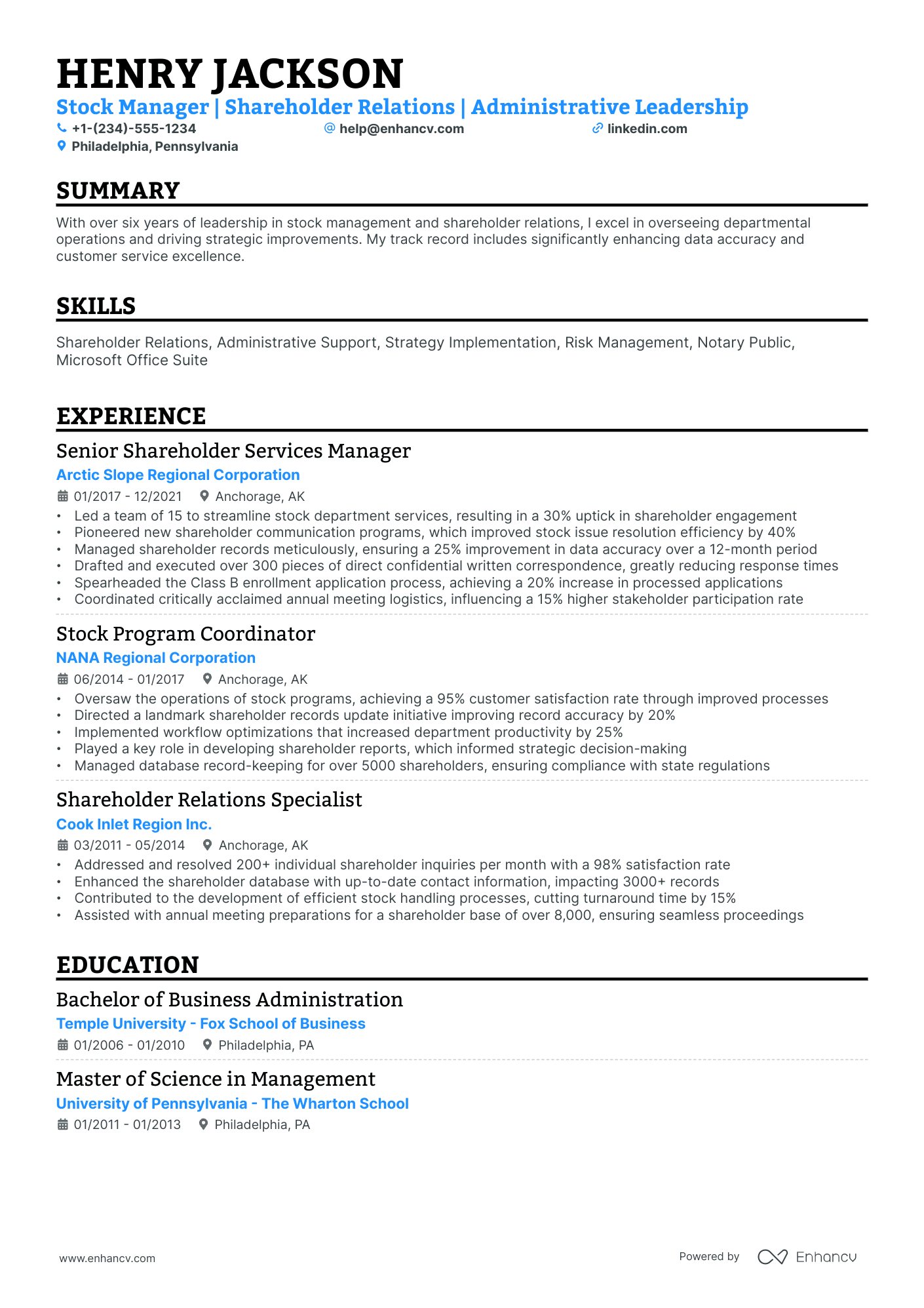
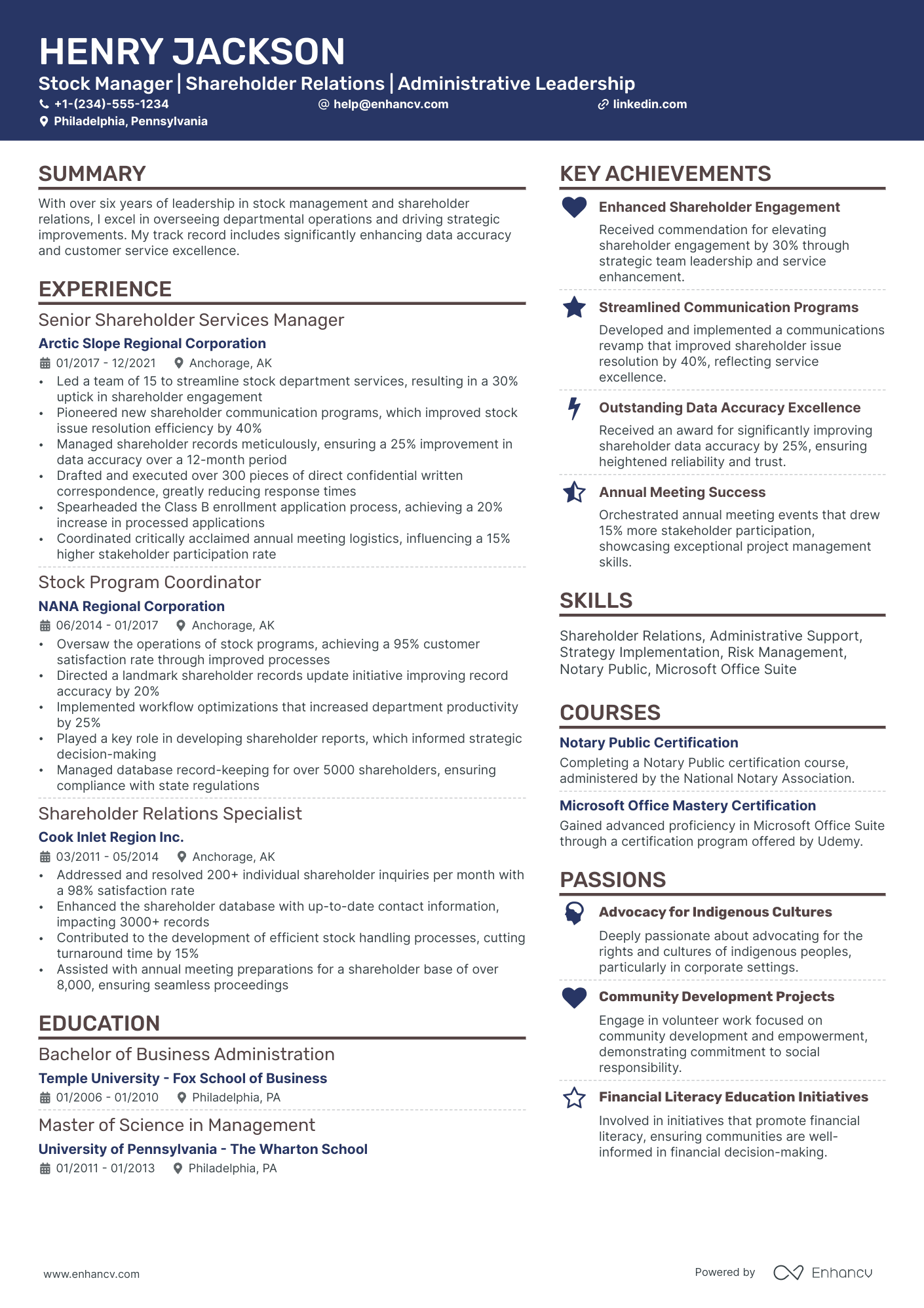
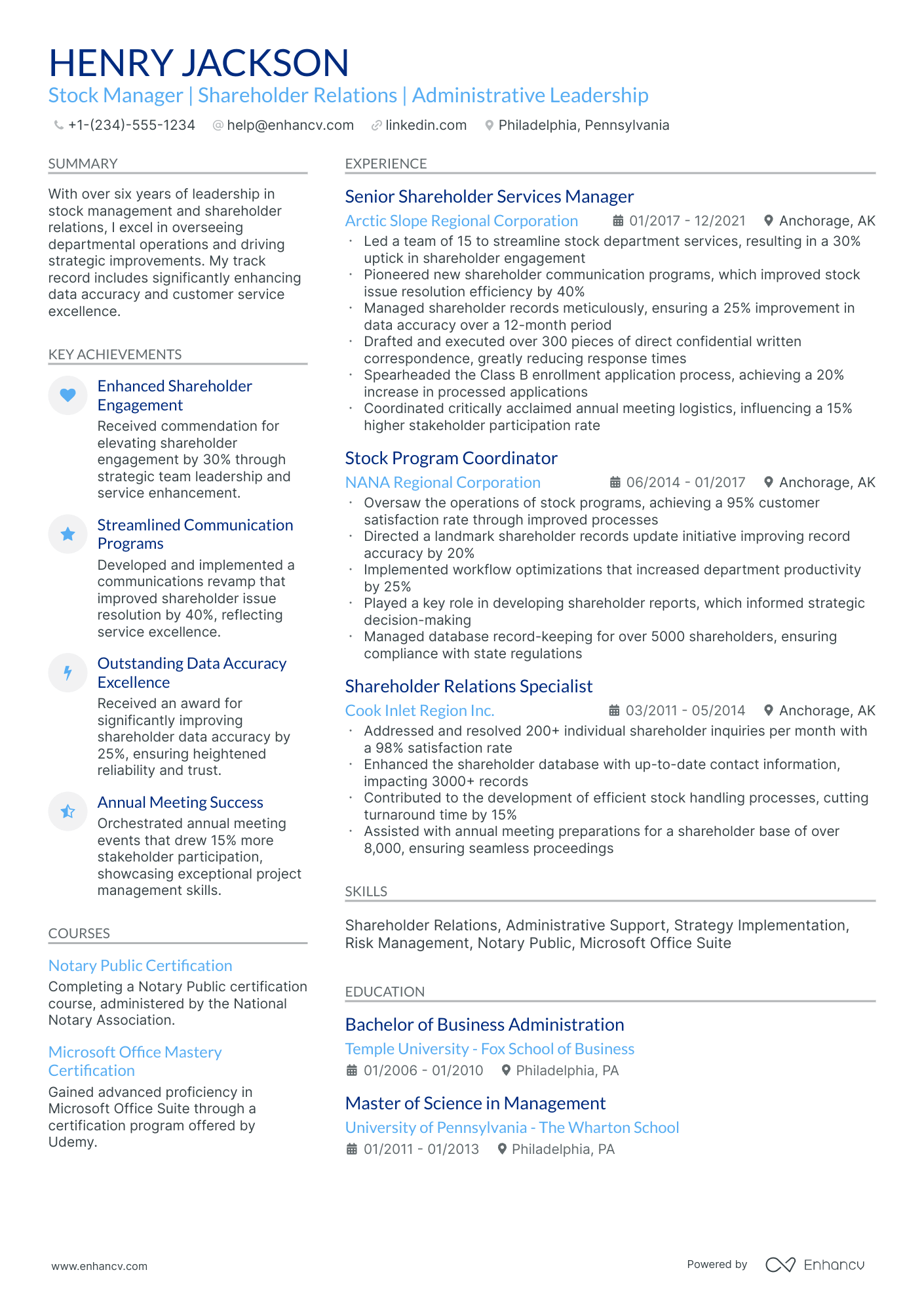
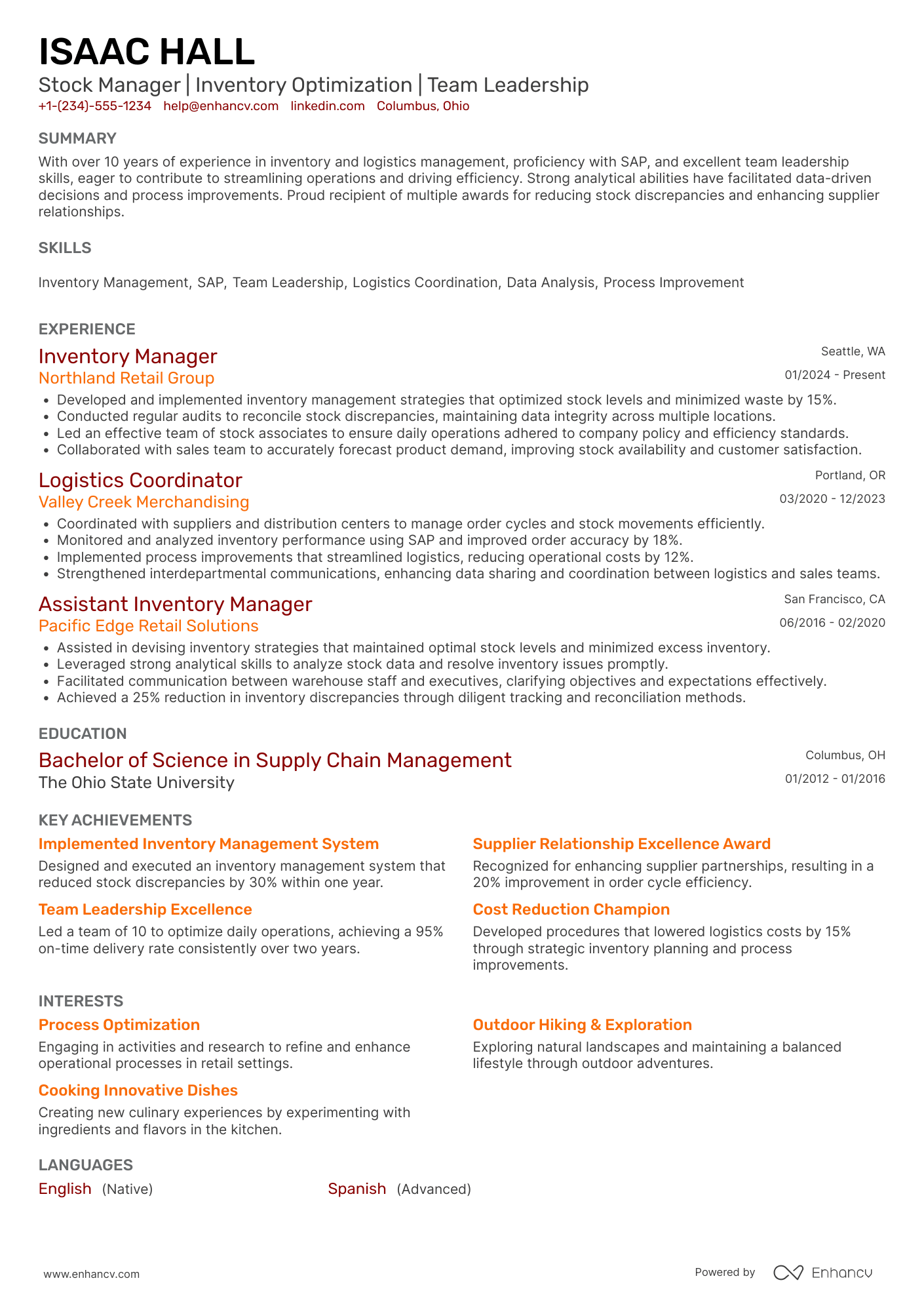
Many stock manager resume drafts fail because they list tasks but skip measurable inventory control results and systems context. That hurts during ATS screening and fast recruiter scans, especially when competition is high for operational leadership roles.
A strong resume shows what you improved and by how much. Knowing how to make your resume stand out means highlighting shrink reduction, inventory accuracy gains, faster cycle counts, smoother replenishment, fewer stockouts, higher fill rates, larger SKU scope, and audit-ready compliance.

Key takeaways
- Quantify inventory results like shrink reduction, accuracy gains, and cost savings in every experience bullet.
- Use reverse-chronological format if you have stock management experience; use hybrid if switching careers.
- Tailor resume language to each job posting's specific systems, KPIs, and process terminology.
- Demonstrate skills through measurable outcomes in your experience section, not just in a skills list.
- Lead your summary with years of experience, core tools, and one or two concrete achievements.
- Add certifications like CPIM or CSCP near your education to reinforce inventory management credibility.
- Use Enhancv's tools to sharpen bullet points and align your resume with stock manager job descriptions.
Job market snapshot for stock managers
We analyzed 63 recent stock manager job ads across major US job boards. These numbers help you understand experience requirements, industry demand, regional hotspots at a glance.
What level of experience employers are looking for stock managers
| Years of Experience | Percentage found in job ads |
|---|---|
| 1–2 years | 65.1% (41) |
| 3–4 years | 4.8% (3) |
| 9–10 years | 1.6% (1) |
| 10+ years | 1.6% (1) |
| Not specified | 28.6% (18) |
Stock manager ads by area of specialization (industry)
| Industry (Area) | Percentage found in job ads |
|---|---|
| Finance & Banking | 95.2% (60) |
Top companies hiring stock managers
| Company | Percentage found in job ads |
|---|---|
| Harbor Freight Tools | 60.3% (38) |
| Hy-Vee | 19.0% (12) |
Role overview stats
These tables show the most common responsibilities and employment types for stock manager roles. Use them to align your resume with what employers expect and to understand how the role is structured across the market.
Day-to-day activities and top responsibilities for a stock manager
| Responsibility | Percentage found in job ads |
|---|---|
| Computer | 19.0% (12) |
| Fork lift | 17.5% (11) |
| Cash register | 14.3% (9) |
| Inventory | 14.3% (9) |
| Pricing | 14.3% (9) |
| Box cutter | 12.7% (8) |
| Compactor | 12.7% (8) |
| Power jack | 12.7% (8) |
| Scales | 12.7% (8) |
| Tomra machines | 12.7% (8) |
| Two wheeler | 12.7% (8) |
| Cars system | 9.5% (6) |
How to format a stock manager resume
Recruiters evaluating stock manager resumes prioritize evidence of inventory accuracy, loss prevention, and team coordination within warehouse or retail environments. A clear, well-structured resume format ensures these operational signals surface quickly during both human review and applicant tracking system (ATS) scans.

I have significant experience as a stock manager—which format should I use?
Use a reverse-chronological format to lead with your most recent and relevant inventory management experience. Do:
- Highlight the scope and ownership of your stock operations, including warehouse size, SKU counts, and team size managed.
- Feature role-specific tools and domains such as warehouse management systems (WMS), demand forecasting, cycle counting, and vendor coordination.
- Quantify outcomes tied to shrinkage reduction, inventory turnover rates, order fulfillment accuracy, or cost savings.
I'm junior or switching into a stock manager role—what format works best?
A hybrid format works best, letting you lead with transferable skills while still showing a concise work history. Do:
- Place a skills section near the top featuring inventory software proficiency, stock replenishment knowledge, and supply chain fundamentals.
- Include projects or transitional experience such as managing stockroom operations during seasonal peaks, coordinating receiving shipments, or completing logistics coursework.
- Link each action directly to a result so recruiters can see your potential impact.
Why not use a functional resume?
A functional format buries the timeline of your inventory management experience, making it difficult for recruiters to assess how your skills developed in real operational settings.
- A functional resume may be acceptable if you're transitioning from a related field (such as logistics coordination or retail sales) with limited direct stock management titles, but only if you tie every listed skill to specific projects, measurable outcomes, or hands-on inventory responsibilities.
Once your format establishes a clean, readable structure, the next step is filling it with the right sections to give hiring managers exactly what they're looking for.
What sections should go on a stock manager resume
Recruiters expect your stock manager resume to show you can keep inventory accurate, stocked, and compliant while hitting service and cost targets. Understanding what to put on a resume for this role is critical to passing both ATS and human review.
Use this structure for maximum clarity:
- Header
- Summary
- Experience
- Skills
- Projects
- Education
- Certifications
- Optional sections: Awards, Leadership, Languages
Your experience bullets should emphasize measurable inventory accuracy, shrink reduction, replenishment performance, audit readiness, and the scale of locations, teams, and stock-keeping units you managed.
Is your resume good enough?
Drop your resume here or choose a file. PDF & DOCX only. Max 2MB file size.
Once you’ve organized your resume with the right components, the next step is to write your stock manager experience section so each entry supports that structure with clear, role-relevant detail.
How to write your stock manager resume experience
Your work experience section should highlight the inventory systems you've managed, the tools and methods you've used to optimize stock levels, and the measurable outcomes you've delivered—like reduced shrinkage, improved turnover rates, or cost savings. Hiring managers prioritize demonstrated impact over descriptive task lists, so focus on what you accomplished rather than what you were assigned.
Each entry should include:
- Job title
- Company and location (or remote)
- Dates of employment (month and year)
Three to five concise bullet points showing what you owned, how you executed, and what outcomes you delivered:
- Ownership scope: the warehouses, distribution centers, product categories, inventory systems, or teams you were directly accountable for as a stock manager.
- Execution approach: the inventory management software, demand forecasting methods, replenishment frameworks, or data analysis tools you used to guide purchasing decisions and maintain optimal stock levels.
- Value improved: changes to stock accuracy, order fulfillment speed, carrying costs, waste reduction, shelf availability, or supply chain reliability that resulted from your work.
- Collaboration context: how you coordinated with procurement teams, suppliers, logistics partners, sales departments, or warehouse staff to align stock operations with broader business needs.
- Impact delivered: outcomes expressed through business results—such as reductions in overstock or stockouts, improvements in inventory turnover, or contributions to revenue protection—rather than routine activities.
Experience bullet formula
A stock manager experience example
✅ Right example - modern, quantified, specific.
Stock Manager
Redwood Outdoor Supply | Denver, CO
2021–Present
Multi-location outdoor retailer supporting five stores and an e-commerce channel with ten thousand active stock keeping units.
- Implemented NetSuite inventory controls and cycle count schedules by ABC classification, cutting stock variance from 2.8% to 0.9% and improving audit pass rate to 99.6%.
- Built Power BI dashboards from point of sale and warehouse management system data to track sell-through, days on hand, and supplier lead times, reducing stockouts by 22% and freeing $310K in working capital.
- Standardized receiving, putaway, and replenishment workflows using barcode scanning (Zebra TC52) and bin-location logic, improving pick accuracy from 97.1% to 99.2% and saving twelve labor hours per week.
- Partnered with buyers, store managers, and finance to reset reorder points and safety stock for top 300 items, lifting on-shelf availability by 14% and increasing quarterly revenue by $185K.
- Led weekly supplier performance reviews and corrective action plans, cutting late deliveries by 18% and reducing expedited freight spend by 27% while maintaining service level targets.
Now that you've seen how a strong experience section looks in practice, let's break down how to tailor each element to match the specific stock manager role you're targeting.
How to tailor your stock manager resume experience
Recruiters evaluate your stock manager resume through both human review and applicant tracking systems (ATS), so tailoring your resume to the job description is essential. Tailoring ensures your most relevant qualifications surface quickly during both screening methods.
Ways to tailor your stock manager experience:
- Match inventory management systems and software listed in the job description.
- Mirror the exact terminology used for replenishment or fulfillment processes.
- Reflect specific KPIs like shrinkage rates or inventory turnover the posting mentions.
- Highlight warehouse or retail domain experience when the role requires it.
- Emphasize compliance and safety standards referenced in the job requirements.
- Incorporate loss prevention or quality control methods the employer prioritizes.
- Align your team leadership scope with the collaboration structure described.
- Reference demand forecasting or stock optimization frameworks the posting names.
Tailoring means aligning your real accomplishments with what the employer asks for, not forcing keywords where they don't belong.
Resume tailoring examples for stock manager
| Job description excerpt | Untailored | Tailored |
|---|---|---|
| Manage inventory levels across three warehouse locations using Oracle NetSuite, ensuring stock accuracy of 98% or higher through cycle counting and regular audits. | Managed inventory and kept track of stock levels. | Maintained 98.5% stock accuracy across three warehouse locations by conducting weekly cycle counts and quarterly audits in Oracle NetSuite. |
| Coordinate with procurement and sales teams to forecast demand, reduce overstock, and minimize stockouts using min/max replenishment strategies. | Helped order products and worked with other departments. | Collaborated with procurement and sales teams to forecast seasonal demand, reducing overstock by 22% and cutting stockouts by 15% through min/max replenishment planning. |
| Supervise a team of 10 warehouse associates, oversee receiving and put-away processes, and enforce FIFO rotation standards for perishable goods. | Led a team and made sure warehouse operations ran smoothly. | Supervised 10 warehouse associates in daily receiving and put-away workflows, enforcing FIFO rotation standards that reduced perishable goods shrinkage by 30%. |
Once you’ve aligned your experience with the role’s priorities, the next step is to quantify your stock manager achievements to show the impact of that work.
How to quantify your stock manager achievements
Quantifying your achievements shows how well you control inventory, prevent loss, and keep operations moving. Focus on accuracy, shrink, replenishment speed, stock availability, and cost savings across clear timeframes and item volumes.
Quantifying examples for stock manager
| Metric | Example |
|---|---|
| Inventory accuracy | "Raised inventory accuracy from 94% to 99.2% by tightening cycle counts and reconciling variances in the warehouse management system (WMS) each week." |
| Shrink reduction | "Cut shrink from 2.1% to 1.3% in six months by improving receiving checks, locking high-value bins, and auditing transfers by SKU." |
| Replenishment speed | "Reduced stockroom-to-shelf replenishment time from 18 hours to six hours by reorganizing pick paths and batching restocks by aisle." |
| Stock availability | "Improved in-stock rate from 92% to 97% for top two hundred SKUs by resetting reorder points and tracking vendor lead times weekly." |
| Cost savings | "Saved $48,000 annually by lowering excess inventory 15% and renegotiating minimum order quantities with three suppliers without increasing stockouts." |
Turn your everyday tasks into measurable, recruiter-ready resume bullets in seconds with Enhancv's Bullet Point Generator.
Once you've crafted strong bullet points to showcase your experience, the next step is highlighting the specific hard and soft skills that reinforce your qualifications as a stock manager.
How to list your hard and soft skills on a stock manager resume
Your skills section shows you can keep inventory accurate, available, and cost-effective, and recruiters and an ATS (applicant tracking system) scan them to confirm fit fast; aim for a mix weighted toward hard skills like system-based inventory capabilities with role-specific soft skills.
stock manager roles require a blend of:
- Product strategy and discovery skills.
- Data, analytics, and experimentation skills.
- Delivery, execution, and go-to-market discipline.
- Soft skills.
Your skills section should be:
- Scannable (bullet-style grouping).
- Relevant to the job post.
- Backed by proof in experience bullets.
- Updated with current tools.
Place your skills section:
- Above experience if you're junior or switching careers.
- Below experience if you're mid/senior with strong achievements.

Hard skills
- Inventory control, cycle counts
- Stock reconciliation, variance analysis
- Warehouse management systems (WMS)
- Enterprise resource planning systems
- Barcode scanning, label systems
- Reorder points, safety stock
- Demand forecasting, replenishment
- Purchase orders, receiving
- Lot, batch, expiration tracking
- FIFO, FEFO, LIFO
- Microsoft Excel, pivot tables
- Root cause analysis, CAPA
Soft skills
- Prioritize high-impact stock issues
- Communicate shortages and risks early
- Coordinate with purchasing and sales
- Lead cycle counts and follow-through
- Resolve discrepancies with urgency
- Escalate blockers with clear options
- Document processes and train staff
- Maintain audit-ready records
- Negotiate delivery timelines with vendors
- Make data-driven tradeoffs under pressure
- Hold teams accountable to standards
- Improve workflows through continuous feedback
How to show your stock manager skills in context
Skills shouldn't live only in a dedicated skills list. Browse examples of resume skills shown in context to see how other professionals weave them into real entries.
They should be demonstrated in:
- Your summary (high-level professional identity)
- Your experience (proof through outcomes)
Here's how that looks in practice.
Summary example
Senior stock manager with 10+ years in retail distribution. Skilled in demand forecasting, SAP WM, and cross-functional vendor coordination. Reduced carrying costs by 18% through cycle count optimization and data-driven reorder strategies.
- Signals senior-level expertise immediately
- Names specific tools like SAP WM
- Quantifies cost savings with a metric
- Highlights collaboration as a soft skill
Experience example
Senior Stock Manager
Bridgewell Distribution Co. | Charlotte, NC
March 2019–Present
- Redesigned bin-location mapping in SAP WM, cutting pick-and-pack errors by 27% across three warehouse zones.
- Partnered with procurement and logistics teams to implement vendor-managed inventory, reducing stockouts by 34% year over year.
- Led quarterly demand forecasting reviews using historical sales data, improving inventory turnover ratio from 5.1 to 7.3.
- Every bullet includes measurable proof.
- Skills surface naturally through real outcomes.
Once you’ve demonstrated your inventory strengths through specific, results-focused examples, the next step is learning how to build a stock manager resume with no experience by applying that same approach to transferable tasks and achievements.
How do I write a stock manager resume with no experience
Even without full-time experience, you can demonstrate readiness through:
- Retail stocking and backroom shifts
- Inventory counts for school events
- Warehouse volunteer picking and packing
- Small business receiving and tagging
- E-commerce order fulfillment projects
- POS inventory adjustments and audits
- Barcode labeling and shelf resets
If you're building a resume without work experience, focus on:
- Inventory accuracy and cycle counts
- Receiving, put-away, and bin logic
- Stock manager tools and systems
- Loss prevention and shrink controls
Resume format tip for entry-level stock manager
Use a combination resume format because it highlights inventory skills and tools first, while still showing reliable work history and projects. Do:
- Start with a skills summary tied to inventory tasks.
- List tools used: Excel, barcode scanners, POS.
- Add projects with metrics: counts, time, accuracy.
- Use stock manager keywords from job posts.
- Quantify results: shrink, errors, throughput.
- Led a POS inventory audit for a school store, reconciled 180 items in Excel, and cut adjustment errors by 22% in two weeks.
Even without direct experience, your education section can demonstrate the foundational knowledge and relevant coursework that qualify you for a stock manager role.
How to list your education on a stock manager resume
Your education section helps hiring teams confirm you have foundational knowledge in supply chain, logistics, or business. It validates your readiness for stock manager responsibilities.
Include:
- Degree name
- Institution
- Location
- Graduation year
- Relevant coursework (for juniors or entry-level candidates)
- Honors & GPA (if 3.5 or higher)
Skip month and day details—list the graduation year only.
Here's a strong education entry tailored for a stock manager resume:
Example education entry
Bachelor of Science in Supply Chain Management
University of North Texas, Denton, TX
Graduated 2021
GPA: 3.7/4.0
- Relevant coursework: Inventory Control Systems, Warehouse Operations, Demand Forecasting, and Procurement Strategies
- Honors: Magna Cum Laude, Dean's List (six semesters)
How to list your certifications on a stock manager resume
Certifications show your commitment to learning, prove tool proficiency, and confirm industry relevance as a stock manager. They also signal you can follow standards, improve accuracy, and support safe, efficient inventory operations.
Include:
- Certificate name
- Issuing organization
- Year
- Optional: credential ID or URL
- Place certifications below education when they are older, broad, or less relevant than your degree.
- Place certifications above education when they are recent, highly relevant, or required for the stock manager role.
Best certifications for your stock manager resume
- Certified in Production and Inventory Management (CPIM)
- Certified Supply Chain Professional (CSCP)
- Certified Logistics Associate (CLA)
- OSHA 10-Hour General Industry
- Lean Six Sigma Yellow Belt
- Hazardous Materials (HazMat) Awareness Certification
- Forklift Operator Certification
Once you’ve positioned your credentials where hiring managers will notice them, shift to your stock manager resume summary to frame those qualifications in a clear, results-focused opening.
How to write your stock manager resume summary
Your resume summary is the first thing a recruiter reads. A strong one instantly signals you're qualified to manage inventory, optimize stock levels, and lead warehouse operations.
Keep it to three to four lines, with:
- Your title and total years of experience in stock or inventory management.
- The industry or product type you've worked with, such as retail, manufacturing, or logistics.
- Core tools and skills like warehouse management systems, demand forecasting, or ERP platforms.
- One or two measurable achievements, such as reducing shrinkage or improving turnover rates.
- Soft skills tied to real outcomes, like team coordination that cut restocking delays.

PRO TIP
At this level, lead with hands-on skills, relevant tools, and concrete early wins. Quantify improvements even if they're modest. Avoid vague phrases like "passionate team player" or "motivated self-starter." Recruiters want proof of what you've done, not declarations about who you are.
Example summary for a stock manager
Stock manager with four years of experience in retail inventory control. Skilled in SAP and cycle counting, reducing shrinkage by 18% while maintaining 99.2% order accuracy across two distribution centers.
Optimize your resume summary and objective for ATS
Drop your resume here or choose a file.
PDF & DOCX only. Max 2MB file size.
Now that your summary captures your value as a stock manager, make sure your header presents the essential contact and professional details recruiters need to reach you.
What to include in a stock manager resume header
A resume header lists your key contact and professional details, and it boosts visibility, credibility, and recruiter screening for a stock manager role.
Essential resume header elements
- Full name
- Tailored job title and headline
- Location
- Phone number
- Professional email
- GitHub link
- Portfolio link
A LinkedIn link lets recruiters verify experience fast and supports screening with consistent dates, titles, and employers.
Don't include a photo on a stock manager resume unless the role is explicitly front-facing or appearance-dependent.
Use a clear job title and inventory-focused headline that matches the posting, and keep your contact details easy to scan on one line.
Example
Stock manager resume header
Jordan Taylor
Stock Manager | Inventory Control, Cycle Counts, and Warehouse Accuracy
Columbus, OH
(614) 555-01XX
your.name@enhancv.com
github.com/yourname
yourwebsite.com
linkedin.com/in/yourname
Once your contact details and role-specific identifiers are set at the top, add optional sections to highlight additional qualifications that strengthen your stock manager resume.
Additional sections for stock manager resumes
When your core qualifications match other candidates, additional resume sections can set you apart by showcasing role-specific credibility and depth. For example, listing language skills can be especially valuable if you coordinate with international suppliers or manage a multilingual warehouse team.
- Languages
- Certifications
- Professional affiliations
- Volunteer experience
- Awards and recognition
- Technical proficiencies
- Hobbies and interests
Once you've rounded out your resume with the right supplementary sections, it's worth pairing it with a cover letter to make your application even stronger.
Do stock manager resumes need a cover letter
A cover letter isn't required for a stock manager, but it helps in competitive roles or strict hiring processes. If you're unsure what a cover letter is or when to use one, it can make a difference when your resume needs context, or when the employer expects a clear fit.
Use a cover letter to add details your resume can't:
- Explain role and team fit by matching your inventory routines to their shift structure, tools, and accountability expectations.
- Highlight one or two outcomes, like reducing stockouts, improving pick accuracy, or speeding cycle counts, and note the methods you used.
- Show you understand the product, users, and business context, like seasonality, shrink risk, service levels, or fulfillment timelines.
- Address career transitions or non-obvious experience by linking transferable skills to stock manager work, like audits, safety, or process control.
Drop your resume here or choose a file.
PDF & DOCX only. Max 2MB file size.
Whether you include a cover letter or not, using AI to improve your stock manager resume helps you strengthen the document employers will evaluate first.
Using AI to improve your stock manager resume
AI can sharpen your resume's clarity, structure, and impact. It helps reframe bullet points and tighten language. But overuse kills authenticity. Once your content feels clear and role-aligned, step away from AI. If you're exploring options, learn which AI is best for writing resumes before committing to a tool.
Here are 10 prompts you can copy and paste to strengthen specific sections of your stock manager resume:
Sharpen the summary
Quantify experience bullets
Align skills section
Strengthen action verbs
Tailor to job posting
Improve project descriptions
Tighten education section
Clarify certifications
Remove redundancy
Fix tone and consistency
Conclusion
A strong stock manager resume proves results with numbers, highlights role-specific skills, and stays easy to scan. Focus on accuracy, inventory control, replenishment, receiving, cycle counts, and shrink reduction, supported by measurable outcomes.
Keep the structure clear with a targeted summary, focused experience, and relevant skills. This format shows you can deliver reliable performance and adapt to today’s and near-future hiring market as a stock manager.