


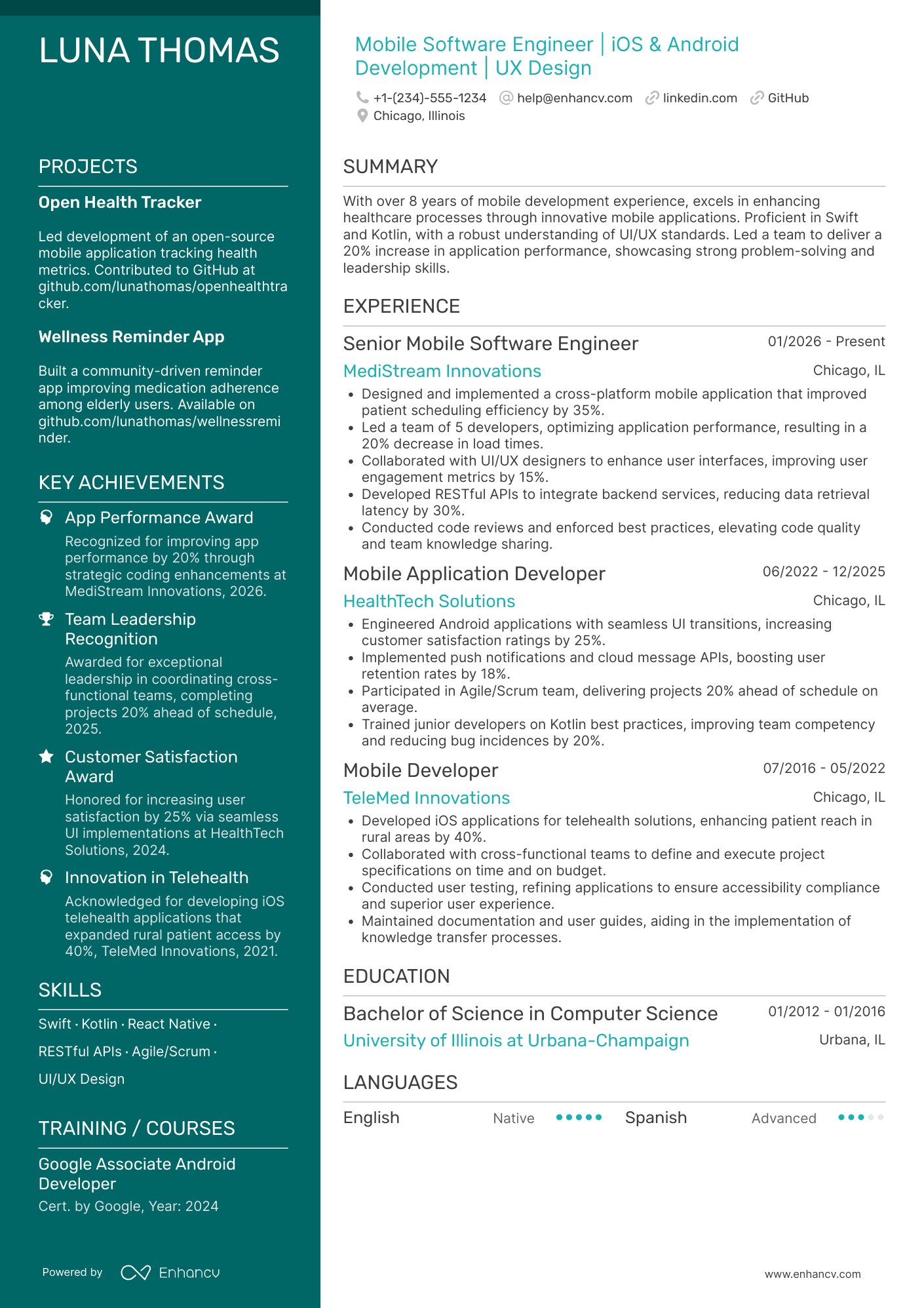
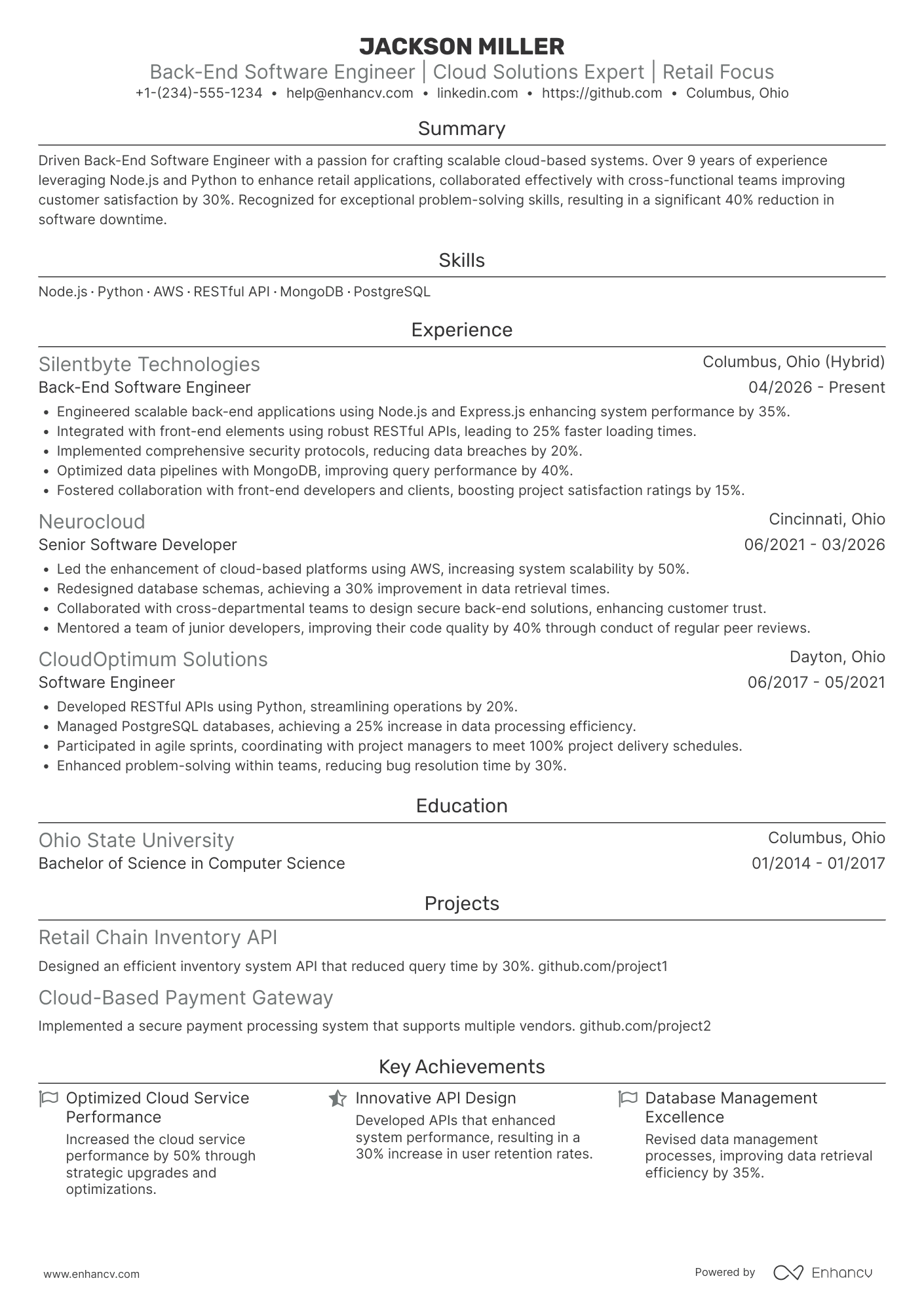
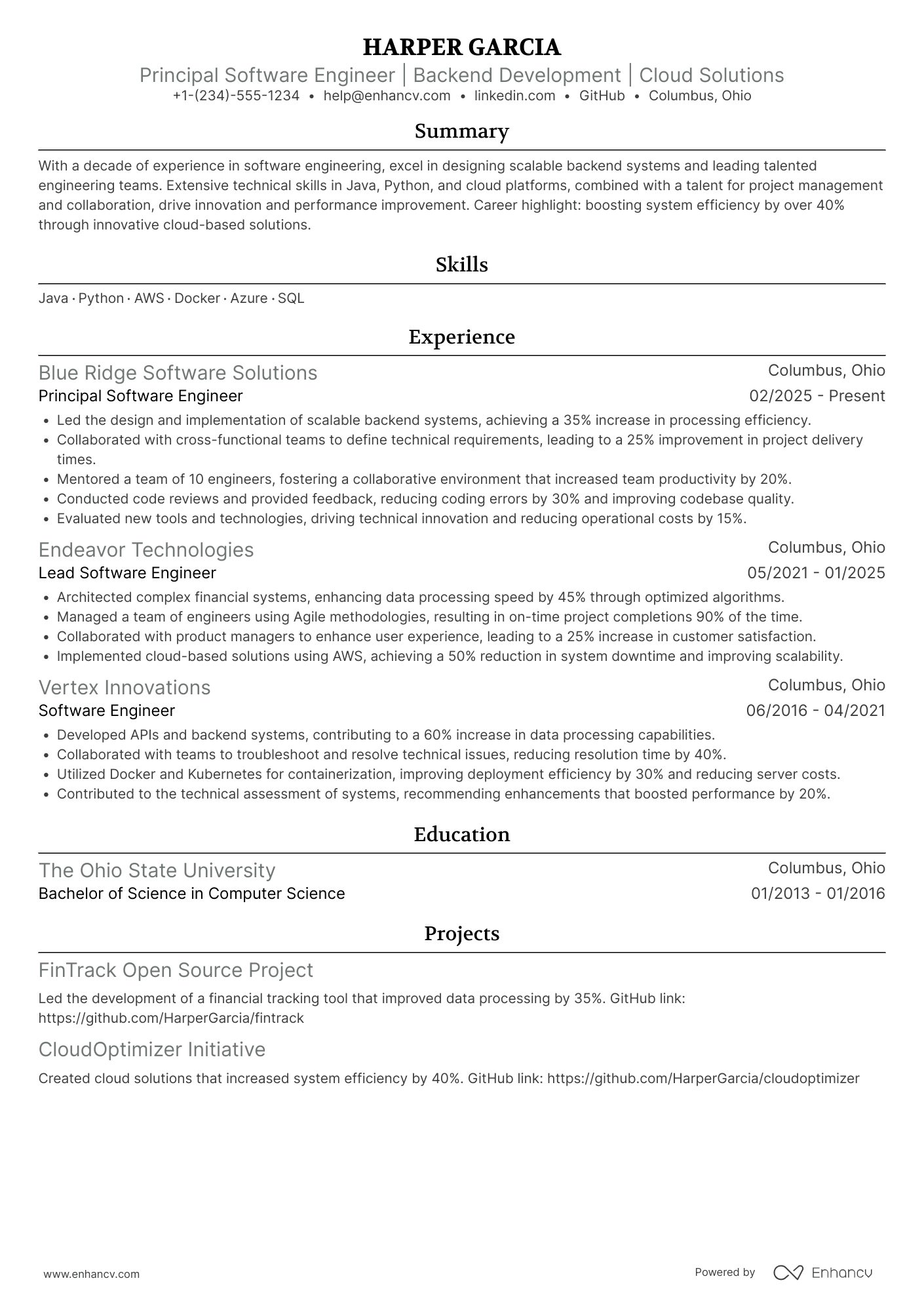
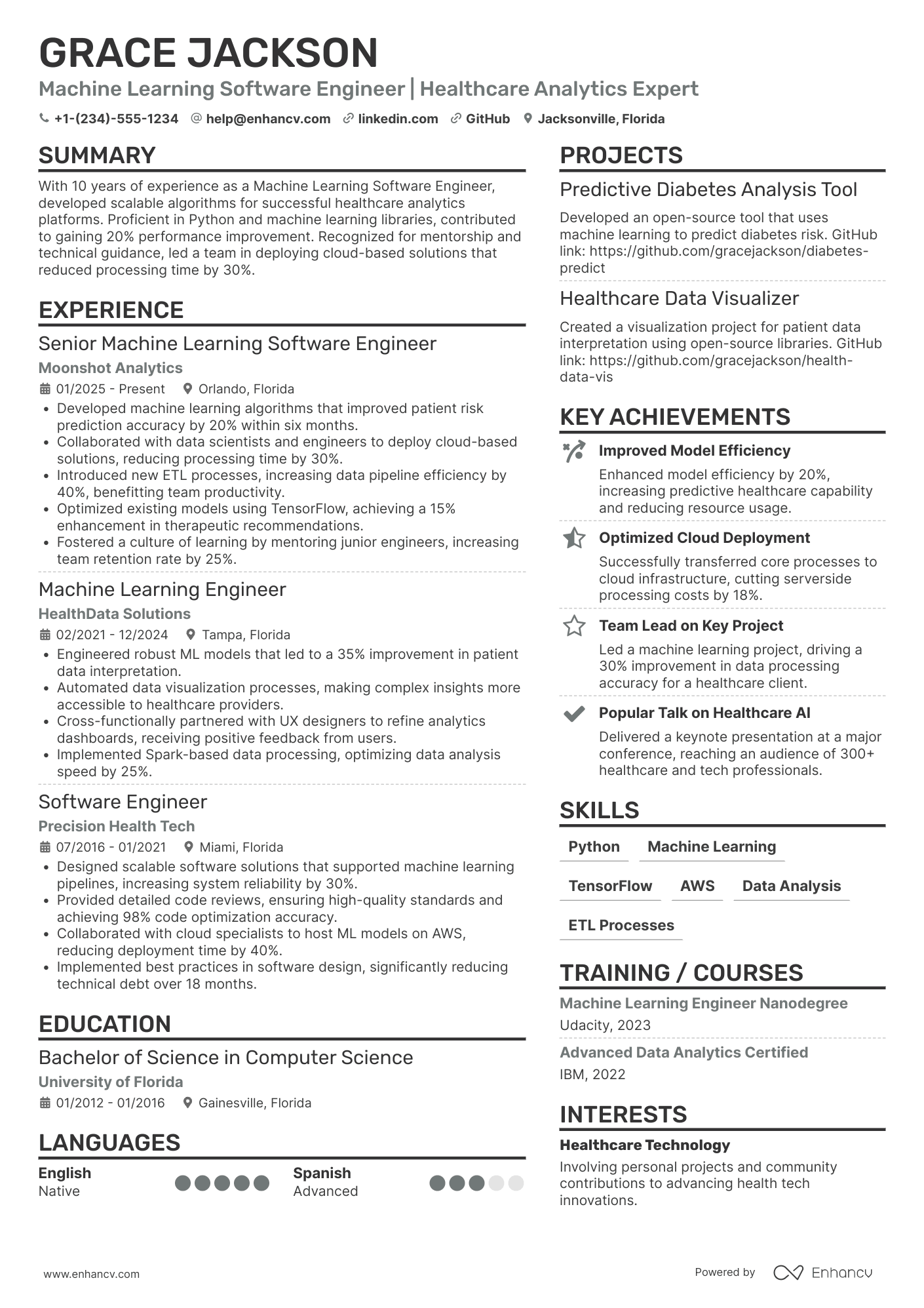
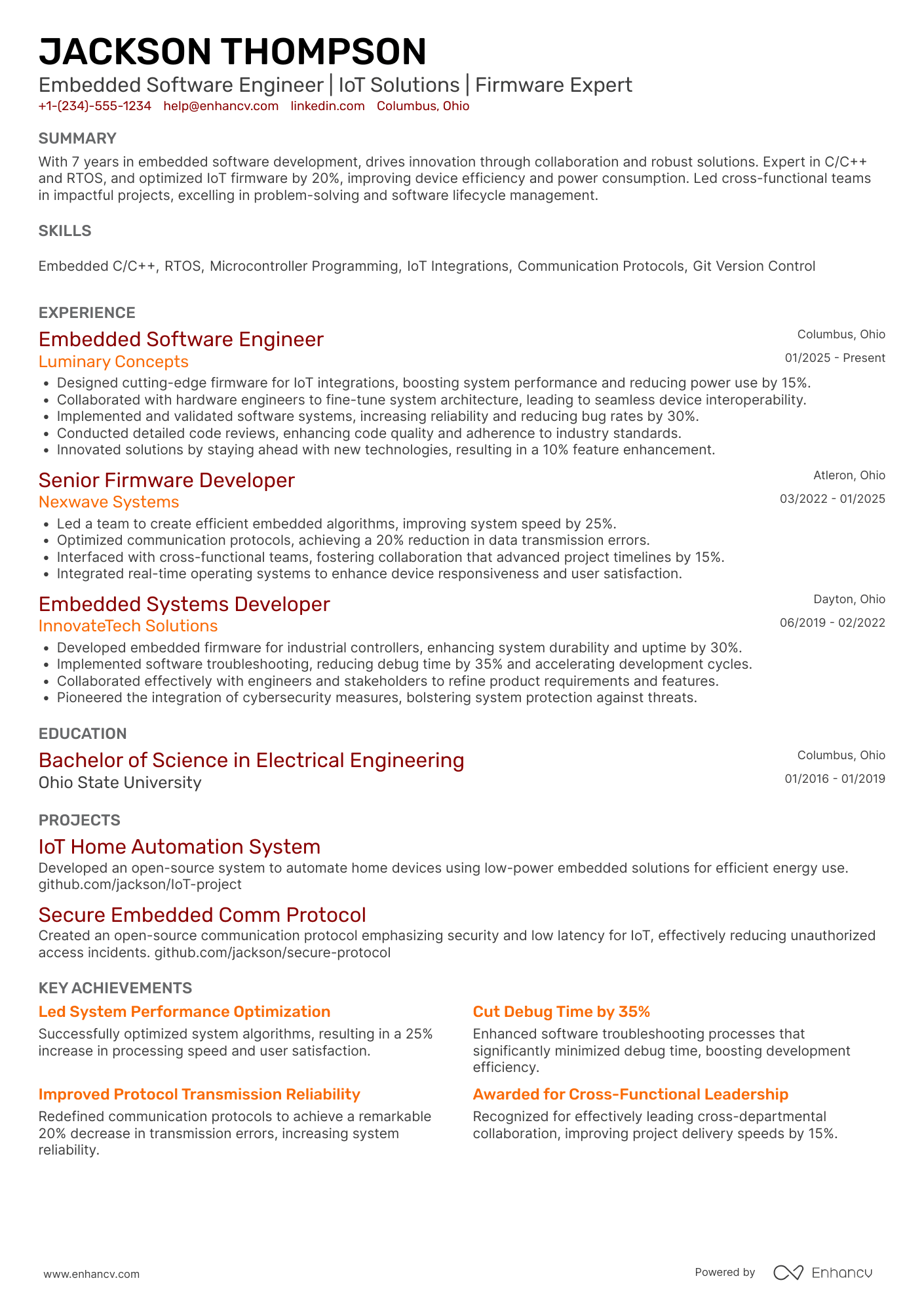
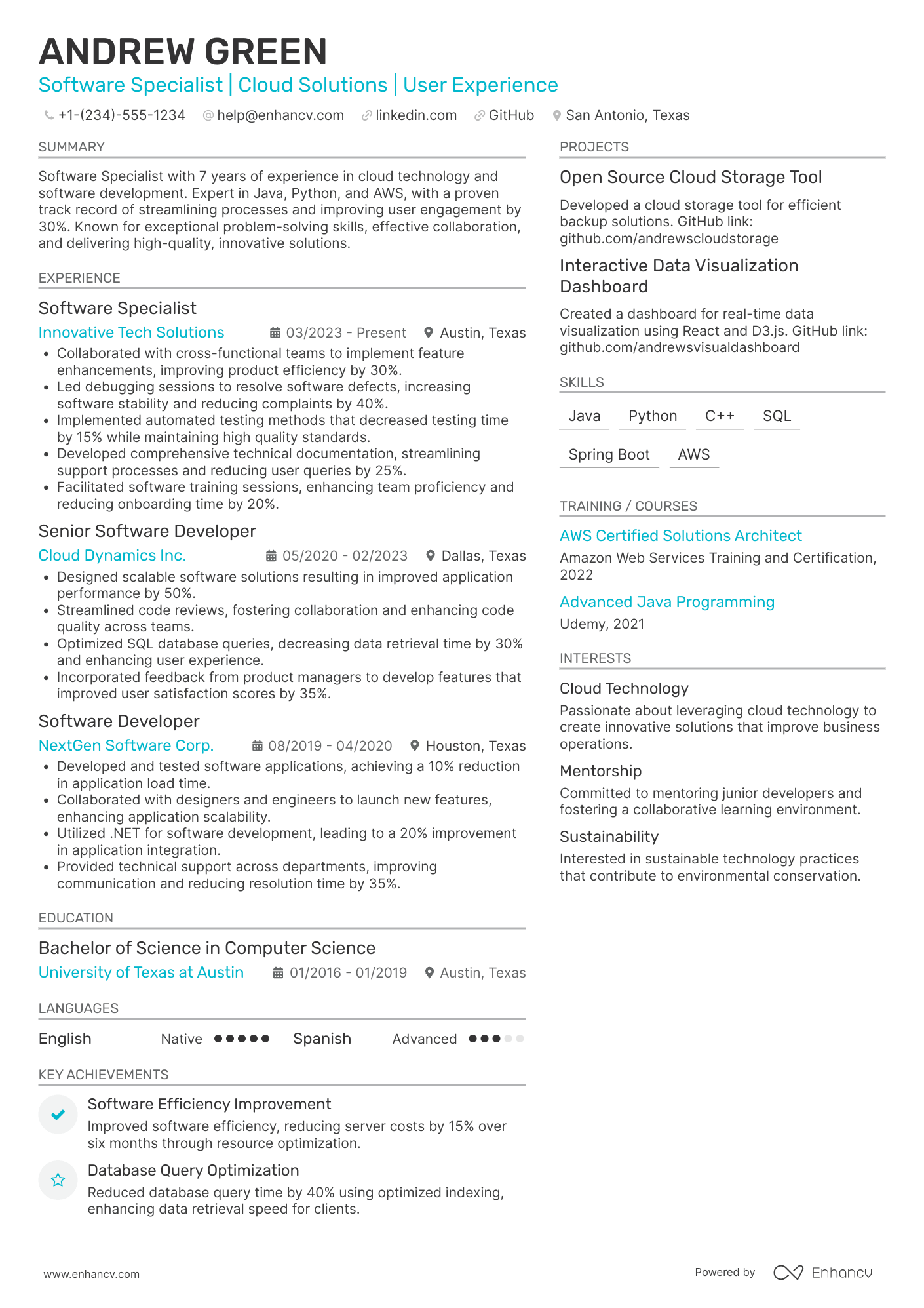
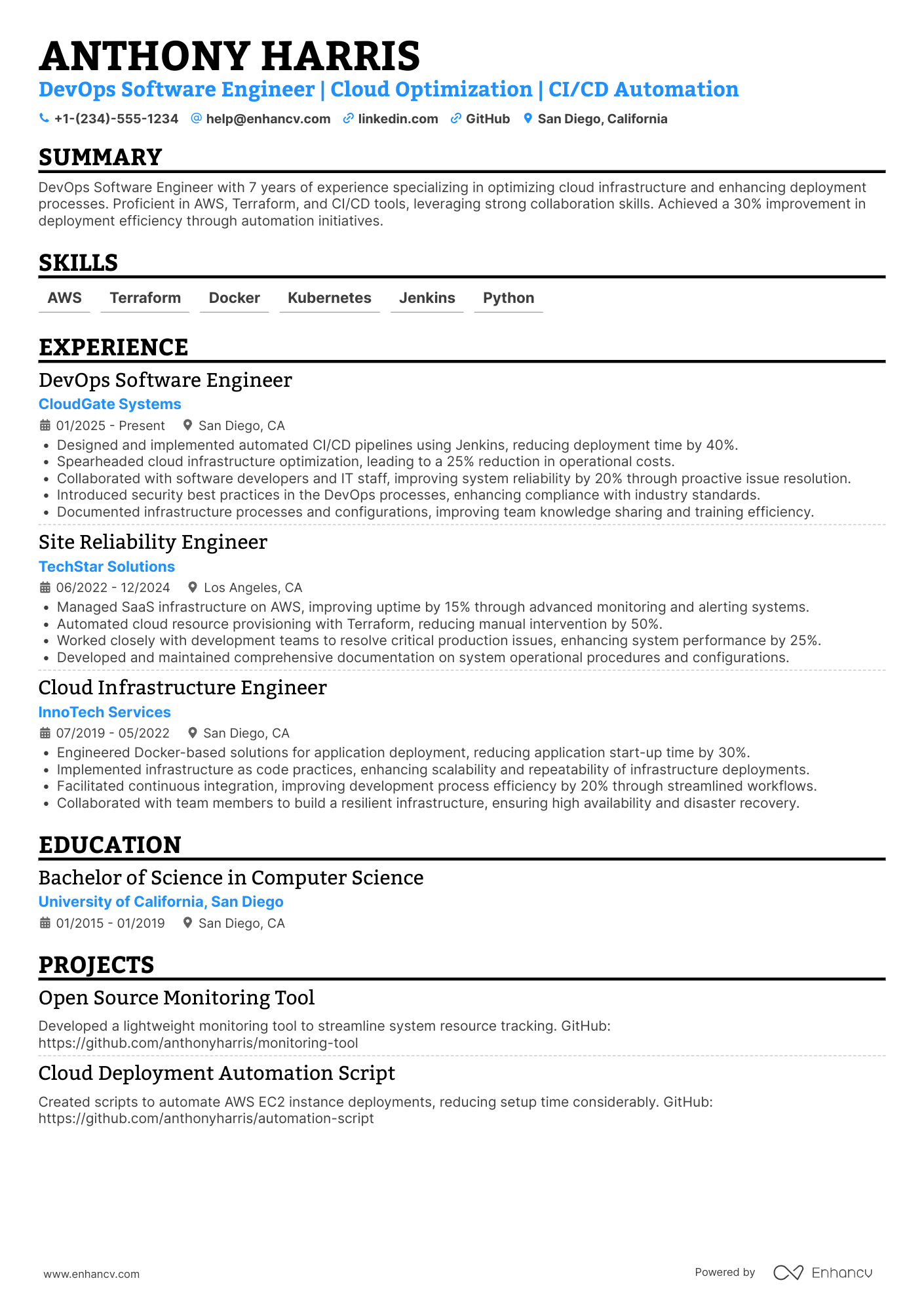
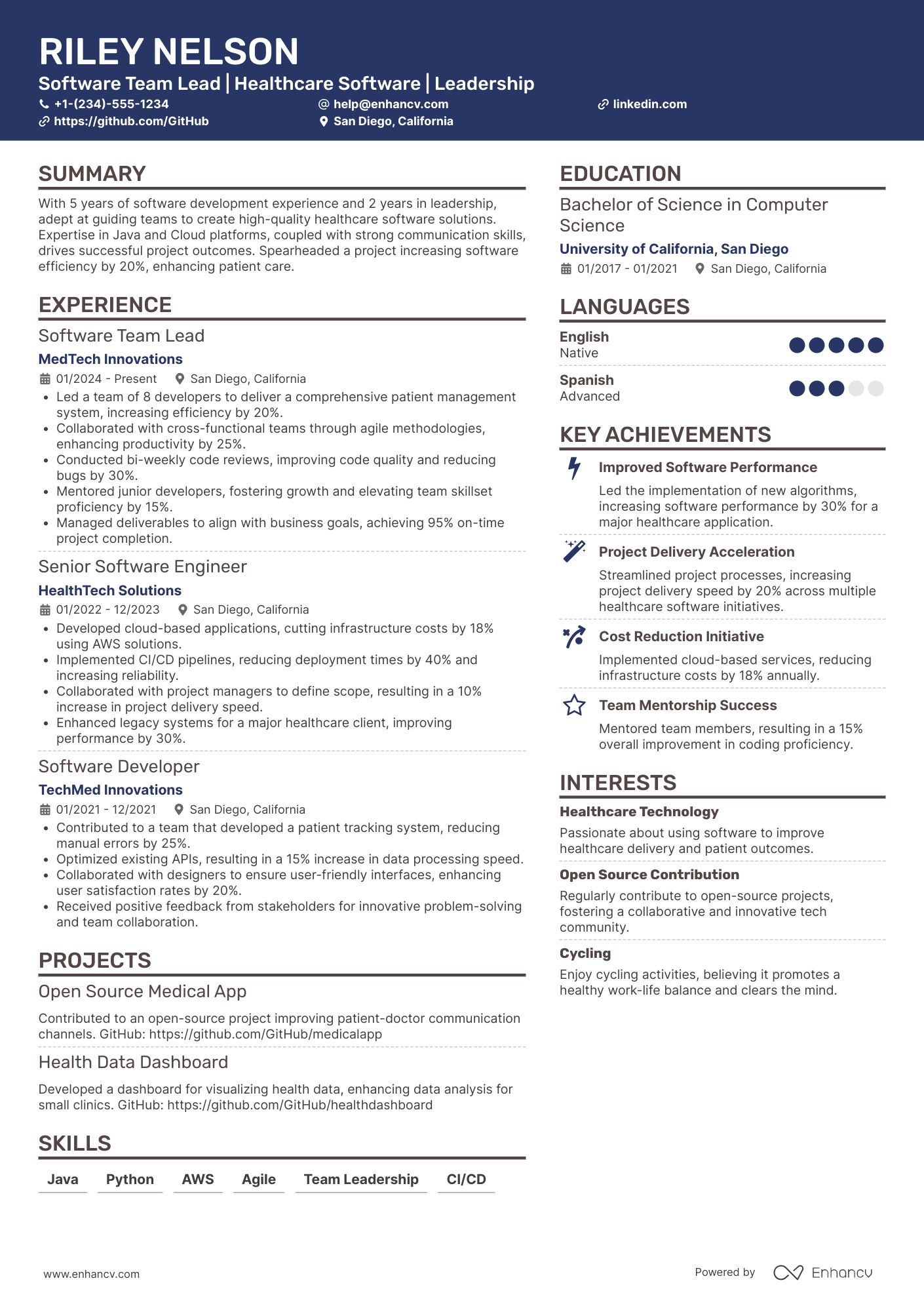
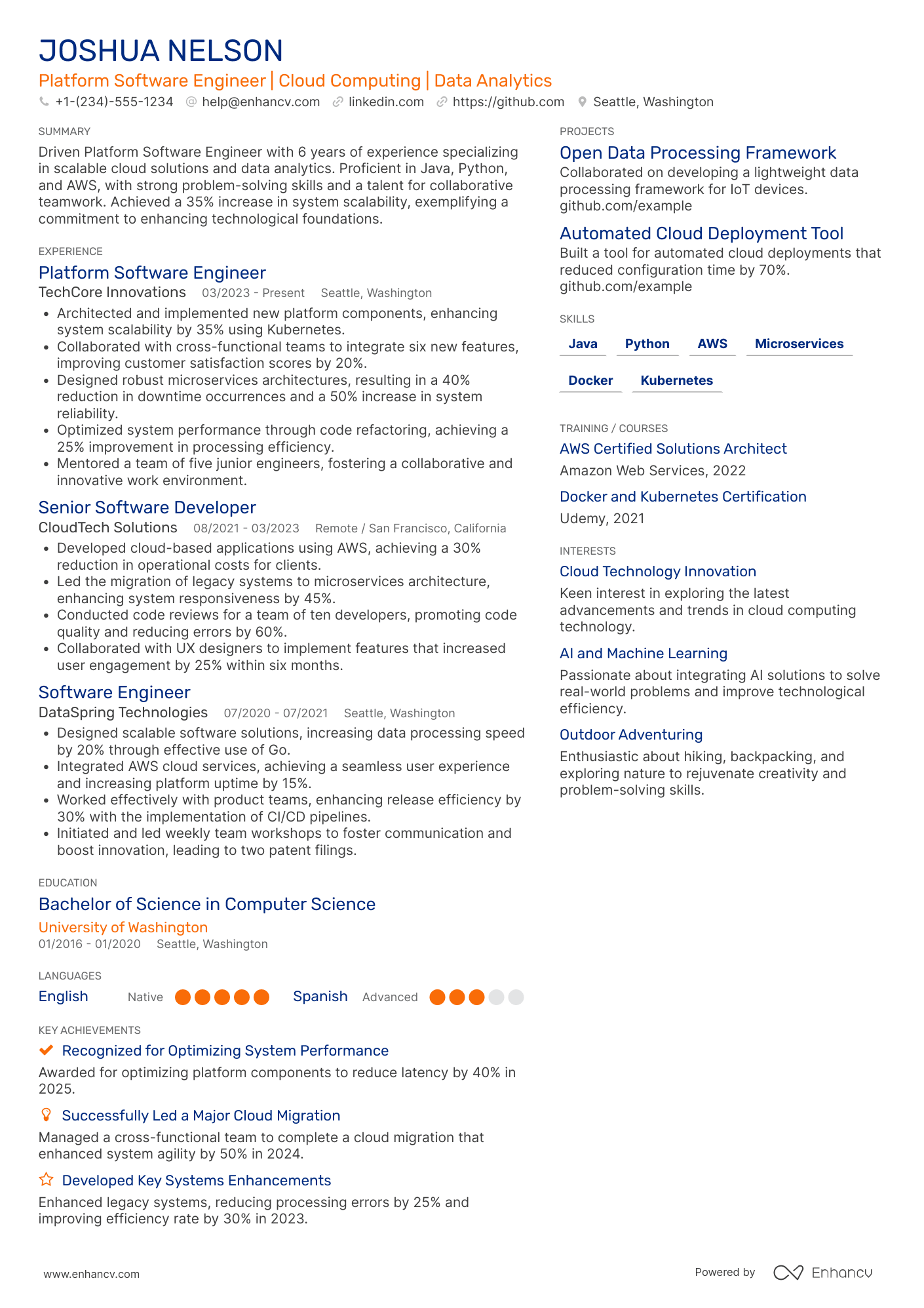
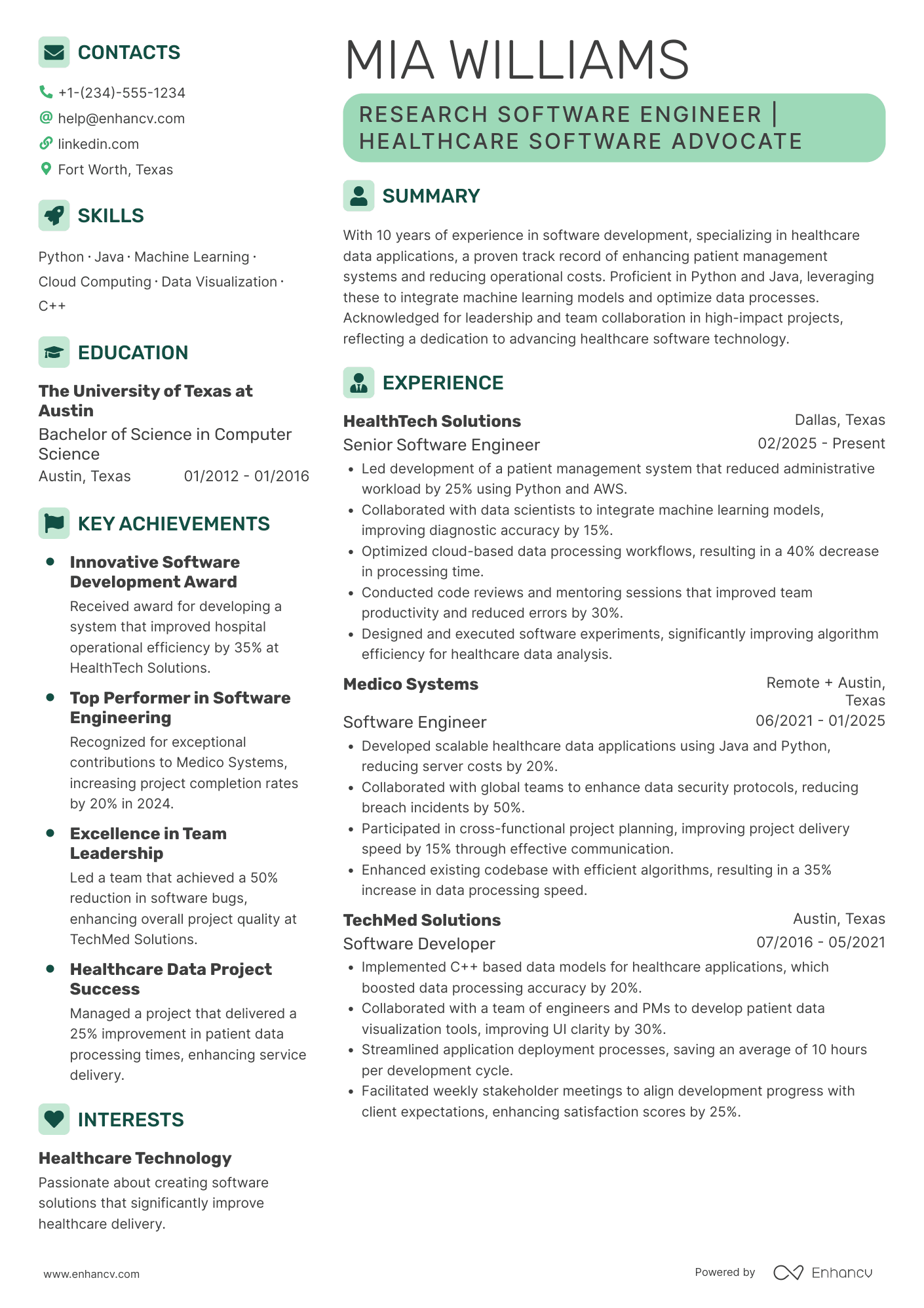
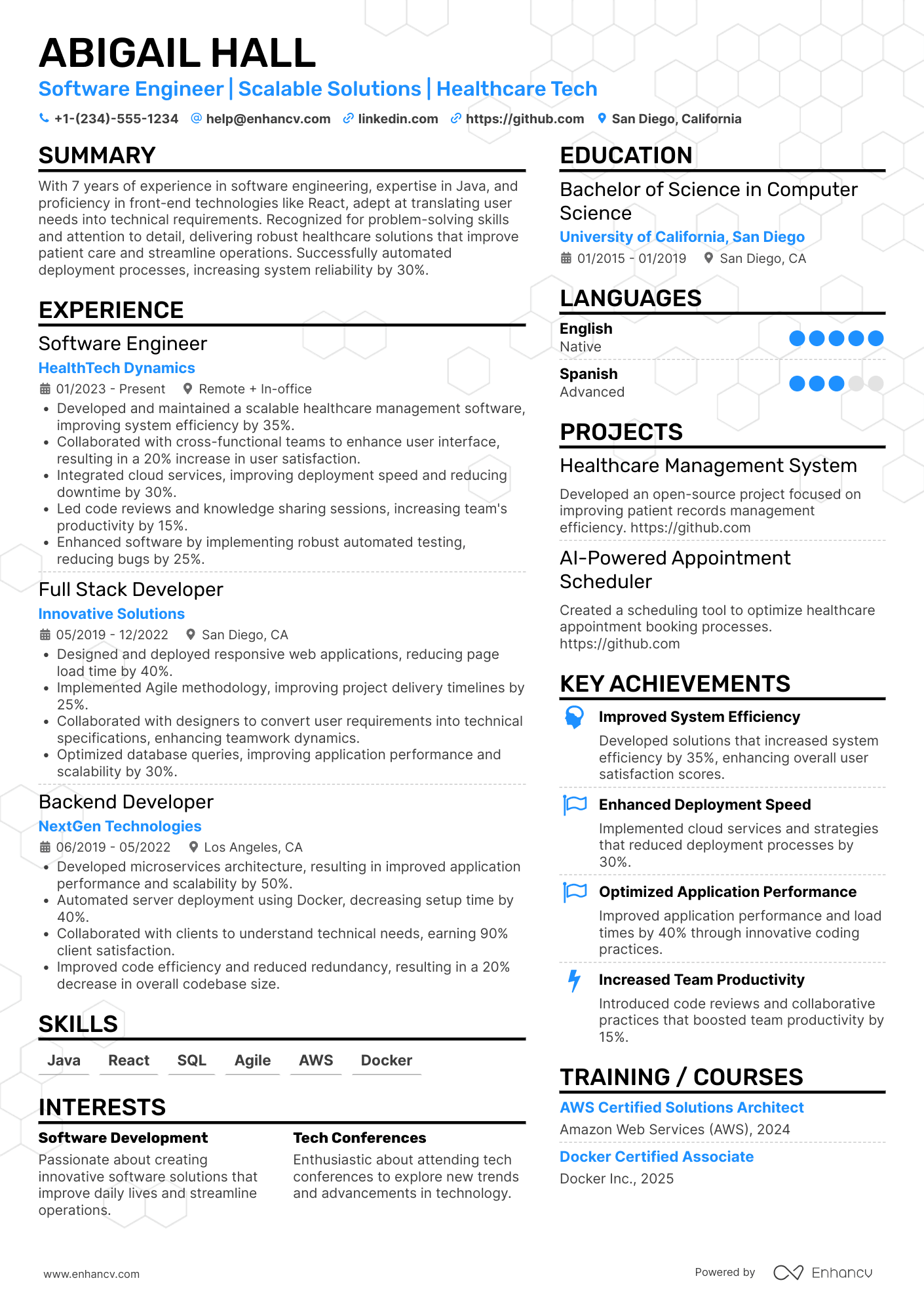
As a software engineer, you are like a swiss army knife, able to adapt and meet expectations with whatever task that’s thrown at you. Whether you’re engineering modern applications with JavaScript or designing and implementing PHP web applications, your software engineering success hinges on your ability to innovate and achieve your client’s expectations.
In that same way, you want to create a software engineer resume which achieves your goal: to land your dream job. At Enhancv, our job is to create resumes which allow you to get your foot in the door and to gain a highly sought after interview.
In this article, we will provide you with:
- How to detail your unique software engineer experiences over a wide variety of disciplines, such as mastery of programming languages, web development, and software development methodologies;
- How to summarize your career achievements in delivering scalable and robust software solutions;
- How to highlight your certifications from recognized bootcamps or specialized courses in AWS and Azure.
Before you go on, there are other resume examples with guides that can be relevant for you:
- Front-end developer resume
- Back-end engineer resume
- Full-Stack developer resume
- Python developer resume
- Node.js developer resume
- PhP developer resume
- Net developer resume
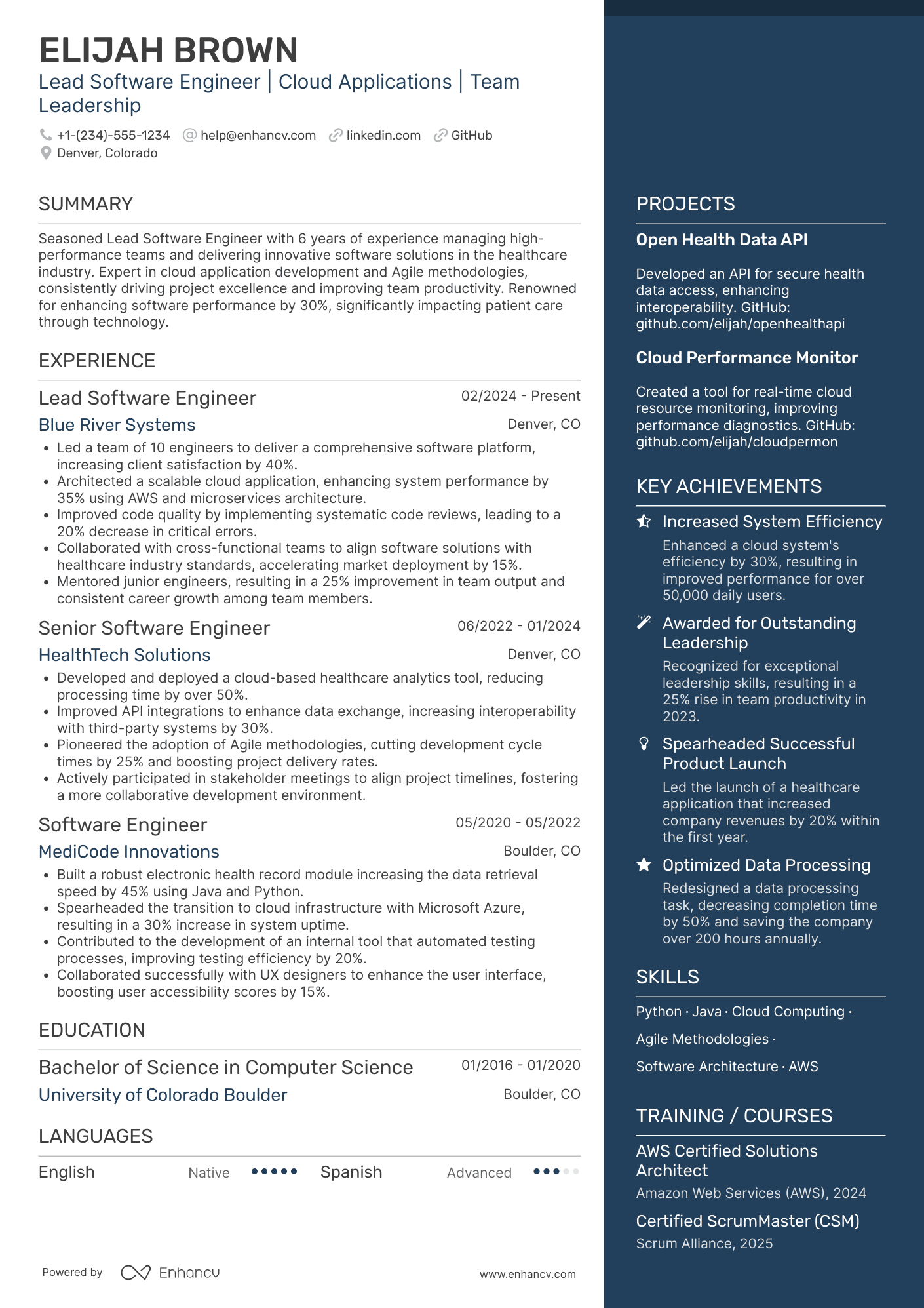
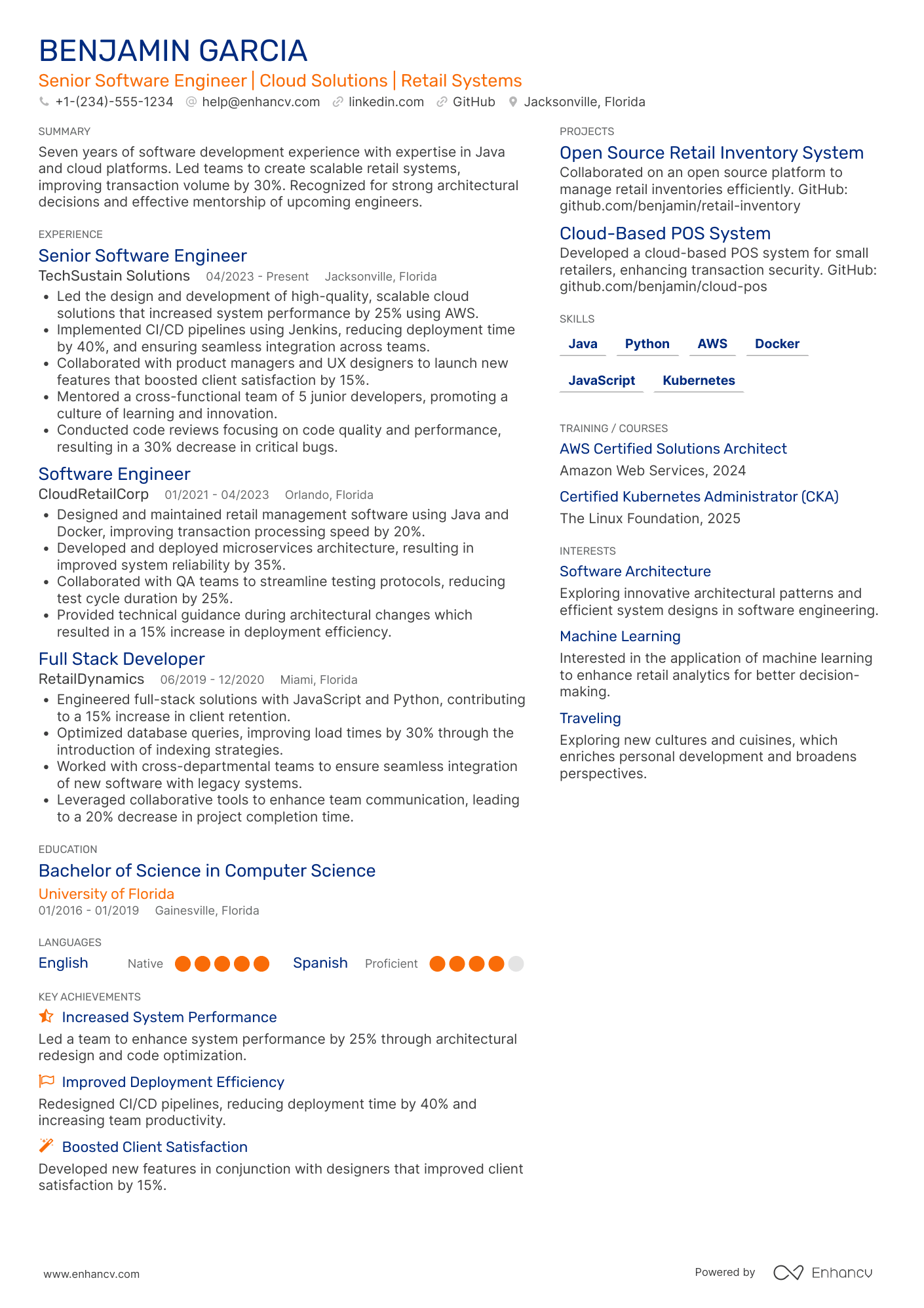
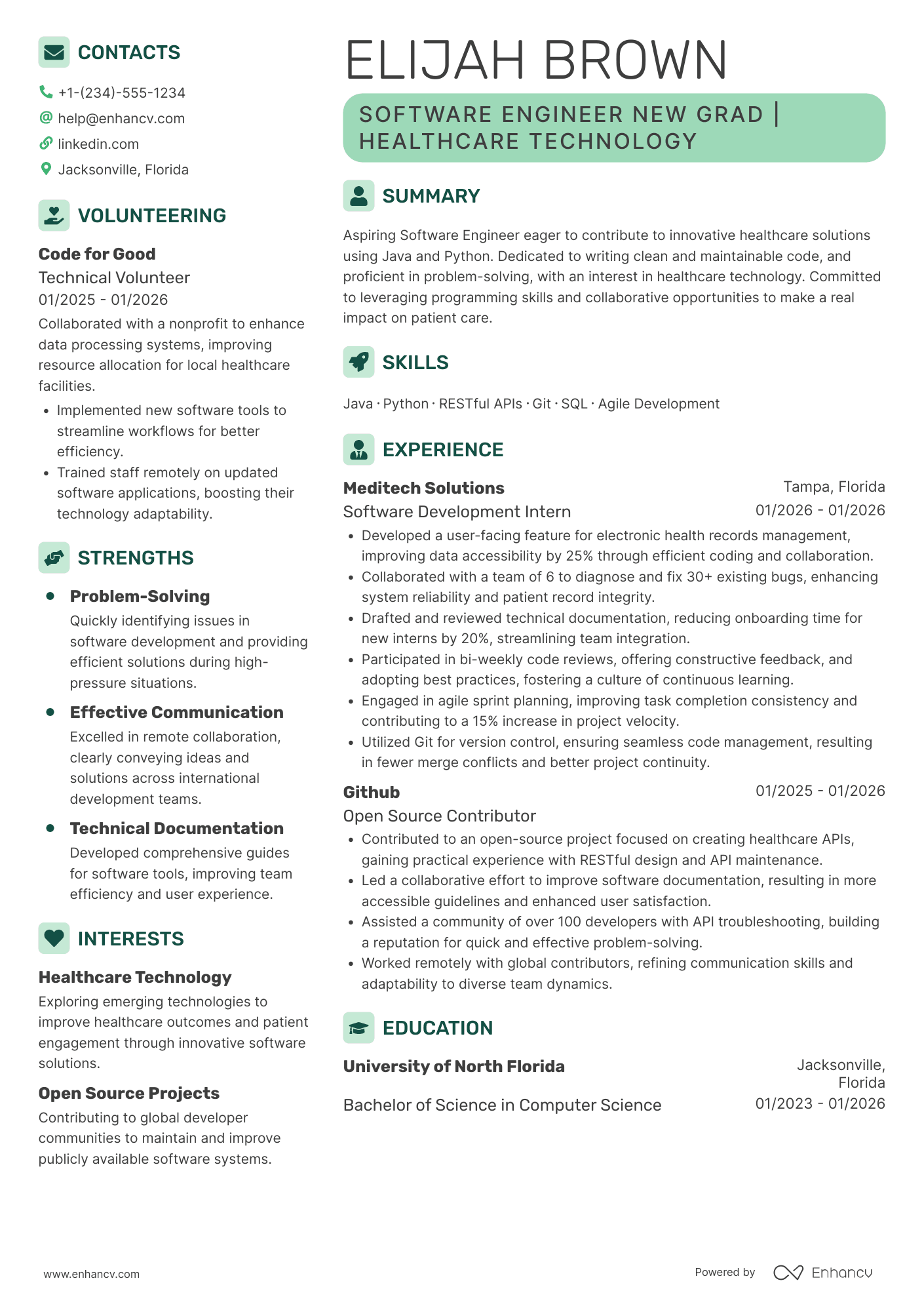
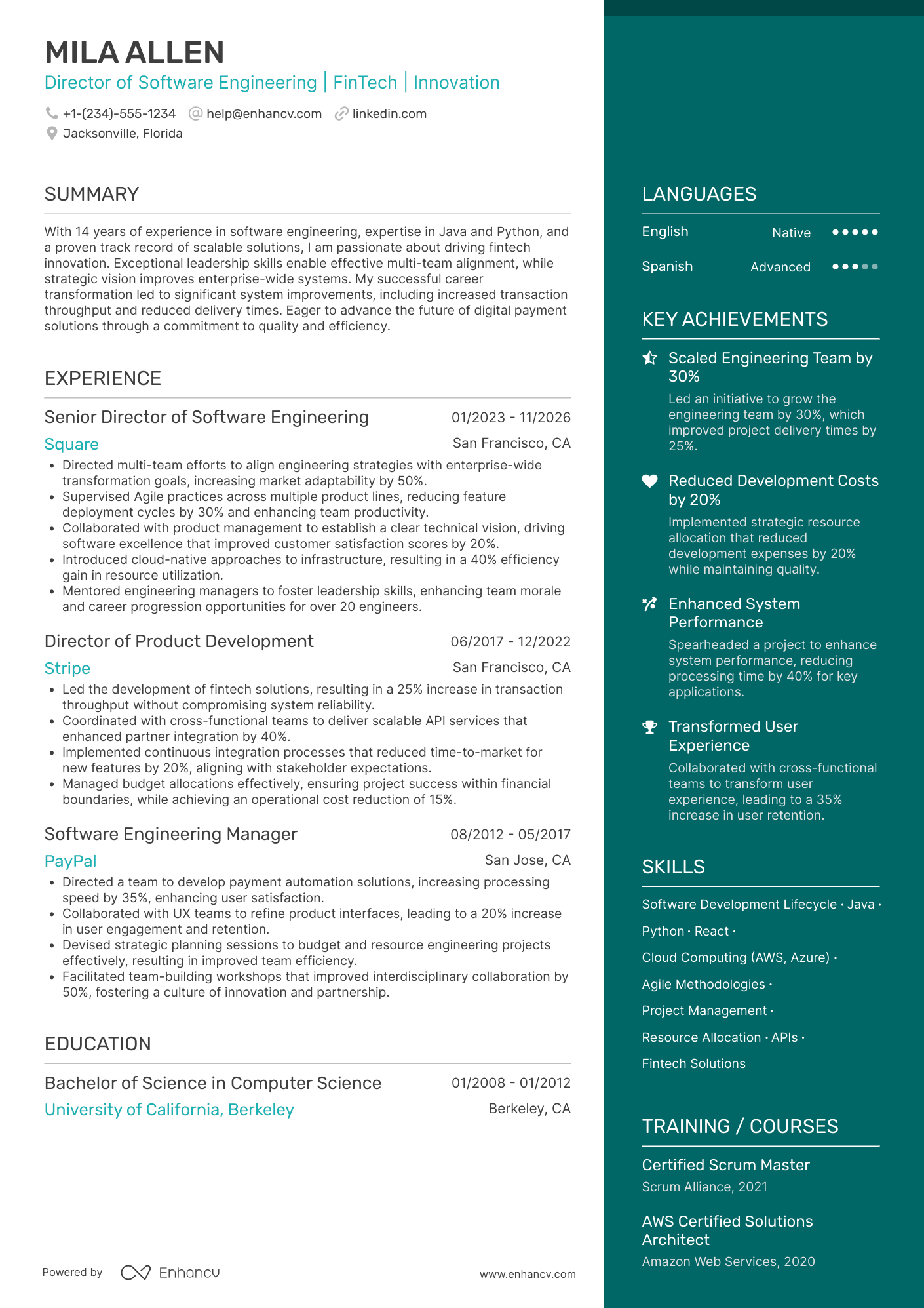
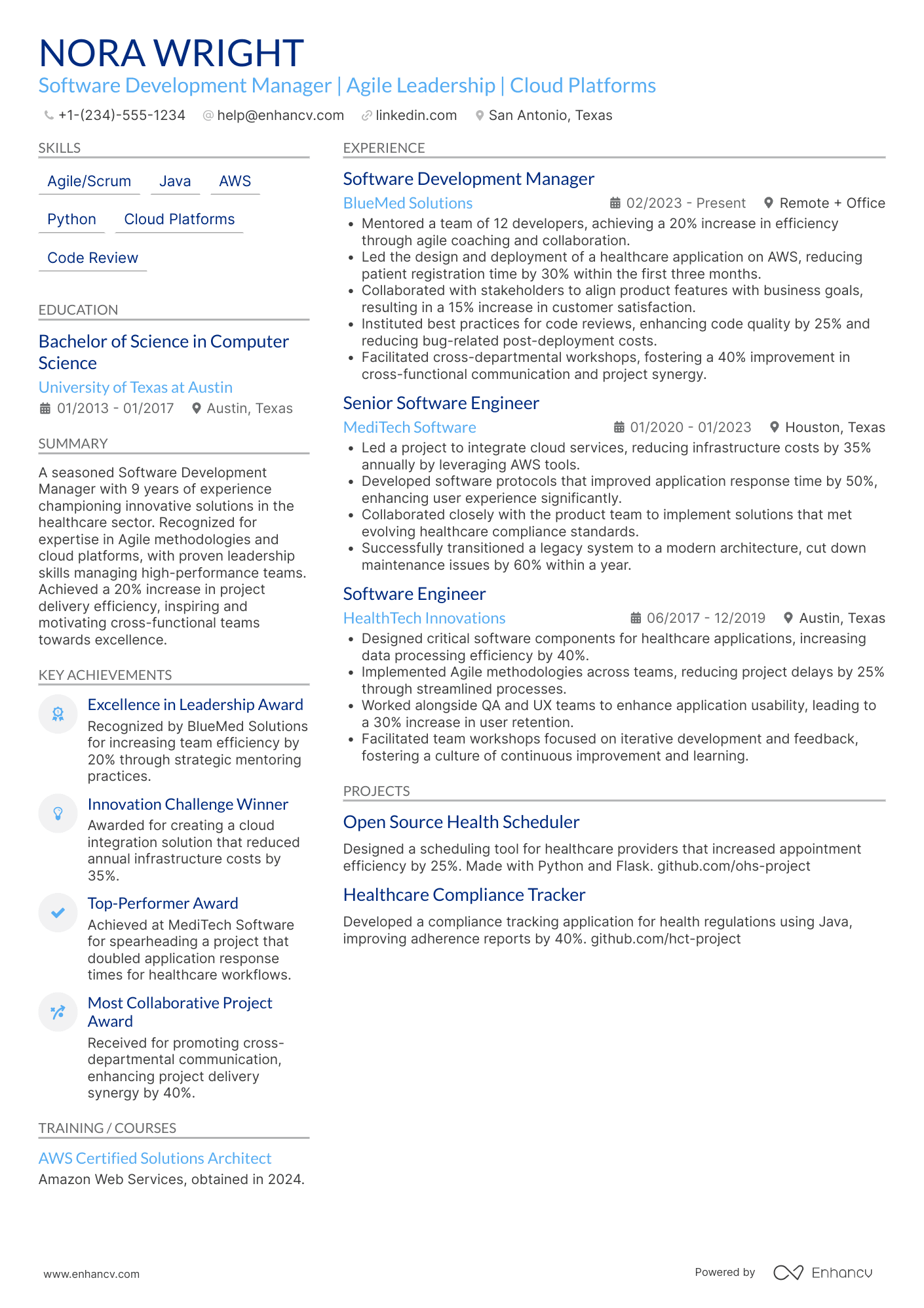
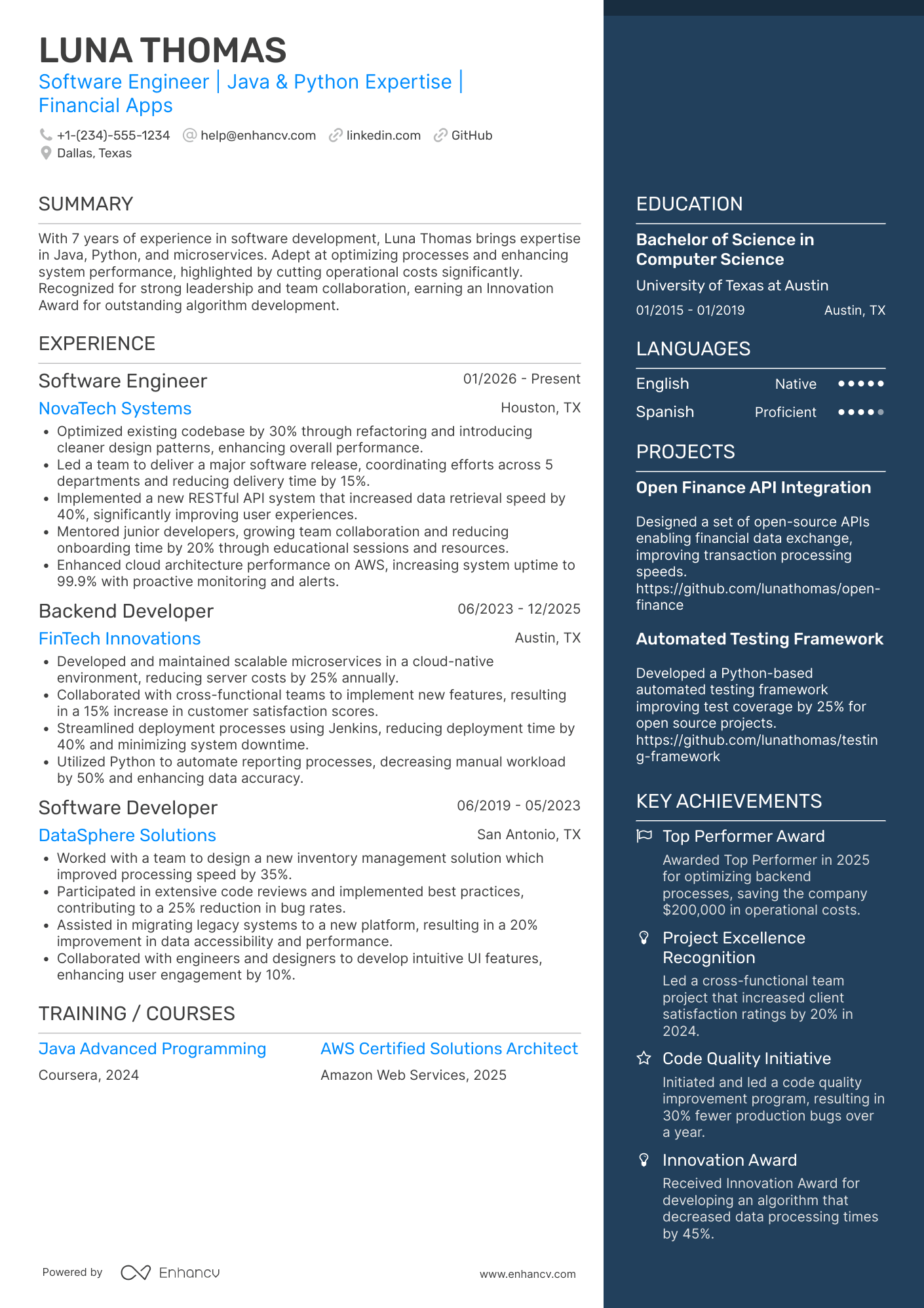
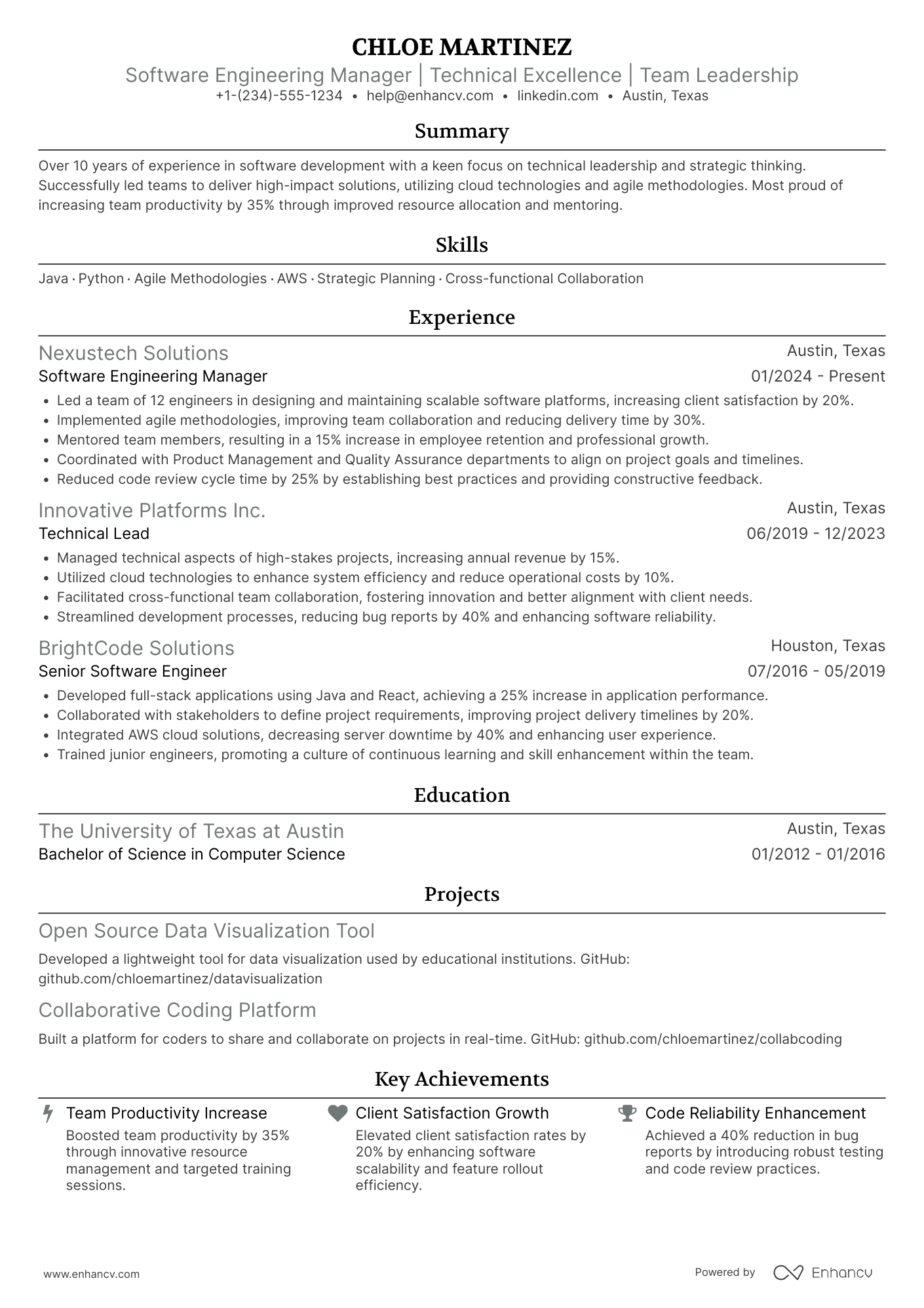
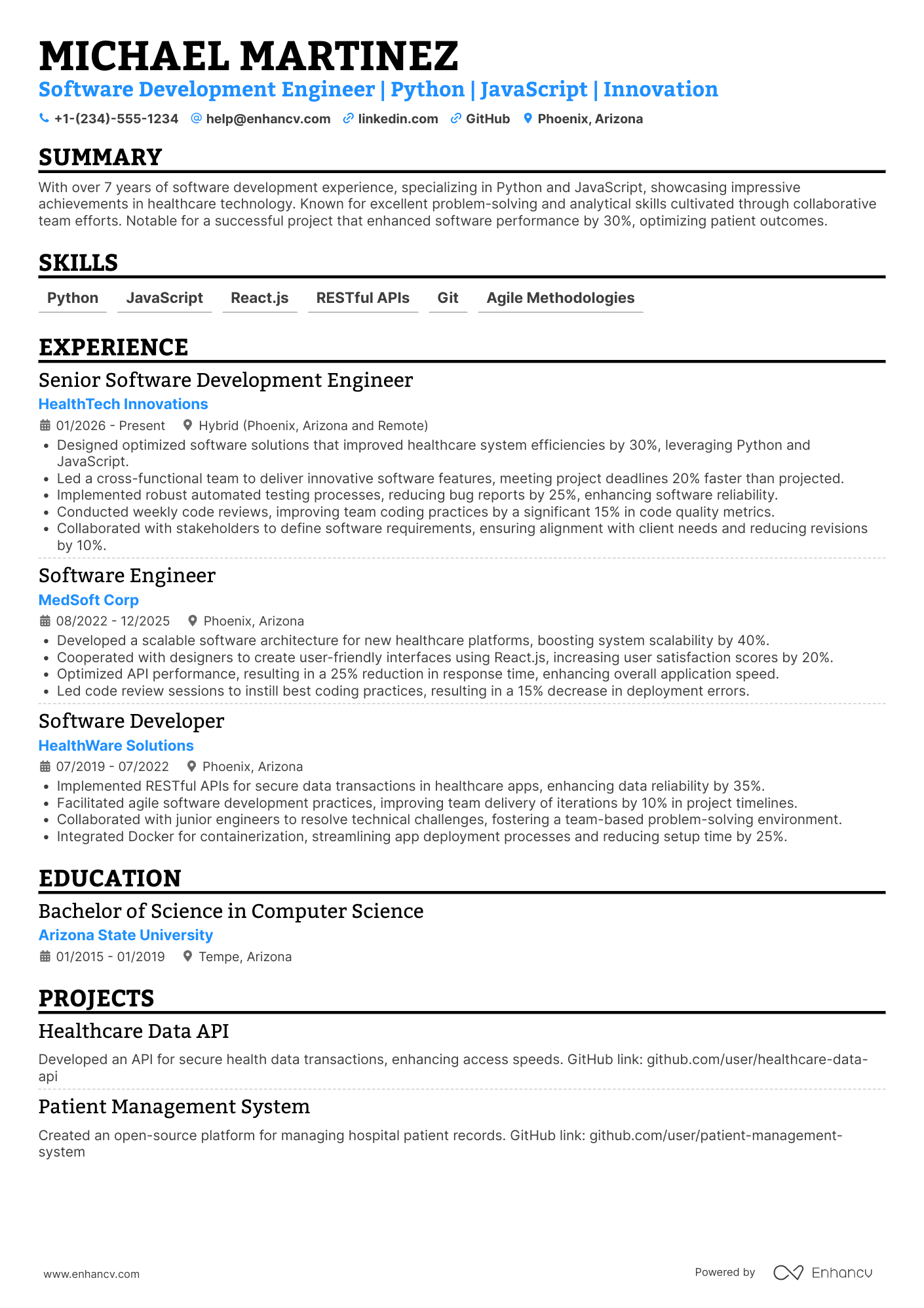
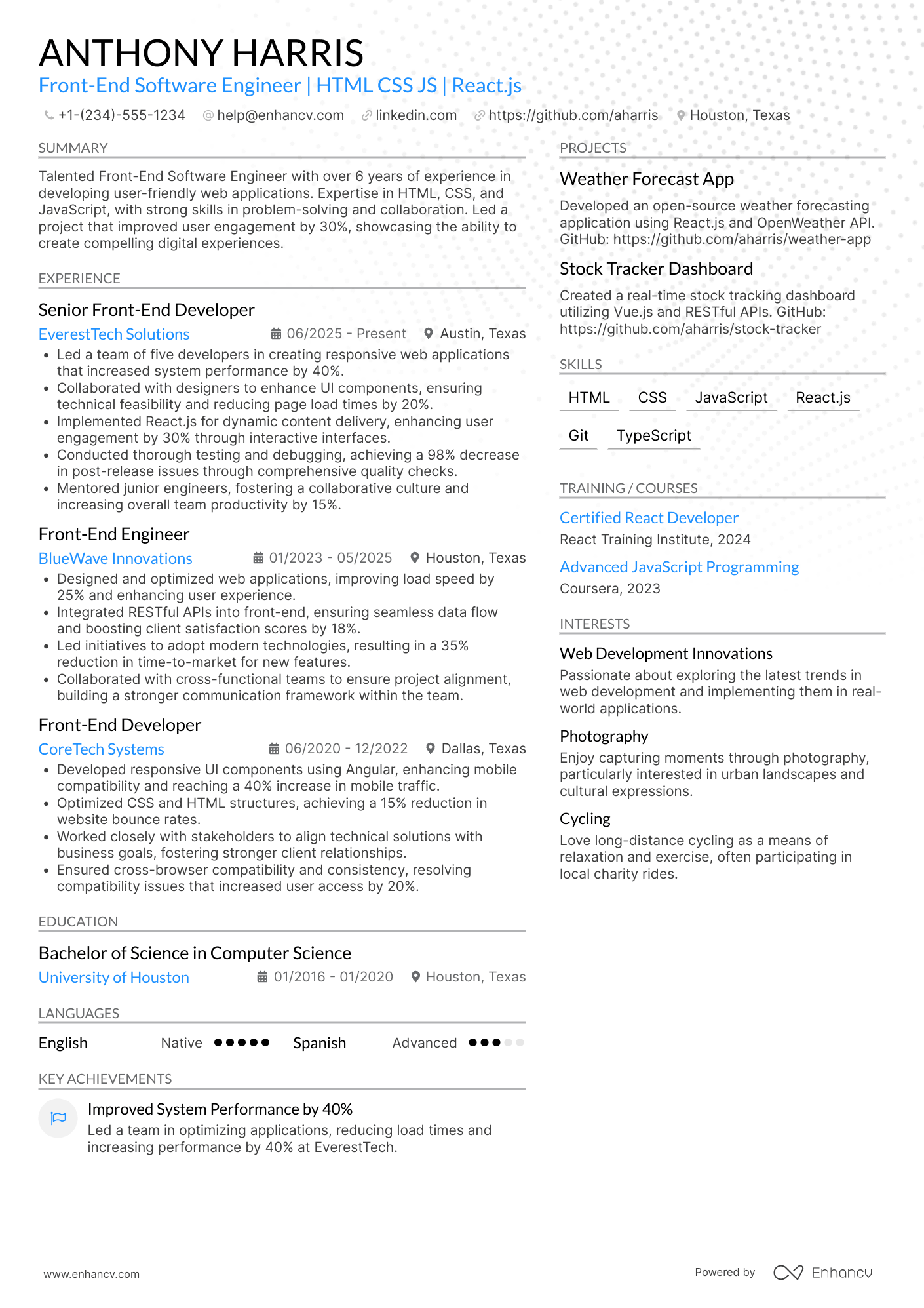
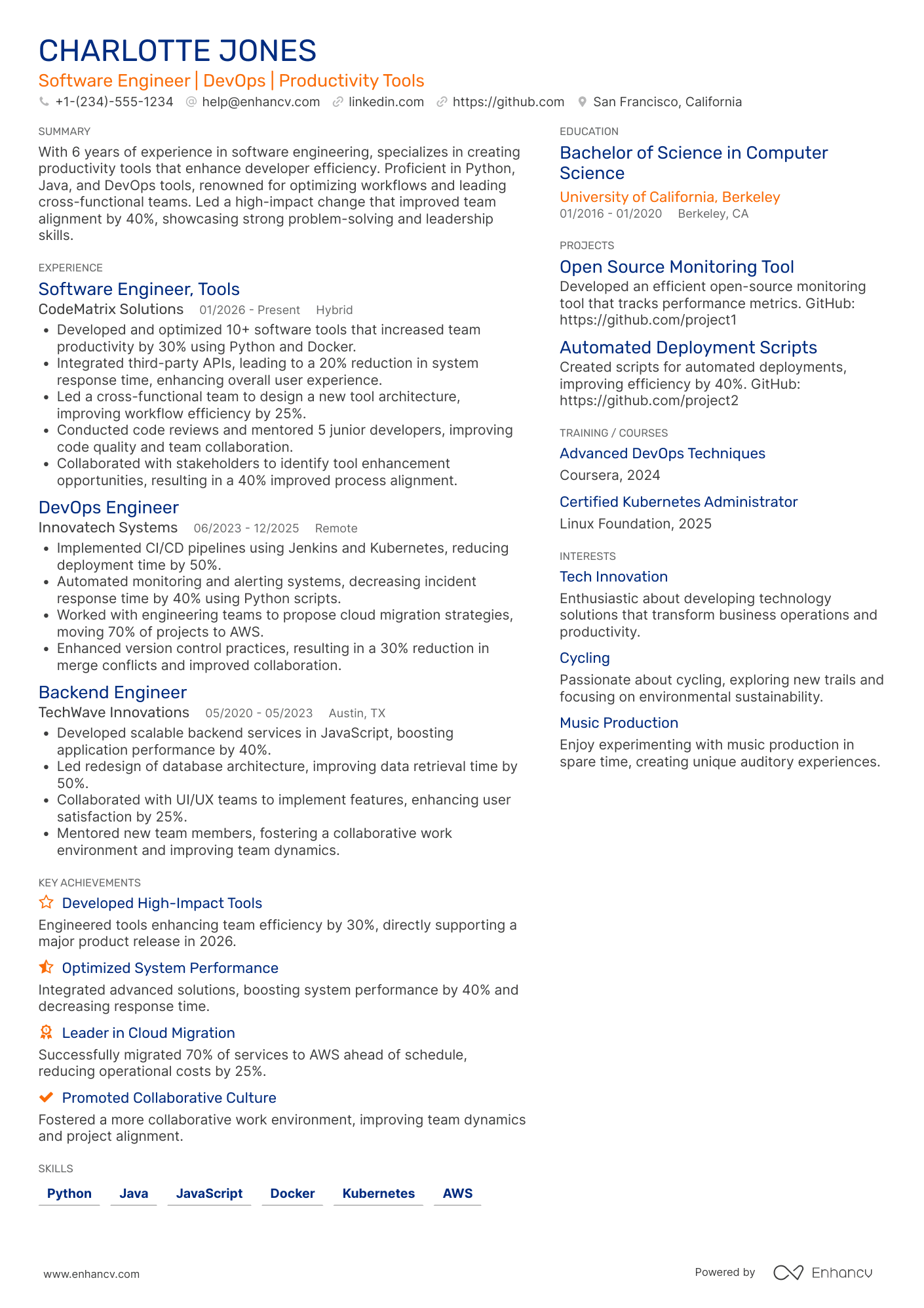
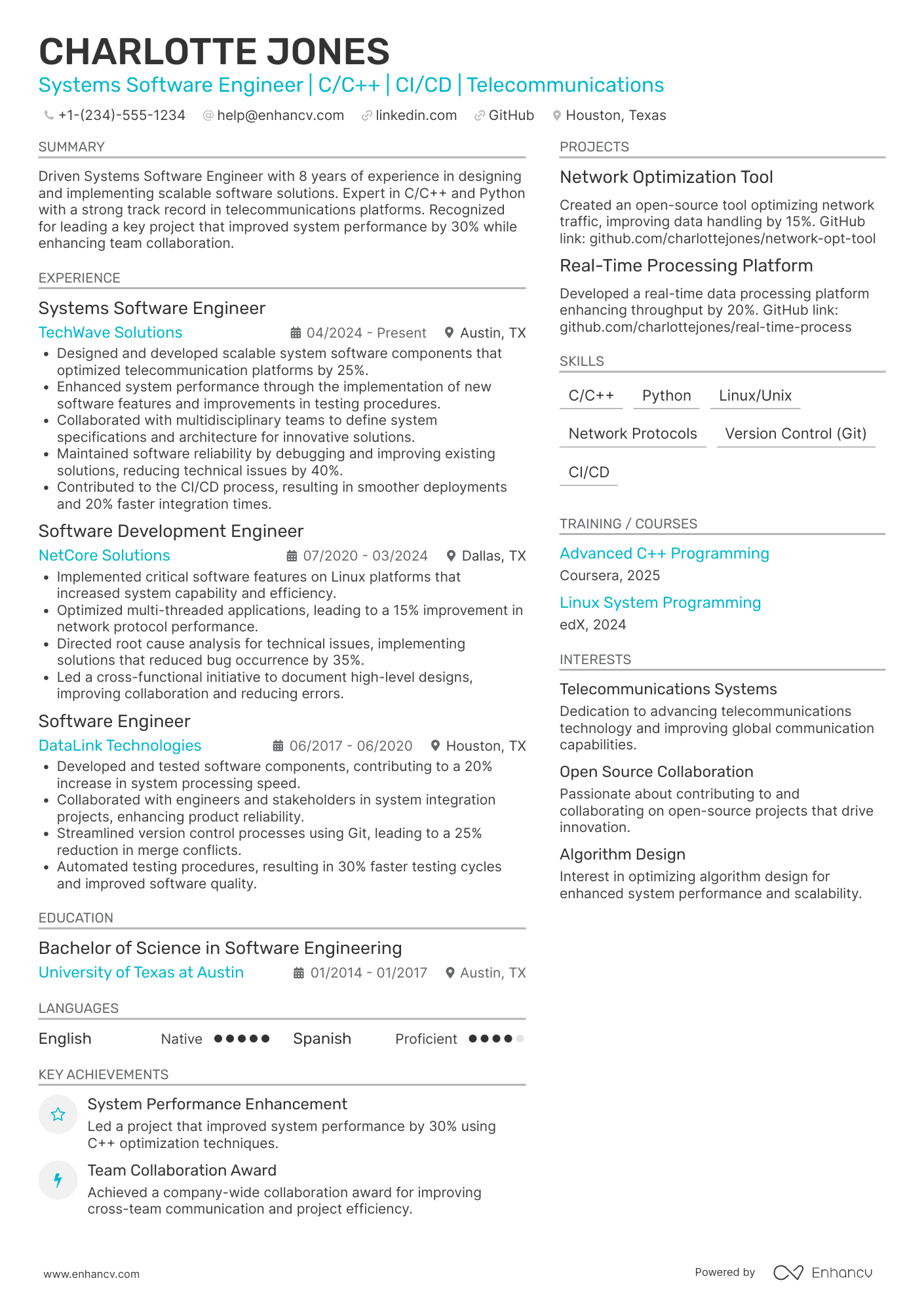
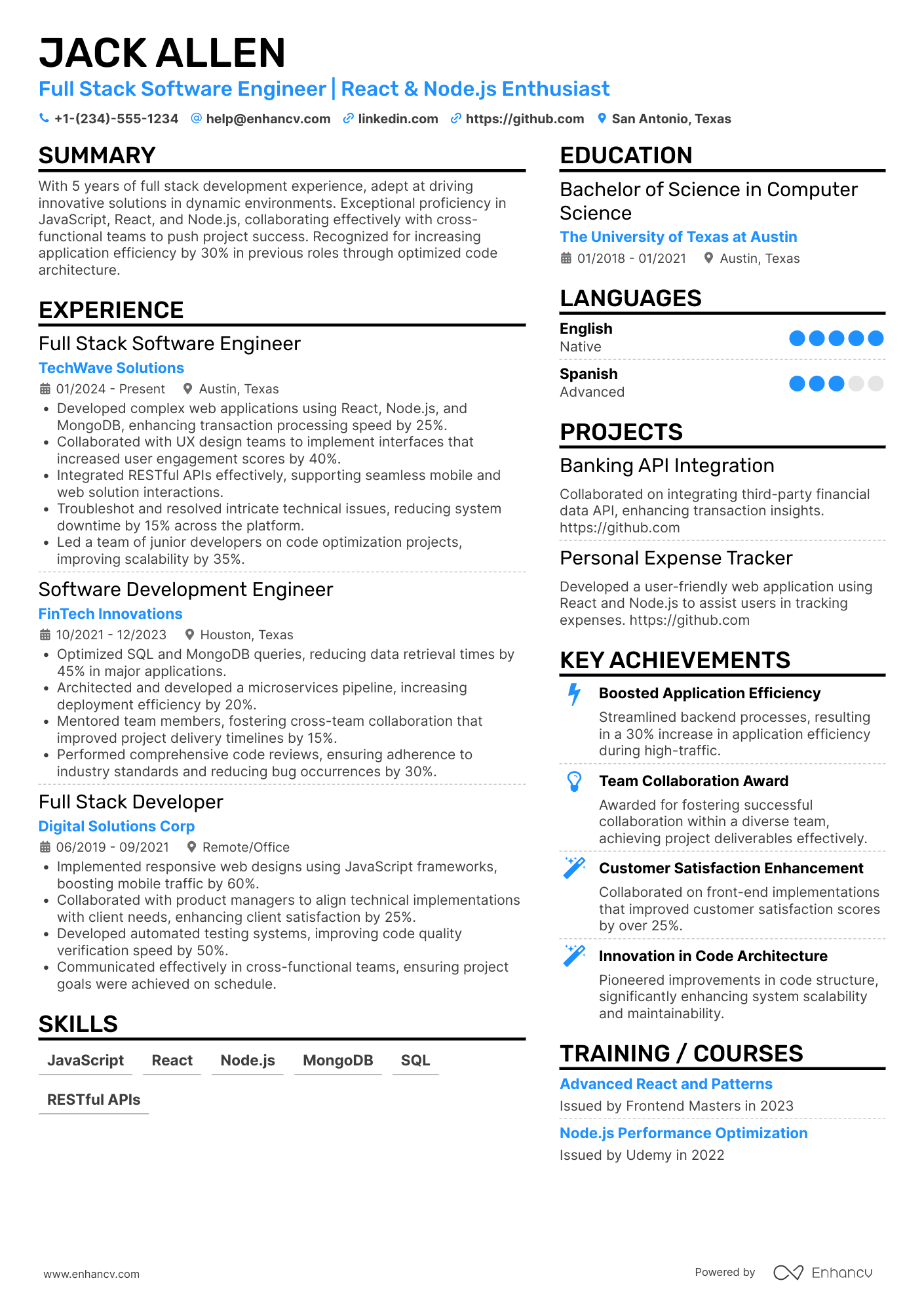
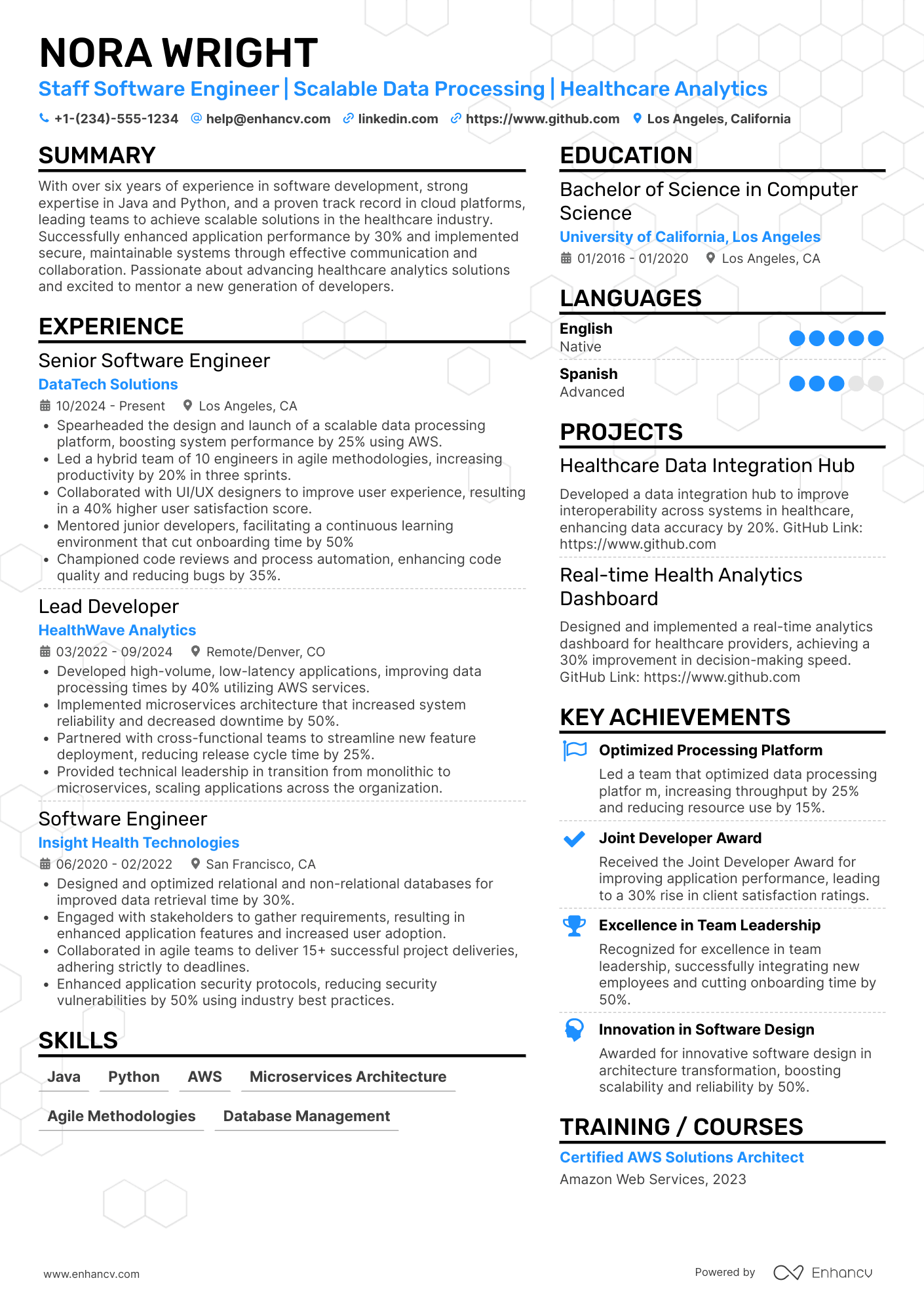
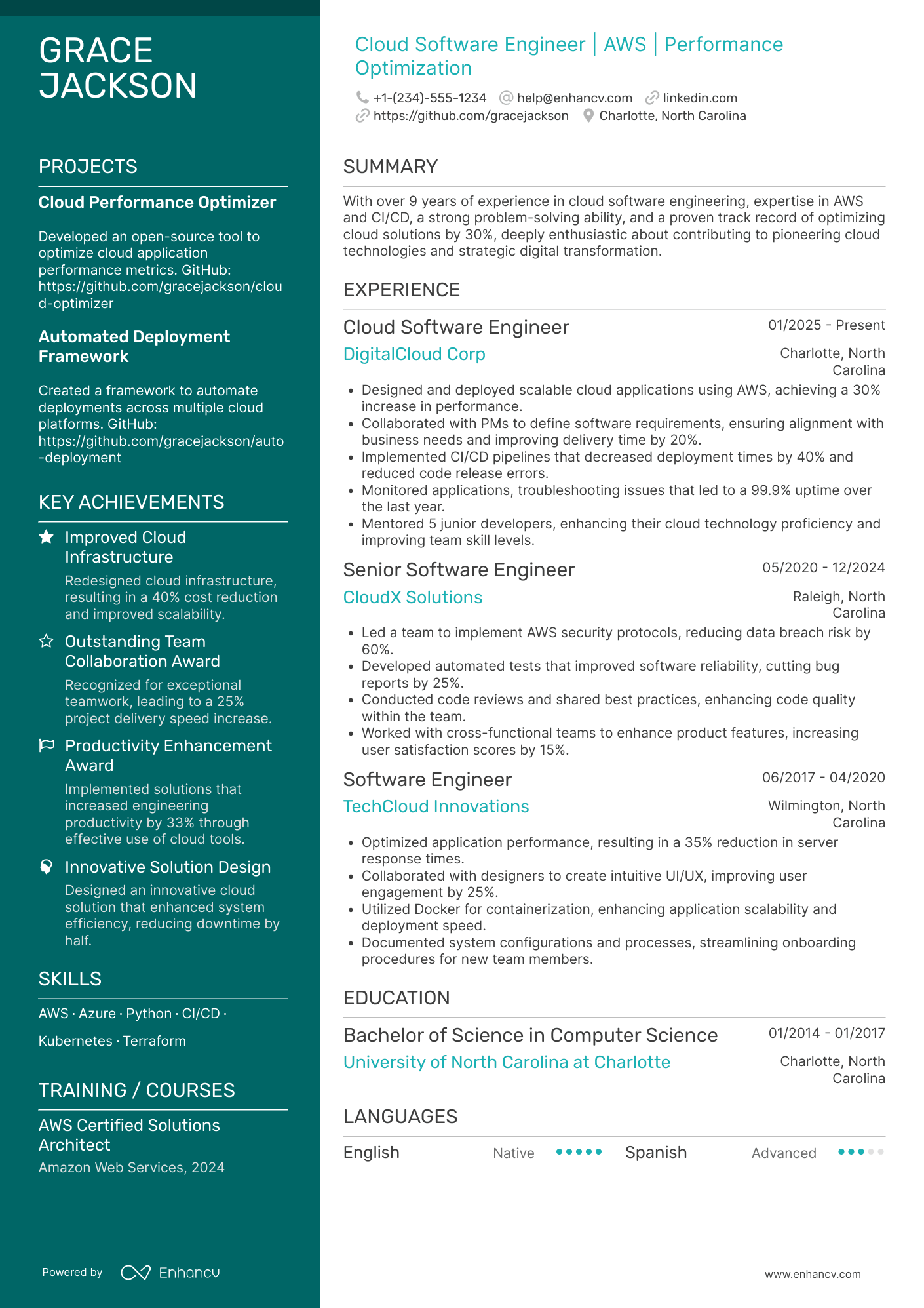
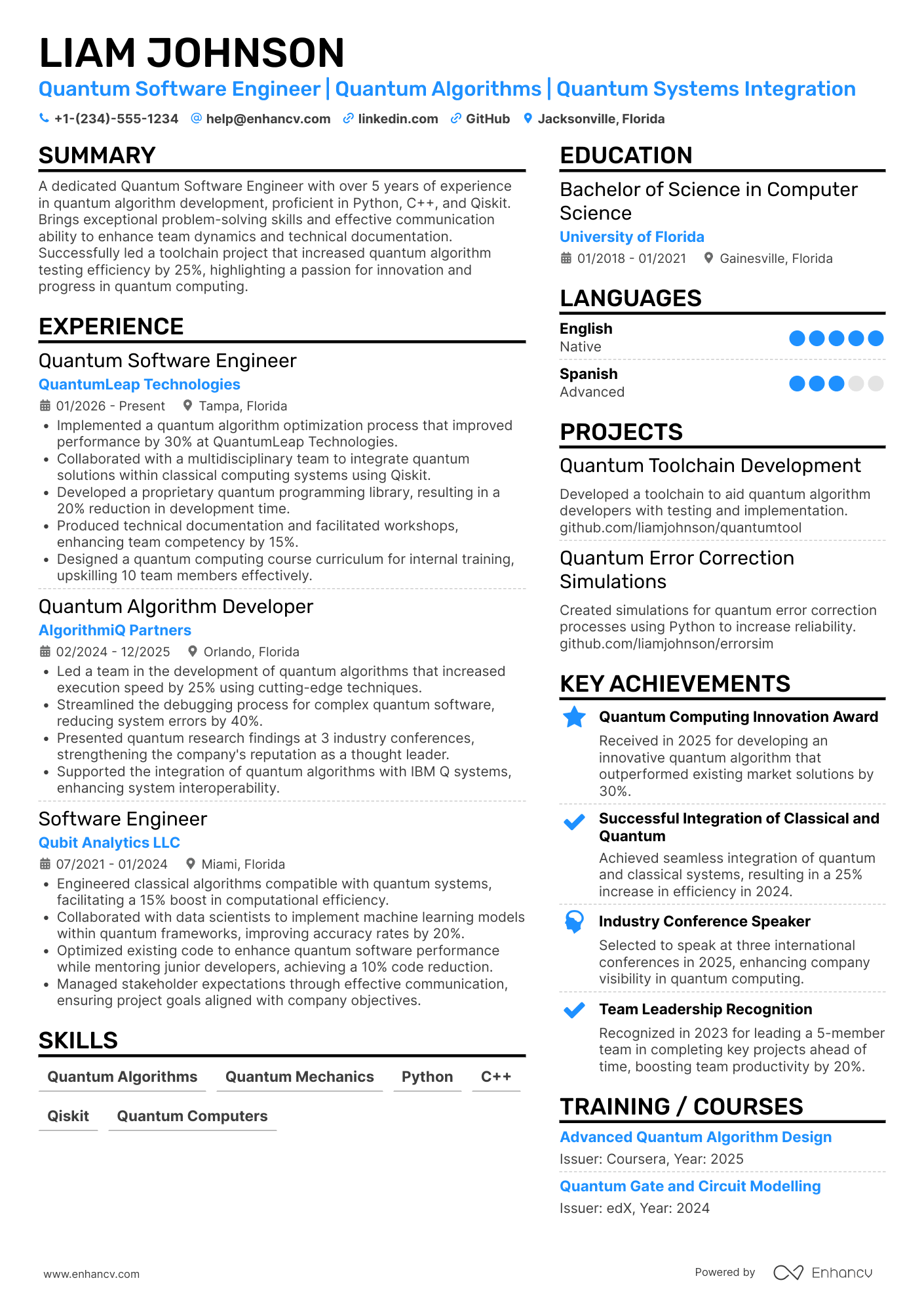
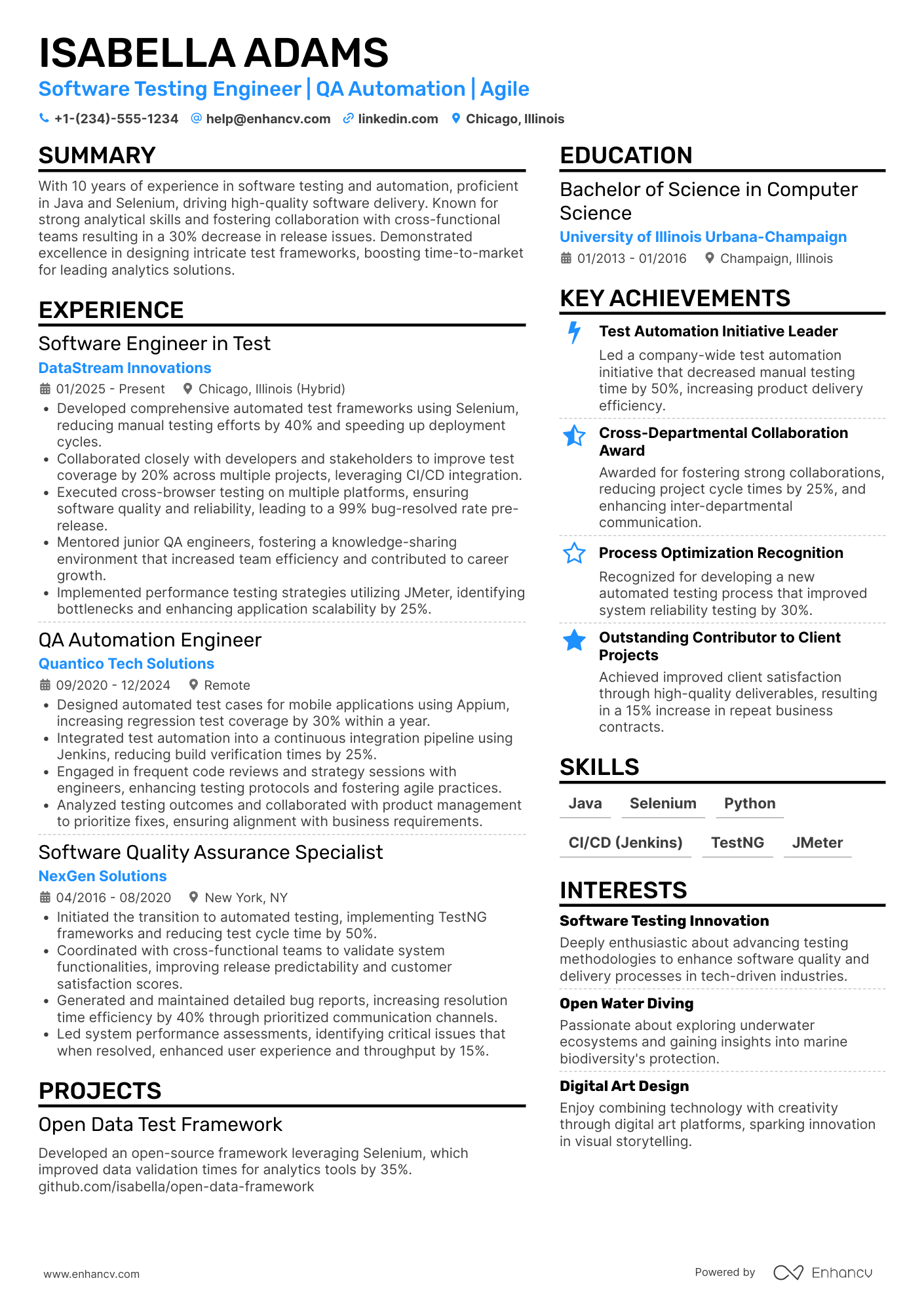
Software engineer resume example
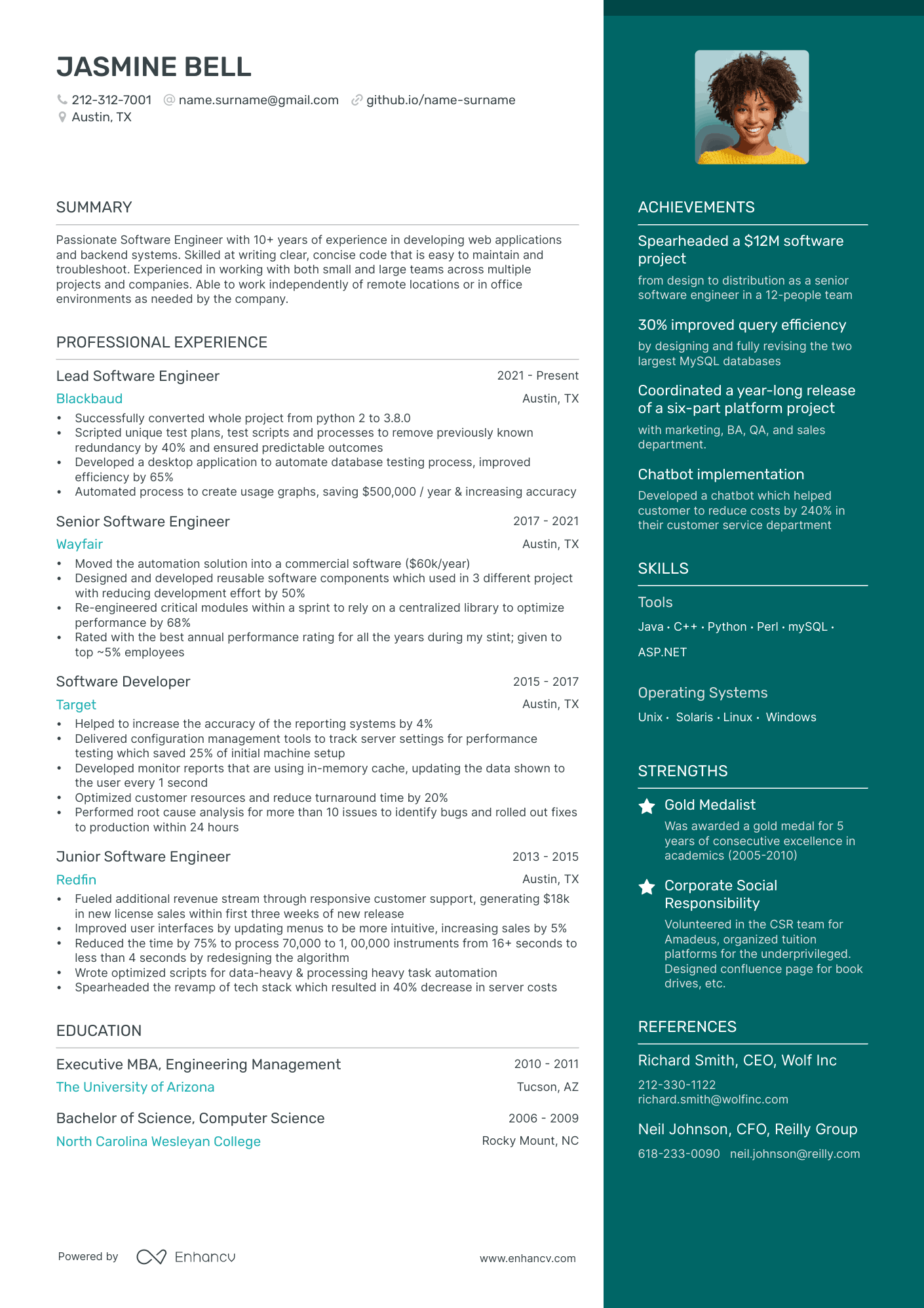
What does this resume example do well?
- Focusing attention on their programming skills: First, the author of this resume highlights their knowledge of programming languages. But they also list the operating systems they are comfortable working with, while also highlighting it throughout their resume. In fact, in their achievement section, they even mentioned that they created a unique Chabad which reduced customer costs by 240%.
- Showcasing their achievements through real-world numbers: Right as soon as your eyes glance over to the right side of the page, one phrase immediately sticks out, “Spearheaded a $12M software project.” The author of this resume chose to highlight their achievements through quantifiable, real-world examples. They shared that they increased efficiency by 30%, and successfully coordinated a yearlong project. These points prove to a potential hiring manager they are competent and able to handle a position.
- Highlighting their strengths: In addition, the author of this resume has a large section focused on their strengths. In this section, you can see the author mentions they were gold medalists for excellence in academics for five years.
How to format a software engineer's resume
As a software engineer, you should approach your resume like you would a line of code. When you format your code, you’re not just doing it for aesthetic reasons, but you’re doing it to enhance readability and make the codebase easier to maintain. In that same way, a properly formatted resume can enhance the readability of your resume for a potential hiring manager. In fact, by just making small tweaks to your resume, you can present yourself in a much more appealing way and potentially position yourself to get that much sought-after interview.
Below, you’ll find some helpful tips to keep in mind when you’re formatting your resume:
- Reverse Chronological Format: when drafting your resume, use a reverse chronological format that lists your most recent experience first. This allows an employer to see where you currently are, while also providing them with previous experience to show how far you’ve come.
- Header and contact info: Your resume header is literally the first thing that a recruiter will look at, so it’s important to include important information about you in it. You should include contact information in your header, including your name, phone number, email, location, and possibly even your portfolio or GitHub link.
- How many pages?: Although there is no rule written in stone, it’s best to keep your resume between one and two pages. If you’ve been in the same field for less than 10 years, then one page should work, and more than 10 years, you might need two pages. If possible, only include highly relevant experience on your resume.
- File format: Unless otherwise requested, use the PDF file format. This is because a PDF file format is easier to share than a Word document and the photos and text won’t get shifted around.
Targeting Canada? – Keep in mind their resume layout may differ from others.
Is your resume good enough?
Drop your resume here or choose a file. PDF & DOCX only. Max 2MB file size.

The top sections on a software engineer resume:
- Resume Summary: Your resume summary is your first opportunity to share about your goals and aspirations for your career with a hiring manager. It should be short, between two to four sentences, and should focus on specific skills and abilities that you bring to a teaching environment.
- Experience: Your experience section may be the most scanned section of your resume, so include only the most pertinent work experience for the role.
- Education: Your education section is a key part of your resume, especially in the IT field. If you attended a prestigious university, then it can be an opportunity to showcase the highly specialized skills you picked up at your alma mater.
- Skills section: Your skills section can make you stand out from the crowd. In your skills section, don’t be afraid to brag about yourself, listing your most important skills that apply to the position.
- Certifications, licenses, and awards: As a software engineer, having unique certifications can help you show that you fit a specific niche in a company. For example, if you are an AWS Certified Solutions Architect, include that on your resume because you can show a unique competency with cloud computing.
What hiring managers want to see on a software engineer resume
- Unique technical skills: Recruiters want to see what will add value to the company that you’re applying for, especially knowledge of common programming languages (JavaScript, Python, and SQL), frameworks, tools, and technologies you are proficient in.
- Projects and Contributions: Being a software developer is a creative endeavor, so you can draw the attention of a hiring manager by listing the projects that you’ve completed. Describe your role, the technologies used, and the impact of the project. You may also want to list open-sourced projects and personal pet projects that showcase your passions.
- GitHub or Portfolio: Your resume can only go into so much detail about the projects that you’ve worked on. That’s why you may also wish to include a link to your GitHub profile or portfolio.
- Ability to Collaborate: software engineers move in wide circles, working with several teams in a company ranging from management and the sales department. Having the ability to work in a team is a great asset as a software engineer. Using real, quantifiable examples from your career to highlight your ability to collaborate is best.
How to write your software engineer resume experience
Your resume experience section will be the first thing that a recruiter looks for when they scan your resume. They’ll scrutinize the contributions that you made in your previous role, checking to see what impact you made. That’s why you should bolster your experience and skills with real, quantifiable examples from your career.
Below, you’ll find a list of two experience sections. One of them will be the correct way to fill out an experience section, while the other will be a resume section that falls below expectations. Use both examples as a guideline to create your own:
 05/2021 - 05/2023
- •Helped to implement Agile methodologies within a cross-functional team of software engineers.
- •Conducted regular code reviews and mentored junior developers.
- •Actively participated in the evaluation and selection of new technologies and tools to improve development processes.
- •Designed and developed a scalable microservices architecture using Node.js and Docker.
What’s the issue with this resume experience section?
There’s not a single quantifiable example here. What exactly did implementing Agile methodologies do in your previous job? There’s nothing here to show the impact that the applicant made. Also, some of the weak verbs should be changed to active, engaging verbs. The verb ‘helped’ is a weak verb, which could be shifted to ‘collaborated’ or just simply ‘implemented’.
05/2021 - 05/2023 - •Led a cross-functional team of five engineers in the successful implementation of Agile methodologies, resulting in a 20% increase in project efficiency and on-time deliveries.
- •Conducted regular code reviews and mentored junior developers, resulting in a 30% improvement in code quality and adherence to coding standards.
- •Actively participated in the evaluation and selection of new technologies and tools to improve development processes.
- •Designed and developed a scalable microservices architecture using Node.js and Docker, reducing response times by 40% and ensuring high availability for a customer-facing application serving over 1 million users.
What does this do right?
There are quantifiable examples scattered throughout this resume experience section, and this helps to show the impact that the applicant has made in their previous roles. Not only that, but the applicant uses unique keywords of specific programming languages and open-source server platforms which would help their resume make it through a scan by applicant tracking systems (ATS).

Pro tip
Start every one of your bullet points with a power verb to make them super impactful. Examples of power words include collaborated, developed, advocated, facilitated, and transformed.
How to quantify impact on your resume
It’s important to quantify the impact you’ve made in previous roles because you can add credibility to the claims that you make. Chances are, as a software engineer, you’ve spent a great deal of time creating and developing software, fixing bugs, and creating programs and applications that can benefit people. But you likely have spent very little time reflecting on the impact that you’ve made.
Potential hiring managers don’t want to see a bland list of the things that you’ve done. They want to see real-world examples of the difference you’ve made. In order to do this, use the PAR (Problem-Action-Result) method to refine your contributions. List a specific problem and then share the actions you took to achieve a specific result.
Below, you’ll find a list of the top quantifiable achievements to include on your resume:
- Scalability: “Designed and implemented a scalable microservices architecture, enabling the application to handle 3x more concurrent users.”
- Bug Reduction: “Achieved a 15% decrease in post-release bug reports by implementing comprehensive testing suites.”
- Increased Application Performance: “Improved application response time by 30% through code optimization.”
- Efficiency Improvements: “Automated deployment processes, reducing deployment times from 4 hours to 30 minutes.”
- User Growth: “Contributed to a feature that increased user engagement, resulting in a 25% growth in monthly active users.”
- Customer Satisfaction: “Resolved customer issues with a 24-hour turnaround time, leading to a 20% increase in customer retention.”
How to list your hard skills and soft skills on your resume
In the IT field, you’ll likely find it easier to go into detail about the hard (technical skills) that you possess. You have a technical education which has allowed you to develop your coding and programming languages to become proficient in them. No doubt when someone asks what you do for a living, you might list off several technical skills you have and explain how that fits into your role in a company.
These technical skills may form the core of your experience, but you also possess soft (also known as people) skills. Whenever you collaborate with an interdisciplinary team filled with marketing experts, managers, and research and development professionals, you have to use communication skills to explain the decisions and actions you’ve taken.
Below, you’ll find two lists. The first one lists all the hard skills a software engineer should include on their resume. The second will include all the soft skills to include.
Best hard skills for your software developer resume
- Programming Languages: Java, Python, C++, C#, Ruby, JavaScript, PHP, Swift, Go, Kotlin
- Web Development: HTML/CSS, JavaScript frameworks (e.g., React, Angular, Vue.js), Front-end and back-end development, RESTful API design and implementation, Responsive web design
- Database Management: SQL (Structured Query Language), Database design and modeling, MySQL, PostgreSQL, MongoDB (NoSQL), Microsoft SQL Server
- Version Control/Git: Git, GitHub or GitLab
- Software Development Methodologies: Agile (Scrum, Kanban), Waterfall, DevOps practices
- Integrated Development Environments (IDEs): Visual Studio Code, IntelliJ IDEA, Eclipse, PyCharm
- Operating Systems: Linux/Unix, Windows, macOS
Best soft skills for your software engineer resume
- Problem-Solving
- Teamwork
- Adaptability
- Attention to Detail
- Time Management
- Critical Thinking
- Creativity
- Empathy
- Leadership
- Conflict Resolution
- Customer Focus
- Self-Motivation
- Professionalism
- Collaboration
- Open-Mindedness
5 examples of skills to include on your resume:
- Collaboration: “Provided leadership to an interdisciplinary team as the subject matter expert on hosting issues, staff and customer logins, and upgrades to servers.”
- Problem-solving skills: “Created ecommerce sites integrated with PayPal, Authorize.net, and other payment APIs. Navigated issues related to a complex ecommerce site.”
- Leadership: “Led a team of 5 programmers to structure several internal systems, including custom REST APIs through Python.”
- Attention to detail: “Refined the application’s features to root out and fix bugs, which optimized overall performance, efficiency, and reliability.”
- Adaptability: “Modified and designed HTML, JavaScript, and CSS web pages in order to optimize the performance for quicker loading.
How to list your certifications and education on your resume
In the IT field, possessing the right education and certifications can make all the difference in finding the right job. In fact, if you possess the right educational background and certifications, you may be able to win job offers over more experienced software engineers.
Here’s what you need to include when listing your education on your resume:
- The name of the degree
- The name of the school
- The location of the school
- The years you attended the school
- GPA (optional)
- Honors or extra-curricular involvement (optional)
02/2000 - 11/2004 Listing certifications on your resume:
- Add the title of the certification
- List the name of the awarding organization
- List the date that you acquired your certification
- Mention the date when it will expire
Best certifications for your software engineer resume
- AWS Certified Solutions Architect – Associate (AWS-CSA)
- Microsoft Certified: Azure Developer Associate
- Certified Kubernetes Administrator (CKA)
- Certified Ethical Hacker (CEH)
- Certified Information Systems Security Professional (CISSP)
- Google Associate Cloud Engineer
- Oracle Certified Professional, Java SE 8 Programmer (OCPJP8)
- Certified ScrumMaster (CSM)
- Red Hat Certified Engineer (RHCE)
- PMI Agile Certified Practitioner (PMI-ACP)
How to get past ATS (Applicant Tracking Systems)
ATS software scans your resume before a human ever sees it. If your resume doesn't match the job posting's keywords, it gets filtered out — doesn't matter how qualified you are.
Here's the thing most resume advice won't tell you: ATS isn't some mysterious black box. It's pattern matching. Use the right words in the right format, and you're through. Here's how.
Keywords that ATS scans for
These are the terms that show up most in software engineering job postings. Include the ones you actually know — don't list tools you've never touched.
| Category | Keywords |
|---|---|
| Languages | Java, Python, JavaScript, TypeScript, C++, Go, Rust, C# |
| Frameworks | React, Angular, Node.js, Spring Boot, Django, .NET, Vue.js |
| Cloud & DevOps | AWS, Azure, GCP, Docker, Kubernetes, CI/CD, Terraform, Jenkins |
| Data | SQL, PostgreSQL, MongoDB, Redis, Kafka, Elasticsearch |
| Practices | Agile, Scrum, Microservices, REST API, GraphQL, TDD, Git |
Match your resume to the job description
The table above is a starting point. The real cheat code is the job posting itself — it tells you exactly what to write.
| Job Description Says | Weak | Better |
|---|---|---|
| Experience building cloud-native microservices architecture | Worked on backend systems | Designed cloud-native microservices architecture serving 2M daily requests on AWS EKS |
| Proficiency in Python and machine learning frameworks | Used Python for various projects | Built ML pipeline in Python using TensorFlow and scikit-learn, improving prediction accuracy by 34% |
| Experience with CI/CD pipelines and infrastructure as code | Helped with deployments | Implemented CI/CD pipelines with GitHub Actions and Terraform, cutting deployment time from 2 hours to 15 minutes |
The pattern: pull the exact terms from the posting, then wrap them in a result with a number.
Formatting rules ATS won't forgive
- Use standard section headings. "Experience," "Education," "Skills." Creative names like "My Journey" confuse parsers.
- Save as PDF unless the posting asks for .docx.
- Don't hide keywords in white text. Modern ATS flags this — and so do recruiters.
How to use your GitHub profile to strengthen your resume
Recruiters Google you. For software engineers, that means they'll check your GitHub. A strong profile backs up everything on your resume. A dead one raises questions.
You don't need hundreds of repos. You need a few that show you can actually build things. For a deeper walkthrough, check our full guide on putting GitHub on your resume.
What to pin on your GitHub
- One or two projects with clean READMEs. If a recruiter can't understand what it does in 10 seconds, it won't help you. Include: what it does, how to run it, what stack you used.
- Projects that match your target role. Applying for backend roles? Pin an API project, not a to-do app. Targeting ML? Show a model with real data, not a tutorial clone.
- Contributions to open source. Even small PRs count — bug fixes, docs improvements, test coverage. They show you can work in someone else's codebase.
What recruiters actually look at
Skip the vanity metrics. Recruiters and hiring managers care about:
- Commit history — regular activity beats a burst of commits the week before applying.
- Code quality — clean structure, meaningful variable names, basic tests. Not perfection — just competence.
- README quality — this is the first thing they see. Treat it like a product page, not an afterthought.
They don't count your stars. They don't check your contribution graph color. They skim one or two repos and form an opinion in under a minute.
When to leave GitHub off your resume
If your GitHub is empty, inactive, or full of half-finished tutorials — leave it off. An empty GitHub is neutral. A bad one is negative.
Same goes for portfolios: only link one if it's current and relevant. A broken deploy or a site from 2019 does more harm than good.
How to write your software developer resume summary or objective
There is a big difference between a resume summary on a resume objective. A resume objective, also known as an objective statement, is a short, position-focused statement that describes the value that you could add to the position you’re applying for. A resume objective tends to be used more for those who are new to the field, or those without as much experience.
You can use bullet points in your resume objective to help break up a large paragraph of text. It also helps to draw the eye to each of the individual unique skills you possess.
In contrast, a professional summary goes into a little more detail than a resume objective does. Resume summaries go into more depth about how each unique set of skills you possess will aid the company. Using real-world, quantifiable examples, a resume summary should effectively build your case on why your experience shows you’ll be the best candidate to fill the position. Resume summaries can be used by those who have more experience under their belt.
Let’s first examine a couple of resume objectives for software engineers, and see what they do bad and well.
One major issue with his resume objective is that it lacks specific details about the technical skills that the applicant possesses. Don’t be afraid to explain individual skills that you highlight later on in your resume.
What does this example do right?
It’s a lot more specific, going into more detail about the skills and abilities that the applicant possesses. Not only does it mention programming languages, but it also mentions their unique background in database management and cloud technologies.
Now, let’s move on to resume summaries and focus on how to do them well and what to avoid.
This resume summary doesn’t have the same impact as the one you will read below. It misses the unique programming languages that the applicant possesses, as well as not possessing powerful words. For what could be a great resume summary, it falls lifeless and flat.
Conversely, not only does it showcase all the unique programming languages and skills the applicant possesses, but it also shows that the applicant is looking for a new challenge. This shows someone who is driven to create an impact and to innovate.
Optimize your resume summary and objective for ATS
Drop your resume here or choose a file.
PDF & DOCX only. Max 2MB file size.
Cover letter matching your software engineer resume
Cover letters are important because they allow a hiring manager to learn a little more about you than what your resume can offer. In your cover letter, be sure to go into more depth about the skills and experience you possess, while also showing how you are interested in the position you’re applying for.
Below, you can find a list of tips to help you craft your cover letter:
- Cover letter header: Make sure to include all the contact information that you provided in your resume and make sure that they match.
- Address the letter to a hiring manager: Do your best to find the specific person who is hiring for the position. If you tailor your cover letter to a specific hiring manager, it’ll show that you took the time to find out their name and put it on the cover letter.
- Write a salutation and introduction: Begin your cover letter with a salutation like “Dear ___” and then write an introductory paragraph. Your introductory paragraph should give a first taste of who you are. It should also include a bit of information about why you are interested in working at the company you’re applying for.
- Describe technical and soft skills: Next, include some specific skills that you possess. Make sure to quantify and provide real-world examples of the skills.
- Call to action: Finish off your cover letter with a call to action, a specific statement that provokes a response. This can include asking them to contact you through email or your phone number provided.
Check our software engineer cover letter here.
Software engineer salary by experience level
Understanding salary benchmarks helps you evaluate offers and negotiate confidently. The table below uses the most recent official data from the U.S. Bureau of Labor Statistics (May 2024, SOC 15-1252 — Software Developers).
| Experience Level | Annual Salary Range | BLS Percentile |
|---|---|---|
| Entry-Level / Junior | $79,850 – $103,050 | 10th – 25th |
| Mid-Level (3–5 years) | $103,050 – $133,080 | 25th – 50th |
| Senior (5–10 years) | $133,080 – $169,000 | 50th – 75th |
| Staff / Principal (10+ years) | $169,000 – $211,450 | 75th – 90th |
Source: U.S. Bureau of Labor Statistics, Occupational Employment and Wage Statistics, May 2024 — the most recent official release at time of writing.
These figures represent base salary only and do not include stock options, bonuses, or other compensation common at mid-to-large tech companies. Total compensation at senior levels can be significantly higher, particularly at FAANG and comparable employers.
Common mistakes on software engineer resumes
These cost you interviews. Check your resume against this list before you submit.

Mistakes to avoid
- Listing technologies without context. "Python, Java, React" tells a recruiter nothing. Show what you built, how it performed, and why it mattered.
- No numbers anywhere. "Improved performance" is vague. "Reduced API response time by 40%" is proof. Every bullet point should have a metric if possible.
- Submitting the same resume for every job. ATS filters by keyword match. If you don't tailor your resume to each posting, you're getting filtered out before a human sees it.
- Stuffing buzzwords without substance. "Passionate team player with excellent communication skills" is filler. Replace it with a specific result.
- Ignoring formatting basics. Fancy layouts, two-column designs, and creative fonts break ATS parsers. Keep it clean and single-column.
- Burying technical skills at the bottom. Recruiters scan top-down. If your skills section is on page two, they won't find it.
Key takeaways
- Use a reverse chronological format to create your software developer resume, as it allows you to list the most recent experience first.
- Hiring managers want to see an aptitude for using programming language, as well as real-world examples of projects that you’ve worked on.
- Do your best to quantify all achievements you make. You can do this by using the PAR (Problem-Action-Result) method.
- Include both technical and soft skills on your resume to provide a more well-rounded view of your abilities.
- List your education and certifications, including any awards or honors you received.
- Tailor your resume objective or summary specifically to the role that you’re applying for, showcasing through your skills and abilities why you think you’re the best candidate for the position.
- By crafting a cover letter, you can go into a bit more detail about who you are and why you think you are a good fit for the company.