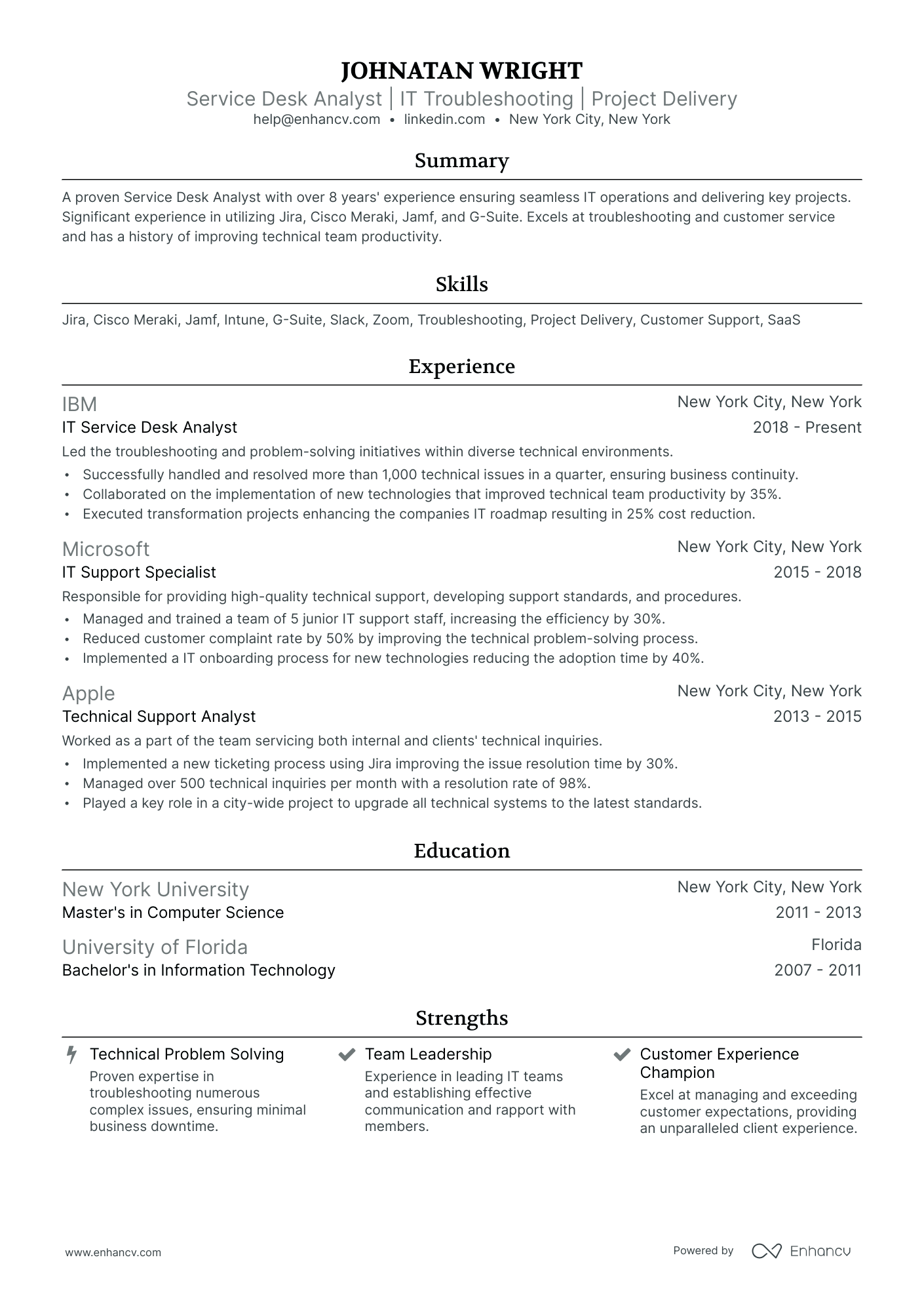
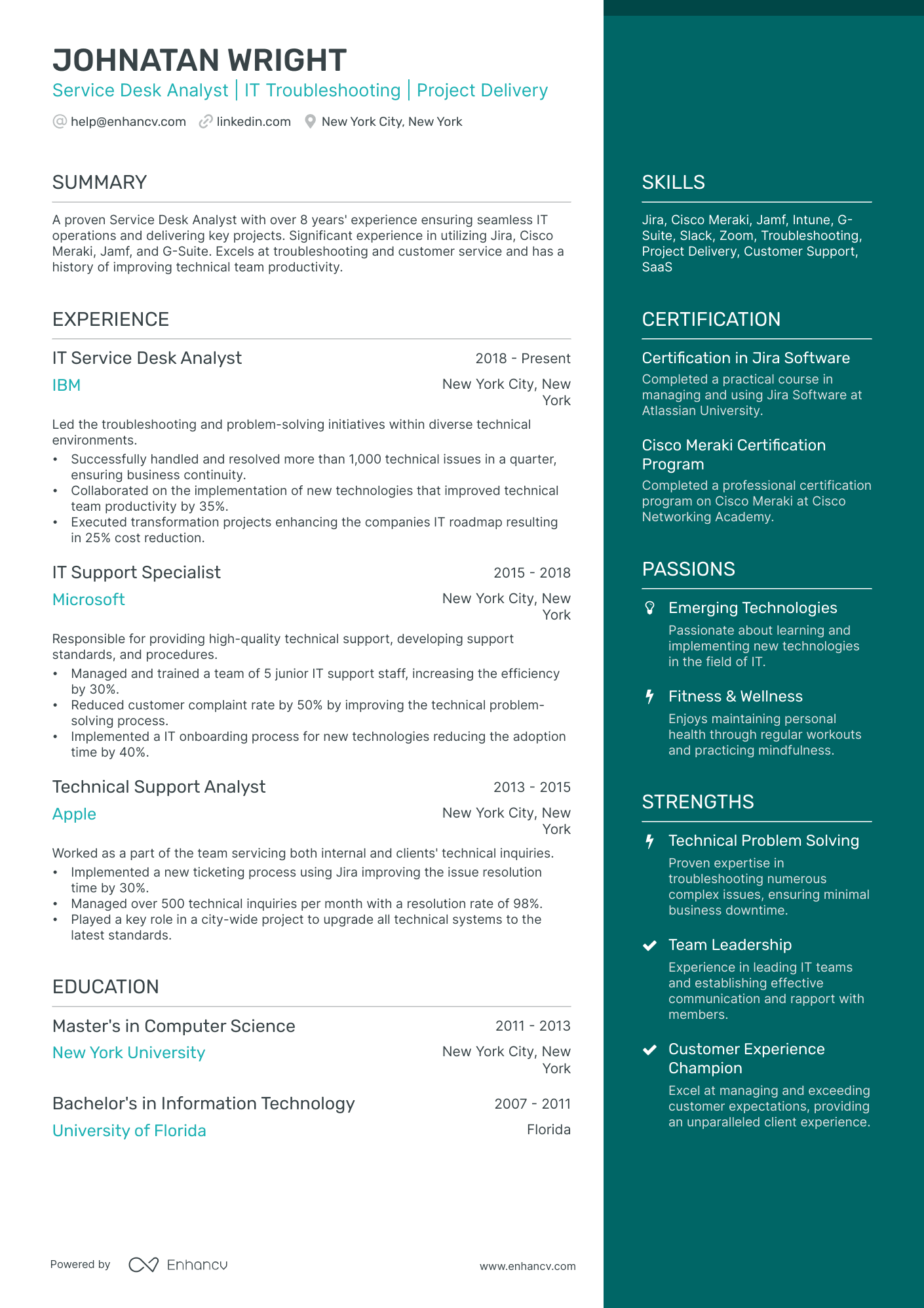
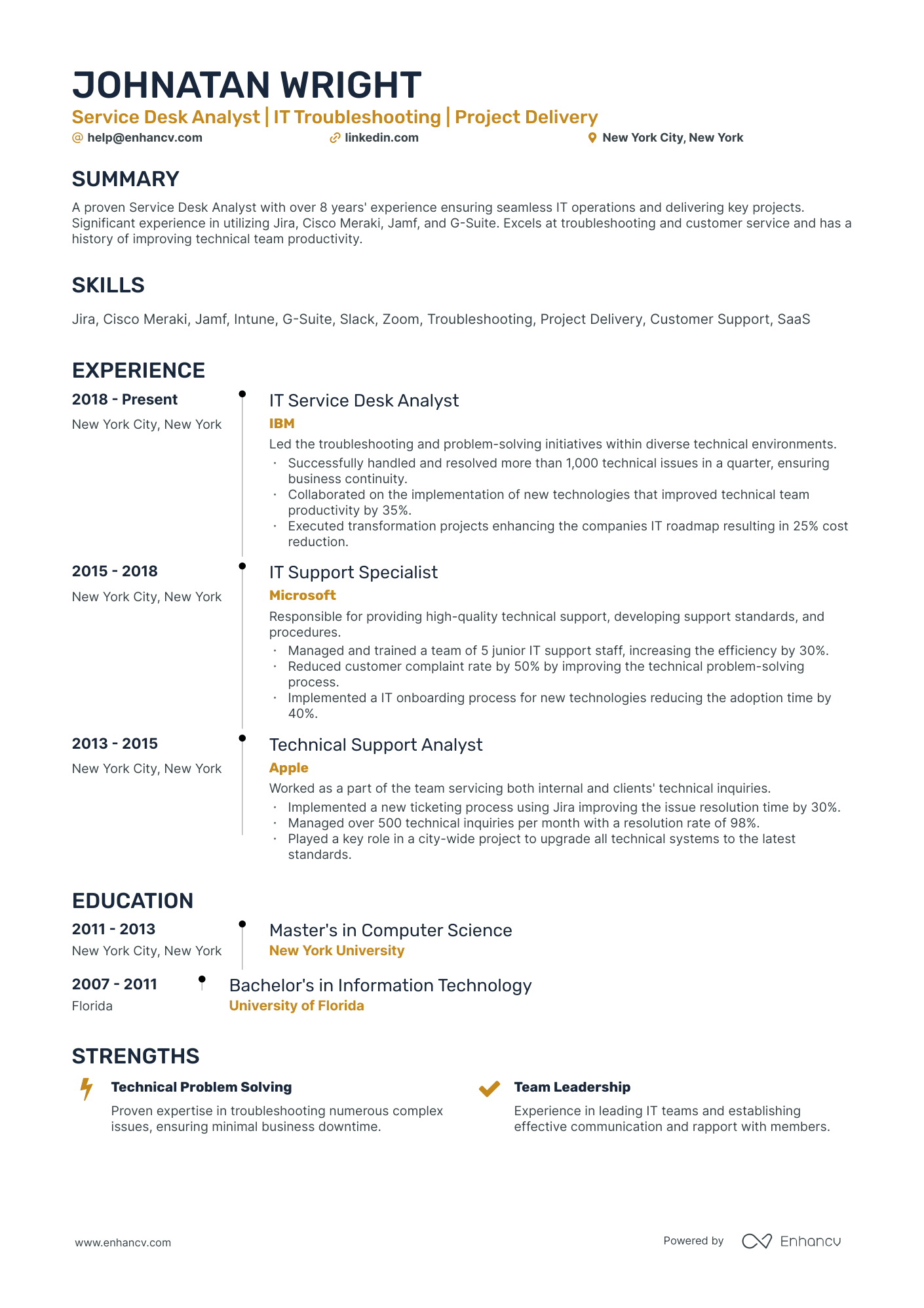
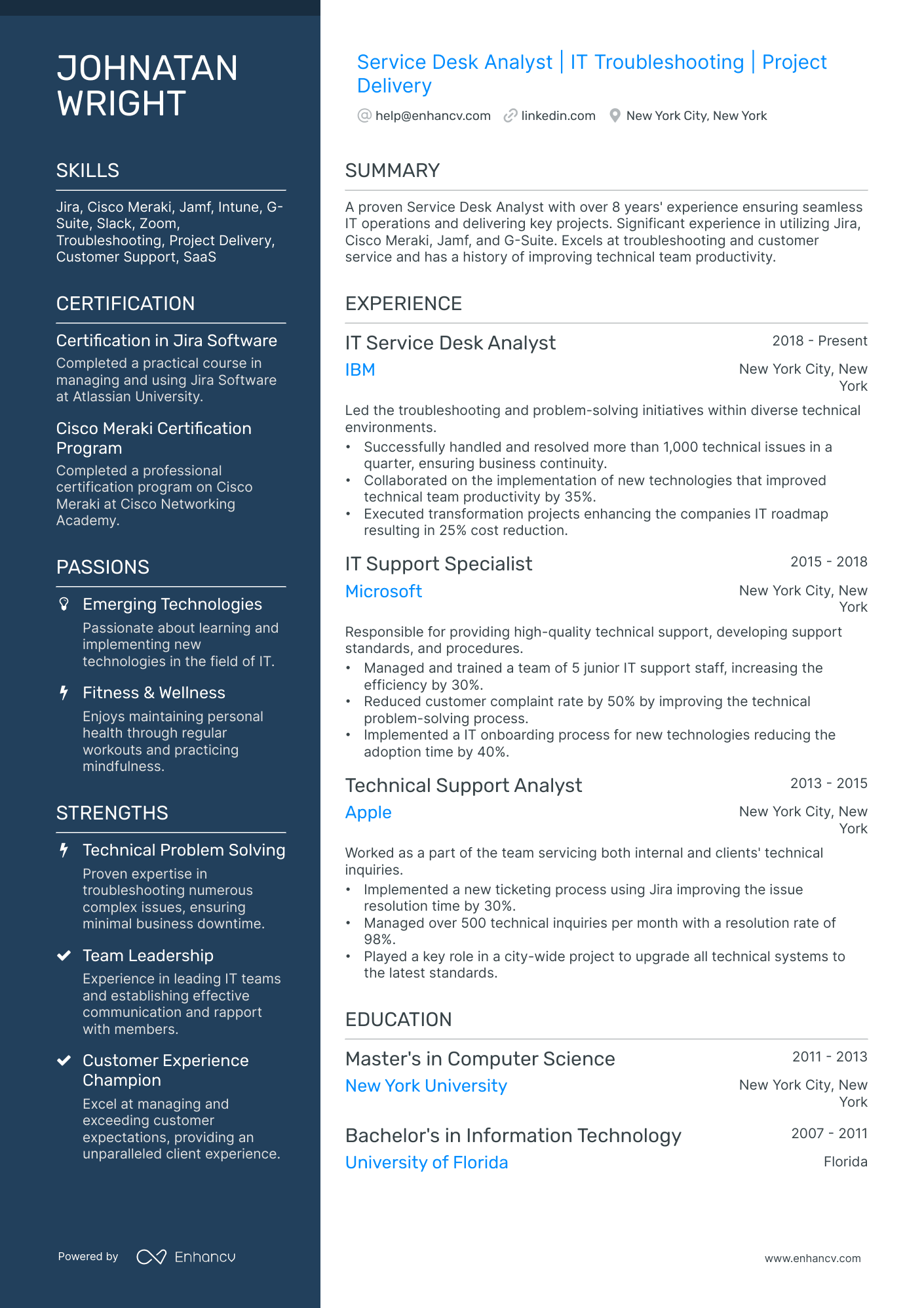
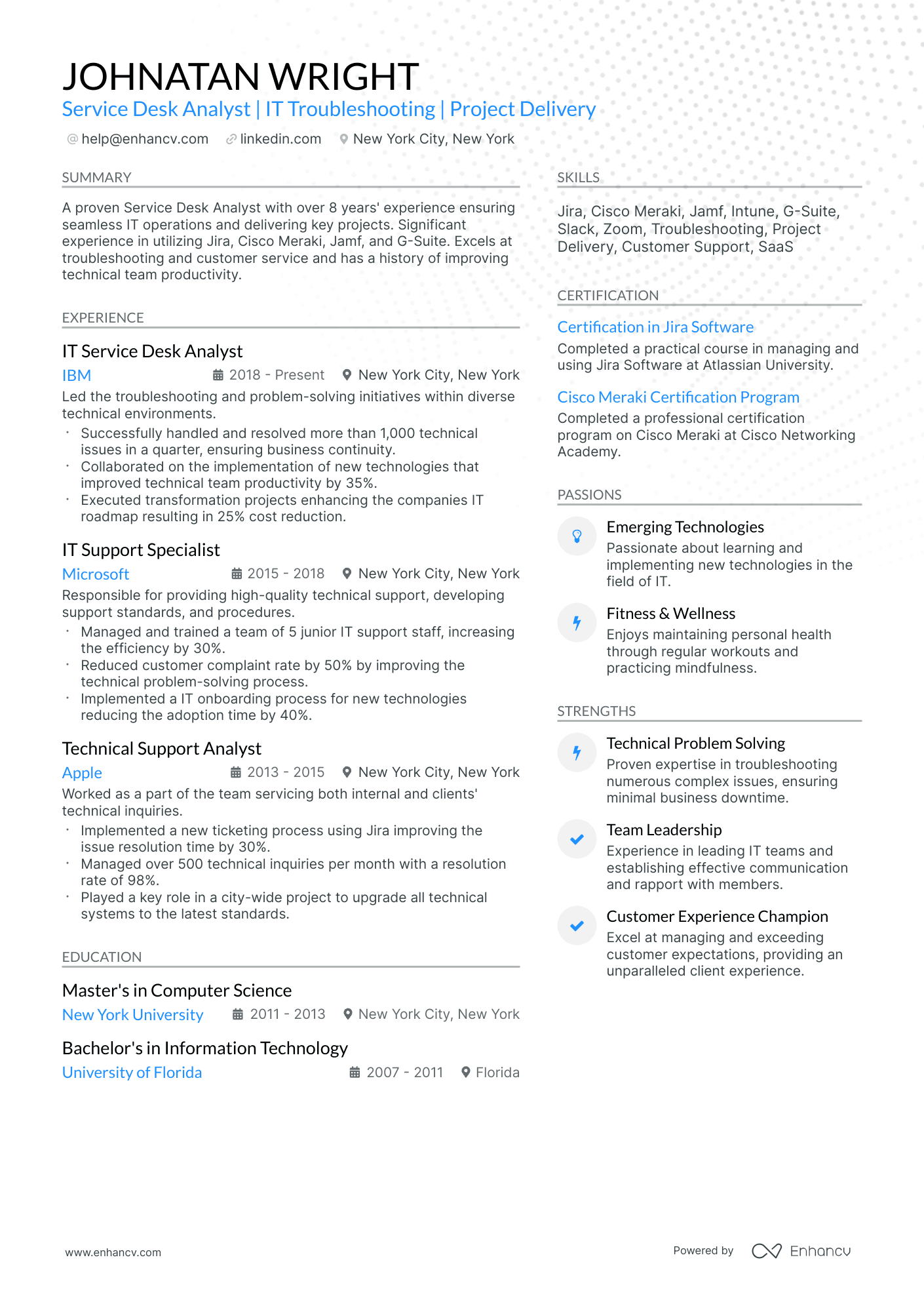
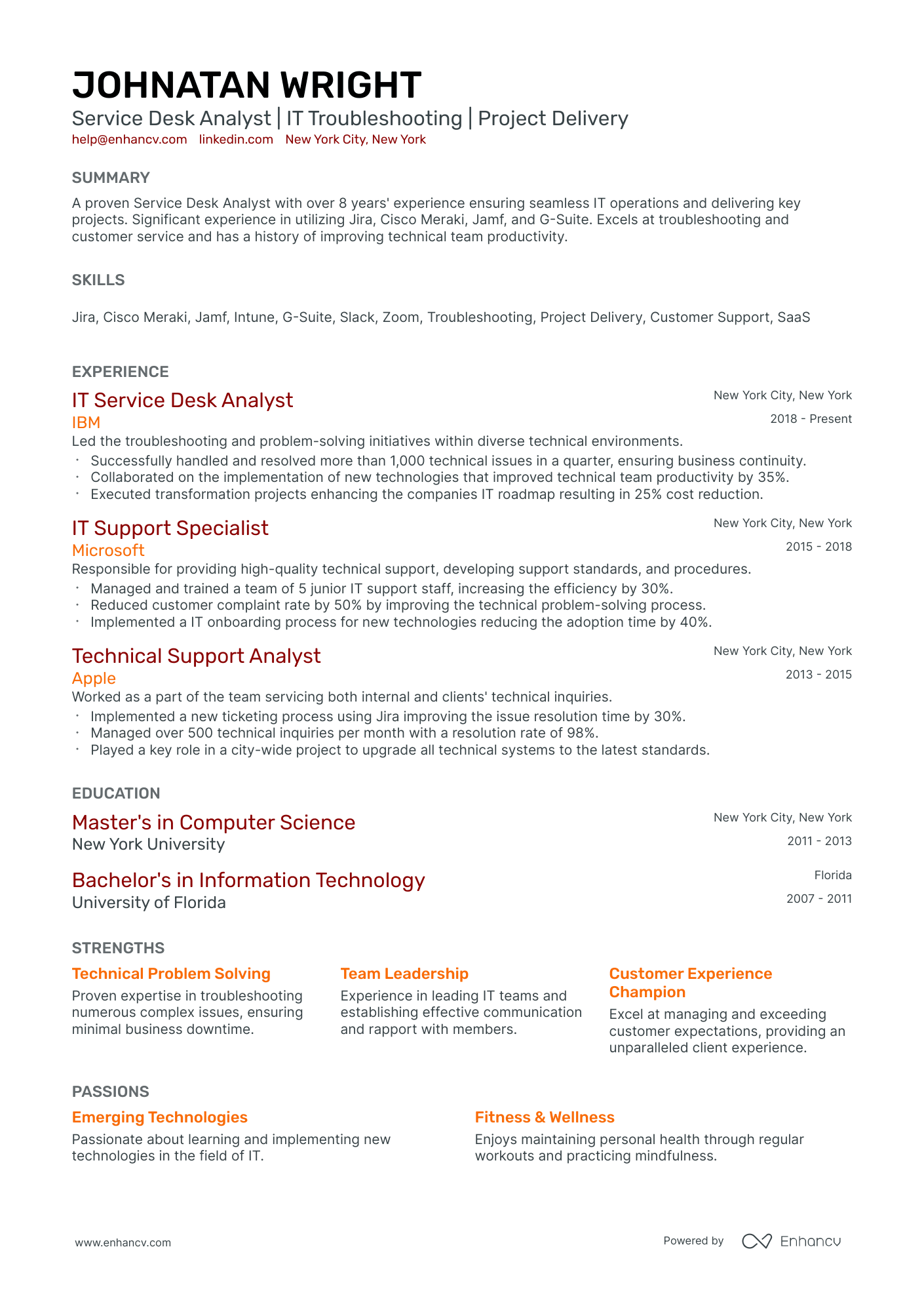
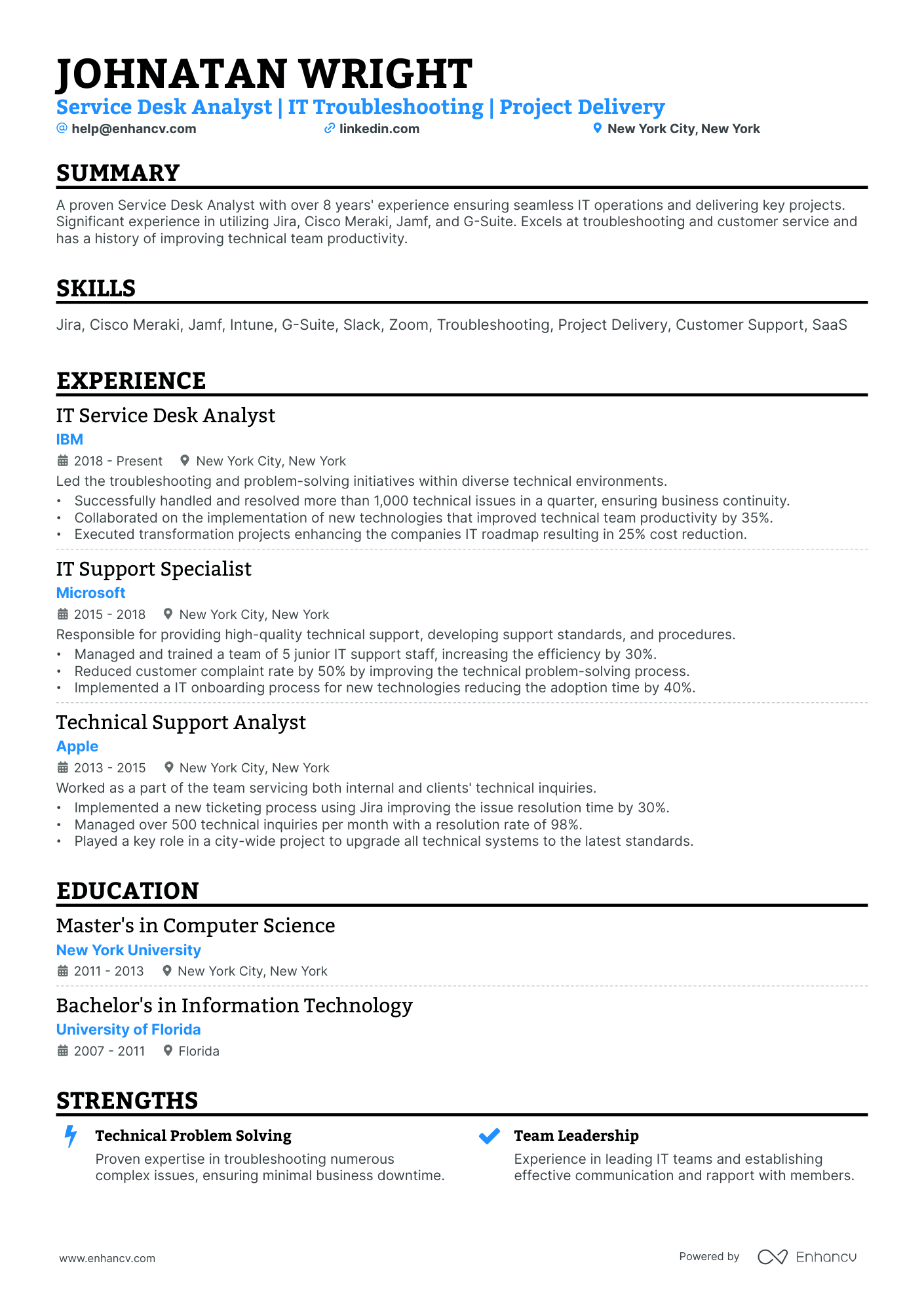
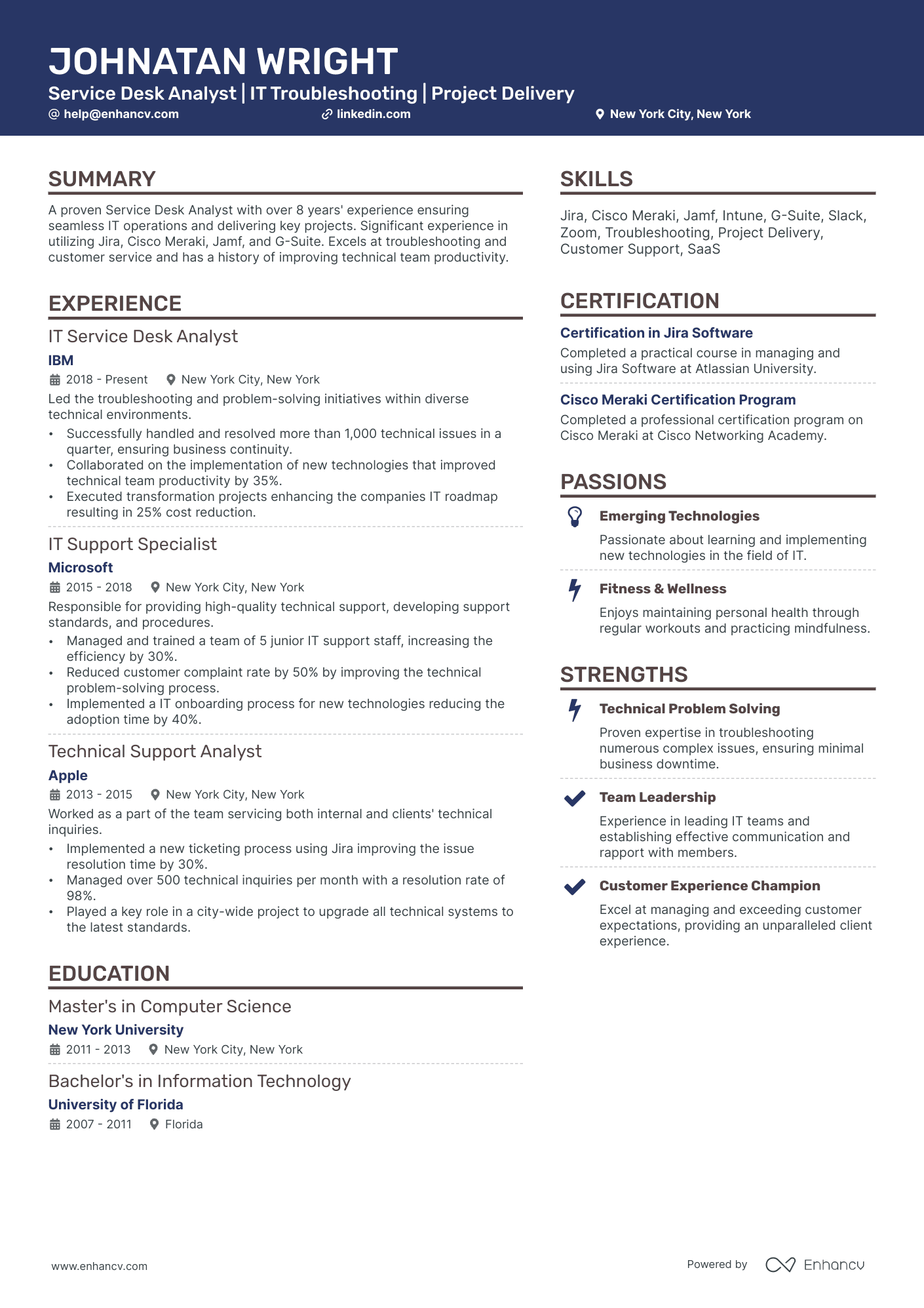
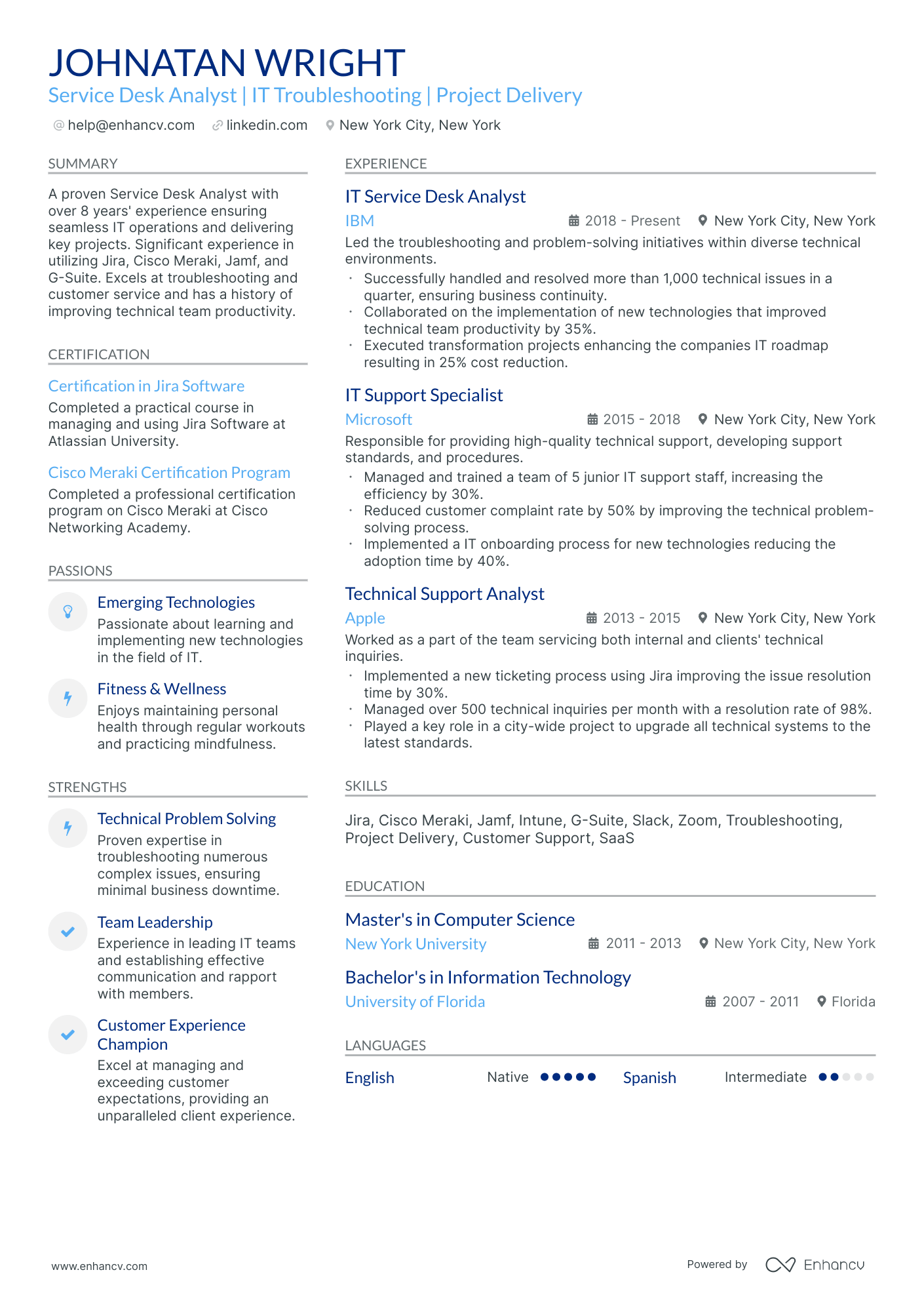
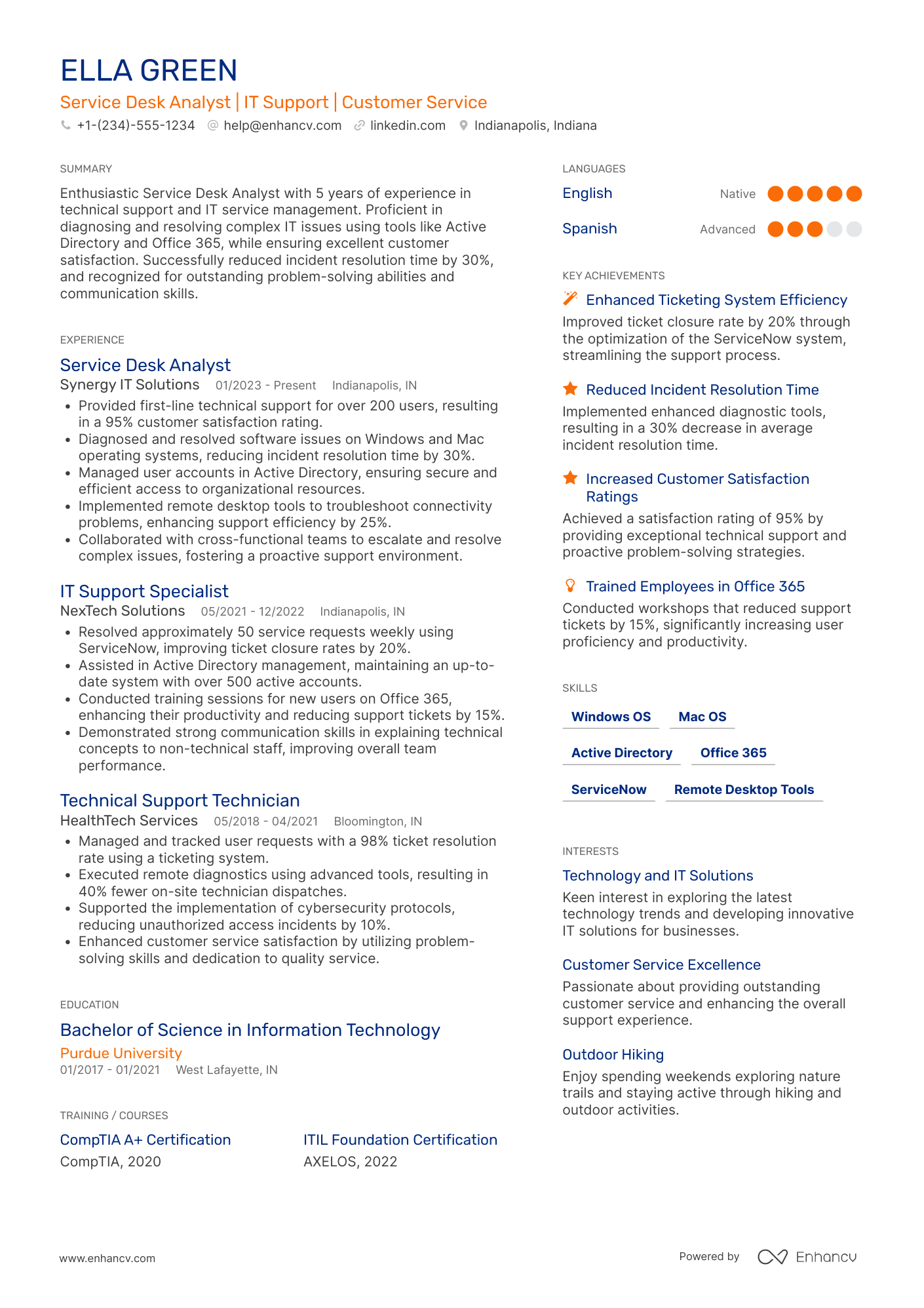
Most service desk analyst resume drafts fail because they read like ticket logs—tools, queues, and duties—without clear impact. That gets you filtered by ATS screening and missed in fast recruiter scans. With high competition, vague summaries cost interviews.
A strong resume shows how you improve service, reliability, and user outcomes. If you're unsure where to start, learning how to write a resume with clear structure and purpose is the first step. You can highlight faster resolution time, higher first-contact resolution, better customer satisfaction scores, reduced backlog, fewer repeat incidents, smoother onboarding, and measurable uptime improvements. Focus on results, not task lists.

Key takeaways
- Quantify ticket volume, resolution time, and satisfaction scores to prove your service desk impact.
- Use a reverse-chronological format for experienced analysts and a hybrid format for career changers.
- Tailor every experience bullet to mirror the job posting's tools, terminology, and KPIs.
- Place certifications like CompTIA A+ and ITIL 4 Foundation prominently to signal job-ready expertise.
- Demonstrate skills through measurable outcomes in your summary and experience, not just a skills list.
- Leverage lab projects, volunteer support, or home-lab work to build credibility without formal IT experience.
- Use Enhancv to align your resume with role-specific language and strengthen bullet points efficiently.
Job market snapshot for service desk analysts
We analyzed 112 recent service desk analyst job ads across major US job boards. These numbers help you understand top companies hiring, employer expectations, industry demand at a glance.
What level of experience employers are looking for service desk analysts
| Years of Experience | Percentage found in job ads |
|---|---|
| 1–2 years | 34.8% (39) |
| 3–4 years | 8.0% (9) |
| 5–6 years | 7.1% (8) |
| 7–8 years | 0.9% (1) |
| 10+ years | 0.9% (1) |
| Not specified | 47.3% (53) |
Service desk analyst ads by area of specialization (industry)
| Industry (Area) | Percentage found in job ads |
|---|---|
| Finance & Banking | 46.4% (52) |
| Healthcare | 22.3% (25) |
| Government | 12.5% (14) |
Top companies hiring service desk analysts
| Company | Percentage found in job ads |
|---|---|
| Wipro Ltd. | 10.7% (12) |
Role overview stats
These tables show the most common responsibilities and employment types for service desk analyst roles. Use them to align your resume with what employers expect and to understand how the role is structured across the market.
Day-to-day activities and top responsibilities for a service desk analyst
| Responsibility | Percentage found in job ads |
|---|---|
| Active directory | 25.0% (28) |
| Windows | 22.3% (25) |
| Servicenow | 21.4% (24) |
| Itil | 20.5% (23) |
| Windows 10 | 17.0% (19) |
| Microsoft office | 15.2% (17) |
| Vpn | 15.2% (17) |
| Ios | 14.3% (16) |
| Itsm | 11.6% (13) |
| Android | 9.8% (11) |
| Comptia a+ | 8.9% (10) |
| Voip | 8.9% (10) |
Type of employment (remote vs on-site vs hybrid)
| Employment type | Percentage found in job ads |
|---|---|
| On-site | 64.3% (72) |
| Hybrid | 21.4% (24) |
| Remote | 14.3% (16) |
How to format a service desk analyst resume
Recruiters evaluating service desk analyst candidates prioritize technical troubleshooting skills, ticket resolution metrics, and customer service ability. A clean, well-structured resume format ensures these signals surface quickly during both ATS parsing and the initial recruiter scan.

I have significant experience in this role—which format should I use?
Use a reverse-chronological format to present your service desk career with clear progression and growing technical responsibility. Do:
- Lead with your most recent role and emphasize scope—team size supported, ticket volume managed, and escalation ownership.
- Highlight proficiency in role-specific tools and domains such as ServiceNow, JIRA, Active Directory, ITIL frameworks, and remote desktop support platforms.
- Quantify outcomes tied to efficiency, resolution time, customer satisfaction, or cost savings.
I'm junior or switching into this role—what format works best?
A hybrid format works best, letting you lead with a focused skills section while still showing relevant experience in chronological order. Do:
- Place a technical skills section near the top featuring tools like ServiceNow, Active Directory, Windows/macOS troubleshooting, and ticketing systems to pass ATS filters immediately.
- Include lab projects, IT internships, help desk volunteer work, or home-lab environments that demonstrate hands-on troubleshooting and customer interaction.
- Connect every listed skill to a specific action and a measurable or observable result.
Why not use a functional resume?
A functional format strips away the timeline and context recruiters need to evaluate your troubleshooting consistency, tool exposure, and growth—making it harder to trust your readiness for a service desk role.
- A functional resume may be acceptable if you're transitioning from a non-IT customer service role, have limited formal work history, or are addressing a significant resume gap—but only if every listed skill is tied directly to a specific project, lab, or support scenario with a clear outcome.
Once your layout and formatting choices are in place, the next step is deciding which sections to include so each one reinforces your qualifications.
What sections should go on a service desk analyst resume
Recruiters expect to quickly find proof you can resolve tickets efficiently, communicate clearly, and support users across common systems and tools. Knowing which resume sections to include helps you organize that proof effectively.
Use this structure for maximum clarity:
- Header
- Summary
- Experience
- Skills
- Projects
- Education
- Certifications
- Optional sections: Languages, Volunteering, Leadership
Strong experience bullets should emphasize ticket volume and complexity, resolution speed, customer satisfaction, escalation accuracy, and measurable outcomes from process or documentation improvements.
Is your resume good enough?
Drop your resume here or choose a file. PDF & DOCX only. Max 2MB file size.
Now that you’ve organized the key resume components, the next step is to write your service desk analyst experience section so it fits that structure and highlights your impact.
How to write your service desk analyst resume experience
The experience section is where you prove you've resolved real issues, supported real users, and improved real systems—not just occupied a seat at the help desk. Hiring managers prioritize demonstrated impact over descriptive task lists, so focus on shipped resolutions, the ITSM tools and diagnostic methods you applied, and measurable outcomes like reduced ticket volume or faster response times. Building a targeted resume that aligns each bullet with the role's requirements makes your experience section far more compelling.
Each entry should include:
- Job title
- Company and location (or remote)
- Dates of employment (month and year)
Three to five concise bullet points showing what you owned, how you executed, and what outcomes you delivered:
- Ownership scope: the service queues, support tiers, endpoint environments, user populations, or IT systems you were directly accountable for as a service desk analyst.
- Execution approach: the ticketing platforms, remote support utilities, knowledge base systems, diagnostic frameworks, or escalation protocols you used to triage issues and deliver resolutions.
- Value improved: the changes you drove in first-call resolution rates, mean time to resolution, ticket backlog size, system uptime, end-user satisfaction, or compliance posture through your daily service desk work.
- Collaboration context: how you partnered with network engineers, security teams, application developers, vendors, or business units to resolve cross-functional incidents and fulfill service requests.
- Impact delivered: the outcomes your work produced—expressed through service-level improvements, reduced escalations, faster onboarding cycles, or measurable gains in operational efficiency—rather than a list of tasks you performed.
Experience bullet formula
A service desk analyst experience example
✅ Right example - modern, quantified, specific.
Service Desk Analyst
Northbridge Health Systems | Austin, TX
2022–Present
Supported a four-hundred-user healthcare network across three clinics with strict uptime and compliance requirements.
- Resolved an average of thirty-five tickets per day in ServiceNow, sustaining a ninety-two percent first-contact resolution rate and cutting median time-to-resolution from eight hours to three hours.
- Automated password resets and account unlocks with PowerShell and Active Directory, reducing identity-related tickets by twenty-eight percent and saving about ten hours per week for the service desk.
- Diagnosed endpoint and network issues using Microsoft Intune, Microsoft Endpoint Manager, and Wireshark, lowering repeat incidents by eighteen percent through standardized runbooks and root-cause tagging.
- Coordinated with infrastructure engineers and security analysts to deploy Microsoft Defender for Endpoint policy updates, decreasing high-severity malware alerts by forty percent quarter over quarter.
- Built and maintained a Confluence knowledge base and ServiceNow self-service catalog, increasing self-service adoption from twelve percent to twenty-six percent and improving customer satisfaction from 4.3 to 4.7 out of five.
Now that you've seen how a strong experience section comes together, let's look at how to adjust yours to match the specific job you're applying for.
How to tailor your service desk analyst resume experience
Recruiters evaluate your service desk analyst resume through applicant tracking systems and manual review, scanning for alignment with the posted role. Tailoring your resume to the job description by mirroring its language and priorities increases your chances of passing both filters.
Ways to tailor your service desk analyst experience:
- Match ITSM tools like ServiceNow or Jira listed in the posting.
- Mirror the exact incident management terminology the job description uses.
- Align your ticket resolution metrics with the KPIs they prioritize.
- Highlight ITIL framework experience when the posting references it.
- Emphasize SLA compliance tracking if the role mentions service levels.
- Include industry-specific support experience relevant to their business sector.
- Reference remote desktop or Active Directory skills the listing specifies.
- Reflect escalation workflows or tiered support models they describe.
Tailoring means aligning your real accomplishments with what the role demands, not forcing keywords where they don't belong.
Resume tailoring examples for service desk analyst
| Job description excerpt | Untailored | Tailored |
|---|---|---|
| Provide first-level support using ServiceNow for ticket logging, categorization, and escalation while maintaining a first-call resolution rate of 70% or higher. | Helped users with IT issues and logged tickets in the system. | Delivered first-level support through ServiceNow, handling ticket logging, categorization, and escalation for 40+ daily requests while sustaining a 74% first-call resolution rate. |
| Troubleshoot hardware, software, and network connectivity issues across Windows 10/11 environments, supporting a user base of 500+ employees. | Resolved technical problems for employees and assisted with computer setup. | Diagnosed and resolved hardware, software, and network connectivity issues across Windows 10/11 endpoints, providing consistent support to a 500+ employee user base and reducing average resolution time by 18%. |
| Monitor and respond to alerts in SolarWinds, escalate P1/P2 incidents per ITIL procedures, and maintain detailed documentation in the knowledge base. | Monitored systems and followed procedures to handle incidents when they came up. | Monitored SolarWinds alerts in real time, escalating P1/P2 incidents within SLA targets per ITIL incident management procedures and contributing 30+ articles to the internal knowledge base to streamline future troubleshooting. |
Once you’ve aligned your service desk analyst experience with the role’s priorities, the next step is to quantify your achievements so hiring managers can quickly see your impact.
How to quantify your service desk analyst achievements
Quantifying your achievements proves you improve support outcomes, not just complete tickets. Focus on ticket volume, response and resolution time, first-contact resolution, customer satisfaction, and quality metrics like reopen rate and incident reduction.
Quantifying examples for service desk analyst
| Metric | Example |
|---|---|
| Ticket throughput | "Resolved 45–60 tickets per day in ServiceNow while maintaining a 92% first-contact resolution rate across Windows, Microsoft 365, and VPN issues." |
| Response time | "Cut median first-response time from 28 minutes to 9 minutes by refining routing rules and canned responses in ServiceNow." |
| Quality rate | "Reduced ticket reopen rate from 12% to 6% by improving troubleshooting checklists and documenting fixes in Confluence." |
| Customer satisfaction | "Raised customer satisfaction score from 4.2 to 4.6 out of 5 over three months by improving communication and setting clear resolution expectations." |
| Security compliance | "Prevented five account takeover attempts in one quarter by enforcing multifactor authentication resets and validating identity per policy in Azure Active Directory." |
Turn your everyday tasks into measurable, recruiter-ready resume bullets in seconds with Enhancv's Bullet Point Generator.
Once you've crafted strong bullet points for your experience section, it's equally important to highlight the specific hard and soft skills that qualify you for a service desk analyst role.
How to list your hard and soft skills on a service desk analyst resume
Your skills section shows you can resolve incidents, support users, and keep systems running, and recruiters and an ATS (applicant tracking system) scan this section to confirm role fit fast; aim for a mix weighted toward hard skills with targeted soft skills. service desk analyst roles require a blend of:
- Ticketing, incident, and request management skills.
- Troubleshooting, diagnostics, and root cause analysis skills.
- Service delivery execution and documentation discipline.
- Collaboration and customer communication skills.
Your skills section should be:
- Scannable (bullet-style grouping).
- Relevant to the job post.
- Backed by proof in experience bullets.
- Updated with current tools.
Place your skills section:
- Above experience if you're junior or switching careers.
- Below experience if you're mid/senior with strong achievements.

Hard skills
- ServiceNow, Jira Service Management
- Incident, problem, change management
- ITIL practices
- Service level agreements, escalation paths
- Active Directory user administration
- Microsoft 365, Exchange Online
- Windows 10/11, macOS support
- TCP/IP, DNS, DHCP, VPN
- Remote support tools, RDP
- Endpoint management, Microsoft Intune
- PowerShell basics
- Knowledge base authoring
Soft skills
- Triage and prioritize tickets
- Clarify issues with targeted questions
- Communicate status and next steps
- Set expectations with users
- De-escalate frustrated customers
- Document fixes for reuse
- Coordinate handoffs across teams
- Follow through to closure
- Make risk-aware decisions
- Manage time under volume
- Spot patterns and raise trends
- Coach users on self-service
How to show your service desk analyst skills in context
Skills shouldn't live only in a bulleted list on your resume. You can explore common resume skills by role to see how other professionals present theirs effectively.
They should be demonstrated in:
- Your summary (high-level professional identity)
- Your experience (proof through outcomes)
Here's what each looks like in practice.
Summary example
Senior service desk analyst with eight years in healthcare IT. Skilled in ITIL-based incident management, ServiceNow, and cross-team escalation workflows. Reduced average ticket resolution time by 34% while maintaining a 97% end-user satisfaction rating.
- Specifies senior-level experience clearly
- Names role-relevant tools and frameworks
- Leads with a measurable outcome
- Highlights communication and collaboration
Experience example
Senior Service Desk Analyst
Meridian Health Systems | Remote
March 2019–Present
- Resolved an average of 65 tickets daily using ServiceNow, cutting mean resolution time from 4.2 hours to 2.7 hours across all priority levels.
- Collaborated with network and infrastructure teams to build a shared knowledge base, decreasing repeat incidents by 22% within six months.
- Mentored three junior analysts on ITIL best practices and remote troubleshooting protocols, improving first-call resolution rates by 18%.
- Every bullet includes measurable proof.
- Skills appear naturally through outcomes.
Once you’ve tied your support capabilities to real scenarios and outcomes, the next step is to apply that approach to building a service desk analyst resume when you don’t have direct experience.
How do I write a service desk analyst resume with no experience
Even without full-time experience, you can demonstrate readiness through:
- IT help desk lab simulations
- Home network troubleshooting tickets
- Volunteer tech support for nonprofits
- Campus IT service desk shadowing
- CompTIA A+ or ITIL coursework
- Personal device imaging and setup
- Customer support roles with ticketing
- Documented knowledge base articles
If you're starting out, our guide on building a resume without work experience walks you through how to structure these alternative qualifications effectively.
Focus on:
- Ticket handling in ServiceNow
- Active Directory password resets
- Troubleshooting steps and outcomes
- Clear metrics and scope
Resume format tip for entry-level service desk analyst
Use a hybrid resume format because it highlights skills and projects first, while still showing work history, even if it isn't IT. Do:
- Add a Projects section with ticket-style bullets.
- List tools used: ServiceNow, Active Directory, Microsoft 365.
- Quantify volume, time saved, or resolution rate.
- Mirror keywords from the job posting.
- Include certifications and labs near the top.
- Completed twenty ServiceNow lab tickets, documented troubleshooting steps, and achieved a ninety percent first-contact resolution rate across password resets and Microsoft 365 access issues.
Once you've built your resume around transferable skills and relevant projects, the next step is presenting your education in a way that reinforces your qualifications for the role.
How to list your education on a service desk analyst resume
Your education section helps hiring teams confirm you have the foundational knowledge needed for a service desk analyst role. It validates technical training and problem-solving skills quickly.
Include:
- Degree name
- Institution
- Location
- Graduation year
- Relevant coursework (for juniors or entry-level candidates)
- Honors & GPA (if 3.5 or higher)
Skip month and day details—list the graduation year only.
Here's a strong education entry tailored to a service desk analyst resume.
Example education entry
Bachelor of Science in Information Technology
George Mason University, Fairfax, VA
Graduated 2022
GPA: 3.7/4.0
- Relevant coursework: Network Administration, IT Service Management, Operating Systems, Database Fundamentals, and Cybersecurity Basics
- Honors: Dean's List (six consecutive semesters), Magna Cum Laude
How to list your certifications on a service desk analyst resume
Certifications on your resume show your commitment to learning, prove tool proficiency, and confirm industry relevance for a service desk analyst role, especially when hiring teams compare similar experience levels.
Include:
- Certificate name
- Issuing organization
- Year
- Optional: credential ID or URL
- Place certifications below education when your degree is recent and your certifications are older or less relevant to service desk analyst work.
- Place certifications above education when your certifications are recent, role-relevant, or required for the service desk analyst roles you target.
Best certifications for your service desk analyst resume
- CompTIA A+
- CompTIA Network+
- CompTIA Security+
- ITIL 4 Foundation
- Microsoft Certified: Azure Fundamentals
- Microsoft 365 Certified: Fundamentals
- HDI Support Center Analyst
Once you’ve positioned your credentials to validate your technical foundation, you can write your service desk analyst resume summary to highlight that value upfront.
How to write your service desk analyst resume summary
Your resume summary is the first thing a recruiter reads. A sharp, relevant opening can set you apart from dozens of other service desk analyst applicants.
Keep it to three to four lines, with:
- Your title and total years of experience in IT support or service desk roles.
- The domain or industry you've worked in, such as healthcare, finance, or SaaS.
- Core tools and technologies like ServiceNow, JIRA, Active Directory, or remote desktop software.
- One or two measurable achievements, such as ticket resolution rates or response time improvements.
- Soft skills tied to real outcomes, like clear communication that reduced escalations or repeat tickets.

PRO TIP
At this level, focus on the specific tools you've used and any early wins you can quantify. Highlight your ability to learn quickly and resolve issues efficiently. Avoid vague phrases like "passionate team player" or "driven self-starter." Recruiters want to see relevant skills and concrete contributions, not motivational filler.
Example summary for a service desk analyst
Service desk analyst with two years of experience supporting 500+ end users via ServiceNow and Active Directory. Maintained a 94% first-call resolution rate while cutting average ticket response time by 18%.
Optimize your resume summary and objective for ATS
Drop your resume here or choose a file.
PDF & DOCX only. Max 2MB file size.
Now that your summary captures your strongest qualifications, make sure your header presents your contact details correctly so recruiters can actually reach you.
What to include in a service desk analyst resume header
A resume header is the contact and identity block at the top, and it drives visibility, credibility, and fast recruiter screening for a service desk analyst.
Essential resume header elements
- Full name
- Tailored job title and headline
- Location
- Phone number
- Professional email
- GitHub link
- Portfolio link
A LinkedIn link lets recruiters confirm titles, dates, and tools quickly, which speeds up screening.
Do not include a photo on a service desk analyst resume unless the role is explicitly front-facing or appearance-dependent.
Keep the header to two lines, match the service desk analyst job title to the posting, and use consistent formatting across every link.
Service desk analyst resume header
Jordan Lee
Service Desk Analyst | IT Support, Ticketing Systems, and Windows Troubleshooting
Austin, TX | (512) 555-01XX | your.name@enhancv.com
github.com/yourname yourwebsite.com linkedin.com/in/yourname
With your contact details and role identification set, add optional resume sections to strengthen your service desk analyst application and highlight relevant qualifications.
Additional sections for service desk analyst resumes
When your core qualifications match other applicants, additional resume sections help you stand out with unique, role-relevant credibility.
- Languages — listing language skills on your resume can be a differentiator when supporting multilingual user bases.
- IT certifications
- Volunteer experience
- Professional development and training
- Hobbies and interests
- Awards and recognition
Once you've strengthened your resume with relevant extra sections, the next step is pairing it with a well-crafted cover letter to make an even stronger impression.
Do service desk analyst resumes need a cover letter
A cover letter isn't required for most service desk analyst roles, but it helps when the role is competitive or the employer expects one. If you're wondering what a cover letter is and when it adds value, it can make a difference when your resume needs context, or when you want to show precise fit.
Use these guidelines to decide if you should include one:
- Explain role or team fit by matching your experience to the ticket types, tools, shifts, and service-level expectations in the posting.
- Highlight one or two relevant projects or outcomes, such as reduced resolution time, improved first-contact resolution, or cleaner knowledge base articles.
- Show understanding of the product, users, or business context by referencing common user workflows, priority impacts, and how you communicate during incidents.
- Address career transitions or non-obvious experience by connecting past work to service desk analyst strengths, like troubleshooting, documentation, and customer communication.
Drop your resume here or choose a file.
PDF & DOCX only. Max 2MB file size.
Whether you include a cover letter or not, AI can help you strengthen your service desk analyst resume by tailoring it to the role and highlighting the most relevant experience.
Using AI to improve your service desk analyst resume
AI can sharpen your resume's clarity, structure, and impact. It helps tighten language, quantify results, and align content with job postings. But overuse makes resumes sound robotic. Once your content is clear and role-aligned, step away from AI. If you're curious about which AI is best for writing resumes, the right tool depends on your specific needs and the level of customization you require.
Here are 10 practical prompts you can copy and paste to strengthen specific sections of your service desk analyst resume:
- Strengthen your summary: "Rewrite my service desk analyst resume summary to highlight technical support skills, ticket resolution speed, and customer satisfaction in three concise sentences."
- Quantify experience bullets: "Add measurable outcomes to these service desk analyst experience bullets, focusing on ticket volume, resolution time, and first-call resolution rates."
- Align skills with postings: "Compare my service desk analyst skills section against this job description and identify missing keywords I should add."
- Tighten action verbs: "Replace weak or passive verbs in my service desk analyst experience section with strong, specific action verbs."
- Refine technical skills: "Organize my service desk analyst technical skills into clear categories like operating systems, ticketing tools, and remote support software."
- Improve project descriptions: "Rewrite this service desk analyst project description to emphasize my specific contribution, tools used, and measurable results."
- Tailor education details: "Suggest how to present my education section to better support a service desk analyst role, highlighting relevant coursework."
- Highlight certifications: "Reorder and describe my certifications to show their direct relevance to a service desk analyst position."
- Remove filler language: "Identify and remove vague or unnecessary words from my service desk analyst resume without losing important details."
- Fix formatting consistency: "Review my service desk analyst resume for inconsistent formatting in dates, bullet structure, and section headings."
Stop using AI once your resume sounds accurate, specific, and aligned with real experience. AI should never invent experience or inflate claims—if it didn't happen, it doesn't belong here.
Conclusion
A strong service desk analyst resume shows measurable outcomes, role-specific skills, and a clear structure. It highlights ticket volume, resolution time, first-contact resolution, and customer satisfaction. It also shows troubleshooting, documentation, escalation, and communication skills.
Keep each section easy to scan and focused on impact. This approach shows you can support users today and adapt as tools and expectations change. It positions you as a service desk analyst ready for the current market.