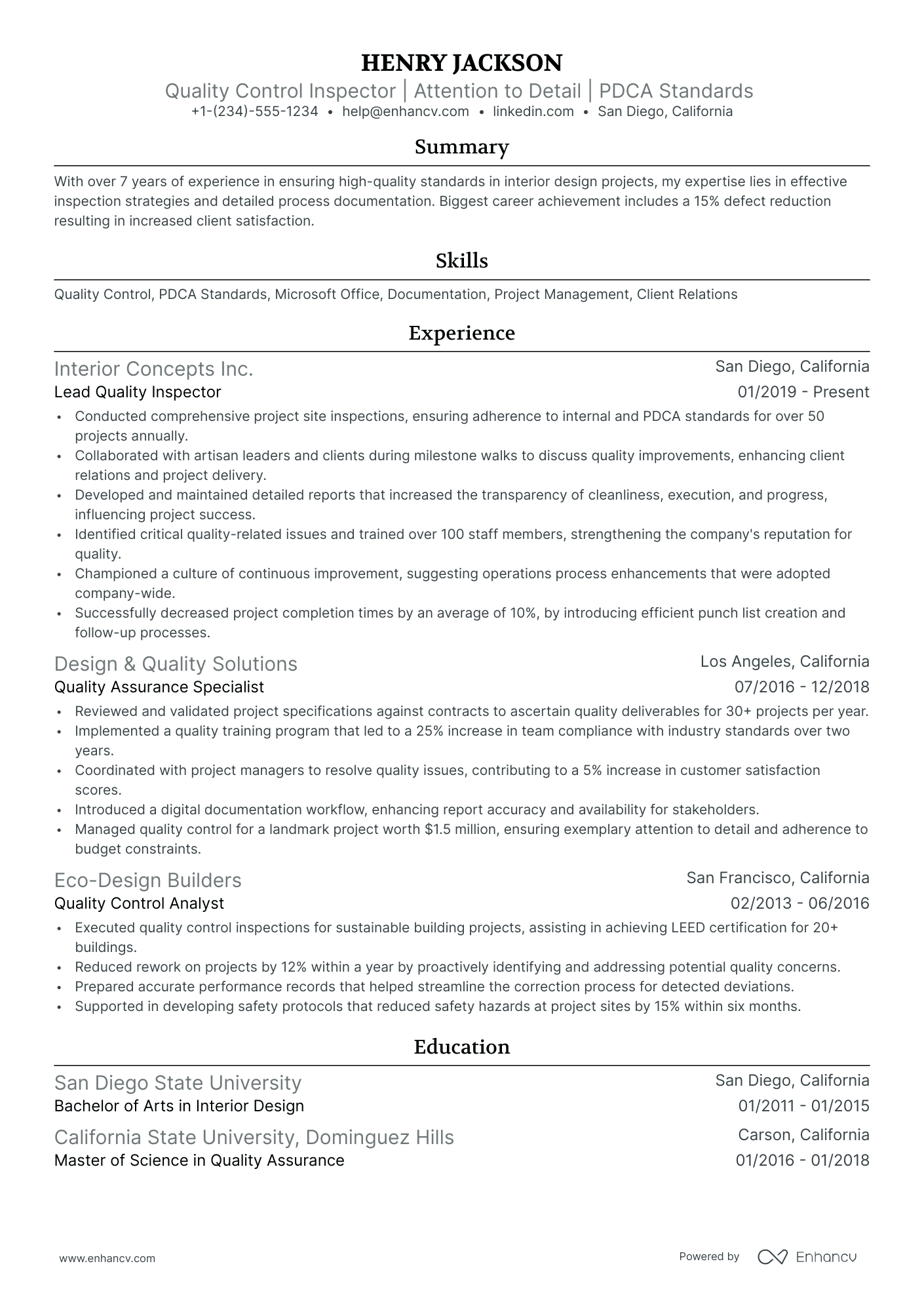
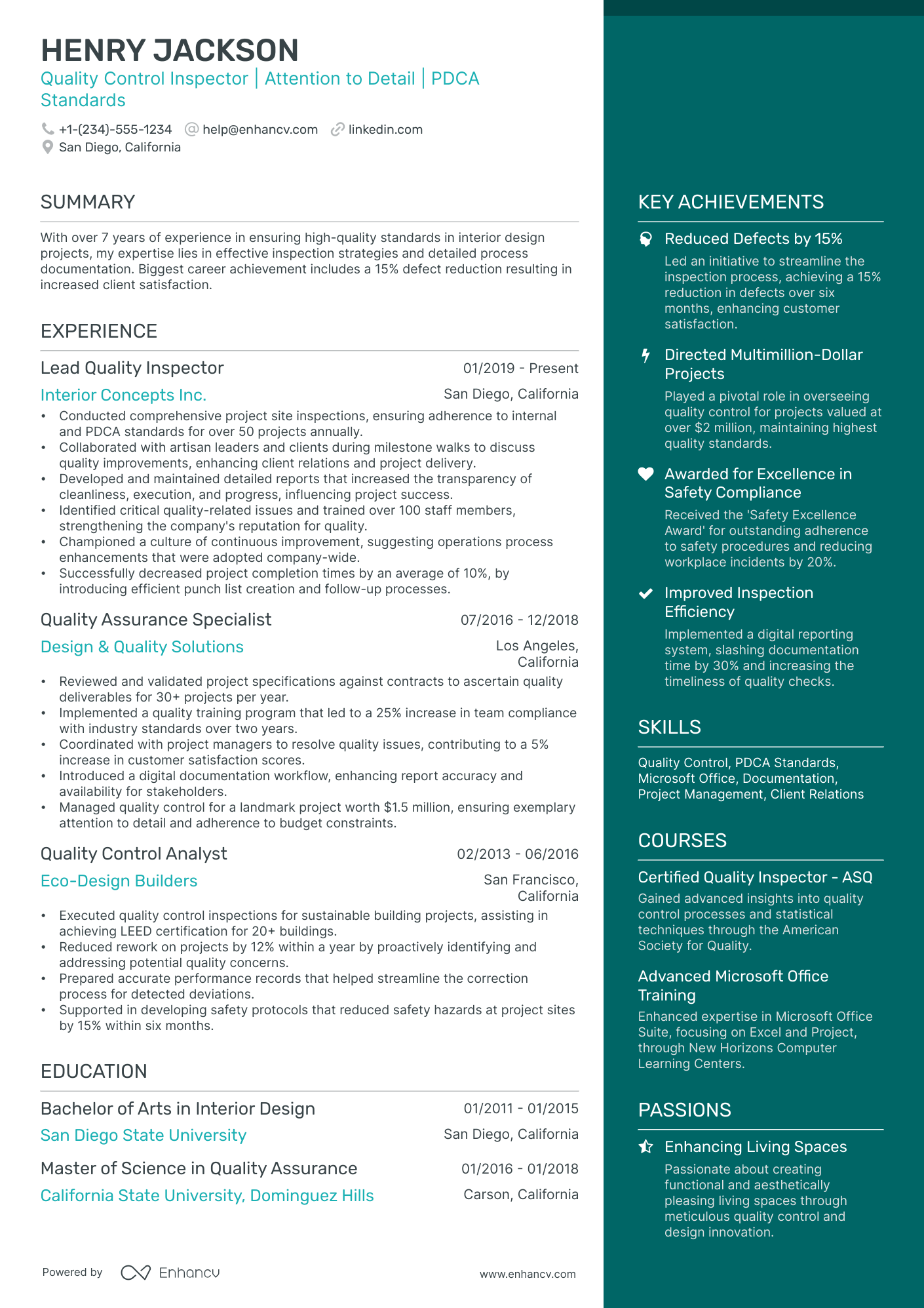
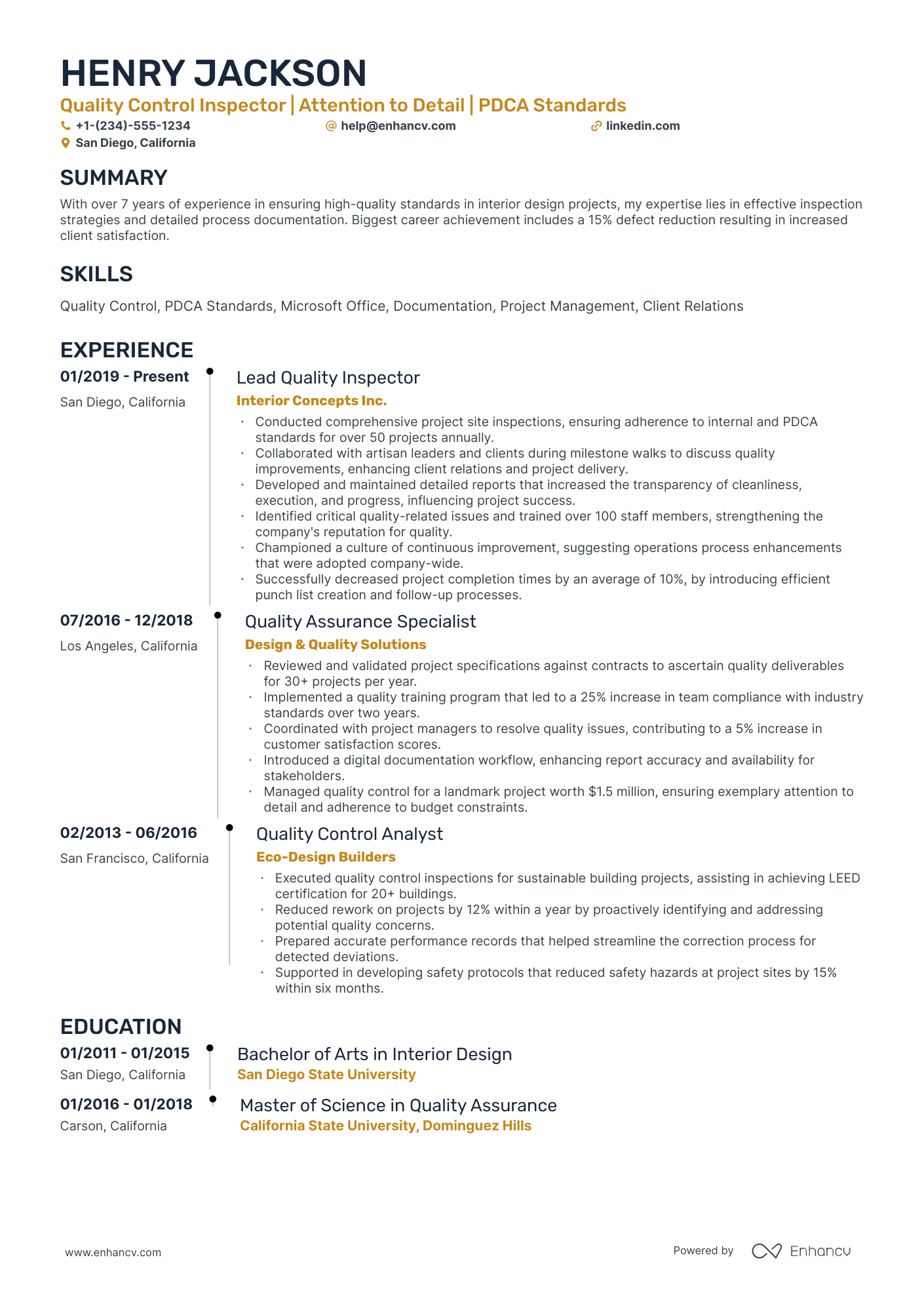
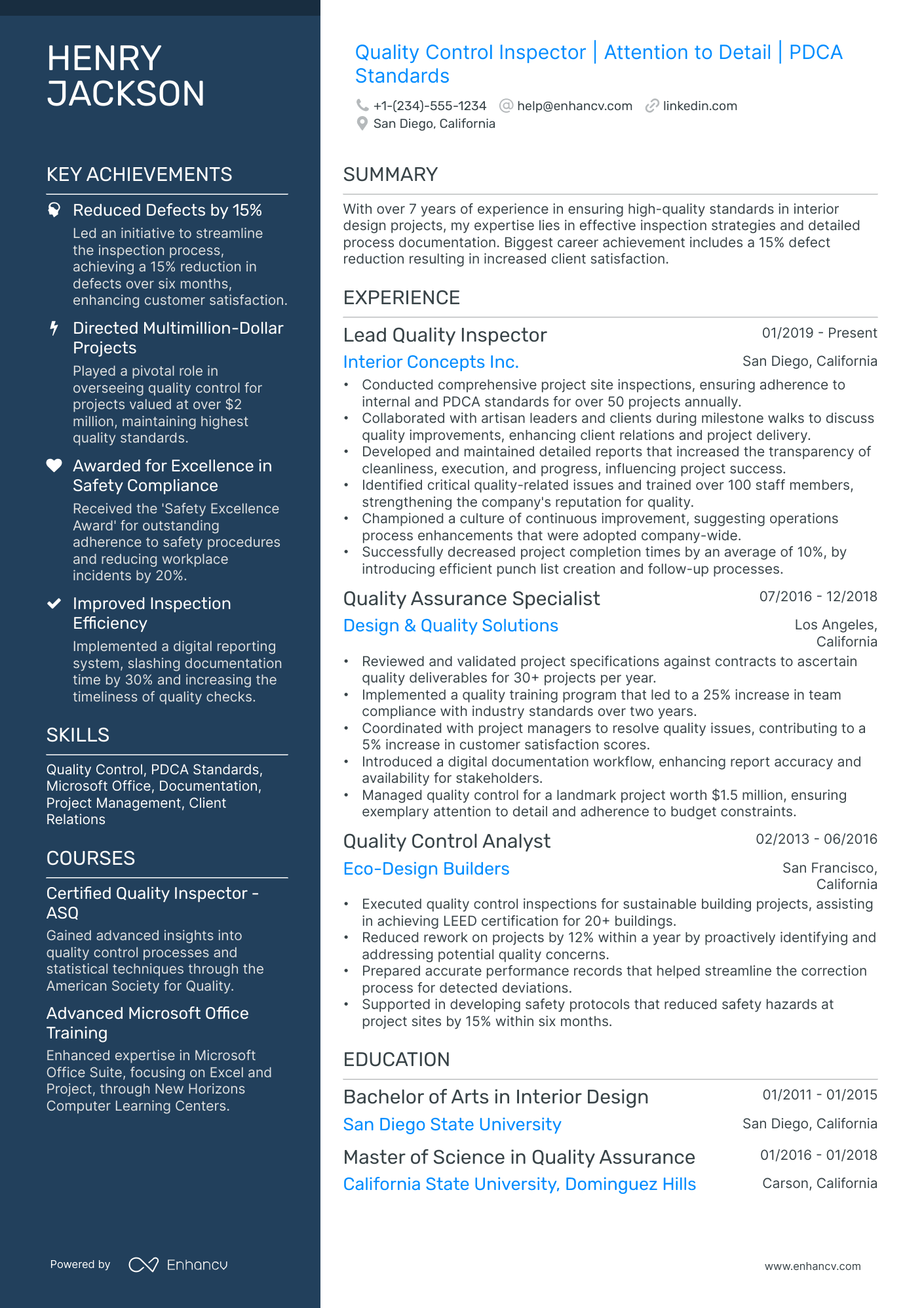
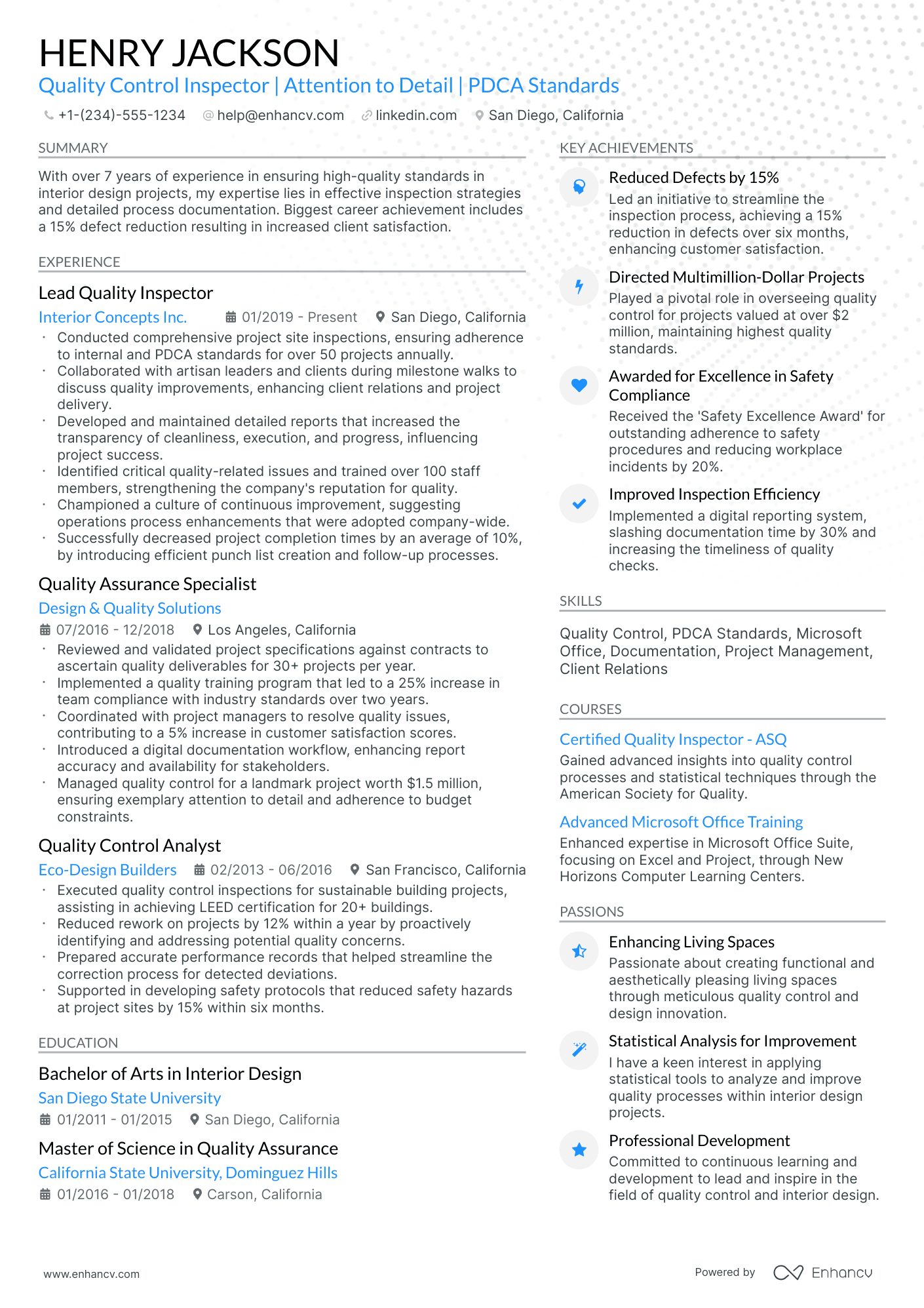
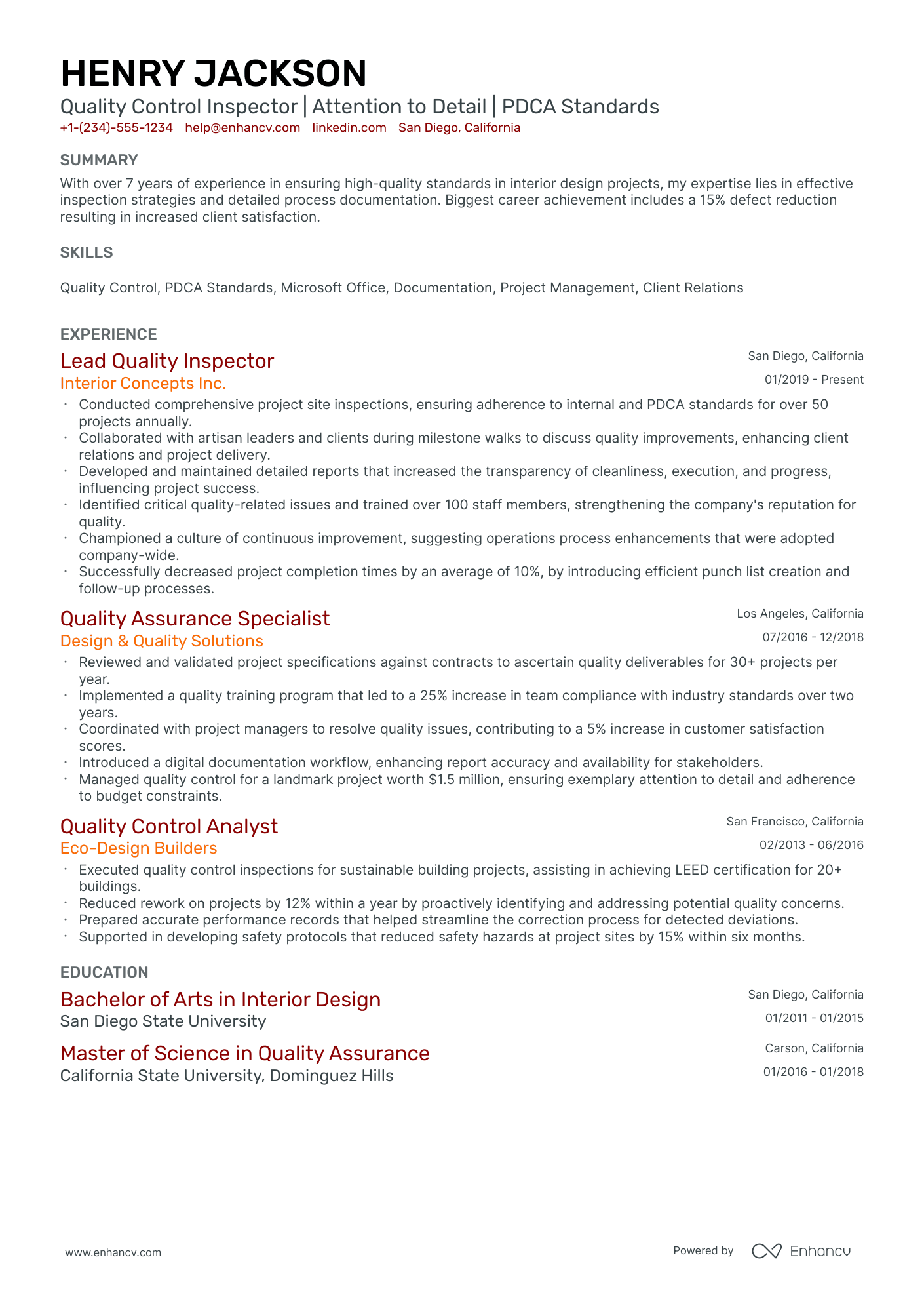
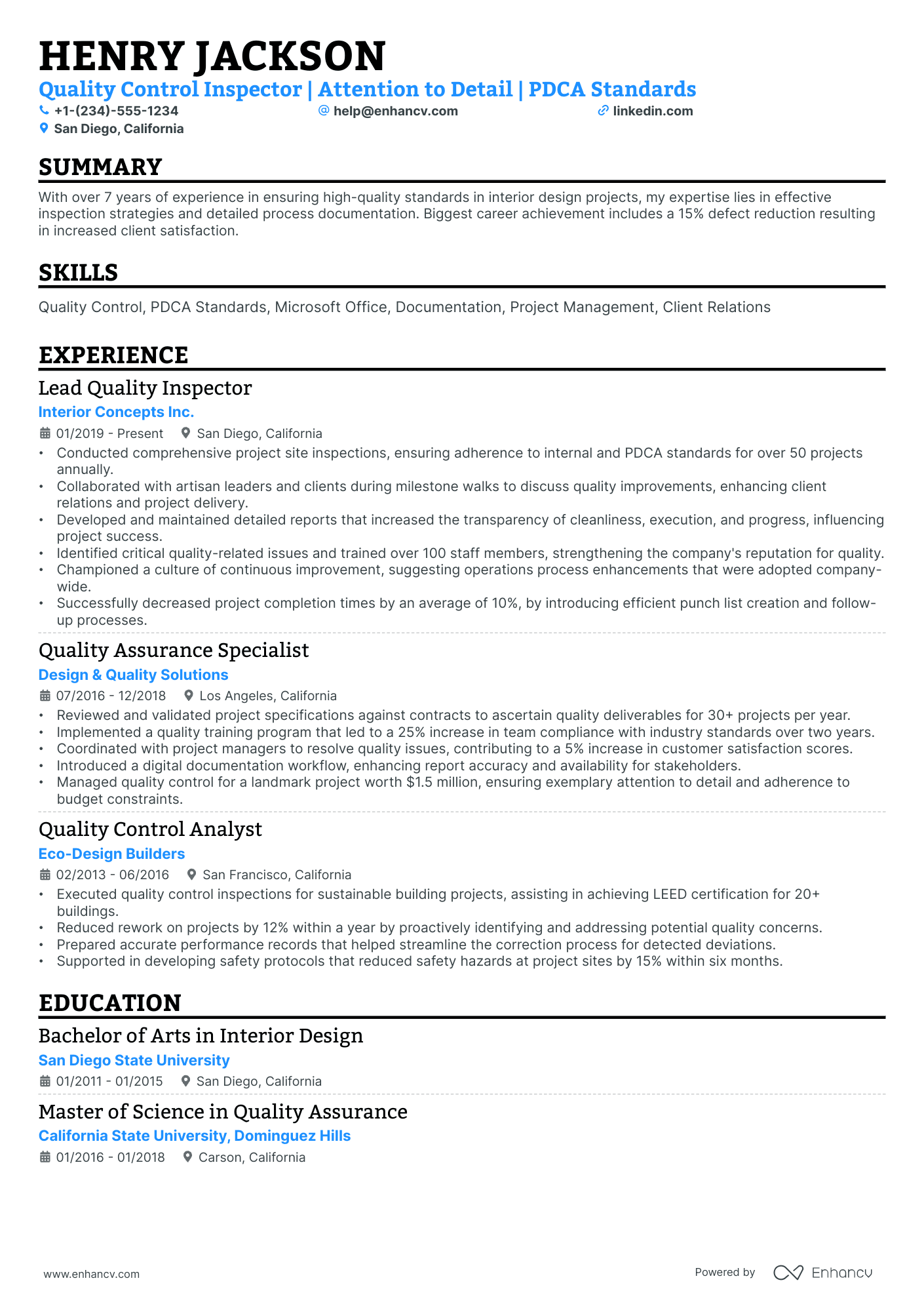
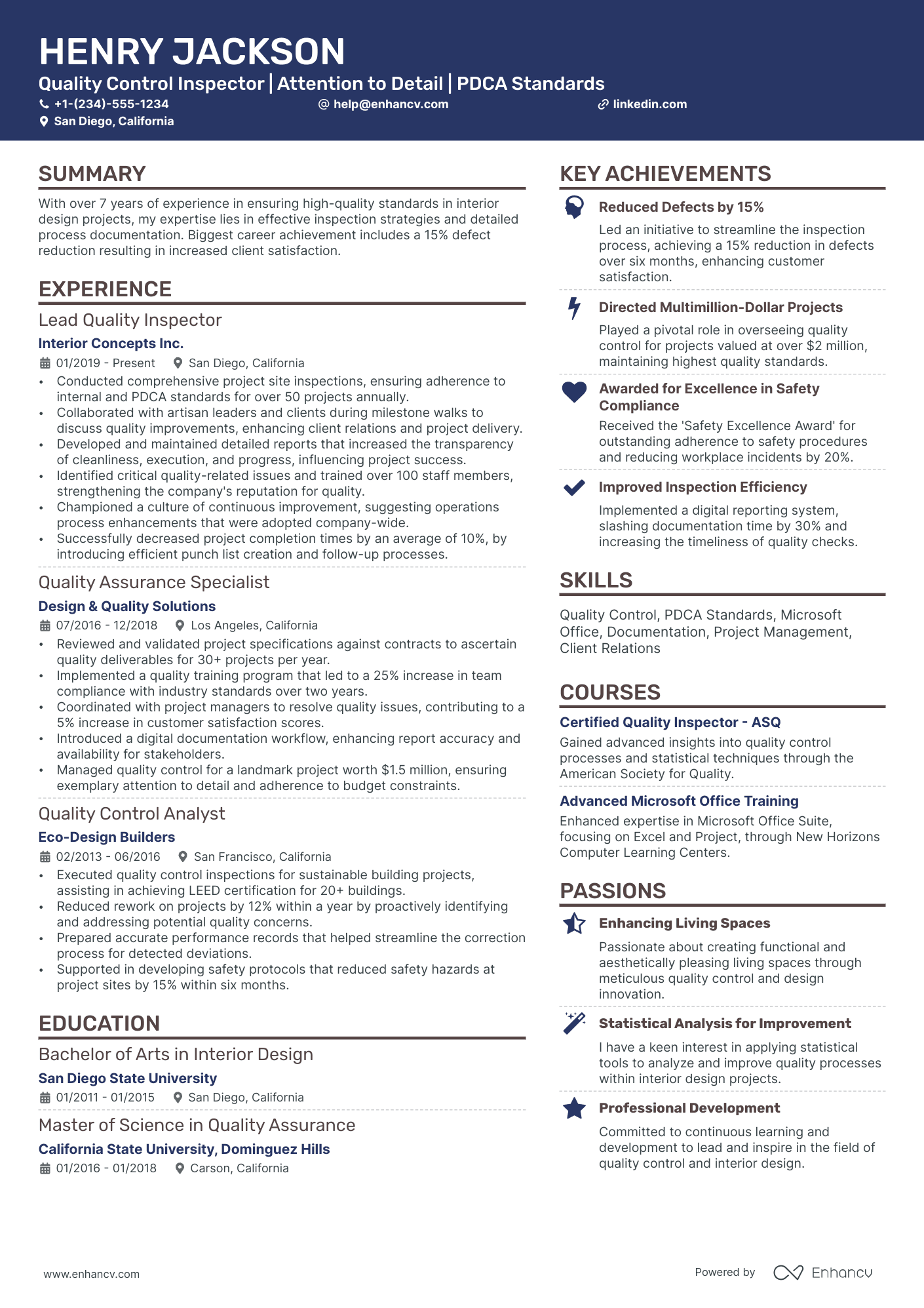
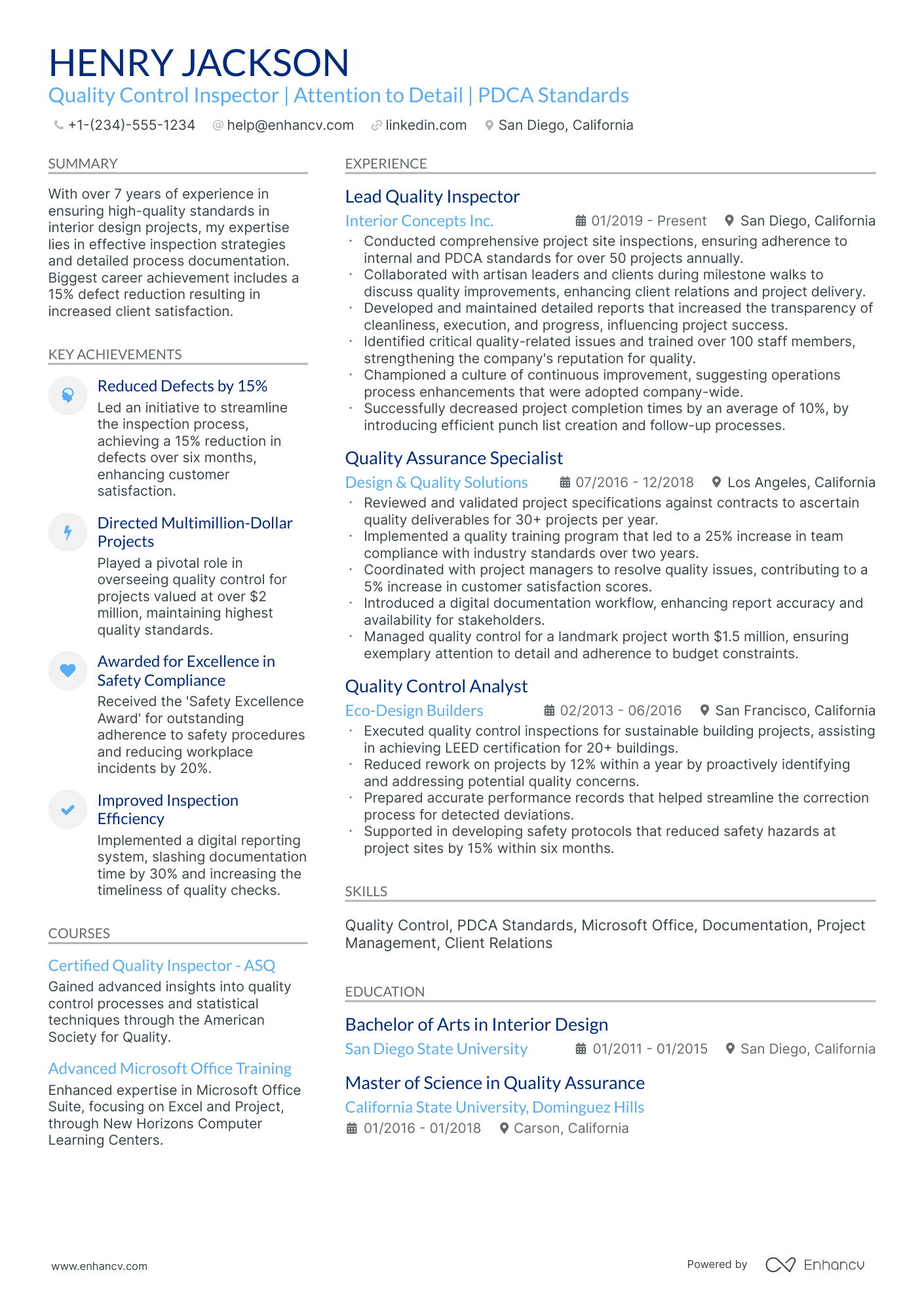
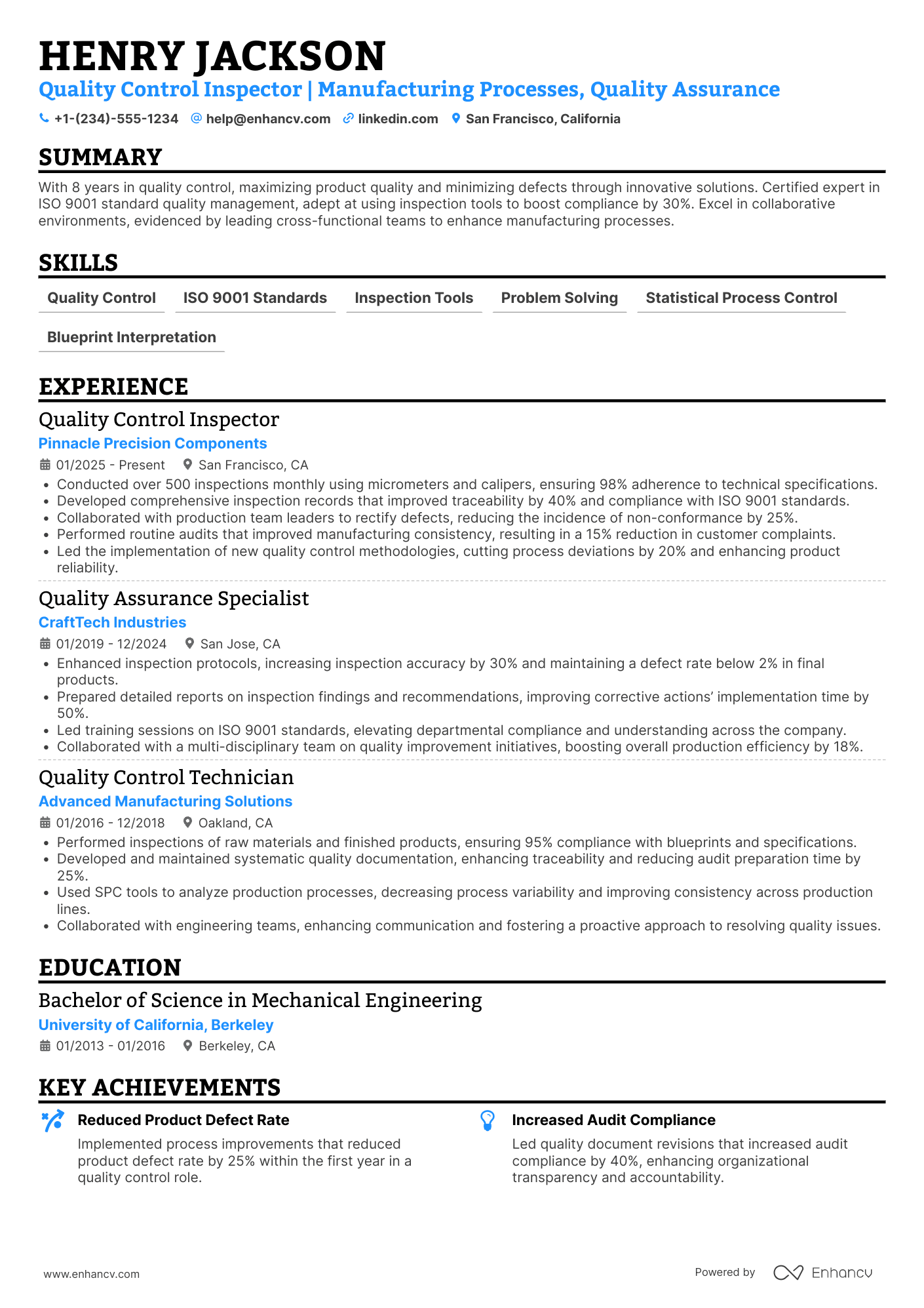
Quality control inspector resume drafts often fail because they list inspections and tools but skip measurable results, making them indistinguishable. That hurts in ATS screening and fast recruiter scans, where high competition rewards clear proof of impact. If you're unsure where to begin, understanding how to write a resume that highlights measurable outcomes is the essential first step.
A strong resume shows what improved because of you. Highlight defect reduction percentages, audit pass rates, fewer customer returns, faster release timelines, tighter first-pass yield, and the dollar value of scrap avoided. Tie results to product lines, shift coverage, and compliance outcomes.

Key takeaways
- Quantify inspection results like defect rates, scrap savings, and audit outcomes in every experience bullet.
- Use reverse-chronological format with direct quality control experience; use hybrid format without it.
- Tailor your resume to each job posting by mirroring its tools, standards, and terminology.
- Place certifications above education when they're recent, relevant, or required for the role.
- Anchor every listed skill to a measurable outcome in your experience or project sections.
- Write a three-to-four-line summary featuring your title, industry, core tools, and a key metric.
- Use Enhancv to turn vague quality control duties into focused, recruiter-ready resume bullets.
Job market snapshot for quality control inspectors
We analyzed 172 recent quality control inspector job ads across major US job boards. These numbers help you understand employer expectations, skills in demand, career growth patterns at a glance.
What level of experience employers are looking for quality control inspectors
| Years of Experience | Percentage found in job ads |
|---|---|
| 1–2 years | 23.3% (40) |
| 3–4 years | 16.3% (28) |
| 5–6 years | 11.6% (20) |
| 7–8 years | 0.6% (1) |
| 9–10 years | 0.6% (1) |
| 10+ years | 4.1% (7) |
| Not specified | 43.6% (75) |
Quality control inspector ads by area of specialization (industry)
| Industry (Area) | Percentage found in job ads |
|---|---|
| Finance & Banking | 47.7% (82) |
| Healthcare | 22.7% (39) |
| Manufacturing | 19.2% (33) |
Top companies hiring quality control inspectors
| Company | Percentage found in job ads |
|---|---|
| ZP Group | 6.4% (11) |
Role overview stats
These tables show the most common responsibilities and employment types for quality control inspector roles. Use them to align your resume with what employers expect and to understand how the role is structured across the market.
Day-to-day activities and top responsibilities for a quality control inspector
| Responsibility | Percentage found in job ads |
|---|---|
| Quality control | 45.9% (79) |
| Inspection | 25.0% (43) |
| Calipers | 19.8% (34) |
| Quality assurance | 15.7% (27) |
| Micrometers | 14.5% (25) |
| Microsoft excel | 11.6% (20) |
| Microsoft office | 9.9% (17) |
| Sap | 9.3% (16) |
| Construction | 8.7% (15) |
| Excel | 8.7% (15) |
| Microsoft word | 8.1% (14) |
| Data analysis | 7.6% (13) |
How to format a quality control inspector resume
Recruiters evaluating quality control inspector resumes prioritize hands-on inspection experience, familiarity with industry standards (ISO 9001, GMP, Six Sigma), and documented results in defect reduction or process improvement. A clean, well-organized format ensures these signals surface quickly during both ATS parsing and the recruiter's initial scan. Choosing the right resume format is critical to making this happen.

I have significant experience in this role—which format should I use?
Use a reverse-chronological format to put your deepest inspection and quality assurance experience front and center. Do:
- Lead with your most recent role and clearly define your scope: team size, facility type, product lines inspected, and reporting structure.
- Highlight role-specific tools and domains—CMM equipment, SPC software, calibration systems, FDA/ISO/AS9100 compliance—within each position's bullet points.
- Quantify outcomes tied to quality improvements, cost savings, or audit results in every role.
I'm junior or switching into this role—what format works best?
A hybrid format works best, letting you lead with a targeted skills section while still showing relevant work history in chronological order. Do:
- Place a skills section near the top that highlights inspection methodologies, measurement tools (calipers, micrometers, gauges), and any quality certifications (CQI, Six Sigma Green Belt).
- Include academic projects, internships, or cross-functional experience where you performed testing, auditing, documentation review, or root cause analysis.
- Connect every listed skill or project to a clear action and a measurable or observable result.
Why not use a functional resume?
A functional format strips away the timeline and context recruiters need to verify where, when, and how you applied your inspection and quality skills—making it harder to trust that your experience is current and relevant.
- A functional format may be acceptable if you're transitioning from a related field (manufacturing, lab science, or engineering) with limited direct QC titles, or if you have significant resume gaps—but only if every listed skill is anchored to a specific project, audit, or measurable outcome rather than presented as an abstract competency.
Once you've established a clean, readable format, the next step is filling it with the right sections to showcase your qualifications effectively.
What sections should go on a quality control inspector resume
Recruiters expect a quality control inspector resume to quickly show your inspection expertise, standards knowledge, and measurable results. Understanding which resume sections to include ensures you present a complete and compelling application.
Use this structure for maximum clarity:
- Header
- Summary
- Experience
- Skills
- Projects
- Education
- Certifications
- Optional sections: Awards, leadership, languages
Strong experience bullets should emphasize defect reduction, compliance outcomes, throughput improvements, audit readiness, and the scope of products, processes, and tools you inspected.
Is your resume good enough?
Drop your resume here or choose a file. PDF & DOCX only. Max 2MB file size.
Once you’ve organized the key resume components, the next step is to write your quality control inspector resume experience section so it fits those elements and supports your overall application.
How to write your quality control inspector resume experience
The experience section is where you prove you've shipped reliable, standards-compliant work—not just performed tasks. Hiring managers prioritize demonstrated impact, so every bullet should connect a role-relevant tool or method to a measurable outcome that moved quality forward. Building a targeted resume ensures each bullet speaks directly to the specific role you're pursuing.
Each entry should include:
- Job title
- Company and location (or remote)
- Dates of employment (month and year)
Three to five concise bullet points showing what you owned, how you executed, and what outcomes you delivered:
- Ownership scope: the product lines, production stages, inspection programs, or facility systems you were directly accountable for as a quality control inspector.
- Execution approach: the inspection tools, testing equipment, statistical methods, regulatory frameworks, or quality management systems you used to evaluate conformance and drive decisions.
- Value improved: the specific changes you influenced in defect rates, process reliability, regulatory compliance, product consistency, or risk reduction tied to your inspection work.
- Collaboration context: how you coordinated with production teams, engineering, suppliers, regulatory bodies, or management to resolve nonconformances and uphold quality standards.
- Impact delivered: the business-level outcomes your inspection work produced—expressed through results, scale, or operational improvements rather than a list of daily activities.
Experience bullet formula
A quality control inspector experience example
✅ Right example - modern, quantified, specific.
Quality Control Inspector
AeroSeal Components | Wichita, KS
2022–Present
AS9100-certified manufacturer producing precision machined and coated components for commercial and defense aerospace programs.
- Executed in-process and final inspections using calipers, micrometers, height gauges, and coordinate measuring machines (CMM); improved first-pass yield from 92% to 97% across three production cells.
- Interpreted engineering drawings and geometric dimensioning and tolerancing (GD&T) per ASME Y14.5; reduced drawing-related nonconformances by 38% by standardizing inspection plans and ballooned prints.
- Logged results in an electronic quality management system (eQMS) and maintained gage calibration in GAGEtrak; cut audit findings to zero across two AS9100 surveillance audits and improved on-time certificate of conformance (CoC) release by 22%.
- Led root cause analysis using 8D, 5 Whys, and fishbone diagrams with manufacturing engineers and operators; lowered scrap rate from 1.8% to 1.1% and avoided $140K in annual material loss.
- Partnered with suppliers and purchasing on incoming inspection and supplier corrective action requests (SCARs); decreased supplier-related defects by 29% and reduced line stoppages by 15 hours per month.
Now that you've seen how a strong experience section comes together, let's look at how to adjust those details to match the specific job you're applying for.
How to tailor your quality control inspector resume experience
Recruiters evaluate your quality control inspector resume through both applicant tracking systems and manual review. Tailoring your resume to the job description ensures your qualifications stand out in both screening methods.
Ways to tailor your quality control inspector experience:
- Match specific inspection tools and measurement equipment named in the posting.
- Mirror the exact quality standards like ISO or Six Sigma referenced.
- Use the same terminology for defect tracking or reporting systems listed.
- Highlight industry experience that aligns with the employer's manufacturing sector.
- Reflect compliance or regulatory frameworks mentioned in the job description.
- Incorporate the same KPIs or quality benchmarks the posting prioritizes.
- Emphasize collaboration with production teams if cross-functional work is referenced.
- Align your SPC or root cause analysis methods with those specified.
Tailoring means aligning your real accomplishments with the language and priorities of each job posting, not forcing in keywords where they don't belong.
Resume tailoring examples for quality control inspector
| Job description excerpt | Untailored | Tailored |
|---|---|---|
| "Perform incoming, in-process, and final inspections using CMM, calipers, and micrometers per AS9100 standards in an aerospace manufacturing environment." | Inspected products and documented results to ensure quality standards were met. | Conducted incoming, in-process, and final inspections of aerospace components using CMM, calipers, and micrometers, maintaining full compliance with AS9100 standards across 12,000+ parts annually. |
| "Identify non-conforming materials, initiate NCRs, and collaborate with production teams to implement corrective actions using 8D methodology." | Found defective items and reported them to management for further review. | Identified non-conforming materials and initiated 15–20 NCRs per month, leading 8D root cause investigations with production teams that reduced repeat defects by 32% over two quarters. |
| "Operate optical comparators and coordinate with the SPC program to monitor process capability (Cpk) for critical-to-quality dimensions in medical device production." | Monitored equipment and tracked data to support quality improvement efforts. | Operated optical comparators to inspect critical-to-quality dimensions on Class II medical devices, contributing SPC data that improved Cpk from 1.2 to 1.8 across three high-volume production lines. |
Once you’ve aligned your experience with the role’s inspection priorities, the next step is to quantify your quality control inspector achievements to show the measurable impact of that work.
How to quantify your quality control inspector achievements
Quantifying your work proves you protect quality, reduce risk, and speed production. Focus on defect rates, inspection throughput, rework and scrap costs, audit results, and corrective action closure time. Using numbers on your resume transforms generic duties into compelling evidence of your impact.
Quantifying examples for quality control inspector
| Metric | Example |
|---|---|
| Defect rate | "Reduced line defect rate from 2.8% to 1.6% in six months by tightening sampling plans and using Minitab control charts." |
| Inspection throughput | "Increased inspection throughput from 45 to 70 units per hour by standardizing checklists and reorganizing gauges at the inspection station." |
| Rework and scrap cost | "Cut monthly scrap and rework costs by $18,000 by identifying recurring torque failures and updating work instructions with production leads." |
| Compliance audits | "Passed three ISO 9001 internal audits with zero major nonconformities by maintaining calibration logs and improving traceability for 1,200 lots." |
| Corrective actions | "Improved corrective action closure from 21 to 10 days on average by tracking eight-department owners in Excel and escalating overdue actions weekly." |
Turn vague job duties into measurable, recruiter-ready resume bullets in seconds with Enhancv's Bullet Point Generator.
Once you've crafted strong bullet points for your experience section, you'll want to apply that same precision to presenting your hard and soft skills effectively.
How to list your hard and soft skills on a quality control inspector resume
Skills show you can inspect to spec, document results, and prevent defects, and recruiters and an ATS (applicant tracking system) scan this section to match you to requirements—aim for a hard-skill-heavy mix with role-specific soft skills. A well-structured skills section makes this easy to scan. Balance your listing by including both hard skills like CMM operation and SPC analysis alongside soft skills like cross-team communication and risk escalation.
quality control inspector roles require a blend of:
- Product strategy and discovery skills.
- Data, analytics, and experimentation skills.
- Delivery, execution, and go-to-market discipline.
- Soft skills.
Your skills section should be:
- Scannable (bullet-style grouping).
- Relevant to the job post.
- Backed by proof in experience bullets.
- Updated with current tools.
Place your skills section:
- Above experience if you're junior or switching careers.
- Below experience if you're mid/senior with strong achievements.

Hard skills
- ISO 9001 compliance
- GMP and SOP adherence
- AQL sampling plans
- Control charts, SPC
- Root cause analysis, CAPA
- 8D, 5 Whys, fishbone
- GD&T blueprint reading
- Micrometers, calipers, CMM
- First article inspection (FAI)
- Nonconformance reports, MRB
- Gage R&R, MSA
- SAP, Excel
Soft skills
- Flag defects and stop-the-line
- Write clear inspection reports
- Escalate risks with evidence
- Hold firm to specs under pressure
- Align with production on rework
- Partner with engineering on fixes
- Ask precise clarifying questions
- Prioritize inspections by risk
- Maintain focus during repetitive checks
- Manage shift handoffs cleanly
- Coach operators on defect prevention
- Follow up until closure on CAPA
How to show your quality control inspector skills in context
Skills shouldn't live only in a bulleted list on your resume. Browse examples of resume skills in action to see how top candidates weave them into summaries and experience bullets.
They should be demonstrated in:
- Your summary (high-level professional identity)
- Your experience (proof through outcomes)
Here's what strong, context-rich examples look like in practice.
Summary example
Senior quality control inspector with 12 years in aerospace manufacturing. Skilled in GD&T, CMM programming, and root cause analysis using 8D methodology. Reduced customer rejection rates by 34% through cross-functional corrective action initiatives.
- Signals senior-level expertise immediately
- Names industry-specific tools and methods
- Quantifies impact with a clear metric
- Highlights cross-functional collaboration skills
Experience example
Senior Quality Control Inspector
Vantage Precision Manufacturing | Wichita, KS
March 2018–Present
- Implemented statistical process control across six production lines, reducing defect rates by 27% within the first year.
- Partnered with engineering and procurement teams to overhaul incoming material inspections using Zeiss CMM equipment, cutting supplier nonconformances by 41%.
- Led First Article Inspection procedures aligned with AS9102 standards, achieving 100% customer audit compliance for three consecutive years.
- Every bullet includes measurable proof.
- Skills surface naturally through real outcomes.
Once you’ve tied your inspection strengths to real tasks and outcomes, the next step is learning how to write a quality control inspector resume with no experience so you can apply that same approach to schoolwork, training, and projects.
How do I write a quality control inspector resume with no experience
Even without full-time experience, you can demonstrate readiness through relevant projects and training. Our guide on writing a resume without work experience walks you through exactly how to do this:
- Quality inspection class lab reports
- Capstone project defect tracking
- Internship in manufacturing operations
- Volunteer inventory and lot audits
- Personal project gauge calibration logs
- ISO 9001 training certificate
- Safety and GMP compliance training
- Technical drawing interpretation exercises
Focus on:
- Inspection methods and sampling plans
- Measurement tools and calibration records
- Defect documentation with clear evidence
- Standards: ISO 9001, GMP
Resume format tip for entry-level quality control inspector
Use a hybrid resume format because it spotlights relevant skills and projects while still showing your work history, even if it's unrelated. Do:
- Add a Projects section with inspection work.
- List tools: calipers, micrometers, gauges.
- Include standards and procedures you followed.
- Quantify results: defects found, accuracy, time.
- Mirror quality control inspector keywords from job posts.
- Completed capstone defect tracking using calipers and a go/no-go gauge, logged forty-eight checks, flagged five nonconforming parts, and improved first-pass yield by eight percent.
Even without direct experience, your educational background can demonstrate the foundational knowledge employers look for in a quality control inspector.
How to list your education on a quality control inspector resume
Your education section helps hiring teams confirm you have the foundational knowledge needed. It validates your understanding of quality principles, inspection methods, and technical skills relevant to the quality control inspector role.
Include:
- Degree name
- Institution
- Location
- Graduation year
- Relevant coursework (for juniors or entry-level candidates)
- Honors & GPA (if 3.5 or higher)
Skip month and day details—list the graduation year only.
Here's a strong education entry for a quality control inspector resume:
Example education entry
Bachelor of Science in Industrial Engineering
Ohio State University, Columbus, OH
Graduated 2021
GPA: 3.7/4.0
- Relevant Coursework: Statistical Process Control, Manufacturing Quality Systems, Materials Science, and Metrology
- Honors: Magna Cum Laude, Dean's List (six semesters)
How to list your certifications on a quality control inspector resume
Certifications on your resume show your commitment to learning, proficiency with inspection tools, and relevance to regulated industries as a quality control inspector. They also help employers trust your judgment on standards and documentation.
Include:
- Certificate name
- Issuing organization
- Year
- Optional: credential ID or URL
- Place certifications below education when your degree is recent and your certifications are older or less relevant to the quality control inspector role.
- Place certifications above education when they are recent, highly relevant, or required for the quality control inspector job you want.
Best certifications for your quality control inspector resume
- ASQ Certified Quality Inspector (CQI)
- ASQ Certified Quality Technician (CQT)
- ASQ Certified Quality Improvement Associate (CQIA)
- ISO 9001:2015 Internal Auditor Certification
- Six Sigma Green Belt Certification
- IPC-A-610 Certified IPC Specialist (CIS)
- NDT Level II Certification (ASNT)
Once you’ve positioned your credentials where hiring teams can spot them quickly, use your resume summary to reinforce that qualification in a clear, role-specific snapshot.
How to write your quality control inspector resume summary
Your resume summary is the first thing a recruiter reads. A strong one immediately signals you have the inspection skills and attention to detail the role demands.
Keep it to three to four lines, with:
- Your title and total years of quality control or inspection experience.
- The industry or product type you've worked in, such as manufacturing, aerospace, or food production.
- Core tools and skills like calipers, CMMs, GD&T, or ISO 9001 auditing.
- One or two measurable achievements, such as defect reduction rates or audit pass percentages.
- Soft skills tied to real outcomes, like cross-team communication that shortened corrective action cycles.

PRO TIP
At this level, emphasize hands-on inspection skills, specific tools you've mastered, and early wins that show reliability. Quantify results wherever possible, even from internships or short-term roles. Avoid vague phrases like "passionate about quality" or "detail-oriented team player." Recruiters want proof, not personality descriptors.
Example summary for a quality control inspector
Quality control inspector with two years of experience in automotive parts manufacturing. Skilled in CMM operation, GD&T interpretation, and ISO 9001 compliance. Reduced defect escape rate by 18% through improved first-article inspection procedures.
Optimize your resume summary and objective for ATS
Drop your resume here or choose a file.
PDF & DOCX only. Max 2MB file size.
Now that your summary is ready to showcase your qualifications at a glance, make sure your header provides the essential contact details recruiters need to reach you.
What to include in a quality control inspector resume header
A resume header lists your key identification and contact details, helping recruiters quickly confirm visibility, credibility, and fit during screening for a quality control inspector.
Essential resume header elements
- Full name
- Tailored job title and headline
- Location
- Phone number
- Professional email
- GitHub link
- Portfolio link
A LinkedIn link helps recruiters verify experience quickly and supports faster screening.
Do not include photos on a quality control inspector resume unless the role is explicitly front-facing or appearance-dependent.
Use a clear job title, a specific headline, and consistent contact details so recruiters can match you to quality control inspector roles in seconds.
Example
Quality control inspector resume header
Jordan Taylor
Quality Control Inspector | ISO 9001 Audits, Caliper Use, Root Cause Analysis
Columbus, OH
(614) 555-12XX
jordan.taylor@enhancv.com
github.com/jordantaylor
jordantaylorqc.com
linkedin.com/in/jordantaylor
Once your contact details and role focus are clearly established at the top, you can strengthen the rest of the document with additional sections that support your qualifications as a quality control inspector.
Additional sections for quality control inspector resumes
When your core qualifications match other applicants, well-chosen additional sections can set your quality control inspector resume apart.
They highlight specialized knowledge, industry commitment, and personal strengths that standard sections don't capture. For example, listing language skills can be a differentiator if you work with international suppliers or in multilingual manufacturing environments.
Consider adding these sections to strengthen your candidacy:
- Languages
- Certifications and licenses
- Industry conferences and training
- Publications or technical reports
- Professional affiliations
- Volunteer experience in safety or compliance initiatives
- Hobbies and interests
Once you've strengthened your resume with relevant additional sections, the next step is pairing it with a well-crafted cover letter to make an even stronger impression.
Do quality control inspector resumes need a cover letter
A cover letter isn't required for a quality control inspector, but it helps in competitive roles or when employers expect one. It can make a difference when your resume needs context, or when you want to show fit with the team and product. If you're unsure where to start, learn what a cover letter is and how it complements your resume.
Use a cover letter to add context your resume can't:
- Explain role or team fit by matching your inspection approach to their standards, shift needs, pace, and cross-functional workflows.
- Highlight one or two relevant projects or outcomes, including defect reductions, scrap savings, audit results, or faster release cycles.
- Show understanding of the product, users, or business context by naming key risks, failure modes, and what "good" quality means for customers.
- Address career transitions or non-obvious experience by connecting prior work to inspection tools, documentation, and root-cause practices.
Drop your resume here or choose a file.
PDF & DOCX only. Max 2MB file size.
Once you’ve decided whether to include a cover letter to support your application, the next step is using AI to strengthen your quality control inspector resume so it reflects the same intent with more precision and impact.
Using AI to improve your quality control inspector resume
AI can sharpen your resume's clarity, structure, and impact. It helps tighten language and highlight measurable results. But overuse kills authenticity. Once your content reads clearly and fits the role, step away from AI. For practical starting points, explore these ChatGPT resume writing prompts tailored to different resume sections.
Here are 10 practical prompts to strengthen specific sections of your quality control inspector resume:
Strengthen your summary
Quantify experience bullets
Tighten skills section
Align with job posting
Improve action verbs
Clarify certifications section
Refine project descriptions
Trim redundant content
Enhance education details
Fix inconsistent formatting
Conclusion
A strong quality control inspector resume shows measurable outcomes, role-specific skills, and a clear structure. It highlights defect reductions, audit pass rates, rework savings, and on-time release results. It also shows inspection methods, documentation accuracy, and strong attention to detail.
Keep your quality control inspector resume easy to scan and easy to verify. Use consistent headings, focused bullets, and metrics that match today’s hiring needs. This approach shows you can support compliance, reduce risk, and deliver reliable quality now and next.