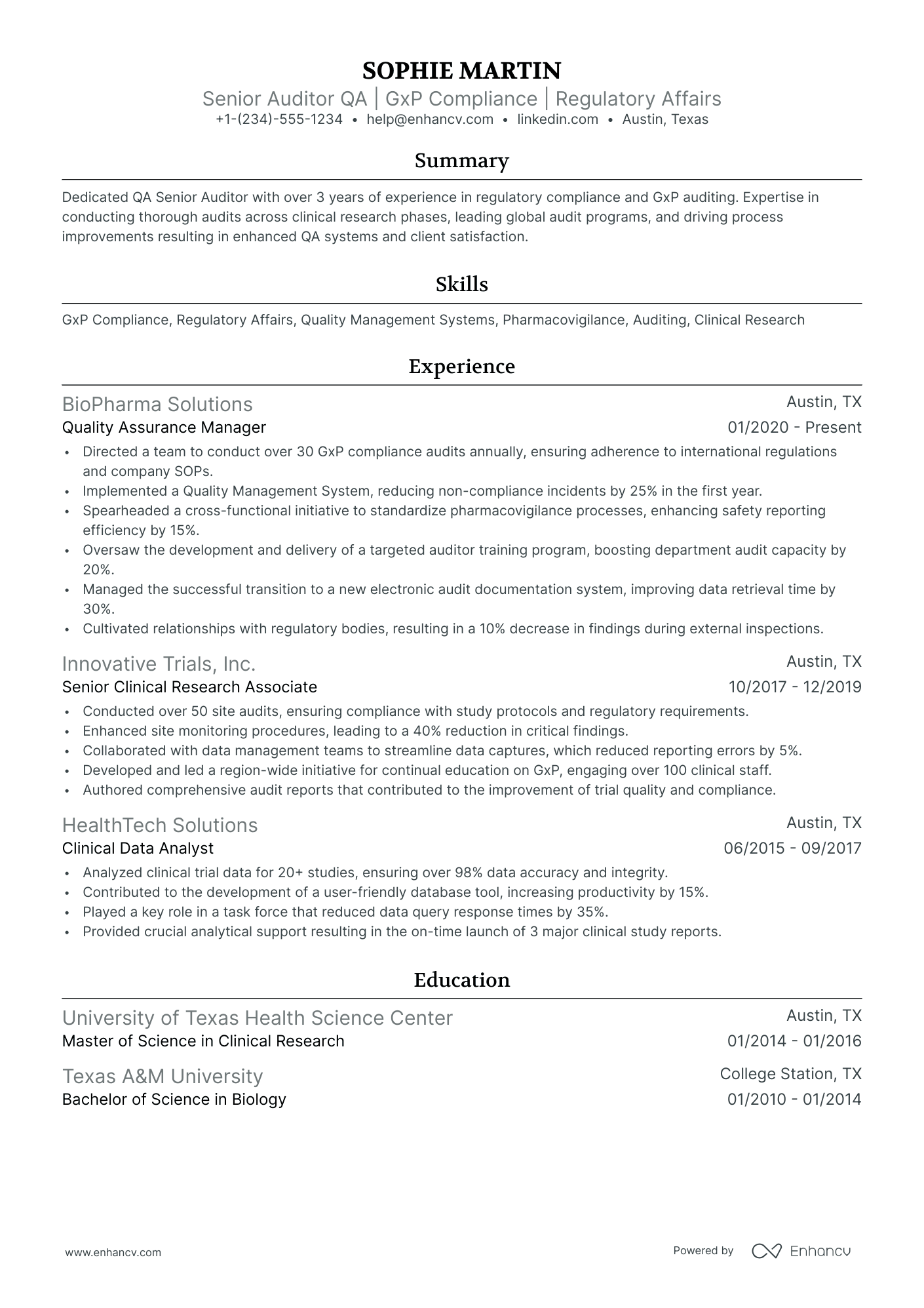
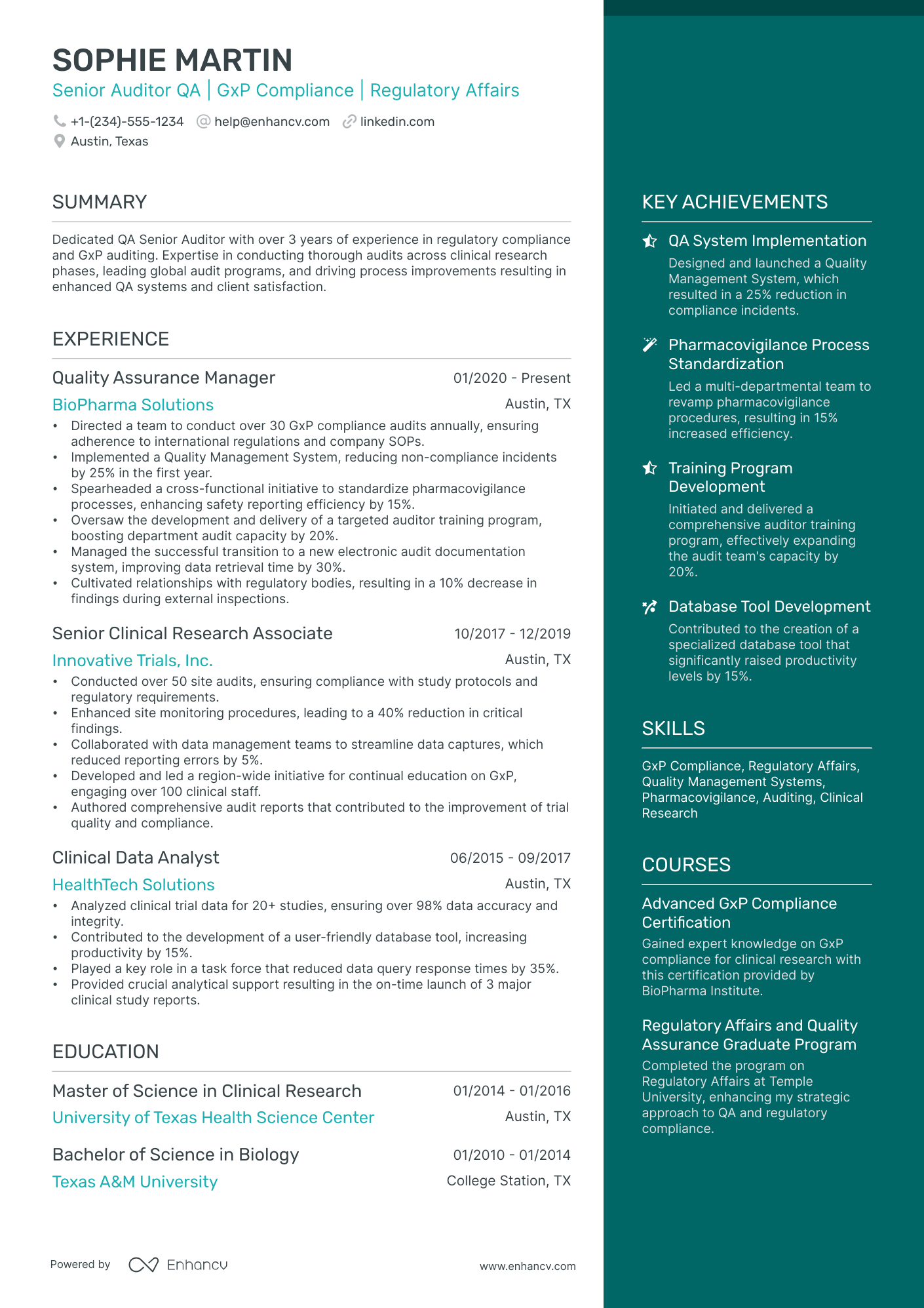
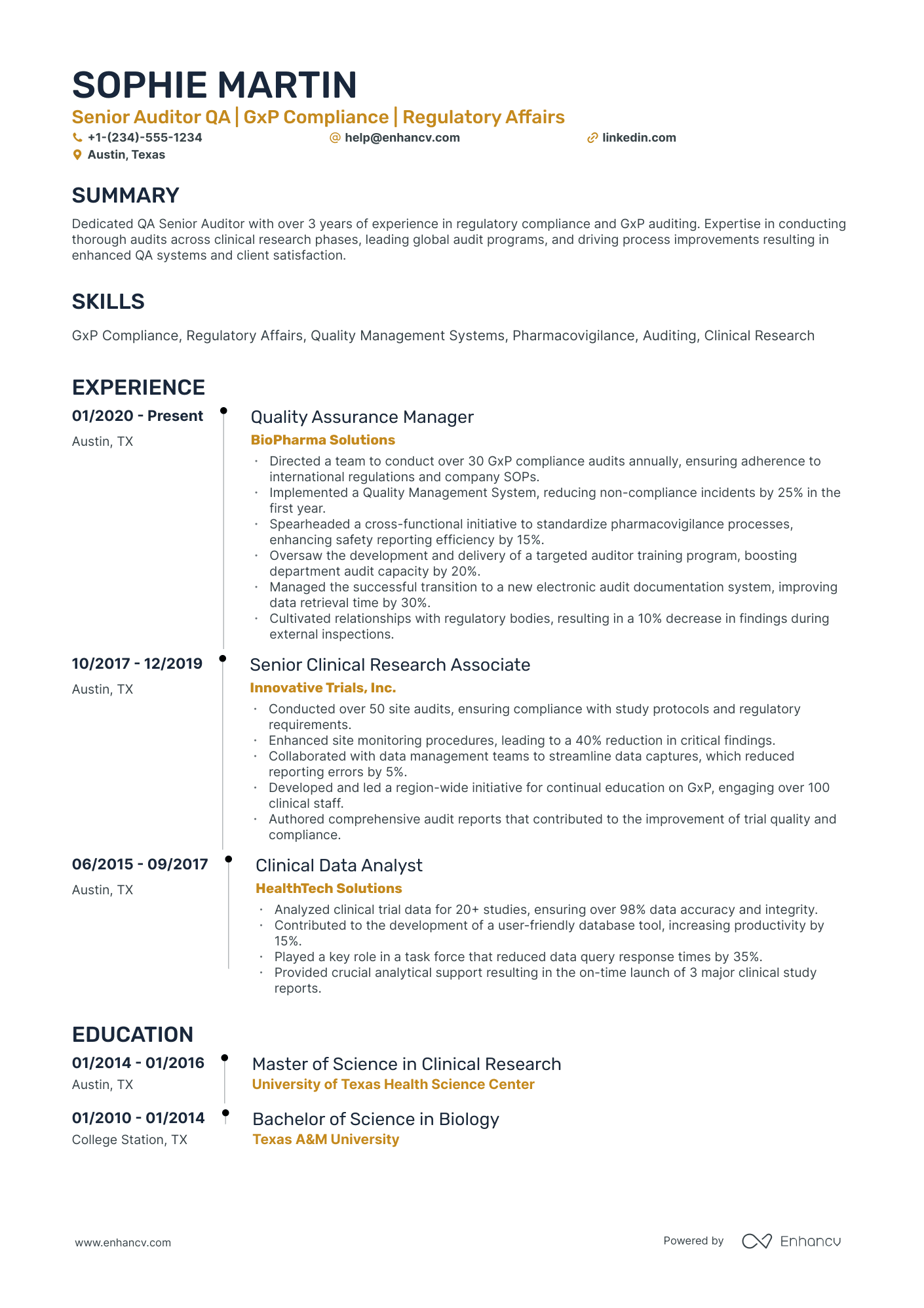
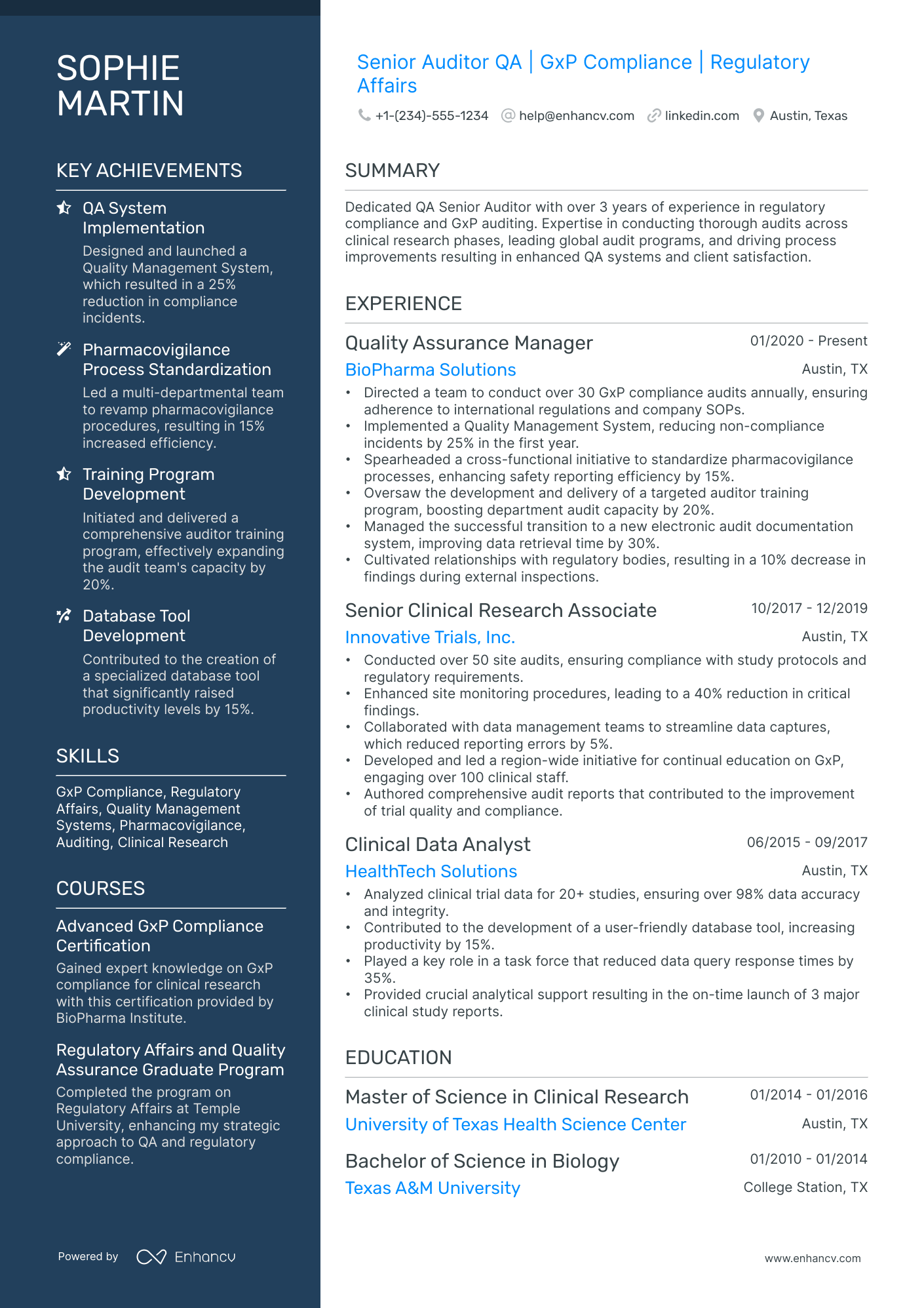
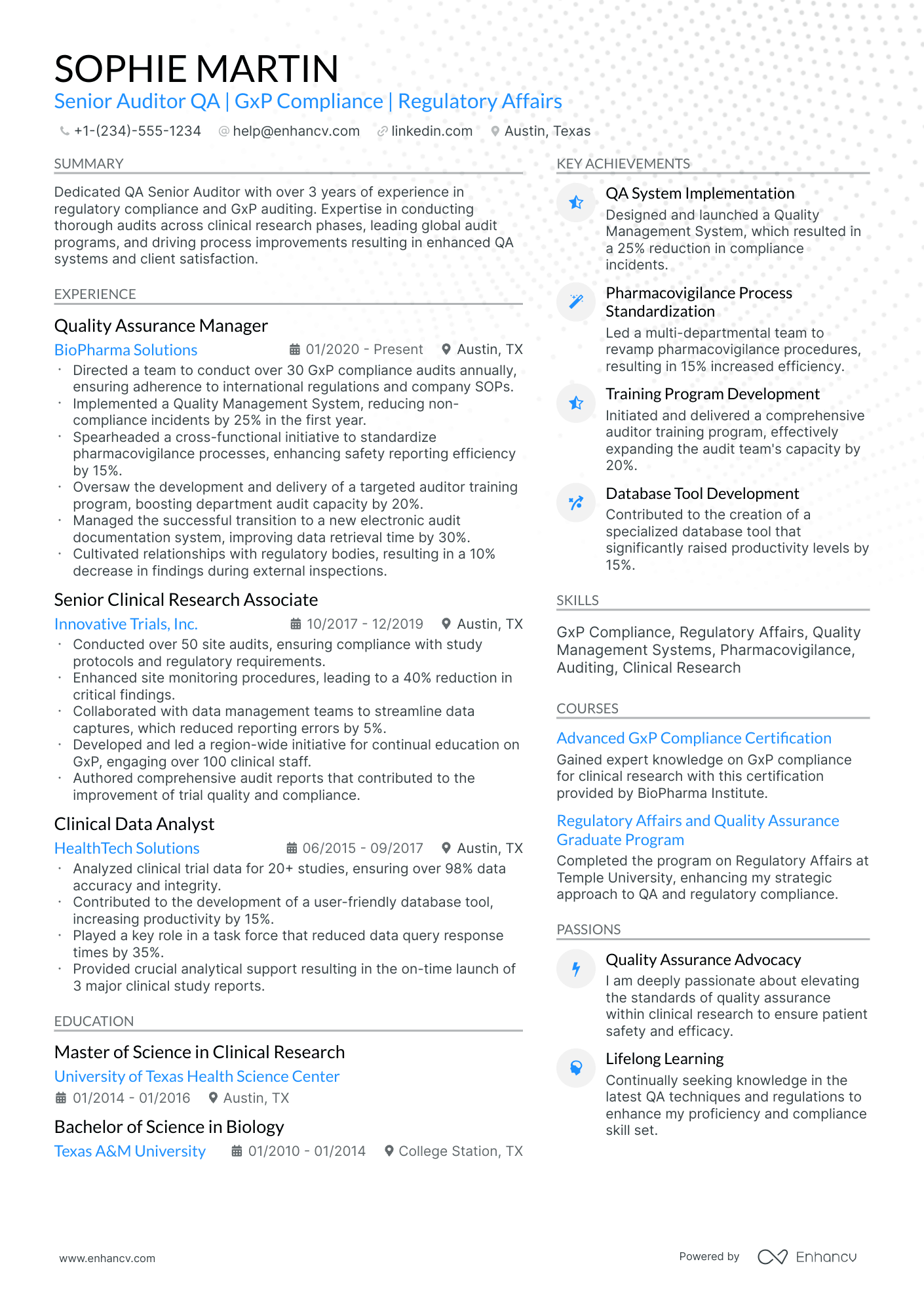
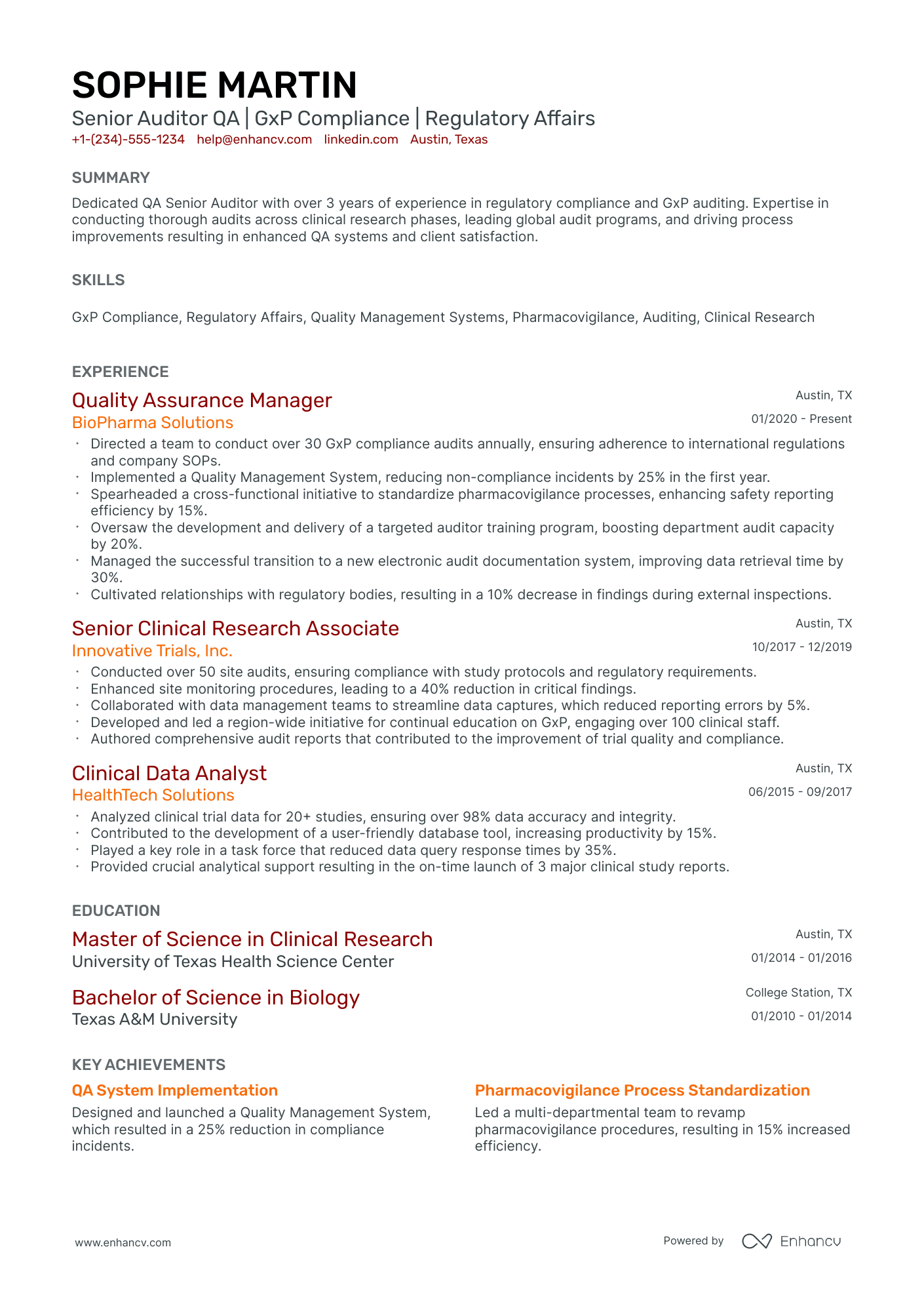
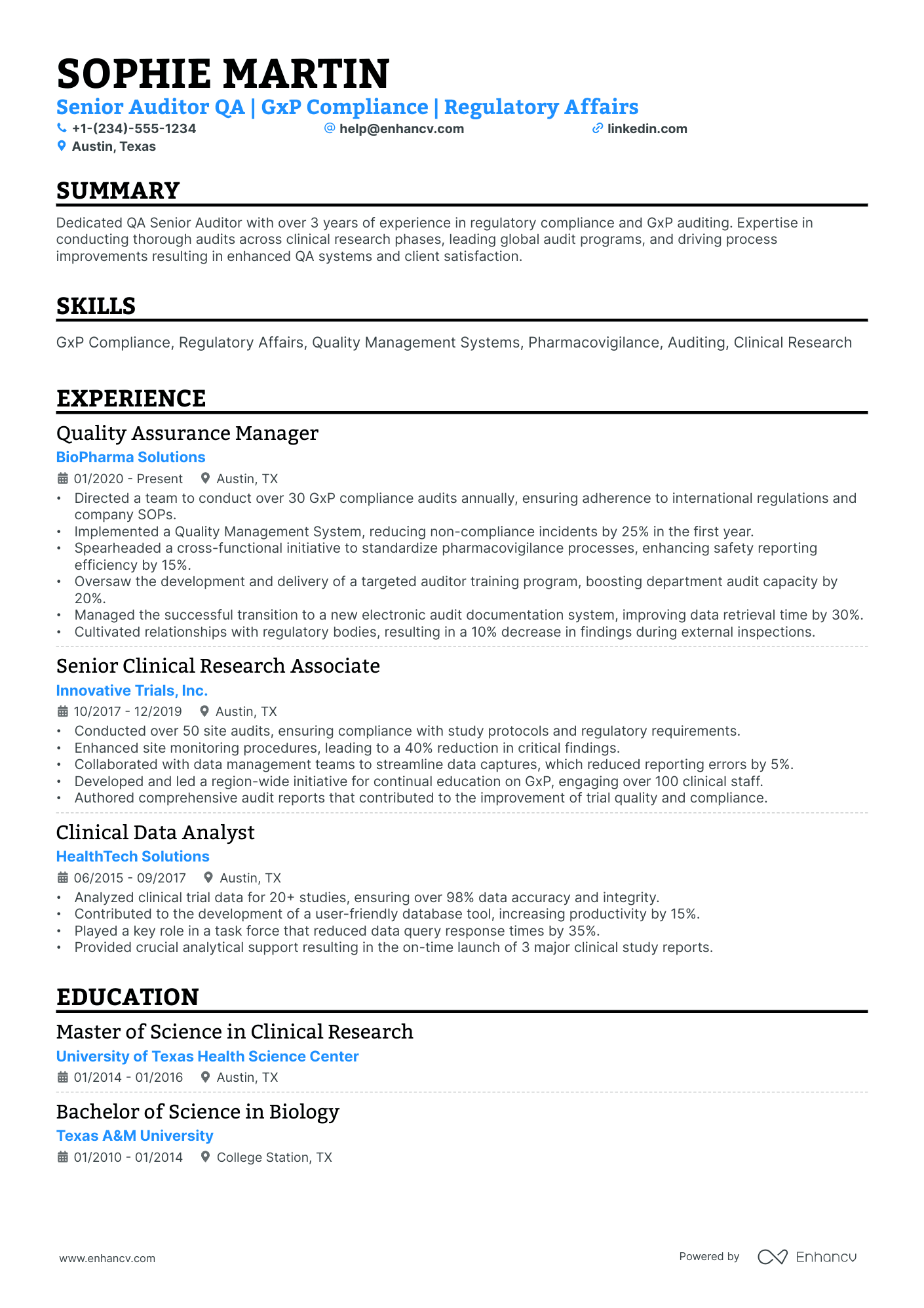
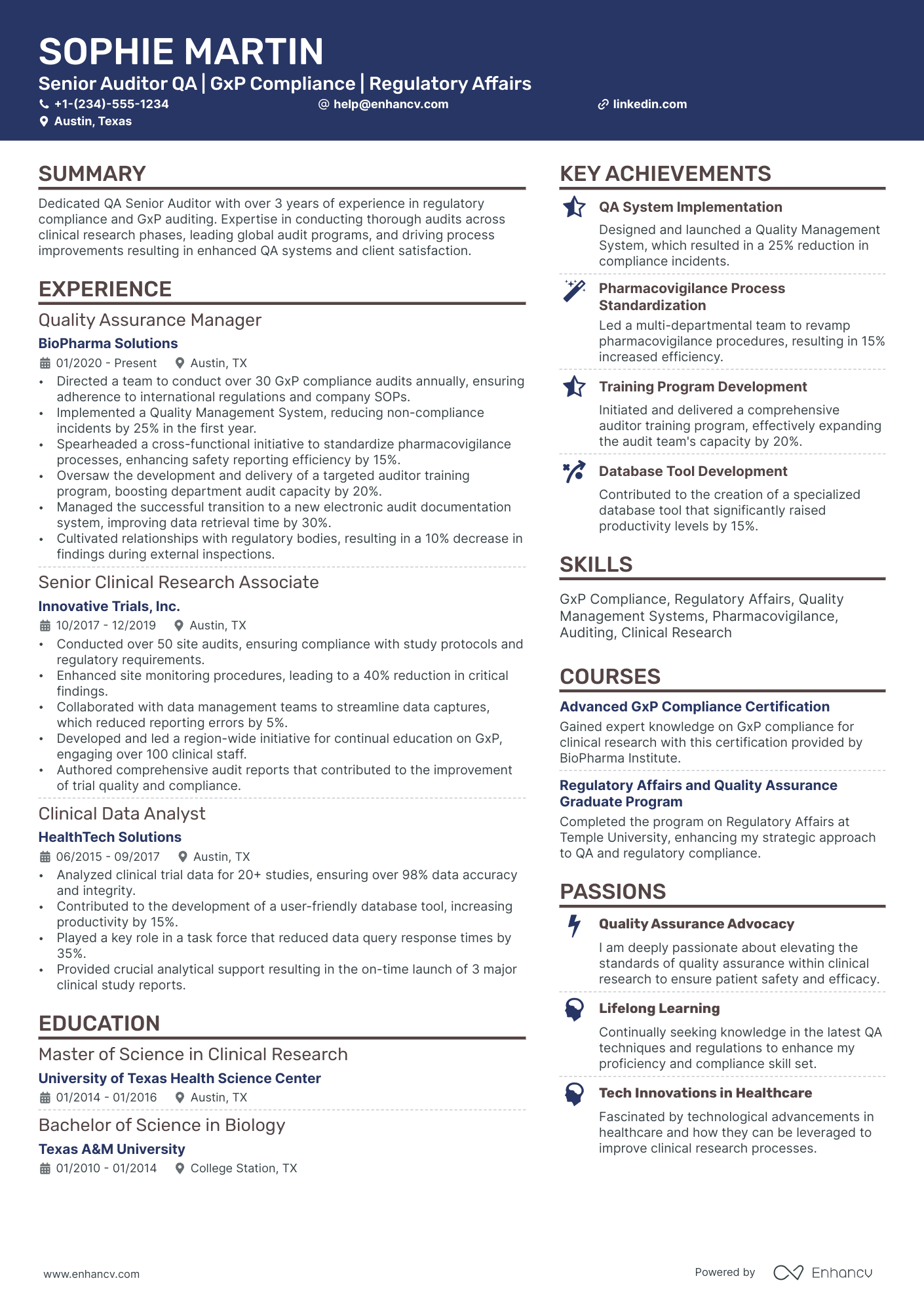
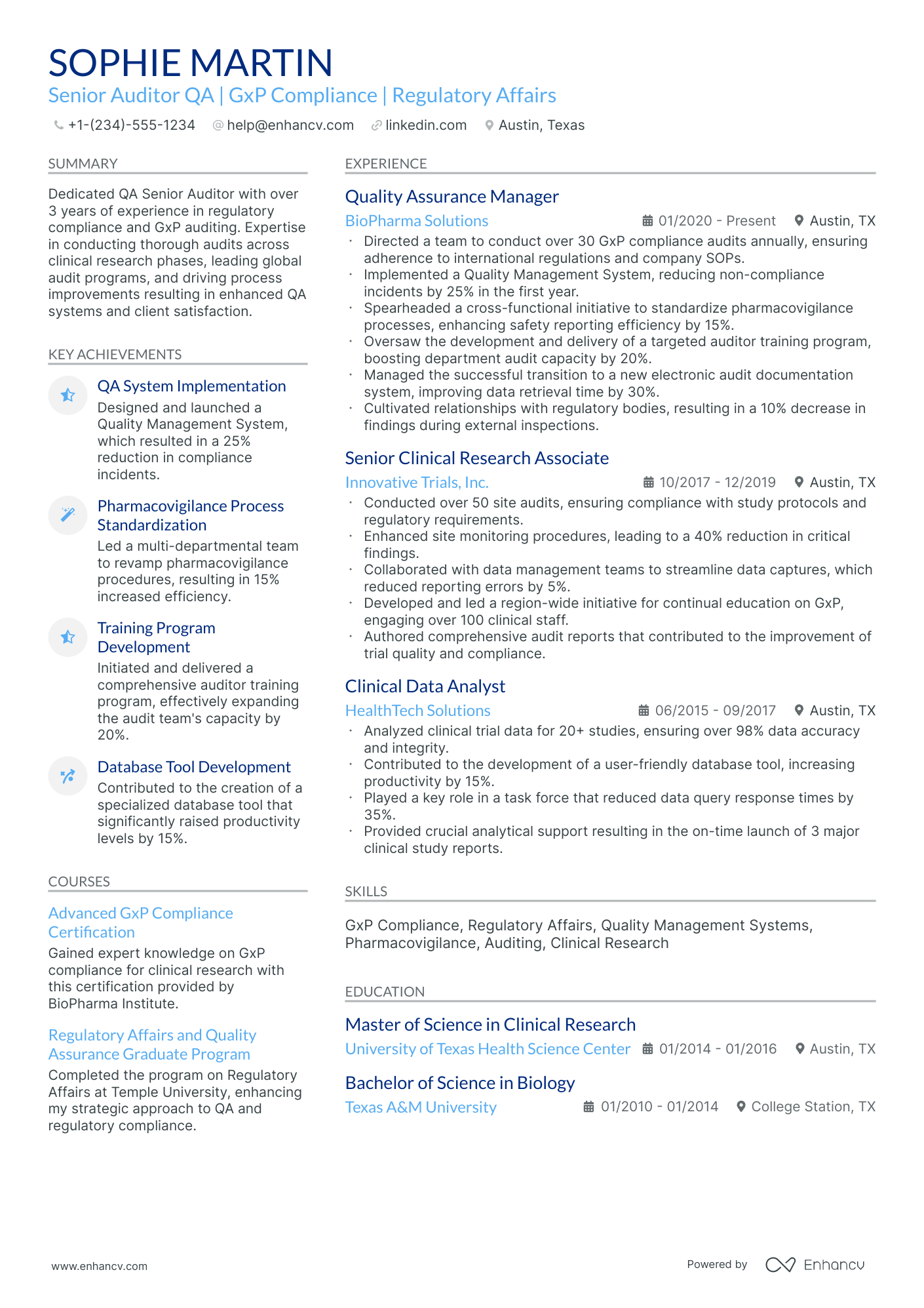
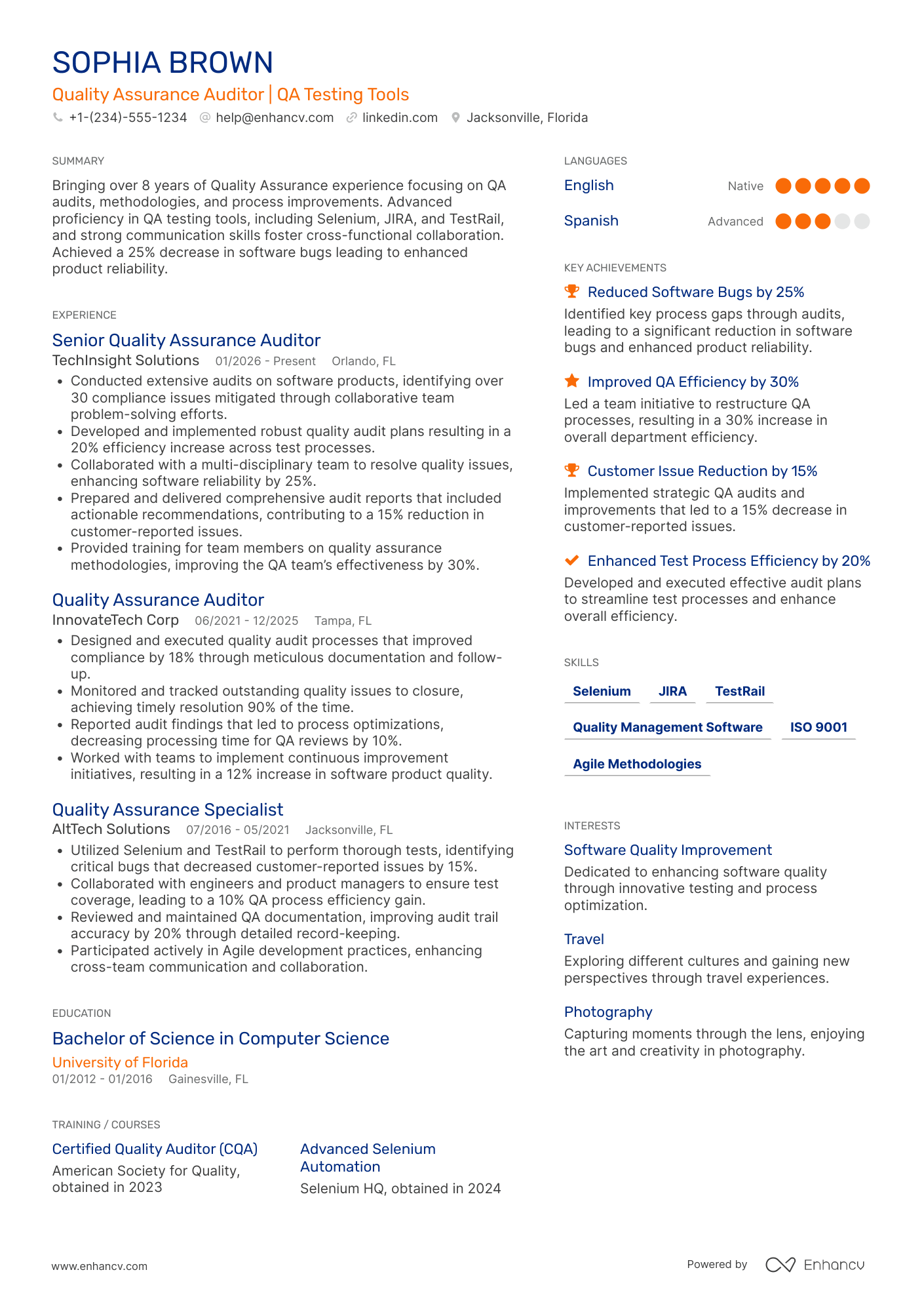
Many QA auditor resumes fail because they list checklists and tools but don't prove audit impact or risk reduction. This QA auditor resume guide helps you pass ATS screening and earn attention in fast recruiter scans amid heavy competition.
A strong resume shows what changed because of your audits, not what you touched. Knowing how to make your resume stand out starts with highlighting defect escape reduction, audit coverage across products or sites, cycle time gains, fewer customer complaints, stronger compliance scores, and measurable cost or rework savings.

Key takeaways
- Quantify audit outcomes like defect reduction, compliance rates, and rework savings in every bullet.
- Use reverse-chronological format if experienced and hybrid format if junior or switching careers.
- Tailor experience bullets to mirror the exact tools, standards, and KPIs in each job posting.
- Tie every listed skill to a specific action and measurable result in your experience section.
- Place certifications like CQA or ISO 9001 Lead Auditor where they'll get noticed fastest.
- Write a three- to four-line summary with your title, domain, core tools, and top achievement.
- Use Enhancv to turn vague duties into measurable, recruiter-ready resume bullets quickly.
How to format a QA auditor resume
Recruiters evaluating QA auditor candidates prioritize attention to detail, familiarity with audit frameworks and compliance standards, and the ability to identify process gaps that lead to measurable quality improvements. Choosing the right resume format ensures these signals surface quickly during both automated screening and manual review.

I have significant experience in this role—which format should I use?
Use a reverse-chronological format to present your audit experience in a clear, linear progression that highlights increasing scope and responsibility. Do:
- Lead with your most recent role and emphasize the scope of audits you owned—number of departments, facilities, or product lines covered, and the standards you enforced (ISO 9001, FDA, GMP, SOX).
- Feature role-specific tools and domains prominently, including audit management platforms (e.g., MasterControl, ETQ, SAP QM), root cause analysis methodologies, and regulatory frameworks relevant to your industry.
- Quantify outcomes tied to business impact, such as defect reduction rates, cost savings from corrective actions, audit pass rates, or compliance improvements.
- Conducted 45+ internal and supplier audits annually across three manufacturing sites, identifying 120 nonconformances and driving corrective actions that reduced product defect rates by 32% within 12 months.
I'm junior or switching into this role—what format works best?
A hybrid format works best, allowing you to lead with relevant quality and auditing skills while still providing a concise work history that gives recruiters timeline context. Do:
- Place a skills or qualifications section near the top of your resume, highlighting audit-related competencies such as document control, CAPA processes, statistical sampling, and relevant certifications (CQA, Six Sigma Green Belt).
- Include projects, internships, or transitional experience that demonstrate hands-on exposure to quality systems—such as assisting with internal audits, supporting ISO certification efforts, or conducting inspection activities in a previous role.
- Connect every listed skill or project to a clear action and result so recruiters can see practical application, not just theoretical knowledge.
- Root cause analysis (skill) → led a cross-functional investigation into a recurring packaging defect (action) → identified a supplier material inconsistency that eliminated 15% of monthly rework hours (result).
Why not use a functional resume?
A functional resume strips away the timeline and context recruiters need to evaluate how your auditing skills were applied in real work environments, which weakens your candidacy even at the entry or mid level.
- Edge-case exception: A functional format may be acceptable if you're transitioning from an adjacent field (e.g., manufacturing, lab testing, or regulatory affairs) with no direct audit titles on your resume, or if you're returning to the workforce after a significant gap—but only if every listed skill is tied to a specific project, audit activity, or measurable outcome rather than presented as a standalone list.
Once your layout and formatting choices are in place, the next step is deciding which sections to include so each one reinforces your qualifications.
What sections should go on a QA auditor resume
Recruiters expect a QA auditor resume to show clear evidence of audit-ready quality systems experience, compliance knowledge, and measurable improvements. Understanding which resume sections to include ensures nothing critical gets overlooked.
Use this structure for maximum clarity:
- Header
- Summary
- Experience
- Skills
- Projects
- Education
- Certifications
- Optional sections: Awards, Publications, Languages
Strong experience bullets should emphasize audit scope, compliance outcomes, defect and risk reduction, and measurable results tied to quality metrics.
Is your resume good enough?
Drop your resume here or choose a file. PDF & DOCX only. Max 2MB file size.
Once you’ve organized your resume with the right structure and supporting details, focus next on writing your QA auditor experience section to show how you’ve applied them in your work.
How to write your QA auditor resume experience
Your work experience section should spotlight the audits you've completed, the quality frameworks and compliance tools you've applied, and the measurable improvements you've driven across processes and products. Hiring managers prioritize demonstrated impact—reduced defect rates, tightened compliance gaps, stronger audit outcomes—over descriptive task lists.
Each entry should include:
- Job title
- Company and location (or remote)
- Dates of employment (month and year)
Three to five concise bullet points showing what you owned, how you executed, and what outcomes you delivered:
- Ownership scope: the audit programs, quality management systems, product lines, regulatory domains, or cross-site operations you were directly accountable for as a QA auditor.
- Execution approach: the standards, inspection methodologies, compliance frameworks, root-cause analysis techniques, or audit management tools you used to evaluate processes and drive corrective actions.
- Value improved: the changes you produced in defect reduction, regulatory compliance rates, process efficiency, documentation accuracy, or overall product reliability through your audit findings and recommendations.
- Collaboration context: how you partnered with production teams, engineering groups, regulatory bodies, suppliers, or senior leadership to align audit outcomes with organizational quality objectives.
- Impact delivered: the tangible results your audits produced—expressed through scope of influence, risk mitigation, certification achievements, or business-level quality improvements rather than routine activities performed.
Experience bullet formula
A QA auditor experience example
✅ Right example - modern, quantified, specific.
QA Auditor
ClearPath Health | Remote
2022–Present
Audited claims and member support workflows for a national health insurer serving two million members across five states.
- Led end-to-end audits of claims and call documentation using SQL, Excel, and Salesforce Service Cloud, cutting critical defects by 28% quarter over quarter.
- Built a risk-based sampling plan in Minitab and Excel (AQL, stratified sampling) across 1,200 transactions per month, improving audit coverage by 35% without added headcount.
- Implemented calibrated scoring rubrics and weekly inter-rater reliability checks (Cohen’s kappa from 0.62 to 0.84), reducing auditor variance and increasing stakeholder trust.
- Partnered with operations leaders, trainers, and product managers to convert findings into corrective action plans in Jira and Confluence, decreasing repeat nonconformance by 22% within ninety days.
- Automated audit reporting with Power BI dashboards and scheduled exports, saving eight hours per week and accelerating executive readouts from five days to two.
Now that you've seen what a strong experience section looks like in practice, let's break down how to adapt yours to match the specific job you're targeting.
How to tailor your QA auditor resume experience
Recruiters evaluate your QA auditor resume through both human review and applicant tracking systems. Tailoring your resume to the job description ensures your qualifications connect directly with what hiring managers prioritize.
Ways to tailor your QA auditor experience:
- Match audit tools and compliance platforms named in the job description.
- Use the exact terminology for quality standards like ISO or CMMI.
- Mirror specific KPIs or success criteria the posting highlights.
- Include industry experience relevant to the employer's domain or sector.
- Emphasize regulatory compliance areas such as FDA or SOX if listed.
- Highlight collaboration with cross-functional teams when the role requires it.
- Reference root cause analysis or corrective action frameworks the posting mentions.
- Align your process improvement language with the methodologies they specify.
Tailoring means aligning your real accomplishments with the role's stated requirements, not forcing keywords where they don't belong.
Resume tailoring examples for QA auditor
| Job description excerpt | Untailored | Tailored |
|---|---|---|
| Conduct internal audits of manufacturing processes to ensure compliance with ISO 9001 and FDA 21 CFR Part 820 regulations. | Performed audits and ensured quality standards were met across the organization. | Conducted 30+ internal audits annually across manufacturing lines, verifying compliance with ISO 9001 and FDA 21 CFR Part 820 requirements and closing 95% of nonconformances within 30 days. |
| Review and approve corrective and preventive action (CAPA) plans using root cause analysis tools such as 5 Whys and fishbone diagrams. | Helped teams fix quality issues and improve processes. | Evaluated and approved CAPA plans by leading root cause investigations using 5 Whys and fishbone diagrams, reducing recurring deviations by 40% over two years. |
| Audit supplier quality documentation and perform on-site supplier assessments to maintain approved vendor list accuracy. | Worked with suppliers to make sure they met company requirements. | Audited supplier quality records and conducted 12 on-site supplier assessments per year, identifying documentation gaps that led to the removal of three underperforming vendors from the approved vendor list. |
Once you’ve aligned your experience with the role’s priorities, the next step is to quantify your QA auditor achievements so employers can quickly see the impact of that fit.
How to quantify your QA auditor achievements
Quantifying your achievements proves you improved quality, reduced risk, and sped delivery. Track defect escape rate, audit cycle time, compliance pass rates, rework cost avoided, and coverage across releases, teams, or regulated processes.
Quantifying examples for QA auditor
| Metric | Example |
|---|---|
| Defect escape rate | "Reduced production defect escape rate from 2.1% to 0.8% by tightening audit checklists and validating Jira defect triage weekly." |
| Audit cycle time | "Cut audit turnaround time from five days to two by standardizing evidence requests and automating sampling in Excel and Power Query." |
| Compliance pass rate | "Improved ISO 9001 internal audit pass rate from 89% to 97% across three departments by updating control tests and retraining process owners." |
| Rework cost avoided | "Prevented an estimated $120,000 in rework by catching 34 high-severity documentation and test gaps before release sign-off." |
| Coverage and volume | "Audited 220 test cases per sprint across two products, increasing requirements-to-test traceability coverage from 76% to 95% in Confluence." |
Turn vague job duties into measurable, recruiter-ready resume bullets in seconds with Enhancv's Bullet Point Generator.
Once you've crafted strong bullet points for your experience section, it's equally important to highlight the specific hard and soft skills that qualify you for the QA auditor role.
How to list your hard and soft skills on a QA auditor resume
Skills matter for QA auditors because recruiters and ATS scan them to confirm audit readiness, tool familiarity, and compliance coverage, so aim for a balanced mix of hard skills (tools and standards) and soft skills (reporting and stakeholder alignment). A well-organized skills section helps both systems and humans quickly validate your qualifications.
QA auditor roles require a blend of:
- Product strategy and discovery skills.
- Data, analytics, and experimentation skills.
- Delivery, execution, and go-to-market discipline.
- Soft skills.
Your skills section should be:
- Scannable (bullet-style grouping).
- Relevant to the job post.
- Backed by proof in experience bullets.
- Updated with current tools.
Place your skills section:
- Above experience if you're junior or switching careers.
- Below experience if you're mid/senior with strong achievements.

Hard skills
- ISO 9001, ISO 19011
- Internal audit planning
- Audit checklists, workpapers
- CAPA management
- Root cause analysis (5 Whys)
- Risk assessment, FMEA
- SOP, policy compliance
- Document control systems
- Quality metrics, KPI reporting
- SQL, Excel, Power BI
- Jira, Confluence
- Sampling, trend analysis
Soft skills
- Write clear audit reports
- Ask precise, evidence-based questions
- Communicate nonconformities tactfully
- Align stakeholders on corrective actions
- Prioritize findings by risk
- Facilitate corrective action follow-ups
- Maintain independence under pressure
- Resolve scope and evidence disputes
- Manage audit timelines and cadence
- Collaborate with operations and HR
- Escalate issues with context
- Coach teams on compliance expectations
How to show your QA auditor skills in context
Skills shouldn't live only in a dedicated skills list. Browse resume skills examples to see how other professionals present their competencies effectively.
They should be demonstrated in:
- Your summary (high-level professional identity)
- Your experience (proof through outcomes)
Here's what that looks like in practice.
Summary example
Senior QA auditor with 10 years in medical device manufacturing. Skilled in ISO 13485 compliance, root cause analysis, and CAPA management using SAP QM. Reduced audit nonconformities by 35% through cross-functional training programs.
- Signals senior-level expertise immediately
- Names industry-specific tools and standards
- Leads with a measurable compliance outcome
- Highlights leadership and collaboration skills
Experience example
Senior QA Auditor
Meridian Health Technologies | Remote
March 2019–Present
- Conducted 60+ internal audits annually using ISO 13485 frameworks, cutting critical findings by 42% over three years.
- Partnered with R&D and operations teams to redesign CAPA workflows in SAP QM, shortening resolution time by 28%.
- Trained 15 junior auditors on risk-based audit methodologies, improving first-pass audit accuracy to 94%.
- Every bullet includes measurable proof.
- Skills appear naturally through real outcomes.
Once you’ve tied your quality assurance auditor strengths to real outcomes and examples, the next step is to apply that approach to building a quality assurance auditor resume with no experience so your transferable skills still read as job-ready.
How do I write a QA auditor resume with no experience
Even without full-time experience, you can demonstrate readiness through:
- ISO 9001 internal audit coursework
- University lab quality inspections
- Volunteer nonprofit compliance reviews
- Capstone process audit project
- Internship in quality operations
- Mock audits using checklists
- SOP writing and revision work
- Customer complaint trend analysis
If you're building a resume without work experience, focus on:
- Audit checklists and evidence logs
- ISO 9001 or GMP familiarity
- CAPA documentation and follow-up
- Measurable defect or error reductions
Resume format tip for entry-level QA auditor
Use a skills-based resume format because it highlights audit methods, tools, and projects before work history. Do:
- Lead with a QA auditor skills summary.
- Add two to three audit projects.
- Name standards: ISO 9001, GMP.
- Quantify findings, defects, and time saved.
- List tools: Excel, Jira, Smartsheet.
- Completed a mock ISO 9001 audit using checklists and Excel evidence logs, found 12 nonconformities, and reduced documentation errors by 20% after CAPA updates.
Once you've structured your resume to highlight transferable skills and relevant projects, presenting your education effectively becomes the next essential step in building credibility.
How to list your education on a QA auditor resume
Your education section helps hiring teams confirm you have the foundational knowledge needed for quality assurance work. It validates your analytical training and understanding of compliance frameworks.
Include:
- Degree name
- Institution
- Location
- Graduation year
- Relevant coursework (for juniors or entry-level candidates)
- Honors & GPA (if 3.5 or higher)
Skip month and day details—list the graduation year only.
Here's a strong education entry tailored to a QA auditor resume.
Example education entry
Bachelor of Science in Industrial Engineering
University of Michigan, Ann Arbor, MI
Graduated 2021
GPA: 3.7/4.0
- Relevant coursework: Statistical Quality Control, Process Improvement Methods, Risk Analysis, and Regulatory Compliance Systems
- Honors: Magna Cum Laude, Dean's List (six semesters)
How to list your certifications on a QA auditor resume
Certifications on your resume show your commitment to learning, prove tool proficiency, and confirm industry relevance as a QA auditor. They also help recruiters quickly validate your qualifications against audit, compliance, and quality standards.
Include:
- Certificate name
- Issuing organization
- Year
- Optional: credential ID or URL
- Place certifications below education when your degree is recent and directly relevant to QA auditor work.
- Place certifications above education when they are recent, highly relevant, or required for QA auditor roles you target.
Best certifications for your QA auditor resume
- ASQ Certified Quality Auditor (CQA)
- ASQ Certified Quality Improvement Associate (CQIA)
- ISO 9001:2015 Lead Auditor
- ISO 13485:2016 Lead Auditor
- ISO 27001 Lead Auditor
- HACCP Certification
- Six Sigma Green Belt
Once you’ve placed your certifications where they’re easy to verify, you’re ready to write your QA auditor resume summary, which should highlight those credentials as proof of your qualifications.
How to write your QA auditor resume summary
Your resume summary is the first thing a recruiter reads. A sharp, specific opening sets the tone and decides whether the rest of your resume gets attention.
Keep it to three to four lines, with:
- Your title and total years of QA auditing experience.
- The domain or industry you've worked in, such as manufacturing, healthcare, or software.
- Core tools and skills like ISO 9001, root cause analysis, or CAPA management.
- One or two measurable achievements that prove your impact.
- Soft skills tied to real outcomes, such as cross-functional communication that reduced audit cycle time.

PRO TIP
At a junior level, lead with relevant skills, certifications, and tools you've applied in real settings. Highlight early wins like audit findings or process improvements. Avoid vague phrases like "passionate team player" or "eager self-starter." Recruiters want proof of what you can do, not motivation statements.
Example summary for a QA auditor
Detail-oriented QA auditor with two years of experience conducting ISO 9001 internal audits in medical device manufacturing. Identified 30+ nonconformances and supported CAPA processes that cut recurring defects by 18%.
Optimize your resume summary and objective for ATS
Drop your resume here or choose a file.
PDF & DOCX only. Max 2MB file size.
Once your summary captures the value you bring as a QA auditor, make sure your header presents the essential contact and professional details recruiters need to reach you.
What to include in a QA auditor resume header
A resume header is the top section with your identity and contact details, and it boosts visibility, credibility, and recruiter screening for a QA auditor role.
Essential resume header elements
- Full name
- Tailored job title and headline
- Location
- Phone number
- Professional email
- GitHub link
- Portfolio link
A LinkedIn link helps recruiters verify your experience quickly and supports screening.
Don't include a photo on a QA auditor resume unless the role is explicitly front-facing or appearance-dependent.
Keep the header to one or two lines of contact details, use consistent formatting, and match your job title to the posting.
Example
QA auditor resume header
Jordan Lee
QA auditor | ISO 9001 audits, CAPA, and root cause analysis
Austin, TX
(512) 555-01XX | jordan.lee@enhancv.com github.com/jordanlee jordanleeqa.com linkedin.com/in/jordanlee
Once your contact details and role identifiers are clearly presented at the top, add targeted additional sections to reinforce your qualifications and support the rest of your QA auditor resume.
Additional sections for QA auditor resumes
When your core qualifications match other candidates, additional sections can highlight unique strengths that set your QA auditor profile apart. For example, listing language skills can demonstrate your ability to conduct audits across multilingual teams and global facilities.
- Certifications (e.g., CQA, ISO 9001 Lead Auditor, Six Sigma)
- Languages
- Industry-specific training
- Professional affiliations (e.g., ASQ membership)
- Publications
- Conferences and speaking engagements
- Volunteer auditing experience
Once your resume's additional sections reinforce your QA auditing qualifications, pairing it with a tailored cover letter can further strengthen your application.
Do QA auditor resumes need a cover letter
A cover letter isn't required for a QA auditor, but it helps in competitive searches or when hiring teams expect one. If you're unsure what a cover letter is or when to use one, it can make a difference when your resume needs context, or when you're targeting a specific product and team.
Use a cover letter to add detail your resume can't:
- Explain role and team fit by matching your audit approach to their workflow, tools, and quality standards.
- Highlight one or two relevant projects or outcomes, using numbers like defect escape rate, audit pass rate, or cycle time improvements.
- Show you understand the product, users, and business context by naming key risks, compliance needs, or customer-impact areas you'd prioritize.
- Address career transitions or non-obvious experience by connecting past work to QA auditor responsibilities and explaining the shift clearly.
Drop your resume here or choose a file.
PDF & DOCX only. Max 2MB file size.
Once you’ve decided whether to include a cover letter based on the role’s expectations, you can use AI to strengthen your QA auditor resume faster and more consistently.
Using AI to improve your QA auditor resume
AI can sharpen your resume's clarity, structure, and impact. It helps refine bullet points, tighten language, and highlight results. But overuse strips authenticity. If you're wondering which AI is best for writing resumes, start with tools that let you stay in control of your content. Once your content is clear and role-aligned, step away from AI.
Here are 10 practical prompts to strengthen specific sections of your QA auditor resume:
Strengthen summary focus
Quantify experience bullets
Align skills with job posting
Clarify audit scope
Tighten action verbs
Improve project descriptions
Optimize certifications placement
Reduce redundancy
Enhance education relevance
Tailor for ATS clarity
Conclusion
A strong QA auditor resume highlights measurable outcomes, role-specific skills, and a clear structure. Use metrics to show audit coverage, defect reduction, compliance results, and cycle-time improvements. Keep each section scannable, consistent, and focused on impact.
This approach shows hiring teams you can deliver accurate audits, manage risk, and support continuous improvement. It also signals readiness for today’s hiring market and near-future expectations. Your QA auditor resume should read cleanly and prove results fast.