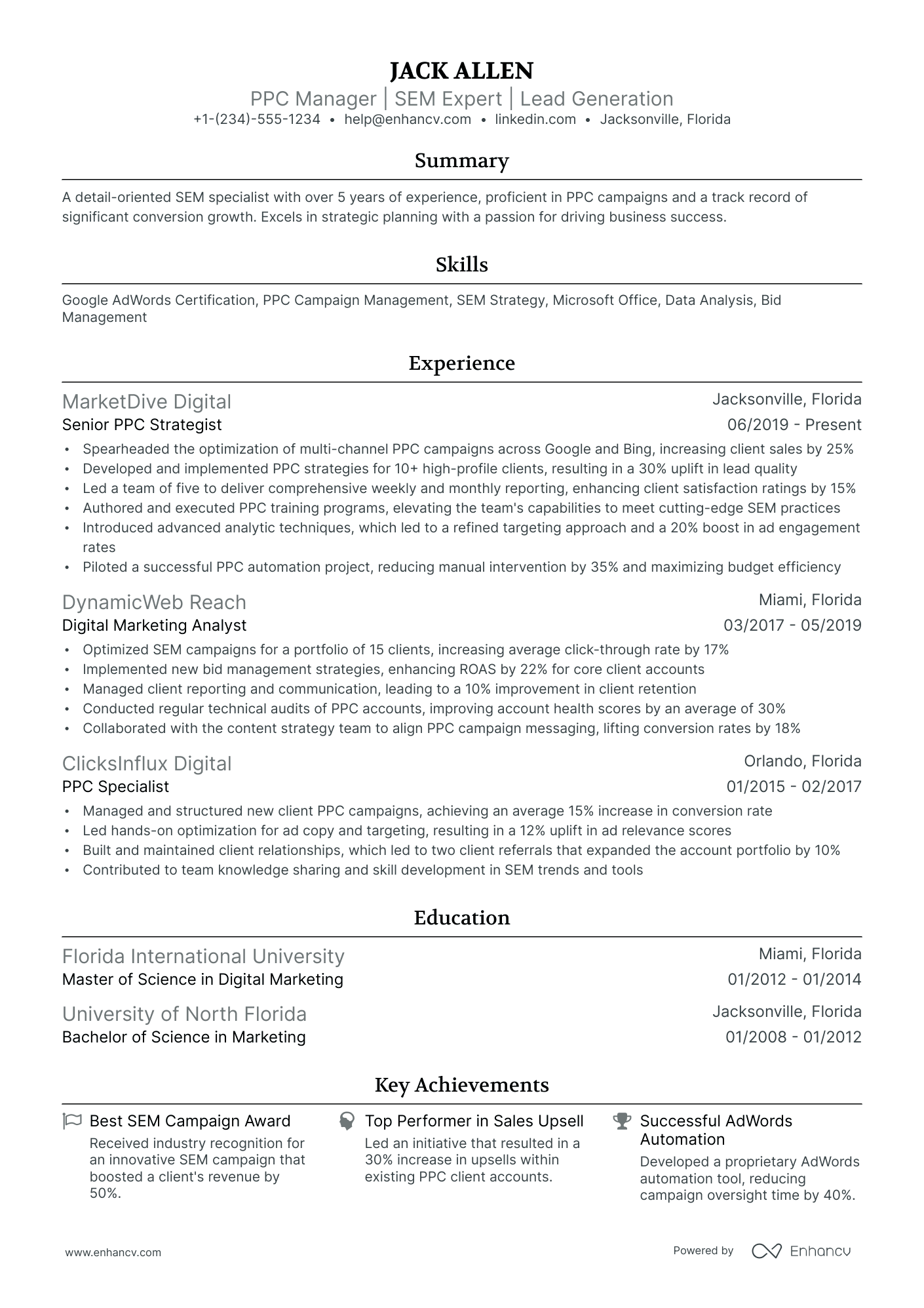
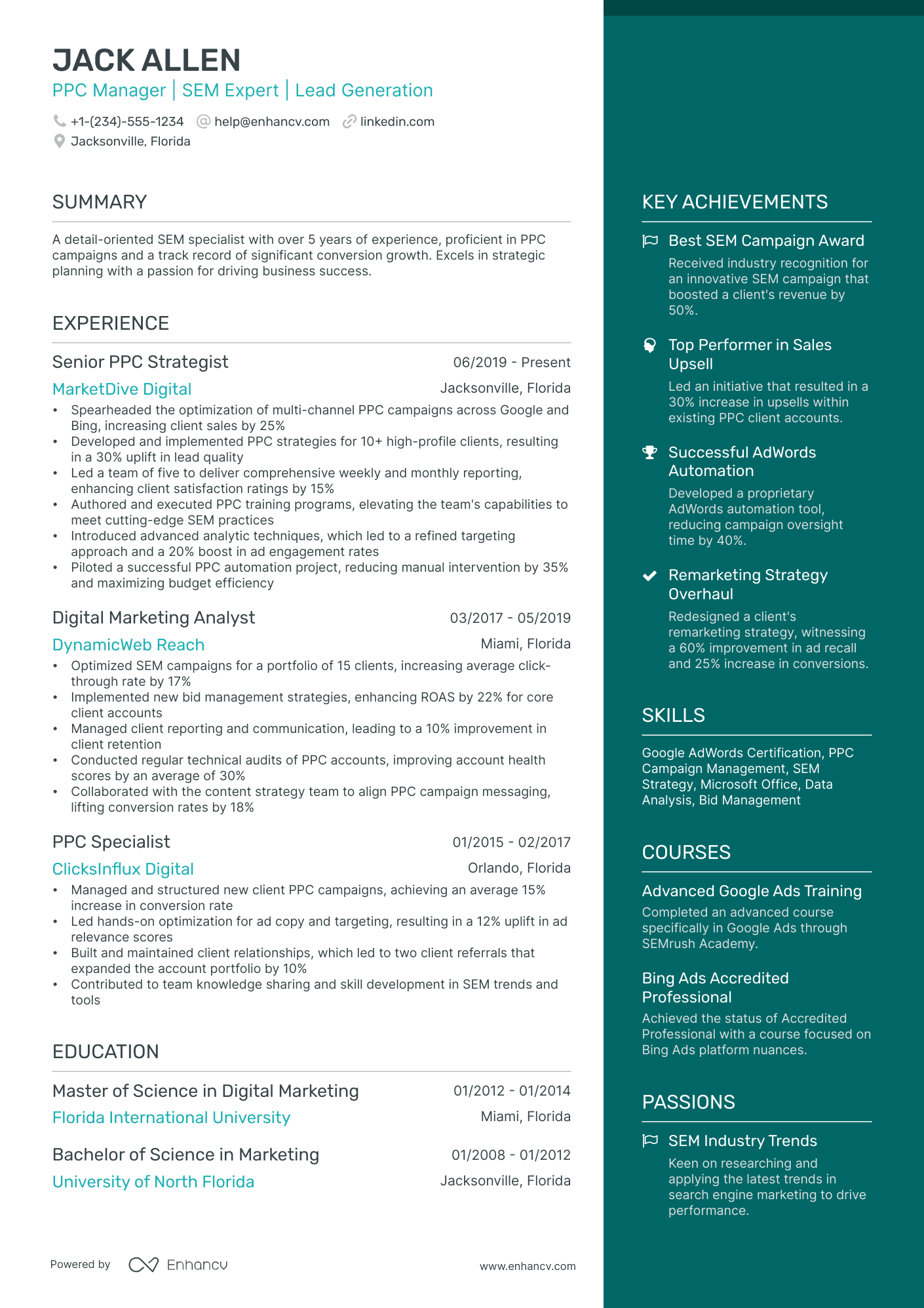
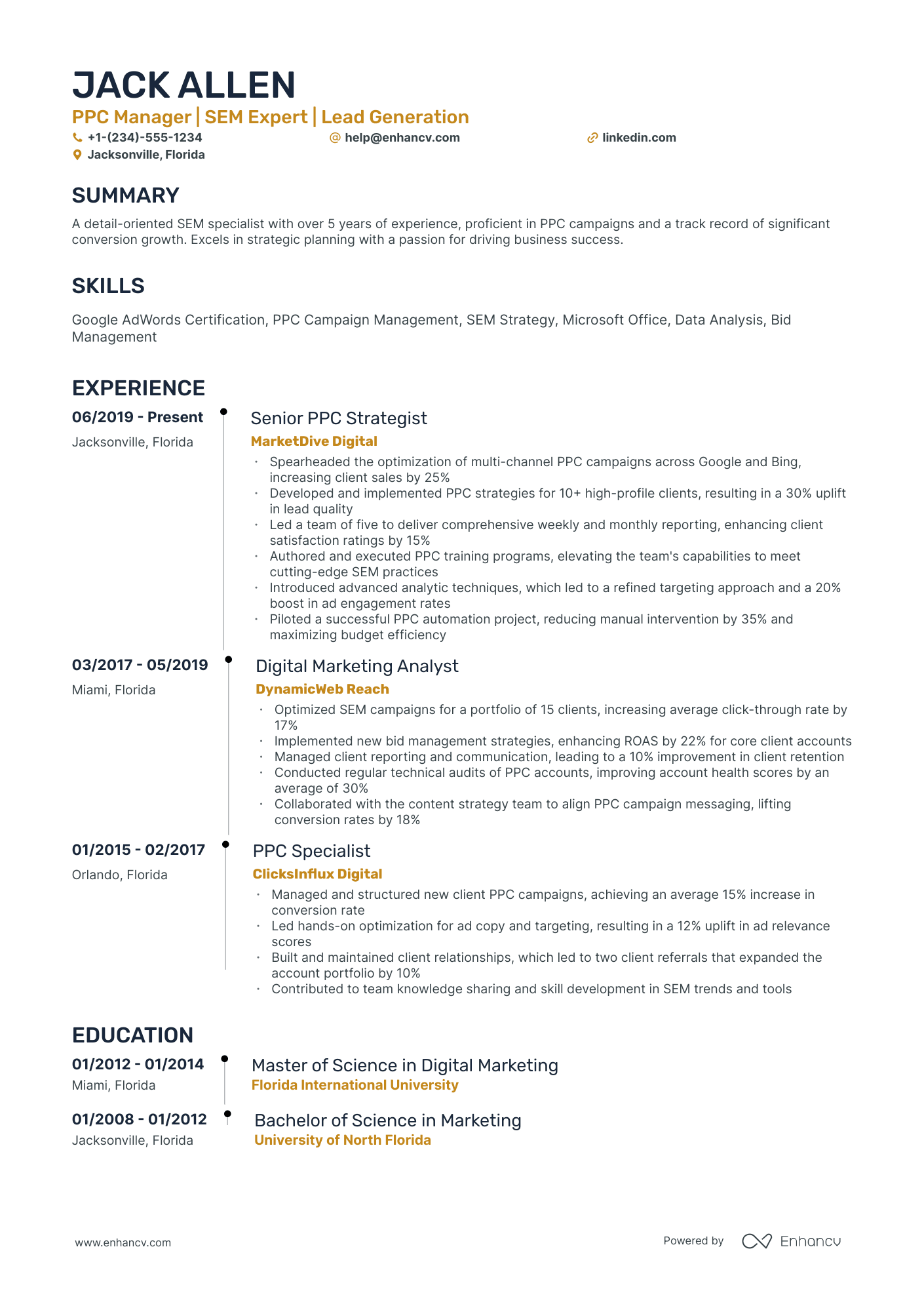
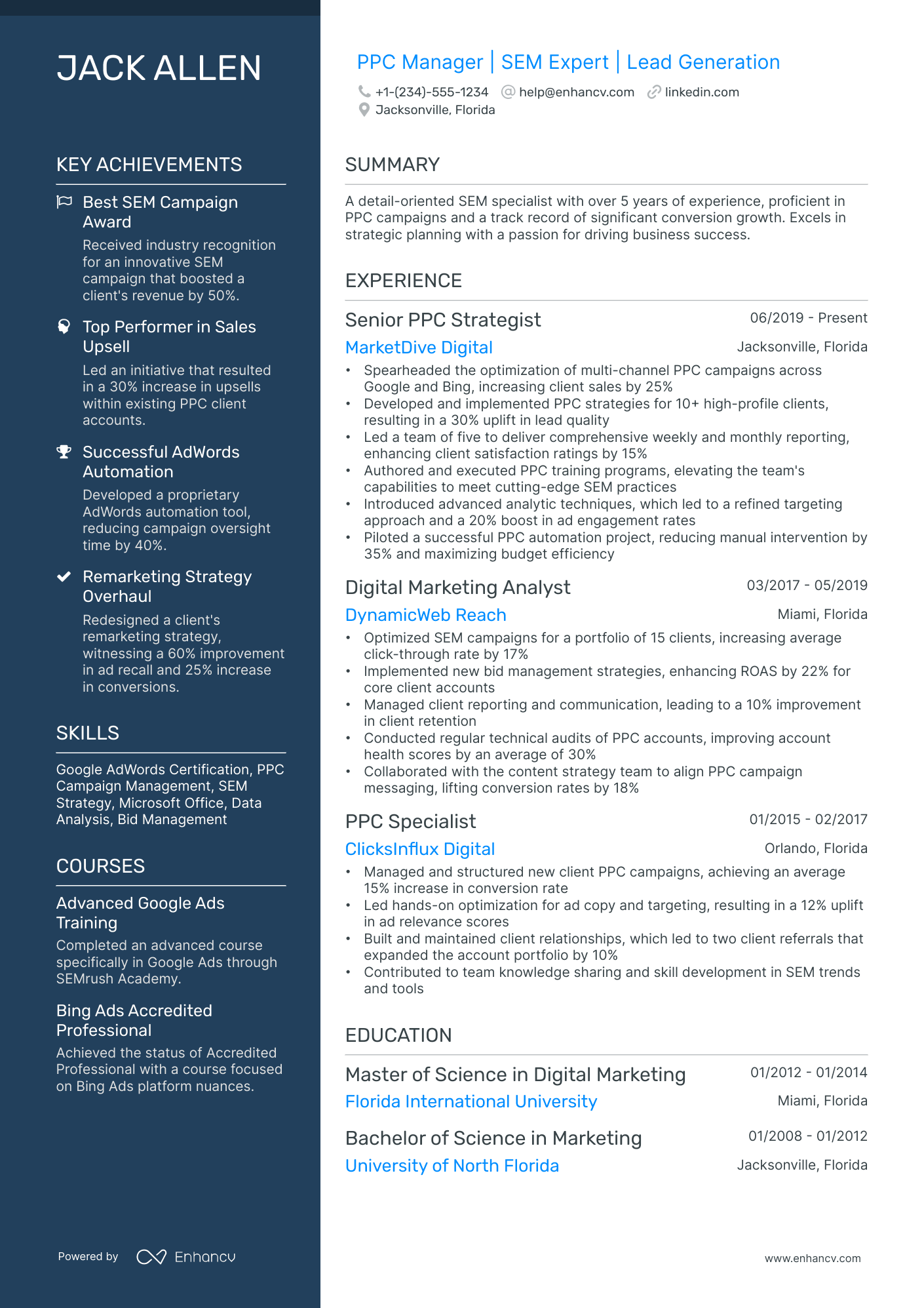
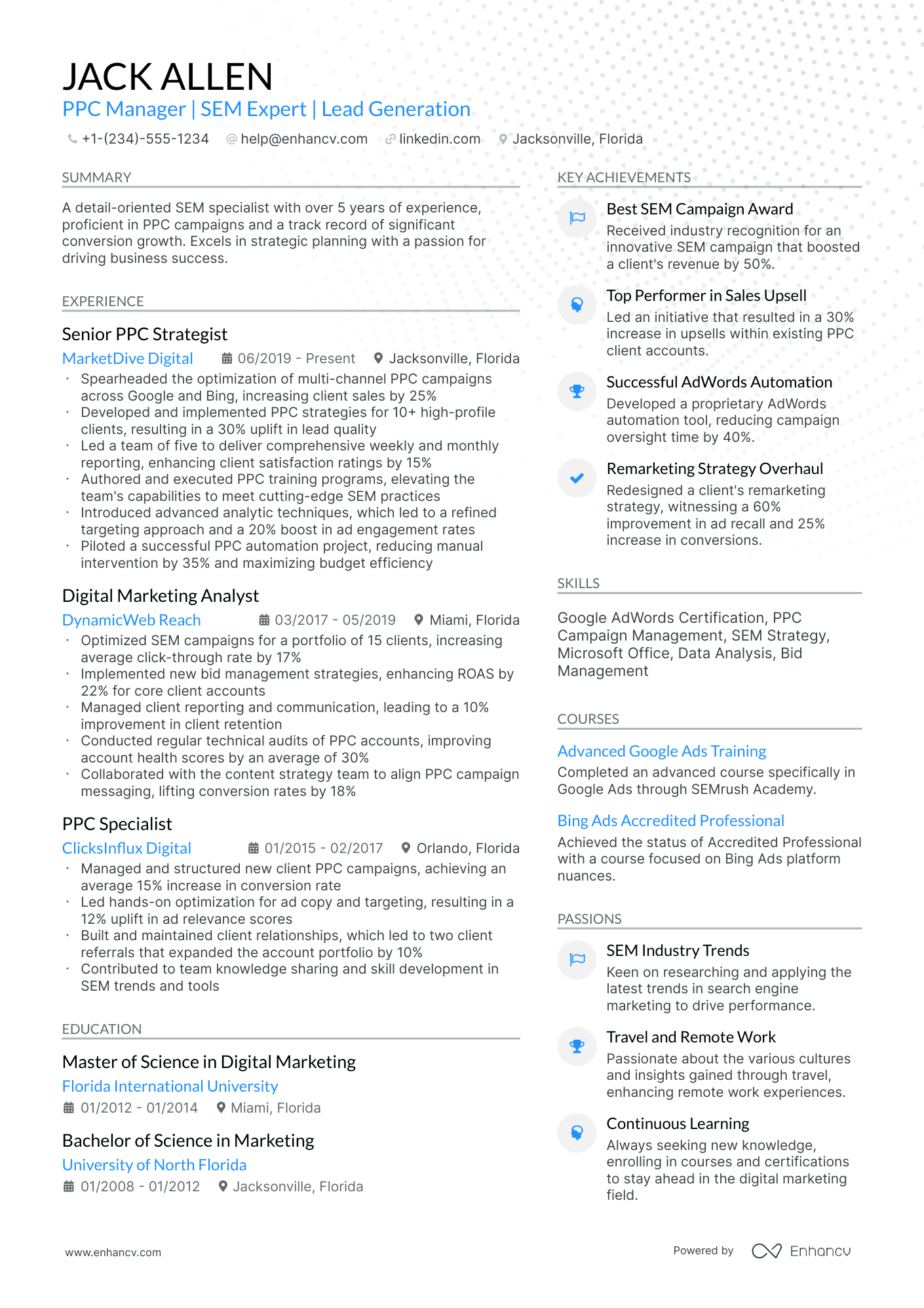
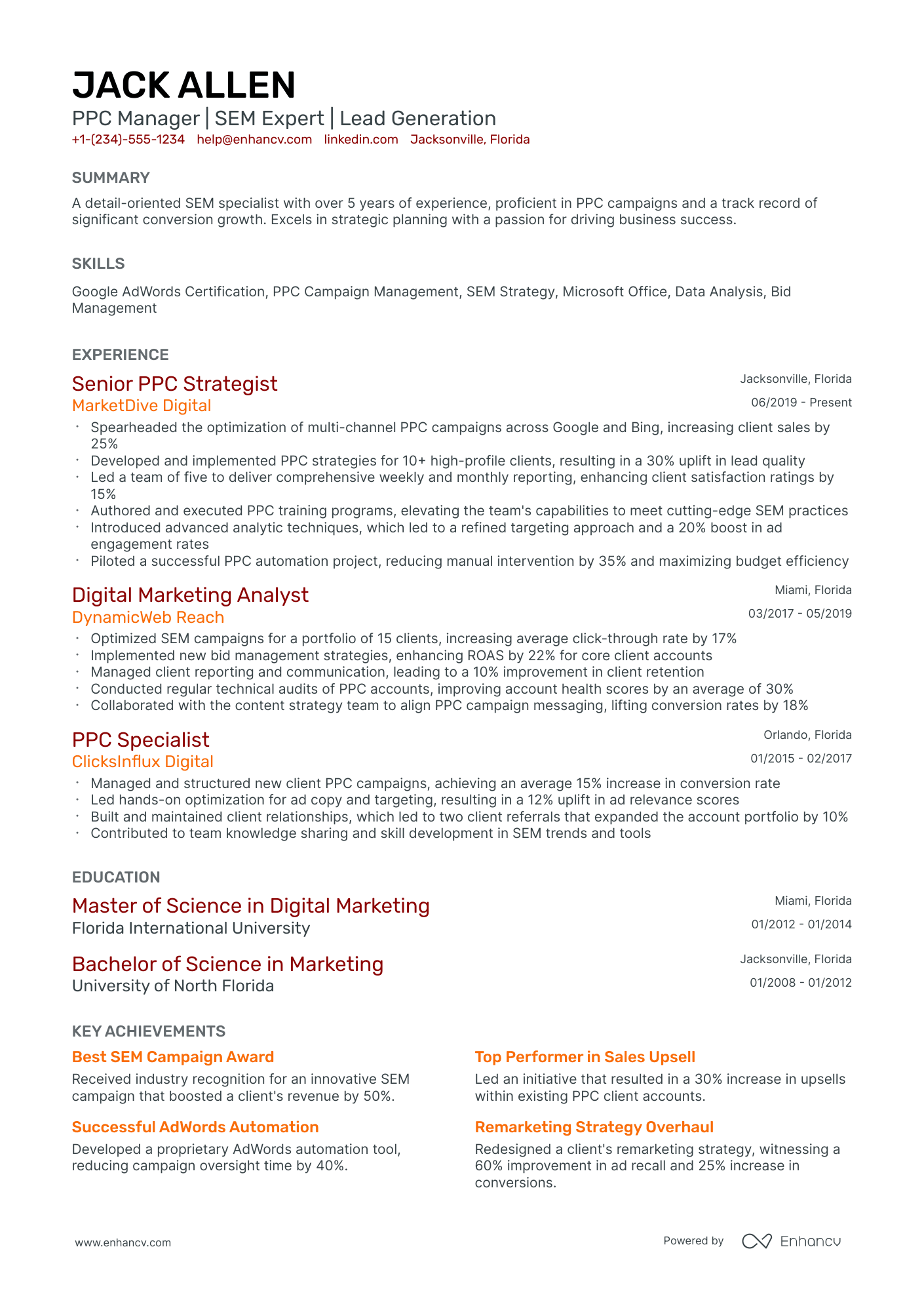
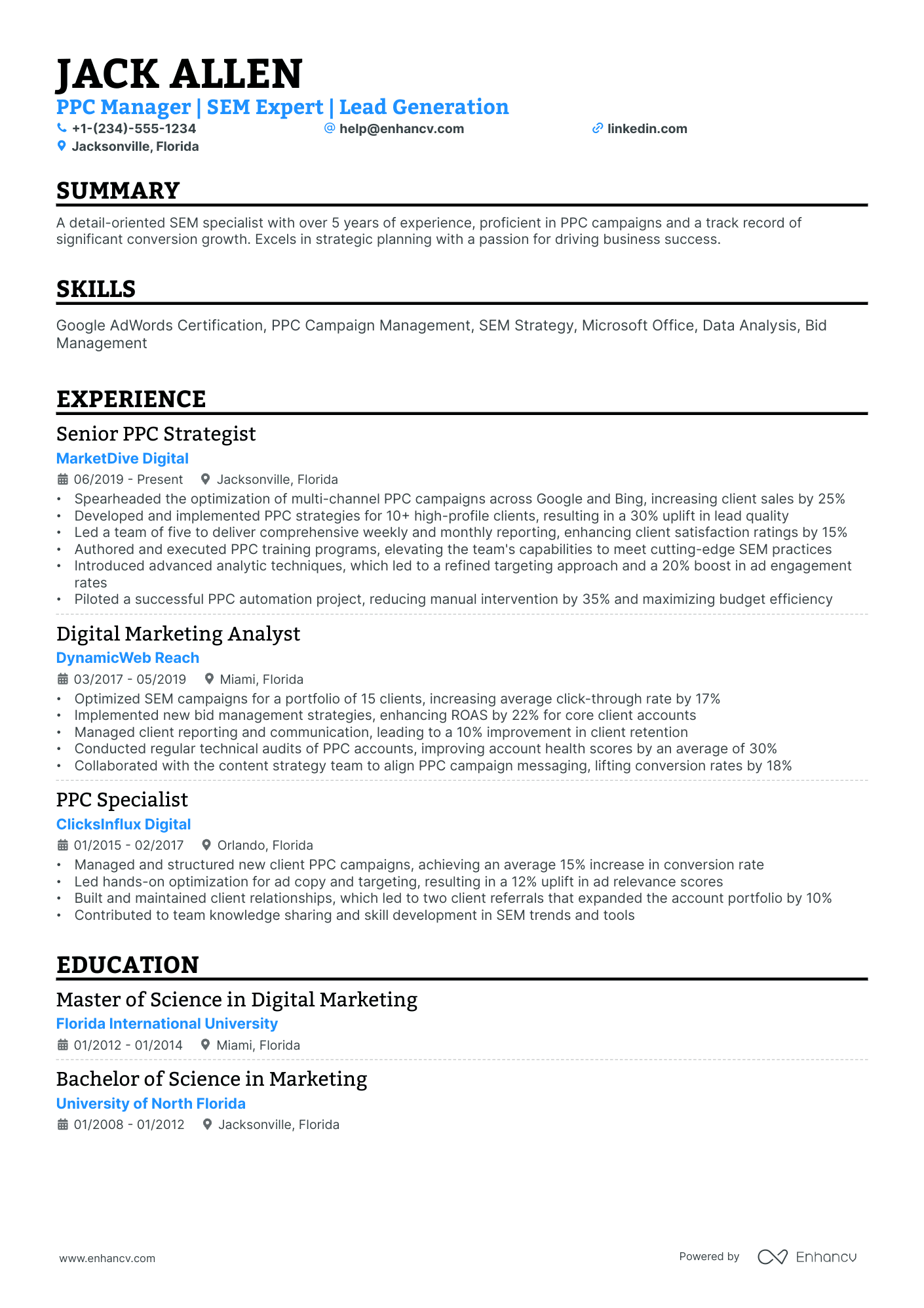
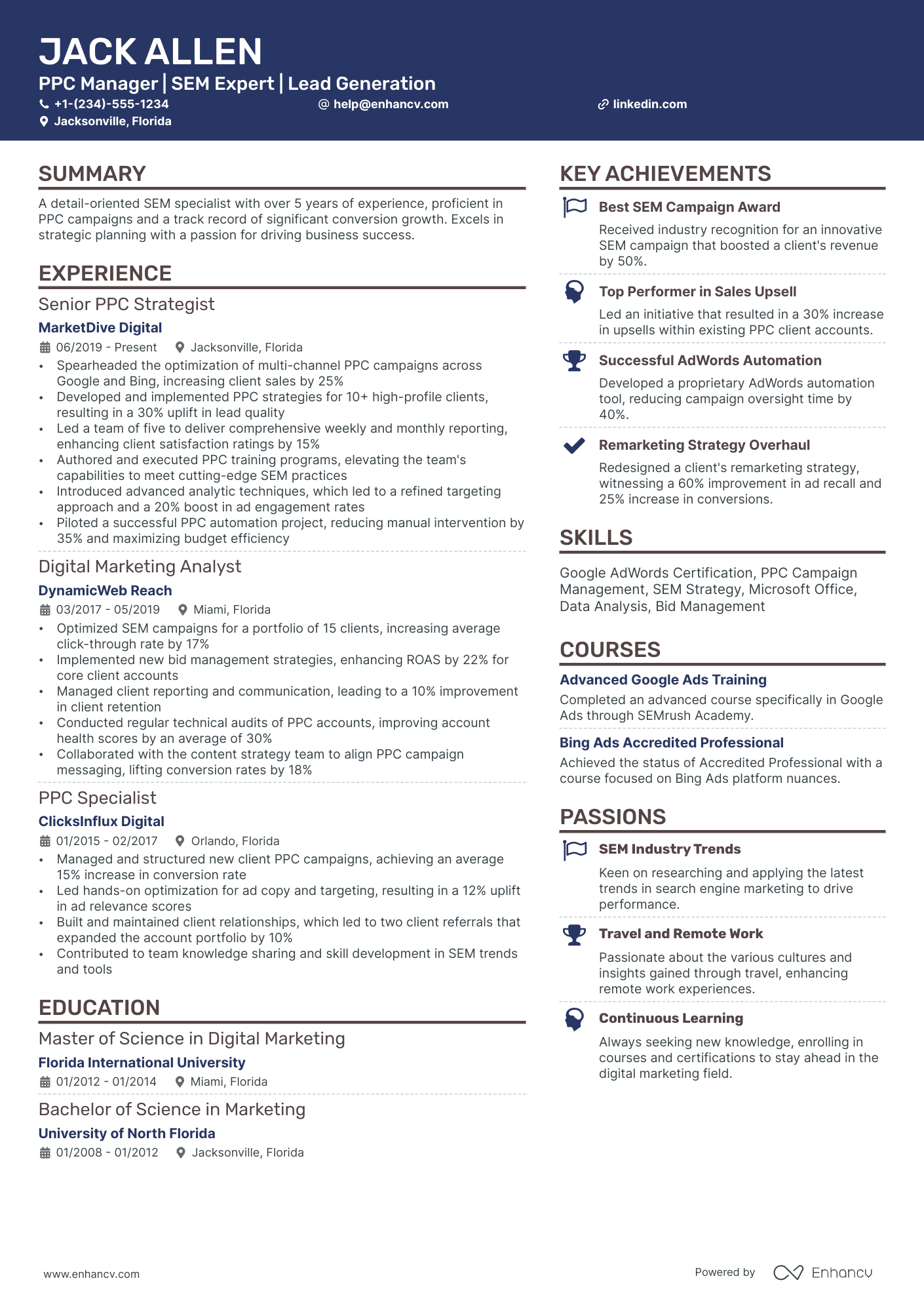
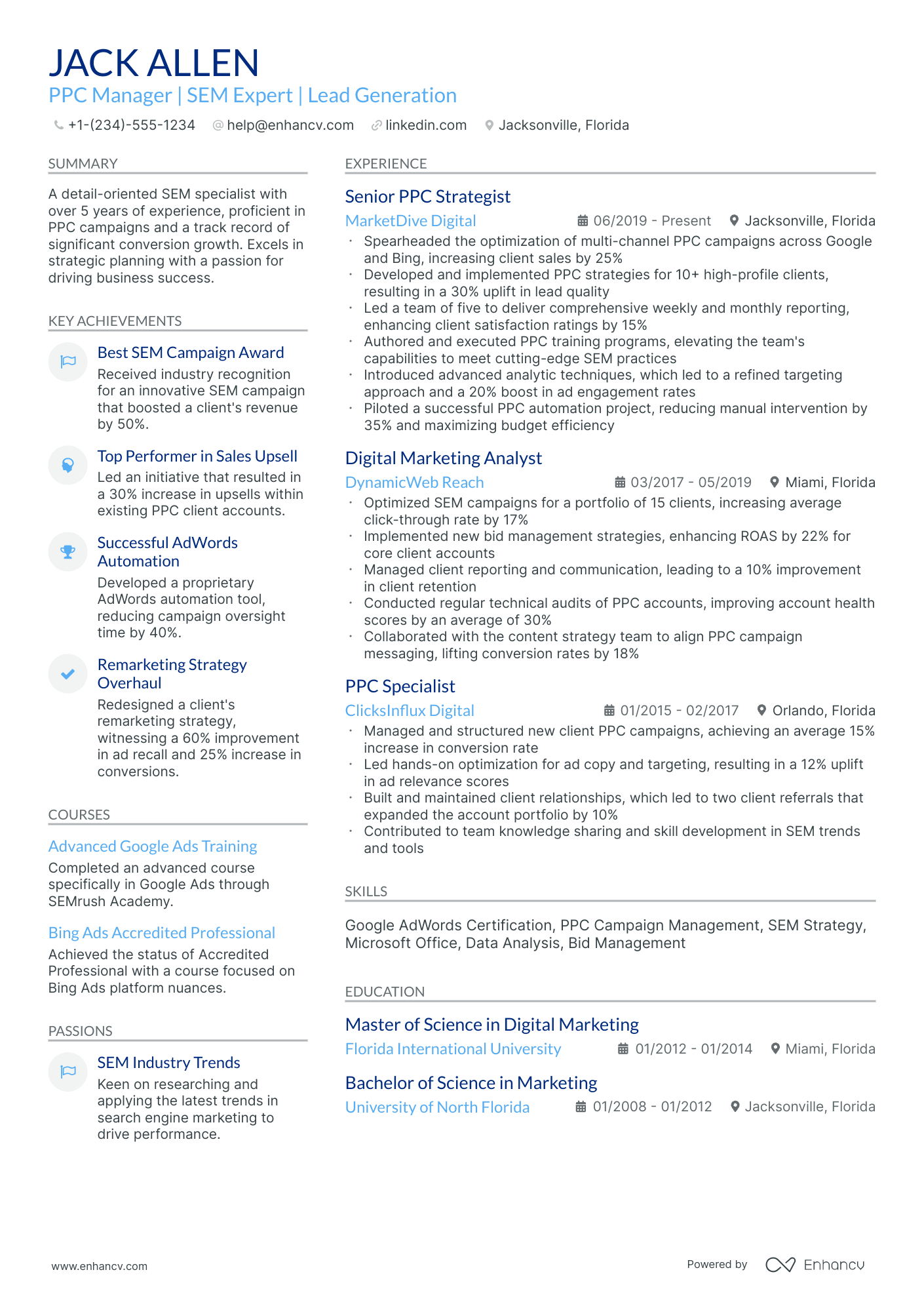
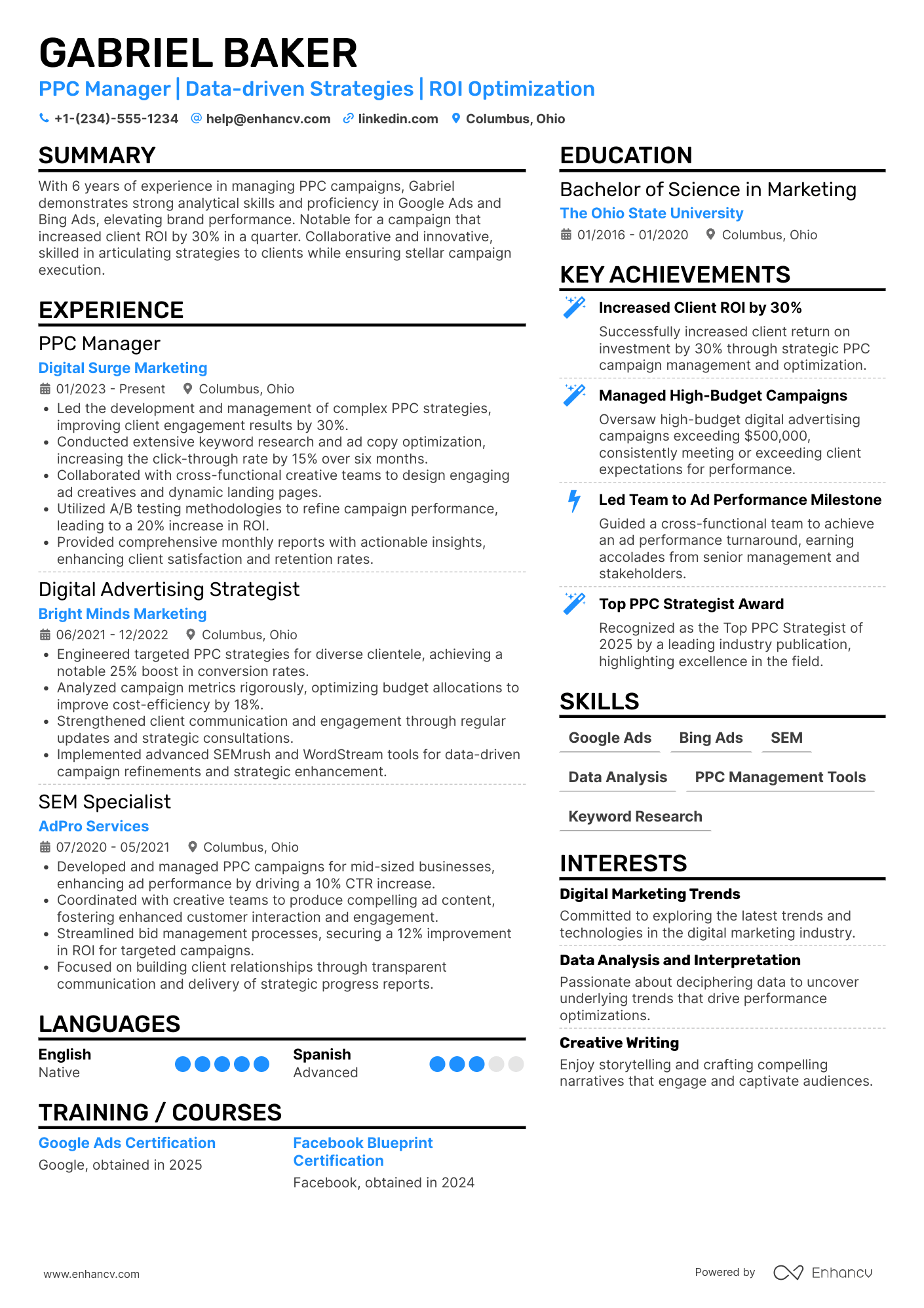
Most PPC manager resume drafts fail because they list platforms and tasks but skip measurable impact and campaign context. That hurts when an applicant tracking system filters on relevance and recruiters scan fast in a crowded market.
A strong resume shows what you changed and why it mattered, so you earn interviews. If you're unsure where to begin, learning how to write a resume that highlights impact is the essential first step. You should highlight revenue lift, cost per acquisition reduction, return on ad spend gains, budget managed, account scale, and landing page conversion improvements.

Key takeaways
- Quantify every achievement with metrics like ROAS, CPA, conversion rate, and budget scale.
- Use reverse-chronological format if you have significant PPC experience showing growth.
- Tailor experience bullets to mirror each job posting's platforms, KPIs, and terminology.
- Demonstrate skills through outcome-driven bullets, not isolated keyword lists.
- Lead your summary with years of experience, core platforms, and one standout result.
- Anchor entry-level resumes in certifications, projects, and real campaign simulations with measurable results.
- Use Enhancv to turn vague task descriptions into focused, recruiter-ready resume bullets.
How to format a PPC manager resume
Recruiters evaluating PPC manager candidates prioritize hands-on campaign management experience, platform proficiency across Google Ads and Meta Ads, and measurable performance outcomes like return on ad spend (ROAS) and cost-per-acquisition (CPA) improvements. Choosing the right resume format is critical—your structure directly determines whether your strongest qualifications get noticed or buried within a six-second scan.

I have significant experience in this role—which format should I use?
Use a reverse-chronological format to give recruiters an immediate, linear view of your campaign management growth and expanding budget ownership. Do:
- Lead each role entry with scope indicators: channels managed, monthly ad spend controlled, team size, and number of accounts or clients overseen.
- List platform-specific expertise—Google Ads, Microsoft Advertising, Meta Ads Manager, SA360, Google Analytics 4, and bid management tools—within each position's context rather than in an isolated skills section.
- Quantify every key achievement with metrics tied to business outcomes: ROAS lift, CPA reduction, revenue generated, or conversion rate improvement.
I'm junior or switching into this role—what format works best?
Use a hybrid format that leads with a targeted skills section and follows with a concise experience timeline to compensate for limited PPC-specific tenure. Do:
- Place core PPC competencies—keyword research, A/B testing, audience segmentation, conversion tracking—in a dedicated skills section near the top of the resume so applicant tracking systems (ATS) capture them immediately.
- Include freelance campaigns, Google Ads certifications, agency internships, or personal projects where you managed real ad budgets, even small ones.
- Connect every listed skill to a specific action and a measurable result so recruiters see applied ability, not just keyword lists.
Why not use a functional resume?
A functional format strips away the timeline and context recruiters need to verify where, when, and how you applied your PPC skills, making it nearly impossible to assess your hands-on campaign experience or growth trajectory.
- Career changers with transferable analytical experience: You have a background in data analysis, marketing analytics, or media buying and can demonstrate PPC platform knowledge through certifications and side projects but lack formal PPC job titles.
- Recent graduates or bootcamp completers: You've earned Google Ads or Meta Blueprint certifications and managed real or simulated campaigns but haven't held a dedicated PPC role yet.
- A functional format is acceptable only if you have no PPC work history at all—and even then, every skill listed must be anchored to a specific project, certification exercise, or freelance engagement with a stated outcome.
Once your layout and formatting choices are in place, the next step is deciding which sections to include so each one reinforces your PPC expertise.
What sections should go on a PPC manager resume
Recruiters expect a PPC manager resume to show measurable paid media results, clear channel ownership, and strong optimization skills. Understanding which resume sections to include ensures you present a complete picture of your qualifications.
Use this structure for maximum clarity:
- Header
- Summary
- Experience
- Skills
- Projects
- Education
- Certifications
- Optional sections: Awards, Leadership, Languages
Your experience bullets should emphasize performance impact, spend and account scope, efficiency gains, and revenue or lead outcomes tied to specific campaigns and optimizations.
Is your resume good enough?
Drop your resume here or choose a file. PDF & DOCX only. Max 2MB file size.
Once you’ve organized the key resume components, the next step is to detail your PPC manager experience so each section shows clear impact and relevance.
How to write your PPC manager resume experience
The experience section is where you prove you've delivered real results—not just managed campaigns. Hiring managers reviewing PPC manager resumes prioritize demonstrated impact through platform expertise, optimization methods, and measurable performance outcomes over generic descriptions of daily tasks.
Each entry should include:
- Job title
- Company and location (or remote)
- Dates of employment (month and year)
Three to five concise bullet points showing what you owned, how you executed, and what outcomes you delivered:
- Ownership scope: the accounts, platforms, campaign portfolios, budget tiers, or market segments you were directly accountable for as a PPC manager.
- Execution approach: the bidding strategies, audience frameworks, attribution models, A/B testing methods, or platform tools you used to inform decisions and optimize campaign performance.
- Value improved: changes to return on ad spend, cost efficiency, conversion quality, lead volume, or campaign scalability that resulted from your work.
- Collaboration context: how you partnered with creative teams, landing page designers, analytics specialists, clients, or sales stakeholders to align paid media efforts with broader business goals.
- Impact delivered: outcomes framed as business results—revenue influenced, pipeline generated, acquisition costs reduced, or growth achieved—rather than a list of campaigns launched or ads created.
Experience bullet formula
A PPC manager experience example
✅ Right example - modern, quantified, specific.
PPC Manager
BrightCart | Remote
2022–Present
Series B ecommerce platform supporting two thousand merchants across the US and Canada.
- Rebuilt Google Ads and Microsoft Advertising account structure (Performance Max, Search, Shopping) using keyword mapping, negative keyword libraries, and shared budgets, lifting return on ad spend from 3.1 to 4.4 and reducing cost per acquisition by 18%.
- Implemented server-side Google Tag Manager with Google Analytics 4, enhanced conversions, and offline conversion imports via HubSpot, improving conversion attribution by 22% and cutting “unassigned” revenue by 15% in reporting.
- Launched audience strategy across remarketing, customer match, and lookalikes, partnering with lifecycle marketing and design on creative testing, increasing new-customer revenue share by 12% and improving click-through rate by 28%.
- Automated pacing, anomaly alerts, and weekly stakeholder reporting in Looker Studio using BigQuery exports and scripts, saving six hours per week and reducing overspend incidents by 80%.
- Negotiated and executed landing page experiments with product managers and engineers (A/B tests in Optimizely), improving checkout conversion rate by 9% and lowering cost per click by 11% through higher quality score.
Now that you've seen what a strong experience section looks like in practice, let's break down how to adapt yours to match the specific PPC role you're targeting.
How to tailor your PPC manager resume experience
Recruiters evaluate your PPC manager resume through both human review and applicant tracking systems. Tailoring your resume to the job description ensures you pass both screenings.
Ways to tailor your PPC manager experience:
- Match ad platforms like Google Ads or Microsoft Advertising listed in the posting.
- Mirror the exact bidding strategies or campaign types the role requires.
- Use the same terminology for attribution models or conversion tracking methods.
- Reflect KPIs such as ROAS or cost per acquisition the employer prioritizes.
- Highlight industry experience when the posting specifies ecommerce or SaaS verticals.
- Include A/B testing or landing page optimization if the description mentions them.
- Reference cross-functional collaboration with SEO or creative teams when noted.
- Emphasize budget management at the scale the job description outlines.
Tailoring means aligning your real accomplishments with the role's stated requirements, not forcing keywords where they don't belong.
Resume tailoring examples for PPC manager
| Job description excerpt | Untailored | Tailored |
|---|---|---|
| Manage and optimize Google Ads and Microsoft Advertising campaigns across Search, Shopping, and Performance Max to drive ROAS above 400% for our e-commerce catalog of 5,000+ SKUs. | Managed online advertising campaigns and helped improve performance over time. | Managed Google Ads and Microsoft Advertising campaigns across Search, Shopping, and Performance Max for an e-commerce catalog of 6,200 SKUs, sustaining a 430% ROAS over 18 months. |
| Build and maintain keyword strategies, negative keyword lists, and audience segmentation in SA360, collaborating with the SEO team to align paid and organic efforts. | Conducted keyword research and worked with other teams on digital marketing projects. | Built keyword strategies and maintained negative keyword lists in SA360, segmenting audiences by intent tier and partnering with the SEO team to eliminate paid-organic cannibalization—cutting wasted spend by 15%. |
| Own weekly budget pacing, bid strategy testing (tCPA, tROAS, Maximize Conversions), and reporting dashboards in Looker Studio for a combined monthly spend of $250K+. | Tracked campaign budgets and created reports for leadership on a regular basis. | Owned weekly budget pacing and A/B tested tCPA, tROAS, and Maximize Conversions bid strategies across a $280K monthly spend, building Looker Studio dashboards that reduced reporting turnaround from three days to four hours. |
Once you’ve aligned your experience with the role’s priorities, the next step is to quantify your PPC manager achievements so hiring teams can see the measurable impact behind those choices.
How to quantify your PPC manager achievements
Quantifying your achievements proves what improved and by how much. Focus on efficiency and revenue numbers like return on ad spend, cost per acquisition, conversion rate, budget pacing, and quality score.
Quantifying examples for PPC manager
| Metric | Example |
|---|---|
| ROAS growth | "Increased Google Ads return on ad spend from 3.1x to 4.4x in eight weeks by restructuring campaigns and shifting budget to top-margin products." |
| CPA reduction | "Reduced blended cost per acquisition by 22% ($68 to $53) across Google Ads and Microsoft Advertising using value-based bidding and negative keyword expansion." |
| Conversion rate | "Improved landing page conversion rate from 2.6% to 3.4% by running six A/B tests in Google Optimize and aligning ad copy to search intent." |
| Quality score | "Raised average Quality Score from 6.2 to 7.6 by tightening keyword-to-ad-group themes and rewriting responsive search ads for relevance." |
| Budget pacing | "Kept monthly spend within 1% of a $250K budget for six months by using automated rules, shared budgets, and weekly forecast updates in Looker Studio." |
Turn vague job tasks into measurable, recruiter-ready resume bullets in seconds with Enhancv's Bullet Point Generator.
Once your bullet points clearly convey your impact, the next step is ensuring your skills section reinforces that expertise with the right mix of hard and soft skills.
How to list your hard and soft skills on a PPC manager resume
Your skills section shows how you drive paid search and paid social results, and recruiters and applicant tracking systems scan it to match you to the job post—aim for a mix heavy on hard skills with a smaller set of role-specific soft skills. PPC manager roles require a blend of:
- Product strategy and discovery skills.
- Data, analytics, and experimentation skills.
- Delivery, execution, and go-to-market discipline.
- Soft skills.
Your skills section should be:
- Scannable (bullet-style grouping).
- Relevant to the job post.
- Backed by proof in experience bullets.
- Updated with current tools.
Place your skills section:
- Above experience if you're junior or switching careers.
- Below experience if you're mid/senior with strong achievements.

Hard skills
- Google Ads, Microsoft Advertising
- Meta Ads Manager, LinkedIn Campaign Manager
- Google Analytics 4 (GA4)
- Google Tag Manager
- Conversion tracking, pixel setup
- Keyword research, match types
- Account structure, campaign architecture
- Ad copywriting, RSA optimization
- Landing page testing, CRO
- A/B testing, incrementality testing
- Bid strategies, budget pacing
- Looker Studio reporting, dashboards
Soft skills
- Translate goals into KPIs
- Prioritize by impact and effort
- Write clear optimization rationales
- Communicate performance to stakeholders
- Partner with creative and design
- Align with sales on lead quality
- Manage agency and vendor work
- Challenge assumptions with data
- Run structured weekly optimizations
- Escalate risks early and clearly
- Document processes and learnings
- Own outcomes and next steps
How to show your PPC manager skills in context
Skills shouldn't live only in a dedicated skills list. Explore how other professionals present their resume skills in context for inspiration.
They should be demonstrated in:
- Your summary (high-level professional identity)
- Your experience (proof through outcomes)
Here's what that looks like in practice.
Summary example
Senior PPC manager with eight years of experience driving e-commerce growth through Google Ads, Meta Ads, and programmatic display. Skilled in cross-channel budget strategy and A/B testing, delivering a 42% average improvement in ROAS across multimillion-dollar accounts.
- Establishes senior-level expertise immediately
- Names specific platforms and tools
- Leads with a measurable outcome
- Signals strategic thinking and collaboration
Experience example
Senior PPC Manager
BrightPath Digital | Remote
March 2020–Present
- Managed $1.8M in annual ad spend across Google Ads, Microsoft Ads, and Meta, improving ROAS by 37% through refined bidding strategies and audience segmentation.
- Partnered with the creative and analytics teams to launch 12 A/B testing cycles per quarter, cutting cost per acquisition by 24%.
- Built automated reporting dashboards in Looker Studio, reducing weekly client reporting time by five hours and improving campaign transparency.
- Every bullet includes measurable proof
- Skills surface naturally through real outcomes
Once you’ve demonstrated your pay-per-click (PPC) manager strengths through results, tools, and campaign examples, the next step is to apply the same approach to a PPC manager resume with no experience so you can present that evidence without relying on a formal job history.
How do I write a PPC manager resume with no experience
Even without full-time experience, you can demonstrate readiness through projects and certifications. If you're building your first application, our guide on writing a resume without work experience covers how to position yourself effectively. Consider including:
- Google Ads Search campaign simulations
- Google Ads certification score reports
- Keyword research and intent mapping
- Landing page audit recommendations
- Volunteer nonprofit PPC management
- Personal ecommerce test campaigns
- GA4 and Tag Manager setups
- Competitive ad copy teardown reports
Focus on:
- Campaign builds and structure choices
- Keyword strategy and match types
- Conversion tracking and attribution setup
- Performance results with clear metrics
Resume format tip for entry-level PPC manager
Use a combination resume format because it highlights PPC manager skills and projects first, while still showing work history and education. Do:
- Add a "Projects" section near top.
- List tools: Google Ads, GA4.
- Quantify results: cost per lead, conversions.
- Show tracking: Tag Manager events, goals.
- Include certifications with completion dates.
- Built a Google Ads Search campaign simulation with keyword research, ad groups, and conversion tracking in GA4, lowering cost per lead by 18% in tests.
Even without direct work experience, your educational background can demonstrate the analytical and marketing foundations that hiring managers look for in a PPC manager candidate.
How to list your education on a PPC manager resume
Your education section helps hiring teams confirm you have foundational knowledge in marketing, analytics, or business. It validates your ability to manage paid campaigns strategically.
Include:
- Degree name
- Institution
- Location
- Graduation year
- Relevant coursework (for juniors or entry-level candidates)
- Honors & GPA (if 3.5 or higher)
Skip month and day details—list the graduation year only.
Here's a strong education entry tailored to a PPC manager resume.
Example education entry
Bachelor of Science in Marketing
University of Wisconsin–Madison, Madison, WI
Graduated 2021
GPA: 3.7/4.0
- Relevant coursework: Digital Advertising Strategy, Consumer Analytics, Media Planning, Marketing Data Science
- Honors: Dean's List (six semesters), Beta Gamma Sigma Honor Society
How to list your certifications on a PPC manager resume
Certifications on your resume show a PPC manager's commitment to learning, hands-on tool proficiency, and current industry knowledge. They also help validate specialized skills when results or experience need extra support.
Include:
- Certificate name
- Issuing organization
- Year
- Optional: credential ID or URL
- Place certifications below education when your degree is recent and directly relevant, and your certifications add supporting credibility.
- Place certifications above education when they're more recent than your degree and closely match the PPC manager role or required tools.
Best certifications for your PPC manager resume
Google Ads Search Certification Google Ads Display Certification Google Ads Video Certification Google Ads Measurement Certification Microsoft Advertising Certified Professional Meta Certified Digital Marketing Associate Google Analytics Certification
Once you’ve positioned your credentials where recruiters will notice them, use your PPC manager resume summary to reinforce that expertise upfront and set context for the rest of your experience.
How to write your PPC manager resume summary
Your resume summary is the first thing a recruiter reads. A strong one instantly signals you have the paid media skills and results to back up your candidacy.
Keep it to three to four lines, with:
- Your title and total years of experience managing PPC campaigns.
- The industries or verticals where you've driven paid performance.
- Core platforms and tools like Google Ads, Microsoft Ads, SA360, or Google Analytics.
- One or two quantified wins, such as ROAS improvements or cost-per-acquisition reductions.
- Soft skills tied to real outcomes, like cross-team collaboration that improved campaign alignment.

PRO TIP
At the mid-level, emphasize hands-on platform expertise and measurable campaign results. Show you can own strategy and execution across channels. Avoid vague phrases like "passionate marketer" or "results-driven professional." Replace them with specific metrics and concrete skills.
Example summary for a PPC manager
PPC manager with five years of experience in e-commerce and SaaS. Skilled in Google Ads, Meta Ads, and SA360. Reduced client CPA by 34% while scaling monthly ad spend to $200K.
Optimize your resume summary and objective for ATS
Drop your resume here or choose a file.
PDF & DOCX only. Max 2MB file size.
Now that your summary is crafted to highlight your strongest PPC qualifications, make sure the header above it presents your contact details correctly so recruiters can actually reach you.
What to include in a PPC manager resume header
Your resume header is the top section with your key identity and contact details, and it boosts visibility, credibility, and recruiter screening for a PPC manager.
Essential resume header elements
- Full name
- Tailored job title and headline
- Location
- Phone number
- Professional email
- GitHub link
- Portfolio link
A LinkedIn link helps recruiters confirm your work history fast and supports screening.
Don't include a photo on a PPC manager resume unless the role is explicitly front-facing or appearance-dependent.
Match your headline to the job posting and include a channel focus, such as Google Ads, Microsoft Advertising, or paid social.
PPC manager resume header
Jordan Lee
PPC manager — Search and Paid Social | Google Ads and Microsoft Advertising
Austin, TX
(512) 555-13XX
jordan.lee@enhancv.com
github.com/jordanlee
yourwebsite.com
linkedin.com/in/jordanlee
Once your contact details and role focus are clear at the top, add additional sections to reinforce your qualifications and support the rest of your PPC manager resume.
Additional sections for PPC manager resumes
When your core qualifications match other applicants, well-chosen additional sections can set your PPC manager resume apart with unique credibility. For example, listing language skills can be a differentiator if you manage campaigns across international markets.
- Languages
- Certifications (Google Ads, Meta Blueprint, Microsoft Advertising)
- Industry conferences and speaking engagements
- Publications and case studies
- Professional affiliations (PPC-specific communities or marketing associations)
- Awards and recognition
- Volunteer marketing projects
Once you've strengthened your resume with relevant additional sections, pairing it with a well-crafted cover letter can further set your application apart.
Do PPC manager resumes need a cover letter
A cover letter isn't required for a PPC manager, but it often helps. If you're unfamiliar with the format, start by understanding what a cover letter is and when it adds value. It matters most in competitive roles, agency hiring, or when the job post asks for one. It can also help when your resume doesn't show fit at first glance.
Use a cover letter to add context that a PPC manager resume can't:
- Explain role and team fit: Match your channel focus, budget ownership, and cross-functional work to the team's needs.
- Highlight one or two outcomes: Tie a project to results like lower cost per acquisition, improved return on ad spend, or better lead quality.
- Show product and user understanding: Reference the audience, buying cycle, and key conversion actions you'd optimize.
- Address transitions or non-obvious experience: Connect adjacent work, explain gaps, or clarify how your skills transfer to PPC manager responsibilities.
Drop your resume here or choose a file.
PDF & DOCX only. Max 2MB file size.
Even if you decide a cover letter won’t add value for your application, using AI to improve your PPC manager resume helps you strengthen the document hiring teams will prioritize.
Using AI to improve your PPC manager resume
AI can sharpen your resume's clarity, structure, and overall impact. It helps you organize achievements and tighten language across every section. But overuse strips authenticity fast. Once your content reads clearly and aligns with the role, step away from AI entirely. If you're curious about where to start, explore ChatGPT resume writing prompts designed specifically for resume improvement.
Here are 10 practical prompts to strengthen specific sections of your PPC manager resume:
Strengthen your summary
Quantify experience bullets
Align skills with job posts
Tighten action verbs
Refine project descriptions
Improve certification relevance
Clarify education details
Remove filler language
Tailor for specific roles
Check overall consistency
Conclusion
A strong PPC manager resume proves impact with measurable outcomes, role-specific skills, and a clear structure. Lead with results like return on ad spend, cost per acquisition, conversion rate, and budget efficiency. Support them with tools, platforms, testing, and reporting skills.
Keep formatting clean and scannable, with focused bullets and consistent sections. This approach shows you can manage performance today and adapt as platforms change. It helps hiring teams see you’re ready to deliver results quickly.