You’re applying to tens of job ads every day. Writing a unique cover letter for each is unrealistic. What if there was a letter that worked for every job posting?
It actually exists. Having a general cover letter is a great way to speed up your job search efforts. But there’s more to it than the name suggests. Using a general cover letter is more of a methodology of crafting varied versions, not sending out the exact same document with every application.
Here we’ll take a closer look at how to write a general cover letter and explore the various use cases.

Key takeaways
- A general cover letter is a base template you customize for each application.
- Change the company name, job title, hiring manager's name, one company-specific sentence, and two or three phrases from the ad.
- Use a real name in the greeting when you can find one and "Dear Hiring Manager" when you can't.
- Back every claim with one number, one project, or one outcome.
- Send a letter even when it's marked optional, because it can sway the outcome in your favor.
What is a general cover letter?
A general cover letter is a pre-written master document that allows you to quickly craft tailored versions for different job ads. It covers your core skills and most notable professional achievements but leaves blank spots for targeting specific requirements Those are usually for company names, job titles, alignment statements, and details about the role.
You might encounter it under a different name, and there are some nuances to those variants:
- Master cover letter: The version you keep saved and copy from every time.
- Universal or all-purpose cover letter: Usually means a letter with no company named at all, like the one you'd hand out at a job fair.
- Generic cover letter: Used with negative connotation. A letter that’s vague, uninspired, or possibly generated by AI.
A cover letter has a different purpose than a resume. While your resume describes what you’ve achieved, your cover letters goes into why it matters. It also gives you the opportunity to connect with the recruiter or the employer on a human level. But does sending one with your application make a difference?

Does a general cover letter work?
Writing a unique cover letter for every application is too time-consuming. Meanwhile, using entirely AI-generated cover letters is obvious and would only alienate most recruiters.
Having a general cover letter gives you the best of both extremes:
- Quick enough to not be a burden.
- Tailored enough to not sound generic.
Try Enhancv’s AI Cover Letter Generator today. Just one click and it will generate a whole draft that you can quickly redact to sound more like you. Best of all, you can make it in the same visual style as your resume to have a consistent application package.
Drop your resume here or choose a file.
PDF & DOCX only. Max 2MB file size.
Now let’s go over the components of a good general cover letter.
What should a general cover letter include?
A general cover letter has six parts, in this order.

Essential components of a general cover letter
- Contact details: Name, phone, email, and city. Add your LinkedIn, too (make sure it reflects your resume).
- A greeting: "Dear [Name]" beats anything generic. Research who you should address.
- An opening paragraph: Say which role you’re applying for and give one reason you're a good fit.
- One or two middle paragraphs: This is your proof of competence. Describe real results with numbers.
- A closing paragraph: Thank them, say you'd like to talk, and close.
Here’s a template you can copy right away:
General cover letter template
[Your full name] [Phone number] | [Email address] | [City, State] [LinkedIn profile]
Dear [Hiring manager's name],
I've spent [number] years working in [field or type of work], and the part of this job about [specific duty from the ad] is the part I'm best at.
At [current or most recent company], I [describe one thing you did] and [describe the result, with a number if you have one]. I also [second thing you did], which [what changed because of it]. Both of those came down to [the main skill the job ad asks for], which is what drew me to this posting.
[Company name] stood out to me because [one honest, specific reason: something they build, a value they list, a project you read about, a person you know there]. I'd like to bring [your strongest skill] to that.
I'm available to discuss any that may arise. Please reach me at your earliest convenience.
Sincerely,
[Your full name]
The bracketed sections are where the magic happens. Everything in brackets changes per job, and nothing else has to. However, you end up with a letter that’s perfectly customized for the specific role you’re targeting. And that’s the whole point.
Let’s break it down even further in case you want to write one entirely from scratch.
Writing a general cover letter step by step
All you need to do is to write the base one, and then you’re ready to start producing customized versions.
4 steps to writing an effective general cover letter
1. Start with the job you want most
Pick the role you’re usually targeting. A letter aimed at one real role is better than a letter aimed at nothing. You can shorten it later by removing the most specific bits.
2. Pick three proof points
Choose three things you've done that show you can do the work. A project you finished, a problem you solved, or a number you moved. Numbers help a lot here. "Cut our weekly stock count from four hours to one" is way more convincing than "improved efficiency."
3. Write the opening last
Openings are the hardest part, so write the body first and come back. Once you know what your proof is, the opening almost writes itself. This is especially helpful if you experience writer’s block or imposter syndrome. Once the proof is there, your confidence will follow.
(Sidenote: Skip the cliche "I am writing to apply for." Instead, say what you want and why you're a perfect fit.)
4. Mark your swap points
Go back through and put brackets around every word that would change for a different company. Company name, job title, the one specific reason, and any words you lifted from the ad.
However, depending on your specific situations, you might want to slightly vary your approach. The next section explores these nuances.
General cover letter variant examples
Here are four versions of the same idea, for four common situations. You can take the one closest to you and swap in your own details.
Entry-level general cover letter example
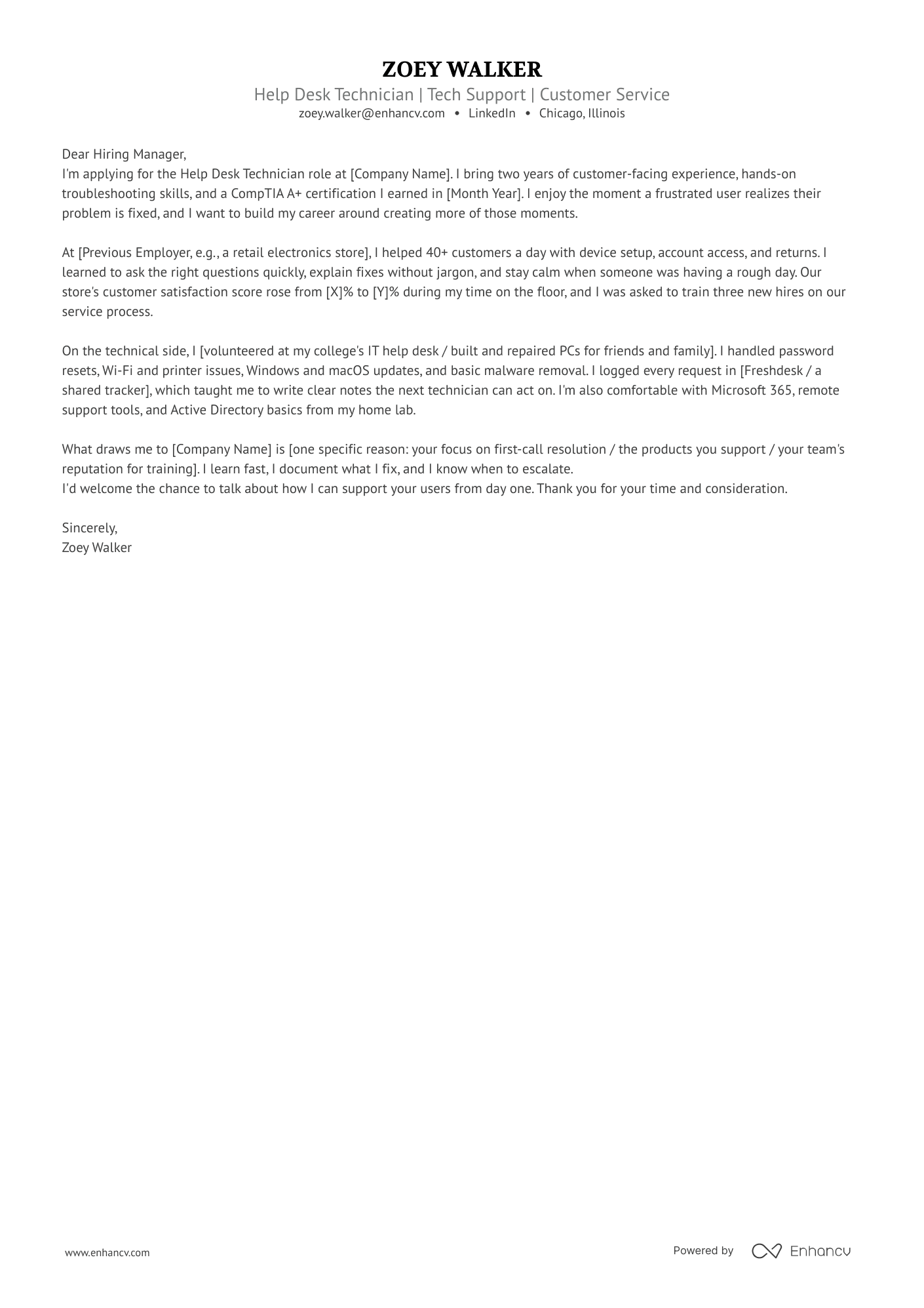
Note what carries this letter. There's no long career behind it, just one placement described honestly, with a number and a reason why the company is interesting to them.
Career change general cover letter example
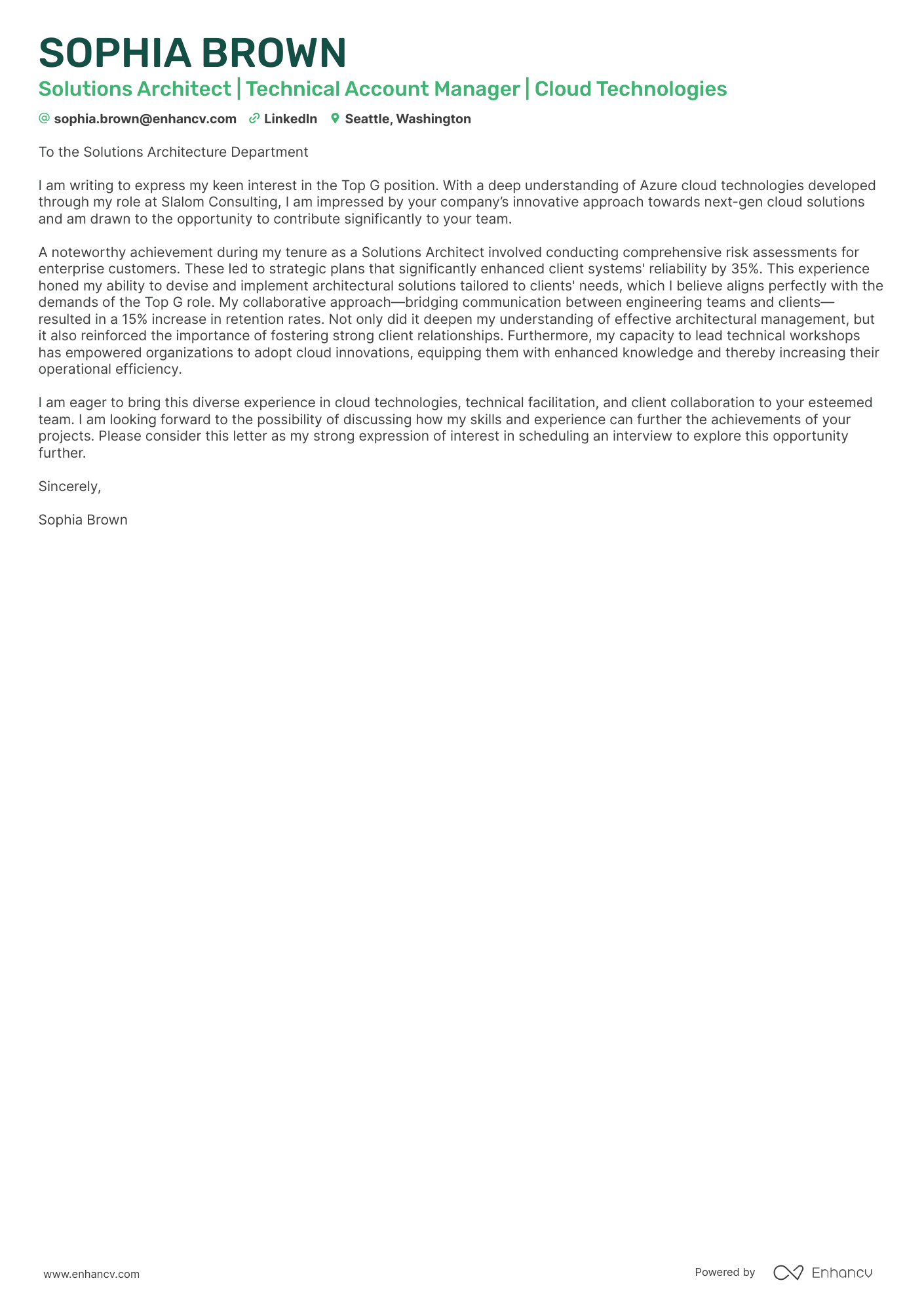
Career changers often bury the change or apologize for it. But in reality, naming it in one short line works better. Then refocus on what you can do for the company.
General cover letter with no specific job in mind
This is the version for job fairs, walk-ins, and open applications where you don't have a posting to point at.
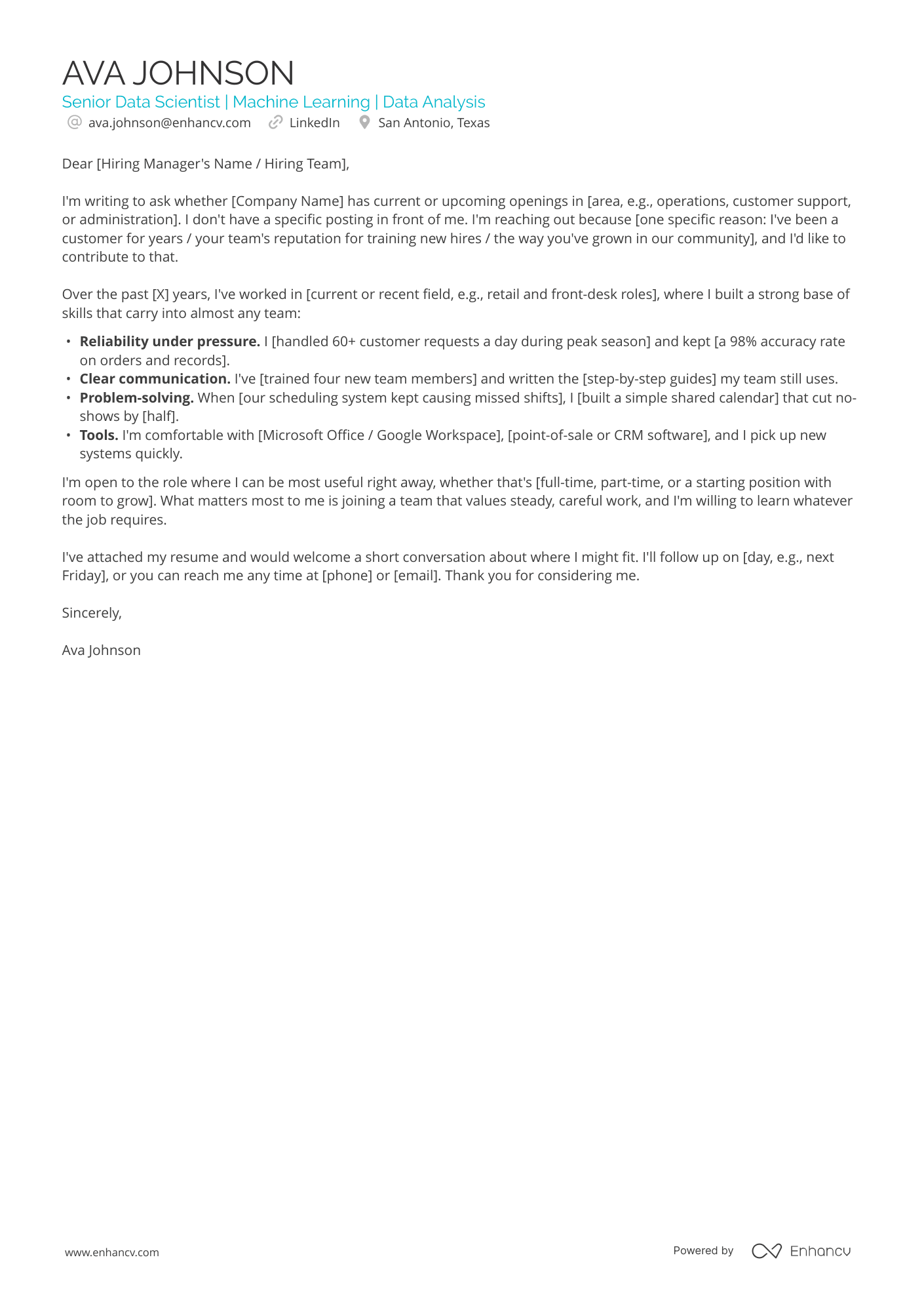
With no company to name, be specific about yourself instead. The certifications, the area, the type of work you want. Bring printed copies to a job fair and pair them with a short, direct message to the hiring manager if you follow up by email.
Short general cover letter example
Under 150 words, for applications with a small text box or a "cover letter optional" field.
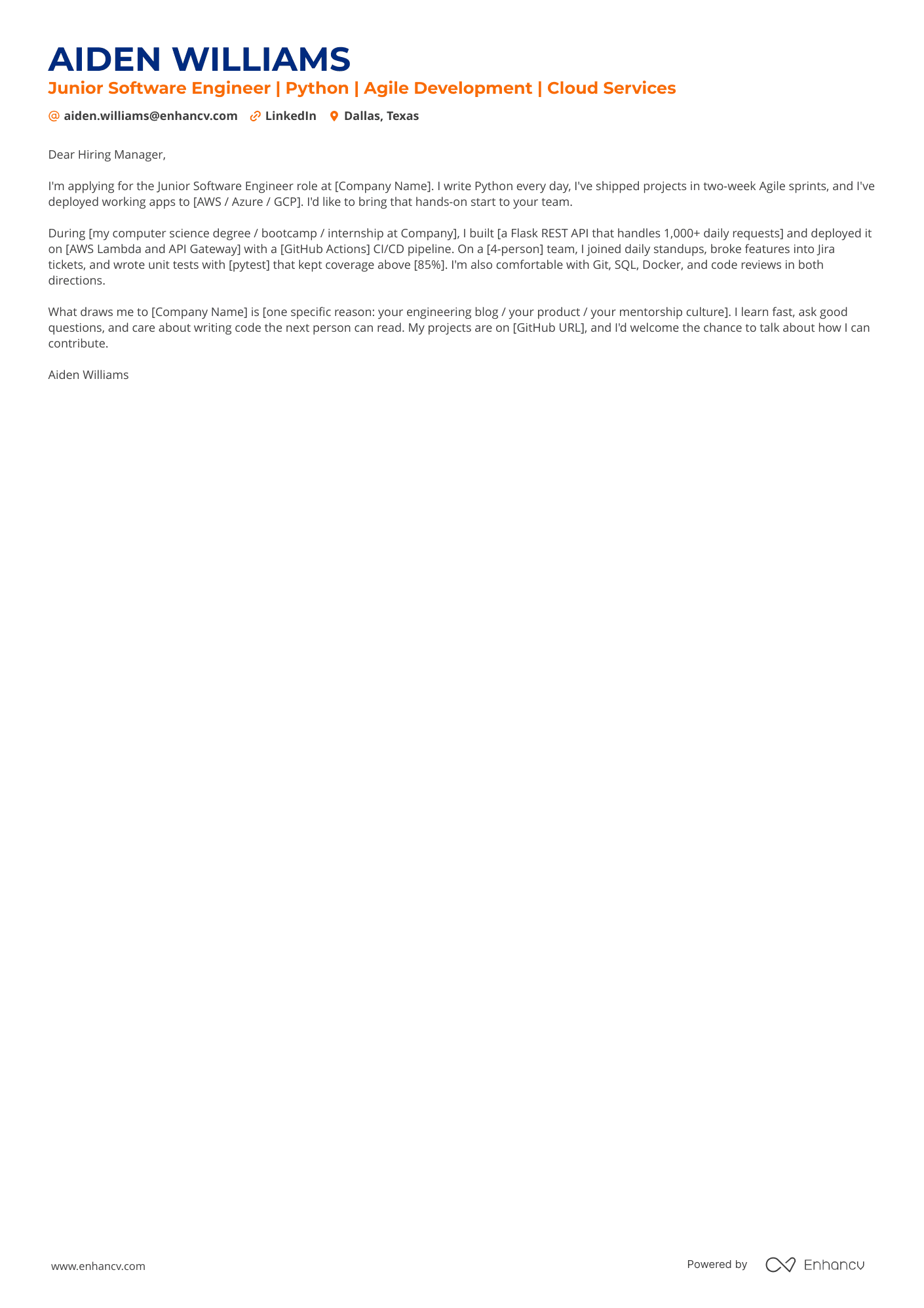
Short letters work when every sentence has a purpose behind it.
How to customize a general cover letter
Change five things. Here's the checklist, in the order that takes the least time.
5-step general cover letter tailoring method
- Swap the company name and job title: Search the document for your old brackets so you don't miss one. A leftover company name is the most common way this goes wrong.
- Add the hiring manager's name: Just go on LinkedIn and research it or visit the company’s website.
- Pull two or three phrases from the job ad: If the ad says "inventory reconciliation," use those words instead of "stock checks." This helps with real readers, and it helps with the software that scans applications. It works the same way resume keywords do.
- Write one honest sentence about the company: Mention one product, one project, one value they list, one person you know there. All it takes is ten minutes to research them.
- Reorder your proof points: Say how can you contribute to the company, what problem can you solve, what expertise do you have that will be of use to the company.
Finally, read the letter carefully to ensure there are no mistakes. Speaking of which…
The most common general cover letter mistakes
There are five things that usually go wrong, and all five are easy to avoid.
Avoid these at all cost
- Leaving the wrong company name in: It happens constantly, and it ends the application. Check what company name you’re using before you send.
- Repeating your resume line by line: The letter adds context and reasons you’re a good fit. If someone could get the same information from your bullet points, then cut it out.
- Writing about what you want instead of what you offer: One sentence about your goals is plenty. The rest should be focused on the value you can bring to the employer.
- Going over one page: Long letters get skimmed, and skimmed letters lose their best sentence.
- Sending it with no proof: A letter filled with buzzwords but no real substance is just useless noise that will be frowned upon.
Frequently asked questions about general cover letters
Let’s go over some typical follow-up questions so you can proceed with confidence.
What if the cover letter is optional?
Then definitely send one. "Optional" usually means the recruiter reads it when the resume is a close call, and close calls are exactly when you want another chance to make your case.
However, send it only if you’re willing to write one that’s actually good. A generic, untouched letter can leave a worse impression than no letter at all. So if you have five minutes for the swaps, send it. If you truly have none, send a strong resume by itself and move on.
Can you use the same cover letter for every job?
You can reuse the same structure and most of the wording, but change the company name, the job title, and one specific detail about the role each time. Sending a completely untouched letter is the main reason general letters get a bad reputation. Recruiters have seen thousands of those, and they can recognize them at a glance.
What's the difference between a general and a generic cover letter?
It’s not just semantics. The current notion is that "generic" is sometimes used as a criticism, meaning a letter that was never adjusted at all, while "general" usually means the reusable template itself, which is a totally valid strategy that’s respected by recruiters and employers alike.
Can AI write your general cover letter?
It can write a solid first draft, and that's a reasonable use of it. But the parts that would convince a recruiter to call you for an interview are the specific results and the honest reason you want to be at that company, and those still have to come from you.
Do applicant tracking systems read cover letters?
Technically yes, they can read them as long as they are in the proper file format. But the more relevant question is if those cover letters are considered by the systems in the initial screening phase. This depends on the decision of the recruiters to set those up or not. Regardless, if your resume is shortlisted for review, it’s almost certain that your cover letter will be read, and that’s what matters more.
How long should a general cover letter be?
Go for one page and aim for 250 to 400 words across three or four short paragraphs. Shorter is fine when every sentence earns its place, and anything past one page tends to get skimmed.
Should you send a general cover letter as a PDF or a Word file?
Send a PDF unless the application specifically asks for Word. PDF keeps your spacing and fonts identical on every device, and virtually all modern application systems accept it without trouble.
Conclusion
Don’t underestimate the power of a cover letter. Sending a good letter can only work in your favor when it matters the most. Using a general cover letter is a smart tactic that speeds up your job hunting. Just take the time to write the base version, and the rest is as easy as it gets.