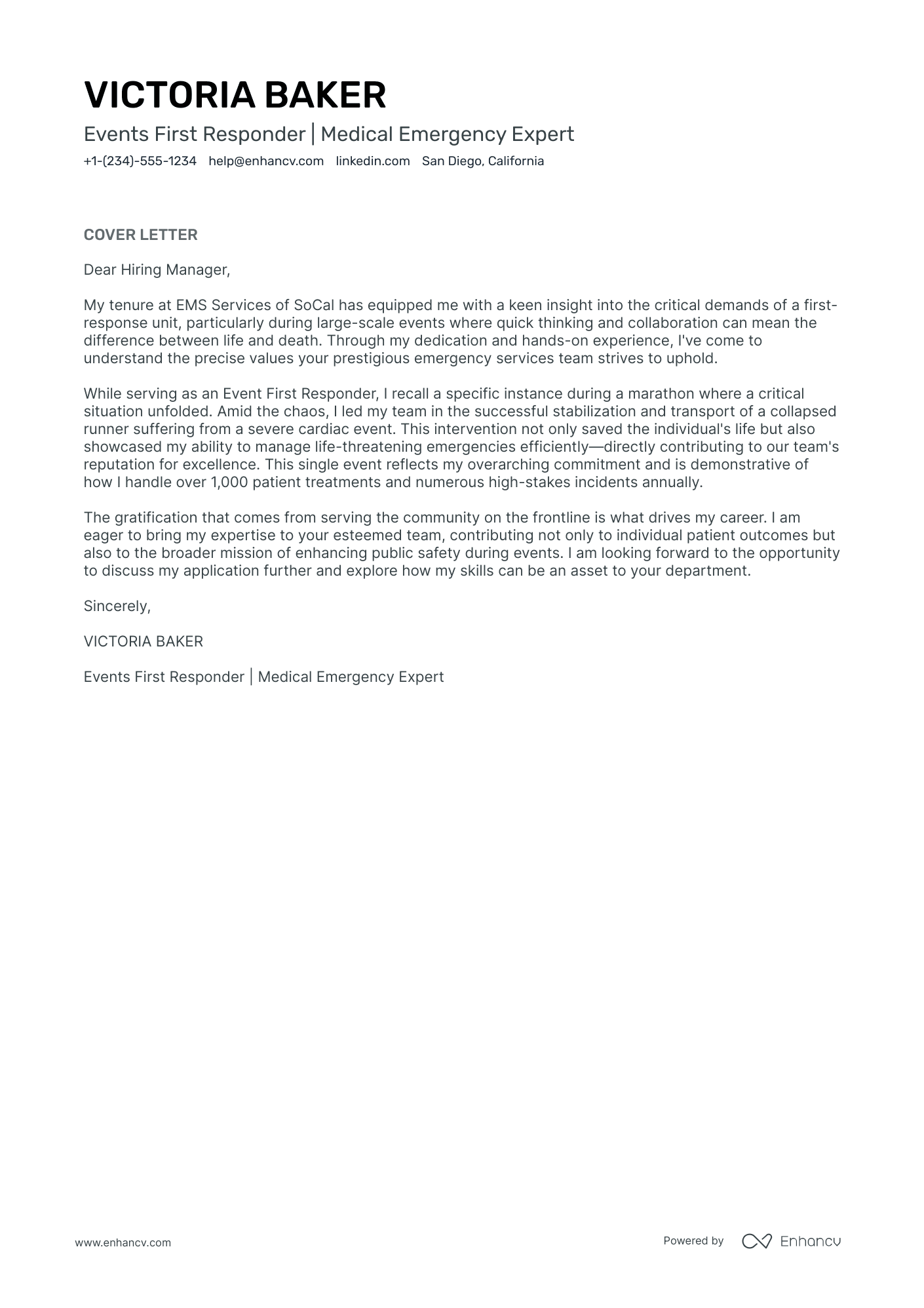
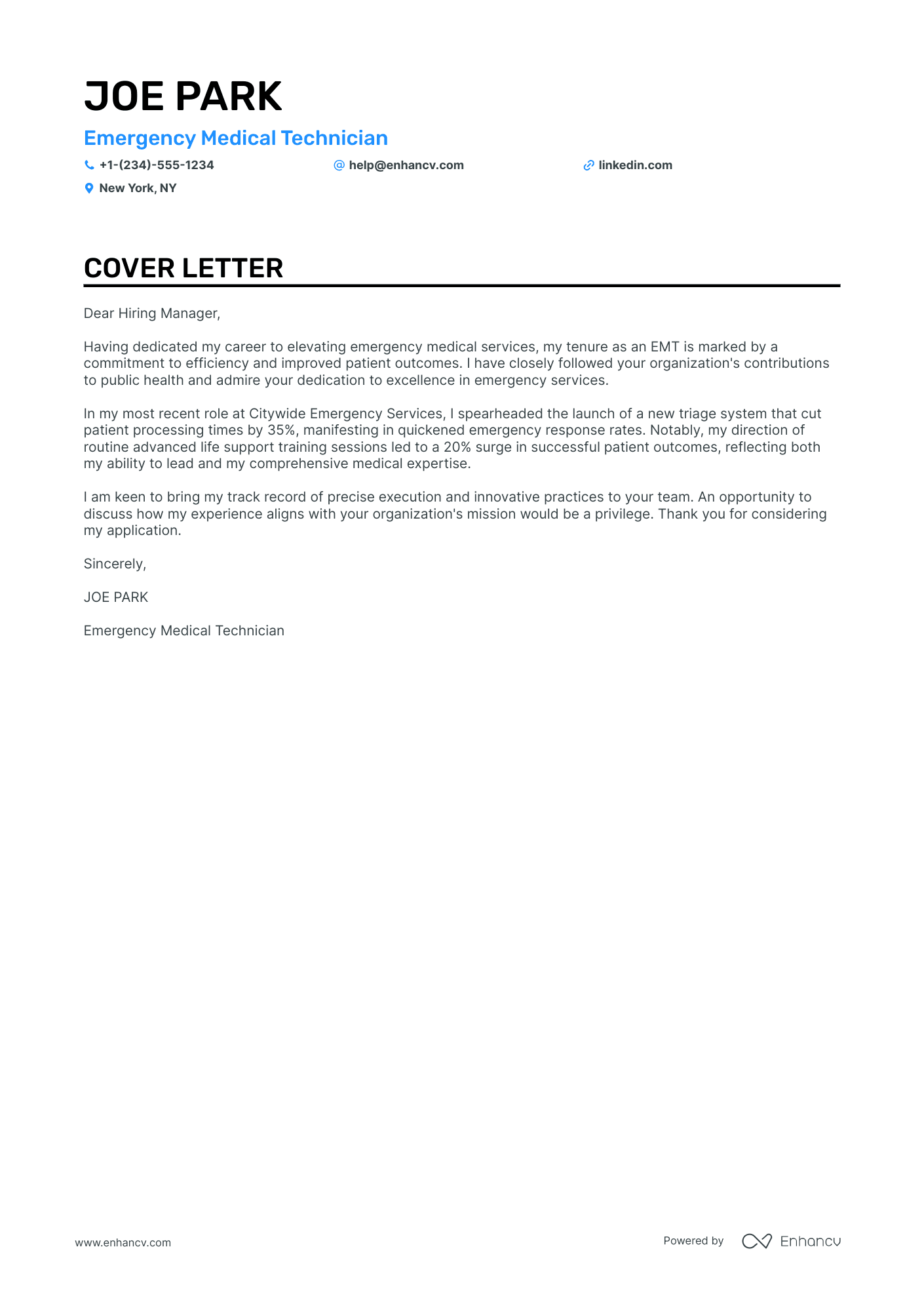
Do you realize what most EMT cover letters read like? Essentially, they’re incident reports with the personality redacted out of them.
"I am a certified EMT-Basic seeking employment with your department."
That sentence probably appears on roughly 80% of the applications EMS chiefs put in the maybe-later pile. That’s the not-gonna-hire pile, by the way.
An emt cover letter needs to do something your NREMT card can't: prove you communicate clearly under pressure. Every shift is triage, and so is the hiring process. If you want to use Enhancv's Cover Letter Builder to build a letter that makes the cut, write the way you run a call. Be direct, specific, and make sure there are no wasted steps.

Key takeaways
- Open with your certification level, unit assignment, and call volume because chiefs want to see operational context immediately.
- Name the department you're applying to and why. Generic letters get generic rejections.
- Include one field achievement with real numbers: response times, transport compliance, patient outcomes.
- Show composure and reliability, not just clinical skills.
- EMS hiring is as much about temperament as technique.
Let’s start with a proper sample to inspire you.
Cover letter example: EMT-B applying to fire department
Alex Dominguez | EMT-B | ACLS | PALS
alex.dominguez@email.com | (555) XXX-4567 | LinkedIn.com/profile
Dear Fire Chief,
I'm an NREMT-B with a state license, ACLS and PALS certifications, and 300+ clinical hours responding to calls across the county. I'm also a CPR/BLS instructor, which means I've trained the next generation on the protocols you're going to trust with saves.
Last year I hit a 97% protocol compliance rate—beating the department target of 90% by seven points. That's not luck. That's reading charts before shift, knowing the updates, and catching near-misses before they become incidents. One metric matters more than five vague promises about excellence.
There's a call from six months ago I still think about. Pediatric cardiac arrest, two years old, parents losing it in the background. We got a rhythm back in the truck. Got her to the hospital. She's home now. I didn't mention that to impress you—I mentioned it because that call changed how I think about this work. It stopped being a job and became a responsibility.
I've trained 12 new EMTs in the past eighteen months, and I built a pre-hospital assessment checklist that's now being used across 42 units in the region. I saw gaps in consistency, sat down, documented the fix, and pushed it out instead of just working around the problem. That's the kind of person who doesn't clock out mentally.
I'm halfway through my paramedic program right now. This isn't a stepping stone—it's a commitment to staying in this work and getting better at it.
I'm ready to run calls with your crew and contribute beyond minimum scope. Let me know what times work for a conversation.
Best,
Alex Dominguez
Here's why this letter works:
- NREMT certification and context up front: We see NREMT-B, state license, ACLS, PALS, CPR/BLS instructor, 300+ clinical hours. The chief can verify qualifications before the second paragraph.
- One concrete measurable achievement: Not "maintained excellent response times." A 97% compliance rate against a 90% department target. A real number beats five bullet points about skills.
- A human moment: The pediatric cardiac arrest save is mentioned honestly, without dramatizing it. "That call changed how I think about this work" is something a real EMT would say.
- Leadership evidence: Training 12 new EMTs and building a checklist used across 42 units shows initiative beyond minimum scope.
- Forward trajectory: Paramedic program in progress signals ambition and longevity.
Now let’s move on to constructing your own letter.
What your EMT cover letter needs to cover
EMS chiefs ask themselves four basic questions when they pick up your cover letter. If you answer all four and you're ahead of most applicants who just list their certificates and hope for the best.
Here’s what’s going through their head:
1. Can this candidate handle the call volume?
Unit assignment, shift type, average calls per shift. A chief hiring for a busy urban 911 system needs to know you won't burn out by week three. Context matters more than a generic "experience in pre-hospital emergency care."
2. What have they done beyond the protocol card?
Every EMT can follow standing orders. What did you do that went beyond the baseline? Did you improve a process, train someone, catch something another provider missed? Your best field story, told with numbers, is the strongest paragraph in your letter.
3. Why do they want to be in this department?
Fire-based EMS, third service, private ambulance, hospital-based — they all operate differently. Chiefs know when someone is mass-applying. Name the department's structure, their response area, their reputation. Ten minutes of research separates you from the stack.
4. Are they going to stick around or move on quickly?
Turnover in EMS is brutal. If you're pursuing paramedic school, say so and explain how it benefits their department. Stability signals are worth more than another FEMA cert.
Sections to include in your EMT cover letter
An EMT cover letter follows the same structure as any professional letter, but the content is what makes it EMS.
- Header: Full name, certification level (EMT-B, AEMT, EMT-P), phone, email, city and state, LinkedIn URL. Match it to your EMT resume. If you hold a National Registry certification, note it after your name.
- Salutation: Use the hiring officer's name and rank. Check the job posting, the department website, or call the admin office and ask. See the addressing section below.
- Opening paragraph: State the role, the department, your current assignment, and your certification chain. Two to three sentences. No filler.
- Body paragraphs: One paragraph for your strongest field achievement with numbers. One paragraph for why this specific department and role. This is where the letter lives or dies.
- Closing: Request the next step. Mention availability for a ride-along, physical agility test, or interview. Sign off with your credentials after your name.
After structure comes substance. Here’s what’s important next.

What EMS chiefs and hiring officers scan for first
- Current NREMT certification and state EMS license at the appropriate level.
- Call volume context: 911 vs. IFT, urban vs. rural, calls per shift.
- Quantified field performance: response times, transport compliance, patient outcomes.
- Evidence of composure under pressure like specific calls, not vague claims.
- Training and mentorship involvement like FTO experience, preceptor roles, protocol development.
- Career trajectory: paramedic program enrollment, fire academy plans, specialty certifications.
Now that you have a good understanding of how to structure your letter and what to focus on, we can move on to writing its various components.
How to address your EMT cover letter
"To Whom It May Concern" tells the chief you didn't care enough to make one phone call. In EMS, attention to detail keeps people alive. Start demonstrating it in the cover letter salutation.
Check the job posting first. Many list the hiring officer directly. If not, go to the department's website and look for the EMS division leadership page. Call the station and ask who's reviewing applications. LinkedIn works too.
Use "Dear Chief Name" or "Dear EMS Division Chief Name" if you know their rank. For fire departments, match their rank structure exactly, like Captain, Battalion Chief, Division Chief. If you truly cannot find a name, "Dear EMS Hiring Committee" is better than any generic greeting.
How to open your EMT cover letter
Your opening will get about six seconds of attention. Don't waste them on "I am writing to express my interest in the EMT position."
Here’s what would work well:
Strong opening for an EMT cover letter
I'm an NREMT-B certified EMT currently running 911 response on Unit 37 at Austin-Travis County EMS, averaging 14 calls per 12-hour shift. I'm applying for the EMT-B/Firefighter position with the Houston Fire Department. My field experience includes 300+ clinical hours, ACLS and PALS certifications, and a 97% on-scene-to-transport compliance rate against a department target of 90%.
Weak opening to avoid
I am writing to express my strong interest in the EMT position at your fire department. I am a dedicated and hardworking emergency medical technician with a passion for helping others. I believe my skills and certifications make me a strong candidate for this role.
The bad version could go to any department for any EMS role. Zero operational specifics, zero numbers, zero evidence of actual field time.
The good one names the unit, call volume, department, and a measurable result. All in three sentences. That's how to start a cover letter in a field where specificity signals competence.
How to write the body of your EMT cover letter
The body is where you prove you perform, not just respond.
Structure your achievement like this:
- Problem
- Action
- Result
Don't just say you "provided excellent pre-hospital care." Walk through it.
- What was the situation on your unit?
- What did you do?
- What changed?
For example:
"Our unit's on-scene-to-transport times were averaging 88% compliance. I identified that documentation delays during handoff were the main bottleneck. I built a streamlined field checklist that cut handoff time by two minutes per call. Within three months, our compliance rate hit 97%."
That's a paragraph an EMS chief will remember.
Tailoring your letter to the job posting
Every job posting tells you exactly what to write about. Match their language to your experience.
Match job posting language to your EMT experience
| Job posting says | Your cover letter should include |
|---|---|
| Experience in 911 emergency response | Name your unit, call volume per shift, and specific call types: cardiac, trauma, stroke, pediatric |
| Strong patient assessment skills | Describe a call where your assessment changed the treatment plan or outcome |
| Ability to work under pressure | Reference high-volume shifts, multi-casualty incidents, or critical saves with specific details |
| Team-oriented provider | Name your crew dynamics, FTO experience, cross-training with fire or law enforcement |
| Commitment to professional development | Mention paramedic school, specialty certs (ACLS, PALS, PHTLS), or continuing education hours |
Enhancv's Tailoring Tool scans a job posting and flags the skills and language the role prioritizes. Worth using before you write the body paragraph.
How to close your EMT cover letter
Your closing should do two things: state the next step and leave a professional impression. In EMS, that means being direct.
Strong closing for an EMT cover letter
I'd welcome the chance to discuss how my 911 experience at Austin-Travis County EMS translates to Houston Fire's dual-role model. I'm available for a physical agility test, ride-along, or interview at your convenience, and I'm happy to provide references from my current unit supervisor and medical director. Thank you for your time.
Respectfully,
Alex Dominguez
Weak closing to avoid
Thank you so much for considering my application. I am very excited about this opportunity and know I would be a great addition to your team. I look forward to hearing from you and am available anytime.
Sincerely,
Alex
The weak version is all enthusiasm, no substance. "I would be a great addition" is an empty claim. The strong version references specific experience, offers concrete next steps, and includes the full credential chain. More formats in the cover letter ending guide.
EMT cover letter with no experience
New EMTs have more to work with than they think. Your clinical ride-alongs are field experience. Your skills practicals count. Your scenario-based training counts.

New EMT cover letter formula
[EMT program + school name] + [total clinical/ride-along hours] + [strongest call type or patient contact from clinicals] + [one specific assessment or intervention performed under preceptor supervision] + [NREMT status and state license] + [why this department for your first role]
Here's what that looks like:
"During my 180-hour clinical rotation at Austin Community College's EMT program, I completed 48 patient contacts across 911 and IFT settings. On my final ride-along, I was primary provider on a multi-vehicle MVC with three patients requiring c-spine immobilization and rapid transport. My preceptor signed off on my patient assessments without corrections by week six."
That beats "I am a recently certified EMT eager to begin my career in emergency medicine" every single time.
Don't apologize for being new. Chiefs hiring new EMTs know you're new. They want to see clinical competence from your rotations, genuine interest in their department, and the ability to take feedback without ego. Enhancv's AI content suggestions can help you turn clinical rotation notes into cover letter language — the full cover letter with no experience guide has more strategies.
Frequently asked questions about EMT cover letters
What should an EMT cover letter include?
Your NREMT certification level, state EMS license, relevant certifications (ACLS, PALS, CPR/BLS), current assignment with call volume context, one quantified field achievement, and a specific reason you want to work at that department. Skip the adjectives about being passionate and hardworking. Show the work.
How to format an EMT cover letter?
Use 11–12pt font (Calibri or Arial), single-spaced paragraphs with space between, left-aligned. Font choices matter less than you think, consistency with your resume format is what counts.
How long should an EMT cover letter be?
One page. Four paragraphs. 250–400 words. EMS supervisors review applications between calls, during shift change, or at the end of a 24-hour tour. If your letter spills onto a second page, cut the paragraph that sounds most like a template.
What makes an EMT cover letter stand out?
A real number in the first paragraph. Not "strong response times" — an actual compliance rate, outcome statistic, or patient volume. Chiefs have read every EMS adjective in existence. A concrete operational detail cuts through in the first ten seconds.
How do I write an EMT cover letter with no experience?
Lead with your clinical rotation hours, your strongest patient contact from training, and the specific department you want to join. Name the preceptor feedback you received, the call types you handled, and the NREMT status. New EMTs who write like field providers get hired over polished applicants who write like students.