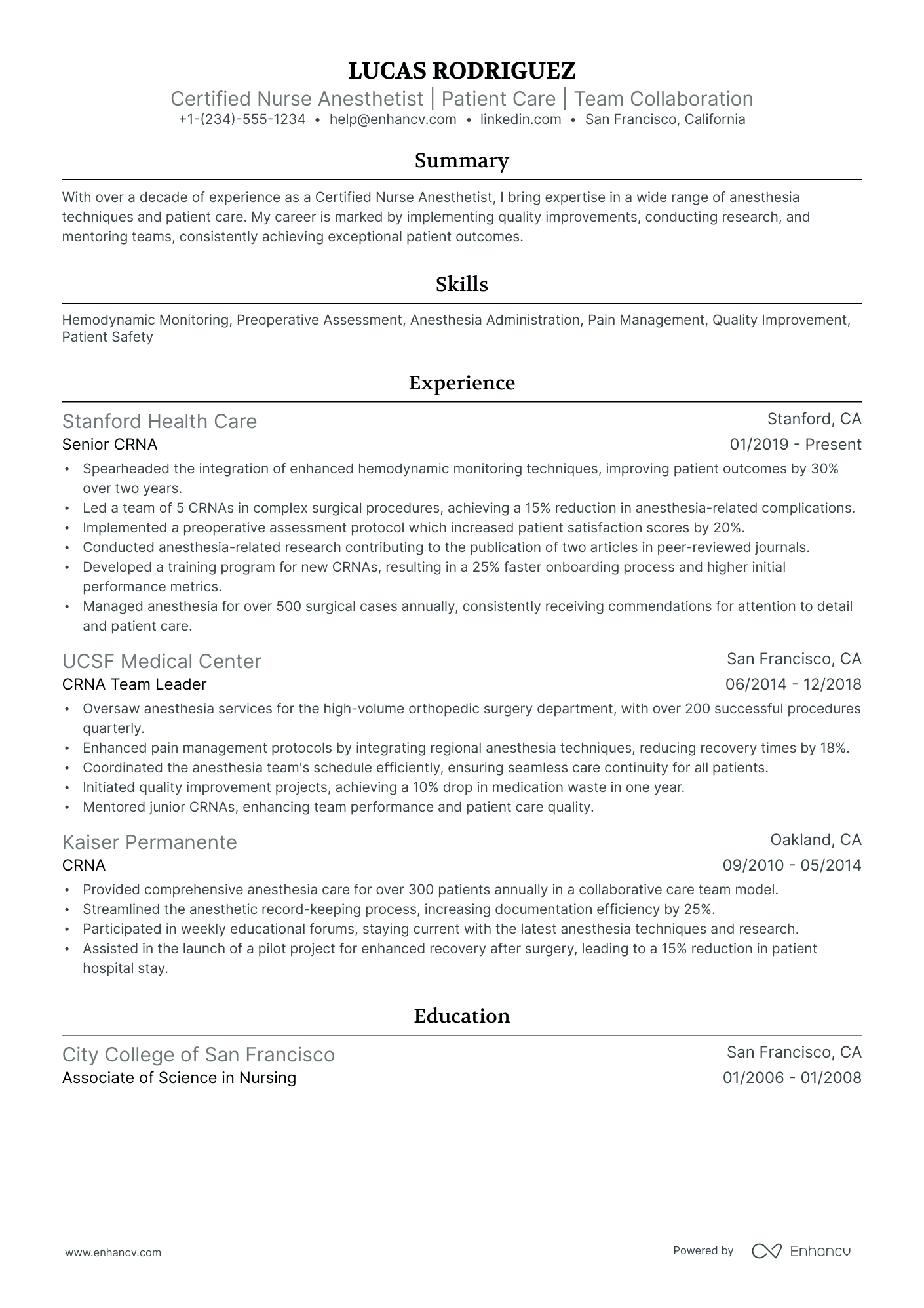
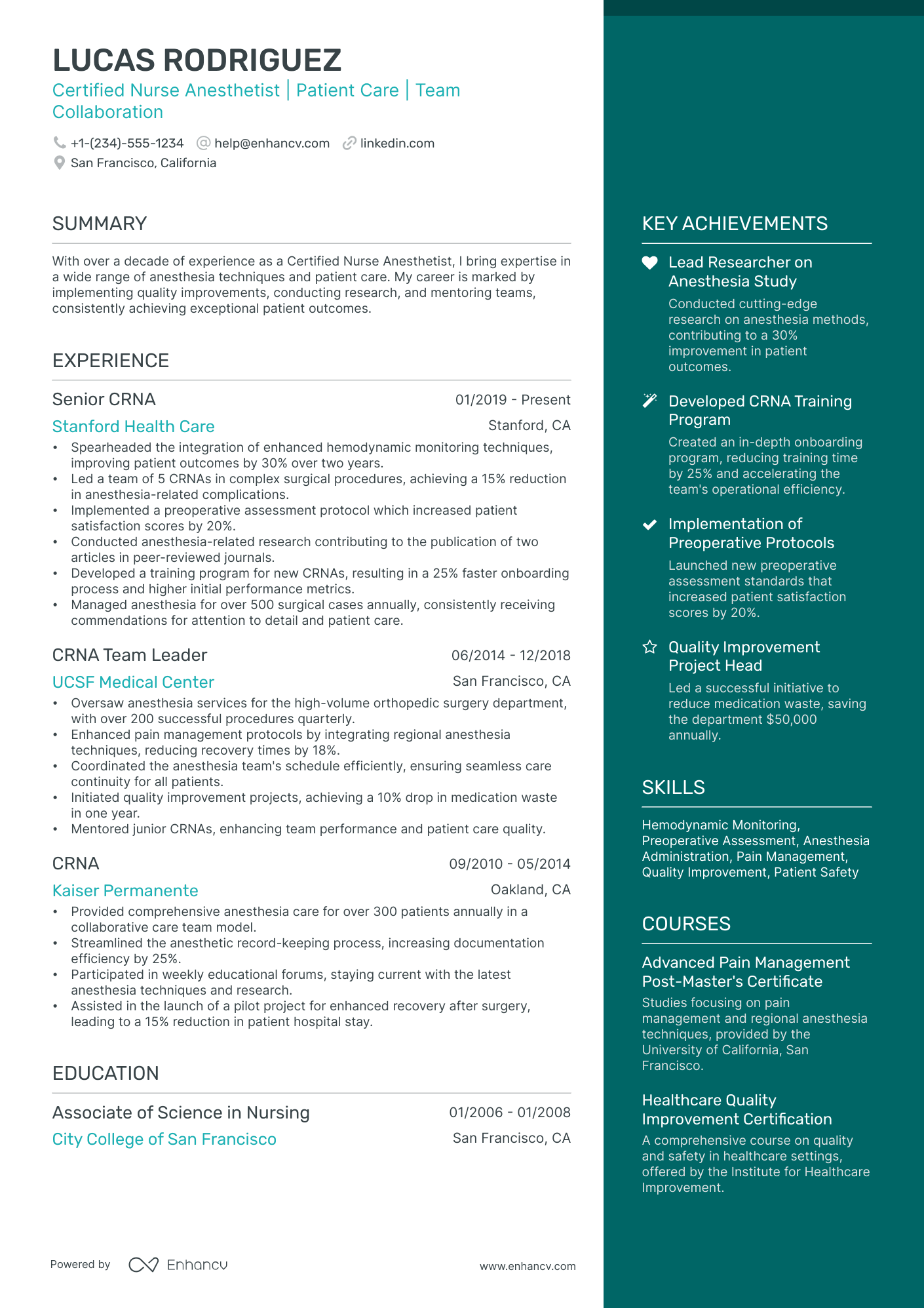
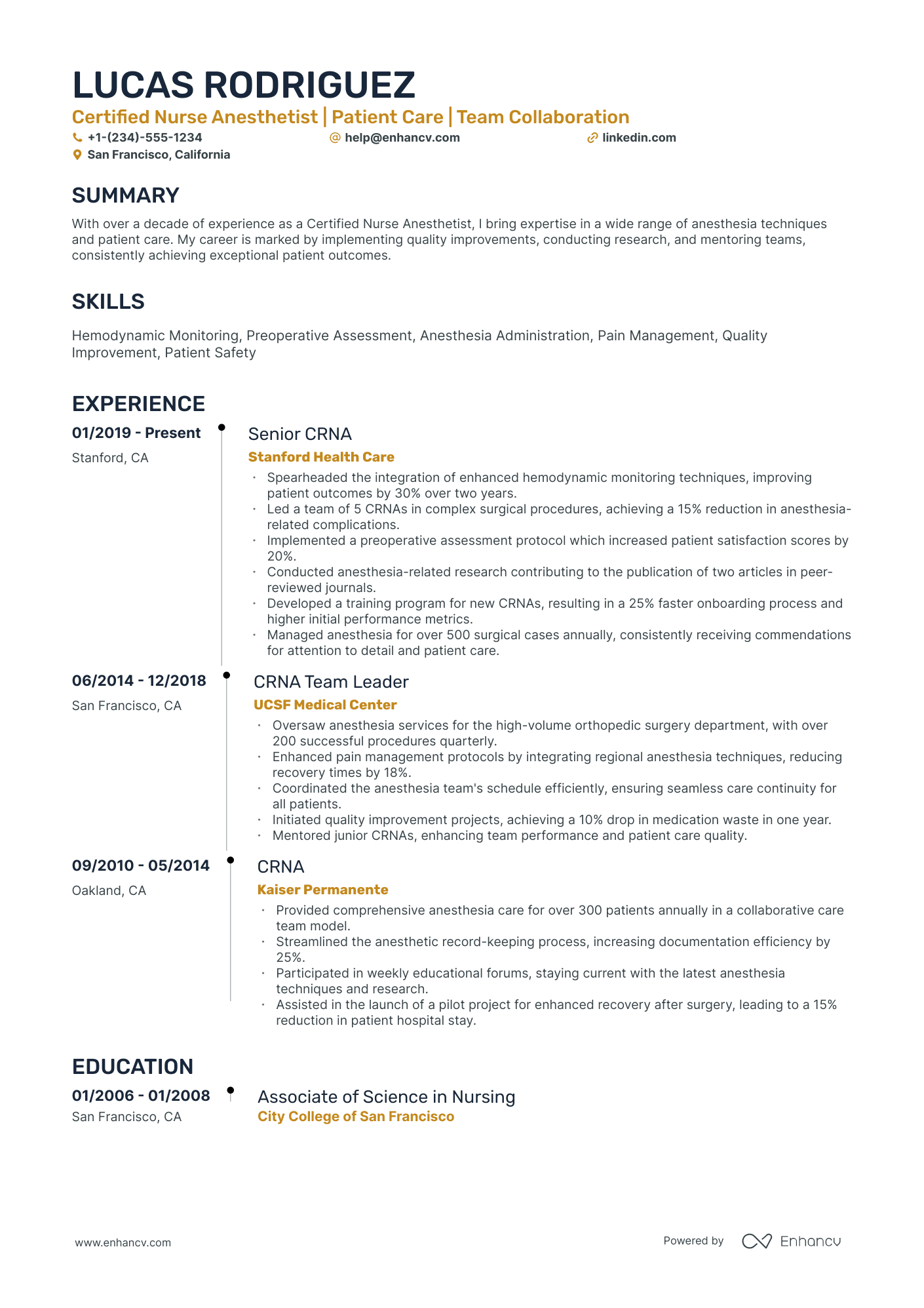
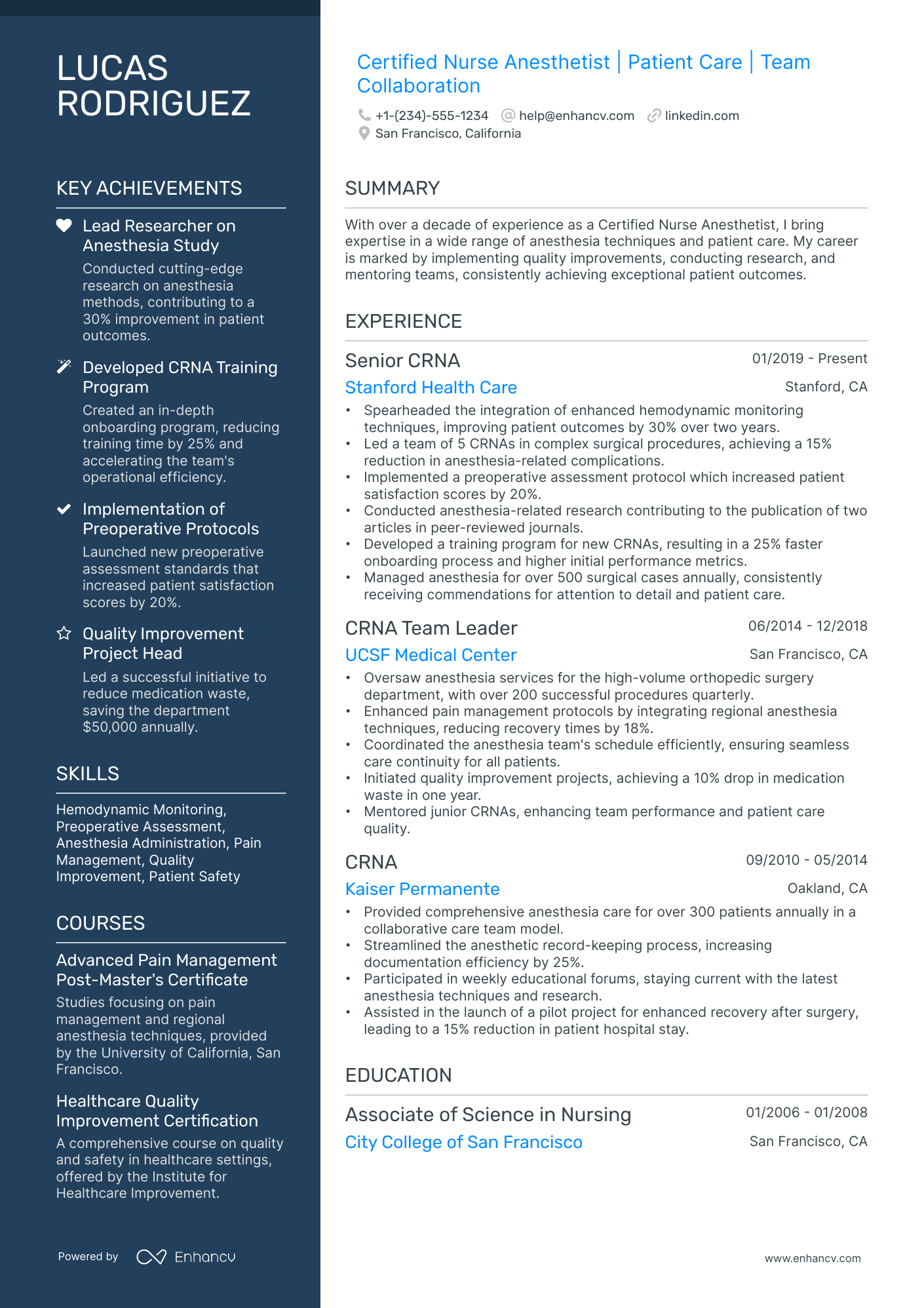
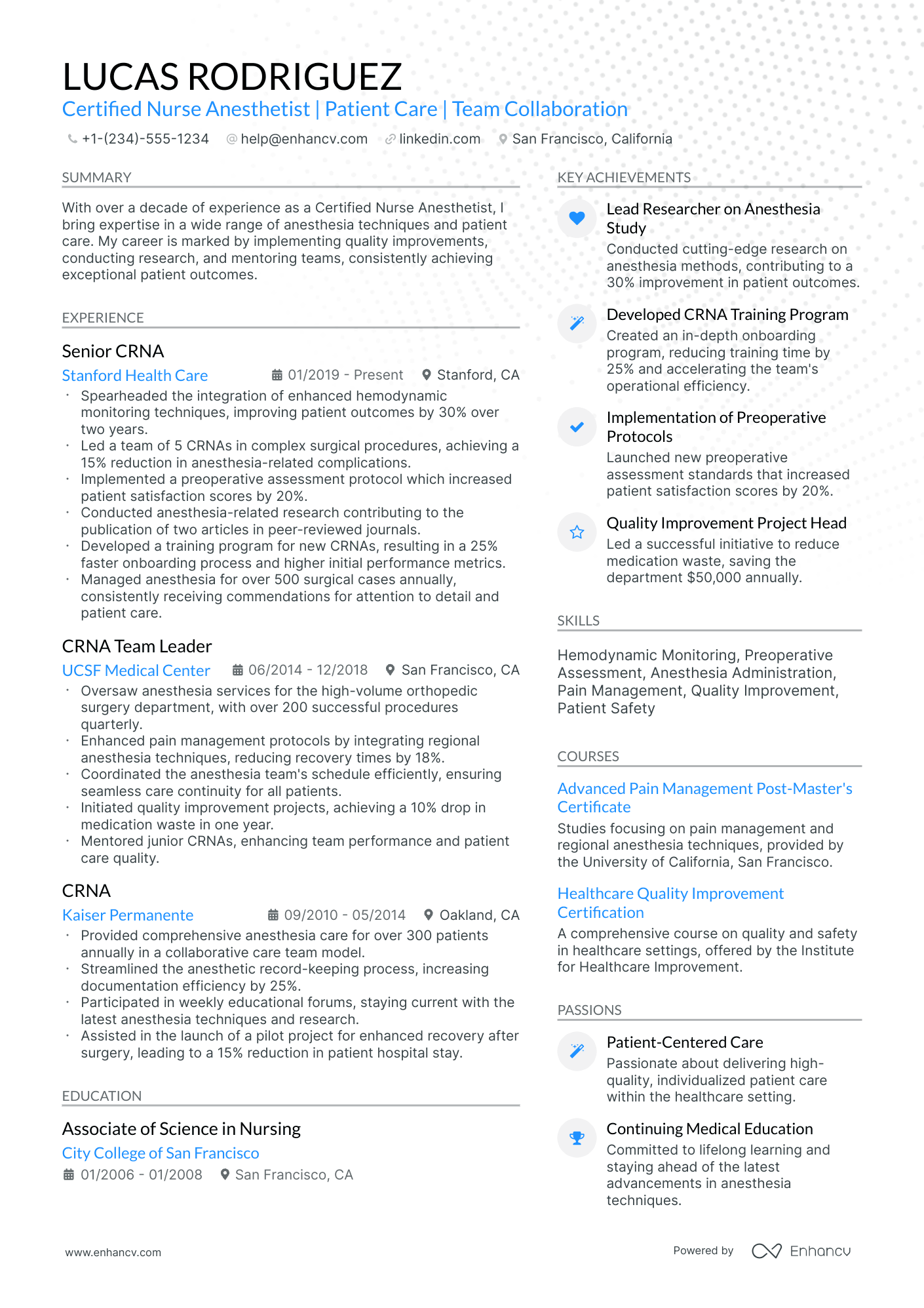
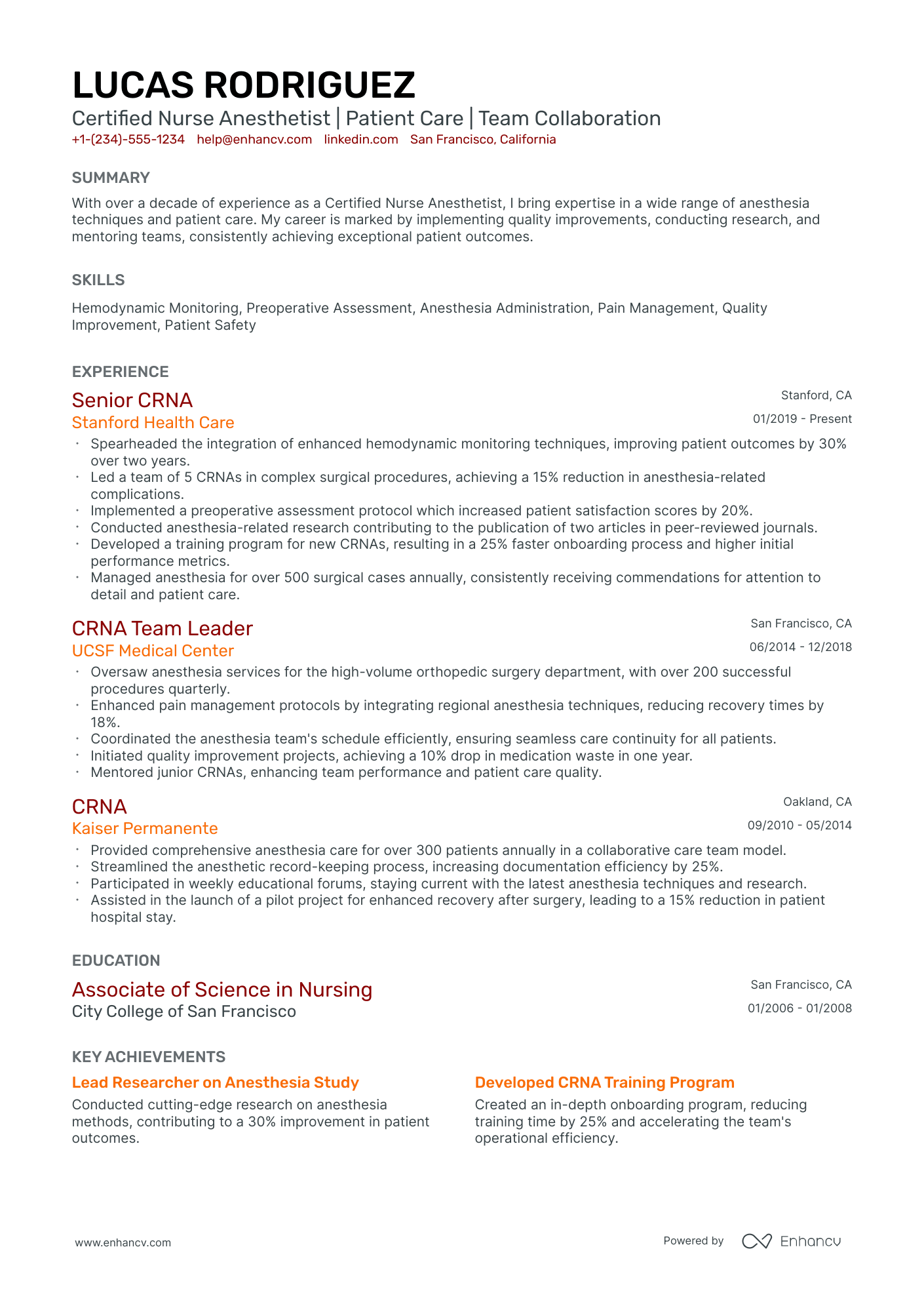
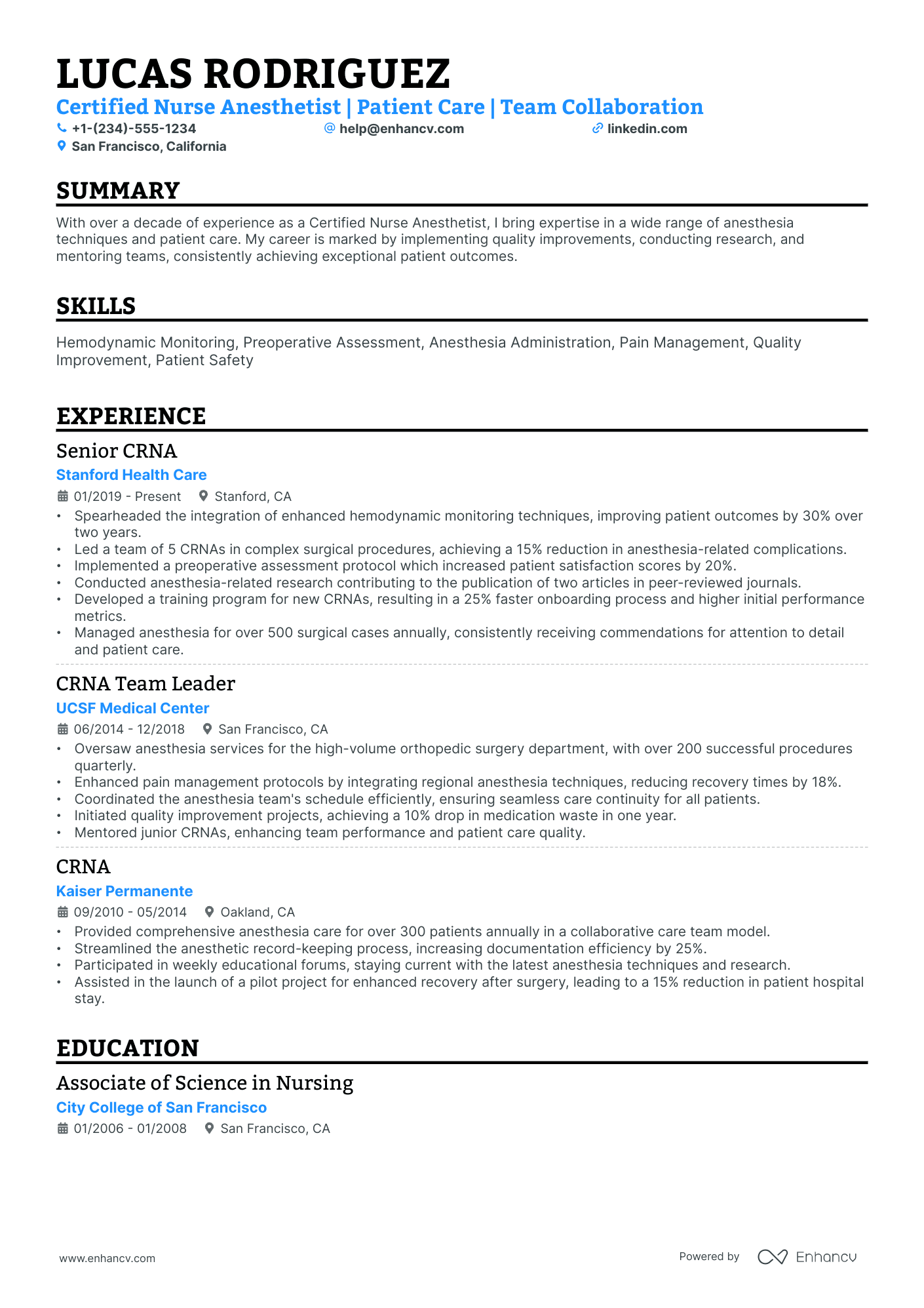
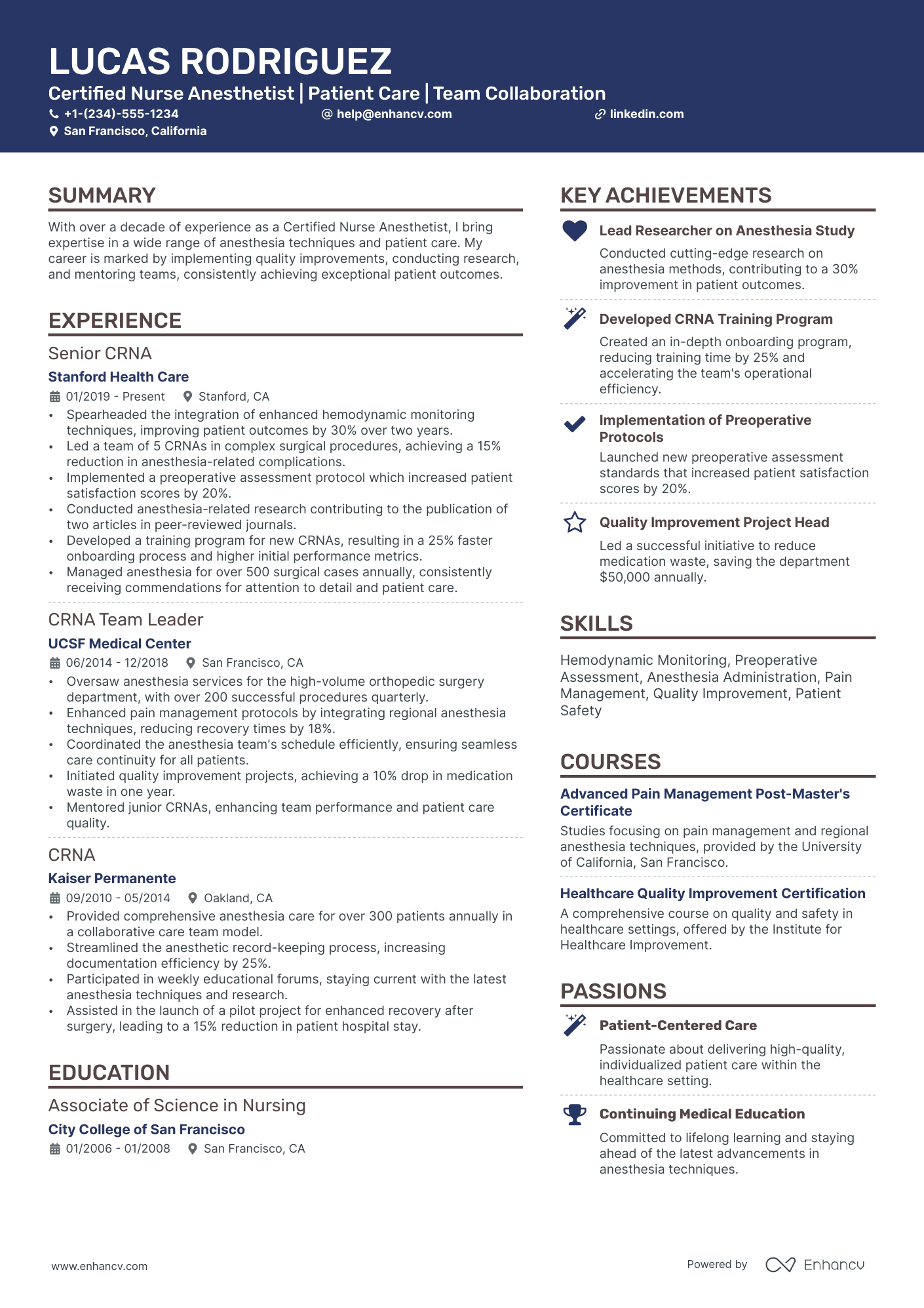
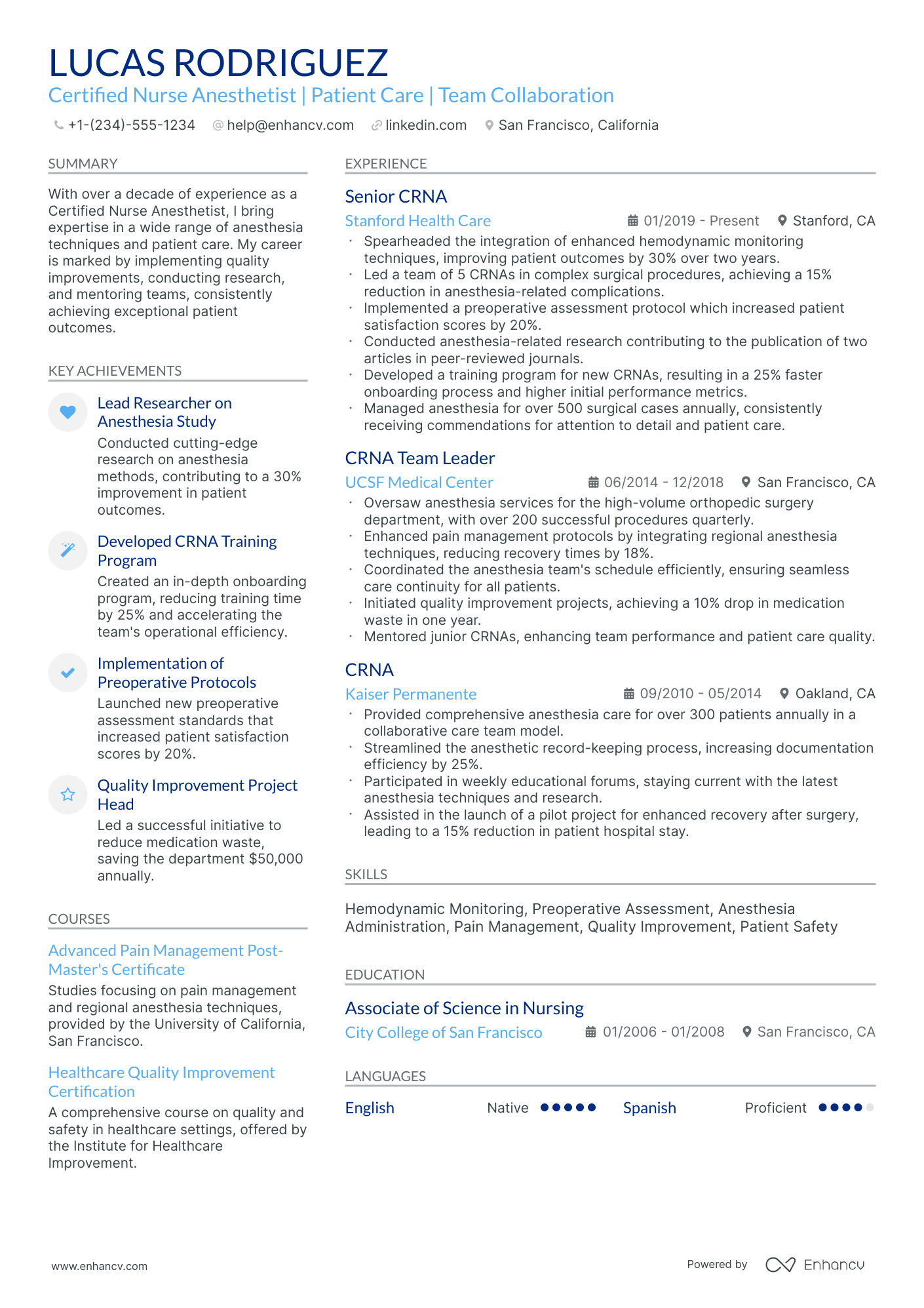
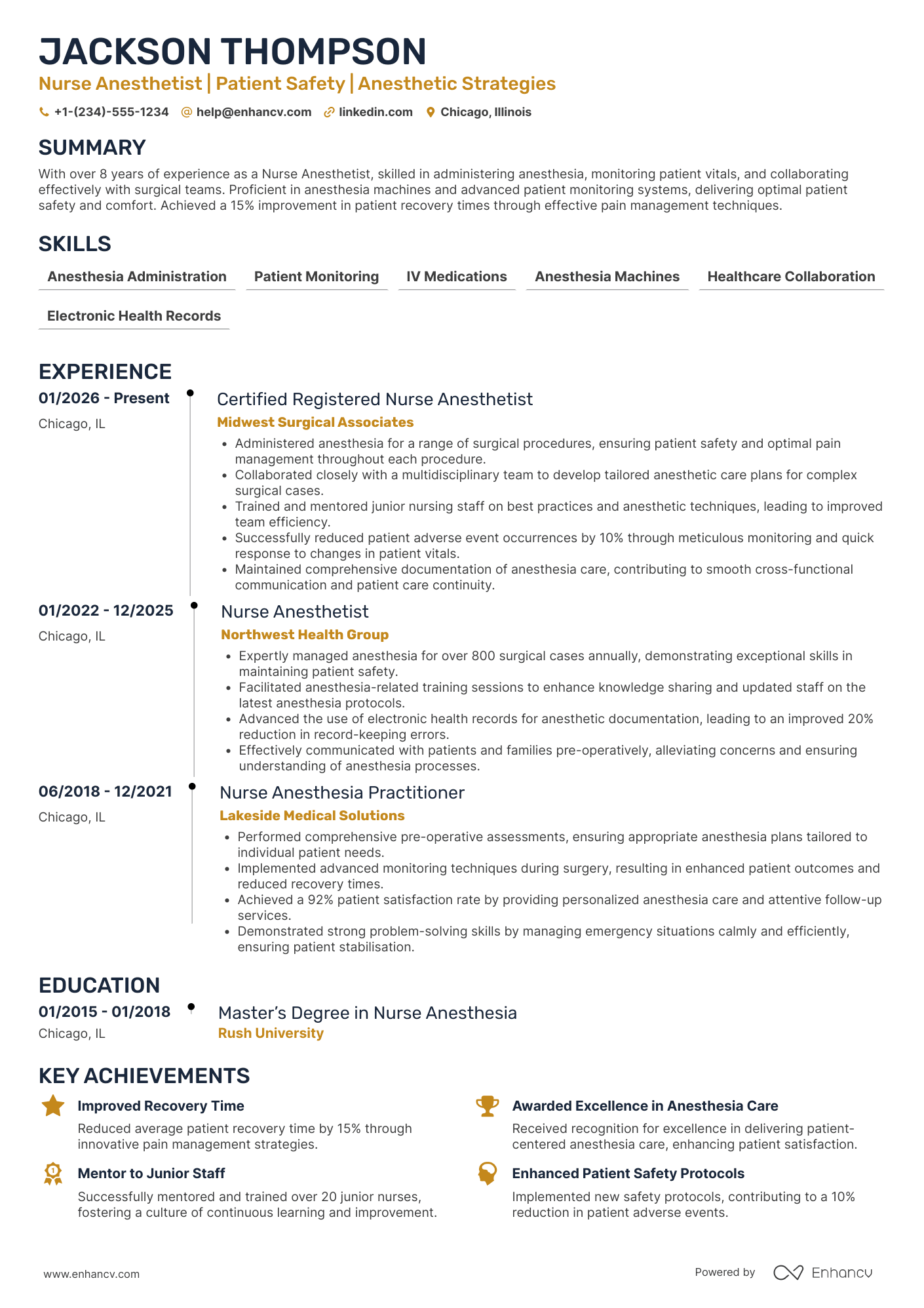
Every CRNA resume guide I've seen treats you like a bedside nurse writing your first resume. You're not. You're an advanced practice registered nurse who manages anesthesia care for 600+ cases a year — a Certified Registered Nurse Anesthetist earning north of $200K. This guide works for practicing nurse anesthetist professionals hunting for the next role and for ICU nurses building a resume for CRNA school. Same framework, different emphasis. Here's how to write a resume that does your skills justice.

Key takeaways
- Lead with case volume and anesthesia subspecialties — not generic nursing duties
- Use reverse chronological format; one page for jobs, up to two for CRNA school applications
- Name your certifications in order: NBCRNA, APRN, ACLS, BLS, PALS
- Quantify everything: cases per year, complication rates, OR turnaround improvement
- Tailor each resume to the job posting — cardiac CRNA positions want different keywords than ambulatory surgery centers
- Enhancv's resume builder formats your clinical credentials and case metrics into a clean, ATS-friendly layout
How to format your CRNA resume
Use a reverse chronological resume format. Your most recent clinical experience is your most relevant — hiring managers want to see it first.
How long should a CRNA resume be? One page for job applications. Period. If you're putting together a CRNA school resume, you can go to two pages because admissions committees want to see research, volunteer work, clinical hours, and your GPA alongside your ICU experience.
That distinction matters and nobody talks about it. A job resume is lean and results-focused. A CRNA school resume example includes sections that would be dead weight on a job application — shadowing hours, community involvement, your capstone proposal.
Your resume format should include these resume sections: contact information, professional summary, work experience, education, certifications, and skills. Keep the layout clean with standard fonts and clear section headers. Save your final version as a CRNA resume PDF to preserve formatting across systems. If you're looking for a CRNA school resume template, start with a clean reverse-chronological layout and add the extra sections school applications require.
Job resume vs CRNA school resume
| Feature | Job resume | CRNA school resume |
|---|---|---|
| Length | One page | Up to two pages |
| Summary | Results-focused, case volume | Motivation, clinical readiness, program fit |
| Experience | Recent CRNA or ICU roles only | All relevant clinical, research, volunteer |
| Education | Degree and school, that's it | GPA, honors, relevant coursework |
| Extras | None | Shadowing hours, leadership, publications |
Is your resume good enough?
Drop your resume here or choose a file. PDF & DOCX only. Max 2MB file size.
Your format sets the first impression. The content within each section is what earns the interview.
Write your CRNA experience section
Your experience section should read like an anesthesia case log, not a nursing job description. I've seen too many CRNA resume examples where a provider with 3,000+ cases writes "provided patient care" as a bullet point. That's garbage. It tells me nothing about your case mix, your complexity level, or your patient outcomes.
Structure every bullet like this: [Action verb] + [what you did] + [for how many/what type of patients] + [measurable result].
Strong CRNA experience bullets
- Administered general anesthesia, regional anesthesia, and monitored anesthesia care for 800+ cases annually across cardiac, OB, and trauma specialties
- Managed airway for ASA III-V patients including emergency intubations with 99.8% first-pass success rate
- Performed hemodynamic monitoring via arterial lines and central venous access for complex surgical cases, maintaining zero unplanned ICU transfers
- Precepted 6 SRNAs through 500+ clinical hours across all anesthesia subspecialties
Generic bullets that waste space
- Provided patient care in the operating room
- Assisted with anesthesia administration
- Monitored patients during surgery
- Communicated with surgical team members
See the difference? The strong bullets name specific anesthesia techniques, patient assessment complexity levels (ASA classification), and measurable results. The weak bullets could describe a surgical tech.
If you're an ICU nurse building an ICU nurse resume for CRNA school, frame your experience around anesthesia-relevant skills. Hemodynamic monitoring, ventilator management, vasoactive drip titration, and code blue response — that's what admissions committees want to see. Don't bury it under generic med-surg language.
For your work experience on your resume, distinguish between autonomous practice and supervised practice. If you work under full practice authority, say so. If you're in a collaborative practice model with anesthesiologist oversight, name that too. The employer will ask anyway — getting ahead of it shows confidence. And while you're rewriting those bullets, Enhancv's bullet point generator does a decent job of turning flat descriptions into something with actual numbers and action verbs.
Getting the language right matters, but without matching it to what the employer is actually asking for, even strong bullets can miss the mark.
Tailor your CRNA resume to the job description
A cardiac CRNA position and an ambulatory surgery center posting need completely different resumes. Read the job description, highlight the keywords, and mirror that language in your experience bullets.
Here's what I mean. If a posting says "seeking a CRNA with cardiac anesthesia experience including TEE monitoring and Swan-Ganz catheter management," your resume better include those exact terms — not just "anesthesia experience." Match the anesthesia subspecialties they name: cardiac, OB, pediatric, neuro, regional, pain management, trauma. Match the practice setting: hospital, ASC, office-based, pain clinic, locum tenens.
Tailoring your resume to the job description isn't optional in this market — and if you want a CRNA resume review before submitting, run your tailored version against the posting one more time. Enhancv's resume tailoring feature analyzes the job description keywords and shows you exactly where your resume aligns and where it doesn't — which saves time when you're applying to multiple CRNA positions across different specialties.
What the posting says vs what your resume should say
| Job posting language | Your resume mirror |
|---|---|
| "Cardiac anesthesia experience required" | "Administered anesthesia for 200+ cardiac cases including CABG, valve replacements, and thoracic procedures" |
| "Must be proficient with regional techniques" | "Performed 300+ regional blocks annually including epidurals, spinals, and ultrasound-guided nerve blocks" |
| "Experience in fast-paced ASC environment" | "Managed anesthesia for 12-15 cases daily in high-volume ambulatory surgery center with 98% on-time starts" |
| "SRNA preceptor experience preferred" | "Precepted 8 SRNAs through 1,000+ combined clinical hours across all anesthesia subspecialties" |
Tailoring gets the right words onto the page. Quantifying proves those words are real.
Quantify your impact as a CRNA
Case volume is your strongest number. Lead with it. Every CRNA resume sample I review that lands interviews has hard metrics front and center.
Stop saying "experienced CRNA" and start saying "managed anesthesia for 850 cases annually." The first is an opinion. The second is a fact that a hiring manager can evaluate. You should quantify achievements on your resume with numbers that are specific to CRNA practice.

Metrics to include on your CRNA resume
- Annual case volume (e.g., 800+ cases/year)
- Case mix breakdown (% cardiac, % OB, % trauma, % ambulatory)
- Complication and adverse event rates (e.g., zero anesthesia-related adverse events over 2 years)
- OR turnaround time improvement (e.g., reduced turnaround by 12 minutes per case)
- Patient satisfaction scores (e.g., 97th percentile HCAHPS)
- Code blue response and emergency airway metrics
- Cost savings from protocol changes (e.g., saved $45K annually through drug formulary optimization)
- Student preceptorship numbers (SRNAs precepted and clinical hours supervised)
These metrics communicate patient outcomes, operational efficiency, and leadership — the three things hiring managers actually care about.
Numbers tell the story, but your skills section tells them what tools you used to get there.
Skills to include on your CRNA resume
Split your resume skills section into clinical skills and professional competencies. And please — name your equipment and EHR systems. "Proficient in anesthesia equipment" tells me nothing. "Dräger Perseus A500 and GE Aisys CS2" tells me you'll need zero orientation time on our machines.
Your CRNA resume skills should be specific enough that another CRNA would read them and know exactly what you can do on day one.
Clinical skills
- Pharmacology and drug calculations
- Airway management (intubation, LMA, fiberoptic)
- General, regional, and MAC anesthesia
- Hemodynamic and patient monitoring
- Arterial lines, CVP, TEE interpretation
- Epic / Cerner / Meditech (EHR systems)
- Dräger / GE Aisys (anesthesia machines)
- Pain management protocols
- Infection control and sterile technique
The clinical skills get you through the door. The professional competencies are what keep you there and get you promoted.
Professional competencies
- Crisis management and malignant hyperthermia response
- Interdisciplinary collaboration with surgeons and anesthesiologists
- Patient education and informed consent
- Clinical decision-making under pressure
- Quality improvement leadership
- Mentorship and SRNA precepting
- Communication with surgical teams
A strong resume skills section bridges the gap between your experience bullets and what the hiring manager is scanning for.
Skills show what you can do. Certifications prove you're authorized to do it.
Certifications and education for your CRNA resume
List your NBCRNA certification first. It's the single credential hiring managers scan for on a certified registered nurse anesthetist resume, and it should be the first thing they find.
Here's the order I recommend for certifications on your resume: NBCRNA → APRN license (state-specific) → RN license → ACLS → BLS → PALS (if you work in pediatric anesthesia).
For your education section on your resume, the big shift you need to know about: as of 2025, all new CRNA graduates must hold a DNP or DNAP. If you're a new grad, list your doctorate prominently — it's now the baseline expectation. If you're an experienced CRNA with an MSN, you're grandfathered in. No need to go back to school, but format it clearly: "MSN, Nurse Anesthesia, CRNA (NBCRNA Certified)" so there's no confusion. Your BSN goes below that.
Is a 3.7 GPA good enough for CRNA school? Yes. Programs typically require a 3.0-3.5 minimum. A 3.7 is competitive — list it on your CRNA school resume without hesitation.
One differentiator people overlook: Continued Professional Certification (CPC) through NBCRNA. If you've completed CPC modules beyond the minimum requirement, include that. It signals you're staying current.
Key CRNA certifications
| Certification | Issuing body | Renewal |
|---|---|---|
| NBCRNA (National Certification) | National Board of Certification and Recertification for Nurse Anesthetists | Every 4 years (CPC) |
| APRN License | State Board of Nursing | 1-3 years by state |
| ACLS | American Heart Association | Every 2 years |
| BLS | American Heart Association | Every 2 years |
| PALS | American Heart Association | Every 2 years |
Your credentials back up everything else on the page. Now wrap it all into a summary that makes the hiring manager want to read the rest.
Write your CRNA resume summary
Two to three sentences. Lead with years of experience and case volume. Name your top subspecialty. That's the formula for a resume summary that actually gets read.
Your resume summary and CRNA resume objective serve different purposes depending on where you are in your career. A job resume summary should be results-focused with case volume and specialty areas front and center. A CRNA school resume objective should show motivation, your ICU background, and clinical readiness.
Strong summary for experienced CRNA
Board-certified CRNA with 8 years of experience and 4,000+ cases across cardiac, OB, and trauma anesthesia. Reduced OR turnaround time by 15% at a Level I trauma center while maintaining zero anesthesia-related adverse events over 3 years. Seeking a cardiac-focused CRNA position with autonomous practice authority.
Strong objective for CRNA school applicant
ICU nurse with 3 years of critical care experience in a 22-bed surgical ICU, including hemodynamic monitoring, ventilator management, and code blue team leadership. Completed 40 hours of CRNA shadowing and hold CCRN certification. Seeking admission to [Program Name]'s DNP Nurse Anesthesia program to advance into anesthesia practice.
People sometimes search for "what is a good summary for a resume for a CNA" when they actually mean CRNA — the two roles couldn't be more different. A CNA summary focuses on patient care assistance. A CRNA resume summary needs case volume, years of experience, and specialty areas. Don't confuse the two.
Optimize your resume summary and objective for ATS
Drop your resume here or choose a file.
PDF & DOCX only. Max 2MB file size.

Author's take
I've reviewed CRNA resumes where the candidate had 10 years of cardiac anesthesia experience but their resume read like a med-surg nurse's. The fix is the same every time: lead with your case volume, name the subspecialties, and stop listing basic nursing duties. If you're managing ASA IV patients for open-heart surgery, say that. "Provided patient care" tells me nothing. "Administered anesthesia for 200+ cardiac cases including CABG, valve replacements, and thoracic procedures with zero adverse events" tells me everything.
Everything above assumes you have CRNA experience to draw from. If you don't yet, the approach changes.
How to write a CRNA resume with no experience
If you're a new grad CRNA, an SRNA finishing clinical rotations, or an ICU nurse applying to CRNA school, your clinical rotations and ICU experience ARE your experience. Don't sell yourself short.
New grads should lead with clinical rotations. List the sites, the case types, the hours. Include your capstone or DNP project — especially if it involved a quality improvement initiative or research. Your ICU experience goes in work history, and it's gold. Conference presentations, published research, and QI projects all belong here.
ICU nurses building a resume for CRNA school should frame every bullet around anesthesia-relevant skills. Hemodynamic monitoring, ventilator management, vasoactive drip titration, rapid sequence intubation assist, and code team participation. Include clinical hours, certifications (ACLS, CCRN), GPA, shadowing hours, and leadership roles.
Think of it as translating ICU language into CRNA school language. Writing a resume without work experience in your target role is all about reframing what you've already done.
Fill-in-the-blank for ICU nurse applying to CRNA school
[Your title] with [X] years of experience in [unit type] ICU at [hospital name/type]. Managed [patient population] including [specific skills: hemodynamic monitoring, mechanical ventilation, vasoactive drips]. Hold [certifications: CCRN, ACLS, BLS] with a [GPA] GPA from [BSN program]. Completed [X] hours of CRNA shadowing at [facility]. Seeking admission to [program name] to pursue [DNP/DNAP] in Nurse Anesthesia.
Frequently asked questions about CRNA resumes
How long should a CRNA resume be?
One page for job applications. Up to two pages for CRNA school resume applications that need clinical hours, research, volunteer sections, and GPA. If your job resume spills onto a second page, you're including too much — cut the generic nursing duties and keep only what demonstrates your value as a CRNA.
Should I include case logs on my CRNA resume?
Not the full log. Summarize your case volume and case mix in your experience bullets or summary. "800+ annual cases across cardiac (30%), OB (25%), orthopedic (20%), and general surgery (25%)" gives the hiring manager what they need without turning your resume into a spreadsheet.
Is a 3.7 GPA good enough for CRNA school?
Yes. Programs typically require a 3.0-3.5 minimum GPA. A 3.7 is competitive and worth listing prominently on your CRNA school resume example. If your science GPA is different from your cumulative GPA, list both — some programs weigh science courses more heavily.
What's the difference between a CRNA resume and a CRNA CV?
A resume is one to two pages for job applications. A CRNA CV is comprehensive — used for academic positions, it includes publications, presentations, research, and teaching history. Use a resume unless the posting specifically says CV. If you need a CRNA resume template, Enhancv's resume templates are designed for clinical professionals.
Do I need a cover letter with my CRNA resume?
If the posting asks for one, yes. For hospital positions, a cover letter that explains your subspecialty interest and why that specific facility stands out can set you apart. Locum tenens and agency positions rarely need one.
How do I list autonomous vs supervised practice on my CRNA resume?
Name the practice model directly. "Full practice authority" or "Collaborative practice with anesthesiologist oversight." Don't hide it — the employer will ask anyway. In states with full practice authority, leading with "autonomous CRNA practice" is a strength, not a detail to bury.
In conclusion
Your CRNA resume comes down to three things: case volume, subspecialties, and measurable results. Stop writing like a bedside nurse and start writing like the advanced practice provider you are. Name your numbers, name your equipment, name your anesthesia techniques — and tailor every version to the specific posting. If you need a clean starting point, Enhancv's resume templates give you a professional layout built for clinical credentials so you can focus on the content that actually matters.