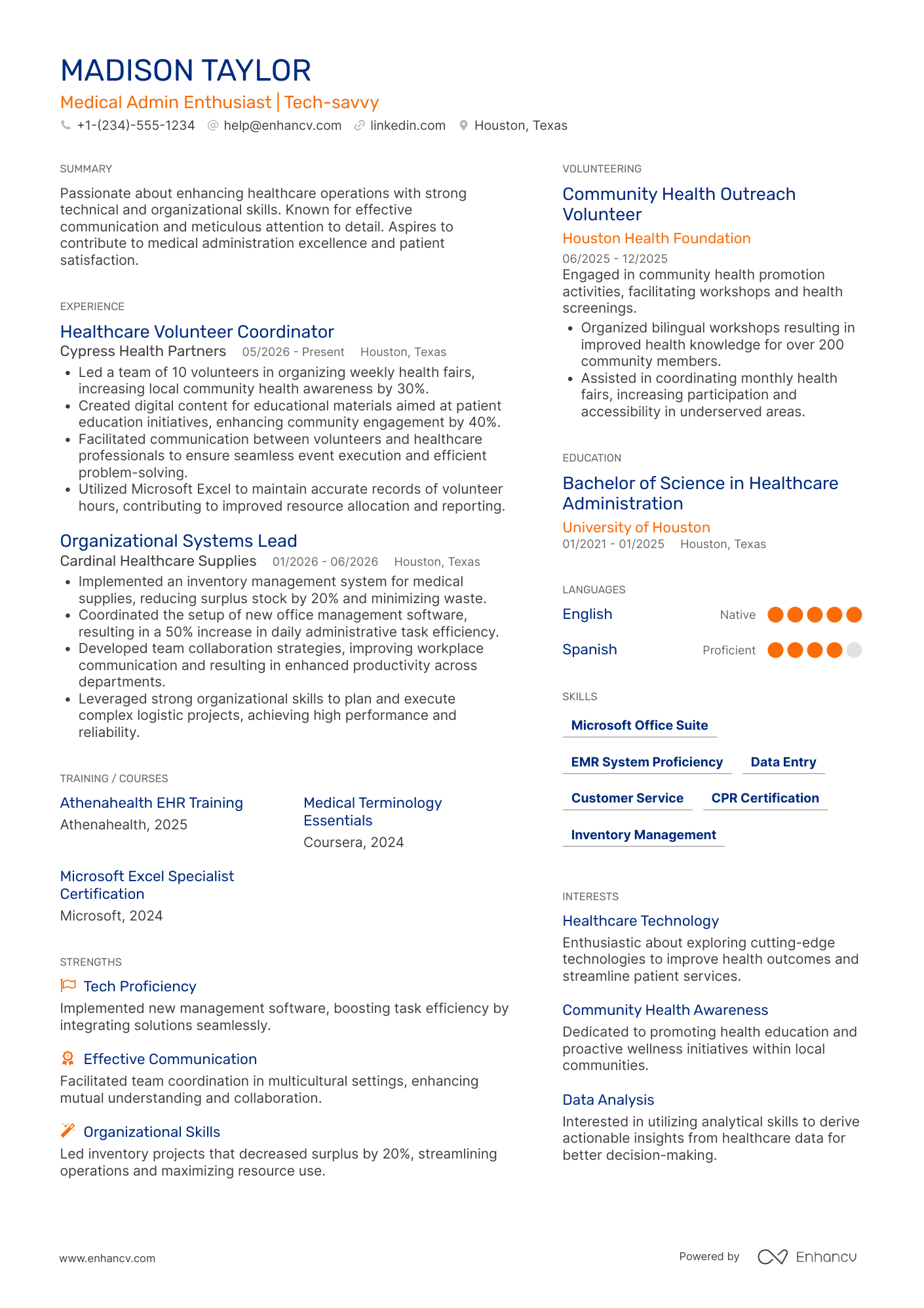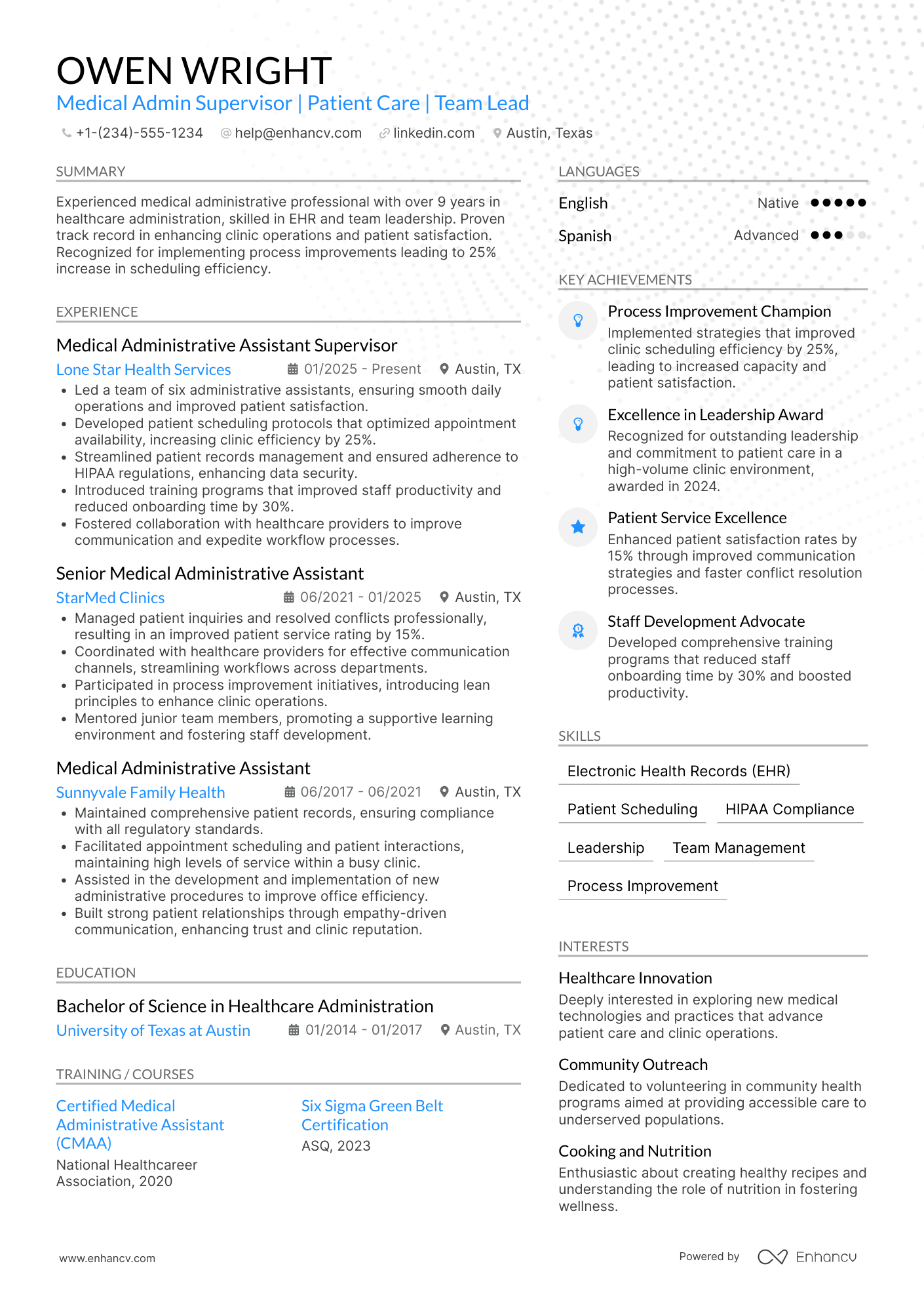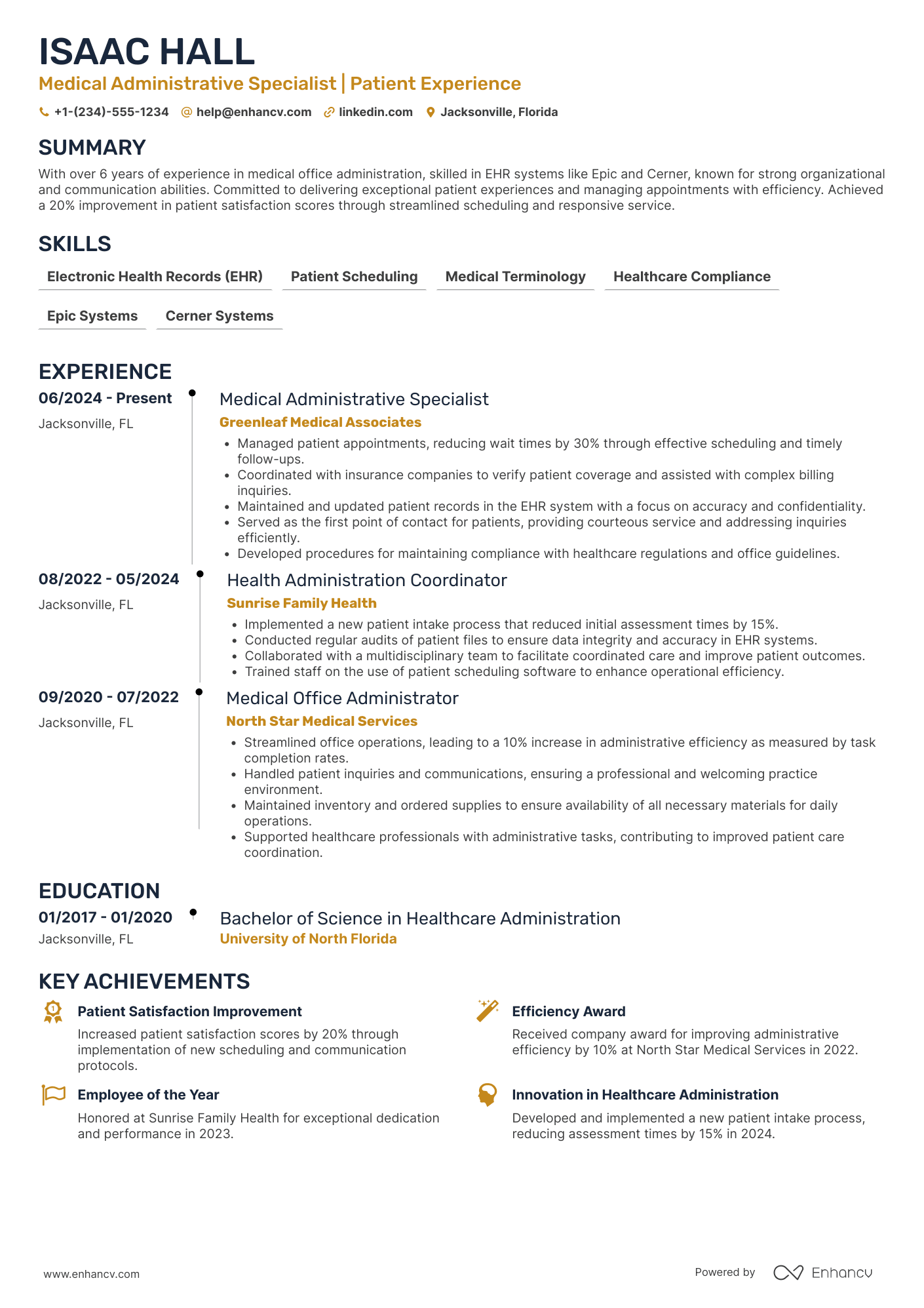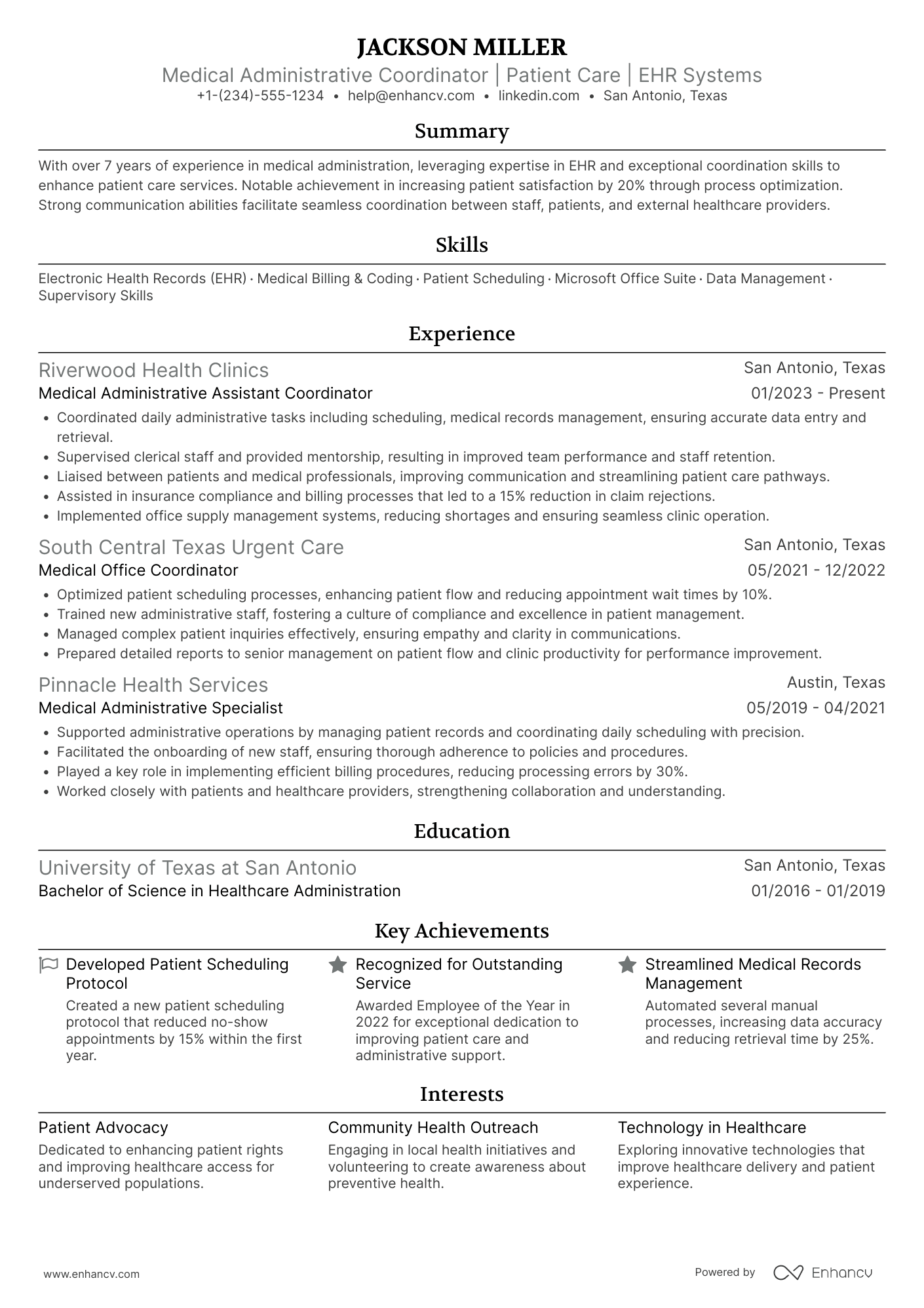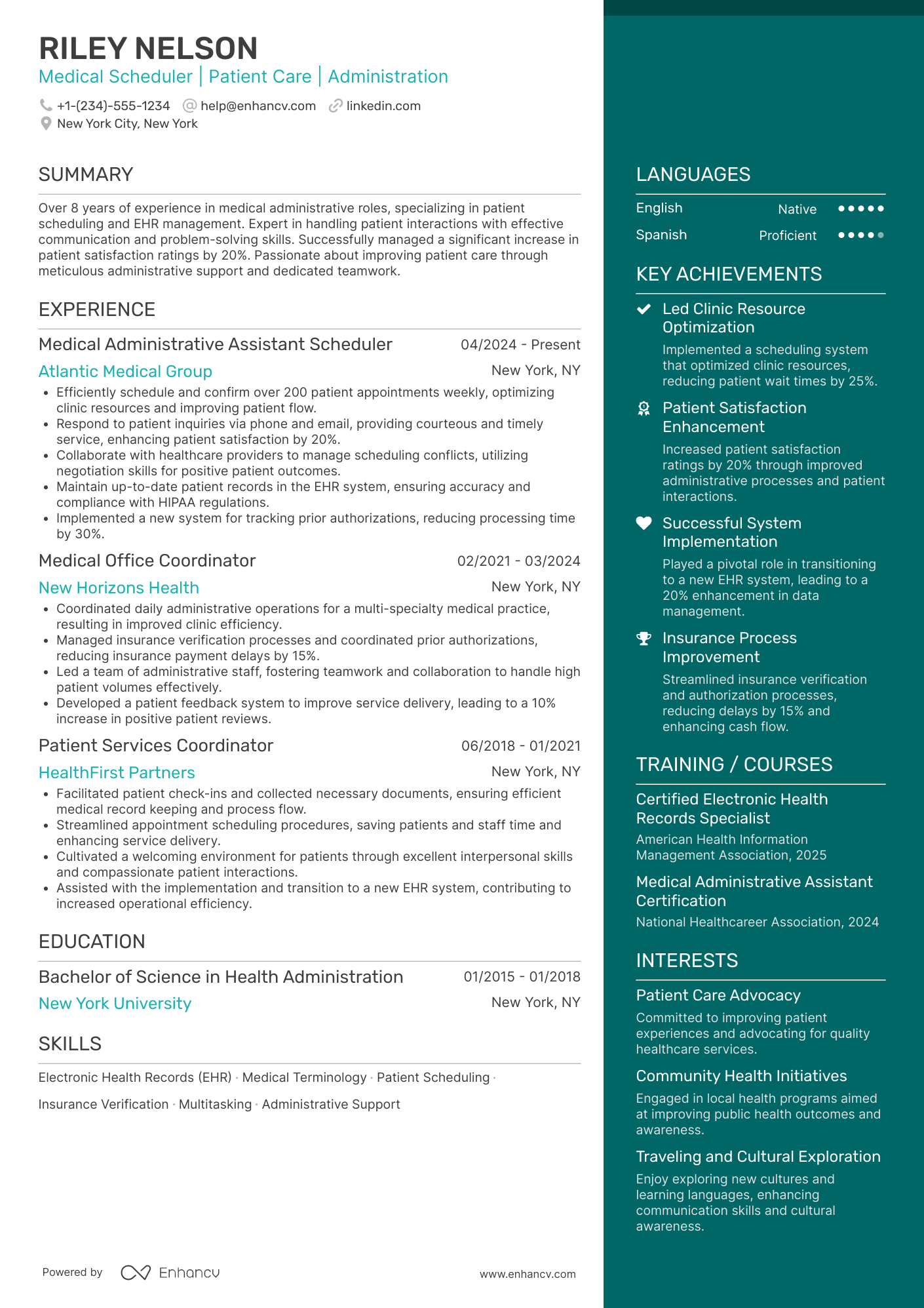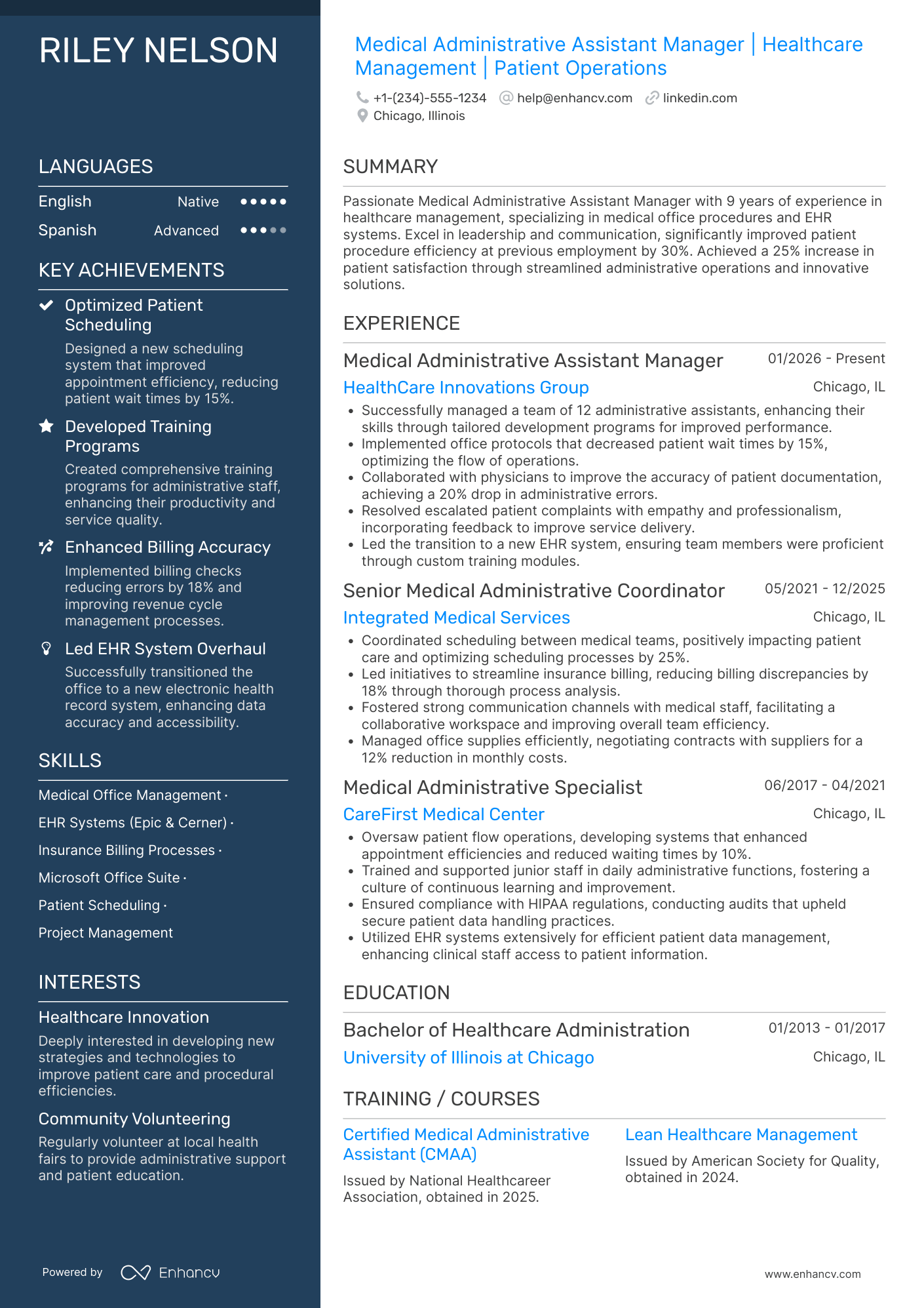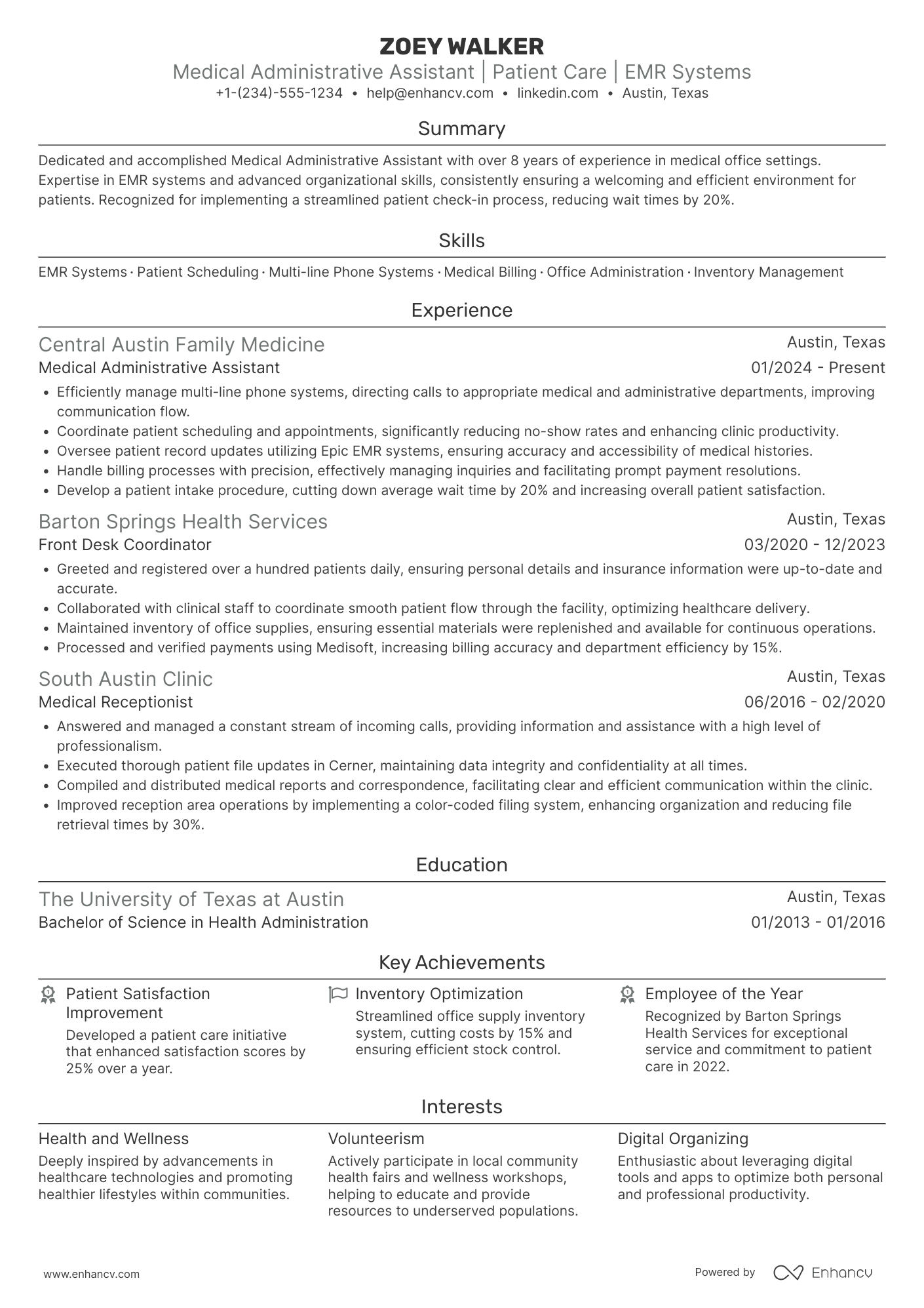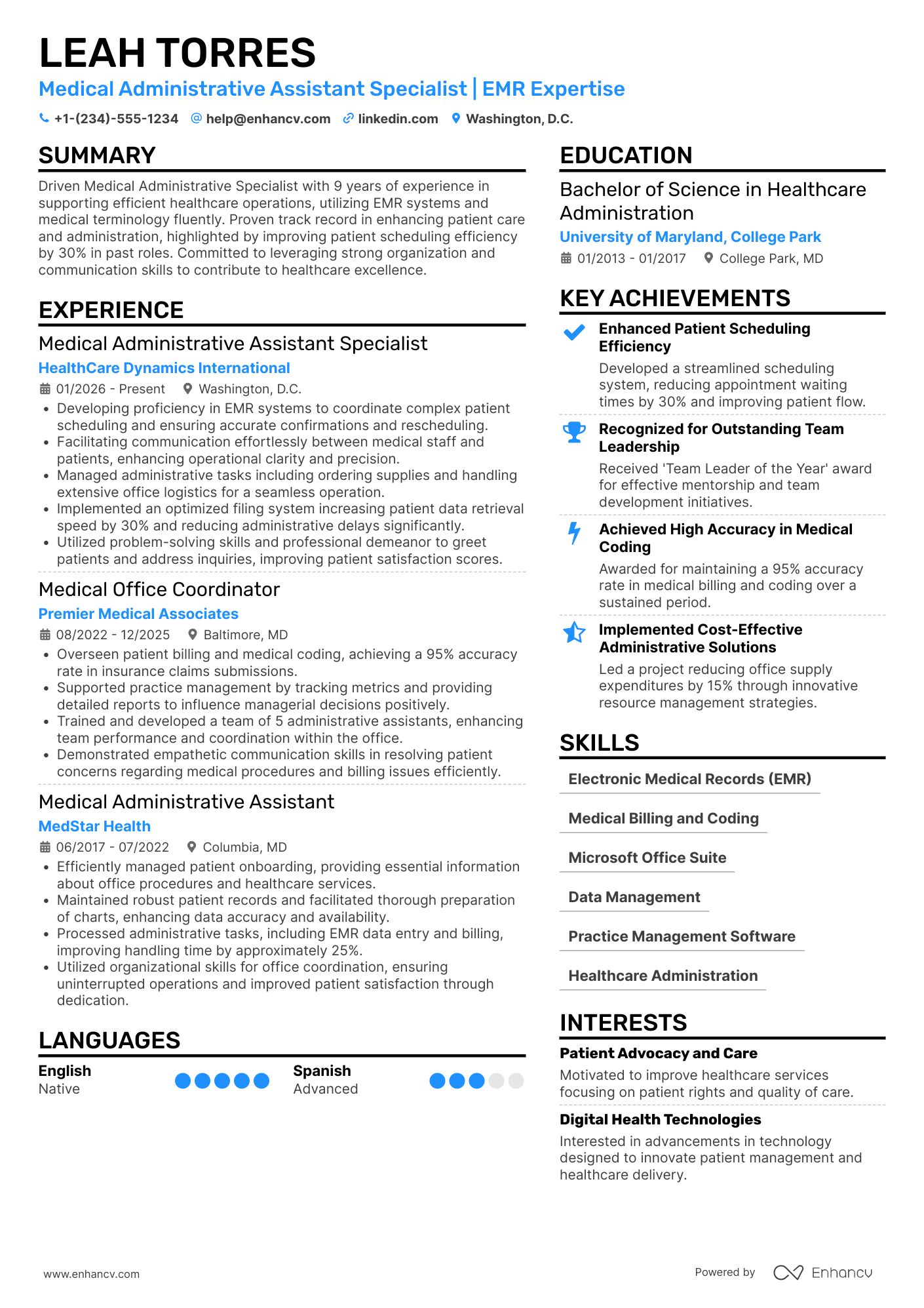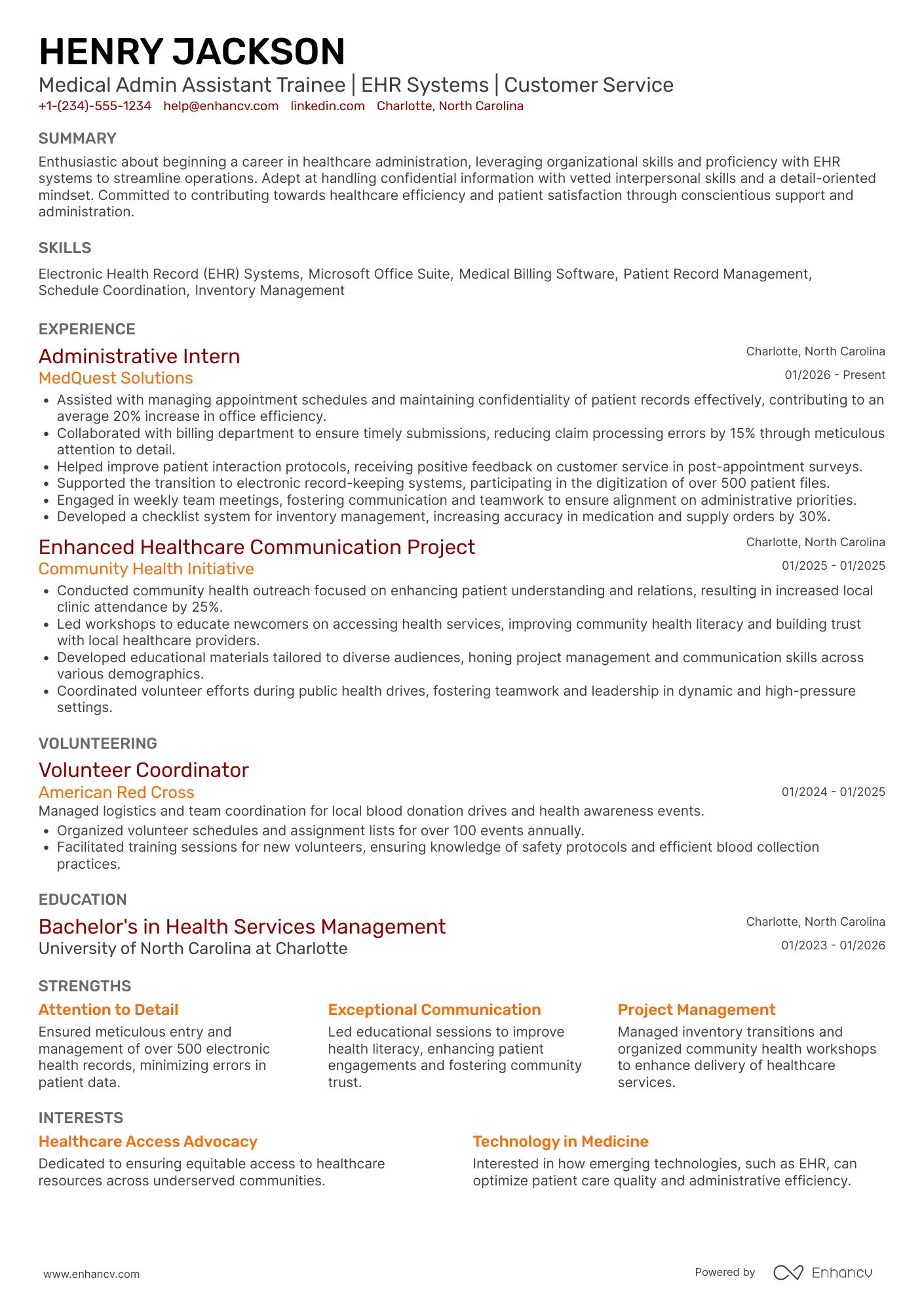
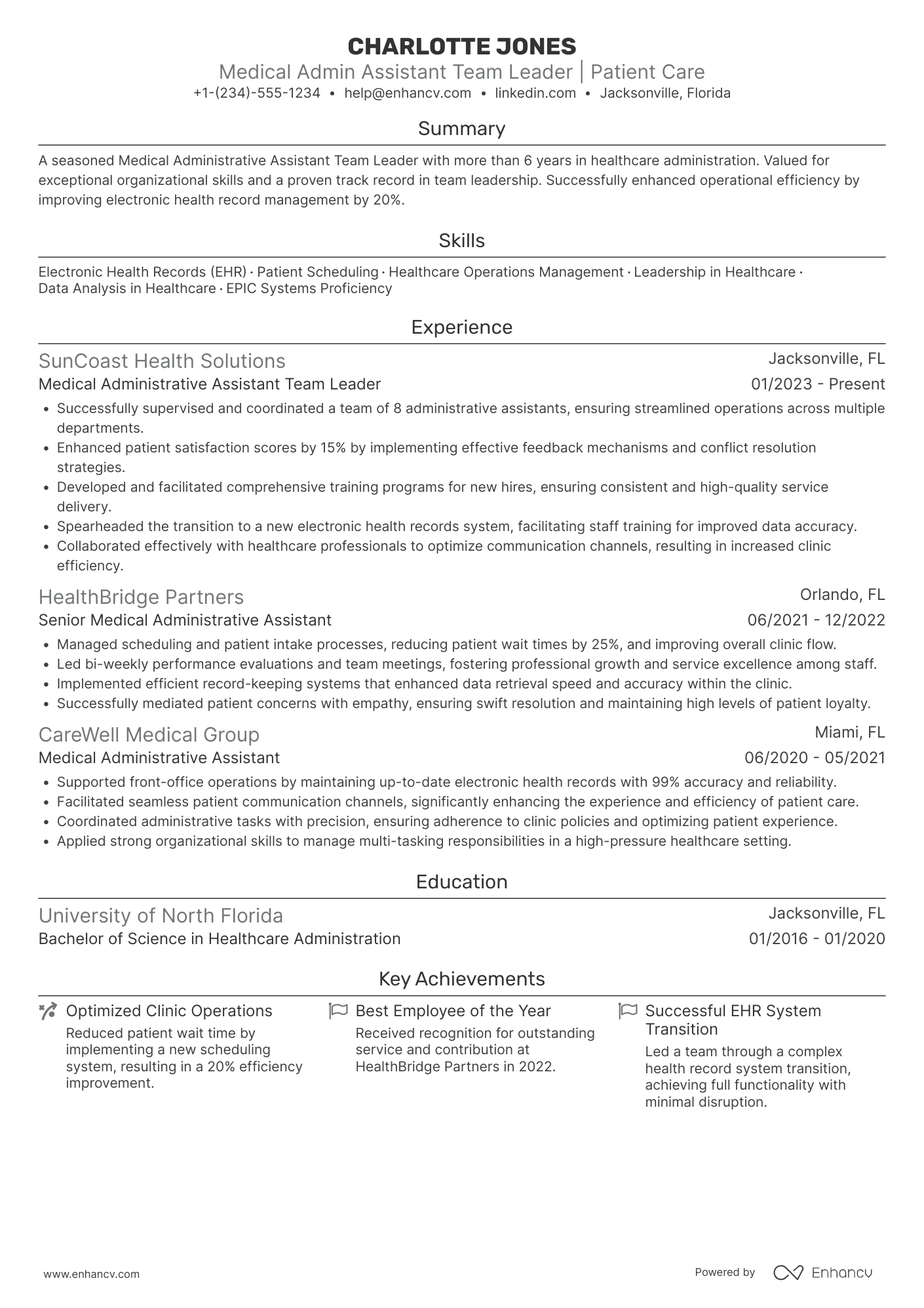
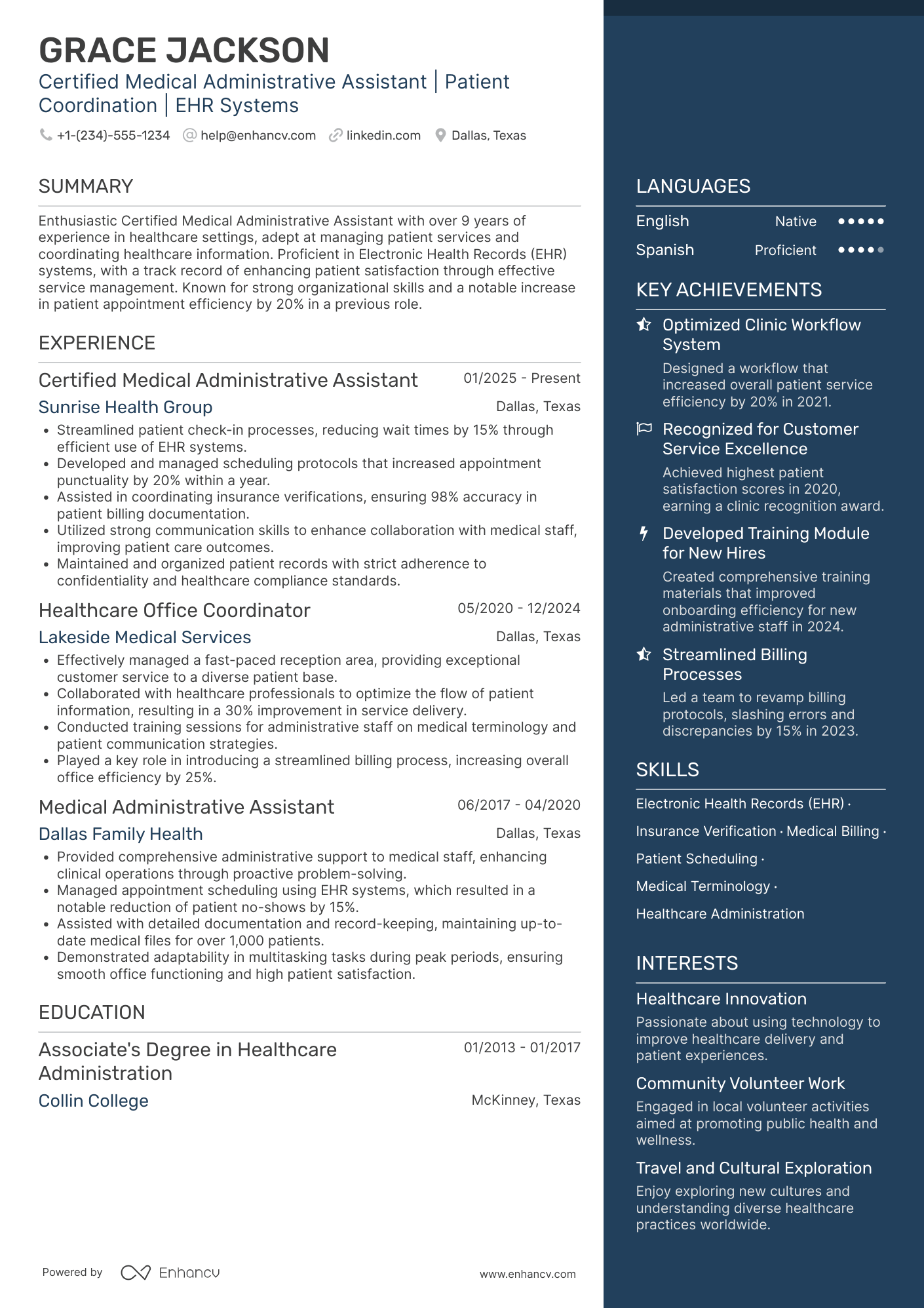
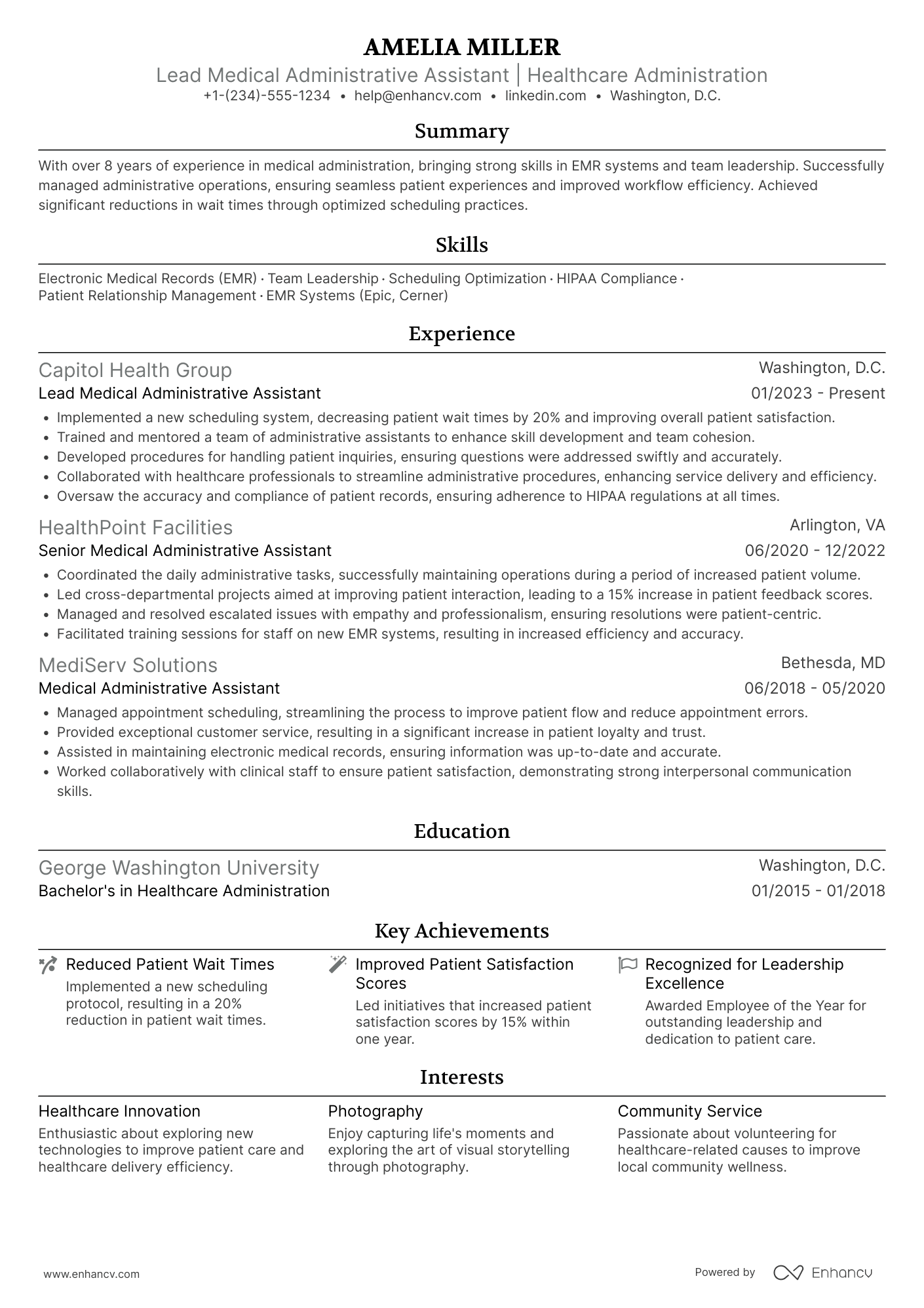
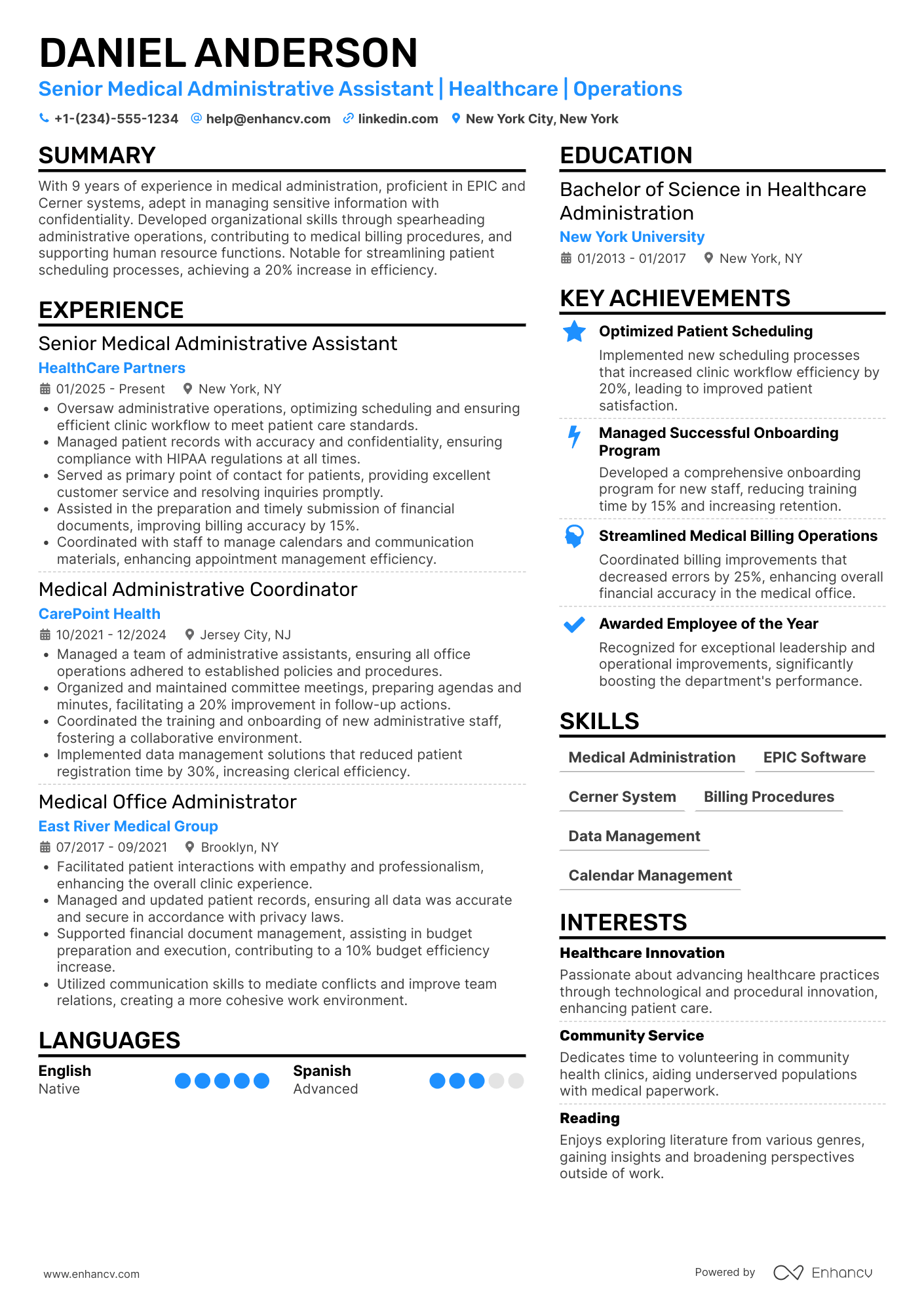
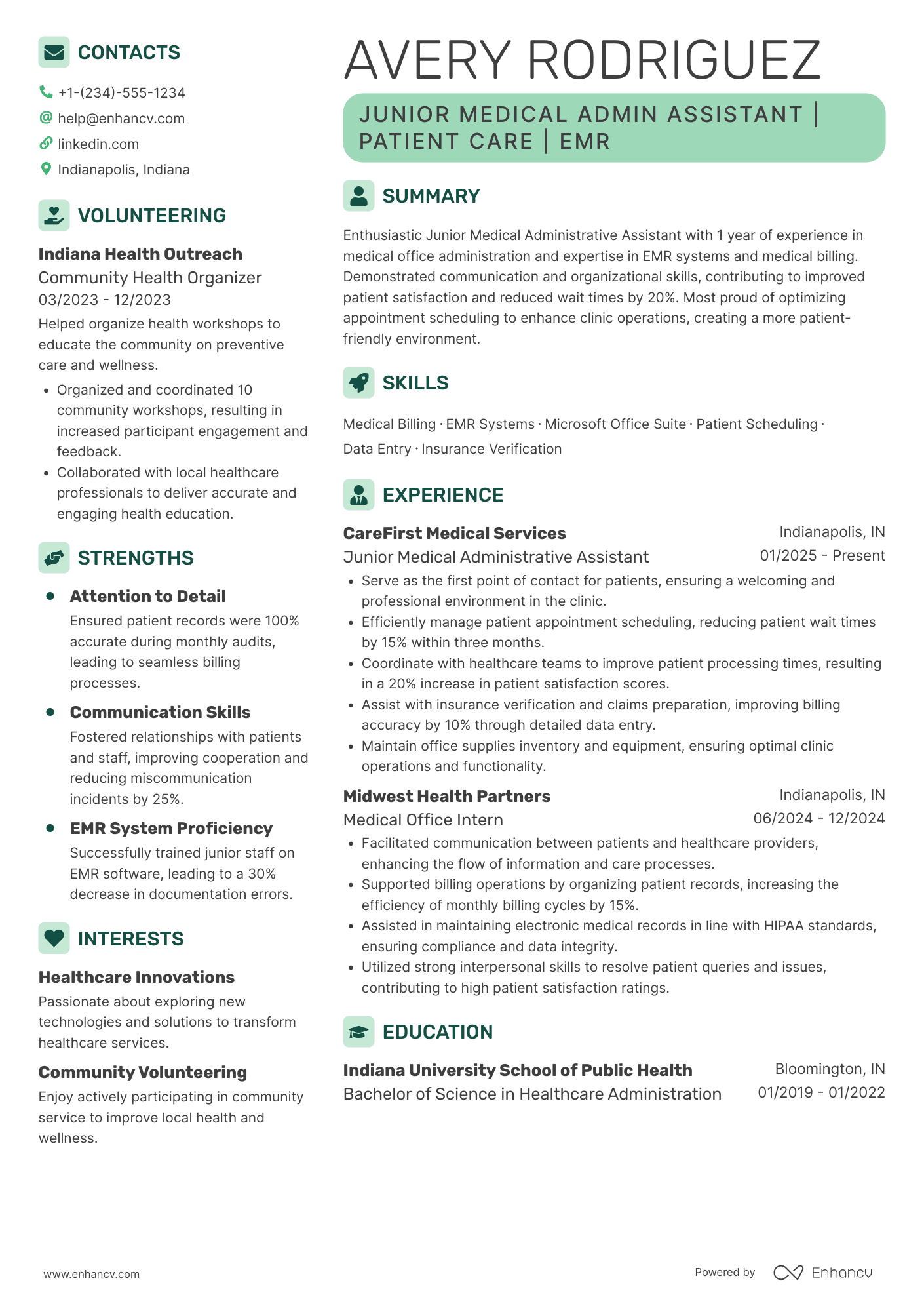
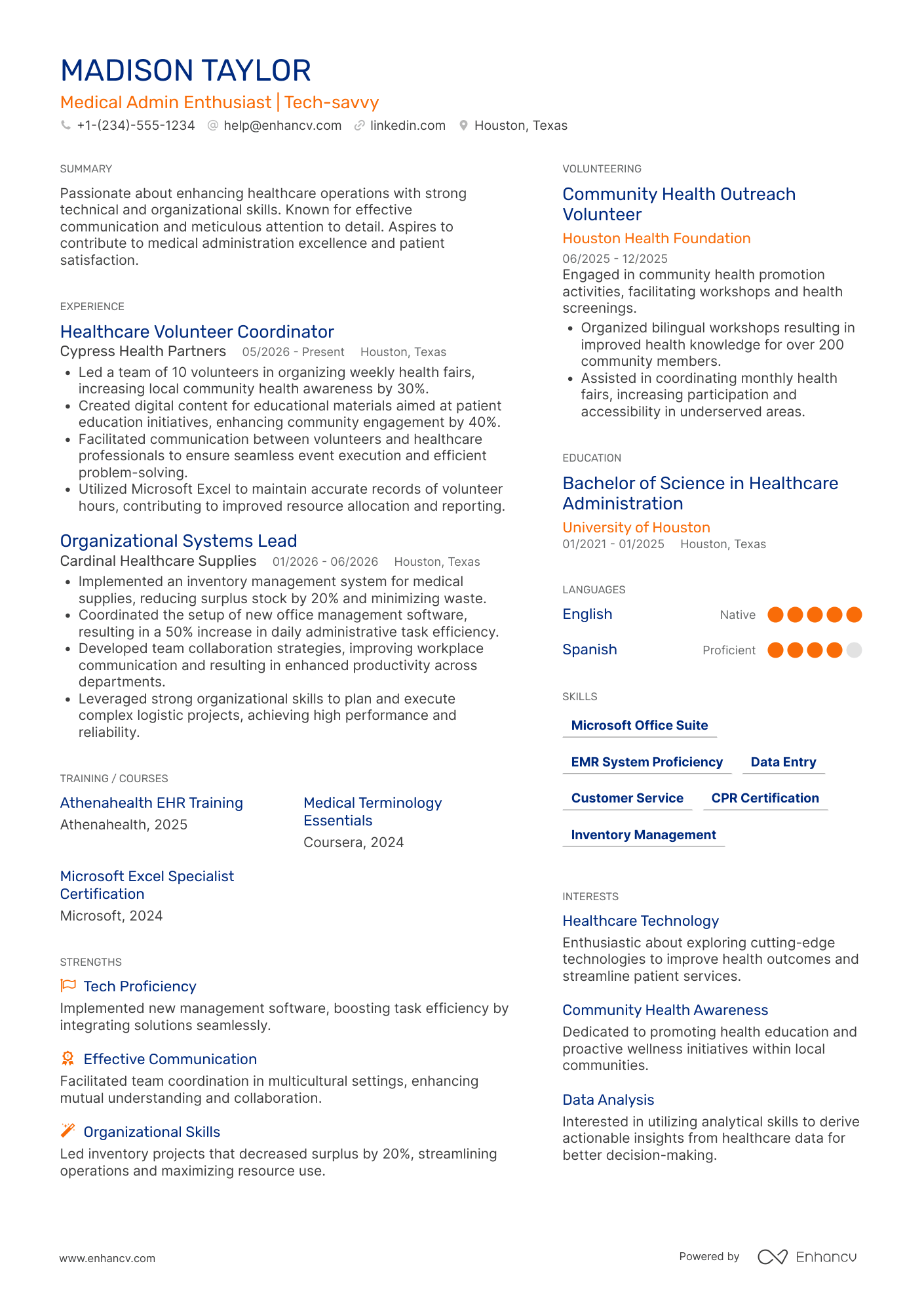
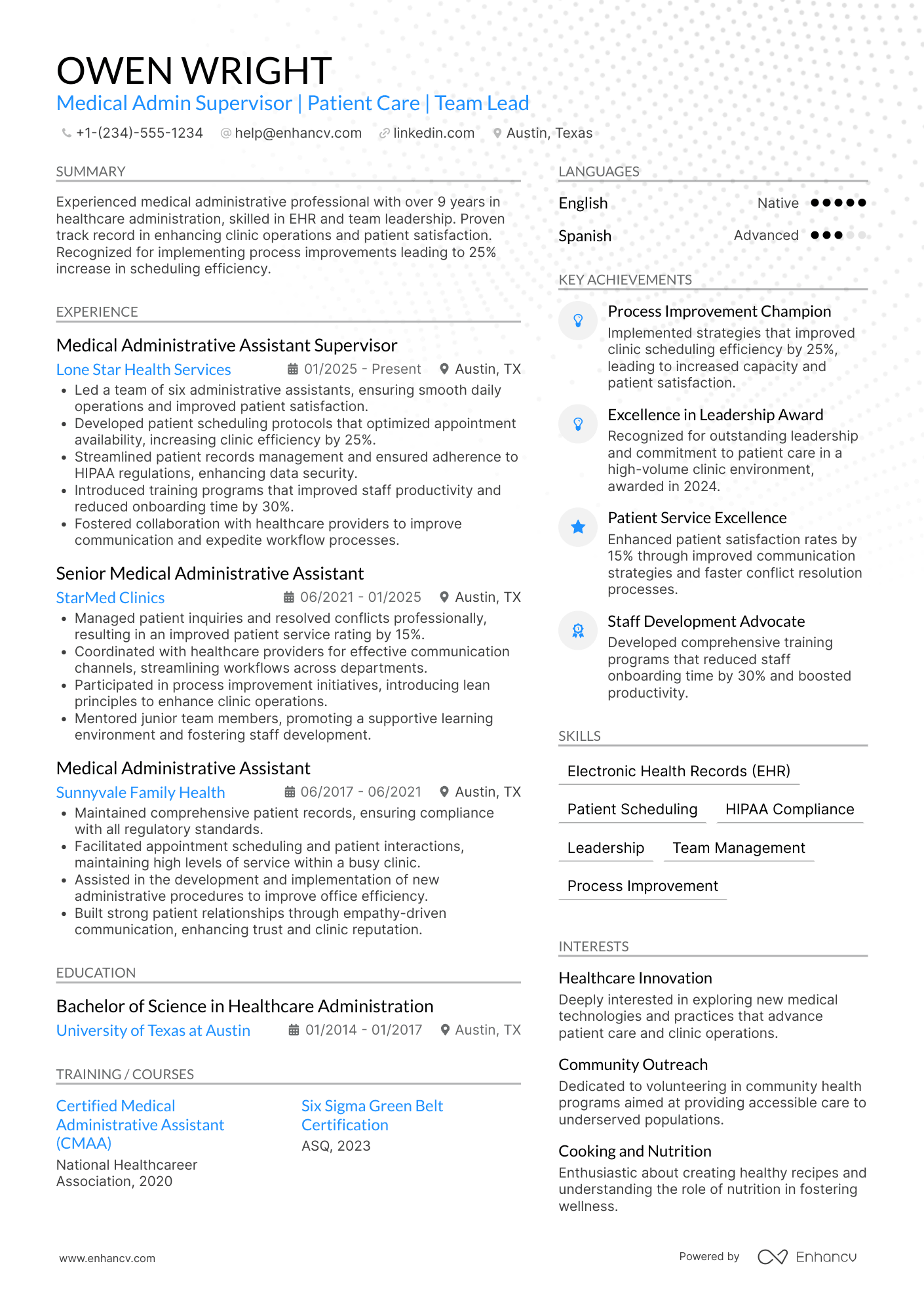
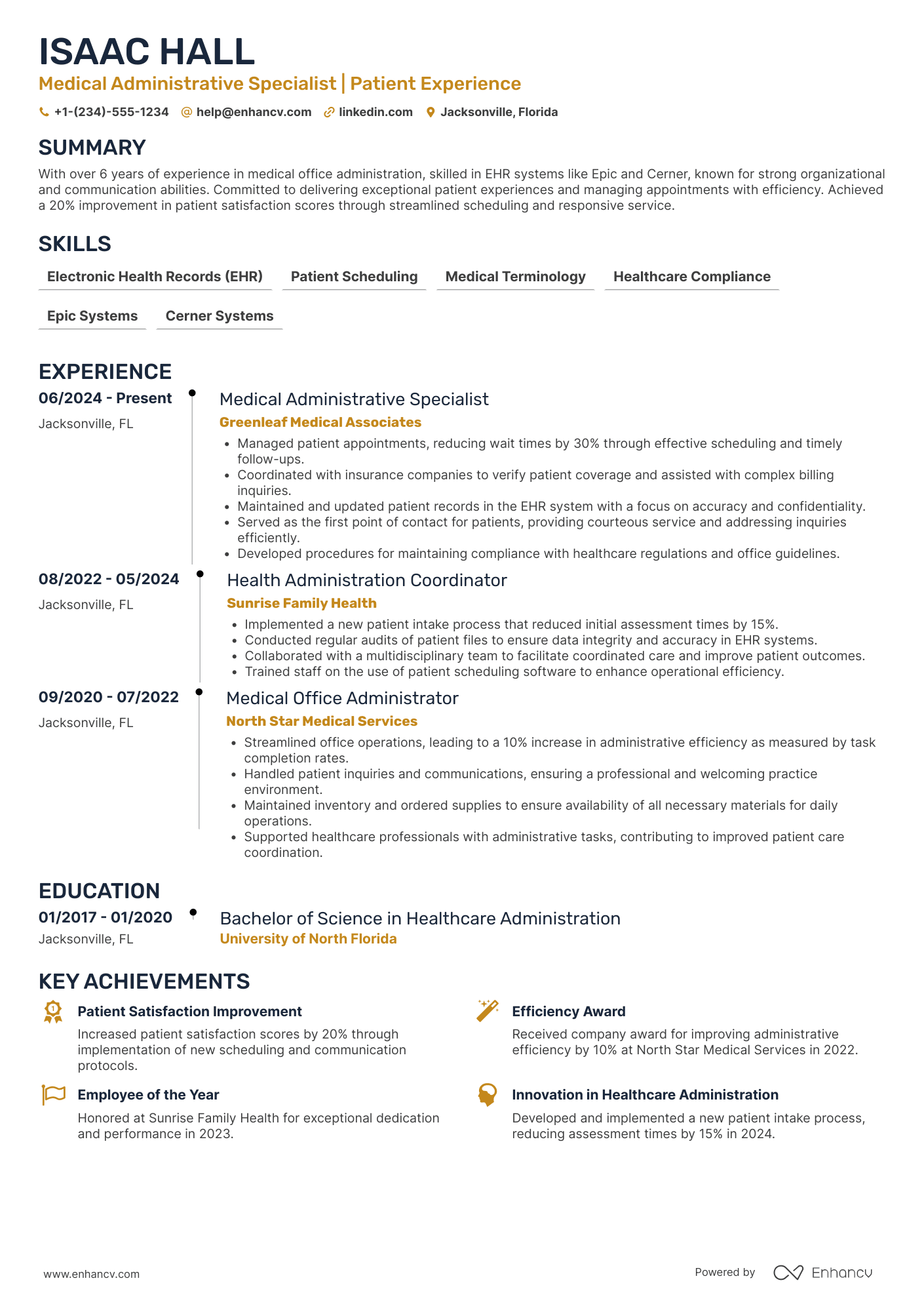
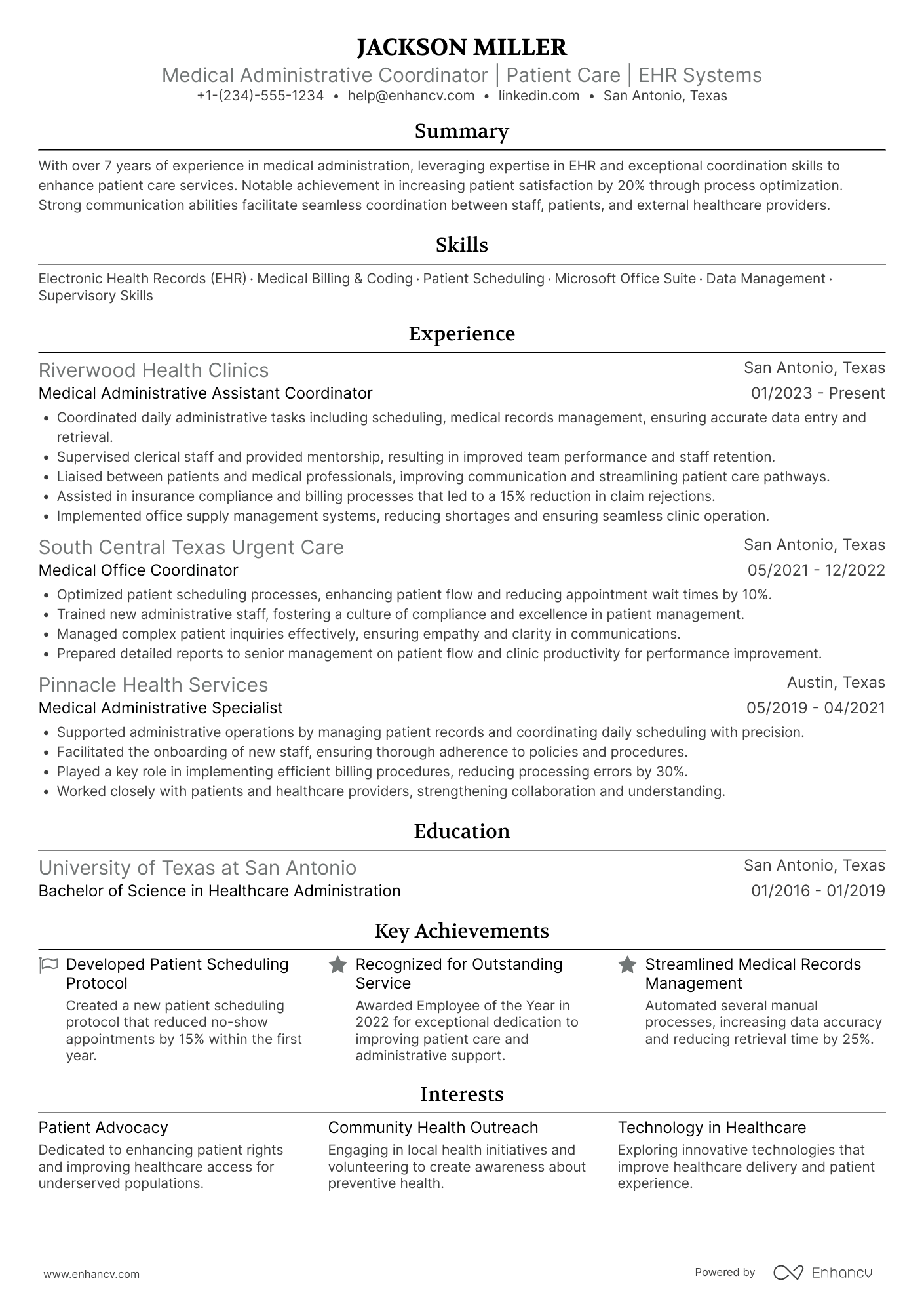
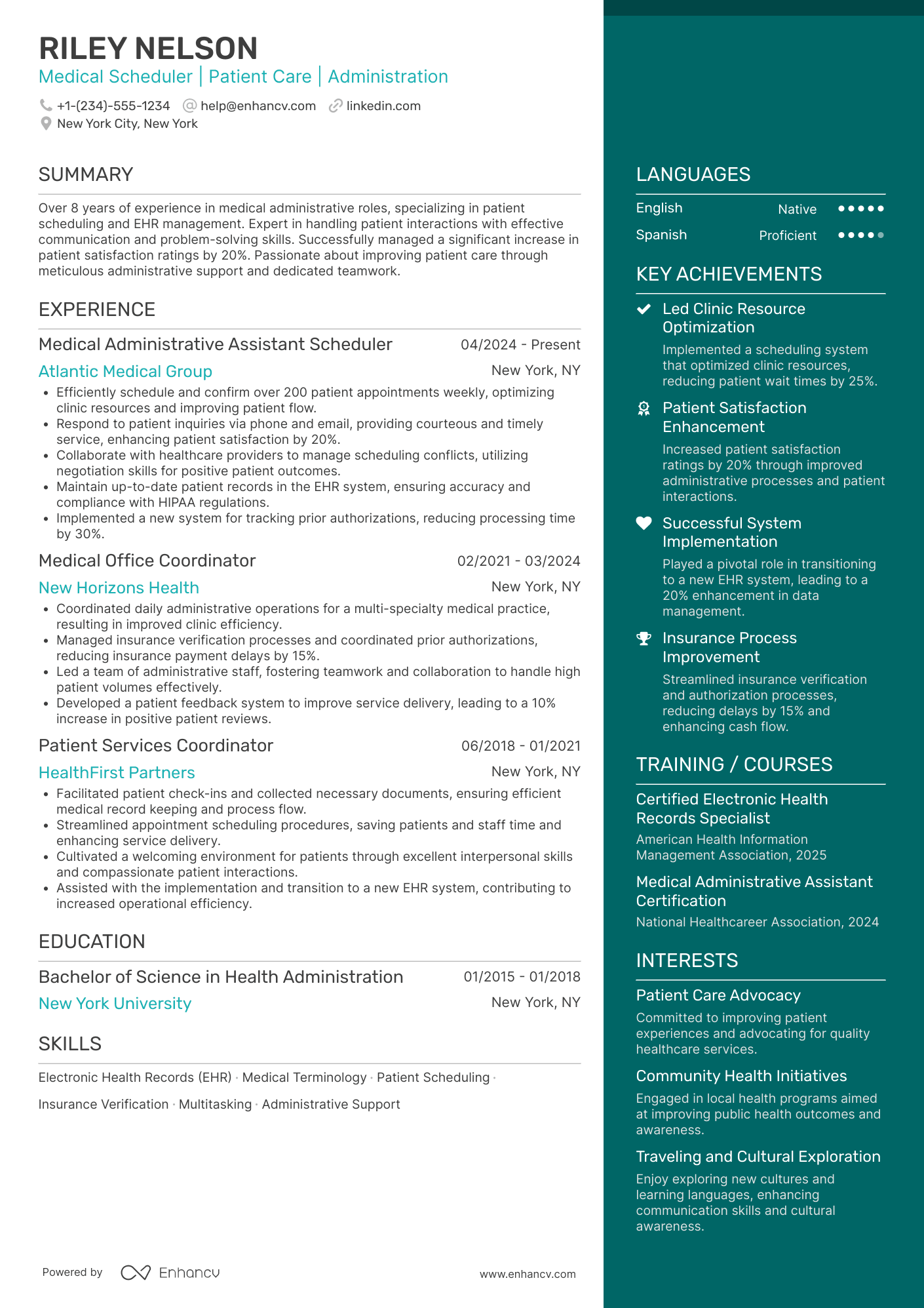
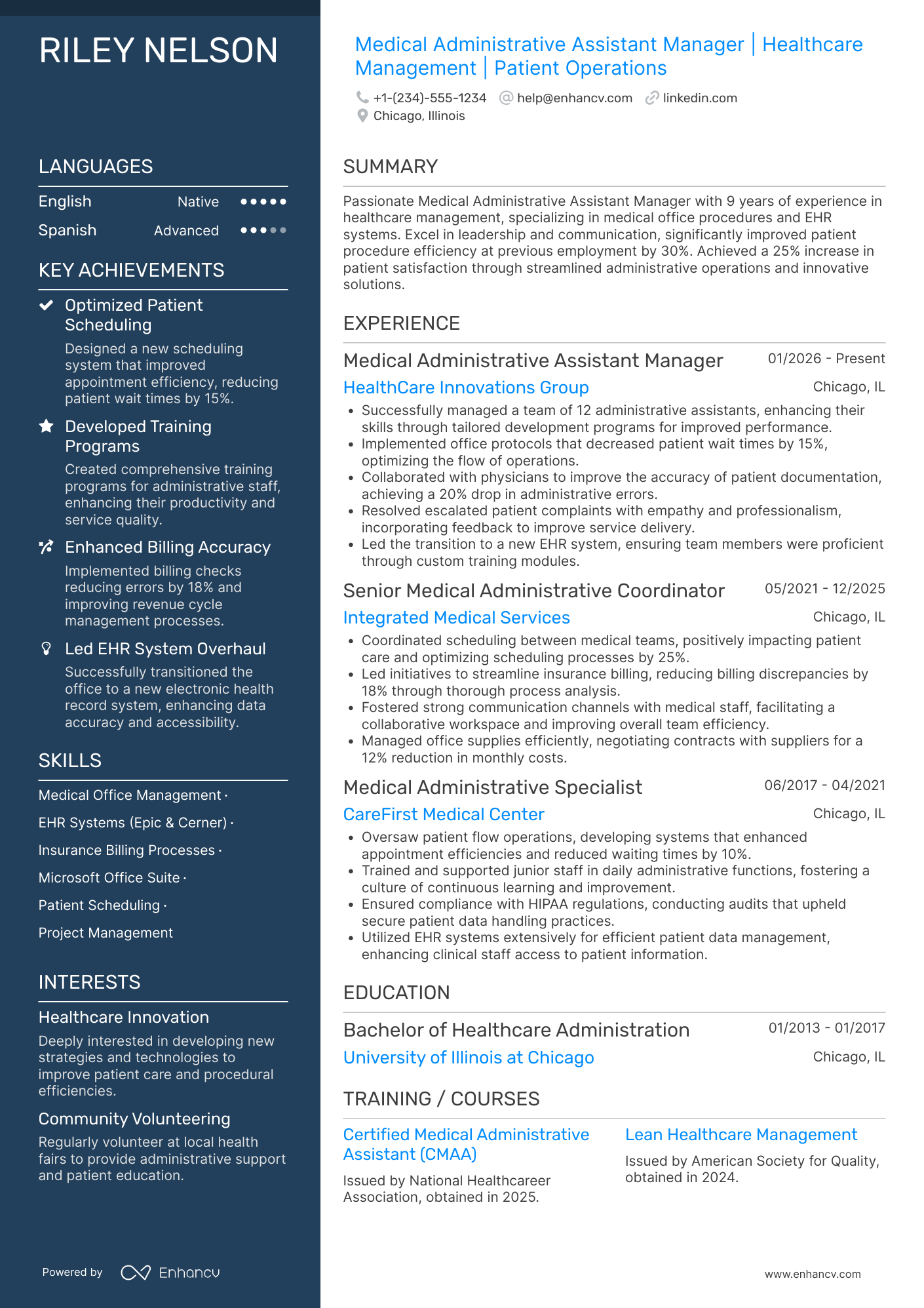
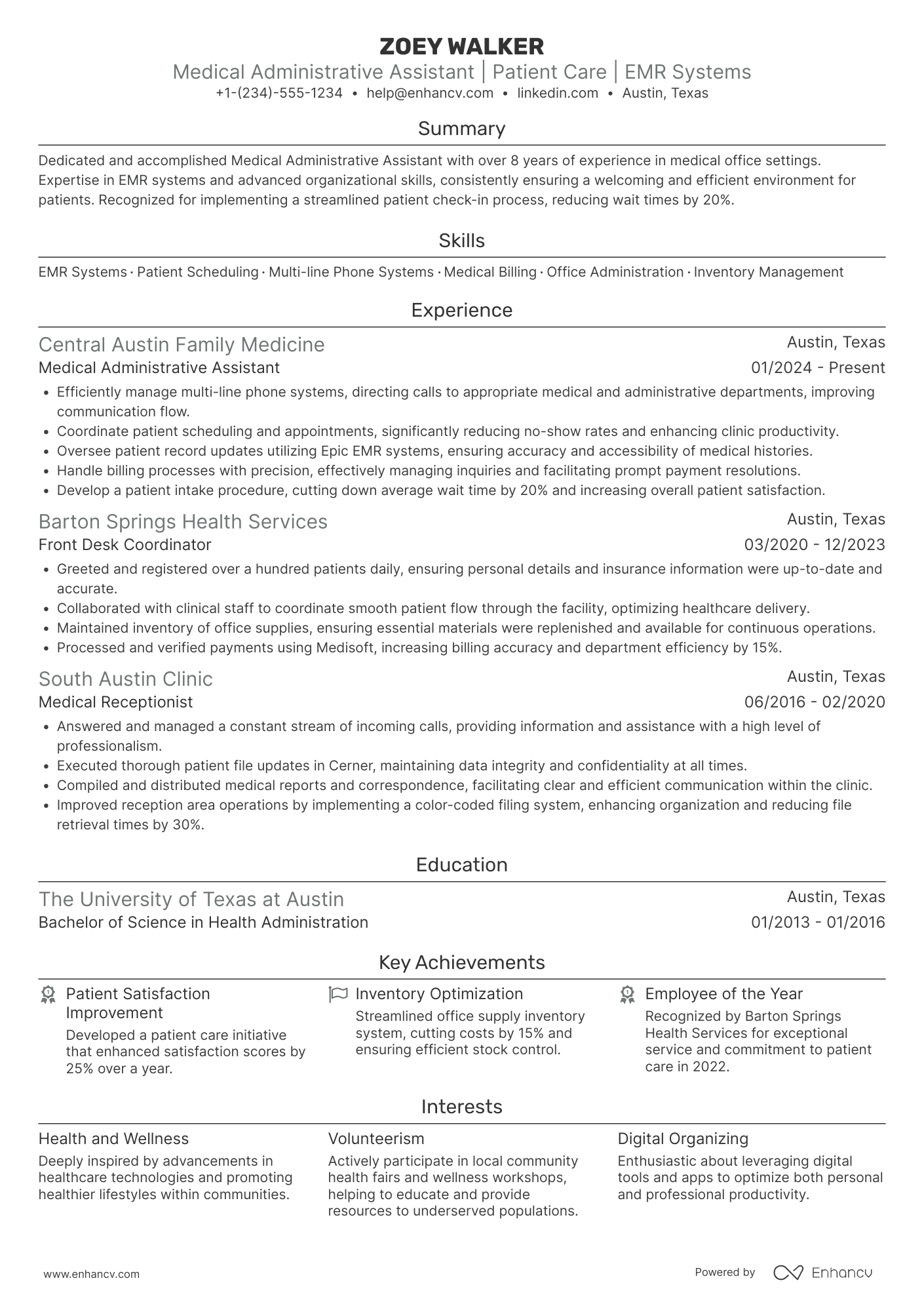
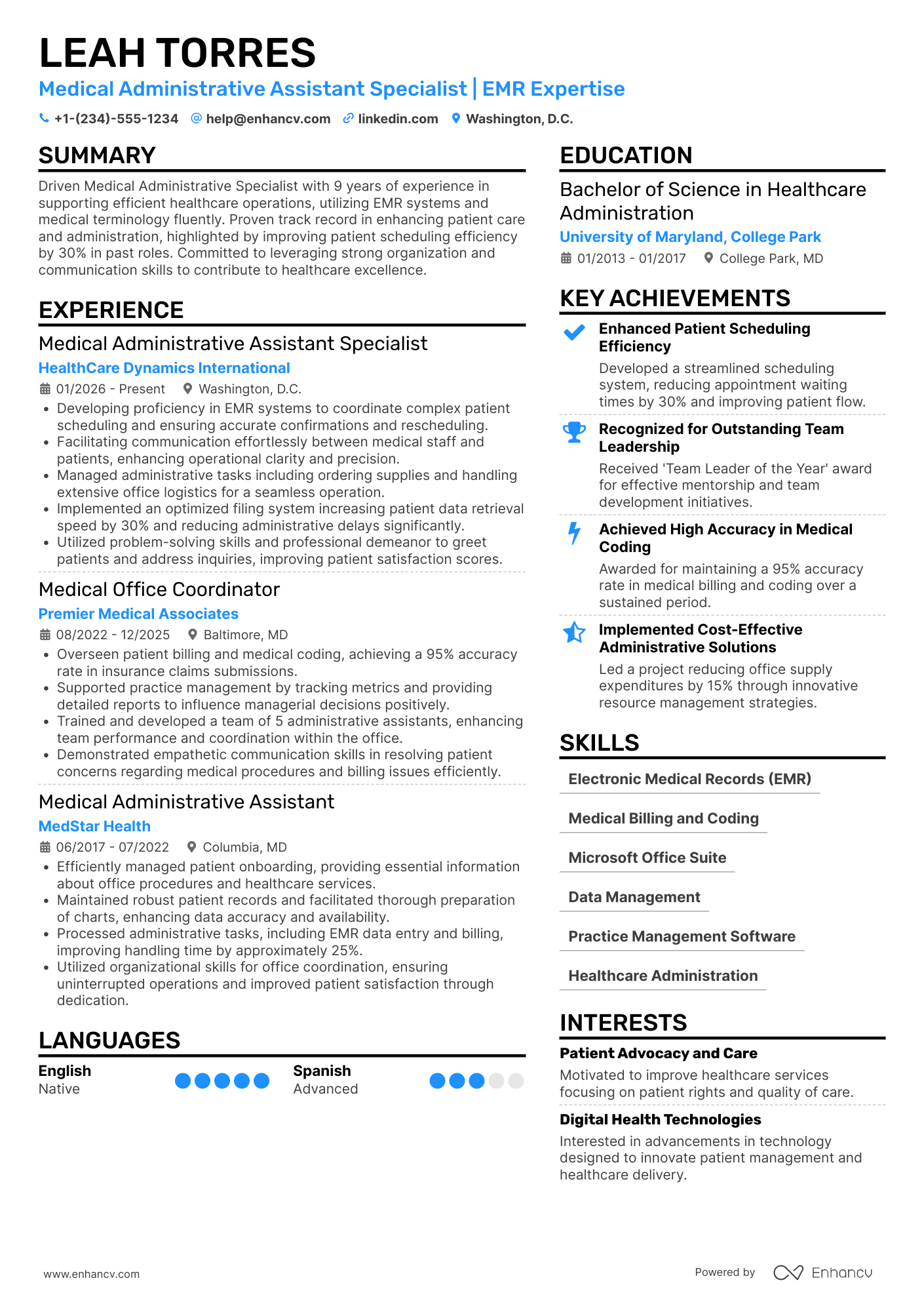
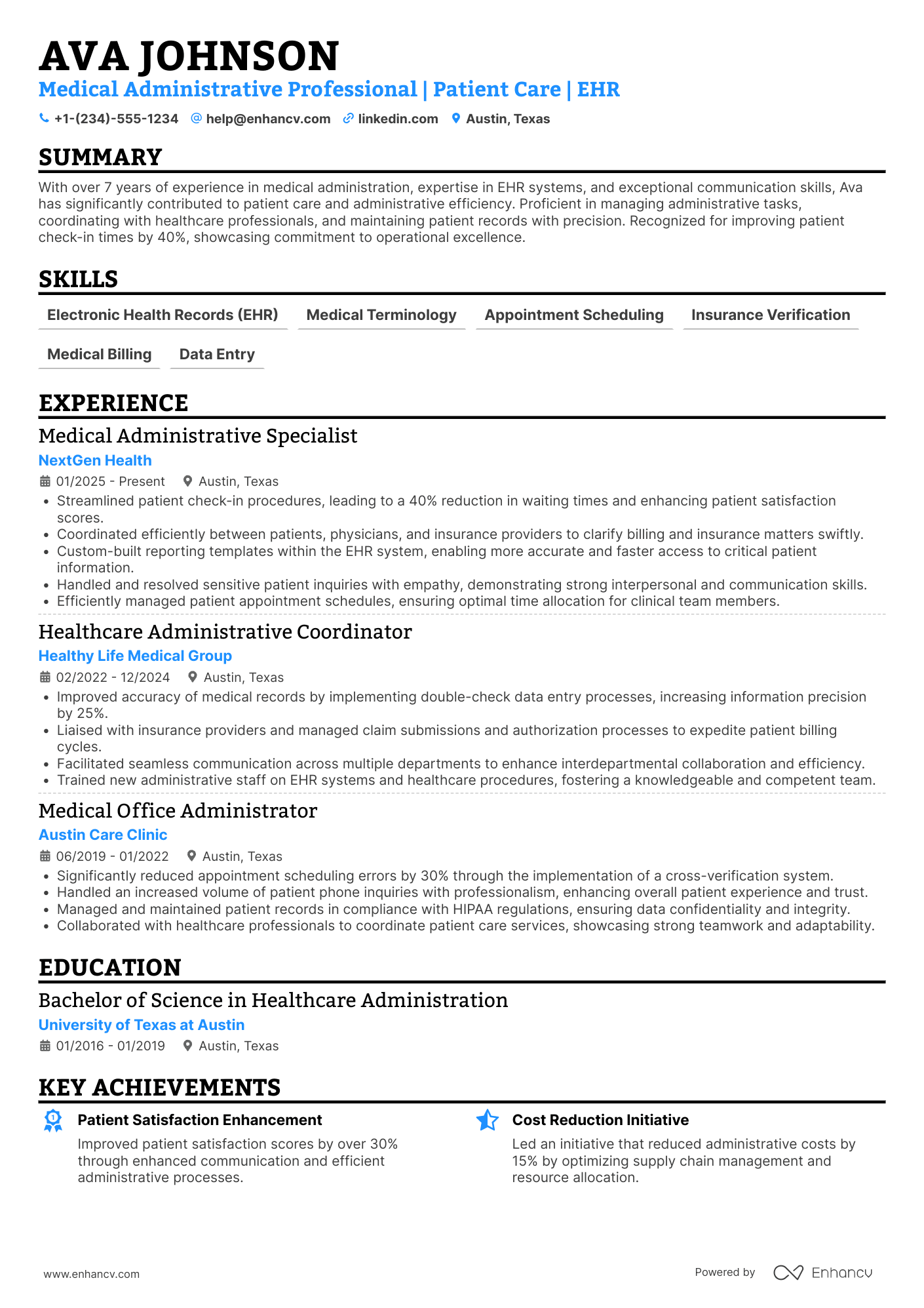
Many medical administrative assistant resume drafts fail because they read like task logs and bury results under generic summaries. That hurts when an ATS (applicant tracking system) filters fast and recruiters scan in seconds. If you're unsure where to begin, learning how to write a resume that highlights impact over duties is a critical first step.
A strong resume shows how you improved access, accuracy, and throughput. Highlight outcomes like reduced patient wait times, higher claim acceptance rates, fewer charting errors, faster prior authorizations, smoother referral coordination across providers, and higher patient satisfaction scores.

Key takeaways
- Quantify achievements like reduced wait times and claim denial rates instead of listing tasks.
- Use reverse-chronological format for experienced candidates and hybrid format for career changers.
- Tailor every experience bullet to match the specific job posting's keywords and priorities.
- Name exact EHR platforms, billing tools, and compliance protocols you've used.
- Place certifications above education when they're recent, role-relevant, or employer-required.
- Write a three- to four-line summary with your title, setting, tools, and one measurable win.
- Build your resume faster with Enhancv and turn daily responsibilities into recruiter-ready bullets.
How to format a medical administrative assistant resume
Recruiters hiring for medical administrative assistant roles prioritize organized presentation of relevant clinical office skills, familiarity with healthcare systems, and a clear record of administrative competence. Choosing the right resume format directly affects how quickly a hiring manager can identify these signals—and whether an applicant tracking system (ATS) can parse them correctly.

I have significant experience in this role—which format should I use?
Use a reverse-chronological format to highlight your depth of medical administrative experience and career growth across healthcare settings. Do:
- Lead each role entry with your scope of responsibility, such as patient volume managed, number of providers supported, or departments coordinated.
- Feature role-specific proficiencies like electronic health records (EHR) systems, medical billing and coding platforms, HIPAA compliance procedures, and insurance verification workflows.
- Quantify outcomes that reflect your direct impact on office efficiency, patient satisfaction, or revenue cycle accuracy.
I'm junior or switching into this role—what format works best?
A hybrid format works best, allowing you to lead with a targeted skills section while still showing your work history in chronological order. Do:
- Place a dedicated skills section near the top featuring healthcare-specific competencies like medical terminology, EHR software (e.g., Epic, Athenahealth), appointment scheduling, and HIPAA compliance.
- Include internships, clinical externships, volunteer work in healthcare settings, or relevant coursework that demonstrates hands-on exposure to medical office environments.
- Connect every listed skill or experience to a concrete action and a measurable or observable result.
Why not use a functional resume?
A functional format strips away the timeline context that hiring managers need to verify where and when you applied your medical administrative skills, making it harder for them to assess your readiness for a healthcare office environment.
- Career changers with transferable administrative skills: If you have strong experience in general office administration, customer service, or data entry but no direct healthcare background, a functional format can help foreground transferable competencies like scheduling, records management, and compliance awareness while you build clinical office experience.
- Recent graduates of medical office administration programs: If your work history is limited but you've completed a certified program with practicum hours, a functional format lets you organize skills learned during training—such as medical coding, EHR navigation, and patient communication—ahead of a thin employment section.
Once you've established a clean, readable format, the next step is deciding which sections to include and how to arrange them for maximum impact.
What sections should go on a medical administrative assistant resume
Recruiters expect a clean, healthcare-focused resume that quickly shows your administrative impact, patient-facing support, and compliance awareness. Knowing what to put on a resume for this role helps you prioritize the right details. Use this structure for maximum clarity:
- Header
- Summary
- Experience
- Skills
- Projects
- Education
- Certifications
- Optional sections: Languages, Volunteering, Leadership
Strong experience bullets should emphasize measurable outcomes, patient volume supported, process improvements, accuracy, and compliance-related results.
Is your resume good enough?
Drop your resume here or choose a file. PDF & DOCX only. Max 2MB file size.
Once you’ve organized your resume with the right components in place, the next step is learning how to write your medical administrative assistant resume experience so it supports each section with clear, role-relevant impact.
How to write your medical administrative assistant resume experience
The work experience section is where you prove you've delivered real results in medical office environments—managing patient scheduling systems, handling insurance verification workflows, and maintaining electronic health records with accuracy. Hiring managers prioritize demonstrated impact over descriptive task lists, so every bullet should connect what you did to a measurable outcome that mattered to the practice or facility.
Each entry should include:
- Job title
- Company and location (or remote)
- Dates of employment (month and year)
Three to five concise bullet points showing what you owned, how you executed, and what outcomes you delivered:
- Ownership scope: the specific medical office functions, patient populations, scheduling systems, or administrative workflows you were directly accountable for managing and maintaining.
- Execution approach: the EHR platforms, practice management software, billing tools, HIPAA compliance protocols, or verification methods you used to complete your work and make operational decisions.
- Value improved: the changes you drove in appointment accuracy, claim processing speed, patient wait times, record-keeping quality, billing error reduction, or regulatory compliance across the practice.
- Collaboration context: how you coordinated with physicians, nursing staff, insurance representatives, patients, or external vendors to keep administrative operations running without disruption.
- Impact delivered: the outcomes your work produced—expressed through patient volume handled, revenue cycle improvements, error reduction, or operational efficiency gains rather than a simple list of daily tasks.
Experience bullet formula
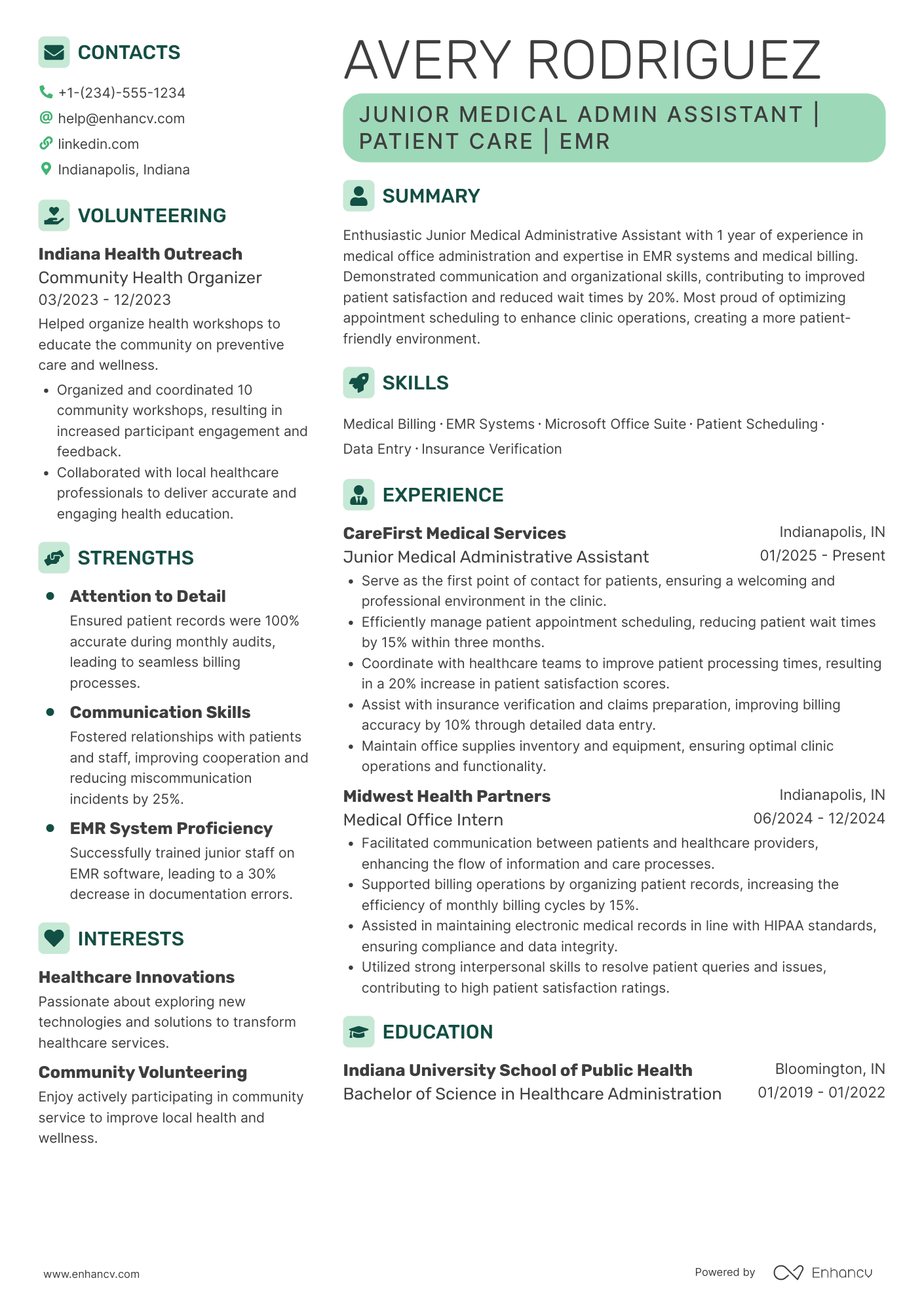
A medical administrative assistant experience example
✅ Right example - modern, quantified, specific.
Medical Administrative Assistant
Riverside Family Health | Columbus, OH
2022–Present
High-volume primary care clinic supporting twelve providers across family medicine and pediatrics.
- Streamlined check-in and registration using Epic and eClinicalWorks, cutting average wait time from twelve to eight minutes and improving patient satisfaction scores by 11%.
- Coordinated provider calendars in Outlook and Epic Cadence, reducing scheduling errors by 32% and increasing appointment fill rate by 9% through proactive waitlist management.
- Verified eligibility and obtained prior authorizations via Availity and payer portals, decreasing claim denials by 18% and accelerating time-to-approval by two days on average.
- Reconciled daily payments and copays in Clover and Epic, balancing within 0.2% variance and reducing end-of-day closeout time by twenty minutes through standardized audit steps.
- Partnered with nurses, providers, and billing to standardize intake forms in Microsoft Forms and Adobe Acrobat, lowering incomplete documentation rates by 27% and reducing follow-up calls by 15% per week.
Now that you've seen what a strong experience section looks like, let's break down how to customize yours for each specific job posting.
How to tailor your medical administrative assistant resume experience
Recruiters evaluate your medical administrative assistant resume through both human review and applicant tracking systems (ATS). Tailoring your resume to the job description increases your chances of passing both screenings.
Ways to tailor your medical administrative assistant experience:
- Match EHR platforms like Epic or Meditech named in the posting.
- Mirror the exact medical terminology used in the job description.
- Reflect patient volume or scheduling capacity metrics the employer references.
- Highlight HIPAA compliance experience when the posting emphasizes regulatory standards.
- Include insurance verification or prior authorization processes the role requires.
- Emphasize coordination with clinical staff if the posting mentions team collaboration.
- Reference medical coding or billing systems listed in the qualifications section.
- Align your quality assurance experience with accuracy standards the employer prioritizes.
Tailoring means aligning your real accomplishments with each job's specific requirements—not forcing keywords where they don't belong.
Resume tailoring examples for medical administrative assistant
| Job description excerpt | Untailored | Tailored |
|---|---|---|
| "Schedule and confirm patient appointments using Epic EHR, manage provider calendars, and coordinate referrals across departments." | Handled scheduling and other office duties as needed. | Scheduled and confirmed 80+ daily patient appointments in Epic EHR, managed calendars for five providers, and coordinated interdepartmental referrals to reduce scheduling conflicts by 30%. |
| "Verify patient insurance eligibility, process prior authorizations, and ensure accurate coding of medical claims using ICD-10 and CPT codes." | Assisted with insurance paperwork and billing tasks. | Verified insurance eligibility for 50+ patients per day, processed prior authorizations within 24 hours, and ensured accurate ICD-10 and CPT coding that reduced claim denials by 18%. |
| "Greet patients, maintain HIPAA-compliant medical records, and support daily front-desk operations including check-in/check-out workflows." | Worked at the front desk and helped with patient records. | Managed check-in and check-out workflows for a 12-provider clinic, maintained HIPAA-compliant electronic medical records, and improved front-desk patient wait times by 15% through a streamlined intake process. |
Once you’ve aligned your experience with the role’s priorities, the next step is to quantify your medical administrative assistant achievements so employers can see the impact of your work.
How to quantify your medical administrative assistant achievements
Quantifying achievements shows how you improved patient flow, billing accuracy, and compliance. Focus on appointment volume, wait time, claim acceptance, error rates, and patient satisfaction across phones, scheduling, electronic health records, and insurance workflows.
Quantifying examples for medical administrative assistant
| Metric | Example |
|---|---|
| Scheduling volume | "Scheduled and confirmed 65–80 patient appointments per day in Epic, cutting no-shows from 14% to 9% in three months." |
| Cycle time | "Reduced average check-in time from eight minutes to five by standardizing intake forms and pre-verifying insurance for next-day visits." |
| Billing accuracy | "Improved clean-claim rate from 91% to 96% by correcting ICD-10 and demographic errors before submission in Kareo." |
| Compliance risk | "Maintained 100% HIPAA compliance during 2 quarterly audits by tightening release-of-information logs and access controls for 12 staff members." |
| Patient satisfaction | "Raised front-desk patient satisfaction from 4.2 to 4.6 out of five by implementing call-back tracking and resolving 30+ weekly inquiries within one business day." |
Turn your everyday tasks into measurable, recruiter-ready resume bullets in seconds with Enhancv's Bullet Point Generator.
Once you've crafted strong bullet points for your experience section, the next step is ensuring your skills section highlights the right mix of hard and soft skills that medical employers prioritize.
How to list your hard and soft skills on a medical administrative assistant resume
Your skills section shows you can manage patient flow, protect data, and keep billing and scheduling accurate—recruiters and an ATS (applicant tracking system) scan this section to match keywords, so aim for a balanced mix of role-specific hard skills and job-proven soft skills. medical administrative assistant roles require a blend of:
- Product strategy and discovery skills.
- Data, analytics, and experimentation skills.
- Delivery, execution, and go-to-market discipline.
- Soft skills.
Your skills section should be:
- Scannable (bullet-style grouping).
- Relevant to the job post.
- Backed by proof in experience bullets.
- Updated with current tools.
Place your skills section:
- Above experience if you're junior or switching careers.
- Below experience if you're mid/senior with strong achievements.

Hard skills
- Electronic health records (EHR) systems
- Epic, Cerner, athenahealth
- Medical terminology, ICD-10, CPT
- Insurance verification, eligibility checks
- Prior authorizations, referrals
- Appointment scheduling, calendar management
- Patient registration, intake forms
- HIPAA compliance, PHI handling
- Claims submission, denial management
- Copay collection, payment posting
- Microsoft Excel, Microsoft Outlook
Soft skills
- Patient-centered communication
- De-escalation and complaint handling
- Triage and prioritization
- Cross-team coordination with clinical staff
- Clear handoffs and follow-ups
- Detail-driven documentation
- Confidentiality-first judgment
- Time blocking and workload management
- Process improvement mindset
- Ownership of front-desk workflows
- Accurate message taking and routing
How to show your medical administrative assistant skills in context
Skills shouldn't live only in a bulleted list on your resume. Browse examples of resume skills shown in context to see how other candidates weave competencies into their summaries and experience sections.
They should be demonstrated in:
- Your summary (high-level professional identity)
- Your experience (proof through outcomes)
Here's what that looks like in practice.
Summary example
Detail-oriented medical administrative assistant with eight years in multi-physician orthopedic practices. Skilled in Epic EHR, insurance verification, and HIPAA compliance. Streamlined patient intake workflows, reducing average check-in time by 35% while maintaining a 98% scheduling accuracy rate.
- Reflects senior-level experience clearly
- Names role-relevant tools like Epic
- Quantifies impact with specific metrics
- Highlights communication and organizational strengths
Experience example
Senior Medical Administrative Assistant
Lakeview Orthopedic Partners | Milwaukee, WI
March 2019–Present
- Managed scheduling for five orthopedic surgeons using Epic EHR, maintaining 97% appointment accuracy across 400+ weekly visits.
- Collaborated with billing staff and clinical teams to resolve insurance pre-authorization delays, cutting claim rejection rates by 22%.
- Trained four new front-desk hires on HIPAA-compliant intake procedures, reducing onboarding time from three weeks to ten days.
- Every bullet includes a measurable outcome
- Skills surface naturally through real tasks
Once you’ve demonstrated your abilities through real examples and outcomes, the next step is learning how to write a medical administrative assistant resume with no experience so you can apply that same approach using schoolwork, volunteer work, and transferable tasks.
How do I write a medical administrative assistant resume with no experience
Even without full-time experience, you can demonstrate readiness through:
- Externship in clinic front desk
- Medical office volunteer scheduling support
- Healthcare reception job shadowing hours
- HIPAA training and certificate
- School project on patient intake
- Customer service role handling phones
- Data entry work with accuracy metrics
- Appointment booking for community events
If you're starting out, our guide on building a resume without work experience walks you through how to leverage training, projects, and transferable skills effectively.
Focus on:
- HIPAA compliance and patient privacy
- Scheduling, phones, and triage notes
- Electronic health record data accuracy
- Insurance verification and copay handling
Resume format tip for entry-level medical administrative assistant
Use a skills-based resume format because it highlights relevant training, projects, and tools when your work history is limited. Do:
- Add a "Relevant Training" section.
- List electronic health record tools used.
- Include metrics for accuracy and volume.
- Mirror keywords from the job posting.
- Put HIPAA certificate near the top.
- Built a mock patient intake workflow in an electronic health record, entered 60 test charts with 99% accuracy, and reduced check-in errors by 25% in the final review.
How to list your education on a medical administrative assistant resume
Your education section helps hiring teams confirm you have the foundational knowledge needed for a medical administrative assistant role. It validates your training in healthcare systems, office procedures, and patient communication.
Include:
- Degree name
- Institution
- Location
- Graduation year
- Relevant coursework (for juniors or entry-level candidates)
- Honors & GPA (if 3.5 or higher)
Skip month and day details—list the graduation year only.
Here's a strong education entry for a medical administrative assistant resume:
Example education entry
Associate of Applied Science in Health Information Technology
Brookdale Community College, Lincroft, NJ
Graduated 2023
GPA: 3.7/4.0
- Relevant Coursework: Medical Terminology, Health Records Management, Healthcare Billing and Coding, Office Administration in Clinical Settings
- Honors: Dean's List (four consecutive semesters)
How to list your certifications on a medical administrative assistant resume
Certifications on a resume show a medical administrative assistant's commitment to learning, proficiency with healthcare tools, and alignment with industry standards. They also help employers quickly confirm job-ready skills.
Include:
- Certificate name
- Issuing organization
- Year
- Optional: credential ID or URL
- Place certifications below education when your degree is recent and your certifications add secondary, supporting value.
- Place certifications above education when they are recent, role-relevant, or required, and you want them noticed first.
Best certifications for your medical administrative assistant resume
- Certified Medical Administrative Assistant (CMAA)
- Certified Healthcare Access Associate (CHAA)
- Certified Healthcare Access Manager (CHAM)
- Certified Medical Reimbursement Specialist (CMRS)
- Certified Professional Coder (CPC)
- Certified Electronic Health Records Specialist (CEHRS)
- HIPAA Compliance Certification
Once you’ve placed your credentials where employers can spot them quickly, you’re ready to write your medical administrative assistant resume summary to reinforce those qualifications in a focused opening statement.
How to write your medical administrative assistant resume summary
Your resume summary is the first thing a recruiter reads. A strong one instantly signals you're qualified and worth interviewing for a medical administrative assistant role.
Keep it to three to four lines, with:
- Your title and total years of experience in healthcare administration.
- The type of setting you've worked in, such as clinics, hospitals, or private practices.
- Core tools and skills like EHR systems, medical billing, scheduling, and HIPAA compliance.
- One or two measurable accomplishments, such as reduced wait times or improved record accuracy.
- Soft skills tied to real outcomes, like patient communication that boosted satisfaction scores.

PRO TIP
At this level, emphasize practical skills, relevant tools, and any early wins that show initiative. Highlight familiarity with EHR platforms and medical terminology. Avoid vague phrases like "passionate team player" or "hardworking self-starter." Recruiters want specifics, not motivation statements.
Example summary for a medical administrative assistant
Medical administrative assistant with two years of experience in multi-physician clinics. Skilled in Epic EHR, appointment scheduling, and insurance verification. Streamlined patient intake workflows, reducing average check-in time by 18%.
Optimize your resume summary and objective for ATS
Drop your resume here or choose a file.
PDF & DOCX only. Max 2MB file size.
Now that your summary captures your professional value, make sure your resume header presents the essential contact and identification details that let hiring managers reach you.
What to include in a medical administrative assistant resume header
A resume header is the top section with your key identifiers, and it boosts visibility, credibility, and recruiter screening for a medical administrative assistant role.
Essential resume header elements
- Full name
- Tailored job title and headline
- Location
- Phone number
- Professional email
- GitHub link
- Portfolio link
A LinkedIn link helps recruiters verify your experience quickly and supports screening.
Do not include photos on a medical administrative assistant resume unless the role is explicitly front-facing or appearance-dependent.
Use a clear job title, a relevant headline, and consistent contact details so recruiters can confirm fit in seconds.
Medical administrative assistant resume header
Jordan Taylor
Medical administrative assistant | Patient scheduling, insurance verification, and HIPAA documentation
Austin, TX
(512) 555-01XX
your.name@enhancv.com
github.com/yourname
yourwebsite.com
linkedin.com/in/yourname
Once your contact details and professional identifiers are in place at the top of your resume, add relevant optional sections to round out your medical administrative assistant application.
Additional sections for medical administrative assistant resumes
When your core qualifications match other applicants, additional resume sections help you stand out with role-specific credibility and depth. For example, listing language skills on your resume can be especially valuable in clinics serving multilingual patient populations.
- Languages
- Certifications and licenses
- Professional affiliations
- Volunteer experience in healthcare settings
- Continuing education and training
- Awards and recognitions
Once you've rounded out your resume with relevant additional sections, pair it with a tailored cover letter to strengthen your application.
Do medical administrative assistant resumes need a cover letter
A cover letter isn't required for a medical administrative assistant, but it often helps in competitive roles or clinics that expect one. If you're wondering what a cover letter is and when it adds value, it can make a difference when your resume needs context, or when the posting asks for patient-facing communication skills.
Use a cover letter to add detail your resume can't:
- Explain role or team fit by matching your experience to the clinic's pace, specialties, patient volume, and collaboration with providers.
- Highlight one or two relevant projects or outcomes, such as reducing no-shows, improving referral tracking, or speeding up prior authorizations.
- Show understanding of the product, users, or business context, like the electronic health record workflow, patient portal usage, or billing and insurance constraints.
- Address career transitions or non-obvious experience by connecting transferable skills to scheduling, intake, records management, and patient communication.
Drop your resume here or choose a file.
PDF & DOCX only. Max 2MB file size.
Once you’ve decided whether to include a cover letter to add context to your application, the next step is using AI to improve your medical administrative assistant resume so it communicates your qualifications more clearly and consistently.
Using AI to improve your medical administrative assistant resume
AI can sharpen your resume's clarity, structure, and impact. It helps refine wording and highlight measurable results. But overuse strips authenticity. Once your content feels clear and role-aligned, step away from AI. If you're curious about which AI is best for writing resumes, start with tools designed specifically for resume optimization.
Here are 10 practical prompts to strengthen specific sections of your medical administrative assistant resume:
- Strengthen your summary. "Rewrite my medical administrative assistant resume summary to highlight relevant skills and years of experience in under four sentences."
- Quantify experience bullets. "Add measurable results to these medical administrative assistant experience bullets using patient volumes, accuracy rates, or turnaround times."
- Tailor skills section. "Compare this job posting to my medical administrative assistant skills section and suggest missing keywords I should add."
- Improve action verbs. "Replace weak verbs in my medical administrative assistant experience section with strong, healthcare-specific action verbs."
- Refine certification details. "Reformat my medical administrative assistant certifications section so each entry includes the credential name, issuing body, and date."
- Tighten education entries. "Edit my medical administrative assistant education section to emphasize coursework and honors relevant to healthcare administration."
- Clarify project descriptions. "Rewrite this medical administrative assistant project description to clearly state my role, tools used, and outcome achieved."
- Remove redundant phrasing. "Identify and eliminate redundant or filler phrases throughout my medical administrative assistant resume without losing important details."
- Align with job posting. "Reorganize my medical administrative assistant experience bullets to mirror the priority order of this specific job description."
- Check tone consistency. "Review my entire medical administrative assistant resume for inconsistent tone, tense shifts, or formatting errors across all sections."
Stop using AI once your resume sounds accurate, specific, and aligned with real experience. AI should never invent experience or inflate claims—if it didn't happen, it doesn't belong here.
Conclusion
A strong medical administrative assistant resume highlights measurable outcomes, role-specific skills, and a clear structure. It shows how you improved scheduling accuracy, reduced claim errors, increased patient satisfaction, or handled higher call volumes.
Keep your medical administrative assistant resume easy to scan and focused on results. A clean summary, targeted skills, and concise experience show you’re ready for today’s hiring market and tomorrow’s expectations.
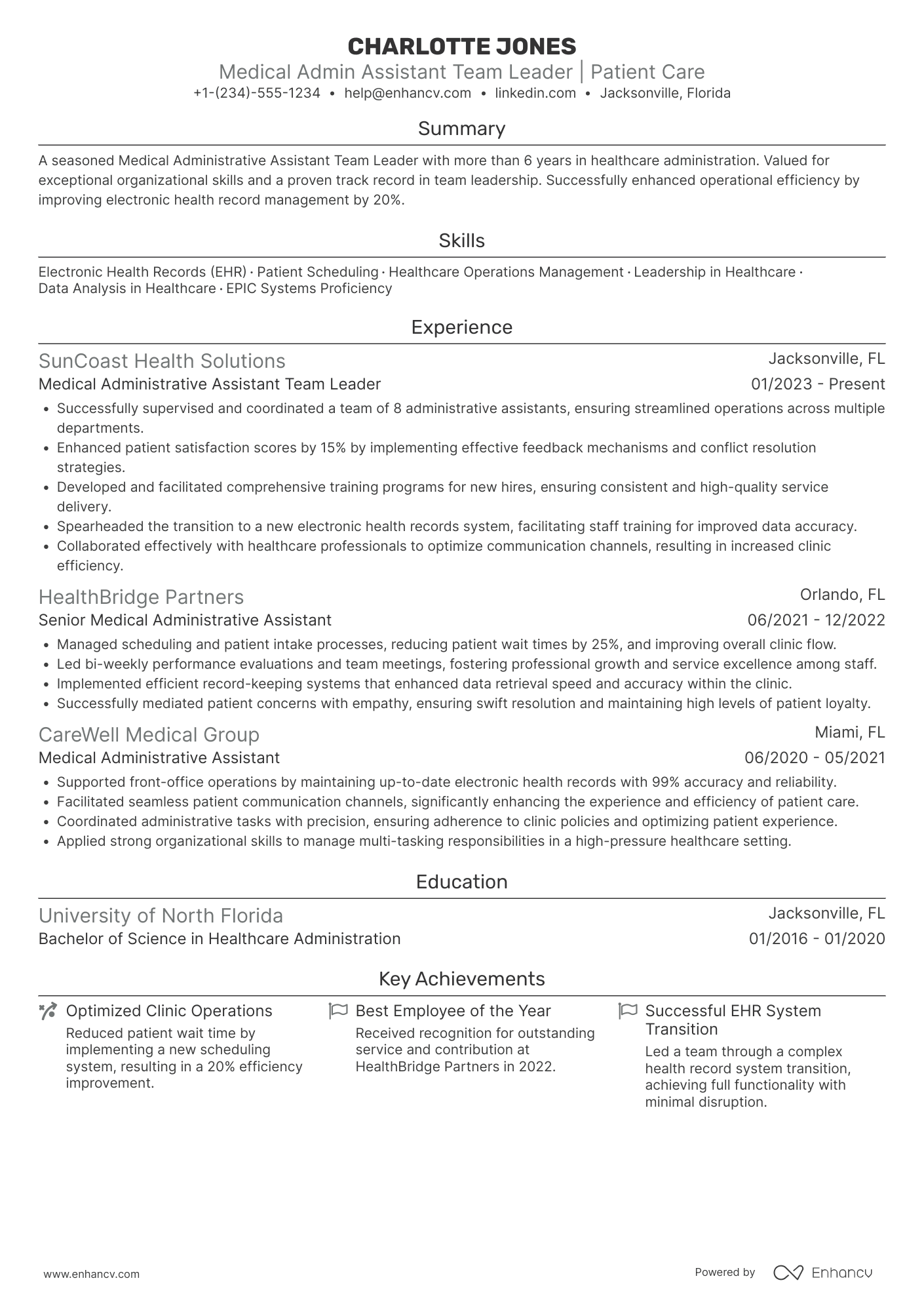
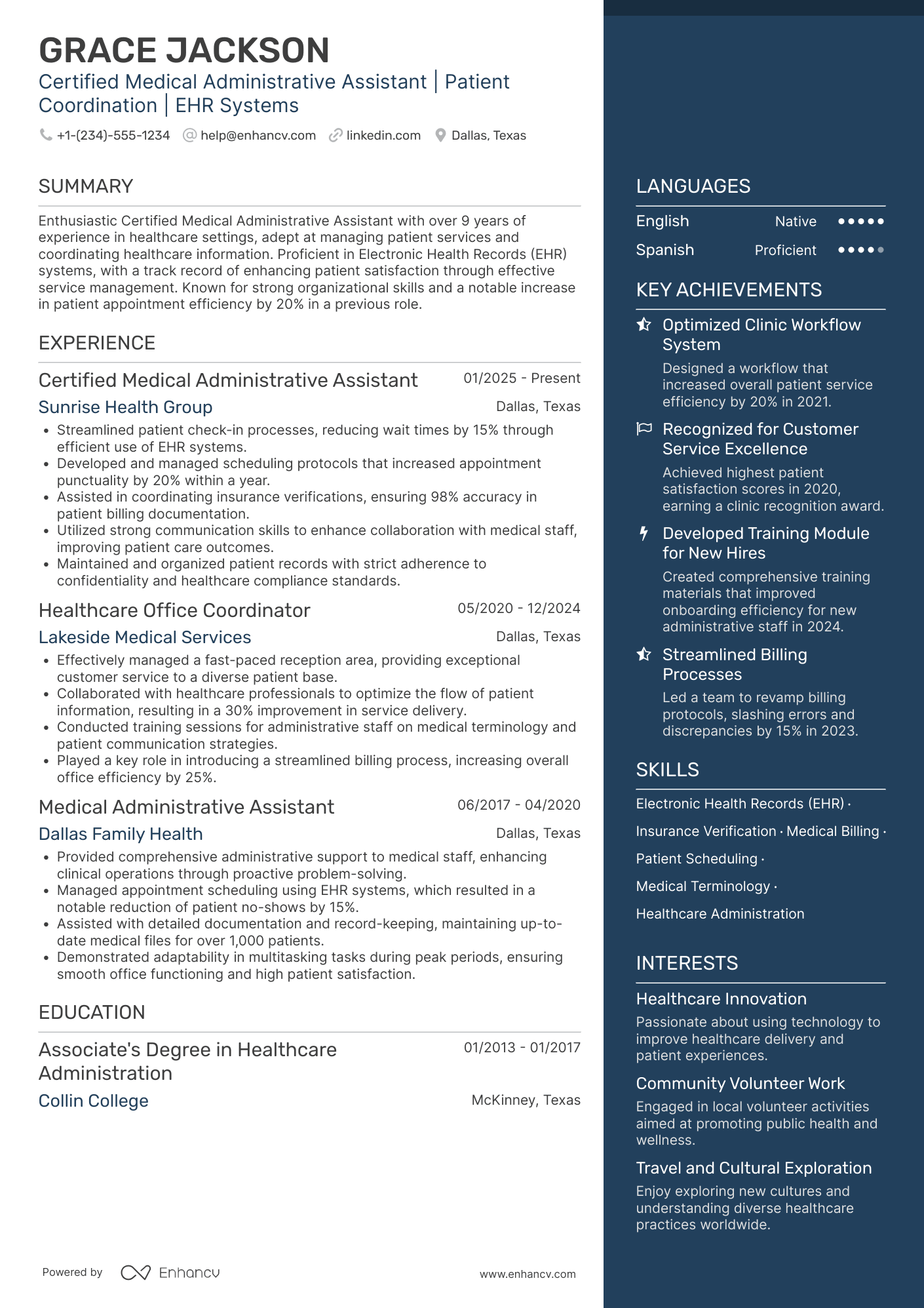
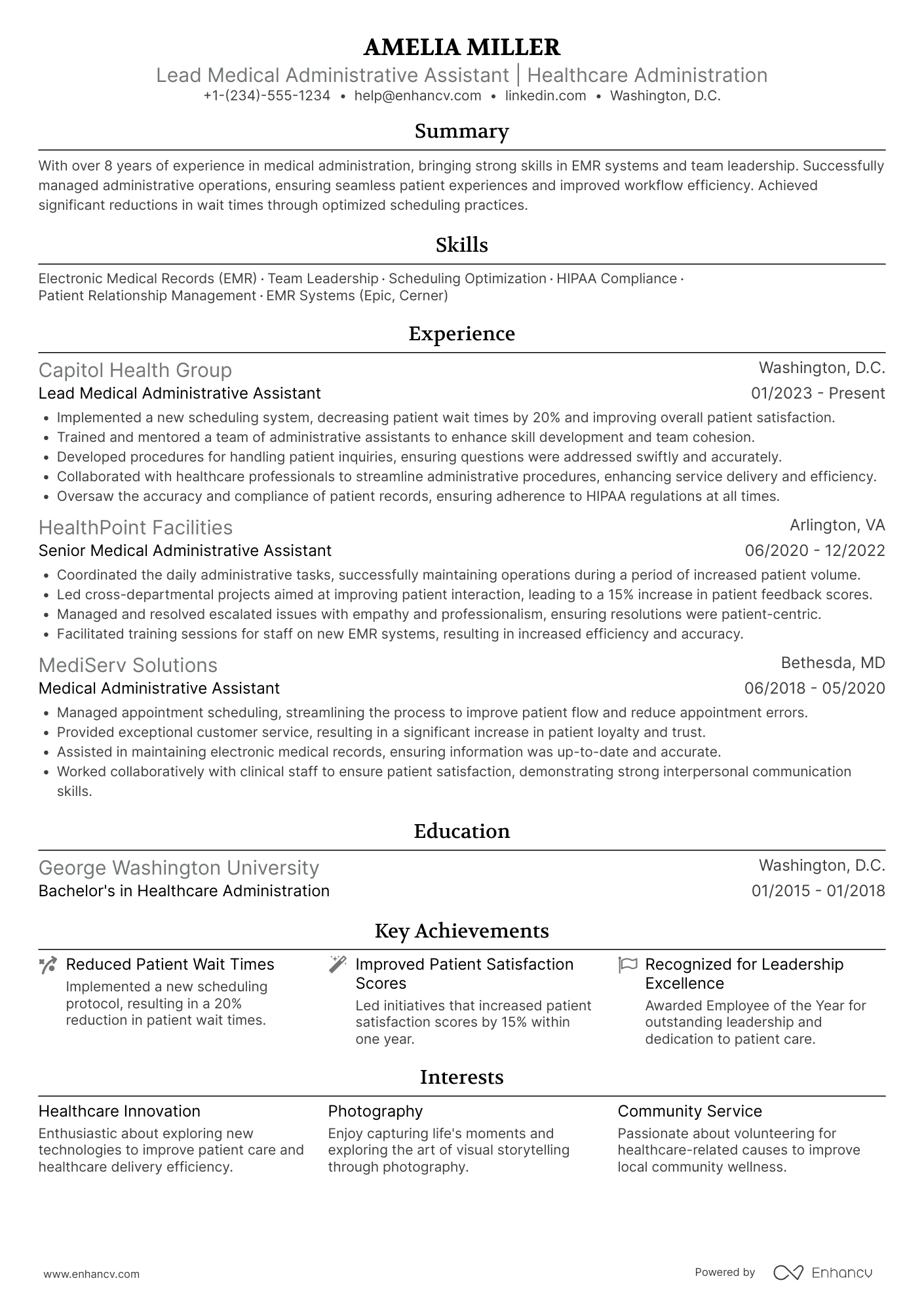
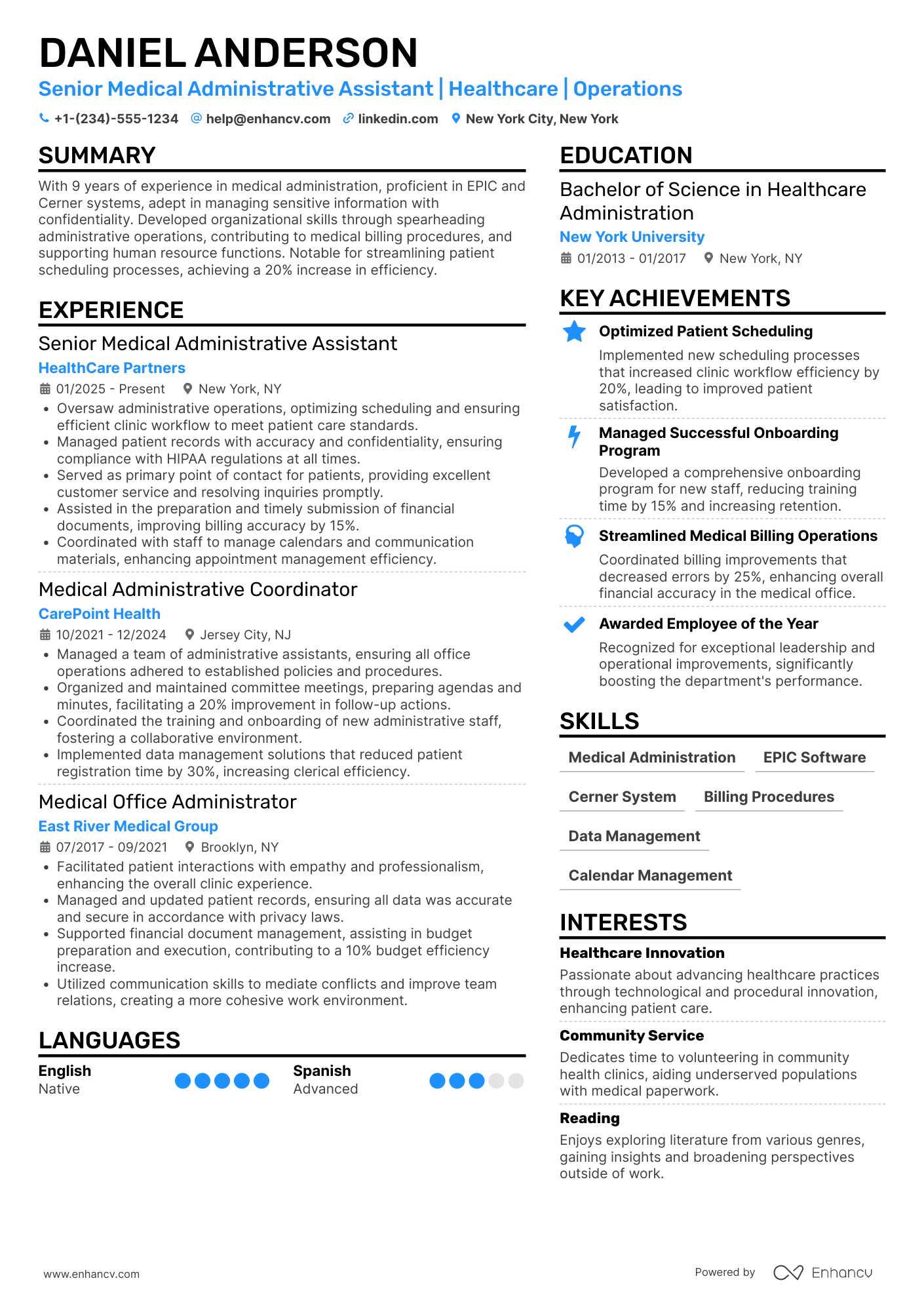
Medical Administrative Assistant resume examples
By Experience
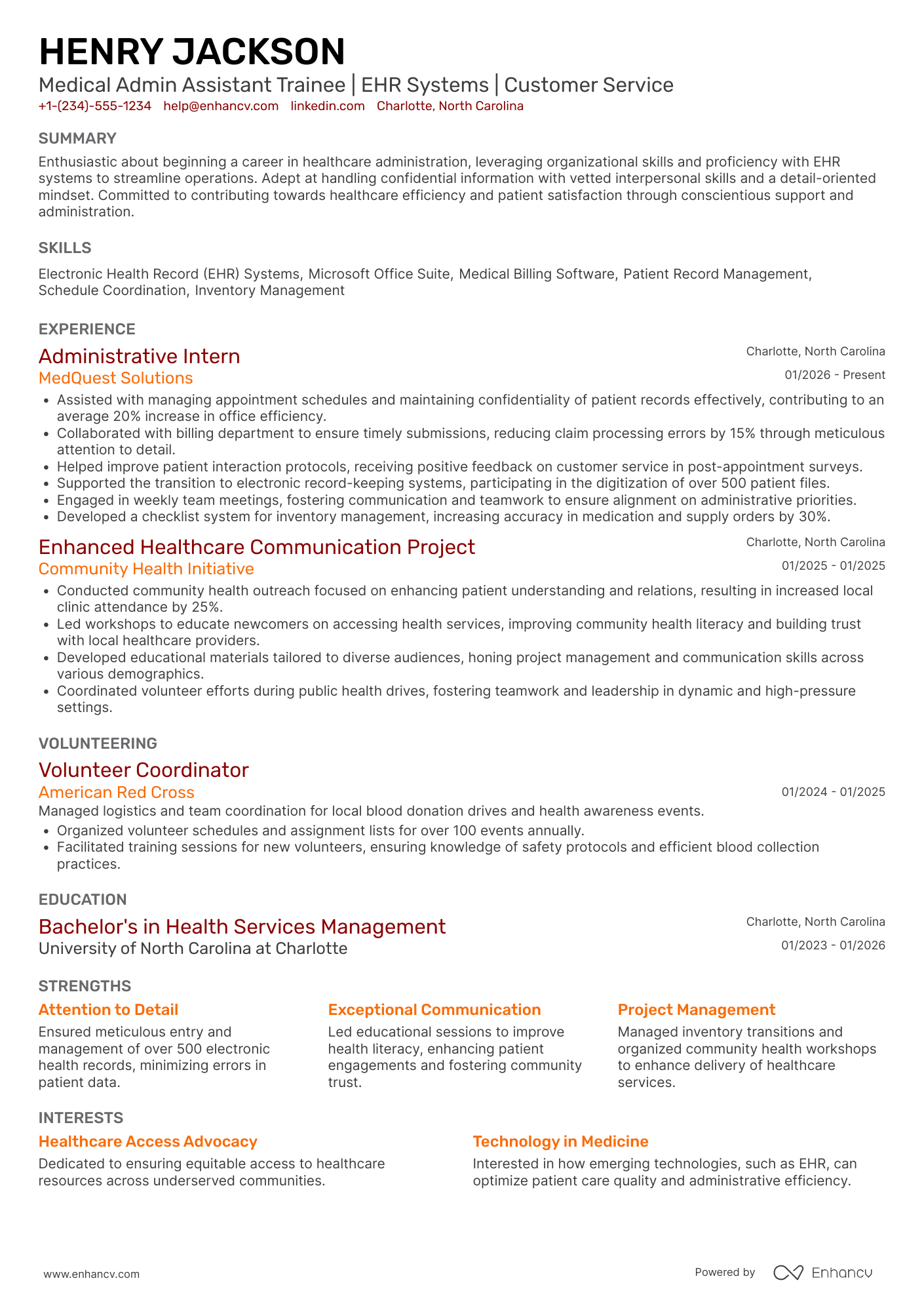
By Role