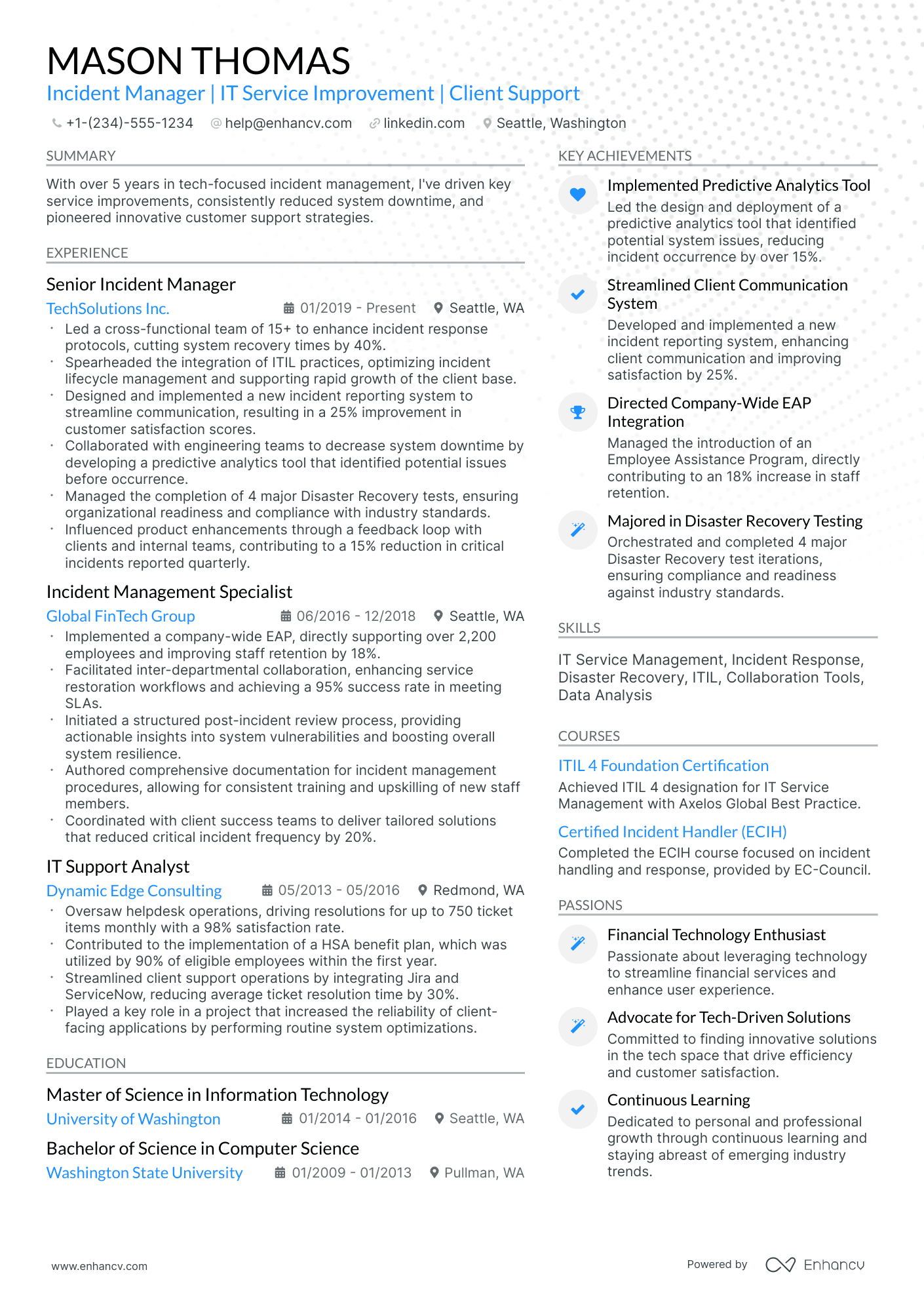
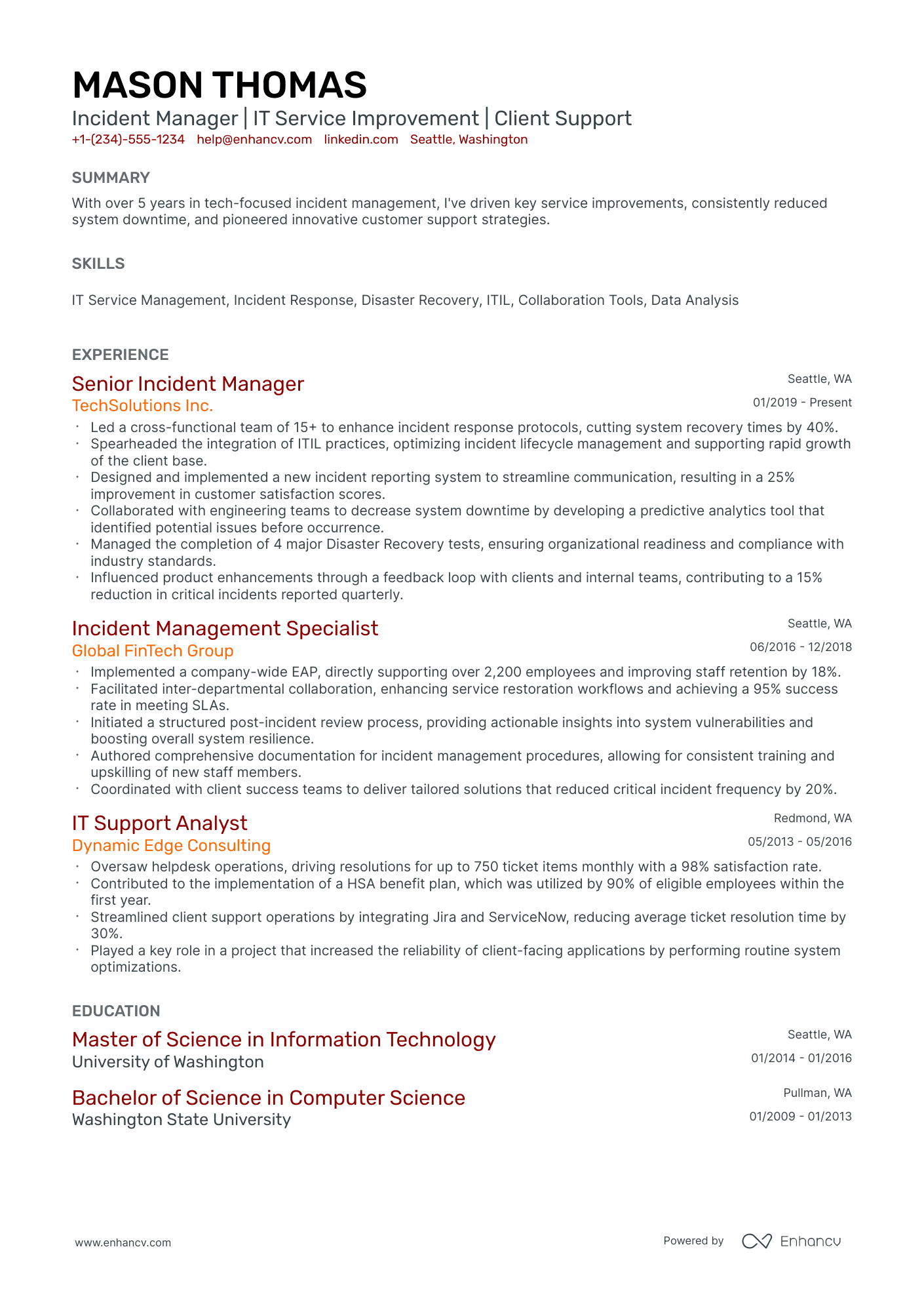
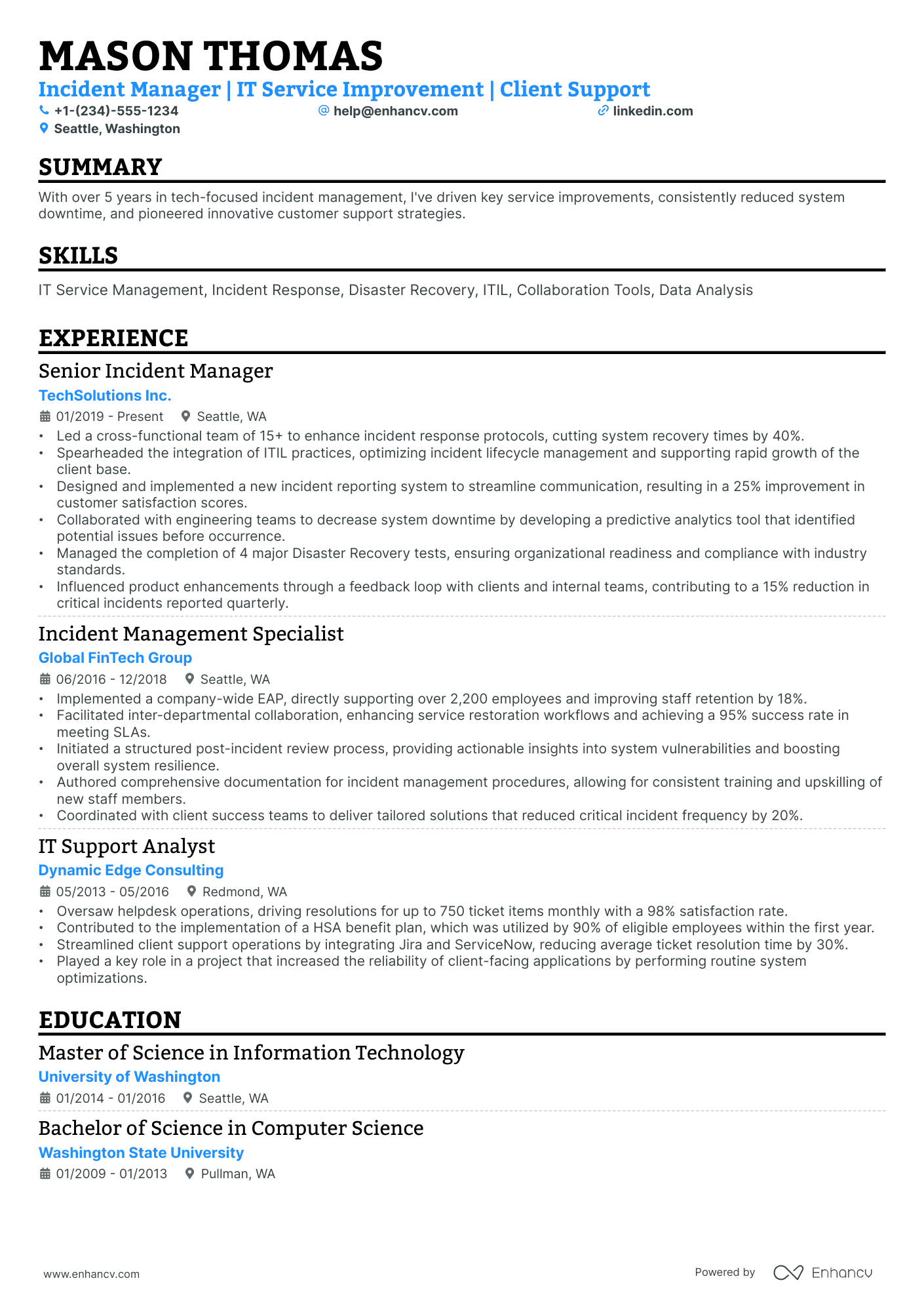
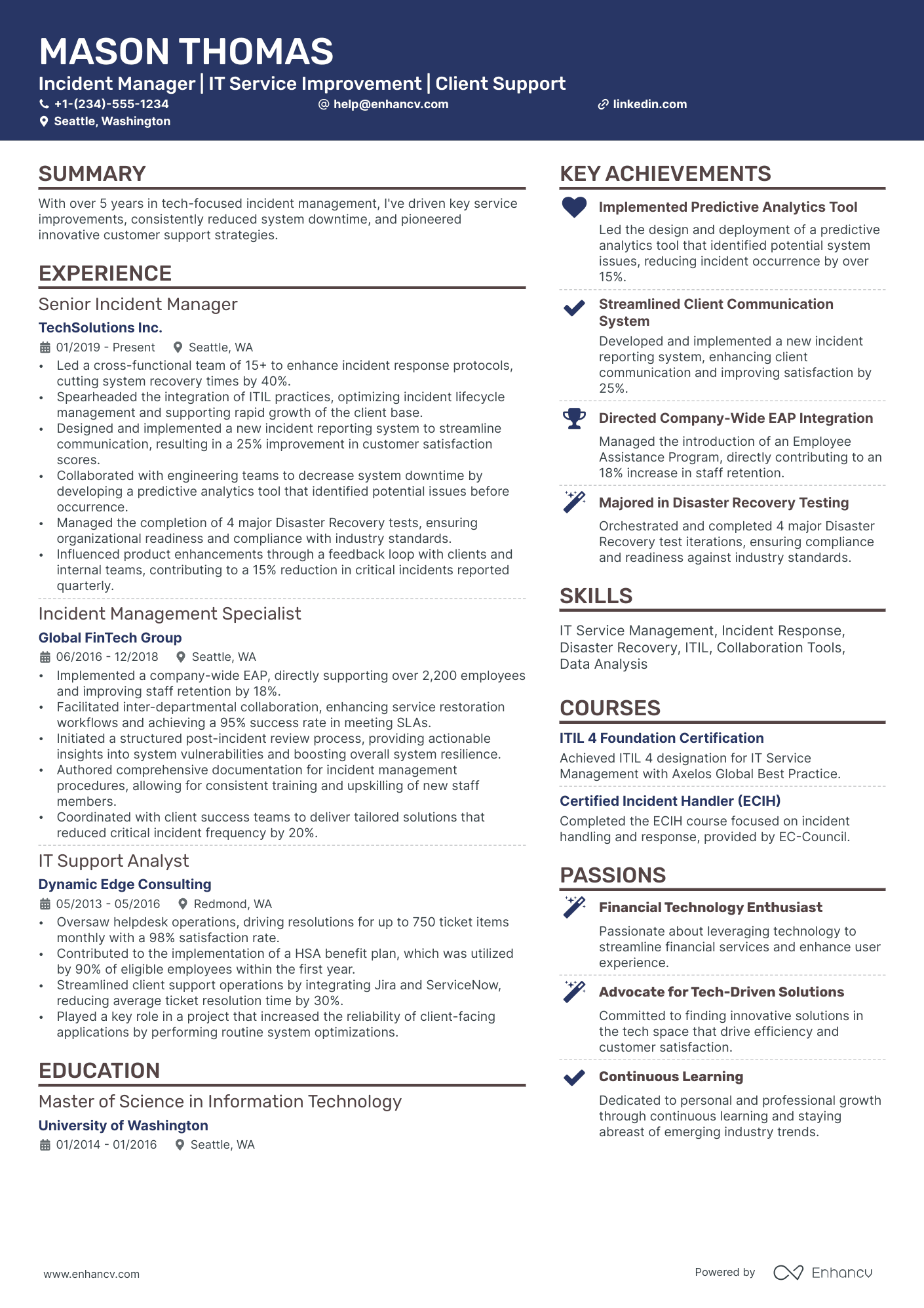
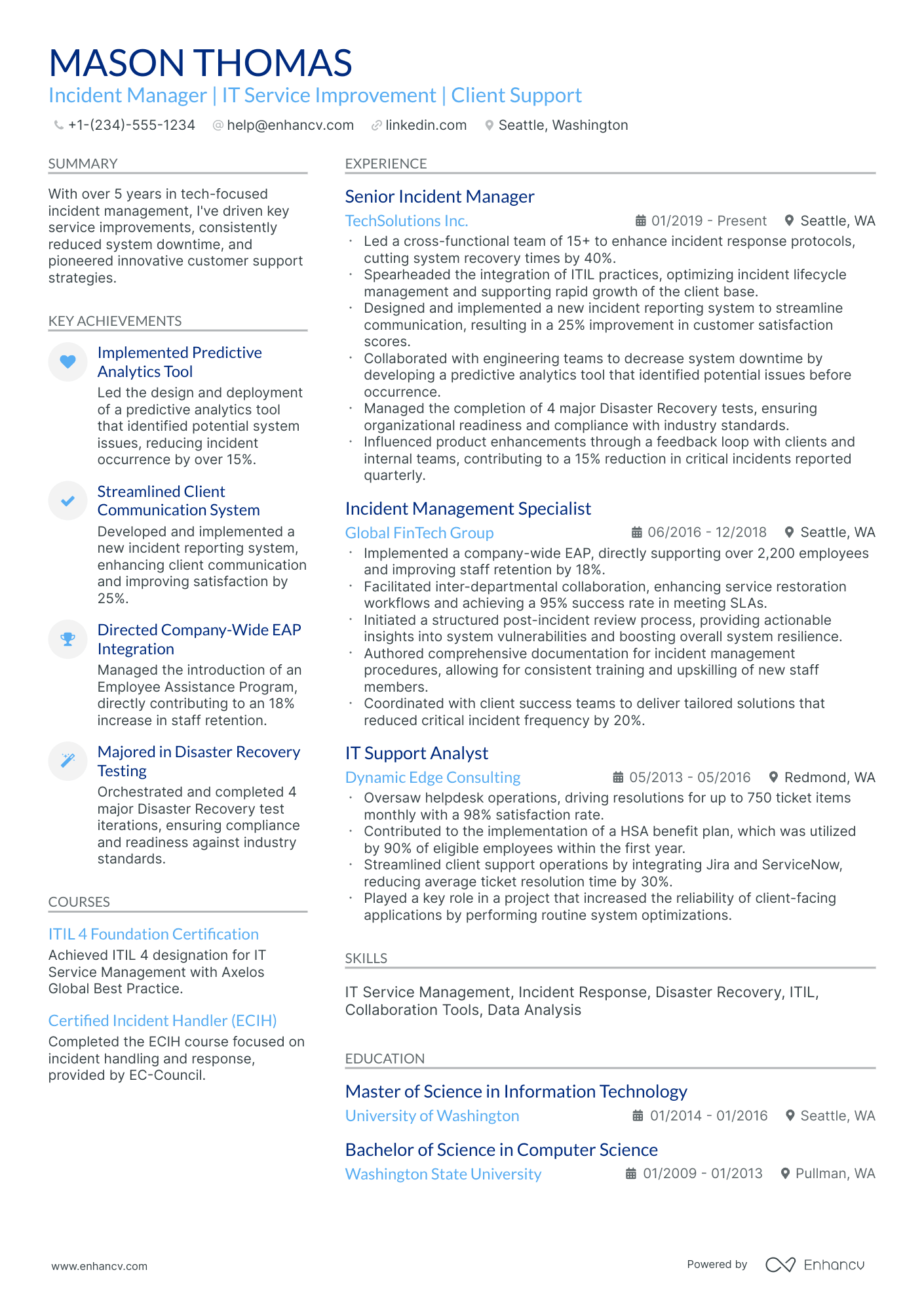
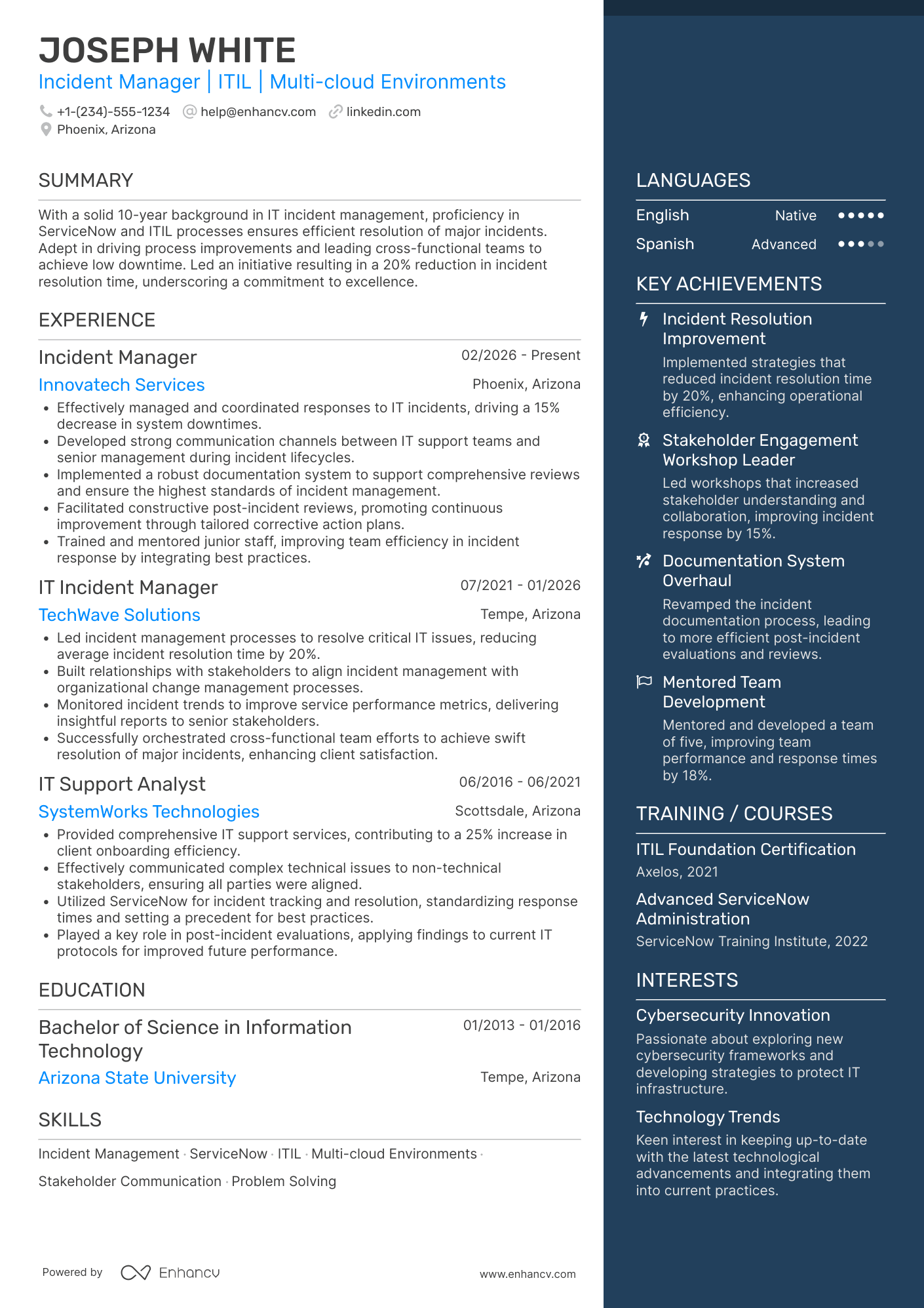
Many incident manager resume submissions fail because they describe ticket handling and tooling, but don't show ownership across detection, coordination, and recovery. That gets missed in ATS screening and fast recruiter scans, especially when competition is high.
A strong resume shows how you reduce impact and restore service under pressure. Knowing how to make your resume stand out is essential in this field. You should highlight outcomes like lower mean time to resolution, fewer repeat incidents, improved service level agreement compliance, reduced customer-impact minutes, and clearer post-incident actions that prevent regressions.

Key takeaways
- Quantify incident outcomes like resolution time and SLA compliance in every experience bullet.
- Tailor resume language to mirror the exact tools and frameworks each job posting names.
- Use reverse-chronological format for experienced candidates and hybrid format for career switchers.
- Demonstrate skills through measurable results in experience bullets, not just in a skills list.
- Pair hard skills like PagerDuty and root cause analysis with execution-focused soft skills.
- Write a three-to-four-line summary featuring your domain, core tools, and a standout metric.
- Use Enhancv to turn vague incident management duties into sharp, results-driven resume bullets.
Job market snapshot for incident managers
We analyzed 97 recent incident manager job ads across major US job boards. These numbers help you understand industry demand, experience requirements, employer expectations at a glance.
What level of experience employers are looking for incident managers
| Years of Experience | Percentage found in job ads |
|---|---|
| 1–2 years | 2.1% (2) |
| 3–4 years | 26.8% (26) |
| 5–6 years | 17.5% (17) |
| 7–8 years | 1.0% (1) |
| 9–10 years | 4.1% (4) |
| 10+ years | 7.2% (7) |
| Not specified | 45.4% (44) |
Incident manager ads by area of specialization (industry)
| Industry (Area) | Percentage found in job ads |
|---|---|
| Finance & Banking | 59.8% (58) |
| Healthcare | 21.6% (21) |
Top companies hiring incident managers
| Company | Percentage found in job ads |
|---|---|
| Seacoast National Bank | 15.5% (15) |
Role overview stats
These tables show the most common responsibilities and employment types for incident manager roles. Use them to align your resume with what employers expect and to understand how the role is structured across the market.
Day-to-day activities and top responsibilities for a incident manager
| Responsibility | Percentage found in job ads |
|---|---|
| Incident management | 55.7% (54) |
| Itil | 50.5% (49) |
| Servicenow | 39.2% (38) |
| Change management | 20.6% (20) |
| It service management | 19.6% (19) |
| Problem management | 19.6% (19) |
| Root cause analysis | 19.6% (19) |
| Reporting | 18.6% (18) |
| Cloud platforms | 17.5% (17) |
| Configuration management | 17.5% (17) |
| Sla | 17.5% (17) |
| Cybersecurity | 16.5% (16) |
Type of employment (remote vs on-site vs hybrid)
| Employment type | Percentage found in job ads |
|---|---|
| On-site | 58.8% (57) |
| Hybrid | 22.7% (22) |
| Remote | 18.6% (18) |
How to format a incident manager resume
Recruiters evaluating incident manager candidates prioritize evidence of cross-functional coordination, escalation ownership, and measurable improvements to incident resolution timelines and service reliability. A clear, well-structured resume format ensures these signals surface quickly during both automated screening and the initial human scan.

I have significant experience in this role—which format should I use?
Use a reverse-chronological format to present your incident management career in a clear, progression-driven timeline. Do:
- Lead with your most recent role and emphasize scope: team size, number of services or systems covered, and escalation authority across business units.
- Highlight incident management frameworks, tools, and domains you've operated in—such as PagerDuty, ServiceNow, ITIL processes, and major incident bridges.
- Quantify outcomes tied to resolution efficiency, downtime reduction, or post-incident process improvements.
I'm junior or switching into this role—what format works best?
A hybrid format works best, letting you lead with relevant skills and certifications while still showing a concise work history that proves applied experience. Do:
- Place a skills section near the top featuring incident response competencies—triage, root cause analysis, stakeholder communication, and monitoring tools like Datadog or Splunk.
- Include projects, on-call rotations, or transitional experience where you coordinated responses, managed outages, or contributed to post-incident reviews, even in an adjacent role.
- Connect every action to a clear result so recruiters see direct impact, not just responsibility.
Why not use a functional resume?
A functional format strips away the timeline context that recruiters need to evaluate how your incident management responsibilities, tooling proficiency, and coordination skills developed across real operational environments. A functional resume might be acceptable if you're transitioning from a related role like NOC analyst or site reliability engineer and have limited direct incident manager titles—but only if you anchor every listed skill to a specific project, incident, or measurable outcome rather than presenting skills in isolation.
Once you've established a clean, readable format, the next step is deciding which sections to include so each one reinforces your qualifications as an incident manager.
What sections should go on a incident manager resume
Recruiters expect you to present incident response leadership, operational rigor, and measurable service reliability improvements in a clean, easy-to-scan resume. Understanding what to put on a resume helps you prioritize the right content for this role.
Use this structure for maximum clarity:
- Header
- Summary
- Experience
- Skills
- Projects
- Education
- Certifications
- Optional sections: Awards, Leadership, Languages
Strong experience bullets should emphasize incident severity and scope, time-to-detect and time-to-resolve improvements, stakeholder coordination, and measurable outcomes such as reduced downtime and fewer repeat incidents.
Is your resume good enough?
Drop your resume here or choose a file. PDF & DOCX only. Max 2MB file size.
Once you’ve organized the essential resume components, the next step is to write your incident manager resume experience section so each role supports that structure with clear, relevant impact.
How to write your incident manager resume experience
The experience section is where you prove you've managed real incidents end to end—demonstrating the tools, frameworks, and escalation methods you used alongside the measurable outcomes you delivered. Hiring managers prioritize demonstrated impact over descriptive task lists, so every bullet should connect your actions to reduced downtime, faster resolution, or stronger operational resilience.
Each entry should include:
- Job title
- Company and location (or remote)
- Dates of employment (month and year)
Three to five concise bullet points showing what you owned, how you executed, and what outcomes you delivered:
- Ownership scope: the incident response processes, on-call rotations, service tiers, or critical systems you were directly accountable for as an incident manager.
- Execution approach: the monitoring platforms, ticketing systems, communication protocols, or incident classification frameworks you used to triage, coordinate, and resolve incidents.
- Value improved: the changes you drove in mean time to resolution, service availability, alert accuracy, post-incident review quality, or overall operational reliability.
- Collaboration context: how you coordinated with engineering, DevOps, security, customer support, or executive stakeholders during high-severity incidents and post-mortems.
- Impact delivered: the outcomes your incident management work produced—expressed through restoration speed, reduction in recurring incidents, improved SLA compliance, or strengthened organizational readiness rather than routine activity.
Experience bullet formula
A incident manager experience example
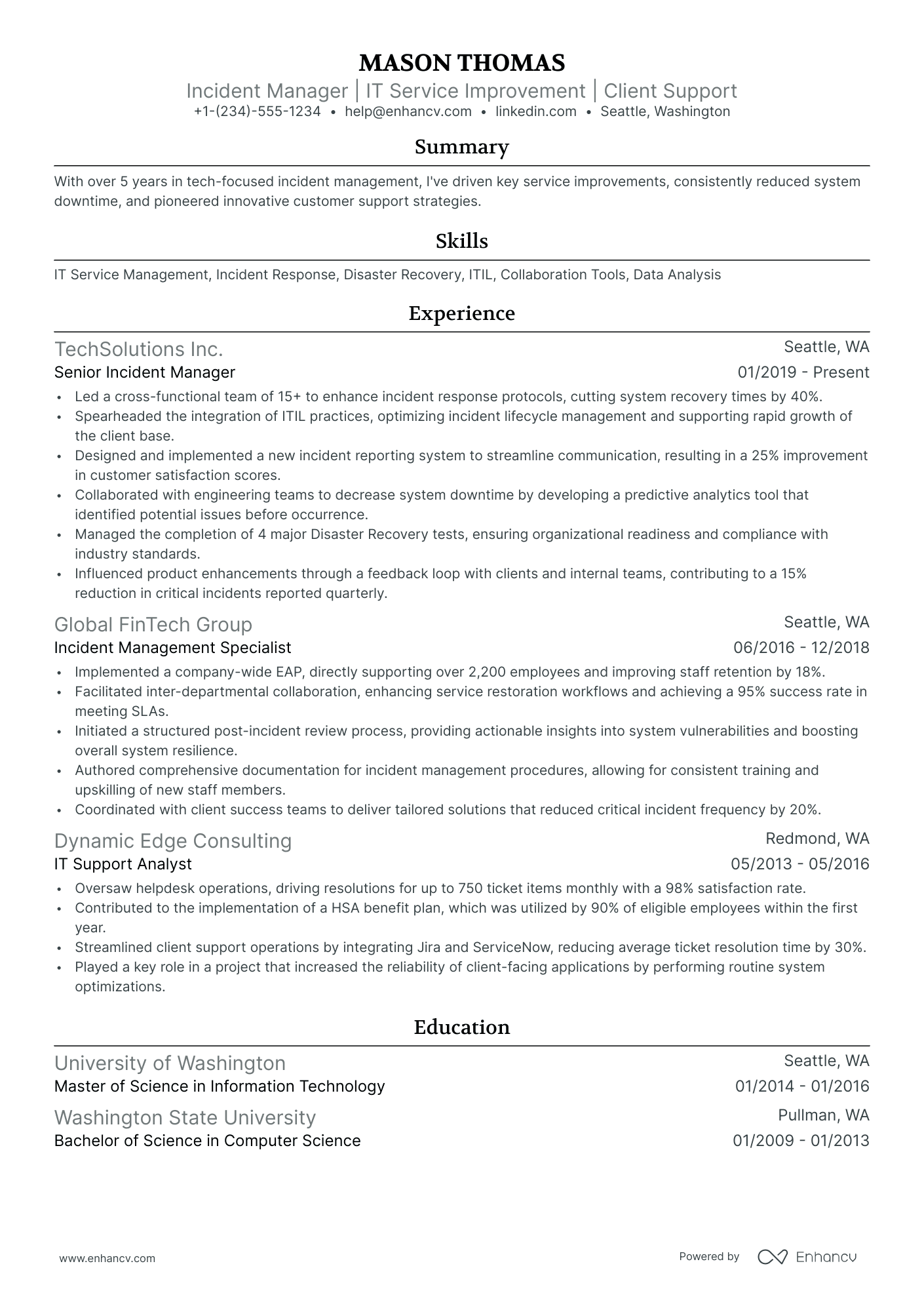
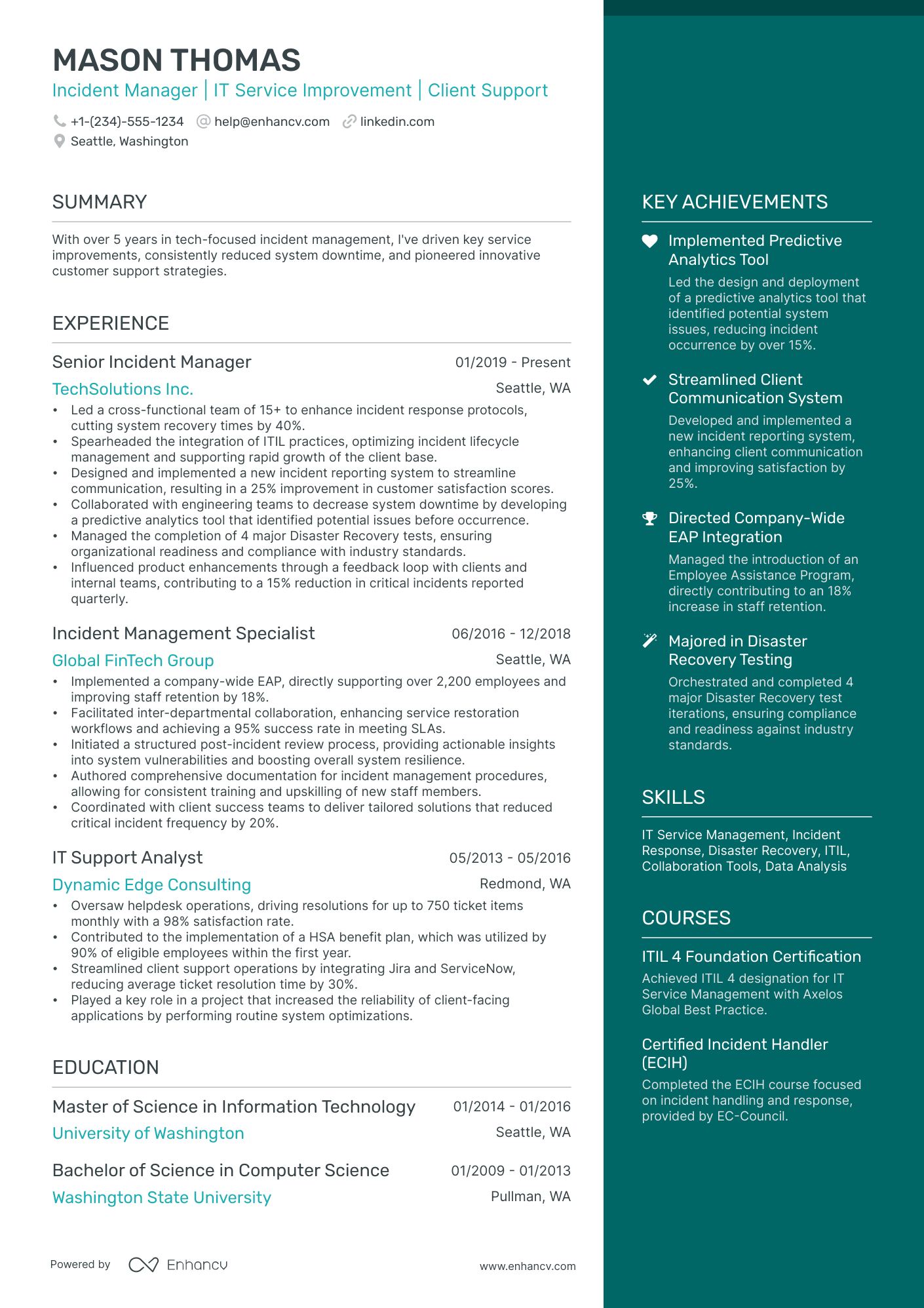
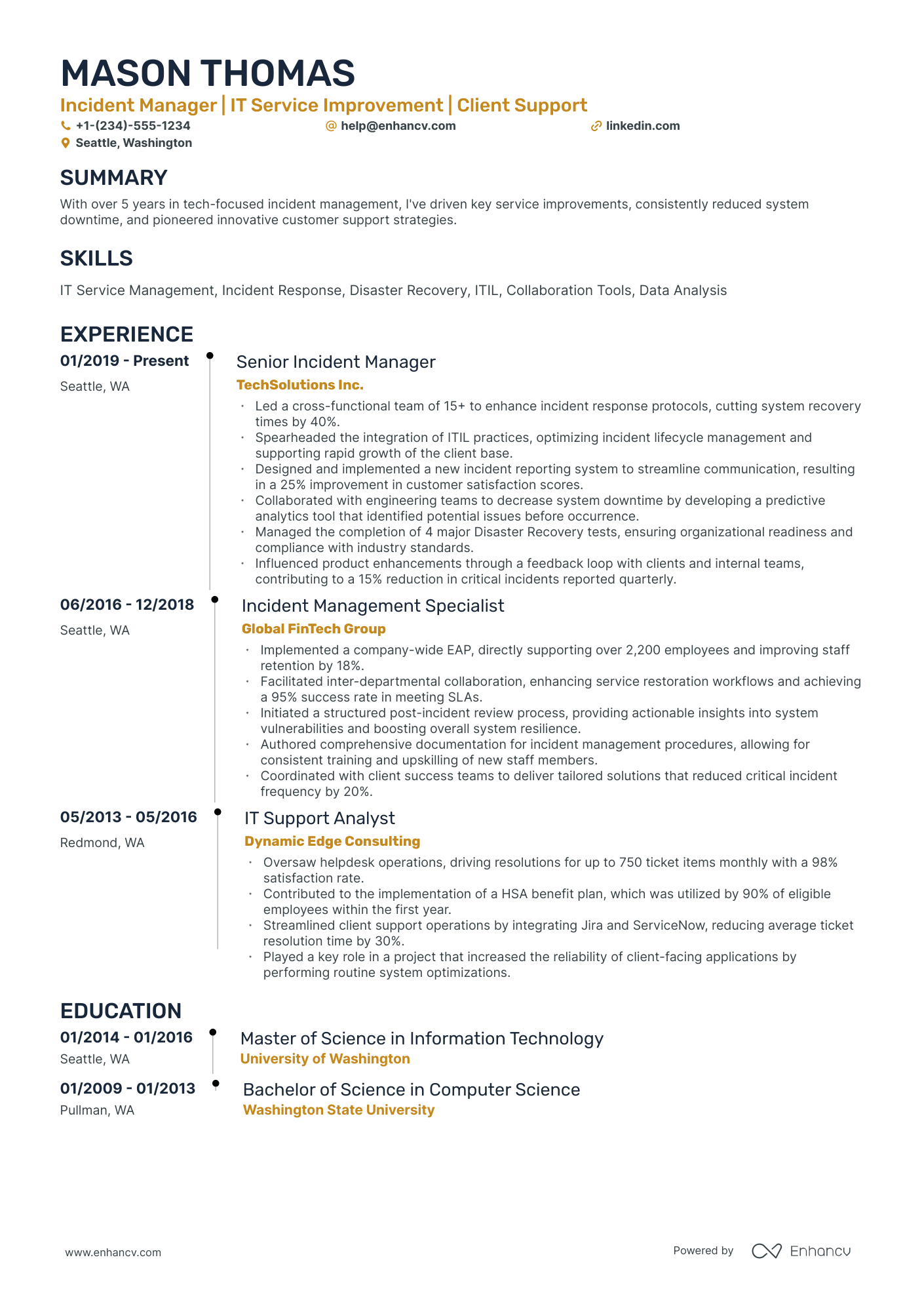
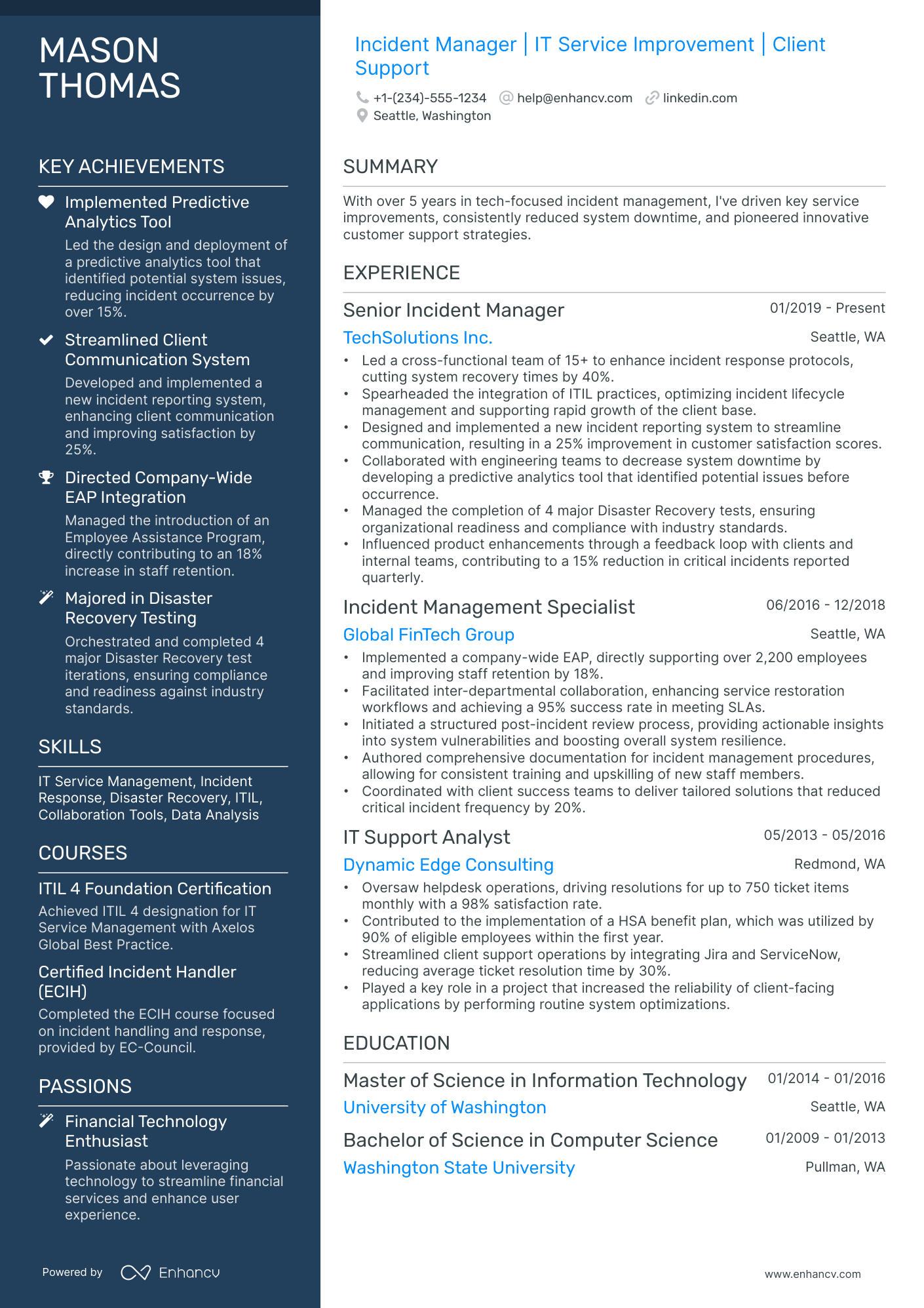
✅ Right example - modern, quantified, specific.
Incident Manager
NorthBridge Payments | Austin, TX (Remote)
2022–Present
High-volume payment platform processing over five million transactions per day for enterprise and mid-market merchants.
- Orchestrated Sev1–Sev3 incident response using PagerDuty, Jira Service Management, and Slack war rooms, cutting mean time to resolution (MTTR) from forty-eight minutes to thirty-one minutes (35%) across twelve on-call teams.
- Implemented ITIL-aligned incident, major incident, and escalation workflows in ServiceNow, improving service level agreement compliance from 89% to 97% and reducing customer-impact minutes by 22% quarter over quarter.
- Led blameless post-incident reviews and root cause analysis with engineering and product managers using the “five whys” and fishbone analysis, driving thirty-two corrective actions that lowered repeat incidents by 28% in six months.
- Built real-time incident dashboards in Grafana and Datadog tied to ServiceNow and PagerDuty data, improving detection-to-acknowledgment time from seven minutes to three minutes and increasing stakeholder update cadence to every fifteen minutes during major incidents.
- Coordinated customer communications with support, account management, and legal using preapproved templates and status page updates, reducing inbound ticket volume by 18% during outages and improving customer satisfaction score from 4.2 to 4.5.
Now that you've seen how to structure strong experience entries, let's focus on customizing them to match the specific incident manager role you're targeting.
How to tailor your incident manager resume experience
Recruiters evaluate your incident manager resume through applicant tracking systems and manual review, screening for specific qualifications. Tailoring your resume to the job description ensures your relevant skills and accomplishments surface immediately.
Ways to tailor your incident manager experience:
- Match incident management tools and platforms named in the job description.
- Mirror the exact ITIL or ITSM terminology the posting uses.
- Reflect escalation frameworks or severity classification models they reference.
- Include SLA or MTTR metrics that align with their success criteria.
- Highlight experience in their specific industry or operational domain.
- Emphasize reliability or service continuity practices when the role requires them.
- Reference cross-functional coordination models described in the posting.
- Align your experience with compliance or security standards they mention.
Tailoring means framing your real accomplishments in language that directly matches what the role demands, not forcing keywords where they don't belong.
Resume tailoring examples for incident manager
| Job description excerpt | Untailored | Tailored |
|---|---|---|
| Lead major incident response using ITIL framework, coordinate cross-functional teams, and ensure SLA compliance for enterprise clients. | Managed incidents and worked with teams to resolve issues quickly. | Led major incident response for 200+ enterprise clients using ITIL processes, coordinating 5 cross-functional teams to maintain 99.5% SLA compliance over 18 months. |
| Drive root cause analysis with ServiceNow, produce post-incident reviews, and reduce repeat incidents across cloud infrastructure environments. | Conducted reviews after incidents and helped prevent future problems. | Conducted root cause analysis in ServiceNow following each P1/P2 incident, delivering post-incident reviews that reduced repeat cloud infrastructure incidents by 34% year over year. |
| Manage real-time incident communication with executive stakeholders, maintain runbooks in Confluence, and oversee on-call rotations across global support teams. | Communicated with leadership during outages and kept documentation updated. | Managed real-time incident bridge calls with C-suite stakeholders during critical outages, maintained 75+ runbooks in Confluence, and coordinated on-call rotations across three global support teams spanning APAC, EMEA, and NA. |
Once you’ve aligned your experience with the role’s priorities, quantify your achievements to show the impact of that work in clear, measurable terms.
How to quantify your incident manager achievements
Quantifying your achievements shows how you reduced downtime, improved reliability, and protected customers. Focus on time to detect, time to restore, incident volume, change failure impact, and post-incident action completion.
Quantifying examples for incident manager
| Metric | Example |
|---|---|
| Time to restore | "Cut mean time to restore from 62 to 38 minutes by standardizing Sev-1 runbooks in Confluence and tightening PagerDuty escalation paths." |
| Incident volume | "Reduced repeat incidents by 27% quarter over quarter by launching weekly problem reviews and tracking top ten recurring alerts in Jira." |
| SLA compliance | "Improved Sev-1 communication SLA from 84% to 98% by implementing a 15-minute update cadence and templated stakeholder emails in Slack." |
| Change risk | "Lowered change-related incidents from 19% to 11% by enforcing pre-change checklists and adding a rollback validation step to the change calendar." |
| Cost avoidance | "Avoided about $180,000 in downtime penalties by coordinating a 12-service outage bridge and restoring priority customer workflows within 45 minutes." |
Turn vague job duties into measurable, recruiter-ready resume bullets in seconds with Enhancv's Bullet Point Generator.
With strong, results-driven bullet points in place, you'll want to ensure your incident manager resume also highlights the right mix of hard and soft skills to give recruiters a complete picture of your qualifications.
How to list your hard and soft skills on a incident manager resume
Your skills section shows you can restore service fast and reduce risk, and recruiters and applicant tracking systems (ATS) scan this section for role keywords and fit—aim for a hard-skill-heavy mix supported by a smaller set of execution-focused soft skills. incident manager roles require a blend of:
- Product strategy and discovery skills.
- Data, analytics, and experimentation skills.
- Delivery, execution, and go-to-market discipline.
- Soft skills.
Your skills section should be:
- Scannable (bullet-style grouping).
- Relevant to the job post.
- Backed by proof in experience bullets.
- Updated with current tools.
Place your skills section:
- Above experience if you're junior or switching careers.
- Below experience if you're mid/senior with strong achievements.

Hard skills
- ITIL incident management
- Major incident management (MIM)
- Incident command system
- ServiceNow, Jira Service Management
- PagerDuty, Opsgenie
- Splunk, Datadog, New Relic
- SLI/SLO, error budgets
- Root cause analysis, 5 Whys
- Post-incident reviews
- Runbooks, playbooks
- Change management, CAB
- SLA tracking and reporting
Soft skills
- Lead incident bridges
- Triage under pressure
- Make rapid trade-offs
- Escalate with clarity
- Align cross-team priorities
- Communicate status updates
- Drive action-item closure
- Facilitate blameless reviews
- Manage stakeholder expectations
- Coordinate executives and teams
- De-escalate conflict fast
- Maintain operational ownership
How to show your incident manager skills in context
Skills shouldn't live only in a dedicated skills list. Browse examples of resume skills in context to see how top candidates weave competencies into their narrative.
They should be demonstrated in:
- Your summary (high-level professional identity)
- Your experience (proof through outcomes)
Here's what that looks like in practice.
Summary example
Senior incident manager with 10 years in financial services, skilled in PagerDuty, root cause analysis, and cross-functional crisis coordination. Reduced mean time to resolution by 38% while leading a 15-person on-call response team.
- Signals senior-level expertise immediately
- Names industry-standard tools directly
- Includes a concrete, measurable metric
- Highlights leadership and collaboration skills
Experience example
Senior Incident Manager
Meridian Financial Technologies | Remote
March 2019–Present
- Drove adoption of PagerDuty and Jira Service Management, cutting mean time to resolution from 47 minutes to 29 minutes across all severity levels.
- Partnered with engineering, security, and DevOps teams to redesign the escalation framework, reducing repeat P1 incidents by 34% year over year.
- Led post-incident review sessions using root cause analysis, producing actionable runbooks that improved first-response accuracy by 22%.
- Every bullet contains measurable proof.
- Skills surface naturally through real outcomes.
Once you’ve tied your strengths to real situations and outcomes, the next step is to apply that approach to building an incident manager resume when you don’t have direct experience.
How do I write a incident manager resume with no experience
Even without full-time experience, you can demonstrate readiness through transferable work. Our guide on writing a resume without work experience covers strategies that apply directly to incident management candidates breaking into the field.
- IT service desk ticket triage
- On-call rotation in student IT
- Incident postmortems for outages
- System monitoring and alert tuning
- Runbook creation and maintenance
- Change management in lab systems
- Root cause analysis case studies
- Disaster recovery tabletop exercises
Focus on:
- Severity-based triage decisions
- SLA tracking and reporting
- Clear incident timelines and notes
- Tooling: Jira Service Management, PagerDuty
Resume format tip for entry-level incident manager
Use a skills-based resume format because it highlights incident manager workflows, tools, and outcomes when your job history is limited. Do:
- Add a "Projects" section with metrics.
- List incident manager tools you used.
- Show severity levels and response times.
- Include runbooks, postmortems, and timelines.
- Quantify volume, uptime, and SLA impact.
- Led a Jira Service Management incident drill using PagerDuty and Datadog alerts, reduced simulated mean time to acknowledge from seven to three minutes across 12 test incidents.
Even without hands-on experience, your education section can demonstrate the foundational knowledge and relevant training that qualify you for an incident manager role—here's how to present it effectively.
How to list your education on a incident manager resume
Your education section helps hiring teams confirm you have the foundational knowledge needed for an incident manager role. It validates technical training, analytical thinking, and relevant academic preparation.
Include:
- Degree name
- Institution
- Location
- Graduation year
- Relevant coursework (for juniors or entry-level candidates)
- Honors & GPA (if 3.5 or higher)
Skip month and day details—list the graduation year only.
Here's a strong education entry tailored for an incident manager resume.
Example education entry
Bachelor of Science in Information Technology
George Mason University, Fairfax, VA
Graduated 2019
GPA: 3.7/4.0
- Relevant Coursework: IT Service Management, Network Security, Systems Administration, Risk Analysis
- Honors: Magna Cum Laude, Dean's List (six semesters)
How to list your certifications on a incident manager resume
Certifications on your resume show your commitment to continuous learning, your proficiency with incident tools, and your alignment with industry standards expected of an incident manager.
Include:
- Certificate name
- Issuing organization
- Year
- Optional: credential ID or URL
- Place certifications below education when your degree is recent and your certifications add supporting skills.
- Place certifications above education when they are recent, role-relevant, or required for the incident manager roles you target.
Best certifications for your incident manager resume
ITIL 4 Foundation Certified Information Systems Security Professional (CISSP) Certified Information Security Manager (CISM) AWS Certified SysOps Administrator – Associate Microsoft Certified: Azure Administrator Associate Google Professional Cloud DevOps Engineer Certified ScrumMaster (CSM)
Once you’ve positioned your credentials where hiring teams can spot them quickly, focus on writing your incident manager resume summary to connect those qualifications to the impact you deliver.
How to write your incident manager resume summary
Your resume summary is the first thing a recruiter reads, so it needs to earn attention fast. A strong summary frames your incident management expertise and signals you're worth a closer look.
Keep it to three to four lines, with:
- Your title and total years of incident management experience.
- The domain or industry you've worked in, such as SaaS, fintech, or cloud infrastructure.
- Core tools and skills like PagerDuty, ServiceNow, ITIL frameworks, or root cause analysis.
- One or two measurable achievements, such as reduced resolution times or improved uptime.
- Soft skills tied to real outcomes, like cross-team coordination that cut escalation rates.

PRO TIP
At the mid-level, emphasize technical fluency, process ownership, and measurable improvements to incident workflows. Highlight specific tools you've mastered and results you've driven. Avoid vague descriptors like "passionate" or "motivated self-starter." Recruiters want evidence, not enthusiasm.
Example summary for a incident manager
Incident manager with five years of experience in SaaS environments. Skilled in PagerDuty, Jira, and ITIL-based workflows. Reduced mean time to resolution by 34% through streamlined escalation processes and cross-functional coordination.
Optimize your resume summary and objective for ATS
Drop your resume here or choose a file.
PDF & DOCX only. Max 2MB file size.
Now that your summary is crafted to showcase your incident management expertise, make sure the header framing it presents your contact details clearly and professionally.
What to include in a incident manager resume header
A resume header lists your key identifiers and contact details, and it boosts visibility, credibility, and recruiter screening for a incident manager role.
Essential resume header elements
- Full name
- Tailored job title and headline
- Location
- Phone number
- Professional email
- GitHub link
- Portfolio link
A LinkedIn link lets recruiters confirm titles, dates, and recommendations fast, which supports faster screening.
Don't include a photo on a incident manager resume unless the role is explicitly front-facing or appearance-dependent.
Match your header title to the incident manager job posting and keep links short, working, and consistent with your resume details.
Incident manager resume header
Jordan Lee
Incident Manager | Major Incident Response, ITIL, and Stakeholder Communication
Austin, TX
(512) 555-12XX
your.name@enhancv.com
github.com/yourname
yourwebsite.com
linkedin.com/in/yourname
Once your contact details and role-specific identifiers are clear and easy to scan, you can strengthen the rest of your resume with additional sections that add relevant context and credibility.
Additional sections for incident manager resumes
When your core qualifications match other candidates, additional sections can set you apart by showcasing unique strengths relevant to incident management.
- Certifications (ITIL, PMP, ICS)
- Languages
- Professional affiliations and memberships
- Publications and conference presentations
- Volunteer emergency response experience
- Awards and recognitions
- Hobbies and interests
Once you've strengthened your resume with relevant additional sections, it's worth pairing it with a well-crafted cover letter to maximize your impact.
Do incident manager resumes need a cover letter
An incident manager resume doesn't always need a cover letter. It helps when the role is competitive, when the posting requests one, or when hiring teams expect context. If you're unsure about what a cover letter is and when it adds value, it can make a difference when your resume needs a clear narrative.
Use a cover letter to add context your resume can't show:
- Explain role and team fit by mapping your incident manager approach to the on-call model, escalation paths, and stakeholder cadence.
- Highlight one or two relevant projects or outcomes, such as reducing mean time to resolution, improving post-incident reviews, or strengthening incident communications.
- Show understanding of the product, users, and business context by naming key reliability risks and the impact of downtime on customers and revenue.
- Address career transitions or non-obvious experience by connecting prior roles to incident manager skills, such as coordination, prioritization, and calm execution.
Drop your resume here or choose a file.
PDF & DOCX only. Max 2MB file size.
Even if you choose not to include a cover letter, you can still strengthen your incident manager resume by using AI to refine your content and presentation.
Using AI to improve your incident manager resume
AI can sharpen your resume's clarity, structure, and impact. It helps tighten language and highlight results. But overuse strips authenticity. If you're wondering which AI is best for writing resumes, the key is choosing tools that enhance rather than replace your voice. Once your content is clear and role-aligned, step away from AI.
Here are 10 practical prompts to strengthen specific sections of your incident manager resume:
- Strengthen your summary. "Rewrite my resume summary to highlight my experience as an incident manager, emphasizing leadership during critical outages and measurable recovery improvements."
- Quantify experience bullets. "Add specific metrics to these incident manager experience bullets, focusing on resolution time reductions, SLA compliance rates, and team coordination outcomes."
- Refine skills relevance. "Review my skills section and remove entries irrelevant to an incident manager role. Suggest replacements tied to ITIL, root cause analysis, and escalation management."
- Tighten action verbs. "Replace weak or passive verbs in my incident manager experience section with strong action verbs that convey ownership, urgency, and cross-functional leadership."
- Align with job descriptions. "Compare my incident manager resume bullets against this job description. Identify gaps in keywords, responsibilities, or qualifications I should address."
- Improve certification descriptions. "Rewrite my certifications section to clarify how each credential—like ITIL or PMP—directly supports my effectiveness as an incident manager."
- Clarify project contributions. "Rewrite my project descriptions to clearly show my incident manager role, specific actions I took, and measurable results delivered."
- Eliminate redundancy. "Identify and remove repetitive phrasing across my incident manager resume. Consolidate overlapping bullets without losing key details or achievements."
- Enhance education relevance. "Rewrite my education section to connect coursework and academic projects to real incident manager responsibilities like risk assessment and service continuity."
- Sharpen bullet impact. "Restructure each incident manager experience bullet using a clear 'Action + Context + Result' format, ensuring every bullet includes a measurable outcome."
Stop using AI once your resume sounds accurate, specific, and aligned with real experience. AI should never invent experience or inflate claims—if it didn't happen, it doesn't belong here.
Conclusion
A strong incident manager resume shows measurable outcomes, role-specific skills, and a clear structure. Lead with impact, like reduced downtime, faster resolution, and stronger service levels. Use active language, consistent formatting, and scannable sections.
Hiring teams want an incident manager who can lead under pressure and improve reliability. Your resume should highlight incident response, stakeholder communication, root cause analysis, and post-incident follow-through. When your results and structure stay clear, you look ready for today’s market and what comes next.