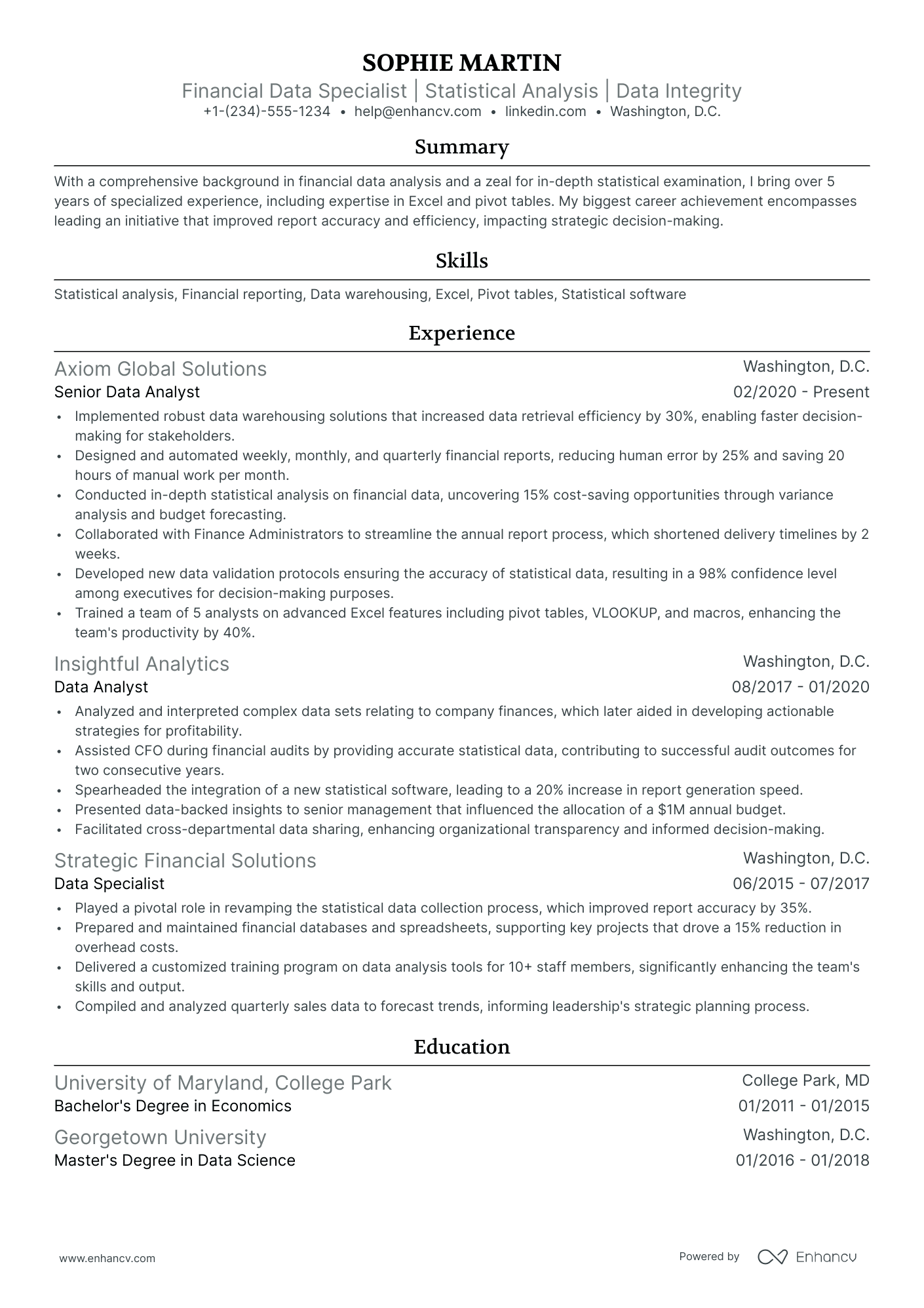
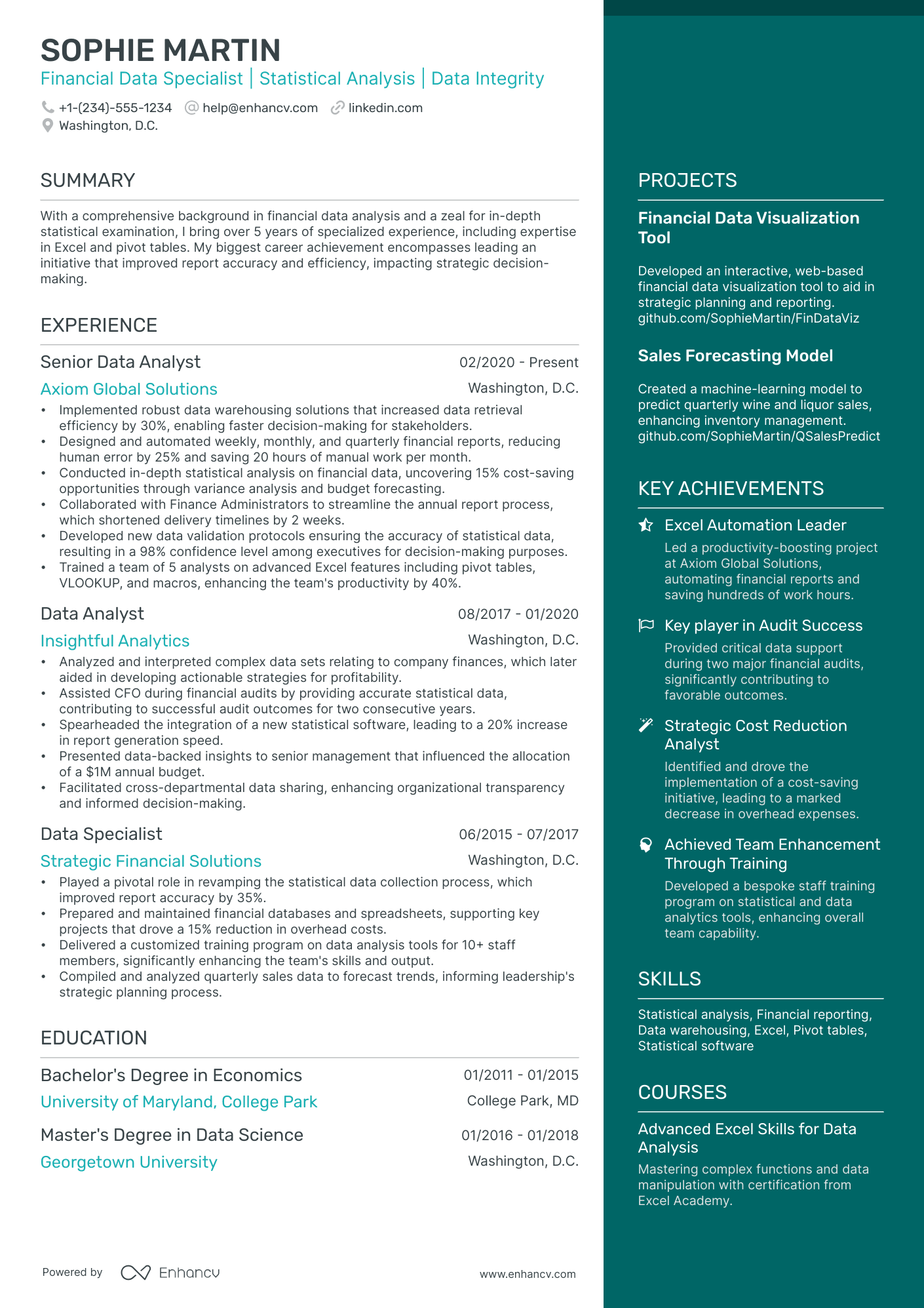
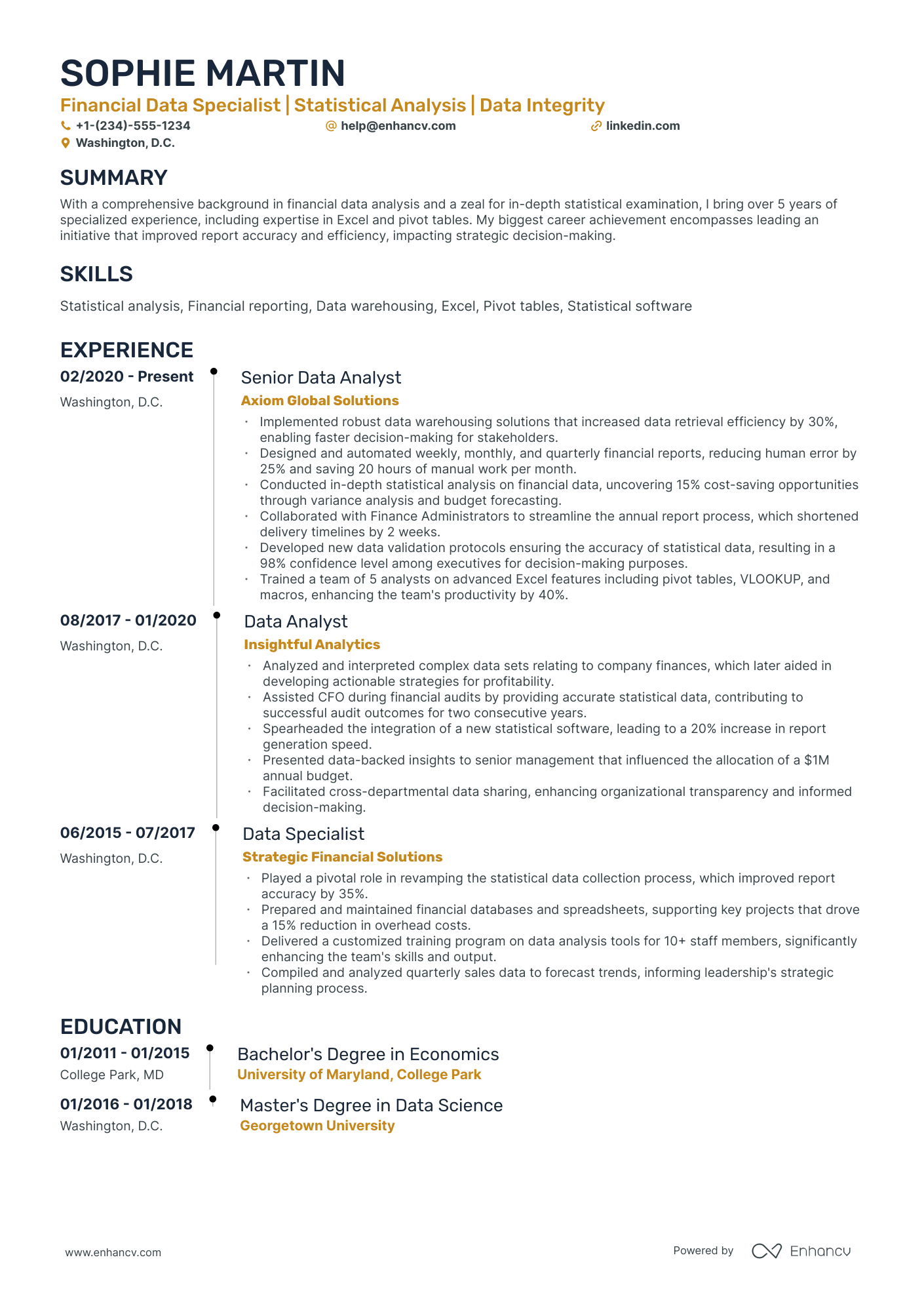
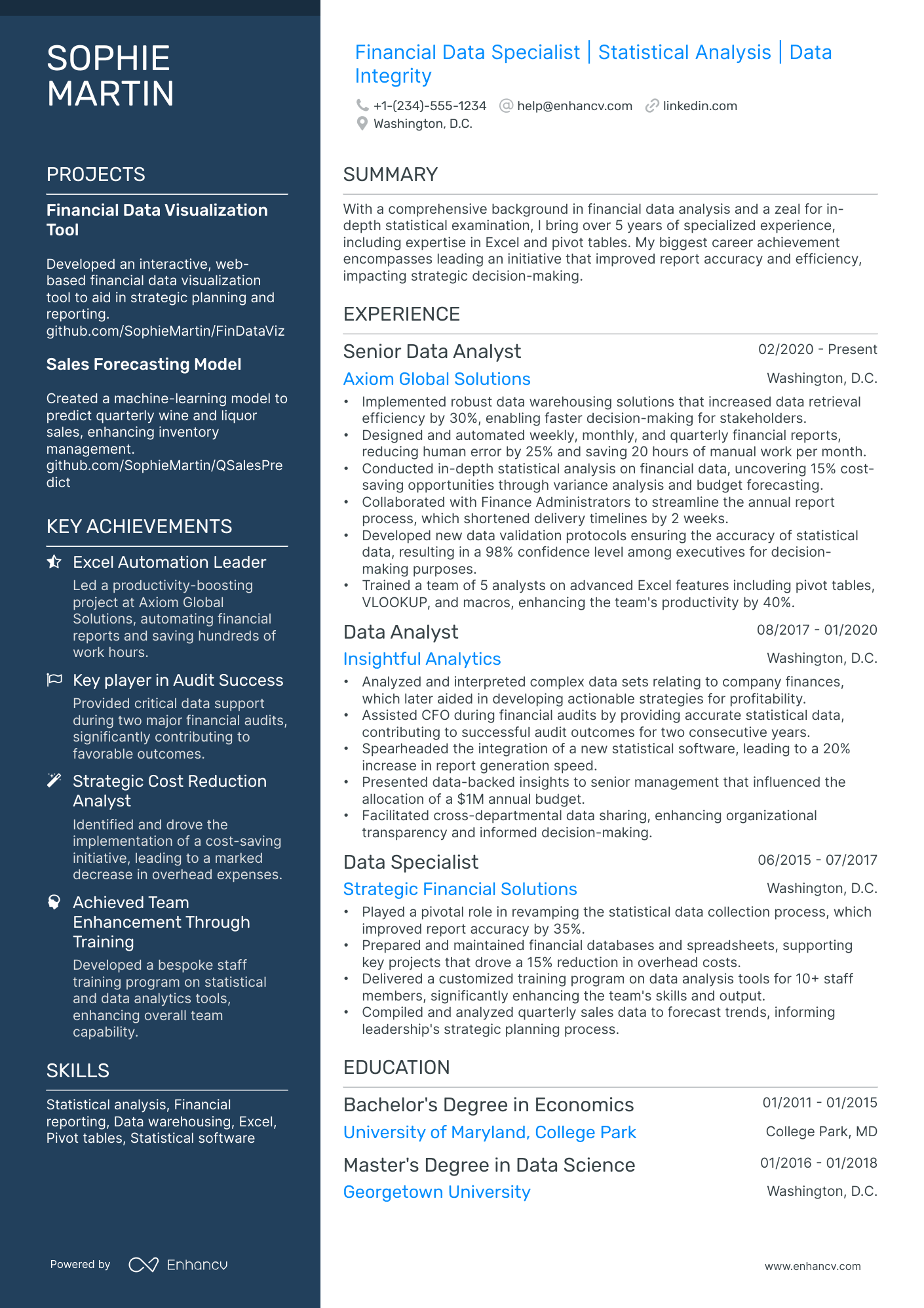
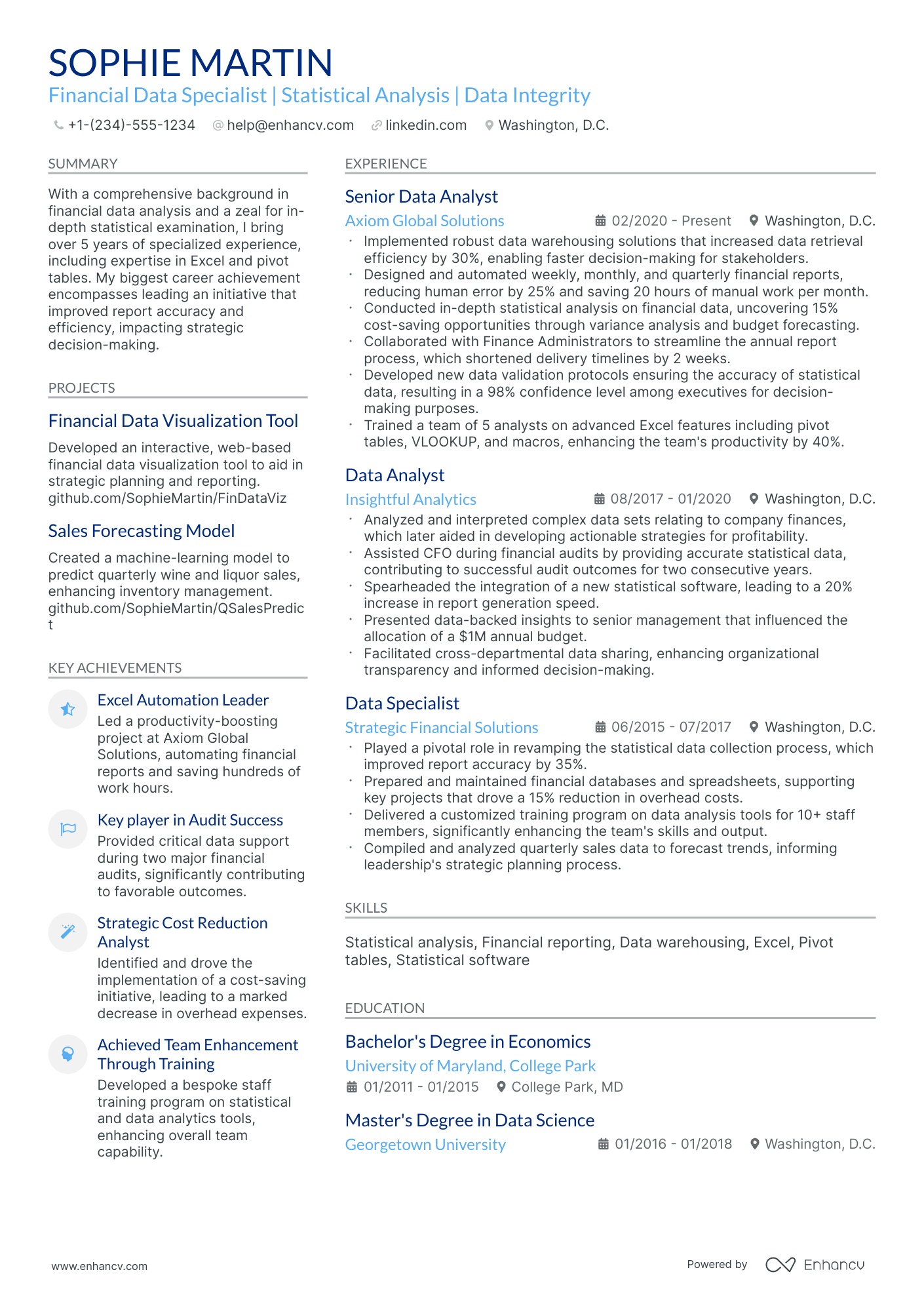
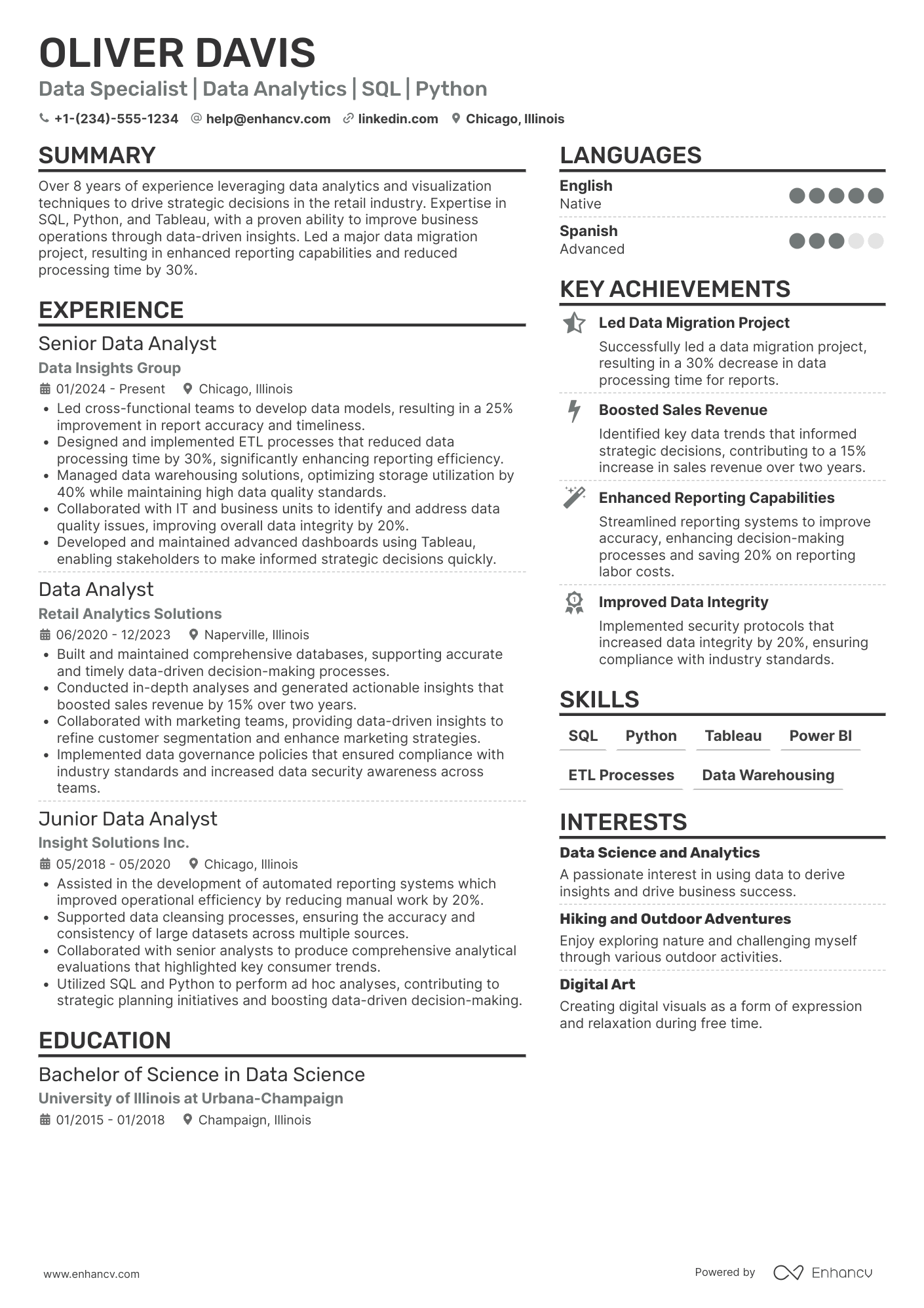
Many data specialist resume submissions fail because they list tools and tasks without showing measurable impact. A data specialist resume must pass ATS screening and earn attention in fast recruiter scans amid heavy competition. Understanding how to make your resume stand out is essential in such a competitive field.
A strong resume shows what you improved, delivered, or protected. Highlight reduced reporting time, increased data accuracy, improved pipeline reliability, supported decisions for large datasets, met tight deadlines, and prevented costly errors. Tie each result to scope and business outcomes.

Key takeaways
- Quantify every achievement with metrics like time saved, error reduction, or cost impact.
- Use reverse-chronological format for experienced candidates and hybrid format for career changers.
- Tailor each resume to the job posting's tools, platforms, and compliance frameworks.
- Demonstrate skills through outcome-driven experience bullets, not isolated keyword lists.
- Place certifications above or below education based on recency and role relevance.
- Write a three- to four-line summary highlighting tools, domain expertise, and measurable results.
- Use Enhancv to turn vague duties into focused, recruiter-ready resume bullets faster.
Job market snapshot for data specialists
We analyzed 382 recent data specialist job ads across major US job boards. These numbers help you understand industry demand, skills in demand, career growth patterns at a glance.
What level of experience employers are looking for data specialists
| Years of Experience | Percentage found in job ads |
|---|---|
| 1–2 years | 22.3% (85) |
| 3–4 years | 3.9% (15) |
| 5–6 years | 3.9% (15) |
| 7–8 years | 0.8% (3) |
| 10+ years | 0.8% (3) |
| Not specified | 68.3% (261) |
Data specialist ads by area of specialization (industry)
| Industry (Area) | Percentage found in job ads |
|---|---|
| Finance & Banking | 36.1% (138) |
| Healthcare | 27.2% (104) |
| Government | 19.9% (76) |
| Education | 11.5% (44) |
| Manufacturing | 2.6% (10) |
Top companies hiring data specialists
| Company | Percentage found in job ads |
|---|---|
| Ryder System Inc. | 14.4% (55) |
| Accenture | 11.3% (43) |
| CONTACT GOVERNMENT SERVICES | 9.9% (38) |
| State of California | 7.1% (27) |
Role overview stats
These tables show the most common responsibilities and employment types for data specialist roles. Use them to align your resume with what employers expect and to understand how the role is structured across the market.
Day-to-day activities and top responsibilities for a data specialist
| Responsibility | Percentage found in job ads |
|---|---|
| Data analysis | 32.7% (125) |
| Sql | 24.1% (92) |
| Python | 19.4% (74) |
| Git | 13.6% (52) |
| Ci/cd | 10.2% (39) |
| Data validation | 9.9% (38) |
| General ledger | 9.7% (37) |
| Business planning | 9.2% (35) |
| Dataproc | 9.2% (35) |
| Financial data management | 9.2% (35) |
| Financial reporting | 9.2% (35) |
| Forecasting | 9.2% (35) |
Type of employment (remote vs on-site vs hybrid)
| Employment type | Percentage found in job ads |
|---|---|
| On-site | 58.1% (222) |
| Remote | 23.0% (88) |
| Hybrid | 18.8% (72) |
How to format a data specialist resume
Recruiters evaluating data specialist resumes prioritize technical proficiency across data tools and platforms, the ability to translate raw data into actionable insights, and evidence of cross-functional collaboration. A clear, well-structured format ensures these signals surface quickly during both automated screening and manual review. Choosing the right resume format is one of the most important decisions you'll make.

I have significant experience in this role—which format should I use?
Use a reverse-chronological format to present your deepest and most relevant data experience first. Do:
- Lead each role entry with your scope of ownership—datasets managed, stakeholders served, and systems maintained or improved.
- Highlight proficiency in role-specific tools and domains such as SQL, Python, Tableau, ETL pipelines, data governance, or cloud platforms like AWS and GCP.
- Quantify outcomes tied to business impact, including cost savings, efficiency gains, error reduction, or improved reporting accuracy.
I'm junior or switching into this role—what format works best?
A hybrid format works best, letting you lead with a focused skills section while still grounding your experience in real work history. Do:
- Place a technical skills section near the top of your resume, grouping competencies by category (e.g., querying, visualization, data cleaning).
- Include academic projects, freelance work, or transitional experience that demonstrates hands-on data work—even if it wasn't your primary job function.
- Link every listed skill to a concrete action and a measurable or observable result.
Why not use a functional resume?
A functional format strips away the timeline and context that recruiters need to evaluate how you applied your data skills in real work or project settings, making it harder to assess growth and reliability.
- Career changers with no data-related work history who've completed structured programs, bootcamps, or portfolio projects demonstrating applied data skills.
- Candidates with significant resume gaps who can point to independent projects, certifications, or volunteer data work completed during that time.
Once you've established a clean, readable format, the next step is filling it with the right sections to showcase your qualifications effectively.
What sections should go on a data specialist resume
Recruiters expect a clean, standard resume layout that quickly shows your data skills, tools, and measurable results. Knowing what to put on a resume ensures you include the sections that matter most.
Use this structure for maximum clarity:
- Header
- Summary
- Experience
- Skills
- Projects
- Education
- Certifications
- Optional sections: Awards, Publications, Languages
Strong experience bullets should emphasize business impact, measurable outcomes, data scope, and the results you delivered.
Is your resume good enough?
Drop your resume here or choose a file. PDF & DOCX only. Max 2MB file size.
Now that you’ve organized the key resume components, the next step is to write your data specialist resume experience so those details translate into clear, role-relevant impact.
How to write your data specialist resume experience
Your work experience section proves you can do the work, not just describe it. Hiring managers scanning data specialist resumes prioritize demonstrated impact—shipped analyses, deployed pipelines, validated datasets, and measurable outcomes tied to role-relevant tools and methods—over generic task lists.
Each entry should include:
- Job title
- Company and location (or remote)
- Dates of employment (month and year)
Three to five concise bullet points showing what you owned, how you executed, and what outcomes you delivered:
- Ownership scope: the datasets, databases, reporting systems, data pipelines, or governance processes you were directly accountable for as a data specialist.
- Execution approach: the tools, query languages, platforms, frameworks, or analytical methods you used to collect, clean, transform, validate, or visualize data.
- Value improved: the changes you drove in data quality, reporting accuracy, processing efficiency, system reliability, or risk reduction across your data specialist responsibilities.
- Collaboration context: how you partnered with analysts, engineers, product teams, compliance stakeholders, or business leaders to define requirements, resolve data issues, or deliver insights.
- Impact delivered: the outcomes your work produced, expressed through business results, operational scale, or decision-making improvements rather than a list of daily activities.
Experience bullet formula
A data specialist experience example
✅ Right example - modern, quantified, specific.
Data Specialist
NorthBridge Health | Remote
2022–Present
Supported a multi-state healthcare network modernizing analytics for clinical operations, finance, and patient access across forty-plus locations.
- Built and maintained automated Extract, Transform, Load (ETL) pipelines in SQL, Python, and dbt, reducing manual reporting time by 60% and improving refresh cadence from weekly to daily for twelve core dashboards.
- Standardized data quality checks with Great Expectations and Airflow alerts, cutting failed loads by 35% and improving downstream report accuracy from 92% to 98% across eight source systems.
- Modeled a unified patient access dataset in Snowflake using dimensional design, enabling self-serve analytics for product managers and operations leaders and reducing ad hoc ticket volume by 25%.
- Partnered with data engineers and security stakeholders to implement role-based access control and audit logging, reducing unauthorized data access risk by 40% and meeting Health Insurance Portability and Accountability Act (HIPAA) reporting requirements.
- Delivered Looker dashboards and metric definitions with finance and clinical teams, uncovering scheduling bottlenecks that increased appointment throughput by 8% and improved no-show prediction precision by 12%.
Now that you've seen how a strong experience section comes together, let's look at how to adjust yours to match a specific job posting.
How to tailor your data specialist resume experience
Recruiters evaluate your data specialist resume through applicant tracking systems and manual review, so alignment with the job posting matters. Tailoring your resume to the job description ensures the tools, methods, and responsibilities you list directly reflect what each employer prioritizes.
Ways to tailor your data specialist experience:
- Match database tools and platforms named in the job description.
- Mirror the exact terminology used for data governance standards.
- Reflect KPIs or success criteria the posting highlights.
- Include industry or domain experience when the role requires it.
- Emphasize data quality or integrity if the posting specifies those priorities.
- Highlight ETL workflows or pipelines referenced in the listing.
- Reference compliance frameworks like GDPR or HIPAA when relevant.
- Align collaboration language with cross-functional team structures described.
Tailoring means aligning your real accomplishments with each role's stated requirements, not forcing keywords where they don't belong.
Resume tailoring examples for data specialist
| Job description excerpt | Untailored | Tailored |
|---|---|---|
| "Build and maintain ETL pipelines using Apache Airflow and dbt to support analytics across marketing and finance teams." | Worked with data tools to move and organize information for different departments. | Built and maintained 12 ETL pipelines in Apache Airflow and dbt, delivering clean, scheduled datasets to marketing and finance analytics teams and reducing data prep time by 35%. |
| "Perform exploratory data analysis and develop dashboards in Tableau to track KPIs for our e-commerce platform." | Created reports and visualizations to help stakeholders understand business performance. | Conducted exploratory data analysis on e-commerce transaction data and built five Tableau dashboards tracking KPIs—conversion rate, average order value, and cart abandonment—used weekly by product and sales leads. |
| "Write and optimize complex SQL queries across large-scale PostgreSQL databases to support data integrity and reporting accuracy." | Used SQL to pull data and generate reports as needed by the team. | Wrote and optimized complex SQL queries across three PostgreSQL databases with 500M+ rows, improving report generation speed by 40% and resolving 15 data integrity issues flagged during quarterly audits. |
Once you’ve aligned your experience with the role’s priorities, the next step is to quantify your achievements so hiring managers can see the impact you delivered.
How to quantify your data specialist achievements
Quantifying your achievements proves business impact, not just activity. Focus on performance, data quality, delivery speed, cost, reliability, and risk reduction—numbers tied to pipelines, dashboards, governance, and stakeholder outcomes.
Quantifying examples for data specialist
| Metric | Example |
|---|---|
| Query performance | "Reduced average Snowflake query runtime from 42s to 11s by clustering keys and rewriting joins across eight core tables." |
| Data quality | "Cut null-rate in customer_email from 7.8% to 0.6% using Great Expectations checks and automated backfills in Airflow." |
| Delivery speed | "Decreased weekly reporting turnaround from three days to six hours by migrating Excel workflows to Power BI with scheduled refreshes." |
| Cost efficiency | "Lowered monthly compute spend by 18% by right-sizing Databricks clusters and enforcing job-level autoscaling for 25 pipelines." |
| Reliability | "Improved pipeline success rate from 94.5% to 99.2% by adding retries, alerts in PagerDuty, and SLA monitoring in Airflow." |
Turn vague job duties into measurable, recruiter-ready resume bullets in seconds with Enhancv's Bullet Point Generator.
With your experience clearly articulated in strong bullet points, the next step is ensuring your skills section effectively showcases the technical and interpersonal abilities employers expect from a data specialist.
How to list your hard and soft skills on a data specialist resume
Your skills section shows how you collect, clean, analyze, and report data, and recruiters and applicant tracking systems scan this section to confirm core tools and workflows—most data specialist resumes lean slightly heavier on hard skills than soft skills. data specialist roles require a blend of:
- Product strategy and discovery skills: Translate business questions into measurable metrics, dashboards, and reporting requirements.
- Data, analytics, and experimentation skills: Query, validate, analyze, and test data to surface insights and measure impact.
- Delivery, execution, and go-to-market discipline: Ship reliable datasets, reports, and documentation on a predictable cadence.
- Soft skills: Communicate findings, align stakeholders, and drive decisions with clear data narratives.
Your skills section should be:
- Scannable (bullet-style grouping).
- Relevant to the job post.
- Backed by proof in experience bullets.
- Updated with current tools.
Place your skills section:
- Above experience if you're junior or switching careers.
- Below experience if you're mid/senior with strong achievements.

Hard skills
- SQL, window functions
- Python, pandas, NumPy
- Excel, Power Query, pivot tables
- Tableau, Power BI, Looker
- Data cleaning, deduplication
- Data validation, QA checks
- ETL pipelines, scheduling
- dbt, data modeling
- BigQuery, Snowflake, Redshift
- Git, version control
- A/B testing, hypothesis testing
- KPI design, metric definitions
Soft skills
- Translate questions into metrics
- Clarify requirements with stakeholders
- Communicate insights to nontechnical teams
- Write clear analysis summaries
- Prioritize requests by impact
- Own data quality and follow-through
- Challenge assumptions with evidence
- Ask targeted, diagnostic questions
- Collaborate with engineering and analytics
- Manage deadlines and dependencies
- Document processes for reuse
- Present tradeoffs and recommendations
How to show your data specialist skills in context
Skills shouldn't live only in a bulleted list on your resume. Browse examples of resume skills to see how other professionals present their competencies effectively.
They should be demonstrated in:
- Your summary (high-level professional identity)
- Your experience (proof through outcomes)
Here's what each looks like in practice.
Summary example
Senior data specialist with eight years in healthcare analytics. Skilled in SQL, Python, and Tableau, with deep expertise in ETL pipeline optimization. Reduced reporting cycle time by 35% through automated data validation workflows and cross-functional stakeholder collaboration.
- Signals senior-level expertise immediately
- Names role-relevant tools directly
- Leads with a measurable outcome
- Highlights collaboration as a strength
Experience example
Senior Data Specialist
Meridian Health Partners | Remote
June 2019–Present
- Built automated ETL pipelines in Python and Apache Airflow, cutting data processing errors by 42% across three departments.
- Partnered with clinical operations teams to design Tableau dashboards, improving executive reporting turnaround by 30%.
- Led a SQL-based data quality initiative with engineering, resolving 1,200+ duplicate patient records within six months.
- Every bullet includes measurable proof.
- Skills appear naturally within achievements.
Once you’ve tied your data specialist abilities to real outcomes and responsibilities, the next step is applying that approach to a resume when you have no experience, so your skills still read as credible and relevant.
How do I write a data specialist resume with no experience
Even without full-time experience, you can demonstrate readiness through projects and practice. Learn how to build a compelling resume without work experience by focusing on transferable skills and applied projects:
- SQL practice datasets with reports
- Excel dashboards for real scenarios
- Personal data cleaning projects
- Internship or co-op analytics tasks
- Volunteer reporting for nonprofits
- Course capstone with datasets
- Kaggle competitions and notebooks
- Data entry roles with QA
Focus on:
- SQL queries and data validation
- Excel or BI dashboards
- Cleaned datasets with documentation
- Metrics, outcomes, and scope
Resume format tip for entry-level data specialist
Use a skills-based resume format because it highlights tools, projects, and measurable results when work history is limited. Do:
- Put SQL, Excel, and BI tools first.
- Add two to four project bullets.
- Quantify results with time or accuracy.
- Link to a portfolio or repository.
- Match keywords from job postings.
- Built an Excel dashboard from practice sales data, cleaned five thousand rows with Power Query, and cut weekly reporting time by thirty percent.
Even without formal work experience, your educational background can serve as a strong foundation for your data specialist resume.
How to list your education on a data specialist resume
Your education section helps hiring teams confirm you have the foundational knowledge needed. It validates your technical training, analytical skills, and academic background relevant to the data specialist role.
Include:
- Degree name
- Institution
- Location
- Graduation year
- Relevant coursework (for juniors or entry-level candidates)
- Honors & GPA (if 3.5 or higher)
Skip month and day details—list the graduation year only.
Here's a strong education entry tailored for a data specialist resume.
Example education entry
Bachelor of Science in Information Systems
University of Wisconsin–Madison, Madison, WI
Graduated 2021
GPA: 3.7/4.0
- Relevant coursework: Database Management, Statistical Analysis, Data Mining, and Applied Machine Learning
- Honors: Dean's List (six consecutive semesters), magna cum laude
How to list your certifications on a data specialist resume
Certifications on your resume show your commitment to learning, prove tool proficiency, and signal industry relevance for a data specialist in fast-changing data environments. Include:
- Certificate name
- Issuing organization
- Year
- Optional: credential ID or URL
- Put certifications below education when your degree is recent and more relevant than your credentials.
- Put certifications above education when they are recent, role-relevant, or required for the data specialist job.
Best certifications for your data specialist resume
Google Data Analytics Professional Certificate Microsoft Certified: Power BI Data Analyst Associate AWS Certified Data Analytics – Specialty Tableau Desktop Specialist IBM Data Analyst Professional Certificate SnowPro Core Certification SAS Certified Specialist: Base Programming Using SAS 9.4
Once you’ve positioned your credentials where they add the most value, you can use them to shape a focused resume summary that highlights your qualifications upfront.
How to write your data specialist resume summary
Your resume summary is the first thing a recruiter reads. A strong one immediately signals you have the right skills and experience for a data specialist role.
Keep it to three to four lines, with:
- Your title and relevant years of experience in data roles.
- The domain or industry where you've applied your expertise.
- Core tools and technologies such as SQL, Python, Tableau, or ETL pipelines.
- One or two quantified achievements that show your impact on real projects.
- Soft skills tied to outcomes, like cross-team collaboration that improved reporting accuracy.

PRO TIP
At the junior level, lead with your strongest technical skills and any measurable contributions from internships or early roles. Avoid vague phrases like "passionate self-starter" or "eager to learn." Recruiters want proof of what you can do, not motivational statements.
Example summary for a data specialist
Data specialist with two years of experience in retail analytics. Built automated SQL reporting pipelines that cut manual processing time by 35%. Skilled in Python, Tableau, and cross-functional data collaboration.
Optimize your resume summary and objective for ATS
Drop your resume here or choose a file.
PDF & DOCX only. Max 2MB file size.
Now that your summary is crafted to highlight your strongest qualifications, make sure the header above it presents your contact details correctly so recruiters can actually reach you.
What to include in a data specialist resume header
A resume header lists your key contact and professional details, helping data specialist candidates boost visibility, build credibility, and pass recruiter screening fast.
Essential resume header elements
- Full name
- Tailored job title and headline
- Location
- Phone number
- Professional email
- GitHub link
- Portfolio link
A LinkedIn link helps recruiters verify experience quickly and supports screening.
Do not include a photo on a data specialist resume unless the role is explicitly front-facing or appearance-dependent.
Keep the header concise, keyword-aligned to the job posting, and consistent with the name and titles used across your professional profiles.
Example
Data specialist resume header
Jordan Lee
Data Specialist | SQL, Python, Dashboard Reporting
Austin, TX
(512) 555-01XX
jordan.lee@enhancv.com
github.com/jordanlee
yourwebsite.com
linkedin.com/in/jordanlee
Once you've strengthened your resume with well-chosen additional sections, it's worth pairing it with a cover letter to give your application even more impact.
Do data specialist resumes need a cover letter
A cover letter isn't required for a data specialist, but it helps in competitive roles or when hiring managers expect one. If you're unsure where to start, understanding what a cover letter is and how it complements your resume can clarify when it's worth including. It can make a difference when your resume needs context, or when you want to show clear fit.
Use a cover letter to add value in these cases:
- Explain role or team fit: Connect your strengths to the team's stack, workflows, and priorities, such as data quality, reporting cadence, or stakeholder support.
- Highlight one or two relevant projects or outcomes: Name the dataset, metric, or workflow you improved, and quantify impact like time saved or error reduction.
- Show understanding of the product, users, or business context: Reference the company's domain and explain how you'd measure success for key users or decisions.
- Address career transitions or non-obvious experience: Tie adjacent work to data specialist tasks, and clarify how you built the needed skills and tools.
Drop your resume here or choose a file.
PDF & DOCX only. Max 2MB file size.
Once you’ve decided whether to include a cover letter based on the role and employer expectations, you can use AI to strengthen your data specialist resume more efficiently and consistently.
Conclusion
A strong data specialist resume proves impact with measurable outcomes, highlights role-specific skills, and uses a clear structure that’s easy to scan. It links your tools, methods, and results to the work the role requires.
Keep every section focused, consistent, and relevant to the job. This approach shows you’re ready for today’s hiring market and the near-future demands for accurate, reliable, and scalable data work.