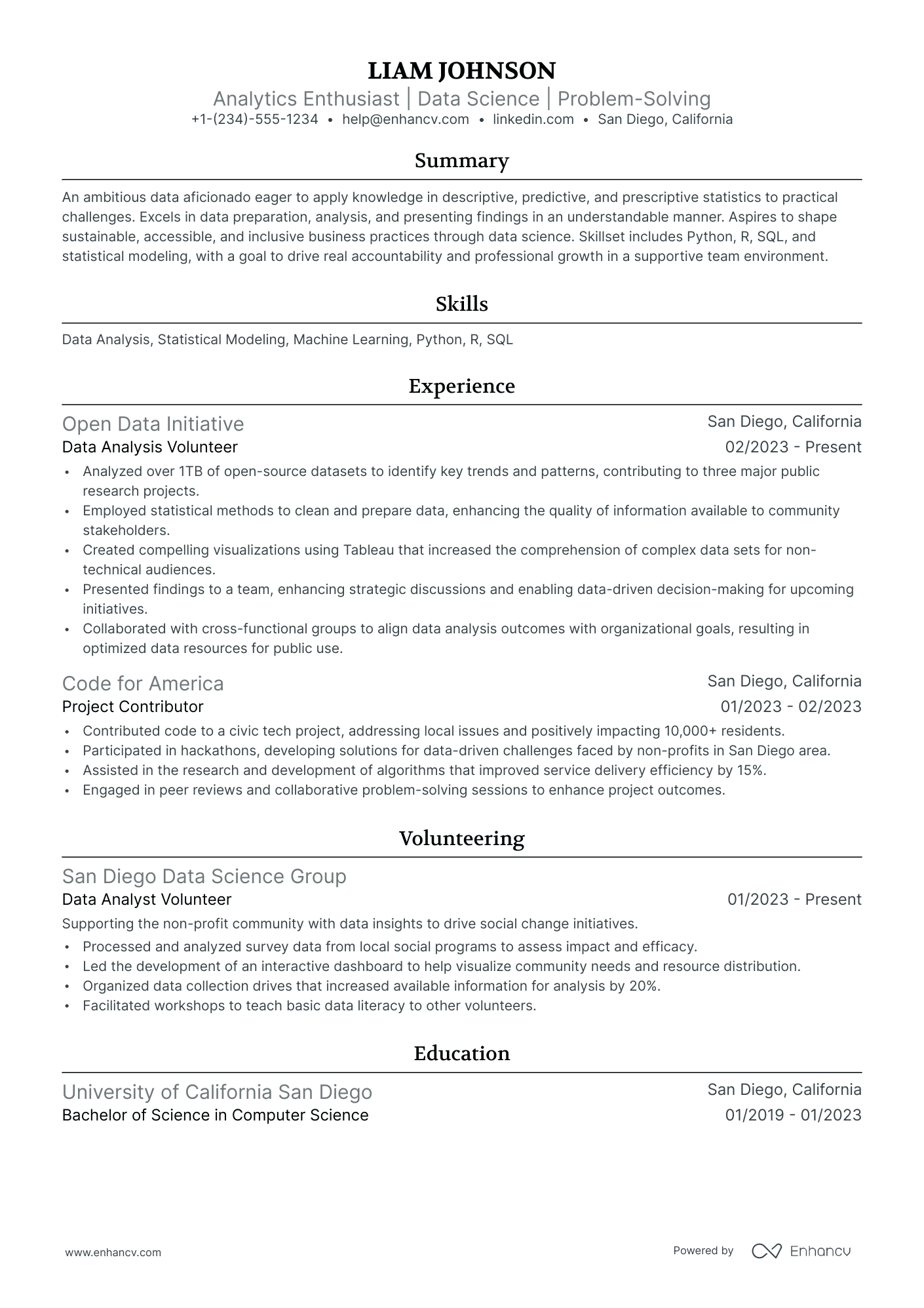
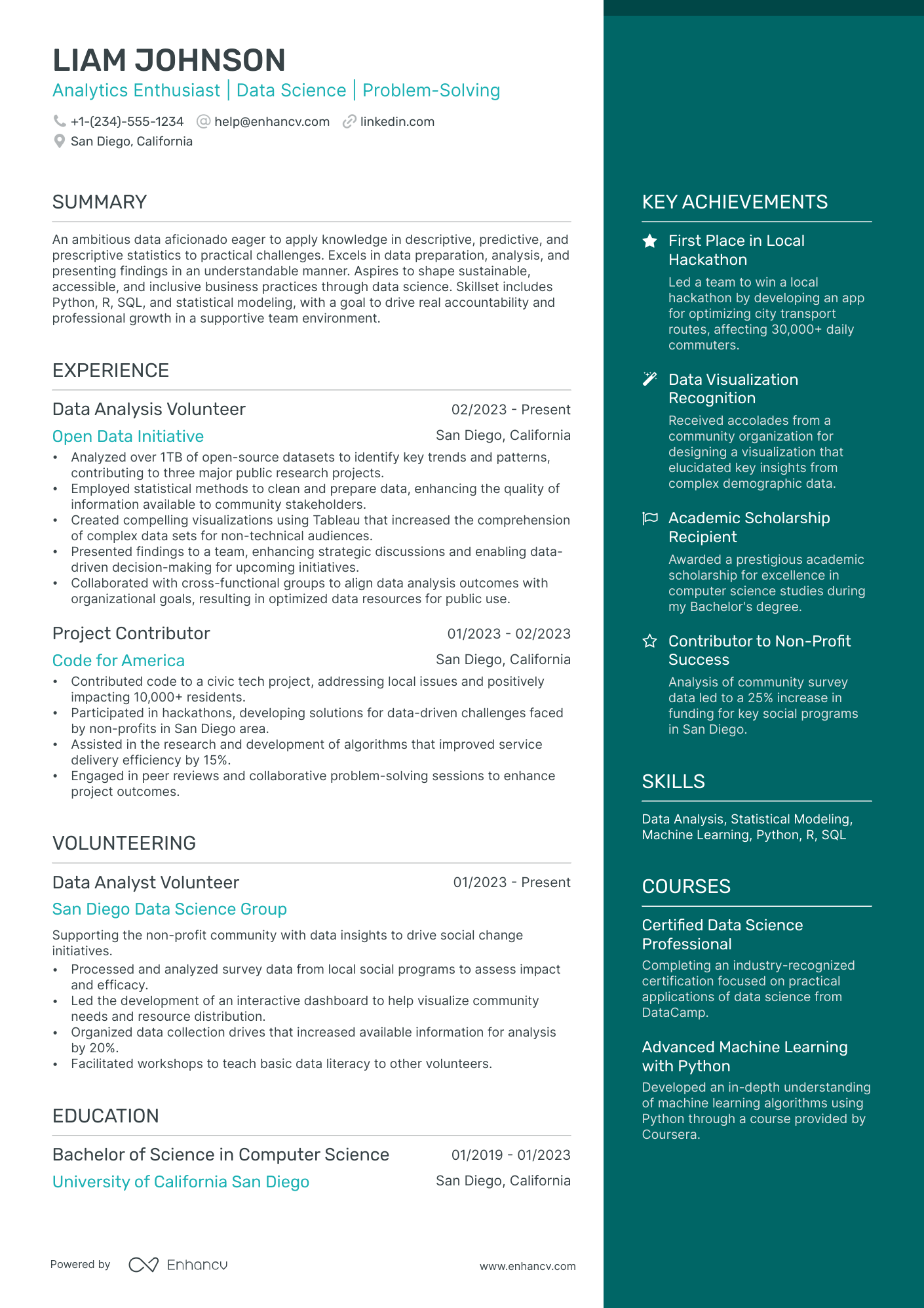
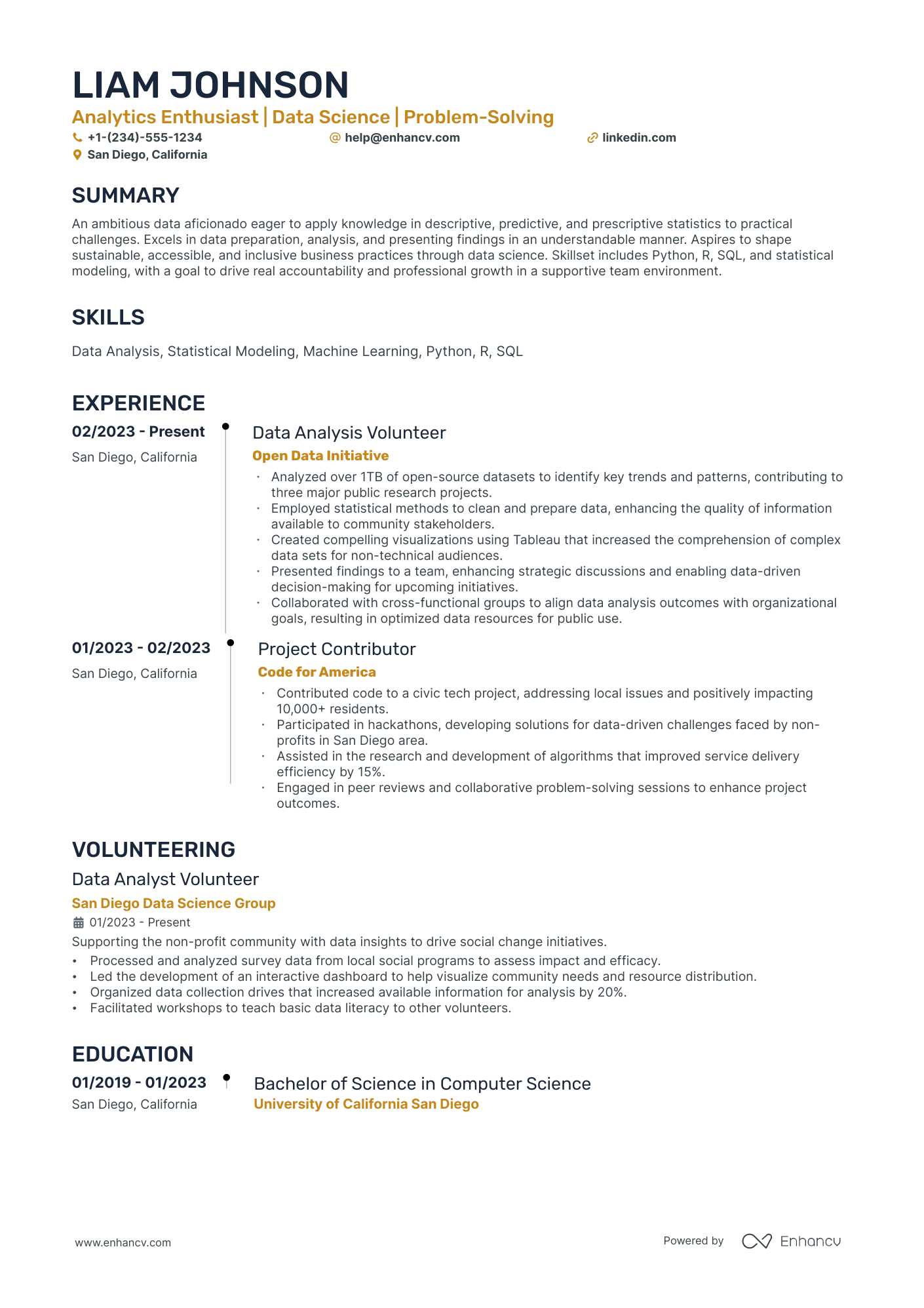
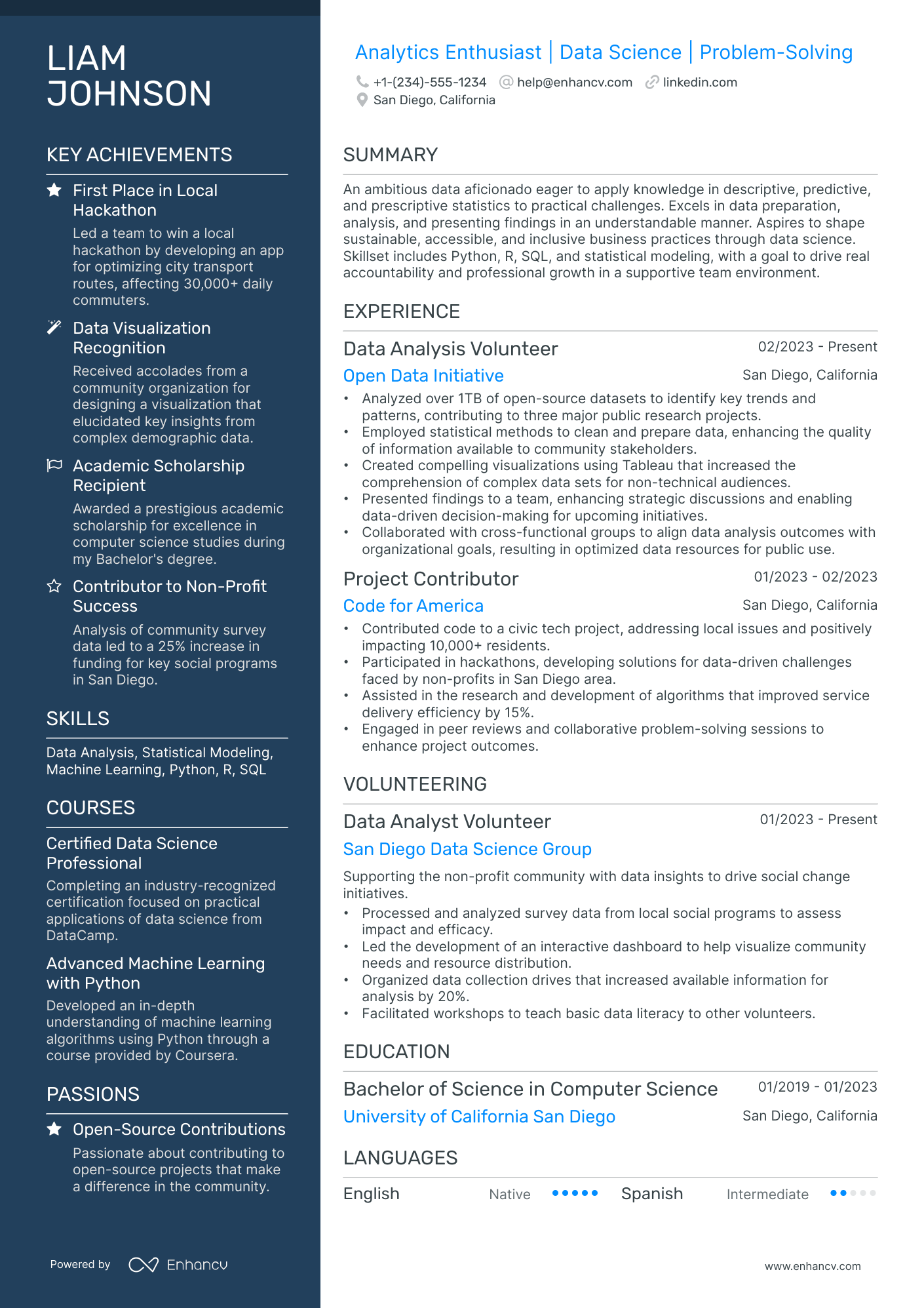
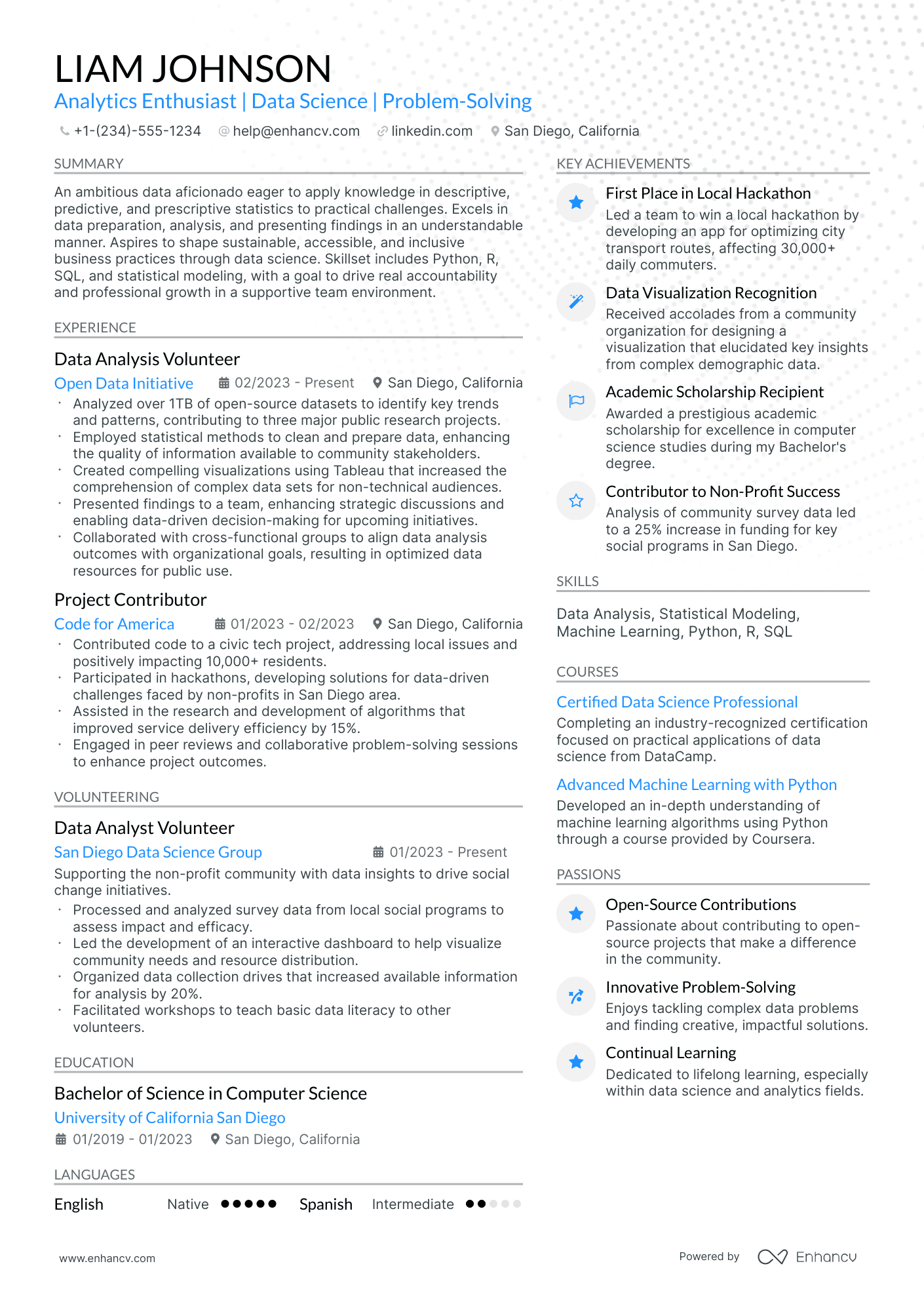
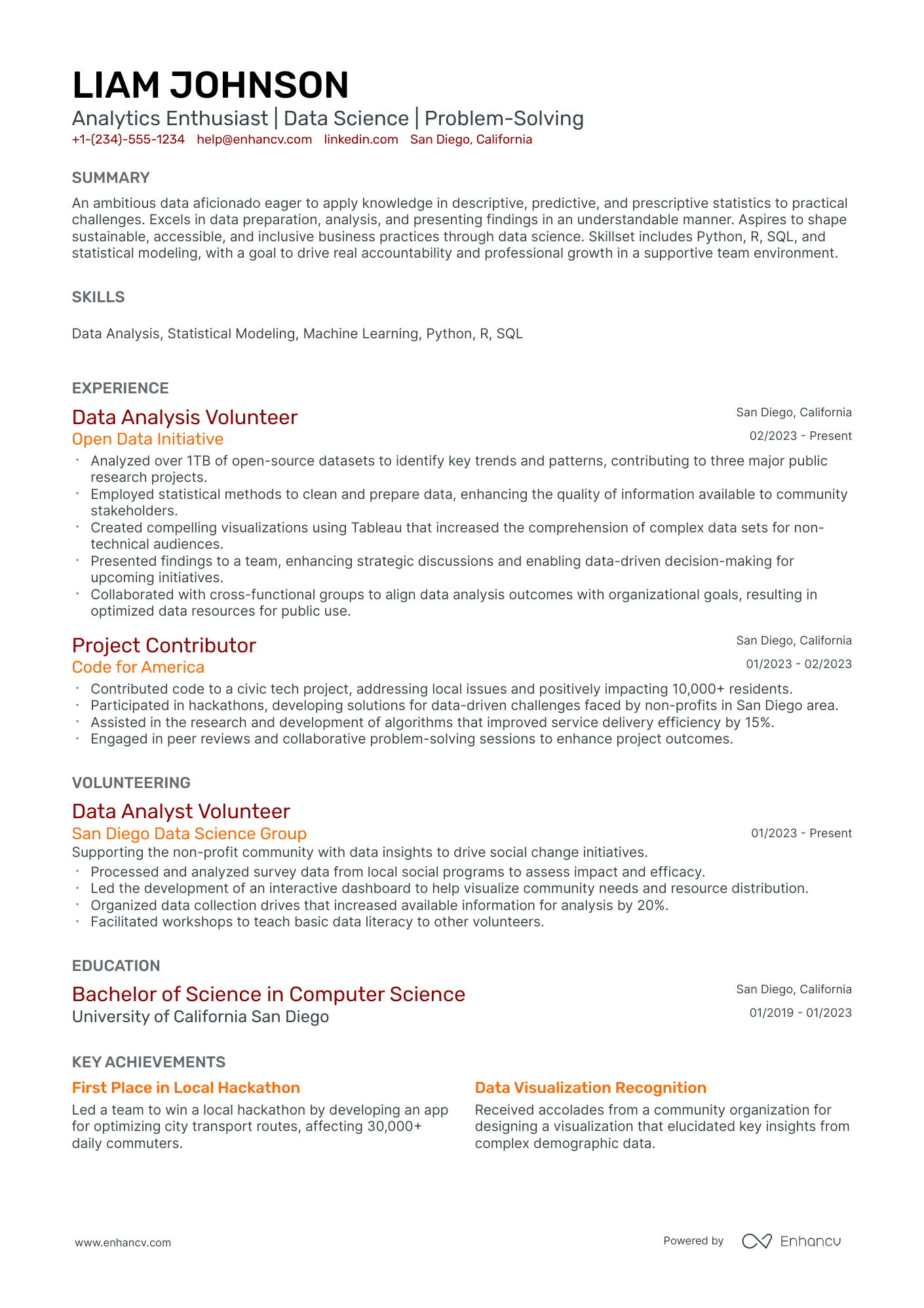
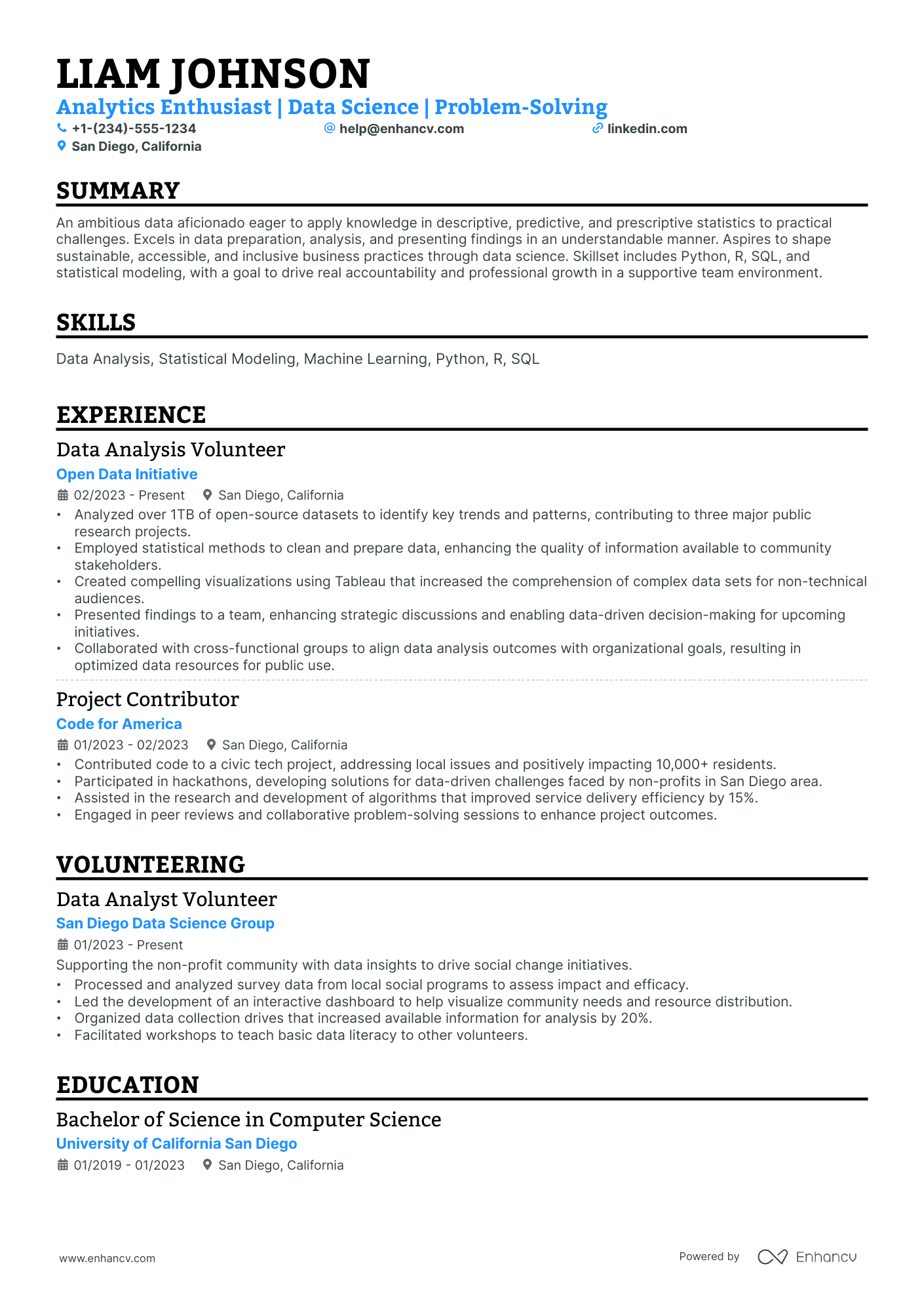
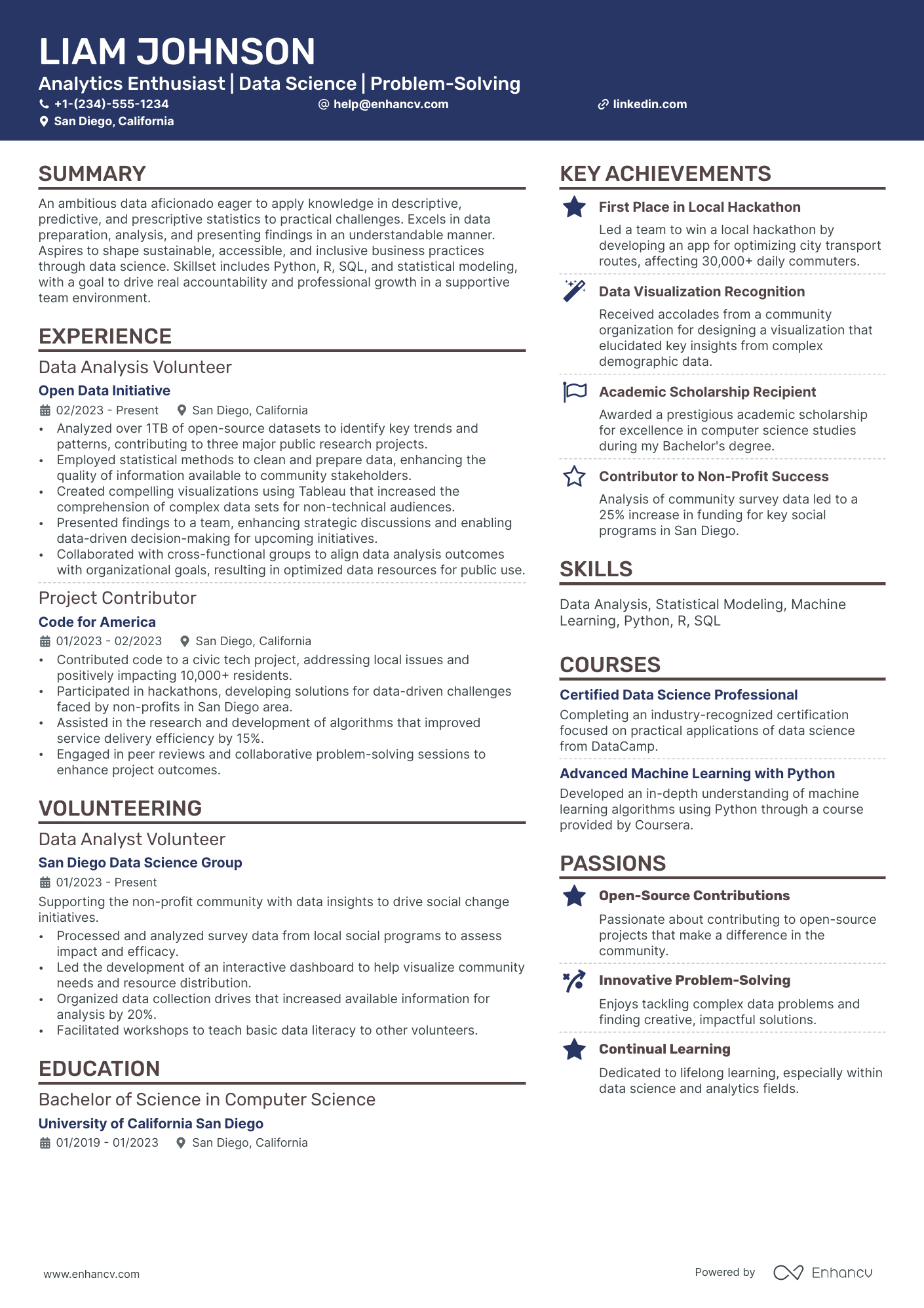
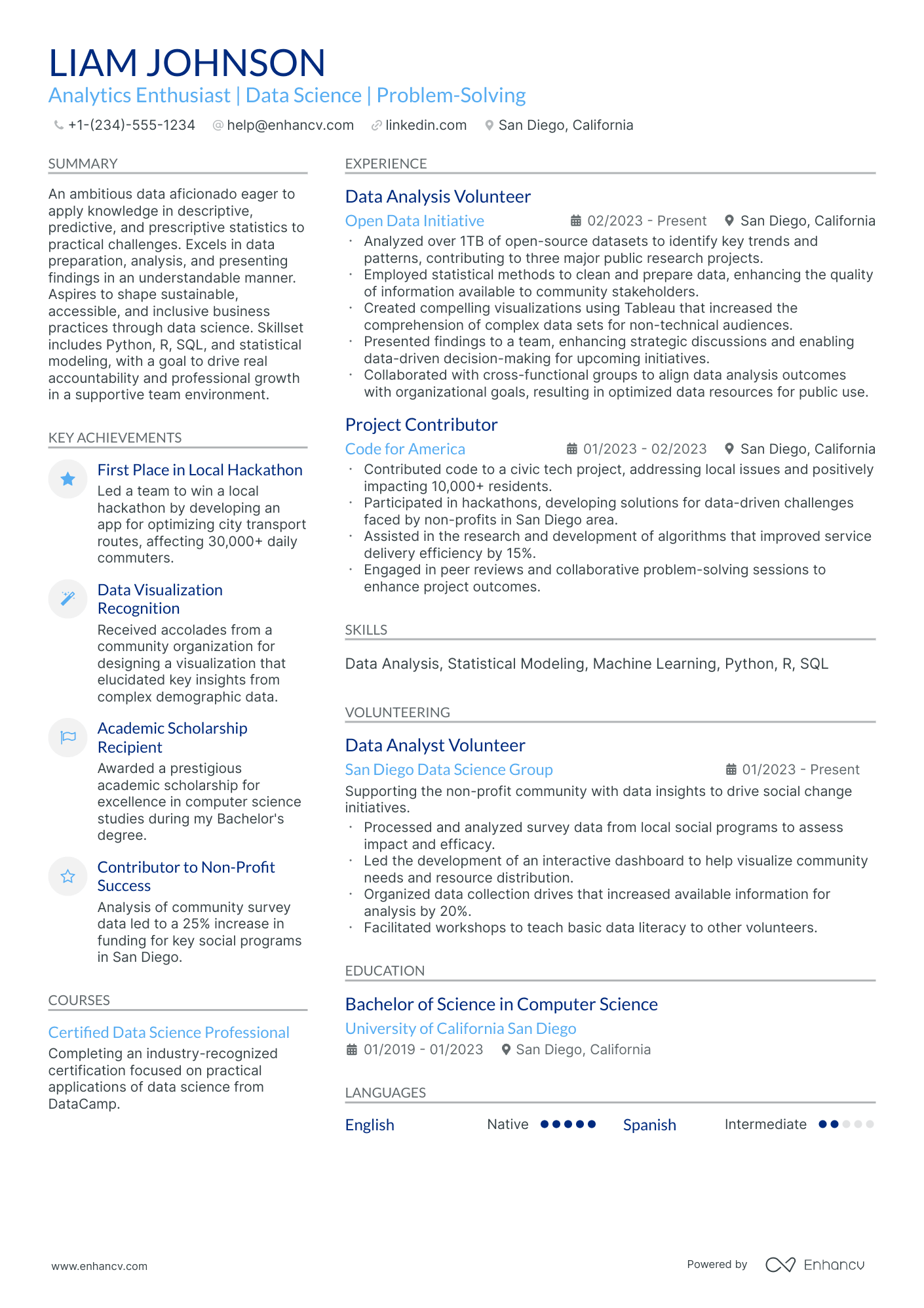
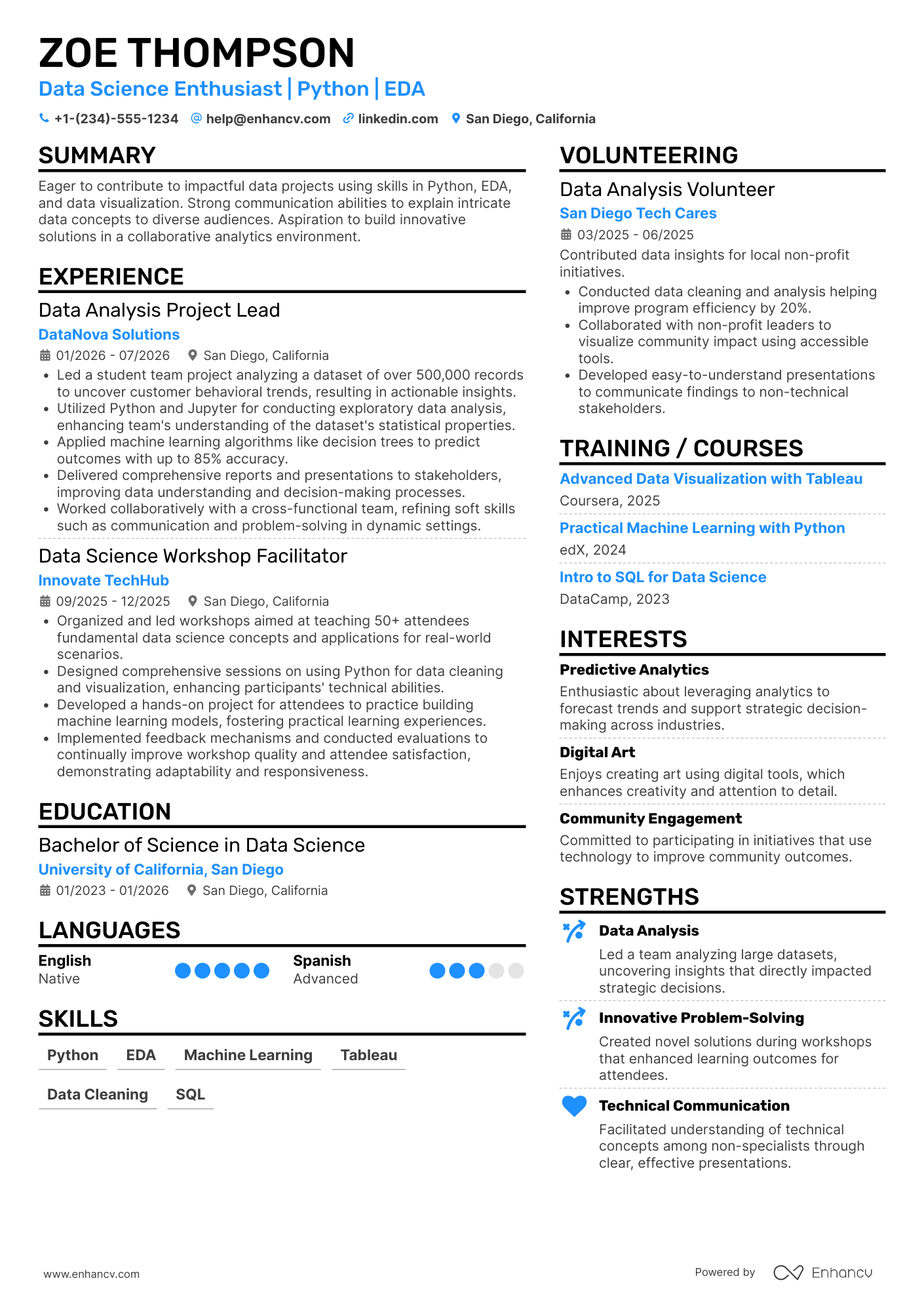
Most data science intern resume drafts fail because they list coursework and tools but don't show measurable impact. In today's high-volume hiring, a data science intern resume must pass applicant tracking system filters and win a fast recruiter scan.
A strong resume shows what you improved, shipped, or proved. You should highlight model lift, error reduction, runtime savings, dataset size, experiment results, dashboard adoption, fewer manual hours, clearer decisions, and cleaner data quality. If you're unsure where to begin, learning how to write a resume from scratch can help you build a solid foundation before diving into data science specifics.

Key takeaways
- Attach measurable outcomes like model accuracy, pipeline speed, or cost savings to every resume bullet.
- Choose a hybrid format if you lack experience, leading with skills and projects first.
- Tailor each bullet to mirror the exact tools, methods, and KPIs in the job posting.
- Replace vague task descriptions with specific scope, execution method, and quantified result.
- Place certifications above education when they're recent and directly relevant to the role.
- Use Enhancv's Bullet Point Generator to turn routine duties into recruiter-ready, quantified statements.
- Write a three-to-four-line summary naming your tools, domain focus, and one standout achievement.
Job market snapshot for data science interns
We analyzed 82 recent data science intern job ads across major US job boards. These numbers help you understand salary landscape, skills in demand, role specialization trends at a glance.
What level of experience employers are looking for data science interns
| Years of Experience | Percentage found in job ads |
|---|---|
| 1–2 years | 4.9% (4) |
| 5–6 years | 1.2% (1) |
| 10+ years | 2.4% (2) |
| Not specified | 91.5% (75) |
Data science intern ads by area of specialization (industry)
| Industry (Area) | Percentage found in job ads |
|---|---|
| Finance & Banking | 34.1% (28) |
| Healthcare | 19.5% (16) |
| Government | 14.6% (12) |
Top companies hiring data science interns
| Company | Percentage found in job ads |
|---|---|
| Korn/Ferry International | 14.6% (12) |
Role overview stats
These tables show the most common responsibilities and employment types for data science intern roles. Use them to align your resume with what employers expect and to understand how the role is structured across the market.
Day-to-day activities and top responsibilities for a data science intern
| Responsibility | Percentage found in job ads |
|---|---|
| Python | 72.0% (59) |
| Sql | 50.0% (41) |
| Machine learning | 42.7% (35) |
| Data analysis | 29.3% (24) |
| R | 28.0% (23) |
| Data visualization | 20.7% (17) |
| Data science | 19.5% (16) |
| Pandas | 13.4% (11) |
| Scikit-learn | 13.4% (11) |
| Statistics | 13.4% (11) |
| Data engineering | 9.8% (8) |
| Tableau | 9.8% (8) |
Type of employment (remote vs on-site vs hybrid)
| Employment type | Percentage found in job ads |
|---|---|
| On-site | 53.7% (44) |
| Hybrid | 30.5% (25) |
| Remote | 15.9% (13) |
How to format a data science intern resume
Recruiters reviewing data science intern resumes prioritize technical skills, relevant coursework, and project-based evidence of analytical thinking—often scanning for these signals in under 10 seconds. Your resume format directly determines whether these elements surface quickly or get buried, so choosing the right structure is essential for passing both human review and applicant tracking system (ATS) scans.

I have significant experience in this role—which format should I use?
Use a reverse-chronological format to put your most recent and relevant internships, projects, or research at the top where recruiters will see them first. Do:
- Lead with your most recent data science internship, co-op, or research role to show clear progression and growing ownership of analytical tasks.
- Highlight role-specific tools and skills—Python, R, SQL, scikit-learn, TensorFlow, Tableau, or statistical modeling—within the context of each experience entry.
- Attach measurable outcomes or business impact to every bullet, quantifying results wherever possible.
I'm junior or switching into this role—what format works best?
Use a hybrid format that leads with a focused skills section, then supports it with project and education entries in reverse-chronological order. Do:
- Place a technical skills section near the top of your resume listing programming languages, libraries, and statistical methods relevant to data science internships.
- Feature academic projects, Kaggle competitions, capstone work, or personal portfolio projects as standalone experience entries with clear descriptions of your role and methods.
- Connect every listed action to a concrete outcome so recruiters can evaluate your analytical impact, even without formal work experience.
When does a functional resume make sense?
A functional format is rarely the best choice for data science intern roles because it strips away the project and timeline context that recruiters use to assess your hands-on analytical ability. However, it can work in a narrow set of situations:
- You're transitioning from an unrelated field (such as biology or finance) into data science and need to foreground newly acquired technical skills.
- You have limited formal work history but have completed intensive bootcamp projects, self-directed analyses, or open-source contributions that demonstrate applied data science competency.
- A functional format is acceptable when you're making a career pivot into data science with no prior analytics roles, but only if every listed skill is anchored to a concrete project, dataset, or outcome that demonstrates real application.
Once your format establishes a clean, readable structure, the next step is filling it with the right sections to highlight your qualifications effectively.
What sections should go on a data science intern resume
Recruiters expect a clean, results-focused resume that shows you can analyze data, build models, and communicate insights clearly. Knowing which resume sections to include ensures you don't miss anything hiring managers expect to see.
Use this structure for maximum clarity:
- Header
- Summary
- Experience
- Skills
- Projects
- Education
- Certifications
- Optional sections: Research, Open-source work, Awards
Strong experience bullets should emphasize measurable impact, clear outcomes, and the scope of your analysis, modeling, and stakeholder collaboration.
Is your resume good enough?
Drop your resume here or choose a file. PDF & DOCX only. Max 2MB file size.
Once you’ve organized your resume with the right core sections, focus next on writing your data science intern resume experience so employers can see the impact behind each entry.
How to write your data science intern resume experience
The work experience section is where you prove you can ship real data science work—not just describe coursework or list tools you've touched. Hiring managers prioritize demonstrated impact, so every bullet should connect a role-relevant method or tool to a measurable outcome you personally delivered.
Each entry should include:
- Job title
- Company and location (or remote)
- Dates of employment (month and year)
Three to five concise bullet points showing what you owned, how you executed, and what outcomes you delivered:
- Ownership scope: the datasets, pipelines, models, dashboards, or analytical projects you were directly accountable for as a data science intern.
- Execution approach: the languages, libraries, statistical methods, machine learning frameworks, or data engineering tools you applied to solve specific problems and deliver finished work.
- Value improved: the changes you drove in model accuracy, prediction reliability, data processing speed, reporting efficiency, or decision-making quality within your team or organization.
- Collaboration context: how you partnered with data engineers, product managers, software developers, or business stakeholders to scope questions, validate findings, and translate analytical results into action.
- Impact delivered: the concrete outcomes your work produced—expressed through business results, operational scale, or stakeholder adoption rather than a summary of tasks you performed.
Experience bullet formula
A data science intern experience example
✅ Right example - modern, quantified, specific.
Data science intern
Nimbus Health | Remote
2025–2025
Digital health startup serving 1M+ monthly users across web and mobile care navigation.
- Built a churn prediction model in Python (pandas, scikit-learn, XGBoost) using 18 months of event data; improved area under the curve from 0.71 to 0.84 and reduced monthly churn by 3.2% after rollout.
- Developed a dbt + Snowflake feature pipeline with Airflow scheduling; cut model refresh time from six hours to forty-five minutes and improved data completeness from 92% to 99%.
- Designed and analyzed an A/B test with a product manager and designer in Amplitude; increased onboarding completion by 8.6% and drove an estimated $120K in annualized retention revenue.
- Created Tableau dashboards for support and operations leaders; decreased time-to-detect billing anomalies by 60% and reduced ticket backlog by 14% through weekly triage.
- Partnered with data engineering to implement Great Expectations checks and GitHub Actions continuous integration; lowered production data incidents from five per month to two per month.
Now that you've seen how a strong experience entry comes together, let's look at how to adjust yours to match the specific role you're applying for.
How to tailor your data science intern resume experience
Recruiters evaluate data science intern resumes through both human review and applicant tracking systems, so tailoring your resume to the job description is essential. Aligning each bullet to reflect the employer's specific needs increases your chances of passing both screening stages.
Ways to tailor your data science intern experience:
- Match Python R SQL or other tools listed in the job description.
- Mirror the machine learning frameworks the employer specifies.
- Use the exact terminology for statistical methods they reference.
- Reflect data visualization platforms named in the posting.
- Include relevant industry or domain experience when the role requires it.
- Emphasize data quality or validation processes if the posting mentions them.
- Highlight cross-functional collaboration with engineering or product teams.
- Align your metrics with the KPIs or success criteria they describe.
Tailoring means aligning your real accomplishments with what the role demands, not forcing keywords where they don't belong.
Resume tailoring examples for data science intern
| Job description excerpt | Untailored | Tailored |
|---|---|---|
| "Assist in building predictive models using Python and scikit-learn to support marketing analytics." | Worked on data projects using various programming languages. | Built three predictive churn models in Python with scikit-learn that helped the marketing team identify at-risk customer segments, improving retention targeting accuracy by 18%. |
| "Clean, transform, and analyze large datasets using SQL and Pandas to generate actionable business insights." | Helped with data analysis and created reports for the team. | Wrote SQL queries across four relational databases and used Pandas to clean and transform 500K+ row datasets, delivering weekly insight reports that informed product pricing decisions. |
| "Collaborate with cross-functional teams to design and evaluate A/B tests for product feature rollouts." | Participated in team meetings and contributed to group projects. | Partnered with product and engineering teams to design A/B tests for two feature rollouts, defining success metrics, calculating sample sizes, and presenting statistical results that guided the final launch decision. |
Once you’ve aligned your experience with the internship’s requirements, quantify your data science intern achievements to show the measurable impact behind those choices.
How to quantify your data science intern achievements
Quantifying your achievements proves business impact beyond code. For a data science intern, focus on model performance, data quality, pipeline speed, cost savings, and delivery outcomes tied to real users.
Quantifying examples for data science intern
| Metric | Example |
|---|---|
| Model performance | "Improved churn model AUC from 0.74 to 0.82 using XGBoost and feature engineering on two million rows, raising top-decile lift by 18%." |
| Data quality | "Cut missing values in the training dataset from 12% to 3% by adding Great Expectations checks and fixing three upstream schema issues." |
| Pipeline efficiency | "Reduced daily ETL runtime from 45 minutes to 14 minutes by optimizing Spark joins and partitioning, keeping costs flat." |
| Reliability | "Lowered inference job failure rate from 6% to 1% by adding retries, idempotent writes, and Datadog alerts on latency and errors." |
| Delivery speed | "Shipped a production-ready model API in three weeks, including Docker, unit tests, and a CI pipeline, supporting five internal analysts." |
Turn vague job duties into measurable, recruiter-ready resume bullets in seconds with Enhancv's Bullet Point Generator.
With strong bullet points in place, the next step is making sure your skills section clearly highlights the hard and soft skills that data science hiring managers are looking for.
How to list your hard and soft skills on a data science intern resume
Your skills section shows recruiters and an ATS (applicant tracking system) that you can build, validate, and communicate data-driven work, and it helps hiring teams match you to the internship's stack; aim for more hard skills than soft skills. data science intern roles require a blend of:
- Product strategy and discovery skills.
- Data, analytics, and experimentation skills.
- Delivery, execution, and go-to-market discipline.
- Soft skills.
Your skills section should be:
- Scannable (bullet-style grouping).
- Relevant to the job post.
- Backed by proof in experience bullets.
- Updated with current tools.
Place your skills section:
- Above experience if you're junior or switching careers.
- Below experience if you're mid/senior with strong achievements.

Hard skills
- Python, pandas, NumPy
- SQL, window functions, joins
- Jupyter Notebook, Google Colab
- scikit-learn model training
- Feature engineering
- Model evaluation, cross-validation
- A/B testing, hypothesis testing
- Statistics, probability
- Data visualization, Tableau, Power BI
- Git, GitHub, pull requests
- dbt, data modeling
- AWS S3, BigQuery
Soft skills
- Translate questions into metrics
- Clarify requirements with stakeholders
- Communicate findings to nontechnical teams
- Write concise experiment readouts
- Document assumptions and decisions
- Prioritize tasks by impact and effort
- Ask for feedback early and often
- Manage deadlines and scope changes
- Collaborate in code reviews
- Handle data issues with urgency
- Present tradeoffs and recommendations
- Take ownership of deliverables
How to show your data science intern skills in context
Skills shouldn't live only in a dedicated skills list. Explore curated resume skills examples to see how other candidates in your field present their technical and interpersonal abilities.
They should be demonstrated in:
- Your summary (high-level professional identity)
- Your experience (proof through outcomes)
Here's what both look like in practice.
Summary example
Senior data science intern with two years of experience in healthcare analytics. Skilled in Python, SQL, and predictive modeling. Built a patient readmission model that reduced false positives by 18%, collaborating across clinical and engineering teams.
- Reflects senior intern experience level
- Names role-relevant tools and methods
- Includes a measurable outcome
- Highlights cross-functional collaboration
Experience example
Data Science Intern
Meridian Health Analytics | Remote
June 2023–August 2024
- Built a churn prediction model in Python and scikit-learn, improving patient retention targeting accuracy by 22%.
- Partnered with product and clinical teams to design SQL dashboards tracking three key operational metrics weekly.
- Automated data cleaning pipelines using Pandas, cutting preprocessing time by 35% across two active research projects.
- Every bullet includes measurable proof.
- Skills appear naturally through outcomes.
Once you’ve demonstrated your data science strengths through relevant examples, the next step is structuring a data science intern resume with no experience to showcase those examples effectively.
How do I write a data science intern resume with no experience
Even without full-time experience, you can demonstrate readiness through projects and coursework. If you're starting from scratch, this guide on writing a resume without work experience walks you through how to build a compelling application using what you already have.
- Capstone data science intern project
- Kaggle competition notebooks and rankings
- Research assistant data analysis work
- Course projects using real datasets
- Open-source contributions to data tools
- Personal portfolio with GitHub repos
- Volunteer analytics for nonprofits
- Technical blog posts with code
Focus on:
- SQL, Python, and notebooks
- Clean, reproducible project workflow
- Quantified impact and results
- Domain-relevant datasets and metrics
Resume format tip for entry-level data science intern
Use a hybrid resume format because it highlights projects and skills first, while still showing education and any relevant work history. Do:
- Put projects above work experience.
- Lead bullets with methods and tools.
- Add links to GitHub and notebooks.
- Quantify results with clear metrics.
- Match keywords to the job post.
- Built a Python and SQL churn model on a public telecom dataset, engineered twenty features, and improved F1 score from 0.62 to 0.74.
Once you've structured your resume around transferable skills and relevant projects, the next step is presenting your education—often your strongest asset as a candidate without professional experience.
How to list your education on a data science intern resume
Your education section lets hiring teams confirm you have the foundational knowledge a data science intern needs. It highlights relevant training in statistics, programming, and analytical thinking.
Include:
- Degree name
- Institution
- Location
- Graduation year
- Relevant coursework (for juniors or entry-level candidates)
- Honors & GPA (if 3.5 or higher)
Skip month and day details—list the graduation year only.
Here's a strong education entry tailored for a data science intern resume:
Example education entry
Bachelor of Science in Statistics
University of Michigan, Ann Arbor, MI
Graduation: 2025
GPA: 3.7/4.0
- Relevant Coursework: Machine Learning, Applied Regression Analysis, Data Visualization, Probability Theory, SQL for Data Analytics
- Honors: Dean's List (six consecutive semesters)
How to list your certifications on a data science intern resume
Certifications on your resume show your commitment to learning, prove tool proficiency, and signal industry relevance for a data science intern role, especially when your experience is still growing.
Include:
- Certificate name
- Issuing organization
- Year
- Optional: credential ID or URL
- Put certifications below education when your degree is current, and the certifications are older or loosely related to a data science intern role.
- Put certifications above education when they are recent, highly relevant, and highlight job-ready skills for a data science intern role.
Best certifications for your data science intern resume
Google Data Analytics Professional Certificate IBM Data Science Professional Certificate Microsoft Certified: Azure Data Scientist Associate AWS Certified Machine Learning—Specialty TensorFlow Developer Certificate SAS Certified Specialist: Base Programming Using SAS 9.4 Databricks Certified Associate Developer for Apache Spark
Once you’ve placed your certifications where they’re easy to verify, use your data science intern resume summary to reinforce those qualifications and set context upfront.
How to write your data science intern resume summary
Your resume summary is the first thing a recruiter reads. A strong one instantly signals you have the right skills and potential for a data science intern role.
Keep it to three to four lines, with:
- Your title and relevant academic or internship experience.
- Domain or industry focus, such as healthcare analytics or e-commerce.
- Core tools and technologies like Python, SQL, pandas, or scikit-learn.
- One or two quantified achievements from projects, coursework, or internships.
- Soft skills tied to real outcomes, such as collaboration that improved a team deliverable.

PRO TIP
At the intern level, emphasize technical skills, relevant coursework, and any measurable contributions from projects or past internships. Avoid generic phrases like "passionate learner" or "hard worker." Instead, show what you did and the result it produced.
Example summary for a data science intern
Data science intern with hands-on Python and SQL experience. Built a classification model during a capstone project that improved prediction accuracy by 18%. Strong collaborator skilled in pandas, scikit-learn, and data visualization.
Optimize your resume summary and objective for ATS
Drop your resume here or choose a file.
PDF & DOCX only. Max 2MB file size.
Now that your summary is ready to highlight your strongest qualifications, make sure the header above it presents your contact details clearly so recruiters can actually reach you.
What to include in a data science intern resume header
A well-crafted resume header lists your key contact and professional links, and it boosts visibility, credibility, and recruiter screening for a data science intern role.
Essential resume header elements
- Full name
- Tailored job title and headline
- Location
- Phone number
- Professional email
- GitHub link
- Portfolio link
A LinkedIn link helps recruiters verify experience quickly and supports screening with consistent dates, titles, and projects.
Don't include a photo on a data science intern resume unless the role is explicitly front-facing or appearance-dependent.
Keep your header to two lines, use consistent formatting, and match your job title and headline to the data science intern posting.
Data science intern resume header
Jordan Lee
Data science intern — Python, SQL, and machine learning projects
Austin, TX | (512) 555-01XX | your.name@enhancv.com github.com/yourname yourwebsite.com linkedin.com/in/yourname
Once your contact details and key identifiers are set up to make you easy to reach and quickly understood, add additional sections to round out the rest of your data science intern resume.
Additional sections for data science intern resumes
Extra resume sections help you stand out when your core experience looks similar to other data science intern candidates.
They showcase unique strengths, specialized knowledge, or role-specific credibility that hiring managers value.
Consider adding any of these sections that genuinely reflect your background:
- Publications and research papers
- Technical certifications (e.g., AWS, Google Cloud, TensorFlow)
- Kaggle competitions and rankings
- Languages
- Hackathons and data science challenges
- Open-source contributions
- Hobbies and interests
Choose sections that reinforce your analytical skills or demonstrate genuine curiosity about data science. Leave off anything that doesn't strengthen your candidacy.
Once you've strengthened your resume with relevant additional sections, the next step is pairing it with a cover letter that adds even more context to your application.
Do data science intern resumes need a cover letter
A cover letter isn't required for a data science intern, but it helps when roles are competitive or hiring managers expect context. If you're unsure where to start, understanding what a cover letter is and how it complements your resume can help you decide whether to include one. It can make a difference when your resume needs a quick story about fit, impact, or direction.
Use a cover letter to add context your resume can't show:
- Explain why you fit the role, team, or domain, and connect your skills to the internship's day-to-day work.
- Highlight one or two relevant projects, including outcomes like accuracy lift, time saved, or clearer decisions for stakeholders.
- Show you understand the product, users, or business context, and name one metric or workflow you'd improve.
- Address career transitions or non-obvious experience, and explain how it supports your work as a data science intern.
Drop your resume here or choose a file.
PDF & DOCX only. Max 2MB file size.
Even if you skip a cover letter, using AI to improve your data science intern resume helps you strengthen the document that hiring teams review first.
Using AI to improve your data science intern resume
AI can sharpen your resume's clarity, structure, and impact. It helps refine phrasing and highlight relevant skills for data science intern roles. But overuse strips authenticity. Once your content feels clear and role-aligned, step away from AI assistance. If you're curious about where to start, explore ChatGPT resume writing prompts for practical ways to leverage AI without losing your voice.
Here are 10 practical prompts to strengthen specific sections of your data science intern resume:
- Strengthen your summary. "Rewrite my resume summary to highlight my most relevant qualifications for a data science intern position in two concise sentences."
- Quantify your impact. "Add measurable outcomes to these experience bullets for my data science intern resume, using metrics like percentages, dataset sizes, or time saved."
- Sharpen project descriptions. "Rewrite this project section to clearly show the tools, methods, and results I achieved as a data science intern candidate."
- Align technical skills. "Review my skills section and rank each skill by relevance to a data science intern role, removing any that don't apply."
- Improve action verbs. "Replace weak or repetitive verbs in my data science intern experience bullets with stronger, more specific alternatives."
- Tailor to postings. "Compare my resume to this data science intern job description and suggest edits to better match its required qualifications."
- Refine education details. "Rewrite my education section to emphasize coursework, GPA, and honors most relevant to a data science intern position."
- Clarify certification value. "Explain how each certification on my resume supports my candidacy for a data science intern role, and cut irrelevant ones."
- Remove filler language. "Identify and remove vague or unnecessary words from my data science intern resume without changing the core meaning."
- Tighten bullet structure. "Restructure my experience bullets into consistent, parallel format for a data science intern resume using action-verb-task-result order."
Stop using AI once your resume sounds accurate, specific, and aligned with real experience. AI should never invent experience or inflate claims—if it didn't happen, it doesn't belong here.
Conclusion
A strong data science intern resume shows measurable outcomes, role-specific skills, and a clear structure. It highlights projects and experience with numbers, names the tools you used, and stays easy to scan.
Keep each section focused and consistent so hiring teams find what they need fast. This approach shows you’re ready for today’s hiring market and the next hiring cycle.