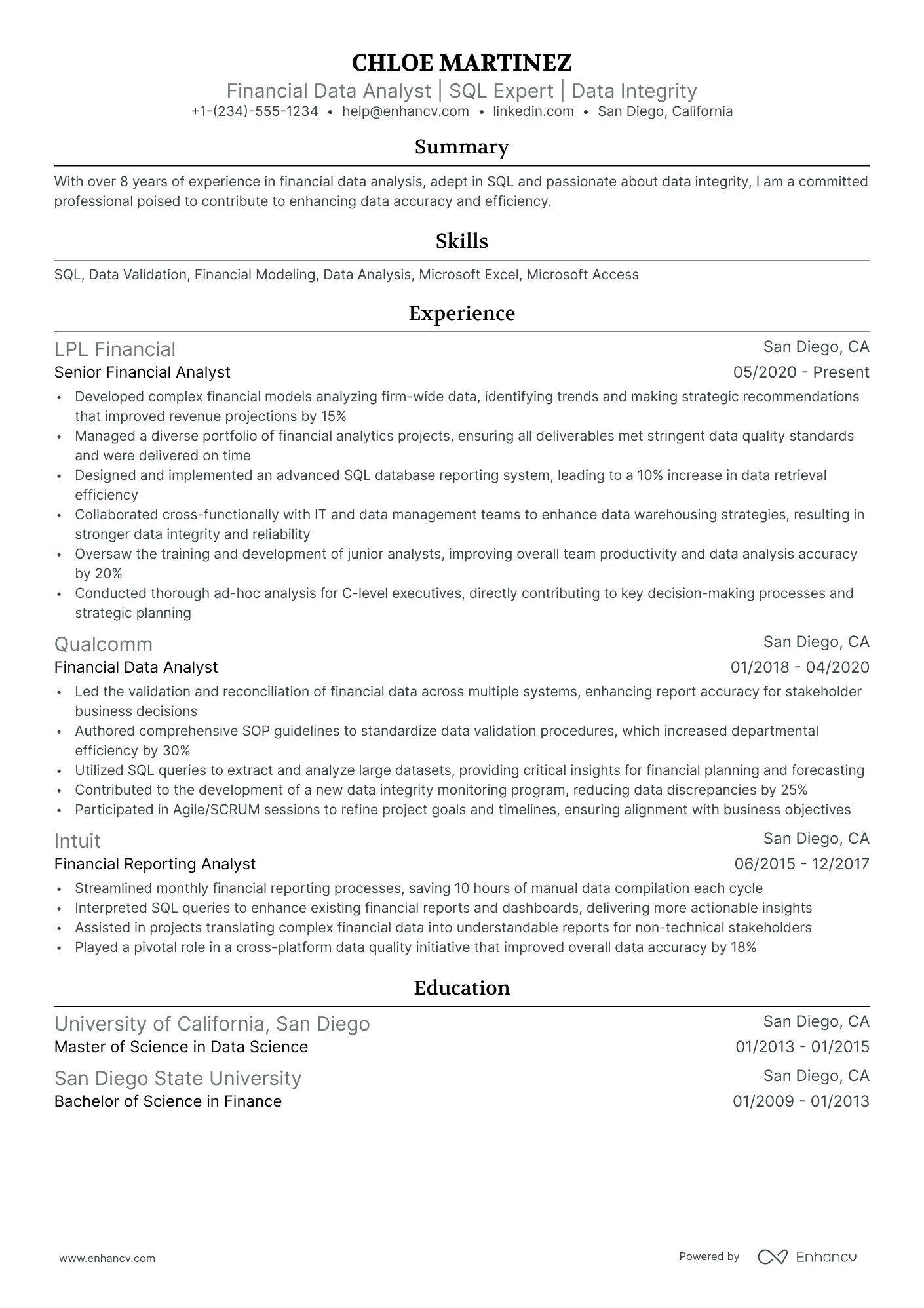
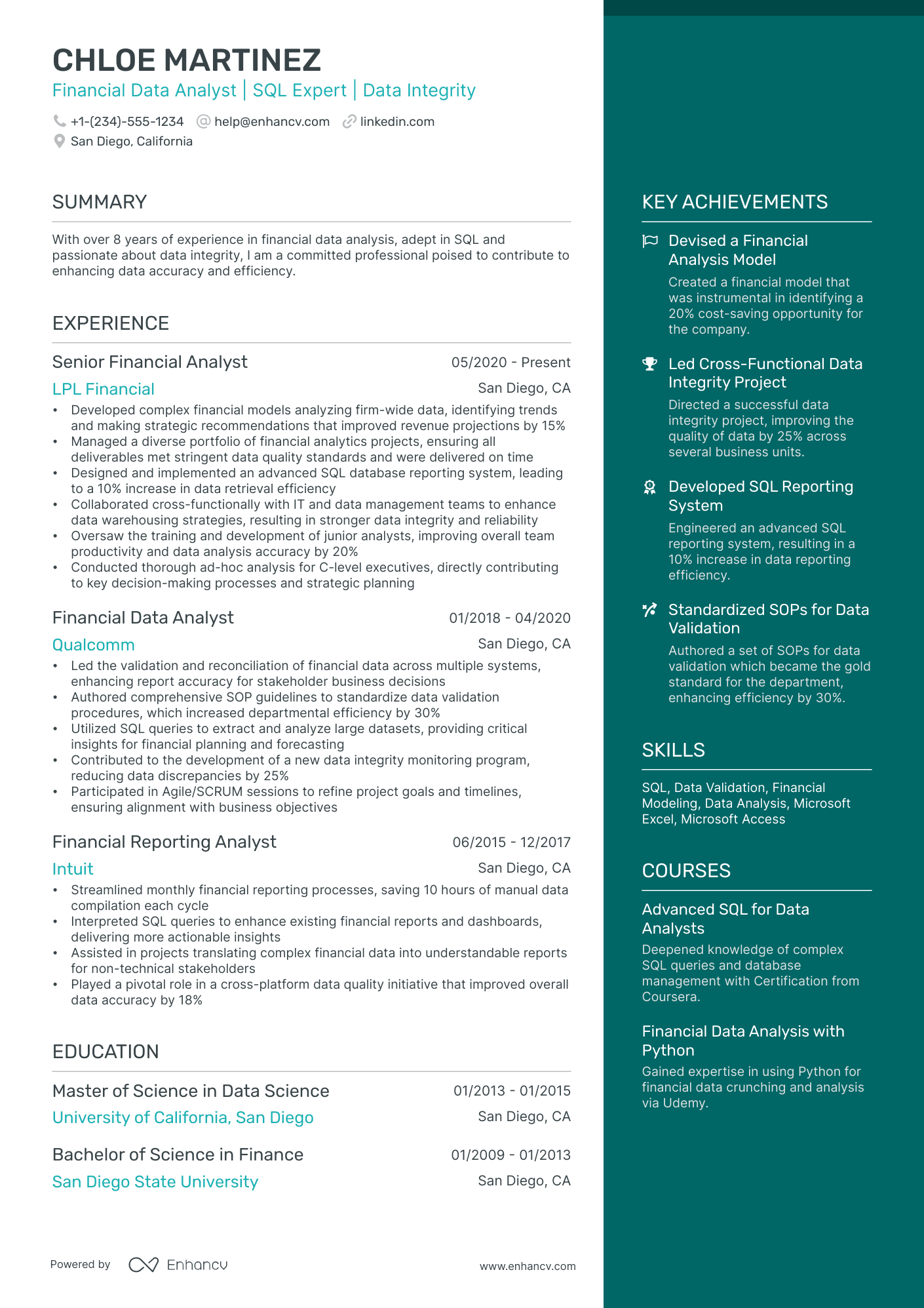
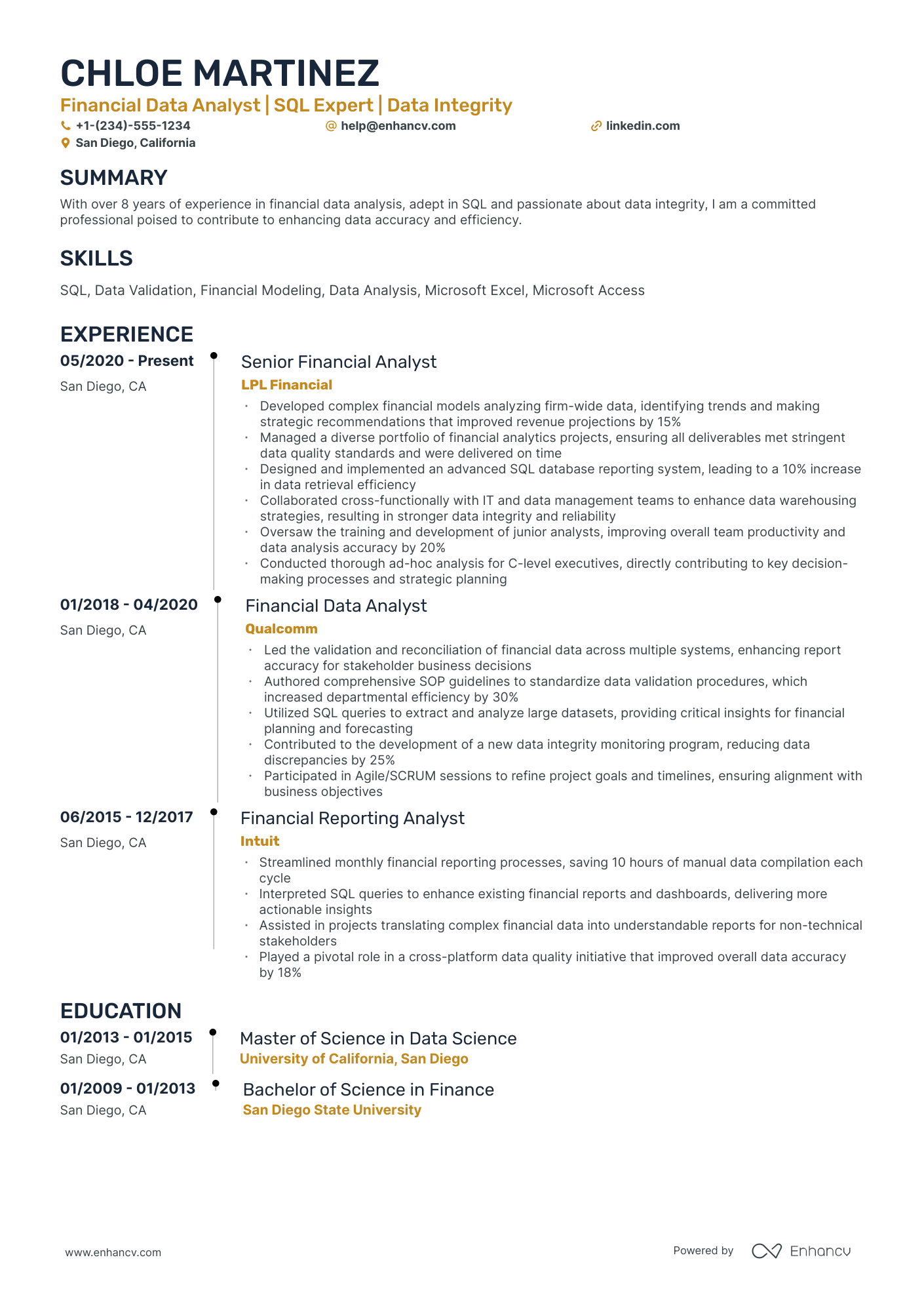
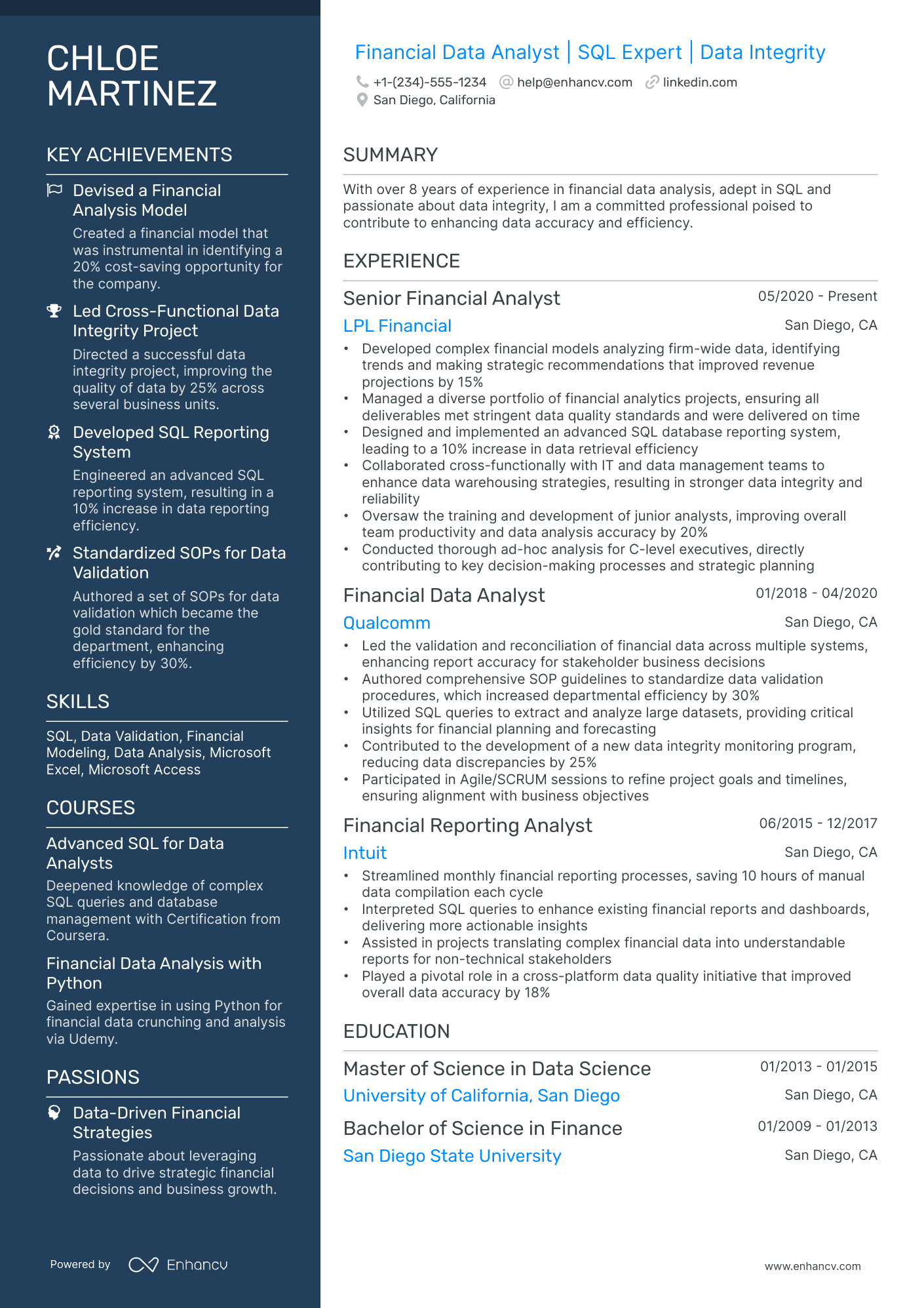
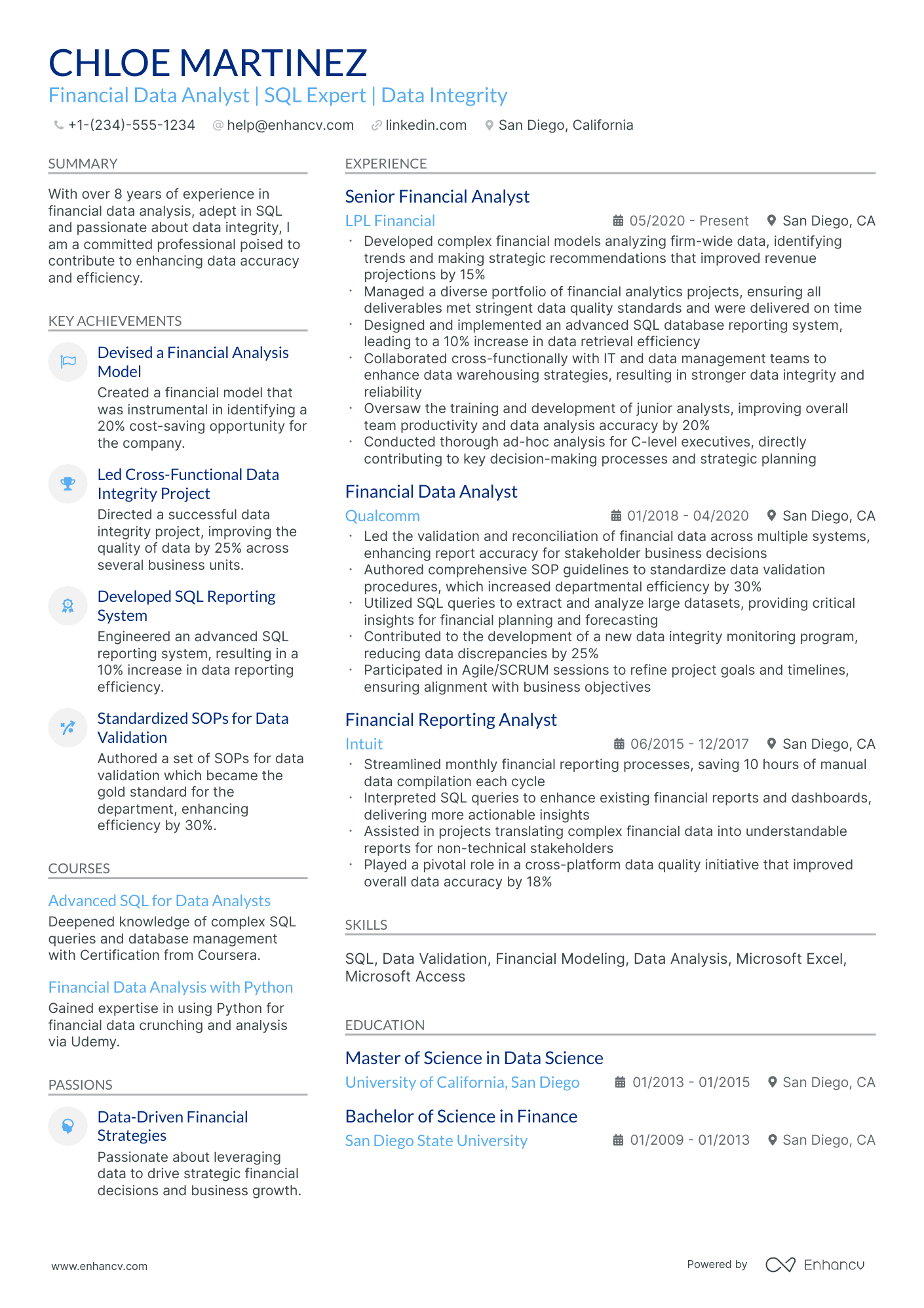
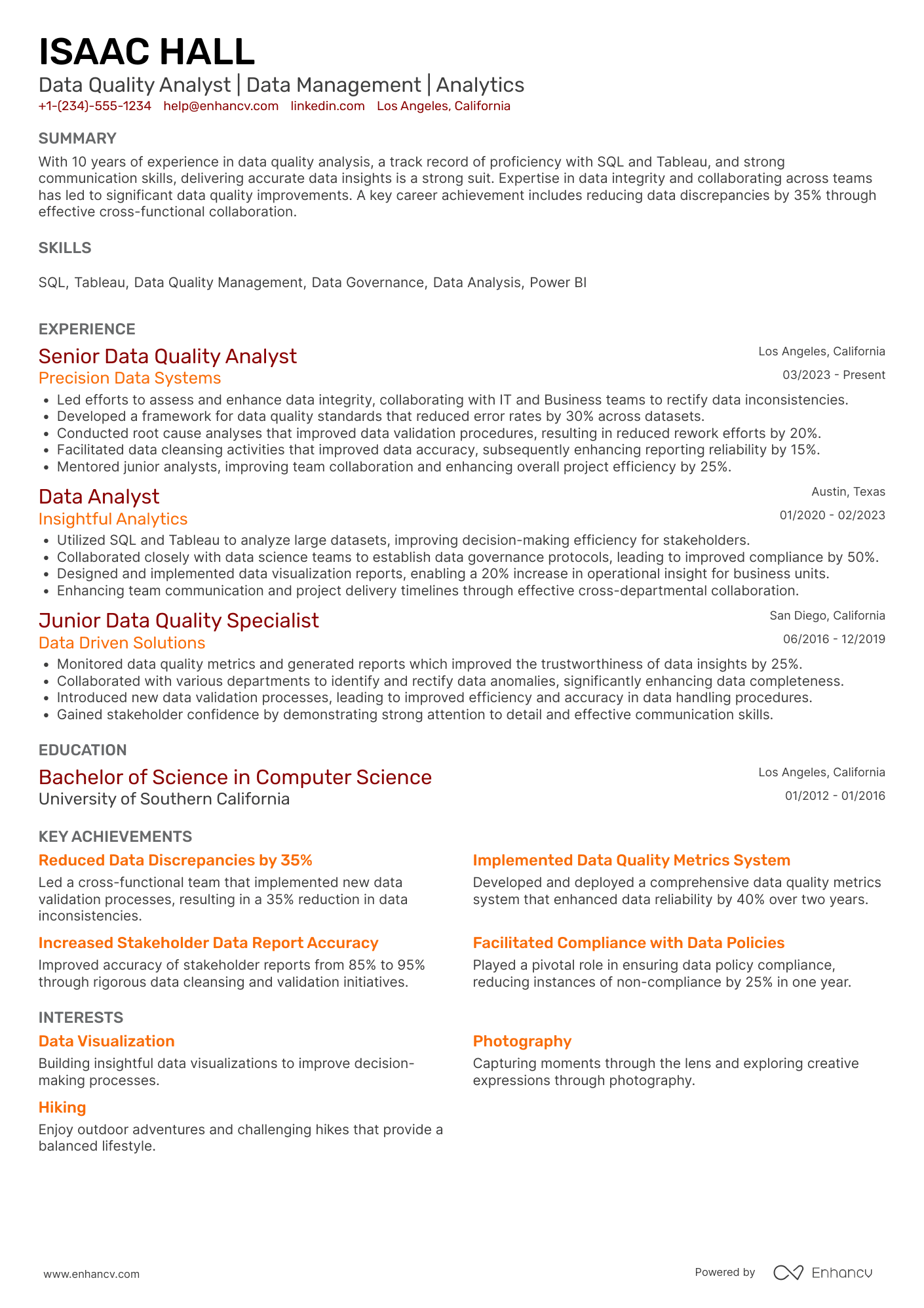
Most data quality analyst resume drafts fail because they list tools and tasks but don't prove measurable impact. That hurts when an ATS filters by keywords and recruiters scan in seconds amid heavy competition. If you're unsure where to begin, understanding how to write a resume that communicates value is the essential first step.
A strong resume shows how you improved accuracy, reduced error rates, and protected downstream reporting. You should quantify audit coverage, defect backlog reduction, faster issue resolution, and the business impact of cleaner data. Include delivery results like fewer incidents, higher stakeholder trust, and tighter service-level compliance.

Key takeaways
- Quantify data quality improvements like defect reduction and accuracy gains in every experience bullet.
- Use reverse-chronological format for experienced analysts and hybrid format for career changers.
- Tailor resume language to mirror each job posting's tools, frameworks, and KPIs.
- Place skills above experience if you're junior—below experience if you're mid-level or senior.
- Prove skills through measurable outcomes in your summary and experience, not just a list.
- Use AI to tighten phrasing and flag gaps, but stop before it overwrites your real experience.
- Enhancv can help you turn vague duties into quantified, recruiter-ready resume bullets faster.
Job market snapshot for data quality analysts
We analyzed 51 recent data quality analyst job ads across major US job boards. These numbers help you understand employment type trends, top companies hiring, salary landscape at a glance.
What level of experience employers are looking for data quality analysts
| Years of Experience | Percentage found in job ads |
|---|---|
| 1–2 years | 19.6% (10) |
| 3–4 years | 21.6% (11) |
| 5–6 years | 21.6% (11) |
| 7–8 years | 2.0% (1) |
| 9–10 years | 3.9% (2) |
| 10+ years | 3.9% (2) |
| Not specified | 31.4% (16) |
Data quality analyst ads by area of specialization (industry)
| Industry (Area) | Percentage found in job ads |
|---|---|
| Finance & Banking | 70.6% (36) |
Role overview stats
These tables show the most common responsibilities and employment types for data quality analyst roles. Use them to align your resume with what employers expect and to understand how the role is structured across the market.
Day-to-day activities and top responsibilities for a data quality analyst
| Responsibility | Percentage found in job ads |
|---|---|
| Sql | 64.7% (33) |
| Python | 62.7% (32) |
| Data quality | 37.3% (19) |
| Data governance | 27.5% (14) |
| Data analysis | 25.5% (13) |
| Etl | 25.5% (13) |
| Root cause analysis | 23.5% (12) |
| Ci/cd | 21.6% (11) |
| Excel | 21.6% (11) |
| Power bi | 19.6% (10) |
| Tableau | 19.6% (10) |
| Elt | 17.6% (9) |
Type of employment (remote vs on-site vs hybrid)
| Employment type | Percentage found in job ads |
|---|---|
| On-site | 47.1% (24) |
| Hybrid | 35.3% (18) |
| Remote | 17.6% (9) |
How to format a data quality analyst resume
Recruiters evaluating data quality analyst resumes prioritize evidence of data profiling expertise, root cause analysis, and measurable improvements to data integrity across systems. Choosing the right resume format ensures these signals surface quickly during both automated screening and manual review.

I have significant experience in this role—which format should I use?
Use a reverse-chronological format to present your data quality career in a clear, progression-driven timeline. Do:
- Lead with your most recent role and emphasize scope of ownership—number of data domains governed, cross-functional teams supported, and systems overseen.
- Highlight proficiency in role-specific tools and frameworks such as Informatica Data Quality, Great Expectations, Talend, SQL-based validation, and data governance methodologies like DAMA-DMBOK.
- Quantify outcomes tied to data accuracy, cost reduction, or process efficiency to demonstrate business impact.
I'm junior or switching into this role—what format works best?
A hybrid format works best, placing a focused skills section at the top while still preserving a concise work history section below. Do:
- Position your strongest data quality competencies—SQL, data profiling, ETL validation, anomaly detection—above the fold so recruiters and applicant tracking systems register them immediately.
- Include academic projects, freelance work, or transitional experience where you performed data cleansing, reconciliation, or quality auditing, even outside a formal data quality analyst title.
- Connect every listed skill or project to a concrete action and a measurable or observable result.
Why not use a functional resume?
A functional format strips away the timeline and context recruiters need to evaluate how your data quality skills were applied in real work environments, making it harder to assess growth and accountability.
- Career changers with transferable analytical experience: You've worked in QA testing, database administration, or business intelligence and can demonstrate data validation, profiling, or cleansing work through specific projects.
- Recent graduates or bootcamp completers: You have limited professional history but can point to capstone projects, internships, or certifications (such as CDMP or IBM Data Quality) where you practiced data quality processes end to end.
- Professionals with resume gaps: You stepped away from the workforce but maintained relevant skills through freelance data work, open-source contributions, or continued education in data management.
Once you've established a clean, readable format, the next step is deciding which sections to include and how to arrange them for maximum impact.
What sections should go on a data quality analyst resume
Recruiters expect a clean, complete resume that proves you can improve data accuracy, reliability, and reporting trust. Knowing exactly what to put on a resume helps you avoid filler and focus on what matters.
Use this structure for maximum clarity:
- Header
- Summary
- Experience
- Skills
- Projects
- Education
- Certifications
- Optional sections: Awards, Publications, Languages
Strong experience bullets should emphasize measurable data quality improvements, defect reduction, process automation gains, audit readiness, and the business impact of cleaner data at scale.
Is your resume good enough?
Drop your resume here or choose a file. PDF & DOCX only. Max 2MB file size.
Once you’ve organized the right resume components, the next step is to write your data quality analyst resume experience so those sections show your impact clearly and consistently.
How to write your data quality analyst resume experience
The experience section is where you prove you've actually shipped work—validated datasets, built monitoring frameworks, resolved data integrity issues using tools and methods that matter in this field. Hiring managers prioritize demonstrated impact over descriptive task lists, so every bullet should connect what you did to a measurable outcome. Building a targeted resume for each application ensures your experience speaks directly to the role's priorities.
Each entry should include:
- Job title
- Company and location (or remote)
- Dates of employment (month and year)
Three to five concise bullet points showing what you owned, how you executed, and what outcomes you delivered:
- Ownership scope: the specific databases, data pipelines, quality frameworks, reporting systems, or governance domains you were directly accountable for as a data quality analyst.
- Execution approach: the profiling tools, validation scripts, SQL queries, ETL platforms, data governance frameworks, or statistical methods you applied to identify, diagnose, and resolve quality issues.
- Value improved: the changes you drove in data accuracy, completeness, consistency, timeliness, or reliability—and how those changes reduced downstream risk or improved decision-making across the organization.
- Collaboration context: how you partnered with data engineers, analytics teams, business stakeholders, or compliance groups to establish quality standards, align on rules, or remediate root causes of data defects.
- Impact delivered: the business outcomes your work produced, expressed through improvements in data trust, reduction in error rates, faster reporting cycles, or stronger regulatory compliance—not just the activities you performed.
Experience bullet formula
A data quality analyst experience example
✅ Right example - modern, quantified, specific.
Data Quality Analyst
NorthBridge Health | Remote
2022–Present
Digital health platform supporting two million members with claims, eligibility, and provider data across multiple payers.
- Built automated data quality monitoring in SQL, dbt, and Great Expectations across eighty-five critical tables, reducing escaped data defects by thirty-eight percent and cutting detection time from two days to thirty minutes.
- Implemented anomaly detection with Python and Airflow on daily ingestion pipelines (Snowflake, Fivetran), lowering late or missing file incidents by forty-four percent and improving on-time downstream reporting to ninety-nine point two percent.
- Standardized data definitions and validation rules in a shared data catalog (Atlan) with product managers and analytics engineers, eliminating duplicate metrics and reducing stakeholder clarification requests by twenty-nine percent.
- Led root-cause analysis for recurring provider directory mismatches using JIRA, Looker, and warehouse query logs, driving fixes with engineering that reduced member-facing search errors by twenty-one percent.
- Designed and delivered executive-ready data quality scorecards in Looker with service-level indicators and alerting, increasing weekly adoption to one hundred twenty stakeholders and preventing an estimated $480,000 in claim rework.
Now that you've seen what a strong experience section looks like in practice, let's break down how to customize yours for each specific job posting.
How to tailor your data quality analyst resume experience
Recruiters evaluate your data quality analyst resume through both applicant tracking systems and manual review. Tailoring your resume to the job description helps you pass both layers of screening by mirroring the posting's language and priorities.
Ways to tailor your data quality analyst experience:
- Match data profiling and cleansing tools named in the job description.
- Use the exact terminology for data governance frameworks they reference.
- Mirror specific data accuracy or completeness KPIs the posting highlights.
- Include industry experience relevant to the company's domain or sector.
- Emphasize compliance and regulatory standards mentioned in the listing.
- Highlight collaboration with data engineering or analytics teams when referenced.
- Align your validation methods with quality assurance processes they describe.
- Reflect workflow tools or issue tracking systems the role requires.
Tailoring means aligning your real accomplishments with the job's stated requirements, not forcing disconnected keywords into your experience bullets.
Resume tailoring examples for data quality analyst
| Job description excerpt | Untailored | Tailored |
|---|---|---|
| "Develop and maintain data quality rules and validation checks using SQL and Python across enterprise data warehouses." | Helped improve data processes and worked on quality initiatives. | Built and maintained 200+ SQL and Python validation rules across three enterprise data warehouses, reducing data defects by 34% in six months. |
| "Collaborate with data governance teams to define data quality KPIs and monitor compliance using Informatica Data Quality." | Worked with different teams to support data-related projects. | Partnered with the data governance team to define 12 data quality KPIs and configured automated compliance monitoring dashboards in Informatica Data Quality. |
| "Profile source system data to identify root causes of quality issues and recommend remediation strategies for healthcare claims data." | Analyzed data and created reports for stakeholders. | Profiled 15 source systems feeding healthcare claims data, identified root causes for 85% of recurring quality issues, and delivered remediation plans that cut claims processing errors by 22%. |
Once you’ve aligned your experience with the role’s priorities, quantify your achievements to show the measurable impact of that work.
How to quantify your data quality analyst achievements
Quantifying your achievements proves business impact beyond "clean data." Focus on defect rates, validation coverage, pipeline reliability, turnaround time, audit findings, and downstream incident reduction across key datasets and dashboards.
Quantifying examples for data quality analyst
| Metric | Example |
|---|---|
| Data accuracy | "Reduced critical data defects from 3.8% to 0.9% by adding Great Expectations checks on 120 tables in Snowflake." |
| Pipeline reliability | "Cut daily ingestion failures by 62% by tuning Airflow retries, adding schema drift alerts, and standardizing 45 upstream feeds." |
| Throughput | "Increased validation throughput from 18 to 55 datasets per week by templating SQL tests and automating Jira ticket creation." |
| Risk reduction | "Prevented 14 compliance issues by enforcing PII masking rules and running monthly audits across five domains in BigQuery." |
| Delivery speed | "Reduced data quality triage time from two days to six hours by building a Looker dashboard and Slack alerts for 25 checks." |
Turn vague job duties into measurable, recruiter-ready resume bullets in seconds with Enhancv's Bullet Point Generator.
With strong bullet points in place, the next step is ensuring your skills section highlights the right mix of hard and soft skills for a data quality analyst role.
How to list your hard and soft skills on a data quality analyst resume
Your skills section shows you can prevent, detect, and resolve data issues, and recruiters and ATS scan it to match your keywords to the job post, so aim for a balanced mix of hard skills and role-specific soft skills. data quality analyst roles require a blend of:
- Product strategy and discovery skills.
- Data, analytics, and experimentation skills.
- Delivery, execution, and go-to-market discipline.
- Soft skills.
Your skills section should be:
- Scannable (bullet-style grouping).
- Relevant to the job post.
- Backed by proof in experience bullets.
- Updated with current tools.
Place your skills section:
- Above experience if you're junior or switching careers.
- Below experience if you're mid/senior with strong achievements.

Hard skills
- SQL querying and optimization
- Data profiling and auditing
- Data quality rules and checks
- Data validation, reconciliation
- Root cause analysis, defect triage
- Data lineage and impact analysis
- ETL monitoring, job scheduling
- Python for data analysis
- Excel, Power Query
- Tableau, Power BI
- Jira, ServiceNow
- Great Expectations (data testing)
Soft skills
- Translate issues into business impact
- Write clear defect tickets
- Partner with data engineering
- Align on definitions with stakeholders
- Escalate risks with options
- Prioritize fixes by severity
- Challenge assumptions with evidence
- Document standards and decisions
- Run efficient quality reviews
- Follow through to closure
- Communicate tradeoffs clearly
- Maintain strong attention to detail
How to show your data quality analyst skills in context
Skills shouldn't live only in a bulleted list on your resume. Explore examples of resume skills presented in context to see how top candidates integrate them throughout their applications.
They should be demonstrated in:
- Your summary (high-level professional identity)
- Your experience (proof through outcomes)
Here's what strong, skills-rich resume content looks like in practice.
Summary example
Senior data quality analyst with eight years in healthcare data governance. Skilled in SQL, Informatica, and root cause analysis. Reduced critical data defects by 43% across enterprise systems while leading cross-functional stewardship initiatives.
- Reflects senior-level expertise clearly
- Names industry-relevant tools upfront
- Quantifies impact with a strong metric
- Highlights cross-functional collaboration skills
Experience example
Senior Data Quality Analyst
Meridian Health Partners | Remote
March 2019–Present
- Built automated SQL validation frameworks in Informatica, cutting data discrepancies by 37% across patient billing systems within one year.
- Partnered with engineering and compliance teams to design profiling rules, improving regulatory reporting accuracy by 28%.
- Led root cause analysis on recurring data anomalies, resolving 15 systemic issues and saving an estimated 200 manual review hours quarterly.
- Every bullet includes a measurable outcome.
- Skills appear naturally within real achievements.
Once you’ve framed your data quality analyst strengths through results and relevant examples, the next step is applying that approach to a resume when you have no experience, so you can still show value through projects, coursework, and transferable skills.
How do I write a data quality analyst resume with no experience
Even without full-time experience, you can demonstrate readiness through:
- Data cleaning course capstone project
- SQL data validation practice datasets
- Data profiling in spreadsheets
- Internship supporting data audits
- Volunteer database deduplication effort
- Personal dashboard with QA checks
- GitHub portfolio of data tests
- Kaggle dataset quality improvements
If you're starting from scratch, our guide on building a resume without work experience walks you through how to highlight projects and transferable skills effectively.
Focus on:
- SQL checks with documented results
- Data profiling and anomaly detection
- Clear issue logs and fixes
- Metrics: accuracy, completeness, timeliness
Resume format tip for entry-level data quality analyst
Use a hybrid resume format because it highlights projects and skills first, while still showing education and any relevant work history. Do:
- Put a "Projects" section above experience.
- List tools used: SQL, Excel, Python.
- Describe checks: duplicates, nulls, outliers.
- Add metrics: error rate, rows fixed.
- Link to a GitHub project repo.
- Improved a Kaggle dataset by profiling in Python and validating with SQL checks, reducing missing values from 12% to 3% across 50,000 rows.
Since your education section carries extra weight when you don't have professional experience, presenting it strategically is essential.
How to list your education on a data quality analyst resume
Your education section helps hiring teams confirm you have the foundational knowledge needed for a data quality analyst role. It validates your analytical training quickly.
Include:
- Degree name
- Institution
- Location
- Graduation year
- Relevant coursework (for juniors or entry-level candidates)
- Honors & GPA (if 3.5 or higher)
Skip month and day details—list the graduation year only.
Here's a strong education entry for a data quality analyst resume:
Example education entry
Bachelor of Science in Information Systems
University of Wisconsin–Madison, Madison, WI
Graduated 2021
GPA: 3.7/4.0
- Relevant coursework: Database Management, Data Warehousing, Statistical Analysis, Data Governance, and SQL Programming
- Honors: Dean's List (six consecutive semesters), Beta Gamma Sigma Honor Society
How to list your certifications on a data quality analyst resume
Certifications on your resume show a data quality analyst's commitment to learning, proficiency with key tools, and alignment with industry standards and practices.
Include:
- Certificate name
- Issuing organization
- Year
- Optional: credential ID or URL
- Place certifications below education when they are older or less relevant than your degree and recent data quality analyst experience.
- Place certifications above education when they are recent and directly match the data quality analyst role, tools, or domain.
Best certifications for your data quality analyst resume
- Certified Data Management Professional (CDMP)
- Microsoft Certified: Power BI Data Analyst Associate
- AWS Certified Data Analytics – Specialty
- Google Cloud Professional Data Engineer
- IBM Data Analyst Professional Certificate
- SAS Certified Specialist: Base Programming Using SAS 9.4
- Lean Six Sigma Green Belt
Once you’ve positioned your credentials where they add the most value, move on to your data quality analyst resume summary to tie them to your core strengths and results.
How to write your data quality analyst resume summary
Your resume summary is the first thing a recruiter reads. A strong one instantly signals you have the right skills and experience for a data quality analyst role.
Keep it to three to four lines, with:
- Your title and relevant years of experience in data quality or related fields.
- The domain or industry you've worked in, such as healthcare, finance, or e-commerce.
- Core tools and skills like SQL, Python, data profiling, or ETL validation.
- One or two measurable achievements that show your impact on data accuracy or efficiency.
- Soft skills tied to real outcomes, such as cross-team collaboration that improved reporting workflows.

PRO TIP
At this level, focus on the specific tools you know and the tangible results you've delivered. Highlight SQL proficiency, data validation experience, and any early wins. Avoid vague phrases like "passionate problem-solver" or "detail-oriented team player." Instead, show your attention to detail through a concrete metric or project outcome.
Example summary for a data quality analyst
Data quality analyst with two years of experience using SQL and Informatica to validate datasets across healthcare systems. Reduced data discrepancies by 32% through automated profiling checks and cross-department collaboration on reporting standards.
Optimize your resume summary and objective for ATS
Drop your resume here or choose a file.
PDF & DOCX only. Max 2MB file size.
Now that your summary is ready to communicate your professional value, make sure your header presents your contact details clearly so recruiters can actually reach you.
What to include in a data quality analyst resume header
Your resume header is the top section with your key identity and contact details, and it drives visibility, credibility, and recruiter screening for a data quality analyst.
Essential resume header elements
- Full name
- Tailored job title and headline
- Location
- Phone number
- Professional email
- GitHub link
- Portfolio link
A LinkedIn link helps recruiters verify your experience fast and supports screening across roles, dates, and skills.
Don't include a photo on a data quality analyst resume unless the role is explicitly front-facing or appearance-dependent.
Keep the header on one to two lines, match the job title to the posting, and use consistent formatting so recruiters can scan it in seconds.
Example
Data quality analyst resume header
Jordan Lee
Data quality analyst | SQL, data validation, and reporting quality
Austin, TX | (512) 555-01XX | jordan.lee@enhancv.com | github.com/jordanlee | jordanlee.com | linkedin.com/in/jordanlee
With your key identifying details and contact information in place, you can strengthen your application by adding relevant additional sections to your data quality analyst resume.
Additional sections for data quality analyst resumes
When your core qualifications match other candidates, additional sections help you stand out by showcasing unique, role-relevant strengths. For example, listing language skills on your resume can set you apart for roles involving international data sources or global teams.
- Languages
- Certifications
- Publications
- Professional affiliations
- Awards and recognition
- Volunteer experience in data governance or analytics
- Conference presentations
Once you've strengthened your resume with relevant additional sections, the next step is pairing it with a cover letter that adds context and personality to your application.
Do data quality analyst resumes need a cover letter
A cover letter isn't required for a data quality analyst, but it helps in competitive roles or when hiring teams expect one. If you're wondering what a cover letter is and when it adds value, it can make a difference when your resume needs context or when you want to show fit fast.
Use a cover letter to add value in these situations:
- Explain role or team fit by matching your strengths to the job's data sources, quality checks, and cross-functional partners.
- Highlight one or two relevant projects or outcomes, such as reducing defect rates, improving data completeness, or speeding up issue triage.
- Show you understand the product, users, or business context by naming key metrics, workflows, and where bad data creates risk.
- Address career transitions or non-obvious experience by connecting past work to data quality analyst tasks, tools, and stakeholder communication.
Drop your resume here or choose a file.
PDF & DOCX only. Max 2MB file size.
Once you’ve decided whether to include a cover letter based on the role and application requirements, using AI to improve your data quality analyst resume is the next step to strengthen your content and alignment.
Using AI to improve your data quality analyst resume
AI can sharpen your resume's clarity, structure, and impact. It helps tighten language and highlight measurable results. But overuse creates generic, robotic phrasing. Once your content is clear and role-aligned, step away from AI. If you're exploring tools, our comparison of which AI is best for writing resumes can help you choose the right one.
Here are 10 practical prompts to strengthen specific sections of your data quality analyst resume:
Strengthen your summary
Quantify experience bullets
Tighten action verbs
Align skills section
Improve project descriptions
Remove redundancy
Refine certifications section
Clarify education details
Tailor for relevance
Check overall consistency
Conclusion
A strong data quality analyst resume proves impact with measurable outcomes, role-specific skills, and a clear structure. Highlight accuracy gains, defect reductions, and faster issue resolution. Use concise bullets that connect your tools, methods, and results.
Keep your data quality analyst resume easy to scan and focused on the work employers need now. Show consistent quality checks, root cause analysis, and clear reporting. When your results and skills align, you look ready for today’s hiring market and what comes next.