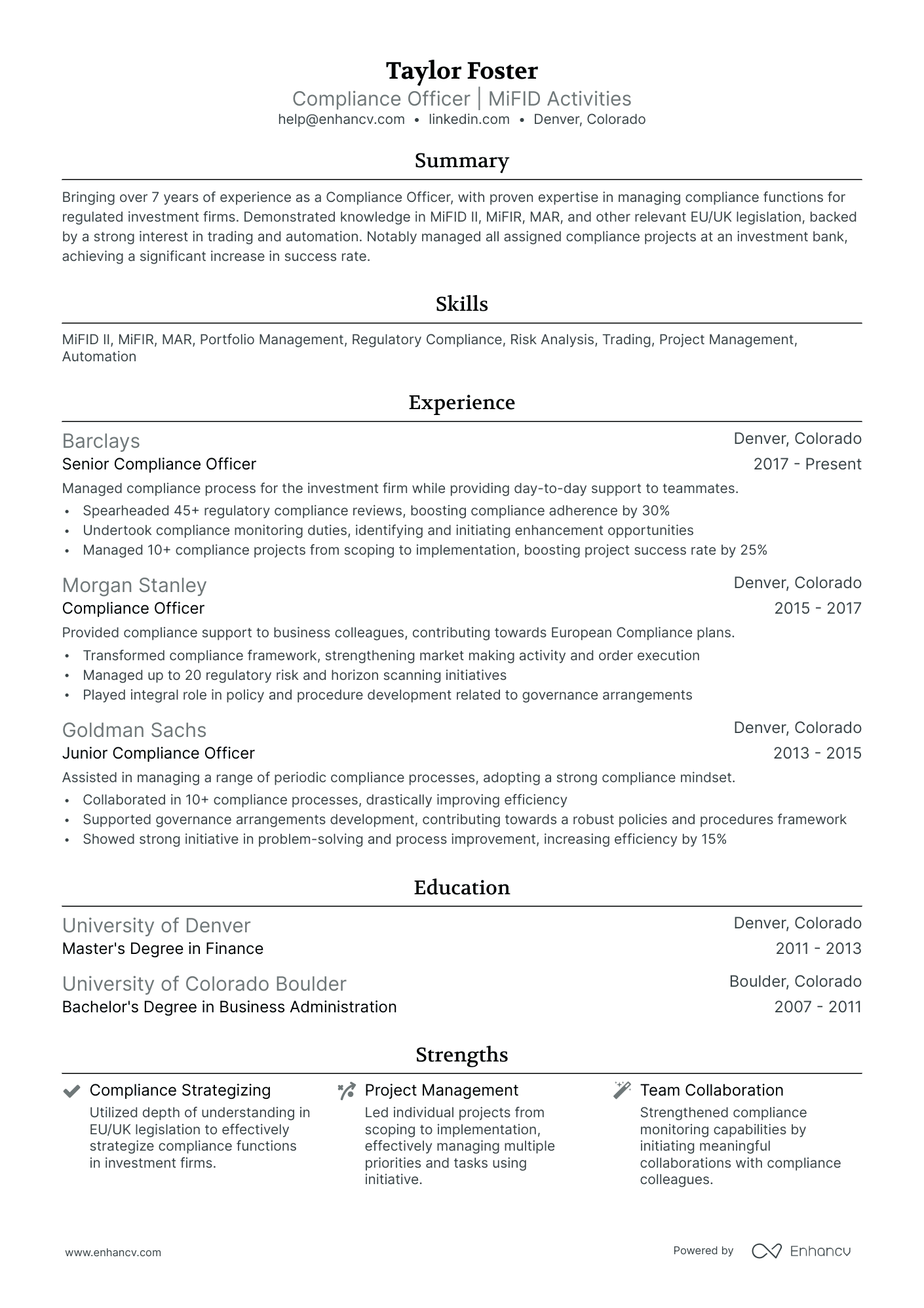
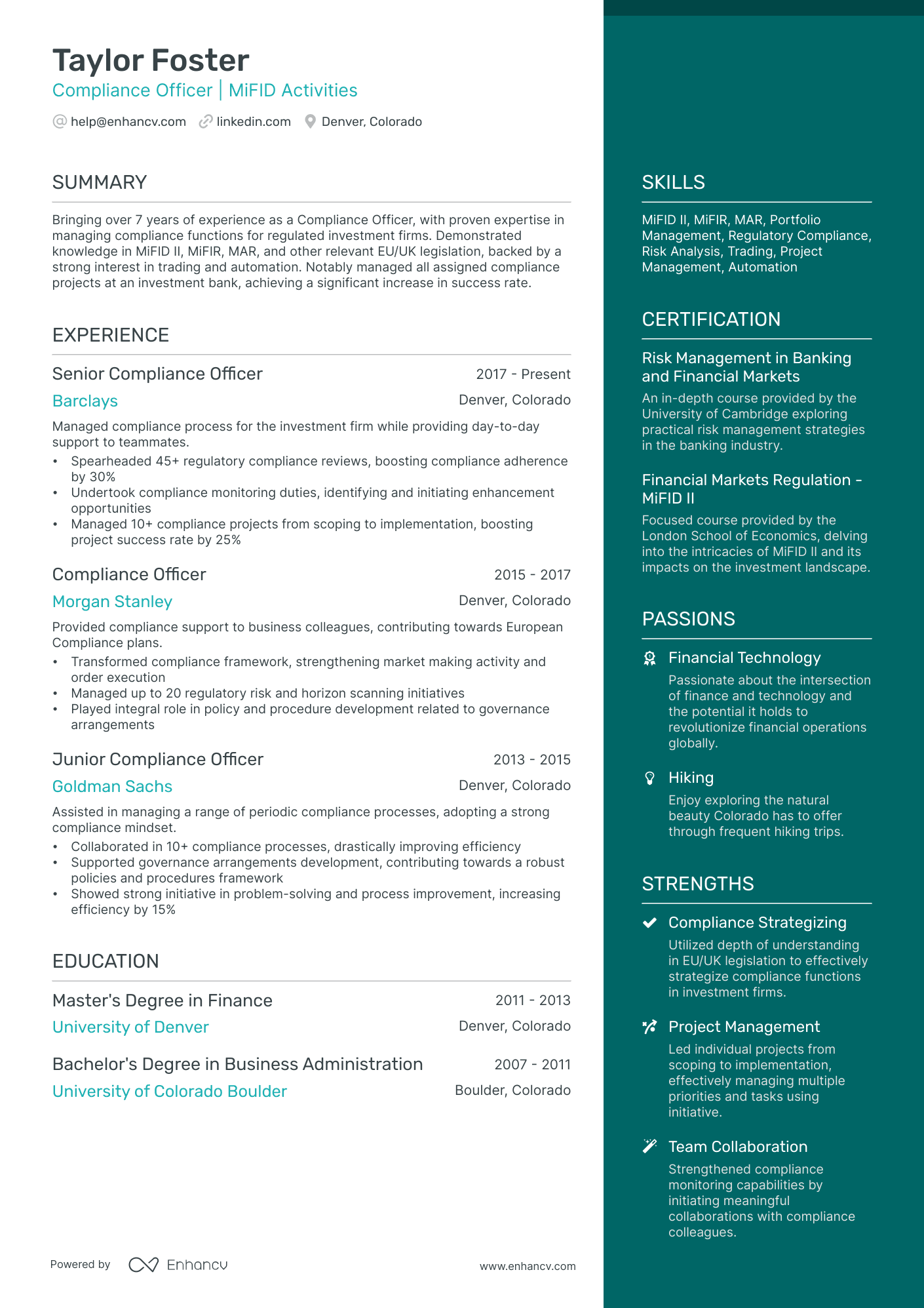
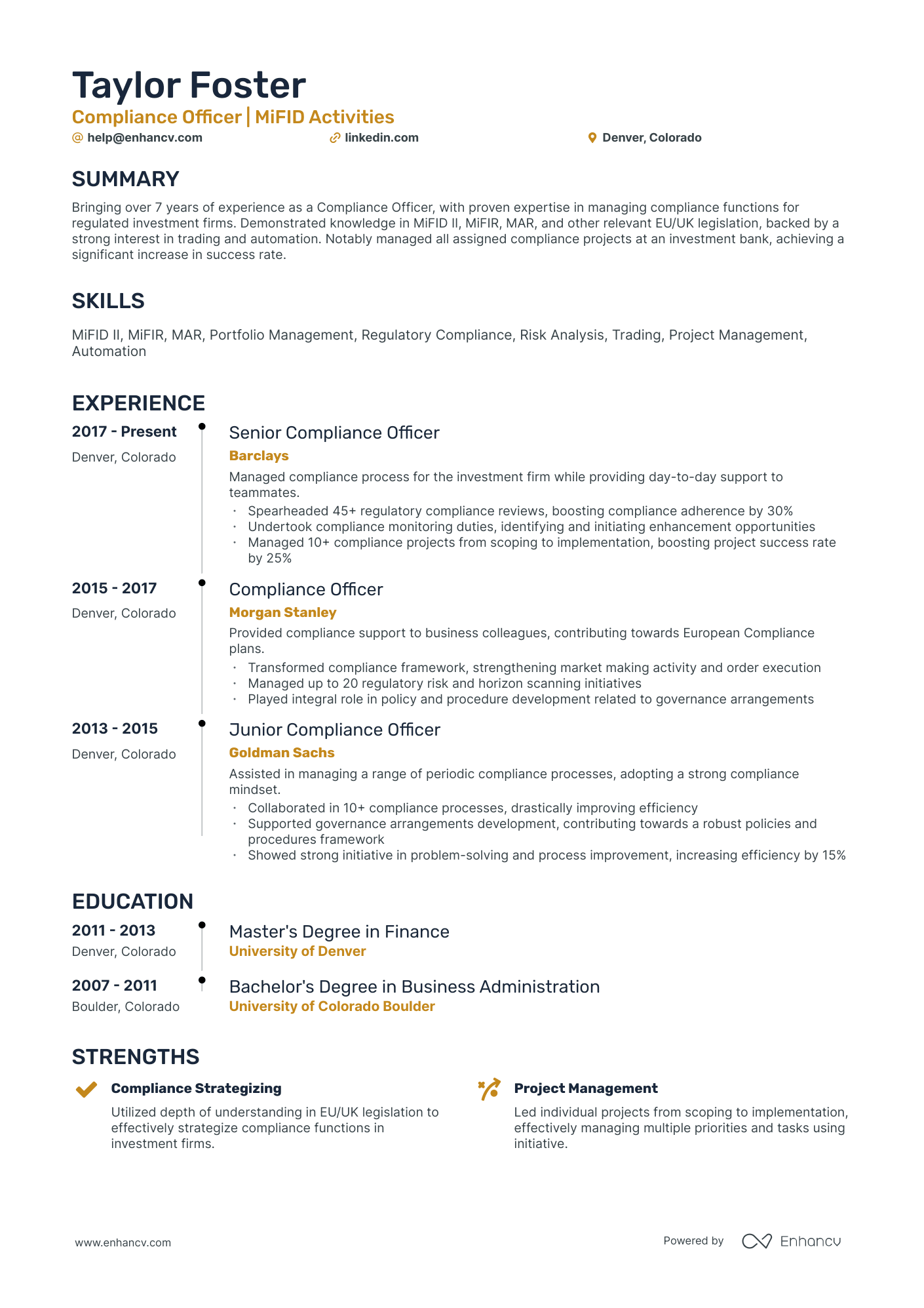
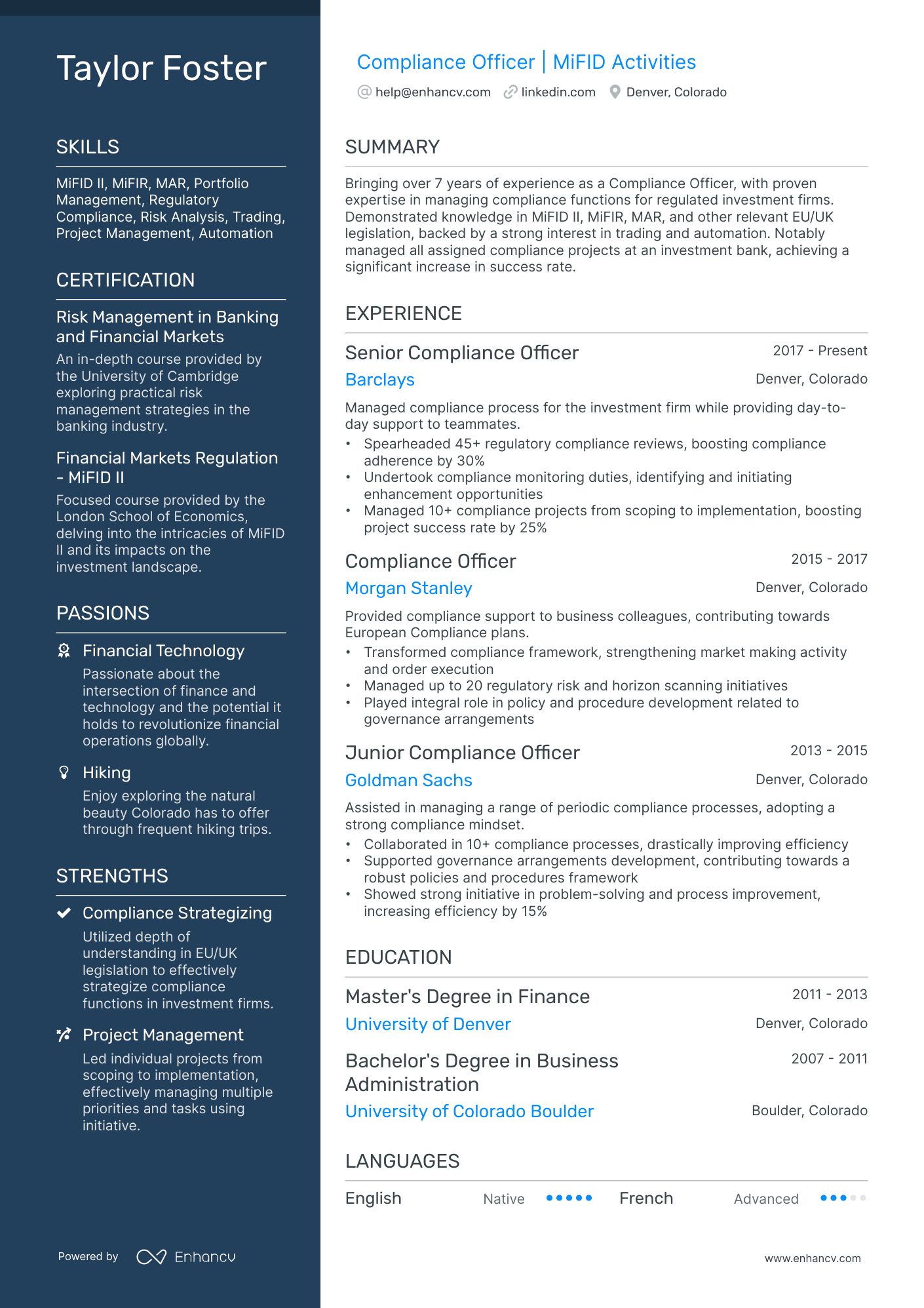
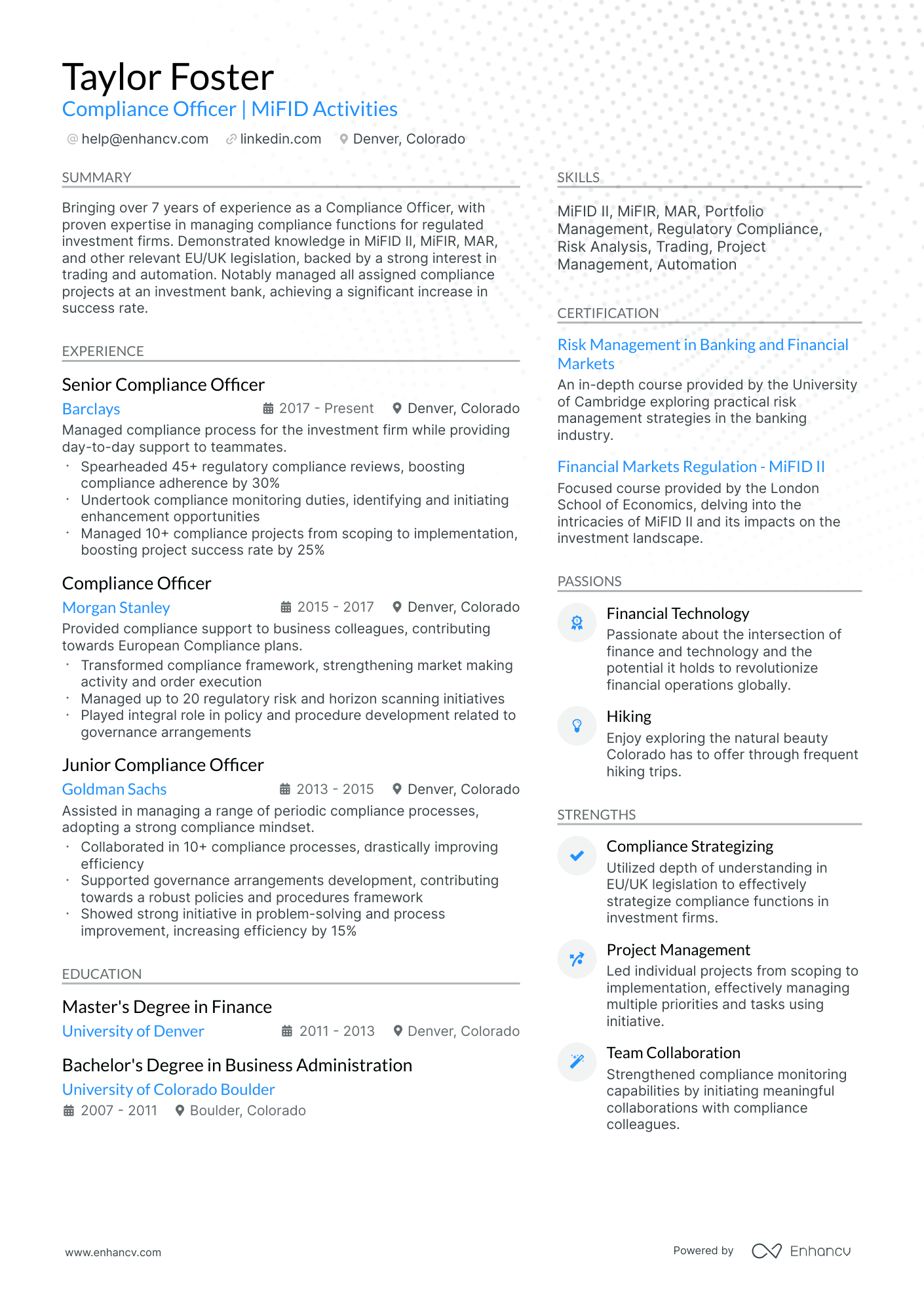
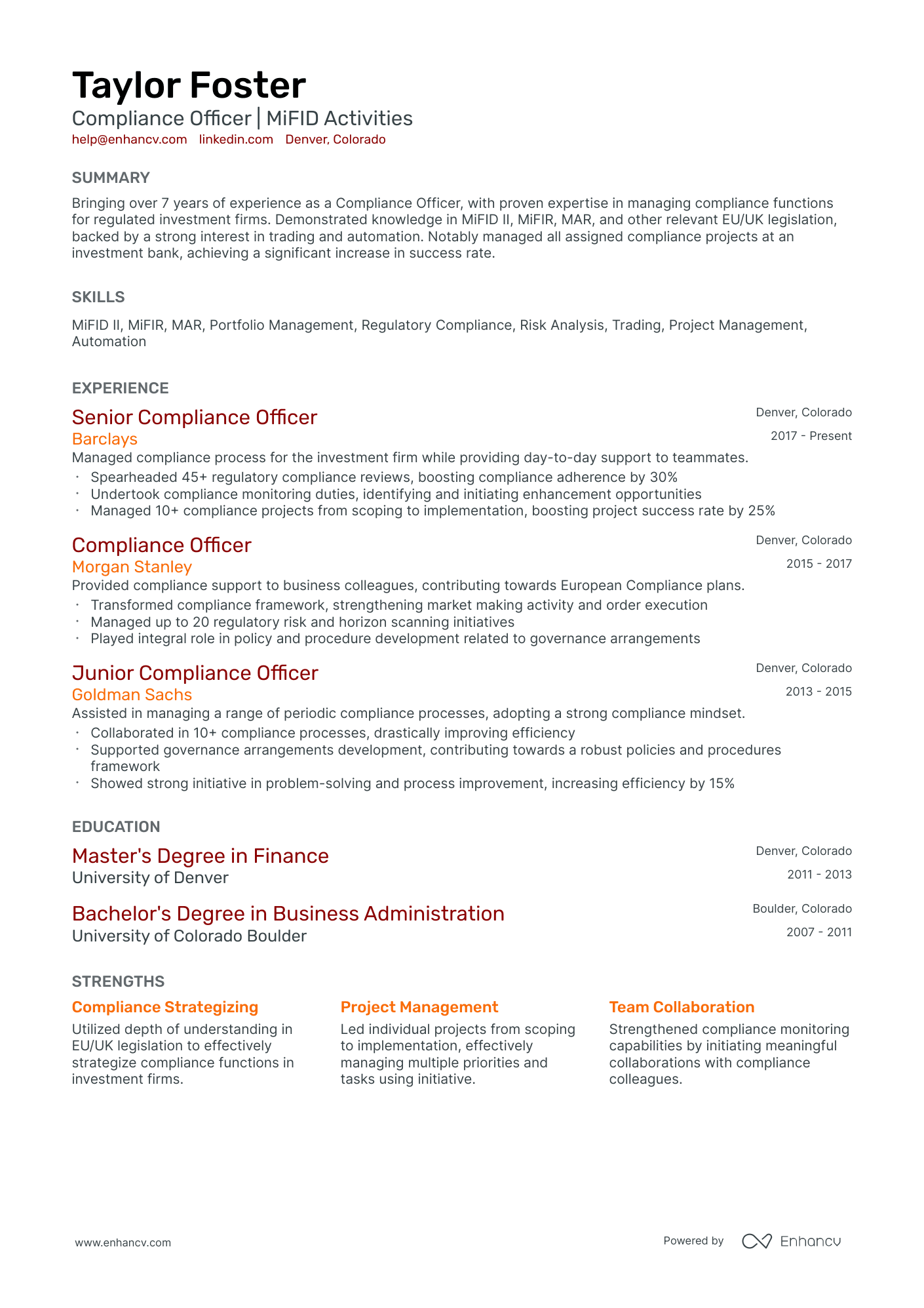
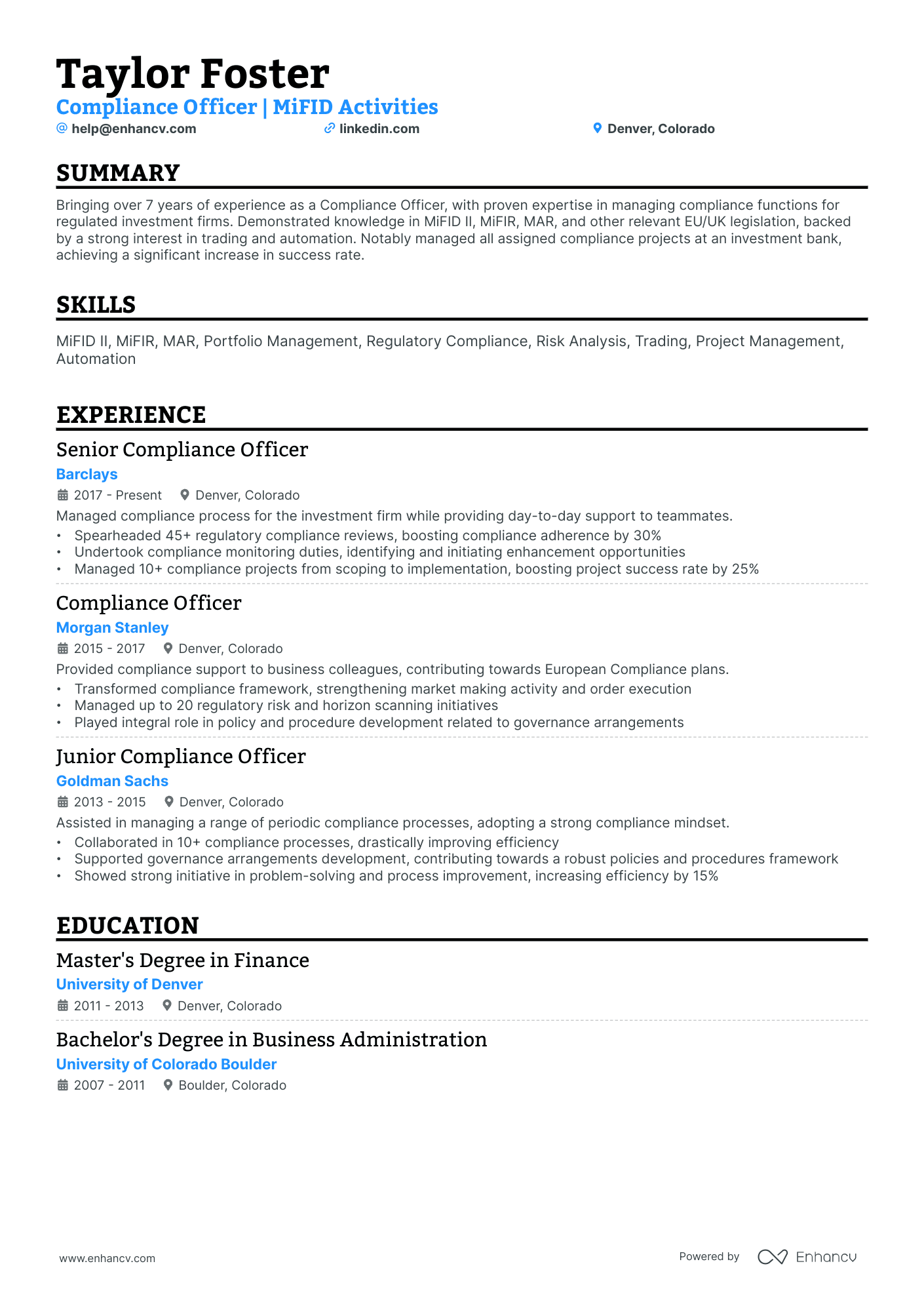
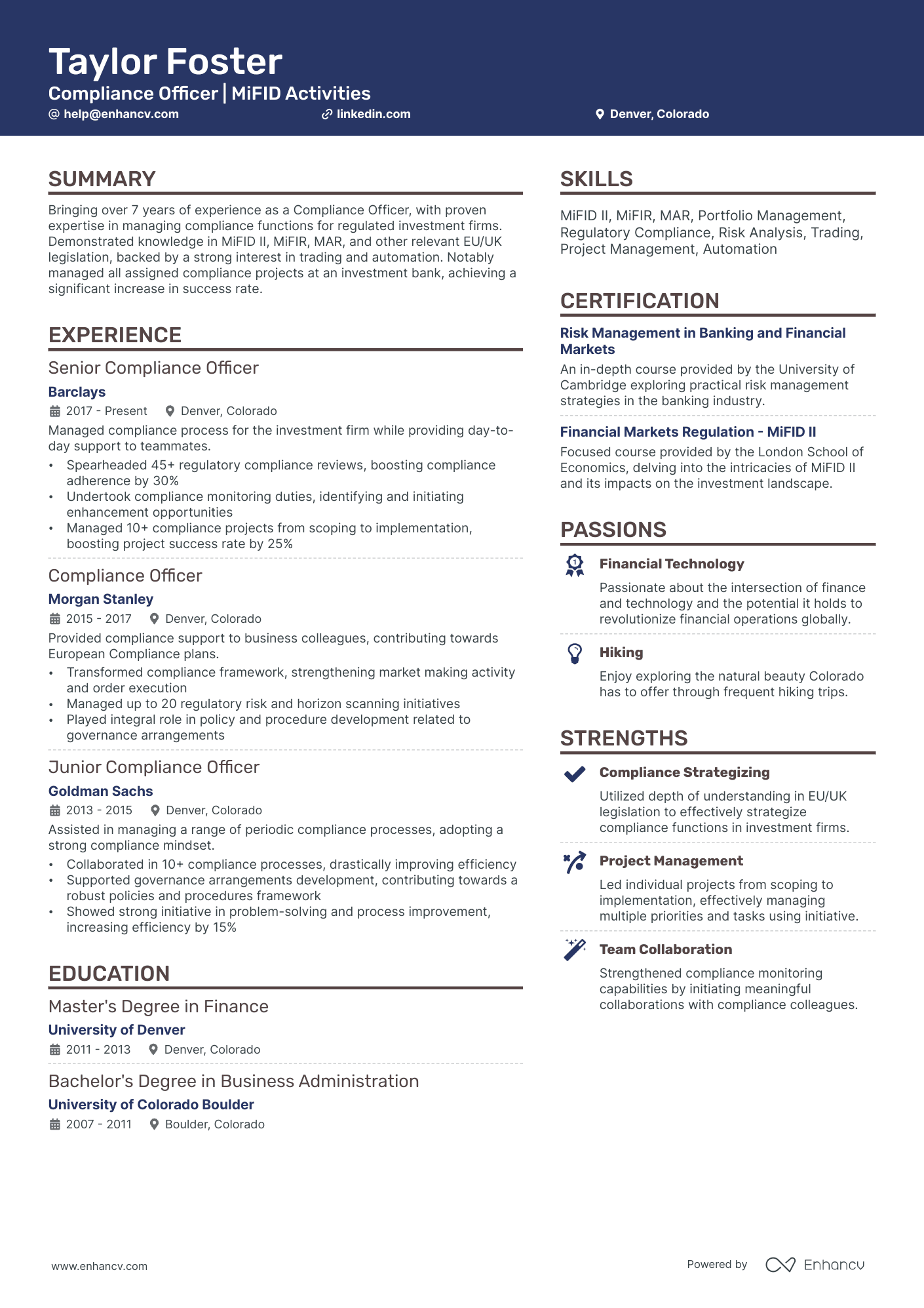
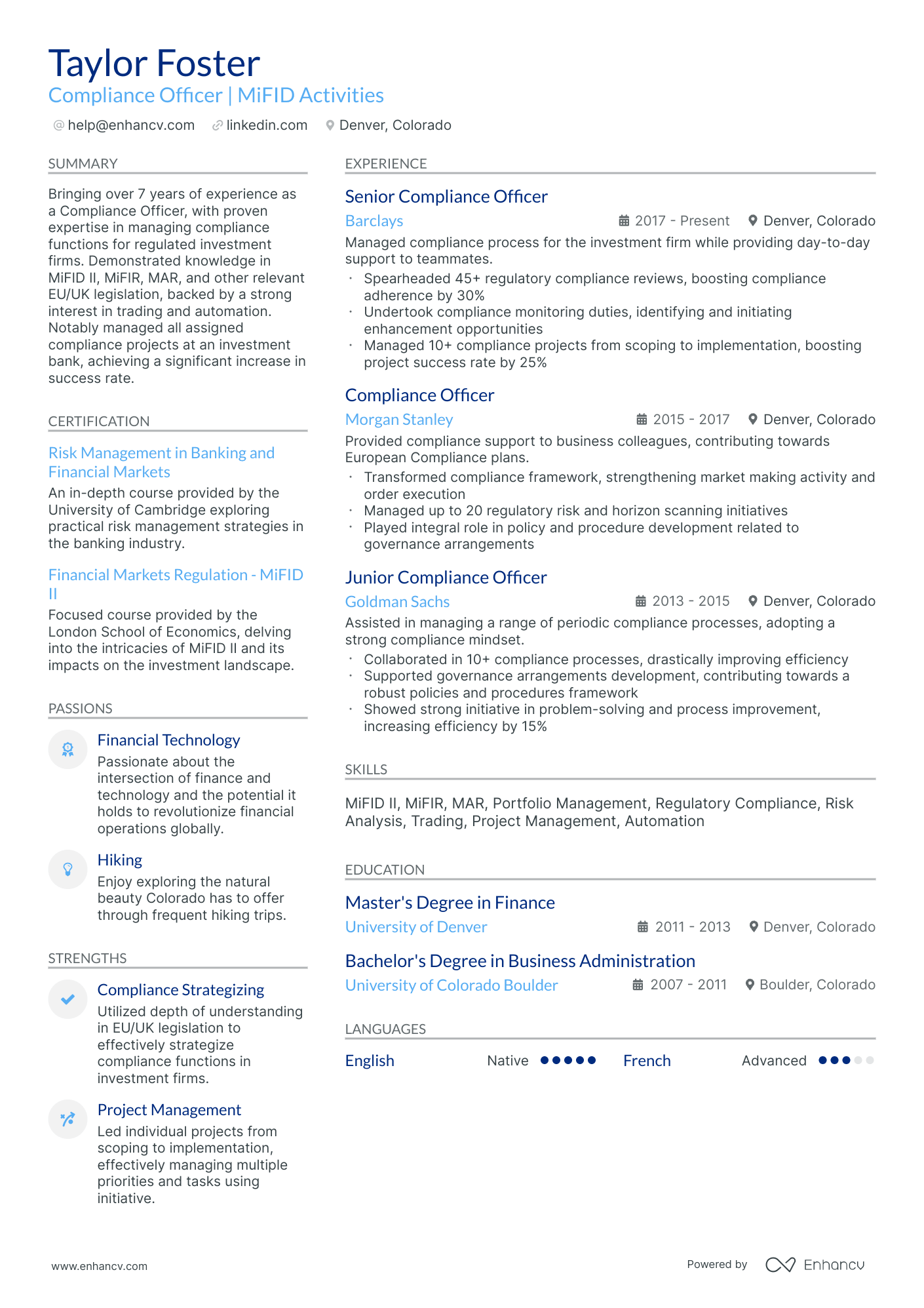
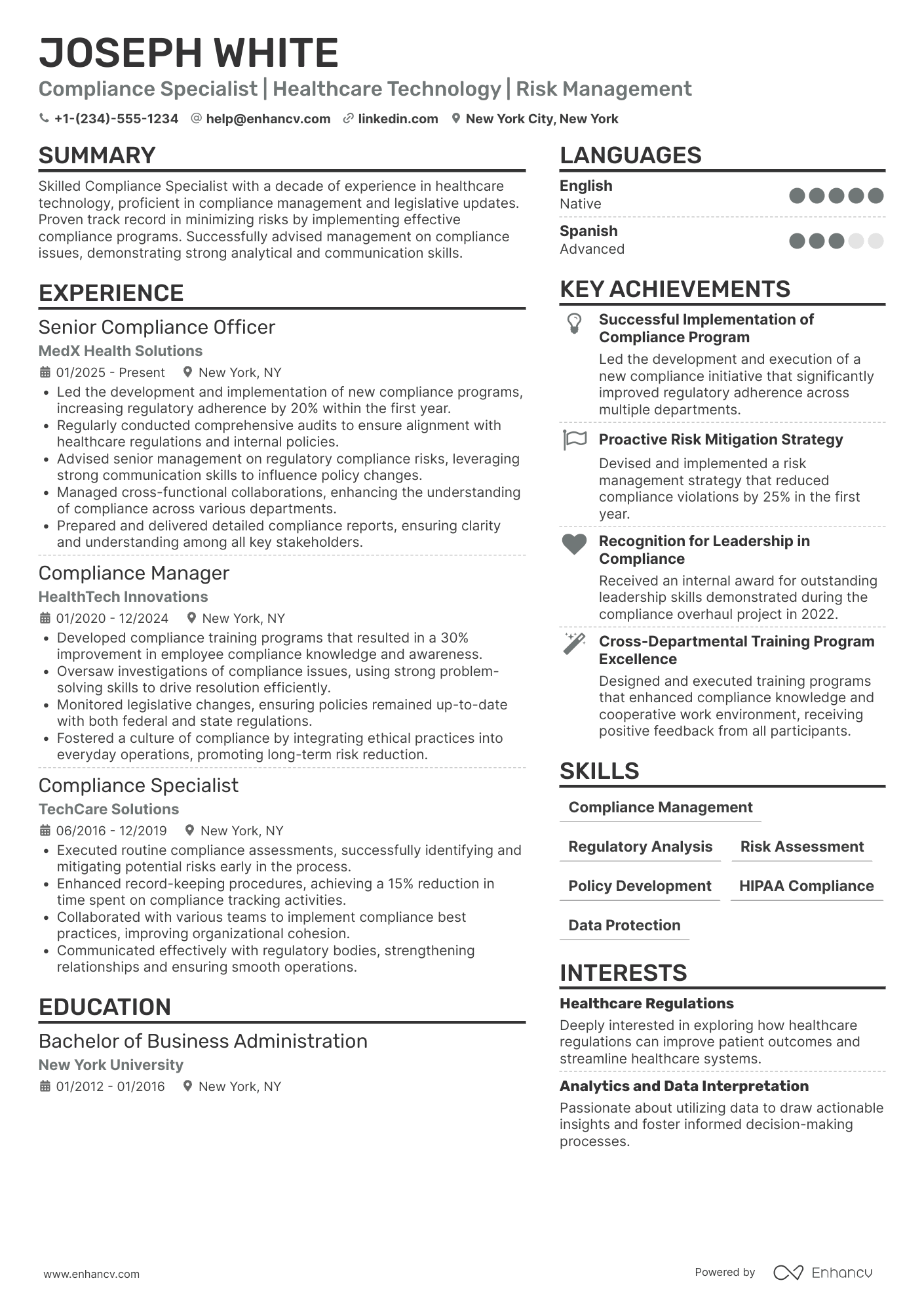
Most compliance officer resume drafts fail because they list policies and tools but don't prove risk reduction or control effectiveness. That gap matters when a compliance officer resume gets filtered by ATS keywords and skimmed in seconds in a crowded market. If you're unsure where to begin, understanding how to write a resume that highlights impact over duties is the first step.
Once the resume proves control effectiveness, pair it with a matching compliance officer cover letter so a Chief Compliance Officer reading both sees the same story of risk reduced, not just policies maintained.
A strong resume shows what you changed and protected. You should highlight audit findings reduced, remediation delivered on time, regulatory exams passed, investigation cycle time shortened, and training completion rates improved. Add scope like business units covered, jurisdictions supported, and dollar exposure mitigated.

Key takeaways
- Quantify audit findings, remediation timelines, and risk reduction instead of listing routine compliance duties.
- Use reverse-chronological format for experienced candidates and hybrid format for career switchers.
- Tailor every experience bullet to mirror the job posting's frameworks, tools, and regulatory language.
- Place certifications like CCEP or CAMS where they add the most differentiation for the target role.
- Prove skills through measurable outcomes in your summary and experience, not just a standalone list.
- Use AI to sharpen clarity and alignment, but stop before it inflates or invents your experience.
- Build your compliance officer resume faster with Enhancv to keep structure clean and sections recruiter-ready.
Job market snapshot for compliance officers
We analyzed 312 recent compliance officer job ads across major US job boards. These numbers help you understand industry demand, career growth patterns, regional hotspots at a glance.
What level of experience employers are looking for compliance officers
| Years of Experience | Percentage found in job ads |
|---|---|
| 1–2 years | 2.9% (9) |
| 3–4 years | 7.7% (24) |
| 5–6 years | 9.6% (30) |
| 7–8 years | 2.9% (9) |
| 9–10 years | 3.8% (12) |
| 10+ years | 5.4% (17) |
| Not specified | 71.5% (223) |
Compliance officer ads by area of specialization (industry)
| Industry (Area) | Percentage found in job ads |
|---|---|
| Finance & Banking | 50.0% (156) |
| Government | 20.8% (65) |
| Healthcare | 17.0% (53) |
| Education | 11.5% (36) |
Top companies hiring compliance officers
| Company | Percentage found in job ads |
|---|---|
| State of Florida | 8.0% (25) |
| Blue Cross and Blue Shield Association | 6.4% (20) |
| BankFirst Financial Services | 3.2% (10) |
Role overview stats
These tables show the most common responsibilities and employment types for compliance officer roles. Use them to align your resume with what employers expect and to understand how the role is structured across the market.
Day-to-day activities and top responsibilities for a compliance officer
| Responsibility | Percentage found in job ads |
|---|---|
| Compliance | 21.8% (68) |
| Excel | 13.5% (42) |
| Microsoft office | 11.9% (37) |
| Risk management | 10.6% (33) |
| Regulatory compliance | 10.3% (32) |
| Microsoft word | 8.7% (27) |
| Powerpoint | 8.3% (26) |
| Word | 7.7% (24) |
| Project management | 6.7% (21) |
| Data analysis | 6.1% (19) |
| Microsoft excel | 6.1% (19) |
| Hipaa | 5.8% (18) |
Type of employment (remote vs on-site vs hybrid)
| Employment type | Percentage found in job ads |
|---|---|
| On-site | 73.7% (230) |
| Hybrid | 20.2% (63) |
| Remote | 6.1% (19) |
How to format a compliance officer resume
Recruiters evaluating compliance officer resumes prioritize regulatory expertise, risk management scope, and a clear record of audit outcomes and policy implementation. A well-chosen resume format ensures these signals surface quickly for both human reviewers and applicant tracking systems.

I have significant experience in this role—which format should I use?
Use a reverse-chronological format to present your compliance career in a clear, linear progression that highlights growing regulatory responsibility. Do:
- Lead with your most recent role, emphasizing the scope of programs you oversee—number of jurisdictions, business units, or regulatory frameworks (SOX, AML, GDPR, HIPAA).
- Feature domain-specific tools and competencies such as GRC platforms, risk assessment methodologies, internal audit coordination, and regulatory filing systems.
- Quantify outcomes tied to business impact, including reduced findings, cost savings from remediation programs, or improved audit pass rates.
I'm junior or switching into this role—what format works best?
A hybrid format works well when you have transferable compliance-adjacent experience but haven't yet built a deep compliance-specific career track. Do:
- Place a skills section near the top highlighting regulatory knowledge areas, certifications (CCEP, CRCM, CFE), and relevant tools like SAP GRC or NAVEX Global.
- Include projects, internships, or cross-functional experience that demonstrates exposure to audits, policy drafting, risk assessments, or regulatory reporting.
- Connect each experience entry to a clear action and outcome, even if the scope is smaller.
Why not use a functional resume?
A functional format strips away the timeline context that compliance hiring managers rely on to verify your exposure to real regulatory cycles, audit seasons, and evolving frameworks.
- A functional resume may be acceptable if you're transitioning from a related field such as legal, internal audit, or risk management and have no direct compliance job titles—but only if you anchor every listed skill to a specific project, outcome, or measurable contribution.
Once you've established a clean, scannable layout, the next step is deciding which sections to include and how to order them for maximum impact.
What sections should go on a compliance officer resume
Recruiters expect a compliance officer resume to show clear compliance scope, risk ownership, and measurable results. Knowing what to put on a resume helps you prioritize the right content from the start.
Use this structure for maximum clarity:
- Header
- Summary
- Experience
- Skills
- Projects
- Education
- Certifications
- Optional sections: Awards, Publications, Languages
Strong experience bullets should emphasize regulatory scope, audit and investigation outcomes, risk reduction, and quantified impact on controls, findings, and remediation timelines.
Is your resume good enough?
Drop your resume here or choose a file. PDF & DOCX only. Max 2MB file size.
Now that you’ve organized the key resume components, the next step is to write your compliance officer experience section so each role supports those elements with clear, job-relevant proof.
How to write your compliance officer resume experience
The experience section is where you prove you've delivered measurable compliance outcomes—not just performed routine tasks. Hiring managers prioritize demonstrated impact, so every bullet should connect your ownership of regulatory frameworks, monitoring tools, or audit processes to a concrete result that moved the business forward.
Each entry should include:
- Job title
- Company and location (or remote)
- Dates of employment (month and year)
Three to five concise bullet points showing what you owned, how you executed, and what outcomes you delivered:
- Ownership scope: the regulatory programs, compliance domains, policy frameworks, geographic jurisdictions, or internal teams you were directly accountable for as a compliance officer.
- Execution approach: the monitoring platforms, risk assessment methodologies, audit techniques, regulatory databases, or reporting tools you used to identify gaps, enforce standards, and drive decisions.
- Value improved: the changes you brought to regulatory adherence rates, audit findings, risk exposure, remediation timelines, policy clarity, or organizational readiness for examinations and reviews.
- Collaboration context: how you partnered with legal counsel, senior leadership, external regulators, business unit heads, or technology teams to embed compliance into operations and resolve findings.
- Impact delivered: the outcomes you achieved expressed through reduced violations, successful examination results, faster remediation cycles, strengthened controls, or enterprise-wide risk reduction—framed as results rather than activities.
Experience bullet formula
A compliance officer experience example
✅ Right example - modern, quantified, specific.
Compliance Officer
FinBridge Payments | Austin, TX
2022–Present
Series C business-to-business payments platform processing $8B+ annually across the United States and Canada.
- Led enterprise-wide risk assessment and compliance roadmap using RSA Archer and Jira, reducing high-risk findings by 38% and cutting remediation cycle time from 62 to 34 days in partnership with engineering and product managers.
- Built and automated anti-money laundering (AML) and know your customer (KYC) controls in Actimize and Salesforce, improving alert-to-case conversion by 21% and decreasing false positives by 17% while maintaining service-level agreements with operations.
- Owned SOC 2 Type II and PCI DSS evidence programs in Vanta and Confluence, achieving zero major nonconformities and reducing audit prep hours by 30% through standardized control narratives and automated evidence collection.
- Implemented third-party risk management across 120 vendors using OneTrust, increasing on-time security and compliance reviews from 54% to 93% and preventing two high-risk renewals through contract control updates with legal and procurement.
- Delivered quarterly compliance reporting and key risk indicators in Power BI for executive stakeholders, improving issue visibility and driving a 25% reduction in repeat control failures through targeted training and policy updates.
Now that you've seen how a strong experience section comes together, let's look at how to adjust those details to match the specific compliance role you're targeting.
How to tailor your compliance officer resume experience
Recruiters evaluate your compliance officer resume through both human review and applicant tracking systems (ATS), so tailoring your resume to the job description is essential. Aligning each bullet to reflect the specific language and priorities of the role increases your chances of passing both screenings.
Ways to tailor your compliance officer experience:
- Match regulatory frameworks and compliance tools named in the job description.
- Mirror the exact terminology used for standards and methodologies.
- Reflect KPIs or success criteria the employer highlights for the role.
- Include industry-specific experience such as healthcare finance or banking.
- Emphasize risk assessment or audit processes when the posting requires them.
- Highlight cross-functional collaboration with legal operations or executive teams.
- Reference monitoring systems or reporting workflows mentioned in the listing.
- Align your bullets with enforcement actions or remediation efforts if noted.
Tailoring means connecting your real accomplishments to what the employer asks for, not forcing keywords where they don't belong.
Resume tailoring examples for compliance officer
| Job description excerpt | Untailored | Tailored |
|---|---|---|
| Conduct internal audits and risk assessments using RSA Archer to ensure adherence to SOX and AML regulations across all business units. | Performed audits and helped with compliance tasks. | Conducted quarterly internal audits and risk assessments in RSA Archer across 12 business units, identifying 34 control gaps under SOX and AML regulations and driving remediation within 60 days. |
| Develop, implement, and maintain compliance policies and training programs aligned with FINRA, SEC, and state regulatory requirements. | Created compliance policies and trained employees on rules. | Developed and maintained 15+ compliance policies aligned with FINRA and SEC requirements, then designed role-specific training programs that increased staff regulatory exam pass rates by 22%. |
| Monitor regulatory changes, advise senior leadership on impact, and coordinate responses with legal counsel to mitigate enterprise-wide compliance risk. | Kept up with regulations and reported issues to management. | Tracked evolving federal and state regulatory changes daily, briefed the C-suite on three high-impact rule amendments, and partnered with legal counsel to implement enterprise-wide response plans that reduced compliance exposure by 40%. |
Once you’ve aligned your experience with the role’s requirements, the next step is to quantify your compliance officer achievements so hiring managers can see the impact of your work.
How to quantify your compliance officer achievements
Quantifying your achievements proves you reduced risk and improved compliance outcomes. Focus on audit results, remediation cycle time, policy adherence rates, training completion, case volumes, and the financial impact of prevented fines.
Quantifying examples for compliance officer
| Metric | Example |
|---|---|
| Audit readiness | "Reduced audit findings from twelve to three by implementing a quarterly control testing plan and tracking evidence in Archer." |
| Remediation cycle time | "Cut corrective action closure time from forty-five to twenty-one days by standardizing root-cause templates and weekly Jira follow-ups." |
| Policy compliance rate | "Raised policy attestation completion from 78% to 98% in four weeks using Workday workflows and automated reminders." |
| Investigation throughput | "Cleared a 160-case hotline backlog in eight weeks while maintaining a 95% on-time triage service level in NAVEX." |
| Financial risk avoided | "Prevented an estimated $450,000 in potential penalties by closing five high-risk gaps before a regulator exam, including KYC sampling fixes." |
Turn your everyday tasks into measurable, recruiter-ready resume bullets in seconds with Enhancv's Bullet Point Generator.
Once you've crafted strong bullet points that highlight your achievements, the next step is ensuring your resume also showcases the right mix of hard and soft skills employers expect from a compliance officer.
How to list your hard and soft skills on a compliance officer resume
Your skills section shows you can interpret regulations, reduce risk, and run controls, and recruiters and ATS scan this section for role keywords and tools; aim for a balance of hard skills like regulatory frameworks and systems and soft skills like stakeholder management. compliance officer roles require a blend of:
- Product strategy and discovery skills.
- Data, analytics, and experimentation skills.
- Delivery, execution, and go-to-market discipline.
- Soft skills.
Your skills section should be:
- Scannable (bullet-style grouping).
- Relevant to the job post.
- Backed by proof in experience bullets.
- Updated with current tools.
Place your skills section:
- Above experience if you're junior or switching careers.
- Below experience if you're mid/senior with strong achievements.

Hard skills
- Regulatory compliance management
- Risk assessments, control testing
- Internal audits, gap analysis
- Policy drafting, SOP governance
- AML, KYC, CDD programs
- OFAC sanctions screening
- SOX, COSO internal controls
- GDPR, data privacy compliance
- Third-party risk management
- Incident investigations, CAPA
- GRC platforms: Archer, ServiceNow
- Excel, SQL, Power BI
Soft skills
- Translate regulations into controls
- Challenge decisions with evidence
- Partner with legal and HR
- Influence without direct authority
- Lead cross-functional remediation
- Escalate issues with clarity
- Write audit-ready documentation
- Run effective training sessions
- Prioritize risks under deadlines
- Maintain confidentiality and discretion
- Negotiate practical risk tradeoffs
- Drive accountability for owners
How to show your compliance officer skills in context
Skills shouldn't live only in a bulleted list on your resume. Explore examples of resume skills presented in context to see how top candidates integrate them naturally.
They should be demonstrated in:
- Your summary (high-level professional identity)
- Your experience (proof through outcomes)
Here's what that looks like in practice.
Summary example
Compliance officer with 12 years in financial services, specializing in BSA/AML frameworks, risk assessments, and regulatory audits. Led enterprise-wide policy overhauls using LogicGate and reduced compliance violations by 43%. Known for cross-functional collaboration and clear stakeholder communication.
- Reflects senior-level expertise clearly
- Names specific tools and frameworks
- Leads with a measurable outcome
- Highlights communication as a soft skill
Experience example
Senior Compliance Officer
Bridgepoint Financial Group | Chicago, IL
March 2019–Present
- Redesigned the firm's AML monitoring program using Actimize, cutting false-positive alerts by 37% within six months.
- Partnered with legal, IT, and operations teams to implement a centralized policy management system using LogicGate.
- Conducted 25+ internal audits annually, identifying control gaps that reduced regulatory findings by 52% over two years.
- Every bullet includes measurable proof
- Skills surface naturally through real outcomes
Once you’ve tied your compliance strengths to real outcomes and responsibilities, the next step is applying that approach to build a compliance officer resume when you don’t have direct experience.
How do I write a compliance officer resume with no experience
Even without full-time experience, you can demonstrate readiness through:
- Compliance coursework and case studies
- Internal audit class project
- Regulatory research memos and briefs
- Policy drafting for student groups
- Data privacy training certificate
- Ethics hotline triage simulation
- Volunteer governance committee support
- Internship in risk or HR
If you're starting out, our guide on building a resume without work experience walks you through how to position transferable skills and projects effectively.
Focus on:
- Compliance officer-relevant project outcomes
- Regulatory knowledge tied to deliverables
- Audit, monitoring, and documentation examples
- Tools: Excel, SQL, GRC platforms
Resume format tip for entry-level compliance officer
Use a skills-based hybrid resume format. It puts compliance officer projects, tools, and coursework above limited work history, so recruiters see evidence first. Do:
- Put "Compliance Projects" above experience.
- Mirror compliance officer keywords from job posts.
- Quantify results: findings, hours, records.
- Name tools used: Excel, SQL, GRC.
- Add relevant laws or standards studied.
- Built an Excel-based compliance monitoring tracker for a mock internal audit, tested twenty controls, and reduced documentation errors by thirty percent.
Even without direct experience, your educational background can serve as the foundation of your compliance officer resume—here's how to present it effectively.
How to list your education on a compliance officer resume
Your education section helps hiring teams confirm you have the foundational knowledge needed for a compliance officer role. It validates your academic background quickly.
Include:
- Degree name
- Institution
- Location
- Graduation year
- Relevant coursework (for juniors or entry-level candidates)
- Honors & GPA (if 3.5 or higher)
Skip month and day details—list the graduation year only.
Here's a strong education entry tailored to a compliance officer resume.
Example education entry
Bachelor of Science in Finance
Georgetown University, Washington, D.C.
Graduated 2020
GPA: 3.7/4.0
- Relevant Coursework: Financial Regulations, Business Ethics, Corporate Governance, Risk Management
- Honors: Magna Cum Laude, Dean's List (six semesters)
How to list your certifications on a compliance officer resume
Certifications show a compliance officer's commitment to ongoing learning, proficiency with core tools and frameworks, and alignment with current regulatory expectations.
Include:
- Certificate name
- Issuing organization
- Year
- Optional: credential ID or URL
- Place certifications below education when your degree is recent and your certifications add support, not differentiation, for the compliance officer role.
- Place certifications above education when they are recent, highly relevant, or required, and they strengthen your compliance officer qualifications immediately.
Best certifications for your compliance officer resume
Certified Compliance & Ethics Professional (CCEP) Certified Regulatory Compliance Manager (CRCM) Certified Anti-Money Laundering Specialist (CAMS) Certified Information Privacy Professional/United States (CIPP/US) Certified Information Systems Auditor (CISA) ISO 37301 Compliance Management Systems Lead Implementer
Once you’ve positioned your credentials where recruiters can spot them fast, use your compliance officer resume summary to tie them to your value and set the tone for the rest of your resume.
How to write your compliance officer resume summary
Your resume summary is the first thing a recruiter reads. A strong one instantly signals you're qualified and worth a closer look.
Keep it to three to four lines, with:
- Your title and total years of compliance experience.
- The domain you specialize in, such as financial services, healthcare, or insurance.
- Core skills like regulatory analysis, risk assessment, and audit management.
- One or two measurable achievements, such as reducing compliance gaps or passing audits.
- Soft skills tied to real outcomes, like cross-functional collaboration that streamlined reporting.

PRO TIP
At this level, emphasize hands-on skills, relevant certifications, and early wins that show initiative. Highlight familiarity with frameworks like SOX, AML, or GDPR. Avoid vague phrases like "passionate professional" or "eager learner." Instead, prove your value with specific contributions and tools you've used in real compliance work.
Example summary for a compliance officer
Compliance officer with three years of experience in financial services. Skilled in AML monitoring, risk assessments, and regulatory reporting. Identified 15 policy gaps during internal audits, strengthening organizational compliance posture across two business units.
Optimize your resume summary and objective for ATS
Drop your resume here or choose a file.
PDF & DOCX only. Max 2MB file size.
Now that your summary effectively communicates your compliance expertise, make sure your header presents the essential contact details recruiters need to reach you.
What to include in a compliance officer resume header
A resume header lists your key identifiers and contact details, helping compliance officer candidates boost visibility, build credibility, and pass recruiter screening faster.
Essential resume header elements
- Full name
- Tailored job title and headline
- Location
- Phone number
- Professional email
- GitHub link
- Portfolio link
A LinkedIn link lets recruiters verify roles, dates, and credentials fast, which supports quick screening.
Do not include a photo on a compliance officer resume unless the role is explicitly front-facing or appearance-dependent.
Keep the header identical across your resume and LinkedIn, and use a compliance officer title that matches the job posting.
Example
Compliance officer resume header
Jordan Lee
Compliance Officer | Financial Services Compliance, Risk Assessments, and Regulatory Reporting
Chicago, IL
(312) 555-19XX
your.name@enhancv.com
github.com/yourname
yourwebsite.com
linkedin.com/in/yourname
Once your contact details and professional identifiers are set, add additional sections to reinforce your qualifications and complete your compliance officer resume.
Additional sections for compliance officer resumes
Adding extra sections strengthens your resume when they showcase specialized expertise or credentials that standard sections can't capture.
- Languages
- Professional affiliations and memberships
- Regulatory publications and white papers
- Industry conferences and speaking engagements
- Volunteer compliance consulting
- Continuing education and compliance training
Once you've strengthened your resume with well-chosen additional sections, it's worth pairing it with a cover letter to make an even stronger case for your candidacy.
Do compliance officer resumes need a cover letter
A cover letter isn't required for a compliance officer, but it often helps. If you're wondering what a cover letter is and when it adds value, it can matter most in competitive roles, regulated industries, or teams with strict hiring expectations. Skip it when the posting says not to include one.
Use a cover letter to add context your resume can't:
- Explain role and team fit: Connect your compliance officer experience to the company's risk areas, operating model, and cross-functional partners.
- Highlight one or two outcomes: Describe a specific program you built or improved, and quantify impact like reduced findings, faster reviews, or stronger controls.
- Show business understanding: Reference the product, users, and revenue model, and explain how compliance supports growth without increasing risk.
- Address transitions or non-obvious experience: Clarify gaps, industry changes, or adjacent work, and map skills to the compliance officer scope.
Drop your resume here or choose a file.
PDF & DOCX only. Max 2MB file size.
Once you’ve decided whether to include a cover letter with your compliance officer resume, the next step is using AI to improve your compliance officer resume so it aligns with the role’s requirements and reads clearly.
Using AI to improve your compliance officer resume
AI can sharpen your resume's clarity, structure, and overall impact. It helps you reframe experience into results-driven language. But overuse strips authenticity. Once your content feels clear and role-aligned, step away from AI entirely. If you're curious about which AI is best for writing resumes, start with tools that prioritize structure and clarity over generic templates.
Here are 10 practical prompts to strengthen specific sections of your compliance officer resume:
Strengthen your summary
Quantify experience bullets
Tighten skills section
Align with job posting
Improve action verbs
Refine certifications section
Clarify project descriptions
Enhance education details
Remove redundant phrasing
Check overall consistency
Conclusion
A strong compliance officer resume proves impact with measurable outcomes, role-specific skills, and a clear structure. It shows how you reduced risk, improved audit results, strengthened controls, and supported business goals.
Keep each section easy to scan, with focused bullets and consistent formatting. This approach matches how teams hire today and prepares you for near-future expectations in compliance officer roles.