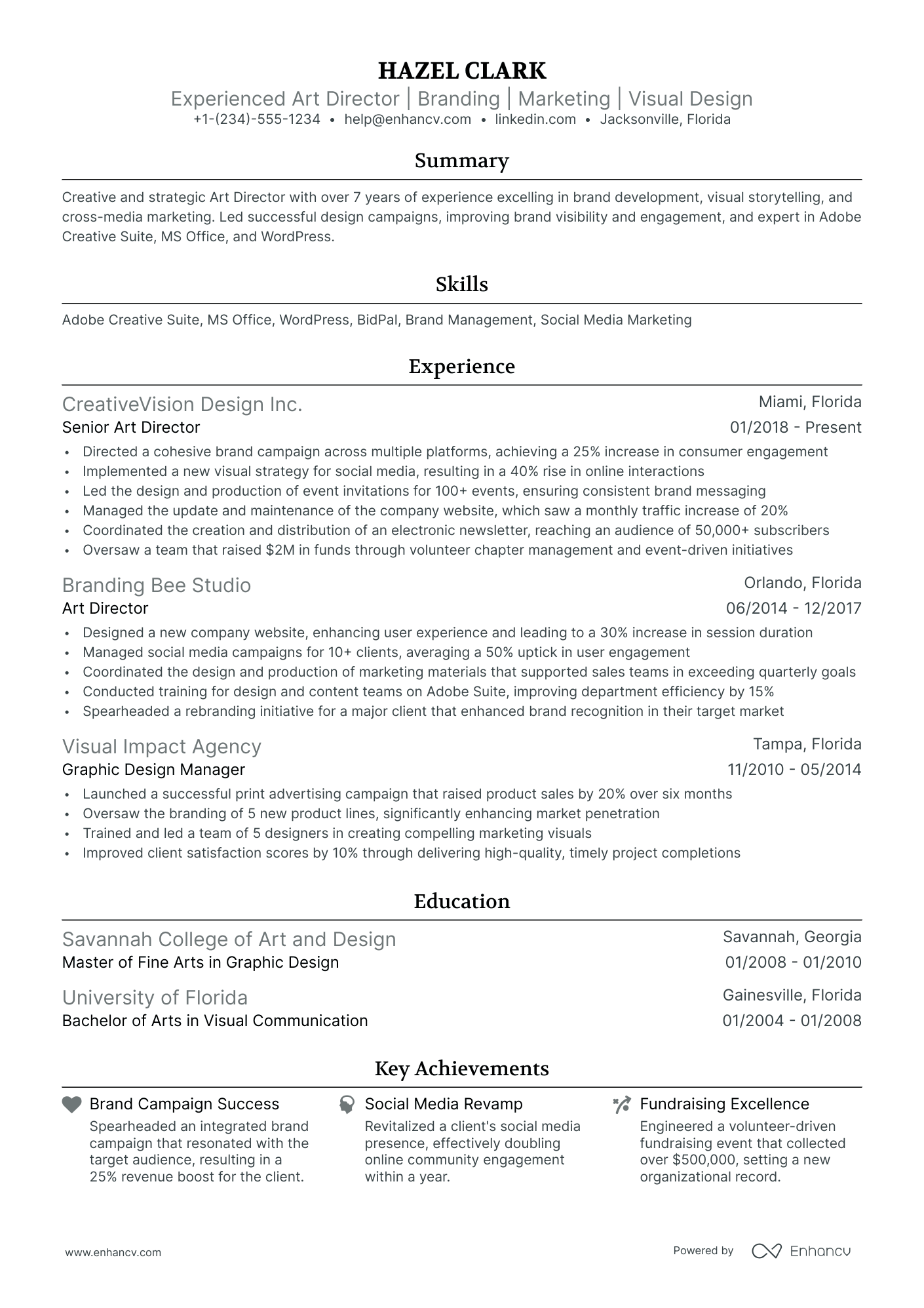
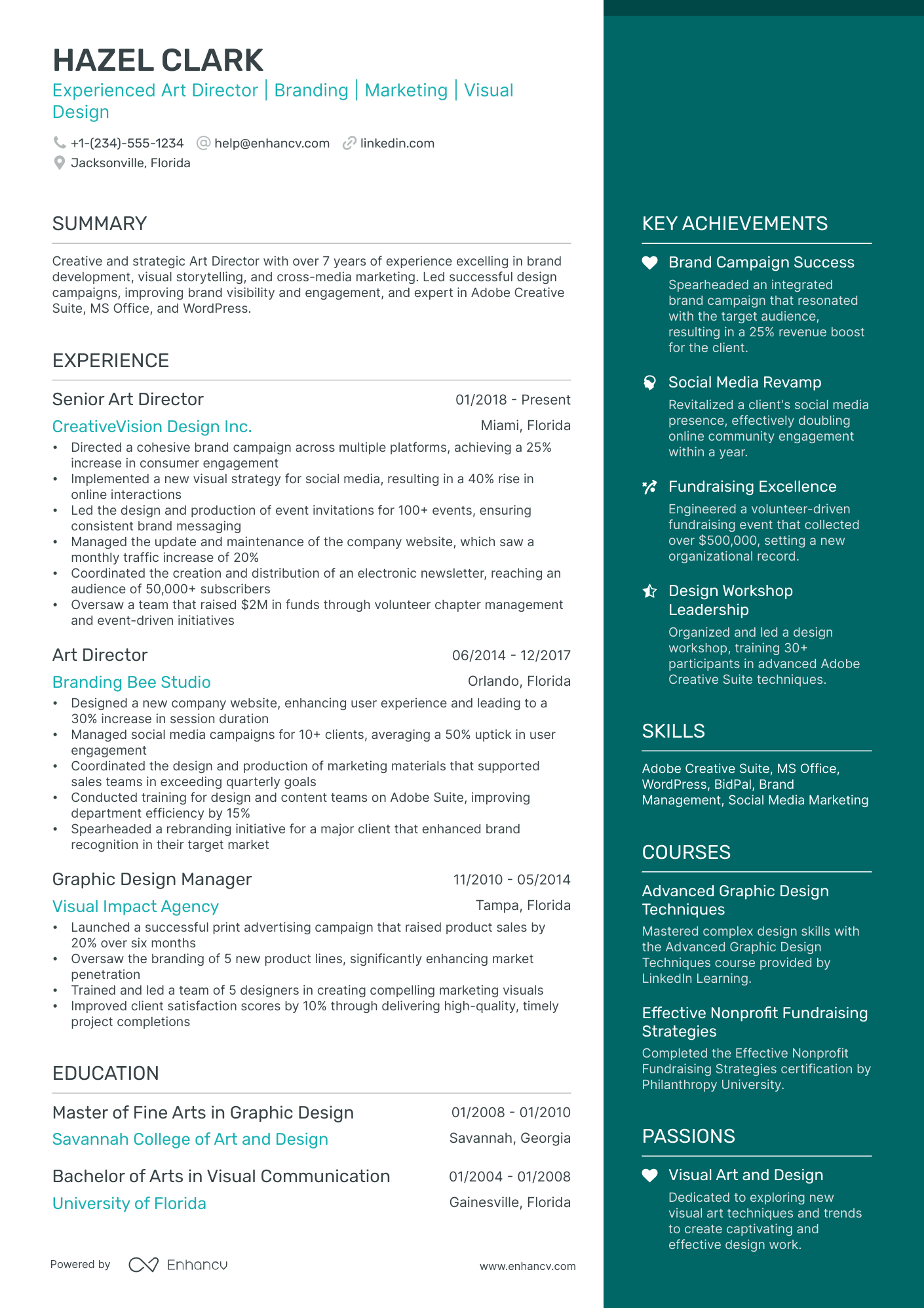
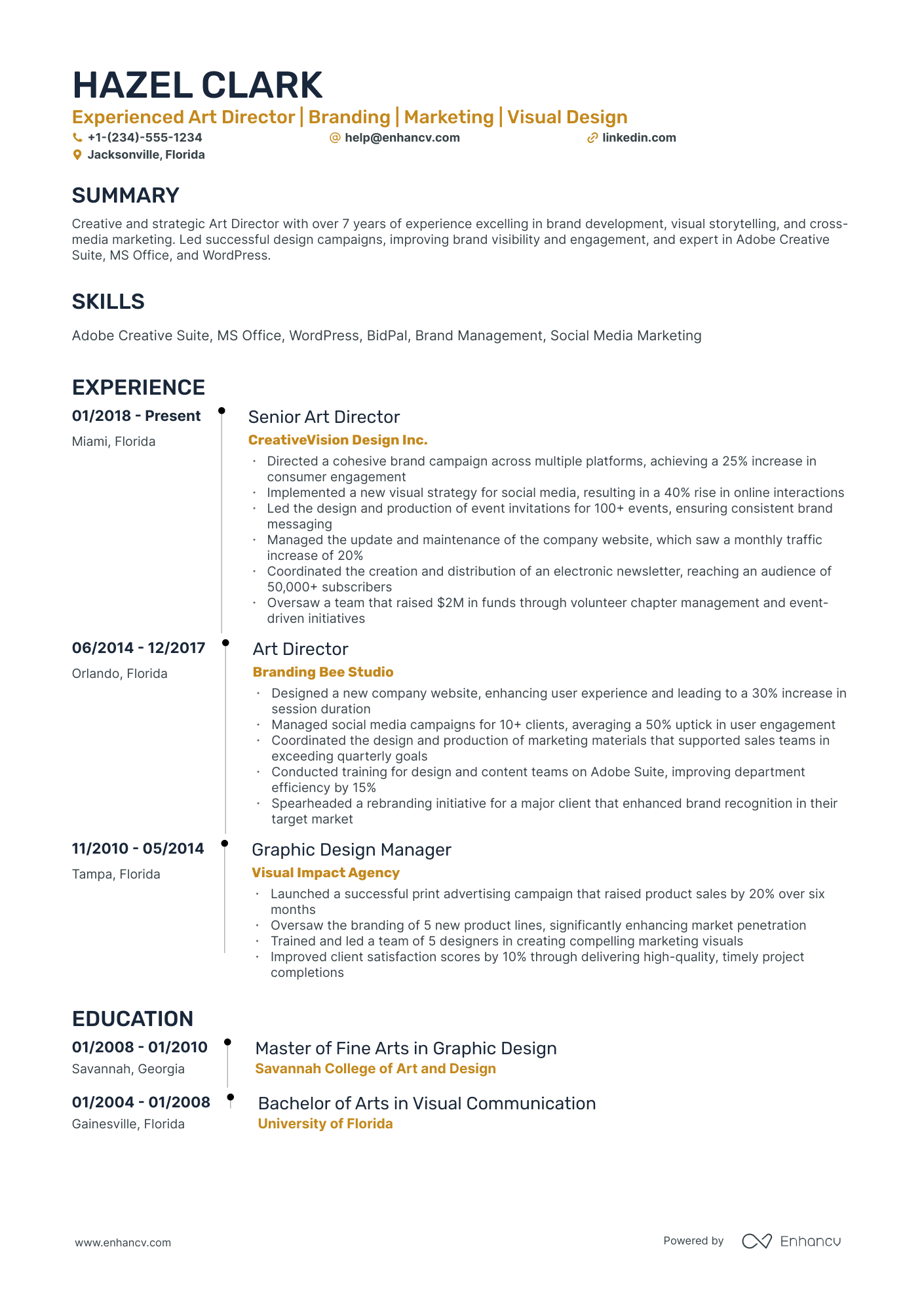
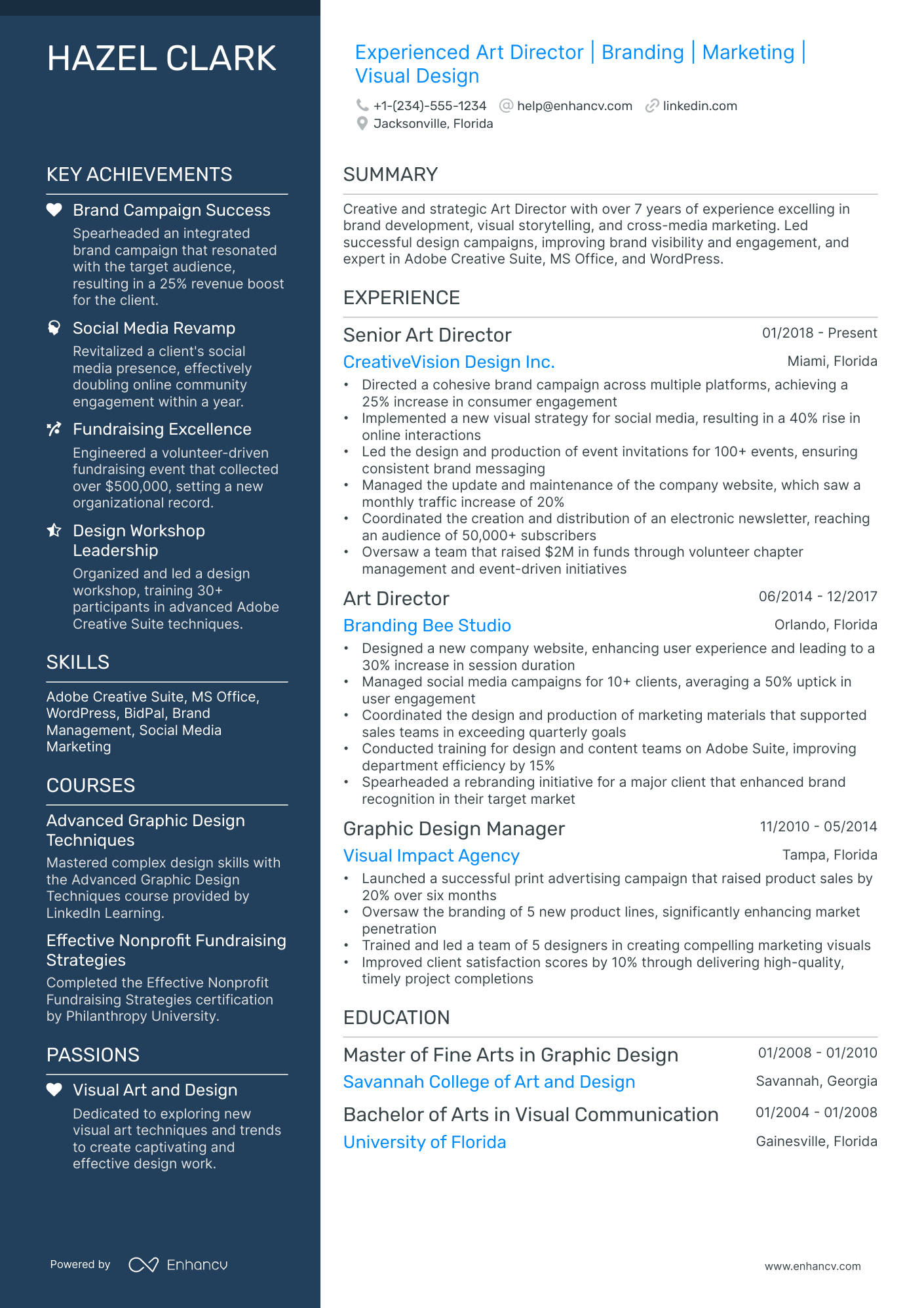
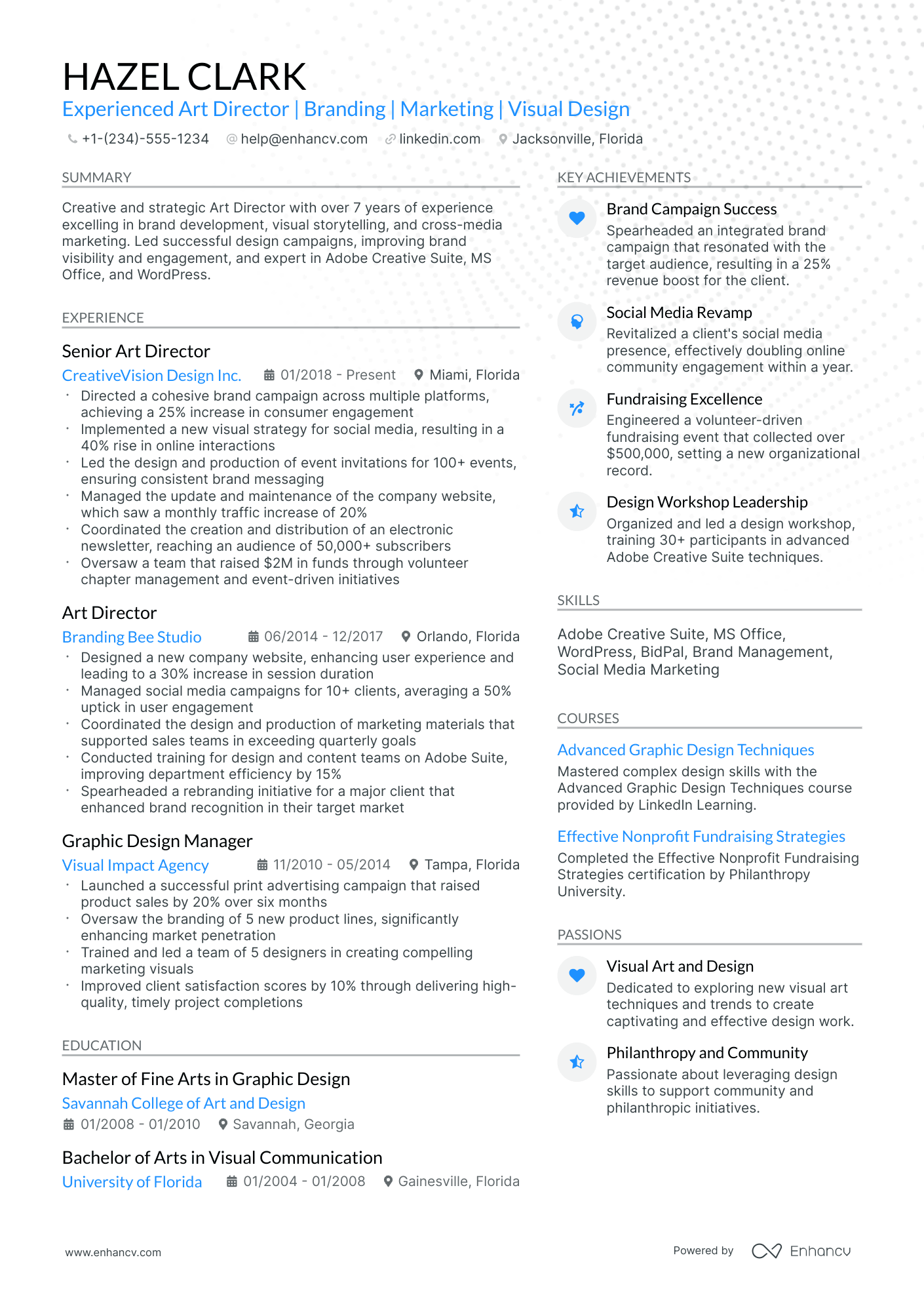
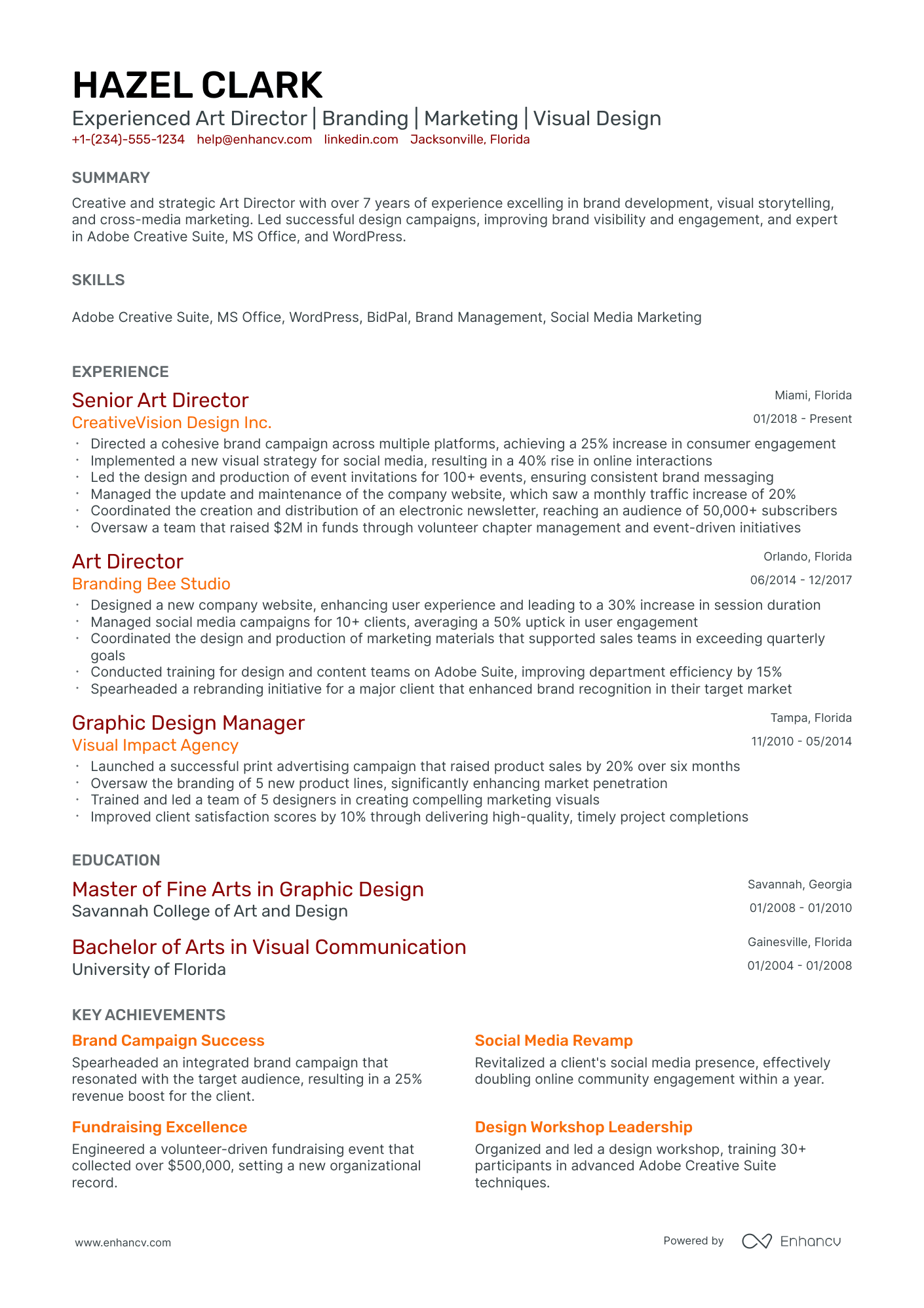
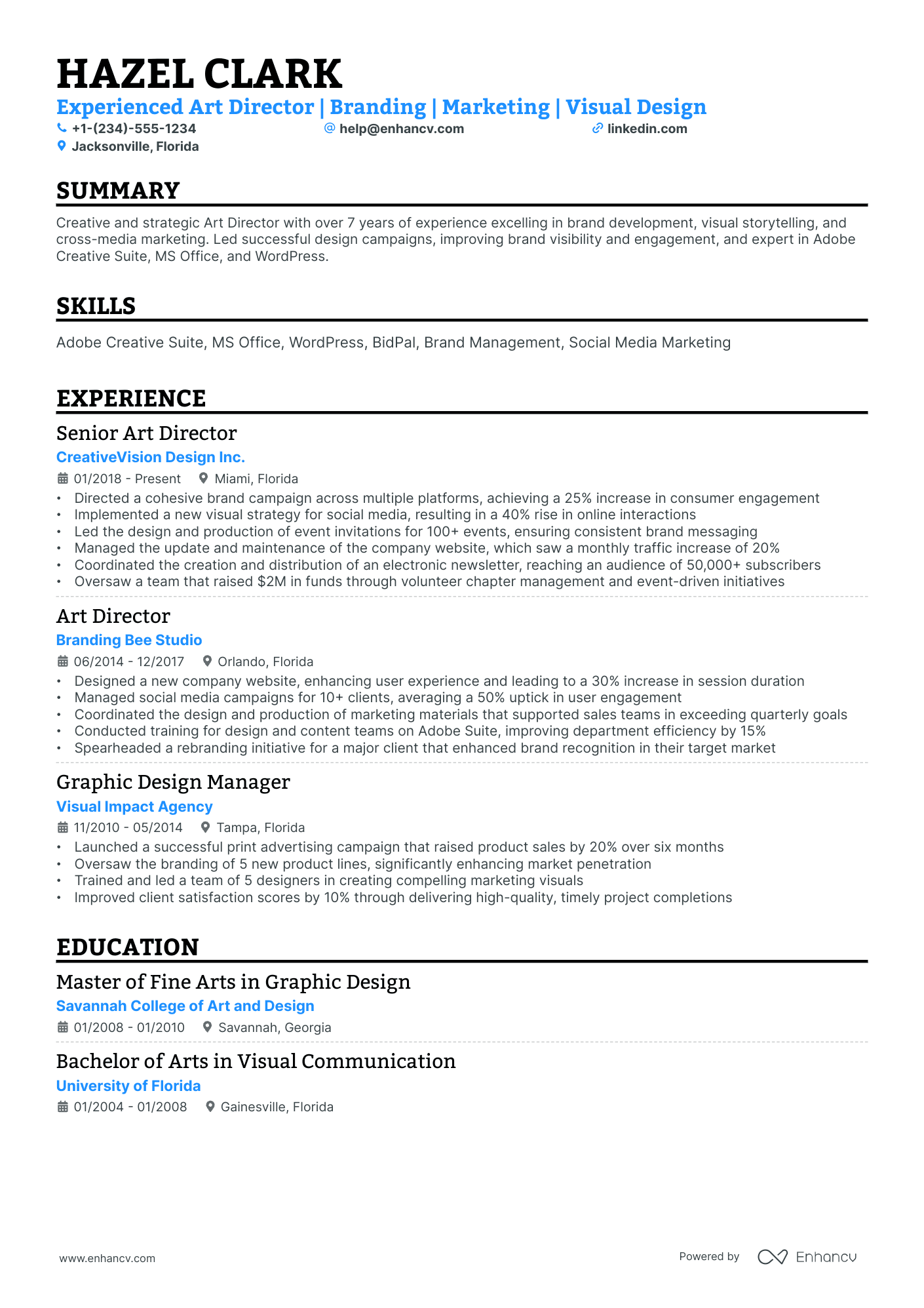
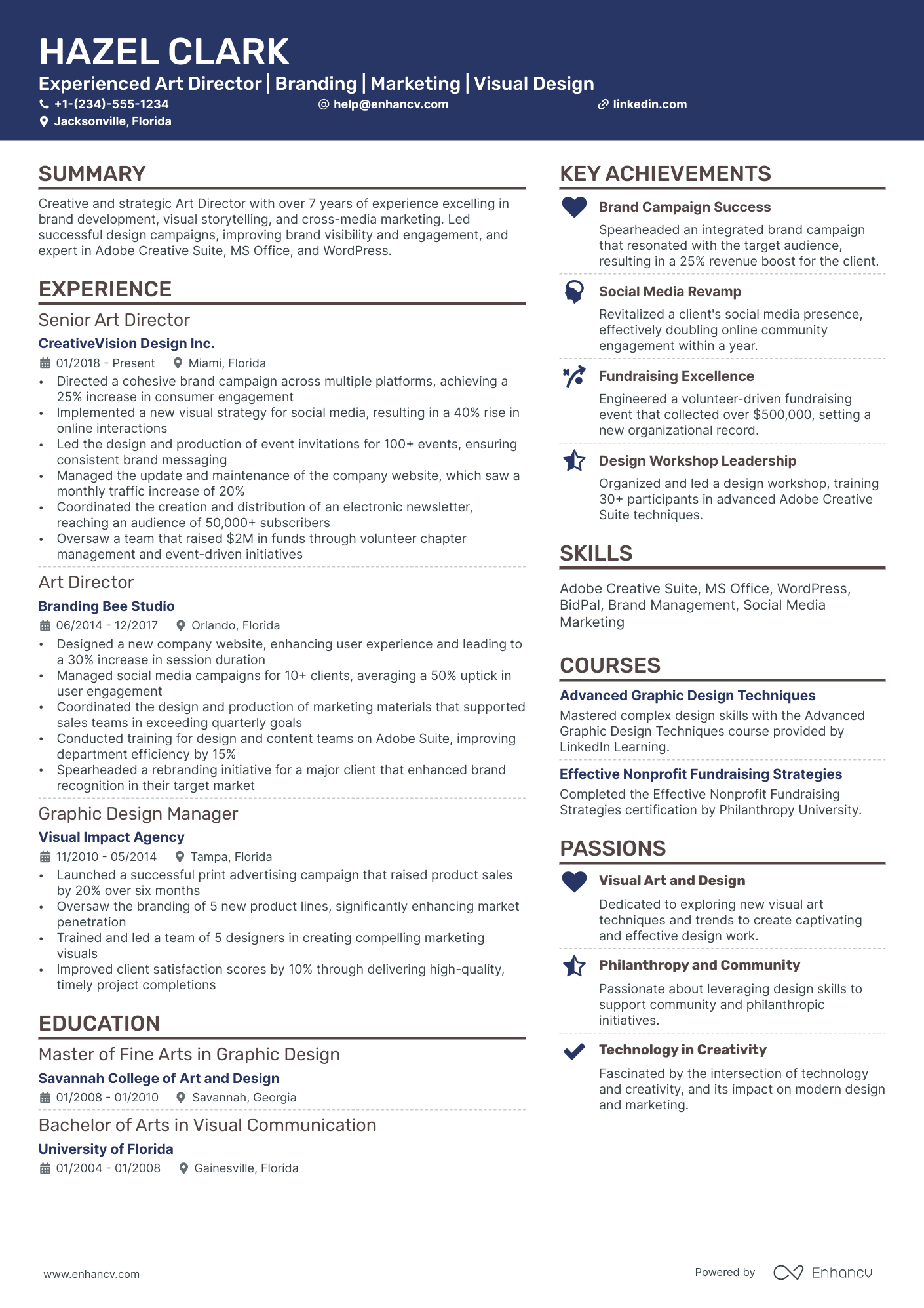
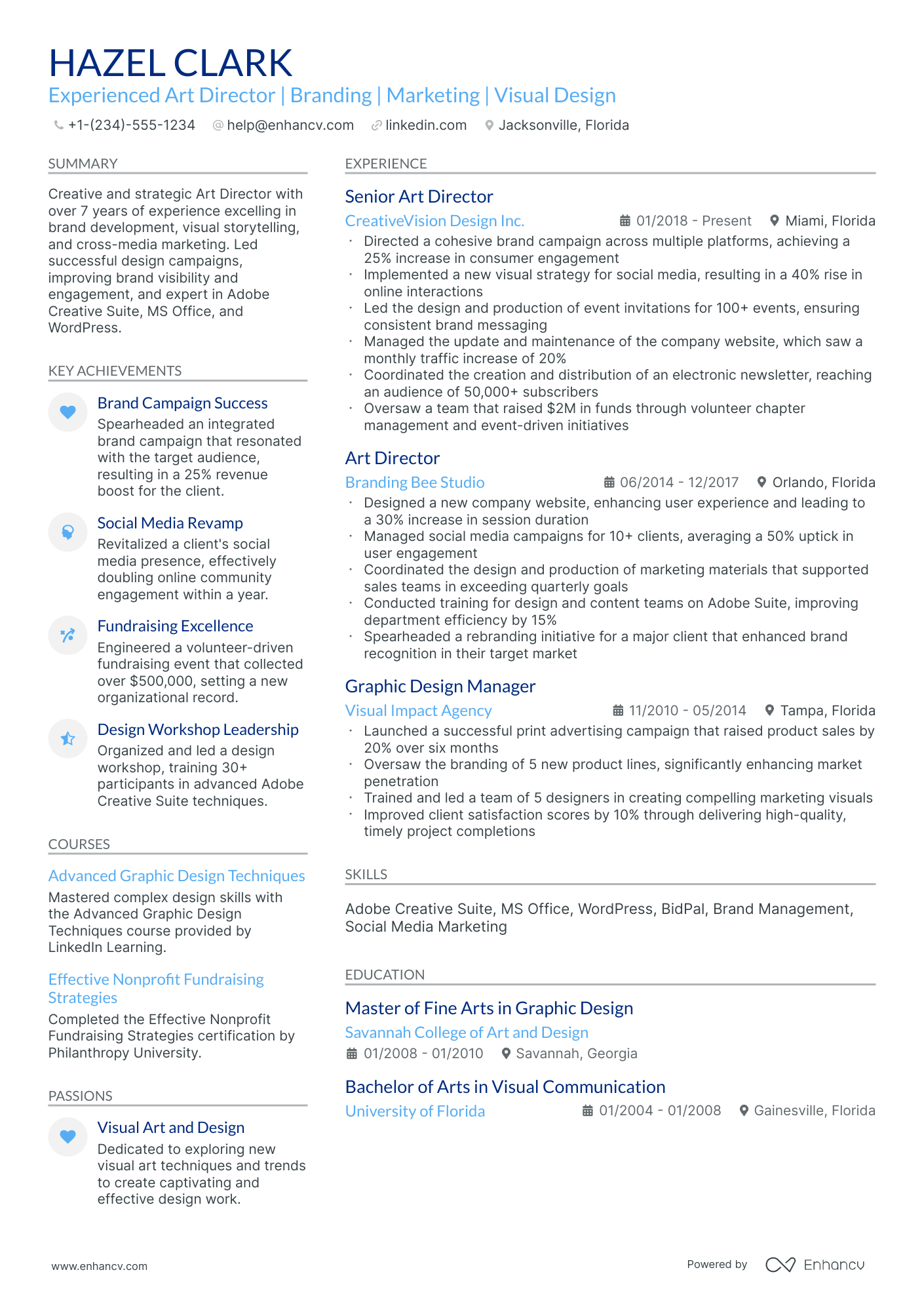
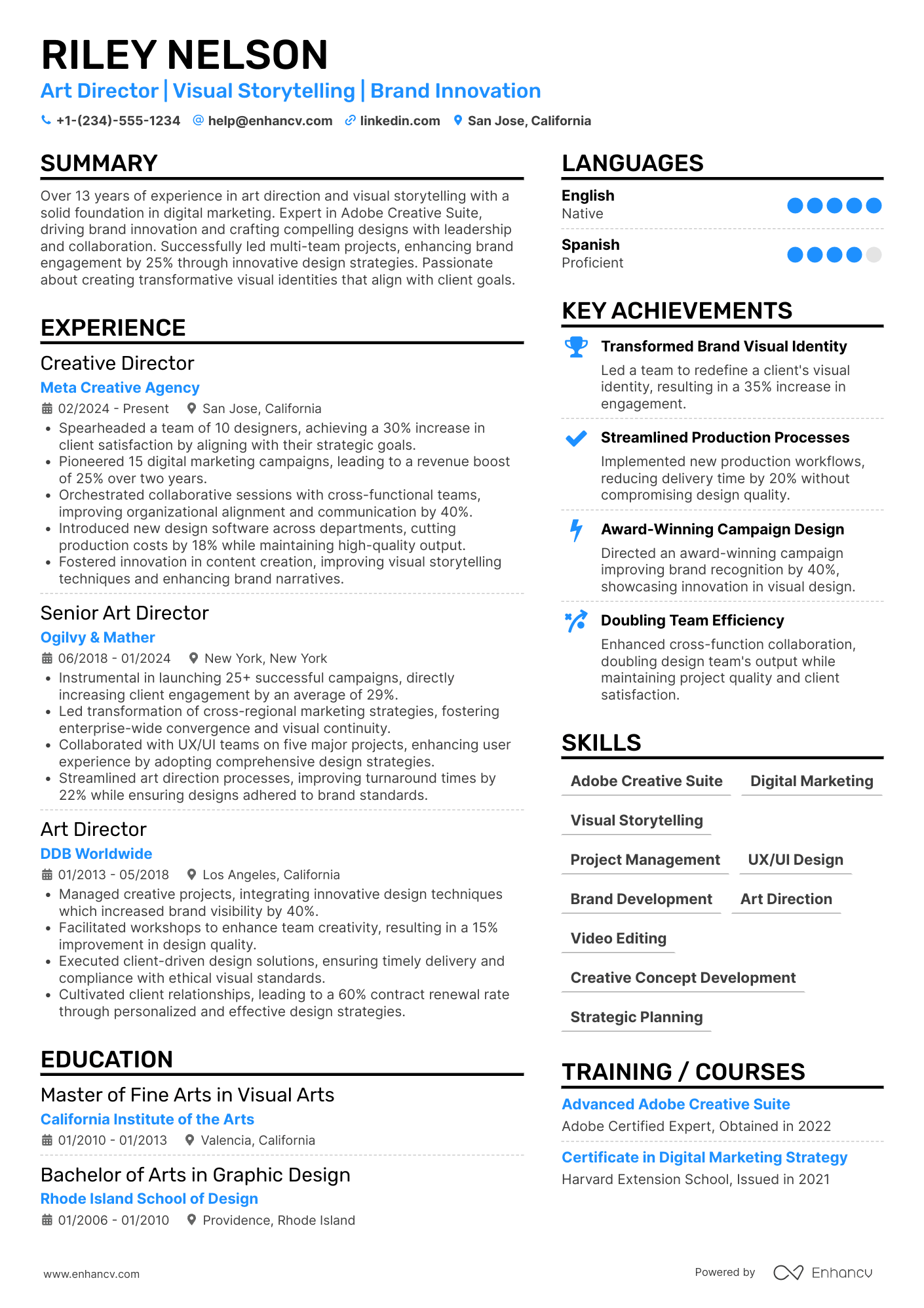
Most art director resume submissions fail because they read like portfolios in text, burying leadership decisions and measurable impact. That makes them easy to miss in ATS screening and fast recruiter scans, especially when competition is intense.
A strong resume shows how you drove outcomes, not just what you used or touched. Knowing how to make your resume stand out means you'll highlight campaign lift, budget and team scope, on-time delivery across channels, improved brand consistency, higher engagement, stronger conversion, and faster approvals through clearer creative direction.

Key takeaways
- Use reverse-chronological format to show progressive creative leadership and decision-making authority.
- Quantify achievements with metrics like conversion lift, budget savings, and turnaround time improvements.
- Tailor every experience bullet to match the specific job posting's tools, scope, and terminology.
- Demonstrate skills in context through your summary and experience, not just a standalone list.
- Lead each role entry with team size, budget authority, and brand portfolio scope.
- Enhancv can help you turn vague duties into measurable, recruiter-ready resume bullets faster.
- Include a cover letter only when the role demands context your resume can't convey alone.
Job market snapshot for art directors
We analyzed 256 recent art director job ads across major US job boards. These numbers help you understand employment type trends, role specialization trends, regional hotspots at a glance.
What level of experience employers are looking for art directors
| Years of Experience | Percentage found in job ads |
|---|---|
| 1–2 years | 17.2% (44) |
| 3–4 years | 28.1% (72) |
| 5–6 years | 10.5% (27) |
| 7–8 years | 6.6% (17) |
| 9–10 years | 2.3% (6) |
| 10+ years | 2.7% (7) |
| Not specified | 34.8% (89) |
Art director ads by area of specialization (industry)
| Industry (Area) | Percentage found in job ads |
|---|---|
| Healthcare | 47.7% (122) |
| Finance & Banking | 26.2% (67) |
| Manufacturing | 7.8% (20) |
| Media & Entertainment | 6.6% (17) |
| Retail & E-commerce | 6.3% (16) |
Top companies hiring art directors
| Company | Percentage found in job ads |
|---|---|
| Accenture | 33.2% (85) |
| PUBLICIS GROUPE | 8.2% (21) |
| Deloitte | 5.9% (15) |
| WPP PLC | 5.1% (13) |
| Media.Monks | 4.7% (12) |
Role overview stats
These tables show the most common responsibilities and employment types for art director roles. Use them to align your resume with what employers expect and to understand how the role is structured across the market.
Day-to-day activities and top responsibilities for a art director
| Responsibility | Percentage found in job ads |
|---|---|
| Adobe creative suite | 55.9% (143) |
| Figma | 41.4% (106) |
| Photoshop | 21.5% (55) |
| Illustrator | 20.3% (52) |
| Indesign | 18.4% (47) |
| After effects | 12.9% (33) |
| Animation | 9.4% (24) |
| Typography | 9.0% (23) |
| Motion design | 8.2% (21) |
| Video | 8.2% (21) |
| Capcut | 5.9% (15) |
| Chatgpt | 5.9% (15) |
Type of employment (remote vs on-site vs hybrid)
| Employment type | Percentage found in job ads |
|---|---|
| On-site | 69.5% (178) |
| Hybrid | 26.6% (68) |
| Remote | 3.9% (10) |
How to format a art director resume
Recruiters evaluating art director candidates prioritize creative leadership scope, brand-level accountability, and a clear trajectory of increasing responsibility over campaigns, teams, and budgets. A reverse-chronological format surfaces these signals immediately, letting hiring managers trace your decision-making authority and business impact without hunting through disconnected skill lists. Choosing the right resume format is critical to making that first impression count.

I have significant experience in this role—which format should I use?
Use a reverse-chronological format—it's the strongest way to demonstrate sustained creative leadership and progressive ownership across brands, teams, and campaigns. Do:
- Lead each role entry with your scope of oversight: team size, number of direct reports, brand portfolios managed, and budget authority.
- Highlight proficiency in role-critical tools and domains such as Adobe Creative Suite, Figma, brand identity systems, integrated campaign development, and cross-functional collaboration with copywriters, UX designers, and marketing stakeholders.
- Quantify outcomes at the business level—revenue influenced, engagement lifts, award recognition, or production efficiencies gained under your direction.
Why hybrid and functional resumes don't work for senior roles
Hybrid formats fragment your leadership narrative by pulling key skills out of their career context, making it harder for recruiters to assess the scale and progression of your creative authority. Functional formats are even more damaging—they obscure accountability entirely, hiding how your decision-making evolved across roles, teams, and campaign complexity. Avoid both formats if you have five or more years of progressive art direction experience, as they will dilute the leadership trajectory that senior hiring managers specifically screen for.
- Edge-case exception: A functional format may be acceptable only if you're transitioning into art direction from an adjacent creative leadership role (such as senior graphic designer or creative lead) and lack formal art director titles—but even then, every skill listed must be anchored to a specific project, team outcome, or measurable result to maintain credibility.
Once you've established a clean, readable format, the next step is deciding which sections to include so each one earns its place on the page.
What sections should go on a art director resume
Recruiters expect you to present a clear snapshot of your creative leadership, brand work, and measurable results as an art director. Understanding which resume sections to include ensures maximum clarity:
- Header
- Summary
- Experience
- Skills
- Projects
- Education
- Certifications
- Optional sections: Awards, Publications, Languages
Strong experience bullets should emphasize campaign and brand impact, creative scope, team leadership, and measurable outcomes.
Is your resume good enough?
Drop your resume here or choose a file. PDF & DOCX only. Max 2MB file size.
Once you’ve organized your resume with the right core components, the next step is to write your art director experience section so it fits that structure and supports the role you’re targeting.
How to write your art director resume experience
The experience section is where you prove you've shipped creative work that shaped brand identity, campaign performance, and visual systems. Hiring managers prioritize demonstrated impact—delivered campaigns, refined brand standards, and measurable creative outcomes—over descriptive task lists that simply catalog daily responsibilities. Building a strong work experience section is essential for showing what you owned and what results you delivered.
Each entry should include:
- Job title
- Company and location (or remote)
- Dates of employment (month and year)
Three to five concise bullet points showing what you owned, how you executed, and what outcomes you delivered:
- Ownership scope: the campaigns, brand systems, visual identities, creative teams, or channels you were directly accountable for as art director.
- Execution approach: the design tools, creative direction frameworks, production workflows, or concept development methods you used to guide visual output and make strategic creative decisions.
- Value improved: changes to brand consistency, campaign performance, production efficiency, creative quality, or audience engagement tied to your art direction.
- Collaboration context: how you partnered with copywriters, designers, photographers, marketing strategists, account teams, or clients to align creative vision with business objectives.
- Impact delivered: outcomes expressed through campaign reach, brand perception shifts, creative awards, production scale, or revenue influence rather than a summary of tasks performed.
Experience bullet formula
A art director experience example
✅ Right example - modern, quantified, specific.
Art Director
Lumen & Co. | Austin, TX
2021–Present
High-growth direct-to-consumer skincare brand scaling ecommerce, retail, and lifecycle marketing across North America.
- Led end-to-end art direction for integrated campaigns across web, email, paid social, and retail displays using Figma, Adobe Creative Cloud, and Asana, increasing conversion rate by 18% and lifting quarterly revenue by $1.2M.
- Built and governed a modular brand system—typography, color, grid, motion, and photography guidelines—documented in Zeroheight, cutting design revisions by 32% and reducing cross-channel inconsistencies by 45%.
- Directed photo and video productions with external studios and in-house teams, creating shot lists and storyboards, negotiating usage rights, and delivering assets two weeks faster on average while lowering production spend by 14%.
- Partnered with product managers and engineers to redesign key ecommerce templates in Shopify and Contentful, improving page load performance by 22% and increasing mobile add-to-cart rate by 11%.
- Managed and mentored five designers through critique rituals, creative briefs, and quality reviews, raising on-time delivery from 76% to 93% and improving stakeholder satisfaction from 3.8 to 4.6 out of five.
Now that you've seen how a strong experience section comes together, let's look at how to adjust those details to match the specific job you're targeting.
How to tailor your art director resume experience
Recruiters evaluate art director resumes through both human review and applicant tracking systems (ATS), so tailoring your resume to the job description is essential. Aligning your bullet points with the specific role ensures your qualifications register with both screening methods.
Ways to tailor your art director experience:
- Match design tools and software platforms listed in the job description.
- Mirror the exact creative methodology or workflow terminology used.
- Reflect brand strategy or campaign KPIs the posting prioritizes.
- Include industry experience relevant to the company's market or sector.
- Highlight team leadership structures that match their collaboration model.
- Emphasize accessibility or brand compliance standards when referenced.
- Incorporate production processes or asset management systems they name.
- Align your creative direction scope with the role's stated responsibilities.
Tailoring means connecting your real accomplishments to what the employer values, not forcing disconnected keywords into your bullet points.
Resume tailoring examples for art director
| Job description excerpt | Untailored | Tailored |
|---|---|---|
| Lead visual direction for integrated campaigns across digital, print, and social channels using Adobe Creative Suite and Figma | Managed creative projects and worked with design teams on various assignments. | Led visual direction for 12+ integrated campaigns across digital, print, and social channels, using Figma and Adobe Creative Suite to deliver cohesive brand storytelling that increased engagement by 34%. |
| Collaborate with copywriters, UX designers, and marketing stakeholders to develop brand identity systems for CPG clients | Worked cross-functionally with different departments to complete branding projects on time. | Partnered with copywriters, UX designers, and marketing leads to develop brand identity systems for three CPG clients, unifying visual language across 40+ SKUs and retail touchpoints. |
| Oversee a team of five designers and motion artists, managing concept-to-delivery workflows in Monday.com while maintaining brand consistency across OOH and streaming platforms | Supervised designers and made sure projects stayed on track and met quality standards. | Managed a team of five designers and motion artists through concept-to-delivery workflows in Monday.com, ensuring brand consistency across OOH and streaming campaigns that reached 8M+ impressions per quarter. |
Once you’ve aligned your experience with the role’s priorities, the next step is to quantify your art director achievements so hiring teams can see the impact behind those choices.
How to quantify your art director achievements
Quantifying your achievements shows how your creative leadership improved speed, quality, and business results. Focus on turnaround time, approval cycles, conversion lift, production accuracy, and budget efficiency across campaigns, brand systems, and content pipelines.
Quantifying examples for art director
| Metric | Example |
|---|---|
| Turnaround time | "Cut campaign creative turnaround from 12 to seven business days by standardizing briefs and building a Figma component library for eight recurring layouts." |
| Approval cycle | "Reduced stakeholder approval rounds from five to two by introducing weekly creative reviews and a clear feedback rubric across marketing and product teams." |
| Conversion lift | "Improved landing page conversion by 14% after art-directing a new visual hierarchy and A/B tests in Optimizely across three hero concepts." |
| Production accuracy | "Lowered print production rework from 9% to 2% by tightening preflight checklists and enforcing Adobe InDesign packaging standards with vendors." |
| Budget efficiency | "Delivered a 22-asset product launch under budget by 18% by renegotiating retouching rates and reusing modular templates across paid and organic." |
Turn vague job duties into measurable, recruiter-ready resume bullets in seconds with Enhancv's Bullet Point Generator.
With strong bullet points in place, the next step is ensuring your skills section highlights the right mix of hard and soft skills that art directors need.
How to list your hard and soft skills on a art director resume
Your skills section shows you can lead visual direction and ship brand-consistent creative, while recruiters and an ATS (applicant tracking system) scan this section for job-match keywords; aim for a balanced mix of hard skills and role-specific soft skills.
art director roles require a blend of:
- Product strategy and discovery skills.
- Data, analytics, and experimentation skills.
- Delivery, execution, and go-to-market discipline.
- Soft skills.
Your skills section should be:
- Scannable (bullet-style grouping).
- Relevant to the job post.
- Backed by proof in experience bullets.
- Updated with current tools.
Place your skills section:
- Above experience if you're junior or switching careers.
- Below experience if you're mid/senior with strong achievements.

Hard skills
- Adobe Creative Cloud
- Photoshop, Illustrator, InDesign
- Figma, FigJam
- After Effects, Premiere Pro
- Typography and layout systems
- Brand identity systems
- Art direction for campaigns
- Storyboarding and shot lists
- Photo retouching workflows
- Print production and prepress
- Digital ad specs and QA
- Design systems and guidelines
Soft skills
- Creative concept development
- Leading critiques and reviews
- Cross-functional alignment
- Clear visual rationale
- Stakeholder expectation setting
- Prioritizing creative tradeoffs
- Delegating and mentoring designers
- Managing external vendors
- Presenting to executives
- Feedback synthesis and iteration
- Owning timelines and quality
- Conflict resolution in reviews
How to show your art director skills in context
Skills shouldn't live only in a dedicated skills list. You can explore common resume skills to identify which ones align best with art director roles.
They should be demonstrated in:
- Your summary (high-level professional identity)
- Your experience (proof through outcomes)
Here's what that looks like in practice.
Summary example
Senior art director with 12 years in lifestyle and retail branding. Skilled in creative direction, Figma, and cross-functional storytelling. Led a campaign rebrand that boosted engagement by 34%. Known for mentoring junior creatives and elevating brand consistency.
- Signals senior-level expertise immediately
- Names role-relevant tools and methods
- Includes a concrete, measurable outcome
- Highlights mentorship as a soft skill
Experience example
Senior Art Director
Rivella Creative Group | Remote
March 2019–January 2024
- Directed a 15-person creative team using Figma and After Effects, delivering campaigns that increased client retention by 22%.
- Partnered with copywriters and UX designers to launch a product rebrand, driving a 40% lift in social engagement.
- Established a visual style guide adopted across four departments, reducing design revision cycles by 30%.
- Every bullet includes measurable proof
- Skills appear naturally within achievements
Once you’ve demonstrated your art director capabilities through real project examples, the next step is to translate that proof into a resume even if you don’t have formal experience.
How do I write a art director resume with no experience
Even without full-time experience, you can demonstrate readiness through creative projects and freelance work. If you're building a resume without work experience, focus on showcasing tangible outputs:
- Student-led brand identity campaigns
- Freelance social ad creative sets
- Agency internship concepting support
- Spec portfolio rebrands for real companies
- Campus magazine art direction
- Pro bono nonprofit campaign visuals
- Motion graphics for digital launches
- Photography and retouching projects
Focus on:
- Portfolio links with role context
- Concept-to-execution process samples
- Brand systems and guidelines work
- Measurable results and deliverables
Resume format tip for entry-level art director
Use a combination resume format to highlight portfolio projects and tools first, then list related experience and education to prove relevance fast. Do:
- Lead with a portfolio link.
- Add a one-line project summary.
- List tools used per project.
- Quantify outputs and performance metrics.
- Match keywords to each job post.
- Art director for a pro bono nonprofit campaign, built a brand kit in Adobe Illustrator and Figma, delivering twelve assets that increased email sign-ups by 18%.
Even without professional experience, your education section can serve as the foundation of your art director resume—here's how to present it effectively.
How to list your education on a art director resume
Your education section helps hiring teams confirm you have foundational training in design, visual communication, or related creative disciplines essential for an art director.
Include:
- Degree name
- Institution
- Location
- Graduation year
- Relevant coursework (for juniors or entry-level candidates)
- Honors & GPA (if 3.5 or higher)
Skip month and day details—list the graduation year only.
Here's a strong education entry tailored for an art director resume.
Example education entry
Bachelor of Fine Arts in Graphic Design
Rhode Island School of Design, Providence, RI
Graduated 2019
GPA: 3.7/4.0
- Relevant coursework: Typography, Brand Identity Systems, Art Direction, Motion Graphics, Visual Storytelling
- Honors: Dean's List (six semesters), recipient of the RISD Award for Excellence in Visual Communication
How to list your certifications on a art director resume
Certifications on your resume show an art director's commitment to learning, proficiency with key tools, and alignment with current industry standards, especially in fast-changing creative workflows.
Include:
- Certificate name
- Issuing organization
- Year
- Optional: credential ID or URL
- Place certifications below education when they are older, general, or less relevant than your degree and recent art director experience.
- Place certifications above education when they are recent, highly relevant, or required for the art director role you target.
Best certifications for your art director resume
- Adobe Certified Professional in Visual Design
- Adobe Certified Professional in Graphic Design & Illustration Using Adobe Illustrator
- Adobe Certified Professional in Print & Digital Media Publication Using Adobe InDesign
- Nielsen Norman Group UX Certification
- IDEO U Foundations in Design Thinking Certificate
- Google UX Design Professional Certificate
- HubSpot Content Marketing Certification
Once you’ve positioned your credentials to reinforce your expertise, shift to writing your art director resume summary so it highlights those strengths upfront.
How to write your art director resume summary
Your resume summary is the first thing a recruiter reads. A strong one frames your creative leadership and makes them want to keep going.
Keep it to three to four lines, with:
- Your title and total years of experience in art direction or creative leadership.
- The domain you work in, such as advertising, branding, editorial, or digital product.
- Core tools and skills like Adobe Creative Suite, Figma, motion design, or typography.
- One or two quantified achievements that show business or campaign impact.
- Soft skills tied to real outcomes, such as mentoring junior designers or aligning cross-functional teams.

PRO TIP
At a senior level, lead with outcomes and creative ownership. Highlight how your vision shaped campaigns, grew teams, or drove revenue. Avoid vague descriptors like "passionate" or "innovative thinker." Show scope and decision-making instead.
Example summary for a art director
Senior art director with 10+ years leading brand campaigns across retail and CPG. Directed a 12-person creative team, delivering work that increased client engagement by 34%. Skilled in Figma, Adobe Creative Suite, and cross-functional collaboration.
Optimize your resume summary and objective for ATS
Drop your resume here or choose a file.
PDF & DOCX only. Max 2MB file size.
Now that your summary captures your creative leadership and vision, make sure the header framing it presents your contact details clearly and professionally.
What to include in a art director resume header
Your resume header is the top section with your identity and contact details, and it boosts visibility, credibility, and recruiter screening for a art director.
Essential resume header elements
- Full name
- Tailored job title and headline
- Location
- Phone number
- Professional email
- GitHub link
- Portfolio link
A LinkedIn link helps recruiters verify experience quickly and supports screening.
Do not include photos on a art director resume unless the role is explicitly front-facing or appearance-dependent.
Keep the header to two lines, use consistent formatting, and place your portfolio link next to your email for fast access.
Art director resume header
Jordan Rivera
Art Director | Branding and Digital Campaigns
Austin, TX
(512) 555-01XX
jordan.rivera@enhancv.com
github.com/jordanrivera
jordanrivera.com
linkedin.com/in/jordanrivera
Once your contact details and professional branding are clear at the top, you can strengthen the rest of your resume with additional sections that support your art direction experience and skills.
Additional sections for art director resumes
When your core sections don't fully capture your creative edge, additional sections help you stand out and build role-specific credibility.
- Awards and creative recognition
- Publications and featured work
- Languages
- Speaking engagements and jury panels
- Professional affiliations (AIGA, The One Club, D&AD)
- Hobbies and interests
Once you've rounded out your resume with the right supplementary sections, it's worth turning your attention to the cover letter—a separate document that can reinforce and expand on everything your resume presents.
Do art director resumes need a cover letter
An art director cover letter isn't required for every application. If you're unsure what a cover letter is and when it matters, it helps most in competitive roles, agency searches, or when hiring managers expect context beyond a portfolio. It can make a difference when your resume needs a clear story.
Use a cover letter when you need to add context that the resume and portfolio can't:
- Explain role or team fit: Match your leadership style to the team's structure, pace, and collaboration model with design, product, and marketing.
- Highlight one or two relevant projects or outcomes: Name the work, your role, and the measurable result, such as conversion lift, faster production, or stronger brand consistency.
- Show understanding of the product, users, or business context: Reference the audience, constraints, and goals, and connect your creative direction to business priorities.
- Address career transitions or non-obvious experience: Clarify shifts across industries, gaps, freelance periods, or title changes, and tie them to art director responsibilities.
Drop your resume here or choose a file.
PDF & DOCX only. Max 2MB file size.
Once you’ve decided whether to include a cover letter based on the role and employer expectations, you can use AI to improve your art director resume by refining your content and tailoring it faster.
Using AI to improve your art director resume
AI can sharpen your resume's clarity, structure, and impact. It helps tighten language and highlight results. But overuse strips away your authentic voice. Once your content feels clear and role-aligned, step away from AI. If you're wondering which AI is best for writing resumes, focus on tools that enhance rather than replace your own voice.
Here are 10 practical prompts to strengthen specific sections of your art director resume:
- Strengthen your summary. "Rewrite my art director resume summary to emphasize creative leadership, brand vision, and measurable campaign results in under four sentences."
- Quantify experience bullets. "Review my art director experience bullets and suggest specific metrics, percentages, or outcomes I can add to each accomplishment."
- Tighten wordy descriptions. "Shorten each of my art director experience bullet points to one concise line without losing key achievements or responsibilities."
- Align skills strategically. "Compare my art director skills section against this job description and recommend which skills to add, remove, or reorder."
- Improve project descriptions. "Rewrite my art director portfolio project descriptions to highlight creative problem-solving, team collaboration, and business impact."
- Refine education details. "Suggest how to format my art director education section to emphasize coursework, honors, or projects relevant to creative direction."
- Showcase certifications clearly. "Reorganize my art director certifications section so the most industry-relevant credentials appear first with clear context."
- Remove filler language. "Identify and remove vague or generic phrases across my entire art director resume, replacing them with specific, concrete language."
- Target action verbs. "Replace weak or repetitive verbs in my art director experience section with strong, varied action verbs tied to creative leadership."
- Check role consistency. "Review my full art director resume for inconsistent job titles, date gaps, or misaligned descriptions and flag each issue."
Stop using AI once your resume sounds accurate, specific, and aligned with real experience. AI should never invent experience or inflate claims—if it didn't happen, it doesn't belong here.
Conclusion
A strong art director resume proves impact with measurable outcomes, shows role-specific skills, and stays easy to scan. Use clear headings, tight bullets, and a focused summary to connect your work to business goals and audience needs.
Hiring teams want art directors who can lead creative, deliver on deadlines, and collaborate across teams. When your structure is clean and your results are specific, you look ready for today’s roles and near-future expectations.