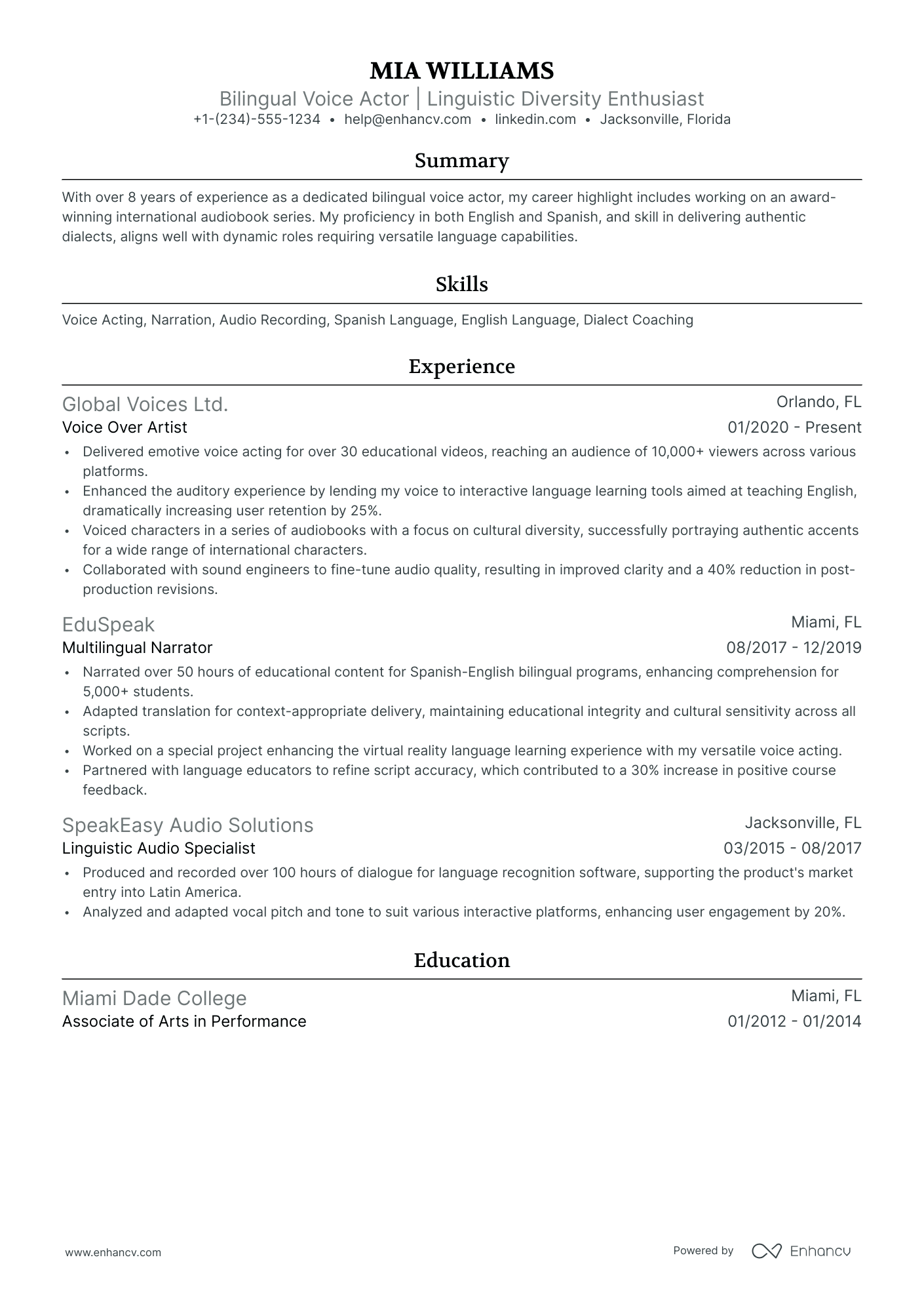
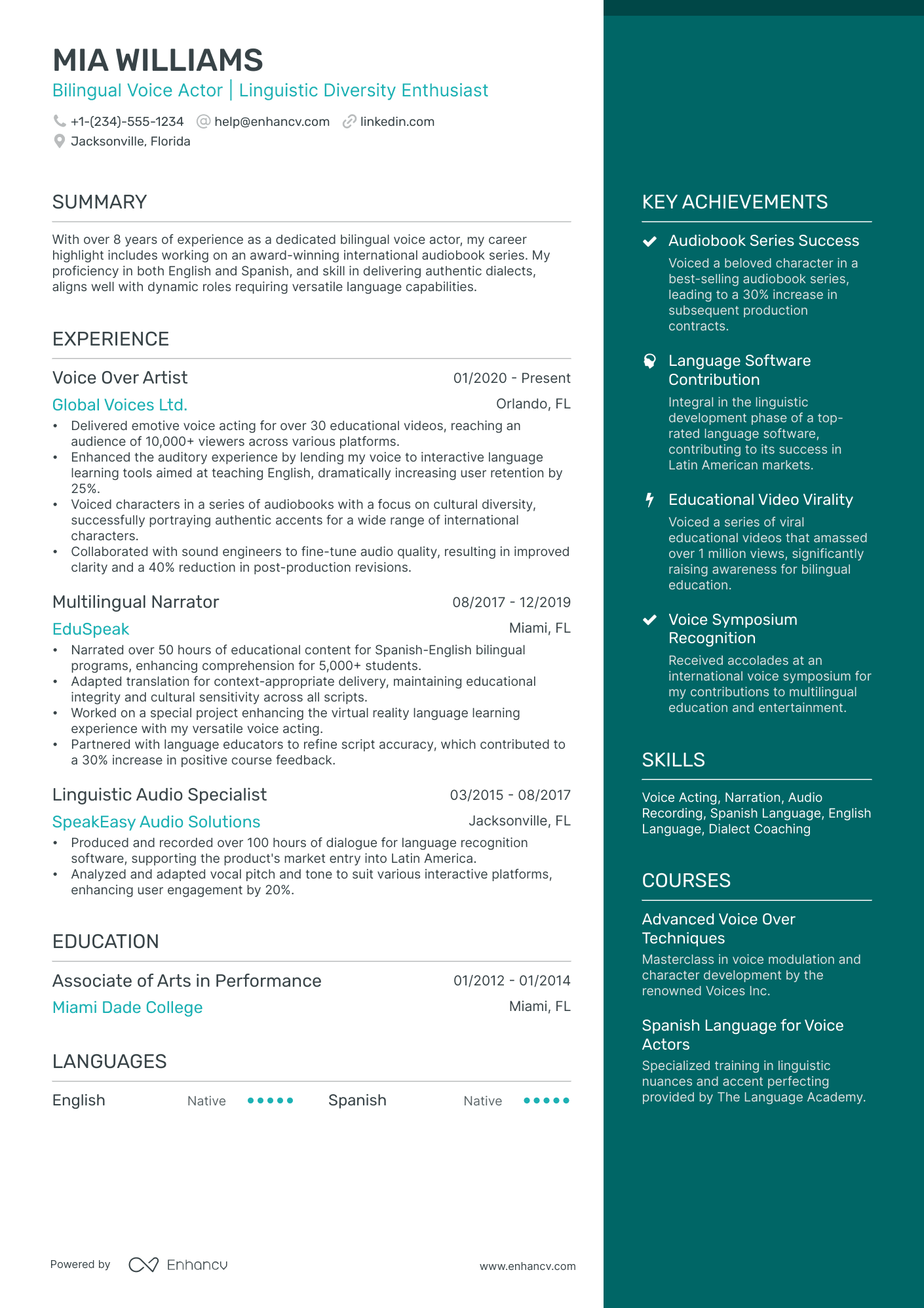
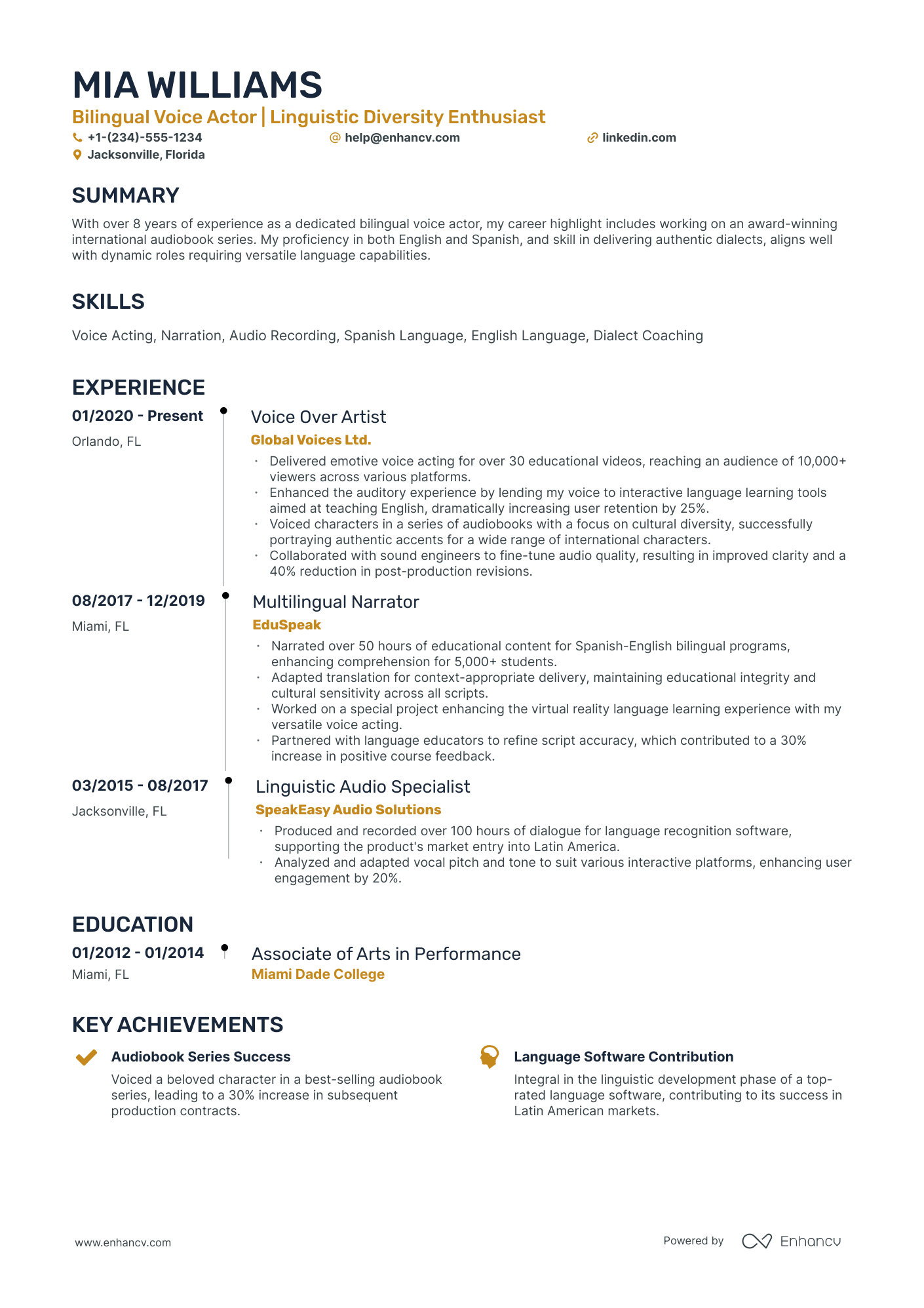
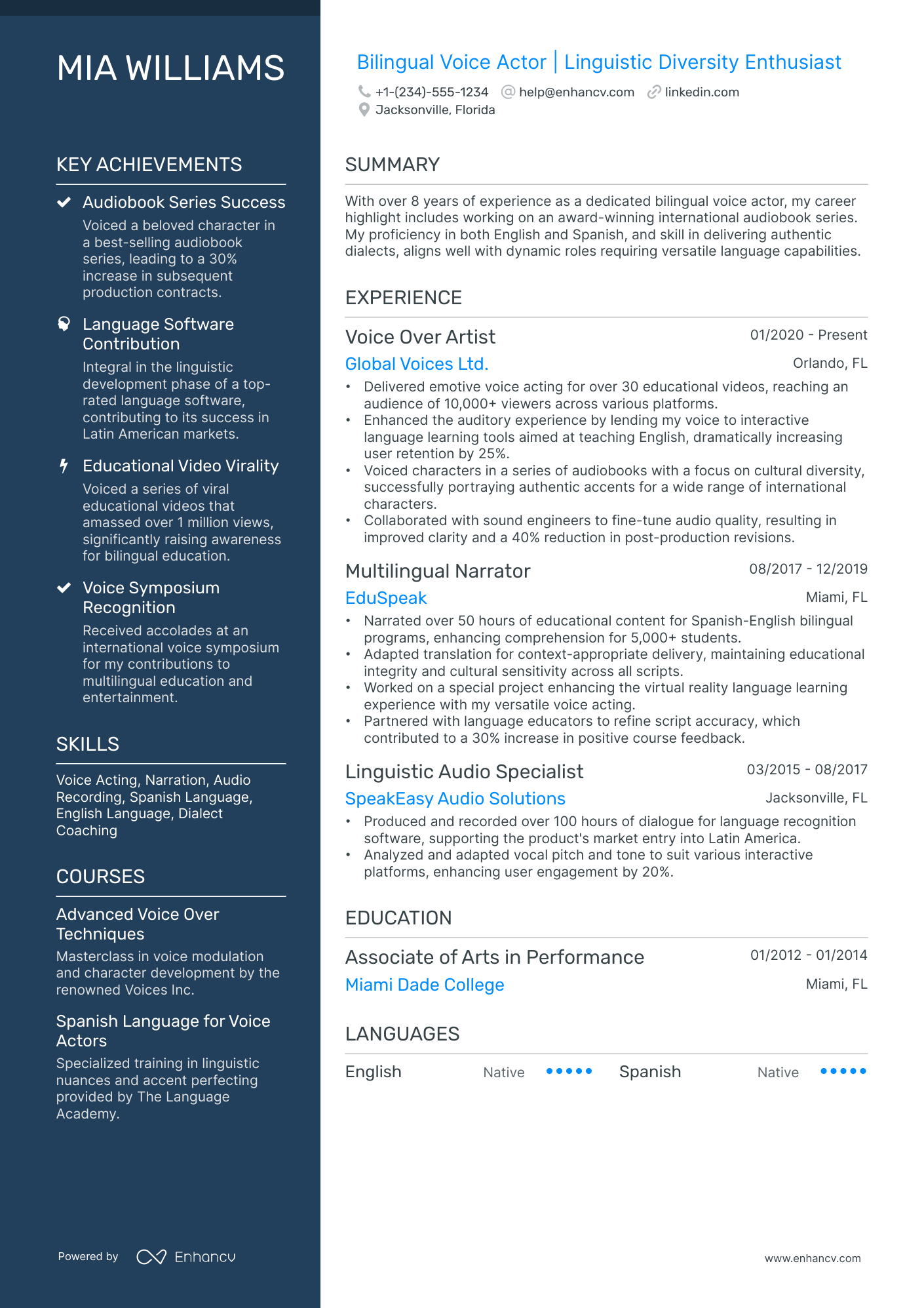
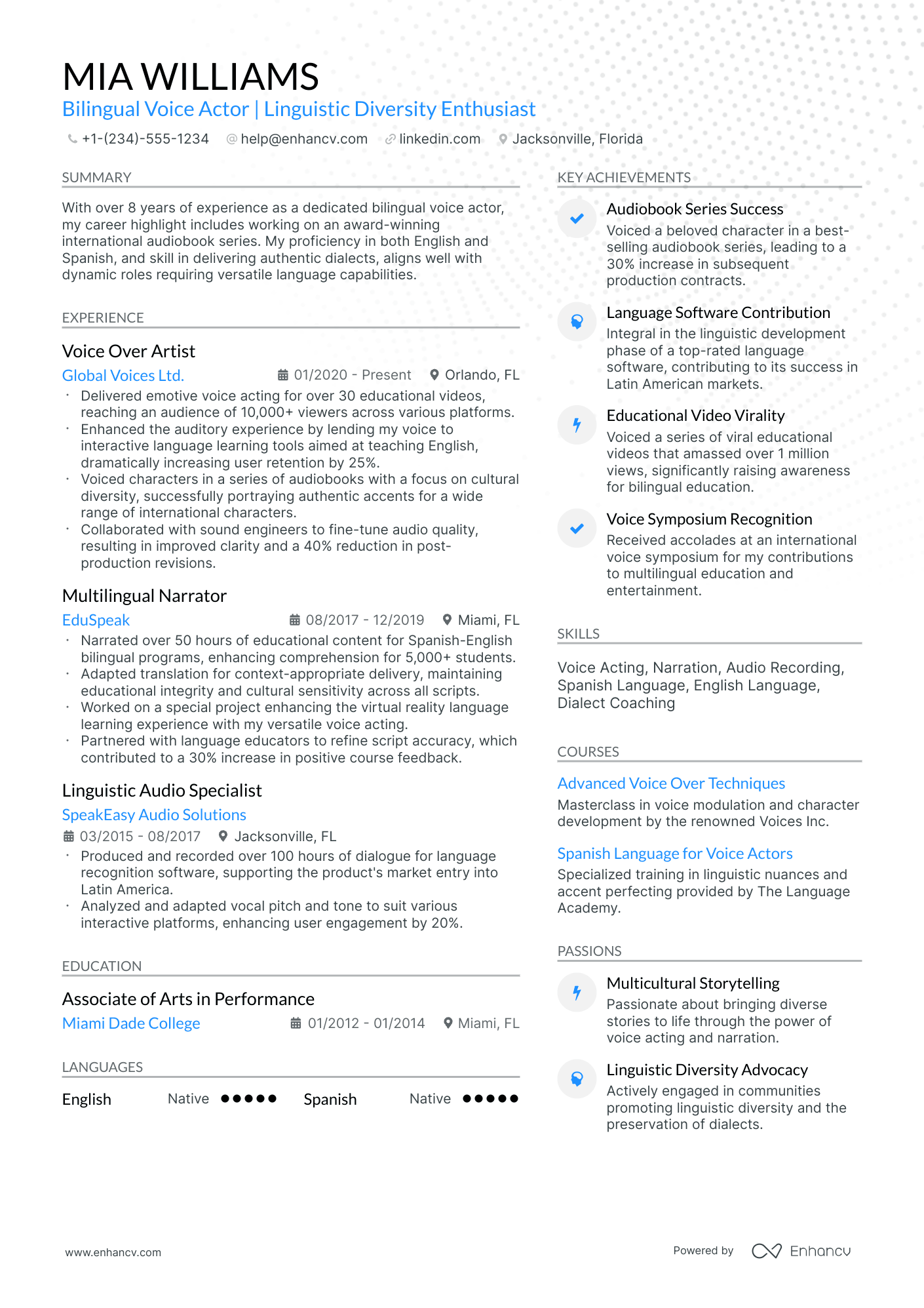
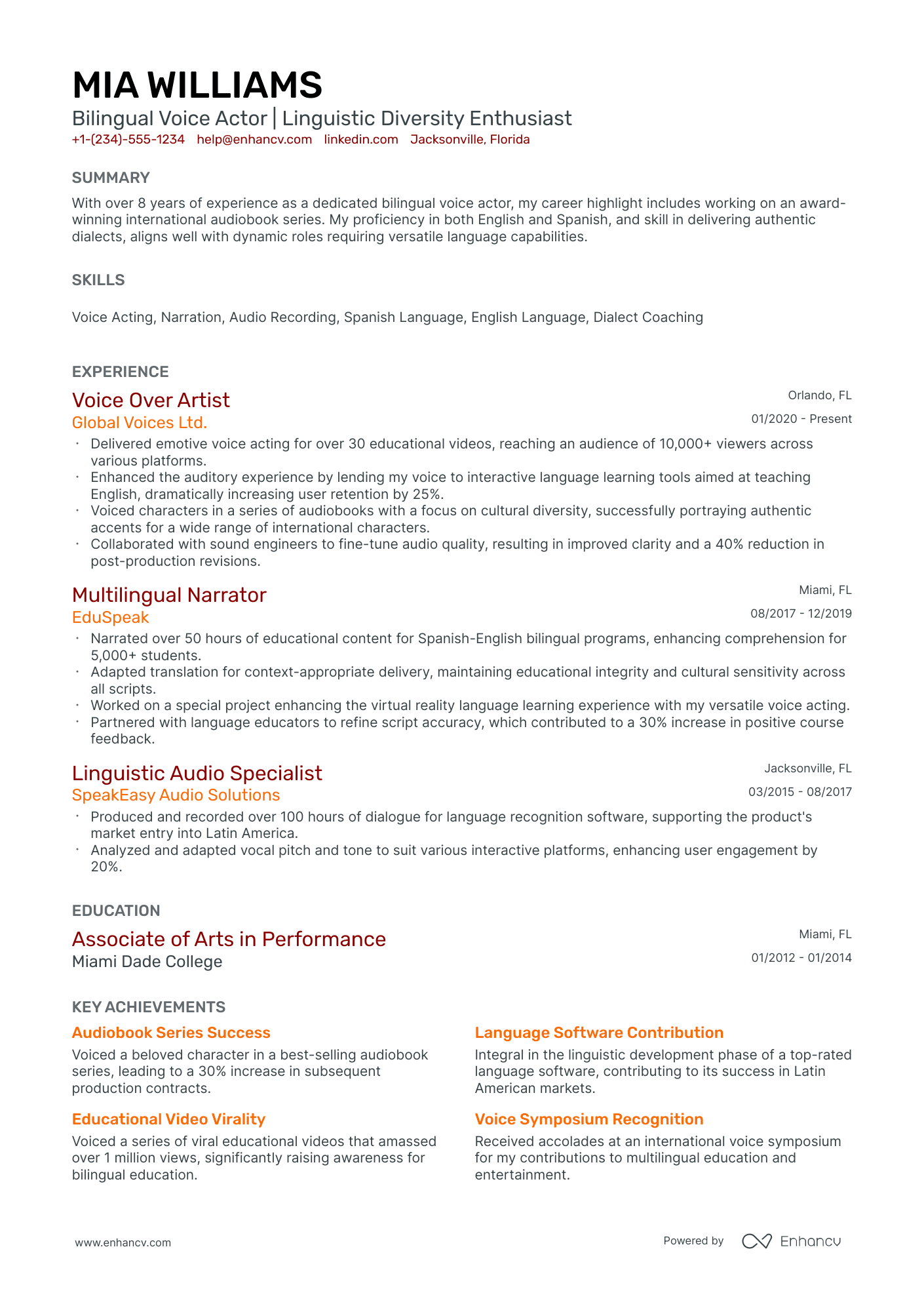
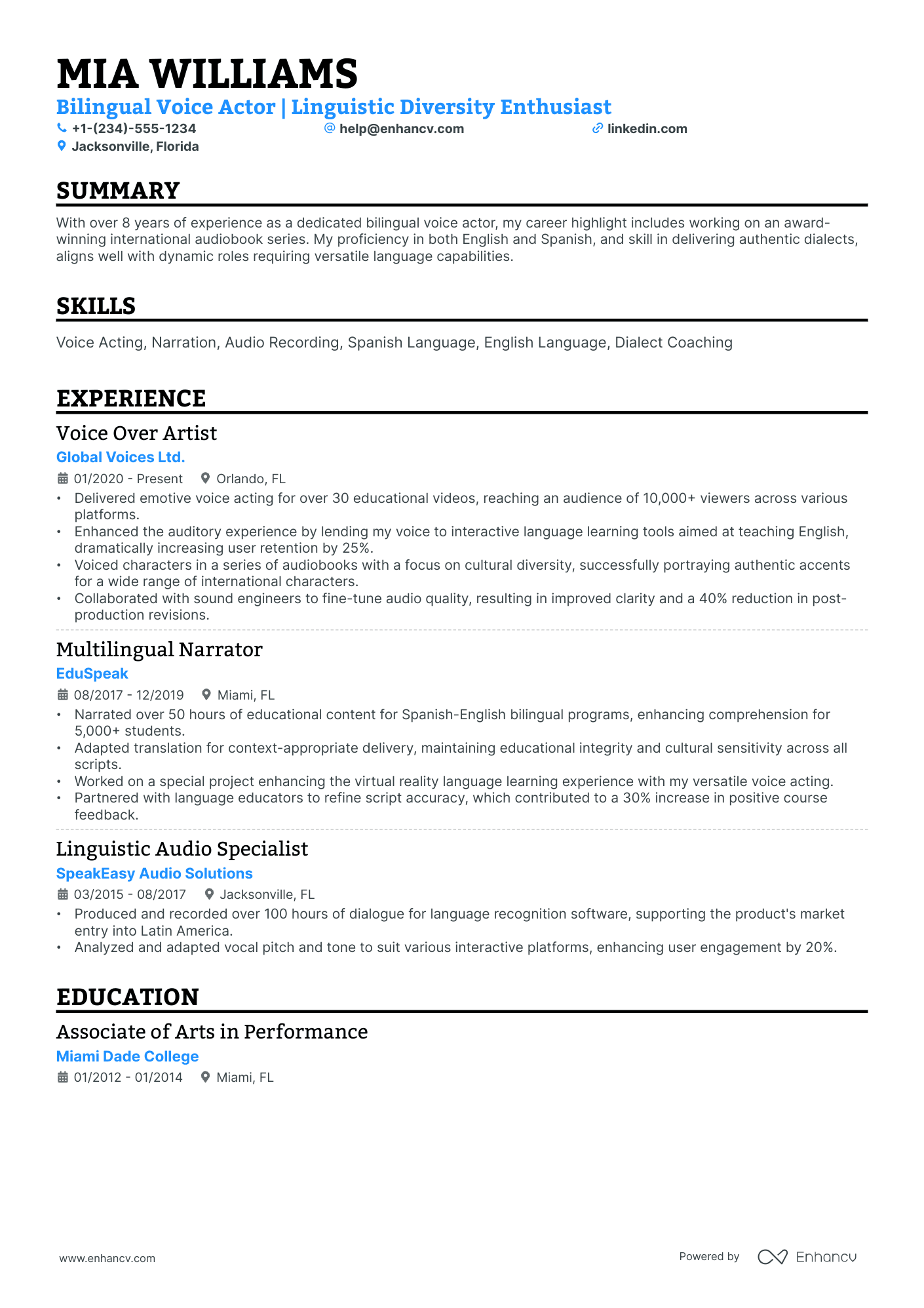
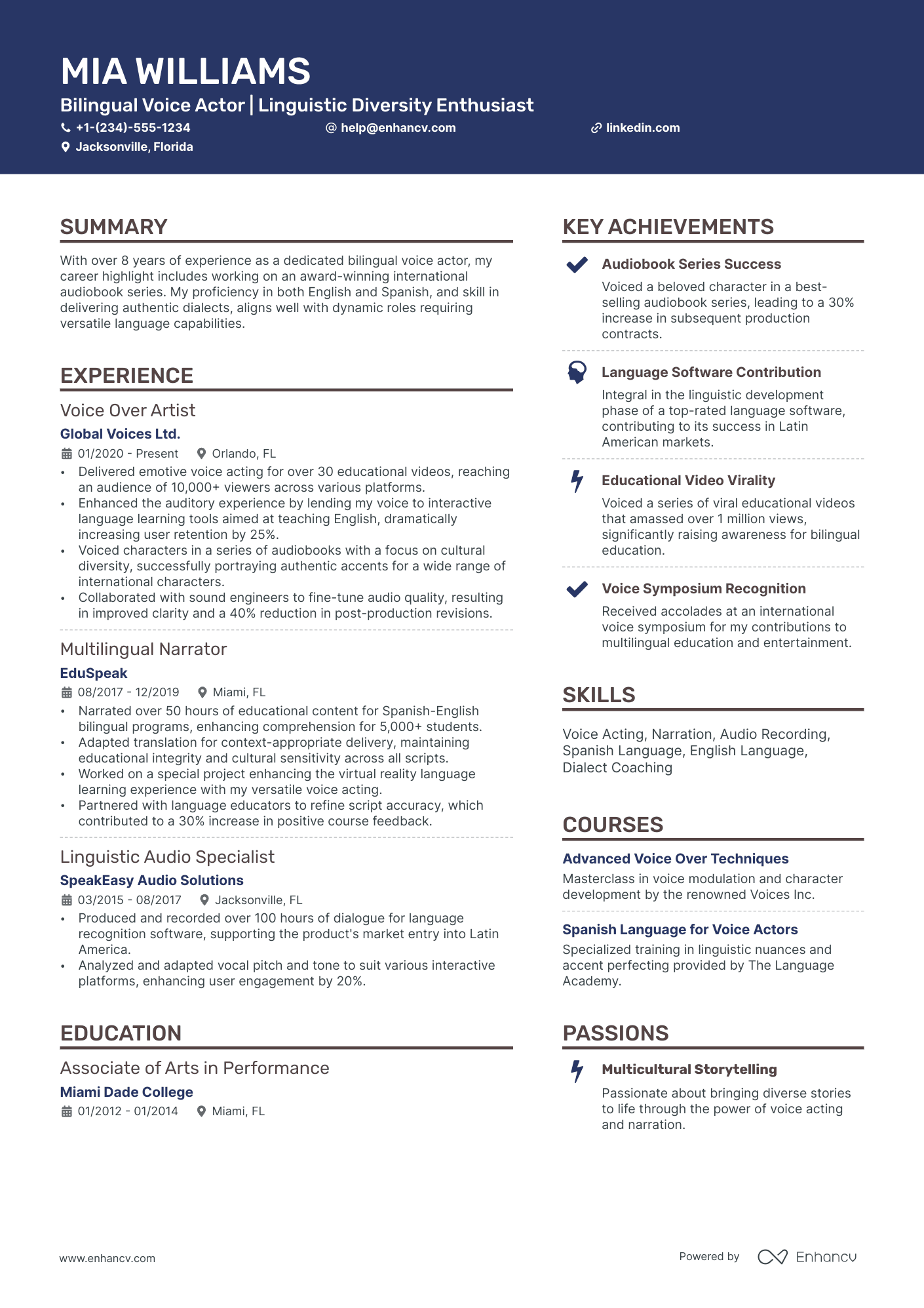
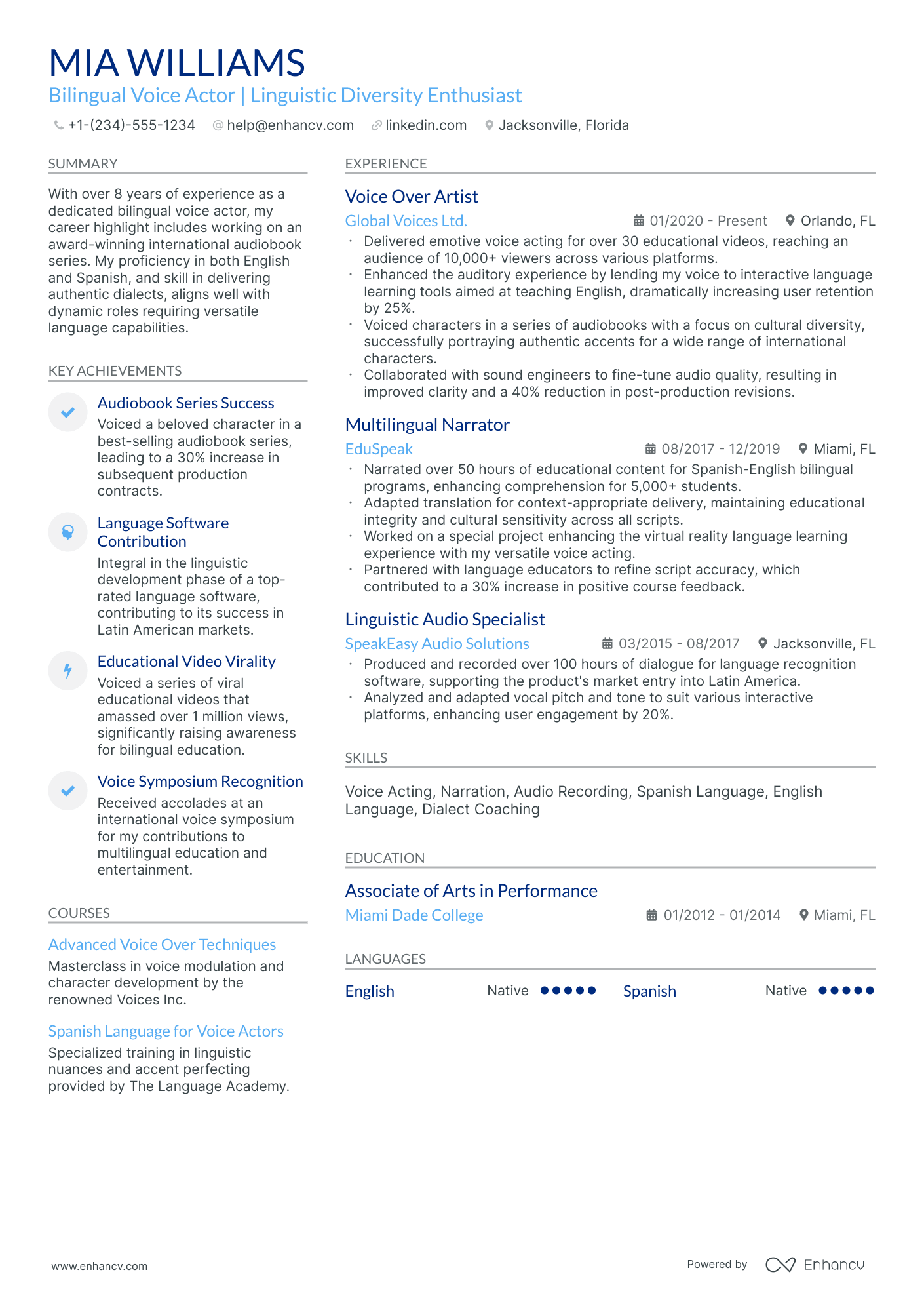
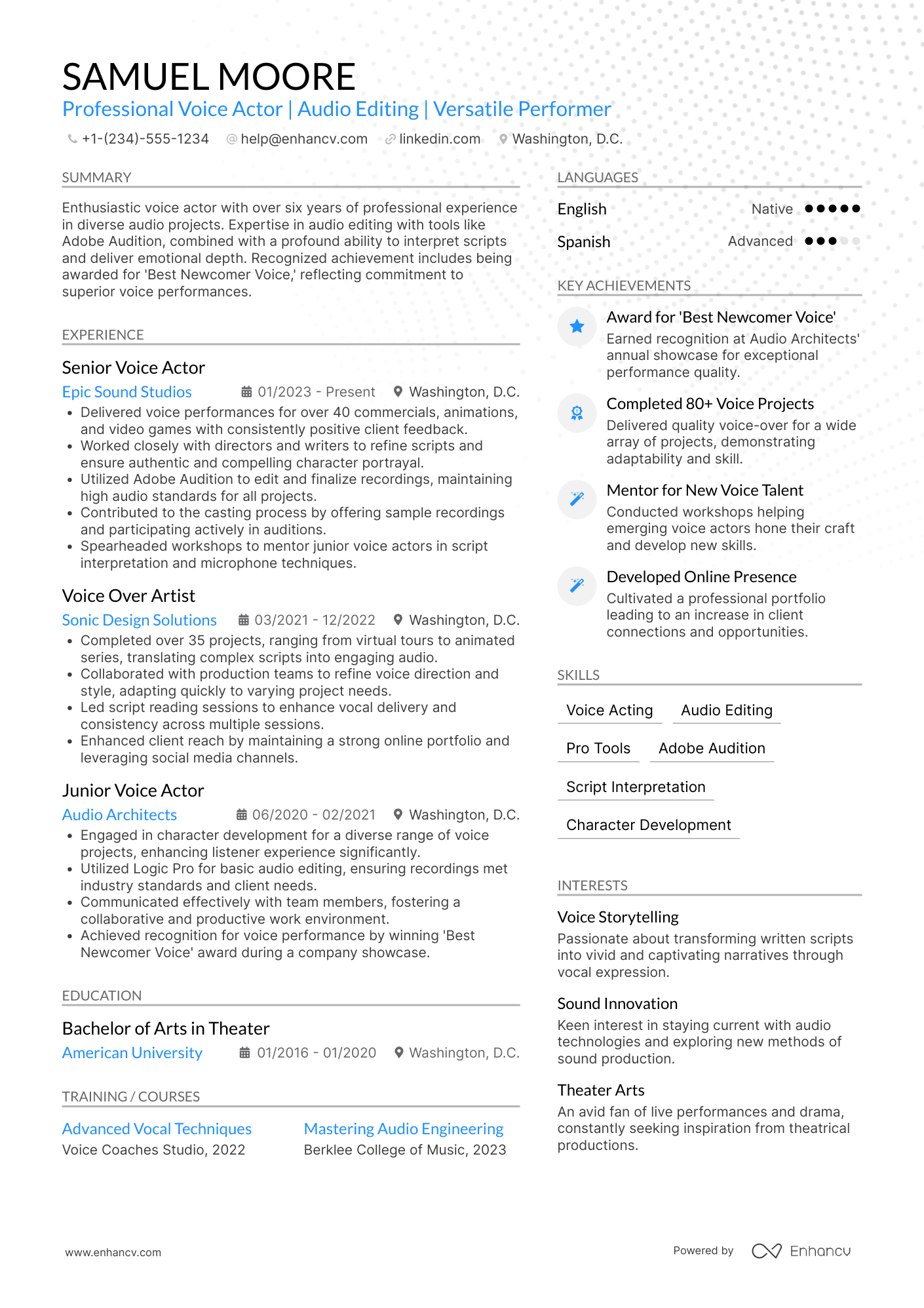
Most voice actor resume submissions fail because they read like gear lists and character rosters, not proof of performance. A voice actor resume must win in seconds through applicant tracking system screening, fast recruiter scans, and intense competition.
A strong resume shows what your voice delivered for the project and the client. Knowing how to make your resume stand out is critical in this field. You'll highlight booking rates, turnaround time, usage scope, audio quality targets met, and listener or conversion lift tied to your reads.

Key takeaways
- Quantify voice work with turnaround times, revision rates, and audio specs instead of listing duties.
- Use reverse-chronological format for established careers and hybrid format for career changers.
- Tailor every resume to match the posting's genre terms, tools, and delivery requirements.
- Demonstrate skills inside experience bullets rather than listing them only in a dedicated section.
- Include home studio setup, DAW proficiency, and remote session tools to prove recording readiness.
- Switch from a functional resume to a credit-based format as soon as you complete real projects.
- Use Enhancv to turn vague job duties into measurable, recruiter-ready bullet points faster.
How to format a voice actor resume
Casting directors and talent agents scanning a voice actor resume prioritize vocal range, genre versatility, and a clear record of completed projects across commercial, animation, narration, and other categories. Choosing the right resume format ensures these signals surface immediately rather than getting buried under unrelated information. A clean, well-organized resume layout makes all the difference when recruiters are scanning dozens of submissions.

I have significant experience in this role—which format should I use?
Use a reverse-chronological format to lead with your most recent and highest-profile voice acting credits first. Do:
- Organize credits by category (commercial, animation, video games, audiobooks, e-learning) and list the most prominent projects at the top of each section to demonstrate the breadth and depth of your booking history.
- Highlight proficiency with industry-standard tools and skills—home studio setup (Source-Connect, Audacity, Adobe Audition), dialect range, character voices, and relevant union affiliations (SAG-AFTRA).
- Quantify outcomes wherever possible, including audience reach, campaign scale, recurring roles, or volume of completed projects.
I'm junior or switching into this role—what format works best?
A hybrid format works best because it lets you lead with a focused skills section while still showing any relevant project history in chronological order. Do:
- Place a skills section near the top that spotlights vocal abilities (accents, character types, tonal range), technical competencies (home studio proficiency, self-direction, audio editing), and any formal training in acting or voice performance.
- Include demo reel categories, class projects, freelance gigs, theater credits, podcast work, or pro bono narration as transitional experience that proves you've applied your skills in real settings.
- Connect each entry to an outcome—link the skill you used to the action you took and the result it produced so casting directors can assess your potential.
Why not use a functional resume?
A functional resume strips away project context and timelines, making it nearly impossible for casting directors to evaluate where, when, and how you've applied your vocal skills in real productions.
- Career changers with transferable performance experience: If you're transitioning from theater, broadcasting, podcasting, or public speaking and have no formal voice acting credits yet, a functional format can organize your transferable skills (vocal control, script interpretation, microphone technique) at the forefront while you build your reel.
- Performers with limited or gapped work history: If you've taken extended time away from performing or are just starting out with only training and demo work to show, a functional layout can prevent empty timelines from dominating the page.
- A functional resume is acceptable when you have zero professional voice acting credits but can tie relevant skills directly to specific training projects, self-produced demos, or performance outcomes from adjacent fields.
Now that you've established a clean, scannable layout, it's time to fill it with the right sections that casting directors expect to see.
What sections should go on a voice actor resume
Recruiters expect to see your voiceover credits, vocal range, and studio readiness presented in a clean, easy-to-scan format. Understanding what to put on a resume helps you prioritize the most impactful information.
Use this structure for maximum clarity:
- Header
- Summary
- Experience
- Skills
- Projects
- Education
- Certifications
- Optional sections: Awards, Languages, Volunteering
In your experience bullets, emphasize booked work, measurable outcomes, production context, and the scope of your roles across mediums and clients.
Is your resume good enough?
Drop your resume here or choose a file. PDF & DOCX only. Max 2MB file size.
Once you’ve organized your resume with the right components, the next step is to write your voice actor experience section in a way that uses that structure to showcase your work clearly and consistently.
How to write your voice actor resume experience
The work experience section is where you prove you've delivered real work—shipped recordings, completed projects using industry-standard tools and techniques, and generated measurable outcomes for clients or studios. Hiring managers prioritize demonstrated impact over descriptive task lists, so every line should reflect what you accomplished rather than what you were assigned.
Each entry should include:
- Job title
- Company and location (or remote)
- Dates of employment (month and year)
Three to five concise bullet points showing what you owned, how you executed, and what outcomes you delivered:
- Ownership scope: the specific projects, characters, brands, genres, or recording pipelines you were accountable for as a voice actor.
- Execution approach: the recording tools, audio software, microphone setups, vocal techniques, or direction methods you used to interpret scripts and deliver final takes.
- Value improved: changes to audio quality, turnaround speed, recording consistency, emotional accuracy, or accessibility that resulted from your voice work.
- Collaboration context: how you worked with directors, sound engineers, producers, casting teams, or clients to align performances with creative briefs and brand standards.
- Impact delivered: outcomes expressed through completed deliverables, audience reach, client retention, or project scale rather than a summary of daily tasks.
Experience bullet formula
A voice actor experience example
✅ Right example - modern, quantified, specific.
Voice Actor (Commercial, E-learning, IVR)
BrightWave Audio | Remote
2021–Present
Boutique production studio delivering broadcast-ready voiceovers for national brands, software companies, and online learning platforms.
- Recorded and delivered three hundred fifty-plus finished minutes per quarter for commercial, explainer, and e-learning projects using TwistedWave, Source-Connect, and a Neumann TLM 103 chain, maintaining a ninety-eight percent on-time delivery rate.
- Directed and self-engineered remote sessions with producers and clients via Source-Connect, Zoom, and ipDTL, cutting live review cycles from three rounds to two and reducing average turnaround time by twenty-eight percent.
- Edited, cleaned, and mastered dialogue in iZotope RX and Adobe Audition to -16 LUFS (stereo) and -19 LUFS (mono) with consistent noise floors below -60 dB, lowering client-requested pickups by thirty-four percent.
- Collaborated with writers, product managers, and localization vendors to adapt scripts for clarity and timing, improving e-learning quiz completion rates by twelve percent across a two hundred thousand-learner rollout.
- Managed session files, cue sheets, and versioning in Google Drive and Airtable, standardizing naming and delivery specs and saving producers four hours per week in rework and asset retrieval.
Now that you've seen how a strong experience section comes together, let's look at how to adjust yours to match the specific role you're applying for.
How to tailor your voice actor resume experience
Recruiters evaluate your resume through both human review and applicant tracking systems, so tailoring your resume to the job description is essential. Aligning your listed experience with the specific role ensures you pass digital filters and capture a casting director's attention.
Ways to tailor your voice actor experience:
- Match the recording software and DAW platforms listed in the posting.
- Mirror the vocal styles or character types the job description specifies.
- Use the exact genre terminology the posting references for deliverables.
- Highlight home studio capabilities when remote recording experience is required.
- Include relevant industry experience such as e-learning or commercial broadcast.
- Emphasize quick turnaround and direction-taking if the role demands flexibility.
- Reference specific audio quality standards or file format requirements mentioned.
- Showcase collaboration with directors or producers when teamwork is highlighted.
Tailoring means aligning your real accomplishments and skills with what the role demands, not forcing unrelated keywords into your experience section.
Resume tailoring examples for voice actor
| Job description excerpt | Untailored | Tailored |
|---|---|---|
| "Seeking a voice actor for long-form audiobook narration in the fantasy and sci-fi genres using Source-Connect for remote directed sessions" | Recorded voiceovers for various projects in a studio setting. | Narrated 12 full-length fantasy and sci-fi audiobooks (averaging 10+ hours each), delivering remote directed sessions through Source-Connect with consistent character differentiation across 30+ recurring roles. |
| "Must perform character voices for an animated children's series (ages 3–7), collaborating with directors in real time and delivering final takes in Pro Tools session files" | Provided voice acting for animation and other media projects. | Voiced five distinct characters for a 52-episode animated children's series targeting ages 3–7, collaborating with directors during live sessions and exporting tagged, edited takes directly in Pro Tools. |
| "Looking for bilingual (English/Spanish) voice talent for a medical e-learning platform, with accurate pronunciation of clinical terminology and a calm, instructional delivery style" | Did voiceover work in multiple languages for corporate clients. | Recorded 40+ bilingual English/Spanish e-learning modules for a medical education platform, maintaining accurate pronunciation of clinical terminology such as pharmacological and anatomical terms while sustaining a calm, instructional tone across eight hours of content. |
Once you’ve aligned your experience with the specific role and project requirements, the next step is to quantify your voice actor achievements so hiring teams can quickly see the impact behind those credits.
How to quantify your voice actor achievements
Quantifying your achievements proves business impact beyond "great tone." Track turnaround time, revision rate, client satisfaction, booking conversion, and audio quality specs like peak levels and noise floor.
Quantifying examples for voice actor
| Metric | Example |
|---|---|
| Turnaround time | "Delivered one hundred twenty-second explainer VO within six hours, meeting same-day deadline across three time zones." |
| Revision rate | "Cut pickup requests from twelve percent to four percent by using Source-Connect sessions and a script markup checklist." |
| Audio quality | "Maintained -60 dB noise floor and -3 dB peaks using Adobe Audition, iZotope RX, and consistent mic placement." |
| Booking conversion | "Raised audition-to-booking rate from eight percent to fourteen percent by tailoring reads and submitting within two hours." |
| Client satisfaction | "Averaged 4.9/5 client ratings across sixty-five Fiverr and direct projects, with repeat-client rate of thirty-eight percent." |
Turn vague job duties into measurable, recruiter-ready resume bullets in seconds with Enhancv's Bullet Point Generator.
Once you've crafted strong bullet points for your experience section, you'll want to apply that same precision to presenting your hard and soft skills.
How to list your hard and soft skills on a voice actor resume
Your skills section shows casting teams and producers how you'll deliver consistent, broadcast-ready performances, and recruiters and an ATS (applicant tracking system) scan them for role keywords—aim for a hard skills-heavy mix supported by role-specific soft skills. voice actor roles require a blend of:
- Product strategy and discovery skills.
- Data, analytics, and experimentation skills.
- Delivery, execution, and go-to-market discipline.
- Soft skills.
Your skills section should be:
- Scannable (bullet-style grouping).
- Relevant to the job post.
- Backed by proof in experience bullets.
- Updated with current tools.
Place your skills section:
- Above experience if you're junior or switching careers.
- Below experience if you're mid/senior with strong achievements.

Hard skills
- Character voice development
- Accents and dialects
- Script interpretation and cold reads
- Microphone technique and proximity control
- Breath control and vocal stamina
- Home studio signal chain setup
- Audio editing, cleanup, mastering
- Source-Connect, ipDTL, Zoom
- Pro Tools, Adobe Audition, Reaper
- Izotope RX, Waves plugins
- Loudness standards, peak limiting
- File naming and delivery specs
Soft skills
- Take direction fast
- Ask clarifying questions early
- Collaborate with directors and clients
- Maintain consistent tone across sessions
- Self-direct for remote sessions
- Meet tight turnaround deadlines
- Manage revisions and pickups cleanly
- Communicate availability and turnaround
- Stay on-brand with creative briefs
- Document session notes and changes
- Handle live session feedback calmly
- Protect vocal health through scheduling
How to show your voice actor skills in context
Skills shouldn't live only in a dedicated skills list. Explore resume skills examples to see how top candidates integrate abilities throughout their resumes.
They should be demonstrated in:
- Your summary (high-level professional identity)
- Your experience (proof through outcomes)
Here's what that looks like in practice.
Summary example
Senior voice actor with 12 years in commercial and animation VO. Skilled in dialect work, Source-Connect, and script interpretation. Directed sessions reducing revision rounds by 35%, delivering consistent brand voices across 200+ campaigns.
- Reflects senior-level expertise clearly
- Names industry-standard tools
- Includes a measurable outcome
- Highlights collaboration and adaptability
Experience example
Senior Voice Actor
Cascade Audio Productions | Remote
March 2019–Present
- Voiced 150+ commercial spots using Source-Connect and Pro Tools, achieving a 94% first-take client approval rate.
- Collaborated with directors and sound engineers to cut average session revision time by 30% across episodic animation projects.
- Developed five distinct character voices for a branded podcast series, helping grow listenership by 40% within six months.
- Every bullet includes measurable proof.
- Skills appear naturally within achievements.
Once you’ve demonstrated your abilities through relevant examples, the next step is to translate that proof into a voice actor resume when you have no experience.
How do I write a voice actor resume with no experience
Even without full-time experience, you can demonstrate readiness through:
- Home studio practice recordings
- Student film voiceover credits
- Indie game character voice work
- Podcast intro and ad reads
- Audiobook sample chapters on ACX
- Volunteer nonprofit narration projects
- Online voice actor workshops
- Paid Fiverr voiceover gigs
Building a resume without work experience is entirely possible when you focus on transferable skills and completed projects.
Focus on:
- Clean audio samples and specs
- Role range with named projects
- Recording workflow and tools
- Usage rights and delivery formats
Resume format tip for entry-level voice actor
Use a functional resume format because it highlights voice actor skills, tools, and credits before limited work history. Do:
- Lead with a link to your demo reel.
- List your home studio gear and setup.
- Add credits with project names and dates.
- Include audio editing tools you use.
- Quantify output, turnaround, and revisions.
- Produced ten podcast ad reads in Audacity, applied noise reduction and compression, and delivered forty-eight kilohertz WAV files with zero rework requests.
Even without professional credits, your educational background can demonstrate relevant training and commitment to the craft, making it one of the most important sections to get right.
How to list your education on a voice actor resume
Your education section helps hiring teams confirm foundational training in performance, communication, and vocal technique. It signals relevant academic preparation for the voice actor role.
Include:
- Degree name
- Institution
- Location
- Graduation year
- Relevant coursework (for juniors or entry-level candidates)
- Honors & GPA (if 3.5 or higher)
Avoid listing specific months or days—use the graduation year only.
Here's a strong education entry tailored for a voice actor resume.
Example education entry
Bachelor of Fine Arts in Theatre Arts
DePaul University, Chicago, IL
Graduated 2021
GPA: 3.7/4.0
- Relevant Coursework: Voice and Diction, Voice-Over Performance, Dialects and Accents, Acting for Media
- Honors: Dean's List (six semesters), Outstanding Achievement in Vocal Performance
How to list your certifications on a voice actor resume
Certifications on a resume show a voice actor's commitment to learning, proficiency with recording tools, and relevance to current industry standards, from studio workflow to audio post-production.
Include:
- Certificate name
- Issuing organization
- Year
- Optional: credential ID or URL
- Place certifications below education when your training is older, less relevant, or secondary to your degree or core voice actor coaching.
- Place certifications above education when they're recent, directly tied to voice actor work, or prove in-demand tools like audio editing and studio workflows.
Best certifications for your voice actor resume
- Source-Connect Standard Certification
- Avid Pro Tools User Certification
- Apple Logic Pro Certification
- Adobe Audition Certification
- iZotope RX Audio Repair Certification
- Gravy For The Brain Voiceover Certificate
- Global Voice Acting Academy (GVAA) Voice Actor Training Certificate
Once you’ve positioned your credentials where hiring teams can find them quickly, you’re ready to write your voice actor resume summary to tie that expertise to the roles you’re targeting.
How to write your voice actor resume summary
Your resume summary is the first thing a casting director or recruiter reads. A strong opening instantly signals you have the vocal range and experience their project demands.
Keep it to three to four lines, with:
- Your title and total years of voice acting experience.
- The domains you work in, such as animation, commercial, audiobook, or video game voiceover.
- Core skills like character voices, dialect work, audio editing software, or directed session experience.
- One or two measurable achievements, such as projects completed or audience reach.
- Collaborative soft skills tied to real outcomes, like adapting direction quickly to reduce studio time.

PRO TIP
At an early-career level, prioritize your vocal training, technical skills, and any completed projects. Highlight specific genres and tools you've used. Avoid vague claims like "passionate performer" or "born storyteller." Ground every sentence in something concrete and verifiable.
Example summary for a voice actor
Voice actor with two years of experience in commercial and animation voiceover. Completed 30-plus projects across e-learning and podcast formats. Proficient in Audacity and Source-Connect, consistently delivering final takes within first directed sessions.
Optimize your resume summary and objective for ATS
Drop your resume here or choose a file.
PDF & DOCX only. Max 2MB file size.
Now that your summary captures your vocal strengths and experience at a glance, make sure your header presents the essential contact and professional details casting directors need to reach you.
What to include in a voice actor resume header
Your resume header is the top section with your key details, and it boosts visibility, credibility, and recruiter screening for a voice actor.
Essential resume header elements
- Full name
- Tailored job title and headline
- Location
- Phone number
- Professional email
- GitHub link
- Portfolio link
A LinkedIn link lets recruiters verify experience quickly and supports screening.
Don't include a photo on a voice actor resume unless the role is explicitly front-facing or appearance-dependent.
Match your header headline to the exact voice actor role and keep every link current, readable, and easy to copy.
Voice actor resume header
Jordan Reese
Voice Actor | Commercial, E-learning, and Character Voiceover
Austin, TX
(512) 555-01XX
jordan.reese@enhancv.com
github.com/jordanreese
jordanreesevoice.com
linkedin.com/in/jordanreese
Once your header clearly presents your name, contact details, and relevant links, you can strengthen your resume with the additional sections that provide more context for your voice acting work.
Additional sections for voice actor resumes
When your core sections don't fully capture your range, additional sections help you stand out and build role-specific credibility. For example, listing language skills on your resume can highlight your dialect versatility and appeal to international projects.
- Languages and dialects
- Demo reel links
- Accents and character voices
- Relevant hobbies and interests
- Union memberships and affiliations
- Publications or industry features
- Continuing education and voice workshops
Once your resume sections are tailored to showcase every relevant detail, pairing it with a strong cover letter can further set you apart from the competition.
Do voice actor resumes need a cover letter
A cover letter isn't required for a voice actor, but it helps in competitive roles or when hiring teams expect one. If you're unsure where to start, understanding what a cover letter is and how it complements your resume can help you decide. It can make a difference when your resume needs context or when the role demands a specific style.
Use a cover letter when it adds clear, role-specific value:
- Explain fit for the role and team by matching your vocal style, turnaround time, and collaboration approach to the posting.
- Highlight one or two relevant projects or outcomes, such as a campaign lift, improved completion rates, or faster delivery for a series.
- Show you understand the product, users, and business context by referencing the audience, platform, tone, and usage rights.
- Address career transitions or non-obvious experience by connecting prior work to voice actor skills, like direction, consistency, and performance under constraints.
Drop your resume here or choose a file.
PDF & DOCX only. Max 2MB file size.
Once you’ve decided whether a separate introduction adds value to your application, the next step is using AI to improve your voice actor resume so it better targets each role.
Using AI to improve your voice actor resume
AI can sharpen your resume's clarity, structure, and impact. It helps tighten language and highlight relevant strengths. But overuse strips away authenticity. Once your content reads clearly and fits the role, step away from AI. If you're wondering which AI is best for writing resumes, the answer depends on your needs—but the principles below apply regardless of the tool you choose.
Here are 10 prompts you can copy and paste to strengthen specific sections of your voice actor resume:
- Strengthen your summary. "Rewrite my voice actor resume summary to emphasize my strongest genre specialties and years of experience in under four sentences."
- Quantify your experience. "Add measurable results to my voice actor experience bullets, such as project counts, studio names, or audience reach."
- Tighten bullet points. "Shorten each voice actor experience bullet to one concise line that leads with a strong action verb."
- Align with job posts. "Compare my voice actor resume skills section against this job description and flag missing relevant keywords."
- Clarify technical skills. "Reorganize my voice actor skills section to separate performance skills from technical tools like DAW software."
- Refine project descriptions. "Rewrite my voice actor project entries to clearly state the role type, client, and final deliverable."
- Improve training details. "Edit my voice actor education section to highlight coaching, workshops, and performance training most relevant to casting directors."
- Showcase certifications. "Format my voice actor certifications section so each entry includes the credential name, issuing organization, and completion year."
- Eliminate filler language. "Remove vague or redundant phrasing from my voice actor resume without changing the original meaning."
- Tailor for a niche. "Adjust my voice actor resume to target commercial voiceover roles by prioritizing relevant experience and demo highlights."
Stop using AI once your resume sounds accurate, specific, and aligned with real experience. AI should never invent experience or inflate claims—if it didn't happen, it doesn't belong here.
Conclusion
A strong voice actor resume stays focused on outcomes, role-specific skills, and a clear structure. It highlights measurable results, credits, and training, and it shows range through accents, character work, and clean audio delivery.
Keep each section easy to scan so hiring teams can confirm fit fast. When your resume matches the role, proves results, and reads cleanly, you’re ready for today’s market and what comes next.