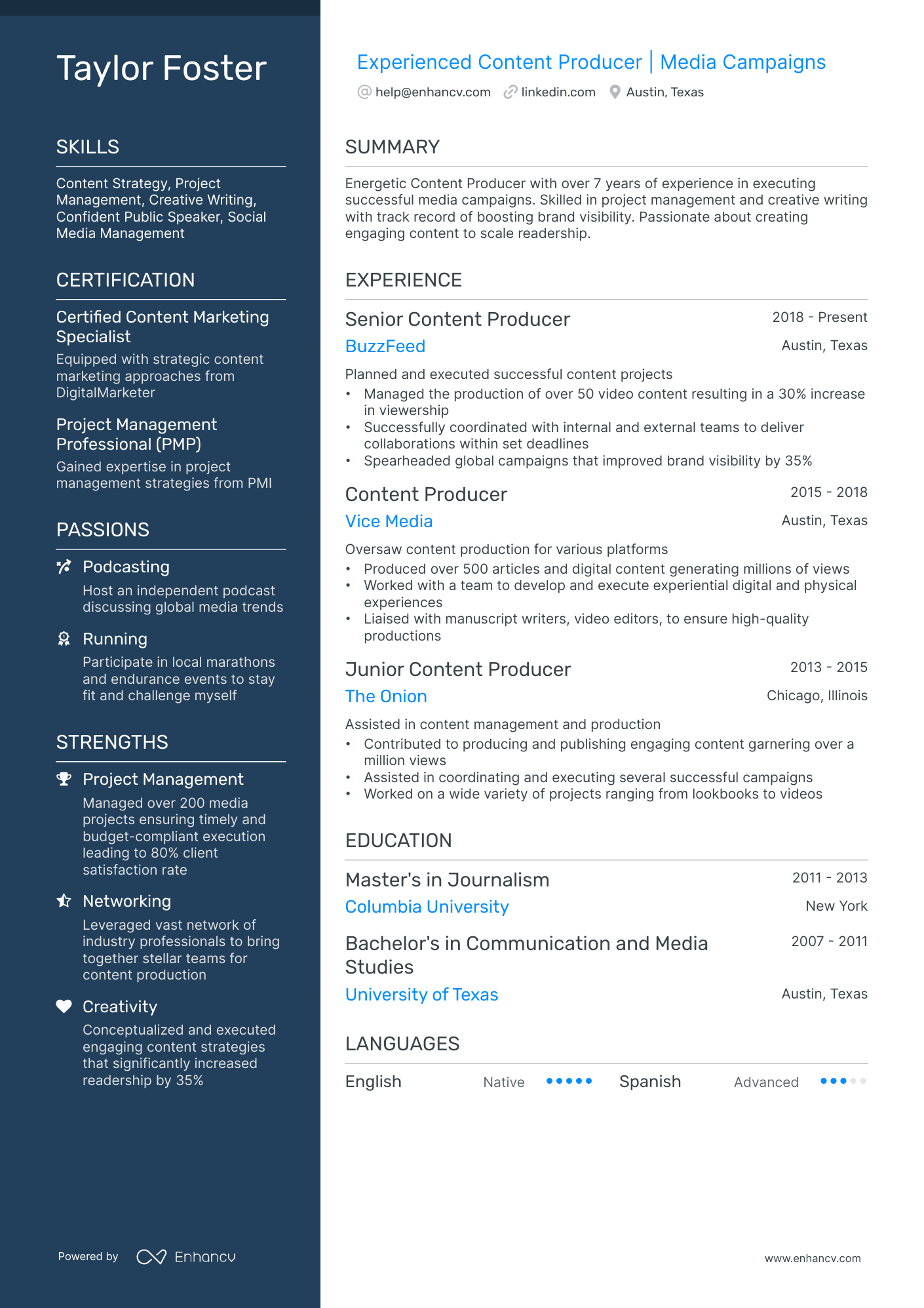
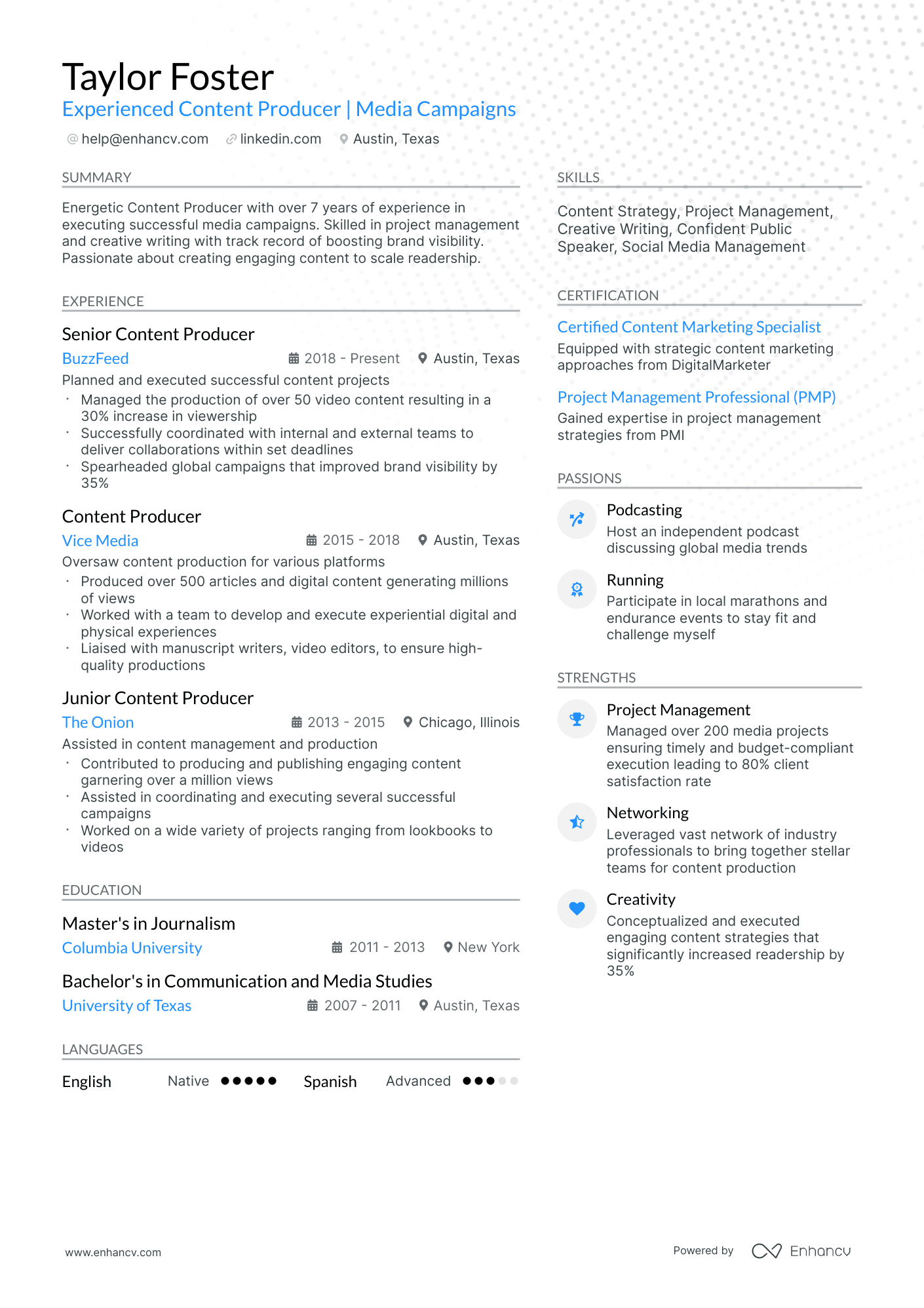
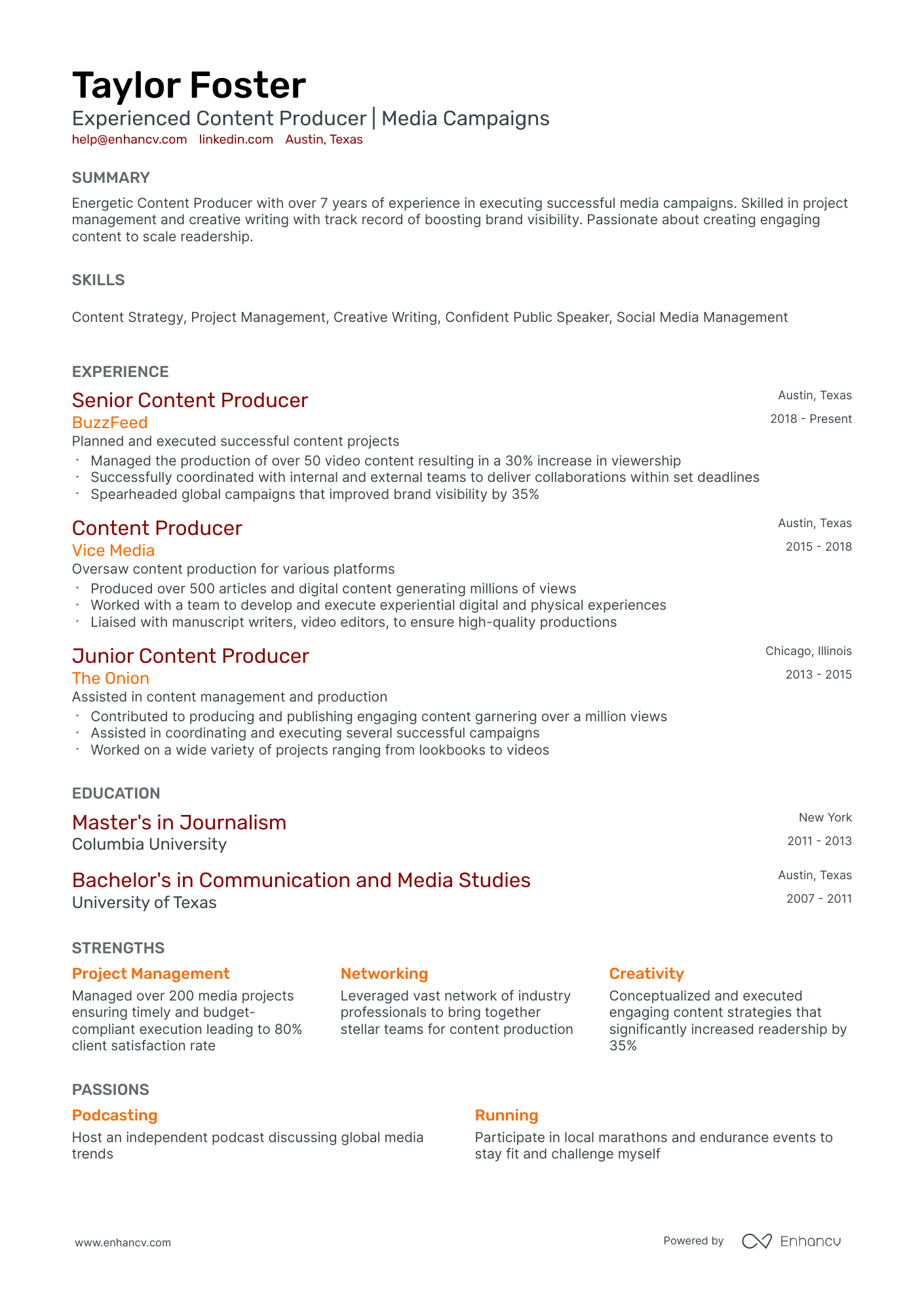
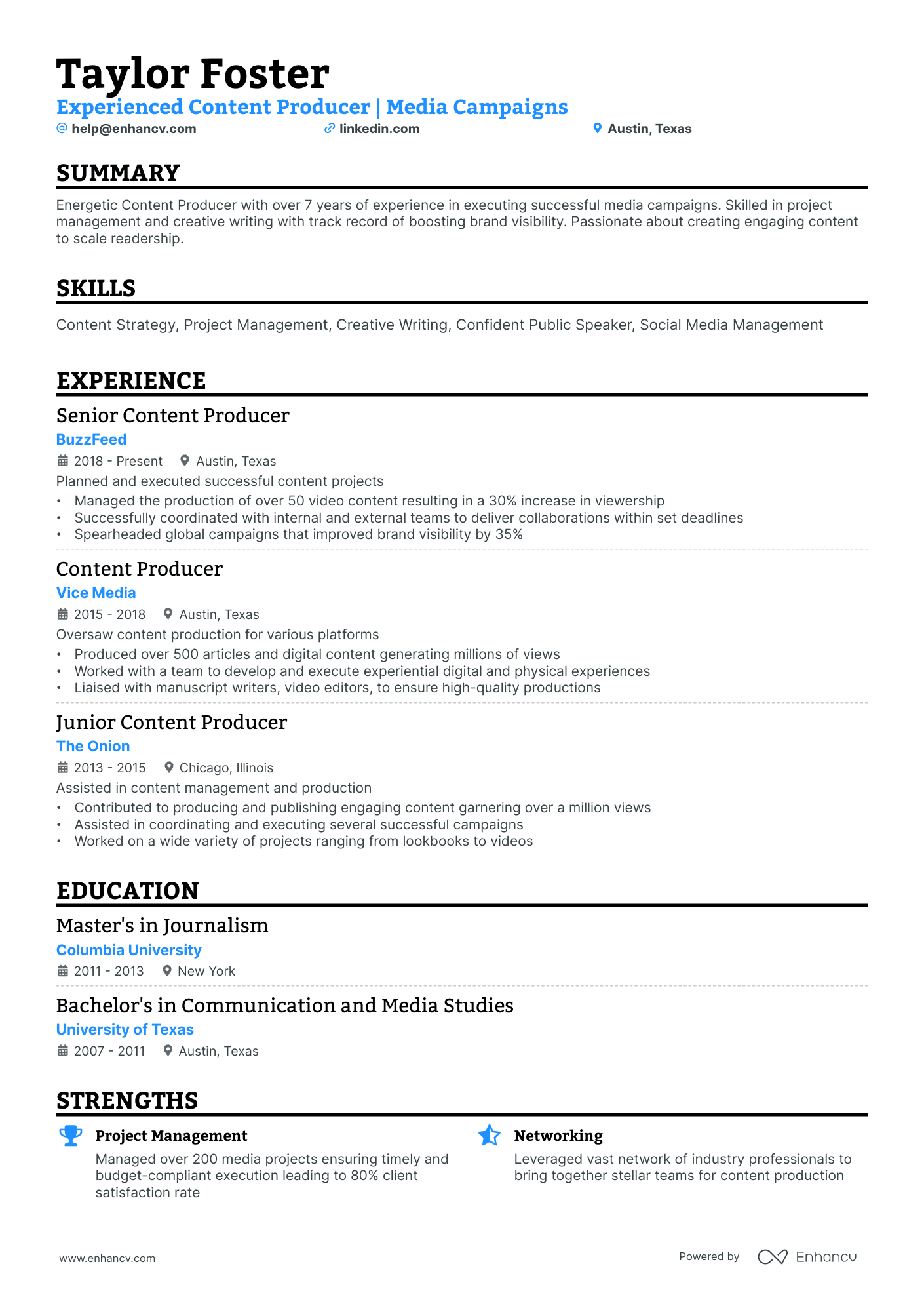
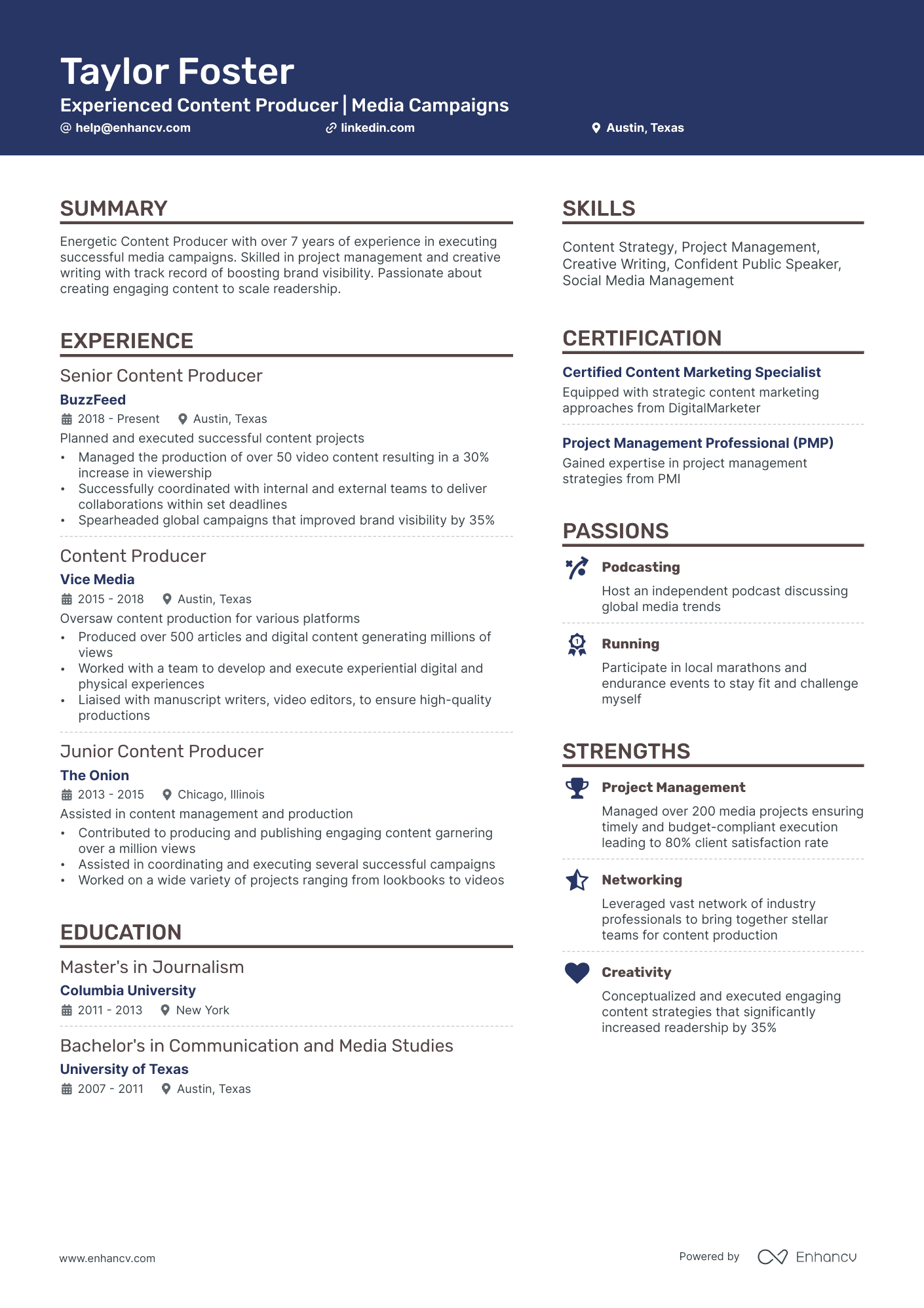
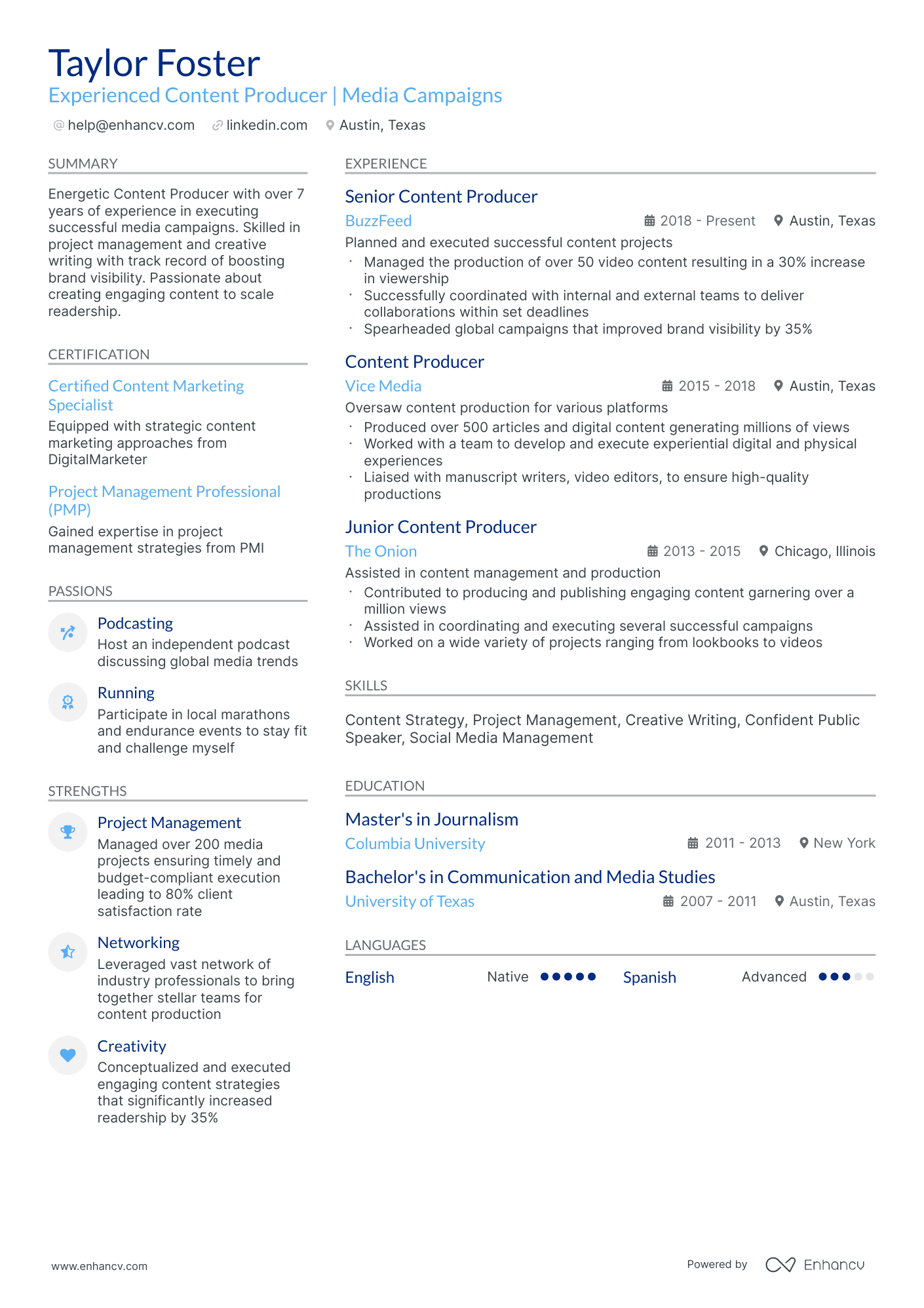
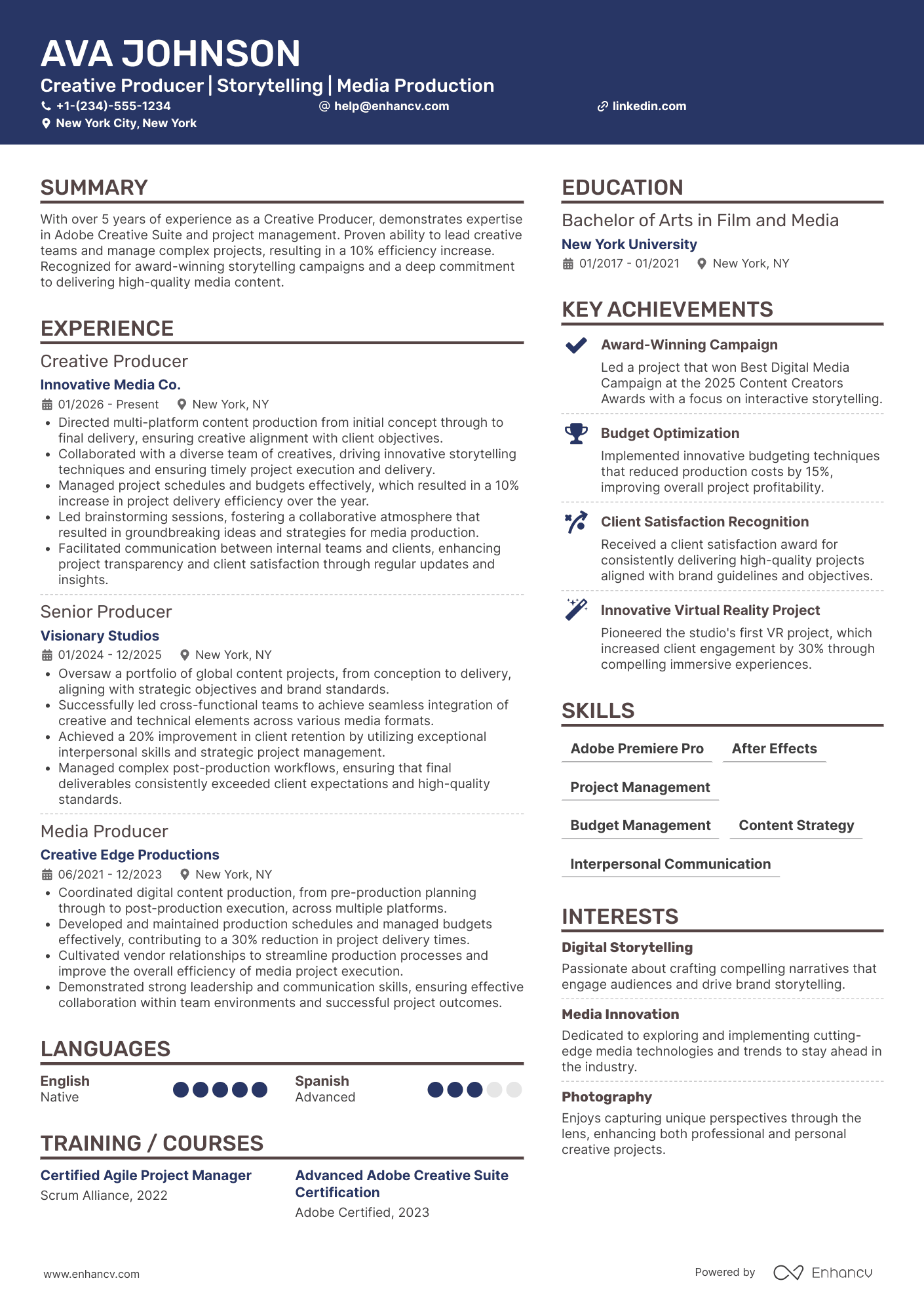
Many creative producer resume drafts show the reel and skip the budgets, timelines, and approvals that got each piece made. Recruiters scan fast, and applicant tracking system (ATS) filters look for production terms a portfolio link can't supply.
When you're writing a resume for production roles, lead with what each project delivered. Show on-time launches, budgets held, assets shipped per campaign, faster review cycles, and audience results like views or conversions.

Key takeaways
- Pair your portfolio with bullets that show budgets, timelines, and delivery results.
- Lead each bullet with what the project shipped and what it achieved.
- Use reverse-chronological order, or hybrid if you're moving in from another field.
- Name the production tools and channels each posting lists.
- Quantify budgets managed, assets delivered, and review time saved.
- Use Enhancv's Bullet Point Generator to turn production notes into measurable bullets.
Job market snapshot for creative producers
We analyzed 36 recent creative producer job ads from major US job boards. The most common requirement is three to four years of experience (33.3%), and 13.9% of ads ask for 10 or more. Use these numbers to gauge employer expectations, match your experience level, and decide which roles to target first.
What level of experience employers are looking for in creative producers
| Years of Experience | Percentage found in job ads |
|---|---|
| 3–4 years | 33.3% (12) |
| 5–6 years | 25.0% (9) |
| 7–8 years | 11.1% (4) |
| 10+ years | 13.9% (5) |
| Not specified | 16.7% (6) |
Role overview stats
These tables show what creative producers do day to day and where the work happens. Owning production from brief to delivery appears in 91.7% of ads, and 75.0% of the roles are on-site. Mirror the duties you've handled, and plan for on-site work when you target these roles.
Day-to-day activities and top responsibilities for a creative producer
| Responsibility | Percentage found in job ads |
|---|---|
| Own production from brief to delivery | 91.7% (33) |
| Produce video and creative assets | 77.8% (28) |
| Develop campaign and content ideas | 75.0% (27) |
| Run social and digital content | 75.0% (27) |
| Manage production timelines and budgets | 72.2% (26) |
| Partner with creative directors and teams | 72.2% (26) |
| Manage clients and stakeholders | 72.2% (26) |
| Manage vendors and freelancers | 69.4% (25) |
| Track projects and resources | 58.3% (21) |
| Improve production processes | 58.3% (21) |
| Manage asset delivery and versioning | 52.8% (19) |
| Stay current on trends | 36.1% (13) |
Type of employment (remote vs on-site vs hybrid)
| Employment type | Percentage found in job ads |
|---|---|
| On-site | 75.0% (27) |
| Remote | 16.7% (6) |
How to format a creative producer resume
Recruiters hiring creative producers look first for the projects you delivered, the budgets you held, and the teams you coordinated. A clear resume layout puts those details beside each role instead of burying them under a reel link.
Resume formatting strategy for creative producers
| Category | Senior & leadership strategy | Entry to mid-level strategy |
|---|---|---|
| Recommended format | Reverse-chronological | Reverse-chronological or hybrid |
| Core dos | Lead each role with the campaigns, budgets, and crews you owned. Name the brands, channels, or formats you produced for. Tie every bullet to on-time delivery, cost control, or audience results. | Put production tools and project management skills near the top. Count freelance shoots, agency assisting, or student productions as transitional experience. Link each project to a delivered asset or result. |
| Example bullet | Led a 12-person crew through a 40-asset holiday campaign, delivering on a $1.2M budget two days early. | Frame.io review workflow → cut client approval rounds from 4 to 2 → delivered 18 social cuts a week early. |
| Format to avoid | Hybrid and functional formats separate your productions from the clients and years behind them. Hiring managers can't see your growth from coordinator to lead producer. Treat any non-chronological layout as a risk at this level. | A functional format hides which projects you produced and when. Edge cases: a move from editing or design into producing, or a return after freelance work. |
Save a functional resume for edge cases, and tie each skill on it to a production and its result.
Once the format shows your production history in order, the sections you choose decide what reviewers notice.
What sections should go on a creative producer resume?
Hiring managers expect clear resume sections on a creative producer resume, with projects, budgets, and tools easy to find next to your portfolio link.
Use this structure for maximum clarity:
- Header
- Summary
- Experience
- Skills
- Projects
- Education
- Certifications
- Optional sections: Awards, Festival selections, Volunteer work
Strong experience bullets should emphasize what you delivered, the budget and timeline you held, and the results each campaign earned.
Is your resume good enough?
Drop your resume here or choose a file. PDF & DOCX only. Max 2MB file size.
Experience is the section hiring managers check against your reel, and it needs the most detail.
How to write your creative producer resume experience
Your work experience should show the campaigns and videos you delivered, the workflow behind them, and tools like Premiere Pro, Frame.io, or Airtable. Hiring managers prioritize demonstrated impact on budgets, deadlines, and audience results over lists of shoots you attended.
Each entry should include:
- Job title
- Company and location (or remote)
- Dates of employment (month and year)
Three to five concise bullet points showing what you owned, how you executed, and what outcomes you delivered:
- Ownership scope: the campaigns, clients, budgets, and crews you were accountable for as a creative producer
- Execution approach: the production workflows, review tools, and scheduling methods you used to move work from brief to delivery
- Value improved: changes to turnaround time, production costs, asset quality, or approval speed
- Collaboration context: how you worked with creative directors, editors, agencies, vendors, and clients
- Impact delivered: results stated as assets shipped, budgets held, deadlines met, or audience performance

Experience bullet formula
A creative producer experience example
✅ Right example - modern, quantified, specific.
Creative Producer
Lanternfish Creative | Los Angeles, CA
2021–Present
Branded content studio producing video and social campaigns for consumer brands.
- Produced 14 multichannel campaigns a year for consumer brands, delivering 600+ video and social assets on budgets up to $850K.
- Built a Frame.io review workflow with editors and account leads, cutting client approval rounds from four to two.
- Negotiated crew, location, and talent rates with 30+ vendors, bringing average shoot costs 18% under budget.
- Partnered with creative directors on a product launch spot that drove 4.2M views and a 22% lift in site traffic.
- Created an Airtable production tracker for 9 producers, reducing missed delivery dates from 11% to 2%.
That entry shows the standard, and tailoring shapes each one around the work a specific team produces.
How to tailor your creative producer resume experience
Recruiters screen creative producer resumes in an ATS, then a hiring manager compares your projects with their own. Using the posting's keywords on your resume ties your real work to the formats and channels they need.
Ways to tailor your creative producer experience:
- Match the production tools and review platforms the posting names.
- Use the team's terms for formats such as spots or social cuts.
- Mirror the channels the role produces for.
- Highlight budget ranges that match the projects described.
- Name the agency or in-house setting you've worked in.
- Emphasize vendor and crew management when the role mentions it.
- Reflect the delivery volume and turnaround the job expects.
Tailoring puts your real productions in the employer's language without stuffing keywords into bullets.
Resume tailoring examples for creative producers
| Job description excerpt | Untailored | Tailored |
|---|---|---|
| "Manage end-to-end production of video and social content, from creative brief through final delivery." | Produced videos for clients. | Produced 120 video and social assets from brief to delivery for 6 brand clients, meeting every launch date in 2024. |
| "Build production budgets and timelines and manage vendors, crews, and freelancers." | Handled budgets and vendors. | Built budgets up to $600K and managed 25 freelancers and vendors, finishing 9 of 10 shoots under budget. |
| "Partner with creative directors to bring campaign concepts to life across paid and organic channels." | Worked with the creative team on campaigns. | Partnered with 3 creative directors to produce a paid and organic launch campaign that reached 6M viewers. |
Tailored bullets show fit, and numbers show how well each production ran.
How to quantify your creative producer achievements
Quantifying your resume achievements turns production work into results a hiring manager can compare. For this role, the numbers that matter are budgets held, assets delivered, turnaround time, approval rounds, and audience performance.
Quantifying examples for creative producers
| Metric | Example |
|---|---|
| Budget control | "Delivered a 3-day national commercial shoot for $410K, 9% under the approved budget." |
| Asset volume | "Produced 240 social cutdowns from one campaign shoot, covering 5 platforms and 3 aspect ratios." |
| Turnaround time | "Cut average edit-to-delivery time from 10 days to 6 by standardizing review in Frame.io." |
| Approval speed | "Reduced client revision rounds from 4 to 2 by adding a pre-shoot alignment session." |
| Audience results | "Produced a product video series that earned 3.1M views and a 15% rise in demo requests." |
Turn shoots, edits, and campaign launches into measurable, recruiter-ready bullets with Enhancv's Bullet Point Generator.
Those numbers show what you delivered, and your skills section shows the tools and judgment behind each production.
How to list your hard and soft skills on a creative producer resume
Recruiters and ATS filters check your resume skills section for production know-how, and a strong list pairs hard skills like budgeting with soft skills like calm problem-solving on set.
Creative producer roles require a blend of:
- Production planning and budgeting skills
- Video and post-production workflow skills
- Vendor, crew, and client management skills
- Soft skills
Your skills section should be:
- Scannable (bullet-style grouping)
- Relevant to the job post
- Backed by proof in experience bullets
- Updated with current tools
Place your skills section:
- Above experience if you're junior or switching careers
- Below experience if you're mid/senior with strong achievements

Hard skills
- Production budgeting and cost tracking
- Scheduling and call sheets
- Adobe Premiere Pro, After Effects
- Frame.io review workflows
- Airtable, Asana, Monday.com
- Vendor and crew negotiation
- Location and talent coordination
- Usage rights and talent releases
- Shot lists and storyboards
- Social and digital asset specs
- Post-production supervision
Soft skills
- Calm problem-solving on set
- Clear client communication
- Negotiating with vendors
- Keeping crews on schedule
- Balancing creative goals with budgets
- Giving direct feedback to editors
- Managing several productions at once
- Decision-making under deadline pressure
- Building trust with creative directors
- Handling last-minute changes
How to show your creative producer skills in context
Hiring managers trust the skills on your resume when your summary and bullets show them at work, not only in a list.
Show them in:
- Your summary (high-level professional identity)
- Your experience (proof through outcomes)
Here's how a creative producer can show them in practice.
Summary example
Creative producer with six years in branded video and social content. Runs productions from brief to delivery in Premiere Pro and Frame.io, and delivered a 40-asset launch campaign 8% under its $500K budget.
- States level and production focus
- Names tools hiring teams search
- Proves budget control with numbers
- Shows end-to-end ownership
Experience example
Creative Producer
Copperline Media | Remote
February 2021–Present
- Coordinated 4 editors and 2 motion designers on a 30-video tutorial series, finishing three weeks ahead of launch.
- Negotiated a new freelance rate card with finance, cutting production costs by 14% across 50 shoots.
- Set up shared Airtable schedules with account managers, raising on-time delivery from 84% to 97%.
- Every bullet carries a measured result
- Skills appear inside real productions
Those examples come from producers with credits, and candidates breaking into production need a different way to show readiness.
How do I write a creative producer resume with no experience?
Even without full-time experience, you can demonstrate readiness through:
- Production assistant or coordinator roles
- Student films and class projects
- Freelance shoots for small brands
- Agency or studio internships
- Social content you planned and shipped
- Event or live production work
- Volunteer video projects for nonprofits
Focus on:
- Projects delivered from start to finish
- Budgets or schedules you managed
- Tools you used on real shoots
- Results like views or deadlines met
Resume format tip for entry-level creative producer
A hybrid format works best because it leads with projects and production skills before any job history. On a resume with no work experience, each project should name the deliverable and one result. Do:
- Lead with two or three projects you produced end to end.
- Quantify budgets, crew size, or deliverables for each project.
- Link a reel or portfolio in your header.
- List the editing, review, and scheduling tools you've used.
- Add a summary aimed at production roles.
- Produced a 3-minute fundraising video for a local food bank on a $1,500 budget, helping raise $22K in two weeks.
Projects prove you can deliver, and your education section shows the training behind your production choices.
How to list your education on a creative producer resume
The education section of your resume helps hiring teams confirm your grounding in film, media, communications, or production management.
Include:
- Degree name
- Institution
- Location
- Graduation year
- Relevant coursework (for juniors or entry-level candidates)
- Honors & GPA (if 3.5 or higher)
Give only the graduation year and leave out months and days.
Here's an education entry for a creative producer:
Example education entry
Bachelor of Fine Arts in Film and Television
New York University, New York, NY
Graduated: 2017
GPA: 3.6/4.0
- Relevant Coursework: Producing, Production Budgeting, Post-Production Workflow, Media Law
- Honors: Dean's List (six semesters)
Certifications usually follow education, and a few credentials show you can manage projects and production tools at a professional level.
How to list your certifications on a creative producer resume
Relevant certifications for your resume show a creative producer keeps learning, knows current production tools, and understands how campaigns run.
Include:
- Certificate name
- Issuing organization
- Year
- Optional: credential ID or URL
- Place certifications below education when they're older or less tied to production work.
- Place certifications above education when they're recent, tool-specific, or listed in the posting.
Best certifications for your creative producer resume
- Project Management Professional (PMP)
- Certified Associate in Project Management (CAPM)
- Adobe Certified Professional in Video Design
- Avid Certified User: Media Composer
- Google Project Management: Professional Certificate
Credentials back up your tools, and your summary is the first place a hiring manager looks for them.
How to write your creative producer resume summary
Your resume summary tells a hiring manager what you produce and at what scale before they open your reel. Three or four lines set the frame for every project below.
Keep it to three to four lines, with:
- Your title and years in production.
- The formats or industries you produce for, such as branded video.
- Core tools and methods, like Premiere Pro or production budgeting.
- One or two quantified results, such as budgets held or assets delivered.
- Soft skills tied to outcomes, like keeping a crew on schedule.

PRO TIP
At the mid level, lead with the formats you produce, the budgets you manage, and one delivery or audience result. Skip phrases like "creative visionary" or "passionate storyteller," and let your projects show your range.
Example summary for a creative producer
Creative producer with seven years in agency and in-house video production. Manages budgets up to $900K and crews of 20, and delivered 300+ campaign assets last year with a 98% on-time rate.
Optimize your resume summary and objective for ATS
Drop your resume here or choose a file.
PDF & DOCX only. Max 2MB file size.
A clear summary works best under a header that makes your reel and contact details easy to find.
What to include in a creative producer resume header
A strong resume header gives your name, focus, and portfolio link, and it's the first place a hiring manager clicks to see your work.
Essential resume header elements
- Full name
- Tailored job title and headline
- Location
- Phone number
- Professional email
- Portfolio link
A LinkedIn link lets hiring managers confirm your credits, employers, and dates quickly.
Leave the photo off a creative producer resume unless the role is explicitly front-facing or appearance-dependent.
Match the posting's title, such as video producer or content producer, and put your reel link where it's easy to click.
Example
Creative producer resume header
Nadia Reyes
Creative producer | Branded video, social campaigns, and production budgets
Los Angeles, CA | (323) 555-01XX | nadia.reyes@enhancv.com nadiareyes.com linkedin.com/in/nadiareyes
With the essentials in place, a few added sections can show the range behind your credits.
Additional sections for creative producer resumes
Extra sections help when they add proof your job list can't, and a portfolio on your resume matters most in production.
- Portfolio or reel
- Awards and festival selections
- Selected clients
- Professional associations
- Volunteer production work
- Languages
Those sections show your range, and a cover letter explains why it fits one team's work.
Do creative producer resumes need a cover letter?
Many creative producer postings don't require a cover letter. A short one helps when the posting asks for it, when you're changing industries, or when you know the brand's content well.
Keep your cover letter to these points:
- Team fit: Connect your production style to the formats this team makes.
- One production: Describe a project you delivered and the result behind it.
- Brand understanding: Show you know the audience and channels the brand uses.
- Career moves: Explain a shift from editing, agency work, or freelance in one sentence.
Drop your resume here or choose a file.
PDF & DOCX only. Max 2MB file size.
With your letter and resume telling one story, AI can help tighten the resume's wording.
Using AI to improve your creative producer resume
AI can tighten phrasing, organize sections, and bring out the production results in your creative producer resume. Use AI resume-writing prompts on content you've drafted, and stop once the copy starts sounding generic.
Work through these prompts one section at a time:
- Frame your summary: "Rewrite my creative producer resume summary to lead with the formats I produce, my budget range, and one delivery result."
- Quantify productions: "Review my creative producer experience bullets and suggest where to add budgets, asset counts, timelines, or audience numbers."
- Show end-to-end ownership: "Rewrite my creative producer bullets so each one shows a project moving from brief to delivery."
- Sharpen action verbs: "Replace weak verbs in my creative producer experience section with precise verbs that show production ownership."
- Match the posting: "Compare my creative producer skills section with this job description and list the tools and skills to add or remove."
- Tailor for a brand: "Adjust my creative producer resume for this brand's job description, keeping only claims my experience supports."
- Tighten project entries: "Edit the projects on my creative producer resume to show the brief, my role, and the measurable result."
- Polish the headline: "Rewrite my creative producer resume headline to name my formats and specialty in under 12 words."
- Connect certifications: "Rewrite my certifications section so each credential ties to a creative producer skill such as budgeting or post-production."
- Remove filler: "Scan my creative producer resume for filler, passive voice, and vague phrases, and suggest direct replacements."
Stop using AI once your resume sounds accurate, specific, and true to the productions you ran. AI should never invent experience or inflate claims: if it didn't happen, it doesn't belong on your resume.
Conclusion
A strong creative producer resume shows what you delivered, proves budget and schedule control with numbers, and points to work hiring managers can watch.
Brands will keep needing producers who ship quality work on time and on budget. Keep your resume focused on that record, and you'll be ready for your next production role.