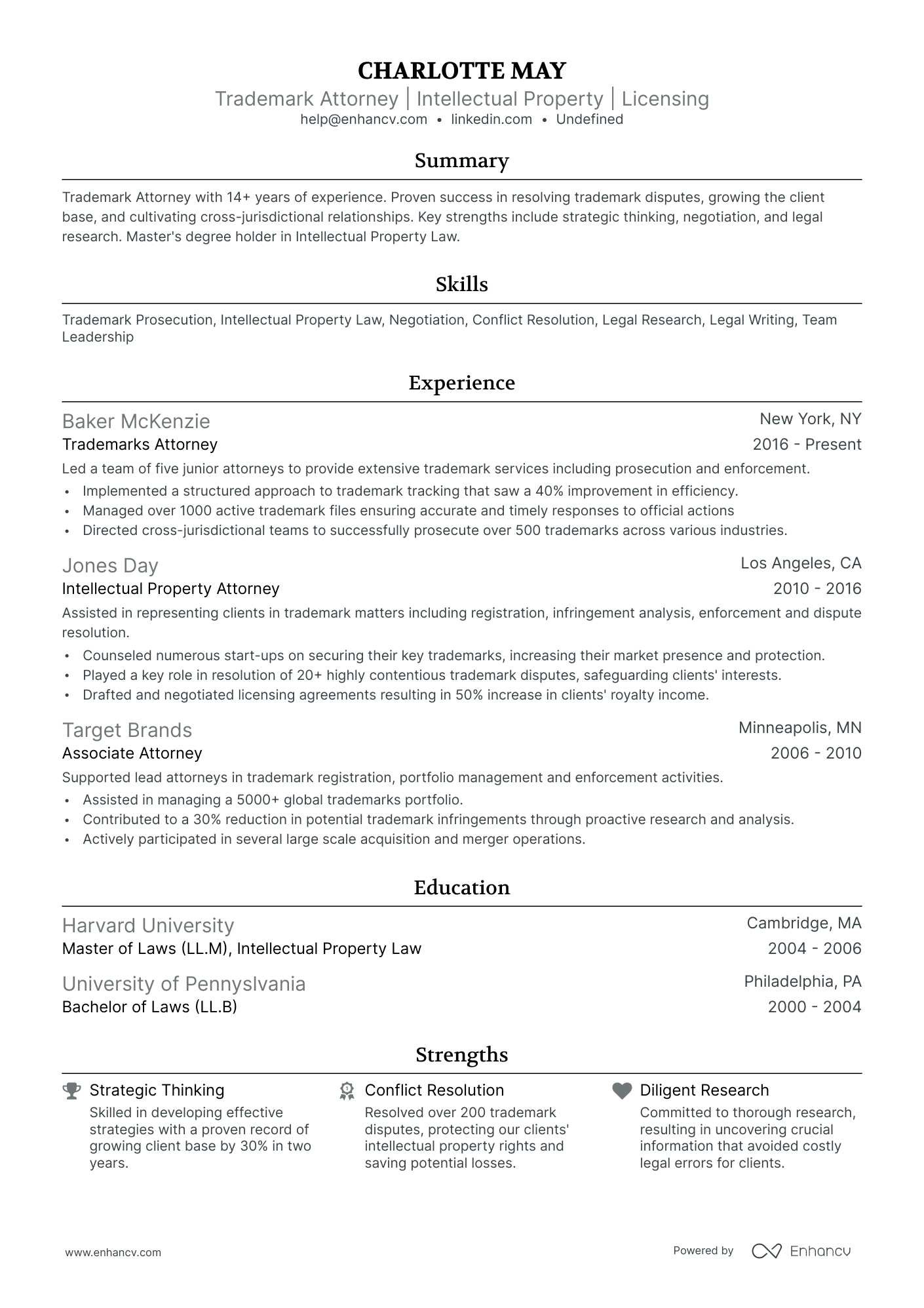
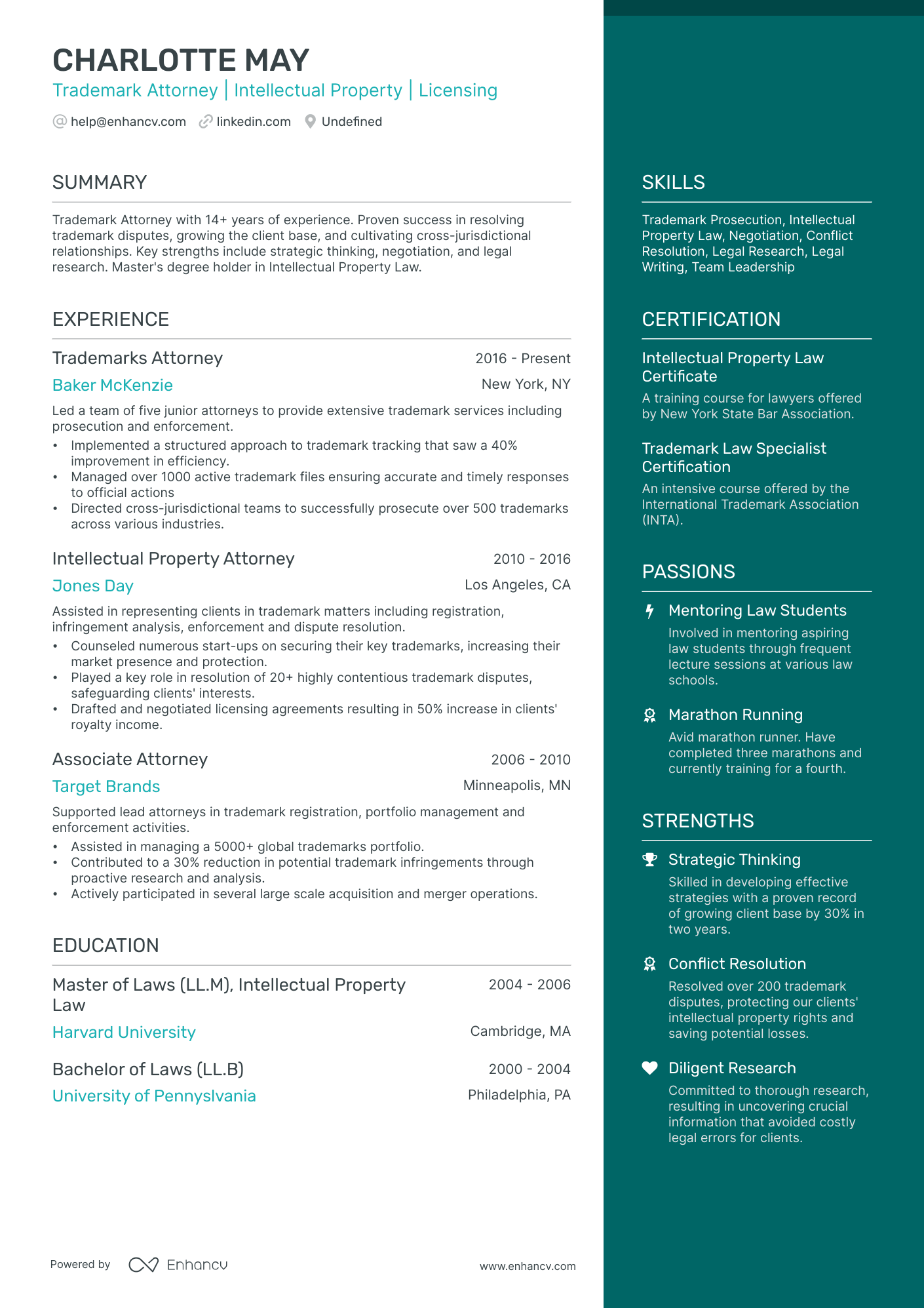
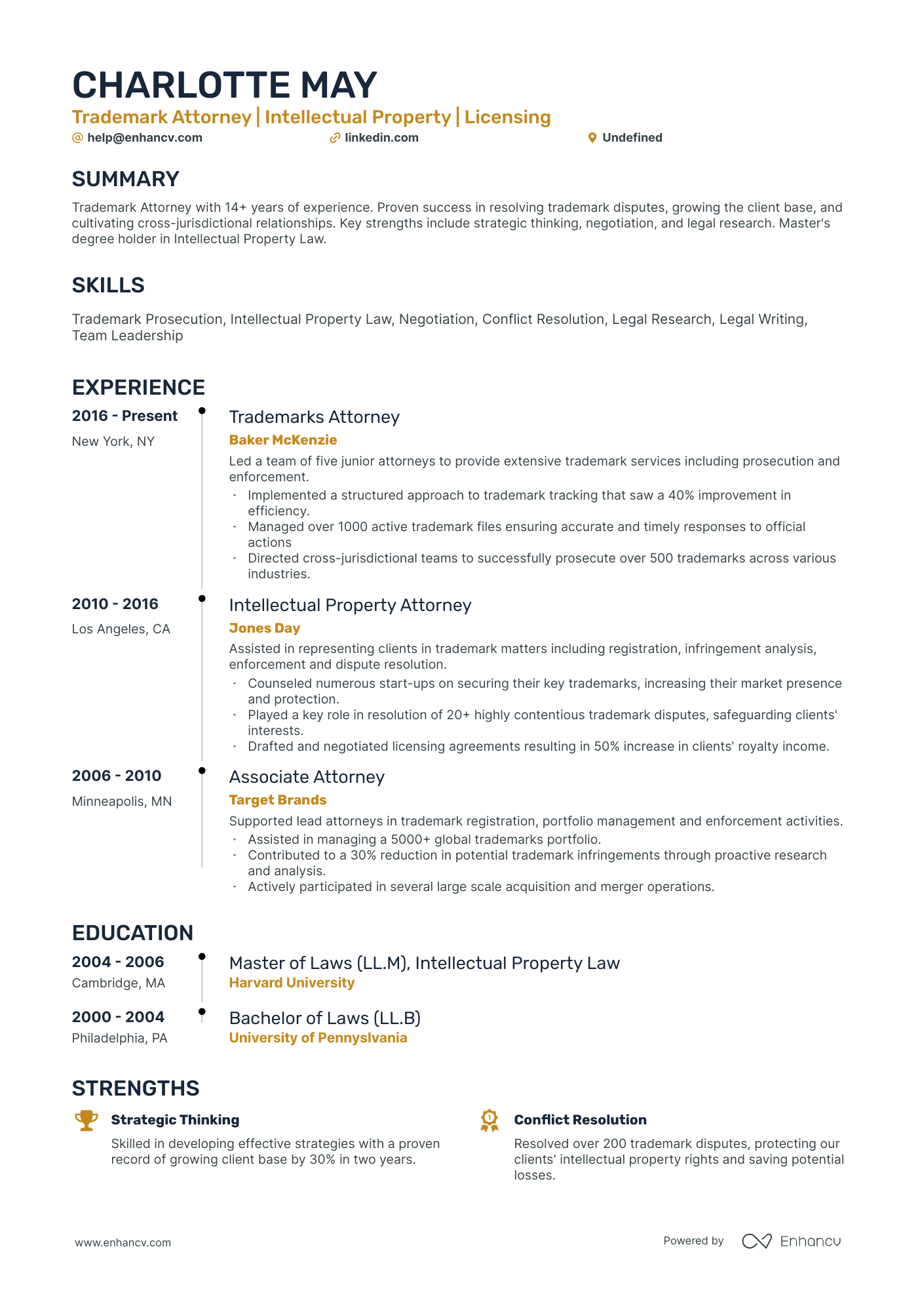
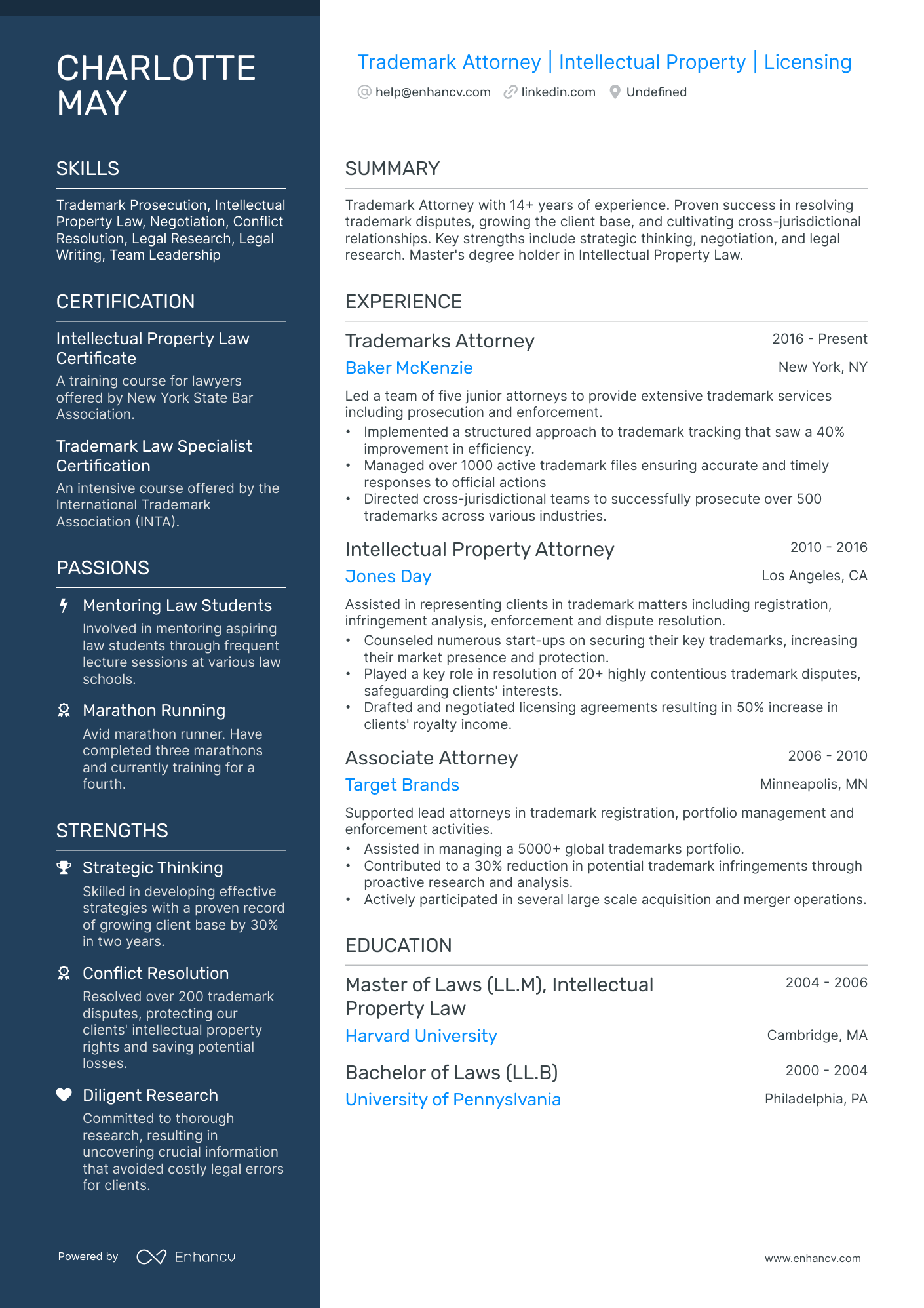
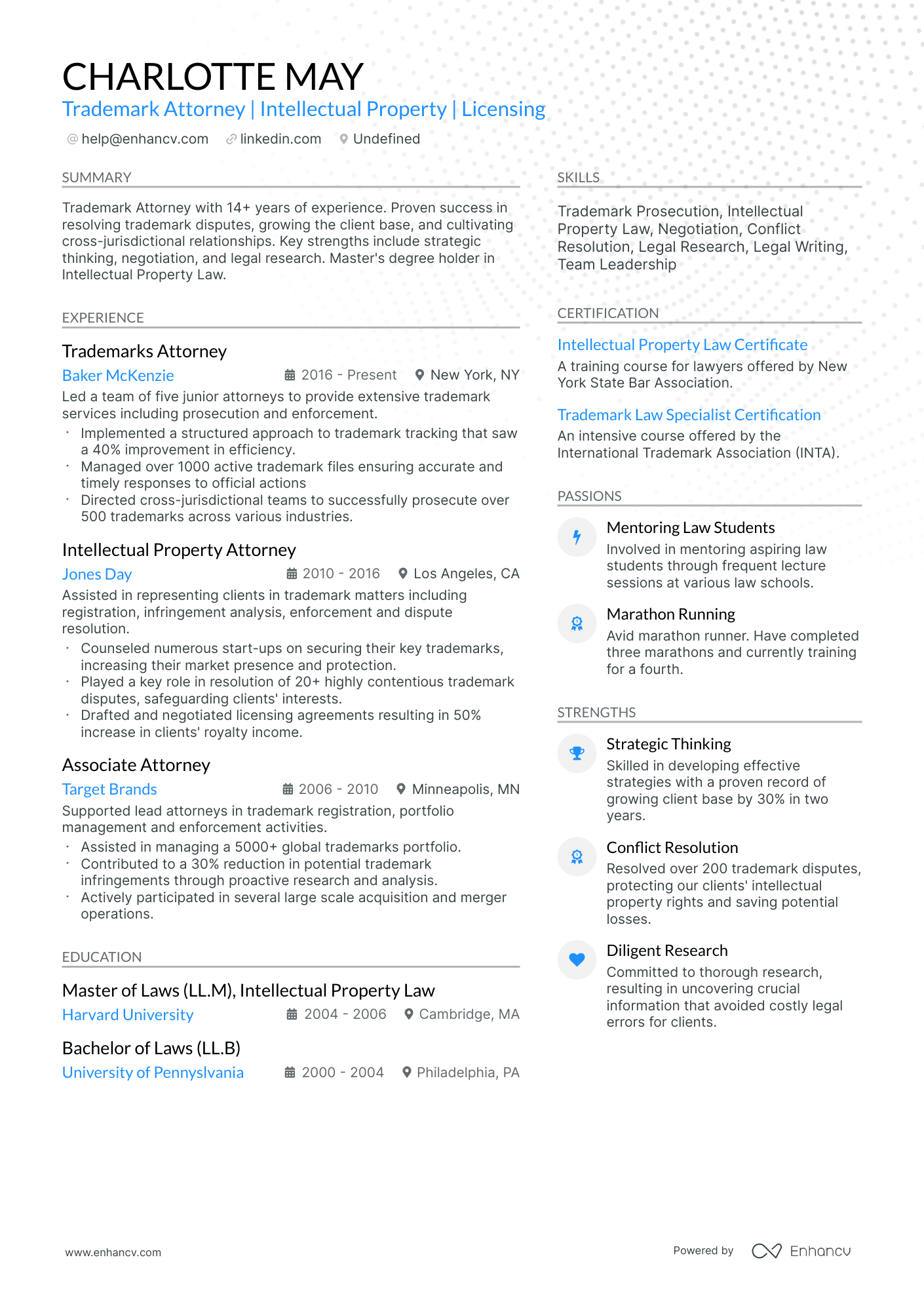
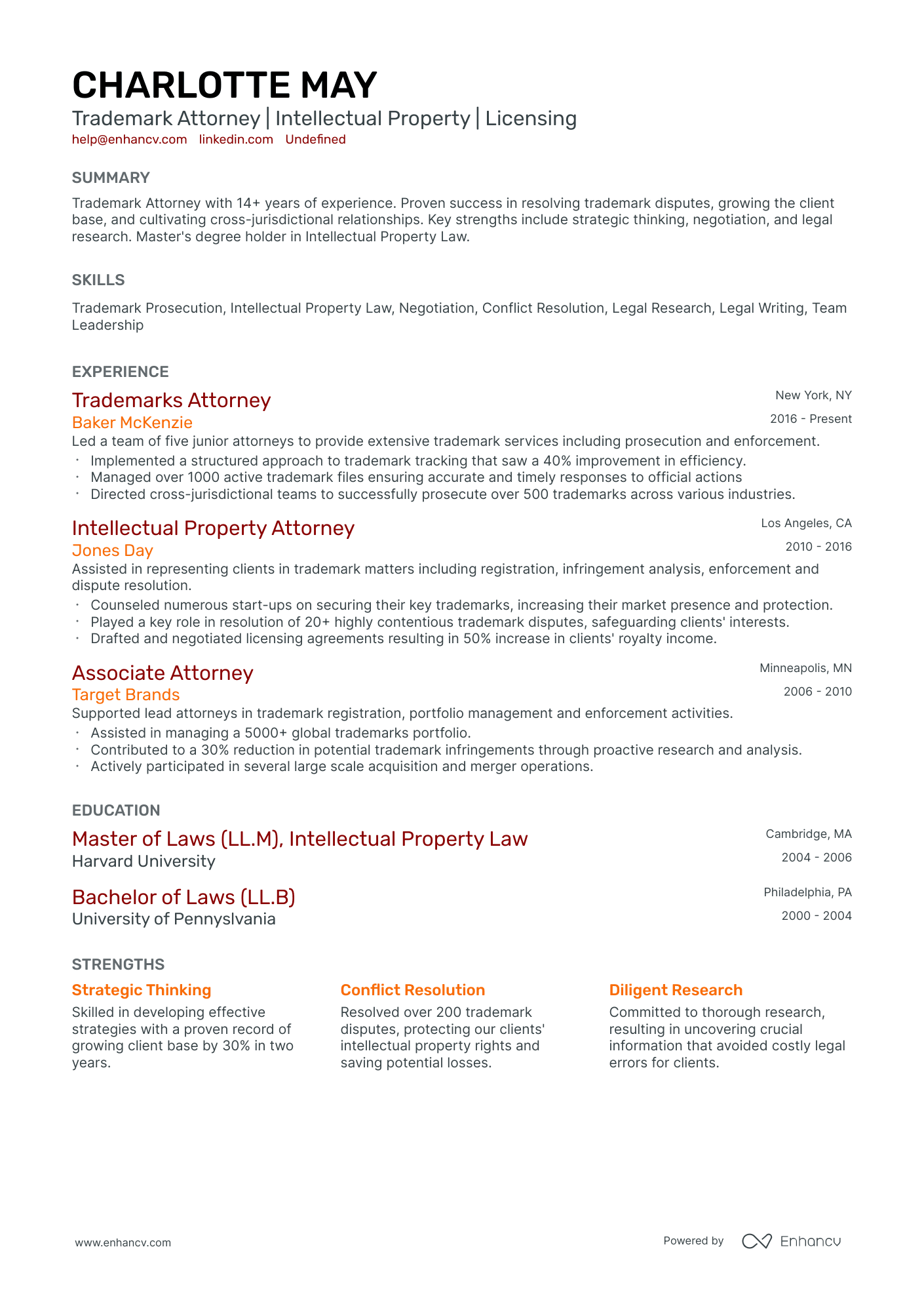
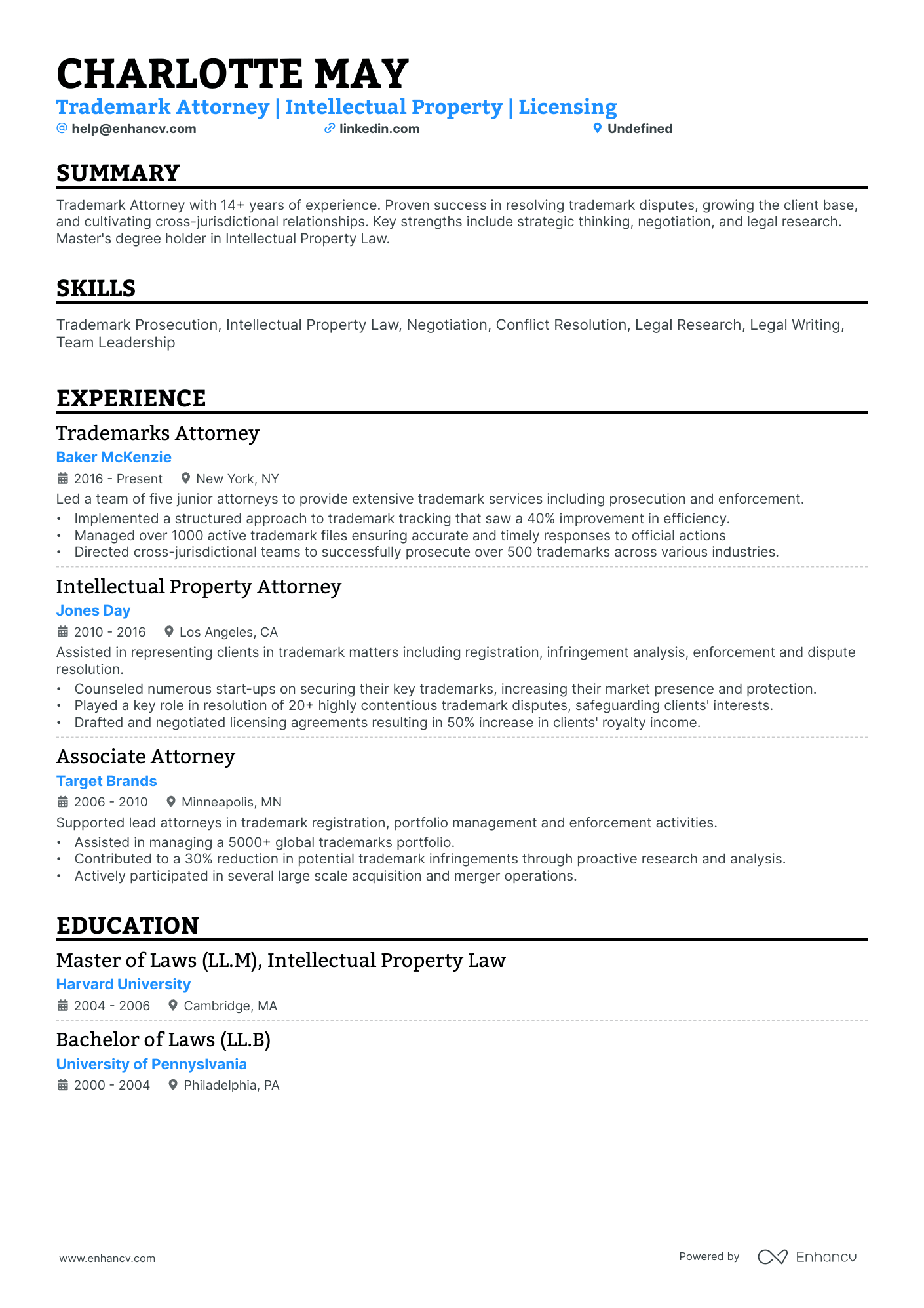
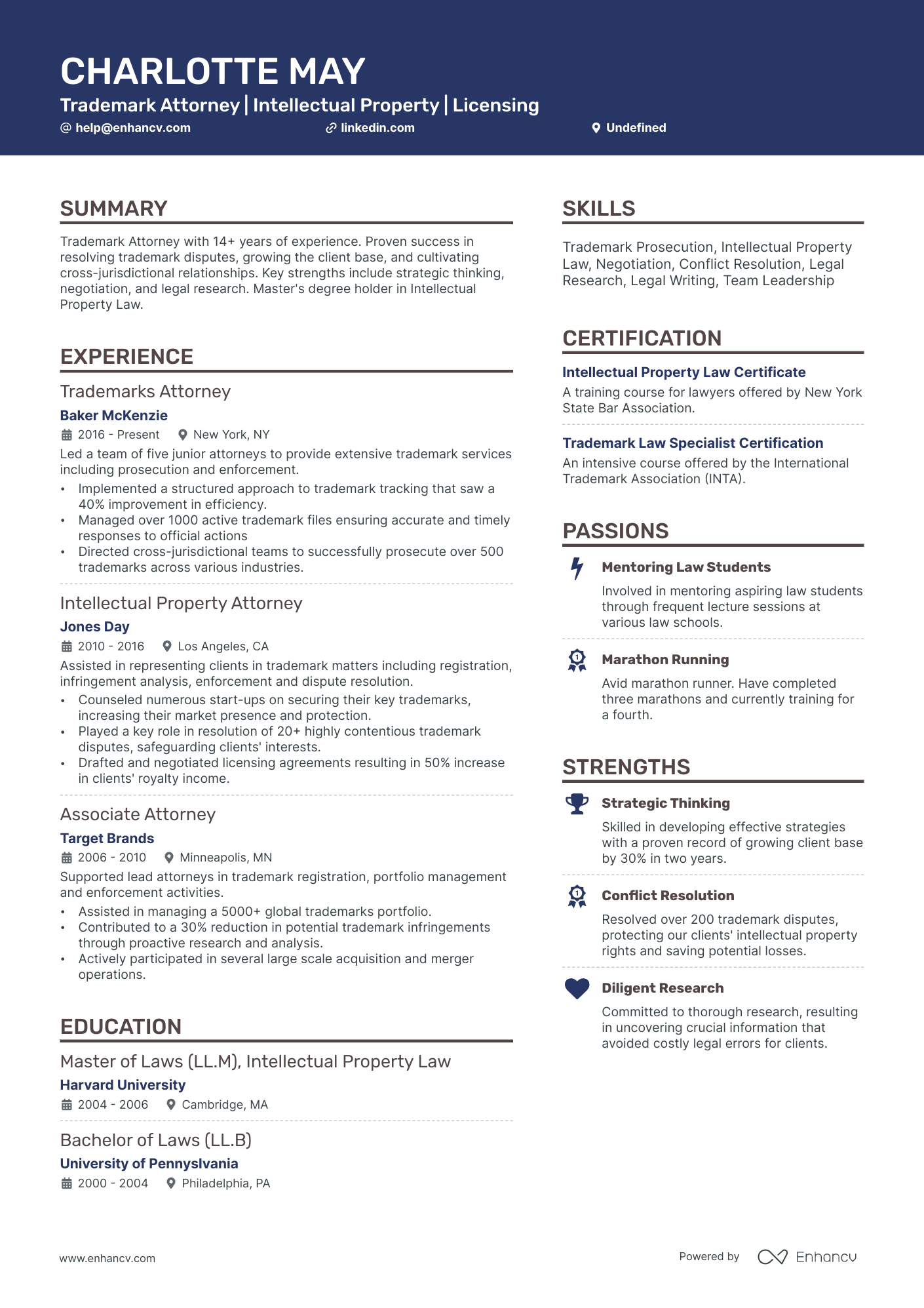
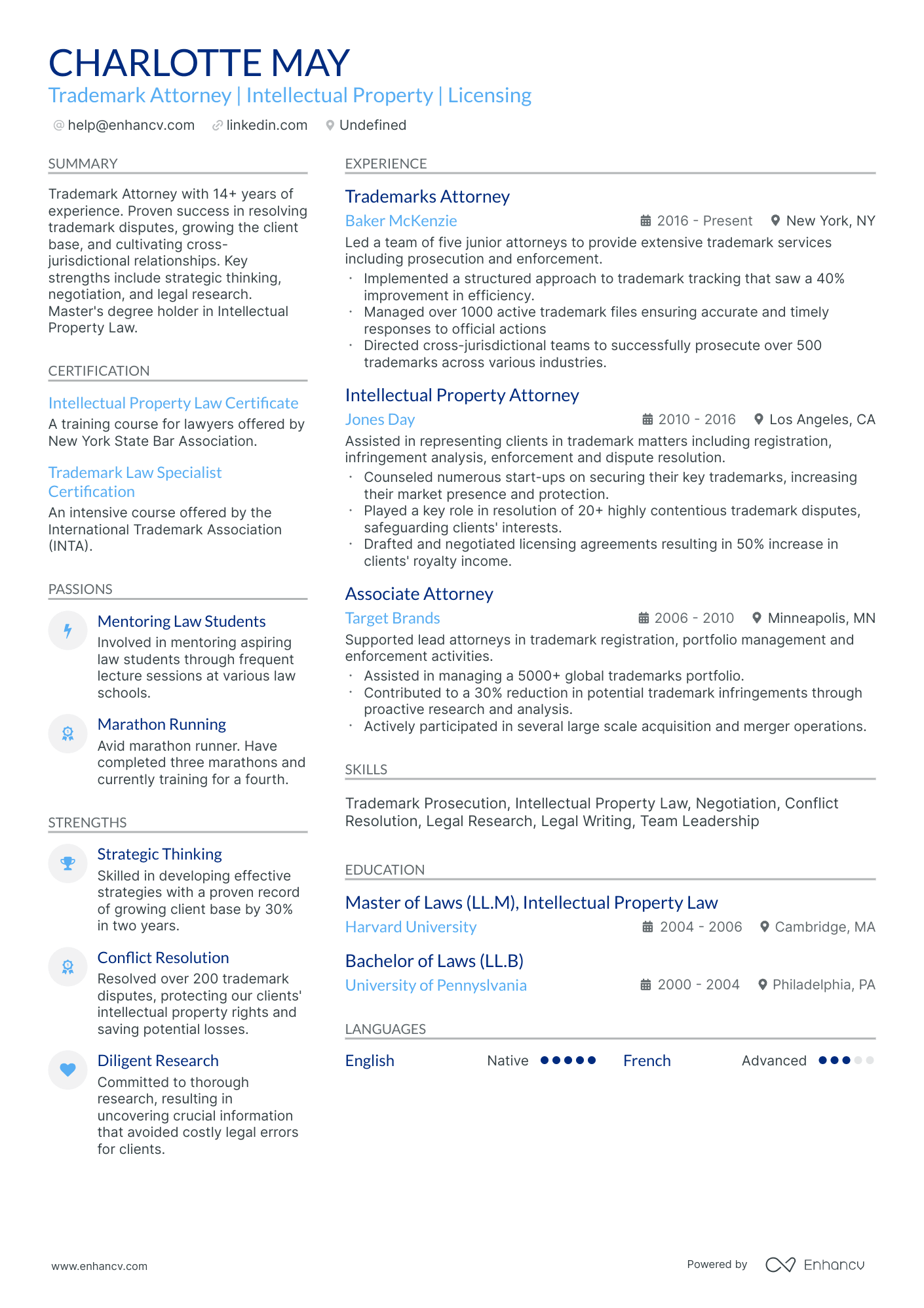
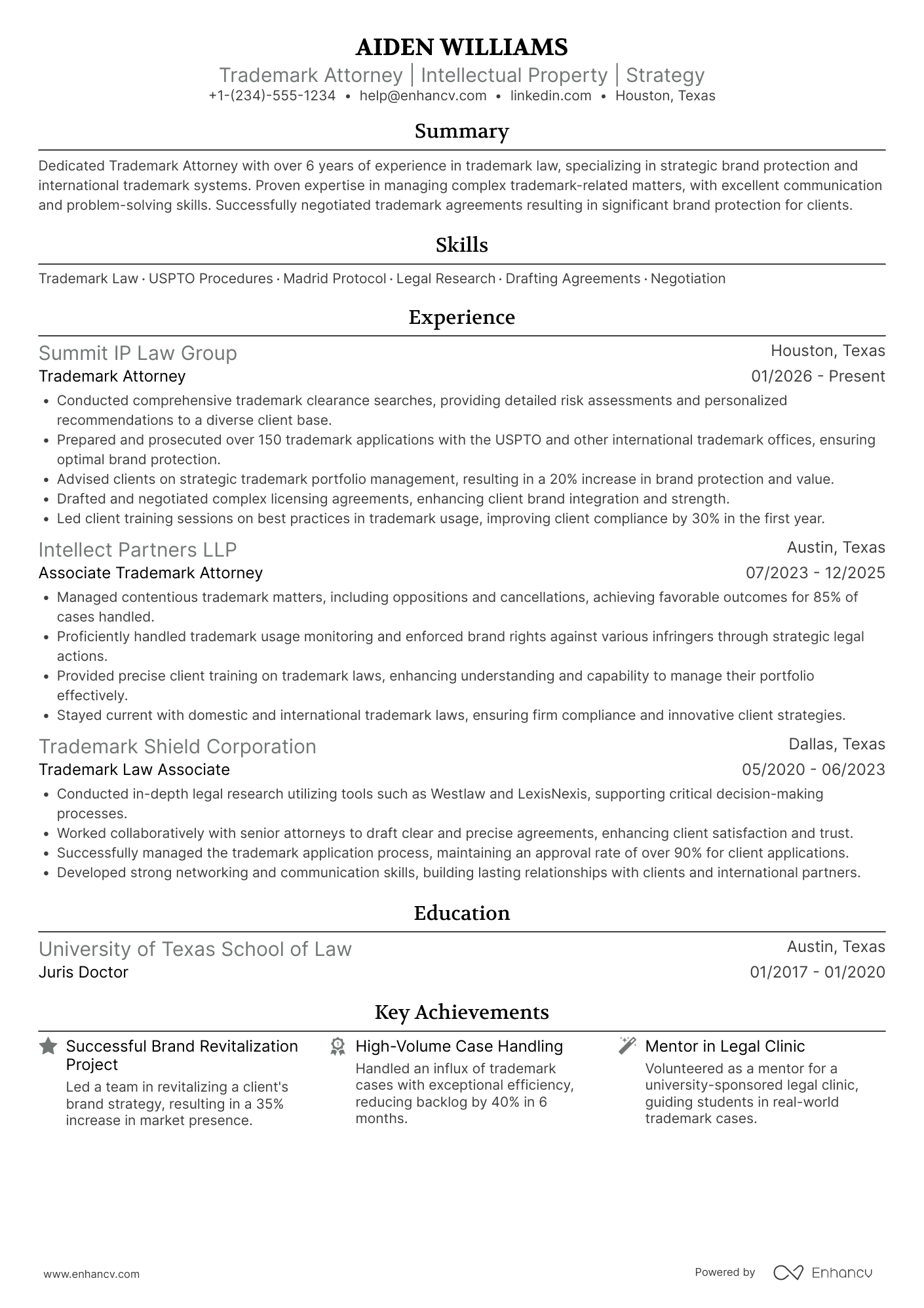
Many trademark attorney resume drafts fail because they read like a task list and bury proof of impact. That matters when an ATS filters fast and recruiters scan in seconds in a crowded legal market.
A strong resume shows what you delivered, not just what you used. Knowing how to make your resume stand out is critical in this competitive field. You should highlight portfolio size, opposition win rate, prosecution cycle time reductions, clearance outcomes, and revenue protected through enforcement. Include jurisdiction scope, deadlines met, and fewer office actions.

Key takeaways
- Quantify trademark work with filing volumes, win rates, cycle times, and revenue protected.
- Choose reverse-chronological format for experienced attorneys and hybrid format for career changers.
- Tailor every resume to the job posting's specific tools, filing systems, and terminology.
- Prove skills through measurable outcomes in experience bullets, not just a skills list.
- Use AI to tighten language and flag gaps, but never fabricate experience or inflate results.
- Pair your resume with a cover letter that adds context your bullets can't convey.
- Build your resume faster with Enhancv to keep each section scannable and impact-focused.
How to format a trademark attorney resume
Recruiters evaluating trademark attorneys prioritize deep prosecution and enforcement experience, portfolio management scope, and demonstrated client advisory ability. A well-chosen resume format ensures these signals surface immediately rather than getting buried beneath generic legal qualifications.

I have significant experience in this role—which format should I use?
Use a reverse-chronological format to showcase your progression through increasingly complex trademark matters, client portfolios, and advisory responsibilities. Do:
- Lead with your most recent role, emphasizing scope: size of trademark portfolios managed, team oversight, and decision-making authority over prosecution, opposition, and enforcement strategies.
- Highlight domain-specific expertise such as USPTO prosecution, Madrid Protocol filings, TTAB proceedings, clearance searches, brand protection programs, and tools like SAEGIS, CompuMark, or trademark docketing systems.
- Quantify business impact through measurable outcomes tied to portfolio growth, cost savings, enforcement results, or client retention.
I'm junior or switching into this role—what format works best?
A hybrid format works best, allowing you to lead with relevant trademark skills and legal knowledge while still providing a chronological work history that demonstrates progression. Do:
- Place a dedicated skills section near the top featuring trademark-specific competencies such as clearance searching, Section 8/9 filings, TTAB practice, and cease-and-desist drafting.
- Include academic projects, clinic work, internships, or transitional experience—such as IP-focused coursework, trademark prosecution externships, or brand-side compliance roles—that demonstrate applied knowledge.
- Connect each experience entry to a clear action and outcome, even if the scope was limited.
Why not use a functional resume?
A functional format strips away the chronological context that hiring managers rely on to assess how your trademark skills developed, making it harder to evaluate your readiness for substantive prosecution or enforcement work.
- A functional format may be acceptable if you're transitioning into trademark law from a related practice area (such as litigation or corporate law), have limited trademark-specific work history, or are re-entering the field after a career gap—but only if every listed skill is tied directly to a project, filing, or measurable outcome rather than presented in isolation.
With your format established, the next step is filling it with the right sections to present your qualifications effectively.
What sections should go on a trademark attorney resume
Recruiters expect to see a clean, complete record of your trademark prosecution, enforcement, and portfolio management work. Understanding what to put on a resume helps you prioritize the most impactful information.
Use this structure for maximum clarity:
- Header
- Summary
- Experience
- Skills
- Projects
- Education
- Certifications
- Optional sections: Publications, Awards, Languages
Strong experience bullets should emphasize measurable outcomes, portfolio scope, risk reduction, successful filings and oppositions, and business impact.
Is your resume good enough?
Drop your resume here or choose a file. PDF & DOCX only. Max 2MB file size.
Once you’ve organized your resume with the right elements in the right order, focus next on writing your trademark attorney experience section to show impact within that structure.
How to write your trademark attorney resume experience
The experience section of your trademark attorney resume should showcase the legal work you've delivered—trademark prosecution, opposition proceedings, portfolio management—along with the tools and methods you used to achieve measurable outcomes for clients or employers. Building a targeted resume ensures hiring managers see demonstrated impact, such as successfully defended marks or streamlined filing processes, over descriptive task lists that merely outline daily responsibilities.
Each entry should include:
- Job title
- Company and location (or remote)
- Dates of employment (month and year)
Three to five concise bullet points showing what you owned, how you executed, and what outcomes you delivered:
- Ownership scope: the trademark portfolios, client accounts, prosecution dockets, opposition or cancellation proceedings, or geographic markets you were directly accountable for managing and protecting.
- Execution approach: the legal research platforms, docketing systems, trademark clearance tools, prosecution strategies, or enforcement frameworks you relied on to assess risk, advise stakeholders, and move filings forward.
- Value improved: changes to portfolio strength, registration success rates, prosecution timelines, infringement exposure, compliance accuracy, or cost efficiency that resulted from your legal counsel and strategic decisions.
- Collaboration context: how you partnered with brand teams, marketing departments, outside counsel, international associates, or regulatory bodies to align trademark strategy with broader business or client objectives.
- Impact delivered: outcomes expressed through resolved disputes, expanded portfolio coverage, reduced legal spend, strengthened brand protection, or successful registrations—framed as results and business impact rather than routine activity.
Experience bullet formula
A trademark attorney experience example
✅ Right example - modern, quantified, specific.
Trademark Attorney
BrightWave Consumer Brands | New York, NY
2021–Present
In-house legal team supporting a global consumer goods portfolio across North America, Europe, and Asia.
- Led end-to-end prosecution for 180+ trademark applications annually using USPTO Trademark Center and WIPO Madrid Monitor, improving first-action allowance rate by 22% through tighter identifications and evidence-ready specimens.
- Cleared and counseled on 120+ new product and brand names per year by running comprehensive searches in Corsearch and TESS, reducing post-launch conflict risk by 35% and cutting outside counsel spend by $240K annually.
- Negotiated and closed 45+ coexistence agreements and settlement terms with opposing counsel, resolving 80% of disputes pre-litigation and reducing average matter cycle time from nine months to five months.
- Built and maintained a global docketing workflow in CPI using standardized office action playbooks and automated reminders, cutting missed-deadline incidents to zero and saving 10+ hours per week across the team.
- Partnered with marketing, product management, and design to implement brand usage guidelines and packaging claim reviews, lowering trademark misuse findings in audits by 40% and accelerating campaign approvals by 30%.
Now that you've seen how a strong experience section comes together, let's look at how to adjust yours to match the specific role you're targeting.
How to tailor your trademark attorney resume experience
Recruiters evaluate your trademark attorney resume through both human review and applicant tracking systems, so tailoring your resume to the job description is essential. Tailoring ensures the most relevant qualifications stand out immediately.
Ways to tailor your trademark attorney experience:
- Mirror the exact trademark filing systems and databases listed in the posting.
- Match the job's terminology for office actions and prosecution workflows.
- Reflect specific portfolio management KPIs or clearance turnaround benchmarks mentioned.
- Highlight opposition and cancellation proceeding experience when the role requires it.
- Emphasize international filing protocols like Madrid Protocol if referenced.
- Include industry-specific brand protection experience relevant to the employer's sector.
- Align your language with cited compliance standards or USPTO practice guidelines.
- Reference cross-functional collaboration with marketing or product teams if noted.
Tailoring means connecting your actual accomplishments to what the role demands, not forcing keywords where they don't belong.
Resume tailoring examples for trademark attorney
| Job description excerpt | Untailored | Tailored |
|---|---|---|
| Conduct comprehensive trademark clearance searches using TESS and Corsearch, assess registrability risks, and prepare detailed opinion letters for domestic and international filing strategies. | Performed trademark research and provided legal opinions to clients. | Conducted 200+ comprehensive trademark clearance searches annually using TESS and Corsearch, drafting registrability opinion letters that guided domestic and Madrid Protocol international filing strategies across 30 jurisdictions. |
| Manage a portfolio of 500+ active trademark registrations, including prosecution before the USPTO, responding to office actions, and coordinating renewal and maintenance filings under Sections 8, 9, and 15. | Handled trademark filings and portfolio management tasks. | Managed a portfolio of 500+ active USPTO trademark registrations, achieving a 94% first-action approval rate by drafting targeted office action responses and coordinating all Section 8, 9, and 15 maintenance filings with zero missed deadlines. |
| Represent clients in TTAB opposition and cancellation proceedings, draft discovery requests, prepare trial briefs, and collaborate with litigation counsel on Lanham Act enforcement actions in federal court. | Assisted with trademark disputes and worked with other attorneys on cases. | Represented clients in 15 TTAB opposition and cancellation proceedings over two years, drafting discovery requests and trial briefs that contributed to favorable outcomes in 12 cases, while coordinating with litigation counsel on three Lanham Act enforcement actions in federal court. |
Once you’ve aligned your experience with the role’s priorities, quantify your trademark attorney achievements to show the measurable impact of that work.
How to quantify your trademark attorney achievements
Quantifying your achievements shows business impact beyond legal tasks. Focus on filing volume, prosecution cycle time, office action win rates, clearance accuracy, and risk reduction from oppositions, cancellations, and enforcement outcomes.
Quantifying examples for trademark attorney
| Metric | Example |
|---|---|
| Cycle time | "Cut average USPTO response turnaround from 14 days to six days by standardizing templates in Microsoft Word and docketing rules in CPI." |
| Quality rate | "Improved office action success rate to 78% across 45 actions by tightening identifications, evidence, and examiner interview preparation." |
| Volume handled | "Managed a portfolio of 220 active marks across eight countries, filing 60 new applications and coordinating Madrid Protocol extensions with local counsel." |
| Risk reduction | "Prevented three likely oppositions by revising specimens and narrowing goods descriptions, avoiding an estimated $45,000 in outside counsel and filing fees." |
| Revenue impact | "Unlocked $1.2M product launch revenue by clearing and filing priority applications for five brands within four weeks, aligning with marketing deadlines." |
Turn vague job duties into measurable, recruiter-ready resume bullets in seconds with Enhancv's Bullet Point Generator.
Once you've refined your experience bullet points, the next step is ensuring your skills section effectively showcases the hard and soft skills that reinforce your trademark attorney expertise.
How to list your hard and soft skills on a trademark attorney resume
Your skills section shows you can clear, prosecute, and enforce marks, and recruiters and an ATS (applicant tracking system) scan this section to match you to the job's legal, research, and portfolio needs—aim for a hard-skills-heavy mix with role-specific soft skills.
trademark attorney roles require a blend of:
- Product strategy and discovery skills.
- Data, analytics, and experimentation skills.
- Delivery, execution, and go-to-market discipline.
- Soft skills.
Your skills section should be:
- Scannable (bullet-style grouping).
- Relevant to the job post.
- Backed by proof in experience bullets.
- Updated with current tools.
Place your skills section:
- Above experience if you're junior or switching careers.
- Below experience if you're mid/senior with strong achievements.

Hard skills
- Trademark clearance searches
- USPTO Trademark Electronic Search System (TESS)
- Trademark Electronic Application System, Trademark Status and Document Retrieval
- Identification of goods and services drafting
- Specimen review and strategy
- Office Action responses
- Madrid Protocol filings
- Trademark opposition and cancellation (TTAB)
- Cease-and-desist drafting
- Coexistence and consent agreements
- Portfolio management and docketing
- Brand enforcement and takedowns
List your strongest hard skills first, prioritizing the tools and competencies most relevant to the job posting.
Soft skills
- Translate legal risk for stakeholders
- Advise on naming go or no-go
- Write concise, persuasive arguments
- Negotiate settlements and coexistence terms
- Manage competing deadlines and priorities
- Coordinate with marketing and product teams
- Communicate clearly with foreign counsel
- Build evidence-based recommendations
- Lead client intake and expectation-setting
- Maintain high-accuracy document review
- Escalate issues with clear options
- Own matters end-to-end
Don't underestimate the value of soft skills—trademark attorneys who can negotiate, communicate clearly, and manage stakeholders are consistently preferred by hiring teams.
How to show your trademark attorney skills in context
Skills shouldn't live only in a dedicated skills list. Browse resume skills examples to see how other professionals weave competencies into their resumes effectively.
They should be demonstrated in:
- Your summary (high-level professional identity)
- Your experience (proof through outcomes)
Here's how that looks in practice.
Summary example
Senior trademark attorney with 12 years of experience managing global portfolios across consumer goods and technology sectors. Skilled in TTAB proceedings, brand clearance strategy, and cross-functional counseling. Reduced opposition filing costs by 35% through proactive watch-notice protocols using CompuMark and TrademarkNow.
- Reflects senior-level expertise immediately
- Names specific industry tools
- Quantifies a cost-saving outcome
- Highlights cross-functional collaboration skills
Experience example
Senior Trademark Attorney
Caldwell & Reeves LLP | Chicago, IL
March 2018–Present
- Managed a portfolio of 1,200+ global trademarks using CompuMark, coordinating with outside counsel across 40 jurisdictions to maintain a 98% renewal compliance rate.
- Led 25 TTAB opposition and cancellation proceedings, achieving favorable outcomes in 88% of cases through strategic evidence development.
- Partnered with marketing and product teams to streamline brand clearance workflows, cutting average clearance turnaround time from 15 days to six.
- Every bullet includes measurable proof
- Skills surface naturally through real outcomes
Once you’ve tied your trademark attorney strengths to real outcomes and responsibilities, the next step is applying that same approach to building a trademark attorney resume with no experience.
How do I write a trademark attorney resume with no experience
Even without full-time experience, you can demonstrate readiness through building a resume without work experience that highlights relevant projects and training:
- USPTO trademark search coursework
- Trademark law clinic casework
- Pro bono clearance research memos
- Specimen and description drafting
- Office action response practice
- Madrid Protocol filing simulations
- Docketing and deadline tracking
Focus on:
- USPTO search and analysis samples
- Drafted identifications and specimens
- Office action responses and outcomes
- Docketing accuracy and timeliness
Resume format tip for entry-level trademark attorney
Use a hybrid resume format because it highlights trademark attorney projects and skills while still showing education, clinics, and internships in a clear timeline. Do:
- Lead with a "Trademark Projects" section.
- Add links to redacted writing samples.
- Name tools like TESS and TEAS.
- Quantify outputs: searches, filings, deadlines.
- Use trademark attorney keywords from postings.
- Conducted fifteen USPTO TESS clearance searches and drafted five TEAS-ready identifications; reduced conflicts by forty percent based on attorney feedback.
When you're building your resume without direct experience, your education section becomes one of the strongest tools for demonstrating your qualifications—so presenting it effectively is essential.
How to list your education on a trademark attorney resume
Your education section lets hiring teams confirm you hold the degrees and training a trademark attorney needs. It validates your legal foundation quickly and efficiently.
Include:
- Degree name
- Institution
- Location
- Graduation year
- Relevant coursework (for juniors or entry-level candidates)
- Honors & GPA (if 3.5 or higher)
Skip month and day details—list the graduation year only.
Here's a strong education entry tailored for a trademark attorney resume.
Example education entry
Juris Doctor (J.D.)
Georgetown University Law Center, Washington, D.C.
Graduated: 2021
GPA: 3.7/4.0
- Relevant Coursework: Trademark Law, Intellectual Property Litigation, Unfair Competition, Patent & Copyright Law
- Honors: Dean's List (all semesters), Intellectual Property Law Society Outstanding Student Award
How to list your certifications on a trademark attorney resume
Certifications on your resume show a trademark attorney's commitment to ongoing learning, proficiency with modern tools, and alignment with current industry standards and client needs. Include:
- Certificate name
- Issuing organization
- Year
- Optional: credential ID or URL
- Place certifications below education when they are older, less role-specific, or secondary to your law degree and bar admission.
- Place certifications above education when they are recent, highly relevant to trademark attorney work, or requested in the job posting.
Best certifications for your trademark attorney resume
- INTA Trademark Administrators Certificate Program
- WIPO General Course on Intellectual Property
- WIPO Advanced Course on Trademarks, Industrial Designs and Geographical Indications
- Paralegal Certification (NALA)
- Certified Information Privacy Professional, United States (IAPP)
- ACAMS Certified Anti-Money Laundering Specialist
Once you’ve positioned your credentials where hiring managers can spot them quickly, use your trademark attorney resume summary to tie them to your most relevant strengths and results.
How to write your trademark attorney resume summary
Your resume summary is the first thing a recruiter reads, so it must immediately signal your fit for the role. A strong summary positions you as a qualified trademark attorney with relevant skills and measurable contributions.
Keep it to three to four lines, with:
- Your title and years of experience in trademark law.
- Domain focus, such as prosecution, enforcement, or portfolio management.
- Core skills like TTAB proceedings, clearance searches, or opposition filings.
- One or two quantified achievements that show early impact.
- Soft skills tied to real outcomes, such as client communication or cross-functional collaboration.

PRO TIP
At a junior level, emphasize your technical skills, relevant tools, and specific contributions rather than broad ambitions. Highlight TTAB familiarity, filing accuracy, or clearance search volume. Avoid vague phrases like "passionate self-starter" or "eager to grow." Recruiters want proof of competence, not motivation.
Example summary for a trademark attorney
Trademark attorney with two years of experience in prosecution and clearance searches. Managed over 150 trademark filings with a 98% first-action approval rate. Skilled in TTAB proceedings and client counseling.
Optimize your resume summary and objective for ATS
Drop your resume here or choose a file.
PDF & DOCX only. Max 2MB file size.
Now that your summary effectively conveys your trademark expertise, make sure the header framing it presents your contact details correctly so recruiters can actually reach you.
What to include in a trademark attorney resume header
A resume header lists your key identifying and contact details, and it boosts visibility, credibility, and recruiter screening for a trademark attorney role.
Essential resume header elements
- Full name
- Tailored job title and headline
- Location
- Phone number
- Professional email
- GitHub link
- Portfolio link
A LinkedIn link lets recruiters verify your experience fast and supports screening.
Don't include a photo on a trademark attorney resume unless the role is explicitly front-facing or appearance-dependent.
Match your job title and headline to the posting, and keep every detail consistent with your bar and professional profiles.
Trademark attorney resume header
Jordan M. Parker
Trademark Attorney | USPTO Filings, Clearance, and Brand Protection
Austin, TX
(512) 555-01XX
your.name@enhancv.com github.com/yourname yourwebsite.com linkedin.com/in/yourname
Once your contact details and professional identifiers are in place, you can strengthen your application by adding the most relevant additional sections for trademark attorney resumes.
Additional sections for trademark attorney resumes
Adding extra sections helps you stand out when your core qualifications match other candidates, letting you highlight unique expertise relevant to trademark law. For example, listing language skills can be particularly valuable if you handle international filings or coordinate with foreign counsel across multiple jurisdictions.
- Languages
- Publications
- Speaking engagements
- Professional affiliations
- Pro bono work
- Certifications
Once you've strengthened your resume with targeted additional sections, pairing it with a well-crafted cover letter can further set your application apart.
Do trademark attorney resumes need a cover letter
A cover letter isn't required for a trademark attorney, but it often helps. If you're unsure what a cover letter is or how it differs from a resume, it's a focused narrative that adds context your bullets can't convey. In competitive roles and brand-driven companies, hiring teams expect one. It can make the difference when your resume doesn't show fit, context, or impact.
Use a cover letter to add details your resume can't:
- Explain why you fit the role and team: connect your practice focus to their workload, such as clearance, prosecution, enforcement, or portfolio strategy.
- Highlight one or two relevant projects or outcomes: quantify results like reduced office action rates, faster filings, or successful oppositions and settlements.
- Show you understand the product, users, or business context: address how trademark risk affects launches, marketing claims, marketplaces, or international expansion.
- Address career transitions or non-obvious experience: explain moves between firms and in-house, jurisdiction changes, or gaps, and tie them to trademark attorney value.
Drop your resume here or choose a file.
PDF & DOCX only. Max 2MB file size.
Even if you include a cover letter to add context beyond your resume, the next step is using AI to improve your trademark attorney resume so it communicates those strengths more clearly and efficiently.
Using AI to improve your trademark attorney resume
AI can sharpen your resume's clarity, structure, and overall impact. It helps tighten language and highlight relevant accomplishments. But overuse strips away authenticity. Once your content feels clear and aligned with your trademark attorney role, step away from AI. If you're wondering which AI is best for writing resumes, the answer depends on how much control you want over tone and formatting.
Here are 10 practical prompts to strengthen specific sections of your trademark attorney resume:
- Sharpen your summary: "Rewrite my trademark attorney resume summary to emphasize prosecution experience, client counseling skills, and measurable portfolio results in under four sentences."
- Quantify experience bullets: "Add specific metrics to these trademark attorney experience bullets, focusing on application volumes, opposition outcomes, and portfolio sizes managed."
- Strengthen action verbs: "Replace weak or passive verbs in my trademark attorney experience section with precise legal action verbs that convey ownership and impact."
- Tailor skills section: "Reorganize my trademark attorney skills section to prioritize competencies most relevant to this job description, removing outdated or generic entries."
- Refine project descriptions: "Rewrite this trademark attorney project description to clearly state my role, the legal challenge addressed, and the measurable outcome achieved."
- Improve education details: "Suggest ways to enhance my trademark attorney education section by highlighting IP coursework, moot court participation, and relevant academic honors."
- Align certification entries: "Format my trademark attorney certifications section for consistency, listing each credential with its issuing body, date, and relevance to IP practice."
- Eliminate redundant language: "Identify and remove redundant phrases across my trademark attorney resume without losing substantive legal detail or accomplishment context."
- Tighten bullet structure: "Restructure each trademark attorney experience bullet into a consistent format: action verb, specific task, and concrete result."
- Target job alignment: "Compare my trademark attorney resume against this job posting and flag gaps in keywords, qualifications, or experience emphasis I should address."
Stop using AI once your resume sounds accurate, specific, and aligned with real experience. AI should never invent experience or inflate claims—if it didn't happen, it doesn't belong here.
Conclusion
A strong trademark attorney resume shows measurable outcomes, role-specific skills, and a clear structure. It highlights trademark prosecution, clearance, enforcement, and portfolio management, supported by numbers such as filings handled, deadlines met, and disputes resolved.
Keep each section easy to scan and focused on impact, not tasks. When you connect results to your core trademark attorney skills, you show readiness for today’s hiring market and near-future needs.