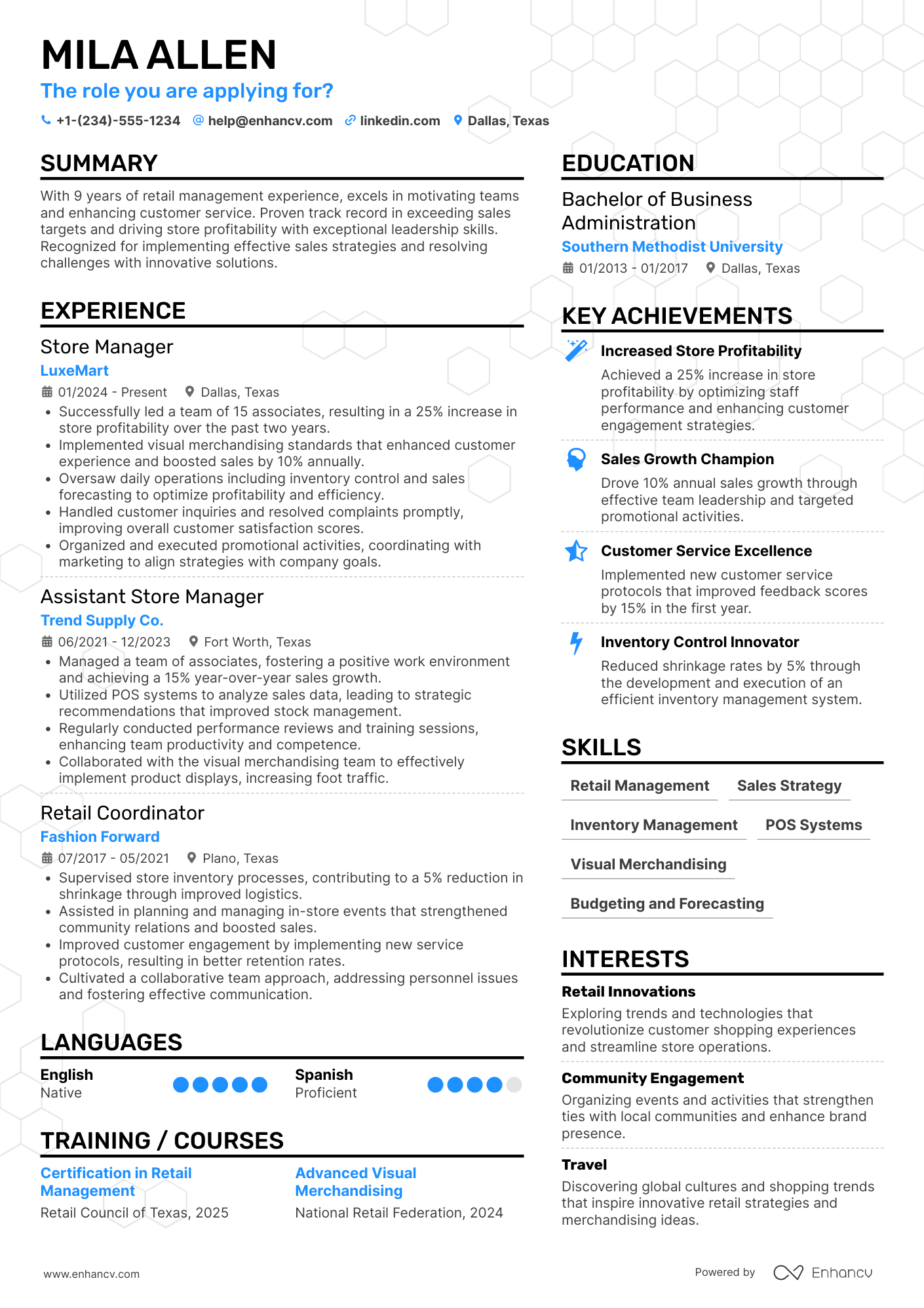
Store manager resumes fail when they read like task lists and bury results under generic retail language. A store manager retail resume needs fast proof of impact to pass ATS screening and stand out in rapid recruiter scans.
Your resume should spotlight outcomes you drove, not tools you used. Show sales growth, shrink reduction, payroll efficiency, inventory accuracy, basket size, customer satisfaction scores, team size, turnover reduction, and audit results you improved. Quantify scope, pace, and consistency.

Key takeaways
- Quantify every experience bullet with metrics like sales growth, shrink reduction, and team size.
- Use reverse-chronological format if you have store management experience; use hybrid if you're transitioning.
- Tailor each resume to the job posting's specific tools, KPIs, and terminology.
- Lead your summary with operational results and leadership scope, not personality statements.
- Pair hard skills like inventory management and POS systems with soft skills proven through outcomes.
- Place skills above experience when junior, below experience when you have strong achievements.
- Use Enhancv's Bullet Point Generator to turn vague duties into measurable, recruiter-ready resume bullets.
How to format a store manager retail resume
Recruiters evaluating store manager candidates prioritize operational leadership, team management scope, and measurable business results like revenue growth and shrink reduction. A clean, well-structured resume format ensures these signals surface quickly during both ATS parsing and the initial six-to-ten-second recruiter scan.

I have significant experience in this role—which format should I use?
Use a reverse-chronological format to showcase your progression through retail management and the expanding scope of your responsibilities. Do:
- Lead with your most recent store management role, emphasizing team size, store volume, and P&L ownership.
- Highlight proficiency with retail-specific tools and domains such as POS systems, inventory management platforms, workforce scheduling software, and loss prevention protocols.
- Anchor every bullet to measurable outcomes—revenue increases, cost reductions, customer satisfaction scores, or employee retention improvements.
I'm junior or switching into this role—what format works best?
A hybrid format works best because it lets you lead with transferable retail and leadership skills while still providing a concise work history timeline. Do:
- Place a skills section near the top of your resume that highlights competencies directly relevant to store management, such as team leadership, visual merchandising, and customer experience strategy.
- Include projects, supervisory assignments, or transitional experience—like assistant manager duties, department lead responsibilities, or retail internships—that demonstrate readiness for a store-level role.
- Connect every skill claim to a specific action and its outcome so recruiters can evaluate your real-world impact rather than a list of keywords.
Why not use a functional resume?
A functional resume strips away the timeline and context recruiters need to evaluate how your management capabilities developed, making it harder to verify leadership readiness for a store manager role.
- A functional format may be acceptable if you're transitioning from a non-retail management background, have a significant gap in your work history, or lack traditional store management titles—but only if you tie every listed skill to specific projects, outcomes, or measurable results.
Once your format establishes a clean, scannable structure, the next step is filling it with the right sections to highlight your qualifications effectively.
What sections should go on a store manager retail resume
Recruiters expect you to present clear leadership, sales performance, and operational execution in a clean, standard resume format. Knowing what to put on a resume for a store manager role ensures you include the right details from the start.
Use this structure for maximum clarity:
- Header
- Summary
- Experience
- Skills
- Projects
- Education
- Certifications
- Optional sections: Awards, Leadership, Languages
In your experience bullets, emphasize measurable sales and margin impact, team size and store volume, operational scope, and results in shrink reduction, customer satisfaction, and process improvements.
Is your resume good enough?
Drop your resume here or choose a file. PDF & DOCX only. Max 2MB file size.
Once you’ve organized your resume with the right information in the right places, the next step is to write your store manager retail resume experience section so it clearly supports those details with specific, role-relevant impact.
How to write your store manager retail resume experience
Your experience section is where you prove you've delivered results—not just held a position. Hiring managers reviewing store manager retail resumes prioritize demonstrated impact through operational leadership, revenue growth, team development, and customer experience improvements over descriptive task lists.
Each entry should include:
- Job title
- Company and location (or remote)
- Dates of employment (month and year)
Three to five concise bullet points showing what you owned, how you executed, and what outcomes you delivered:
- Ownership scope: the store operations, departments, inventory systems, sales floors, or teams you were directly accountable for as a store manager.
- Execution approach: the retail management platforms, point-of-sale systems, merchandising strategies, scheduling tools, or loss prevention methods you used to drive daily decisions and deliver work.
- Value improved: changes to sales performance, shrinkage rates, customer satisfaction, employee retention, operational efficiency, or compliance standards relevant to retail store management.
- Collaboration context: how you worked with district managers, corporate merchandising teams, vendors, HR partners, or community stakeholders to align store performance with broader business goals.
- Impact delivered: outcomes expressed through revenue growth, cost reductions, team performance improvements, or customer experience gains rather than routine activity descriptions.
Experience bullet formula
A store manager retail experience example
✅ Right example - modern, quantified, specific.
Store Manager
BrightMart | Austin, TX
2021–Present
High-volume big-box retailer serving two hundred thousand plus annual shoppers across grocery, household essentials, and seasonal goods.
- Increased same-store sales by 12% year over year by optimizing assortment and endcaps using POS dashboards, loyalty data, and weekly category scorecards in Microsoft Excel.
- Reduced shrink from 1.8% to 1.2% by enforcing RFID cycle counts, exception reporting in the inventory management system, and camera-audit routines with loss prevention partners.
- Improved on-shelf availability by 9% by redesigning replenishment workflows in the warehouse management system, tightening receiving cutoffs, and partnering with vendors on fill-rate targets.
- Cut average checkout wait time from six minutes to four minutes by adjusting labor forecasts in UKG, rebalancing cashier-to-self-checkout coverage, and coordinating with field operations on queue standards.
- Raised customer satisfaction from 4.2 to 4.6 stars by launching a service recovery playbook in the customer relationship management system, coaching department leads, and closing the loop on top complaint drivers.
Now that you've seen how a strong retail store manager experience section comes together, let's look at how to tailor each detail to match the specific job you're applying for.
How to tailor your store manager retail resume experience
Recruiters evaluate your store manager retail resume through both applicant tracking systems and manual review. Tailoring your resume to the job description ensures your qualifications stand out in both screening methods.
Ways to tailor your store manager retail experience:
- Match point-of-sale systems and inventory platforms named in the posting.
- Mirror the exact loss prevention terminology the employer uses.
- Align your reported KPIs with the performance metrics they prioritize.
- Highlight visual merchandising standards referenced in the job description.
- Emphasize staff scheduling or workforce management tools they specify.
- Include compliance or safety protocols relevant to their retail environment.
- Reflect the customer experience frameworks or service models they reference.
- Showcase multi-department or high-volume leadership if the role requires it.
Tailoring means aligning your real accomplishments with the employer's stated priorities, not forcing disconnected keywords into your experience bullets.
Resume tailoring examples for store manager retail
| Job description excerpt | Untailored | Tailored |
|---|---|---|
| "Oversee daily store operations, including inventory management using Oracle NetSuite, staff scheduling, and loss prevention to maintain shrinkage below 1.5%." | Managed daily operations and supervised store activities. | Directed daily operations for a 15,000 sq. ft. retail location, managing inventory through Oracle NetSuite, optimizing staff schedules for 30+ employees, and reducing shrinkage to 0.9%—well below the 1.5% target. |
| "Drive revenue growth by executing seasonal merchandising strategies, analyzing sales data in Power BI, and achieving a minimum 10% year-over-year sales increase." | Helped increase store sales and set up product displays. | Executed seasonal merchandising plans informed by Power BI sales analytics, repositioning high-margin product categories to drive a 14% year-over-year revenue increase across two consecutive fiscal years. |
| "Lead, coach, and develop a team of 25+ associates, conducting quarterly performance reviews and maintaining employee retention rates above 85%." | Supervised employees and handled some training duties. | Coached and developed a team of 28 associates through structured quarterly performance reviews, individualized development plans, and recognition programs that raised employee retention from 78% to 91% within 12 months. |
Once you’ve aligned your experience with the role’s priorities, quantify your achievements to prove the impact behind those responsibilities.
How to quantify your store manager retail achievements
Quantifying your achievements shows how you improved results, not just completed tasks. For store managers, focus on sales growth, labor efficiency, inventory accuracy, shrink reduction, and customer satisfaction.
Quantifying examples for store manager retail
| Metric | Example |
|---|---|
| Revenue growth | "Grew same-store sales 12% year over year by resetting endcaps, coaching add-on selling, and tracking daily KPIs in Excel." |
| Labor efficiency | "Cut labor cost 1.8 points while maintaining coverage by rebuilding schedules in UKG and reducing overtime 22%." |
| Inventory accuracy | "Improved inventory accuracy from 93% to 98% by tightening cycle counts, training receivers, and auditing top 200 SKUs weekly." |
| Shrink reduction | "Reduced shrink 0.7 points in six months by enforcing cash-handling checks, improving CCTV review routines, and partnering with loss prevention." |
| Customer satisfaction | "Raised customer satisfaction score from 4.2 to 4.6 by coaching service recovery, reducing checkout waits to under four minutes, and tracking feedback weekly." |
Turn vague job duties into measurable, recruiter-ready resume bullets in seconds with Enhancv's Bullet Point Generator.
Once you've crafted strong bullet points for your experience section, it's equally important to strategically present your hard and soft skills to give hiring managers a complete picture of your qualifications.
How to list your hard and soft skills on a store manager retail resume
Your skills section shows you can run profitable, compliant store operations, and recruiters and applicant tracking systems (ATS) scan this section to confirm role fit fast; aim for a balanced mix of operational hard skills and people-leadership soft skills. store manager retail roles require a blend of:
- Product strategy and discovery skills
- Data, analytics, and experimentation skills
- Delivery, execution, and go-to-market discipline
- Soft skills
Your skills section should be:
- Scannable (bullet-style grouping).
- Relevant to the job post.
- Backed by proof in experience bullets.
- Updated with current tools.
Place your skills section:
- Above experience if you're junior or switching careers.
- Below experience if you're mid/senior with strong achievements.

Hard skills
- Point-of-sale systems, cash management
- Inventory management, cycle counts
- Visual merchandising standards, planograms
- Sales forecasting, demand planning
- Labor scheduling, workforce planning
- Loss prevention, shrink reduction
- Customer relationship management (CRM) tools
- Key performance indicator reporting, dashboards
- Omnichannel fulfillment: buy online, pick up in store
- Vendor relations, purchase orders
- Safety compliance, incident reporting
- Returns processing, chargeback prevention
Soft skills
- Coach and develop associates
- Set daily priorities and accountability
- Resolve escalations with calm authority
- Lead by example on the sales floor
- Communicate expectations clearly
- Make fast, data-informed decisions
- Coordinate cross-shift handoffs
- Negotiate win-win vendor outcomes
- Deliver candid performance feedback
- Adapt plans during staffing gaps
- Build repeat business through service recovery
- Own results and follow through
How to show your store manager retail skills in context
Skills shouldn't live only in a bulleted list on your resume. Explore examples of resume skills presented in context to see how top candidates integrate them naturally.
They should be demonstrated in:
- Your summary (high-level professional identity)
- Your experience (proof through outcomes)
Here's how strong store manager candidates weave skills into both sections.
Summary example
Senior store manager with 12 years in big-box retail, skilled in workforce scheduling, SAP Retail, and shrinkage prevention. Led a 45-member team to a 17% year-over-year sales increase while maintaining the district's lowest employee turnover rate.
- Reflects senior-level experience clearly
- Names specific tools and methods
- Leads with a measurable sales outcome
- Highlights team leadership and retention
Experience example
Senior Store Manager
HomeGoods | Charlotte, NC
March 2019–Present
- Implemented Kronos-based scheduling optimization with department leads, reducing labor costs by 11% without impacting customer satisfaction scores.
- Partnered with the regional loss prevention team to deploy new inventory audit protocols, cutting shrinkage by 23% over two fiscal years.
- Coached and developed a 38-person team using structured performance reviews, achieving a 91% internal promotion rate for supervisory roles.
- Every bullet contains measurable proof.
- Skills surface naturally through outcomes.
Once you’ve shown hiring managers how your retail strengths translate into real results, the next step is to apply the same approach to a store manager resume when you don’t have direct experience.
How do I write a store manager retail resume with no experience
Even without full-time experience, you can demonstrate readiness through transferable achievements. If you're building a resume without work experience, focus on projects and leadership roles that mirror store manager responsibilities:
- Volunteer shift lead at events
- Student retail club leadership role
- Cash handling in school store
- Inventory counts for fundraiser shop
- Merchandising for pop-up sales
- Customer service in campus office
- Team lead in sports concessions
- Managing online resale storefront
Focus on:
- Metrics: sales, shrink, conversion
- POS system accuracy and speed
- Inventory audits and replenishment
- Scheduling and labor cost control
Resume format tip for entry-level store manager retail
Use a hybrid resume format because it highlights relevant skills and projects before work history, while still showing dates and accountability. Do:
- Add a summary with one metric.
- List retail systems you used.
- Quantify results with clear numbers.
- Use action verbs tied to tasks.
- Put projects above work history.
- Led weekly inventory counts for fundraiser shop using a POS system and cycle counts, cutting stockouts by 20% over six weeks.
Once you've positioned your transferable skills and relevant experiences to compensate for a lack of direct management background, the next step is presenting your education in a way that reinforces your qualifications.
How to list your education on a store manager retail resume
Your education section helps hiring teams confirm you have foundational knowledge in business, management, or retail operations relevant to the store manager retail role.
Include:
- Degree name
- Institution
- Location
- Graduation year
- Relevant coursework (for juniors or entry-level candidates)
- Honors & GPA (if 3.5 or higher)
Skip month and day details—list the graduation year only.
Here's a strong education entry tailored for a store manager retail resume.
Example education entry
Bachelor of Science in Business Administration
University of Georgia, Athens, GA
Graduated 2019
GPA: 3.7/4.0
- Relevant Coursework: Retail Management, Consumer Behavior, Supply Chain Operations, Organizational Leadership
- Honors: Magna Cum Laude, Dean's List (six semesters)
How to list your certifications on a store manager retail resume
Certifications show your commitment to learning, proficiency with retail tools, and industry relevance as a store manager retail. They also help validate leadership, operations, and compliance knowledge.
Include:
- Certificate name
- Issuing organization
- Year
- Optional: credential ID or URL
- Place certifications below education when they're older, less relevant, or you hold a recent degree that matches store manager retail requirements.
- Place certifications above education when they're recent, highly relevant, or required for your target store manager retail role.
Best certifications for your store manager retail resume
- Certified Retail Manager (CRM)
- NRF Customer Service and Sales Certification
- ServSafe Food Protection Manager Certification
- OSHA 10-Hour General Industry
- First Aid/CPR/AED Certification
- Certified Supply Chain Professional (CSCP)
- Lean Six Sigma Yellow Belt
Once you’ve positioned your credentials so hiring managers can spot them quickly, shift to writing your store manager retail resume summary to reinforce that value in a high-impact opening.
How to write your store manager retail resume summary
Your resume summary is the first thing a recruiter reads. A strong one instantly signals you can lead a retail team, drive sales, and manage daily operations.
Keep it to three to four lines, with:
- Your title and total years of retail management experience.
- The retail domain or store type you've managed, such as apparel, grocery, or big-box.
- Core skills like inventory management, POS systems, workforce scheduling, and visual merchandising.
- One or two quantified achievements, such as revenue growth or shrinkage reduction.
- Soft skills tied to real outcomes, like coaching staff to hit quarterly targets.

PRO TIP
At this level, lead with operational results and team leadership. Highlight metrics like sales increases, cost reductions, or improved customer satisfaction scores. Avoid vague phrases like "passionate leader" or "results-driven professional." Recruiters want proof, not personality statements.
Example summary for a store manager retail
Store manager with eight years in high-volume retail, overseeing teams of 30+. Reduced inventory shrinkage by 18% and grew annual revenue 12% through staff training and improved merchandising strategies.
Optimize your resume summary and objective for ATS
Drop your resume here or choose a file.
PDF & DOCX only. Max 2MB file size.
Now that your summary effectively showcases your leadership strengths and retail expertise, make sure the header above it presents your contact details clearly so hiring managers can reach you without any hassle.
What to include in a store manager retail resume header
A resume header lists your key contact details and role focus, boosting visibility, credibility, and recruiter screening for a store manager retail position.
Essential resume header elements
- Full name
- Tailored job title and headline
- Location
- Phone number
- Professional email
- GitHub link
- Portfolio link
A LinkedIn link helps recruiters verify experience quickly and supports screening.
Do not include photos on a store manager retail resume unless the role is explicitly front-facing or appearance-dependent.
Keep your header consistent with the job posting title, and place it at the top so it's easy to scan.
Example
Store manager retail resume header
Jordan Lee
Store manager retail | Multi-unit operations, inventory control, and team leadership
Austin, TX
(512) 555-01XX
your.name@enhancv.com
github.com/yourname
yourwebsite.com
linkedin.com/in/yourname
Once your contact details and role-focused headline are in place, add the additional sections that strengthen your store manager retail resume and support the information above.
Additional sections for store manager retail resumes
When your core qualifications match other candidates, additional sections help you stand out by showcasing unique strengths relevant to retail leadership. For example, listing language skills can be especially valuable if you manage a store serving a diverse customer base.
- Languages
- Certifications and licenses
- Volunteer experience
- Professional affiliations and memberships
- Awards and recognition
- Hobbies and interests
- Community involvement
Once you've strengthened your resume with relevant extra sections, pairing it with a tailored cover letter can further set your application apart.
Do store manager retail resumes need a cover letter
A cover letter isn't required for a store manager retail, but it helps in competitive roles or when employers expect one. If you're unsure where to start, understanding what a cover letter is and how it complements your resume can clarify when it's worth including. It can make a difference when your resume needs context or when you must stand out among similar candidates.
Use a cover letter to add value in these situations:
- Explain role or team fit by linking your leadership style to the store's pace, staffing model, and service standards.
- Highlight one or two outcomes, such as lowering shrink, improving conversion, or raising customer satisfaction, and state what you did to drive them.
- Show you understand the product, users, and business context by referencing the target customer, key categories, and how the store supports brand goals.
- Address career transitions or non-obvious experience by connecting prior roles to store manager retail priorities like coaching, inventory control, and operations.
Drop your resume here or choose a file.
PDF & DOCX only. Max 2MB file size.
Whether you include a cover letter or not, using AI to improve your store manager retail resume helps you tailor and strengthen it for the role.
Using AI to improve your store manager retail resume
AI can sharpen your store manager retail resume's clarity, structure, and impact. It helps tighten language and highlight results. But overuse strips authenticity. If you're exploring this approach, learn more about which AI is best for writing resumes before diving in. Once your content feels clear and role-aligned, step away from AI.
Here are 10 practical prompts to strengthen specific sections of your store manager retail resume:
- Sharpen your summary: "Rewrite my store manager retail resume summary to highlight leadership scope, store revenue, and team size in three concise sentences."
- Quantify experience bullets: "Add measurable results like revenue growth, shrink reduction, or team retention to each store manager retail experience bullet."
- Align skills strategically: "Compare my listed skills against this store manager retail job description and remove any that don't directly match."
- Tighten action verbs: "Replace weak or repeated verbs in my store manager retail experience section with strong, specific action verbs."
- Strengthen project descriptions: "Rewrite my store manager retail project entries to emphasize scope, business impact, and cross-functional collaboration."
- Improve education relevance: "Revise my education section to highlight coursework and achievements most relevant to a store manager retail role."
- Clarify certification value: "For each certification on my store manager retail resume, add one sentence explaining its practical relevance to daily operations."
- Remove filler language: "Identify and remove vague phrases, redundancies, or clichés throughout my store manager retail resume."
- Refine bullet structure: "Restructure every store manager retail experience bullet to follow a clear action-result format with specific metrics."
- Tailor for ATS clarity: "Simplify formatting and incorporate exact keywords from this store manager retail job posting into matching resume sections."
Stop using AI once your resume sounds accurate, specific, and aligned with real experience. AI should never invent experience or inflate claims—if it didn't happen, it doesn't belong here.
Conclusion
A strong store manager retail resume proves impact with measurable outcomes. Highlight sales growth, shrink reduction, labor control, and customer satisfaction improvements. Pair results with role-specific skills like coaching, inventory management, merchandising, scheduling, and loss prevention. Keep a clear structure that recruiters can scan fast.
Today’s hiring market rewards store manager retail candidates who show steady performance and readiness to lead through change. Use consistent formatting, focused bullets, and relevant keywords to support quick screening. When your results and skills align, your resume reads as job-ready.