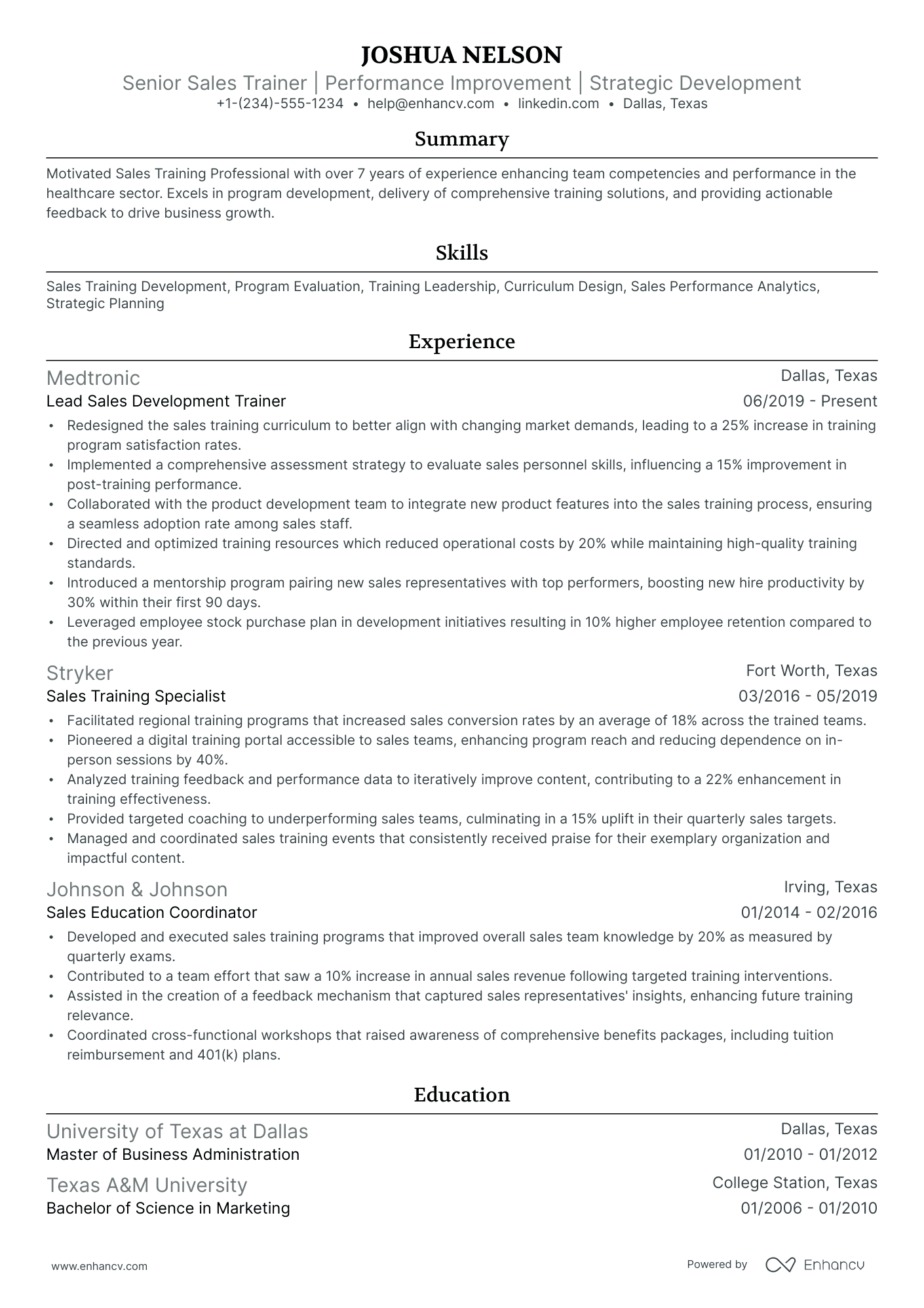
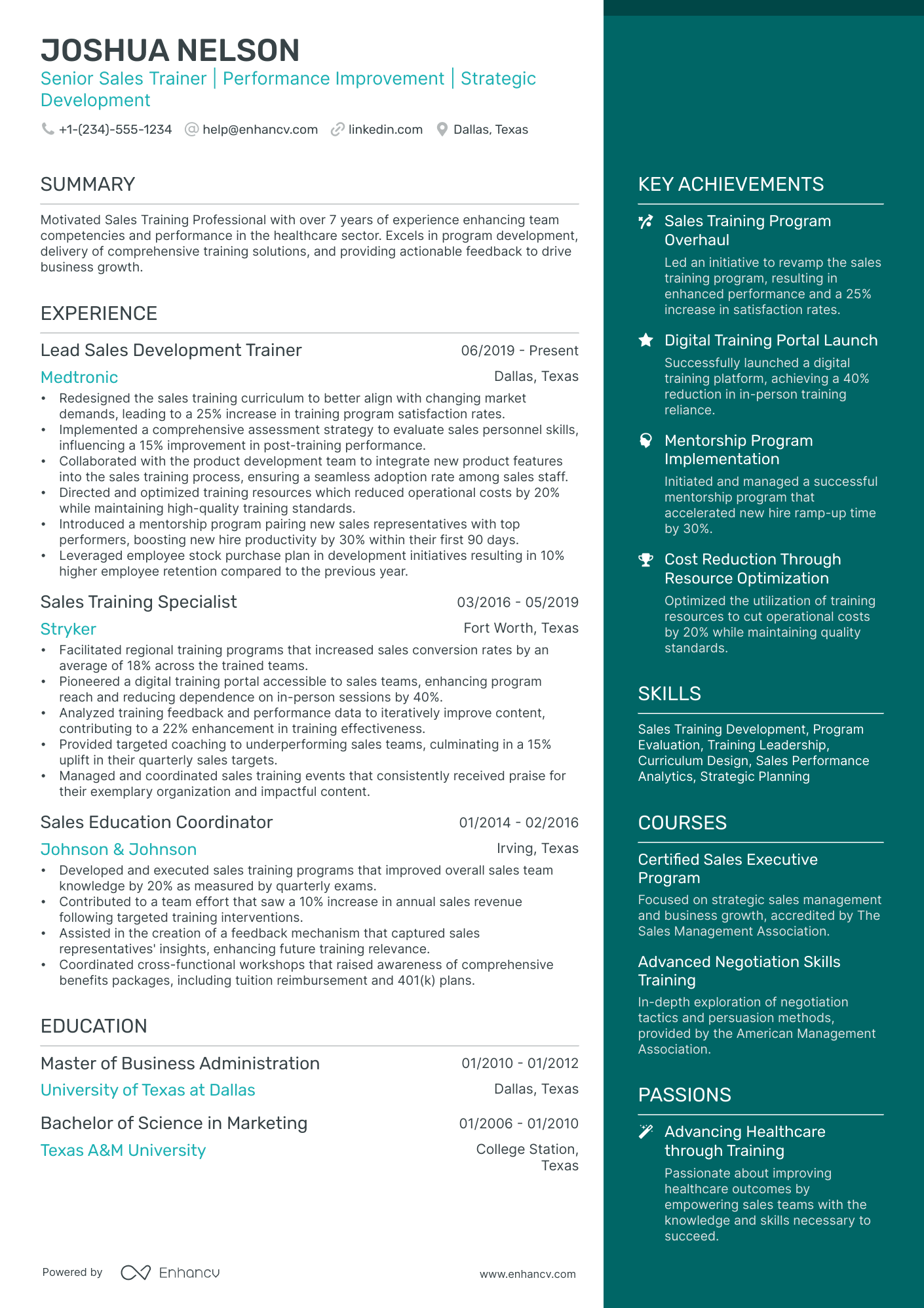
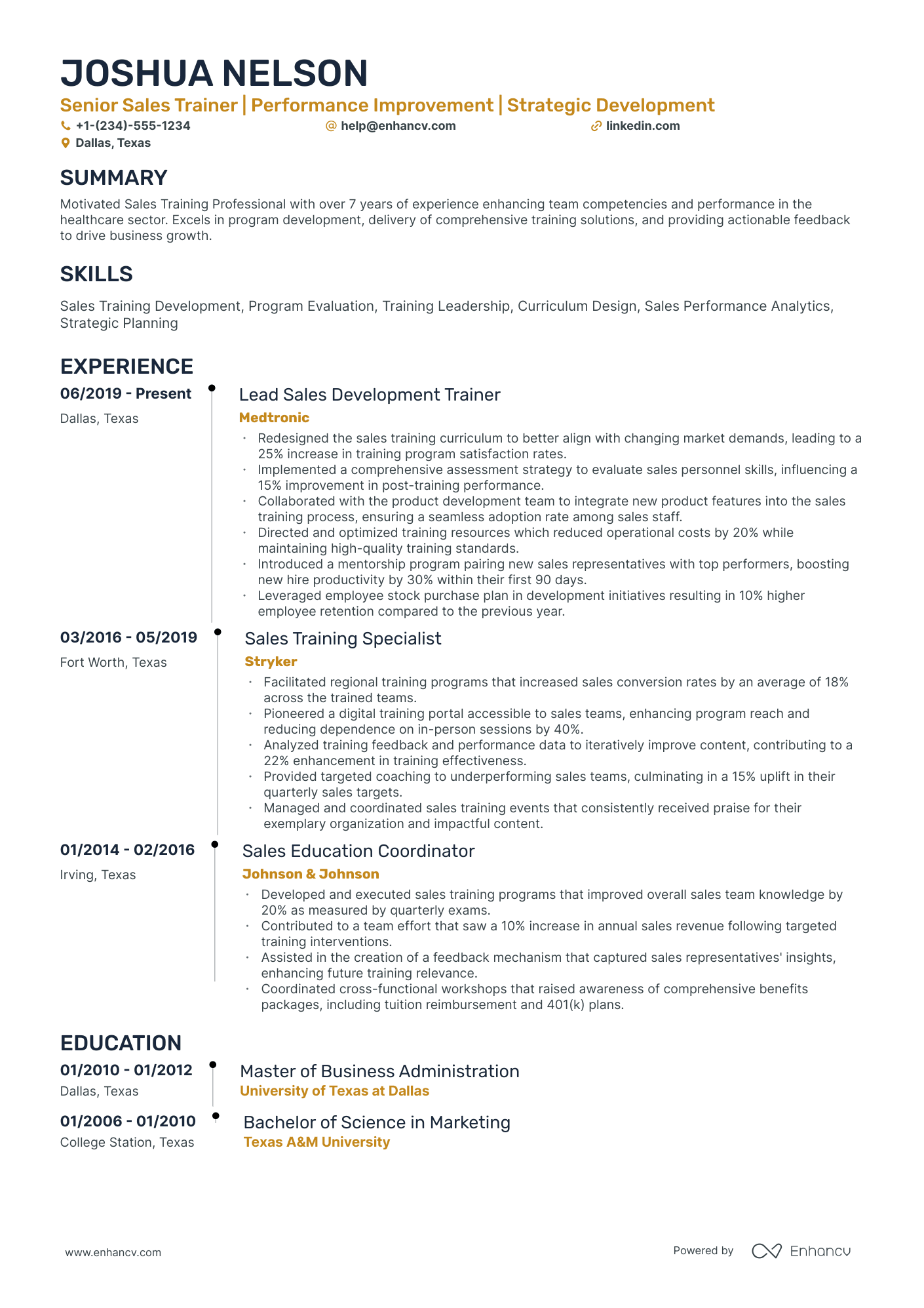
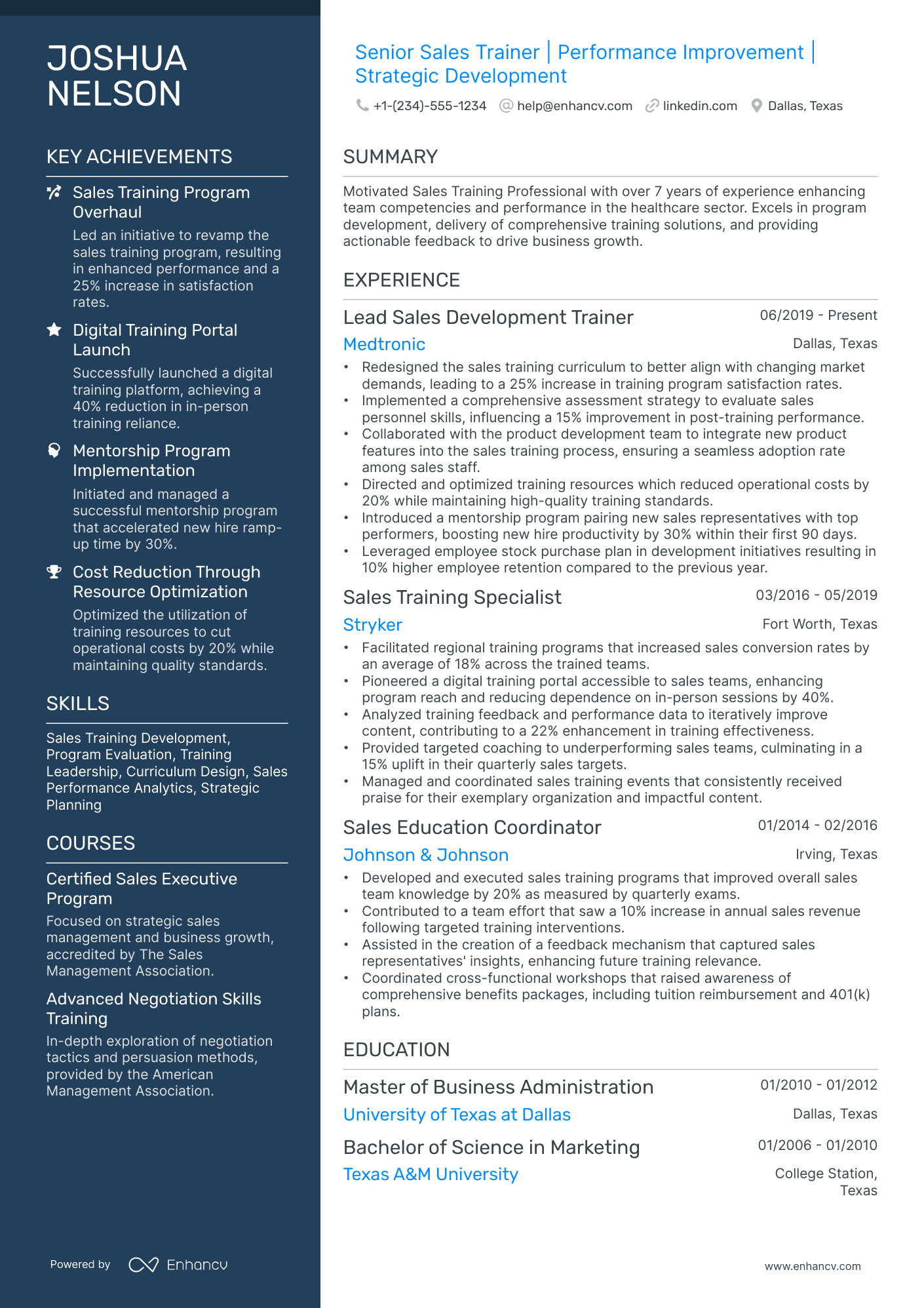
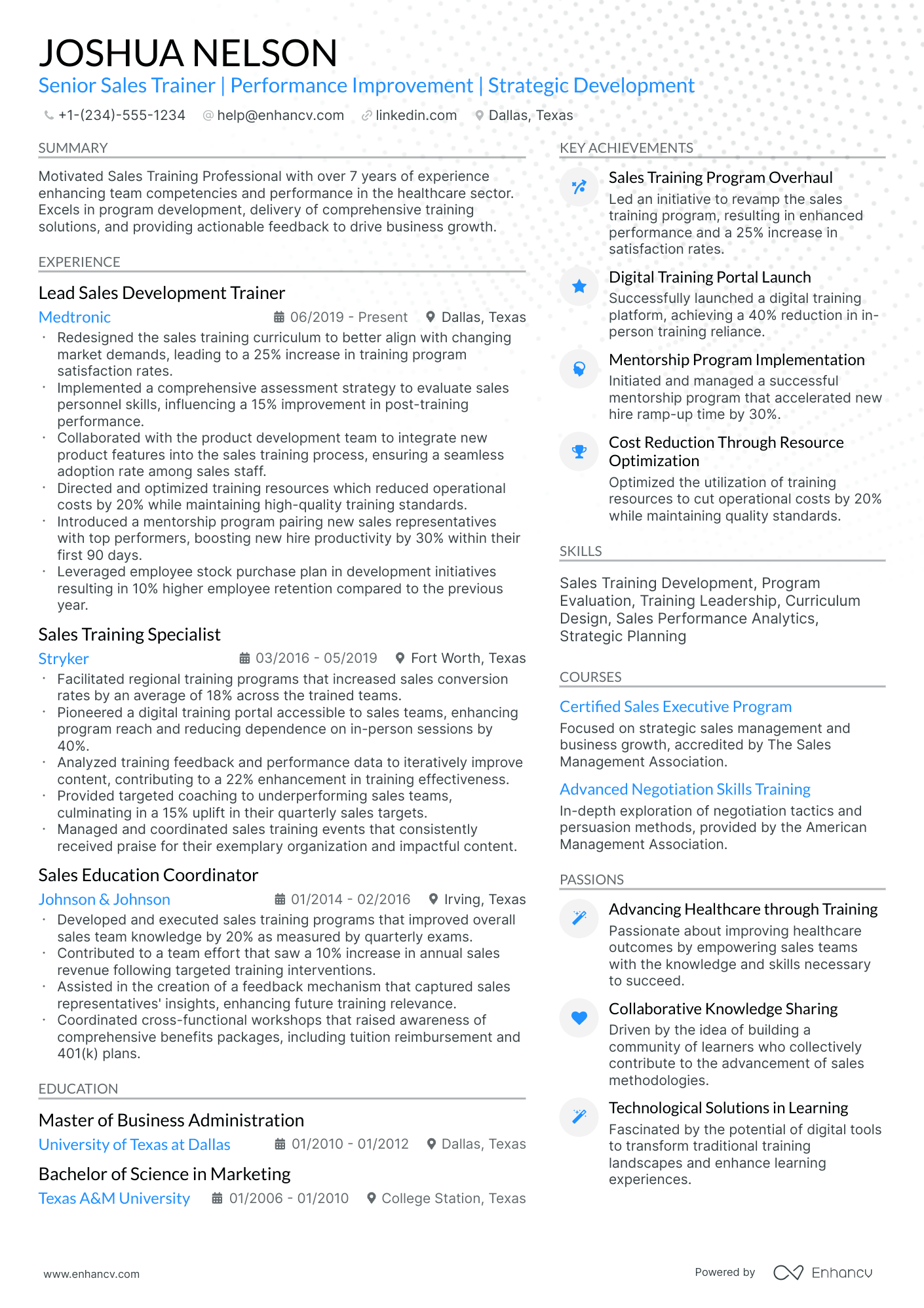
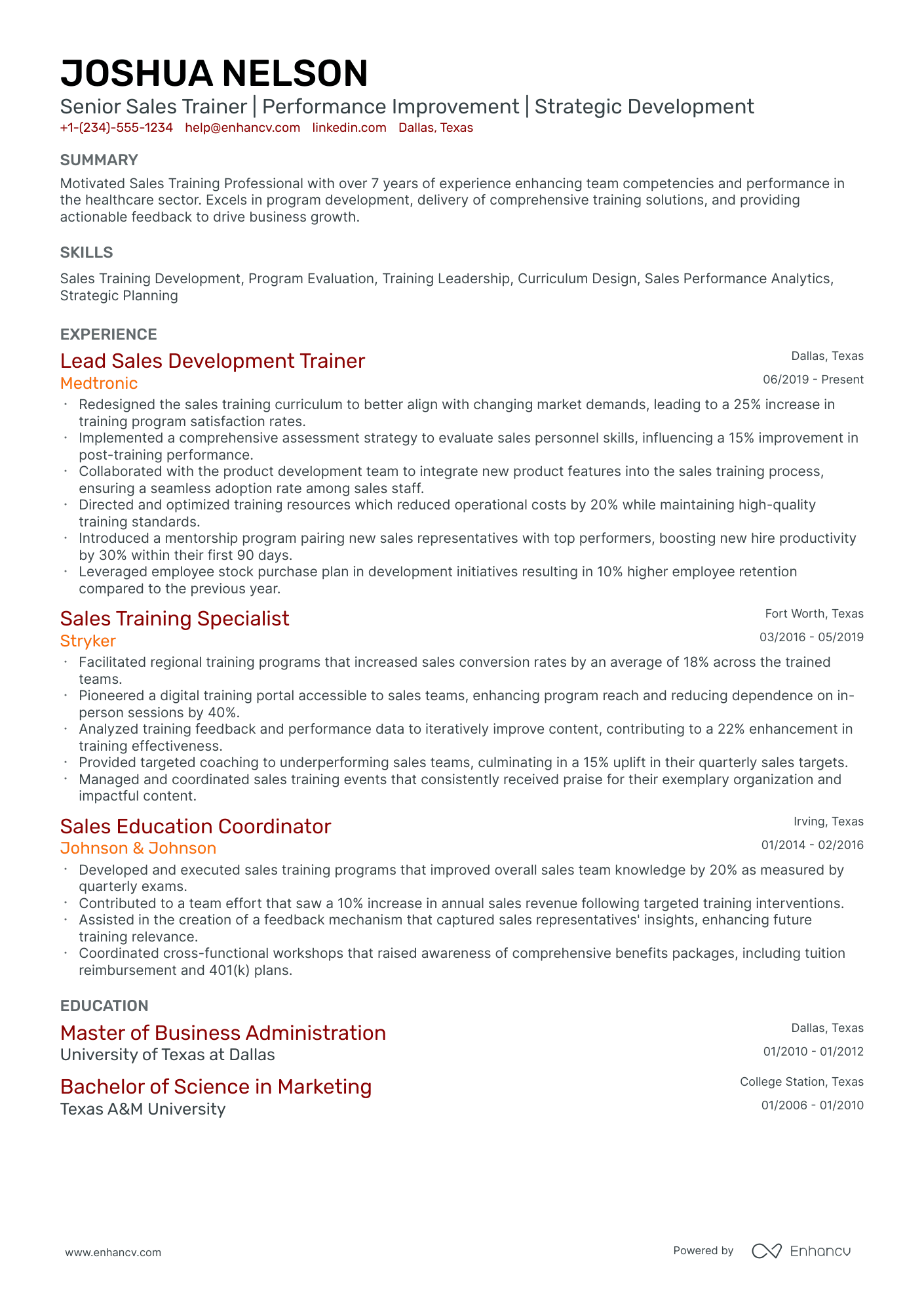
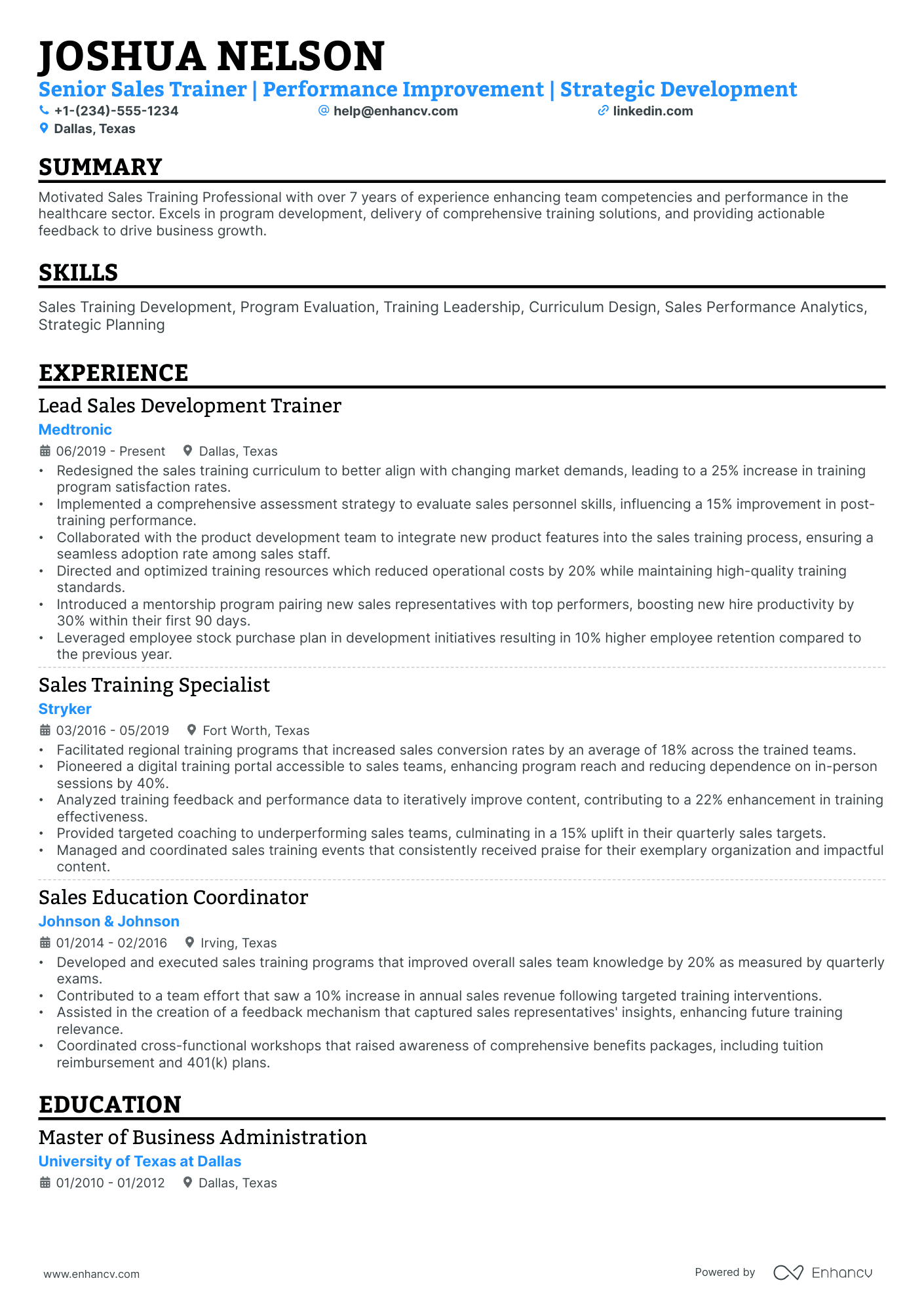
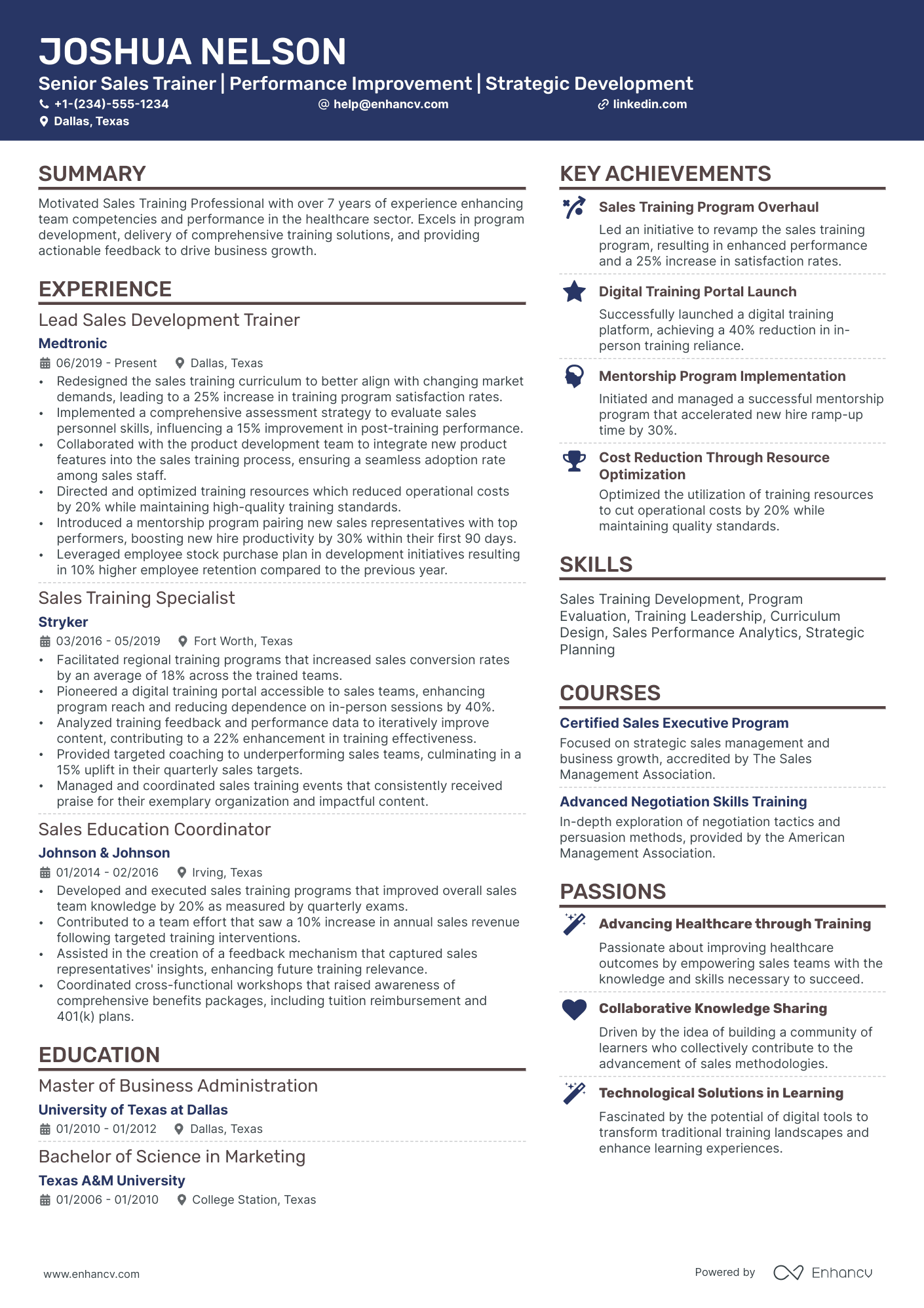
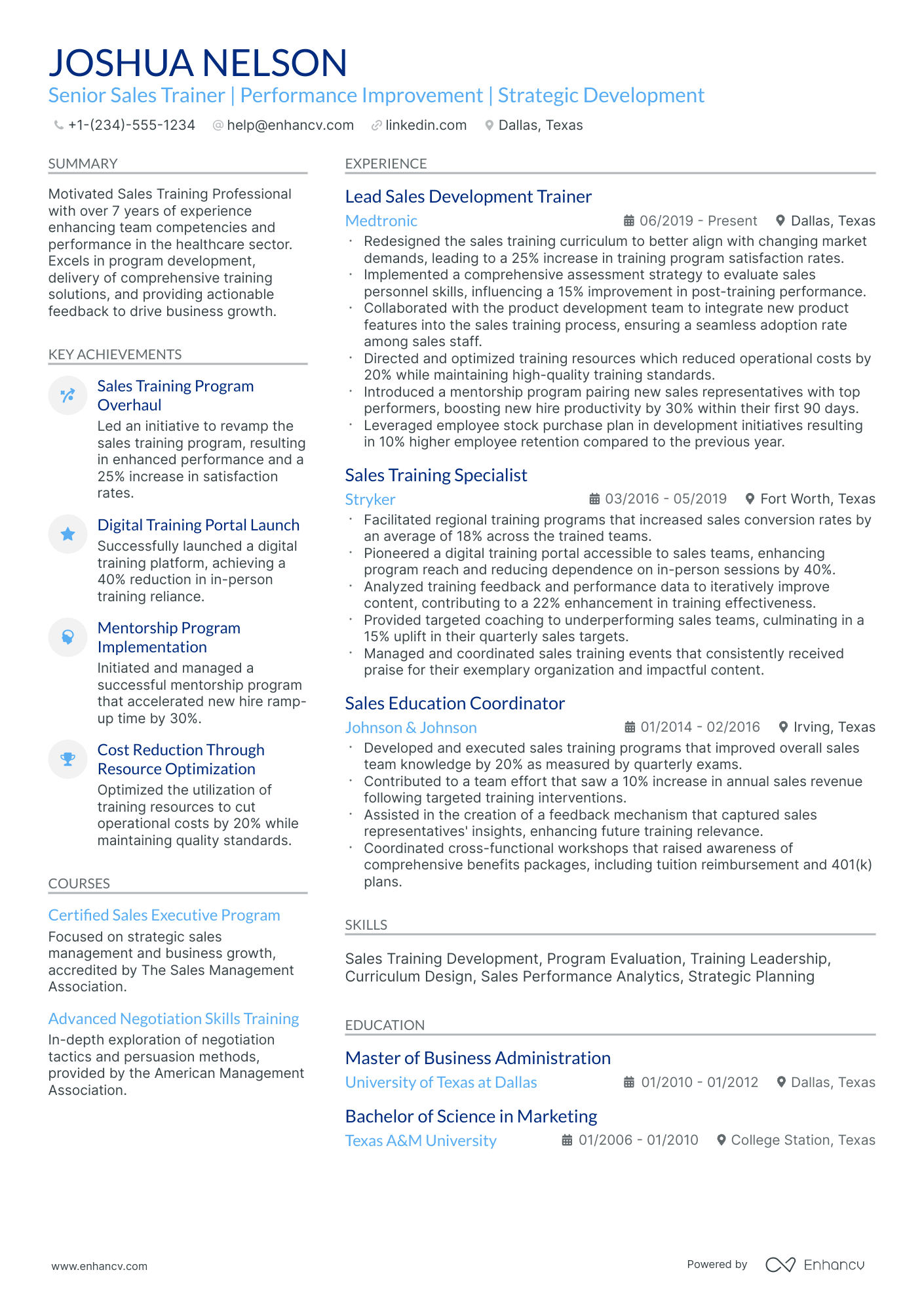
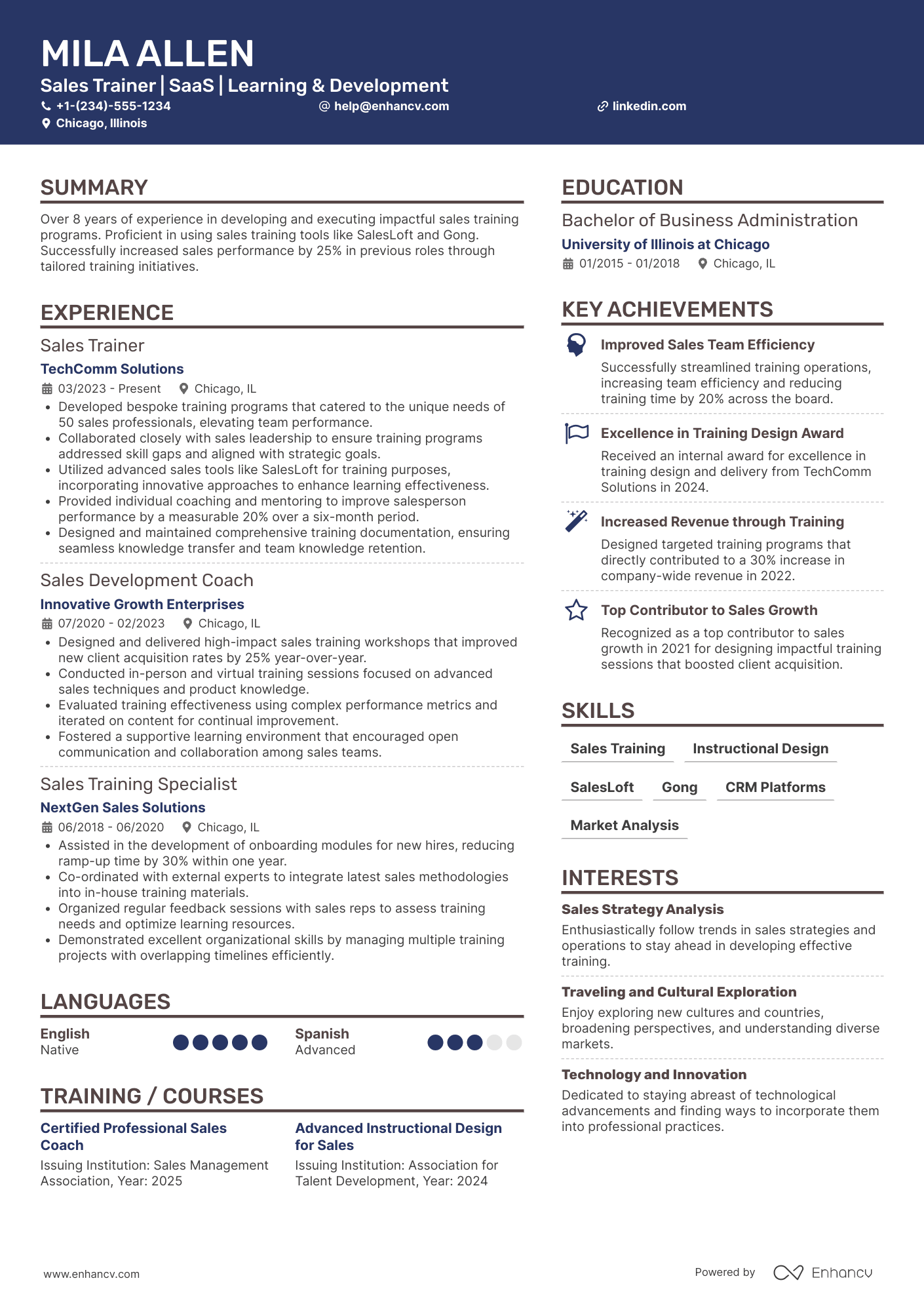
Sales trainer resume drafts often fail because they read like course catalogs, not proof of performance. That buries impact in ATS screening, fast recruiter scans, and crowded pipelines, so your value never reaches the interview.
A strong resume shows what changed because of your training. Knowing how to make your resume stand out means highlighting quota lift, ramp-time reduction, certification pass rates, adoption gains, and performance shifts across regions or teams. Include cohort size, delivery cadence, and measurable results tied to revenue, retention, or win rates.

Key takeaways
- Quantify training outcomes like ramp time, quota lift, and win rates in every experience bullet.
- Use reverse-chronological format if you're experienced; use hybrid format when switching careers.
- Tailor resume language to mirror each job posting's tools, methodologies, and KPIs.
- Place skills above experience when junior, below experience when you have strong achievements.
- Prove skills through measurable results in your summary and experience—not just a skills list.
- Use AI to sharpen clarity and structure, but stop before it inflates or invents your experience.
- Build your resume faster with Enhancv to keep formatting clean and content aligned with recruiter expectations.
Job market snapshot for sales trainers
We analyzed 51 recent sales trainer job ads across major US job boards. These numbers help you understand employment type trends, salary landscape, top companies hiring at a glance.
What level of experience employers are looking for sales trainers
| Years of Experience | Percentage found in job ads |
|---|---|
| 1–2 years | 19.6% (10) |
| 3–4 years | 11.8% (6) |
| 5–6 years | 19.6% (10) |
| 7–8 years | 3.9% (2) |
| 9–10 years | 2.0% (1) |
| 10+ years | 3.9% (2) |
| Not specified | 41.2% (21) |
Sales trainer ads by area of specialization (industry)
| Industry (Area) | Percentage found in job ads |
|---|---|
| Finance & Banking | 51.0% (26) |
| Healthcare | 41.2% (21) |
Role overview stats
These tables show the most common responsibilities and employment types for sales trainer roles. Use them to align your resume with what employers expect and to understand how the role is structured across the market.
Day-to-day activities and top responsibilities for a sales trainer
| Responsibility | Percentage found in job ads |
|---|---|
| Microsoft office | 21.6% (11) |
| Salesforce | 21.6% (11) |
| Crm | 15.7% (8) |
| Instructional design | 15.7% (8) |
| Sales training | 15.7% (8) |
| E-learning | 13.7% (7) |
| Microsoft | 11.8% (6) |
| Coaching | 9.8% (5) |
| Challenger | 7.8% (4) |
| Communication | 7.8% (4) |
| Google workspace | 7.8% (4) |
| Sales enablement | 7.8% (4) |
Type of employment (remote vs on-site vs hybrid)
| Employment type | Percentage found in job ads |
|---|---|
| On-site | 60.8% (31) |
| Hybrid | 23.5% (12) |
| Remote | 15.7% (8) |
How to format a sales trainer resume
Recruiters reviewing sales trainer resumes prioritize training program design, measurable improvements in sales team performance, and proficiency with learning management tools. A clean, well-structured resume format ensures these signals surface quickly during both human review and applicant tracking system (ATS) scans.

I have significant experience in this role—which format should I use?
Use a reverse-chronological format to showcase your progression across training programs, teams, and organizations. Do:
- Lead with your most recent role and emphasize the scope of teams trained, regions covered, and programs owned.
- Highlight proficiency with role-specific tools such as Salesforce, LMS platforms (Cornerstone, Docebo), and curriculum development frameworks.
- Quantify outcomes tied to revenue growth, ramp time reduction, quota attainment, or certification completion rates.
I'm junior or switching into this role—what format works best?
A hybrid format works best, allowing you to lead with relevant training and sales skills while supporting them with concrete experience. Do:
- Place a skills section near the top featuring competencies like instructional design, adult learning theory, CRM platforms, and sales methodology frameworks.
- Include projects, volunteer training facilitation, or mentorship roles that demonstrate your ability to transfer knowledge and improve performance.
- Connect every action to a result, even in non-traditional experience entries.
Why not use a functional resume?
A functional format strips away the timeline context that hiring managers need to evaluate how your training skills developed and were applied in real sales environments.
- Career changers from sales or L&D roles who have facilitated training but lack a formal sales trainer title.
- Candidates with resume gaps who continued developing skills through certifications (e.g., ATD, Kirkpatrick) or freelance training projects.
Once you've established a clean, professional format, the next step is deciding which sections to include so every part of your resume serves a clear purpose.
What sections should go on a sales trainer resume
Recruiters expect a sales trainer resume to show training leadership, measurable performance lift, and strong enablement execution. Understanding what to put on a resume helps you prioritize the right content for this role.
Use this structure for maximum clarity:
- Header
- Summary
- Experience
- Skills
- Projects
- Education
- Certifications
- Optional sections: Awards, Leadership, Languages
Your experience bullets should emphasize measurable sales outcomes, training scope, adoption rates, and performance improvements tied to specific programs and audiences.
Is your resume good enough?
Drop your resume here or choose a file. PDF & DOCX only. Max 2MB file size.
Once you’ve organized your resume with the right core components, the next step is to write your sales trainer resume experience in a way that supports each section with clear, relevant details.
How to write your sales trainer resume experience
The experience section is where you prove you've built, delivered, and refined training programs that moved sales performance forward. Hiring managers reviewing sales trainer resumes prioritize demonstrated impact—measurable lifts in quota attainment, ramp time, or win rates—over generic descriptions of daily responsibilities.
Each entry should include:
- Job title
- Company and location (or remote)
- Dates of employment (month and year)
Three to five concise bullet points showing what you owned, how you executed, and what outcomes you delivered:
- Ownership scope: the training programs, onboarding curricula, sales enablement content, product knowledge modules, or regional teams you were directly accountable for building and maintaining.
- Execution approach: the instructional design frameworks, learning management systems, coaching methodologies, role-play formats, or assessment tools you used to develop and deliver training that sharpened selling skills.
- Value improved: the changes you drove in rep ramp time, knowledge retention, objection-handling quality, pipeline conversion, or consistency of sales messaging across the organization.
- Collaboration context: how you partnered with sales leadership, product marketing, revenue operations, or external vendors to align training content with go-to-market strategy and frontline needs.
- Impact delivered: the business outcomes your training produced, expressed through improvements in team performance, deal velocity, quota attainment, or reduced attrition rather than a count of sessions facilitated.
Experience bullet formula
A sales trainer experience example
✅ Right example - modern, quantified, specific.
Sales Trainer
NimbusPay | Austin, TX
2021–Present
Business-to-business payments software company supporting a two-hundred-representative sales organization across North America.
- Built and delivered a twelve-week onboarding program in Lessonly (Seismic Learning) and Salesforce, cutting time-to-first-deal from sixty to forty-five days and improving ninety-day quota attainment from forty-eight percent to sixty-two percent.
- Launched a call coaching system using Gong, raising discovery-to-demo conversion by nine points and reducing average ramp coaching time by two hours per representative per week.
- Standardized MEDDICC and Challenger messaging across sales plays with product marketing and sales leadership, increasing win rate on mid-market opportunities from twenty-one percent to twenty-six percent over two quarters.
- Created role-based enablement content in Seismic, including pitch decks, battlecards, and objection-handling guides, driving a thirty-four percent lift in content adoption and a twelve percent reduction in discounting.
- Facilitated monthly certification and manager-led coaching workshops with sales managers and revenue operations, improving forecast accuracy by eight points and reducing rep turnover in the first six months by six percent.
Now that you've seen what a strong experience section looks like in practice, let's break down how to adapt yours to match the specific job you're targeting.
How to tailor your sales trainer resume experience
Recruiters evaluate your sales trainer resume through applicant tracking systems and manual review, screening for alignment with the specific role. Tailoring your resume to the job description by mirroring the posting's language and priorities increases your chances of passing both filters.
Ways to tailor your sales trainer experience:
- Match the CRM platforms and sales enablement tools listed in the posting.
- Use the exact terminology for sales methodologies the employer references.
- Mirror the revenue or performance KPIs outlined in the job description.
- Include industry experience that aligns with the company's target market.
- Highlight onboarding or ramp-up frameworks the role specifically mentions.
- Reflect coaching models or facilitation formats described in the posting.
- Emphasize compliance or certification standards relevant to their sales process.
- Align your experience with cross-functional collaboration structures they reference.
Tailoring means framing your real accomplishments in language that directly reflects what the employer is asking for, not forcing irrelevant keywords into your experience.
Resume tailoring examples for sales trainer
| Job description excerpt | Untailored | Tailored |
|---|---|---|
| "Develop and deliver onboarding training programs for new sales hires using Salesforce CRM and consultative selling methodology." | Trained new employees on sales processes and tools. | Designed a 4-week onboarding program for new sales hires, teaching consultative selling techniques and hands-on Salesforce CRM workflows, reducing ramp-up time by 30%. |
| "Conduct ongoing coaching sessions and role-play exercises to improve team performance against quarterly revenue targets." | Helped the sales team improve their skills through regular meetings. | Facilitated weekly one-on-one coaching sessions and structured role-play exercises for a 25-person sales team, contributing to a 15% increase in quarterly revenue attainment. |
| "Assess training needs through call monitoring and KPI analysis, then build customized curricula for inside sales teams." | Created training materials based on team feedback. | Analyzed call recordings and KPI dashboards to identify skill gaps across three inside sales teams, then built targeted curricula that improved average call conversion rates from 12% to 19%. |
Once you’ve aligned your experience with the role’s priorities, the next step is to quantify your sales trainer achievements so hiring managers can see the results of that fit.
How to quantify your sales trainer achievements
Quantifying your achievements proves your training changed selling behavior and business results. Focus on revenue lift, conversion gains, ramp time, coaching throughput, and quality measures like call scores and compliance error reduction.
Quantifying examples for sales trainer
| Metric | Example |
|---|---|
| Revenue impact | "Increased quarterly pipeline influenced by trained reps by $1.2M by rolling out MEDDIC coaching in Salesforce and running eight deal-review workshops." |
| Conversion rate | "Raised discovery-to-demo conversion from 28% to 35% in six weeks by rewriting talk tracks and running weekly Gong call reviews." |
| Ramp time | "Cut new-hire time-to-first-closed-won from 75 to 52 days by launching a four-week onboarding program with role plays and certification gates." |
| Training throughput | "Coached 60 account executives across three regions, delivering 24 live sessions and 180 one-on-one feedback notes per quarter in Lessonly." |
| Compliance quality | "Reduced pricing and discounting policy violations by 40% by adding a mandatory certification and quarterly refreshers tracked in the learning management system." |
Turn vague job duties into measurable, recruiter-ready resume bullets in seconds with Enhancv's Bullet Point Generator.
Once you've crafted strong bullet points that showcase your achievements, you'll want to ensure the skills section of your sales trainer resume highlights the right mix of hard and soft skills.
How to list your hard and soft skills on a sales trainer resume
Your skills section shows how you enable rep performance and revenue outcomes, and recruiters and applicant tracking systems (ATS) scan them to confirm role fit fast, so aim for a balanced mix of hard skills, sales enablement tools, and job-specific soft skills.
sales trainer roles require a blend of:
- Product strategy and discovery skills.
- Data, analytics, and experimentation skills.
- Delivery, execution, and go-to-market discipline.
- Soft skills.
Your skills section should be:
- Scannable (bullet-style grouping).
- Relevant to the job post.
- Backed by proof in experience bullets.
- Updated with current tools.
Place your skills section:
- Above experience if you're junior or switching careers.
- Below experience if you're mid/senior with strong achievements.

Hard skills
- Sales onboarding program design
- Coaching frameworks, GROW model
- Call coaching, deal coaching
- Discovery frameworks, MEDDICC, SPICED
- Objection handling frameworks
- Value selling, ROI storytelling
- Sales methodology rollout, Challenger, SPIN
- Learning management systems, Docebo, Cornerstone
- Content authoring, Articulate 360
- Conversation intelligence, Gong, Chorus
- Customer relationship management (CRM), Salesforce
- Sales metrics, ramp time, win rate
Soft skills
- Facilitate live training sessions
- Coach to observable behaviors
- Give direct, actionable feedback
- Align stakeholders on standards
- Influence without formal authority
- Diagnose skill gaps quickly
- Adapt delivery to audience
- Lead role-plays and debriefs
- Manage training priorities
- Handle resistance to change
- Communicate expectations clearly
- Partner cross-functionally with sales leaders
How to show your sales trainer skills in context
Skills shouldn't live only in a dedicated skills list. Explore resume skills examples to see how top candidates weave competencies throughout their resumes.
They should be demonstrated in:
- Your summary (high-level professional identity)
- Your experience (proof through outcomes)
Here's what that looks like in practice.
Summary example
Senior sales trainer with 12 years in B2B SaaS enablement. Built onboarding curricula using Lessonly and MEDDIC that cut new-rep ramp time by 35%. Skilled in coaching, needs analysis, and cross-functional collaboration.
- Reflects senior-level expertise immediately
- Names industry-relevant tools and frameworks
- Leads with a measurable training outcome
- Signals coaching and collaboration strengths
Experience example
Senior Sales Trainer
Vantage Learning Solutions | Remote
March 2019–January 2024
- Designed a MEDDIC-based curriculum in Lessonly, reducing average new-hire ramp time from 90 to 58 days across four cohorts.
- Partnered with product marketing and sales leadership to launch quarterly refresher workshops, lifting team quota attainment by 14%.
- Analyzed call recordings in Gong to build targeted coaching plans, improving discovery-call conversion rates by 22% within six months.
- Every bullet includes measurable proof.
- Skills surface naturally through real outcomes.
Once you’ve demonstrated your sales trainer abilities through results-driven examples, the next step is to apply that approach to a sales trainer resume when you don’t have direct experience.
How do I write a sales trainer resume with no experience
Even without full-time experience, you can demonstrate readiness through:
- Peer onboarding and shadow training
- Sales playbook or script creation
- Call coaching using recordings
- Product demo workshops for peers
- CRM training for new users
- Role-play facilitation and scoring
- Objection-handling guide development
- Sales enablement content and quizzes
If you're building a resume without work experience, focus on:
- Training materials tied to metrics
- Sales methodology and coaching approach
- CRM and enablement tool usage
- Industry-agnostic sales process knowledge
Resume format tip for entry-level sales trainer
Use a combination resume format because it highlights training projects and sales trainer tools before limited work history. Do:
- Lead with a Training Projects section.
- Add tools like Salesforce, Gong, Zoom.
- Show before-and-after performance metrics.
- Include scripts, rubrics, and playbooks.
- List certifications with completion dates.
- Built a sales playbook and role-play rubric, trained six peers in weekly sessions, and increased mock call close rates from thirty-five percent to fifty-two percent.
Even without direct experience, your educational background can strengthen your candidacy—here's how to present it effectively on your resume.
How to list your education on a sales trainer resume
Your education section helps hiring teams confirm you have the foundational knowledge needed for a sales trainer role. It signals relevant training in communication, business, or adult learning.
Include:
- Degree name
- Institution
- Location
- Graduation year
- Relevant coursework (for juniors or entry-level candidates)
- Honors & GPA (if 3.5 or higher)
Skip month and day details—list the graduation year only.
Here's a strong education entry tailored to a sales trainer resume.
Example education entry
Bachelor of Science in Business Administration
University of Georgia, Athens, GA
Graduated 2019
GPA: 3.7/4.0
- Relevant Coursework: Sales Management, Organizational Behavior, Instructional Design, Consumer Psychology
- Honors: Magna Cum Laude, Dean's List (six semesters)
How to list your certifications on a sales trainer resume
Certifications on a resume show a sales trainer's commitment to learning, proficiency with sales tools, and relevance in today's market. They also help validate your ability to coach teams on modern methods and platforms.
Include:
- Certificate name
- Issuing organization
- Year
- Optional: credential ID or URL
- Place certifications below education when your degree is recent and more relevant than your credentials.
- Place certifications above education when they are recent, role-relevant, or required for the sales trainer roles you target.
Best certifications for your sales trainer resume
- Certified Sales Leadership Professional (CSLP)
- Certified Professional Sales Person (CPSP)
- Certified Sales Executive (CSE)
- Certified Inside Sales Professional (CISP)
- Salesforce Certified Administrator
- HubSpot Sales Software Certification
- Certified Professional in Training Management (CPTM)
Once you’ve positioned your credentials where recruiters can quickly verify them, shift to your sales trainer resume summary to connect those qualifications to the value you deliver.
How to write your sales trainer resume summary
Your resume summary is the first thing a recruiter reads. A strong one instantly signals you're qualified for the sales trainer role.
Keep it to three to four lines, with:
- Your title and total years of experience in sales training or enablement.
- The industry or domain you specialize in, such as SaaS, retail, or financial services.
- Core skills like curriculum development, CRM platforms, LMS tools, or needs assessments.
- One or two measurable achievements, such as improved ramp time or quota attainment rates.
- Soft skills tied to real outcomes, like coaching ability that lifted team close rates.

PRO TIP
At this level, focus on specific skills, tools you've used, and early wins that prove your impact. Highlight training metrics and learner outcomes rather than listing generic qualities. Avoid phrases like "passionate self-starter" or "motivated team player." Instead, show what you delivered and how you measured it.
Example summary for a sales trainer
Sales trainer with three years of experience in SaaS onboarding and enablement. Built a new hire curriculum using Lessonly that cut ramp time by 22%. Skilled in role-play facilitation and CRM-based coaching.
Optimize your resume summary and objective for ATS
Drop your resume here or choose a file.
PDF & DOCX only. Max 2MB file size.
Now that your summary effectively communicates your value, make sure your header—the first thing recruiters see—presents your contact details clearly and professionally.
What to include in a sales trainer resume header
A resume header is the top block with your key details, and it boosts visibility, credibility, and fast recruiter screening for a sales trainer.
Essential resume header elements
- Full name
- Tailored job title and headline
- Location
- Phone number
- Professional email
- GitHub link
- Portfolio link
Including a LinkedIn link helps recruiters verify experience quickly and supports screening.
Do not include photos on a sales trainer resume unless the role is explicitly front-facing or appearance-dependent.
Keep the header to two lines, match your sales trainer title to the job post, and use consistent formatting across every detail.
Sales trainer resume header
Jordan Lee
Sales Trainer | Enablement Programs, Coaching, and Performance Metrics
Austin, TX | (512) 555-01XX | your.name@enhancv.com | github.com/yourname | yourwebsite.com | linkedin.com/in/yourname
Once your contact details and role-focused branding are in place at the top, add relevant optional sections to round out your sales trainer resume with supporting details.
Additional sections for sales trainer resumes
When your core sections don't fully capture your expertise, additional sections help you stand out and reinforce your credibility as a sales trainer. For example, listing language skills on your resume can be especially valuable if you train sales teams across multiple regions.
- Languages
- Certifications and licenses
- Industry conferences and speaking engagements
- Publications and thought leadership
- Professional affiliations and memberships
- Volunteer training and mentorship experience
Once you've rounded out your resume with these supplementary sections, pair it with a strong cover letter to give hiring managers even more reason to reach out.
Do sales trainer resumes need a cover letter
A cover letter isn't required for a sales trainer resume, but it helps in competitive roles or when hiring managers expect one. If you're unsure where to start, understanding what a cover letter is and how it complements your resume can make a difference when your fit, impact, or context isn't obvious from your resume alone.
Use a cover letter to add context your resume can't:
- Explain role and team fit: Tie your coaching style to the sales motion, manager expectations, and how the team measures ramp time and performance.
- Highlight one or two outcomes: Share a training program, enablement rollout, or coaching cadence, plus results like faster ramp, higher conversion, or improved quota attainment.
- Show product and user understanding: Reference the product, target users, and typical objections, and explain how you train reps to sell value in that context.
- Address transitions or non-obvious experience: Connect adjacent work to sales trainer responsibilities, and clarify why the move strengthens your ability to enable reps.
Drop your resume here or choose a file.
PDF & DOCX only. Max 2MB file size.
Once you’ve decided whether to include a cover letter, you can use AI to improve your sales trainer resume by sharpening the same role-specific details recruiters evaluate.
Using AI to improve your sales trainer resume
AI can sharpen your resume's clarity, structure, and overall impact. It helps you reframe experience and highlight results. But overuse kills authenticity. Once your content feels clear and role-aligned, step away from AI. If you're exploring tools, learn which AI is best for writing resumes before committing to one.
Here are 10 practical prompts to strengthen specific sections of your sales trainer resume:
- Strengthen your summary. "Rewrite my sales trainer resume summary to highlight training program leadership and measurable revenue impact in under four sentences."
- Quantify experience bullets. "Add specific metrics to these sales trainer experience bullets, focusing on team performance improvements and quota attainment rates."
- Sharpen skills relevance. "Review my skills section and remove entries not directly relevant to a sales trainer role. Suggest replacements tied to training delivery."
- Improve action verbs. "Replace weak or repetitive verbs in my sales trainer experience section with strong, varied action verbs that show leadership and coaching."
- Tailor to job postings. "Compare my sales trainer resume bullets against this job description. Identify gaps and suggest edits to improve alignment."
- Refine certifications. "Reorganize my certifications section to prioritize credentials most relevant to a sales trainer position in B2B environments."
- Clarify training projects. "Rewrite my projects section to clearly describe each sales trainer initiative, its scope, the audience trained, and the business outcome."
- Tighten education details. "Edit my education section to emphasize coursework, honors, or capstone projects directly applicable to a sales trainer career path."
- Eliminate filler language. "Identify and remove vague phrases like 'responsible for' or 'helped with' from my sales trainer resume. Suggest direct alternatives."
- Focus on coaching outcomes. "Rewrite these sales trainer bullets to emphasize coaching methodologies used, learner progress tracked, and performance outcomes achieved."
Stop using AI once your resume sounds accurate, specific, and aligned with real experience. AI should never invent experience or inflate claims—if it didn't happen, it doesn't belong here.
Conclusion
A strong sales trainer resume proves impact with measurable outcomes, highlights role-specific skills, and stays easy to scan. Use clear headings, focused bullets, and consistent formatting to show how you improved ramp time, win rates, and coaching adoption.
Hiring teams want sales trainers who can drive results across in-person, remote, and hybrid teams. A structured resume with quantified achievements and relevant skills shows you’re ready for today’s hiring market and the next one.