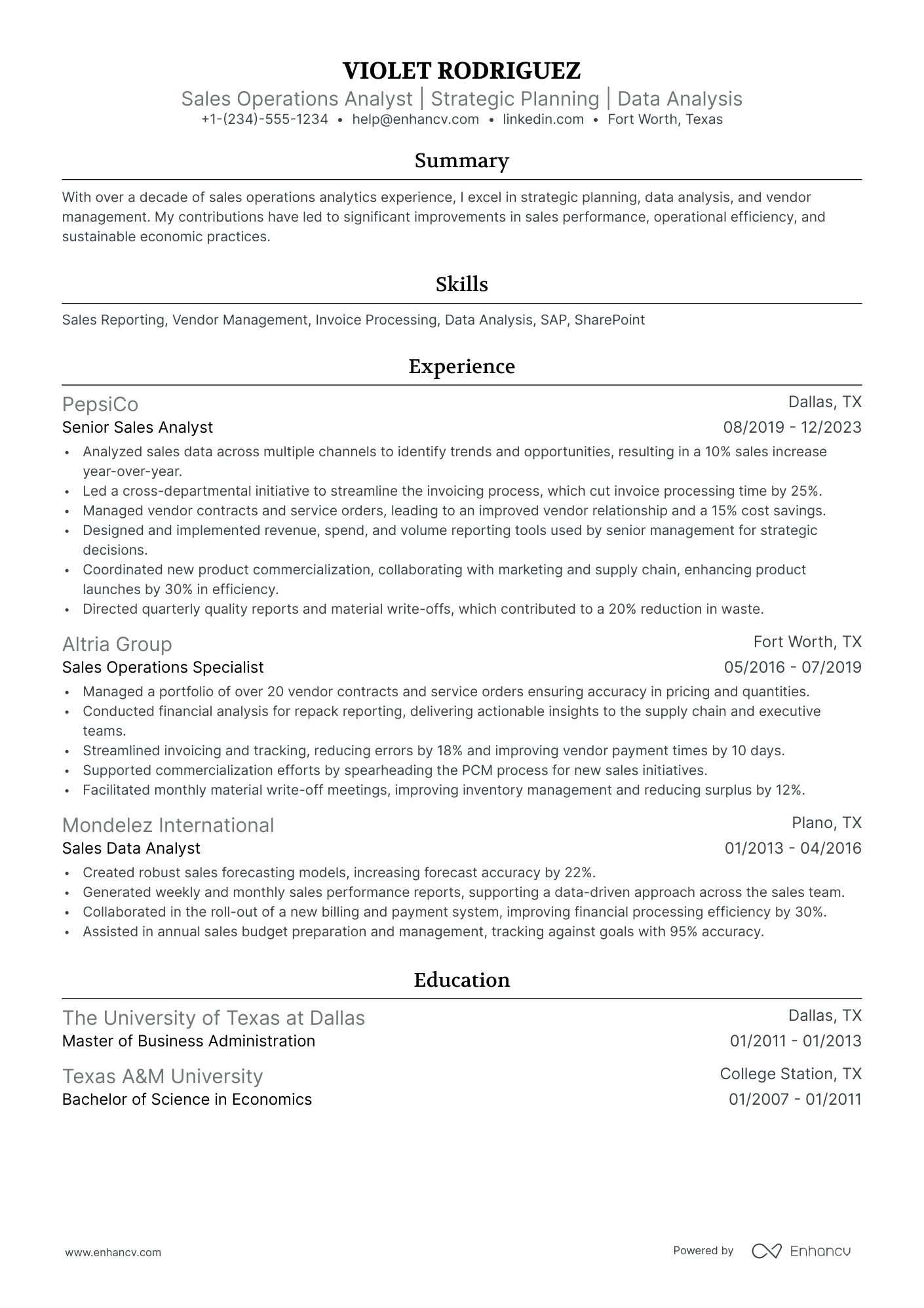
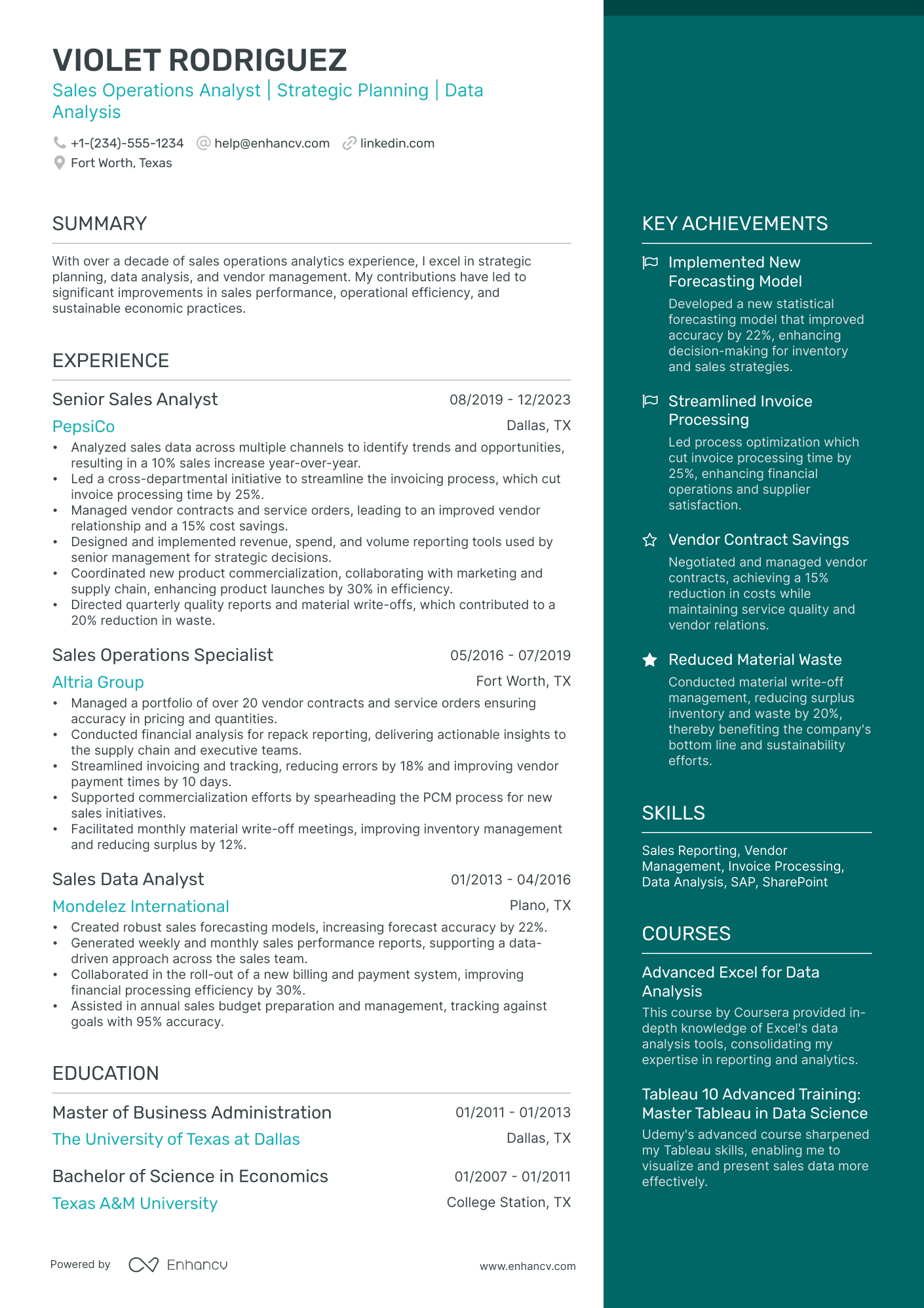
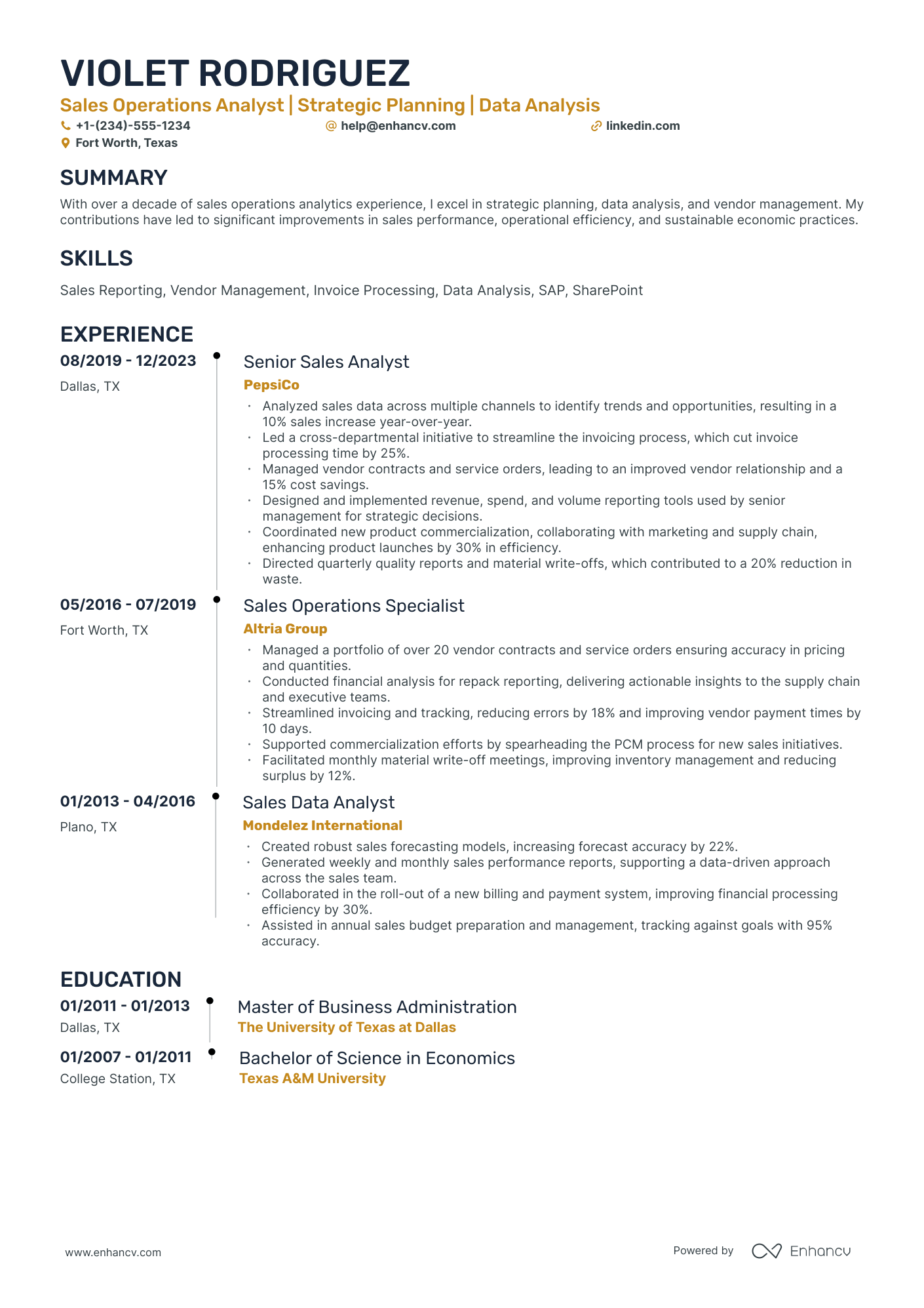
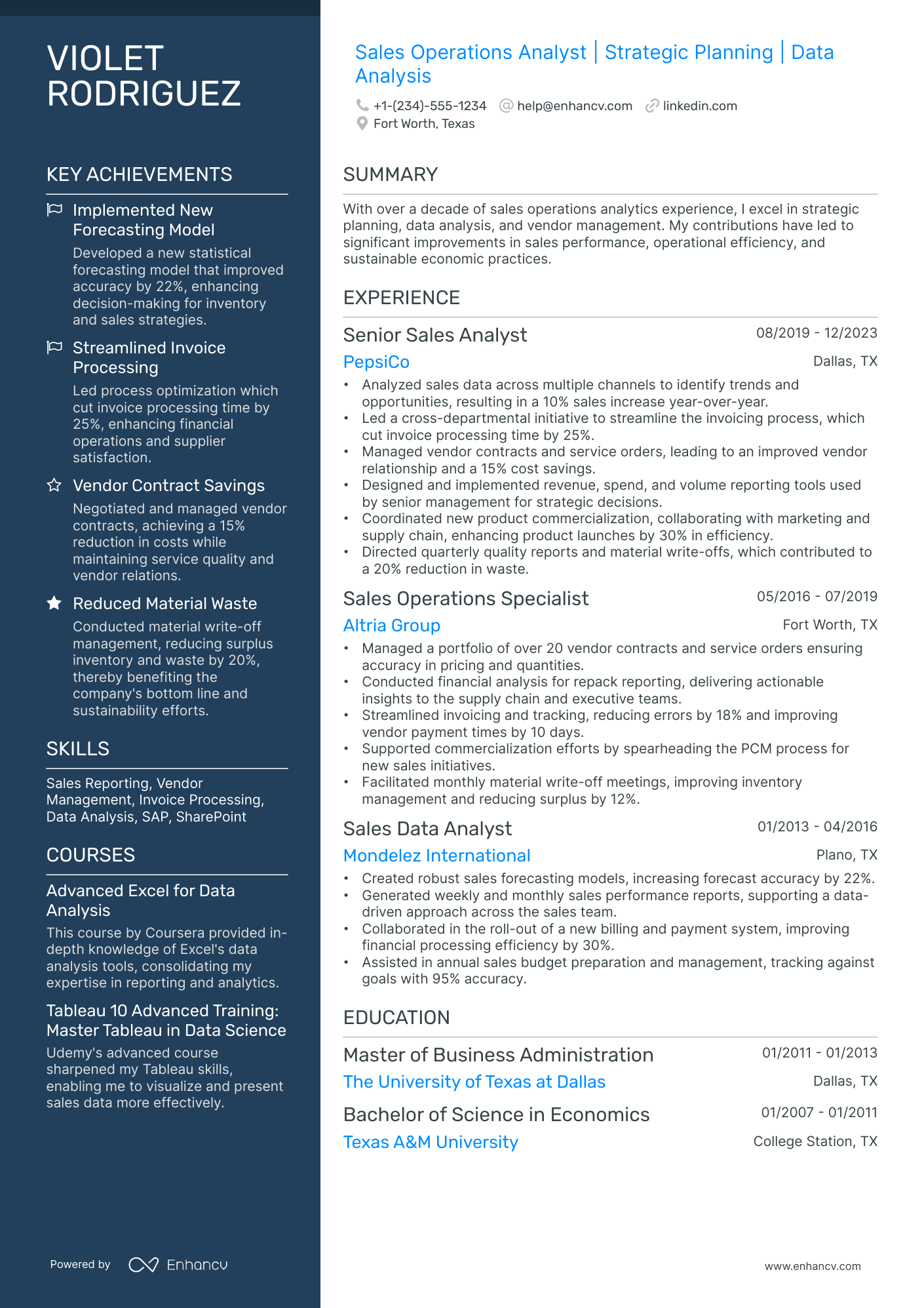
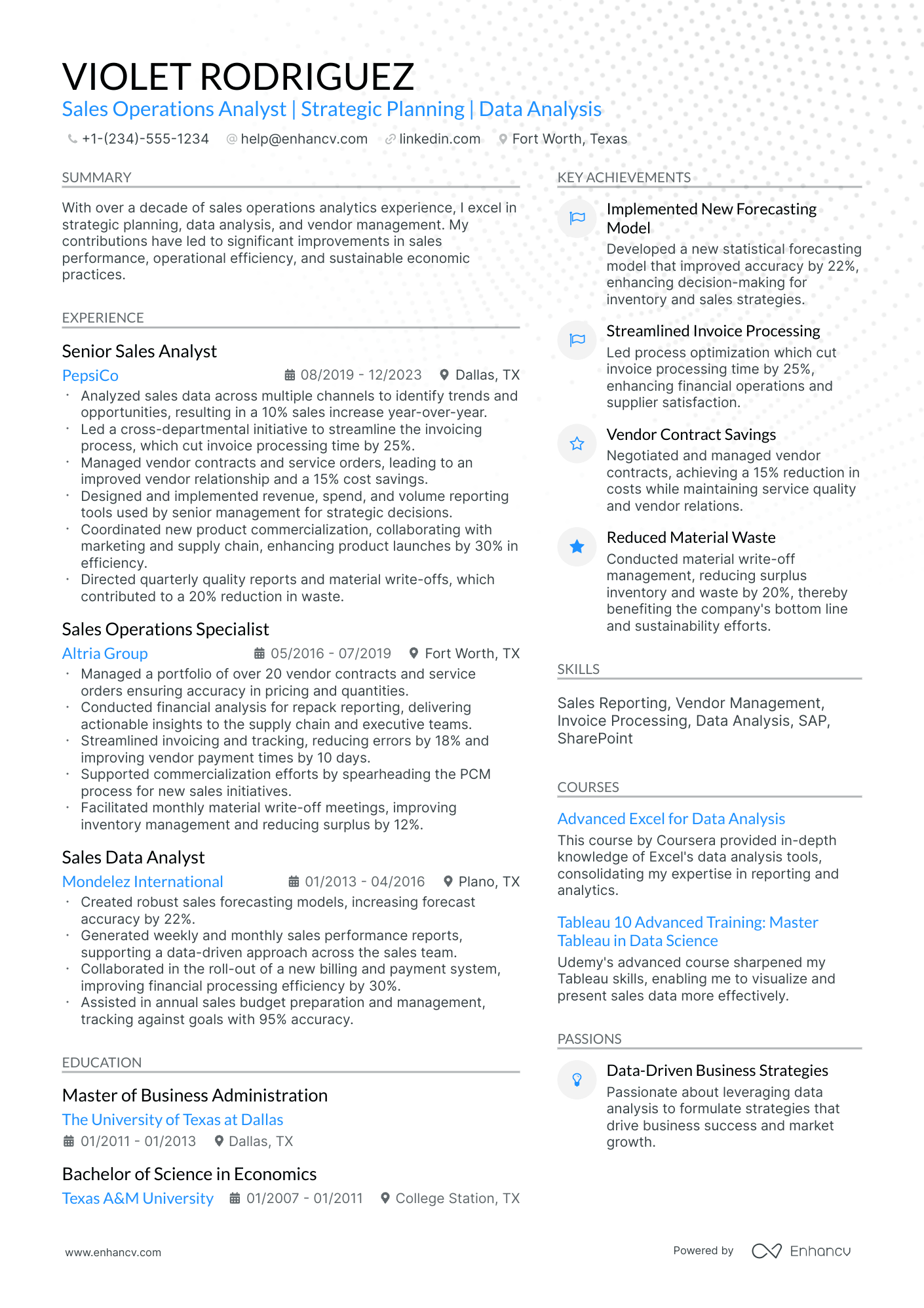
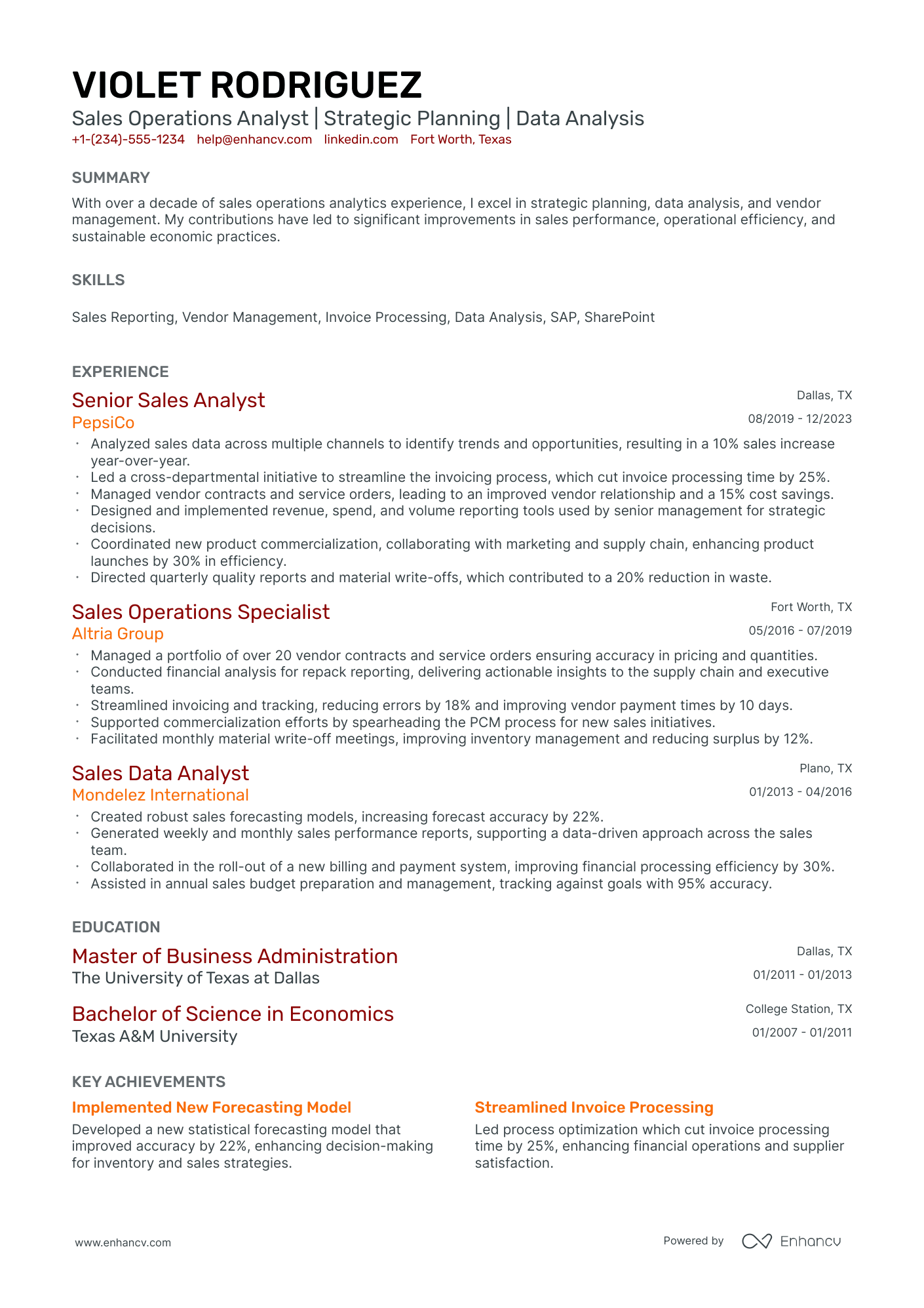
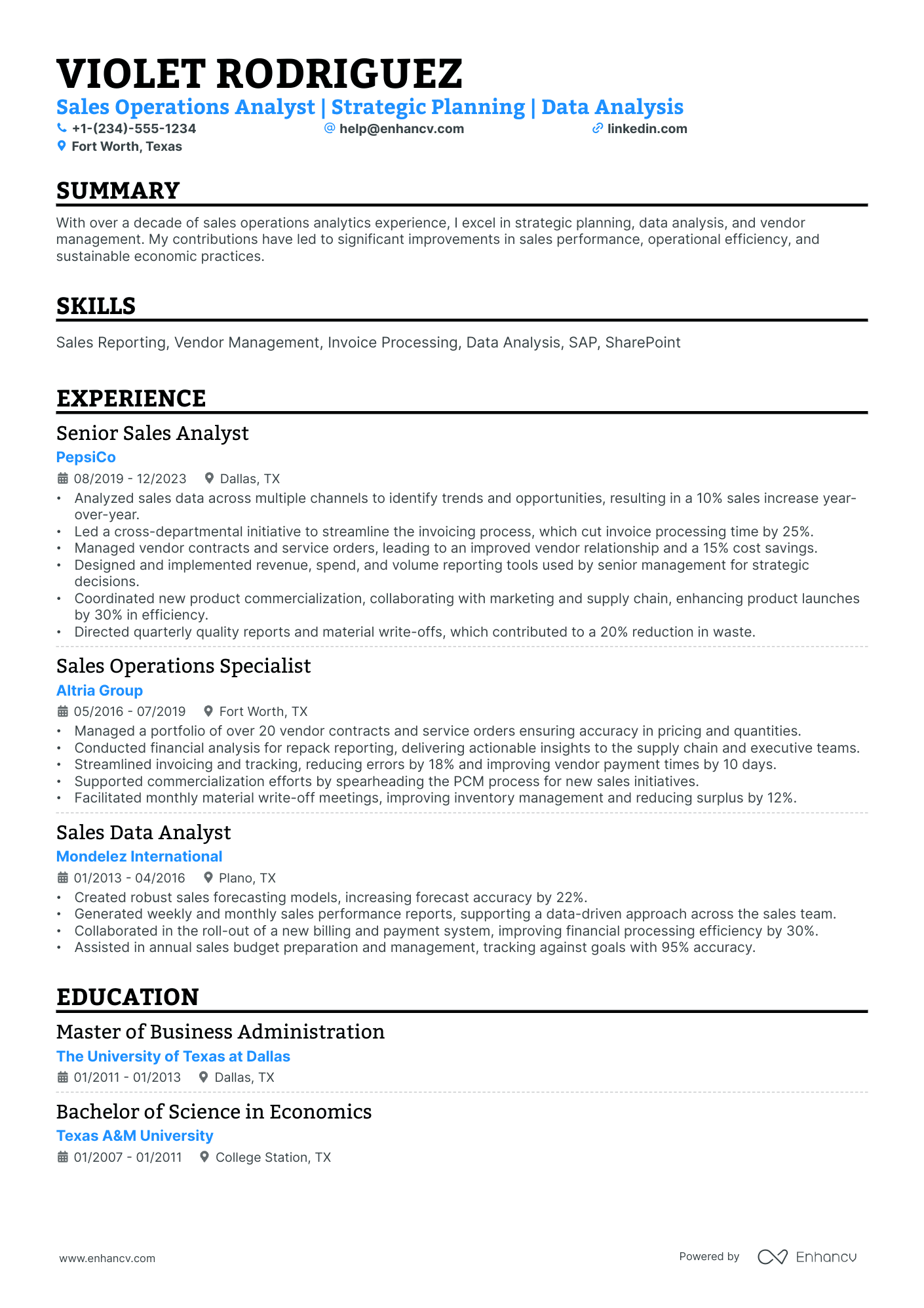
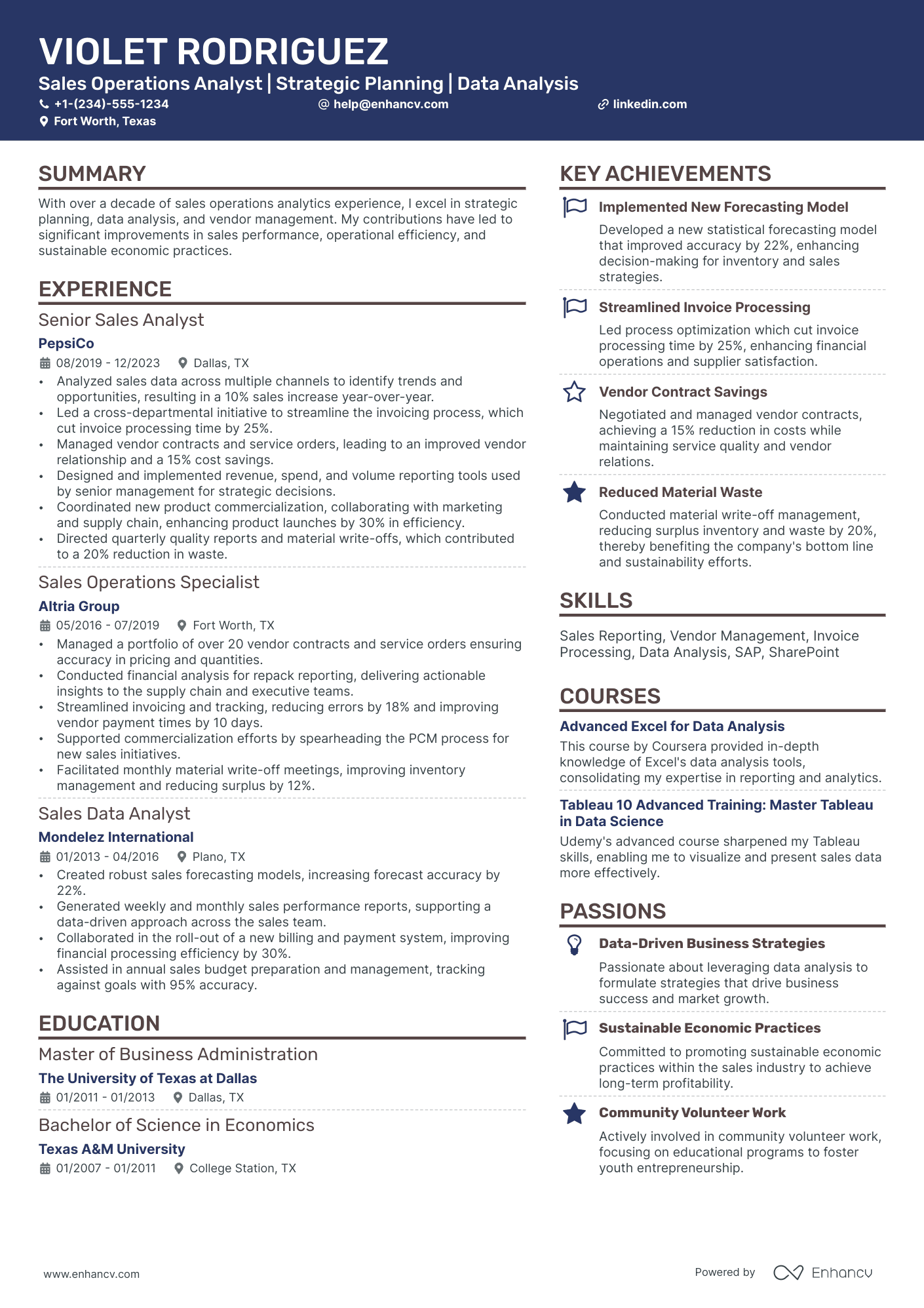
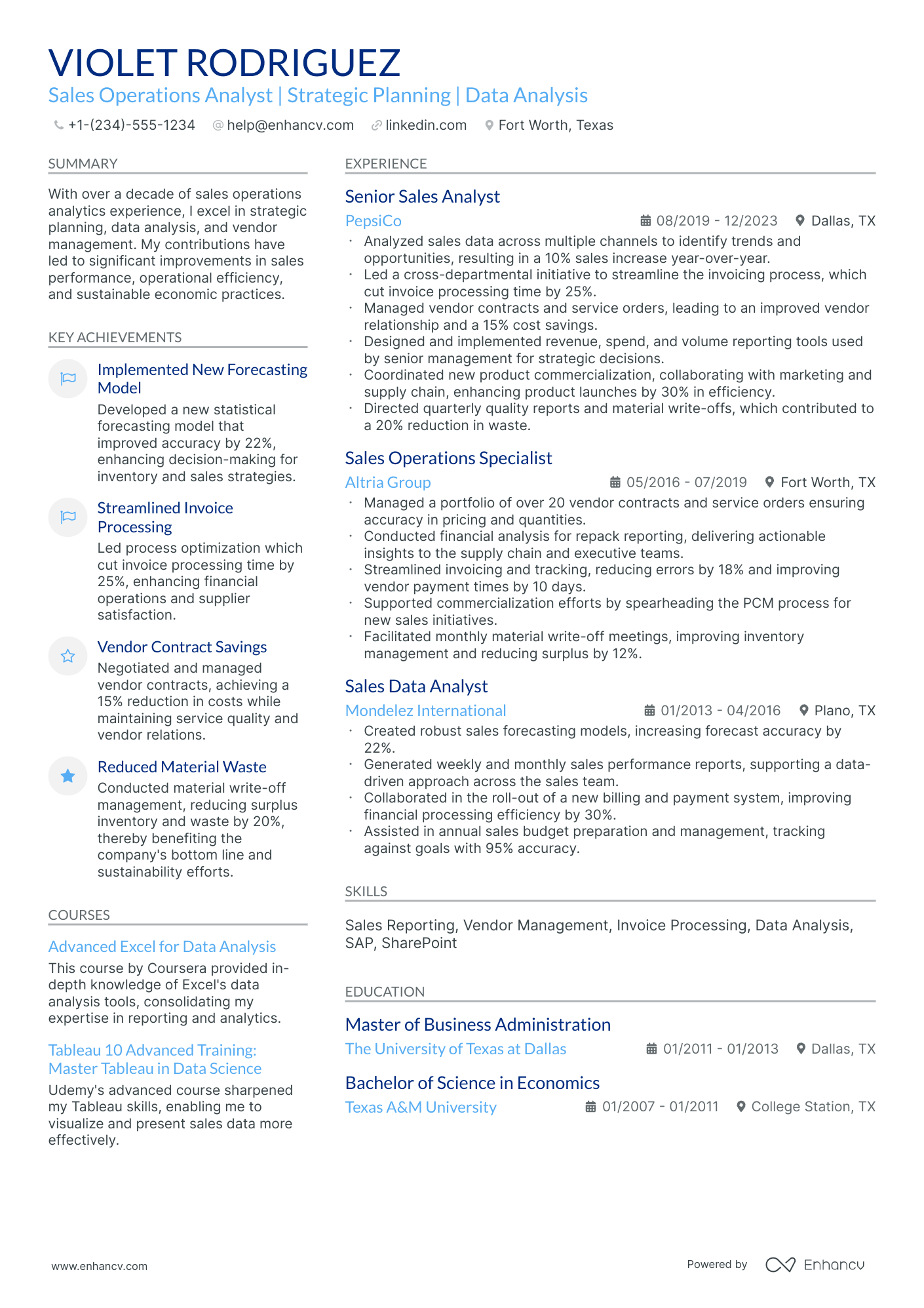
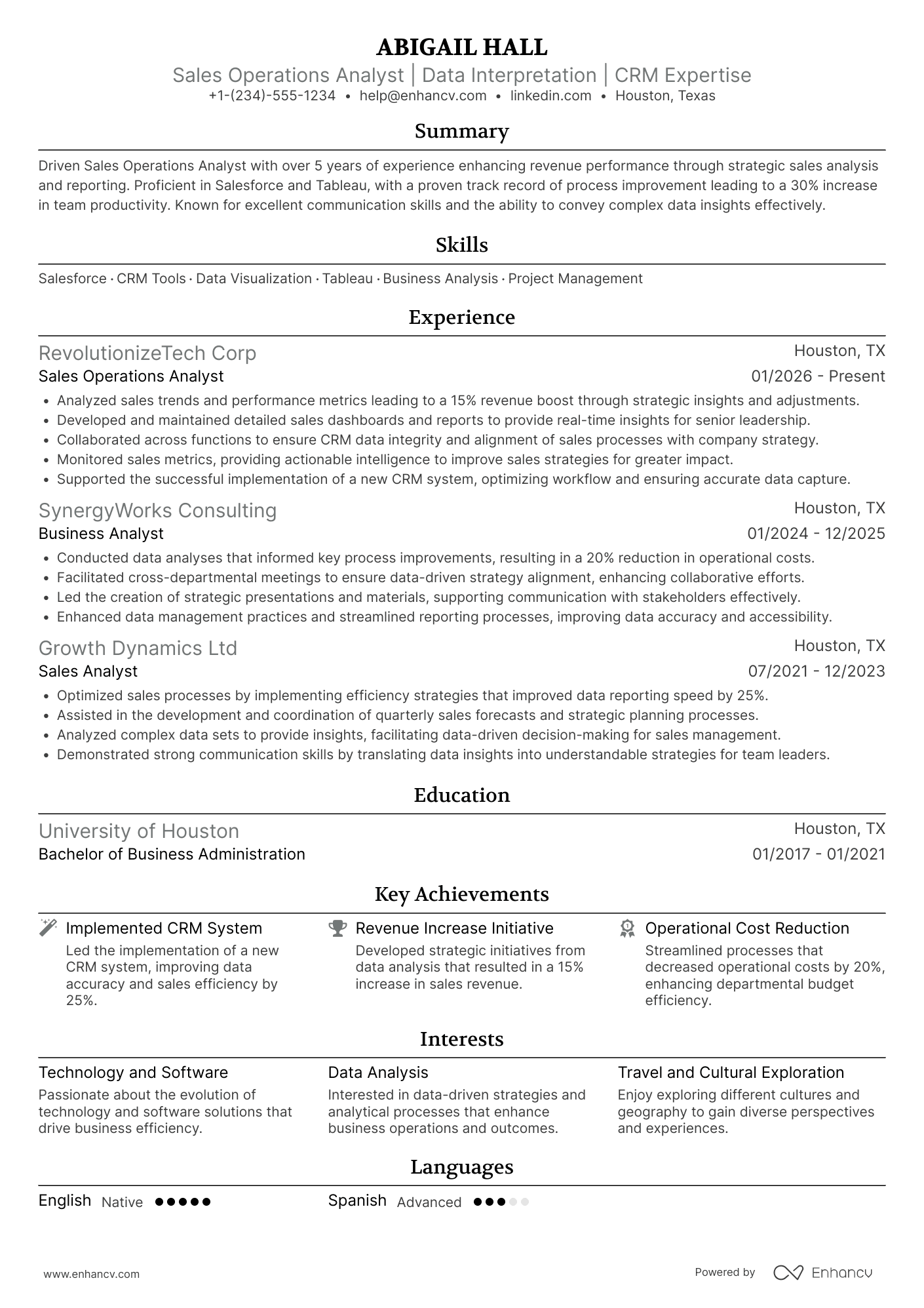
Most sales operations analyst resume submissions fail because they list tools and tasks but don't show measurable impact on pipeline, forecasting, or process efficiency. That gap gets you filtered by ATS rules and skipped in rapid recruiter scans.
A strong resume shows what changed because of your work. If you're unsure where to begin, learning how to write a resume that highlights impact is a critical first step. You should highlight revenue lift from territory realignment, forecast accuracy gains, faster quote-to-cash cycles, cleaner customer relationship management data, and dashboards that improved rep adoption. Quantify scope, timelines, and business outcomes.

Key takeaways
- Quantify every resume bullet with metrics like revenue lift, forecast accuracy, or cycle time saved.
- Use reverse-chronological format if experienced; use a hybrid format when switching careers.
- Mirror the exact CRM platforms, tools, and KPIs named in each job posting.
- Place skills above experience for junior candidates and below it for senior professionals.
- Prove soft skills through measurable outcomes in your experience section, not standalone claims.
- Add certifications like Salesforce Administrator or Tableau Desktop Specialist to validate tool proficiency.
- Use Enhancv to turn vague duties into sharp, results-driven bullets that pass ATS screening.
Job market snapshot for sales operations analysts
We analyzed 108 recent sales operations analyst job ads across major US job boards. These numbers help you understand experience requirements, employment type trends, salary landscape at a glance.
What level of experience employers are looking for sales operations analysts
| Years of Experience | Percentage found in job ads |
|---|---|
| 1–2 years | 7.4% (8) |
| 3–4 years | 13.0% (14) |
| 5–6 years | 35.2% (38) |
| 7–8 years | 6.5% (7) |
| 9–10 years | 0.9% (1) |
| 10+ years | 0.9% (1) |
| Not specified | 37.0% (40) |
Sales operations analyst ads by area of specialization (industry)
| Industry (Area) | Percentage found in job ads |
|---|---|
| Finance & Banking | 77.8% (84) |
| Healthcare | 9.3% (10) |
Top companies hiring sales operations analysts
| Company | Percentage found in job ads |
|---|---|
| Wolters Kluwer | 16.7% (18) |
| Medtronic Inc. | 9.3% (10) |
Role overview stats
These tables show the most common responsibilities and employment types for sales operations analyst roles. Use them to align your resume with what employers expect and to understand how the role is structured across the market.
Day-to-day activities and top responsibilities for a sales operations analyst
| Responsibility | Percentage found in job ads |
|---|---|
| Salesforce | 50.0% (54) |
| Excel | 43.5% (47) |
| Tableau | 31.5% (34) |
| Power bi | 28.7% (31) |
| Crm | 26.9% (29) |
| Microsoft office | 20.4% (22) |
| Sharepoint | 15.7% (17) |
| Data analysis | 14.8% (16) |
| Ms project | 14.8% (16) |
| Project management | 13.0% (14) |
| Reporting | 13.0% (14) |
| Sales operations | 11.1% (12) |
Type of employment (remote vs on-site vs hybrid)
| Employment type | Percentage found in job ads |
|---|---|
| On-site | 40.7% (44) |
| Hybrid | 35.2% (38) |
| Remote | 24.1% (26) |
How to format a sales operations analyst resume
Recruiters evaluating sales operations analyst resumes prioritize analytical skills, CRM and reporting tool proficiency, and evidence of process improvements that directly affect revenue operations. Choosing the right resume format ensures these signals surface quickly during both ATS parsing and the initial human scan.

I have significant experience in this role—which format should I use?
Use a reverse-chronological format to lead with your most recent and relevant sales operations achievements. Do:
- Highlight the scope and ownership of your contributions—territory planning, pipeline management, quota setting, or cross-functional process design.
- Feature role-specific tools and domains prominently, including Salesforce, Tableau, SQL, Excel modeling, and sales forecasting methodologies.
- Quantify outcomes tied to business impact, such as revenue lift, forecast accuracy improvement, or sales cycle reduction.
I'm junior or switching into this role—what format works best?
A hybrid format works best, letting you lead with core analytical and operations skills while supporting them with relevant experience or projects. Do:
- Place a skills section near the top that highlights CRM platforms, data analysis tools, and sales process knowledge so recruiters see qualifications immediately.
- Include projects, internships, or transitional experience that demonstrate your ability to work with sales data, build reports, or optimize workflows—even from adjacent roles.
- Connect every action to a clear result so hiring managers see your potential impact, not just task completion.
Why not use a functional resume?
A functional format strips away the timeline and context that hiring managers need to evaluate how your analytical and operational skills were applied in real sales environments, making it harder to assess your readiness for the role.
- A functional format may be acceptable if you're transitioning from a data analyst, business analyst, or finance role into sales operations and have limited direct experience—but only if every listed skill is tied to a specific project, tool, or measurable outcome rather than presented in isolation.
Now that you've established a clean, readable layout, it's time to fill it with the right sections that highlight your qualifications.
What sections should go on a sales operations analyst resume
Recruiters expect a sales operations analyst resume to clearly show how you improve sales performance through data, process, and systems. Understanding which resume sections to include ensures you cover every area hiring managers evaluate.
Use this structure for maximum clarity:
- Header
- Summary
- Experience
- Skills
- Projects
- Education
- Certifications
- Optional sections: Awards, Leadership, Languages
Your experience bullets should highlight measurable impact, business outcomes, scope, and results across reporting, forecasting, territory and quota support, and sales tools.
Is your resume good enough?
Drop your resume here or choose a file. PDF & DOCX only. Max 2MB file size.
Once you’ve organized the key resume components in a clear structure, the next step is to write your sales operations analyst resume experience section so your responsibilities and results align with that format.
How to write your sales operations analyst resume experience
The experience section is where you prove you've delivered measurable results—not just performed tasks. Hiring managers reviewing sales operations analyst resumes prioritize demonstrated impact, fluency with role-relevant tools and methods, and evidence of shipped or delivered work over descriptive task lists.
Each entry should include:
- Job title
- Company and location (or remote)
- Dates of employment (month and year)
Three to five concise bullet points showing what you owned, how you executed, and what outcomes you delivered:
- Ownership scope: the sales processes, CRM platforms, pipeline segments, forecasting models, or cross-functional systems you were directly accountable for as a sales operations analyst.
- Execution approach: the tools, frameworks, and methods you relied on—such as Salesforce administration, SQL-based reporting, territory modeling, or data hygiene protocols—to analyze operations and drive decisions.
- Value improved: the specific dimensions of performance you strengthened, whether that means forecast accuracy, pipeline velocity, quota attainment visibility, process efficiency, or data reliability across the sales organization.
- Collaboration context: how you partnered with sales leadership, revenue operations, finance, marketing, or enablement teams to align operational workflows with broader go-to-market goals.
- Impact delivered: the business outcomes your work produced, framed through results and scale—such as revenue influence, cycle-time reduction, reporting coverage, or adoption of new operational processes—rather than activity volume.
Experience bullet formula
A sales operations analyst experience example
✅ Right example - modern, quantified, specific.
Sales Operations Analyst
Northwind SaaS | Austin, TX (Remote)
2022–Present
B2B subscription software company serving two thousand mid-market customers across North America.
- Automated Salesforce opportunity hygiene with Flow, validation rules, and scheduled reports, improving forecast accuracy by twelve percent and cutting weekly pipeline cleanup time by six hours.
- Built a revenue dashboard in Tableau using Snowflake and dbt models to unify product usage, marketing, and sales data, reducing executive reporting turnaround from three days to same-day.
- Standardized lead routing in HubSpot and Salesforce with territory logic and round-robin rules, increasing speed-to-lead by thirty-five percent and lifting meeting conversion by eight percent in partnership with marketing operations.
- Ran a quarterly commission audit in Xactly and Salesforce, resolving one hundred twenty discrepancies and reducing payout adjustments by forty percent while aligning changes with finance and HR.
- Partnered with sales leadership and enablement to redesign MEDDICC stage exit criteria and pipeline inspection cadence, increasing stage-to-stage progression by nine percent and improving rep adoption to ninety percent.
Now that you've seen what a strong experience entry looks like, let's break down how to adjust yours to match the specific job you're targeting.
How to tailor your sales operations analyst resume experience
Recruiters evaluate your sales operations analyst resume through both human review and applicant tracking systems, so tailoring your resume to the job description is essential. Tailoring ensures the specific tools, processes, and results you've delivered match what the hiring team is actively searching for.
Ways to tailor your sales operations analyst experience:
- Mirror the CRM platforms and sales tools named in the job description.
- Match terminology for pipeline management and forecasting methodologies used.
- Reflect the specific KPIs and sales performance metrics the role tracks.
- Highlight experience with the data visualization tools the employer requires.
- Include industry or vertical experience when the posting specifies a sector.
- Reference territory planning or quota-setting frameworks the role involves.
- Emphasize cross-functional collaboration with sales and finance teams if mentioned.
- Align process improvement language with the operational standards they describe.
Tailoring means connecting your real accomplishments to the role's stated requirements, not forcing keywords where they don't belong.
Resume tailoring examples for sales operations analyst
| Job description excerpt | Untailored | Tailored |
|---|---|---|
| "Maintain and optimize Salesforce CRM to support pipeline visibility and forecasting accuracy across regional sales teams." | Helped manage CRM system and updated records as needed. | Administered Salesforce CRM for four regional sales teams, building custom dashboards that improved pipeline visibility and increased forecasting accuracy by 18%. |
| "Analyze sales performance data using SQL and Tableau to identify trends, flag underperforming segments, and recommend quota adjustments." | Created reports and analyzed data to support sales leadership. | Queried sales performance datasets in SQL and built Tableau visualizations that identified three underperforming segments, leading to mid-quarter quota adjustments that recovered $1.2M in projected revenue. |
| "Collaborate with finance and sales leadership to streamline commission tracking, resolve discrepancies, and ensure timely payout processing." | Assisted with compensation-related tasks and worked with other departments. | Partnered with finance and sales leadership to overhaul the commission tracking process, resolving 95% of payout discrepancies within 48 hours and cutting processing time by two business days per cycle. |
Once you’ve aligned your experience with the role’s priorities, quantify your sales operations analyst achievements to show the measurable impact of that work.
How to quantify your sales operations analyst achievements
Quantifying your achievements proves you improved revenue outcomes, forecast accuracy, and process efficiency. Focus on pipeline hygiene, reporting speed, data quality, conversion rates, and risk reduction across tools like Salesforce, Tableau, and Excel.
Quantifying examples for sales operations analyst
| Metric | Example |
|---|---|
| Forecast accuracy | "Improved quarterly forecast accuracy from 72% to 86% by standardizing Salesforce stage definitions and building a Tableau variance dashboard." |
| Reporting speed | "Cut weekly KPI reporting time from six hours to ninety minutes by automating data pulls with Salesforce reports and Excel Power Query." |
| Data quality | "Reduced duplicate and incomplete account records by 38% by implementing validation rules and a dedupe workflow in Salesforce." |
| Revenue impact | "Recovered $410K in at-risk pipeline by flagging stalled opportunities over 30 days and routing alerts to sales managers within 24 hours." |
| Compliance risk | "Decreased contract approval exceptions by 22% by enforcing required fields and audit checks in the quote-to-cash workflow." |
Turn vague job duties into measurable, recruiter-ready resume bullets in seconds with Enhancv's Bullet Point Generator.
With strong bullet points in place, the next step is ensuring your skills section presents the right mix of hard and soft skills that sales operations analyst roles demand.
How to list your hard and soft skills on a sales operations analyst resume
Your skills section matters because sales operations analyst work depends on clean data, reliable systems, and cross-functional execution—recruiters and ATS scan this section for role match, so aim for a balanced mix of hard skills and job-relevant soft skills. sales operations analyst roles require a blend of:
- Product strategy and discovery skills
- Data, analytics, and experimentation skills
- Delivery, execution, and go-to-market discipline
- Soft skills
Your skills section should be:
- Scannable (bullet-style grouping).
- Relevant to the job post.
- Backed by proof in experience bullets.
- Updated with current tools.
Place your skills section:
- Above experience if you're junior or switching careers.
- Below experience if you're mid/senior with strong achievements.

Hard skills
- Salesforce CRM
- HubSpot CRM
- Microsoft Excel, Google Sheets
- SQL querying
- Tableau, Power BI
- Sales forecasting
- Pipeline hygiene audits
- Territory and quota modeling
- Lead routing and assignment rules
- Revenue operations reporting
- KPI dashboarding
- Data validation and deduplication
Soft skills
- Translate business needs into requirements
- Align stakeholders on definitions and metrics
- Communicate insights to sales leaders
- Write clear process documentation
- Run tight cross-functional handoffs
- Prioritize work by revenue impact
- Diagnose root causes in funnel issues
- Challenge assumptions with data
- Manage deadlines across dependencies
- Own systems changes end to end
- Handle sensitive data with discretion
- Follow through on operational fixes
How to show your sales operations analyst skills in context
Skills shouldn't live only in a bulleted list on your resume. You can explore curated examples of resume skills to see how other professionals present theirs effectively.
They should be demonstrated in:
- Your summary (high-level professional identity)
- Your experience (proof through outcomes)
Here's what that looks like in practice.
Summary example
Sales operations analyst with eight years in B2B SaaS, specializing in Salesforce optimization, pipeline forecasting, and quota modeling. Built automated reporting workflows that cut forecast variance by 18% and improved cross-functional alignment across revenue teams.
- Reflects senior-level experience clearly
- Names specific tools and methods
- Leads with a measurable outcome
- Signals cross-functional collaboration skills
Experience example
Sales Operations Analyst
Vantage Cloud Solutions | Remote
March 2021–Present
- Redesigned Salesforce lead-routing logic with the marketing ops team, reducing average response time by 34% across all inbound channels.
- Built Tableau dashboards tracking pipeline velocity and win rates, giving leadership weekly visibility that shortened quarterly planning cycles by two weeks.
- Partnered with finance to automate commission calculations in Google Sheets and SQL, eliminating 12 hours of manual work per pay period.
- Every bullet includes measurable proof.
- Skills surface naturally through real outcomes.
Once you’ve demonstrated how your abilities drive sales processes and decisions through real examples, the next step is translating that approach into a resume format that works even if you don’t have direct experience.
How do I write a sales operations analyst resume with no experience
Even without full-time experience, you can demonstrate readiness through projects and transferable work. If you're starting out, this guide on writing a resume without work experience can help you structure your application effectively. Consider including:
- CRM data cleanup volunteer work
- Sales dashboard class capstone project
- Internship supporting pipeline reporting
- Revenue operations student consulting project
- Sales forecasting case competition analysis
- Lead routing workflow mock build
- Data analytics certification portfolio project
- Customer data enrichment freelance task
Focus on:
- CRM hygiene and governance results
- Reporting dashboards with clear metrics
- Process documentation and automation basics
- Cross-system data accuracy and integrity
Resume format tip for entry-level sales operations analyst
Use a skills-based resume format because it highlights tools, projects, and measurable outcomes when your work history is limited. Do:
- List tools: Salesforce, Excel, SQL, Tableau.
- Add two to four projects with metrics.
- Quantify impact: time saved, errors reduced.
- Mirror job keywords in bullets.
- Include relevant coursework and certifications.
- Built a Tableau pipeline dashboard from Salesforce exports, standardized seven fields, and cut weekly reporting time by 30% for a student consulting team.
Once you've structured your resume to highlight transferable skills and relevant projects, presenting your education effectively becomes your strongest tool for demonstrating qualifications.
How to list your education on a sales operations analyst resume
Your education section helps hiring teams confirm you have the analytical and business foundations a sales operations analyst needs. It quickly validates relevant academic training.
Include:
- Degree name
- Institution
- Location
- Graduation year
- Relevant coursework (for juniors or entry-level candidates)
- Honors & GPA (if 3.5 or higher)
Skip month and day details—list the graduation year only.
Here's a strong education entry tailored for a sales operations analyst resume:
Example education entry
Bachelor of Science in Business Analytics
University of Wisconsin–Madison, Madison, WI
Graduated 2022
GPA: 3.7/4.0
- Relevant coursework: Sales Management, Data Modeling, CRM Systems, Statistics, and Supply Chain Analytics
- Honors: Dean's List (six semesters), Beta Gamma Sigma Honor Society
How to list your certifications on a sales operations analyst resume
Certifications on your resume show your commitment to learning, your proficiency with key tools, and your understanding of sales operations analyst workflows and metrics.
Include:
- Certificate name
- Issuing organization
- Year
- Optional: credential ID or URL
- Place certifications below education when they are older, less relevant, or you need education to lead your qualifications for a sales operations analyst role.
- Place certifications above education when they are recent, highly relevant, or they prove tool proficiency that matches the sales operations analyst job requirements.
Best certifications for your sales operations analyst resume
- Salesforce Certified Administrator
- Salesforce Certified Sales Cloud Consultant
- HubSpot Sales Software Certification
- Microsoft Power BI Data Analyst (PL-300)
- Microsoft Excel Expert (Microsoft 365 Apps)
- Tableau Desktop Specialist
- Certified Revenue Operations Professional (CROP)
Once you’ve positioned your credentials so they’re easy to verify, shift to your sales operations analyst resume summary to connect those qualifications to the value you deliver.
How to write your sales operations analyst resume summary
Your resume summary is the first thing a recruiter reads. A strong one instantly signals you're qualified for the sales operations analyst role.
Keep it to three to four lines, with:
- Your title and relevant years of experience in sales operations or analytics.
- The domain or industry you've worked in, such as SaaS, retail, or manufacturing.
- Core tools and skills like Salesforce, SQL, Excel, or data visualization platforms.
- One or two quantified achievements that show measurable business impact.
- Soft skills tied to real outcomes, such as cross-functional collaboration that improved reporting accuracy.

PRO TIP
At this level, emphasize technical proficiency, relevant tools, and early wins that prove you can deliver results. Quantify what you can, even from internships or first roles. Avoid vague phrases like "passionate team player" or "motivated self-starter." Recruiters want to see what you did, not how you describe yourself.
Example summary for a sales operations analyst
Sales operations analyst with two years of experience supporting SaaS pipeline reporting in Salesforce. Built automated dashboards in Tableau that reduced weekly reporting time by 35%. Skilled in SQL, Excel, and cross-functional data collaboration.
Optimize your resume summary and objective for ATS
Drop your resume here or choose a file.
PDF & DOCX only. Max 2MB file size.
Now that your summary conveys the value you bring, make sure your header presents the essential contact and identification details recruiters need to reach you.
What to include in a sales operations analyst resume header
A well-crafted resume header lists your key contact and professional details, and it boosts visibility, credibility, and recruiter screening for a sales operations analyst role.
Essential resume header elements
- Full name
- Tailored job title and headline
- Location
- Phone number
- Professional email
- GitHub link
- Portfolio link
A LinkedIn link helps recruiters verify experience quickly and supports screening.
Do not include photos on a sales operations analyst resume unless the role is explicitly front-facing or appearance-dependent.
Keep your header scannable by using one line per detail and matching your job title to the sales operations analyst posting.
Sales operations analyst resume header
Jordan Lee
Sales operations analyst | Revenue reporting, CRM data quality, forecasting support
Austin, TX
(512) 555-01XX
jordan.lee@enhancv.com
github.com/jordanlee
yourwebsite.com
linkedin.com/in/jordanlee
Once your resume header gives hiring managers your key identifying details at a glance, add supporting sections that reinforce your fit for the sales operations analyst role.
Additional sections for sales operations analyst resumes
When your core qualifications match other candidates, additional resume sections can set you apart by showcasing role-specific credibility.
- Languages
- Certifications
- Industry conferences and speaking engagements
- Publications and data analysis case studies
- Professional affiliations (e.g., Revenue Operations Alliance, SalesOps Society)
- Technical projects and process improvement initiatives
- Volunteer experience in analytics or nonprofit operations
Once you've strengthened your resume with relevant additional sections, pairing it with a well-crafted cover letter can further set your application apart.
Do sales operations analyst resumes need a cover letter
A cover letter isn't required for a sales operations analyst, but it helps in competitive roles or when hiring teams expect one. If you're wondering what a cover letter is and when it adds value, it can make a difference when your resume needs context or when you want to show fit fast.
Use it to add detail your resume can't:
- Explain role or team fit: Connect your experience to the sales operations analyst scope, tools, and cross-functional partners the team uses.
- Highlight one or two relevant projects or outcomes: Name a metric you improved, the analysis you ran, and the business decision it supported.
- Show understanding of the product, users, or business context: Reference the sales motion, customer segments, or pipeline stages you've worked with.
- Address career transitions or non-obvious experience: Translate adjacent work into sales operations analyst value, and clarify why the move makes sense.
Drop your resume here or choose a file.
PDF & DOCX only. Max 2MB file size.
Once you’ve decided whether to include a cover letter to add context beyond your resume, you can use AI to strengthen your sales operations analyst resume by refining its content and alignment.
Using AI to improve your sales operations analyst resume
AI can sharpen your resume's clarity, structure, and overall impact. It helps tighten language and highlight measurable results. But overuse strips authenticity. Once your content is clear and role-aligned, step away from AI. If you're exploring tools, this guide on which AI is best for writing resumes can help you choose the right one.
Here are 10 practical prompts to strengthen specific sections of your sales operations analyst resume:
- Sharpen your summary. "Rewrite my resume summary to clearly position me as a sales operations analyst with measurable contributions to pipeline efficiency and revenue growth."
- Quantify experience bullets. "Review my sales operations analyst experience bullets and suggest where I can add specific metrics like percentages, dollar amounts, or time saved."
- Tighten action verbs. "Replace weak or passive verbs in my sales operations analyst experience section with strong, precise action verbs that show ownership and impact."
- Align skills section. "Compare my skills section against common sales operations analyst job descriptions and flag any missing technical or analytical skills I should add."
- Improve project descriptions. "Rewrite my project descriptions to clearly show how each initiative supported sales operations analyst objectives like forecasting accuracy or CRM optimization."
- Strengthen certification relevance. "Explain how each certification on my resume connects to core sales operations analyst responsibilities, and suggest stronger phrasing for each entry."
- Reduce redundant phrasing. "Identify and remove redundant or filler language across my entire sales operations analyst resume without losing important details."
- Tailor education entries. "Rewrite my education section to emphasize coursework, projects, or achievements most relevant to a sales operations analyst role."
- Clarify technical tools. "Reorganize and clarify the tools and platforms listed on my sales operations analyst resume so recruiters can quickly identify my technical proficiency."
- Target job alignment. "Compare my full sales operations analyst resume against this job description and identify gaps in keywords, qualifications, or emphasis I should address."
Stop using AI once your resume sounds accurate, specific, and aligned with real experience. AI should never invent experience or inflate claims—if it didn't happen, it doesn't belong here.
Conclusion
A strong sales operations analyst resume proves impact with measurable outcomes and role-specific skills. Use clear structure, consistent titles, and easy-to-scan sections. Highlight forecasting, reporting, pipeline analysis, process improvement, and customer relationship management tools.
Keep every bullet tied to results, such as revenue lift, cycle time reduction, improved forecast accuracy, or cleaner data. This approach shows you can support today’s sales teams and adapt to near-future hiring needs.