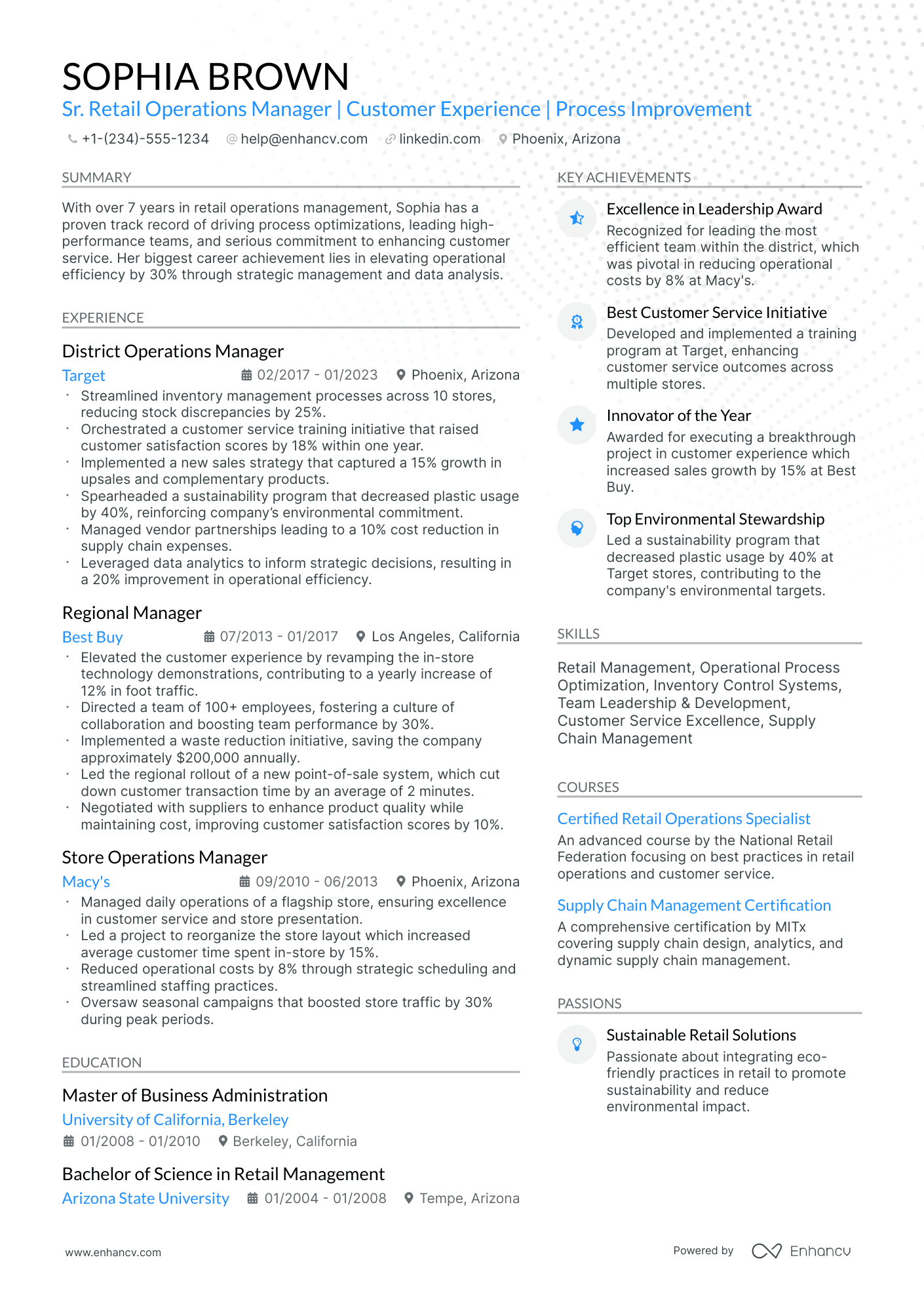
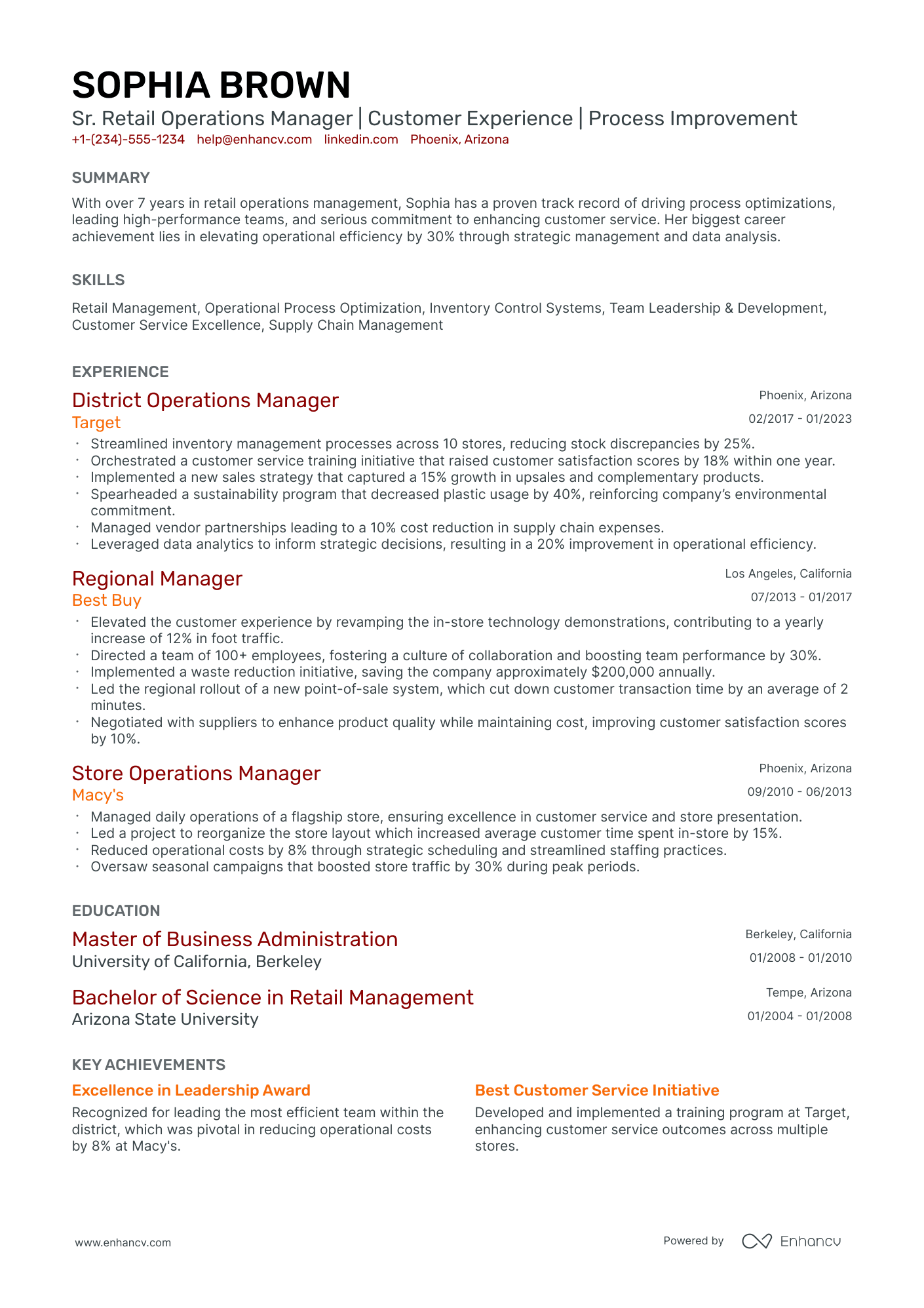
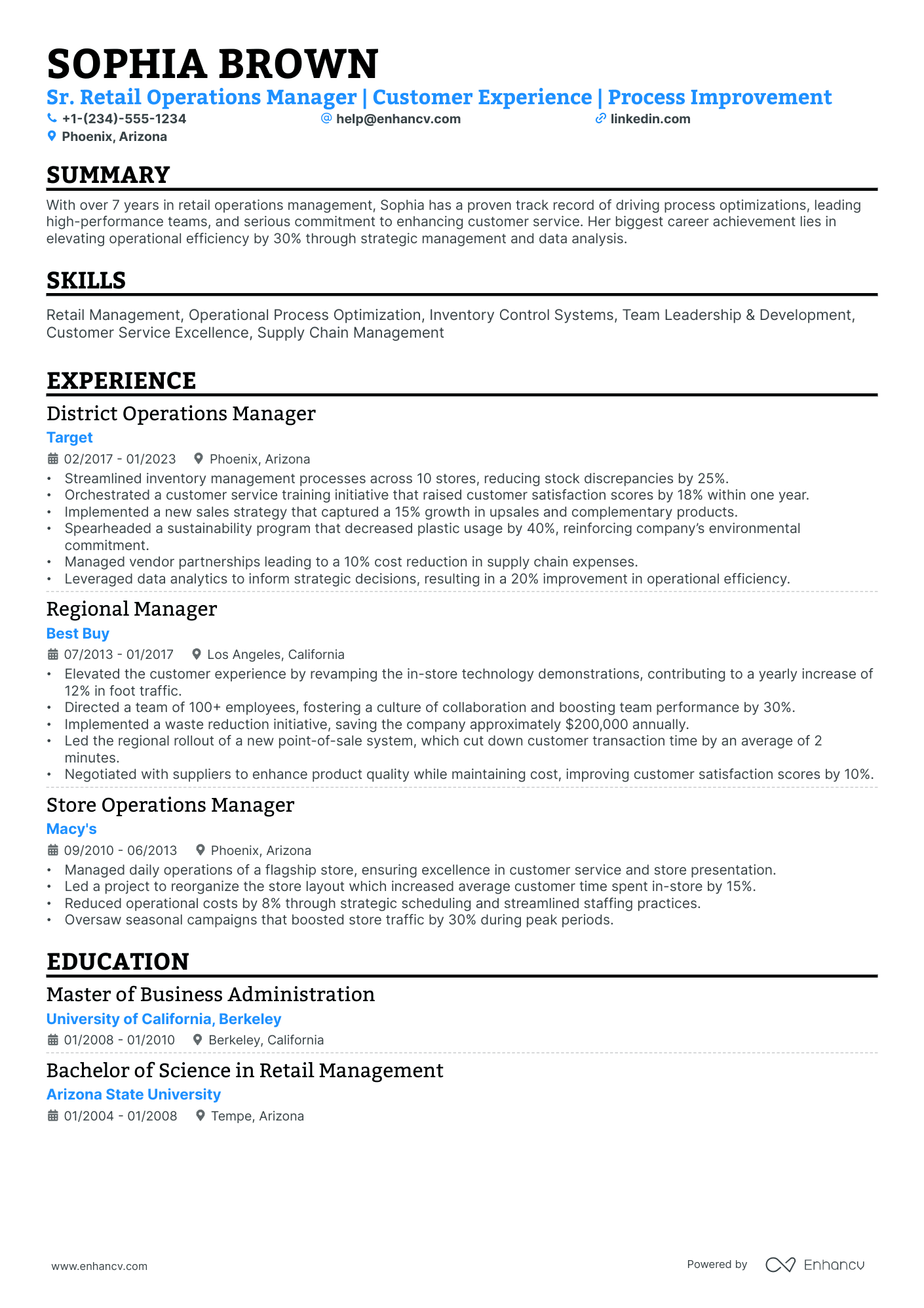
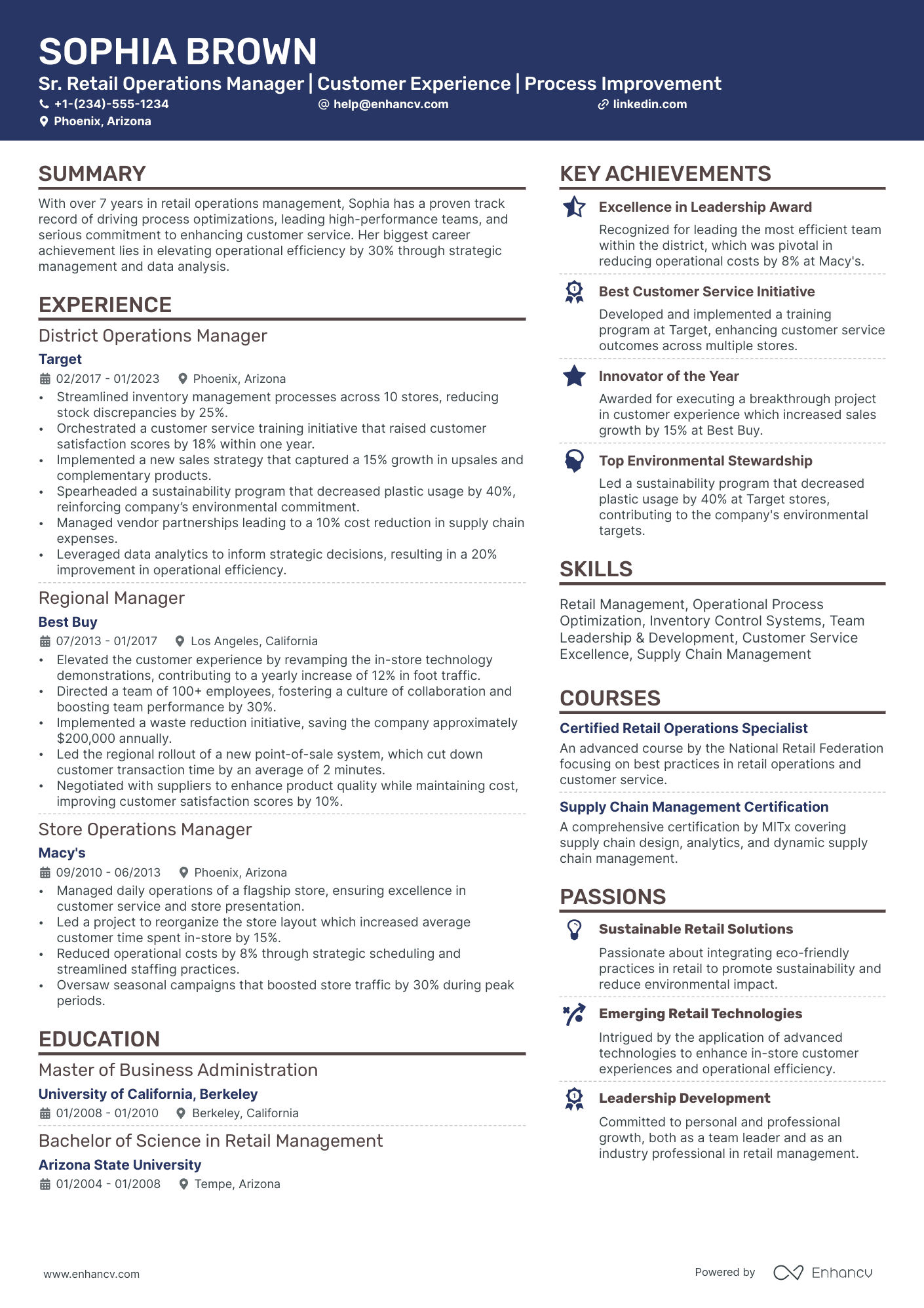
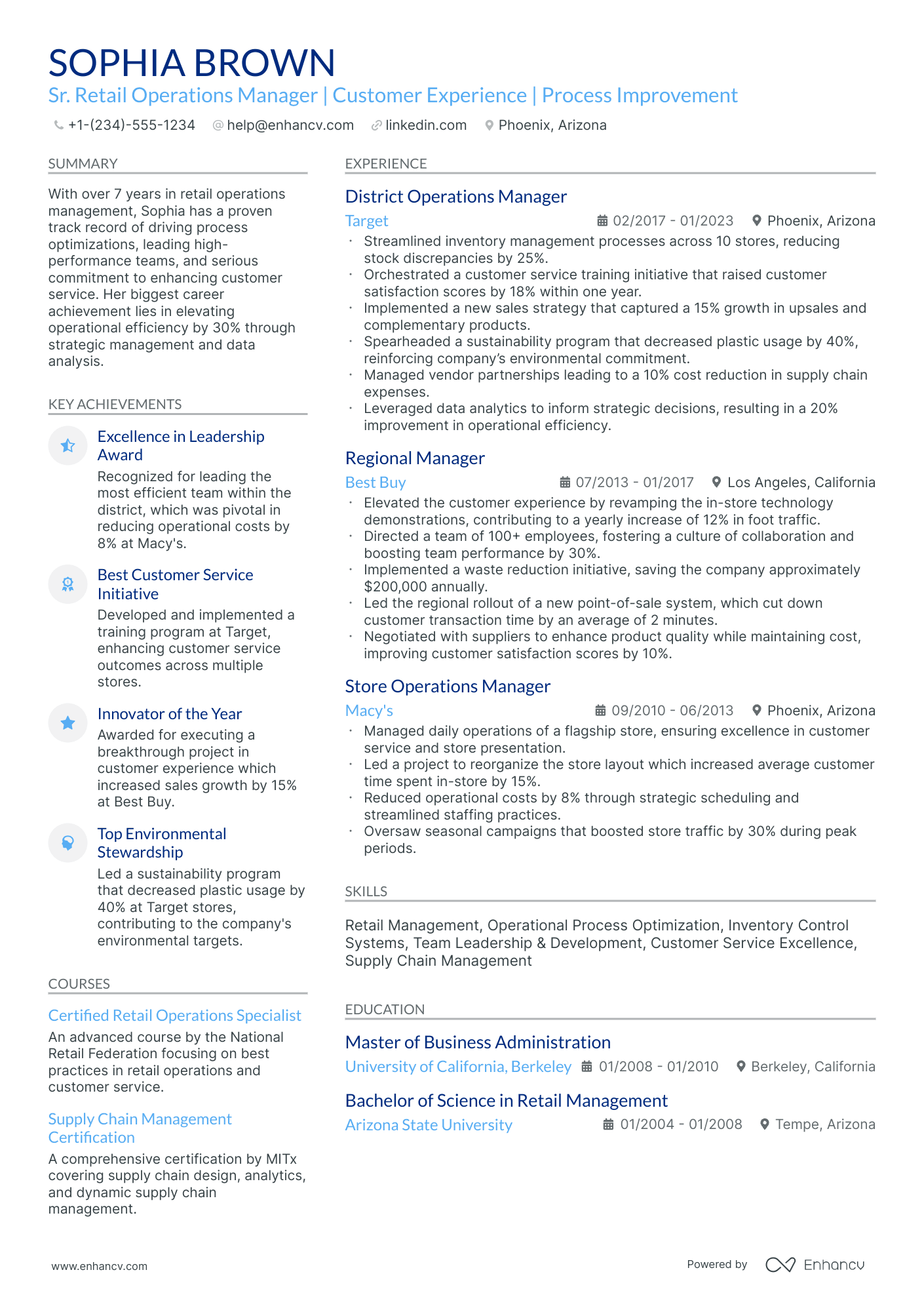
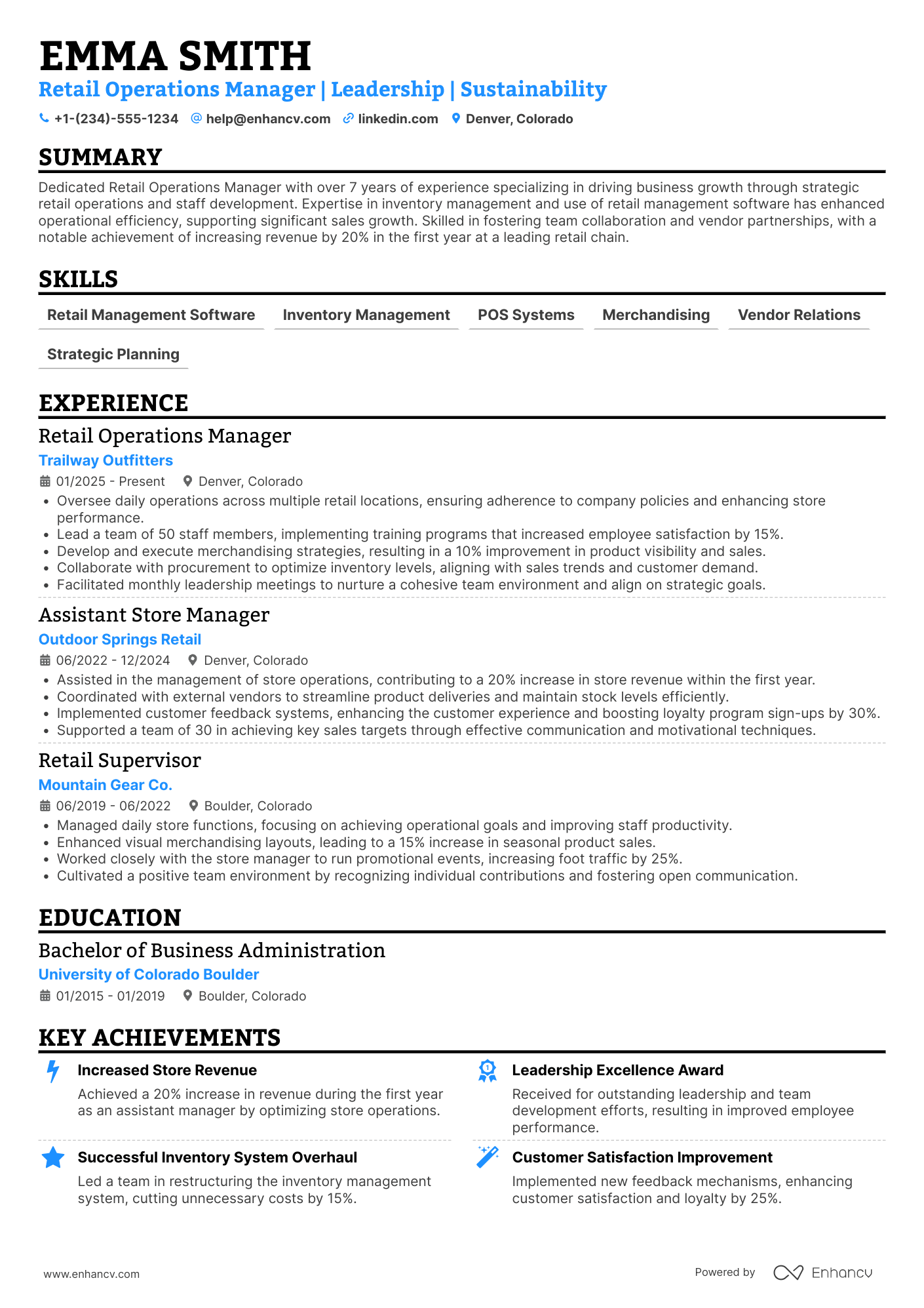
Retail operations manager resume guides often fail because they read like a task list, not a business case. That gets filtered by ATS keywords and loses in fast recruiter scans, especially when hiring teams compare dozens of similar backgrounds.
A strong resume shows how you improved store performance and reduced risk. Knowing how to make your resume stand out is critical in this field. You should highlight sales lift, margin gains, shrink reduction, labor efficiency, audit scores, multi-store scope, on-time openings, and faster replenishment that improved in-stock rates.

Key takeaways
- Quantify every experience bullet with metrics like shrink reduction, labor savings, or sales lift.
- Use reverse-chronological format if you have significant retail operations management experience.
- Tailor resume language to mirror the exact tools, KPIs, and terminology in each job posting.
- Place skills above experience when you're junior or transitioning into operations management.
- Anchor every listed skill to a specific action and measurable result in your experience section.
- Pair your resume with a cover letter when the role is competitive or requires added context.
- Use Enhancv to turn vague duties into concise, recruiter-ready bullets backed by real outcomes.
Job market snapshot for retail operations managers
We analyzed 103 recent retail operations manager job ads across major US job boards. These numbers help you understand employment type trends, top companies hiring, salary landscape at a glance.
What level of experience employers are looking for retail operations managers
| Years of Experience | Percentage found in job ads |
|---|---|
| 1–2 years | 8.7% (9) |
| 3–4 years | 3.9% (4) |
| 5–6 years | 1.0% (1) |
| 7–8 years | 1.9% (2) |
| Not specified | 84.5% (87) |
Retail operations manager ads by area of specialization (industry)
| Industry (Area) | Percentage found in job ads |
|---|---|
| Finance & Banking | 94.2% (97) |
Top companies hiring retail operations managers
| Company | Percentage found in job ads |
|---|---|
| PetSmart | 68.0% (70) |
Role overview stats
These tables show the most common responsibilities and employment types for retail operations manager roles. Use them to align your resume with what employers expect and to understand how the role is structured across the market.
Day-to-day activities and top responsibilities for a retail operations manager
| Responsibility | Percentage found in job ads |
|---|---|
| Computer applications | 66.0% (68) |
| Inventory management | 56.3% (58) |
| Merchandising | 49.5% (51) |
| P&ps | 35.9% (37) |
| Code of ethics | 19.4% (20) |
| P&l | 16.5% (17) |
| Pl | 14.6% (15) |
| Financial analysis | 13.6% (14) |
| P&l management | 13.6% (14) |
| Microsoft office | 8.7% (9) |
| Excel | 7.8% (8) |
| Financial outcomes | 7.8% (8) |
How to format a retail operations manager resume
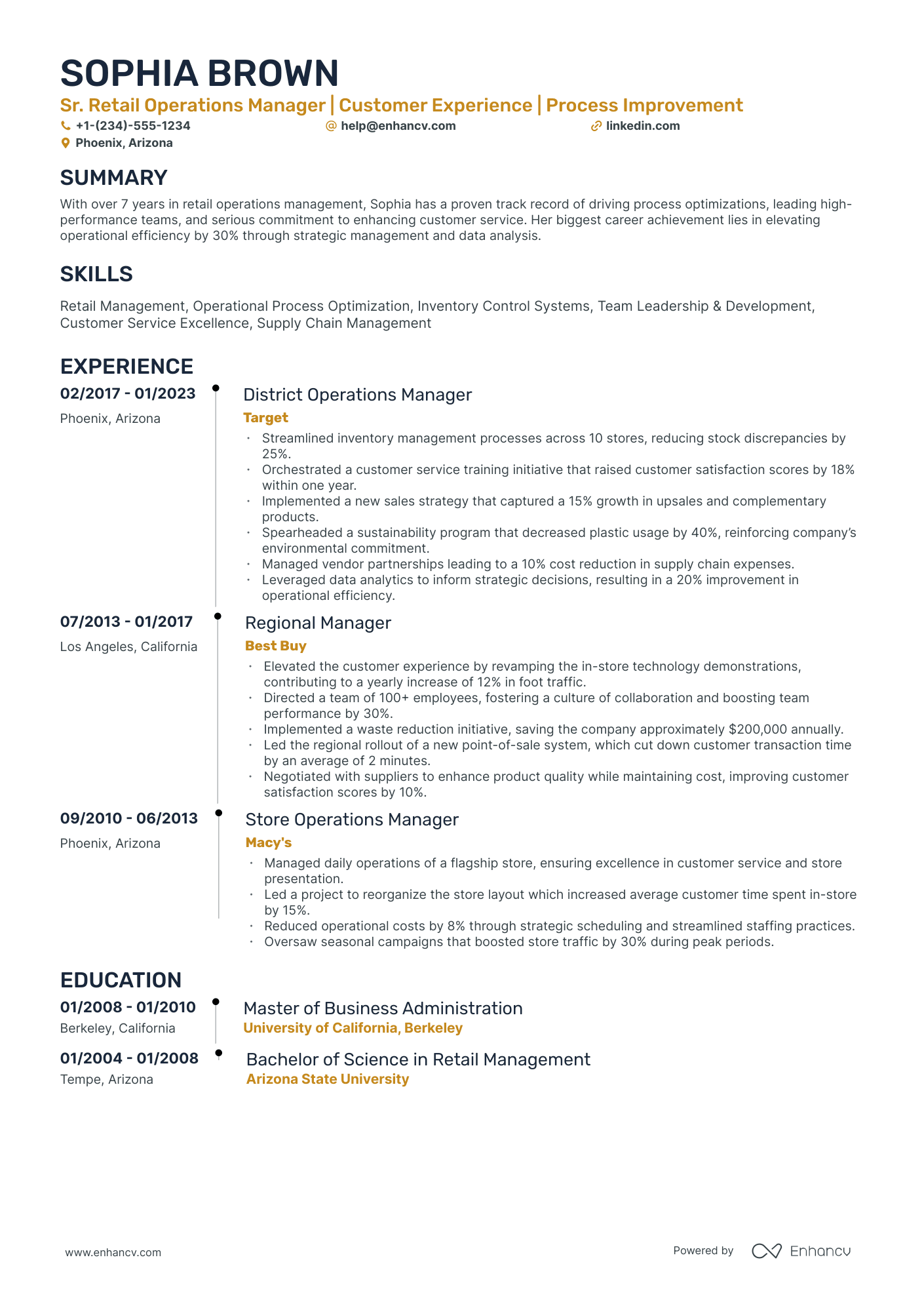
Recruiters evaluating retail operations manager candidates prioritize evidence of store-level or multi-unit operational oversight, process improvement initiatives, and measurable performance outcomes like shrink reduction, labor cost optimization, and sales growth. A clean, well-structured resume format ensures these signals surface quickly during both ATS parsing and the initial 6–8 second recruiter scan.

I have significant experience in this role—which format should I use?
Use a reverse-chronological format to present your operations management career in a clear, progression-driven timeline. Do:
- Lead with your most recent role and highlight scope of ownership—number of stores, team size, budget authority, and regional or district responsibility.
- Feature retail-specific expertise such as inventory management systems (SAP, Oracle Retail), workforce scheduling platforms, POS infrastructure, loss prevention protocols, and vendor negotiations.
- Quantify business impact in every role using metrics tied to revenue, cost savings, compliance, or operational efficiency.
I'm junior or switching into this role—what format works best?
A hybrid format works best, letting you lead with a focused skills section while still showing a concise work history that proves application of those skills. Do:
- Place a skills summary at the top that highlights retail operations competencies—inventory control, shrink management, scheduling optimization, and vendor coordination—so ATS systems and recruiters see your relevance immediately.
- Include any transitional experience such as assistant manager roles, project-based operations work, supply chain internships, or retail leadership rotations that demonstrate readiness for an operations management scope.
- Connect every listed skill to a specific action and a measurable or observable result, even if the outcome is smaller in scale.
Why not use a functional resume?
A functional format strips away the timeline and context that hiring managers need to evaluate your hands-on operational experience, making it harder to verify where, when, and how you developed your management competencies.
- A functional resume may be acceptable if you're making a career change from a non-retail field, have a significant gap in employment, or lack formal operations manager titles—but only if you anchor every listed skill to a specific project, initiative, or measurable outcome rather than presenting skills in isolation.
Once your format establishes a clean, readable structure, the next step is filling it with the right sections to showcase your qualifications effectively.
What sections should go on a retail operations manager resume
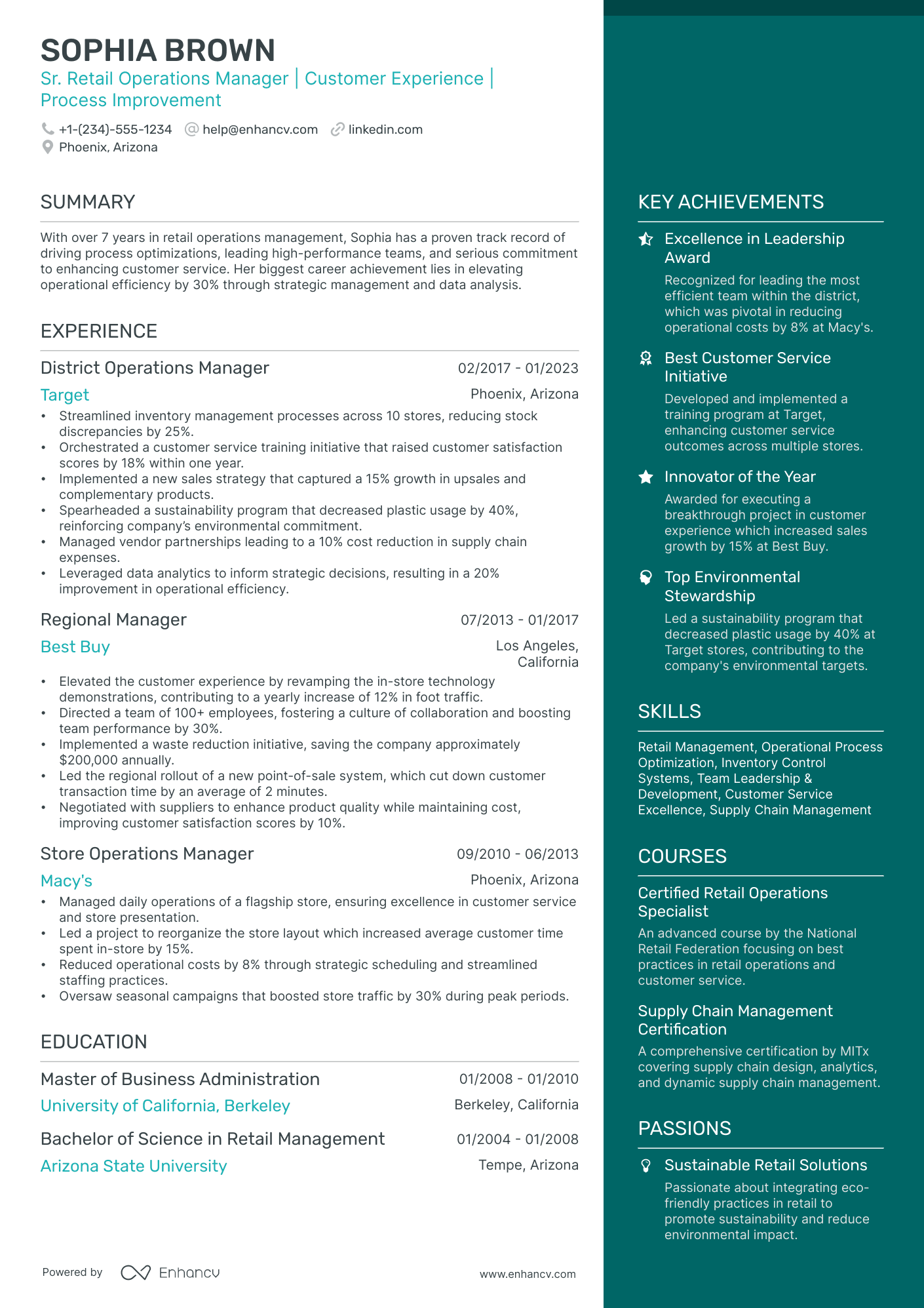
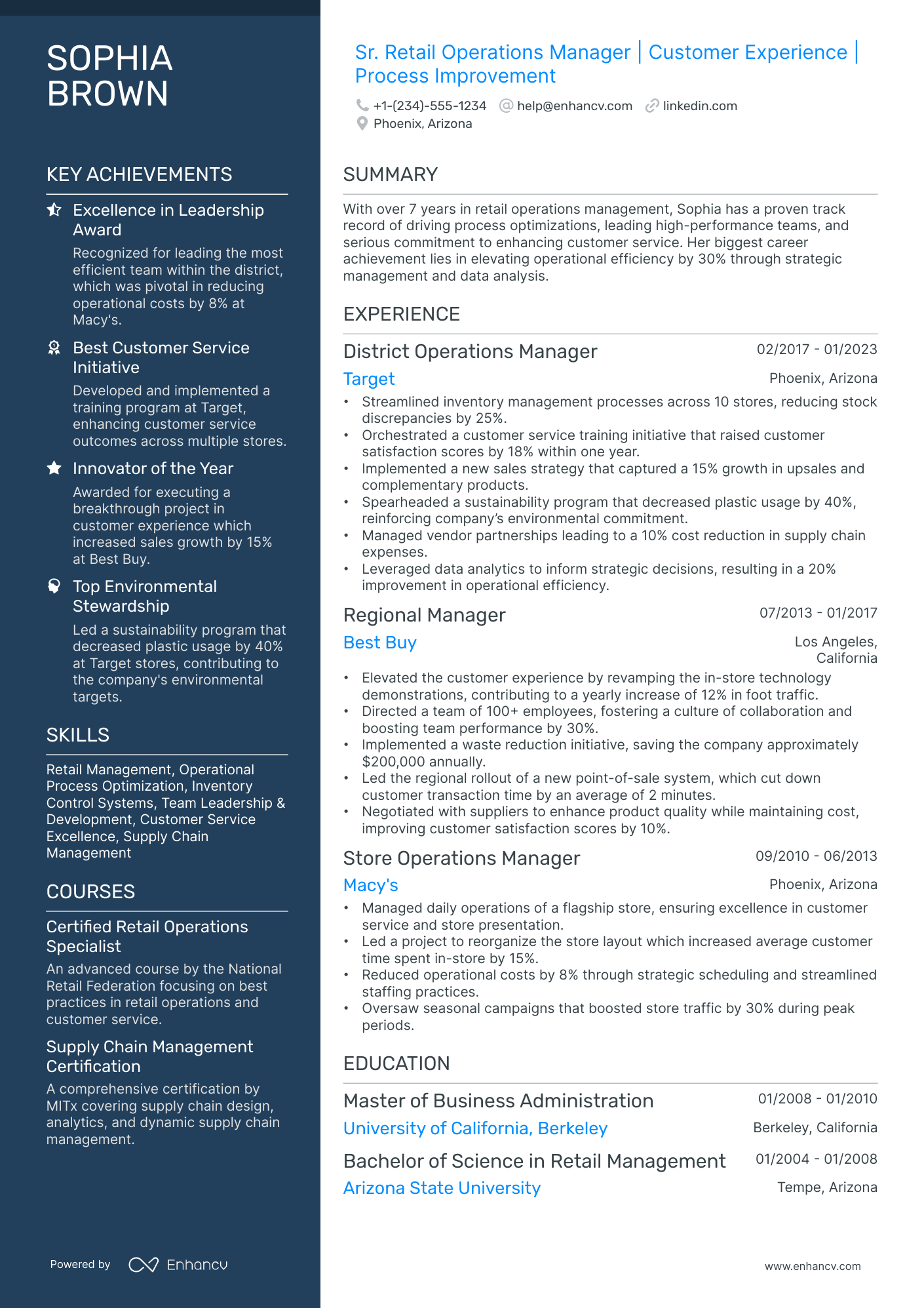
Recruiters expect a retail operations manager resume to show clear ownership of store performance, team execution, and operational discipline. Understanding which resume sections to include ensures you cover every qualification hiring managers look for.
Use this structure for maximum clarity:
- Header
- Summary
- Experience
- Skills
- Projects
- Education
- Certifications
- Optional sections: Awards, Leadership, Languages
Your experience bullets should emphasize measurable impact, operational scope, and business results across sales, labor, inventory, shrink, and customer experience.
Is your resume good enough?
Drop your resume here or choose a file. PDF & DOCX only. Max 2MB file size.
Now that you’ve organized the key parts of your resume, focus on writing your retail operations manager experience section to show how you delivered results in those roles.
How to write your retail operations manager resume experience
The experience section is where you prove you've delivered real results—through store-level execution, operational systems, workforce planning tools, and measurable improvements to efficiency, sales, or customer satisfaction. Hiring managers prioritize demonstrated impact over descriptive task lists, so every bullet should connect what you did to what changed.
Each entry should include:
- Job title
- Company and location (or remote)
- Dates of employment (month and year)
Three to five concise bullet points showing what you owned, how you executed, and what outcomes you delivered:
- Ownership scope: the stores, districts, operational functions, inventory systems, or teams you were directly accountable for as a retail operations manager.
- Execution approach: the tools, frameworks, or methods you used to drive decisions—such as workforce management platforms, POS systems, loss prevention strategies, demand forecasting models, or standard operating procedures.
- Value improved: the specific changes you created in store performance, shrinkage reduction, labor cost efficiency, customer experience scores, compliance adherence, or process reliability.
- Collaboration context: how you partnered with district leadership, merchandising, supply chain, HR, or vendor teams to align on priorities and execute operational initiatives.
- Impact delivered: the outcomes your work produced, expressed through business results, operational scale, or performance shifts rather than a summary of daily responsibilities.
Experience bullet formula
A retail operations manager experience example
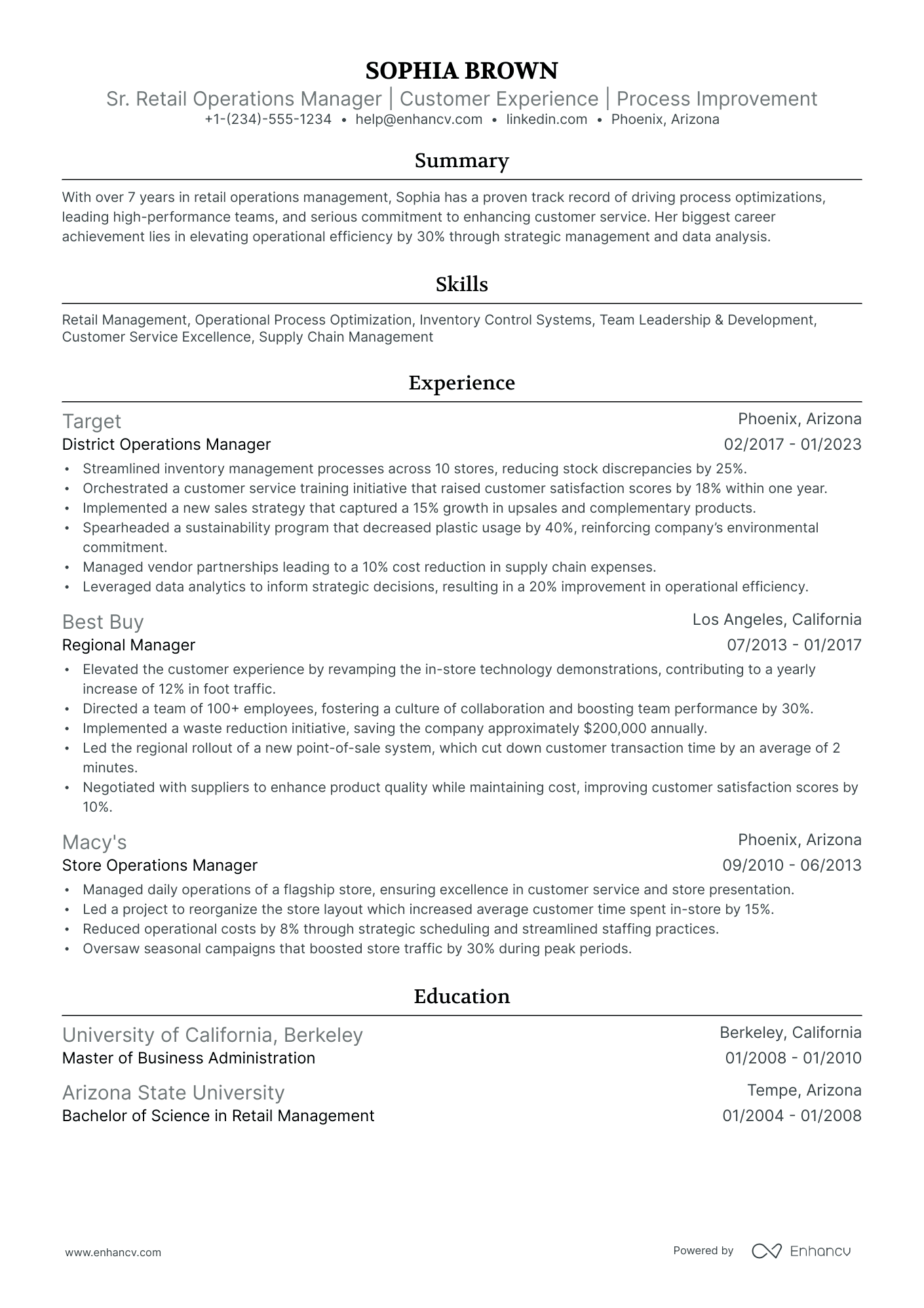
✅ Right example - modern, quantified, specific.
Retail Operations Manager
Evergreen Outfitters | Austin, TX
2021–Present
Multi-store specialty retailer with twelve locations and a high-volume e-commerce fulfillment hub.
- Led weekly labor planning and scheduling in UKG (Ultimate Kronos Group) Workforce Central and Excel, cutting overtime 18% and improving schedule adherence from 86% to 94% across twelve stores.
- Standardized inventory cycle counts and shrink controls using Zebra handhelds and Oracle NetSuite, reducing shrink from 2.1% to 1.5% and increasing inventory accuracy from 92% to 97% in two quarters.
- Built a Power BI dashboard integrating point-of-sale data from Shopify Point of Sale and returns data, improving sell-through 9% and reducing aged stock 14% through faster replenishment decisions with merchandising and finance.
- Implemented service recovery and queue management standards with Medallia customer feedback and in-store audits, raising customer satisfaction score from 4.2 to 4.6 and cutting average checkout time 22% during peak weekends.
- Partnered with loss prevention, HR, and store managers to redesign training and compliance workflows in Workday, reducing safety incidents 28% and achieving 98% completion of required training within thirty days.
Now that you've seen how a strong experience section comes together, let's look at how to adjust yours to match a specific job posting.
How to tailor your retail operations manager resume experience
Recruiters evaluate your retail operations manager resume through both applicant tracking systems and human review. Tailoring your resume to the job description ensures you pass both screenings.
Ways to tailor your retail operations manager experience:
- Match point-of-sale and inventory management systems named in the posting.
- Mirror the exact loss prevention or shrinkage reduction terminology used.
- Align your KPIs with store performance metrics the employer prioritizes.
- Reflect specific workforce scheduling or labor optimization tools referenced.
- Highlight multi-unit or district-level oversight if the role requires it.
- Use the same compliance and safety standards language from the listing.
- Emphasize omnichannel fulfillment or supply chain workflows they mention.
- Include visual merchandising or planogram execution if the posting specifies it.
Tailoring means aligning your real accomplishments with what the employer asks for, not forcing keywords where they don't belong.
Resume tailoring examples for retail operations manager
| Job description excerpt | Untailored | Tailored |
|---|---|---|
| "Oversee inventory management across 15+ store locations using Oracle Retail and reduce shrinkage by implementing loss prevention strategies" | Managed inventory and helped reduce losses at multiple stores. | Directed inventory management across 18 retail locations using Oracle Retail, implementing targeted loss prevention strategies that reduced shrinkage by 23% year over year. |
| "Lead workforce scheduling optimization to maintain labor cost targets while ensuring adequate floor coverage during peak seasonal periods" | Handled employee scheduling and managed labor costs for the team. | Optimized workforce scheduling for 120+ associates across three high-traffic locations, maintaining labor costs within 2% of quarterly targets while ensuring full floor coverage during holiday and back-to-school peak seasons. |
| "Drive operational efficiency by standardizing store opening/closing procedures and conducting regular compliance audits aligned with company SOPs" | Improved store operations and made sure employees followed procedures. | Standardized opening and closing procedures across all district locations, reducing process deviations by 34% and conducting monthly compliance audits aligned with corporate SOPs to maintain consistent operational performance. |
Once you’ve aligned your experience with the role’s priorities, the next step is to quantify your retail operations manager achievements to show the measurable impact behind those responsibilities.
How to quantify your retail operations manager achievements
Quantifying your achievements proves you improved store results, not just stayed busy. Focus on sales lift, labor efficiency, shrink reduction, inventory accuracy, compliance, and customer experience across stores, shifts, and peak seasons.
Quantifying examples for retail operations manager
| Metric | Example |
|---|---|
| Revenue growth | "Increased same-store sales 8.4% across five locations by tightening promo execution and coaching add-on selling; tracked weekly in POS dashboards." |
| Labor efficiency | "Cut labor cost from 12.1% to 10.6% of sales in twelve weeks using Kronos scheduling, cross-training, and peak-hour staffing maps." |
| Inventory accuracy | "Raised inventory accuracy from 92% to 98% by implementing weekly cycle counts and variance root-cause logs; reduced stockouts 22%." |
| Shrink reduction | "Reduced shrink 0.7 points year over year by improving receiving controls, camera audits, and high-theft SKU lockups; passed three loss-prevention audits." |
| Customer satisfaction | "Improved customer satisfaction score from 4.2 to 4.6 in six months by standardizing floor coverage, speeding returns, and coaching service recovery." |
Turn vague job duties into measurable, recruiter-ready resume bullets in seconds with Enhancv's Bullet Point Generator.
With strong bullet points in place, the next step is ensuring your skills section presents the right mix of hard and soft skills that hiring managers expect from a retail operations manager.
How to list your hard and soft skills on a retail operations manager resume
Your skills section shows you can run store operations, hit sales and service targets, and manage risk—recruiters and ATS scan this section to confirm role fit fast, so aim for a balanced mix of hard skills and execution-focused soft skills. retail operations manager roles require a blend of:
- Product strategy and discovery skills.
- Data, analytics, and experimentation skills.
- Delivery, execution, and go-to-market discipline.
- Soft skills.
Your skills section should be:
- Scannable (bullet-style grouping).
- Relevant to the job post.
- Backed by proof in experience bullets.
- Updated with current tools.
Place your skills section:
- Above experience if you're junior or switching careers.
- Below experience if you're mid/senior with strong achievements.

Hard skills
- Store labor forecasting and scheduling
- Sales KPI reporting and dashboards
- Inventory planning and replenishment
- Shrink prevention and loss control
- Planogram execution and merchandising
- Point-of-sale systems (POS)
- Order management systems
- Omnichannel fulfillment operations
- Vendor compliance and chargebacks
- Budgeting, payroll, and P&L
- Standard operating procedures development
- Safety, audits, and regulatory compliance
Soft skills
- Lead and coach store leaders
- Hold teams accountable to KPIs
- Prioritize high-impact operational work
- Communicate changes with clarity
- Resolve customer escalations quickly
- Partner across merchandising and HR
- Drive adoption of new processes
- Make data-informed decisions fast
- Run effective store walk routines
- Manage conflict and performance issues
- Execute consistently under pressure
- Influence without formal authority
How to show your retail operations manager skills in context
Skills shouldn't live only in a bulleted list on your resume. Explore resume skills examples to see how top candidates weave competencies throughout their documents.
They should be demonstrated in:
- Your summary (high-level professional identity)
- Your experience (proof through outcomes)
Here's what strong, skill-rich writing looks like in practice.
Summary example
Retail operations manager with 12 years leading multi-unit teams across big-box and specialty formats. Skilled in workforce planning, SAP, and shrink reduction strategies. Cut operational costs by 18% while improving customer satisfaction scores across 35 locations.
- Reflects senior-level experience clearly
- Names specific tools and methods
- Leads with a measurable outcome
- Signals leadership and collaboration ability
Experience example
Senior Retail Operations Manager
Bridgewell Home & Garden | Charlotte, NC
March 2019–August 2024
- Redesigned inventory replenishment workflows using Oracle NetSuite, reducing stockouts by 27% across 22 stores within the first year.
- Partnered with district managers and HR to roll out a new scheduling model, cutting overtime labor costs by $340,000 annually.
- Led a cross-functional shrink reduction task force that implemented updated loss prevention protocols, lowering inventory shrink from 2.1% to 1.3%.
- Every bullet includes measurable proof
- Skills surface naturally through real outcomes
Once you’ve tied your strengths to real outcomes and responsibilities, the next step is to apply that same approach to building a retail operations manager resume when you don’t have direct experience.
How do I write a retail operations manager resume with no experience
Even without full-time experience, you can demonstrate readiness through:
- Retail store internship operations support
- Inventory audits and cycle counts
- POS system training and troubleshooting
- Opening and closing shift leadership
- Vendor receiving and invoice matching
- Merchandising resets using planograms
- Scheduling support and labor tracking
- Loss prevention audits and reports
If you're starting out, our guide on writing a resume without work experience walks you through how to position transferable skills and projects effectively.
Focus on:
- Inventory accuracy and shrink controls
- POS and reporting tool proficiency
- Labor scheduling and productivity metrics
- Process documentation and compliance
Resume format tip for entry-level retail operations manager
Use a combination resume format because it highlights operations skills and measurable projects before limited work history. Do:
- Add a "Retail operations manager projects" section.
- List tools: POS, Excel, inventory systems.
- Quantify results: shrink, accuracy, sales.
- Mirror keywords from the job posting.
- Include relevant coursework and certifications.
- Led weekly cycle counts in Excel and POS reports, reconciled variances, and improved inventory accuracy from 92% to 97% within six weeks.
When you're building your resume without direct experience, your education section becomes one of the strongest tools for demonstrating relevant qualifications—here's how to structure it effectively.
How to list your education on a retail operations manager resume
Your education section helps hiring teams confirm you have foundational knowledge in business, management, or logistics. It validates your readiness for a retail operations manager role quickly.
Include:
- Degree name
- Institution
- Location
- Graduation year
- Relevant coursework (for juniors or entry-level candidates)
- Honors & GPA (if 3.5 or higher)
Skip month and day details—list the graduation year only.
Here's a strong education entry tailored for a retail operations manager resume.
Example education entry
Bachelor of Science in Business Administration
University of Georgia, Athens, GA
Graduated 2019
GPA: 3.7/4.0
- Relevant Coursework: Supply Chain Management, Retail Strategy, Operations Planning, Organizational Leadership
- Honors: Magna Cum Laude, Dean's List (six semesters)
How to list your certifications on a retail operations manager resume
Certifications on a resume show a retail operations manager's commitment to learning, proficiency with tools and processes, and alignment with retail standards that improve store performance.
Include:
- Certificate name
- Issuing organization
- Year
- Optional: credential ID or URL
- Place certifications below education when they are older, less role-specific, or secondary to your degree and core retail operations manager experience.
- Place certifications above education when they are recent, highly relevant, or required for the retail operations manager role you're targeting.
Best certifications for your retail operations manager resume
Certified Supply Chain Professional (CSCP) Project Management Professional (PMP) Lean Six Sigma Green Belt Certified Manager Certification (CM) OSHA 30-Hour General Industry Certified in Production and Inventory Management (CPIM) Certified Professional in Inventory Management (CPIM)
Once you’ve placed your credentials where hiring managers can spot them quickly, shift to writing your retail operations manager resume summary to connect those qualifications to the value you deliver.
How to write your retail operations manager resume summary
Your resume summary is the first thing a recruiter reads. A strong one instantly signals you're qualified to manage daily retail operations and drive store performance.
Keep it to three to four lines, with:
- Your title and total years of experience in retail operations.
- The retail domain or industry segment you specialize in.
- Core skills like inventory management, workforce scheduling, or POS systems.
- One or two quantified achievements such as cost reductions or efficiency gains.
- Soft skills tied to real outcomes, like team leadership that reduced turnover.

PRO TIP
At this mid-level role, emphasize operational results you directly controlled. Highlight process improvements, team performance metrics, and cost savings. Avoid vague phrases like "passionate leader" or "results-driven professional." Replace them with specific numbers and outcomes.
Example summary for a retail operations manager
Retail operations manager with six years overseeing 12 store locations. Streamlined inventory processes, cutting shrinkage by 18%. Skilled in workforce optimization, vendor negotiations, and SAP-based reporting.
Optimize your resume summary and objective for ATS
Drop your resume here or choose a file.
PDF & DOCX only. Max 2MB file size.
Now that your summary is ready to showcase your qualifications, make sure your resume header presents your contact details correctly so hiring managers can actually reach you.
What to include in a retail operations manager resume header
A resume header is the top section with your identity and contact details, and it boosts visibility, credibility, and recruiter screening for a retail operations manager.
Essential resume header elements
- Full name
- Tailored job title and headline
- Location
- Phone number
- Professional email
- GitHub link
- Portfolio link
Including a LinkedIn link helps recruiters verify experience quickly and supports screening.
Do not include photos on a retail operations manager resume unless the role is explicitly front-facing or appearance-dependent.
Match your job title and headline to the posting, and keep every detail consistent across your resume, LinkedIn, and portfolio.
Retail operations manager resume header
Jordan Taylor
Retail operations manager | Multi-site store operations, labor planning, shrink control
Chicago, IL
(312) 555-01XX
jordan.taylor@enhancv.com
github.com/jordantaylor
jordantaylor.com
linkedin.com/in/jordantaylor
Once your contact details and role focus are clear at the top, add additional sections to highlight relevant strengths and credentials that don’t fit in the header.
Additional sections for retail operations manager resumes
When your core qualifications match other candidates, additional sections can set you apart and reinforce your credibility as a retail operations manager.
- Languages
- Professional affiliations (e.g., Retail Industry Leaders Association)
- Certifications and licenses
- Volunteer experience in community retail or nonprofit operations
- Awards and recognition
- Publications or conference presentations
- Hobbies and interests tied to leadership or logistics
Once you've rounded out your resume with the right supplementary sections, it's worth pairing it with a cover letter to strengthen your overall application.
Do retail operations manager resumes need a cover letter
A cover letter isn't required for a retail operations manager, but it helps in competitive roles or when hiring managers expect one. If you're unsure where to start, learn what a cover letter is and how it complements your resume. It can make a difference when your resume needs context, or when you're targeting a specific brand.
Use a cover letter to add details your resume can't:
- Explain role or team fit: Connect your leadership style to the store model, team structure, and operational priorities.
- Highlight one or two relevant projects or outcomes: Share a specific improvement, like shrink reduction, labor optimization, or faster replenishment, with clear results.
- Show understanding of the product, users, or business context: Reference the customer profile, sales drivers, and how operations supports conversion and retention.
- Address career transitions or non-obvious experience: Translate experience from another industry, region, or function into retail operations manager responsibilities.
Drop your resume here or choose a file.
PDF & DOCX only. Max 2MB file size.
Even if you choose to include a cover letter, AI can help you strengthen your retail operations manager resume faster and more precisely, which is why the next section focuses on using AI to improve it.
Using AI to improve your retail operations manager resume
AI can sharpen your resume's clarity, structure, and impact. It helps refine bullet points, align language with job descriptions, and highlight measurable results. But overuse risks making your resume sound robotic. Once your content feels clear and role-aligned, step away from AI. For specific guidance, explore ChatGPT resume writing prompts tailored to operational roles.
Here are 10 practical prompts you can copy and paste to strengthen specific sections of your resume:
Strengthen your summary
Quantify experience bullets
Align skills with job posts
Sharpen action verbs
Trim redundant phrasing
Improve project descriptions
Refine education relevance
Highlight certifications
Tighten formatting consistency
Tailor for applicant tracking
Conclusion
A strong retail operations manager resume proves impact with measurable outcomes. Use metrics like sales growth, shrink reduction, labor savings, and on-time execution. Highlight role-specific skills, including inventory control, staffing, scheduling, training, compliance, and vendor coordination.
Keep the structure clear and easy to scan. Lead with results, support them with skills, and show steady ownership across stores or teams. This approach signals readiness for today’s hiring market and the changes ahead.