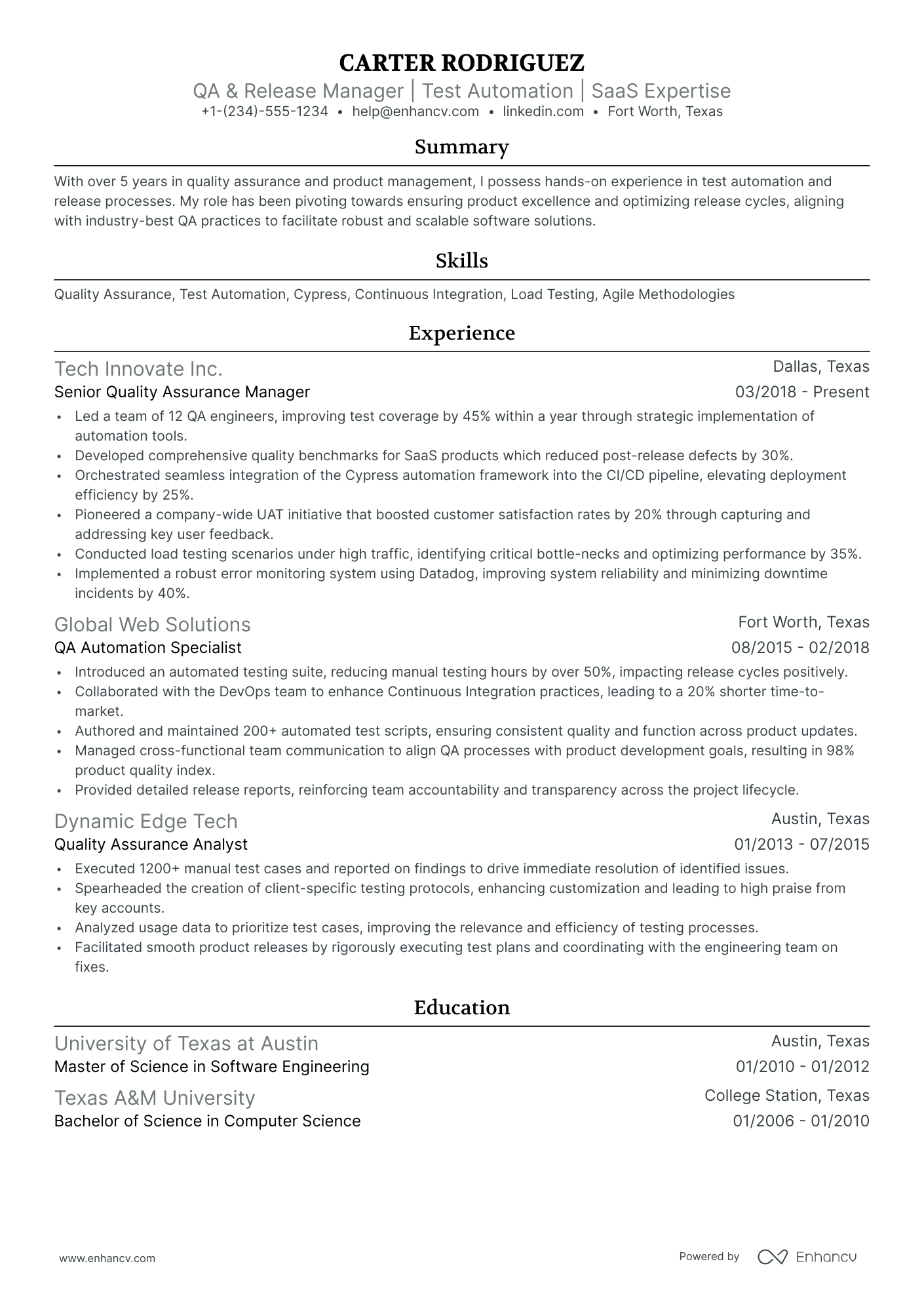
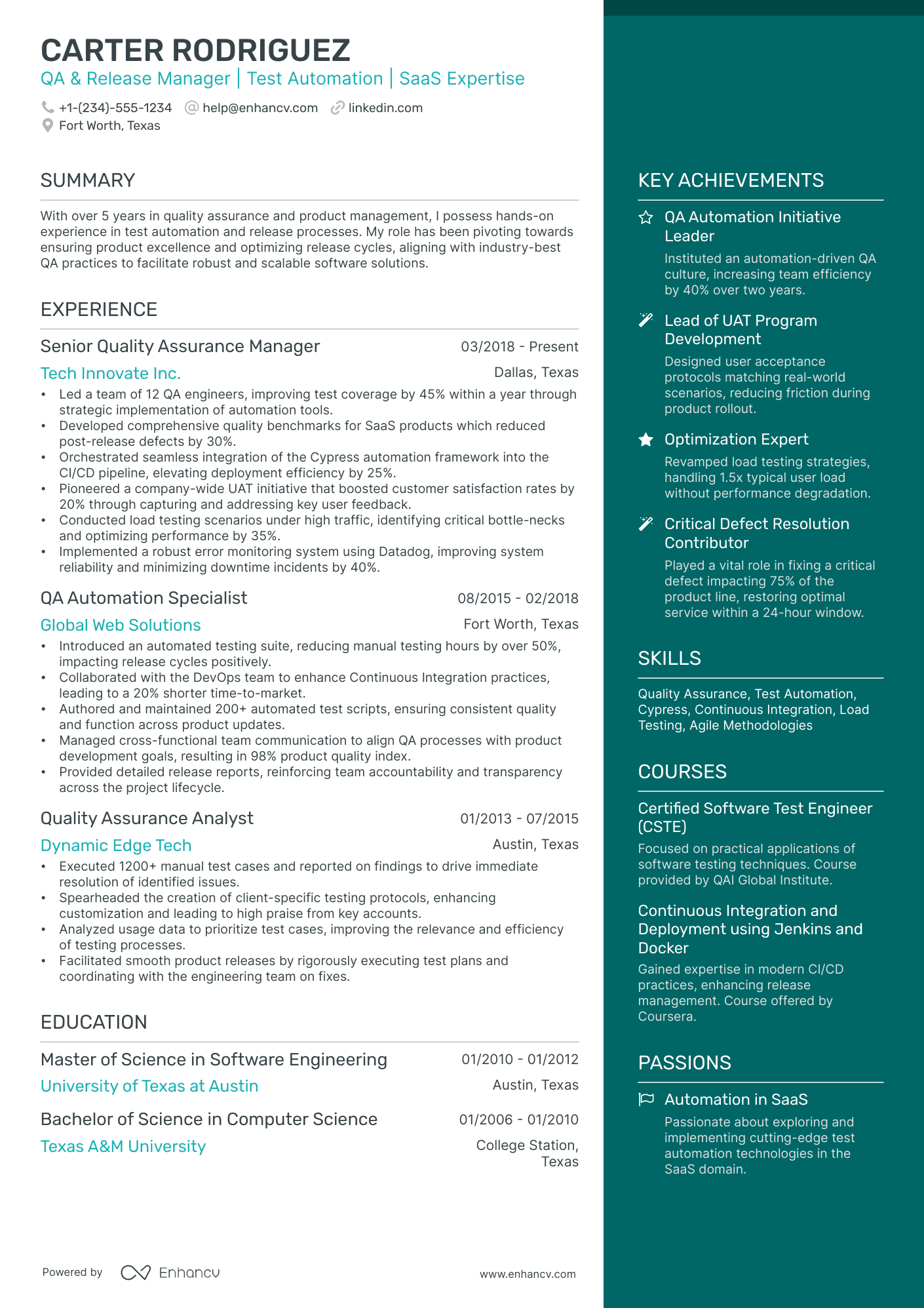
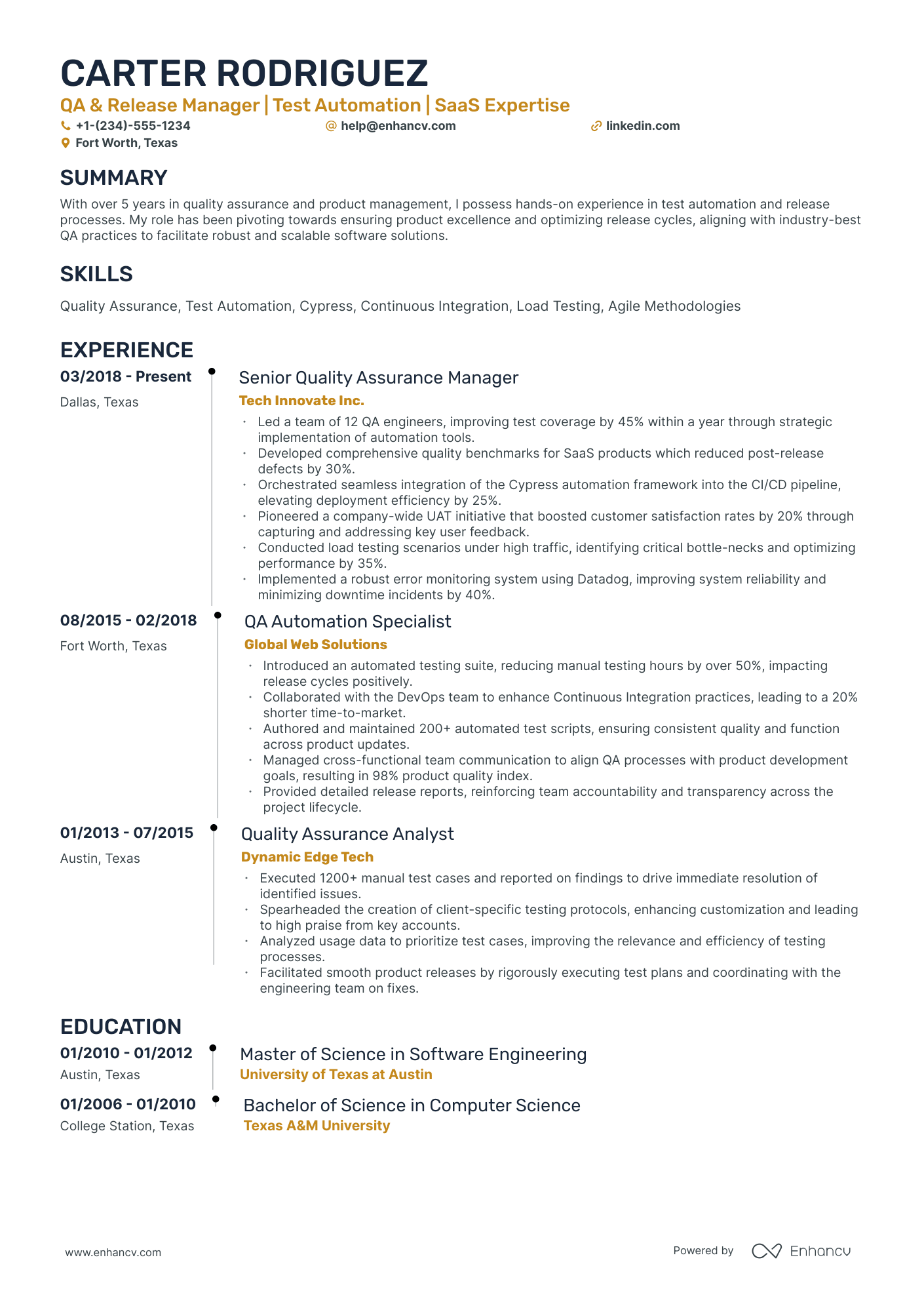
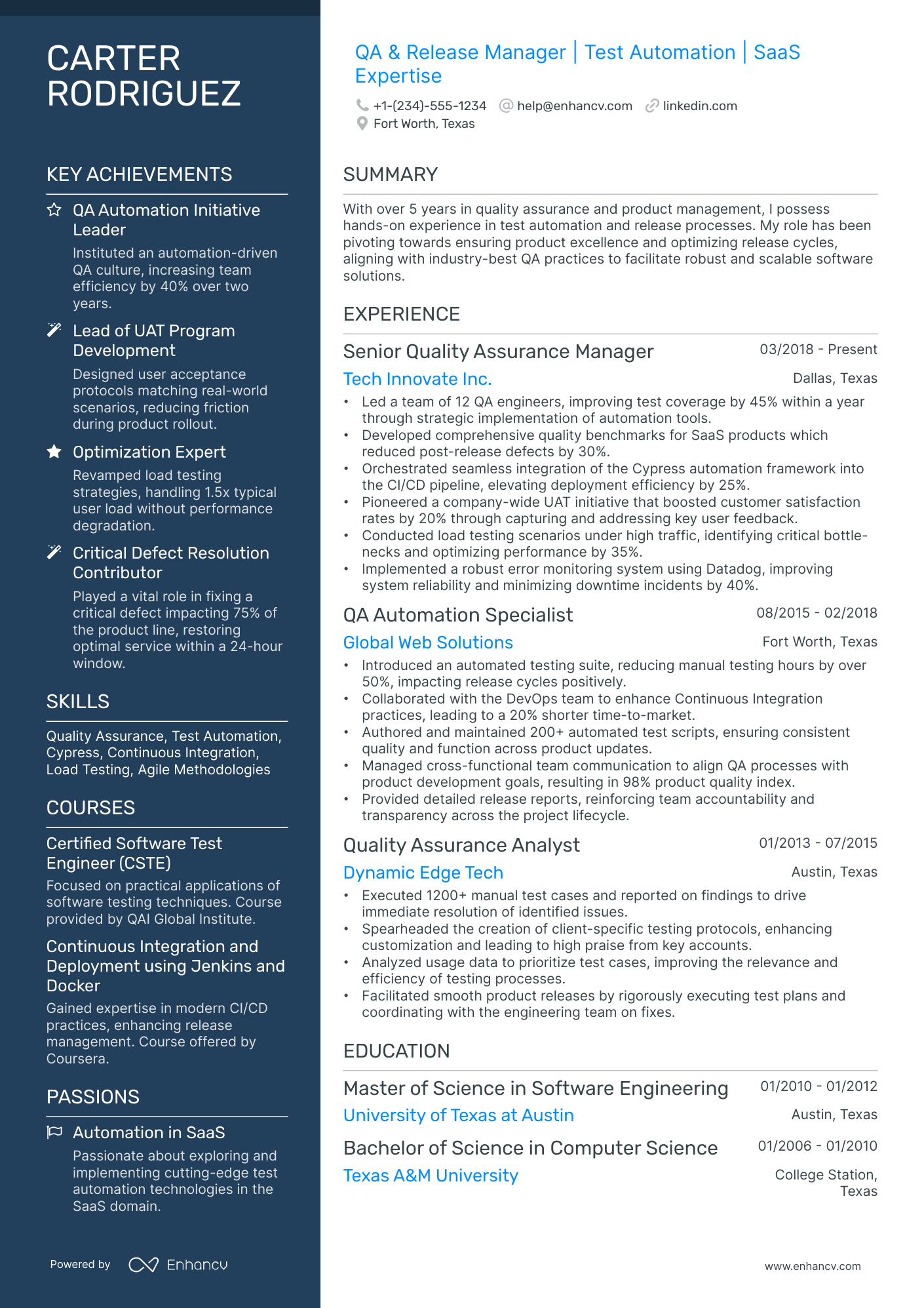
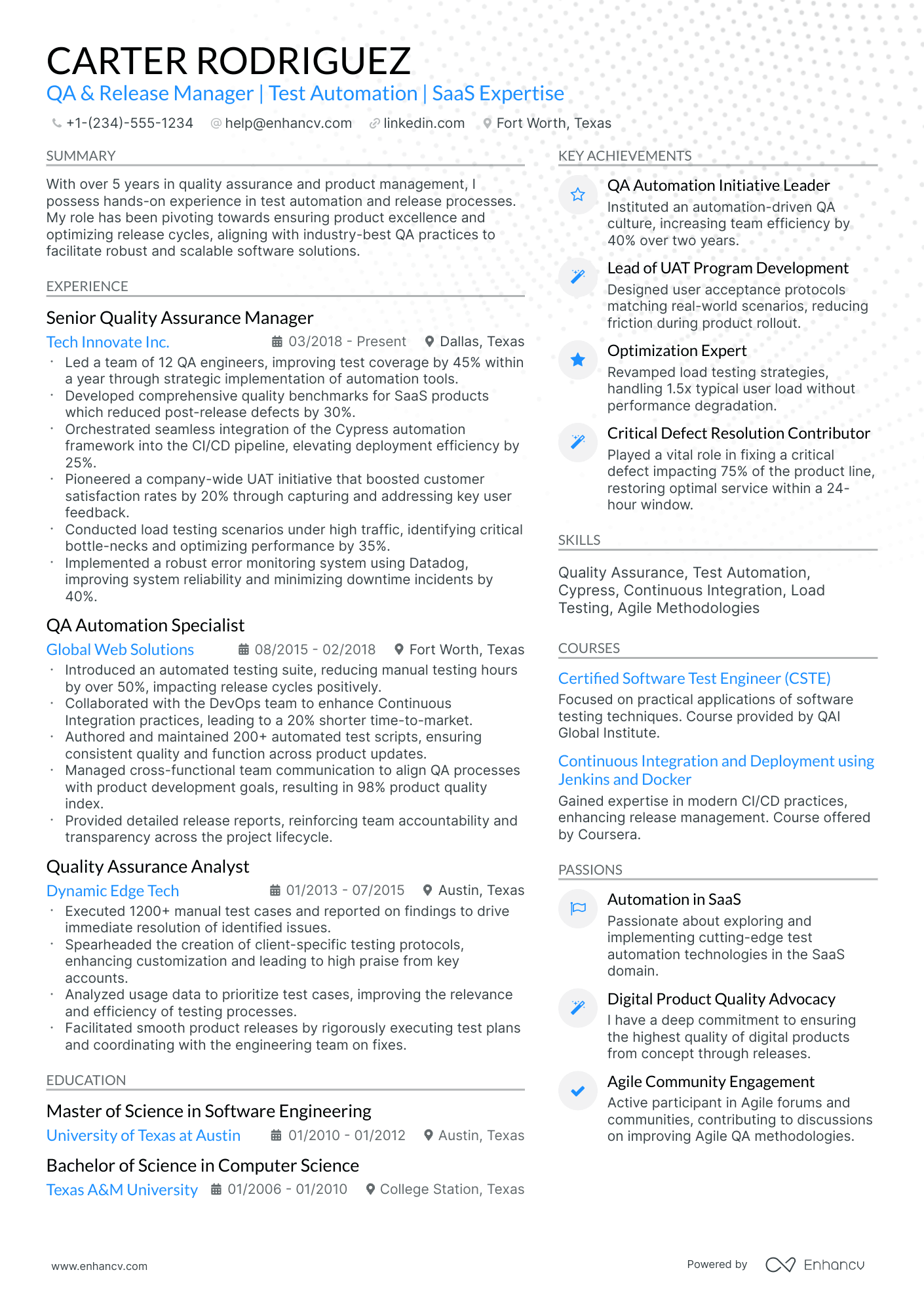
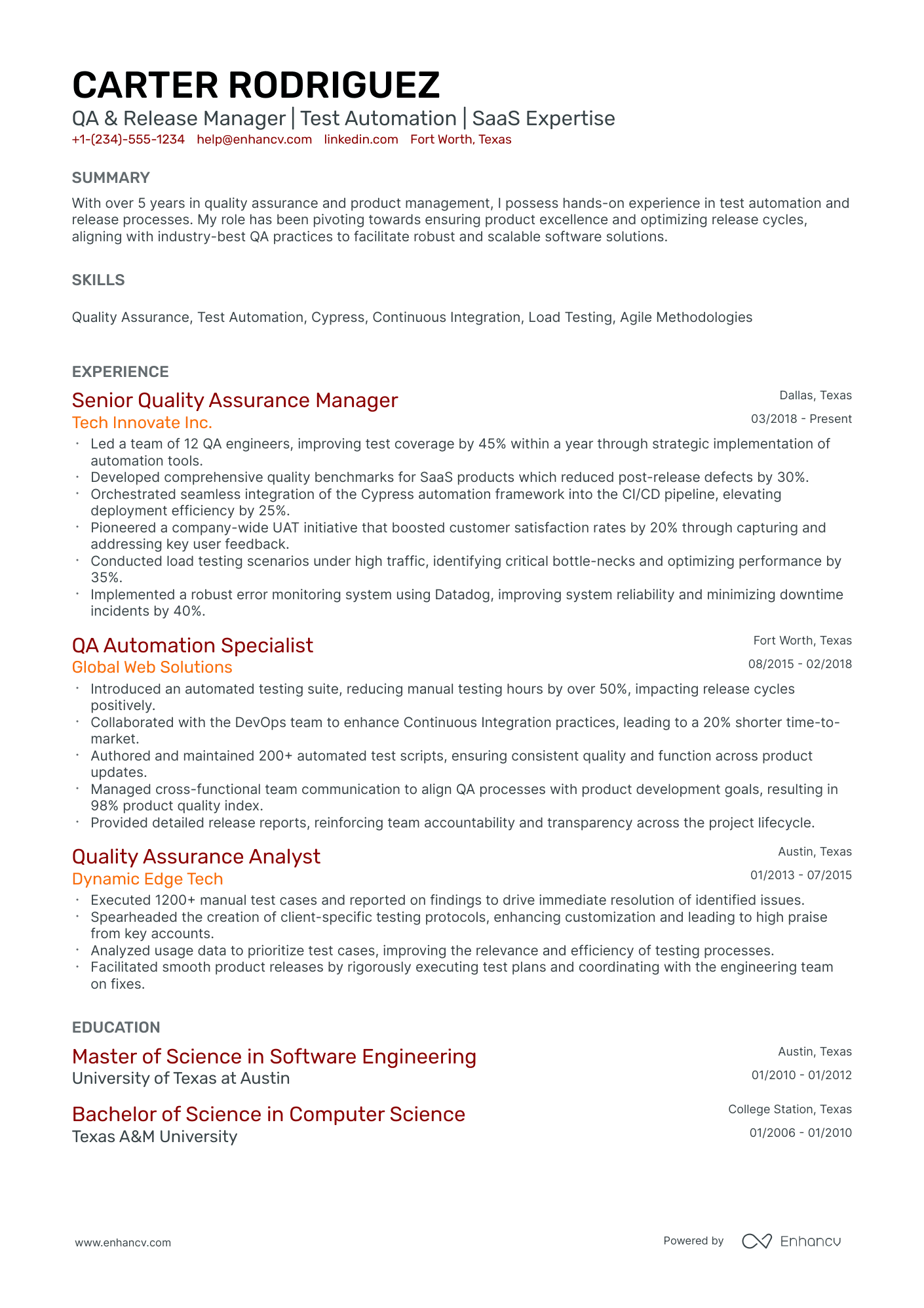
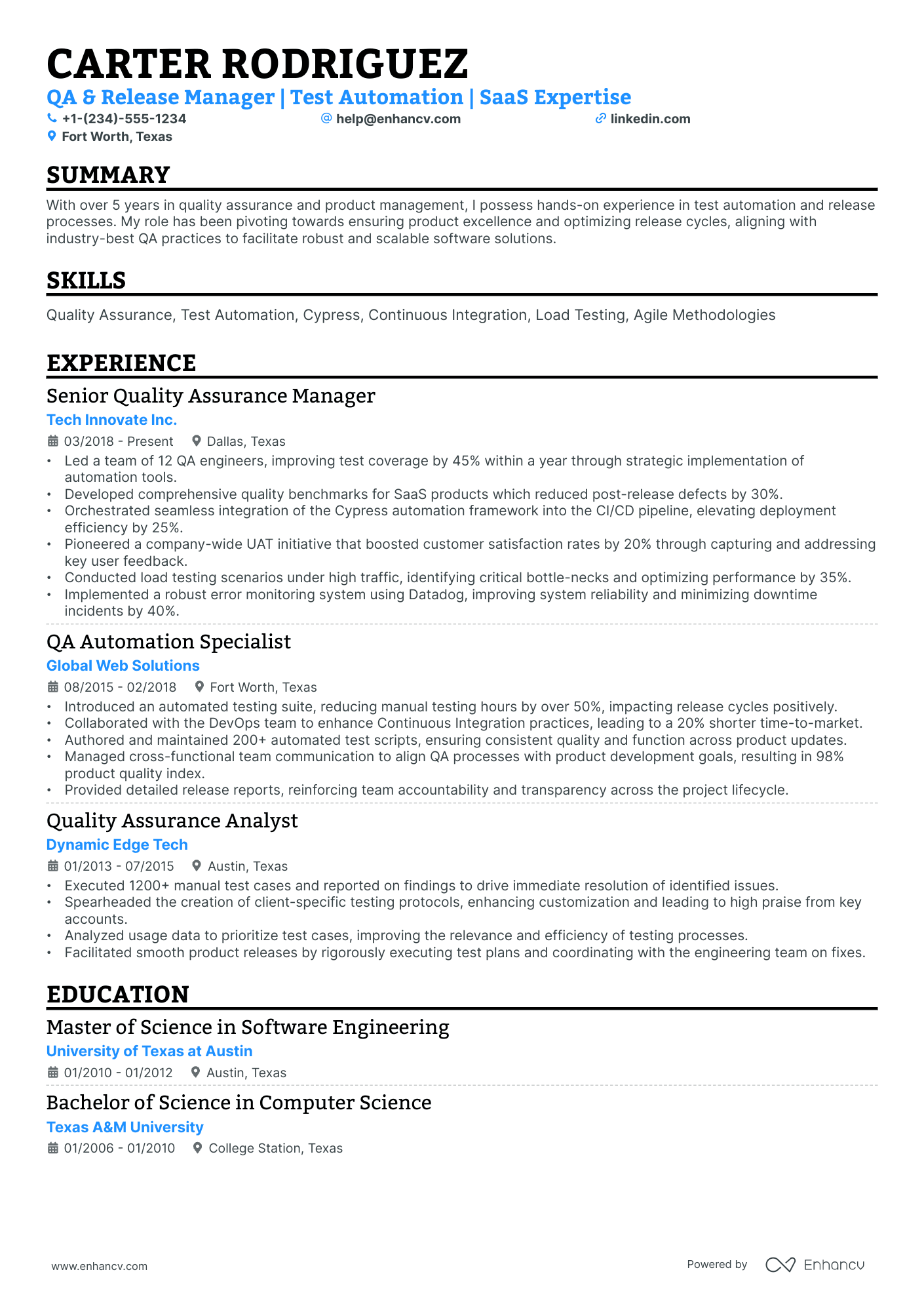
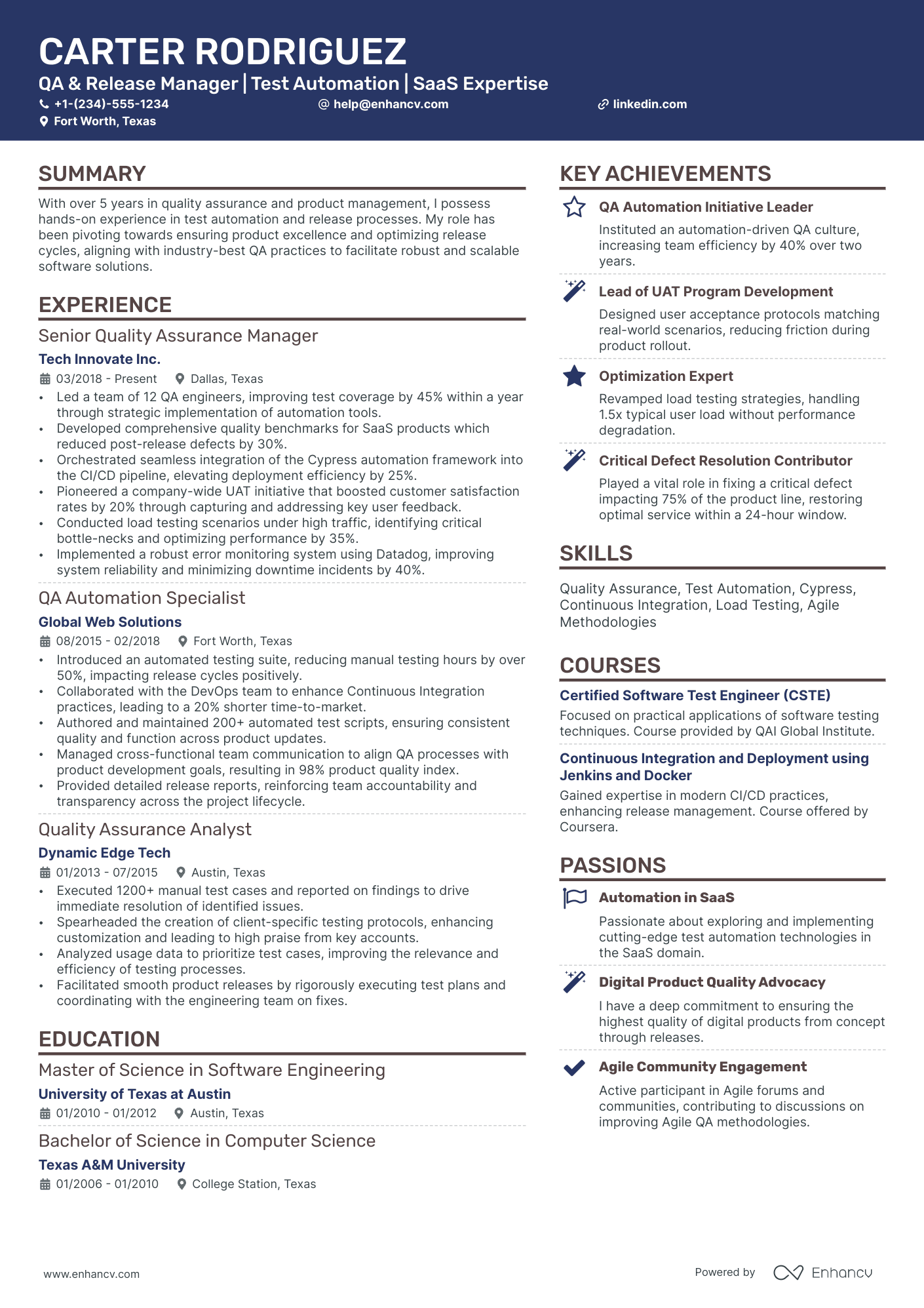
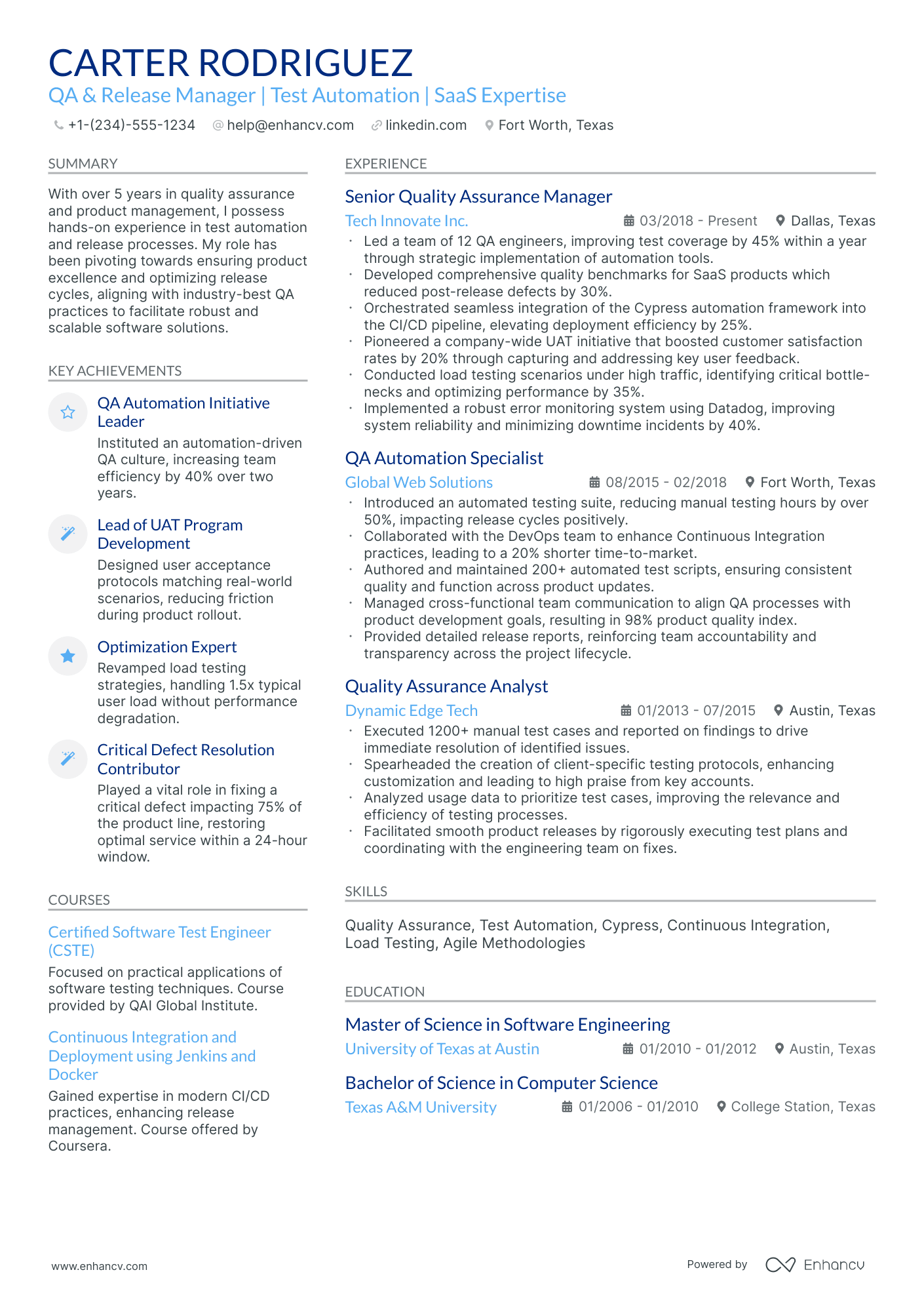
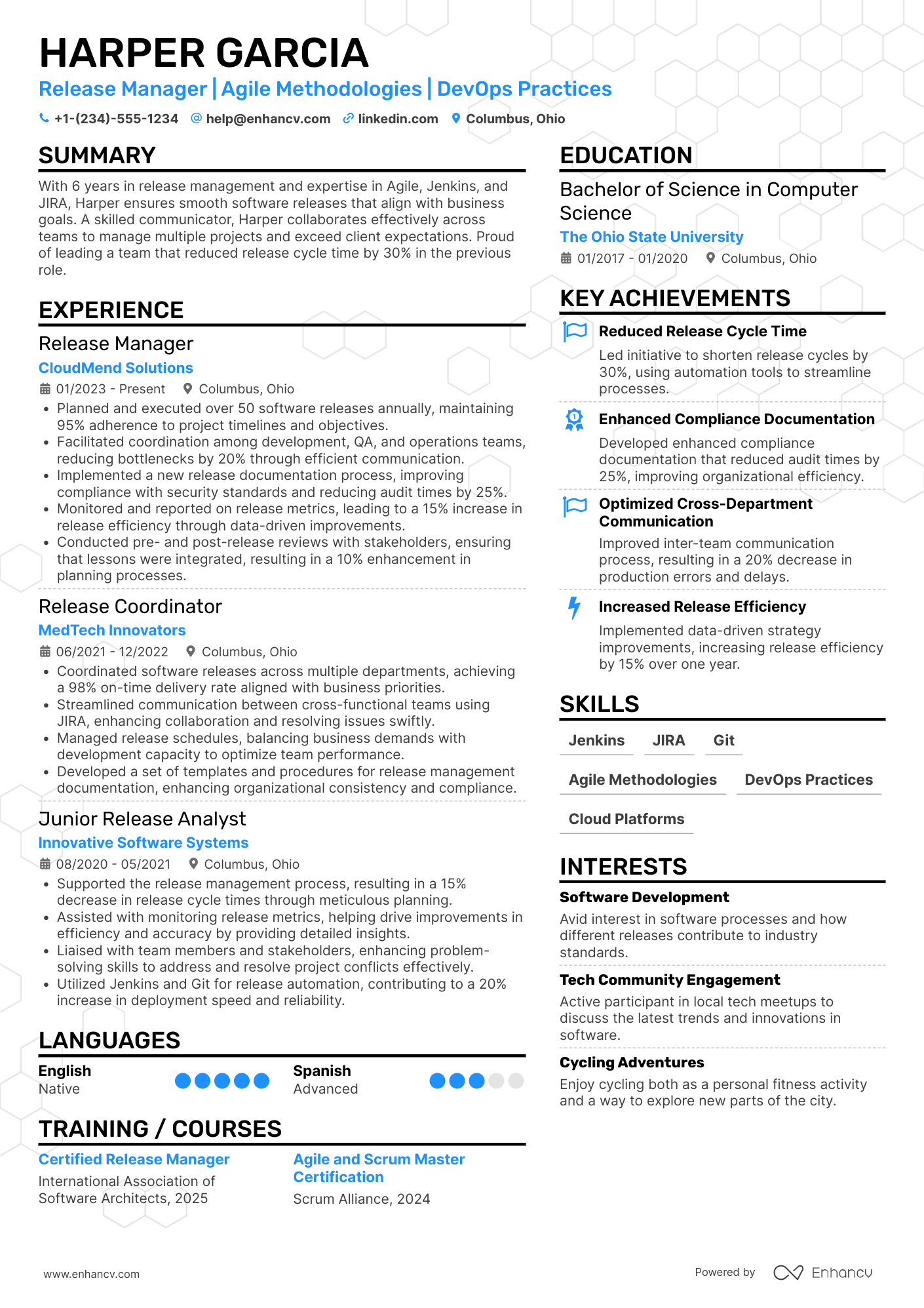
Release manager resume guides exist because many resumes fail to show ownership of release outcomes and risk. That gap gets you filtered by ATS keywords and skipped in fast recruiter scans in a crowded market.
A strong resume shows how you improved delivery, not just what tools you used. Knowing how to make your resume stand out means highlighting release cadence increases, lead time reductions, change failure rate drops, incident volume declines, and revenue or adoption protected through predictable launches.

Key takeaways
- Quantify release outcomes like deployment frequency, failure rates, and recovery time in every bullet.
- Use reverse-chronological format for senior roles to show clear career progression.
- Mirror exact tools, frameworks, and terminology from the job description to pass ATS screening.
- Anchor every listed skill to a specific project, tool, or measurable result.
- Place a skills section above experience when switching careers or entering the field.
- Write a three- to four-line summary that names your domain, tools, and top achievement.
- Use Enhancv's Bullet Point Generator to turn vague duties into measurable, recruiter-ready bullets.
Job market snapshot for release managers
We analyzed 75 recent release manager job ads across major US job boards. These numbers help you understand career growth patterns, role specialization trends, industry demand at a glance.
What level of experience employers are looking for release managers
| Years of Experience | Percentage found in job ads |
|---|---|
| 1–2 years | 2.7% (2) |
| 3–4 years | 20.0% (15) |
| 5–6 years | 8.0% (6) |
| 7–8 years | 9.3% (7) |
| 9–10 years | 9.3% (7) |
| 10+ years | 10.7% (8) |
| Not specified | 49.3% (37) |
Release manager ads by area of specialization (industry)
| Industry (Area) | Percentage found in job ads |
|---|---|
| Finance & Banking | 61.3% (46) |
| Healthcare | 16.0% (12) |
Role overview stats
These tables show the most common responsibilities and employment types for release manager roles. Use them to align your resume with what employers expect and to understand how the role is structured across the market.
Day-to-day activities and top responsibilities for a release manager
| Responsibility | Percentage found in job ads |
|---|---|
| Release management | 61.3% (46) |
| Agile | 38.7% (29) |
| Project management | 29.3% (22) |
| Sdlc | 28.0% (21) |
| Jira | 26.7% (20) |
| Itil | 25.3% (19) |
| Devops | 24.0% (18) |
| Change management | 22.7% (17) |
| Confluence | 22.7% (17) |
| Scrum | 22.7% (17) |
| Servicenow | 22.7% (17) |
| Ci/cd | 21.3% (16) |
Type of employment (remote vs on-site vs hybrid)
| Employment type | Percentage found in job ads |
|---|---|
| On-site | 78.7% (59) |
| Hybrid | 12.0% (9) |
| Remote | 9.3% (7) |
How to format a release manager resume
Recruiters evaluating release manager resumes prioritize evidence of cross-functional coordination, release cadence ownership, and process improvement across complex delivery pipelines. A clear, well-structured resume format ensures these signals surface quickly during both automated screening and manual review.

I have significant experience in this role—which format should I use?
Use a reverse-chronological format—it's the strongest choice for experienced release managers because it foregrounds your progression across increasingly complex release environments and delivery organizations. Do:
- Lead with scope and ownership: number of concurrent releases managed, team sizes coordinated, and environments overseen (staging, production, disaster recovery).
- Highlight release-specific tools and domains such as Jenkins, GitLab CI/CD, Jira, Octopus Deploy, change management frameworks, and ITIL processes.
- Quantify business impact through metrics like deployment frequency, rollback reduction, release cycle time, and incident rates tied to release quality.
I'm junior or switching into this role—what format works best?
A hybrid format works best because it lets you lead with relevant release coordination and CI/CD skills while still showing a concise work history that demonstrates transferable experience. Do:
- Place a dedicated skills section near the top featuring release management tools, version control systems, and deployment automation platforms you've used.
- Include projects or transitional experience such as coordinating software deployments, managing environment configurations, or supporting change advisory boards—even if these weren't your primary job title.
- Link every action to a clear outcome so recruiters see how your contributions affected release quality, team velocity, or system stability.
Why hybrid and functional resumes don't work for senior roles
Hybrid formats fragment your leadership narrative by splitting accomplishments between a skills summary and a shortened work history, making it harder for reviewers to see the full scope of your accountability across release organizations. Functional formats go further in the wrong direction—they obscure career progression entirely, strip leadership impact from its operational context, and prevent recruiters from evaluating how your decision ownership scaled over time. Avoid both formats entirely if you have three or more years of direct release management experience with clear role progression.
- Edge-case exception: A functional format may be acceptable only if you're transitioning into release management from a closely related discipline (such as DevOps engineering or build engineering) and lack formal release manager titles—but even then, every listed skill must be anchored to specific projects, tools, and measurable outcomes.
With your format established, the next step is filling it with the right sections to showcase your qualifications effectively.
What sections should go on a release manager resume
Recruiters expect to quickly find proof you can plan, coordinate, and deliver reliable releases across teams and environments. Understanding what to put on a resume for this role ensures you include the right details.
Use this structure for maximum clarity:
- Header
- Summary
- Experience
- Skills
- Projects
- Education
- Certifications
- Optional sections: Awards, Open-source work, Languages
Strong experience bullets should highlight release frequency improvements, reduced deployment risk, incident and rollback outcomes, cross-functional scope, and measurable delivery results.
Is your resume good enough?
Drop your resume here or choose a file. PDF & DOCX only. Max 2MB file size.
Once you’ve organized your resume with the right core components in place, the next step is to write your release manager resume experience section so it supports that structure with clear, role-relevant details.
How to write your release manager resume experience
The experience section is where you prove you can ship software reliably—highlight the release pipelines you've managed, the coordination methods you've used, and the measurable improvements you've driven in deployment frequency, defect rates, or cycle time. Hiring managers prioritize demonstrated impact over descriptive task lists, so every bullet should connect your work to a tangible outcome.
Each entry should include:
- Job title
- Company and location (or remote)
- Dates of employment (month and year)
Three to five concise bullet points showing what you owned, how you executed, and what outcomes you delivered:
- Ownership scope: the release trains, deployment pipelines, product lines, or environments you were directly accountable for, including the number of teams or services coordinated through each release cycle.
- Execution approach: the CI/CD platforms, version-control workflows, feature-flag systems, release orchestration tools, or change-management frameworks you relied on to plan, gate, and push releases.
- Value improved: the specific gains you drove in release cadence, rollback speed, deployment success rate, incident reduction, environment stability, or compliance adherence as a release manager.
- Collaboration context: how you partnered with engineering, QA, DevOps, product management, security, or external vendors to align release schedules, resolve blockers, and enforce go/no-go criteria.
- Impact delivered: the business-level results your release management produced—expressed through faster time-to-market, reduced downtime, improved customer satisfaction, or stronger audit readiness rather than a list of activities performed.
Experience bullet formula
A release manager experience example
✅ Right example - modern, quantified, specific.
Release Manager
NimbusPay | Austin, TX (Remote)
2021–Present
B2B payments platform supporting five million monthly transactions across North America with a microservices-based SaaS product.
- Orchestrated biweekly release trains across thirty-two microservices using Jira, Confluence, GitHub, and Jenkins, improving on-time delivery from eighty-two percent to ninety-six percent within two quarters.
- Implemented GitFlow, semantic versioning, and automated release notes via GitHub Actions and Confluence templates, cutting release prep time by forty percent and eliminating recurring documentation gaps.
- Standardized change management with ServiceNow (IT service management) workflows, risk scoring, and approval gates, reducing high-severity production incidents tied to releases by thirty percent year over year.
- Led cross-functional go/no-go readiness reviews with product managers, engineering leads, quality assurance, and customer support, shrinking rollback rate from four point one percent to one point six percent and lowering mean time to recovery by twenty-five percent.
- Built deployment dashboards in Datadog and Splunk with automated canary analysis and alerting, detecting regressions within ten minutes on average and preventing an estimated twelve hours per month of customer-impacting downtime.
Now that you've seen how a strong experience section comes together, let's look at how to adjust yours to match the specific job you're targeting.
How to tailor your release manager resume experience
Recruiters evaluate your release manager resume through applicant tracking systems and manual review, filtering for specific skills and experience. Tailoring your resume to the job description by mirroring the language and priorities in the job posting increases your chances of passing both screenings.
Ways to tailor your release manager experience:
- Match deployment tools and CI/CD platforms named in the job description.
- Mirror the exact terminology used for release processes or methodologies.
- Reflect KPIs or success criteria the posting highlights for releases.
- Include domain experience when the role specifies a particular industry.
- Emphasize compliance or security practices if the posting requires them.
- Align your workflow descriptions with collaboration models they reference.
- Highlight reliability or uptime achievements when availability is prioritized.
- Reference change management frameworks the organization follows by name.
The goal is to align your real accomplishments with what the role demands, not to artificially inject keywords where they don't belong.
Resume tailoring examples for release manager
| Job description excerpt | Untailored | Tailored |
|---|---|---|
| "Coordinate cross-functional release cycles using Jira and Jenkins, ensuring zero-downtime deployments across microservices architecture." | Managed software releases and worked with different teams to deploy updates. | Coordinated bi-weekly release cycles across 12 microservices using Jira and Jenkins CI/CD pipelines, achieving 99.9% uptime with zero-downtime deployment strategies. |
| "Own the release calendar, manage Go/No-Go decisions, and enforce change management policies aligned with ITIL frameworks." | Helped with release planning and made decisions about when to push code to production. | Owned the enterprise release calendar for three product lines, led Go/No-Go review boards with 15+ stakeholders, and enforced ITIL-aligned change management policies that reduced failed changes by 34%. |
| "Drive post-release validation and incident triage in partnership with SRE teams, using Datadog for monitoring and PagerDuty for escalation." | Monitored releases after deployment and helped resolve any issues that came up. | Led post-release validation and incident triage alongside SRE teams, leveraging Datadog dashboards and PagerDuty escalation workflows to cut mean time to resolution from 47 minutes to 18 minutes. |
Once you’ve aligned your experience with the role’s priorities, quantify your release manager achievements to show the measurable impact of that work.
How to quantify your release manager achievements
Quantifying your achievements proves you improved delivery, stability, and risk control. Track release frequency, lead time, change failure rate, rollback time, incident volume, automation coverage, and compliance outcomes across apps, teams, and environments.
Quantifying examples for release manager
| Metric | Example |
|---|---|
| Release throughput | "Increased production releases from two per week to five per week by standardizing Jira change templates and automating approvals in ServiceNow." |
| Lead time | "Cut release lead time from seven days to three days by implementing GitFlow, enforcing code freeze windows, and using Azure DevOps pipelines for deployments." |
| Change failure rate | "Reduced change failure rate from twelve percent to five percent by adding smoke tests in Jenkins and tightening go or no-go criteria." |
| Incident impact | "Lowered post-release Sev-1 incidents from six per quarter to two per quarter by improving release notes, runbooks, and on-call handoffs in PagerDuty." |
| Compliance risk | "Passed three SOC 2 change-management audits with zero findings by enforcing evidence capture in ServiceNow and maintaining a complete deployment trail in Git." |
Turn vague job duties into measurable, recruiter-ready resume bullets in seconds with Enhancv's Bullet Point Generator.
Once you've crafted strong bullet points that highlight your accomplishments, the next step is ensuring your resume also showcases the right mix of hard and soft skills that hiring managers expect from a release manager.
How to list your hard and soft skills on a release manager resume
Your skills section shows you can plan, coordinate, and ship releases reliably, and recruiters and applicant tracking systems (ATS) scan this section for keyword matches and role fit—aim for a balanced mix of technical release capabilities and execution-focused collaboration skills. Release manager roles require a blend of hard skills and soft skills, including:
- Product strategy and discovery skills.
- Data, analytics, and experimentation skills.
- Delivery, execution, and go-to-market discipline.
- Soft skills.
Your skills section should be:
- Scannable (bullet-style grouping).
- Relevant to the job post.
- Backed by proof in experience bullets.
- Updated with current tools.
Place your skills section:
- Above experience if you're junior or switching careers.
- Below experience if you're mid/senior with strong achievements.

Hard skills
- Release planning and calendaring
- Change management, CAB governance
- Jira, Confluence, ServiceNow
- Git, GitHub, GitLab
- CI/CD pipelines, Jenkins, GitHub Actions
- Azure DevOps, Bitbucket, Bamboo
- Feature flags, LaunchDarkly
- Semantic versioning, release notes
- Environment management, deployment runbooks
- Incident management, PagerDuty
- Monitoring and logging, Datadog, Splunk
- Risk assessment and rollback planning
Soft skills
- Cross-functional release coordination
- Stakeholder alignment and updates
- Scope and risk trade-off decisions
- Clear go or no-go calls
- Escalation and issue triage
- Dependency mapping and follow-through
- Leading release readiness reviews
- Conflict resolution across teams
- Calm execution under pressure
- Driving accountability to deadlines
- Writing crisp release communications
- Continuous process improvement ownership
How to show your release manager skills in context
Skills shouldn't live only in a dedicated skills list. Browse resume skills examples to see how other professionals integrate them throughout their resumes.
They should be demonstrated in:
- Your summary (high-level professional identity)
- Your experience (proof through outcomes)
Here's how that looks in practice.
Summary example
Release manager with 10+ years in fintech, skilled in CI/CD pipelines, Jenkins, and cross-team coordination. Reduced deployment failures by 35% through automated release gates and standardized rollback procedures across distributed engineering teams.
- Signals senior-level experience immediately
- Names specific tools and methods
- Leads with a measurable outcome
- Highlights cross-team collaboration skills
Experience example
Senior Release Manager
Vantage Systems | Remote
March 2019–Present
- Orchestrated 200+ production releases annually using Jenkins and GitLab CI, cutting average deployment time by 40% across eight engineering squads.
- Partnered with QA, DevOps, and product teams to build automated release validation checks, reducing post-release defects by 28%.
- Designed a release readiness framework in Jira and Confluence that improved cross-functional handoff efficiency by 33%.
- Every bullet includes measurable proof
- Skills surface naturally through real outcomes
Once you’ve demonstrated your release management strengths through specific examples and outcomes, the next step is applying that approach to a resume when you lack direct experience.
How do I write a release manager resume with no experience
Even without full-time experience, you can demonstrate readiness for a release manager role. Our guide on writing a resume without work experience covers this in depth, but here are key approaches:
- Internship supporting release schedules.
- Capstone project with CI/CD.
- Volunteer deployment coordination for nonprofit.
- Open-source release notes and tagging.
- Personal lab using Git branching.
- Change management documentation for class.
- QA test planning for a project.
- IT help desk incident tracking.
Focus on:
- Release planning with clear timelines.
- CI/CD pipelines and version control.
- Change control and rollback plans.
- Metrics: defects, lead time, uptime.
Resume format tip for entry-level release manager
Use a hybrid resume format, since it highlights relevant projects and tools while still showing work history, even if it is unrelated. Do:
- Put a "Projects" section above experience.
- List tools: Jira, Git, Jenkins.
- Quantify results: frequency, defects, downtime.
- Show release artifacts: notes, checklists.
- Tailor keywords to each job post.
- Coordinated a capstone CI/CD release in Jenkins and Git with Jira tracking, cutting deployment time from twenty minutes to eight minutes and reducing failed builds by 30%.
Even without direct experience, your educational background can strengthen your release manager resume—here's how to present it effectively.
How to list your education on a release manager resume
Your education section helps hiring teams confirm you have the foundational technical and project management knowledge a release manager needs. It validates your academic background quickly.
Include:
- Degree name
- Institution
- Location
- Graduation year
- Relevant coursework (for juniors or entry-level candidates)
- Honors & GPA (if 3.5 or higher)
Skip month and day details—list the graduation year only.
Here's a strong education entry tailored for a release manager resume.
Example education entry
Bachelor of Science in Computer Science
Georgia Institute of Technology, Atlanta, GA
Graduated 2019
GPA: 3.7/4.0
- Relevant Coursework: Software Engineering, DevOps Principles, Systems Architecture, Agile Project Management
- Honors: Magna Cum Laude, Dean's List (six semesters)
How to list your certifications on a release manager resume
Certifications on a resume show a release manager's commitment to learning, proficiency with release tools, and alignment with industry standards. They also signal you can manage risk, compliance, and delivery quality across teams.
Include:
- Certificate name
- Issuing organization
- Year
- Optional: credential ID or URL
- Place certifications below education when your degree is recent and more relevant than your credentials.
- Place certifications above education when they are recent, role-specific, or required for the release manager role.
Best certifications for your release manager resume
Project Management Professional (PMP) Certified ScrumMaster (CSM) ITIL 4 Foundation AWS Certified DevOps Engineer—Professional Microsoft Certified: DevOps Engineer Expert Certified Kubernetes Administrator (CKA) SAFe Release Train Engineer (RTE)
Once you’ve positioned your credentials where recruiters can find them fast, use your release manager resume summary to connect those qualifications to the impact you deliver.
How to write your release manager resume summary
Your resume summary is the first thing a recruiter reads. A sharp, specific opening sets the tone and earns a closer look at the rest of your release manager resume.
Keep it to three to four lines, with:
- Your title and total years of experience in release management or related roles.
- The domain or industry you've worked in, such as SaaS, fintech, or e-commerce.
- Core tools and skills like Jenkins, Git, Jira, or CI/CD pipeline orchestration.
- One or two measurable achievements, such as reduced deployment failures or faster release cycles.
- Soft skills tied to real outcomes, like cross-team coordination that shortened go-live timelines.

PRO TIP
At a mid-level release manager position, focus on technical depth and process improvements you've driven. Highlight specific tools you've used and measurable gains in release frequency or stability. Avoid vague descriptors like "passionate" or "motivated self-starter." Recruiters want evidence, not enthusiasm.
Example summary for a release manager
Release manager with four years of experience orchestrating CI/CD pipelines in SaaS environments. Reduced deployment failures by 35% through standardized release workflows using Jenkins and Jira.
Optimize your resume summary and objective for ATS
Drop your resume here or choose a file.
PDF & DOCX only. Max 2MB file size.
Now that your summary effectively communicates your value, make sure the header framing it presents your contact details and professional identity with the same level of precision.
What to include in a release manager resume header
Your resume header lists your key identifying and contact details, which boosts visibility, builds credibility, and speeds recruiter screening for a release manager role.
Essential resume header elements
- Full name
- Tailored job title and headline
- Location
- Phone number
- Professional email
- GitHub link
- Portfolio link
A LinkedIn link helps recruiters verify experience quickly and supports screening across employers, dates, and responsibilities.
Don't include a photo on a release manager resume unless the role is explicitly front-facing or appearance-dependent.
Match your header title to the job posting and align your links with release notes, deployment scripts, and change management documentation.
Example
Release manager resume header
Jordan Lee
Release manager | Coordinated production releases across web and mobile platforms
Austin, TX
(512) 555-01XX
jordan.lee@enhancv.com
github.com/jordanlee
jordanlee.com
linkedin.com/in/jordanlee
Once your contact details and role-specific headline are set, add optional sections that reinforce the same qualifications and make your resume more complete.
Additional sections for release manager resumes
When your core sections look similar to other candidates, additional sections can set you apart with role-specific credibility. For example, listing language skills can be valuable if you coordinate releases across international teams.
- Languages
- Certifications (Agile, ITIL, DevOps)
- Technical tools and platforms
- Publications and conference talks
- Volunteering and mentorship
- Hobbies and interests
- Professional affiliations
Once you've rounded out your resume with the right supplementary sections, the next step is pairing it with a strong cover letter to complete your application.
Do release manager resumes need a cover letter
A cover letter isn't required for a release manager resume, but it helps in competitive searches or when hiring managers expect one. If you're unsure what a cover letter is or when to use one, it can make a difference when your resume needs context or your fit isn't obvious.
Use a cover letter to add details your resume can't:
- Explain role and team fit: Match your release manager approach to their cadence, tooling, and cross-functional setup.
- Highlight one or two outcomes: Name a project, your role, and a measurable result like fewer failed deployments or faster release cycles.
- Show product and business understanding: Connect release decisions to user impact, risk, compliance, or revenue.
- Address transitions or non-obvious experience: Clarify a move into release manager work, a gap, or transferable delivery and coordination experience.
Drop your resume here or choose a file.
PDF & DOCX only. Max 2MB file size.
Even if you decide a cover letter won’t add value to your application, using AI to improve your release manager resume is the next step to strengthen what hiring teams will review first.
Using AI to improve your release manager resume
AI can sharpen your resume's clarity, structure, and impact. It helps tighten language and highlight measurable results. But overuse kills authenticity. Once your content feels clear and role-aligned, step away from AI. For specific guidance, explore ChatGPT resume writing prompts tailored to different resume sections.
Here are 10 practical prompts to strengthen specific sections of your release manager resume:
- Strengthen your summary. "Rewrite my release manager resume summary to highlight leadership in coordinating cross-functional deployments with measurable outcomes in two to three sentences."
- Quantify experience bullets. "Add specific metrics to these release manager experience bullets, focusing on deployment frequency, downtime reduction, and cycle time improvements."
- Align skills to job posts. "Compare my release manager skills section against this job description and suggest missing technical or process-related keywords."
- Tighten bullet clarity. "Rewrite these release manager experience bullets using strong action verbs and remove any vague or redundant phrasing."
- Improve project descriptions. "Revise this release manager project section to clearly state my role, tools used, team size, and the delivery outcome."
- Refine certification entries. "Format my release manager certifications section consistently, listing credential name, issuing body, and year earned."
- Tailor education relevance. "Highlight coursework or achievements in my education section that directly relate to release manager responsibilities."
- Eliminate filler language. "Identify and remove filler words, passive voice, and generic phrases from my release manager resume."
- Focus on tooling expertise. "Reorganize my release manager skills section to group CI/CD tools, version control platforms, and project management software separately."
- Target career progression. "Rewrite my release manager experience section to show clear growth from coordination roles into strategic release ownership."
Stop using AI once your resume sounds accurate, specific, and aligned with real experience. AI should never invent experience or inflate claims—if it didn't happen, it doesn't belong here.
Conclusion
A strong release manager resume shows measurable outcomes, role-specific skills, and a clean structure. It highlights release cadence improvements, fewer incidents, faster recovery, and better delivery predictability. It stays easy to scan, with clear sections and consistent formatting.
Keep your release manager experience aligned to today’s hiring market by showing impact across teams and tools. Your resume should prove you can plan, coordinate, automate, and communicate releases with control and speed. Done well, it signals you’re ready to deliver now and adapt next.