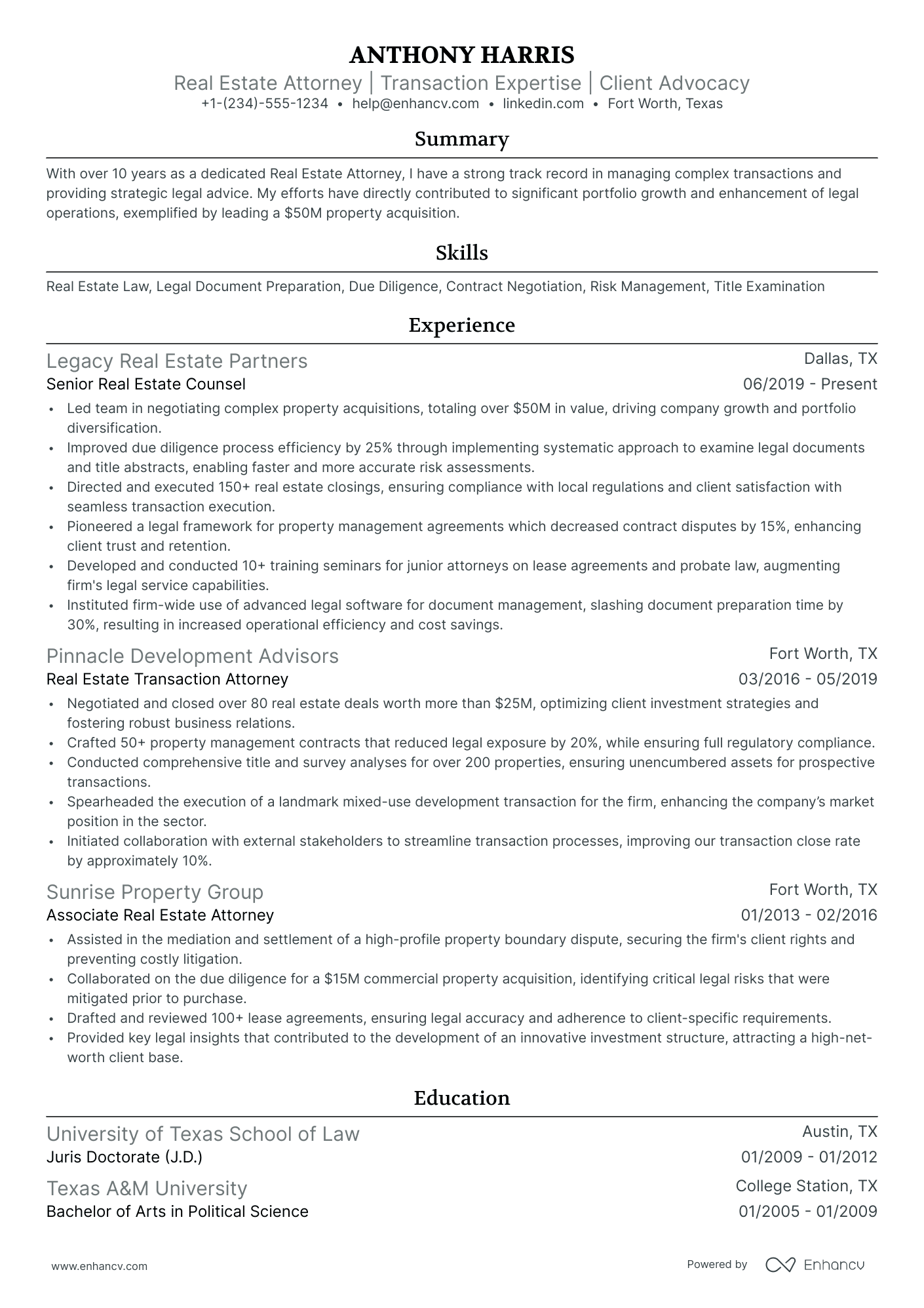
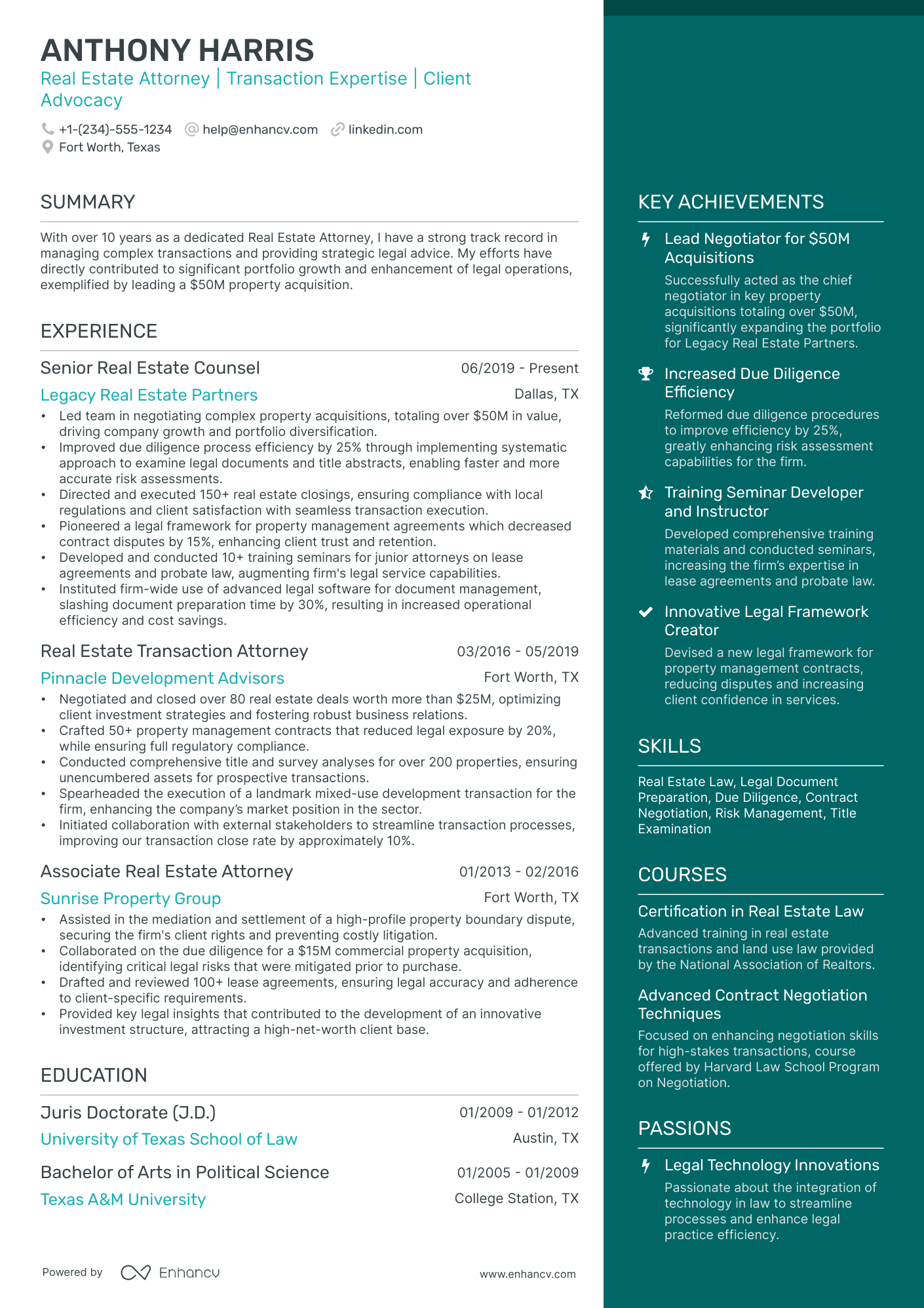
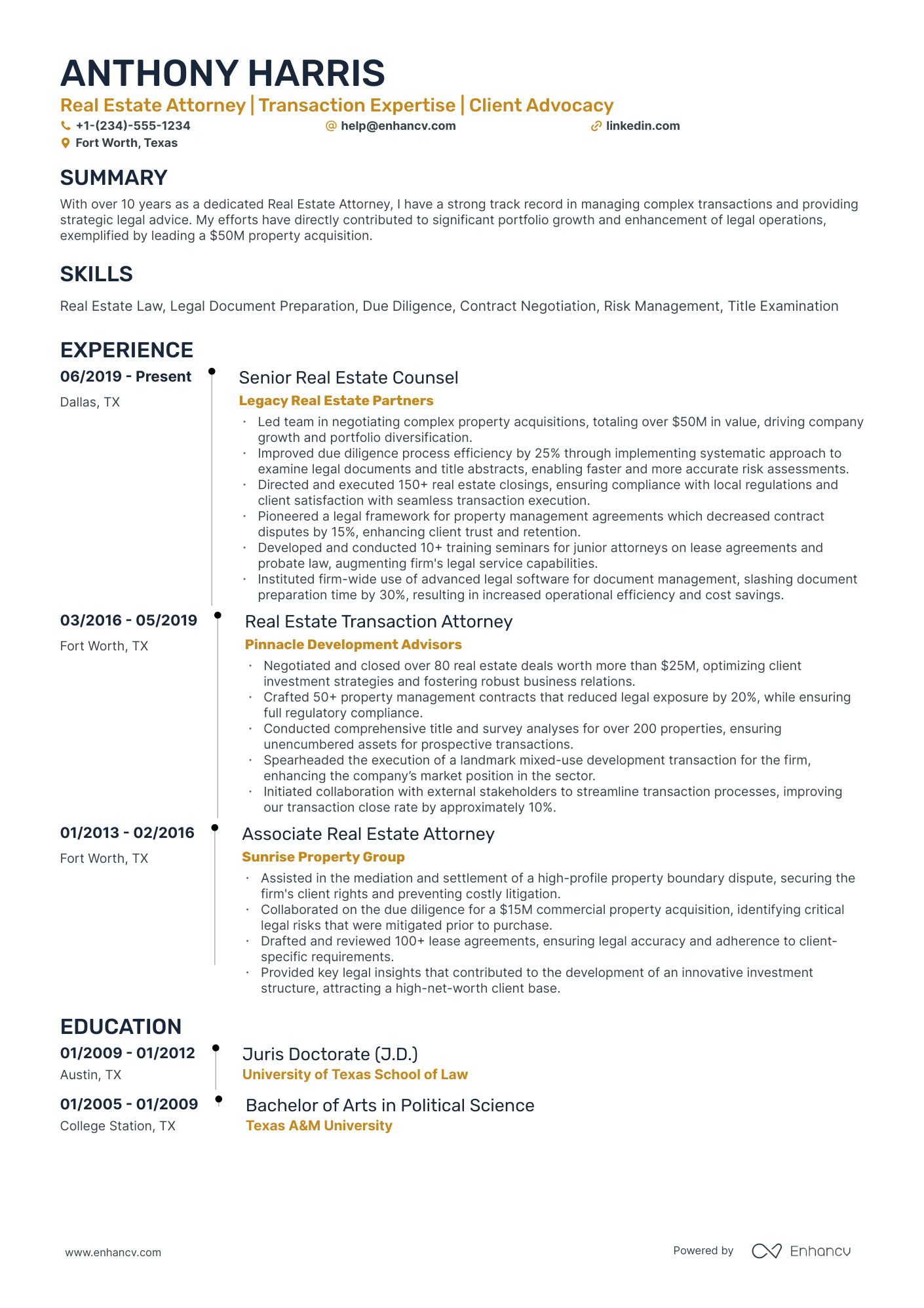
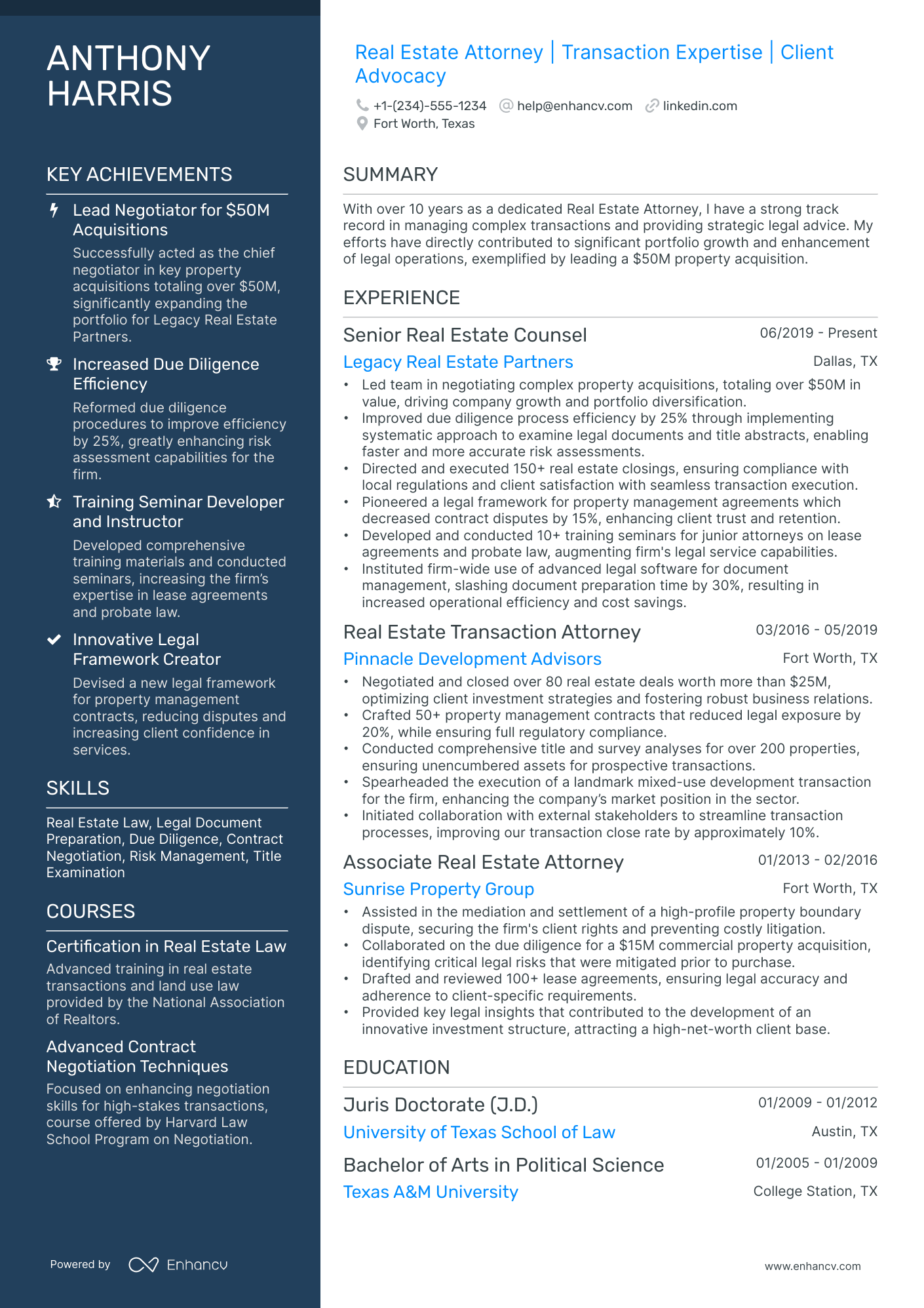
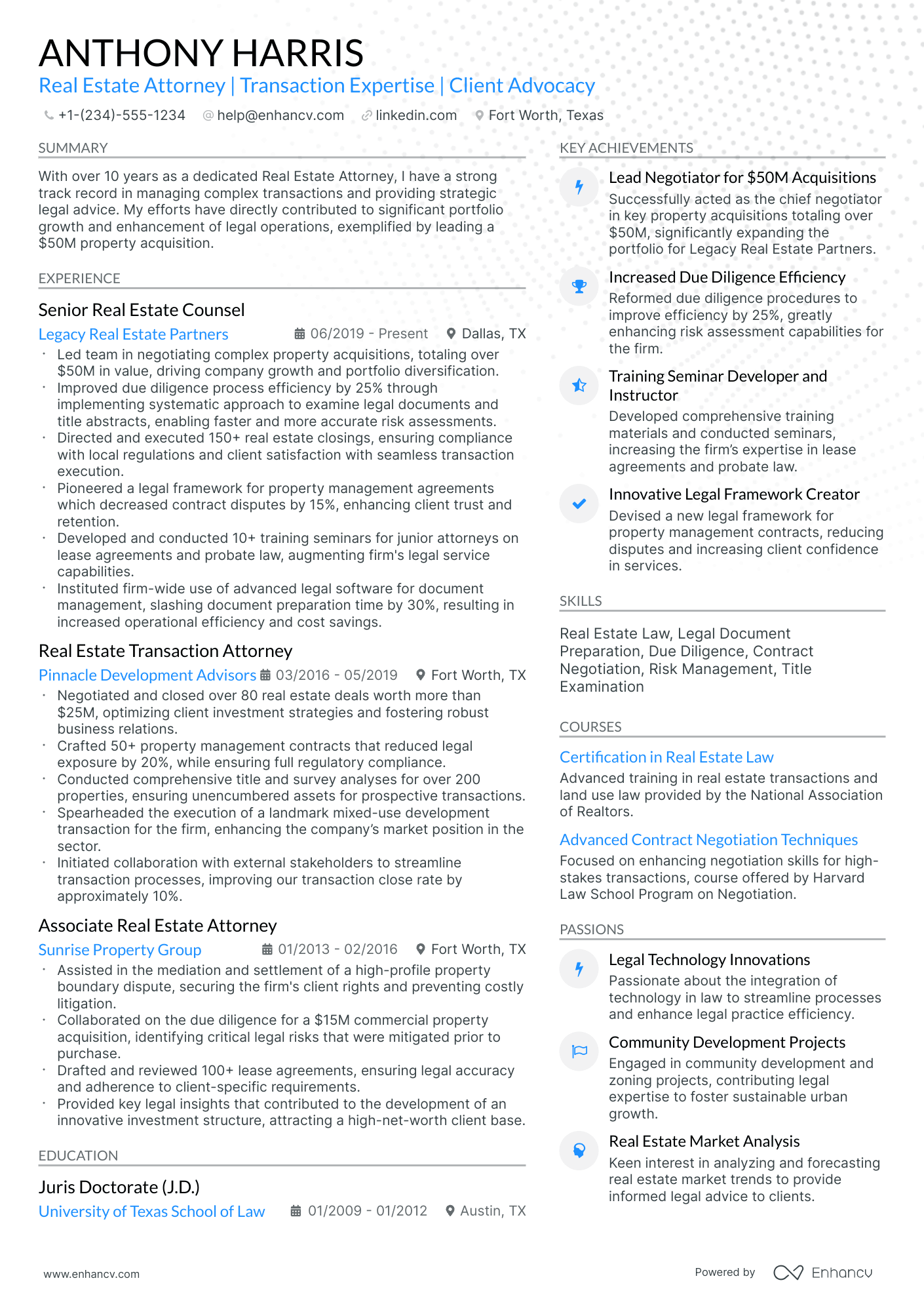
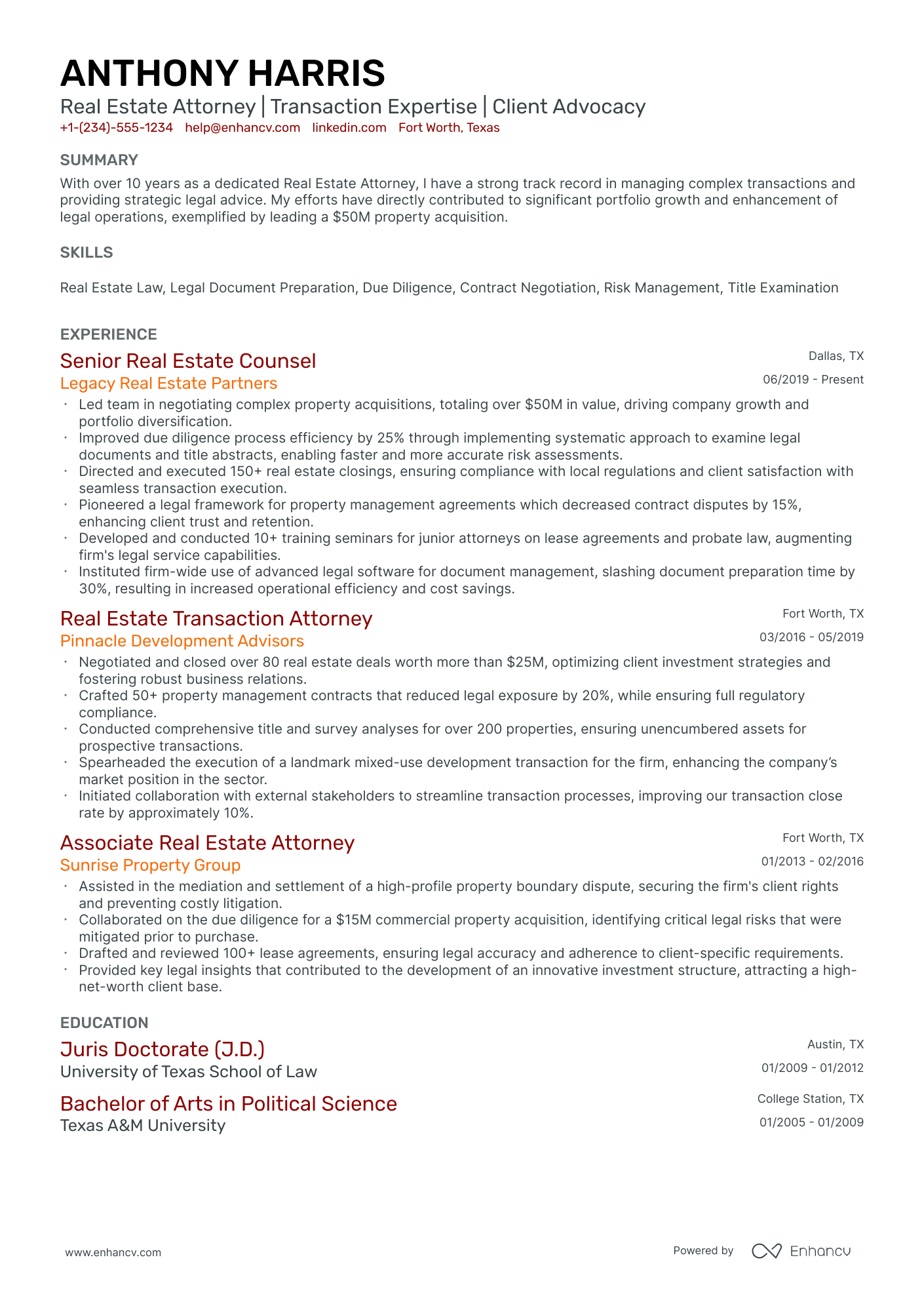
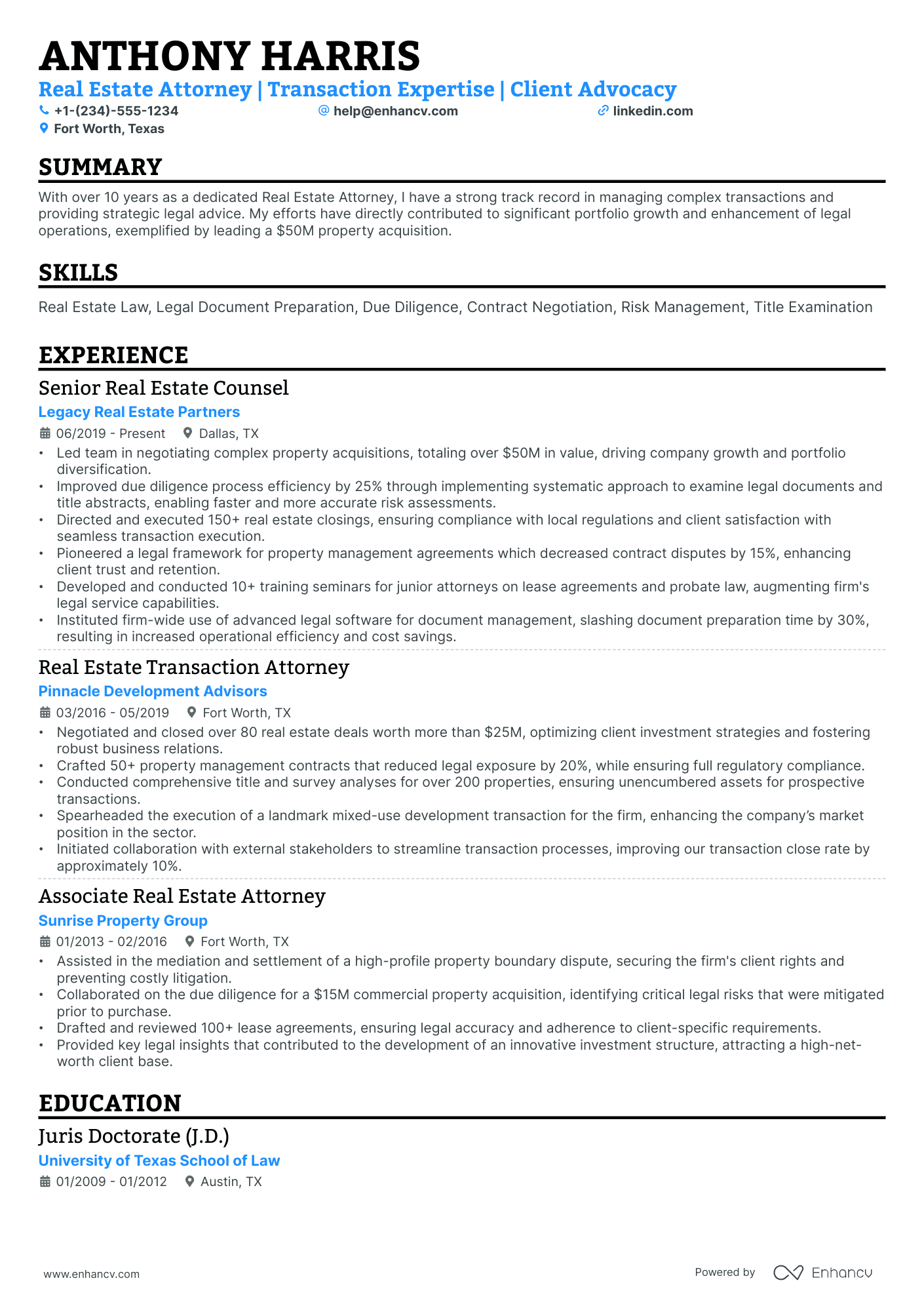
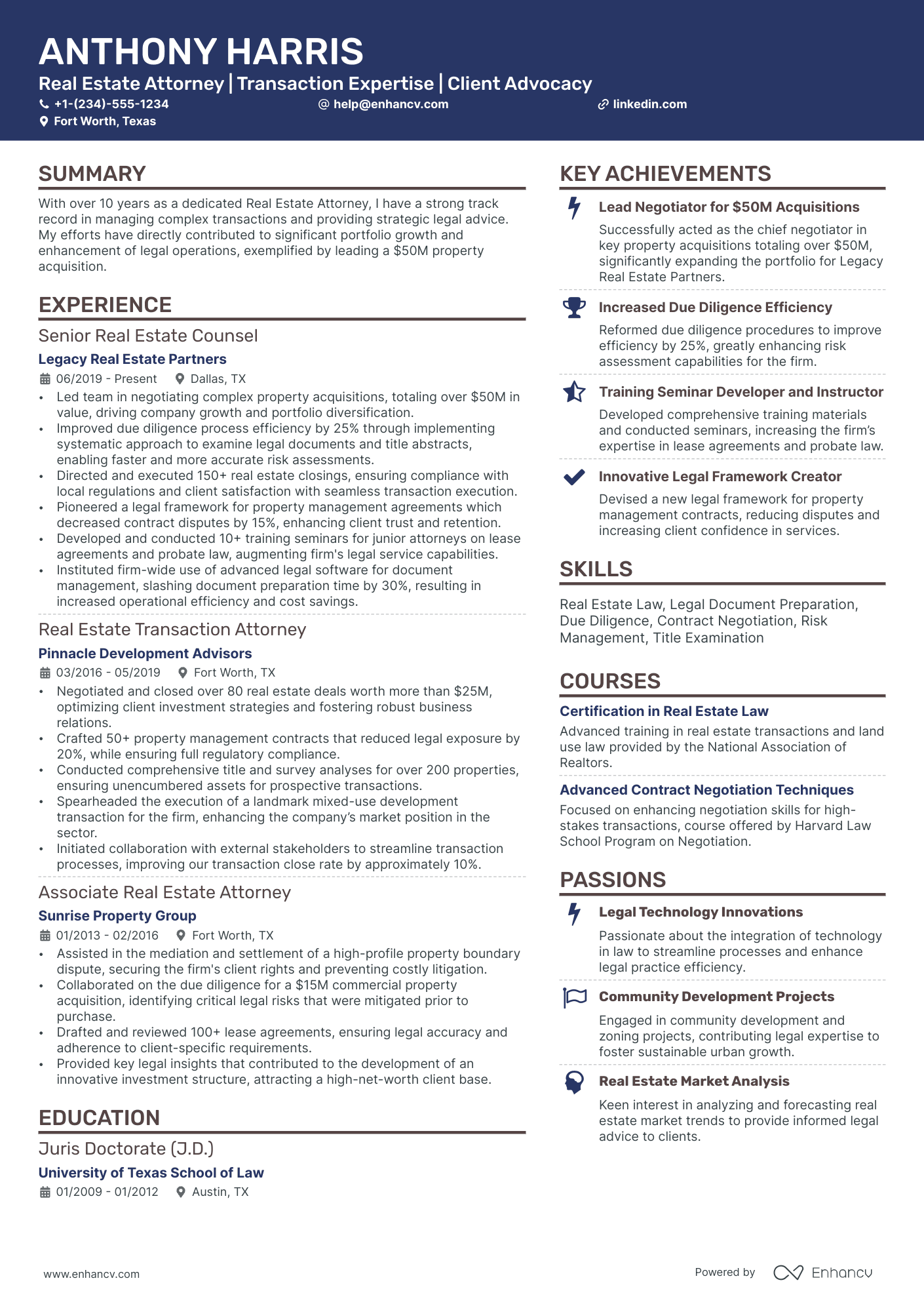
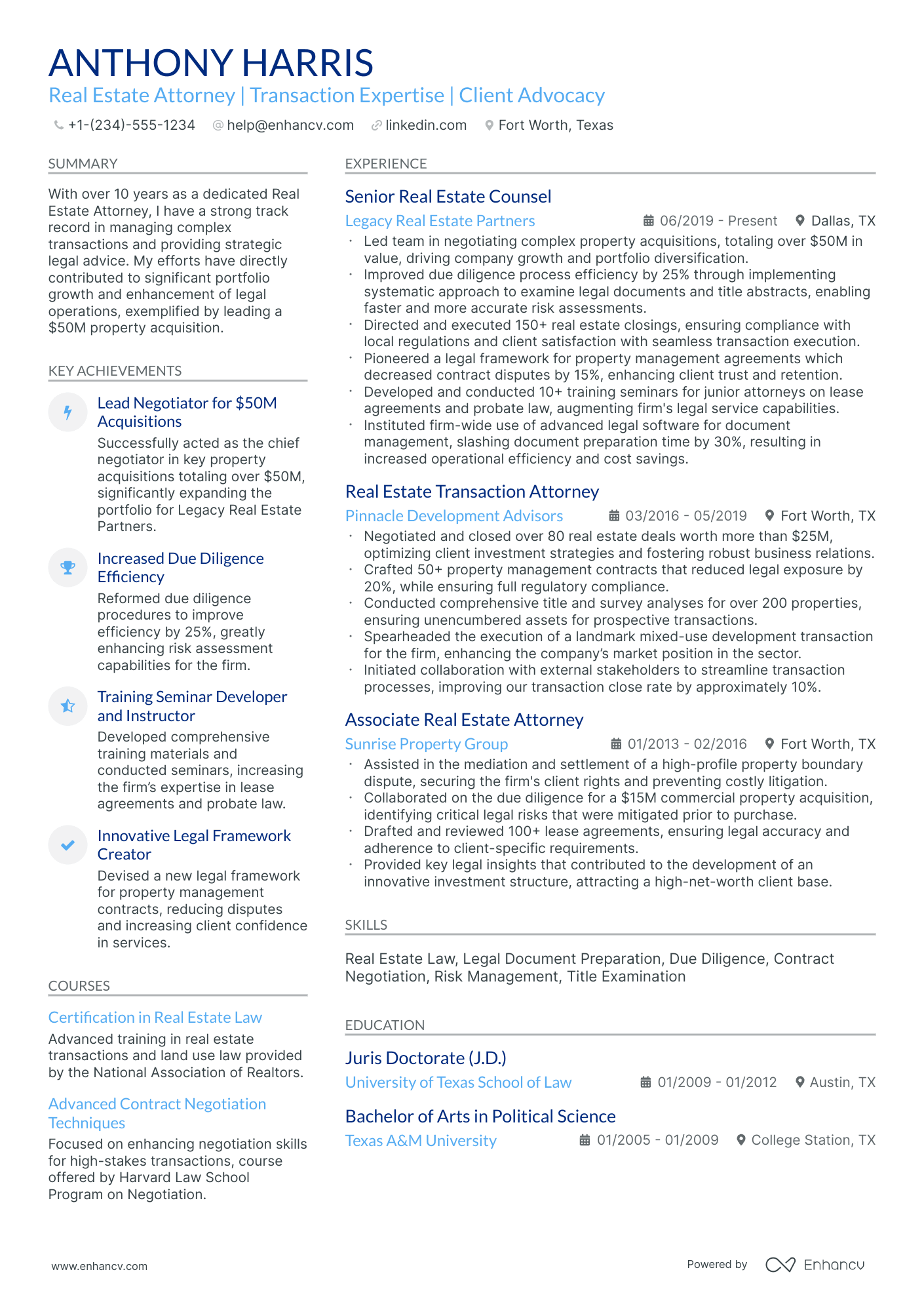
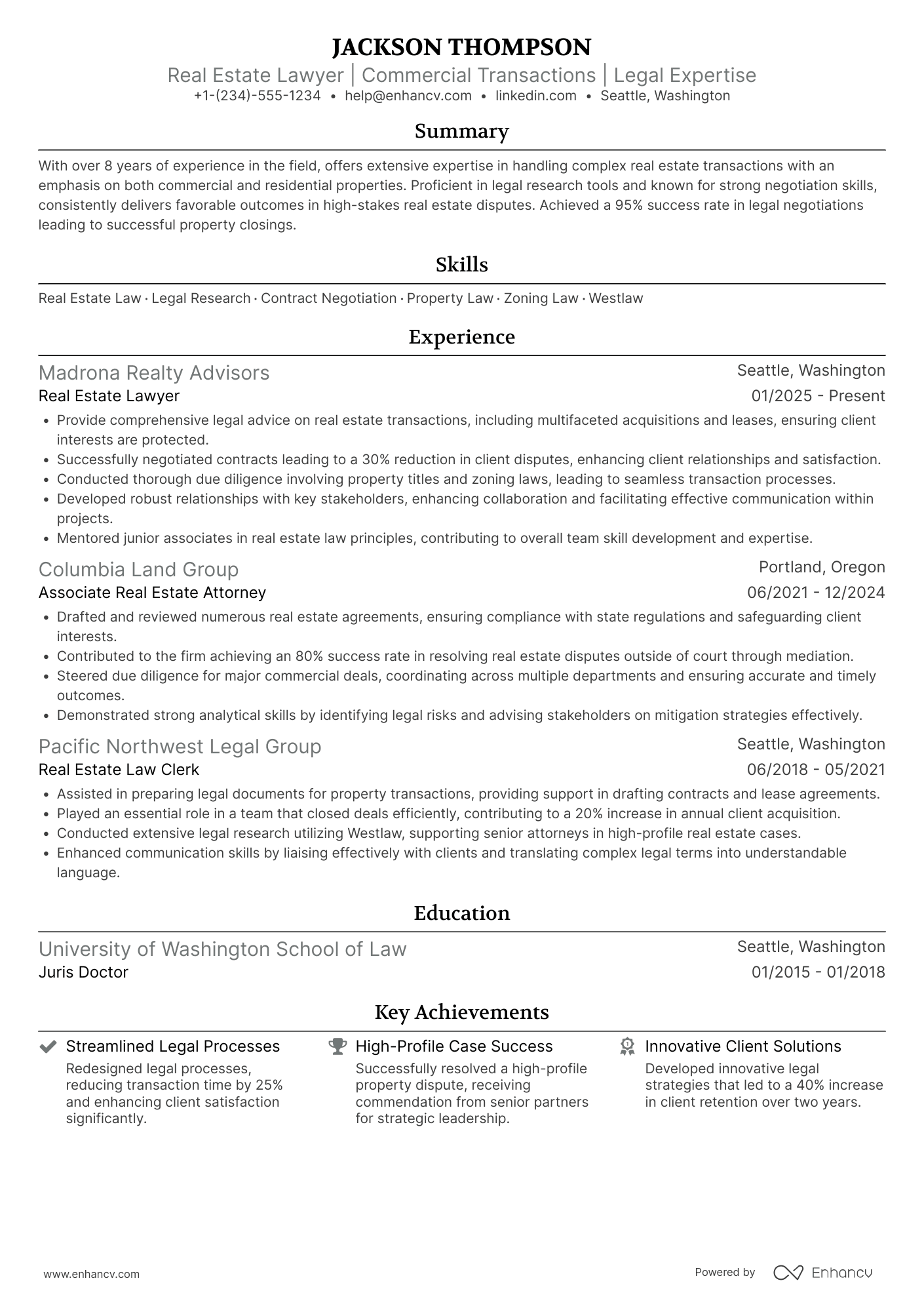
Many real estate lawyer resume drafts fail because they read like matter logs, burying deal value and risk outcomes. That costs you in applicant tracking system filters and fast recruiter scans, especially when competition is tight.
A strong resume shows what changed because of your work. Understanding how to make your resume stand out means highlighting transaction values closed, title defects resolved, zoning approvals secured, closings delivered on schedule, disputes avoided, and compliance issues prevented. Quantify portfolio size, turnaround time, and error rates.

Key takeaways
- Quantify deal volume, transaction value, and closing timelines in every experience bullet.
- Use reverse-chronological format if you have substantial real estate law experience.
- Tailor resume language to mirror each job posting's terminology and priorities.
- Demonstrate skills through measurable outcomes in your summary and experience sections.
- Lead with a projects or skills section if you lack full-time real estate law experience.
- Place certifications strategically—above education when they're recent and role-relevant.
- Build your resume faster with Enhancv, then refine bullets until they reflect real results.
How to format a real estate lawyer resume
Recruiters evaluating real estate lawyer resumes prioritize deal experience, transaction volume, client advisory depth, and demonstrated knowledge of property law, zoning, title work, and commercial or residential closings. Choosing the right resume format ensures these signals surface quickly, both for human reviewers scanning for relevant practice areas and for applicant tracking systems parsing your credentials.

I have significant experience in this role—which format should I use?
Use a reverse-chronological format to showcase your depth of real estate law experience and the progression of your practice. Do:
- Lead each role entry with scope indicators: deal size, client type (institutional, private, municipal), and practice area breadth such as acquisitions, dispositions, leasing, land use, or title insurance.
- Highlight domain-specific tools and competencies, including title examination platforms, due diligence coordination, escrow management, and familiarity with state-specific real property statutes and UCC filings.
- Quantify outcomes and business impact wherever possible—closed deal volume, portfolio value managed, timelines accelerated, or risk exposure reduced.
I'm junior or switching into this role—what format works best?
Use a hybrid format that leads with a focused skills section and follows with a concise employment history to bridge experience gaps. Do:
- Place core real estate law competencies—title review, lease analysis, contract drafting, zoning compliance—at the top of the resume so recruiters and ATS systems register them immediately.
- Feature relevant projects, internships, law school clinics, or transitional experience such as transactional work in adjacent practice areas (corporate, banking, or land use).
- Connect each skill or project to a specific action and a measurable or observable result.
Why not use a functional resume?
A functional format strips away the timeline and context that hiring managers rely on to assess how your real estate law skills were applied, under what deal conditions, and with what level of responsibility—making it harder to evaluate your candidacy against peers with clearly documented practice history. A functional resume may be acceptable if you're transitioning from a related practice area, have a limited work history, or are re-entering the profession after a gap, but only if every listed skill is tied directly to a specific project, transaction, or documented outcome rather than presented as a standalone claim.
With your format established, the next step is determining which sections to include so each one reinforces your qualifications effectively.
What sections should go on a real estate lawyer resume
Recruiters expect to see clear evidence that you can handle real estate transactions, manage risk, and protect clients' interests end to end. Knowing what to put on a resume is critical for structuring yours effectively. Use this structure for maximum clarity:
- Header
- Summary
- Experience
- Skills
- Projects
- Education
- Certifications
- Optional sections: Awards, Publications, Languages
Strong experience bullets should emphasize deal volume and value, transaction complexity, risk mitigation, negotiated outcomes, and measurable results for clients.
Is your resume good enough?
Drop your resume here or choose a file. PDF & DOCX only. Max 2MB file size.
Once you’ve organized your resume with the right components in the right order, focus next on writing your real estate lawyer experience section to show impact within that structure.
How to write your real estate lawyer resume experience
The experience section is where you prove you've delivered meaningful legal work—not just participated in it. Hiring managers reviewing real estate lawyer resumes prioritize demonstrated impact, such as transactions closed, disputes resolved, and risks mitigated, over generic descriptions of daily responsibilities. Building a targeted resume ensures every bullet point speaks directly to what the employer needs.
Each entry should include:
- Job title
- Company and location (or remote)
- Dates of employment (month and year)
Three to five concise bullet points showing what you owned, how you executed, and what outcomes you delivered:
- Ownership scope: the transaction types, property portfolios, client accounts, practice areas, or legal teams you were directly accountable for as a real estate lawyer.
- Execution approach: the due diligence frameworks, title review processes, contract drafting methods, negotiation strategies, or legal research tools you used to structure and close real estate matters.
- Value improved: changes to closing timelines, contract accuracy, regulatory compliance, risk exposure, or client retention that resulted from your legal counsel on real estate transactions.
- Collaboration context: how you coordinated with lenders, title companies, brokers, municipal agencies, opposing counsel, or internal departments to advance property transactions and resolve disputes.
- Impact delivered: outcomes expressed through deal volume, portfolio value protected, litigation results, or regulatory outcomes rather than a list of tasks you performed.
Experience bullet formula
A real estate lawyer experience example
✅ Right example - modern, quantified, specific.
Real Estate Attorney
Crestline Property Law Group | Austin, TX
2021–Present
Boutique real estate firm supporting developers, lenders, and institutional investors across Texas on commercial acquisitions, leasing, and financing.
- Led due diligence and risk review for forty-two commercial acquisitions totaling $310M, using iManage, NetDocuments, and Excel trackers to cut issue-resolution cycle time by twenty-eight percent and reduce post-close claims to zero.
- Drafted and negotiated purchase and sale agreements, loan documents, and title objection letters in collaboration with lenders, title officers, and outside counsel, reducing average closing timelines from forty-five to thirty-four days.
- Managed title and survey review (ALTA/NSPS) and resolved encroachments, easements, and zoning conflicts by coordinating with surveyors and municipal planning staff, lowering deal-kill issues by fifteen percent.
- Implemented standardized lease playbooks and clause libraries in Microsoft Word and Contract Express, improving first-pass markup acceptance by twenty-two percent and saving an estimated nine hours per transaction for partners and paralegals.
- Directed closing workflows in Clio Manage with automated checklists and calendar controls, ensuring one hundred percent on-time filings and cutting recording rejections by forty percent through tighter document QC with county clerks and title companies.
Now that you've seen how a strong experience section looks in practice, let's break down how to customize yours to match the specific role you're targeting.
How to tailor your real estate lawyer resume experience
Recruiters evaluate your real estate lawyer resume through both human review and applicant tracking systems. Tailoring your resume to the job description ensures you pass both screenings.
Ways to tailor your real estate lawyer experience:
- Match specific title examination software or platforms named in the posting.
- Mirror the exact terminology used for closing and settlement processes.
- Reflect transaction volume or deal size metrics the employer prioritizes.
- Highlight commercial or residential domain experience the role requires.
- Emphasize regulatory compliance and due diligence standards mentioned.
- Include referenced collaboration models with lenders or title companies.
- Align your zoning or land use expertise with stated practice areas.
- Reference contract negotiation frameworks or workflows the posting describes.
Tailoring means aligning your real accomplishments with what the employer needs rather than forcing keywords where they don't belong.
Resume tailoring examples for real estate lawyer
| Job description excerpt | Untailored | Tailored |
|---|---|---|
| "Negotiate and draft purchase and sale agreements, lease agreements, and easements for commercial properties across multiple states" | Drafted legal documents for various real estate transactions. | Negotiated and drafted purchase and sale agreements, commercial lease agreements, and easements for properties across 12 states, closing over $180M in transactions annually. |
| "Conduct due diligence reviews, including title searches, zoning compliance, and environmental assessments using RealQuest and ALTA surveys" | Performed research and due diligence for real estate deals. | Conducted due diligence reviews—including title searches, zoning compliance analyses, and Phase I environmental assessments—using RealQuest and ALTA survey standards for 40+ commercial acquisitions per year. |
| "Represent clients in closings and resolve title defects, lien disputes, and boundary issues in coordination with title companies and surveyors" | Helped clients resolve legal issues related to property matters. | Represented buyers and sellers at closings, resolving 95% of title defects, lien disputes, and boundary issues pre-closing through direct coordination with title companies, surveyors, and municipal offices. |
Once you’ve aligned your experience with the role’s priorities, quantify your real estate lawyer achievements to show the measurable impact behind those choices.
How to quantify your real estate lawyer achievements
Quantifying your achievements proves business impact beyond legal knowledge. Focus on deal volume, cycle time, risk reduction, compliance accuracy, and dollars protected or generated across transactions, leases, financing, and title matters.
Quantifying examples for real estate lawyer
| Metric | Example |
|---|---|
| Deal volume | "Closed 38 commercial acquisitions totaling $412M in twelve months, coordinating counsel, lenders, and title to meet all closing deadlines." |
| Cycle time | "Cut average lease negotiation time from 21 to 14 days by standardizing clauses and using Microsoft Word redlines and a clause library." |
| Risk reduction | "Reduced title defect escalations by 30% by implementing a pre-closing checklist with title company partners across 120 closings." |
| Compliance accuracy | "Achieved 98% first-pass approval on zoning and permitting submissions by aligning filings with municipal requirements and tracking changes weekly." |
| Dollars protected | "Recovered $1.6M in tenant reimbursements and CAM charges by auditing lease abstracts and reconciling invoices across 24 properties." |
Turn vague job duties into measurable, recruiter-ready resume bullets in seconds with Enhancv's Bullet Point Generator.
With strong bullet points in place, the next step is ensuring your skills section presents the right mix of hard and soft skills that real estate law employers are looking for.
How to list your hard and soft skills on a real estate lawyer resume
Your skills section shows you can manage transactions, mitigate risk, and close deals; recruiters and ATS (applicant tracking system) scan this section for role-matched keywords, then validate them in your experience, so aim for a balanced mix of hard skills and execution-focused soft skills. real estate lawyer roles require a blend of:
- Product strategy and discovery skills.
- Data, analytics, and experimentation skills.
- Delivery, execution, and go-to-market discipline.
- Soft skills.
Your skills section should be:
- Scannable (bullet-style grouping).
- Relevant to the job post.
- Backed by proof in experience bullets.
- Updated with current tools.
Place your skills section:
- Above experience if you're junior or switching careers.
- Below experience if you're mid/senior with strong achievements.

Hard skills
- Purchase and sale agreements
- Commercial lease drafting
- Title review and curing
- Due diligence checklists
- Zoning and land use
- Easements, covenants, and restrictions
- Entity formation for deals
- UCC filings and searches
- Loan documents and closings
- Real estate finance and secured lending
- Escrow instructions and settlement statements
- Westlaw, LexisNexis
Soft skills
- Client counseling under deadlines
- Negotiation and issue spotting
- Clear contract redlining rationale
- Cross-functional deal coordination
- Risk-based decision-making
- Stakeholder expectation management
- Precise written communication
- Confident oral advocacy
- Ownership of closing timelines
- Calm escalation handling
- Detail control without slowing delivery
- Ethical judgment and confidentiality
How to show your real estate lawyer skills in context
Skills shouldn't live only in a bulleted list on your resume. Explore examples of resume skills presented in context to see how top candidates integrate them naturally.
They should be demonstrated in:
- Your summary (high-level professional identity)
- Your experience (proof through outcomes)
Here's what that looks like in practice.
Summary example
Senior real estate lawyer with 12 years closing complex commercial transactions. Skilled in title examination, zoning compliance, and contract negotiation using ALTA surveys and due diligence frameworks. Reduced average closing timelines by 30% through streamlined document review processes.
- Reflects senior-level credibility immediately
- Names industry-specific tools and methods
- Quantifies impact with a clear metric
- Signals leadership and collaboration ability
Experience example
Senior Real Estate Attorney
Hargrove & Landon LLP | Chicago, IL
March 2018–Present
- Negotiated and closed $240M in commercial lease agreements by coordinating with title companies, lenders, and municipal zoning boards.
- Streamlined due diligence workflows using Qualia and ALTA survey analysis, cutting average transaction review time by 25%.
- Mentored three junior associates on easement disputes and contract drafting, improving team case resolution rate by 18%.
- Every bullet includes a measurable outcome.
- Skills surface naturally through real achievements.
Once you’ve demonstrated your relevant abilities through concrete examples, the next step is to structure a real estate lawyer resume with no experience so those examples carry the application.
How do I write a real estate lawyer resume with no experience
Even without full-time experience, you can demonstrate readiness through projects and coursework. Our guide on writing a resume without work experience covers this in depth. Consider including:
- Real estate law clinic cases
- Title and deed review projects
- Lease drafting coursework assignments
- Pro bono housing legal aid
- Contract analysis capstone project
- Summer internship at law firm
- Continuing legal education credits
- Court observation and case briefs
Focus on:
- Deal document drafting samples
- Title search and issue spotting
- Research citations and authorities
- Transaction checklists and timelines
Resume format tip for entry-level real estate lawyer
Use a combination resume format because it highlights relevant legal projects, coursework, and writing samples before limited work history. Do:
- Lead with a targeted summary and practice areas.
- Add a "Relevant Legal Experience" section.
- List projects with tools and outcomes.
- Include writing samples and citations.
- Quantify volume, turnaround, and error rates.
- Reviewed twenty-five deeds and title commitments in a real estate law clinic, flagged eight encumbrances, and drafted cure memos that reduced closing delays by two days.
Even without professional experience, your education section can serve as the foundation of your resume—here's how to present it effectively.
How to list your education on a real estate lawyer resume
Your education section lets hiring teams confirm you hold the degrees and legal training a real estate lawyer needs. It validates foundational knowledge quickly.
Include:
- Degree name
- Institution
- Location
- Graduation year
- Relevant coursework (for juniors or entry-level candidates)
- Honors & GPA (if 3.5 or higher)
Skip month and day details—list the graduation year only.
Here's a strong education entry tailored for a real estate lawyer.
Example education entry
Juris Doctor (J.D.)
Georgetown University Law Center, Washington, D.C.
Graduated 2021
GPA: 3.7/4.0
- Relevant coursework: Real Estate Transactions, Land Use Regulation, Property Law, Contract Drafting, and Title Insurance Law.
- Honors: Dean's List (all semesters), CALI Excellence for the Future Award in Property Law.
How to list your certifications on a real estate lawyer resume
Certifications show a real estate lawyer's commitment to ongoing learning, proficiency with essential tools, and relevance to current industry standards. Learn more about how to list certifications on your resume to maximize their impact.
Include:
- Certificate name
- Issuing organization
- Year
- Optional: credential ID or URL
- Place certifications below education when they're older, less relevant to your current focus, or secondary to your legal degree.
- Place certifications above education when they're recent, highly relevant to your real estate lawyer work, or required by employers.
Best certifications for your real estate lawyer resume
- Certified Specialist in Real Property Law
- Certified Commercial Investment Member (CCIM)
- LEED Green Associate
- Certified Information Privacy Professional/United States (CIPP/US)
- Certified Fraud Examiner (CFE)
- Certified Anti-Money Laundering Specialist (CAMS)
- Project Management Professional (PMP)
Once you’ve highlighted your credentials and where they appear on your resume, move on to writing your real estate lawyer resume summary so employers see their relevance at a glance.
How to write your real estate lawyer resume summary
Your resume summary is the first thing a recruiter reads. A sharp, focused opening sets the tone and determines whether the rest of your resume gets attention.
Keep it to three to four lines, with:
- Your title and total years of experience in real estate law.
- Domain focus, such as commercial transactions, residential closings, or land use.
- Core skills like title examination, contract drafting, or due diligence review.
- One or two quantified achievements that show measurable impact.
- Soft skills tied to real outcomes, such as negotiation or client communication.

PRO TIP
At a junior level, lead with your relevant skills, legal tools, and any early wins from internships or first roles. Avoid vague phrases like "passionate team player" or "eager self-starter." Recruiters want to see what you can do, not how you describe yourself. Focus on clarity and specificity over enthusiasm.
Example summary for a real estate lawyer
Real estate lawyer with two years of experience in residential closings and title review. Drafted contracts for 80+ transactions and reduced document turnaround time by 30% through streamlined due diligence workflows.
Optimize your resume summary and objective for ATS
Drop your resume here or choose a file.
PDF & DOCX only. Max 2MB file size.
Now that you've crafted a summary that highlights your strongest qualifications, make sure the header above it presents your contact details clearly so recruiters can reach you without hesitation.
What to include in a real estate lawyer resume header
A resume header is the top section with your key identifiers, and it boosts visibility, credibility, and recruiter screening for a real estate lawyer role.
Essential resume header elements
- Full name
- Tailored job title and headline
- Location
- Phone number
- Professional email
- GitHub link
- Portfolio link
A LinkedIn link lets recruiters verify your experience quickly and supports faster screening.
Do not include a photo on a real estate lawyer resume unless the role is explicitly front-facing or appearance-dependent.
Keep your header consistent with your application name, use a local area format, and mirror the job posting's real estate lawyer title keywords.
Example
Real estate lawyer resume header
Jordan Mitchell
Real Estate Lawyer | Commercial Leasing and Title Review
Austin, TX
(512) 555-01XX
your.name@enhancv.com
github.com/yourname
yourwebsite.com
linkedin.com/in/yourname
Once your contact details and key credentials are clearly presented at the top, add targeted additional sections to reinforce your qualifications and support the rest of your resume.
Additional sections for real estate lawyer resumes
When your core qualifications match other candidates, additional sections can set you apart by showcasing role-specific credibility and depth. For example, listing language skills on your resume can be especially valuable if you work with international clients or cross-border transactions.
- Languages
- Publications
- Bar admissions and jurisdictions
- Professional affiliations (e.g., American Bar Association Real Property Section)
- Conferences and speaking engagements
- Community involvement in housing or land use organizations
- Continuing legal education
Once you've rounded out your resume with the right supplementary sections, it's worth ensuring you pair it with an equally strong cover letter.
Do real estate lawyer resumes need a cover letter
A cover letter isn't required for a real estate lawyer, but it often helps. If you're unsure where to start, understanding what a cover letter is and how it complements your resume can clarify its value. It matters most in competitive roles or firms that expect one. It can also tip decisions when several candidates have similar experience.
Use a cover letter to add context your resume can't show:
- Explain role or team fit by linking your real estate lawyer strengths to the firm's deal flow, practice focus, and collaboration style.
- Highlight one or two relevant projects or outcomes, such as closing timelines, risk reductions, or negotiated terms that protected a client's position.
- Show understanding of the business context by referencing the firm's client base, transaction types, and how your work supports speed, accuracy, and compliance.
- Address career transitions or non-obvious experience by connecting prior work to real estate lawyer responsibilities, like due diligence, title issues, or financing terms.
Drop your resume here or choose a file.
PDF & DOCX only. Max 2MB file size.
Even if a cover letter isn’t always required, you still need a resume that stands on its own, which is why the next section focuses on using AI to improve your real estate lawyer resume.
Using AI to improve your real estate lawyer resume
AI can sharpen your resume's clarity, structure, and impact. It helps tighten language and highlight relevant achievements. But overuse strips authenticity. Once your content reads clearly and aligns with the role, step away from AI. If you're exploring tools, our guide on which AI is best for writing resumes can help you choose the right one.
Here are 10 practical prompts to strengthen specific sections of your real estate lawyer resume:
- Strengthen your summary: "Rewrite my real estate lawyer resume summary to highlight closing experience, due diligence skills, and years of practice in 3–4 sentences."
- Quantify deal experience: "Add measurable outcomes to my real estate lawyer experience bullets, including transaction values, deal volume, and timelines."
- Sharpen skills relevance: "Review my real estate lawyer skills section and remove generic entries. Keep only skills directly tied to property transactions."
- Improve action verbs: "Replace weak verbs in my real estate lawyer experience bullets with strong, specific alternatives like negotiated, structured, or closed."
- Tailor to a posting: "Compare my real estate lawyer resume to this job description. Identify missing keywords related to title review and zoning compliance."
- Refine education details: "Rewrite my real estate lawyer education section to emphasize relevant coursework in property law, land use, and contract drafting."
- Highlight certifications: "Reorganize my real estate lawyer certifications section. Prioritize bar admissions and real estate-specific credentials by relevance."
- Clarify project descriptions: "Simplify my real estate lawyer project descriptions so each one states the deal type, my role, and the result."
- Remove redundancy: "Scan my real estate lawyer resume for repeated phrases or overlapping bullet points. Suggest concise alternatives."
- Tighten formatting consistency: "Check my real estate lawyer resume for inconsistent tense, punctuation, and date formatting across all sections. Flag every issue."
Stop using AI once your resume sounds accurate, specific, and aligned with real experience. AI should never invent experience or inflate claims—if it didn't happen, it doesn't belong here.
Conclusion
A strong real estate lawyer resume proves impact with measurable outcomes, role-specific skills, and a clear structure. Highlight deal volume, contract turnaround time, risk reduction, and dispute results. Keep sections scannable, with focused bullets and consistent formatting.
This approach shows you can manage transactions, due diligence, title issues, leasing, and closings with precision. It also signals readiness for today’s hiring market and near-future needs. Employers can quickly match your experience to their caseload and priorities.