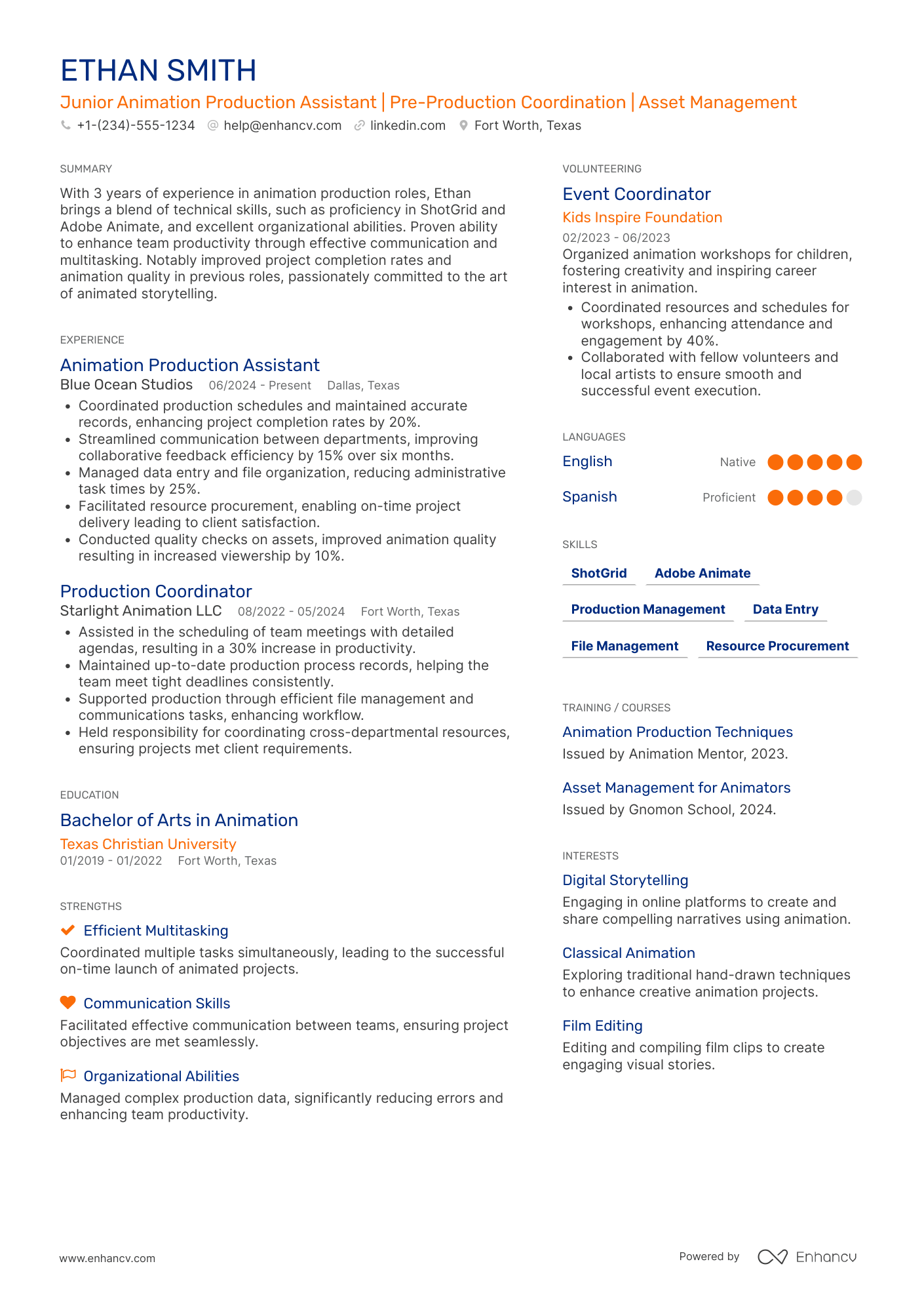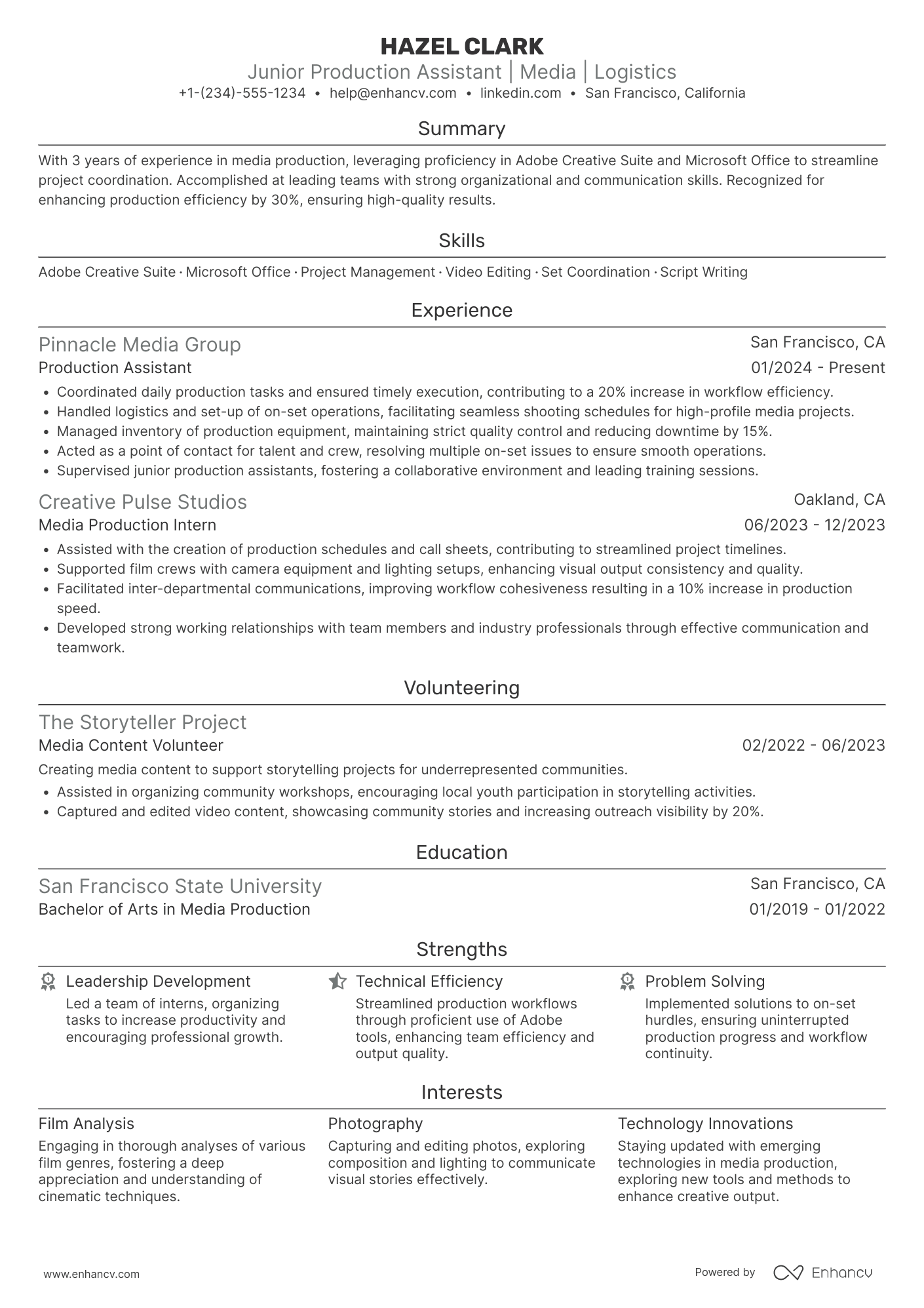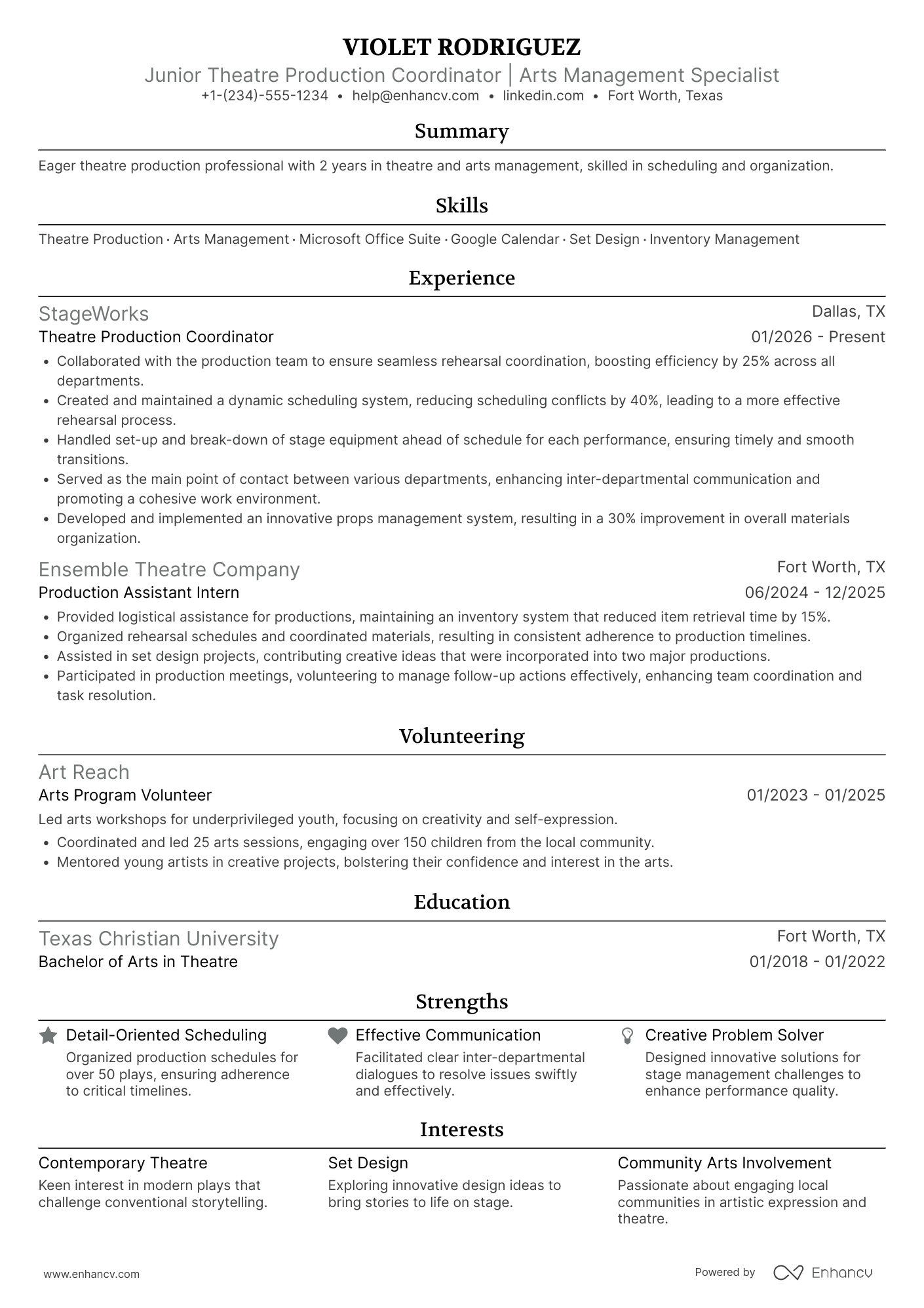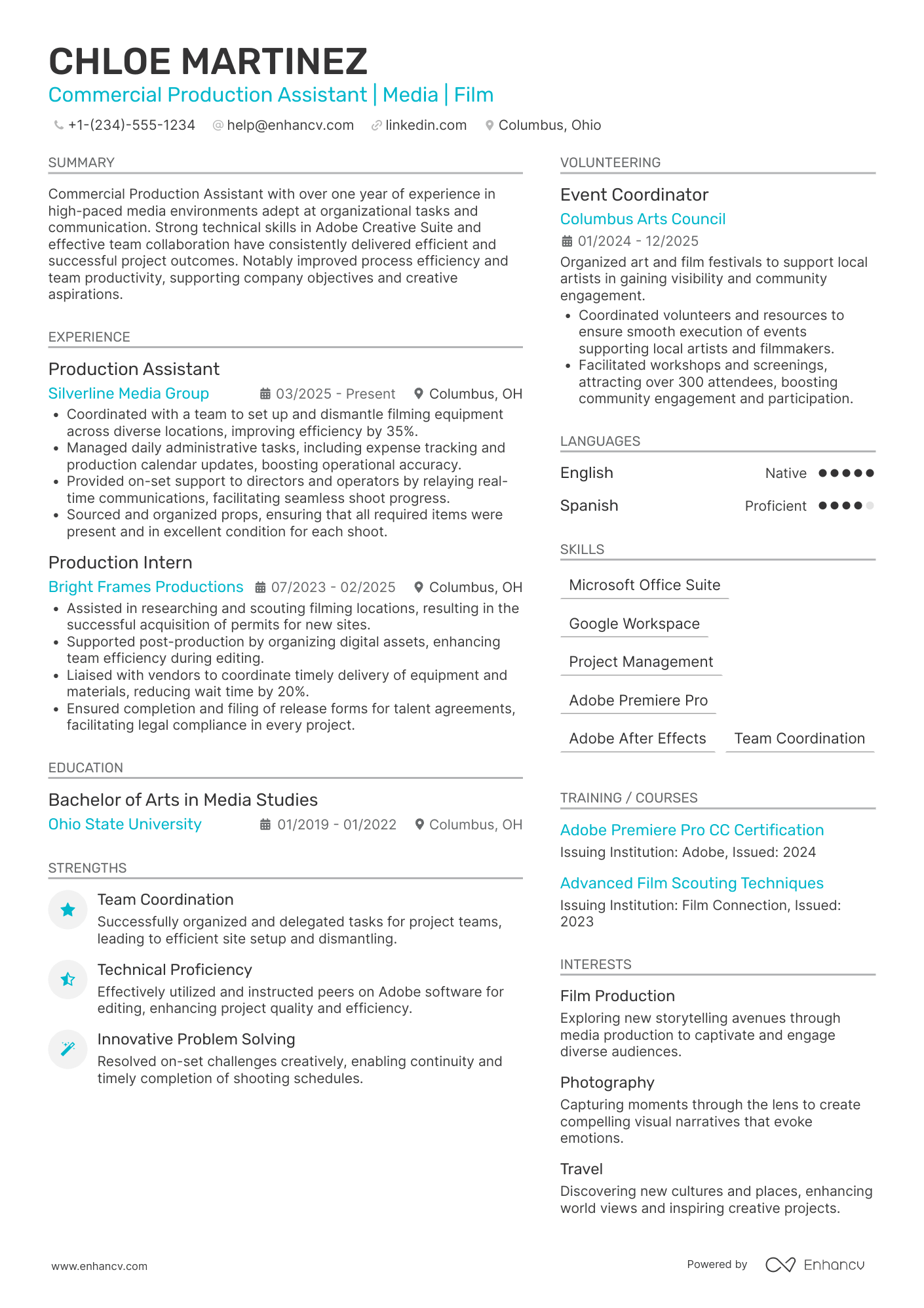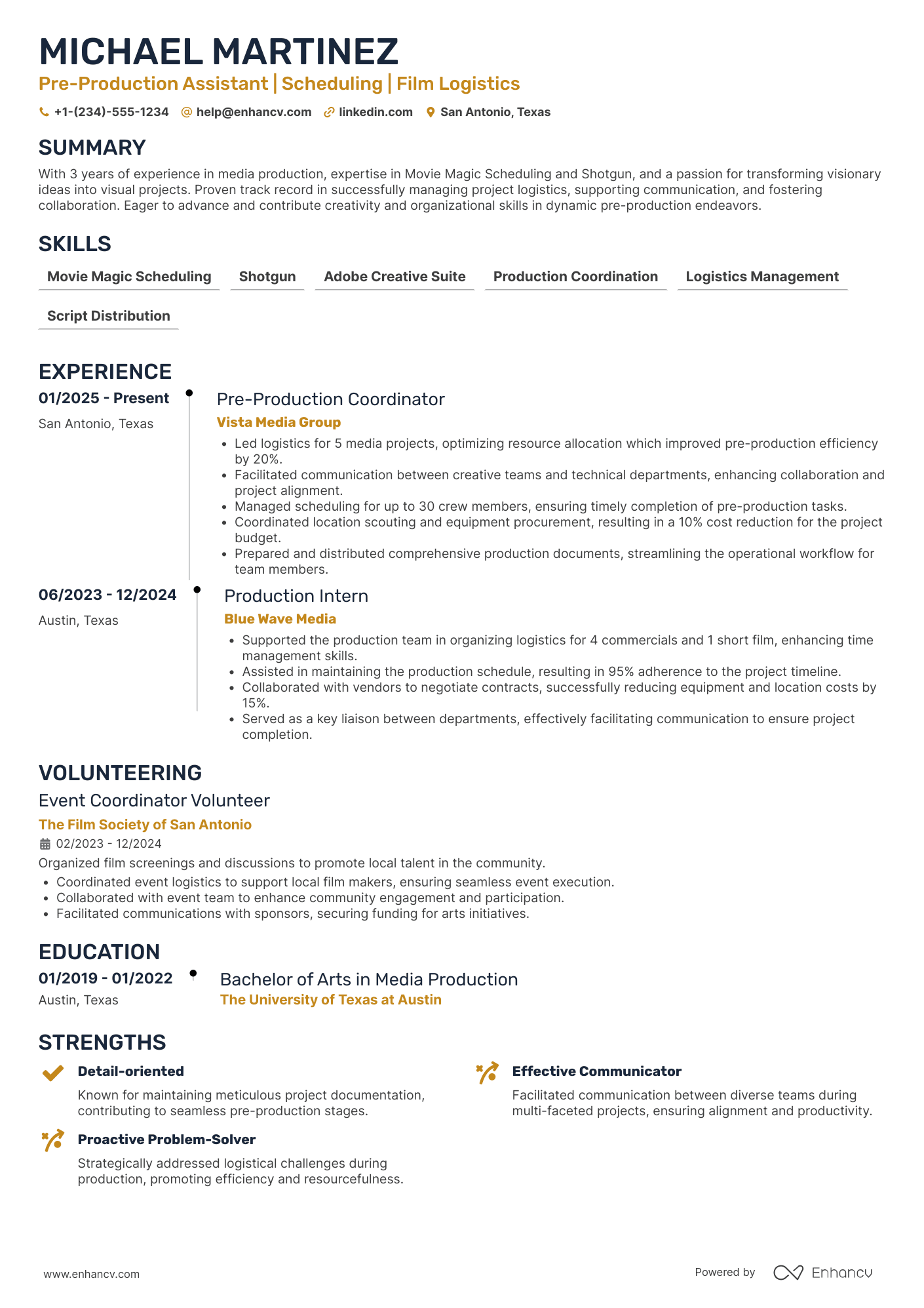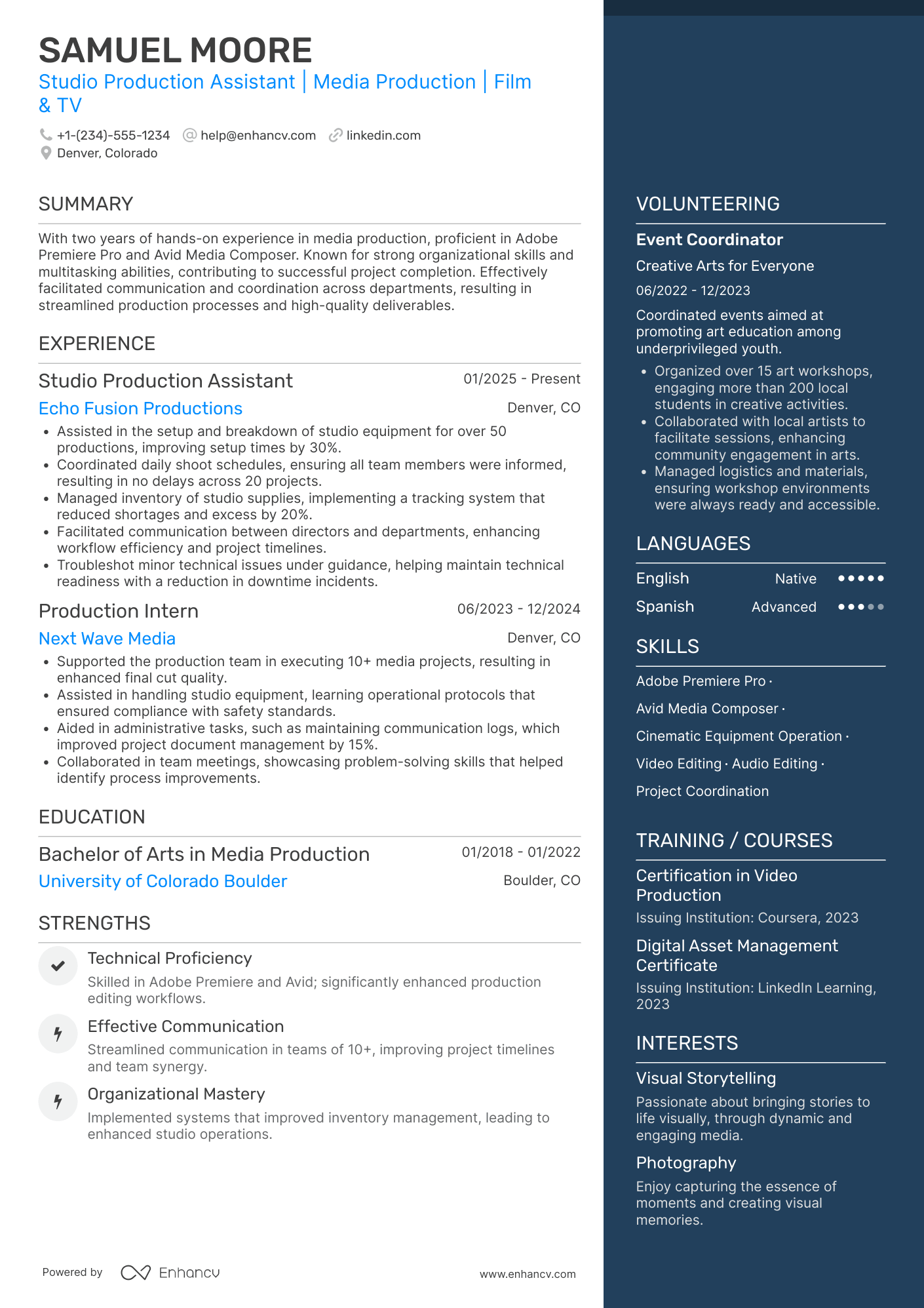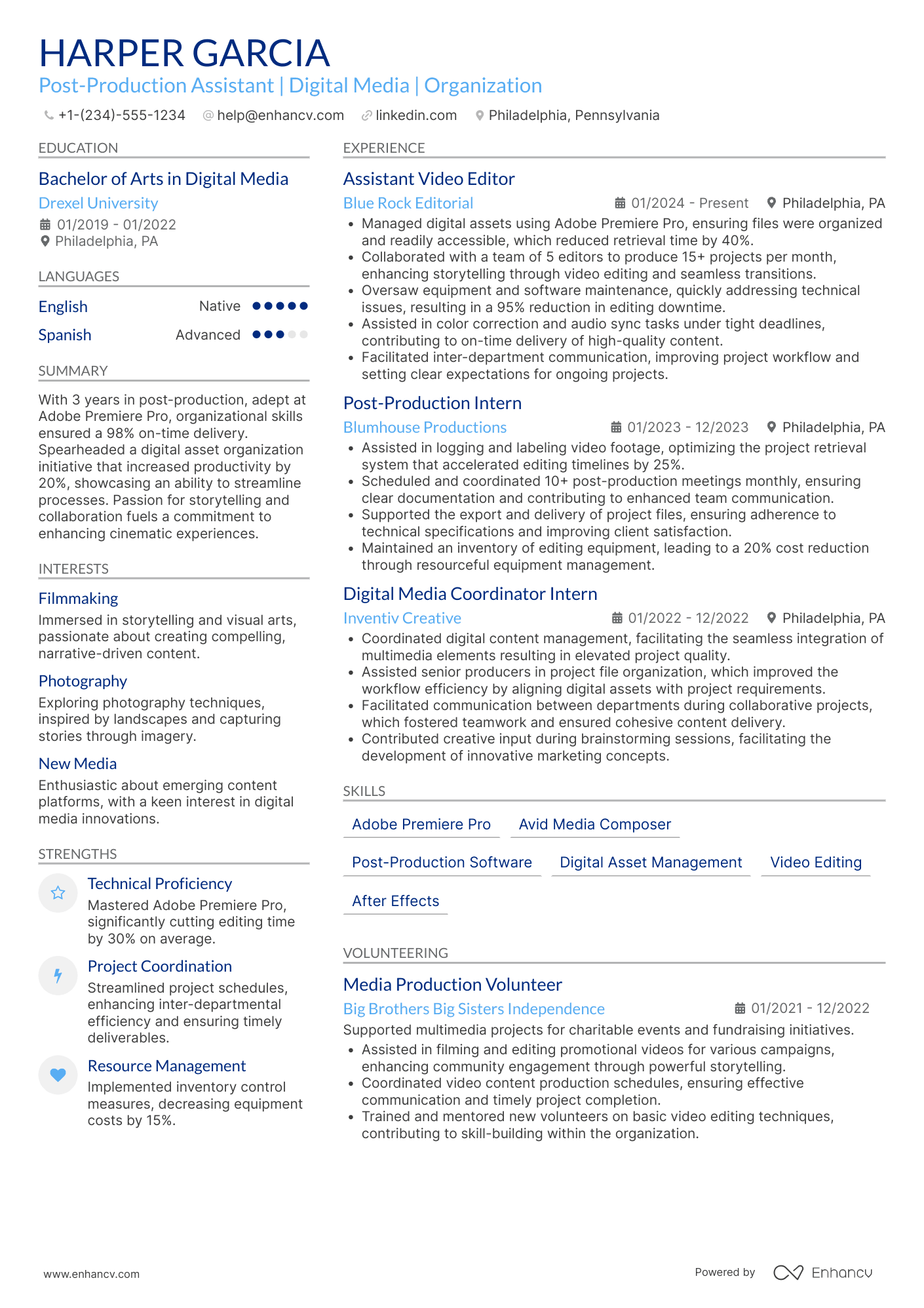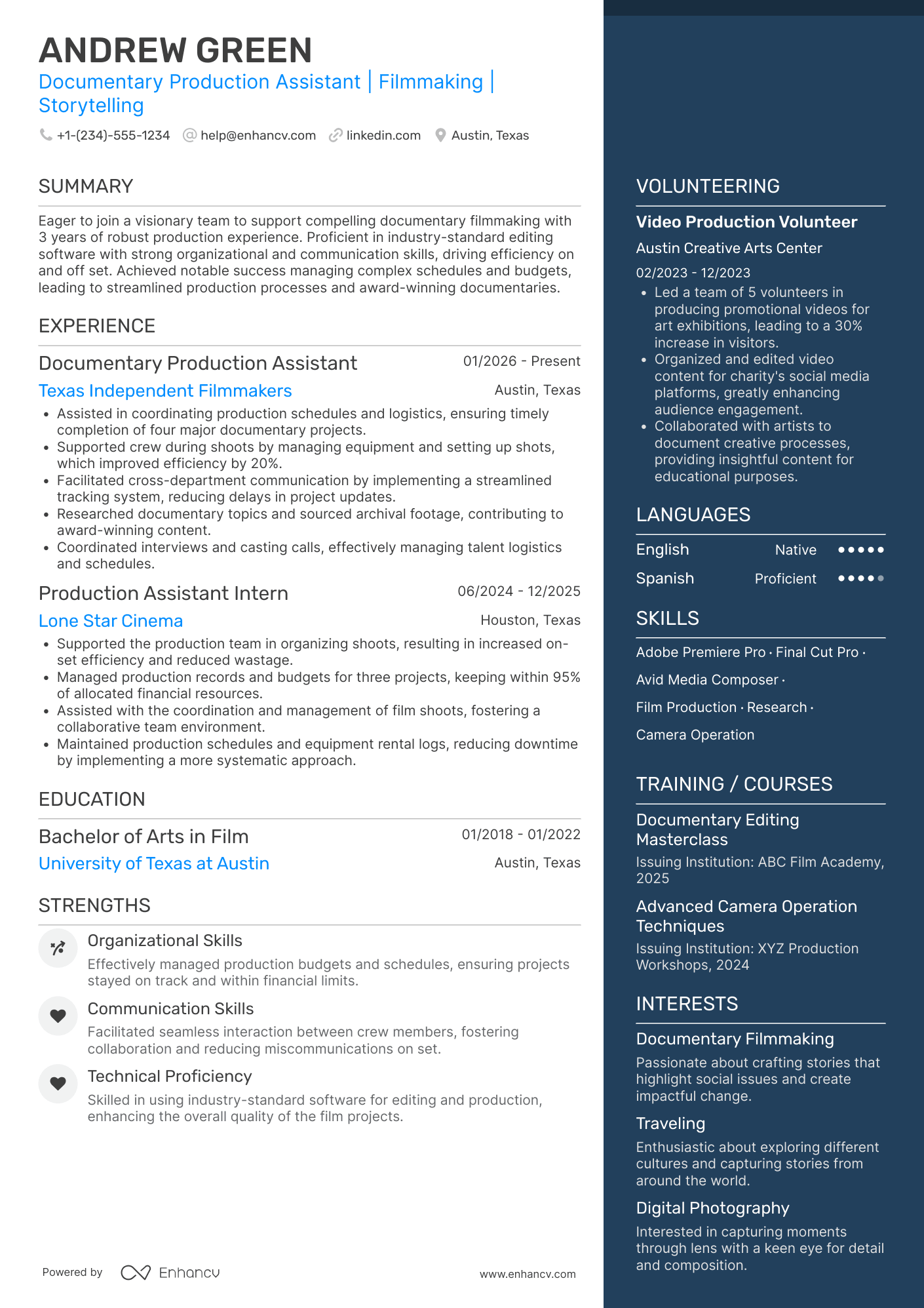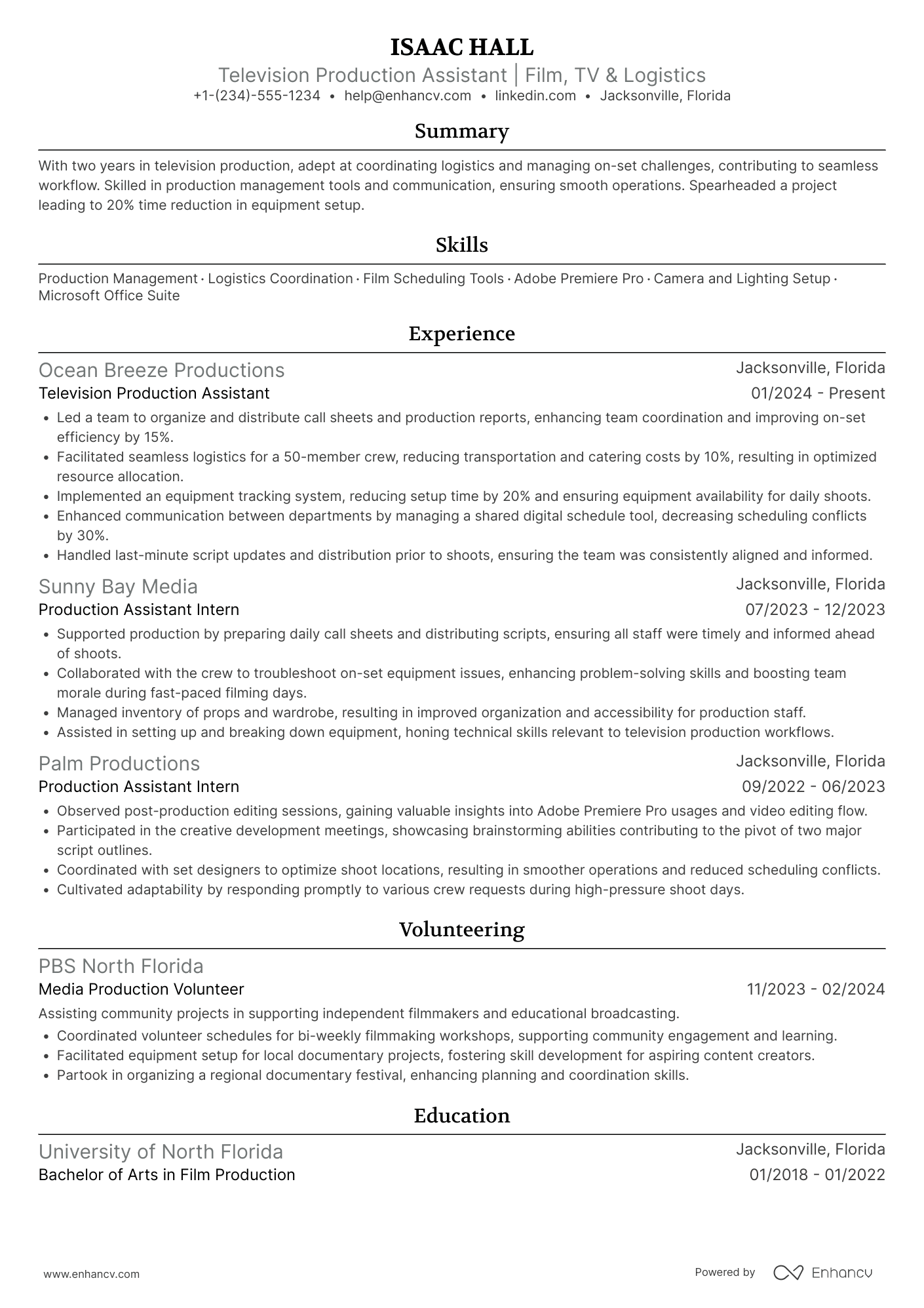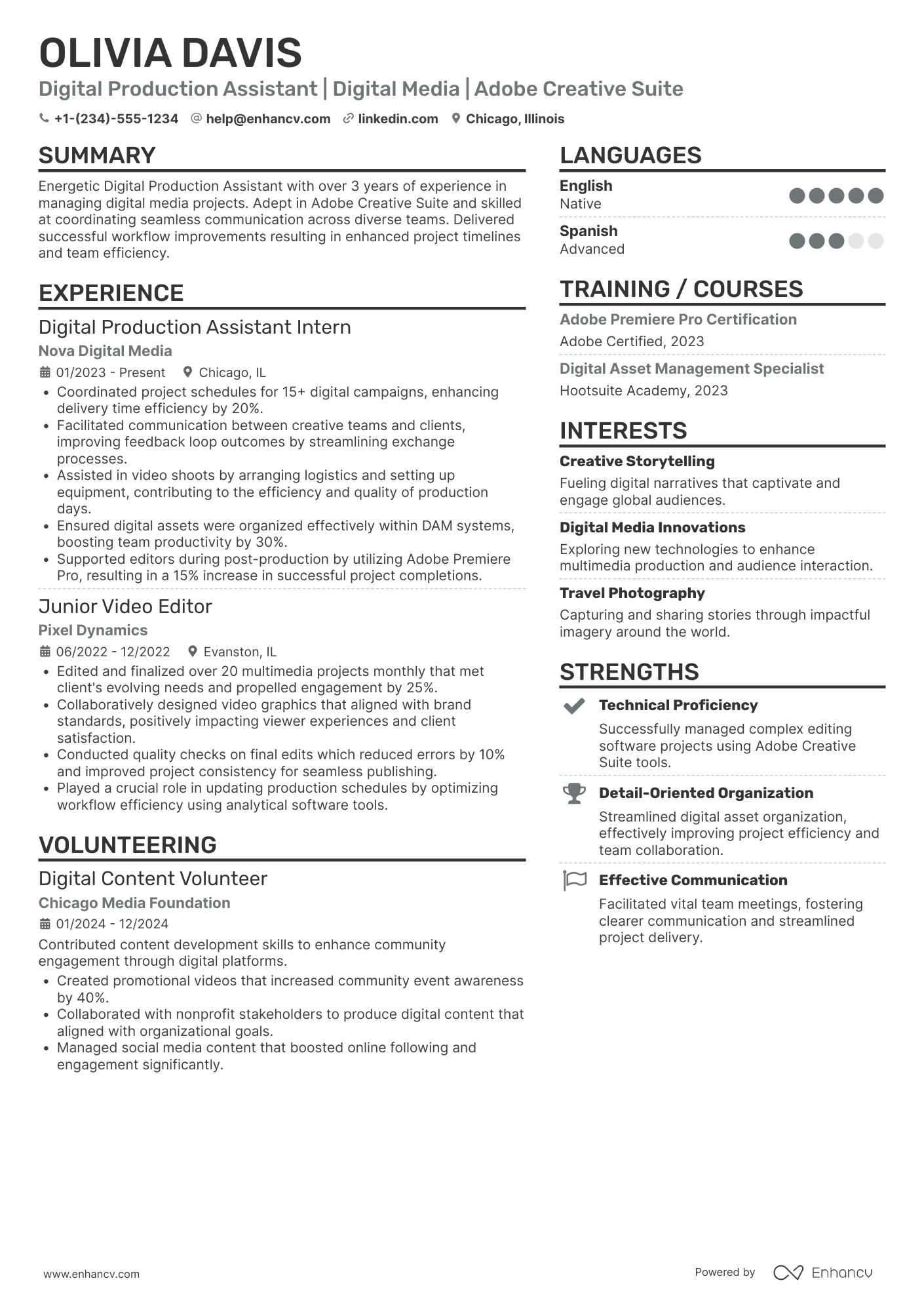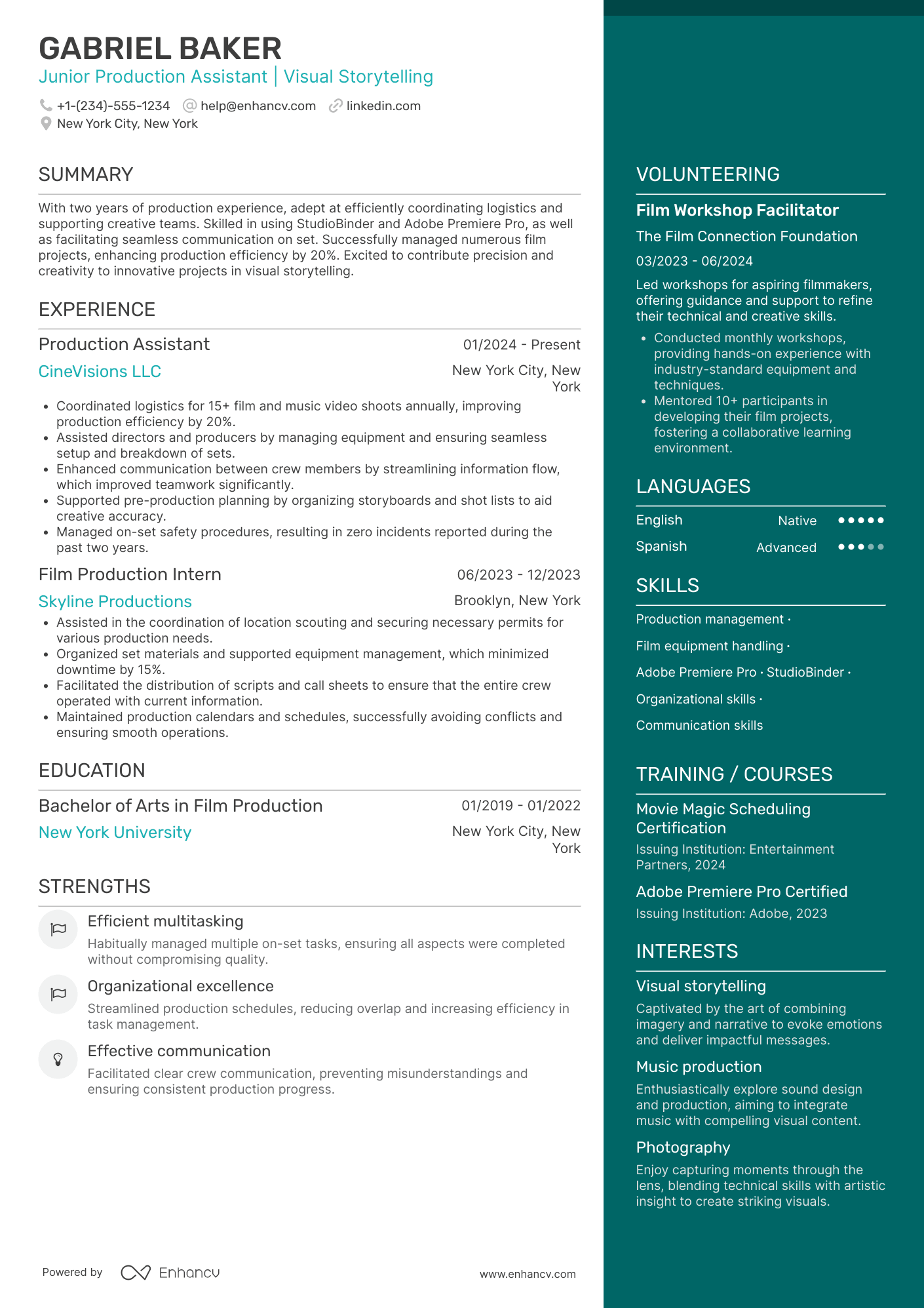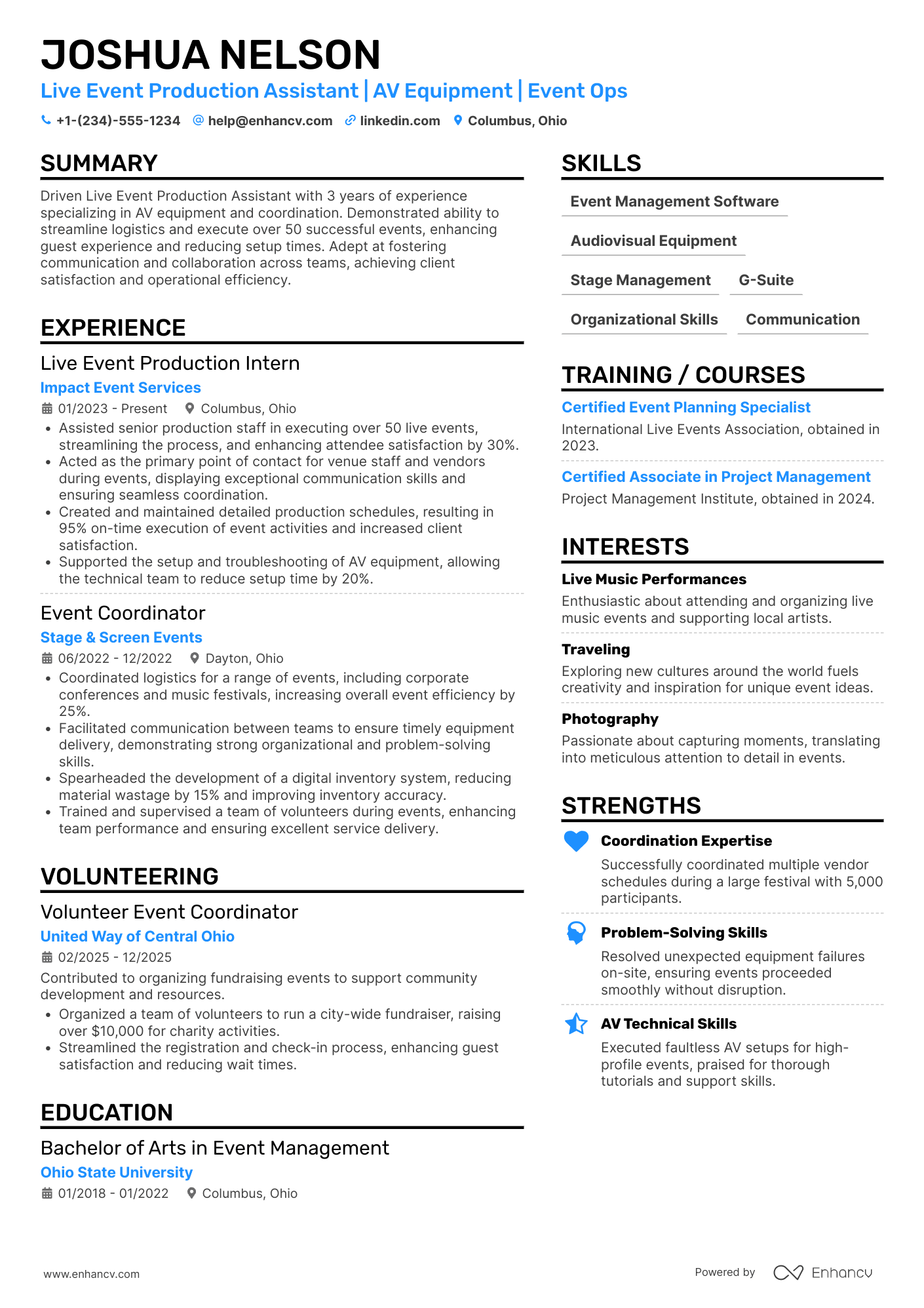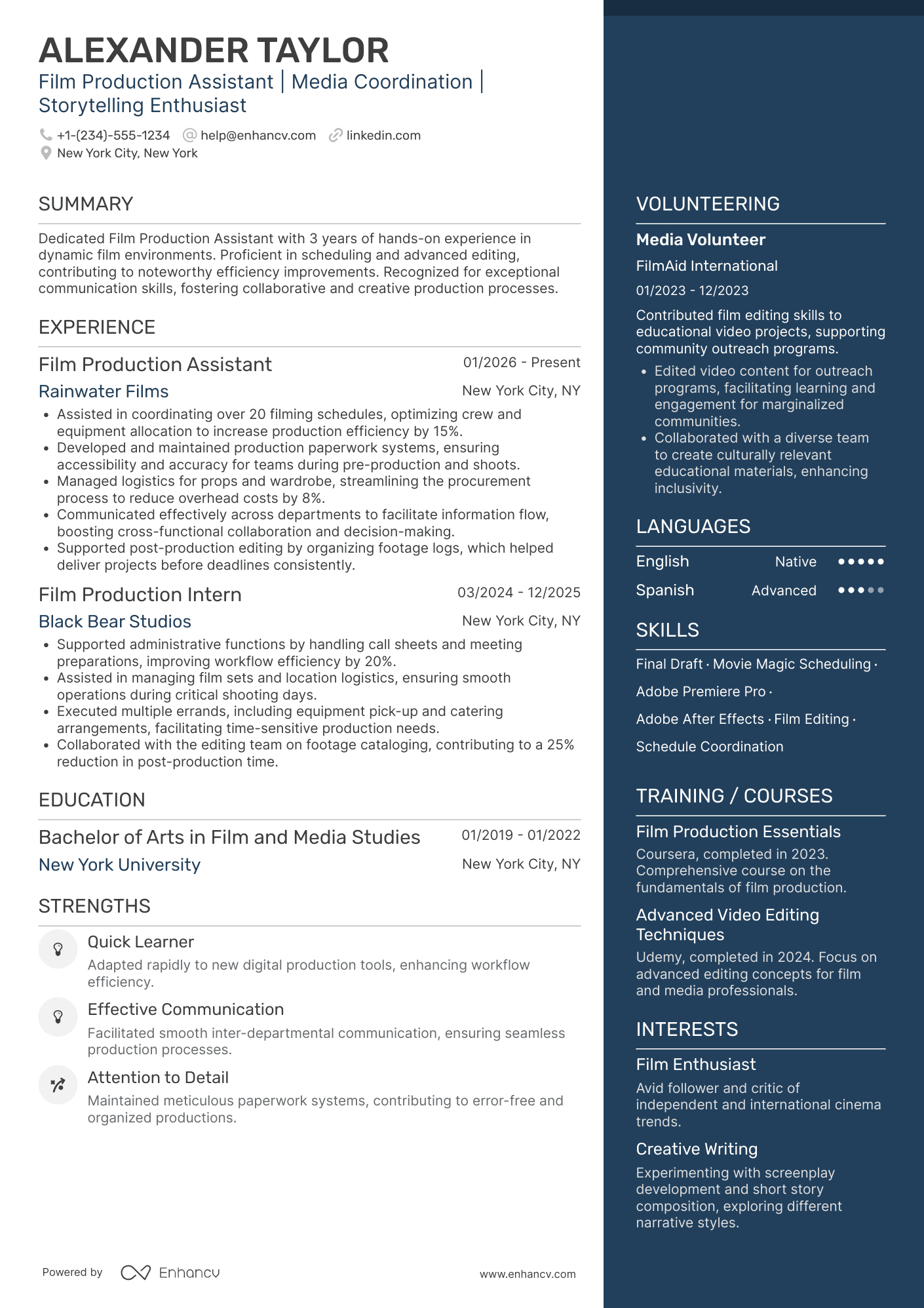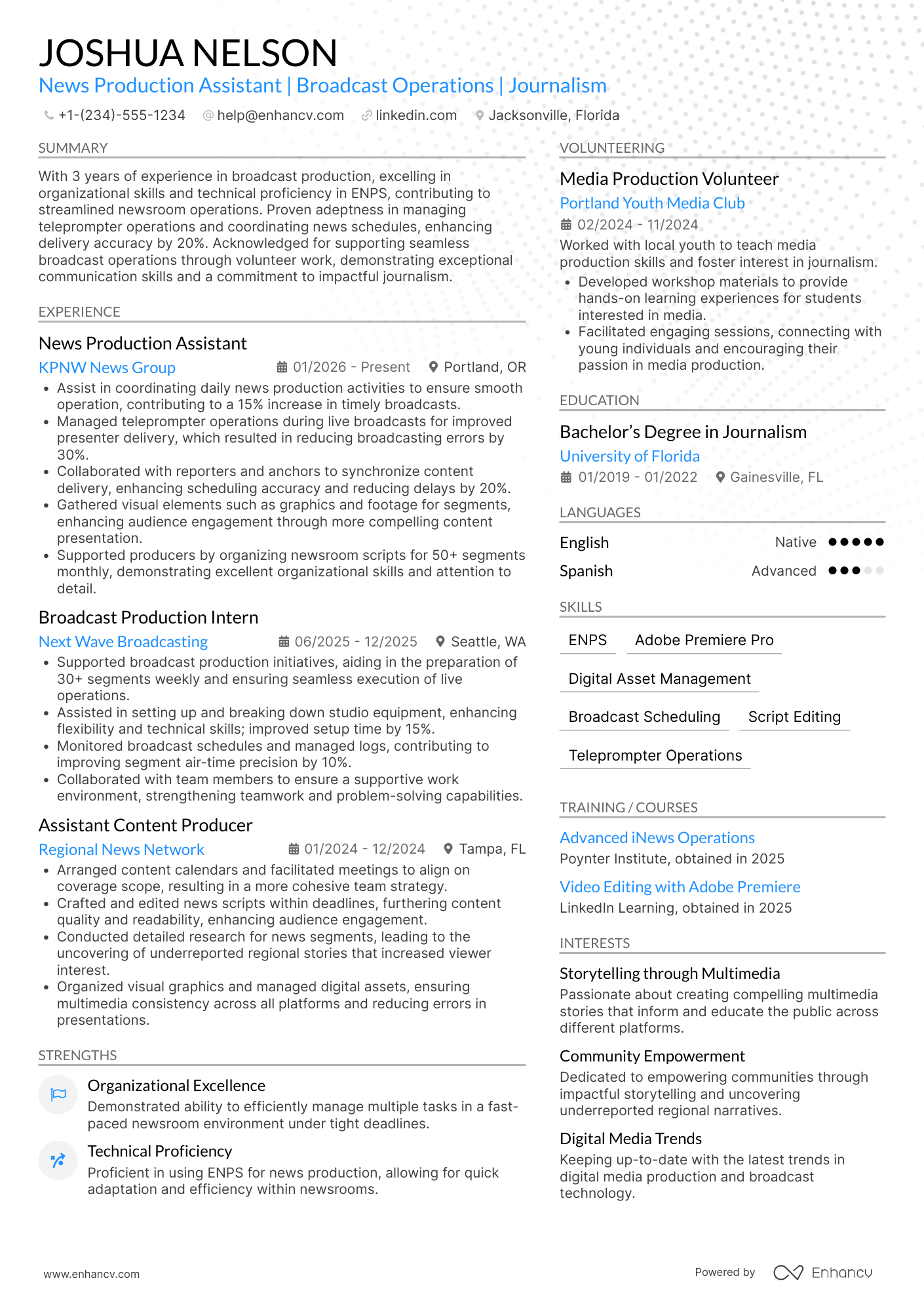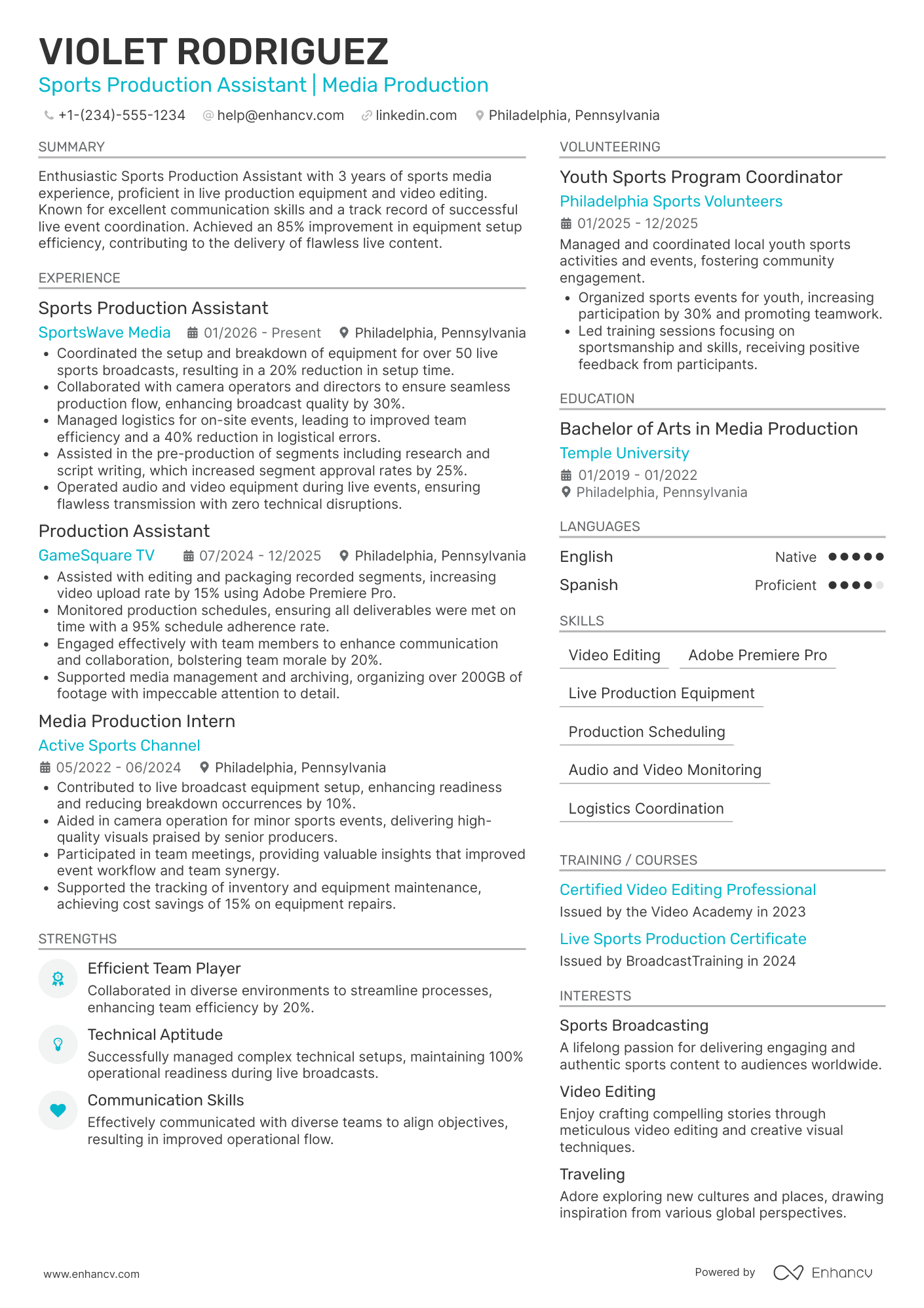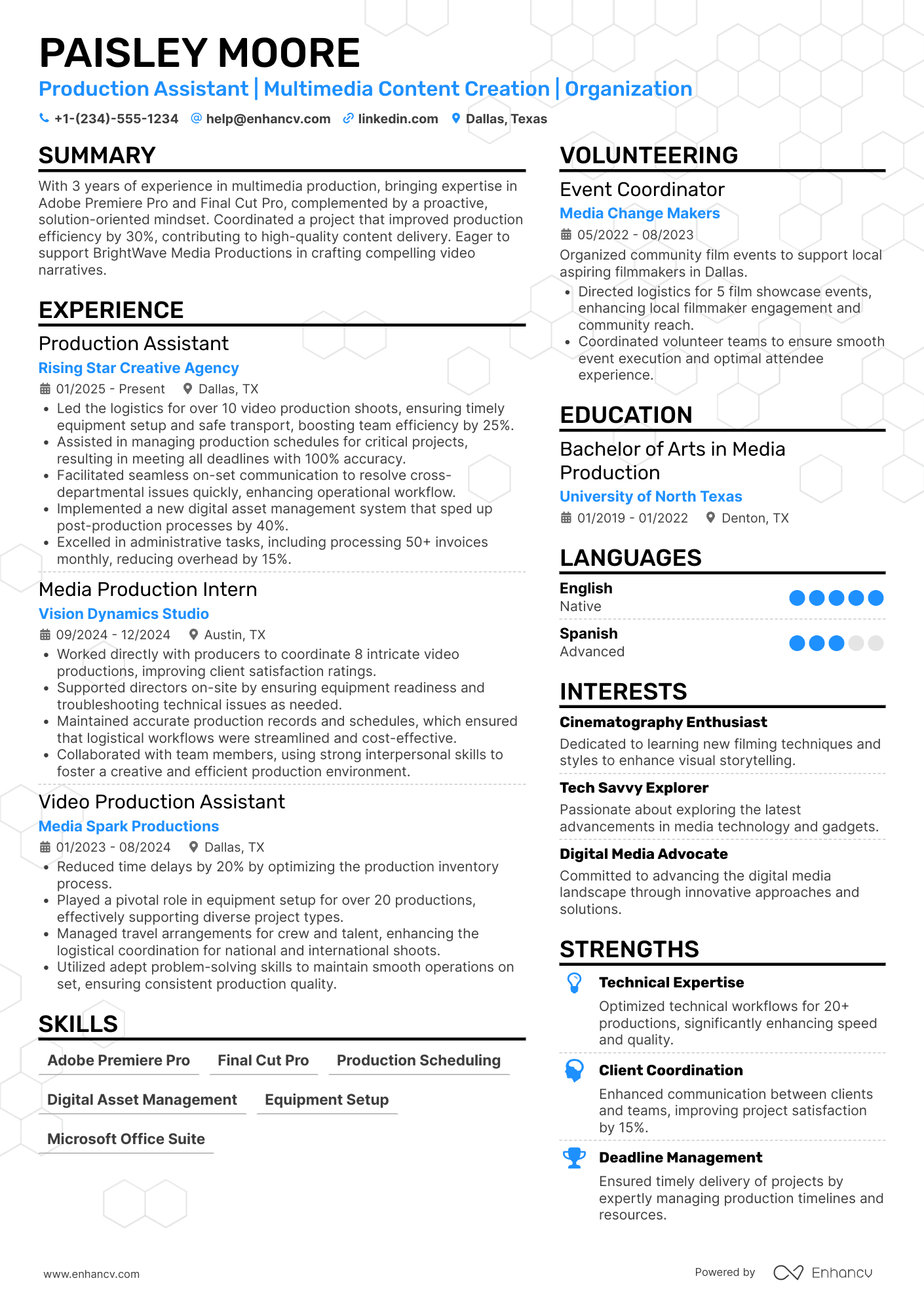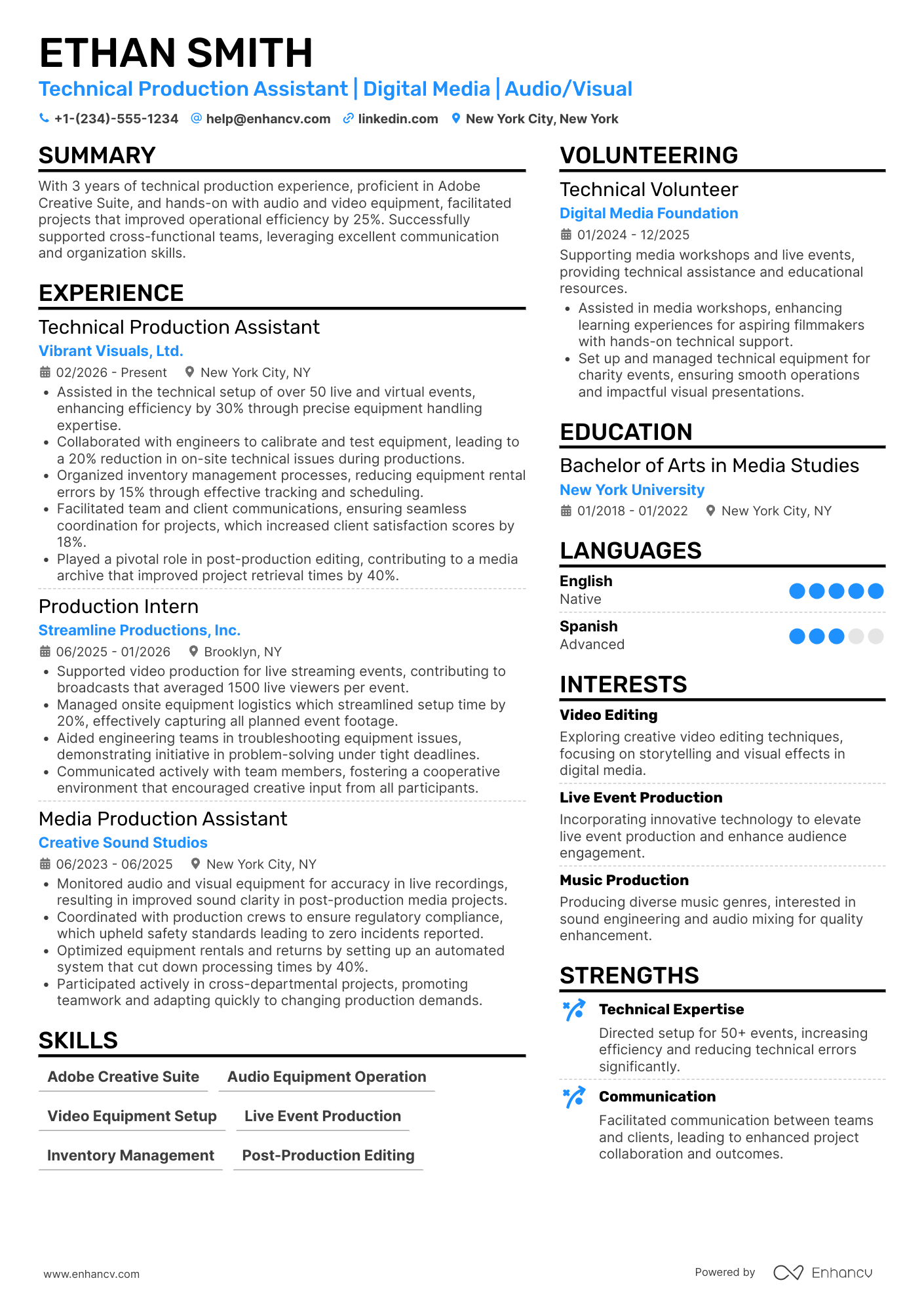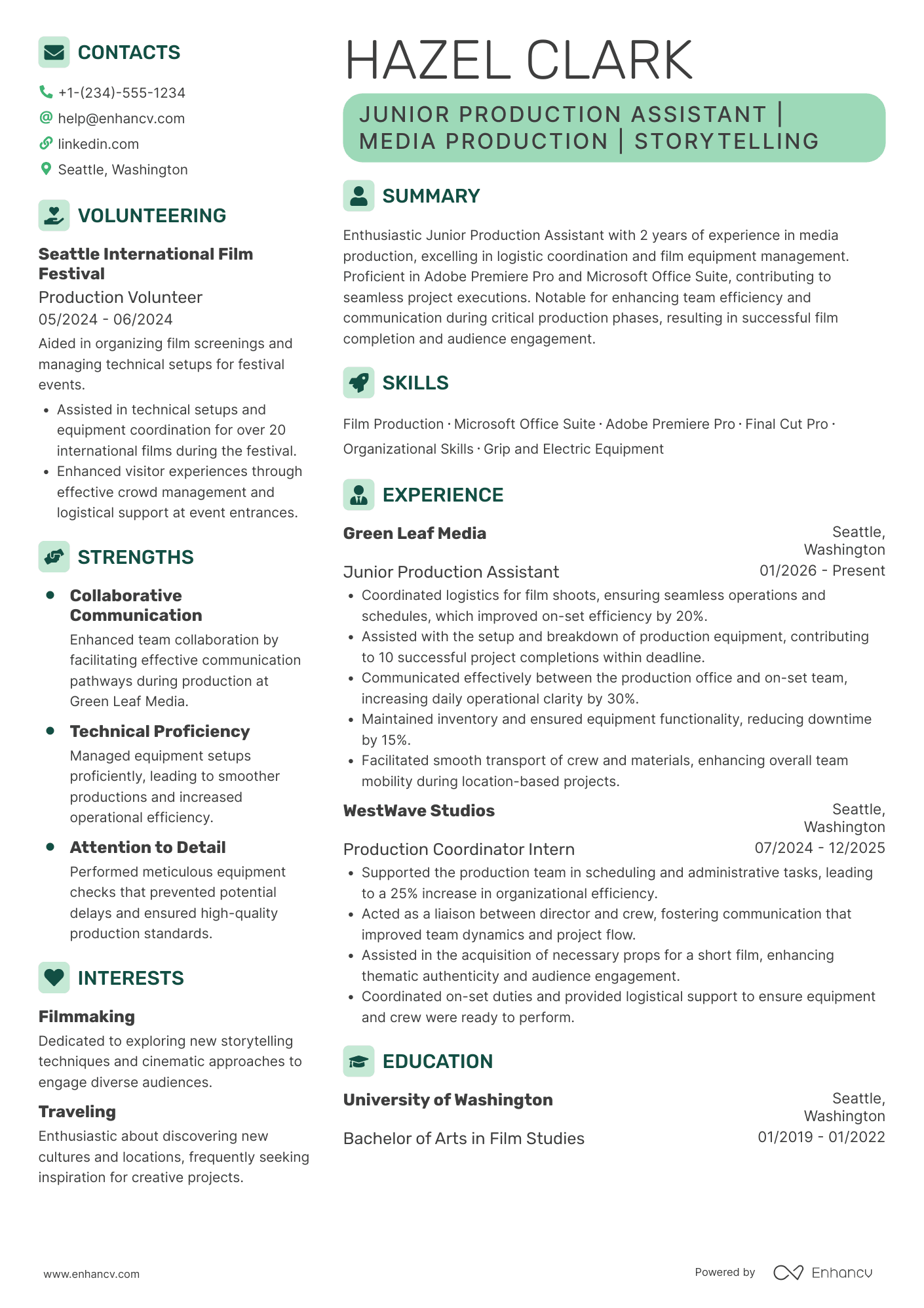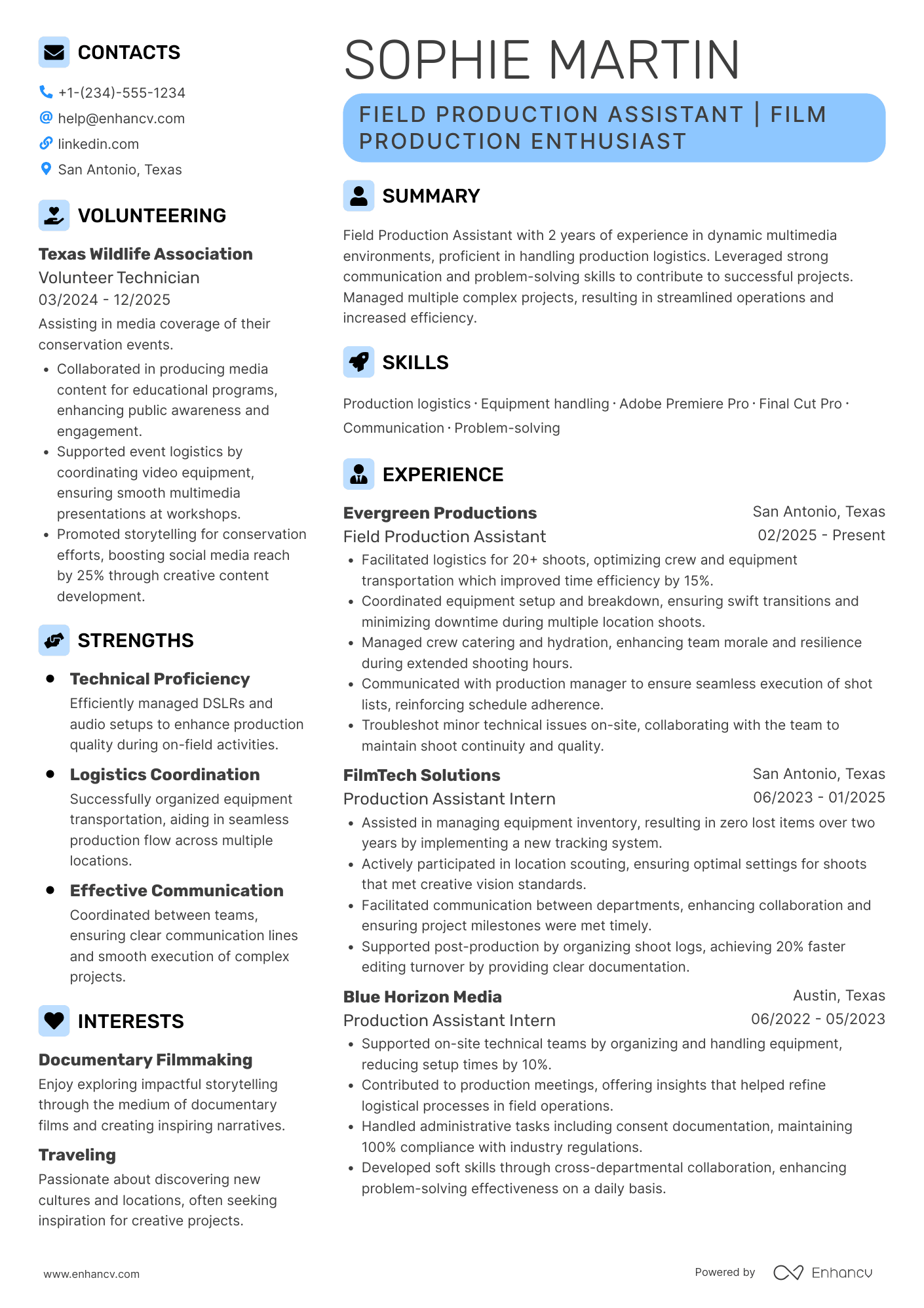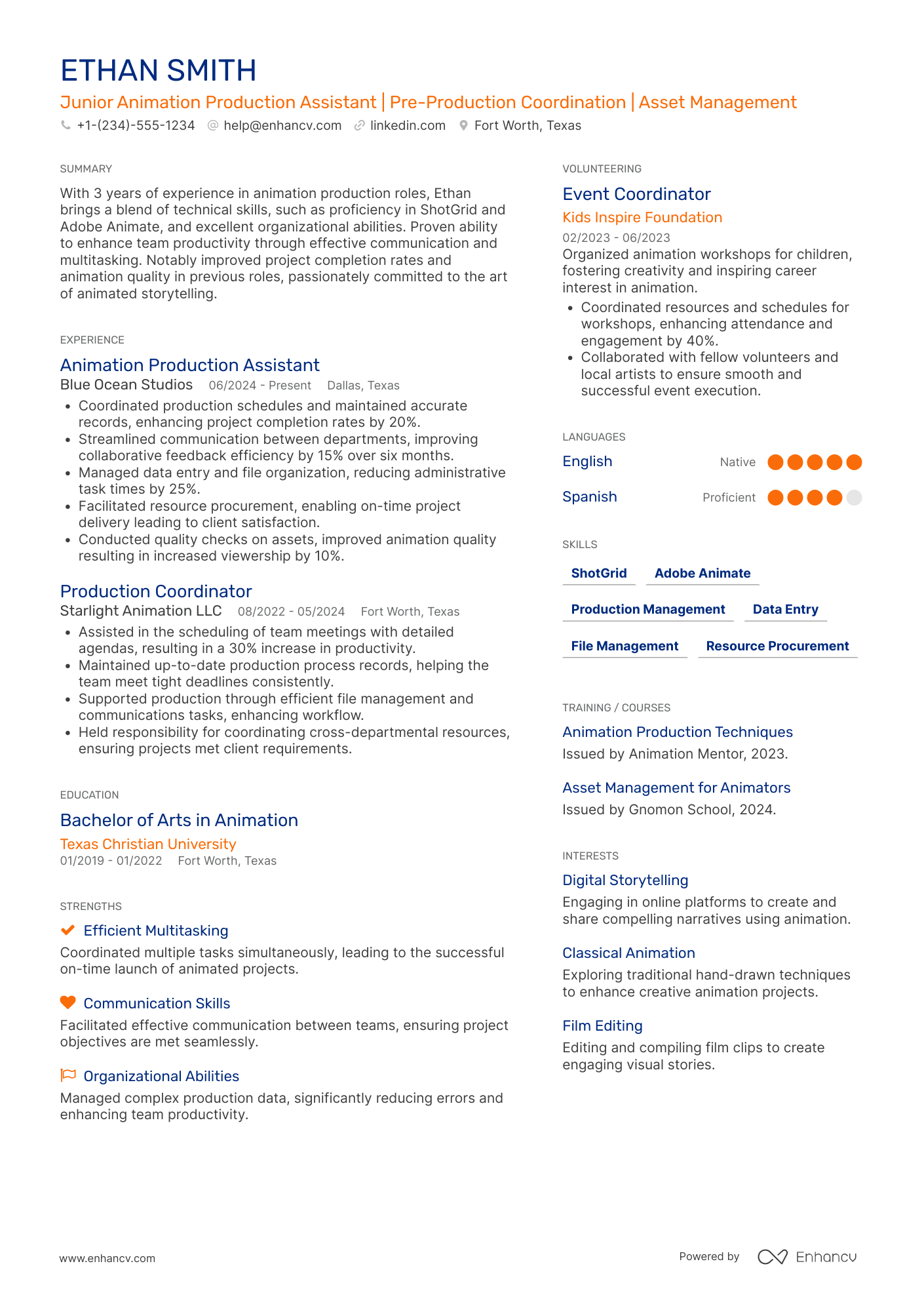
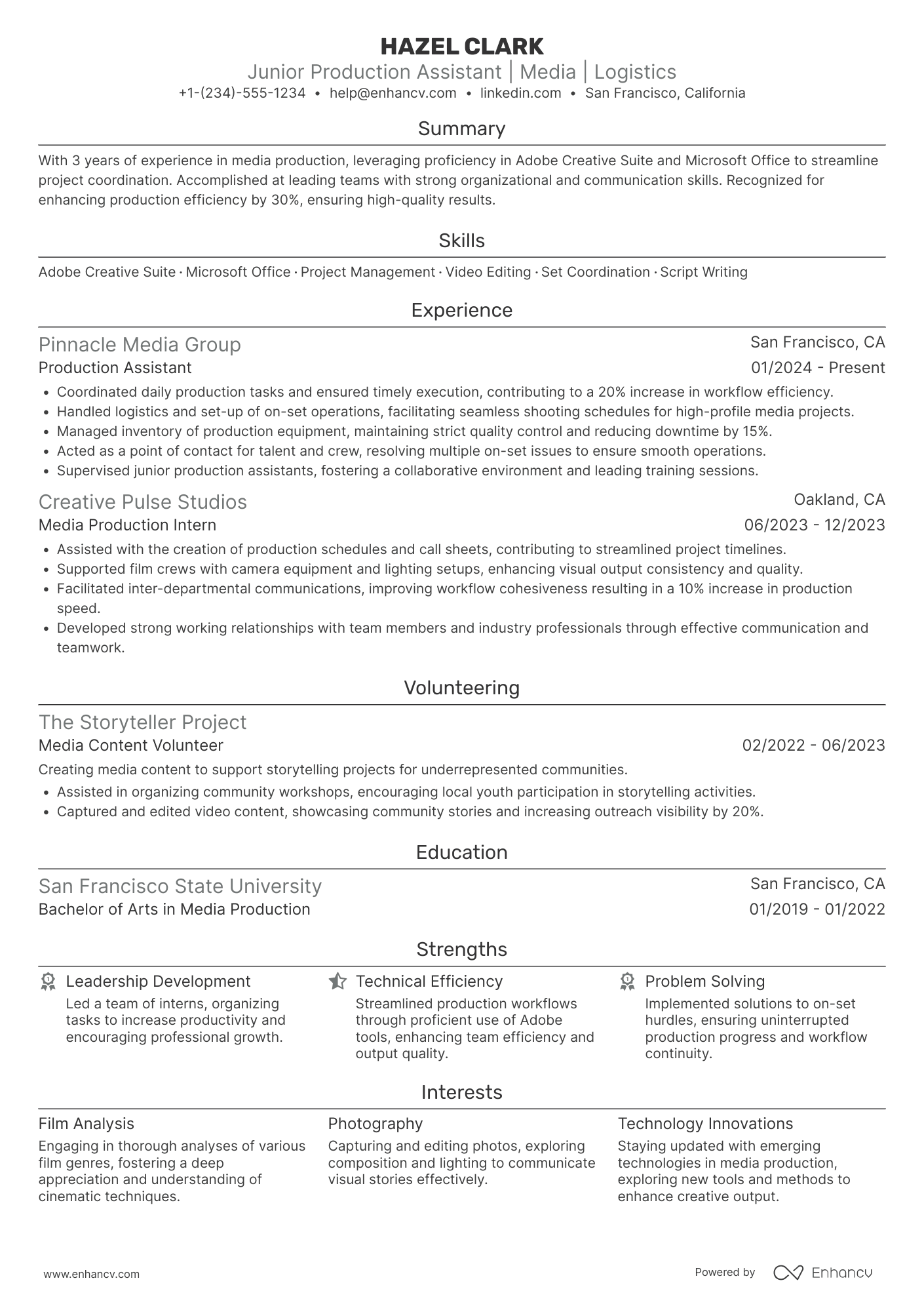
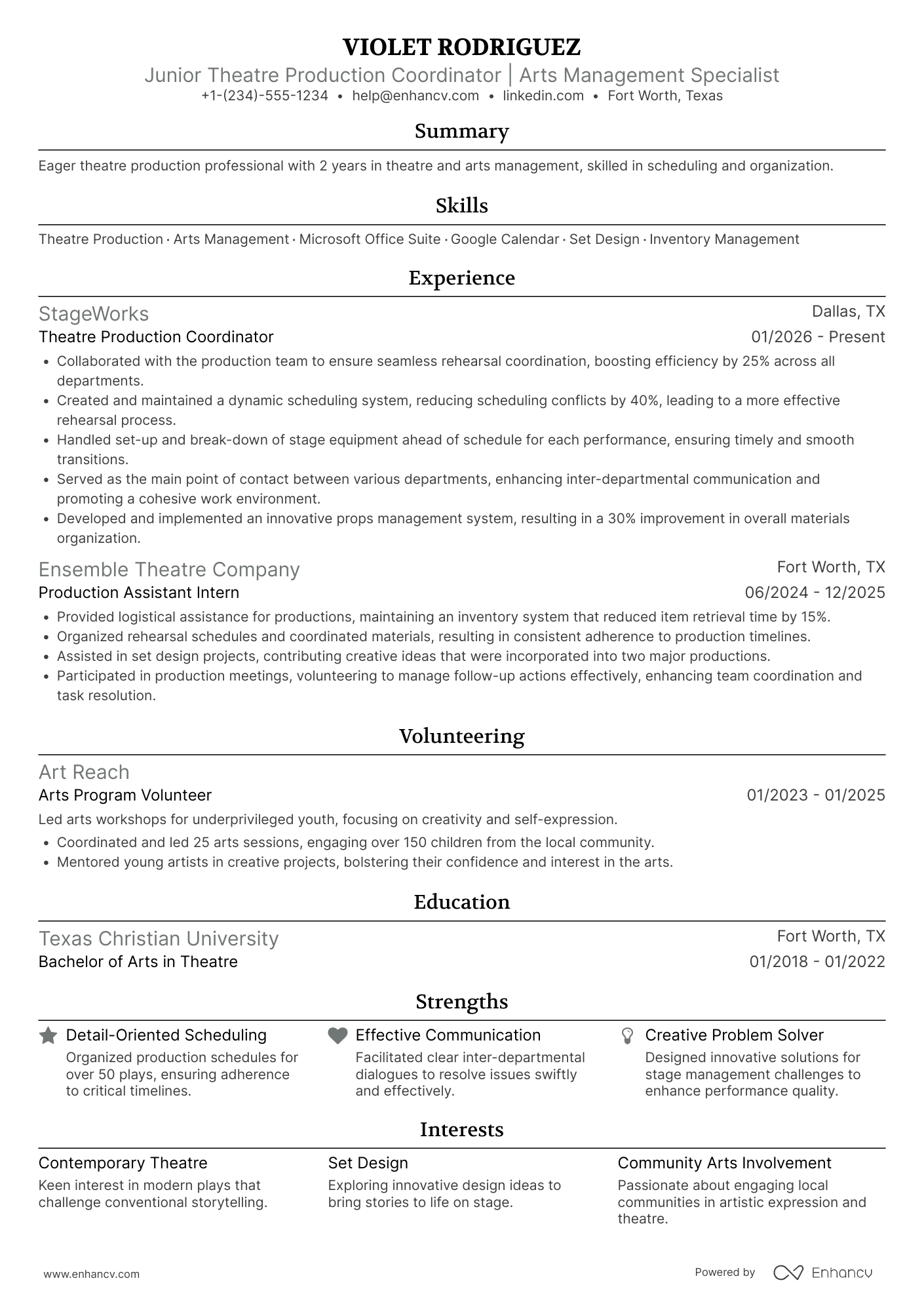
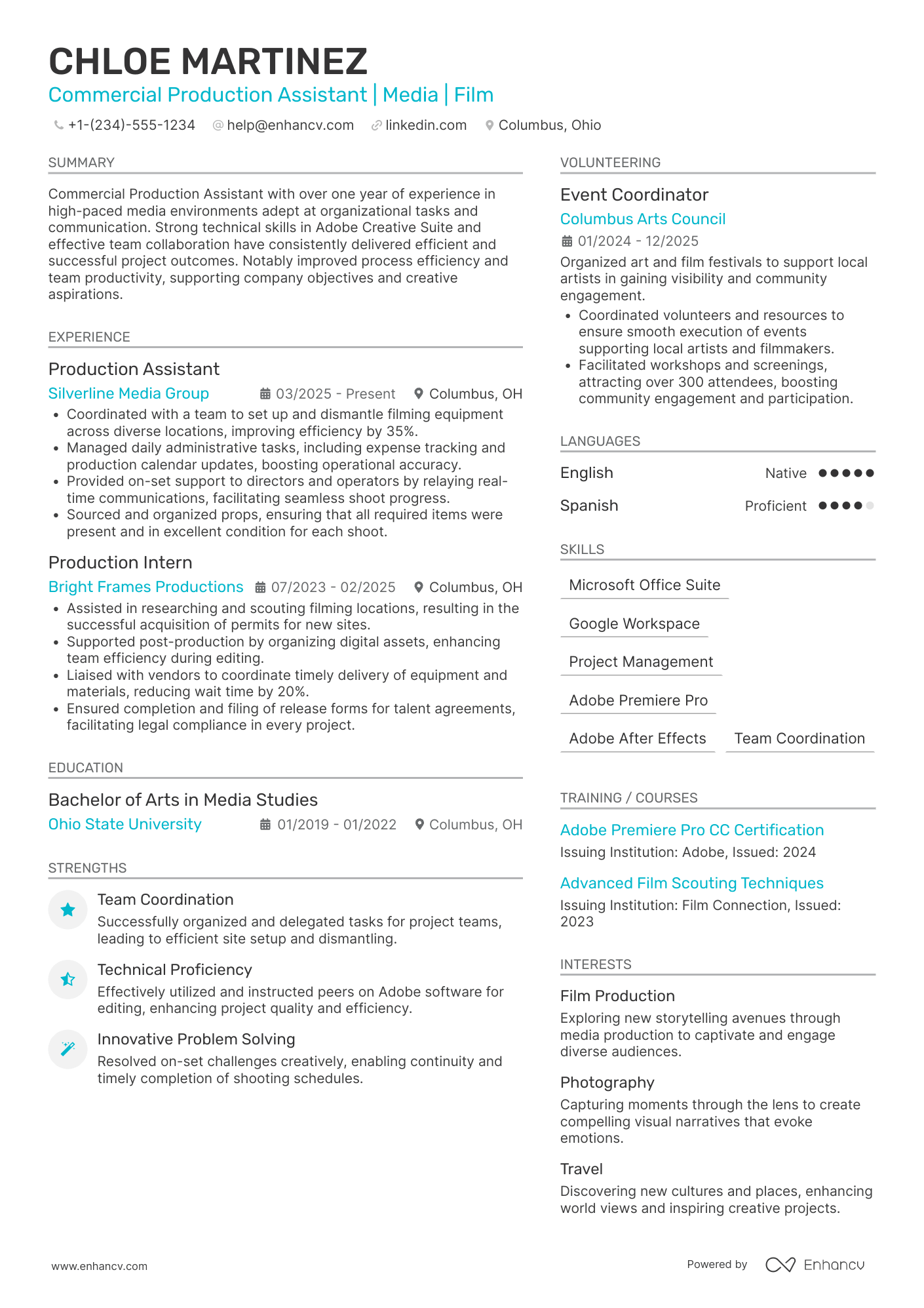
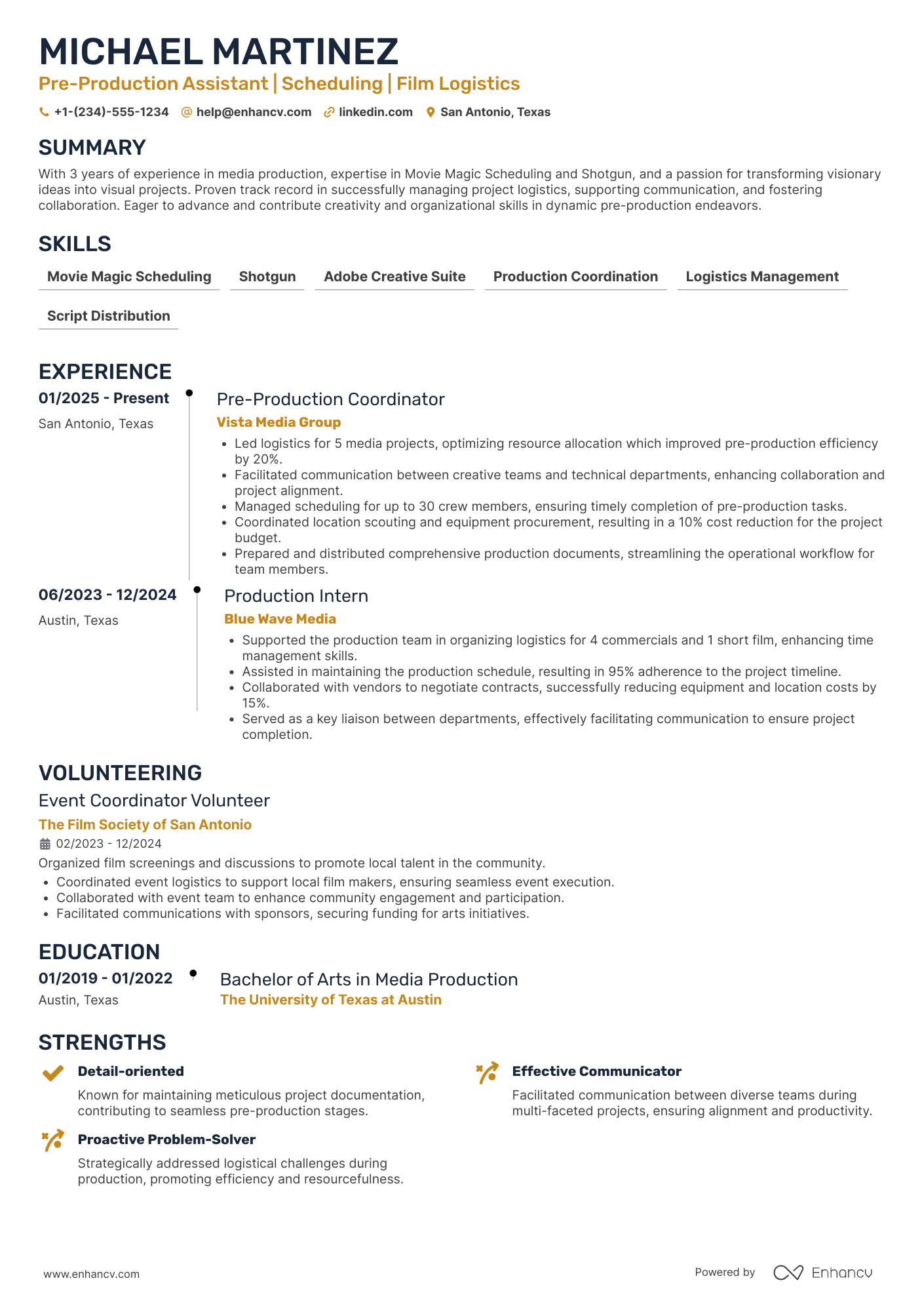
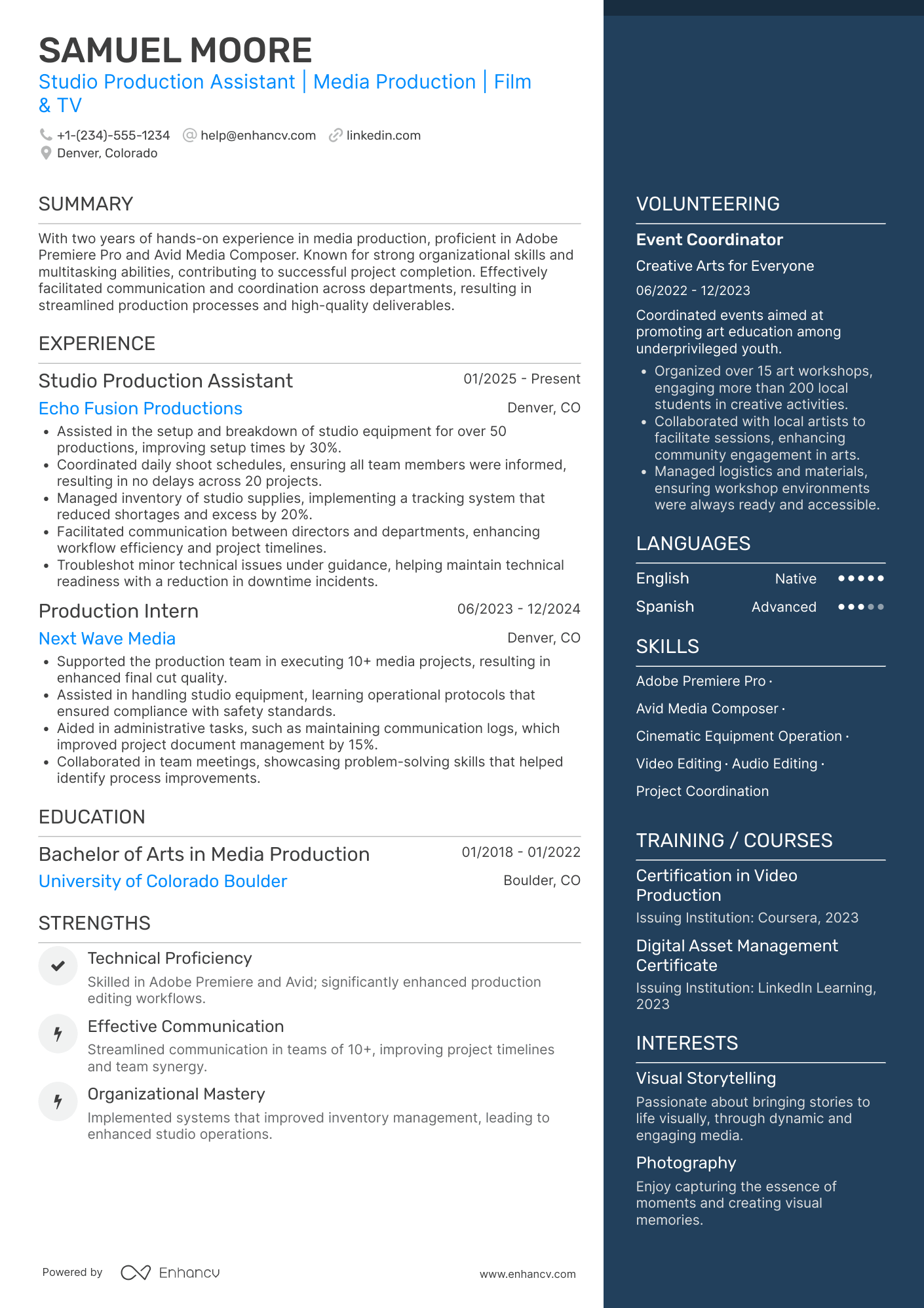
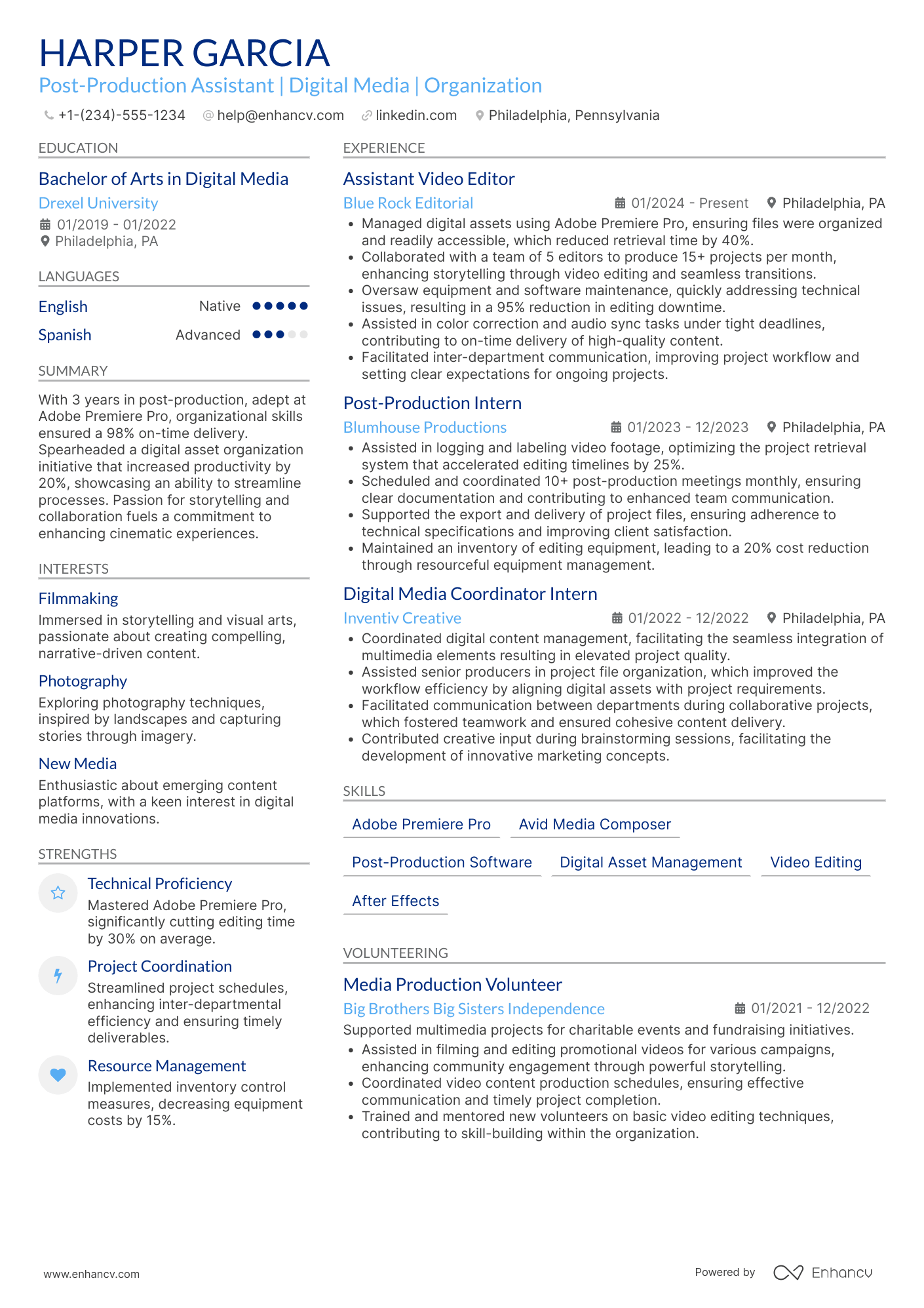
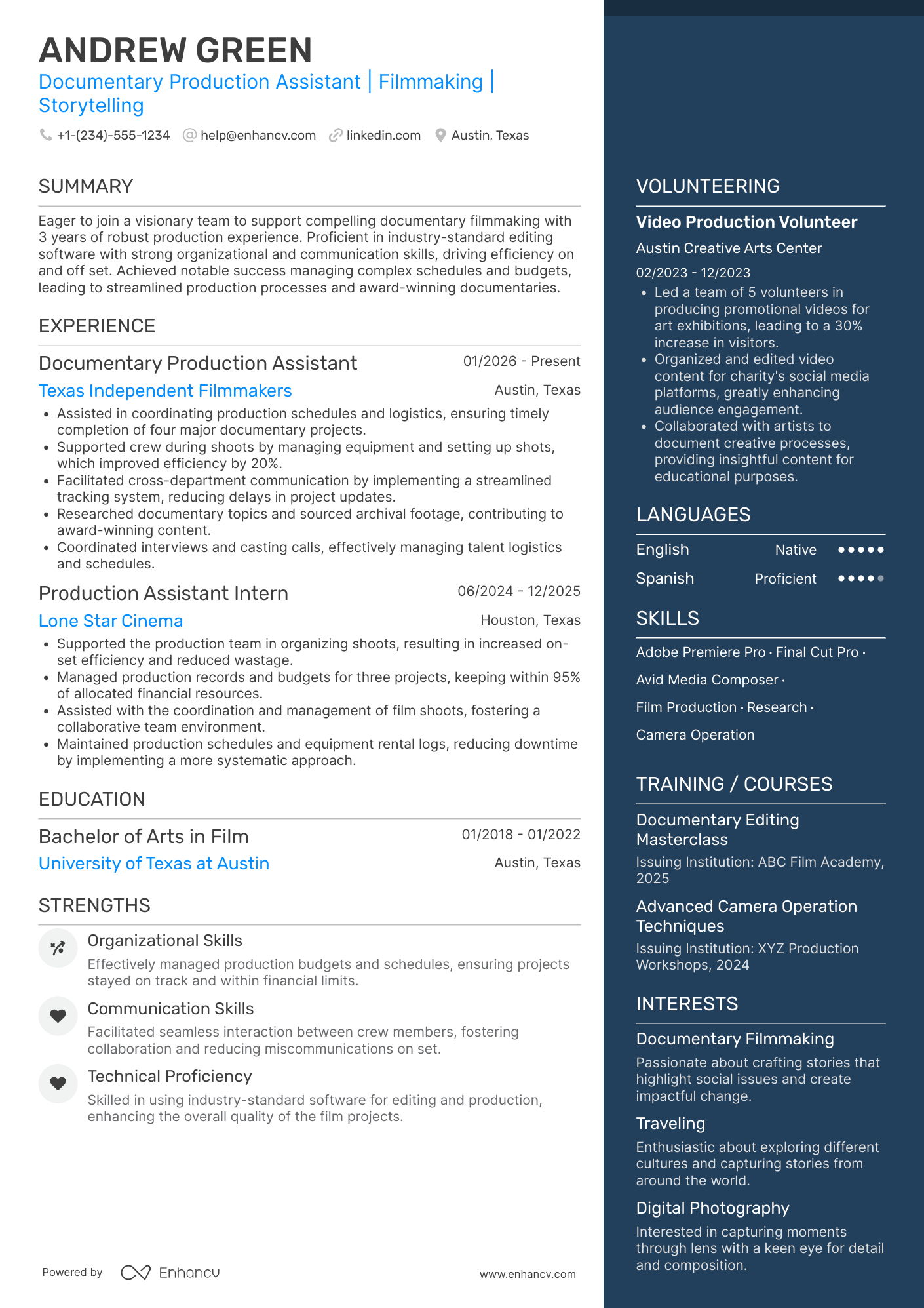
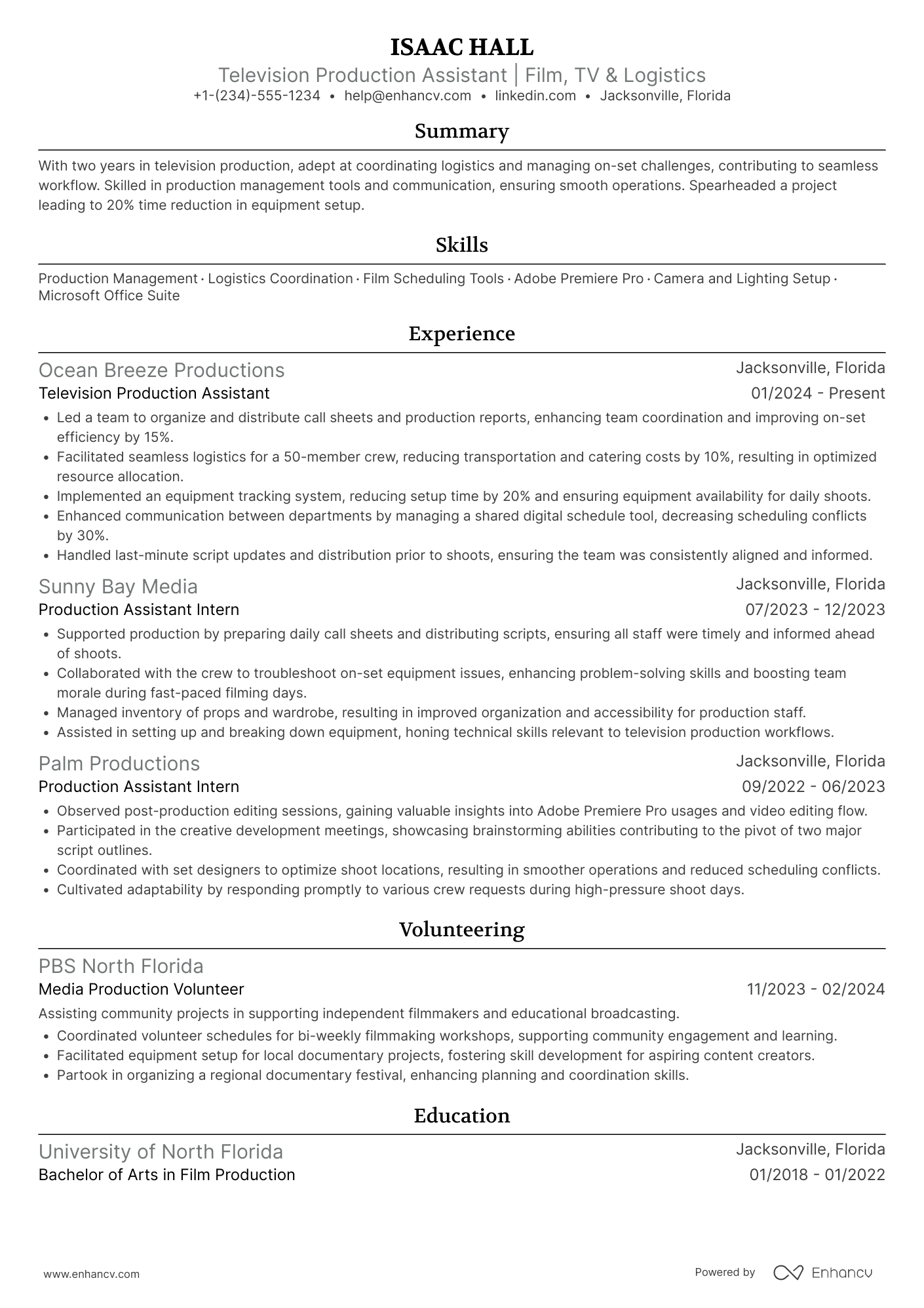
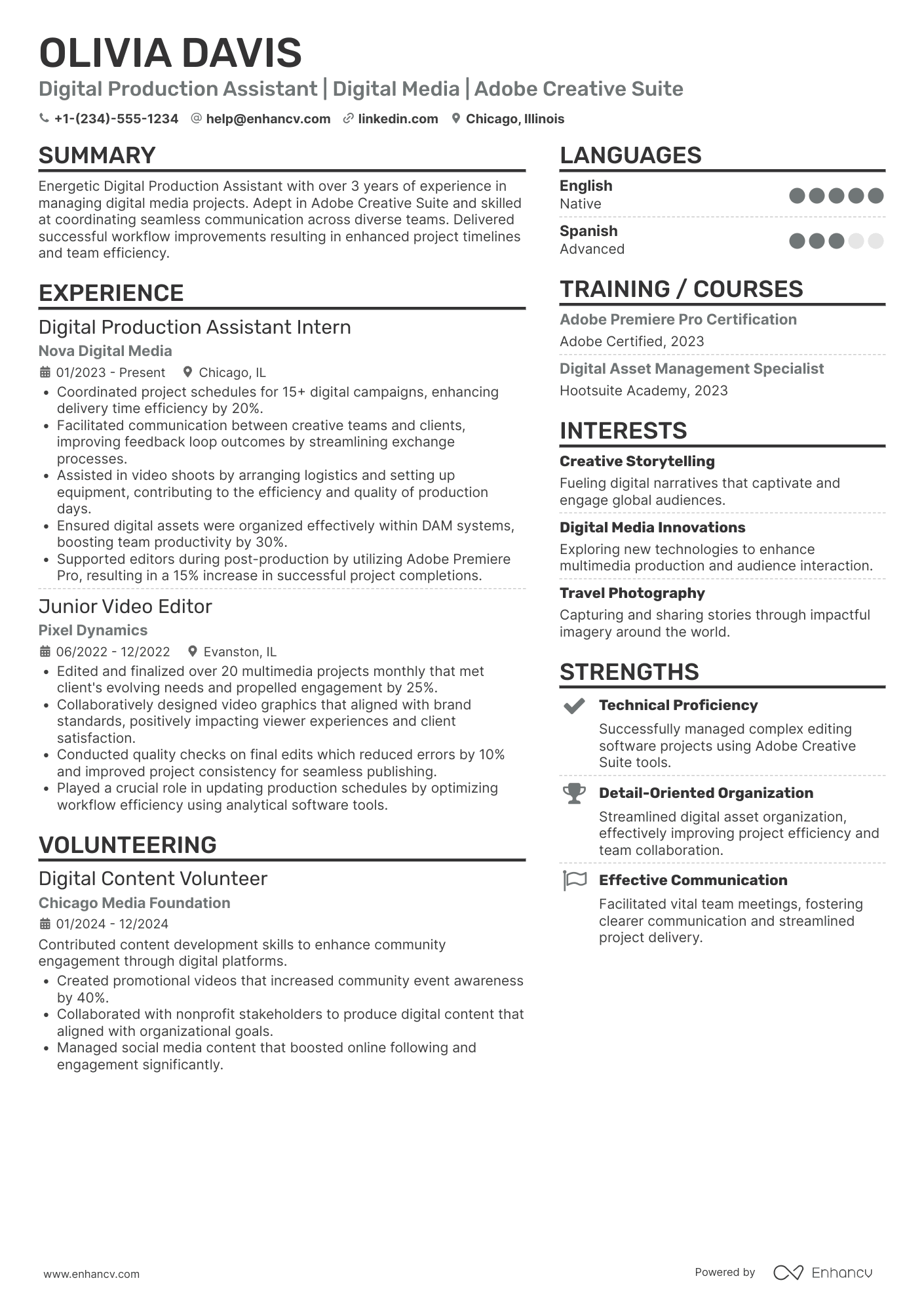
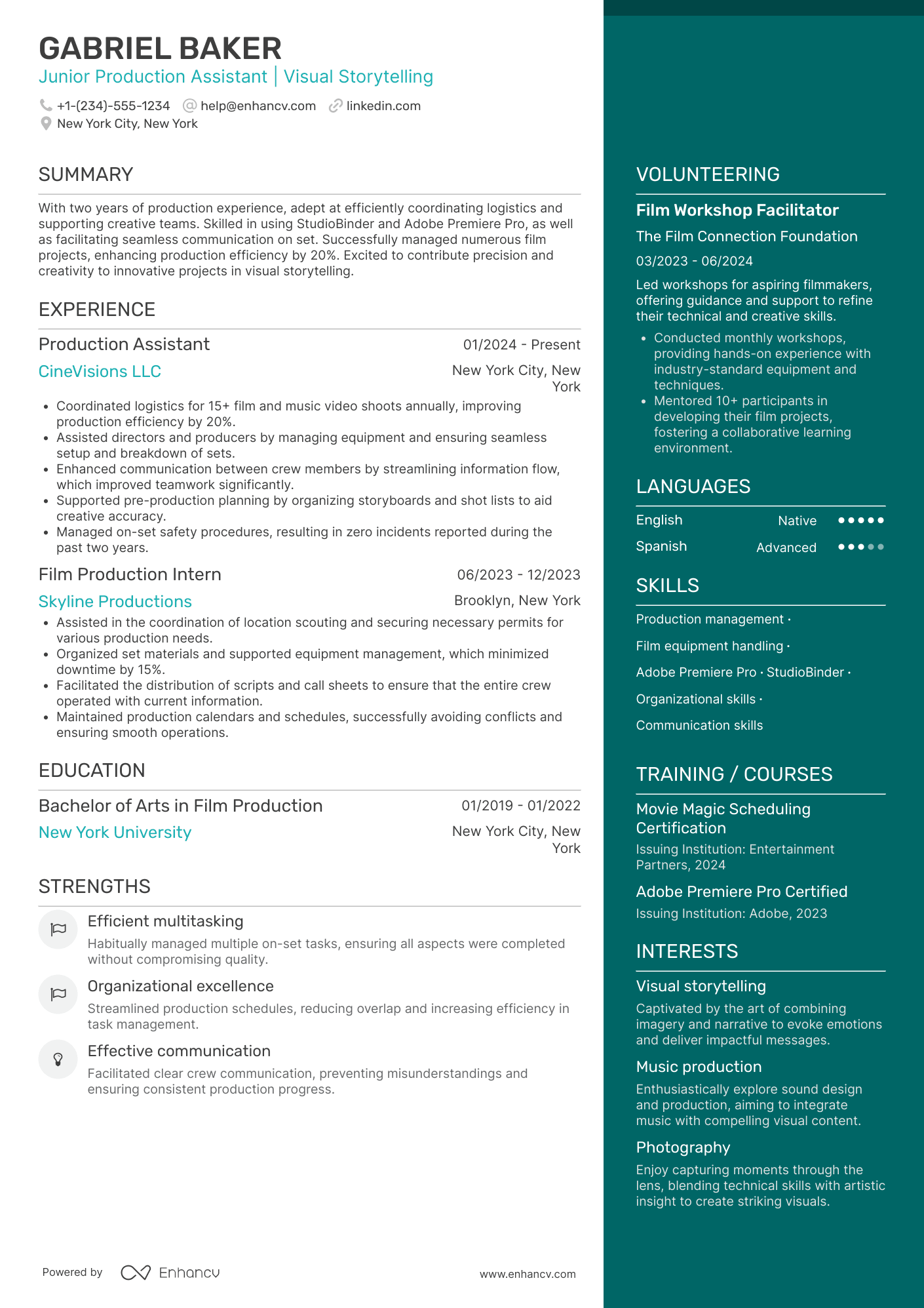
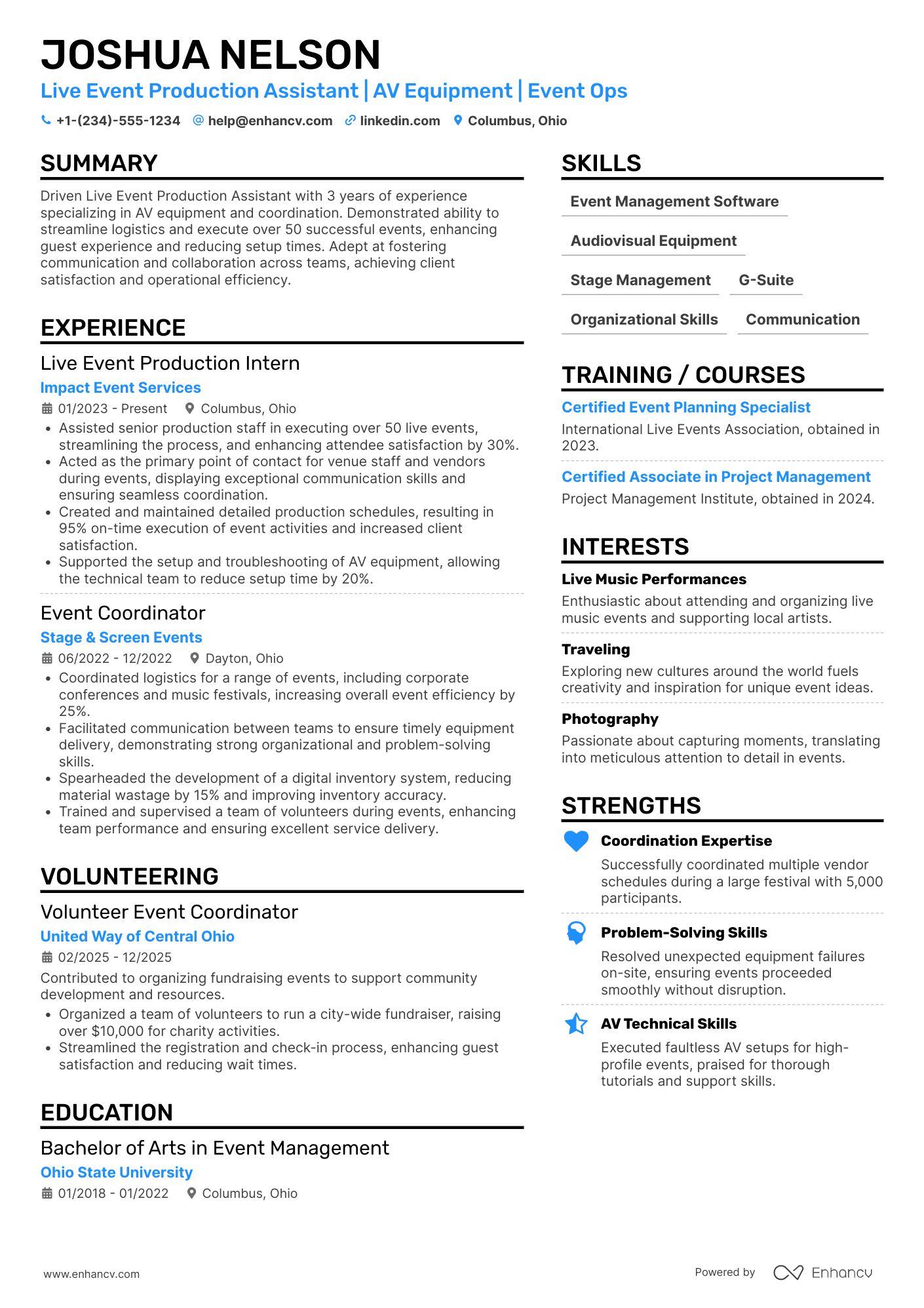
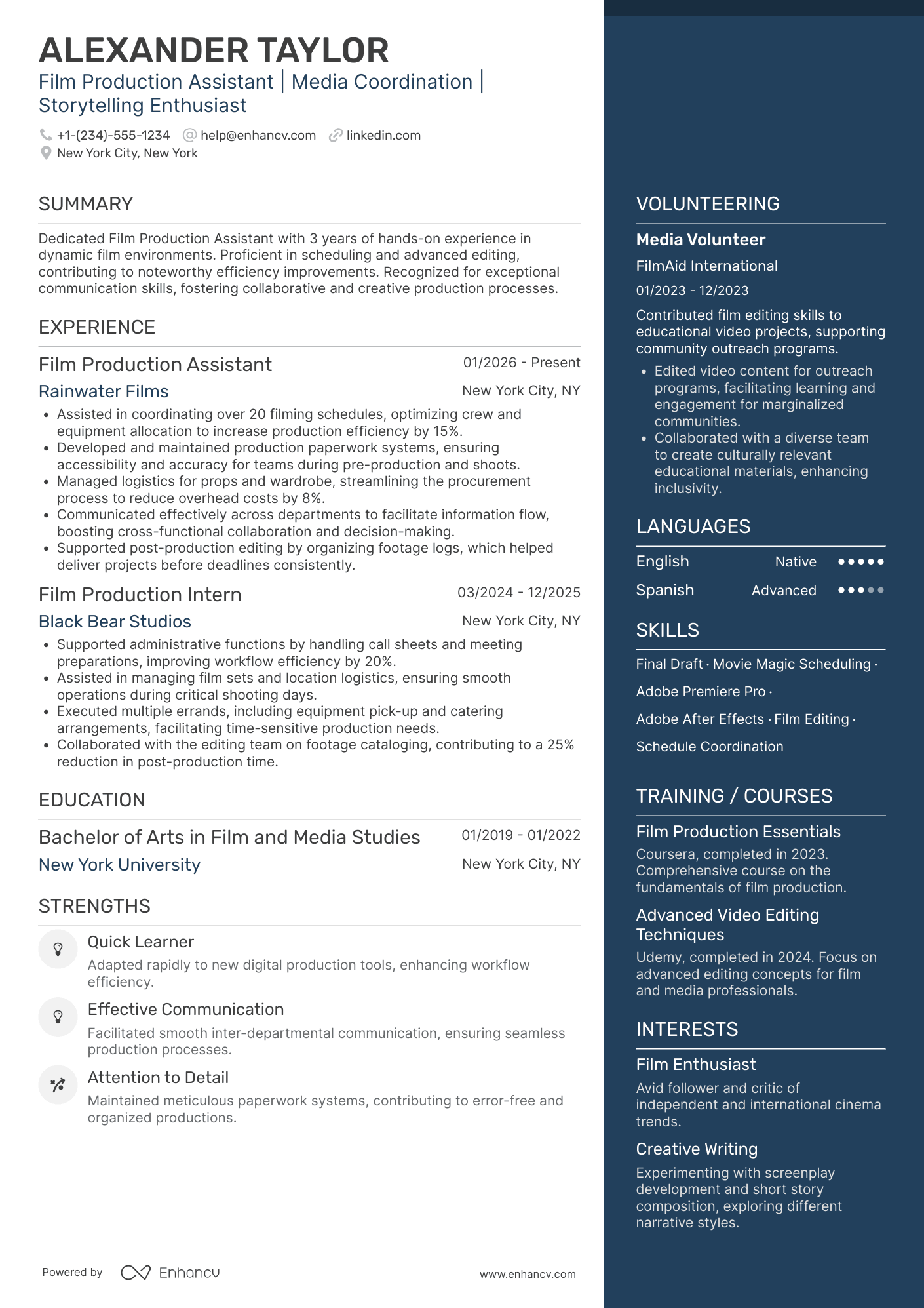
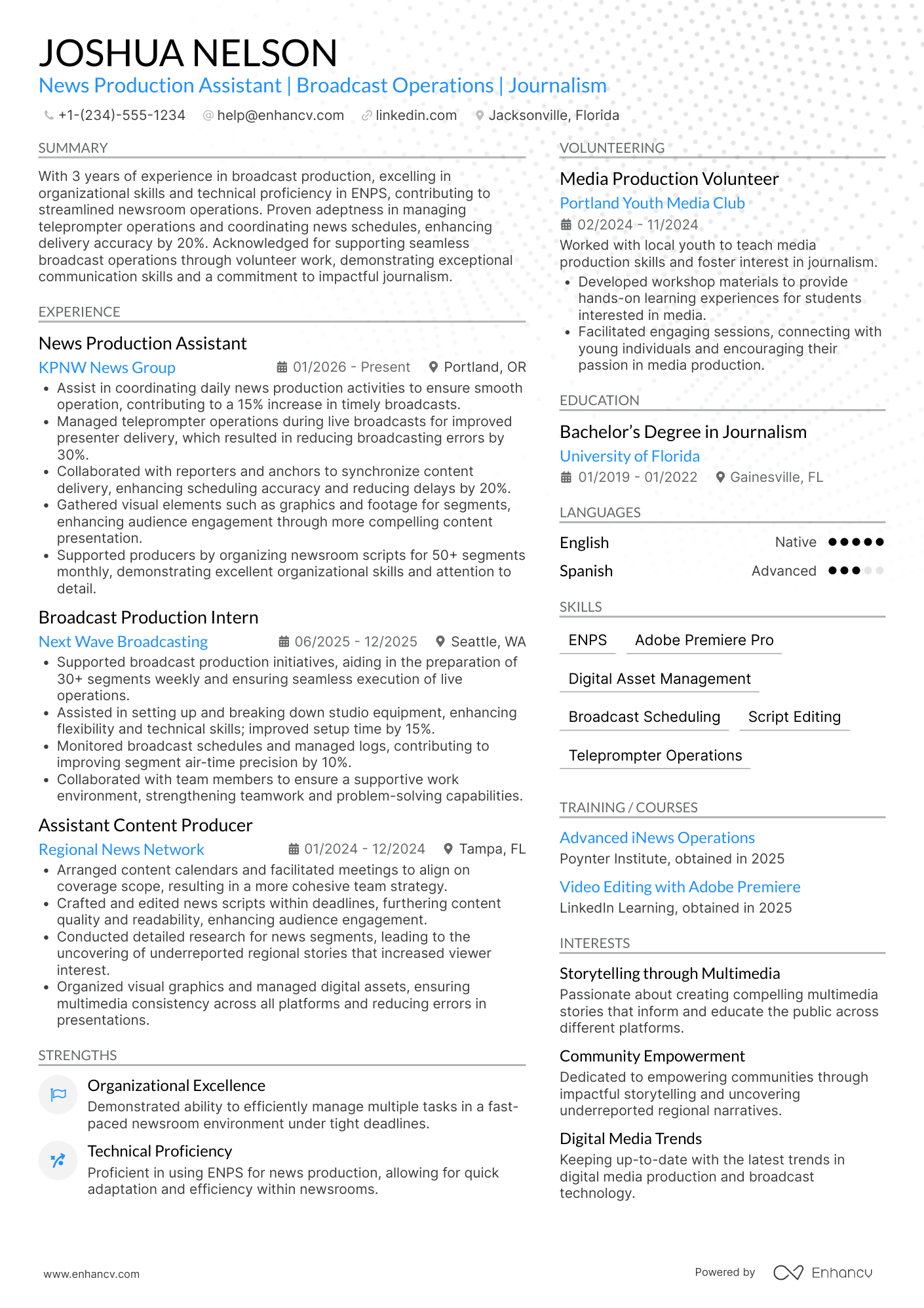
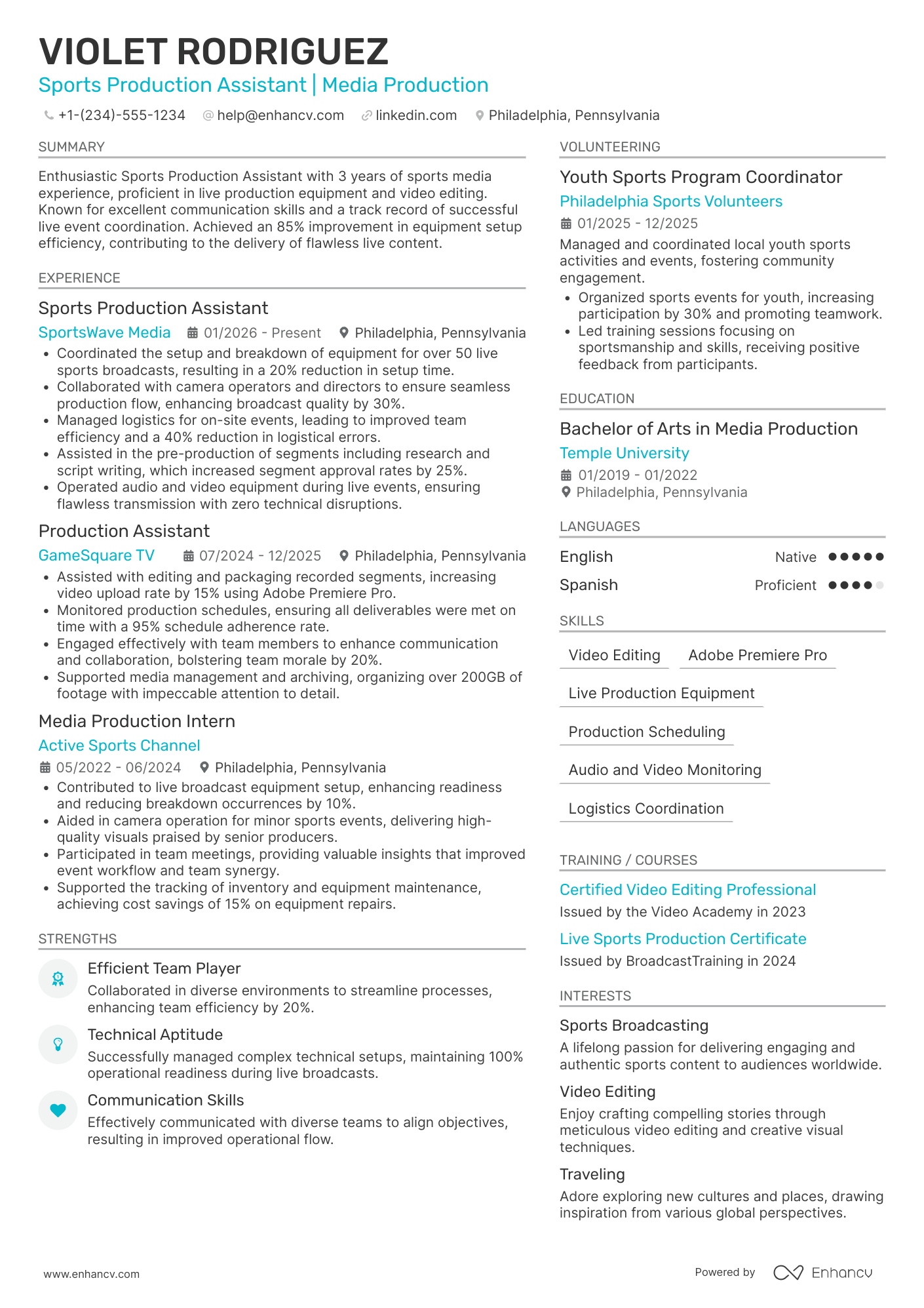
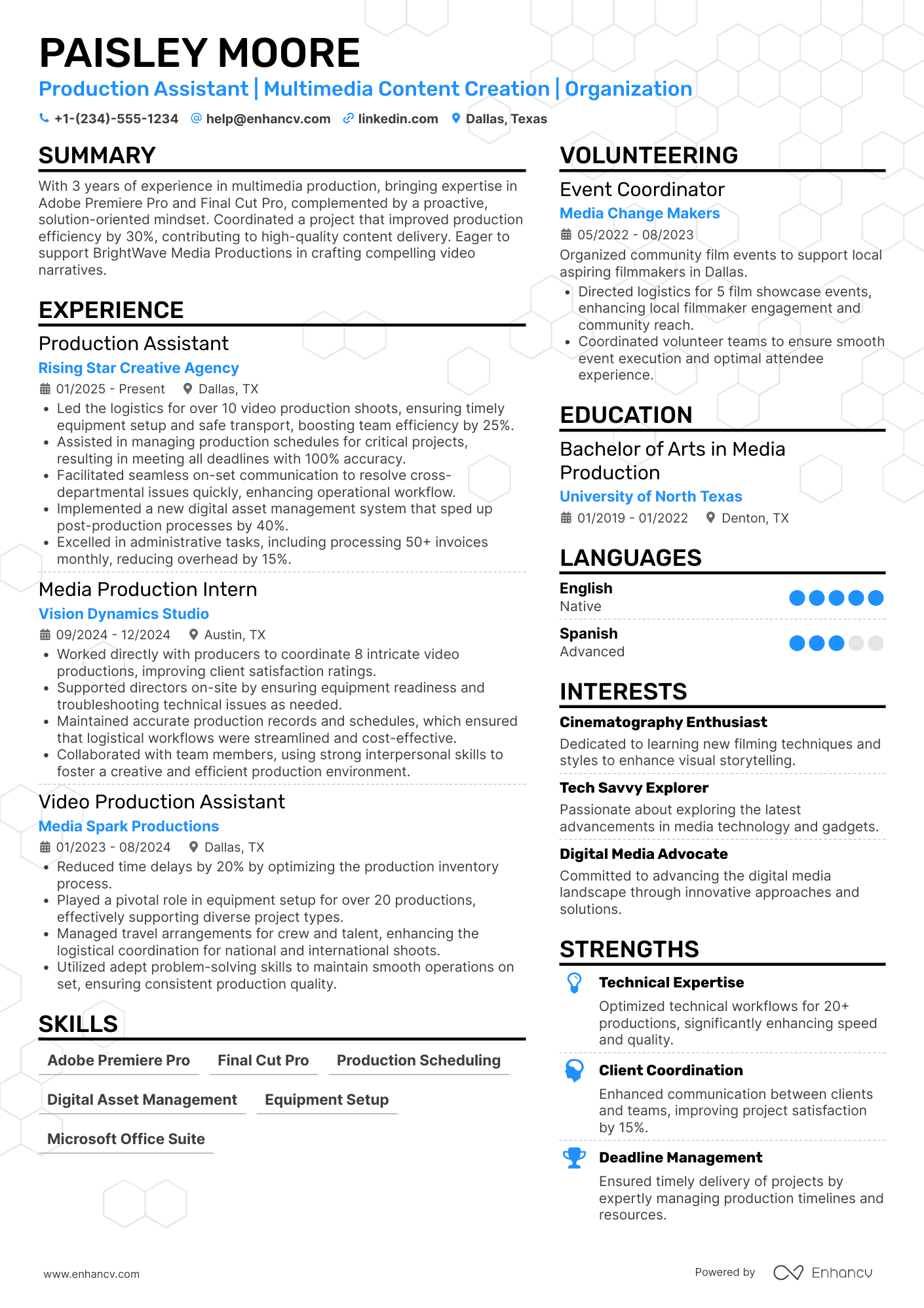
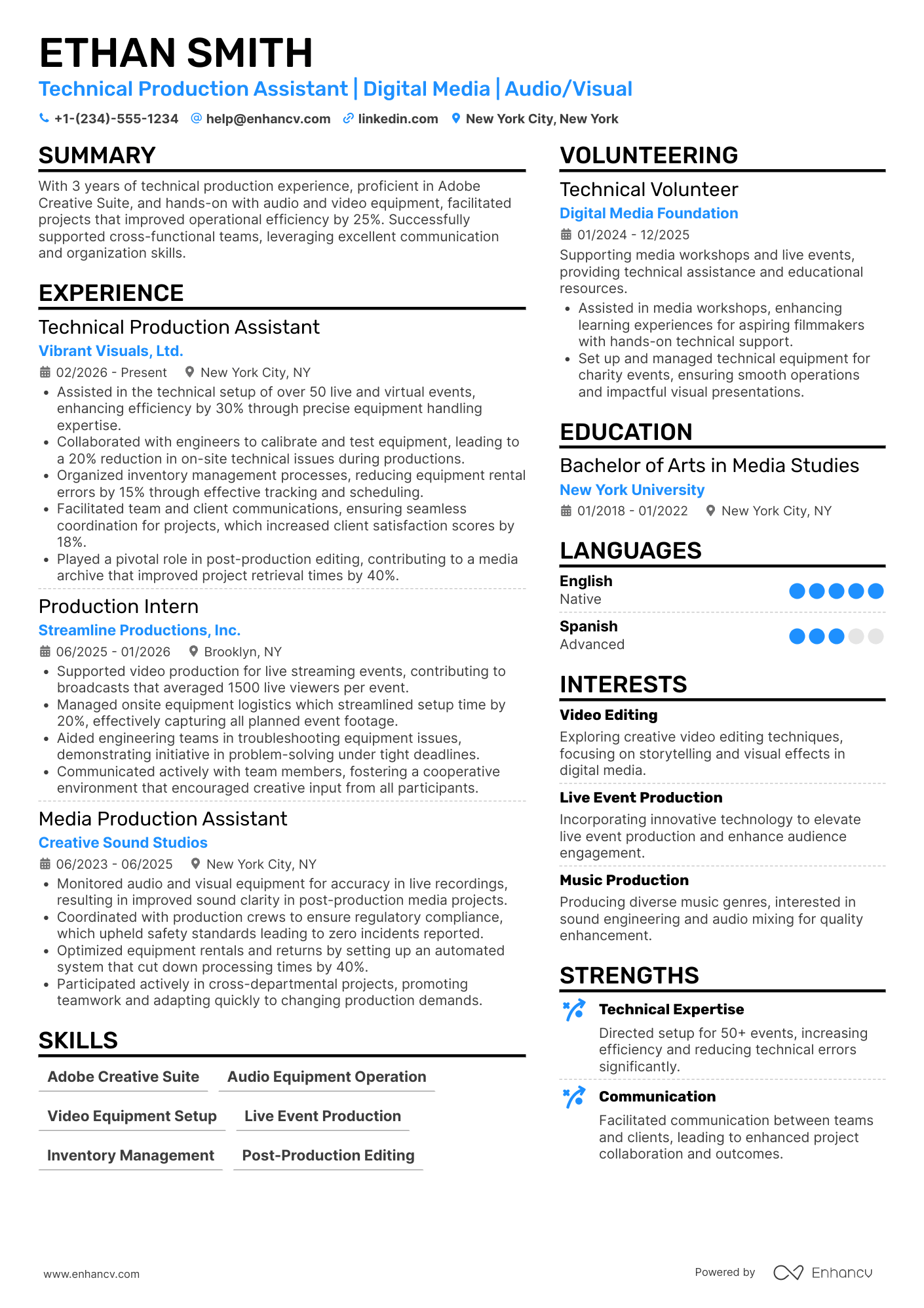
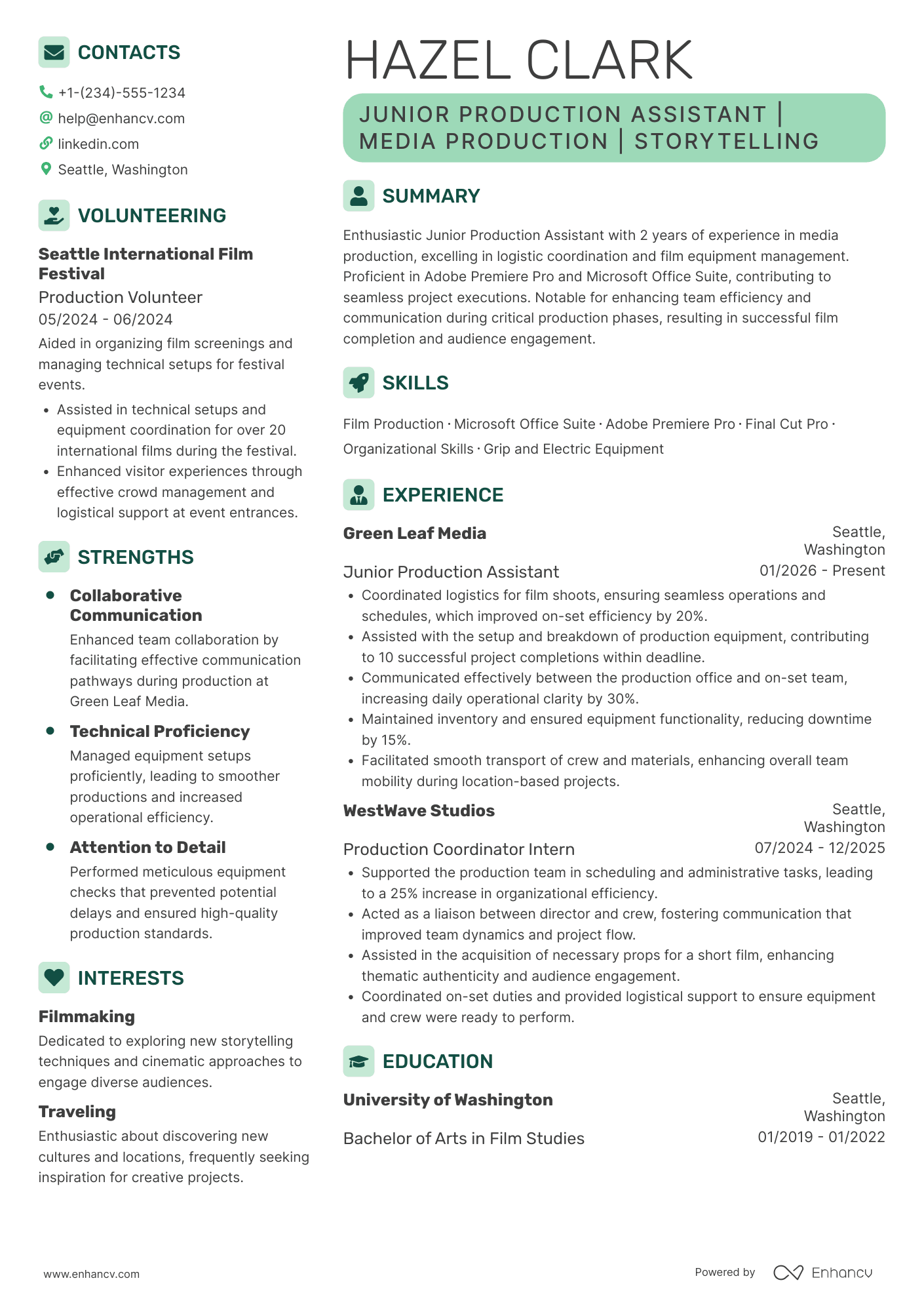
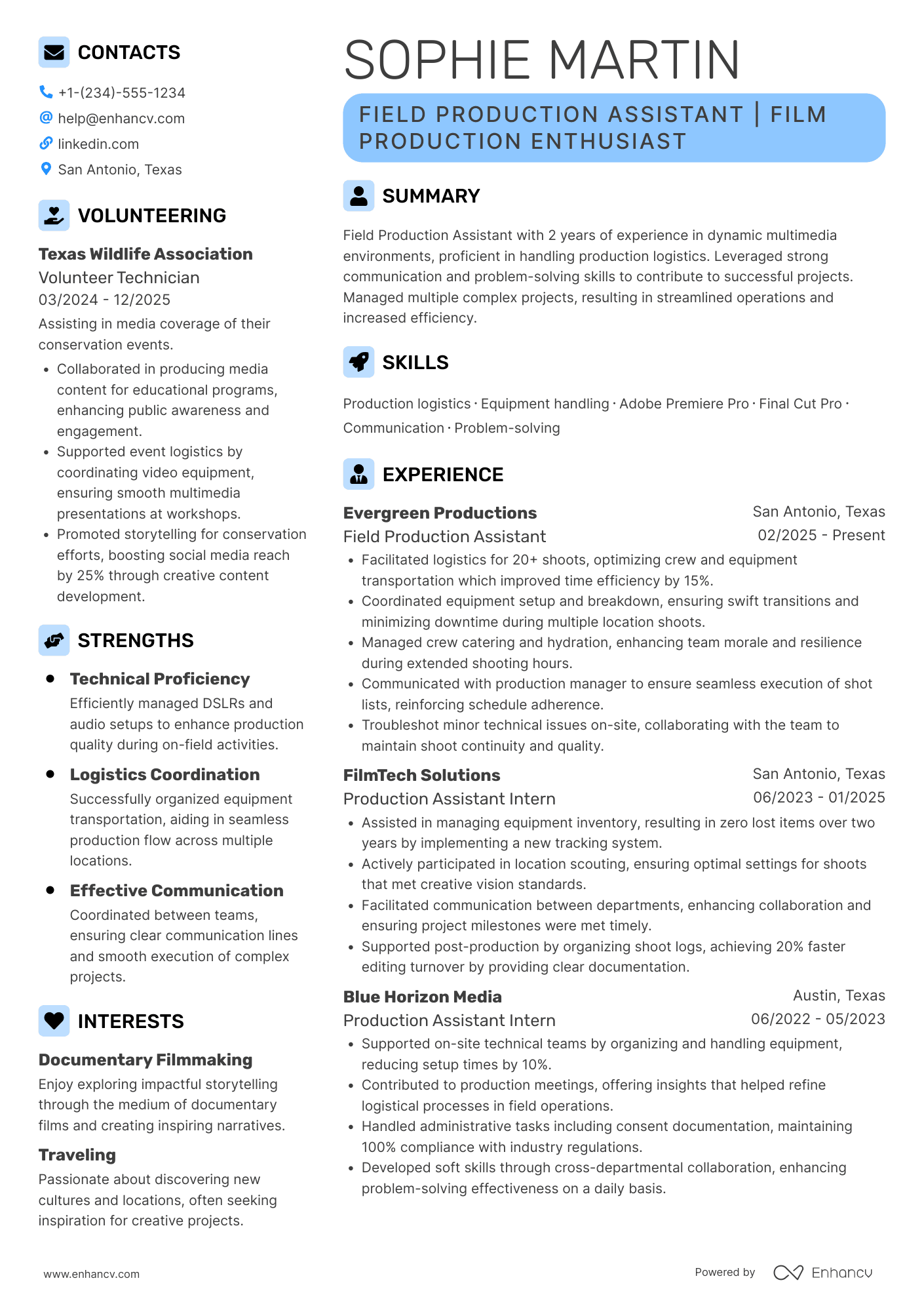
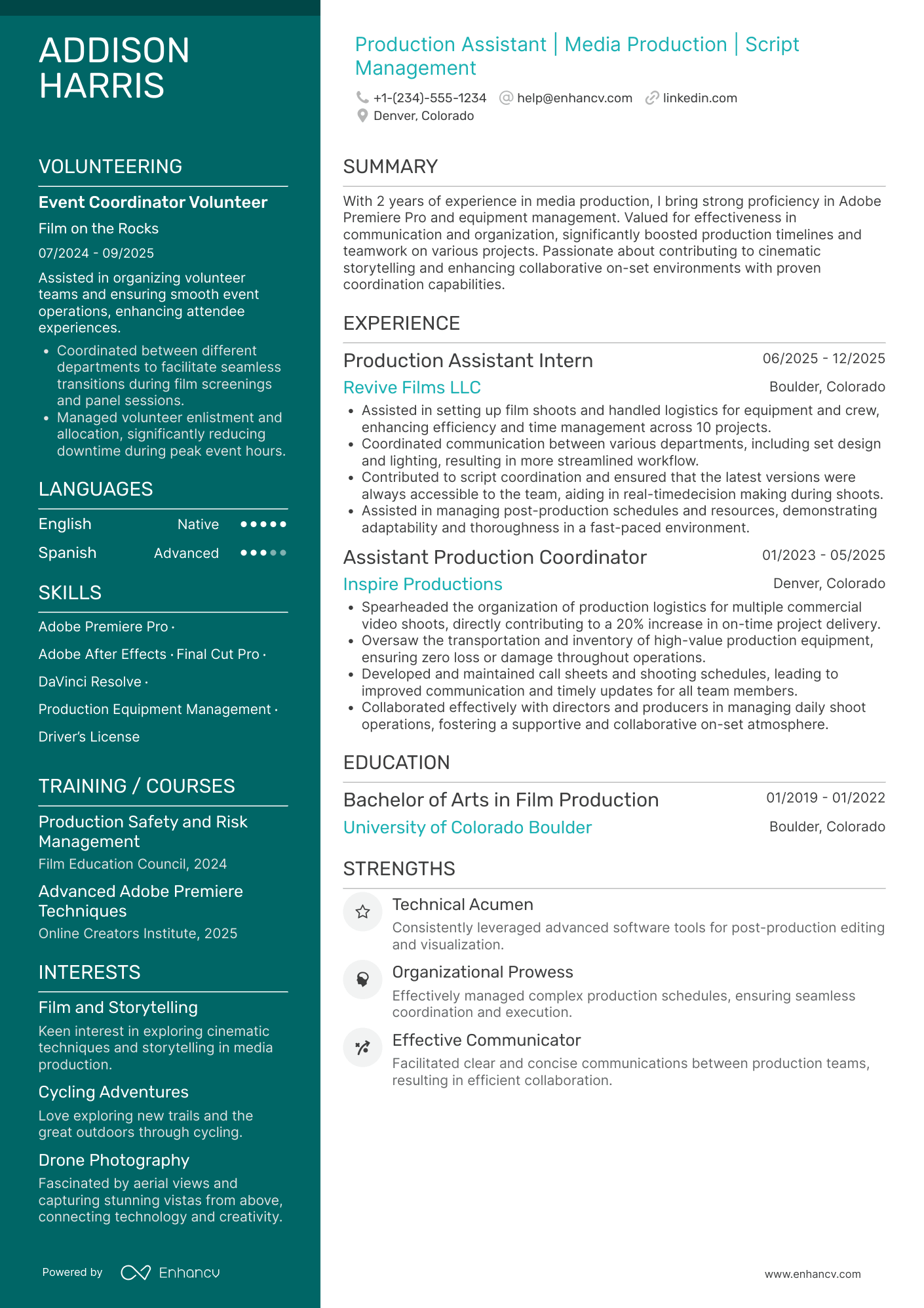
Production assistant resume drafts often fail because they read like task lists and bury call sheet accuracy, turnaround speed, and set readiness. That hurts when an ATS (applicant tracking system) filters fast and recruiters scan in seconds.
A strong resume shows what you delivered, not just what you did. Knowing how to make your resume stand out means highlighting on-time wrap rates, fewer reset delays, handled daily crew sizes, improved inventory accuracy, supported smooth company moves, and reduced overtime through better coordination. Include measurable quality and reliability.

Key takeaways
- Quantify achievements like setup time saved, budget adherence, and crew sizes to prove on-set impact.
- Use reverse-chronological format if experienced or hybrid format if entering production work.
- Tailor every experience bullet to mirror the job posting's exact tools, workflows, and terminology.
- Demonstrate skills in context within your summary and experience—not only in a standalone list.
- Include certifications like OSHA training and software credentials to strengthen a thin production credit list.
- Write a cover letter when the posting is competitive or your resume needs additional context.
- Build and refine your production assistant resume with Enhancv to keep formatting clean and ATS-ready.
Job market snapshot for production assistants
We analyzed 166 recent production assistant job ads across major US job boards. These numbers help you understand skills in demand, regional hotspots, salary landscape at a glance.
What level of experience employers are looking for production assistants
| Years of Experience | Percentage found in job ads |
|---|---|
| 1–2 years | 14.5% (24) |
| 3–4 years | 1.8% (3) |
| 5–6 years | 4.2% (7) |
| 10+ years | 2.4% (4) |
| Not specified | 77.1% (128) |
Production assistant ads by area of specialization (industry)
| Industry (Area) | Percentage found in job ads |
|---|---|
| Finance & Banking | 42.2% (70) |
| Healthcare | 17.5% (29) |
| Education | 13.9% (23) |
| Manufacturing | 12.0% (20) |
Top companies hiring production assistants
| Company | Percentage found in job ads |
|---|---|
| RR Donnelley & Sons | 9.0% (15) |
Role overview stats
These tables show the most common responsibilities and employment types for production assistant roles. Use them to align your resume with what employers expect and to understand how the role is structured across the market.
Day-to-day activities and top responsibilities for a production assistant
| Responsibility | Percentage found in job ads |
|---|---|
| Video editing | 6.6% (11) |
| Excel | 6.0% (10) |
| Microsoft office | 6.0% (10) |
| Video production | 5.4% (9) |
| Word | 5.4% (9) |
| Computer | 4.2% (7) |
| Forklift | 4.2% (7) |
| Lighting | 4.2% (7) |
| Social media | 4.2% (7) |
| Troubleshooting | 4.2% (7) |
| Photoshop | 3.6% (6) |
| Basic math | 3.0% (5) |
How to format a production assistant resume
Recruiters hiring production assistants prioritize adaptability, on-set skills, and the ability to handle fast-paced production environments with minimal supervision. A clean, well-structured resume format ensures these signals are immediately visible rather than buried under cluttered sections or unconventional layouts.

I have significant experience in this role—which format should I use?
Use a reverse-chronological format to lead with your most recent and relevant production experience. Do:
- Highlight the scope of your responsibilities on each production, including department, crew size, and production type (film, television, commercial, or digital).
- Feature role-specific tools and skills such as call sheet distribution, walkie-talkie protocol, production management software (e.g., StudioBinder, Movie Magic), and equipment handling.
- Quantify outcomes and contributions wherever possible to demonstrate reliability and impact on production efficiency.
I'm junior or switching into this role—what format works best?
A hybrid format works best because it lets you lead with transferable skills while still showing any relevant work or project history in chronological order. Do:
- Place a skills section near the top of your resume featuring production-relevant abilities like scheduling, communication, problem-solving, and familiarity with production terminology.
- Include student films, internships, volunteer crew work, or personal projects as legitimate production experience, listing your specific role and contributions on each.
- Connect every skill to a concrete action and a measurable or observable result so recruiters see practical application, not just a keyword list.
Why not use a functional resume?
A functional resume strips away the production-by-production context that hiring coordinators and line producers rely on to assess whether you can handle real set environments.
- Career changers with no direct production experience who have completed relevant internships, PA bootcamps, or volunteer crew work and need to foreground transferable skills.
- Candidates with significant resume gaps who have stayed current through freelance gig work, workshops, or industry networking but lack continuous employment history.
With your format set, the next step is filling it with the right sections to give recruiters exactly what they're looking for.
What sections should go on a production assistant resume
Recruiters expect a production assistant resume to show set readiness, reliability, and hands-on support across production tasks. Understanding what to put on a resume helps you prioritize the most impactful information.
Use this structure for maximum clarity:
- Header
- Summary
- Experience
- Skills
- Projects
- Education
- Certifications
- Optional sections: Awards, Volunteering, Languages
Your strongest experience bullets should emphasize measurable impact, outcomes, and scope—such as days supported, teams coordinated, problems resolved, and time or cost saved.
Is your resume good enough?
Drop your resume here or choose a file. PDF & DOCX only. Max 2MB file size.
Once you’ve organized your resume with the right components, the next step is to write your production assistant resume experience so each role clearly supports that structure.
How to write your production assistant resume experience
The work experience section is where you prove you've contributed to real productions—not just showed up on set. Hiring managers scanning production assistant resumes prioritize demonstrated impact through shipped work, role-relevant tools and workflows, and measurable outcomes over generic task descriptions.
Each entry should include:
- Job title
- Company and location (or remote)
- Dates of employment (month and year)
Three to five concise bullet points showing what you owned, how you executed, and what outcomes you delivered:
- Ownership scope: the specific productions, departments, sets, equipment inventories, or daily operations you were directly accountable for as a production assistant.
- Execution approach: the scheduling software, call sheet platforms, communication systems, logging tools, or on-set coordination methods you used to keep productions running smoothly.
- Value improved: the changes you drove in production efficiency, turnaround time, equipment reliability, set safety, workflow accuracy, or cost management within your responsibilities.
- Collaboration context: how you worked alongside directors, producers, department heads, talent, crew members, vendors, or post-production teams to support seamless production workflows.
- Impact delivered: the tangible results of your contributions expressed through production milestones hit, budget adherence, time saved, or operational improvements—not just the activities you performed.
Experience bullet formula
A production assistant experience example
✅ Right example - modern, quantified, specific.
Production Assistant
BrightFrame Studios | Brooklyn, NY
2023–2025
Supported a high-volume commercial and branded-content production team delivering twenty to thirty shoot days per month.
- Coordinated call sheets, one-liners, and daily production reports in StudioBinder and Google Workspace, cutting crew check-in time by 25% across fifteen consecutive shoot days.
- Managed purchase orders, petty cash, and wrap cost reports in Excel and QuickBooks, reducing reconciliation errors by 30% and keeping weekly spend within 2% of budget.
- Built and maintained asset naming and release-form tracking in Airtable, increasing same-day clearance completion from 70% to 95% and reducing legal follow-ups by 40%.
- Scheduled talent, locations, and vendor holds using Google Calendar and Slack workflows, preventing eight booking conflicts and improving on-time call by 18% quarter over quarter.
- Partnered with producers, camera, sound, and art teams to run gear checkouts and media handoffs, using QR-labeled inventory and checksum verification to cut missing-kit incidents by 50%.
Now that you've seen how a strong experience section comes together, let's look at how to adjust those details to match the specific job you're applying for.
How to tailor your production assistant resume experience
Recruiters evaluate production assistant resumes through both human review and applicant tracking systems (ATS), so tailoring your resume to the job description is essential. Aligning your bullet points with the specific language and priorities in the listing increases your chances of passing both screening stages.
Ways to tailor your production assistant experience:
- Match specific software and equipment listed in the job description.
- Mirror the exact terminology used for production workflows or processes.
- Highlight call sheet or scheduling tools the posting names directly.
- Include relevant industry experience such as film television or commercial.
- Emphasize on-set safety and compliance duties when the role requires them.
- Reference the collaboration structure described like department coordination or crew support.
- Align your metrics with the KPIs or deliverables the employer highlights.
- Incorporate quality control or continuity responsibilities if the posting mentions them.
Tailoring means aligning your real accomplishments with what the role demands, not forcing keywords where they don't belong.
Resume tailoring examples for production assistant
| Job description excerpt | Untailored | Tailored |
|---|---|---|
| "Coordinate daily call sheets, manage talent schedules, and ensure smooth communication between departments using StudioBinder." | Helped with scheduling and communication on set. | Coordinated daily call sheets and talent schedules for a 45-person crew across three departments using StudioBinder, reducing scheduling conflicts by 30%. |
| "Assist with equipment setup and breakdown, maintain gear inventory logs, and support the camera and lighting teams during shoots." | Set up and took down equipment for productions. | Managed setup and breakdown of camera and lighting equipment for 12 on-location shoots, maintaining accurate gear inventory logs that cut missing-item reports to zero over a six-month period. |
| "Handle script distribution, track revisions using Final Draft, and ensure all cast and crew receive updated sides before each shooting day." | Distributed scripts and kept track of changes for the team. | Distributed revised scripts and updated sides to a cast and crew of 60+ before each shooting day, tracking all revisions in Final Draft to ensure version accuracy across five concurrent episodes. |
Once you’ve aligned your experience with the role’s needs, quantify your production assistant achievements to show the scope and impact of your work.
How to quantify your production assistant achievements
Quantifying achievements shows how you kept shoots on schedule, reduced errors, and protected the budget. Focus on turnaround time, task volume, accuracy, cost savings, and risk reduction across call sheets, releases, gear, and daily production reports.
Quantifying examples for production assistant
| Metric | Example |
|---|---|
| Turnaround time | "Cut call sheet turnaround from 90 to 35 minutes by standardizing templates in Google Docs and using a 10-point preflight checklist." |
| Volume handled | "Coordinated 18 shoot days across six locations, tracking 120+ crew and talent call times with zero missed call notifications." |
| Accuracy | "Reduced meal penalty incidents from five per week to one by auditing timecards daily and reconciling with set reports in Excel." |
| Cost control | "Saved $3,400 in rentals by consolidating gear requests, confirming availability 48 hours earlier, and negotiating weekly rates with two vendors." |
| Risk reduction | "Achieved 100% signed release coverage for 65 on-camera participants by managing digital releases in DocuSign and verifying forms before wrap." |
Turn vague job duties into measurable, recruiter-ready resume bullets in seconds with Enhancv's Bullet Point Generator.
Once you've crafted strong bullet points for your experience section, the next step is ensuring your resume also highlights the right hard and soft skills that production teams are looking for.
How to list your hard and soft skills on a production assistant resume
Your skills section shows you can support product managers by running discovery, coordinating delivery, and keeping work moving; recruiters and an ATS (applicant tracking system) scan this section for job-match keywords, and strong resumes balance role-specific hard skills with execution-focused soft skills. production assistant roles require a blend of:
- Product strategy and discovery skills.
- Data, analytics, and experimentation skills.
- Delivery, execution, and go-to-market discipline.
- Soft skills.
Your skills section should be:
- Scannable (bullet-style grouping).
- Relevant to the job post.
- Backed by proof in experience bullets.
- Updated with current tools.
Place your skills section:
- Above experience if you're junior or switching careers.
- Below experience if you're mid/senior with strong achievements.

Hard skills
- Jira, Confluence
- Asana, Trello
- Notion documentation
- Agile ceremonies support
- User story writing
- Acceptance criteria drafting
- Requirements gathering
- Product roadmap updates
- SQL basics
- Excel, Google Sheets
- A/B testing support
- Google Analytics 4
Soft skills
- Turn ambiguity into next steps
- Run tight meeting notes and actions
- Follow up to unblock owners
- Communicate status without noise
- Prioritize tasks under deadlines
- Coordinate across engineering and design
- Ask clarifying questions early
- Escalate risks with context
- Keep stakeholders aligned on scope
- Maintain high-accuracy documentation
- Handle fast context switching
- Own handoffs end-to-end
How to show your production assistant skills in context
Skills shouldn't live only in a dedicated skills list. Explore resume skills examples to see how top candidates weave abilities into every section.
They should be demonstrated in:
- Your summary (high-level professional identity)
- Your experience (proof through outcomes)
Here's how that looks in practice.
Summary example
Production assistant with eight years in live television, skilled in call sheet coordination, Scriptation, and crew logistics. Streamlined daily equipment tracking, reducing setup delays by 20%. Known for calm problem-solving under tight broadcast deadlines.
- Reflects senior-level experience clearly
- Names industry-relevant tools directly
- Includes a concrete performance metric
- Highlights composure as a soft skill
Experience example
Senior Production Assistant
Redwood Media Group | Atlanta, GA
June 2019–March 2024
- Coordinated daily call sheets and crew schedules using StudioBinder, cutting scheduling conflicts by 35% across 12 concurrent productions.
- Collaborated with directors, camera operators, and post-production teams to maintain on-set continuity, reducing reshoot requests by 18%.
- Managed equipment inventory and vendor logistics through Monday.com, keeping production budgets within 5% of approved targets.
- Every bullet includes measurable proof.
- Skills appear naturally within achievements.
Once you’ve tied your abilities to real tasks and outcomes, the next step is applying that approach to a production assistant resume with no experience so you can present transferable work in a credible way.
How do I write a production assistant resume with no experience
Even without full-time experience, you can demonstrate readiness through projects and volunteer work. Our guide on writing a resume without work experience covers this in detail. Here are strong options to include:
- Student film set runner work
- Theater stagehand and load-in shifts
- Event setup and strike crew
- Equipment checkout desk volunteer hours
- Campus TV studio crew roles
- Social media content production projects
- Freelance photo or video shoots
- Production office admin temp work
Focus on:
- Set paperwork and timecards accuracy
- Gear handling and inventory tracking
- Call sheet and schedule coordination
- Safety compliance and incident reporting
Resume format tip for entry-level production assistant
Use a hybrid resume format, so you can spotlight projects and relevant tasks while still showing steady work history and availability. Do:
- Put a "Projects" section above work.
- Mirror job post keywords in bullets.
- List tools you used on set.
- Quantify volume, time, and outputs.
- Add availability, location, and travel.
- Supported a student film shoot using call sheets, walkies, and Google Sheets gear logs, tracking 45 items with zero losses across three shoot days.
Even without formal work experience, your education section can demonstrate relevant knowledge and training that strengthens your candidacy—here's how to present it effectively.
How to list your education on a production assistant resume
Your education section helps hiring teams confirm you have foundational knowledge in film, media, or communications. It validates your training and signals readiness for production assistant work.
Include:
- Degree name
- Institution
- Location
- Graduation year
- Relevant coursework (for juniors or entry-level candidates)
- Honors & GPA (if 3.5 or higher)
Skip month and day details—list the graduation year only.
Here's a strong education entry tailored for a production assistant resume:
Example education entry
Bachelor of Arts in Film and Media Studies
Emerson College, Boston, MA
Graduated 2023
GPA: 3.7/4.0
- Relevant Coursework: Introduction to Film Production, Audio Engineering, Screenwriting, Studio Operations, and Post-Production Techniques
- Honors: Dean's List, Fall 2021–Spring 2023
How to list your certifications on a production assistant resume
Certifications on your resume show your commitment to learning, prove tool proficiency, and signal industry relevance as a production assistant, especially when you lack extensive set credits.
Include:
- Certificate name
- Issuing organization
- Year
- Optional: credential ID or URL
- Place certifications below education when your degree is recent and your certifications only add minor support.
- Place certifications above education when they are recent, role-relevant, or required for the production assistant jobs you target.
Best certifications for your production assistant resume
OSHA 10-Hour General Industry OSHA 30-Hour General Industry First Aid, CPR, and AED Certification Avid Media Composer Certified User Adobe Certified Professional in Premiere Pro Set Lighting Technician Certification (Entertainment Services and Technology Association)
Once you’ve positioned your credentials where hiring managers can spot them quickly, shift to writing your production assistant resume summary to highlight those qualifications upfront.
How to write your production assistant resume summary
Your resume summary is the first thing a recruiter reads on your production assistant resume. A strong opening signals you're organized, reliable, and ready to contribute on set from day one.
Keep it to three to four lines, with:
- Your title and relevant years of experience in production environments.
- The type of productions you've supported, such as film, TV, or commercial.
- Core tools and skills like call sheets, scheduling software, and equipment coordination.
- One or two measurable contributions, such as tasks completed or budgets tracked.
- Soft skills tied to real outcomes, like communication that reduced on-set delays.

PRO TIP
At the production assistant level, emphasize specific skills, tools, and early wins that prove you can handle fast-paced sets. Avoid vague phrases like "passionate team player" or "hard worker." Replace them with concrete actions and results recruiters can verify.
Example summary for a production assistant
Detail-oriented production assistant with two years of experience supporting film and commercial sets. Coordinated daily logistics for crews of 40+, reducing setup delays by 15% through proactive scheduling and clear communication.
Optimize your resume summary and objective for ATS
Drop your resume here or choose a file.
PDF & DOCX only. Max 2MB file size.
Now that your summary is ready to hook hiring managers, make sure the header above it presents your contact details correctly so recruiters can actually reach you.
What to include in a production assistant resume header
Your resume header lists your key contact and professional details, helping recruiters spot you fast, trust your information, and screen you efficiently for production assistant roles.
Essential resume header elements
- Full name
- Tailored job title and headline
- Location
- Phone number
- Professional email
- GitHub link
- Portfolio link
A LinkedIn link helps recruiters confirm your work history quickly and supports faster screening.
Don't include a photo on a production assistant resume unless the role is explicitly front-facing or appearance-dependent.
Match your header title to the posting and keep links short, consistent, and easy to copy on mobile.
Example
Production assistant resume header
Jordan Rivera
Production assistant | Set support, call sheets, and gear coordination
Los Angeles, CA
(323) 555-01XX
jordan.rivera@enhancv.com
github.com/jordanrivera
yourwebsite.com
linkedin.com/in/jordanrivera
Once your contact details and role focus are clear at the top, you can strengthen the rest of your application with additional sections that add relevant context and proof of fit.
Additional sections for production assistant resumes
When your core qualifications match other candidates, additional sections can set you apart and reinforce your production-specific credibility. For example, listing language skills on your resume can be a differentiator on multilingual or international sets.
- Languages
- Certifications and safety training
- Hobbies and interests
- Volunteer experience
- Technical proficiencies
- Professional affiliations
- Awards and recognition
Once you've rounded out your resume with the right supplementary sections, it's worth pairing it with a strong cover letter to make an even bigger impression.
Do production assistant resumes need a cover letter
A cover letter isn't required for a production assistant, but it often helps in competitive postings or teams that expect one. If you're unsure where to start, learn what a cover letter is and how it complements your resume. It can make a difference when your resume needs context, or when hiring managers compare many similar profiles.
Use a cover letter to add value, not repeat your resume:
- Explain why you fit the specific production assistant role and team, including the pace, workflow, and collaboration style.
- Highlight one or two relevant projects or outcomes, such as tighter schedules, fewer errors, or smoother handoffs across departments.
- Show you understand the product, users, or business context, and how a production assistant supports quality, timelines, and communication.
- Address career transitions or non-obvious experience by translating skills into production assistant tasks, tools, and responsibilities.
Drop your resume here or choose a file.
PDF & DOCX only. Max 2MB file size.
Once you’ve decided whether to include a cover letter to add context beyond your resume, the next step is using AI to improve your production assistant resume so it communicates your value more clearly and efficiently.
Using AI to improve your production assistant resume
AI can sharpen your resume's clarity, structure, and impact. It helps tighten language and highlight relevant experience. But overuse strips authenticity. Once your content reads clearly and aligns with production assistant roles, step away from AI. If you're curious about where to begin, explore ChatGPT resume writing prompts for practical starting points.
Here are 10 practical prompts to strengthen specific sections of your resume:
- Tighten your summary. "Rewrite my production assistant resume summary to be under 40 words, focusing on set coordination and logistics skills."
- Quantify experience bullets. "Add measurable results to these production assistant experience bullets using numbers, timelines, or team sizes."
- Cut filler words. "Remove vague or unnecessary words from my production assistant experience section without changing the meaning."
- Align with job posting. "Compare my production assistant resume skills section to this job description and suggest missing keywords."
- Strengthen action verbs. "Replace weak or repeated verbs in my production assistant experience bullets with stronger, industry-specific alternatives."
- Clarify project contributions. "Rewrite my production assistant projects section to clearly state my specific role and deliverables on each project."
- Refine technical skills. "Organize my production assistant skills list by category—software, equipment, logistics—and remove anything outdated or irrelevant."
- Improve education details. "Rewrite my education section to highlight coursework and achievements directly relevant to production assistant roles."
- Highlight certifications clearly. "Format my production assistant certifications section so each entry includes the credential name, issuer, and date earned."
- Fix inconsistent formatting. "Standardize tense, punctuation, and structure across all bullet points in my production assistant resume."
Stop using AI once your resume sounds accurate, specific, and aligned with real experience. AI should never invent experience or inflate claims—if it didn't happen, it doesn't belong here.
Conclusion
A strong production assistant resume shows measurable outcomes, role-specific skills, and a clear structure. Use clean headings, consistent formatting, and direct bullets. Highlight results like reduced setup time, accurate call sheets, smooth runs, and on-time deliveries.
This approach signals you’re ready for today’s hiring market and what’s coming next. It shows you can support fast-paced sets, stay organized, and communicate clearly. Keep it focused, specific, and easy to scan.
Production Assistant resume examples
By Experience