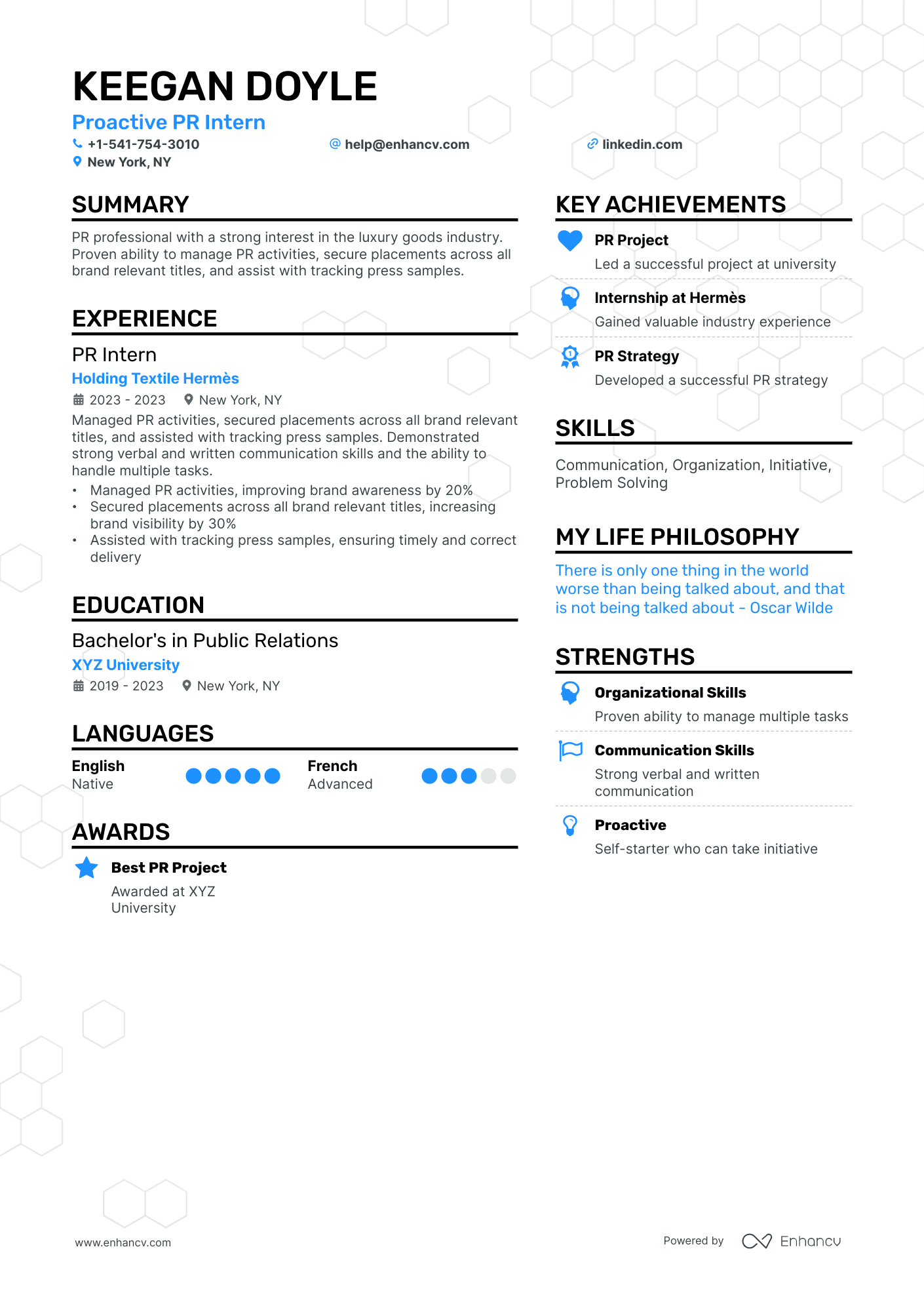
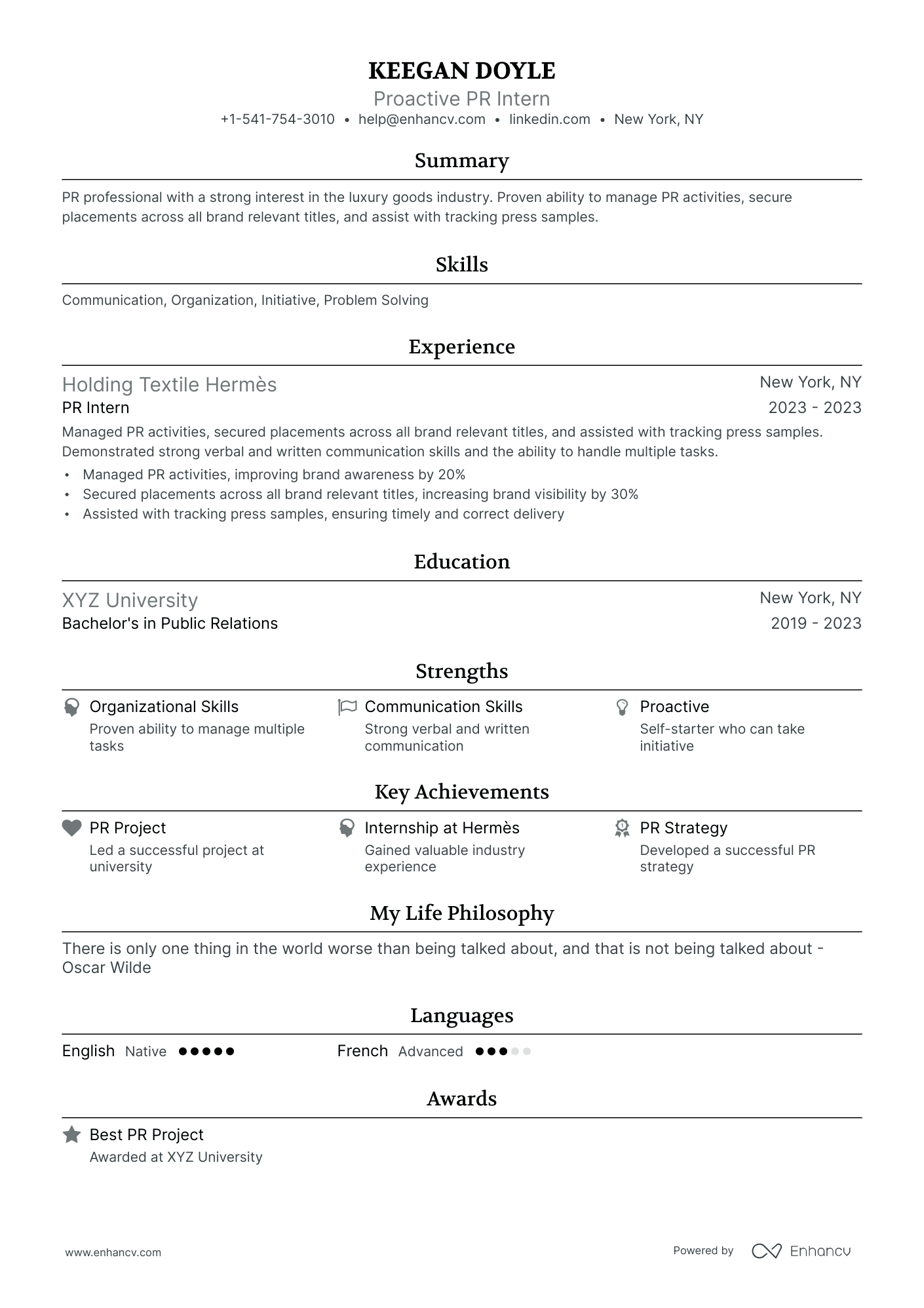
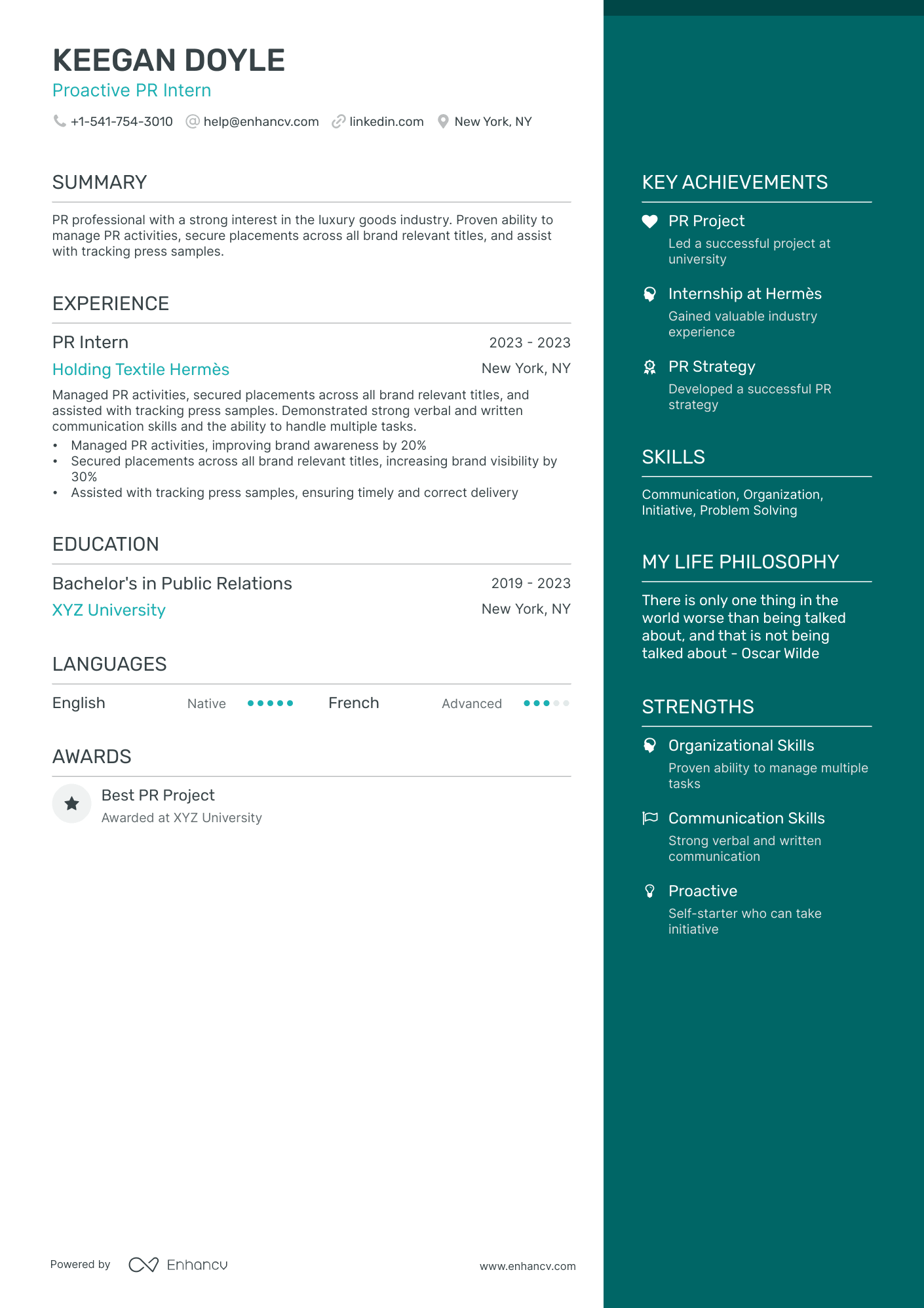
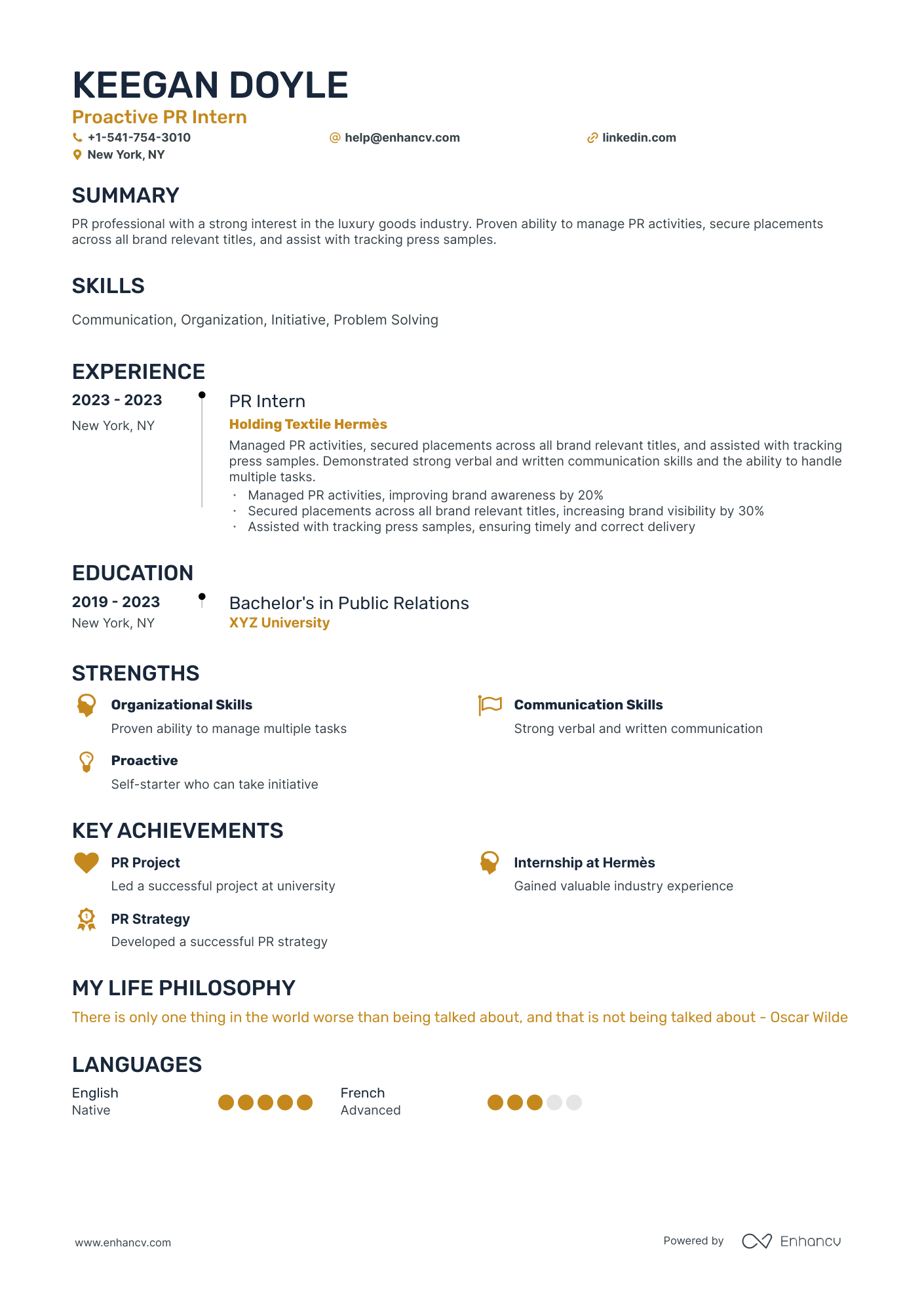
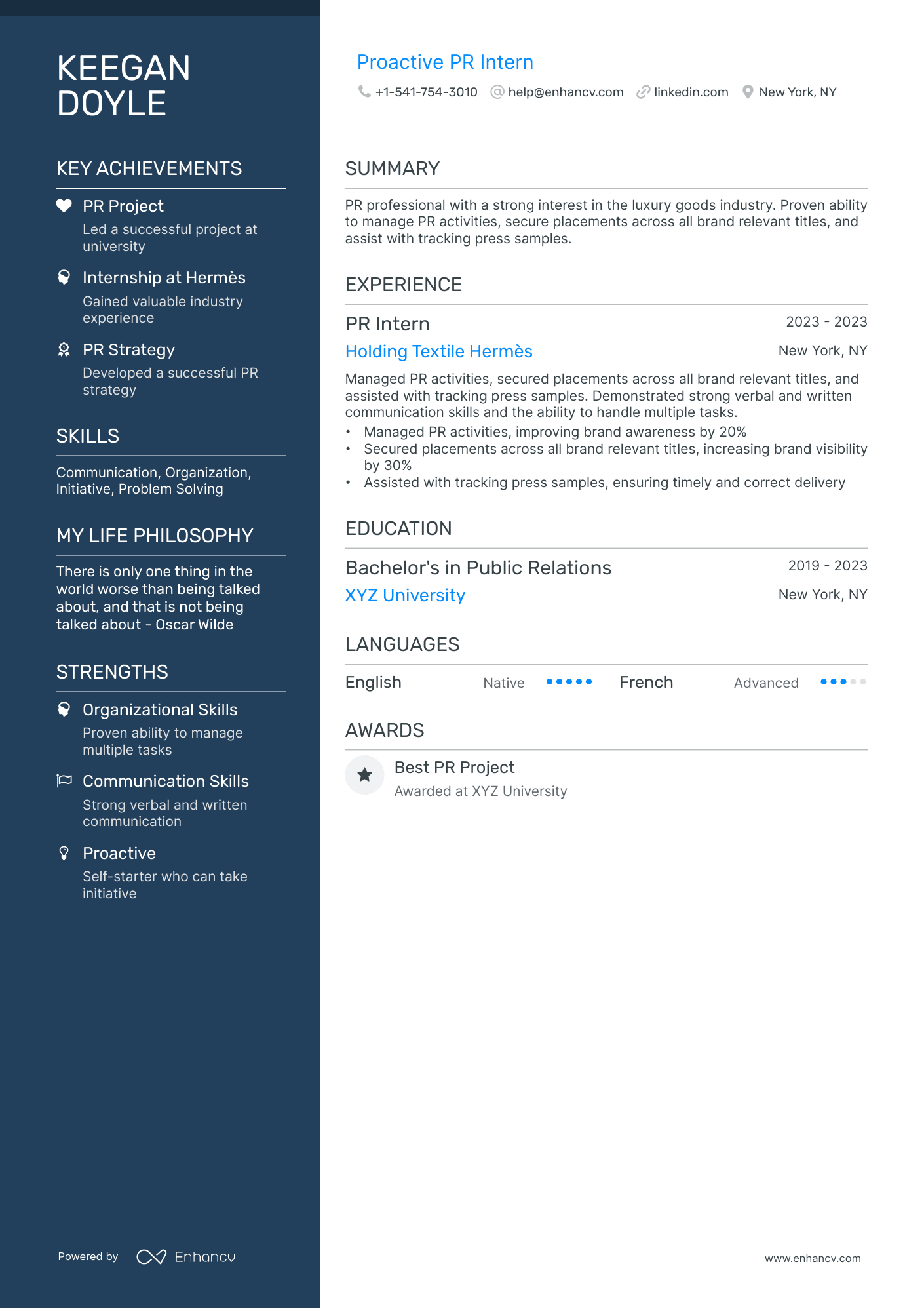
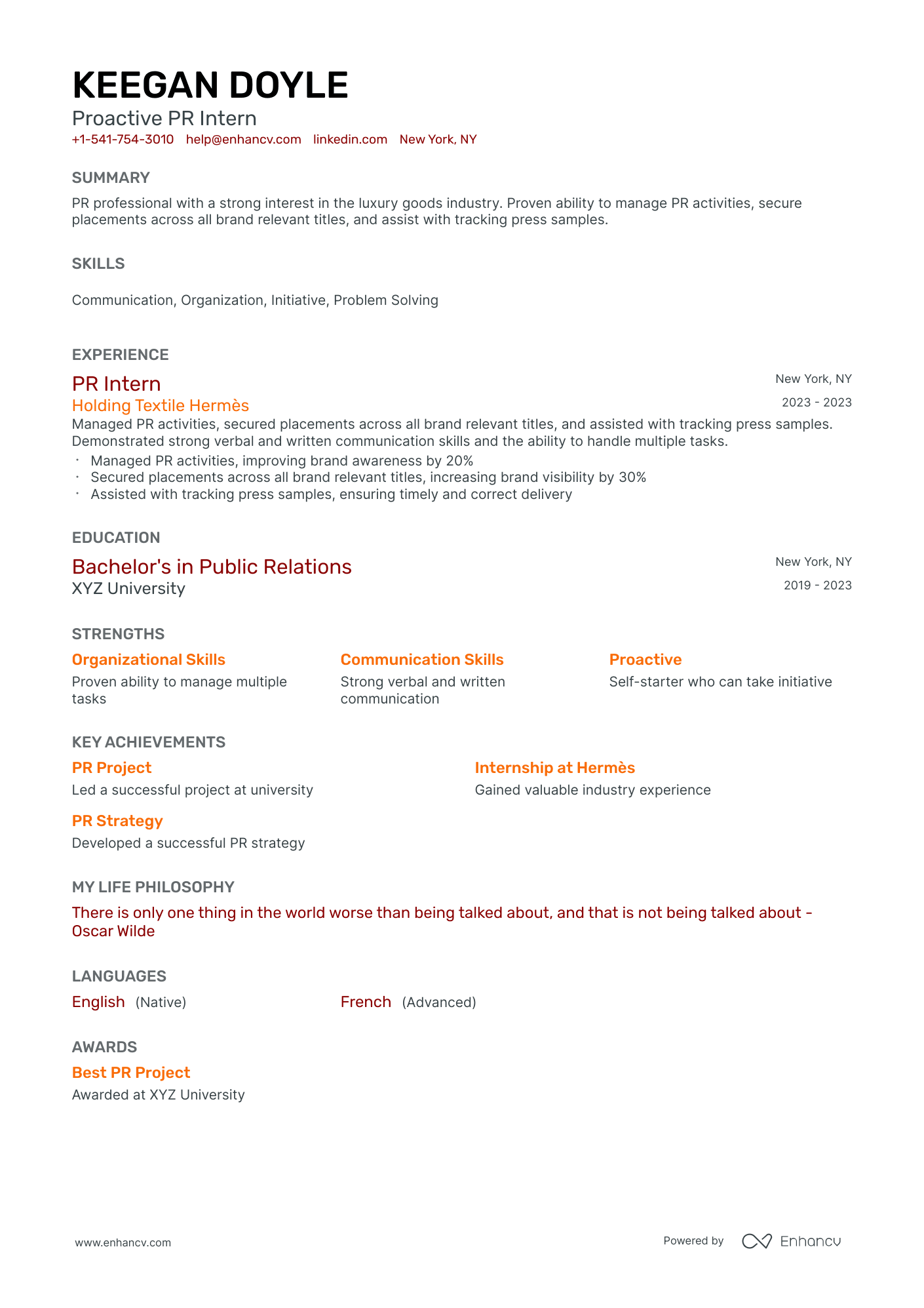
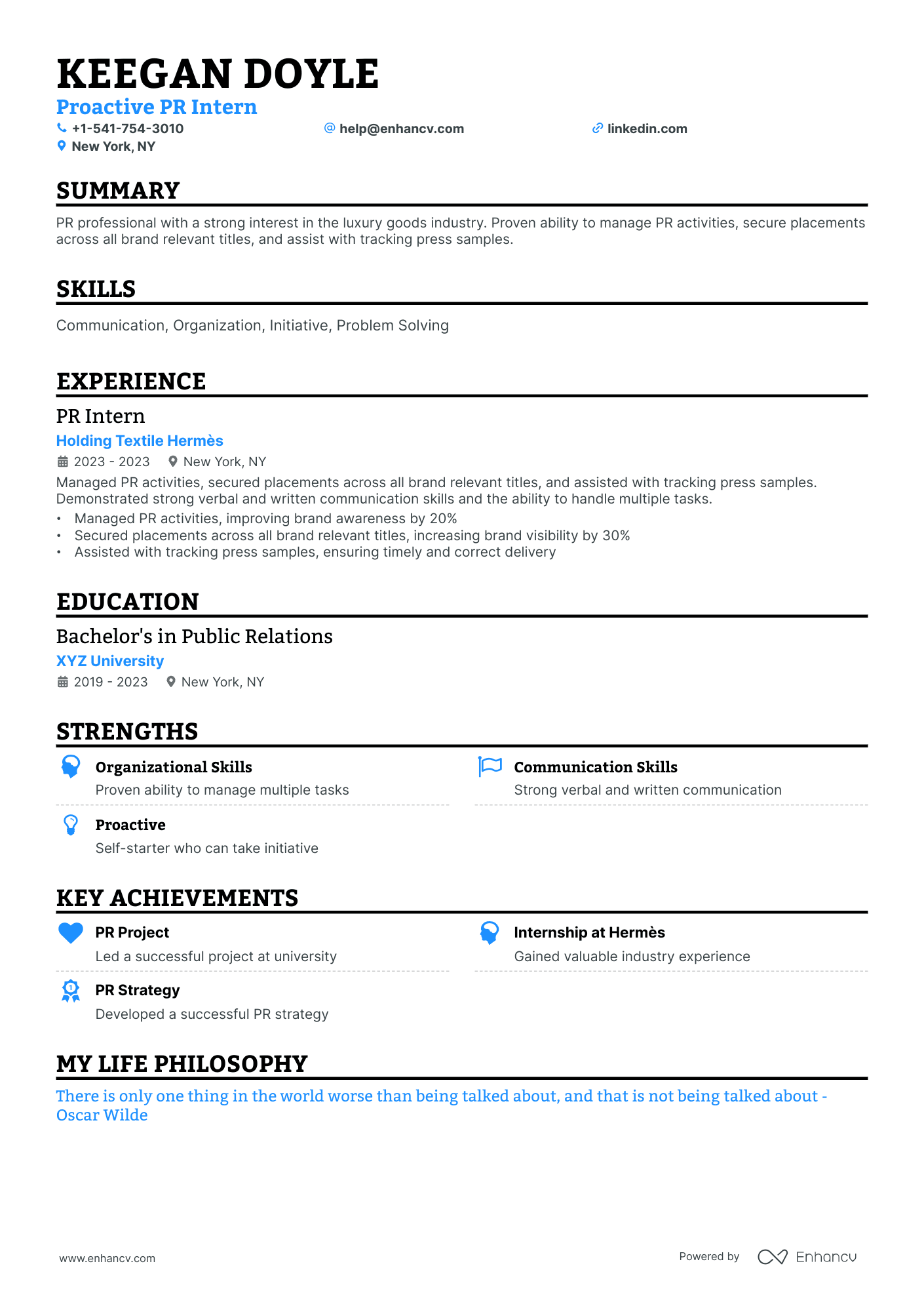
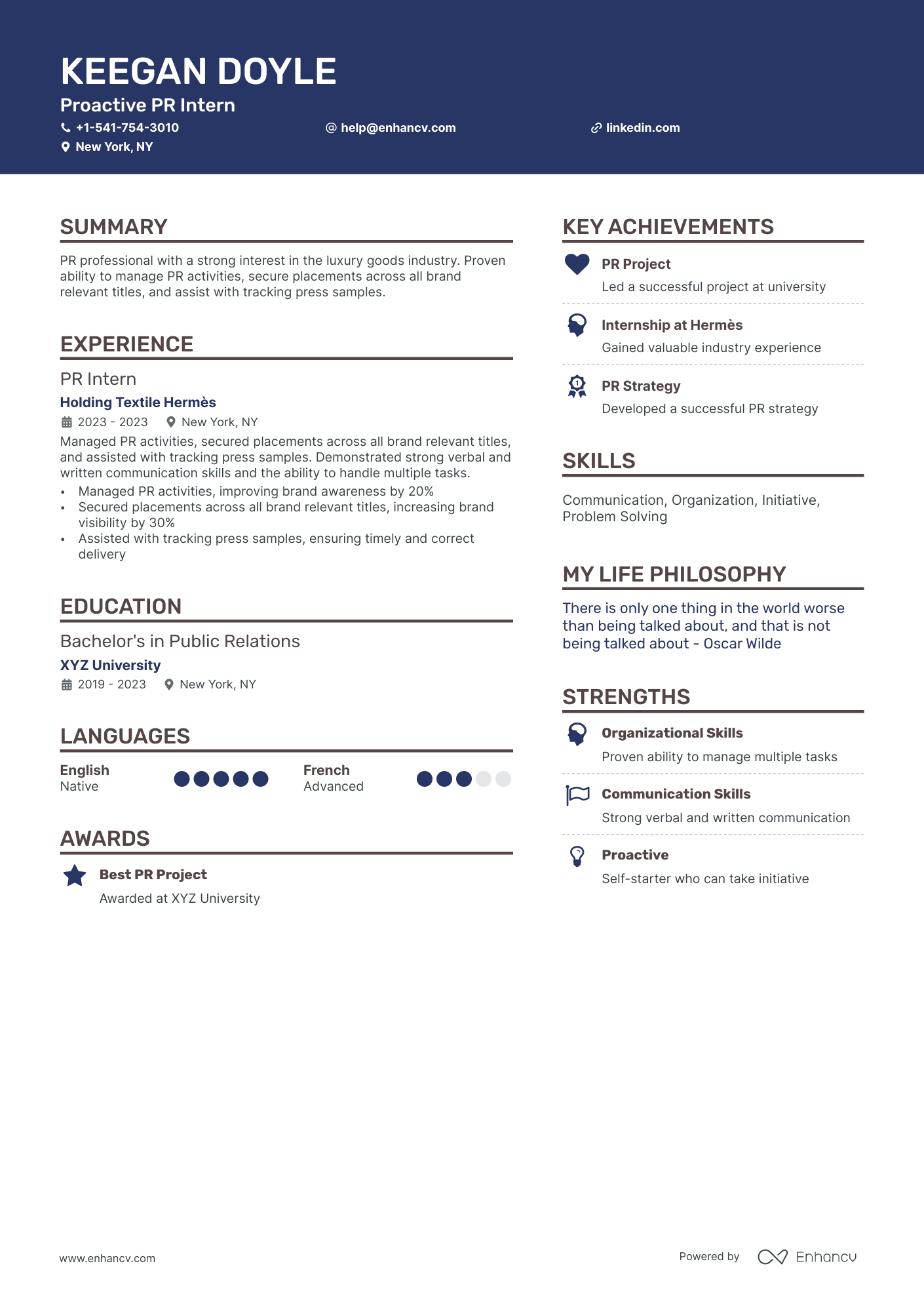
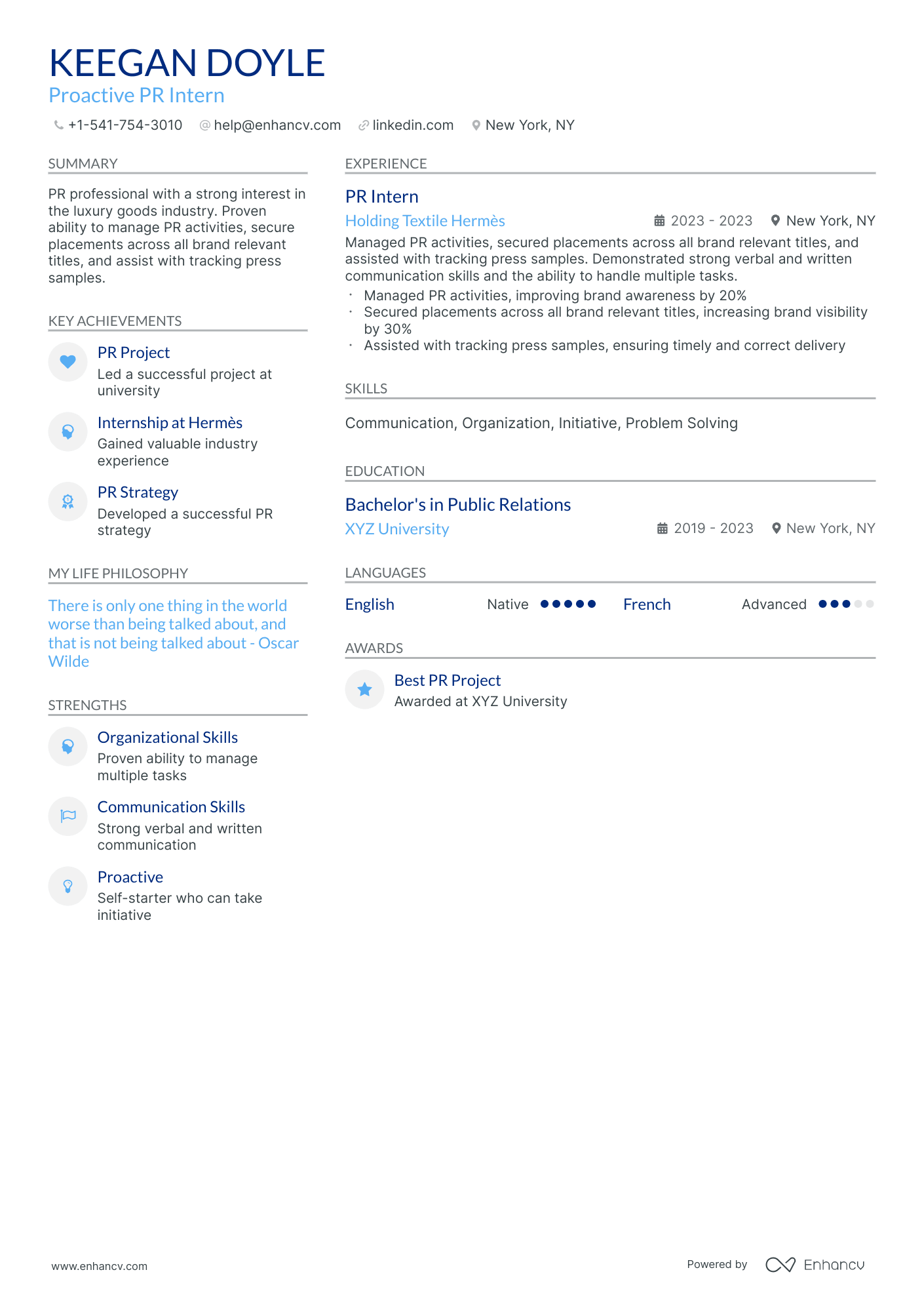
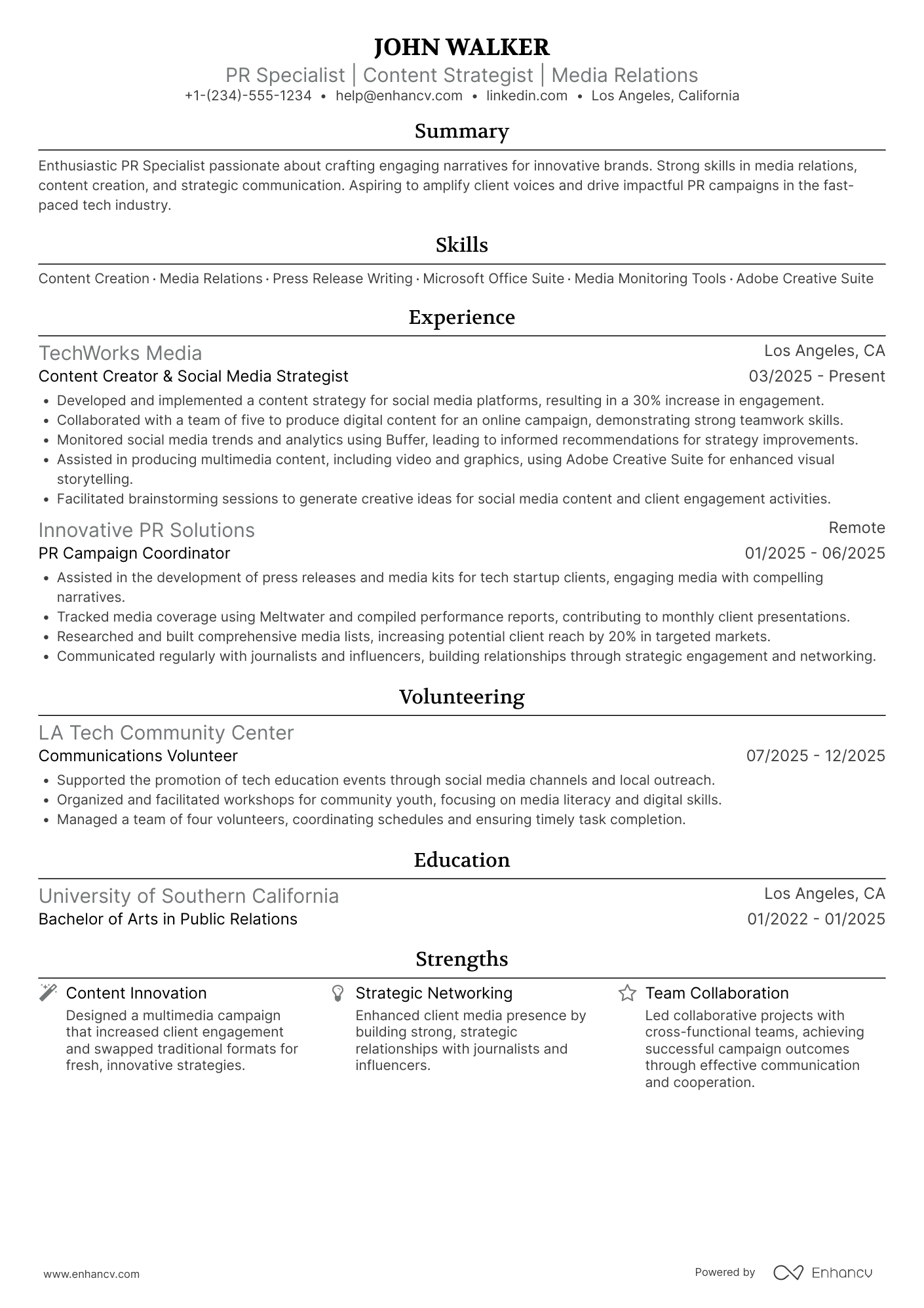
PR intern resume drafts often fail because they read like class notes, not proof of impact. That matters when an ATS filters keywords and recruiters scan in seconds amid heavy competition.
When the placements on the resume are landing, the matching PR intern cover letter is where you pitch the agency on the campaign you would actually want to staff on — the angle, the outlet, the story you could already lead with.
A strong resume shows what you changed, not what you used. When learning how to make your resume stand out, you should highlight outcomes like press mentions earned, pitch-to-response rate, media list growth, event attendance lift, on-time deliverables, and error-free copy.

Key takeaways
- Quantify every PR intern bullet with metrics like placements earned, pitch response rates, or engagement growth.
- Choose a reverse-chronological format with experience or a hybrid format that leads with skills.
- Mirror exact tools and terminology from the job posting to pass ATS and recruiter screening.
- Pair each listed skill with a measurable outcome in your experience or project bullets.
- Lead your summary with role-relevant credentials and results, not vague motivational phrases.
- Use campus projects, volunteer communications work, and coursework to fill experience gaps with proof.
- Strengthen weak bullets fast with Enhancv's Bullet Point Generator to add specificity and measurable impact.
How to format a PR intern resume
Recruiters reviewing PR intern resumes prioritize relevant coursework, communication skills, writing samples or portfolio links, and any hands-on experience with media outreach or content creation. Choosing the right resume format ensures these signals aren't buried beneath unrelated information, giving hiring managers a clear picture of your potential value within seconds.

I have significant experience in this role—which format should I use?
Use a reverse-chronological format to highlight your PR-related internships, campus roles, and media experience in a clear, linear timeline. Do:
- Lead with your most recent PR-relevant position or campus leadership role, emphasizing scope and ownership of communications tasks.
- Feature PR-specific tools and skills—media databases like Cision, press release drafting, social media scheduling platforms, and AP style proficiency.
- Quantify outcomes wherever possible, such as media impressions earned, event attendance driven, or social engagement growth.
I'm junior or switching into this role—what format works best?
A hybrid format works best because it lets you lead with transferable skills and relevant projects before a shorter experience section. Do:
- Place a skills section near the top of your resume, highlighting writing proficiency, media literacy, social media management, and research capabilities.
- Include academic projects, volunteer communications work, or freelance content creation as transitional experience that demonstrates PR fundamentals.
- Connect every listed action to a clear outcome so recruiters can see your ability to deliver results, even without formal PR job titles.
Why not use a functional resume?
A functional resume strips away the timeline and context that recruiters need to evaluate how you developed your communication and media skills, making it harder to trust your readiness for a fast-paced PR environment. Avoid a functional format entirely if you have any relevant experience—including coursework, campus organizations, or volunteer work—that can demonstrate PR competencies in a chronological or hybrid layout.
- A functional resume may be acceptable if you're pivoting from an unrelated field with no PR-adjacent experience and need to foreground transferable skills like writing, event coordination, or stakeholder communication, but even then, tie every skill to a specific project or measurable outcome.
Now that you've established a clean, readable layout, it's time to fill it with the right sections that showcase your qualifications effectively.
What sections should go on a PR intern resume
Recruiters expect you to present PR-relevant experience, writing ability, and measurable results in a clean, easy-to-scan format. Understanding which resume sections to include helps you organize your qualifications for maximum clarity.
Use this structure for maximum clarity:
- Header
- Summary
- Experience
- Skills
- Projects
- Education
- Certifications
- Optional sections: Awards, Publications, Volunteering
Strong experience bullets should emphasize the communications outcomes you drove—media mentions, engagement, event turnout, audience growth, and the scope of the campaigns you supported.
Is your resume good enough?
Drop your resume here or choose a file. PDF & DOCX only. Max 2MB file size.
Once you’ve organized the key parts of your resume, the next step is to write your PR intern experience in a way that supports those sections and shows your impact.
How to write your PR intern resume experience
The experience section of your PR intern resume should spotlight work you've shipped—press materials drafted, media lists built, campaigns supported—using the tools and methods that define public relations practice. Hiring managers prioritize demonstrated impact over descriptive task lists, so frame every entry around outcomes you influenced rather than duties you were assigned. Building a targeted resume that reflects the specific role's priorities will help you stand out.
Each entry should include:
- Job title
- Company and location (or remote)
- Dates of employment (month and year)
Three to five concise bullet points showing what you owned, how you executed, and what outcomes you delivered:
- Ownership scope: the media channels, press materials, client accounts, messaging platforms, or campaign segments you were directly accountable for as a PR intern.
- Execution approach: the media monitoring tools, distribution platforms, editorial calendars, research methods, or pitching frameworks you used to plan and deliver public relations work.
- Value improved: changes to media coverage quality, brand visibility, audience engagement, response time, message consistency, or reputational risk that resulted from your contributions.
- Collaboration context: how you coordinated with account managers, journalists, content teams, clients, or event vendors to advance shared communications objectives.
- Impact delivered: outcomes expressed through coverage results, audience reach, stakeholder feedback, or campaign performance rather than a simple log of tasks completed.
Experience bullet formula
A PR intern experience example
✅ Right example - modern, quantified, specific.
PR Intern
BrightPath Health | Austin, TX
2024–2025
High-growth digital health startup supporting three hundred plus clinics with patient engagement software.
- Drafted and pitched twelve targeted story angles using Muck Rack and Google Trends, securing five earned placements (including two tier-one trade outlets) and driving a twenty-two percent increase in referral traffic to campaign landing pages (GA4).
- Built a media list of two hundred thirty reporters in Cision, segmenting by beat and engagement history; improved pitch open rate from twenty-one percent to thirty-four percent and cut list-building time by forty percent.
- Coordinated a product launch press kit in Google Drive and Canva—press release, fact sheet, executive bios, and visuals—partnering with product marketing and design to deliver assets two days ahead of deadline.
- Monitored coverage and sentiment in Meltwater, producing a weekly dashboard in Looker Studio; identified three recurring message gaps and helped update talking points, reducing negative or neutral mentions from eighteen percent to eleven percent over eight weeks.
- Supported two executive interviews by writing briefing docs and Q-and-A prep in Notion, aligning with legal and the CEO; reduced review cycles from three rounds to two and prevented one compliance risk flagged during pre-brief.
Now that you've seen how a strong PR intern experience section looks in practice, let's break down how to tailor each element to match the specific role you're targeting.
How to tailor your PR intern resume experience
Recruiters evaluate PR intern resumes through both human review and applicant tracking systems. Tailoring your resume to the job description increases your chances of passing both screening stages.
Ways to tailor your PR intern experience:
- Match media monitoring tools named in the job description.
- Mirror the exact terminology used for press release distribution.
- Highlight social media platforms the employer specifically references.
- Include media list building if the posting requests outreach experience.
- Emphasize event coordination skills when the role involves planning.
- Reference crisis communication exposure if the description mentions it.
- Align your writing samples with content formats the employer values.
- Mention relevant industry experience that matches the organization's sector.
Tailoring means aligning your real accomplishments with what the role requires, not forcing keywords where they don't belong.
Resume tailoring examples for PR intern
| Job description excerpt | Untailored | Tailored |
|---|---|---|
| "Assist with drafting press releases, media pitches, and maintaining media contact lists using Cision." | Helped with various writing tasks and administrative duties for the communications team. | Drafted press releases and targeted media pitches for product launches, maintaining a 500+ contact media list in Cision to support outreach campaigns. |
| "Monitor media coverage and compile daily clip reports, tracking brand mentions across print, broadcast, and digital outlets." | Tracked some media activity and put together reports for the team when needed. | Compiled daily media clip reports across print, broadcast, and digital outlets, monitoring 30+ brand mentions per week to flag coverage trends for the PR team. |
| "Support event planning for press conferences and influencer activations, coordinating logistics with vendors and internal stakeholders." | Assisted with planning events and coordinating schedules for different projects. | Coordinated vendor logistics and internal stakeholder communications for three press conferences and two influencer activations, ensuring on-time delivery of all event materials. |
Once you’ve aligned your experience with the role’s priorities, the next step is to quantify your PR intern achievements so hiring teams can see the impact behind that fit.
How to quantify your PR intern achievements
Quantifying your achievements proves real impact, not effort. Focus on volume handled, turnaround time, placement quality, accuracy, and risk reduction across media lists, pitches, monitoring, and reporting.
Quantifying examples for PR intern
| Metric | Example |
|---|---|
| Turnaround time | "Cut press release turnaround from three days to one by building a Google Docs template and approval checklist for five stakeholders." |
| Volume handled | "Logged and tagged 420 media mentions per month in Meltwater, then routed daily digests to eight internal teams." |
| Placement quality | "Secured six earned mentions in tier-two trade outlets by pitching twenty targeted reporters using a segmented media list in Airtable." |
| Data accuracy | "Reduced media list bounce rate from 18% to 6% by verifying 300 contacts across Cision, LinkedIn, and outlet mastheads." |
| Risk reduction | "Prevented two compliance issues by adding a claims and trademark check to the pitch process, cutting legal revisions from five to two per release." |
Turn vague job duties into measurable, recruiter-ready resume bullets in seconds with Enhancv's Bullet Point Generator.
Now that your bullet points clearly convey your achievements, it's time to ensure your skills section highlights the right mix of hard and soft skills for a PR intern role.
How to list your hard and soft skills on a PR intern resume
Your skills section shows you can support media outreach and content execution, and recruiters and an ATS (applicant tracking system) scan this section to confirm role fit quickly—aim for more hard skills than soft skills, with a focused mix of both. PR intern roles require a blend of:
- Product strategy and discovery skills.
- Data, analytics, and experimentation skills.
- Delivery, execution, and go-to-market discipline.
- Soft skills.
Your skills section should be:
- Scannable (bullet-style grouping).
- Relevant to the job post.
- Backed by proof in experience bullets.
- Updated with current tools.
Place your skills section:
- Above experience if you're junior or switching careers.
- Below experience if you're mid/senior with strong achievements.

Hard skills
- Media list building, Cision, Muck Rack
- Press release formatting
- Media pitching and follow-up
- Editorial calendar management
- Social media scheduling, Hootsuite, Sprout Social
- Copyediting, AP Style
- Brand messaging and positioning
- Google Workspace, Microsoft Office
- Coverage tracking and reporting
- Google Analytics, social analytics
- Event support and logistics
- Basic Canva design
Soft skills
- Write clear, audience-first copy
- Ask sharp clarifying questions
- Prioritize tasks under deadlines
- Follow through on commitments
- Coordinate smoothly with teammates
- Incorporate feedback fast
- Communicate status proactively
- Handle sensitive information discreetly
- Stay organized across requests
- Adapt tone for different stakeholders
- Troubleshoot last-minute changes
- Build rapport with journalists respectfully
How to show your PR intern skills in context
Skills shouldn't live only in a dedicated skills list. Explore curated resume skills examples to see how professionals in different fields present their abilities effectively.
They should be demonstrated in:
- Your summary (high-level professional identity)
- Your experience (proof through outcomes)
Here's what strong, skills-rich resume entries look like in practice.
Summary example
Senior PR intern with two years of agency experience in healthcare communications. Skilled in media outreach, Cision, and AP-style writing. Secured 15+ earned media placements and supported crisis messaging that reduced negative sentiment by 30%.
- Reflects senior intern experience level
- Names industry-standard tools like Cision
- Quantifies media placement outcomes clearly
- Highlights communication as a soft skill
Experience example
PR Intern
Redwood Health Communications | Remote
June 2023–August 2024
- Drafted 25+ press releases using Muck Rack, earning coverage in three regional healthcare outlets alongside the senior account team.
- Coordinated influencer outreach with the social media team, growing campaign engagement by 40% across Instagram and LinkedIn.
- Monitored brand mentions through Cision, compiling weekly sentiment reports that helped reduce client response time by 20%.
- Every bullet includes a measurable outcome.
- Tools and collaboration appear naturally in context.
Once you’ve tied your abilities to real outcomes and examples, the next step is translating that same evidence into a PR intern resume even if you don’t have formal experience.
How do I write a PR intern resume with no experience
Even without full-time experience, you can demonstrate readiness through campus and volunteer work. If you're building a resume without work experience, focus on projects and transferable skills that prove PR competencies:
- Student PR campaign deliverables
- Campus newspaper press releases
- Social media content calendars
- Event promotion and media outreach
- Volunteer nonprofit communications support
- Class media list building
- Newsletter writing and analytics
- Mock crisis communications plan
Focus on:
- Published clips, links, and metrics
- PR intern tools used effectively
- Clear writing across PR formats
- Proven research and targeting
Resume format tip for entry-level PR intern
Use a combination resume format because it highlights relevant projects and skills first, while still showing education and any work history. Do:
- Put projects above work experience.
- Add links to clips and portfolios.
- Quantify results with clear metrics.
- List PR intern tools you used.
- Tailor keywords to each posting.
- Built a targeted media list in Google Sheets and pitched five campus reporters via email, securing two event mentions and increasing attendance by 18%.
Once you've structured your resume around transferable skills and relevant projects, the next step is presenting your education—often your strongest asset as an entry-level candidate.
How to list your education on a PR intern resume
Your education section helps hiring teams confirm you have foundational knowledge in communications, media, or related fields. It validates your readiness for a PR intern role.
Include:
- Degree name
- Institution
- Location
- Graduation year
- Relevant coursework (for juniors or entry-level candidates)
- Honors & GPA (if 3.5 or higher)
Skip month and day details—list the graduation year only.
Here's a strong education entry tailored for a PR intern resume.
Example education entry
Bachelor of Arts in Public Relations
University of Oregon, Eugene, OR
Graduated 2024
GPA: 3.7/4.0
- Relevant Coursework: Media Writing, Crisis Communication, Digital PR Strategy, Strategic Brand Management
- Honors: Dean's List (six consecutive semesters), Lambda Pi Eta National Communication Honor Society
How to list your certifications on a PR intern resume
Certifications on your resume show your commitment to learning, prove tool proficiency, and signal industry relevance, which helps a PR intern stand out in competitive applicant pools.
Include:
- Certificate name
- Issuing organization
- Year
- Optional: credential ID or URL
- List certifications below education when they are older, less relevant, or mainly reinforce coursework you already completed.
- List certifications above education when they are recent, highly relevant to PR intern work, or required for the roles you target.
Best certifications for your PR intern resume
Google Analytics Certification HubSpot Content Marketing Certification HubSpot Social Media Marketing Certification Hootsuite Social Marketing Certification Meta Certified Digital Marketing Associate Meltwater Academy Certification Google Ads Search Certification
Once you’ve included your relevant certifications with the right context, use that credibility to shape a focused PR intern resume summary that highlights your fit upfront.
How to write your PR intern resume summary
Your resume summary is the first thing a recruiter reads. A strong one instantly signals you're a relevant candidate for the PR intern role.
Keep it to three to four lines, with:
- Your title and relevant experience, even if it's coursework or campus involvement.
- PR, communications, or media relations as your domain focus.
- Core tools and skills such as Cision, Meltwater, press release writing, or social media management.
- One or two quantified achievements, like media placements secured or campaign reach.
- Soft skills tied to real outcomes, such as deadline management that ensured on-time deliverables.

PRO TIP
At the intern level, emphasize specific skills, relevant coursework, and any measurable contributions from projects or campus roles. Avoid vague phrases like "passionate self-starter" or "eager to learn." Recruiters want proof of what you can do, not motivational statements.
Example summary for a PR intern
Communications student with hands-on media outreach experience. Drafted 12 press releases and secured three local placements during a campus PR campaign. Skilled in Cision, AP style, and social media content scheduling.
Optimize your resume summary and objective for ATS
Drop your resume here or choose a file.
PDF & DOCX only. Max 2MB file size.
Now that your summary is ready to grab attention, make sure the header above it presents your contact details clearly so recruiters can actually reach you.
What to include in a PR intern resume header
A resume header lists your key contact and profile details, and it boosts visibility, credibility, and recruiter screening for a PR intern role.
Essential resume header elements
- Full name
- Tailored job title and headline
- Location
- Phone number
- Professional email
- GitHub link
- Portfolio link
A LinkedIn link helps recruiters confirm your experience quickly and supports faster screening.
Don't include a photo on a PR intern resume unless the role is explicitly front-facing or appearance-dependent.
Keep the header to two lines, use consistent formatting, and match your PR intern job title to the posting.
PR intern resume header
Jordan Lee
PR intern | Media relations and writing
Austin, TX
(512) 555-01XX | your.name@enhancv.com | github.com/yourname | yourwebsite.com | linkedin.com/in/yourname
Once your header clearly identifies you and your contact details, add relevant additional sections to strengthen the rest of your PR intern resume.
Additional sections for PR intern resumes
Extra resume sections help you stand out when your core experience is limited but you have relevant skills or achievements worth highlighting.
Consider adding these sections to strengthen your PR intern resume:
- Languages
- Publications
- Conferences and events
- Professional affiliations
- Volunteering
- Hobbies and interests
- Social media portfolios
Once you've strengthened your resume with relevant additional sections, it's worth pairing it with a cover letter to give your application even more impact.
Do PR intern resumes need a cover letter
A cover letter isn't required for a PR intern, but it often helps. If you're wondering what a cover letter is and when it matters most, it's typically for competitive roles or teams that expect writing samples. It can also tip decisions when several resumes look similar.
Use a cover letter to add context your PR intern resume can't:
- Explain why you fit the role or team: Match your interests to their media focus, brand voice, or campaign types.
- Highlight one or two relevant projects or outcomes: Name the deliverable, your role, and the result, like pickup, engagement, or sign-ups.
- Show you understand the product, users, or business context: Reference a recent launch, audience segment, or competitor, and connect it to PR goals.
- Address career transitions or non-obvious experience: Translate coursework, campus roles, or part-time work into PR intern skills like pitching, research, and writing.
Drop your resume here or choose a file.
PDF & DOCX only. Max 2MB file size.
Even if you decide to skip a cover letter and rely on your resume to make the case, using AI to improve your PR intern resume helps you strengthen that message quickly and consistently.
Using AI to improve your PR intern resume
AI can sharpen your resume's clarity, structure, and impact. It helps tighten language and highlight relevant strengths. But overuse strips authenticity. Once your content is clear and role-aligned, step away from AI. If you're curious about which AI is best for writing resumes, start with tools that focus on structure and specificity rather than generic rewrites.
Here are 10 practical prompts to strengthen specific sections of your PR intern resume:
Strengthen summary statement
Quantify experience bullets
Tighten action verbs
Align skills section
Improve project descriptions
Refine education details
Tailor certification entries
Eliminate filler language
Clarify volunteer experience
Boost bullet relevance
Conclusion
A strong PR intern resume shows measurable outcomes, role-specific skills, and a clear structure. Use metrics to prove results from pitches, media lists, event support, and social posts. Keep sections consistent, and make every bullet easy to scan.
This approach signals you can contribute on day one and adapt as hiring needs shift. When your PR intern resume stays focused, specific, and well organized, recruiters can quickly see your fit and potential.