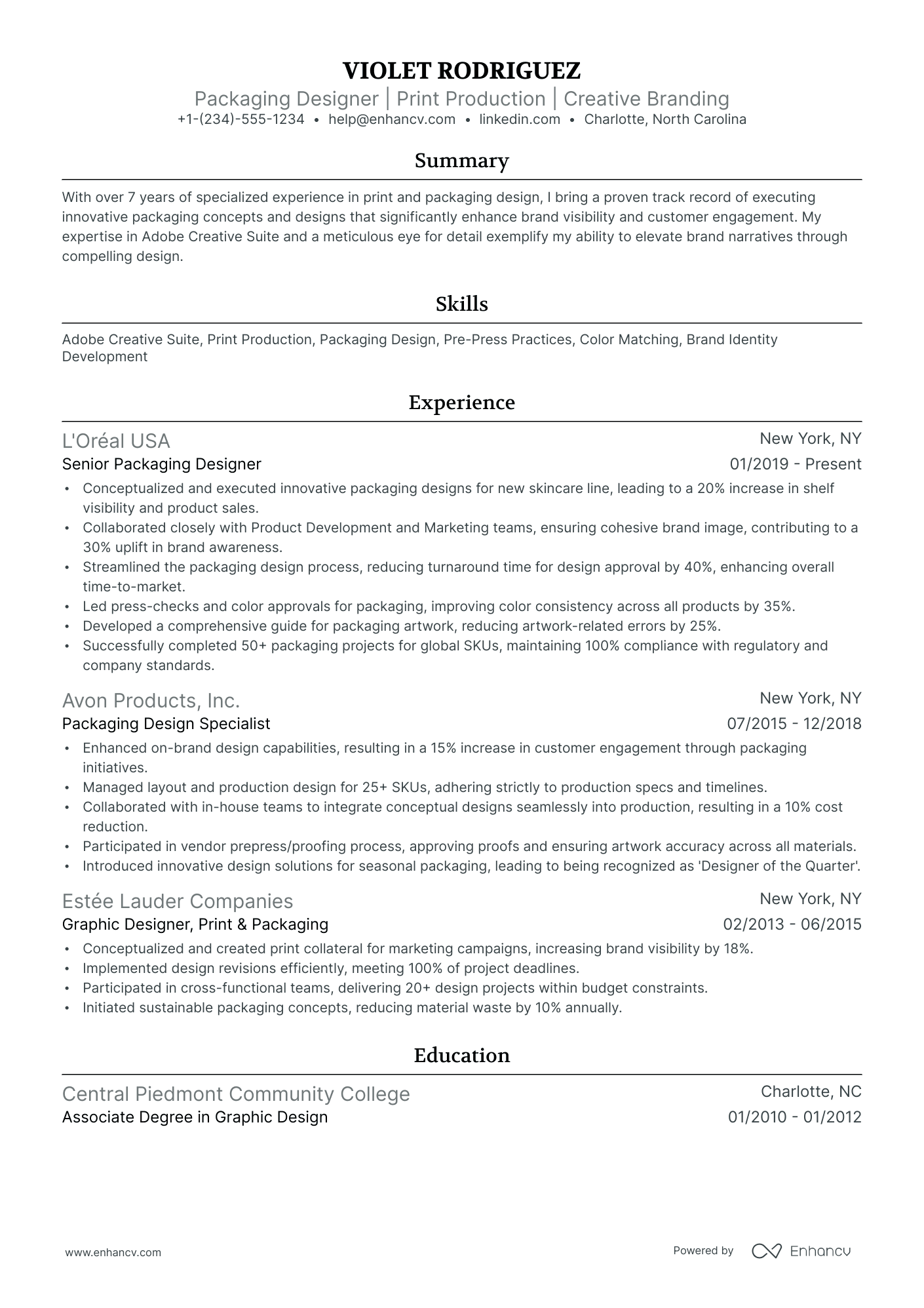
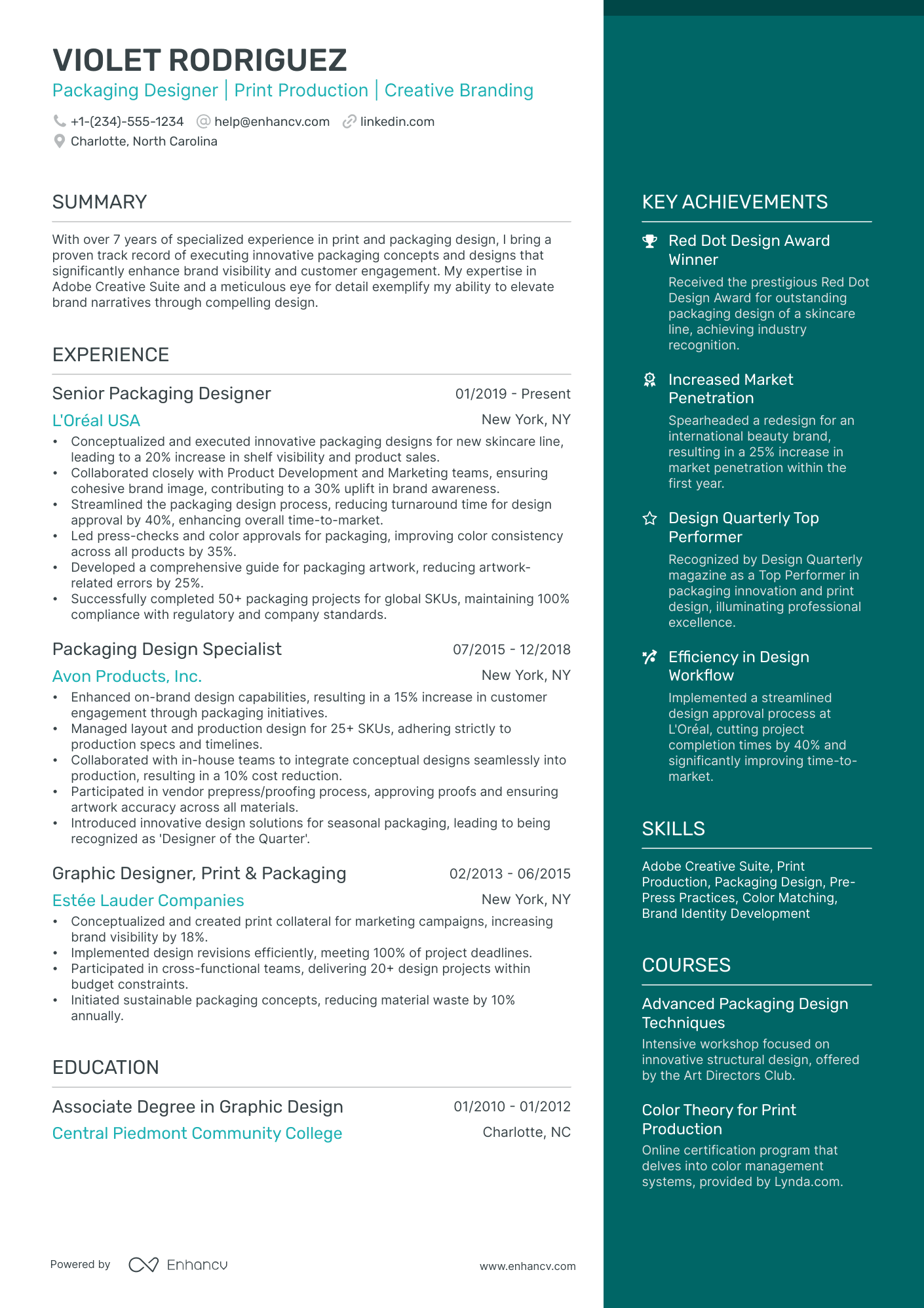
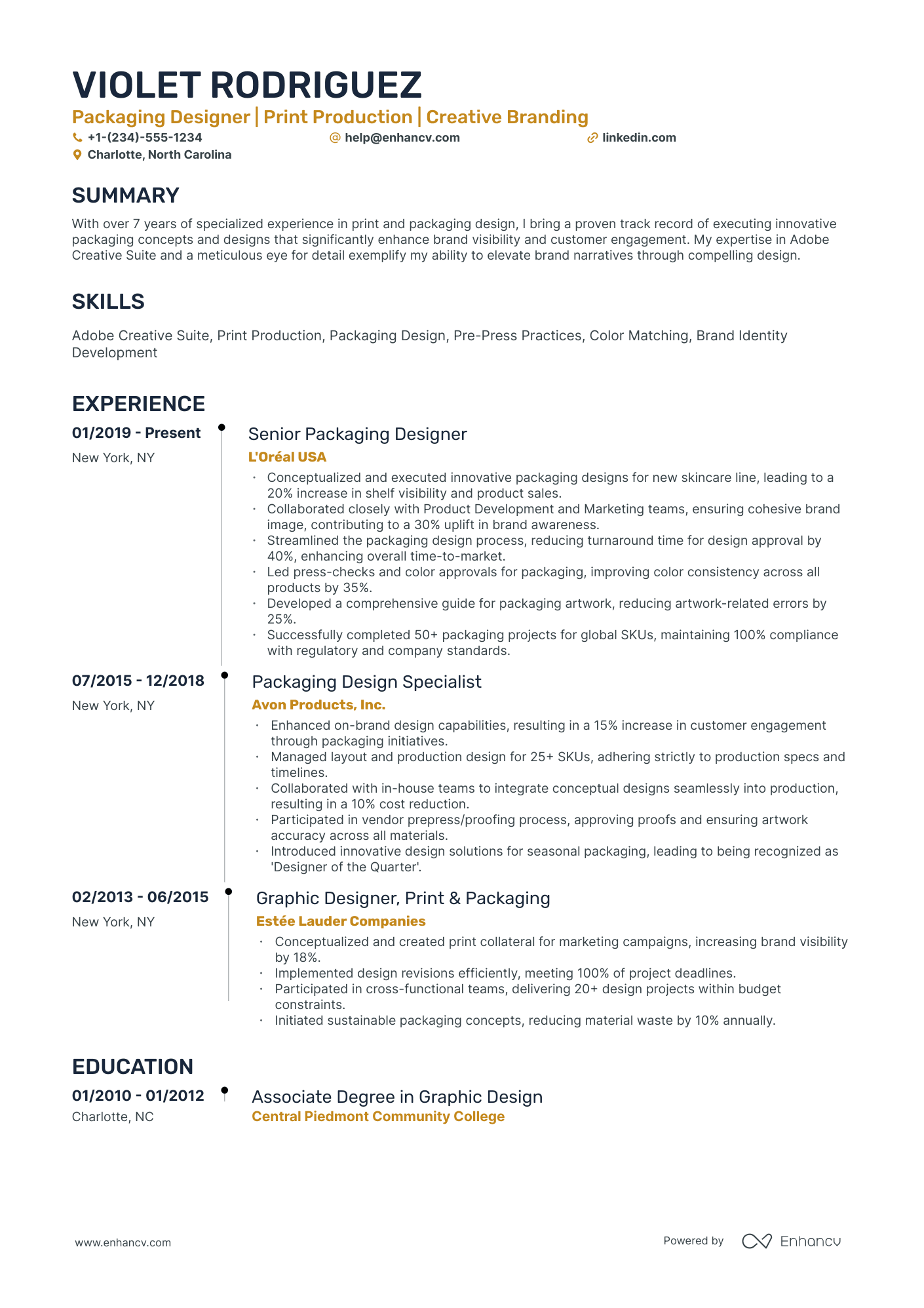
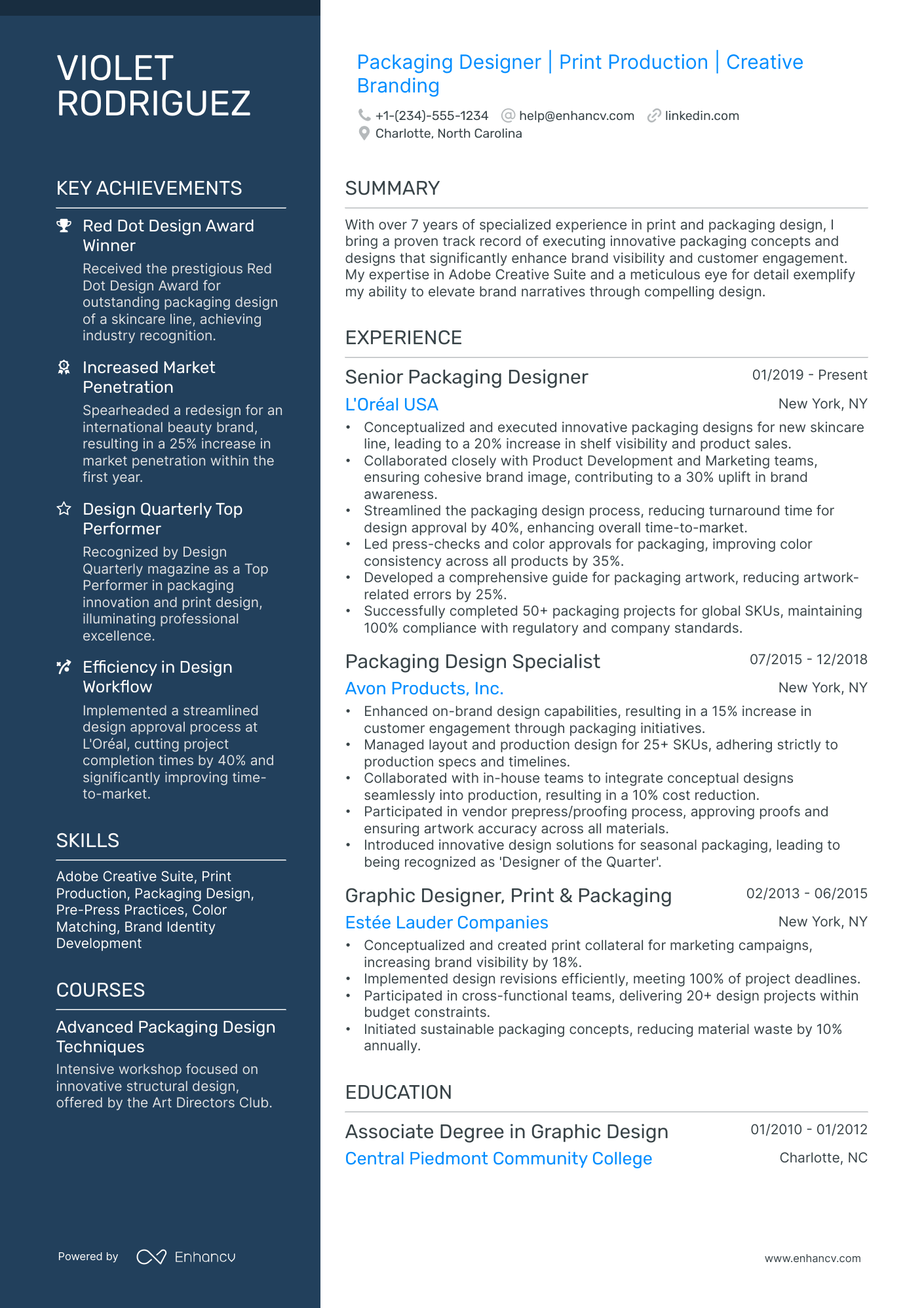
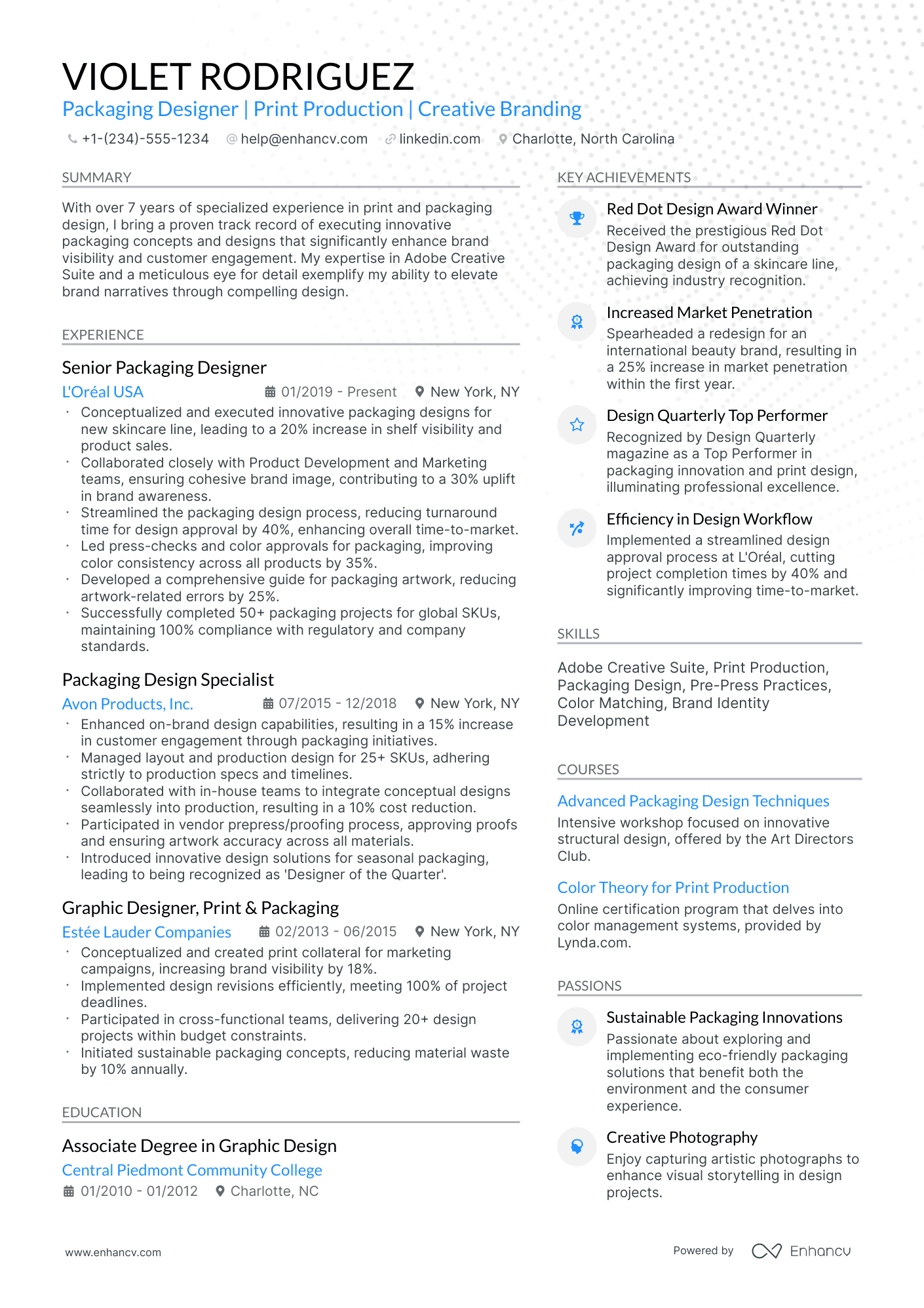
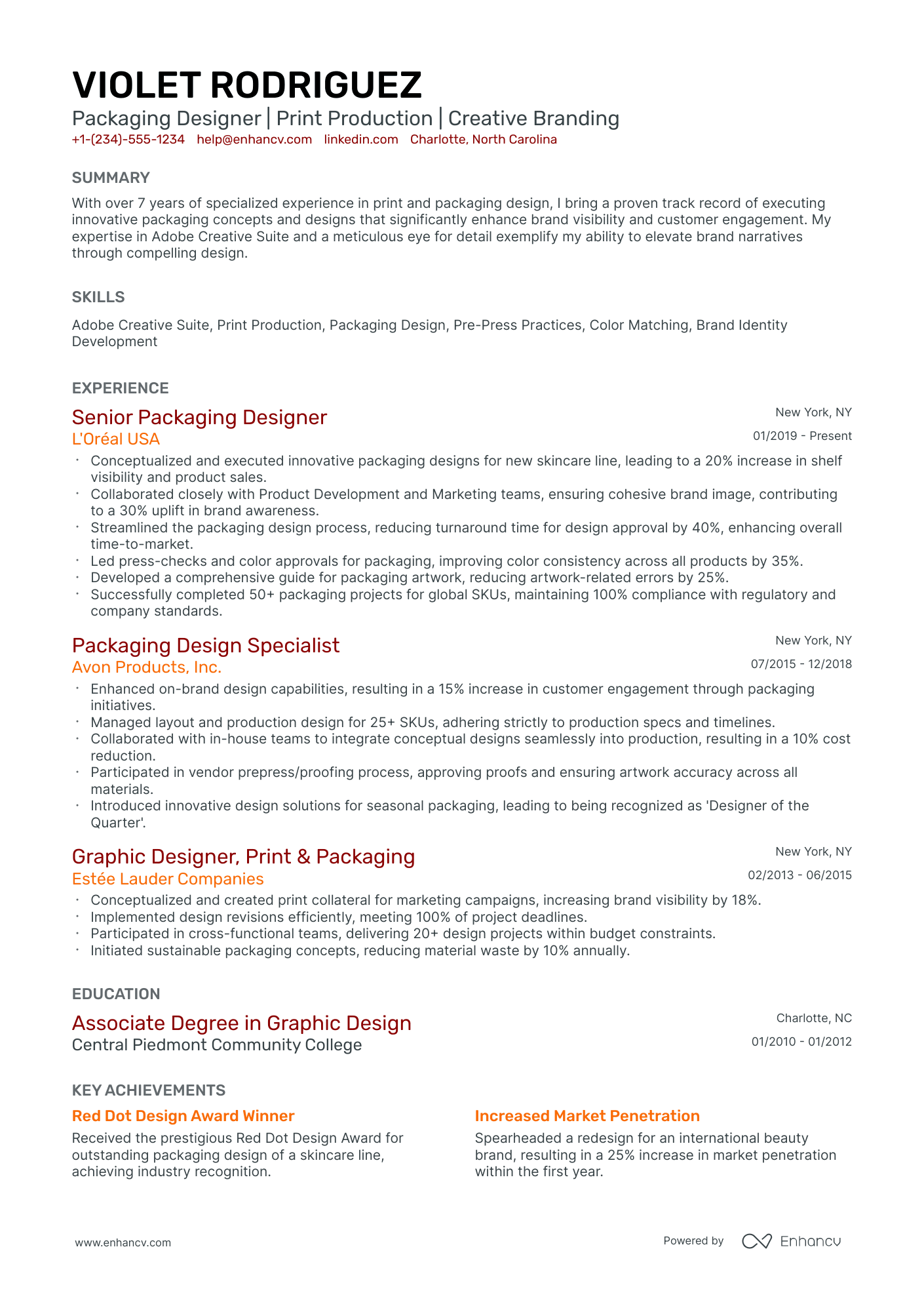
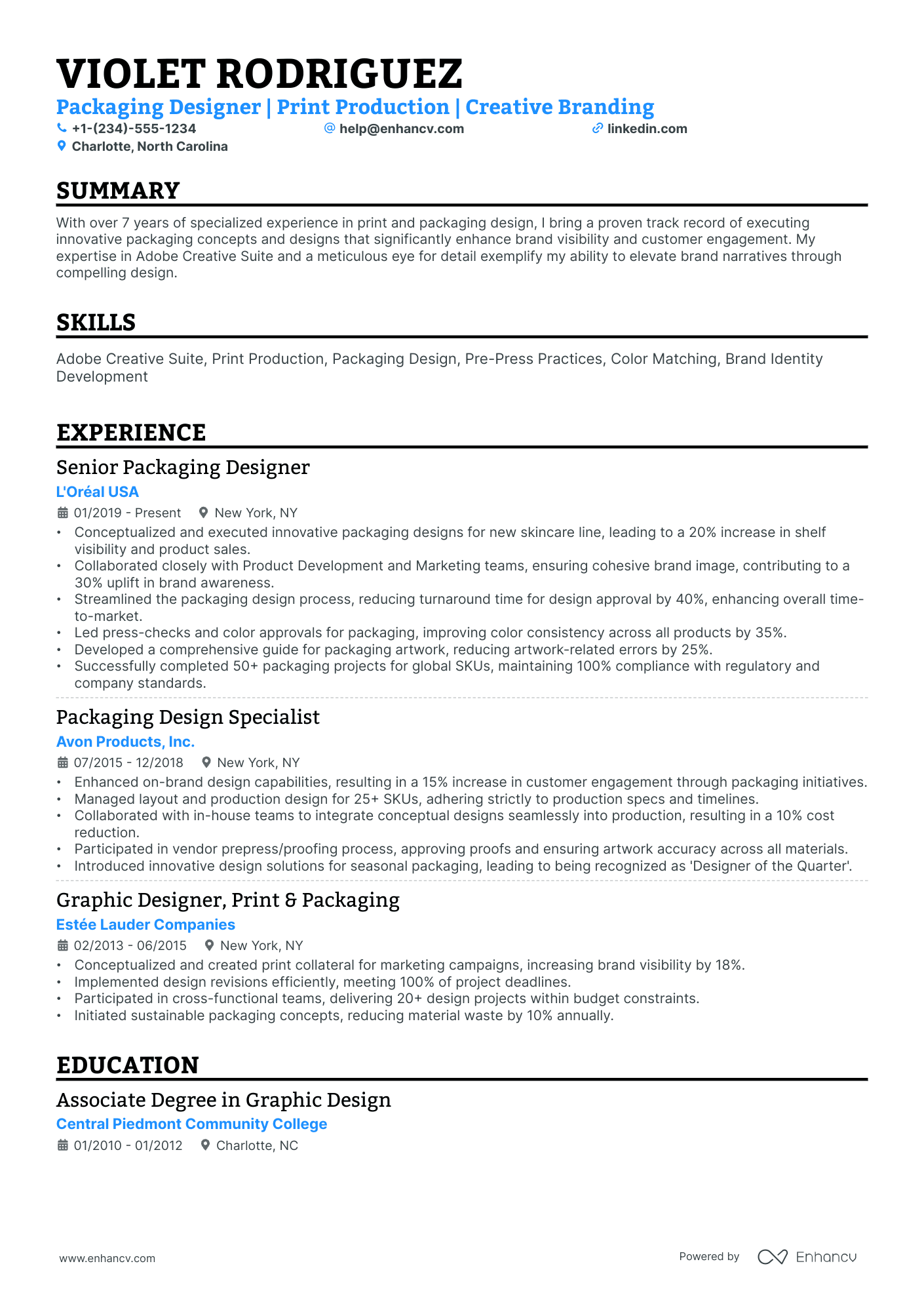
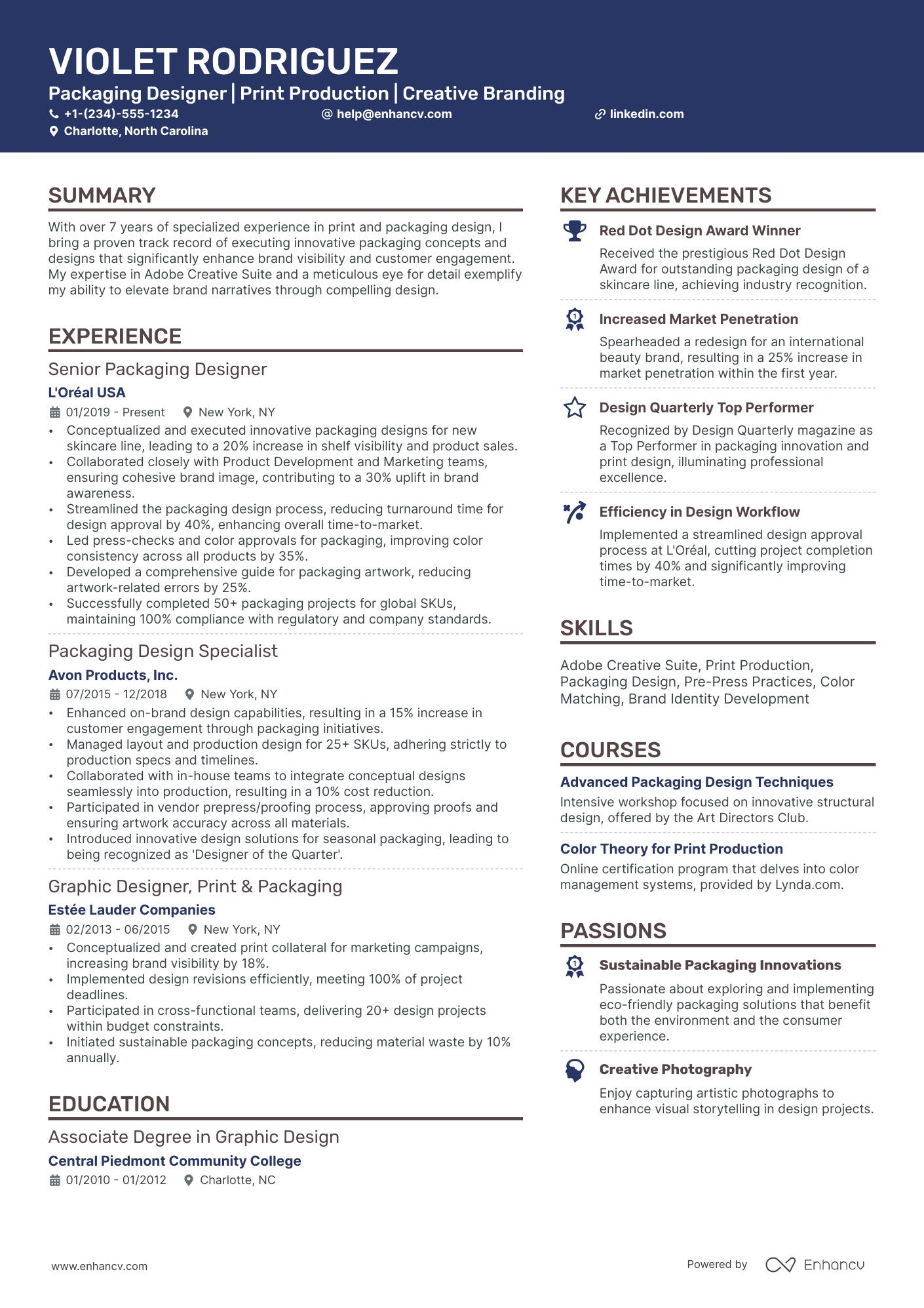
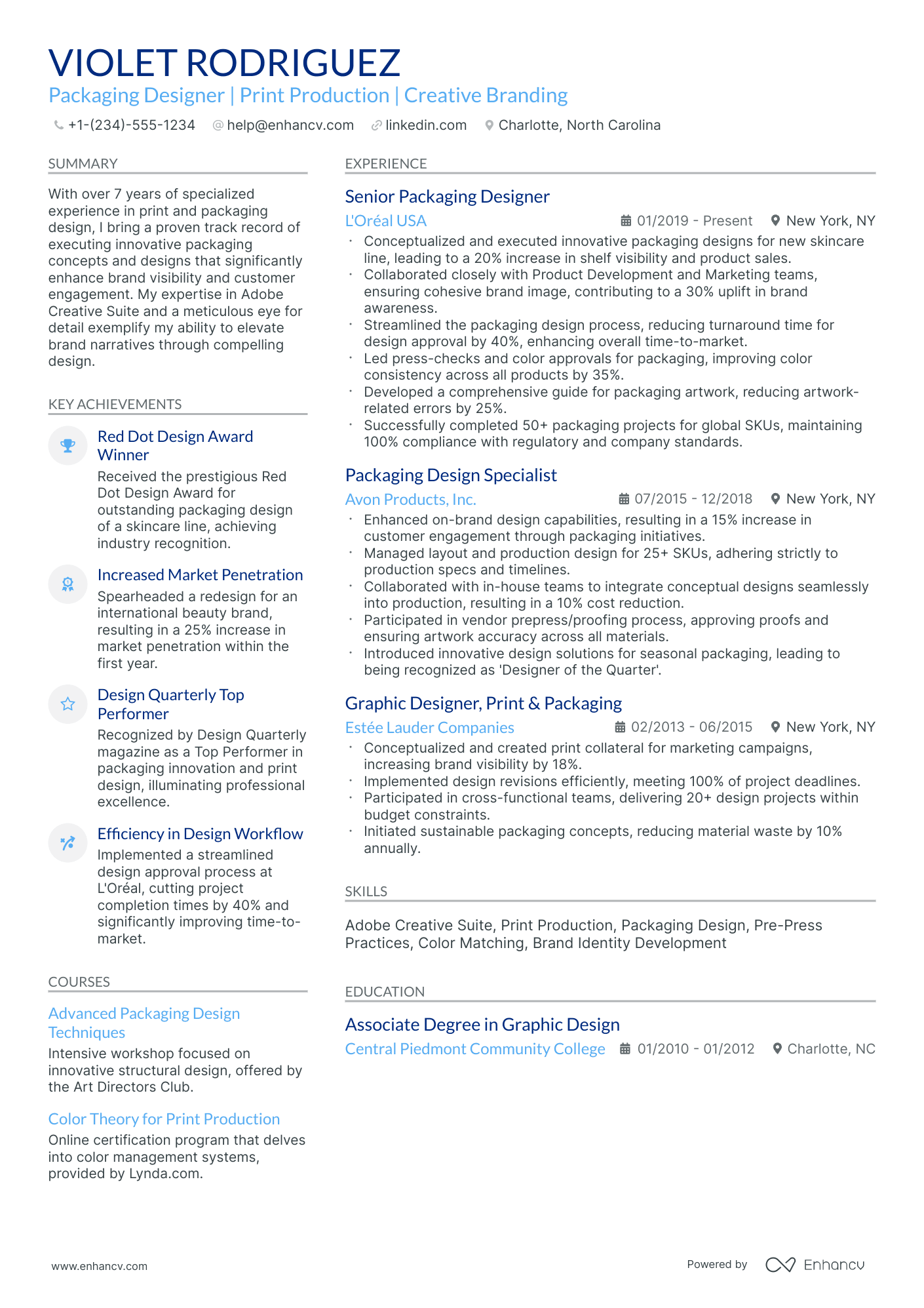
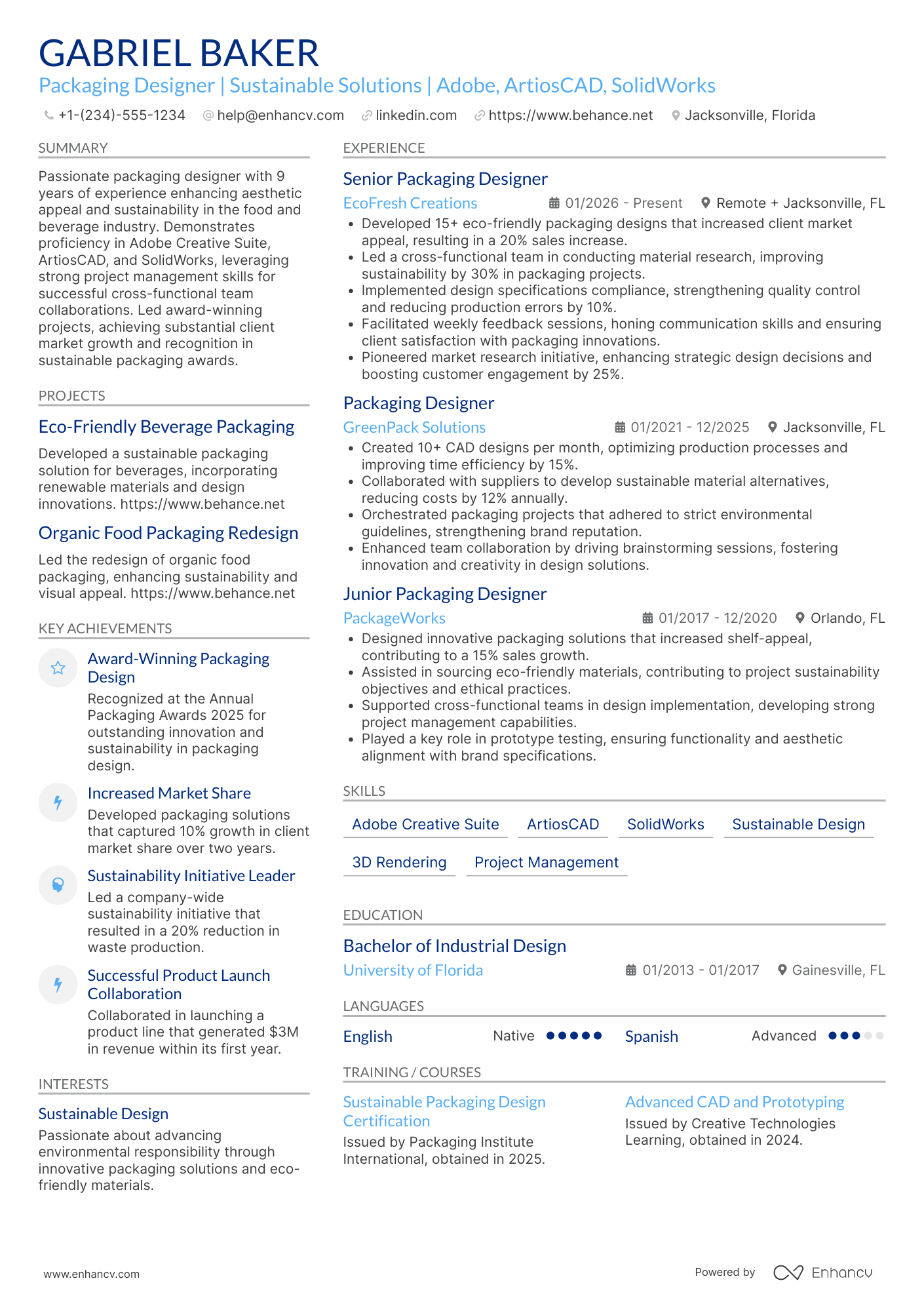
Most packaging designer resume drafts fail because they showcase attractive visuals and software lists but bury results and production-ready details in dense blocks. That hurts during ATS screening and quick recruiter scans, where high competition rewards clear, scannable proof.
A strong resume keeps outcomes front and center, so you show what shipped and what improved. Knowing how to make your resume stand out means highlighting measurable lift in shelf conversion, reduced print errors, faster approvals, on-time launches across multiple stock keeping units, and cost savings from material changes.

Key takeaways
- Anchor every experience bullet to a measurable outcome like cost savings or shelf conversion lift.
- Use reverse-chronological format for experienced designers and hybrid format for career switchers.
- Tailor your resume to each job posting by mirroring its tools, materials, and terminology.
- Demonstrate skills in context within your summary and experience—not only in a standalone list.
- Quantify achievements using metrics such as cycle time, print accuracy, and compliance rates.
- Include a portfolio link, projects section, and production-ready file samples if you lack full-time experience.
- Use Enhancv to quickly sharpen bullet points and align your resume with specific packaging designer roles.
How to format a packaging designer resume
Recruiters evaluating packaging designer resumes prioritize a strong visual and technical skill set, proficiency with structural and graphic design tools, and a portfolio-backed track record of bringing products from concept to shelf. The right resume format ensures these signals—creative problem-solving, material knowledge, and cross-functional collaboration—surface quickly during both ATS parsing and human review.

I have significant experience in this role—which format should I use?
Use a reverse-chronological format to lead with your most recent and relevant packaging design work. Do:
- Open each role entry with your scope of ownership—number of SKUs managed, brand accounts served, or product categories covered.
- Feature core tools and domains prominently: Adobe Illustrator, ArtiosCAD, Esko, dieline development, structural prototyping, prepress, and sustainable materials specification.
- Anchor every bullet to a measurable outcome or business impact such as cost reduction, speed-to-shelf improvement, or retail sell-through lift.
I'm junior or switching into this role—what format works best?
A hybrid format works best because it lets you lead with relevant packaging design skills and tools while still providing a timeline of supporting experience. Do:
- Place a skills section near the top highlighting packaging-specific competencies: dieline creation, substrate knowledge, print production, Adobe Creative Suite, and brand guideline adherence.
- Include academic projects, freelance packaging work, or internship deliverables that demonstrate hands-on design execution—even if they weren't full-time roles.
- Connect every listed skill or project to a clear action and result so recruiters can see applied capability, not just knowledge.
Why not use a functional resume?
A functional format strips away the timeline and context recruiters need to evaluate how your packaging design abilities were built and applied, making it harder to verify hands-on production experience or growth across projects. A functional format may fit a narrow set of circumstances—but only if skills are still tied to real projects and outcomes:
- You're transitioning from a related field such as graphic design or industrial design and need to foreground transferable packaging skills over unrelated job titles.
- You have a gap in employment but completed freelance packaging projects, certifications (such as IOPP packaging fundamentals), or portfolio pieces during that time.
With a clean, well-organized format in place, the next step is filling it with the right sections to showcase your qualifications effectively.
What sections should go on a packaging designer resume
Recruiters expect to see a clean, role-specific resume that proves you can deliver packaging that meets brand, production, and retail requirements. Understanding what to put on a resume helps you prioritize the most impactful information.
Use this structure for maximum clarity:
- Header
- Summary
- Experience
- Skills
- Projects
- Education
- Certifications
- Optional sections: Awards, Publications, Languages
Your experience bullets should emphasize measurable outcomes, production-ready execution, cross-functional scope, and business impact.
Is your resume good enough?
Drop your resume here or choose a file. PDF & DOCX only. Max 2MB file size.
With your resume’s structure in place, the next step is to write your packaging designer experience section so it supports each part with relevant, results-driven details.
How to write your packaging designer resume experience
The experience section is where you prove you've shipped real packaging—from concept through production—using industry-standard tools, sustainable materials, and structural design methods that led to measurable results. Hiring managers prioritize demonstrated impact on shelf performance, brand consistency, and production efficiency over descriptive task lists. Building a targeted resume ensures you emphasize the accomplishments most relevant to each specific role.
Each entry should include:
- Job title
- Company and location (or remote)
- Dates of employment (month and year)
Three to five concise bullet points showing what you owned, how you executed, and what outcomes you delivered:
- Ownership scope: the product lines, packaging formats, brand families, SKU ranges, or retail channels you were directly accountable for as a packaging designer.
- Execution approach: the design software, dieline development tools, prototyping techniques, print production workflows, or material testing methods you used to make decisions and deliver production-ready packaging.
- Value improved: changes to structural integrity, shelf appeal, print accuracy, material waste reduction, regulatory compliance, sustainability benchmarks, or speed to market that resulted from your work.
- Collaboration context: how you worked with brand managers, industrial engineers, print vendors, copywriters, regulatory teams, or retail buyers to align packaging design with broader business and compliance goals.
- Impact delivered: outcomes tied to retail sell-through performance, packaging cost savings, production error reduction, brand recognition gains, or successful product launches rather than a list of tasks completed.
Experience bullet formula
A packaging designer experience example
✅ Right example - modern, quantified, specific.
Packaging Designer
Evergreen Botanics | Portland, OR
2021–Present
Designed primary and secondary packaging for a direct-to-consumer personal care brand shipping over one million units per year.
- Led end-to-end packaging redesigns in Adobe Illustrator, InDesign, and Photoshop, improving shelf standout and lifting retail reorder rate by 14% across three hero product lines.
- Built print-ready dielines and 3D mockups using Esko ArtiosCAD and Adobe Dimension, cutting prepress revisions by 32% and reducing time to press by nine days per launch.
- Standardized color management with Pantone libraries, ICC profiles, and GMG color proofs, reducing color variance complaints by 41% and lowering reprint spend by $68,000 year over year.
- Partnered with product managers, regulatory, and suppliers to implement barcode, ingredient, and compliance updates through a controlled versioning workflow in Bynder, decreasing label-related shipment holds by 27%.
- Collaborated with industrial design and packaging engineers to optimize material choices and structural specs, reducing packaging weight by 18% and saving $0.11 per unit while maintaining drop-test pass rates above 98%.
Now that you've seen how a strong experience section looks in practice, let's walk through how to customize yours for each specific job posting.
How to tailor your packaging designer resume experience
Recruiters evaluate your packaging designer resume through both applicant tracking systems and manual review. Tailoring your resume to the job description ensures your most relevant skills and accomplishments stand out.
Ways to tailor your packaging designer experience:
- Match specific design software and prototyping tools listed in the posting.
- Mirror the exact packaging materials or substrate types the role requires.
- Use the same terminology for structural design processes they reference.
- Reflect brand compliance or regulatory standards mentioned in the description.
- Highlight relevant industry experience such as food beverage or cosmetics.
- Align your metrics with the KPIs or success criteria they prioritize.
- Emphasize sustainability initiatives or eco-friendly packaging if referenced.
- Include cross-functional collaboration methods or workflows they describe.
Tailoring means aligning your real accomplishments with the role's stated requirements, not forcing keywords where they don't belong.
Resume tailoring examples for packaging designer
| Job description excerpt | Untailored | Tailored |
|---|---|---|
| "Develop sustainable packaging solutions using corrugated and recyclable substrates, ensuring compliance with FSC certification standards." | Designed packaging for various products using different materials. | Developed sustainable packaging solutions using corrugated and recyclable substrates, achieving FSC certification compliance across 12 product lines and reducing material waste by 18%. |
| "Create production-ready dielines and mockups in ArtiosCAD and Adobe Illustrator for retail-ready packaging across CPG brands." | Used design software to create packaging files and prototypes. | Built production-ready dielines and 3D mockups in ArtiosCAD and Adobe Illustrator for seven CPG brands, cutting pre-press revision cycles from three rounds to one. |
| "Collaborate with brand marketing and manufacturing teams to ensure structural integrity and shelf appeal while meeting Walmart and Target retail packaging guidelines." | Worked with internal teams to make sure packaging looked good and met standards. | Partnered with brand marketing and manufacturing to design structurally tested packaging that met Walmart and Target retail guidelines, contributing to a 24% increase in shelf-facing visibility for two flagship SKUs. |
Once you’ve aligned your experience with the role’s requirements, quantify your achievements to show the measurable impact of that work.
How to quantify your packaging designer achievements
Quantifying your achievements proves business impact beyond aesthetics. Focus on cycle time, print accuracy, cost savings, compliance risk reduction, and conversion lift from packaging updates.
Quantifying examples for packaging designer
| Metric | Example |
|---|---|
| Cycle time | "Cut concept-to-press timeline from 18 to 12 business days by standardizing dielines in Adobe Illustrator and aligning approvals in Asana." |
| Print accuracy | "Reduced prepress change requests by 32% by tightening barcode quiet zones and color specs using Esko ArtPro+ and Pantone libraries." |
| Cost savings | "Lowered packaging unit cost by 7% by redesigning a folding carton to reduce board usage by 11% while maintaining ISTA drop-test requirements." |
| Compliance risk | "Achieved 100% label compliance across 45 stock keeping units by implementing a regulated copy checklist for allergens, net contents, and country-of-origin." |
| Conversion lift | "Increased shelf conversion by 9% for a new flavor launch after A/B testing two label systems and rolling out the winning design to 600 stores." |
Turn vague job duties into measurable, recruiter-ready resume bullets in seconds with Enhancv's Bullet Point Generator.
Once you've crafted strong bullet points that highlight your accomplishments, the next step is ensuring your resume also presents the right mix of hard and soft skills that packaging design employers look for.
How to list your hard and soft skills on a packaging designer resume
Your skills section shows you can translate brand and product requirements into production-ready packaging, and recruiters and an ATS (applicant tracking system) scan this section to match keywords fast; aim for a balanced mix of hard skills in design and production and role-specific soft skills. packaging designer roles require a blend of:
- Product strategy and discovery skills.
- Data, analytics, and experimentation skills.
- Delivery, execution, and go-to-market discipline.
- Soft skills.
Your skills section should be:
- Scannable (bullet-style grouping).
- Relevant to the job post.
- Backed by proof in experience bullets.
- Updated with current tools.
Place your skills section:
- Above experience if you're junior or switching careers.
- Below experience if you're mid/senior with strong achievements.

Hard skills
- Adobe Illustrator, Photoshop, InDesign
- Esko ArtiosCAD structural design
- Esko Studio 3D mockups
- Packaging dielines and templates
- Prepress, trapping, overprint
- CMYK, Pantone color matching
- Print production specifications
- Barcode, label compliance setup
- FDA, USDA, EU packaging requirements
- Sustainable materials selection
- Vendor-ready print files
- QA press checks and proofs
Soft skills
- Translate briefs into concepts
- Present rationale to stakeholders
- Align brand and legal requirements
- Partner with product and marketing
- Coordinate with printers and vendors
- Ask clear production questions
- Manage timelines and handoffs
- Prioritize revisions under deadlines
- Document decisions and specs
- Resolve feedback with tradeoffs
- Own quality through final approval
- Improve workflows across teams
How to show your packaging designer skills in context
Skills shouldn't live only in a dedicated skills list. Explore resume skills examples to see how top candidates weave competencies throughout their applications.
They should be demonstrated in:
- Your summary (high-level professional identity)
- Your experience (proof through outcomes)
Here's what that looks like in practice.
Summary example
Senior packaging designer with 10+ years in consumer packaged goods, specializing in sustainable structural design using ArtiosCAD and Adobe Illustrator. Led brand refresh initiatives that boosted shelf appeal, increasing retail sell-through rates by 23%.
- Signals senior-level expertise immediately
- Names industry-standard tools directly
- Includes a concrete, measurable outcome
- Highlights strategic and creative thinking
Experience example
Senior Packaging Designer
BrightLeaf Consumer Brands | Chicago, IL
March 2019–Present
- Redesigned structural packaging for 12 product lines using ArtiosCAD, reducing material waste by 18% and saving $140K annually.
- Collaborated with marketing and procurement teams to develop retail-ready packaging that increased point-of-sale engagement by 27%.
- Standardized dieline templates in Adobe Illustrator across three facilities, cutting prepress revision cycles by 35%.
- Every bullet includes measurable proof
- Skills appear naturally within real achievements
Once you’ve demonstrated your packaging design capabilities through real examples and measurable outcomes, the next step is to apply that same approach to building a packaging designer resume when you have no experience.
How do I write a packaging designer resume with no experience
Even without full-time experience, you can demonstrate readiness through portfolio work and hands-on projects. If you're building a resume without work experience, focus on showcasing applied skills rather than job titles. Consider including:
- Student packaging design coursework
- Personal packaging redesign projects
- Freelance packaging design gigs
- Internship or shadowing experience
- Print vendor collaboration samples
- Portfolio case studies with mockups
- Brand identity and label projects
- Competition or hackathon submissions
Focus on:
- Portfolio with production-ready files
- Dielines, bleeds, and prepress knowledge
- Print specs, substrates, finishes
- Measurable results from design tests
Resume format tip for entry-level packaging designer
Use a combination resume format because it highlights skills and projects first, while still showing education and any related work history. Do:
- Lead with a portfolio link and QR code.
- Add a "Projects" section above "Experience."
- List tools: Adobe Illustrator, Photoshop, InDesign.
- Include dielines, specs, and print constraints.
- Quantify outcomes: costs, time, or accuracy.
- Redesigned a snack pouch in Adobe Illustrator using a vendor dieline, delivering print-ready files that reduced prepress revisions from three rounds to one.
Even without professional experience, your education section can demonstrate the foundational knowledge and relevant coursework that make you a strong candidate.
How to list your education on a packaging designer resume
Your education section helps hiring teams confirm you have foundational design training. It validates core knowledge in areas like typography, materials science, and visual communication relevant to the packaging designer role.
Include:
- Degree name
- Institution
- Location
- Graduation year
- Relevant coursework (for juniors or entry-level candidates)
- Honors & GPA (if 3.5 or higher)
Skip month and day details—list the graduation year only.
Here's a strong education entry tailored to a packaging designer resume.
Example education entry
Bachelor of Fine Arts in Graphic Design
Rochester Institute of Technology, Rochester, NY
Graduated 2021
GPA: 3.7/4.0
- Relevant coursework: Packaging Structure & Design, Print Production, Brand Identity Systems, Materials & Sustainability in Design
- Honors: Dean's List (six semesters), recipient of the Outstanding Senior Design Award
How to list your certifications on a packaging designer resume
Certifications on your resume show your commitment to learning, prove proficiency with key tools, and signal industry relevance as a packaging designer. They also help hiring teams trust your technical and production-ready skills.
Include:
- Certificate name
- Issuing organization
- Year
- Optional: credential ID or URL
- Place certifications below education when your degree is recent and your certifications add support instead of leading your qualifications.
- Place certifications above education when they are recent, highly relevant to packaging designer roles, or required for the tools and workflows in the job post.
Best certifications for your packaging designer resume
- Adobe Certified Professional in Adobe Illustrator
- Adobe Certified Professional in Adobe Photoshop
- Esko Certified Associate
- ISTA Certified Packaging Professional
- Sustainable Packaging Coalition Certificate in Sustainable Packaging
- GS1 US Barcode and Standards Education Certificate
- TAPPI Introduction to Packaging and Converting Certificate
Once you’ve positioned your credentials where hiring managers can spot them quickly, you’re ready to write your packaging designer resume summary to tie those qualifications to the value you bring.
How to write your packaging designer resume summary
Your resume summary is the first thing a recruiter reads. A strong one instantly connects your packaging design skills to the role's core needs.
Keep it to three to four lines, with:
- Your title and total years of packaging design experience.
- Domain focus, such as CPG, retail, luxury goods, or food and beverage.
- Core tools like Adobe Illustrator, Esko ArtPro+, and structural dieline software.
- One or two measurable results, such as cost savings or faster time to market.
- Soft skills tied to outcomes, like cross-functional collaboration that reduced revision cycles.

PRO TIP
At this level, lead with relevant skills and tangible early contributions. Highlight specific tools and packaging types you've worked with. Avoid vague phrases like "passionate creative" or "eager to learn." Replace them with real results.
Example summary for a packaging designer
Packaging designer with three years of experience in CPG and retail. Skilled in Illustrator, Esko, and structural design. Reduced production errors by 18% through improved dieline templates and vendor coordination.
Optimize your resume summary and objective for ATS
Drop your resume here or choose a file.
PDF & DOCX only. Max 2MB file size.
Now that your summary captures your strongest qualifications, make sure your header presents your contact details correctly so recruiters can actually reach you.
What to include in a packaging designer resume header
A resume header lists your key identity and contact details, boosting visibility, credibility, and fast recruiter screening for a packaging designer role.
Essential resume header elements
- Full name
- Tailored job title and headline
- Location
- Phone number
- Professional email
- GitHub link
- Portfolio link
A LinkedIn link helps recruiters confirm your experience quickly and supports screening across roles, dates, and recommendations.
Don't include a photo on a packaging designer resume unless the role is explicitly front-facing or appearance-dependent.
Keep the header to two lines, use a tailored packaging designer title, and match your name across your portfolio, GitHub, and LinkedIn.
Example
Packaging designer resume header
Jordan Lee
Packaging Designer | Consumer Packaged Goods, Print Production, and Brand Systems
Austin, TX | (512) 555-13XX | your.name@enhancv.com
github.com/yourname yourwebsite.com linkedin.com/in/yourname
With your key contact details and role identifier in place at the top, you can strengthen your application further by adding targeted additional sections that support your packaging designer resume.
Additional sections for packaging designer resumes
When your core qualifications match other candidates, well-chosen additional sections can set your packaging designer resume apart with unique credibility.
- Languages
- Hobbies and interests
- Awards and design competitions
- Publications and featured work
- Professional memberships (such as the Dieline or IOPP)
- Sustainability certifications
- Volunteer design work
Once you've strengthened your resume with relevant extra sections, it's worth pairing it with a cover letter to give hiring managers even more context about your qualifications.
Do packaging designer resumes need a cover letter
A cover letter isn't required for a packaging designer, but it often helps in competitive roles or teams with strict hiring expectations. If you're unsure what a cover letter is or when to use one, it can make a difference when your resume or portfolio needs context, or when you're not an obvious match.
Use a cover letter to add context your resume can't:
- Explain role and team fit by connecting your process to their workflow, timelines, and cross-functional partners like marketing, engineering, and print vendors.
- Highlight one or two relevant projects with clear outcomes, such as improved shelf impact, reduced costs, fewer print errors, or faster approvals.
- Show you understand the product, users, and business context, including channels, constraints, compliance, and how packaging supports brand and sales.
- Address career transitions or non-obvious experience by translating skills into packaging designer value, and naming what you're ready to own on day one.
Drop your resume here or choose a file.
PDF & DOCX only. Max 2MB file size.
Even if you choose to skip a cover letter and let your resume carry the application, using AI to improve your packaging designer resume helps you sharpen it faster and align it more closely with each role.
Using AI to improve your packaging designer resume
AI can sharpen your resume's clarity, structure, and overall impact. It helps you find stronger words and tighter phrasing. But overuse dulls authenticity. Once your content feels clear and role-aligned, step away from AI. If you're wondering which AI is best for writing resumes, start with tools that focus on structure and keyword alignment rather than generating content from scratch.
Here are 10 practical prompts to strengthen specific sections of your packaging designer resume:
- Strengthen your summary. "Rewrite my packaging designer resume summary to highlight my core design strengths and measurable contributions in under four sentences."
- Quantify experience bullets. "Add specific metrics and measurable outcomes to these packaging designer experience bullets without changing the original scope of work."
- Trim redundant phrasing. "Remove filler words and redundant language from my packaging designer resume while keeping every accomplishment intact and easy to scan."
- Align skills section. "Compare my packaging designer skills section against this job description and flag missing keywords that genuinely match my background."
- Sharpen project descriptions. "Rewrite my packaging designer project descriptions to lead with results and clearly state the materials, tools, and constraints involved."
- Improve action verbs. "Replace weak or repetitive verbs in my packaging designer experience section with precise, industry-specific action verbs."
- Refine education details. "Reorganize my packaging designer education section to emphasize coursework and achievements most relevant to consumer packaging roles."
- Clarify certification value. "Rewrite my packaging designer certifications section so each entry briefly explains its relevance to sustainable or structural packaging work."
- Tighten bullet structure. "Restructure my packaging designer experience bullets into consistent, parallel format starting with a strong verb and ending with a result."
- Target a role. "Tailor my packaging designer resume to this specific job posting by adjusting my summary, skills, and top three experience bullets accordingly."
Stop using AI once your resume sounds accurate, specific, and aligned with real experience. AI should never invent experience or inflate claims—if it didn't happen, it doesn't belong here.
Conclusion
A strong packaging designer resume shows measurable outcomes, role-specific skills, and clear structure. Lead with impact, like reduced costs, faster launches, fewer defects, or higher shelf conversion. Support results with skills in dielines, print production, materials, and brand consistency.
Keep sections easy to scan, with focused bullets and consistent formatting. Tie each role to what you delivered and how you collaborated across teams and vendors. This approach signals a packaging designer is ready for today’s hiring market and next year’s demands.