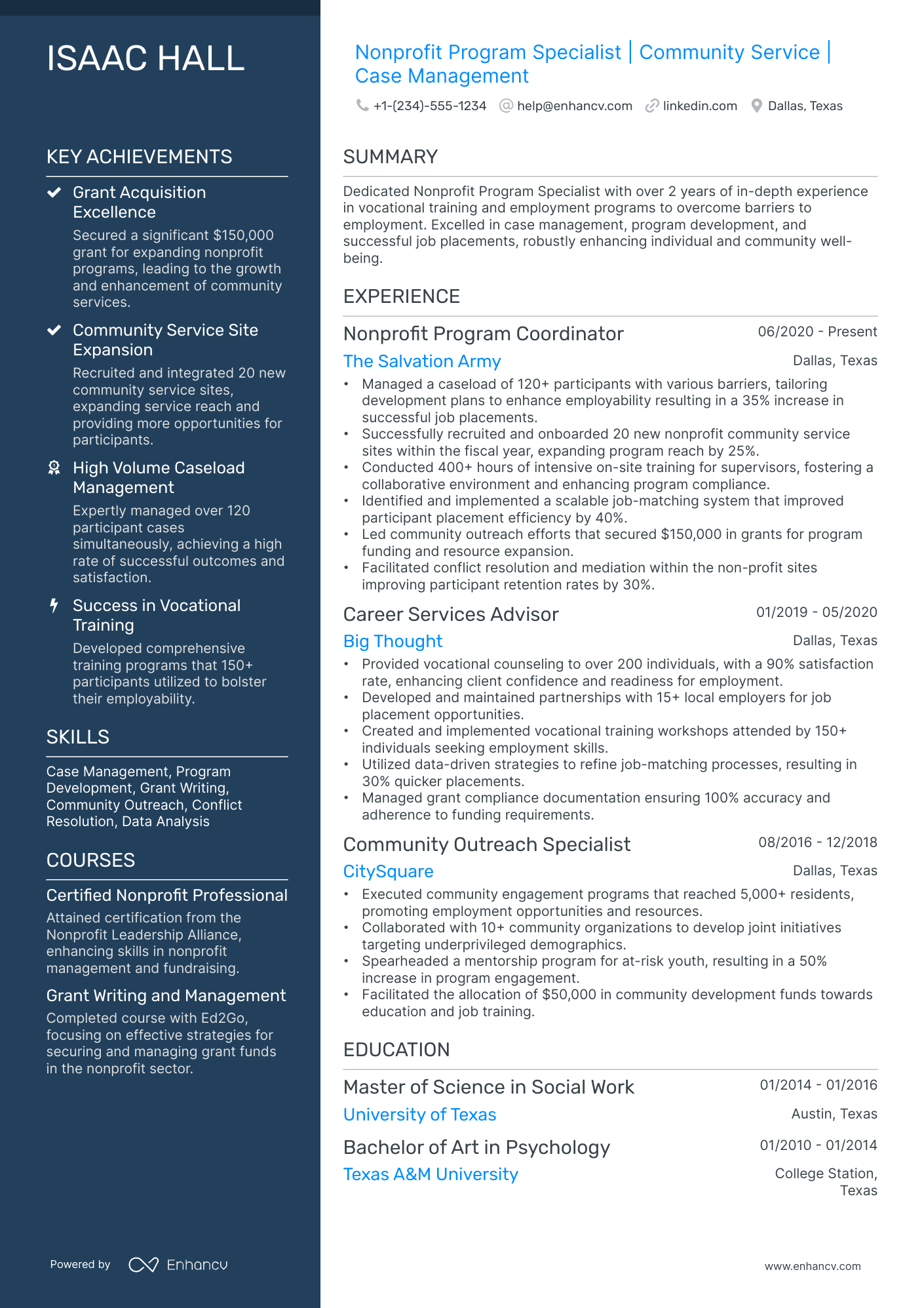
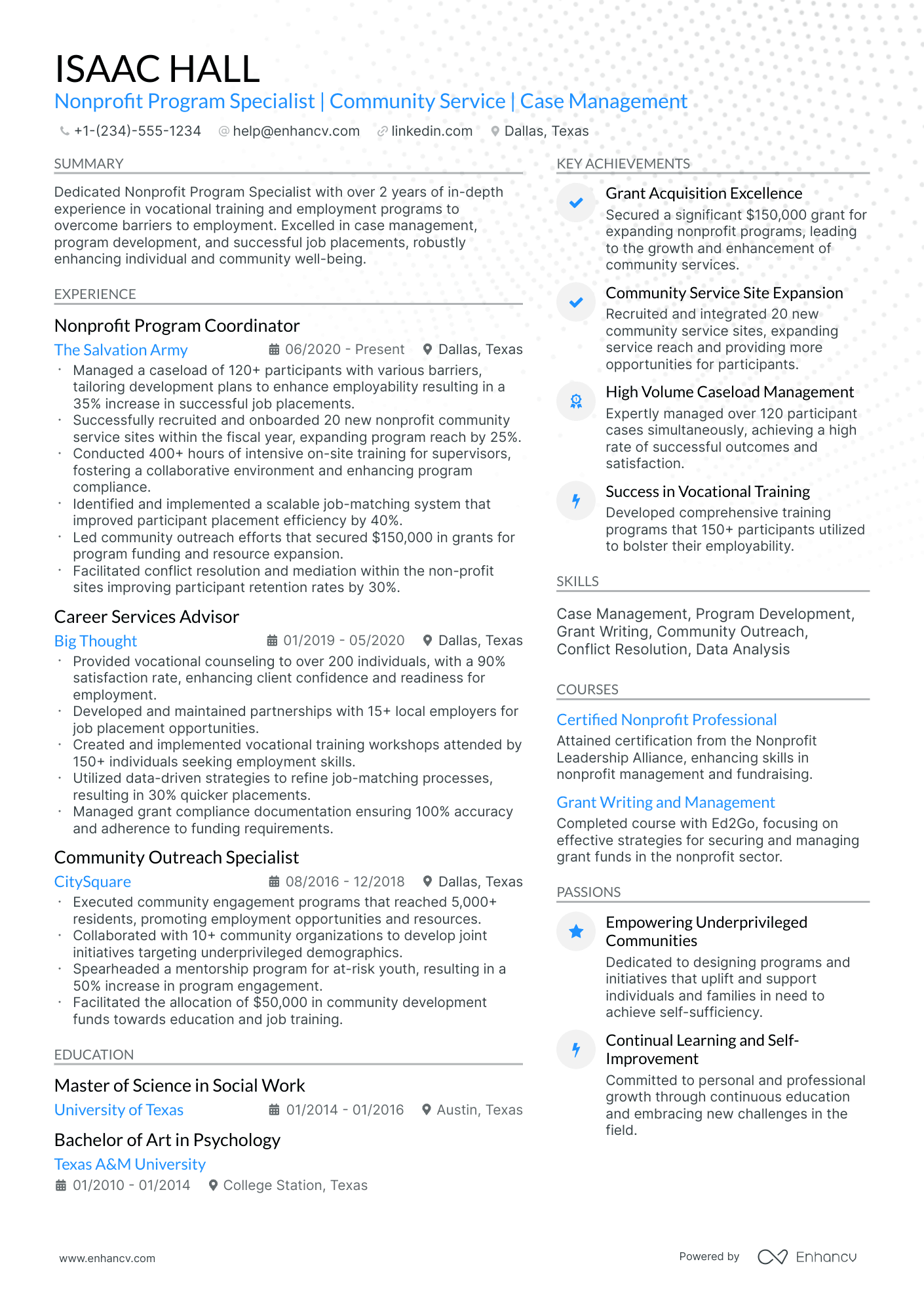
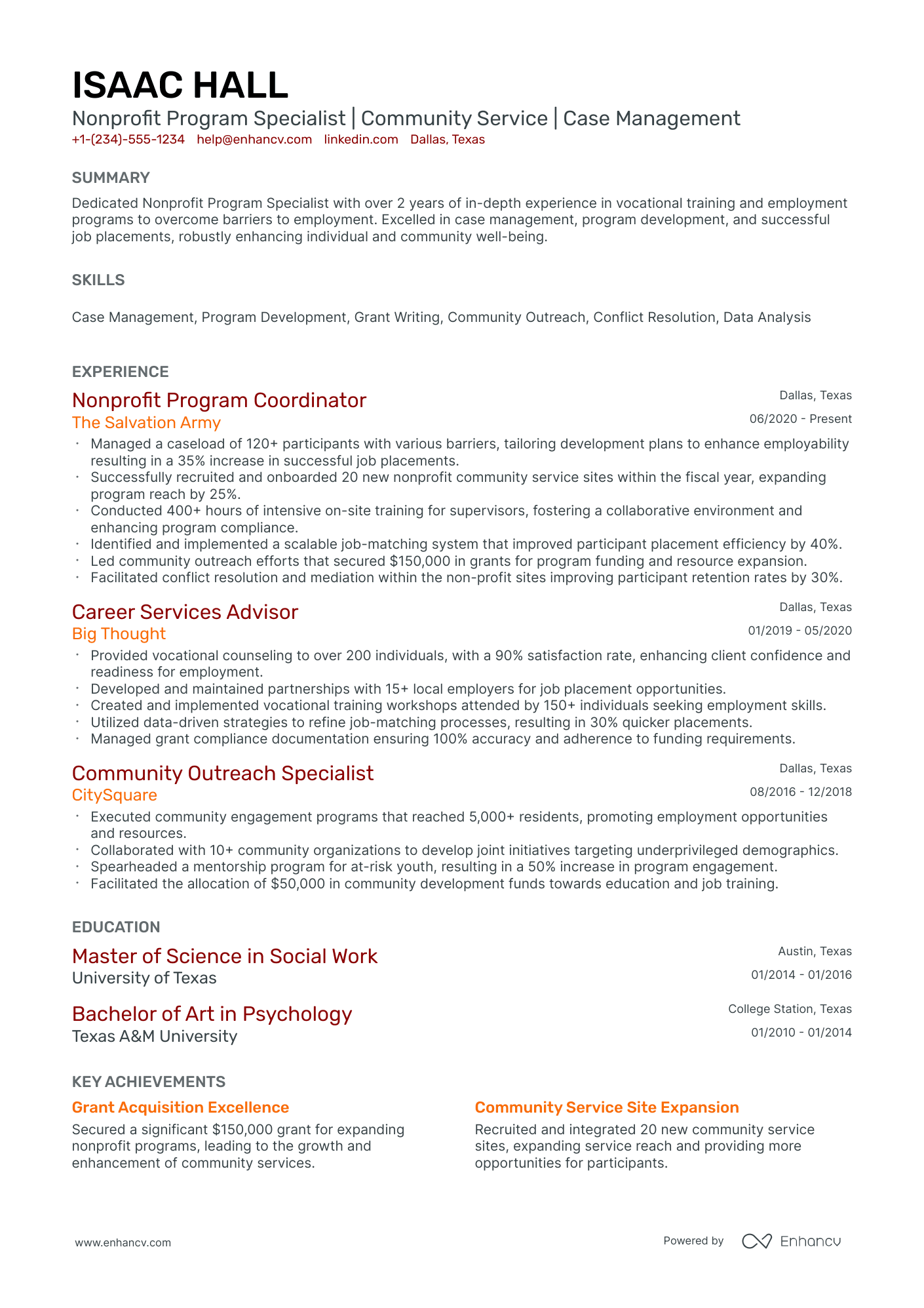
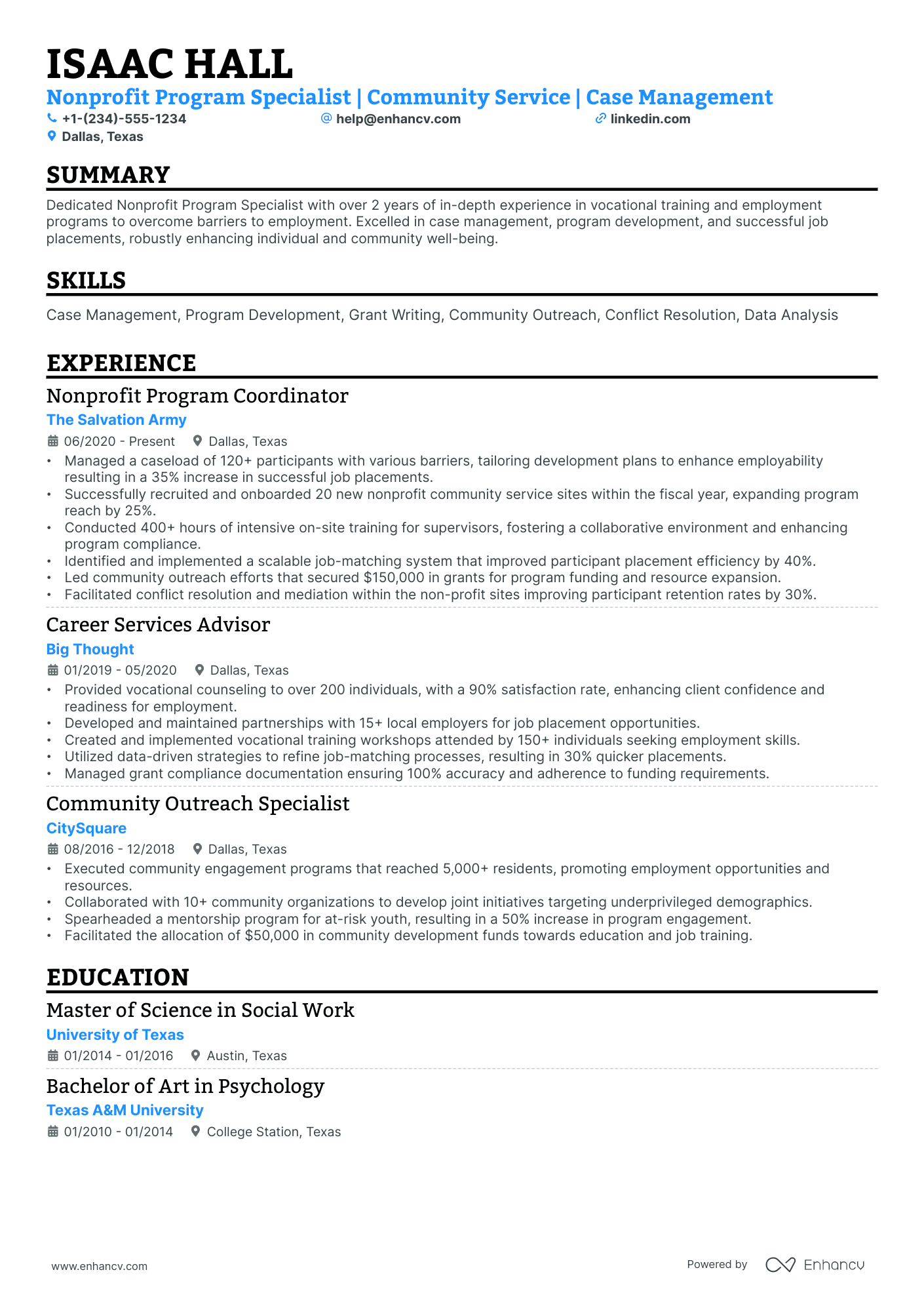
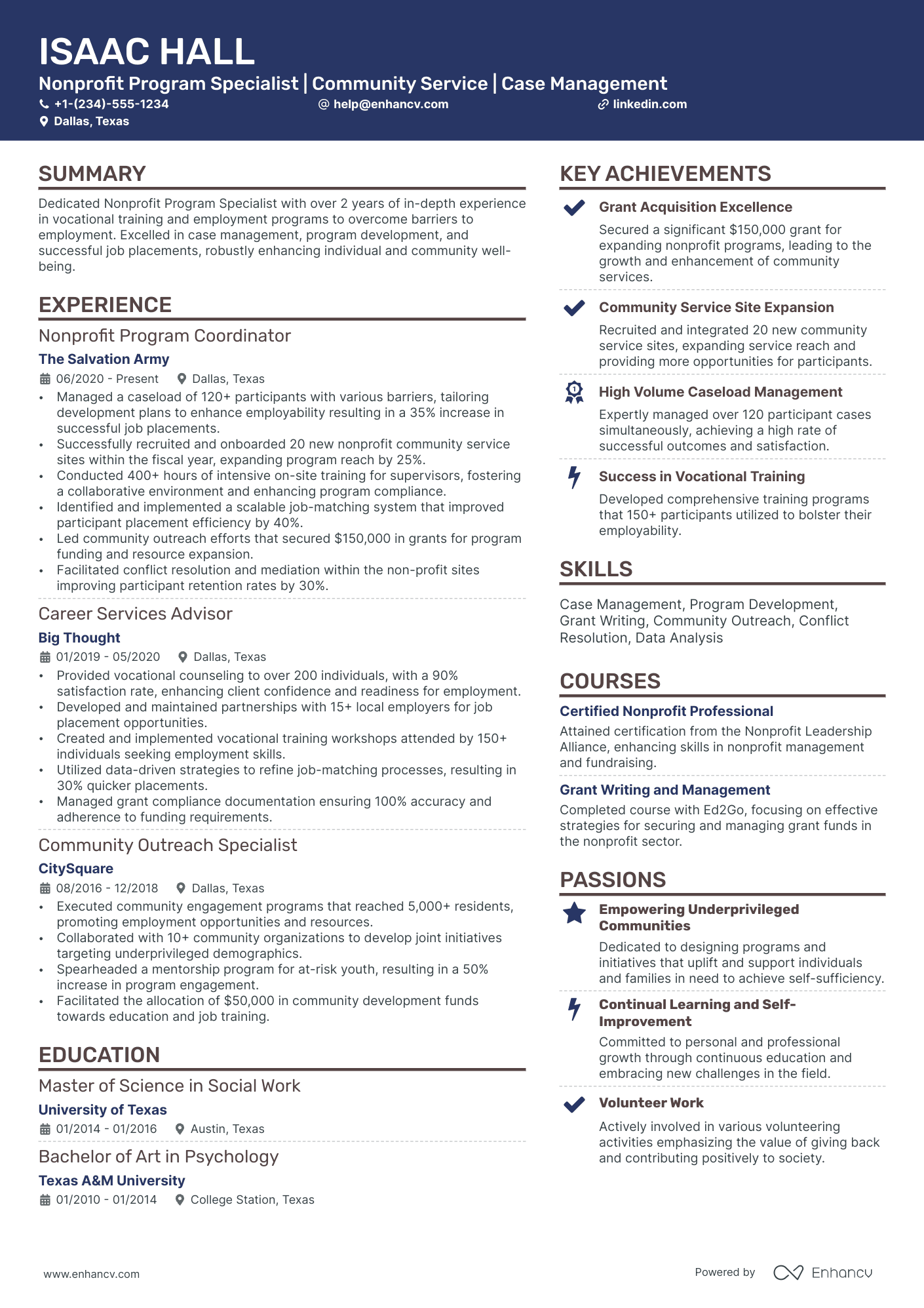
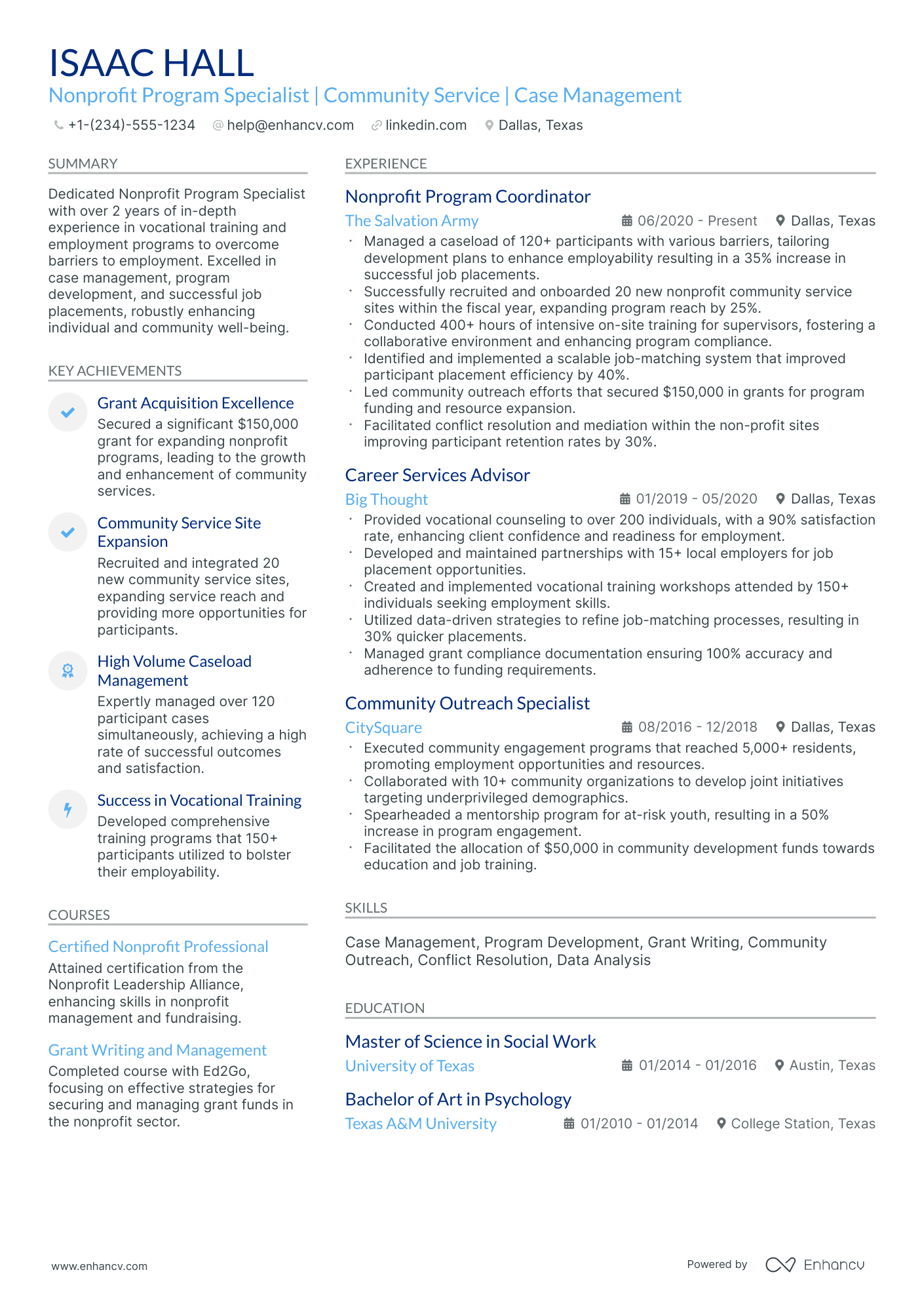
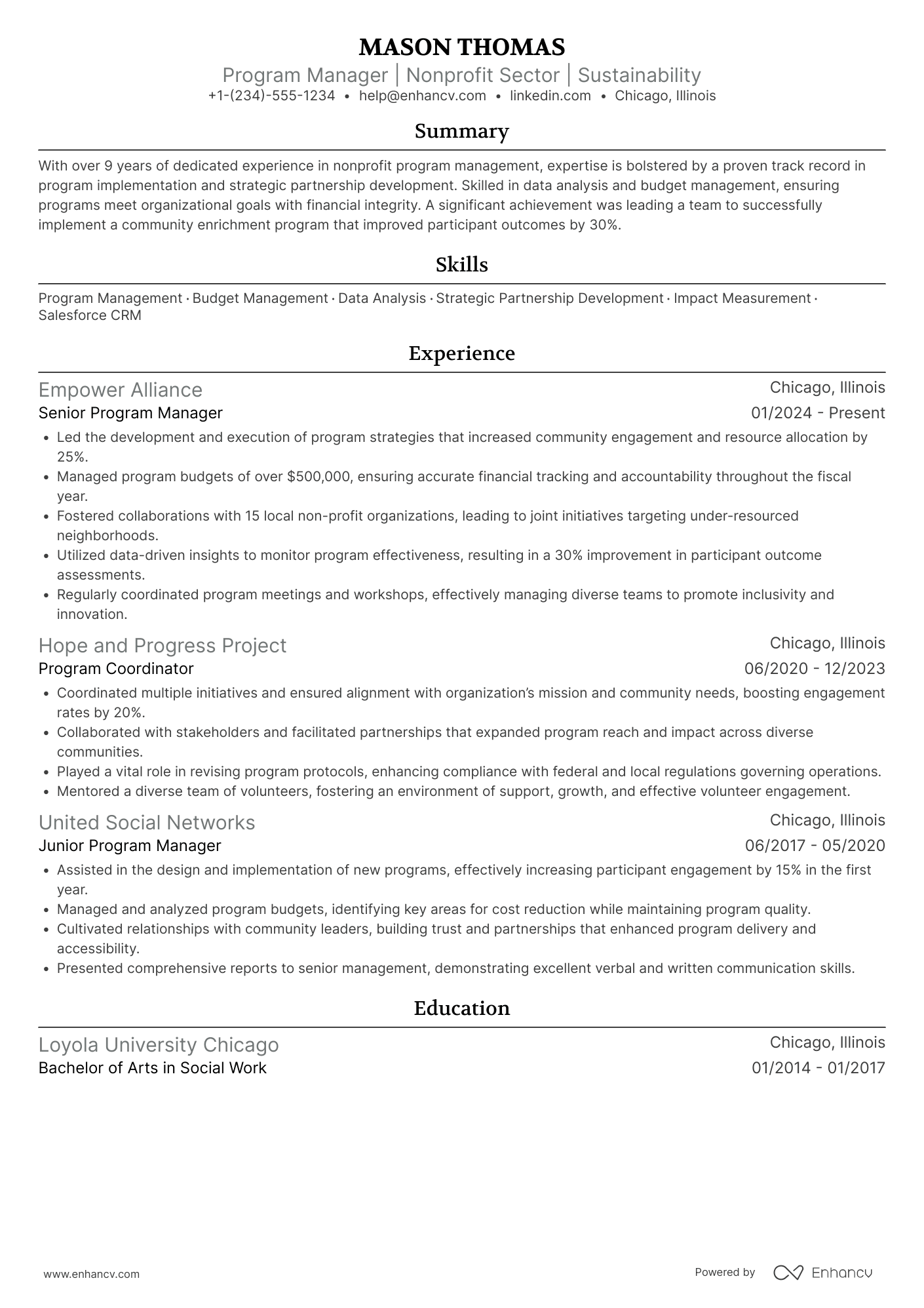
Many nonprofit program manager resume drafts fail because they describe duties, not measurable program results. That makes them hard for an ATS (applicant tracking system) to match and easy for recruiters to skip. Competition is high, and scans are fast.
A strong resume shows what changed because of your work. If you're unsure where to begin, learning how to write a resume that highlights outcomes is essential. You should highlight outcomes like funds raised, budgets managed, participants served, milestones delivered on time, compliance audit results, retention gains, and partner impact across multiple sites. Focus on scale, quality, and sustained results.

Key takeaways
- Quantify program outcomes like funds raised, beneficiaries served, and compliance rates in every bullet.
- Use reverse-chronological format for experienced candidates and hybrid format for career switchers.
- Tailor experience bullets to mirror each job posting's exact language, tools, and metrics.
- Demonstrate skills in context through your summary and experience—not just a standalone list.
- Place certifications like PMP or CNP near education to validate specialized nonprofit expertise.
- Write a cover letter when applying to mission-driven organizations or competitive program roles.
- Use Enhancv to align your resume structure and bullet points with nonprofit program manager requirements.
How to format a nonprofit program manager resume
Recruiters evaluating nonprofit program manager candidates prioritize evidence of program oversight, stakeholder engagement, grant management, and measurable community outcomes. A clear, well-structured resume format ensures these signals surface quickly during both human review and applicant tracking system (ATS) screening.

I have significant experience in this role—which format should I use?
Use a reverse-chronological format to present your program management experience in a clear, progression-driven narrative. Do:
- Lead each role entry with your scope of ownership—number of programs managed, team size, budget authority, and reporting relationships.
- Highlight domain-specific expertise such as grant writing, logic model development, donor management platforms (e.g., Salesforce NPSP, Bloomerang), and compliance with funder requirements.
- Quantify outcomes tied to programmatic goals, including participant impact, funding secured, cost savings, or capacity growth.
I'm junior or switching into this role—what format works best?
Use a hybrid format that leads with a targeted skills section and follows with relevant experience or project work in reverse-chronological order. Do:
- Place core competencies—such as program coordination, community outreach, data tracking, and volunteer management—near the top of the resume so recruiters and ATS systems capture them immediately.
- Include transferable projects, internships, AmeriCorps service, or volunteer leadership roles that demonstrate hands-on program support and stakeholder collaboration.
- Connect each listed experience to a concrete action and a measurable or observable result.
Why not use a functional resume?
A functional format strips away the timeline and context that hiring managers rely on to evaluate your growth, consistency, and hands-on program responsibilities—making it harder to trust the depth of your experience. A functional resume may make sense in a narrow set of circumstances:
- You're transitioning from a related field (e.g., social work, teaching, or community organizing) and need to reframe transferable skills around program management competencies.
- You have a gap in employment but continued building relevant expertise through volunteer program leadership, board service, or freelance consulting for nonprofit organizations.
- Edge-case exception: A functional format is acceptable only if you have minimal paid nonprofit experience but can tie every listed skill directly to specific projects, volunteer engagements, or measurable outcomes that demonstrate program management readiness.
With your format established, the next step is filling it with the right sections to showcase your qualifications effectively.
What sections should go on a nonprofit program manager resume
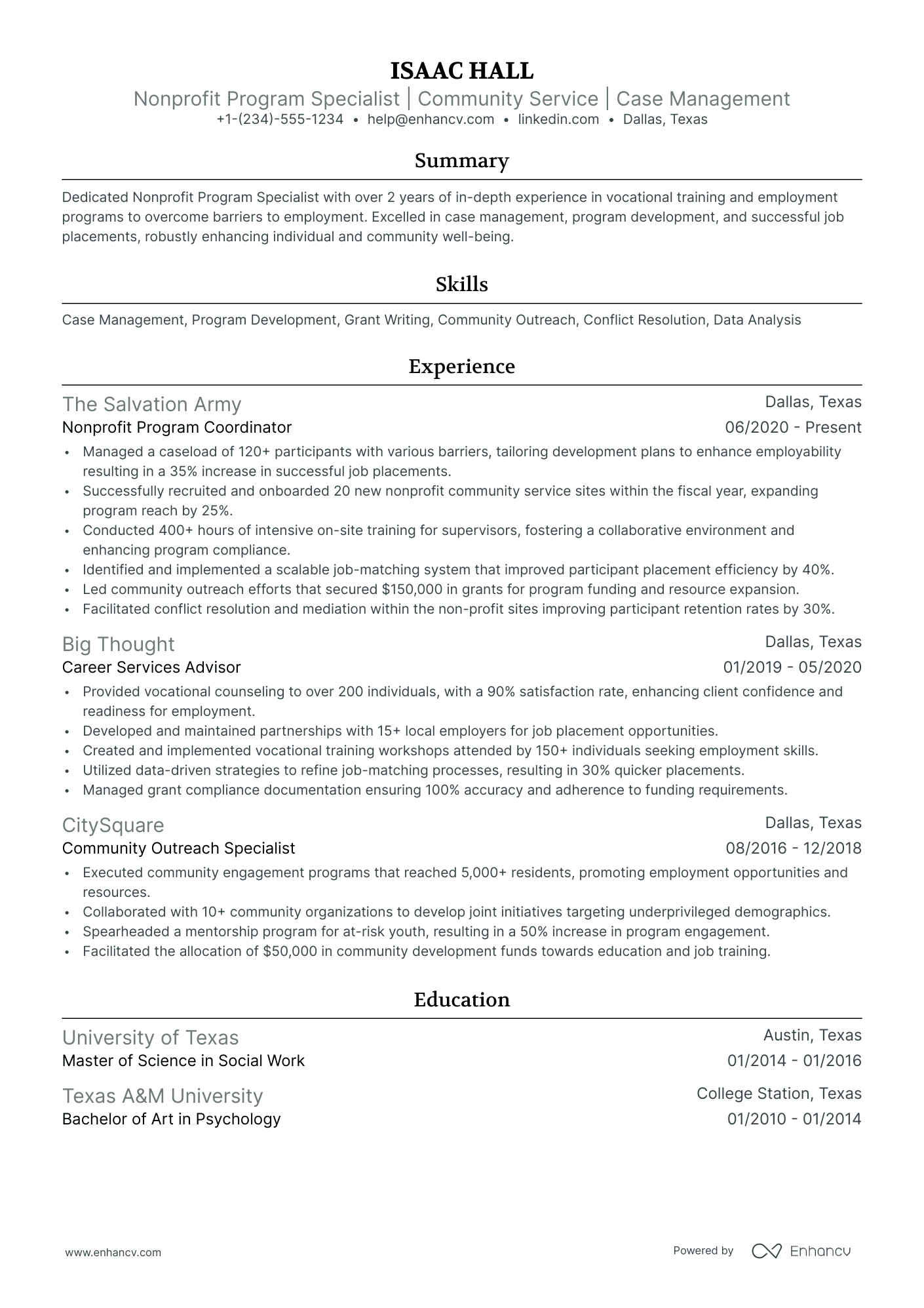
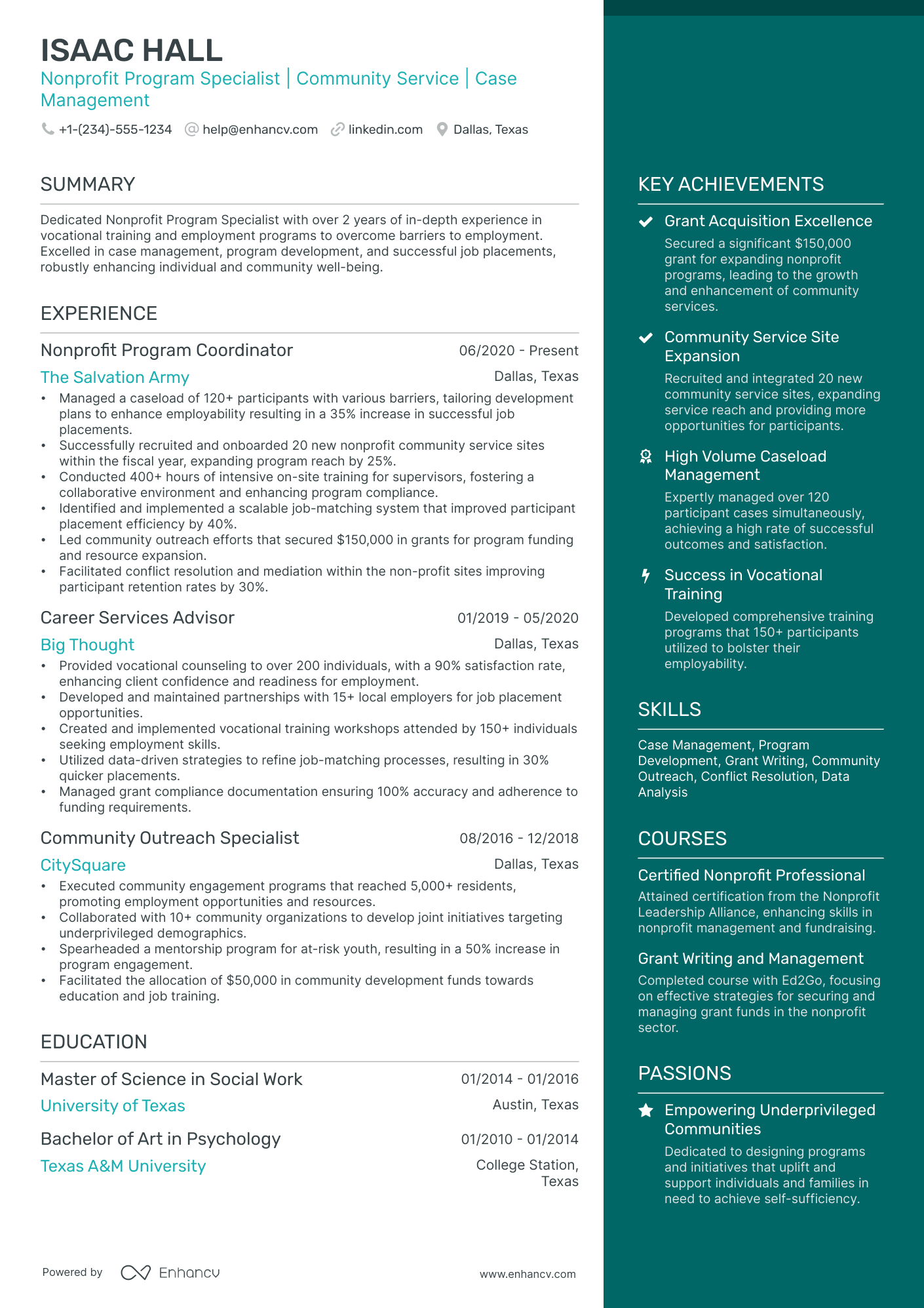
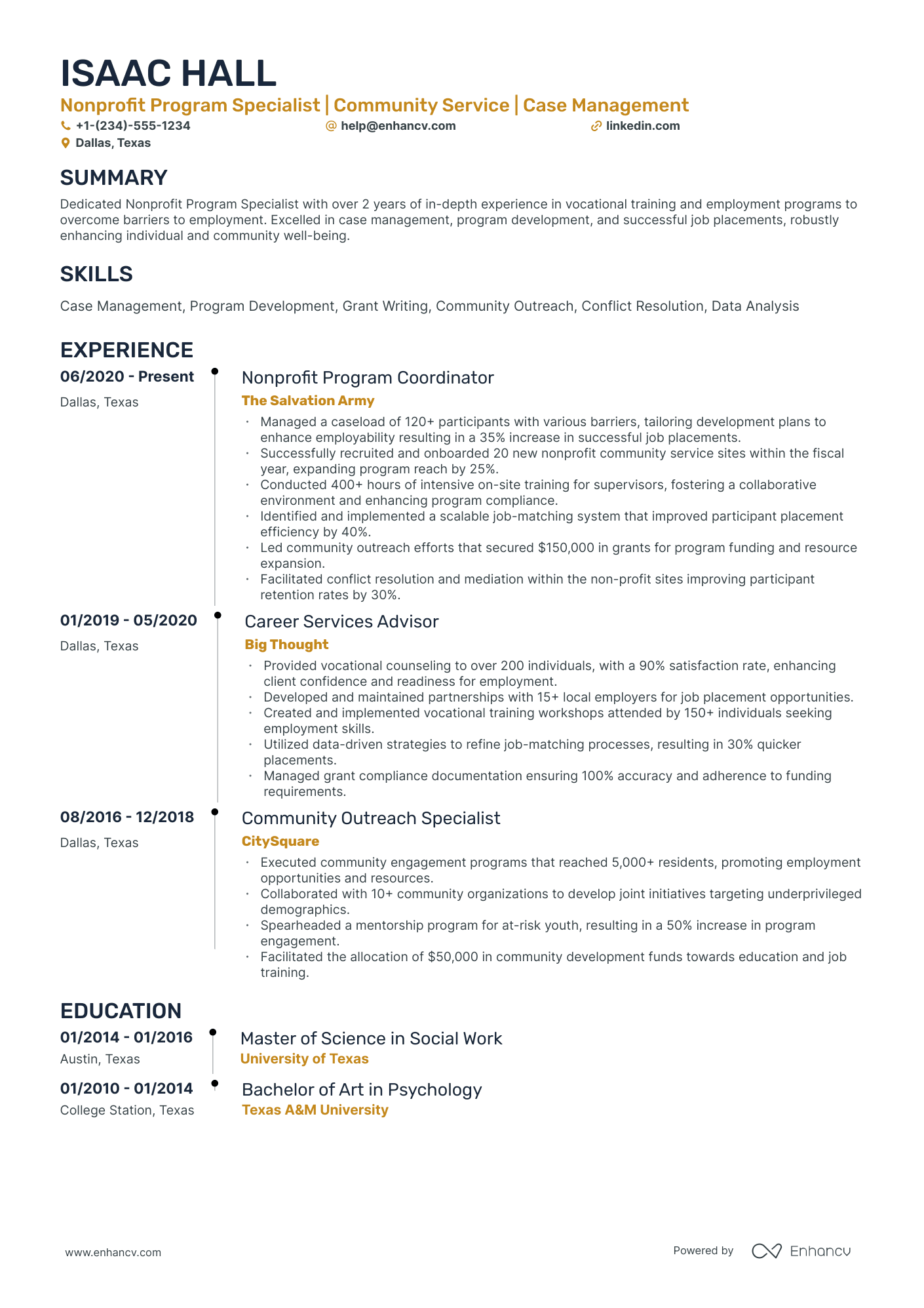
Recruiters expect a nonprofit program manager resume to show program leadership, measurable outcomes, and stakeholder management. Knowing which resume sections to include ensures maximum clarity:
- Header
- Summary
- Experience
- Skills
- Projects
- Education
- Certifications
- Optional sections: Volunteering, Leadership, Languages
Your experience bullets should emphasize impact, outcomes, scope, budgets, partnerships, and results you delivered.
Is your resume good enough?
Drop your resume here or choose a file. PDF & DOCX only. Max 2MB file size.
Once you’ve organized your resume with the right structure, the next step is to write your nonprofit program manager resume experience so each role clearly supports that layout.
How to write your nonprofit program manager resume experience
The experience section is where you prove you can move programs from concept to completion—showcasing the tools, methods, and frameworks you used alongside the measurable outcomes you delivered for communities, funders, and organizational missions. Hiring managers in the nonprofit sector prioritize demonstrated impact over descriptive task lists, so every line should connect your work to tangible results. Building a targeted resume that aligns each bullet with the role's priorities makes this connection even stronger.
Each entry should include:
- Job title
- Company and location (or remote)
- Dates of employment (month and year)
Three to five concise bullet points showing what you owned, how you executed, and what outcomes you delivered:
- Ownership scope: the programs, grants, service delivery models, community partnerships, or teams you were directly accountable for as a nonprofit program manager.
- Execution approach: the program management frameworks, monitoring and evaluation tools, grant management platforms, or stakeholder engagement methods you used to guide decisions and deliver work.
- Value improved: changes to program quality, participant outcomes, operational efficiency, service accessibility, compliance reliability, or organizational risk that resulted from your efforts.
- Collaboration context: how you coordinated with cross-functional staff, board members, government agencies, community organizations, volunteers, or funders to advance program goals.
- Impact delivered: outcomes expressed through program reach, funding secured or sustained, policy influence, or mission-level progress rather than routine activity.
Experience bullet formula
A nonprofit program manager experience example
✅ Right example - modern, quantified, specific.
Program Manager, Youth Workforce Development
BrightPath Community Services | Chicago, IL
2021–Present
Community-based nonprofit serving five thousand youth annually through job readiness, paid internships, and wraparound supports.
- Led a cross-functional team of nine (case managers, employer relations, and data analyst) using Asana and weekly OKR reviews, increasing on-time milestone completion from 72% to 93% in twelve months.
- Built a Salesforce Nonprofit Success Pack (Nonprofit Success Pack) reporting suite and Power BI dashboard for enrollment, attendance, and outcomes, cutting monthly funder reporting time by 40% and reducing data errors by 25%.
- Negotiated and managed twelve employer partnerships and two community college agreements, expanding paid internship placements by 35% (from 220 to 297) and improving six-month job placement from 54% to 63%.
- Implemented a trauma-informed, evidence-based curriculum and facilitator training with pre- and post-surveys in Qualtrics, raising participant completion rates by 18% and satisfaction scores from 4.1 to 4.6 out of five.
- Standardized program budgets, procurement, and compliance workflows in Google Workspace and DocuSign, improving audit readiness and reducing reimbursement turnaround time from twenty-one days to thirteen days through tighter documentation controls.
Now that you've seen how a strong experience section comes together, let's look at how to adjust yours to match the specific nonprofit role you're targeting.
How to tailor your nonprofit program manager resume experience
Recruiters evaluate your nonprofit program manager resume through both human review and applicant tracking systems (ATS). Tailoring your resume to the job description increases your chances of passing both screenings.
Ways to tailor your nonprofit program manager experience:
- Match grant management platforms and donor databases named in the posting.
- Mirror the exact terminology used for program evaluation frameworks.
- Reflect outcome metrics and impact KPIs the organization prioritizes.
- Highlight experience with specific funding sources or compliance standards mentioned.
- Incorporate referenced community engagement or stakeholder collaboration models.
- Align your language with stated program development methodologies.
- Emphasize relevant sector expertise such as education health or housing.
- Include monitoring and reporting workflows described in the job description.
Tailoring means aligning your real accomplishments with the role's stated requirements, not forcing keywords where they don't belong.
Resume tailoring examples for nonprofit program manager
| Job description excerpt | Untailored | Tailored |
|---|---|---|
| "Manage a portfolio of community health programs funded by CDC and state grants, ensuring compliance with federal reporting requirements and OMB Uniform Guidance." | Managed multiple programs and ensured compliance with organizational policies. | Managed a portfolio of six CDC- and state-funded community health programs totaling $2.4M, maintaining full compliance with OMB Uniform Guidance and submitting all federal reports on time across three grant cycles. |
| "Lead cross-functional teams to design and implement youth workforce development initiatives using logic models and Theory of Change frameworks." | Worked with teams to help create and run youth programs. | Led a cross-functional team of 12 staff and community partners to design youth workforce development initiatives grounded in Theory of Change frameworks, using logic models to define outcomes that increased participant job placement rates by 28%. |
| "Monitor program performance through Salesforce-based dashboards, conduct quarterly evaluations, and present impact data to the board of directors and external funders." | Tracked program data and shared updates with leadership. | Built and maintained Salesforce-based dashboards to monitor KPIs across four program sites, conducted quarterly evaluations, and presented impact data to the board of directors and three external funders—contributing to a 95% grant renewal rate. |
Once you’ve aligned your experience with the role’s priorities, quantify your nonprofit program manager achievements to show the scope and impact of that work.
How to quantify your nonprofit program manager achievements
Quantifying your impact shows funders and leaders what changed because of your work. Focus on outcomes served, dollars raised or saved, cycle time, compliance, and stakeholder satisfaction across partners, vendors, and internal teams.
Quantifying examples for nonprofit program manager
| Metric | Example |
|---|---|
| Beneficiaries served | "Expanded after-school program from 120 to 185 students per semester across three sites by standardizing enrollment and referral workflows in Airtable." |
| Grant revenue | "Secured $410,000 in restricted grants in nine months by building a quarterly reporting calendar and tightening logic models and budgets." |
| Cycle time | "Cut partner onboarding time from 28 days to 12 days by introducing a checklist, shared templates, and DocuSign for agreements." |
| Compliance accuracy | "Raised on-time, error-free funder reports from 78% to 98% by implementing a QA review step and version control in Google Drive." |
| Retention | "Improved volunteer six-month retention from 52% to 67% by launching a monthly training cadence and a feedback survey in SurveyMonkey." |
Turn vague job tasks into measurable, recruiter-ready resume bullets in seconds with Enhancv's Bullet Point Generator.
Once you've crafted strong bullet points that quantify your achievements, you'll want to apply that same precision to presenting your hard and soft skills throughout your nonprofit program manager resume.
How to list your hard and soft skills on a nonprofit program manager resume
Your skills section shows you can run programs, manage stakeholders, and report outcomes—recruiters and an ATS (applicant tracking system) scan this section to confirm role fit fast—so aim for a balanced mix of program delivery hard skills and execution-focused soft skills. nonprofit program manager roles require a blend of:
- Product strategy and discovery skills.
- Data, analytics, and experimentation skills.
- Delivery, execution, and go-to-market discipline.
- Soft skills.
Your skills section should be:
- Scannable (bullet-style grouping).
- Relevant to the job post.
- Backed by proof in experience bullets.
- Updated with current tools.
Place your skills section:
- Above experience if you're junior or switching careers.
- Below experience if you're mid/senior with strong achievements.

Hard skills
- Program design and logic models
- Theory of change development
- Monitoring and evaluation plans
- Outcome measurement, key performance indicators
- Grant compliance and reporting
- Budgeting and forecast tracking
- Salesforce Nonprofit Success Pack
- Asana, Trello, Smartsheet
- Survey design, Qualtrics, SurveyMonkey
- Microsoft Excel, Google Sheets
- Power BI, Tableau dashboards
- Safeguarding and risk management
Soft skills
- Stakeholder mapping and alignment
- Cross-functional coordination
- Partner and vendor management
- Clear donor-ready writing
- Facilitating workshops and trainings
- Prioritizing under constraints
- Making data-informed tradeoffs
- Driving timelines and accountability
- Managing up and escalating risks
- Coaching staff and volunteers
- Handling sensitive conversations
- Leading through change
How to show your nonprofit program manager skills in context
Skills shouldn't live only in a bulleted list on your resume. Explore common resume skills to ensure you're not overlooking competencies that match the role.
They should be demonstrated in:
- Your summary (high-level professional identity)
- Your experience (proof through outcomes)
Here's what that looks like in practice.
Summary example
Senior nonprofit program manager with 10+ years leading community health initiatives. Skilled in grant management, Salesforce NPSP, and logic model design. Built cross-sector partnerships that expanded service delivery to 12,000+ beneficiaries annually while reducing program costs by 18%.
- Reflects senior-level experience clearly
- Names role-relevant tools and methods
- Includes a specific measurable outcome
- Highlights collaboration as a soft skill
Experience example
Senior Program Manager
Catalyst Community Partners | Portland, OR
June 2019–Present
- Managed a $2.4M federal grant portfolio using Fluxx, maintaining 100% compliance across three reporting cycles through cross-departmental coordination.
- Launched a youth workforce readiness program with Salesforce NPSP tracking, graduating 340 participants and achieving a 78% job placement rate.
- Led quarterly stakeholder convenings with 15 partner organizations, strengthening referral pipelines and increasing participant enrollment by 32%.
- Every bullet includes measurable proof.
- Skills appear naturally within achievements.
Once you’ve grounded your abilities in concrete examples and outcomes, the next step is applying that same approach to building a nonprofit program manager resume with no experience so your qualifications still come through clearly.
How do I write a nonprofit program manager resume with no experience
Even without full-time experience, you can demonstrate readiness through transferable work. Our guide on writing a resume without work experience covers this approach in detail. Consider highlighting:
- Volunteer program coordination for nonprofits
- Campus club initiative leadership roles
- Service-learning project management coursework
- Grant research and draft proposals
- Internship supporting community outreach events
- Data tracking in spreadsheets dashboards
- Budgeting for student organizations
Focus on:
- Outcomes with numbers and scope
- Program planning and delivery steps
- Stakeholder updates and reporting cadence
- Tools: Excel, Airtable, Asana
Resume format tip for entry-level nonprofit program manager
Use a hybrid resume format because it highlights relevant projects and skills while keeping a clear timeline of internships and volunteer work. Do:
- Lead with a project-based summary section.
- Add a 'Selected Projects' section.
- Quantify reach, cost, and timelines.
- List tools used in each bullet.
- Match keywords from the job post.
- Coordinated volunteer program coordination using Asana and Airtable, scheduled twelve shifts and tracked attendance, improving volunteer fill rate from 70% to 92%.
Once you've positioned your volunteer work and transferable skills to compensate for a lack of formal experience, your education section becomes the next critical area to strengthen your candidacy.
How to list your education on a nonprofit program manager resume
Your education section helps hiring teams confirm you have the foundational knowledge needed for a nonprofit program manager role. It signals relevant training in areas like public administration, social impact, and organizational leadership.
Include:
- Degree name
- Institution
- Location
- Graduation year
- Relevant coursework (for juniors or entry-level candidates)
- Honors & GPA (if 3.5 or higher)
Skip month and day details—list the graduation year only.
Here's a strong education entry tailored to a nonprofit program manager resume.
Example education entry
Bachelor of Arts in Public Administration
Georgetown University, Washington, D.C.
Graduated 2019
GPA: 3.7/4.0
- Relevant Coursework: Nonprofit Management, Grant Writing, Community Development, Program Evaluation, Social Policy Analysis
- Honors: Magna Cum Laude, Dean's List (six semesters)
How to list your certifications on a nonprofit program manager resume
Certifications on your resume show your commitment to learning, proficiency with program tools, and relevance to the sector, which helps a nonprofit program manager stand out in competitive hiring pools.
Include:
- Certificate name
- Issuing organization
- Year
- Optional: credential ID or URL
- Place certifications below education when they're older, less relevant, or only reinforce core qualifications already clear from your degree.
- Place certifications above education when they're recent, highly relevant, or required, especially if they strengthen your nonprofit program manager focus.
Best certifications for your nonprofit program manager resume
- Project Management Professional (PMP)
- Certified Associate in Project Management (CAPM)
- Certified Nonprofit Professional (CNP)
- Certified Fund Raising Executive (CFRE)
- Prosci Change Management Certification
- Lean Six Sigma Green Belt
- Salesforce Certified Administrator
Once you’ve positioned your credentials to support the role, move to your nonprofit program manager resume summary to highlight that value upfront.
How to write your nonprofit program manager resume summary
Your resume summary is the first thing a recruiter reads. A strong one immediately signals you're the right fit for a nonprofit program manager role.
Keep it to three to four lines, with:
- Your title and total years of experience in program management.
- The nonprofit sector, mission area, or program type you specialize in.
- Core skills like grant management, stakeholder engagement, or impact reporting.
- One or two measurable achievements, such as funding secured or outcomes improved.
- Soft skills tied to real results, like cross-functional collaboration that improved program delivery.

PRO TIP
At a mid-level role, emphasize hands-on program execution, measurable community outcomes, and cross-team coordination. Highlight specific funding amounts, populations served, or efficiency gains. Avoid vague phrases like "passionate leader" or "driven professional." Recruiters want evidence, not enthusiasm.
Example summary for a nonprofit program manager
Nonprofit program manager with six years of experience overseeing youth development initiatives. Managed $1.2M in grant-funded programs, improving participant retention by 28% through data-driven curriculum redesign and community partner collaboration.
Optimize your resume summary and objective for ATS
Drop your resume here or choose a file.
PDF & DOCX only. Max 2MB file size.
Now that your summary captures your professional value, make sure the header framing it presents your contact details correctly so recruiters can actually reach you.
What to include in a nonprofit program manager resume header
A well-crafted resume header lists your key contact and professional details, helping your nonprofit program manager application stand out in recruiter screening for visibility and credibility.
Essential resume header elements
- Full name
- Tailored job title and headline
- Location
- Phone number
- Professional email
- GitHub link
- Portfolio link
A LinkedIn link helps recruiters verify experience quickly and supports screening.
Do not include photos on a nonprofit program manager resume unless the role is explicitly front-facing or appearance-dependent.
Keep your header on one to two lines, match the job title to the posting, and use links that open to updated, public profiles.
Example
Nonprofit program manager resume header
Jordan Lee
Nonprofit program manager | Community health programs | Grant compliance
Chicago, IL | (312) 555-01XX | your.name@enhancv.com
github.com/yourname yourwebsite.com linkedin.com/in/yourname
Once your contact details and key identifiers are set, add relevant additional sections to provide supporting context and strengthen your nonprofit program manager resume.
Additional sections for nonprofit program manager resumes
Adding extra sections helps you stand out when your core qualifications match other candidates and you need to demonstrate deeper community ties or mission alignment. For example, listing language skills on your resume can highlight your ability to serve diverse communities.
- Languages
- Volunteer work
- Board memberships and affiliations
- Publications and presentations
- Certifications and professional development
- Awards and grants received
Once you've strengthened your resume with these supplementary sections, pairing it with a tailored cover letter can further distinguish your application.
Do nonprofit program manager resumes need a cover letter
A cover letter isn't always required for a nonprofit program manager, but it often helps. Understanding what a cover letter is and when to use one matters most for competitive roles, mission-driven organizations, or when hiring managers expect context beyond metrics. It can also tip decisions when candidates look similar on paper.
Use a cover letter to add context your nonprofit program manager resume can't:
- Explain role and team fit by linking your program approach to the organization's mission, stakeholders, and operating model.
- Highlight one or two relevant projects or outcomes, and state what changed, for whom, and how you measured results.
- Show understanding of the organization's services, users, and funding constraints, and connect that context to your program decisions.
- Address career transitions or non-obvious experience by translating past work into nonprofit program manager responsibilities and impact.
Drop your resume here or choose a file.
PDF & DOCX only. Max 2MB file size.
If you choose to include a cover letter, using AI to improve your nonprofit program manager resume helps you align your experience with the role and present it clearly and consistently.
Using AI to improve your nonprofit program manager resume
AI can sharpen your resume's clarity, structure, and impact. It helps tighten language and highlight measurable results. But overuse strips authenticity. Once your content feels clear and role-aligned, step away from AI. If you're exploring tools, our comparison of which AI is best for writing resumes can help you choose the right one.
Here are 10 prompts you can copy and paste to strengthen specific sections of your resume:
- Strengthen your summary: "Rewrite my nonprofit program manager resume summary to emphasize mission-driven leadership and measurable community outcomes in under four sentences."
- Quantify experience bullets: "Add specific metrics and outcomes to these nonprofit program manager experience bullets without inventing data I haven't provided."
- Align skills to the role: "Review this job posting and identify which of my listed skills best match the nonprofit program manager requirements."
- Tighten project descriptions: "Shorten these nonprofit program manager project descriptions to one impactful sentence each, focusing on scope and results."
- Improve action verbs: "Replace weak or repetitive verbs in my nonprofit program manager experience section with strong, varied action verbs."
- Tailor education details: "Rewrite my education section to highlight coursework and honors most relevant to a nonprofit program manager position."
- Clarify certification value: "Explain how each certification listed on my nonprofit program manager resume connects to core responsibilities of the role."
- Remove filler language: "Identify and remove vague or redundant phrases across my entire nonprofit program manager resume."
- Focus volunteer experience: "Reframe my volunteer experience bullets to reflect transferable nonprofit program manager skills like stakeholder engagement and budget oversight."
- Match tone to sector: "Adjust the tone of my nonprofit program manager resume to sound mission-focused, collaborative, and results-oriented without corporate jargon."
Stop using AI once your resume sounds accurate, specific, and aligned with real experience. AI should never invent experience or inflate claims—if it didn't happen, it doesn't belong here.
Conclusion
A strong nonprofit program manager resume shows measurable outcomes, role-specific skills, and a clear structure. It highlights program results, budget ownership, partner management, and team leadership. It stays focused, uses clean headings, and makes key achievements easy to scan.
Hiring teams want proof you can deliver results now and adapt to shifting funding and reporting needs. When your nonprofit program manager resume connects your impact to the role and reads fast, it signals readiness for today’s market and the next hiring cycle.