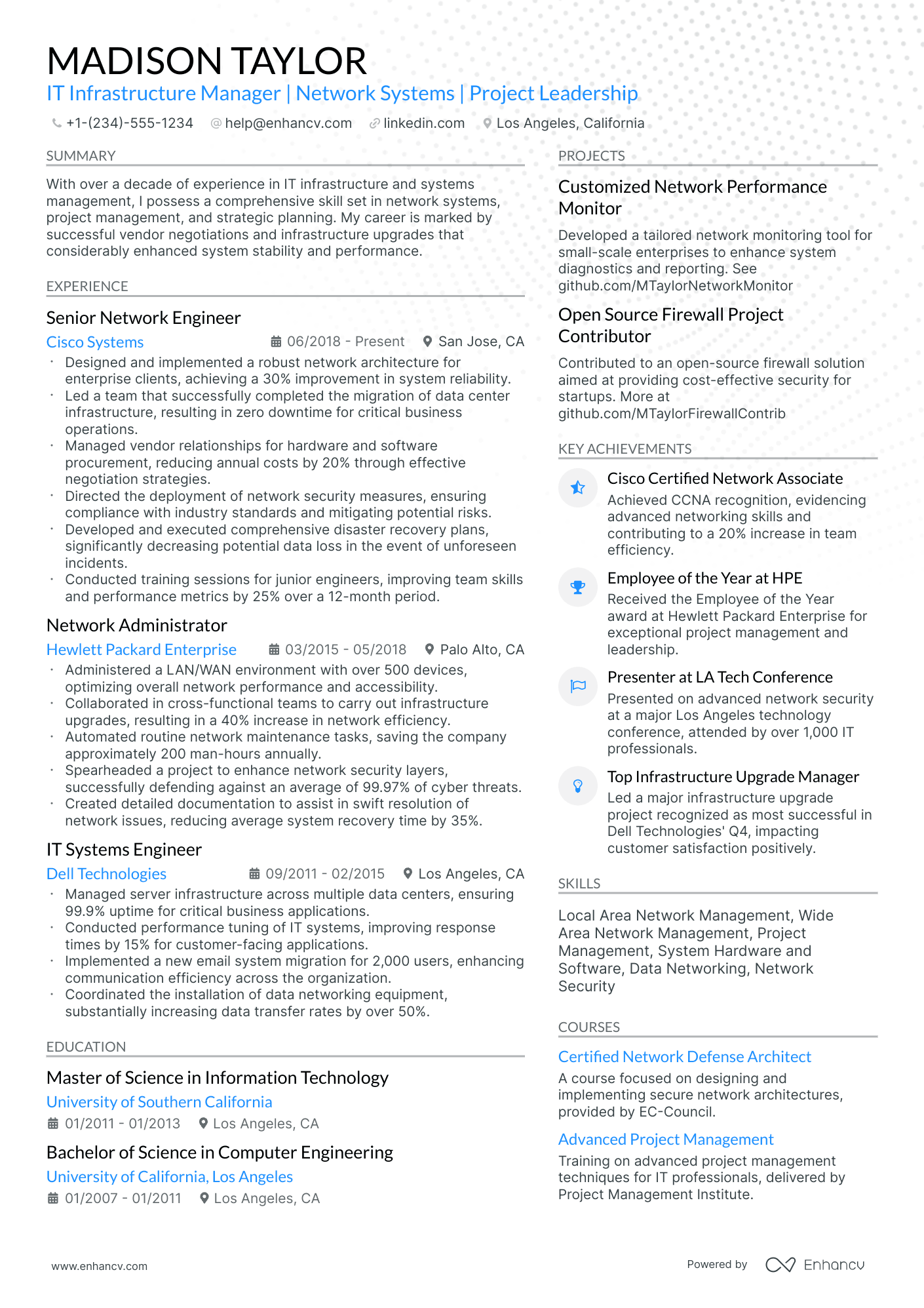
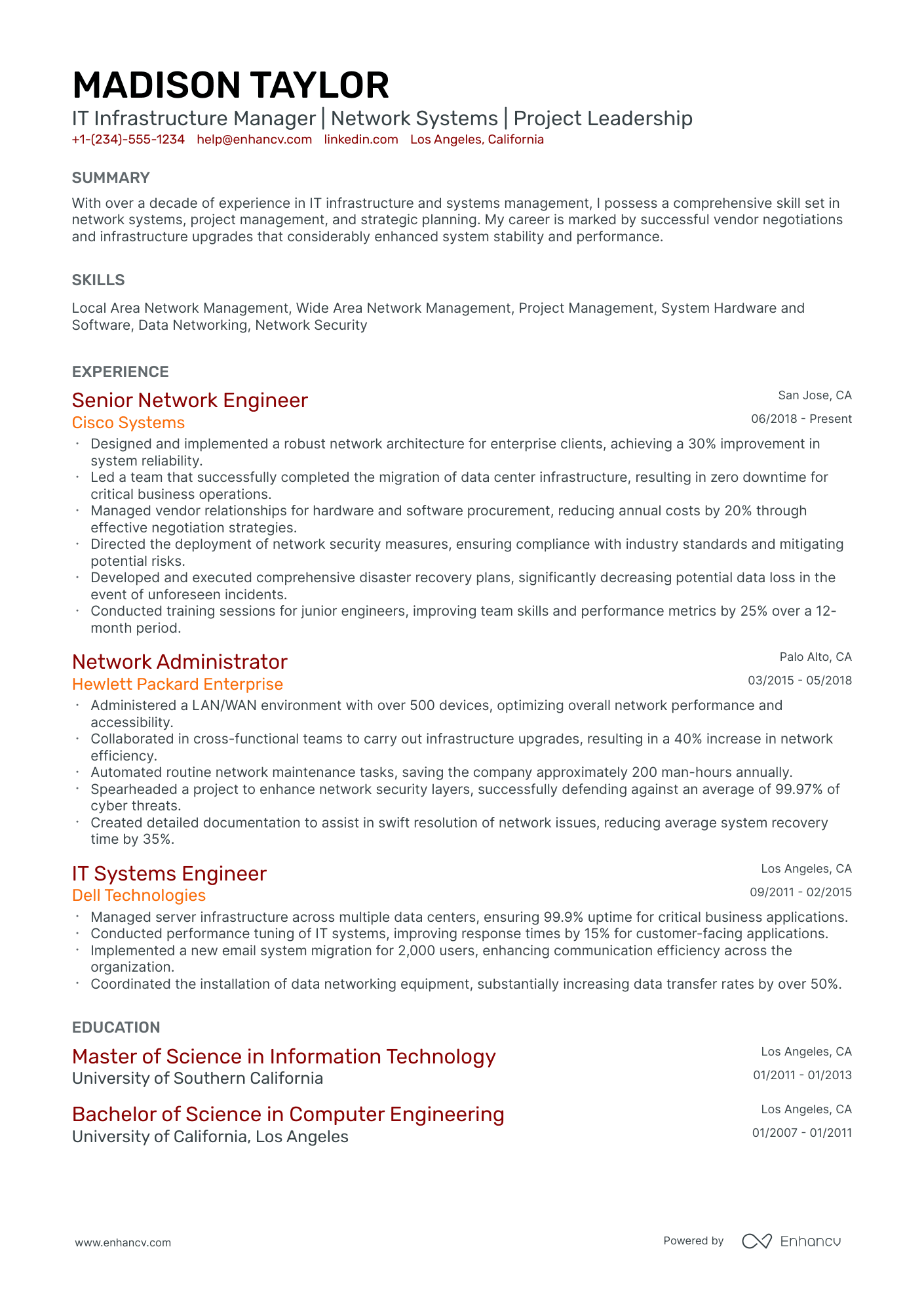
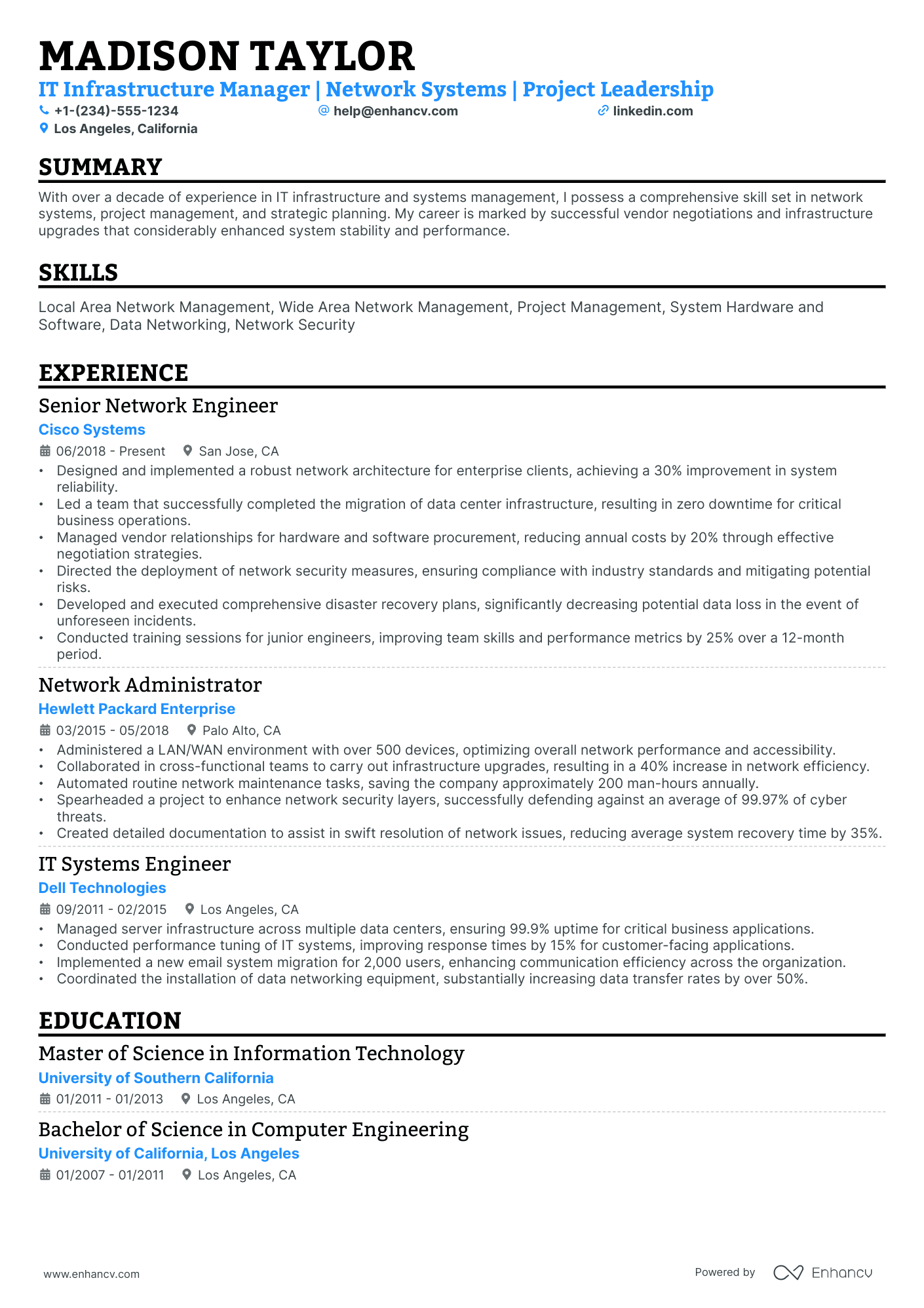
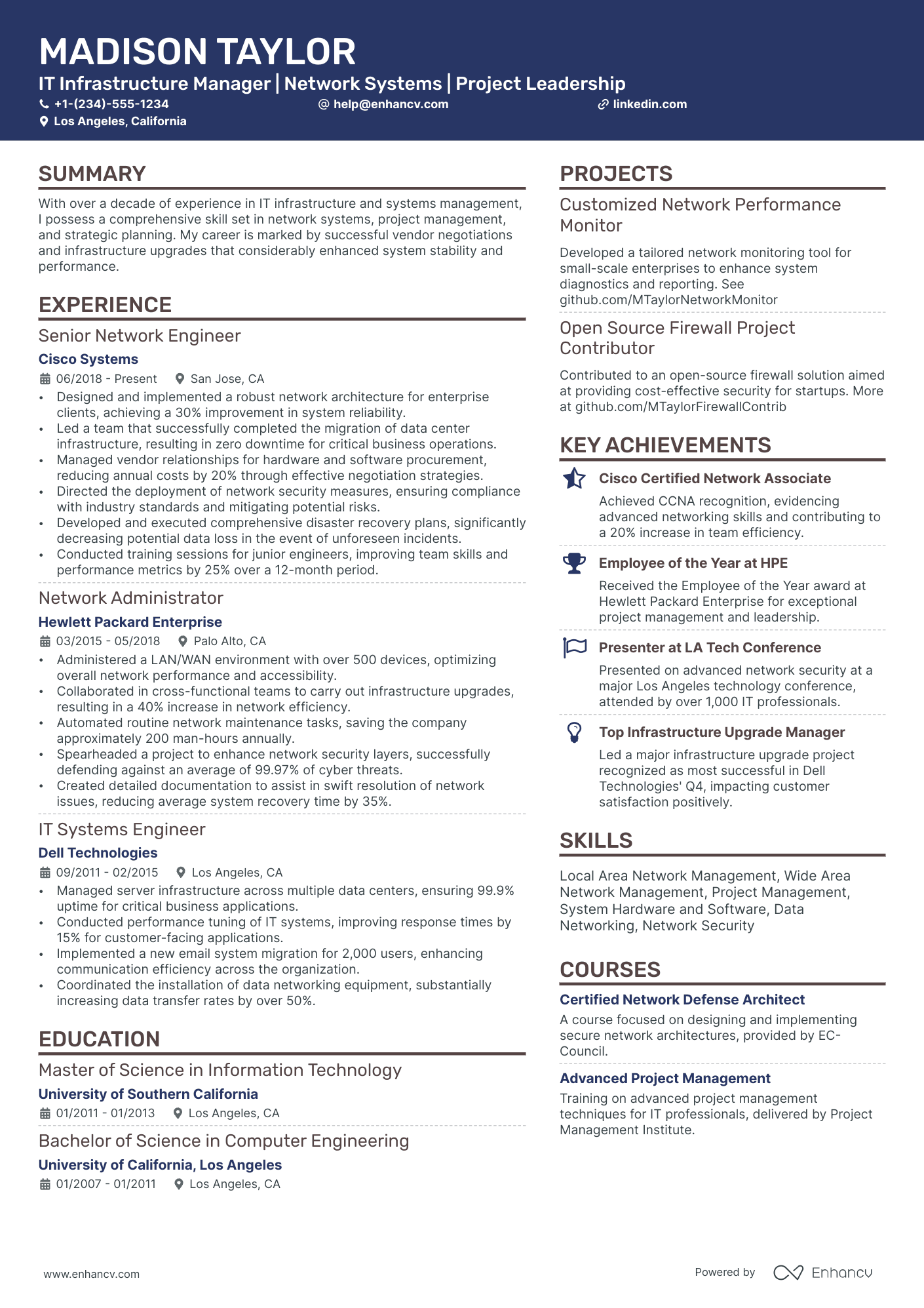
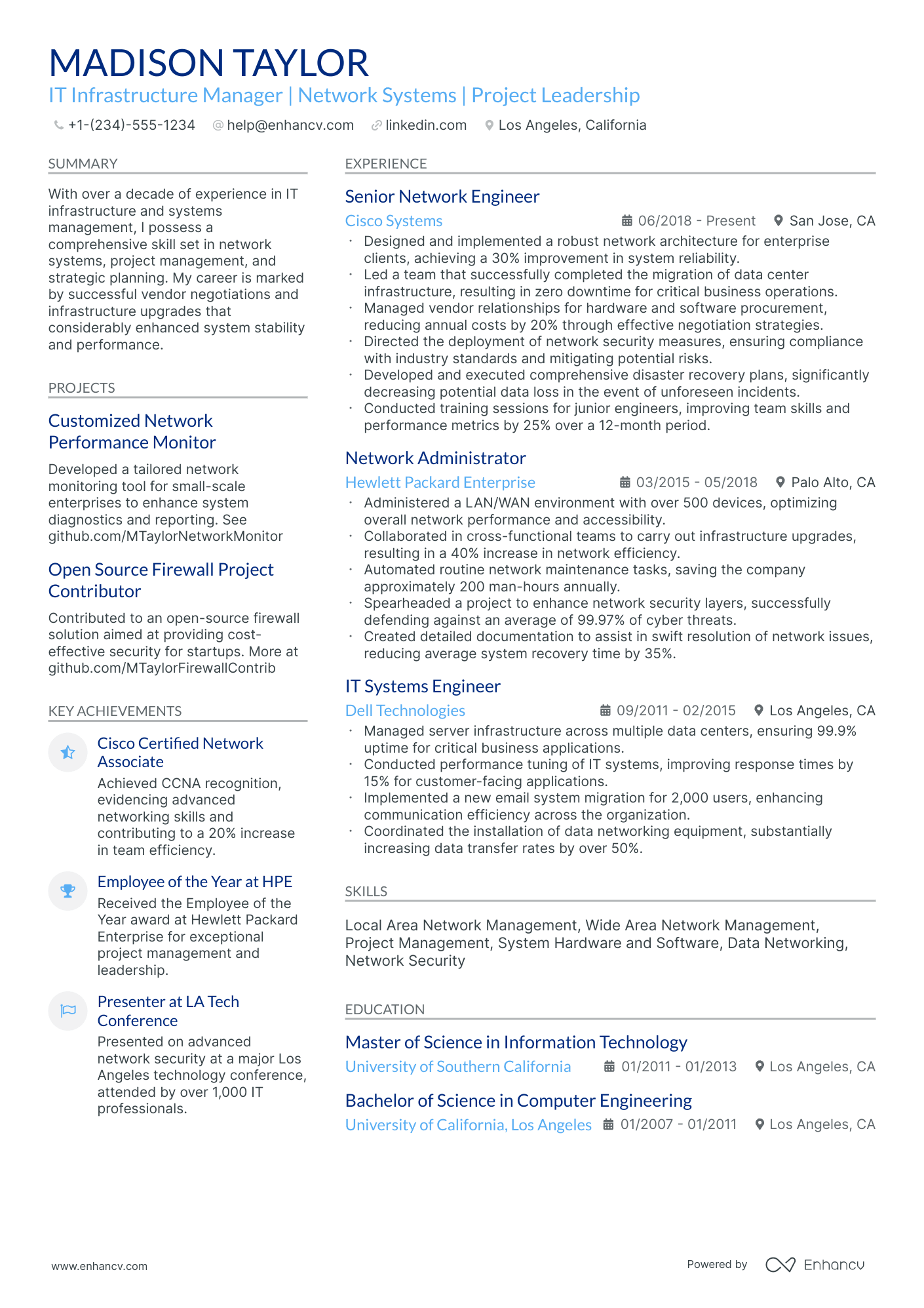
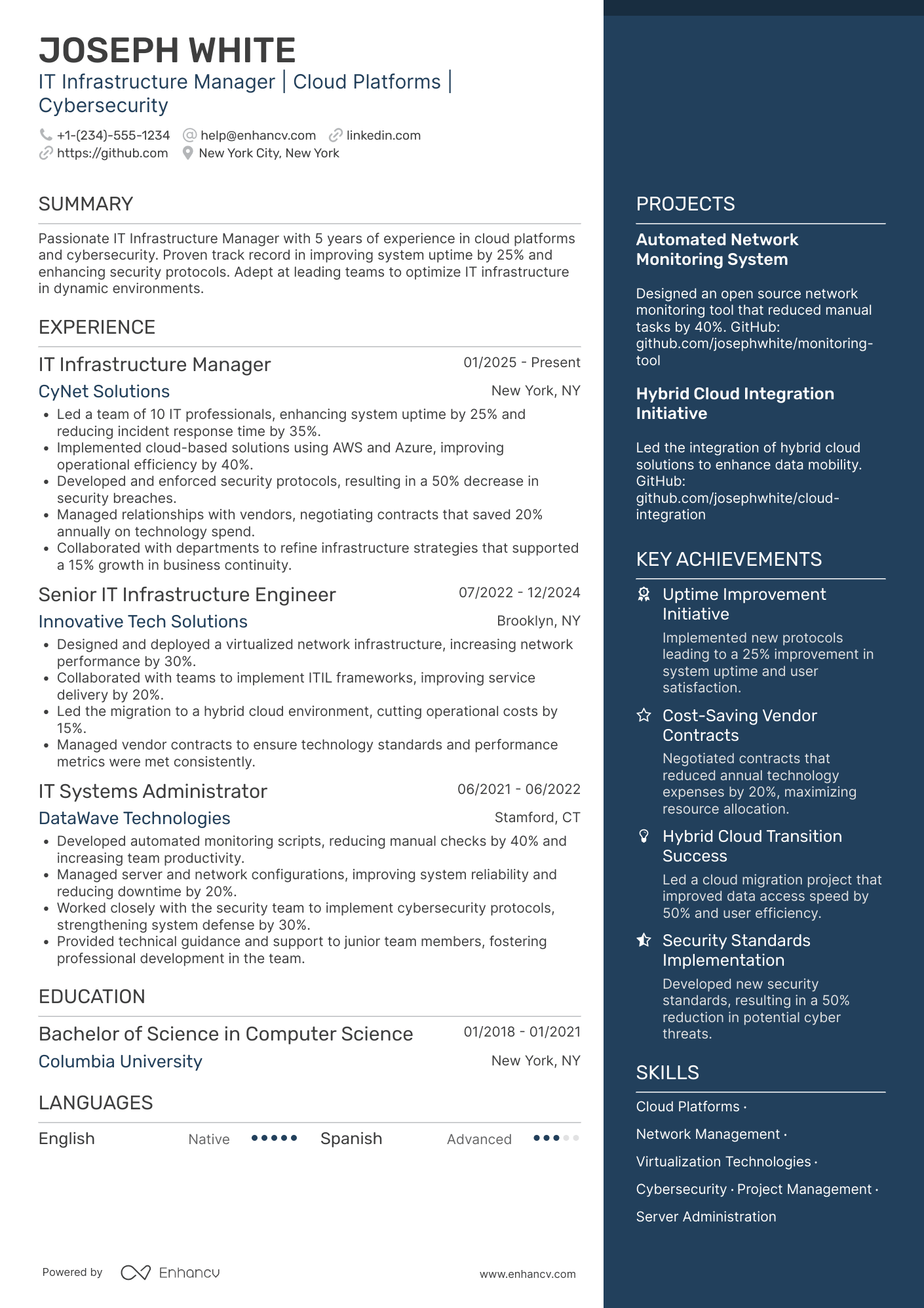
Many IT infrastructure manager resume submissions fail because they read like tool inventories and task lists, not evidence of operational impact. That costs you in ATS screening, fast recruiter scans, and crowded shortlists.
A strong resume shows what improved because of you. Knowing how to make your resume stand out starts with highlighting uptime gains, incident reduction, cloud or data center consolidation scope, cost savings, faster change windows, stronger recovery objectives, audit-ready controls, and smoother migrations with minimal user disruption.

Key takeaways
- Quantify uptime gains, cost savings, and incident reduction instead of listing daily tasks.
- Use reverse-chronological format if you have progressive infrastructure leadership experience.
- Mirror the job posting's exact platforms, frameworks, and compliance terms in your resume.
- Tie every listed skill to a measurable outcome in your experience bullets.
- Lead your summary with title, years of experience, and one or two concrete wins.
- Place certifications above education when they're recent or required for the role.
- Use Enhancv to turn vague job duties into specific, recruiter-ready resume bullets faster.
Job market snapshot for IT infrastructure managers
We analyzed 58 recent IT infrastructure manager job ads across major US job boards. These numbers help you understand skills in demand, top companies hiring, role specialization trends at a glance.
What level of experience employers are looking for IT infrastructure managers
| Years of Experience | Percentage found in job ads |
|---|---|
| 1–2 years | 8.6% (5) |
| 3–4 years | 6.9% (4) |
| 5–6 years | 12.1% (7) |
| 7–8 years | 10.3% (6) |
| 9–10 years | 5.2% (3) |
| 10+ years | 5.2% (3) |
| Not specified | 56.9% (33) |
IT infrastructure manager ads by area of specialization (industry)
| Industry (Area) | Percentage found in job ads |
|---|---|
| Healthcare | 46.6% (27) |
| Finance & Banking | 32.8% (19) |
Top companies hiring IT infrastructure managers
| Company | Percentage found in job ads |
|---|---|
| Ferrovial, S.A. | 37.9% (22) |
Role overview stats
These tables show the most common responsibilities and employment types for IT infrastructure manager roles. Use them to align your resume with what employers expect and to understand how the role is structured across the market.
Day-to-day activities and top responsibilities for a IT infrastructure manager
| Responsibility | Percentage found in job ads |
|---|---|
| Dot certifications | 15.5% (9) |
| Aws | 13.8% (8) |
| Cdl | 13.8% (8) |
| Power tools | 13.8% (8) |
| Project management | 13.8% (8) |
| Asphalt repair | 12.1% (7) |
| Azure | 12.1% (7) |
| Hand tools | 12.1% (7) |
| Risk management | 12.1% (7) |
| Concrete repair | 10.3% (6) |
| Itil | 10.3% (6) |
| Electrical certifications | 8.6% (5) |
Type of employment (remote vs on-site vs hybrid)
| Employment type | Percentage found in job ads |
|---|---|
| On-site | 84.5% (49) |
| Hybrid | 8.6% (5) |
How to format a IT infrastructure manager resume
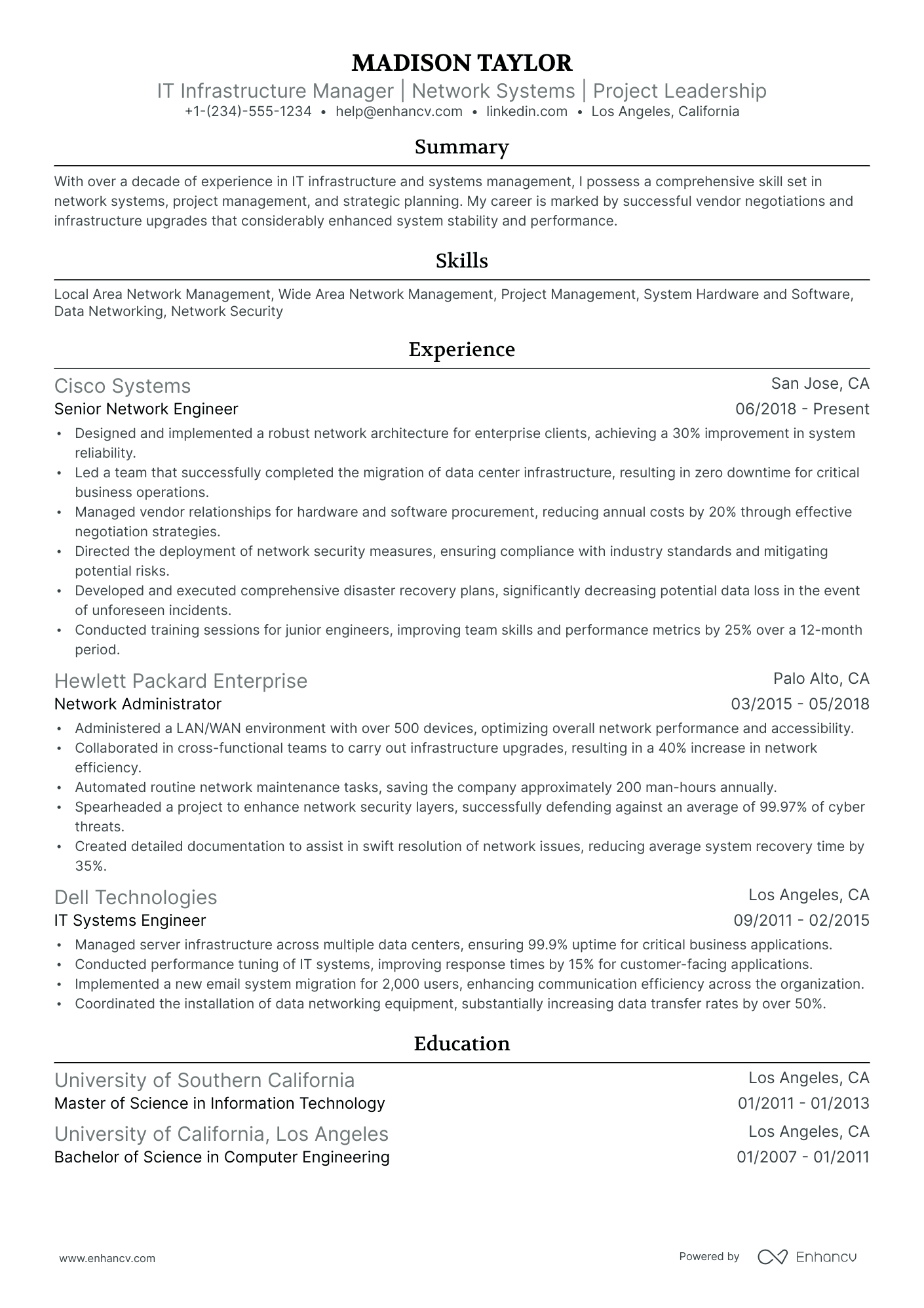
Recruiters evaluating IT infrastructure manager candidates prioritize evidence of hands-on infrastructure oversight, cross-functional team leadership, and measurable improvements to system reliability, uptime, and cost efficiency. Your resume format directly controls how quickly a hiring manager can trace your career progression through increasingly complex environments—and how clearly an applicant tracking system (ATS) can parse your qualifications.

I have significant experience in this role—which format should I use?
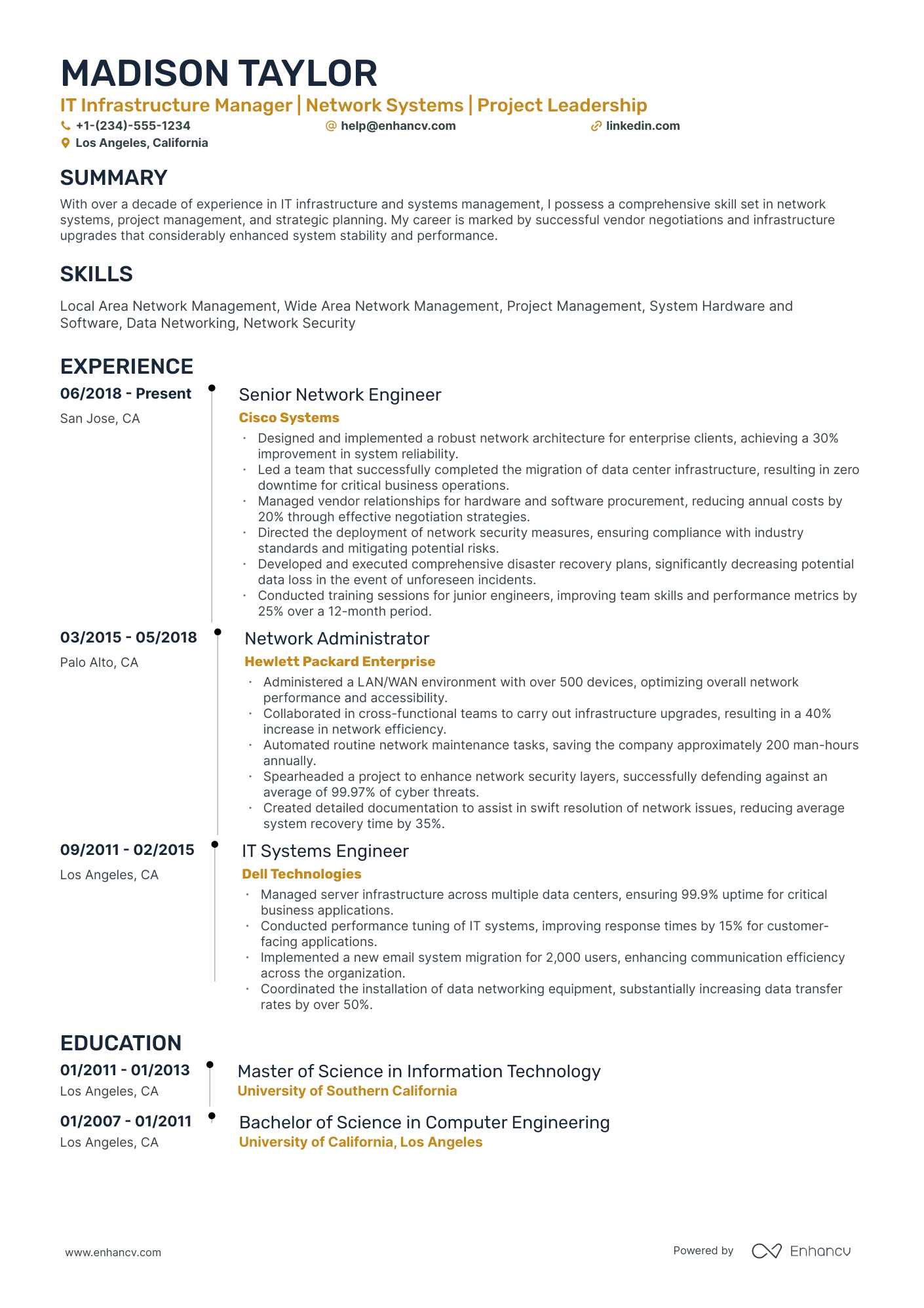
Use a reverse-chronological format—it's the strongest choice for experienced IT infrastructure managers because it immediately surfaces your leadership trajectory and expanding scope of accountability. Do:
- Lead each role entry with the scope of your responsibility: number of sites, team size, budget owned, and infrastructure scale (servers, endpoints, cloud environments).
- Highlight domain-specific expertise such as VMware, Azure/AWS, ITIL frameworks, disaster recovery planning, network architecture, and vendor management.
- Quantify business impact in every bullet—tie your actions to uptime improvements, cost reductions, incident response times, or successful migration outcomes.
I'm junior or switching into this role—what format works best?
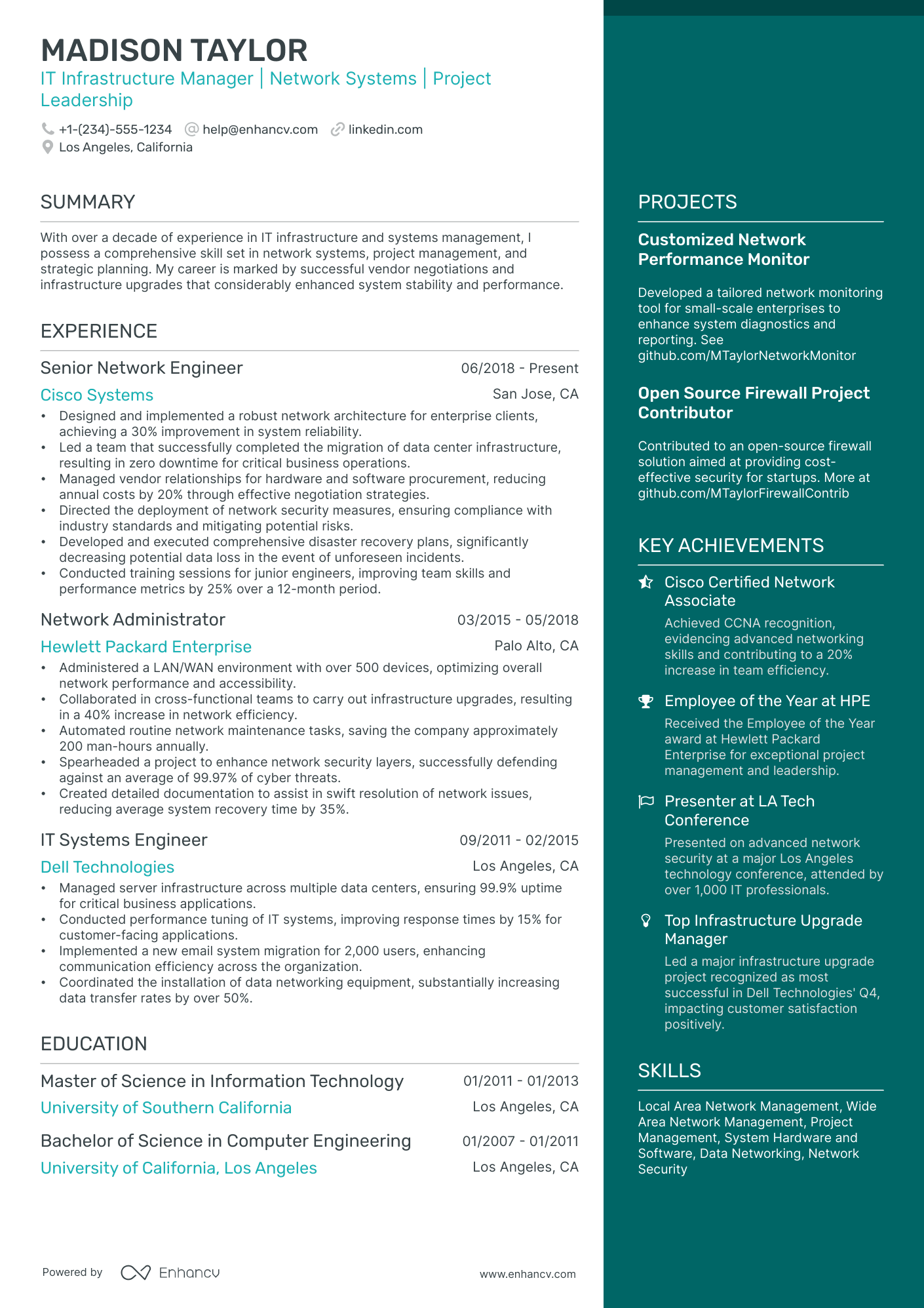
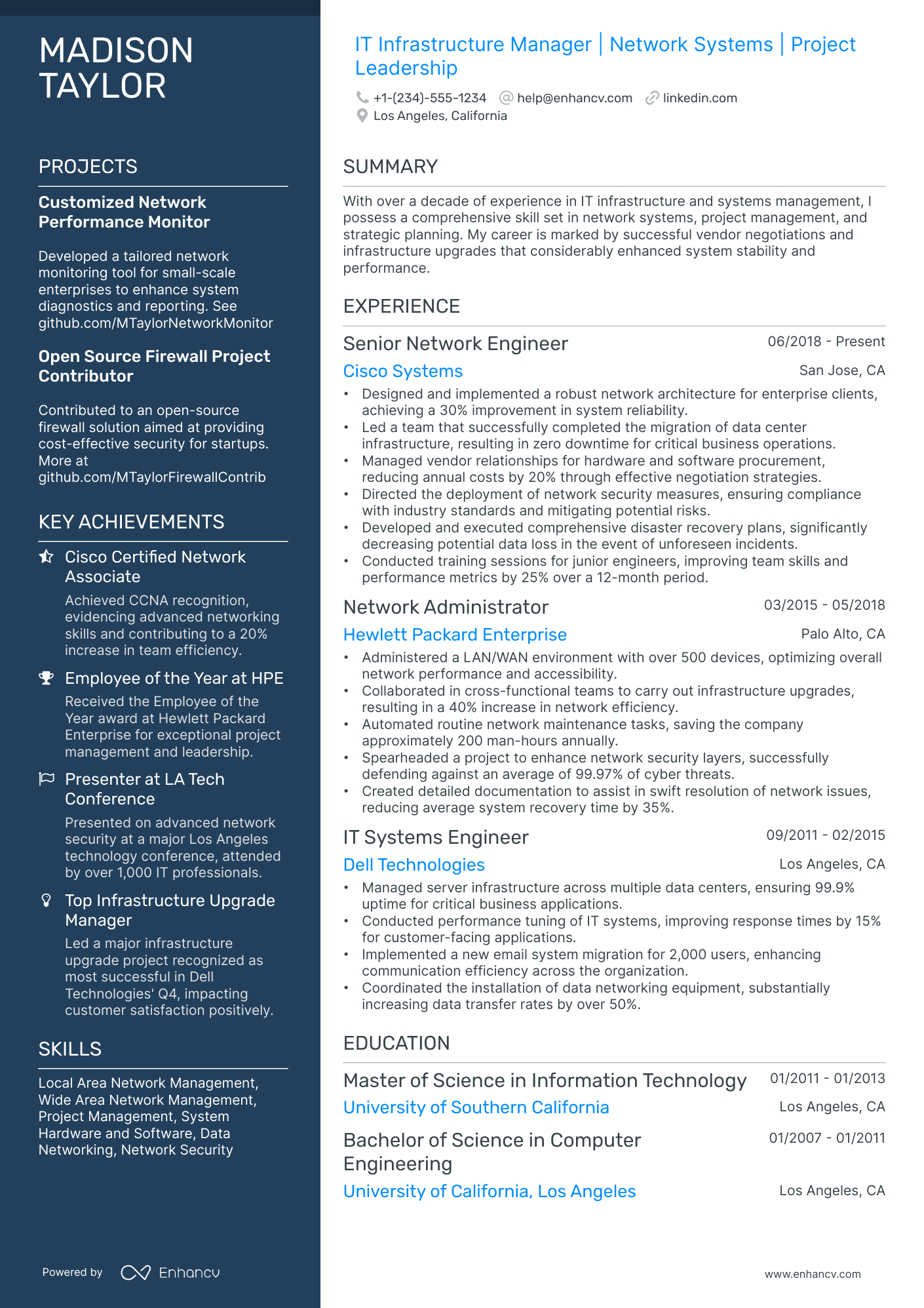
A hybrid format works best because it lets you lead with relevant infrastructure skills and certifications while still showing a clear, chronological work history. Do:
- Place a dedicated skills section near the top featuring tools and platforms critical to infrastructure management (Active Directory, Linux/Windows Server, CI/CD pipelines, monitoring tools like Nagios or Datadog).
- Include project-based entries—such as lab environments, infrastructure upgrades, or cross-departmental deployments—that demonstrate hands-on systems work even if your title didn't reflect it.
- Connect every skill or project to a concrete action and a measurable result so recruiters can assess your readiness for the role.
Why not use a functional resume?
A functional format strips away the timeline recruiters need to evaluate whether your infrastructure skills were applied in progressively responsible, real-world environments—making it harder to trust your readiness for an IT infrastructure manager role.
- A functional resume may be acceptable if you're transitioning from a related field (such as systems administration or network engineering), have a gap in employment, or lack direct infrastructure management titles—but only if every skill listed is tied to a specific project, deployment, or measurable outcome rather than presented as an unanchored keyword list.
Once you've established a clean, readable format, the next step is deciding which sections to include so each one serves a clear purpose on your resume.
What sections should go on a IT infrastructure manager resume
Recruiters expect to see clear evidence you've led reliable, secure, scalable infrastructure operations and delivered measurable improvements. Understanding what to put on a resume ensures every section earns its place.
Use this structure for maximum clarity:
- Header
- Summary
- Experience
- Skills
- Projects
- Education
- Certifications
- Optional sections: Awards, Open-source contributions, Leadership
Strong experience bullets should emphasize uptime and reliability gains, cost and performance outcomes, security and compliance results, and the scale of environments you owned.
Is your resume good enough?
Drop your resume here or choose a file. PDF & DOCX only. Max 2MB file size.
Once you’ve organized your resume with the right core sections, the next step is to write your IT infrastructure manager experience so each role clearly supports that structure.
How to write your IT infrastructure manager resume experience
Your work experience section should highlight infrastructure projects you've delivered, the platforms and tools you used to manage enterprise environments, and the measurable outcomes your work produced. Hiring managers prioritize demonstrated impact—uptime improvements, cost reductions, successful migrations—over descriptive task lists that merely catalog daily responsibilities.
Each entry should include:
- Job title
- Company and location (or remote)
- Dates of employment (month and year)
Three to five concise bullet points showing what you owned, how you executed, and what outcomes you delivered:
- Ownership scope: the infrastructure environments, network systems, data centers, cloud platforms, or technical teams you were directly accountable for as an IT infrastructure manager.
- Execution approach: the monitoring tools, automation frameworks, virtualization technologies, ITIL processes, or disaster recovery methods you used to architect solutions and drive operational decisions.
- Value improved: changes to system uptime, network performance, deployment efficiency, security posture, or infrastructure reliability that resulted from your work.
- Collaboration context: how you partnered with application development teams, security operations, vendors, executive leadership, or end users to align infrastructure capabilities with broader organizational needs.
- Impact delivered: outcomes expressed through service-level improvements, capacity gains, infrastructure cost optimization, or reduced incident resolution times rather than routine administrative activity.
Experience bullet formula
A IT infrastructure manager experience example
✅ Right example - modern, quantified, specific.
IT Infrastructure Manager
NorthBridge Health Systems | Austin, TX
2021–Present
Multi-site healthcare provider supporting five thousand employees across twelve clinics with strict uptime and compliance requirements.
- Led a data center consolidation and VMware vSphere refresh, reducing infrastructure run costs by 18% and improving average provisioning time from five days to six hours.
- Implemented Microsoft Azure landing zone with Terraform, Azure Policy, and Microsoft Entra ID, cutting audit findings by 35% and standardizing deployments across four environments.
- Modernized monitoring and incident response using Datadog, PagerDuty, and ITIL change controls, improving service availability from 99.6% to 99.95% and reducing mean time to resolution by 28%.
- Partnered with security, application engineering, and compliance to roll out Zero Trust network segmentation with Palo Alto firewalls and Zscaler, reducing high-severity vulnerabilities by 42% and eliminating lateral movement paths in quarterly tests.
- Directed a Windows Server and Linux patch automation program using Microsoft Endpoint Configuration Manager and Ansible, increasing patch compliance to 97% within fourteen days and reducing unplanned maintenance windows by 30%.
Now that you've seen how a strong experience section comes together, let's look at how to adjust yours to match a specific job posting.
How to tailor your IT infrastructure manager resume experience
Recruiters evaluate your resume through both applicant tracking systems and manual review, so alignment with the job posting is critical. Tailoring your resume to the job description ensures the most relevant qualifications stand out immediately.
Ways to tailor your IT infrastructure manager experience:
- Mirror the exact network platforms and cloud environments listed in the posting.
- Match infrastructure monitoring tools and ITSM solutions the employer specifies.
- Reflect the same ITIL or COBIT terminology used in the job description.
- Quantify uptime and disaster recovery outcomes using metrics the role prioritizes.
- Highlight compliance frameworks like SOC 2 or ISO 27001 when referenced.
- Emphasize experience managing hybrid or multi-cloud architectures if mentioned.
- Include vendor management or procurement responsibilities the posting calls for.
- Reference cross-functional collaboration models such as DevOps or agile operations.
Tailoring means aligning your real accomplishments with what the employer needs—not forcing keywords where they don't belong.
Resume tailoring examples for IT infrastructure manager
| Job description excerpt | Untailored | Tailored |
|---|---|---|
| Lead the design and migration of on-premises data centers to hybrid cloud environments using Azure and AWS, ensuring 99.99% uptime across all critical systems. | Managed IT infrastructure and helped with cloud projects. | Led hybrid cloud migration of three on-premises data centers to Azure and AWS, architecting redundant failover systems that maintained 99.99% uptime for 200+ production workloads. |
| Oversee network architecture, including MPLS, SD-WAN, and firewall management (Palo Alto, Fortinet), supporting 50+ office locations across North America. | Responsible for networking and security across company offices. | Managed SD-WAN rollout and MPLS optimization across 54 North American office locations, configuring Palo Alto and Fortinet firewalls to reduce security incidents by 37% year over year. |
| Manage a $4M annual infrastructure budget while directing a team of 12 systems engineers and network administrators through ITIL-aligned service delivery processes. | Supervised IT staff and handled department budgeting. | Directed a team of 12 systems engineers and network administrators, managing a $4M annual infrastructure budget while implementing ITIL-aligned service delivery processes that improved incident resolution time by 28%. |
Once your experience aligns with the role’s priorities, quantify your IT infrastructure manager achievements to show the measurable impact of that work.
How to quantify your IT infrastructure manager achievements
Quantifying achievements shows how your infrastructure decisions improved uptime, speed, security, and cost. Use metrics tied to service reliability, incident reduction, delivery speed, capacity, and budget impact, backed by monitoring, ticketing, and cloud billing data.
Quantifying examples for IT infrastructure manager
| Metric | Example |
|---|---|
| Uptime | "Improved core services uptime from 99.85% to 99.98% by redesigning HA clusters in VMware vSphere and standardizing failover runbooks." |
| Incident reduction | "Cut Sev 1 and Sev 2 incidents by 37% in six months by tuning Prometheus alerts, reducing noise, and enforcing post-incident action items in Jira." |
| Cost efficiency | "Reduced monthly cloud spend by $42,000 by right-sizing EC2, implementing S3 lifecycle policies, and negotiating reserved instances with finance." |
| Delivery speed | "Decreased server provisioning time from five days to forty-five minutes using Terraform, Ansible, and a golden-image pipeline in Packer." |
| Security risk | "Lowered critical vulnerability exposure window from twenty-one days to six days by automating patch compliance reporting in Microsoft Endpoint Configuration Manager." |
Turn vague job duties into measurable, recruiter-ready resume bullets in seconds with Enhancv's Bullet Point Generator.
With strong bullet points in place, the next step is ensuring your skills section presents the right mix of hard and soft skills that hiring managers expect from an IT infrastructure manager.
How to list your hard and soft skills on a IT infrastructure manager resume
Your skills section shows you can run reliable, secure infrastructure—recruiters scan them to confirm fit, and an ATS (applicant tracking system) matches them to the job post—so aim for a balanced mix of hard skills and role-specific soft skills. IT infrastructure manager roles require a blend of:
- Product strategy and discovery skills.
- Data, analytics, and experimentation skills.
- Delivery, execution, and go-to-market discipline.
- Soft skills.
Your skills section should be:
- Scannable (bullet-style grouping).
- Relevant to the job post.
- Backed by proof in experience bullets.
- Updated with current tools.
Place your skills section:
- Above experience if you're junior or switching careers.
- Below experience if you're mid/senior with strong achievements.

Hard skills
- Windows Server, Active Directory
- Linux administration
- VMware vSphere, Hyper-V
- Azure, AWS
- Cisco routing and switching
- Palo Alto, Fortinet firewalls
- Microsoft 365, Exchange Online
- Storage: SAN, NAS
- Backup and disaster recovery
- Monitoring: Splunk, Datadog
- Infrastructure as code: Terraform, Ansible
- ITIL incident and change management
Soft skills
- Prioritize uptime and risk tradeoffs
- Lead incident response and postmortems
- Communicate outages and timelines
- Align stakeholders on service levels
- Translate business needs into requirements
- Drive change control discipline
- Delegate and coach engineers
- Negotiate vendors and contracts
- Escalate issues with clear options
- Manage cross-team dependencies
- Run capacity and lifecycle planning
- Document decisions and runbooks
How to show your IT infrastructure manager skills in context
Skills shouldn't live only in a dedicated skills list. Explore resume skills examples to see how top candidates weave technical abilities into every section.
They should be demonstrated in:
- Your summary (high-level professional identity)
- Your experience (proof through outcomes)
Here's what strong, skill-rich entries look like in practice.
Summary example
IT infrastructure manager with 12 years of experience designing resilient enterprise environments across healthcare systems. Skilled in VMware, Azure, and ITIL-driven operations. Led a datacenter consolidation that cut hosting costs by 34% while improving uptime to 99.99%.
- Reflects senior-level experience clearly
- Names specific platforms and frameworks
- Quantifies cost and uptime impact
- Signals leadership as a soft skill
Experience example
IT Infrastructure Manager
Brevell Health Systems | Richmond, VA
March 2019–Present
- Migrated 140 on-premises servers to Azure hybrid cloud using Terraform, reducing provisioning time by 60% and saving $280K annually.
- Partnered with the cybersecurity team to implement zero-trust network segmentation, cutting incident response time by 45% across three hospital campuses.
- Led a cross-functional team of 11 engineers through a full ITIL service management overhaul, improving SLA compliance from 87% to 98%.
- Every bullet includes measurable proof
- Skills surface naturally through real outcomes
Once you’ve tied your technical and leadership strengths to measurable outcomes and real scenarios, the next step is to apply that same approach to structuring an IT infrastructure manager resume when you don’t have direct experience.
How do I write a IT infrastructure manager resume with no experience
Even without full-time experience, you can demonstrate readiness through:
- Homelab network and server builds
- Internship supporting enterprise infrastructure
- Campus data center student role
- Volunteer nonprofit network administration
- Cloud certification labs and projects
- Incident response simulations and writeups
- Infrastructure automation scripts in GitHub
- Capstone designing resilient infrastructure
If you're building a resume without work experience, focus on:
- Clear scope and environment size
- Uptime, latency, and recovery metrics
- Security controls and access management
- Standard tools and documentation
Resume format tip for entry-level IT infrastructure manager
Use a hybrid resume format because it highlights technical projects and certifications while still showing transferable experience and impact. Do:
- Put a project section above work history.
- List tools per project: Windows Server, Linux, Azure, VMware, Terraform, Ansible.
- Quantify outcomes: uptime, tickets closed, deployment time, cost reduction.
- Add a small environment summary: users, sites, servers, cloud services.
- Include links to GitHub and diagrams.
- Built a homelab with VMware, Windows Server, and Azure AD; automated backups and patching with Ansible, cutting recovery time from sixty minutes to fifteen.
Once you've structured your resume around transferable skills and relevant projects, presenting your education effectively becomes the next step in reinforcing your qualifications.
How to list your education on a IT infrastructure manager resume
Your education section helps hiring teams confirm you have the foundational technical and management knowledge needed for an IT infrastructure manager role.
Include:
- Degree name
- Institution
- Location
- Graduation year
- Relevant coursework (for juniors or entry-level candidates)
- Honors & GPA (if 3.5 or higher)
Skip month and day details—list the graduation year only.
Here's a strong education entry tailored to the IT infrastructure manager role.
Example education entry
Bachelor of Science in Information Technology
George Mason University, Fairfax, VA
Graduated 2018
GPA: 3.7/4.0
- Relevant Coursework: Network Architecture, Systems Administration, Cloud Computing, IT Project Management, Cybersecurity Fundamentals
- Honors: Magna Cum Laude, Dean's List (six semesters)
How to list your certifications on a IT infrastructure manager resume
Certifications on your resume show your commitment to learning, prove tool proficiency, and confirm industry relevance for an IT infrastructure manager across networks, cloud, security, and operations.
Include:
- Certificate name
- Issuing organization
- Year
- Optional: credential ID or URL
- Place certifications below education when your degree is recent and your certifications add supporting credibility.
- Place certifications above education when they are recent, highly relevant, or required for the IT infrastructure manager role.
Best certifications for your IT infrastructure manager resume
- ITIL 4 Foundation
- Cisco Certified Network Professional (CCNP) Enterprise
- Microsoft Certified: Azure Administrator Associate
- AWS Certified Solutions Architect—Associate
- VMware Certified Professional—Data Center Virtualization (VCP-DCV)
- Certified Information Systems Security Professional (CISSP)
- CompTIA Security+
Once you’ve positioned your certifications to validate your infrastructure expertise, shift to your IT infrastructure manager resume summary to quickly connect those credentials to your overall impact.
How to write your IT infrastructure manager resume summary
Your resume summary is the first thing a recruiter reads, so it needs to earn attention fast. A strong opening frames you as a capable IT infrastructure manager before the rest of your resume does the heavy lifting.
Keep it to three to four lines, with:
- Your title and total years of infrastructure management experience.
- The domains you've worked in, such as enterprise networking, cloud migration, or data center operations.
- Core tools and platforms like AWS, VMware, Cisco, or Active Directory.
- One or two measurable wins, such as uptime improvements or cost reductions.
- Soft skills tied to real outcomes, like cross-functional collaboration that accelerated project delivery.

PRO TIP
At the mid-level manager stage, emphasize hands-on technical leadership and operational results. Show you can manage teams, budgets, and vendor relationships while keeping systems reliable. Avoid vague phrases like "passionate IT professional" or "results-driven leader." Replace them with specifics—actual metrics, team sizes, and project scope.
Example summary for a IT infrastructure manager
IT infrastructure manager with seven years of experience overseeing enterprise networks and cloud environments. Led a 12-person team through an AWS migration, cutting hosting costs by 34% while maintaining 99.97% uptime.
Optimize your resume summary and objective for ATS
Drop your resume here or choose a file.
PDF & DOCX only. Max 2MB file size.
Now that your summary is ready to showcase your qualifications at a glance, it's time to ensure your header presents the essential contact and identification details recruiters need to reach you.
What to include in a IT infrastructure manager resume header
A resume header is the contact and identity block at the top of your resume, and it boosts visibility, credibility, and recruiter screening for a IT infrastructure manager.
Essential resume header elements
- Full name
- Tailored job title and headline
- Location
- Phone number
- Professional email
- GitHub link
- Portfolio link
A LinkedIn link helps recruiters verify experience quickly and supports screening.
Do not include photos on a IT infrastructure manager resume unless the role is explicitly front-facing or appearance-dependent.
Keep the header to two lines, match your job title to the posting, and use links that open to complete, updated profiles.
Example
IT infrastructure manager resume header
Jordan Lee
IT infrastructure manager | Network, Cloud, and Security Operations
Austin, TX | (512) 555-01XX | your.name@enhancv.com
github.com/yourname yourwebsite.com linkedin.com/in/yourname
Once your contact details and role-specific identifiers are set at the top, add additional sections to reinforce your qualifications and provide relevant context.
Additional sections for IT infrastructure manager resumes
When your core sections don't fully capture your qualifications, additional sections help you stand out and reinforce your credibility as an IT infrastructure manager.
- Languages
- Industry certifications and continuing education
- Technical publications or conference presentations
- Professional associations and memberships
- Volunteer IT projects or pro bono consulting
- Awards and recognitions in infrastructure or operations
Once you've strengthened your resume with relevant additional sections, pairing it with a well-crafted cover letter can further set your application apart.
Do IT infrastructure manager resumes need a cover letter
A cover letter isn't required for an IT infrastructure manager, but it often helps in competitive searches or organizations that expect one. If you're unsure what a cover letter is or when to use one, it can make a difference when the role needs tight stakeholder alignment, regulated operations, or a specific environment.
Use a cover letter to add context your resume can't:
- Explain role and team fit by mapping your experience to their stack, operating model, and reliability priorities.
- Highlight one or two relevant projects with outcomes, like uptime gains, cost reductions, faster recovery times, or smoother migrations.
- Show you understand the product, users, and business context, including service level expectations, risk tolerance, and compliance needs.
- Address career transitions or non-obvious experience by connecting your background to infrastructure leadership and day-to-day operational demands.
Drop your resume here or choose a file.
PDF & DOCX only. Max 2MB file size.
Even if you decide a cover letter won’t add value for this role, you can strengthen your IT infrastructure manager resume faster and more consistently by using AI to improve it.
Using AI to improve your IT infrastructure manager resume
AI can sharpen your resume's clarity, structure, and impact. It helps refine language and highlight measurable results. But overuse dulls authenticity. Once your content feels clear and role-aligned, step away from AI entirely. If you're wondering which AI is best for writing resumes, focus on tools that enhance specificity without fabricating experience.
Here are 10 practical prompts to strengthen specific sections of your IT infrastructure manager resume:
Strengthen your summary
Quantify experience bullets
Align skills to job posts
Clarify project impact
Tighten certification relevance
Remove vague language
Improve action verbs
Refine education details
Target industry keywords
Eliminate redundant content
Conclusion
A strong IT infrastructure manager resume proves impact with numbers, shows role-specific skills, and stays easy to scan. Highlight measurable outcomes like uptime gains, cost reductions, faster incident resolution, and safer change delivery.
Keep a clear structure that matches how hiring teams review candidates today and in the near future. Lead with key achievements, support them with relevant skills, and tie everything to stable, secure, scalable infrastructure.