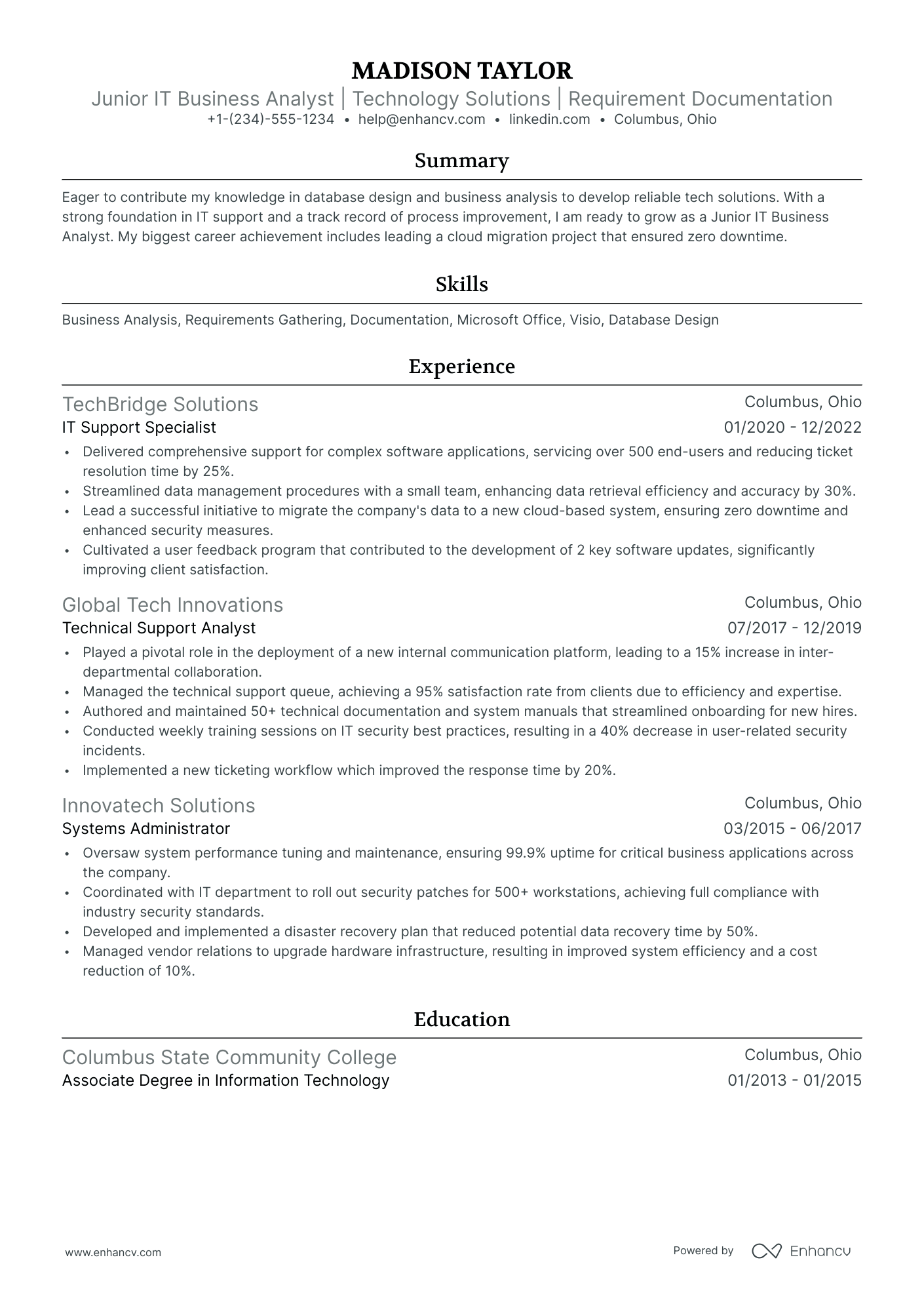
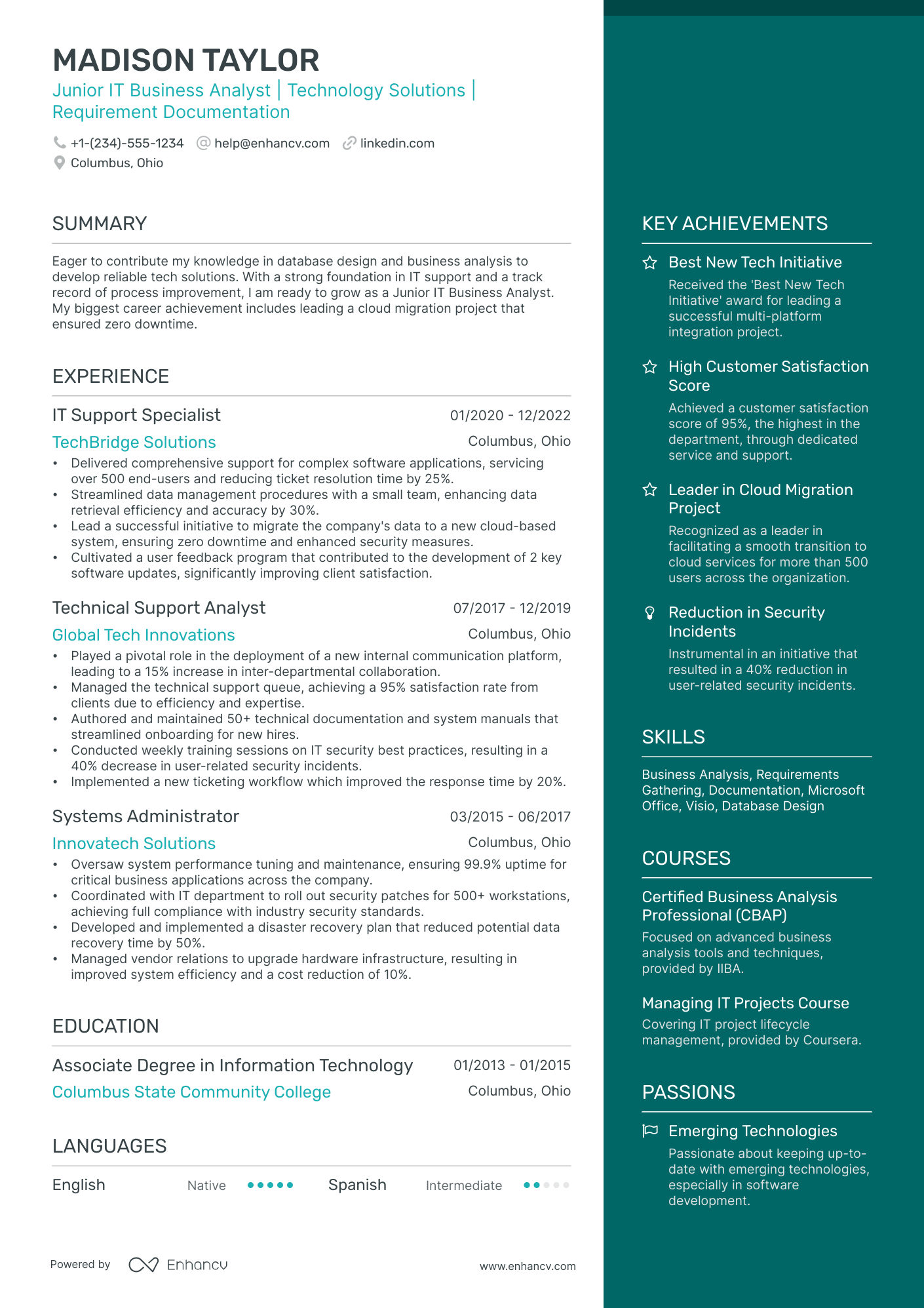
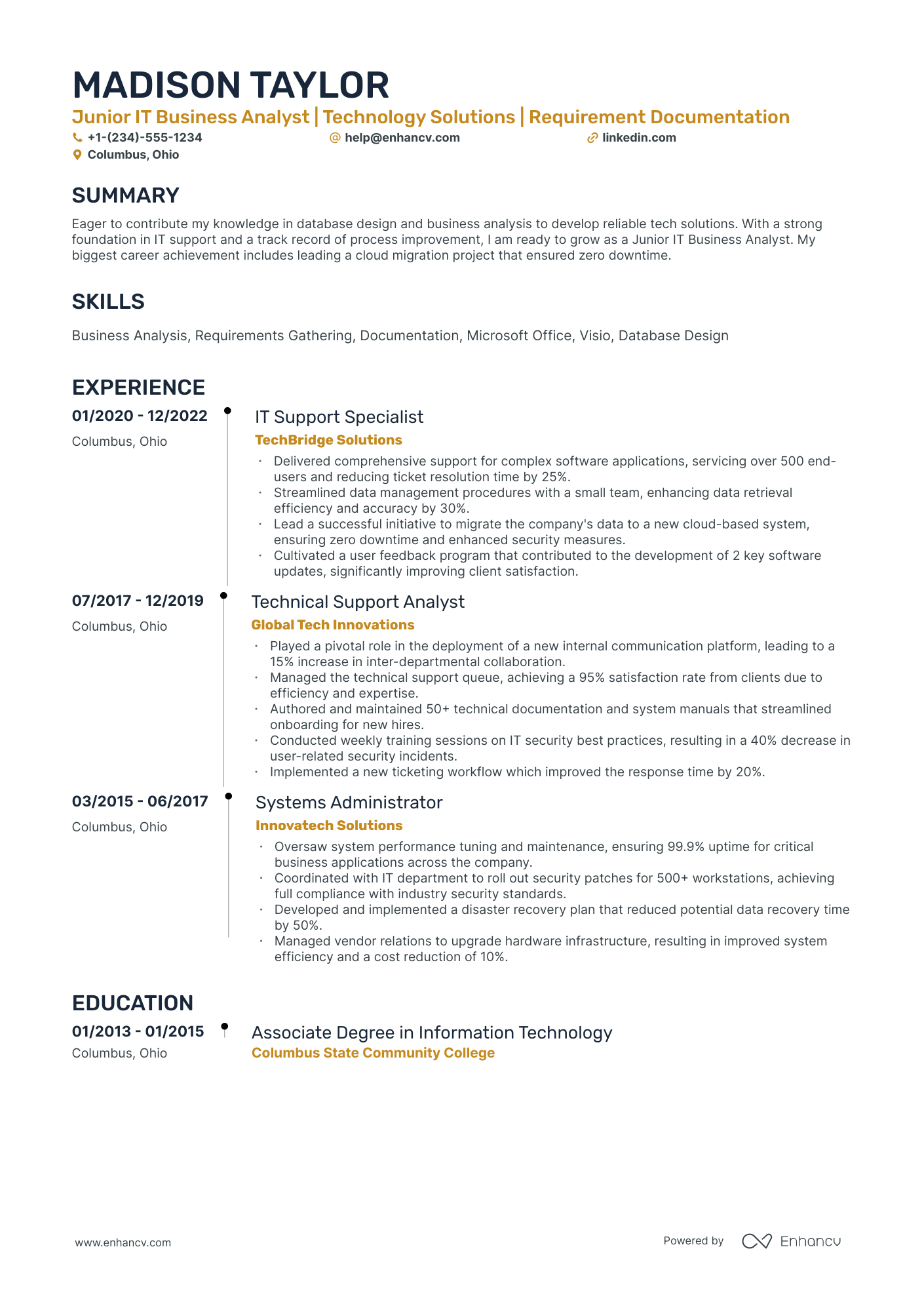
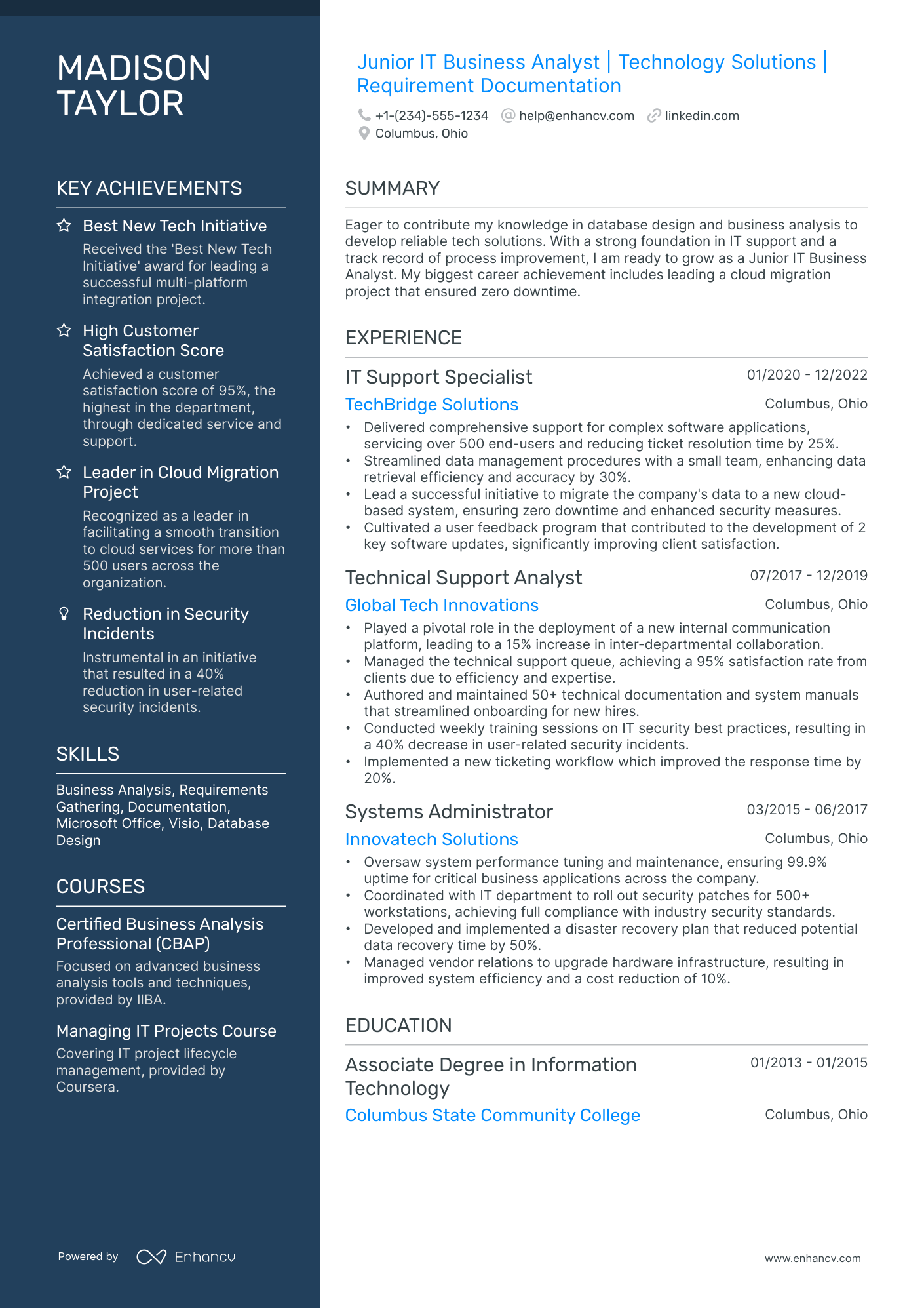
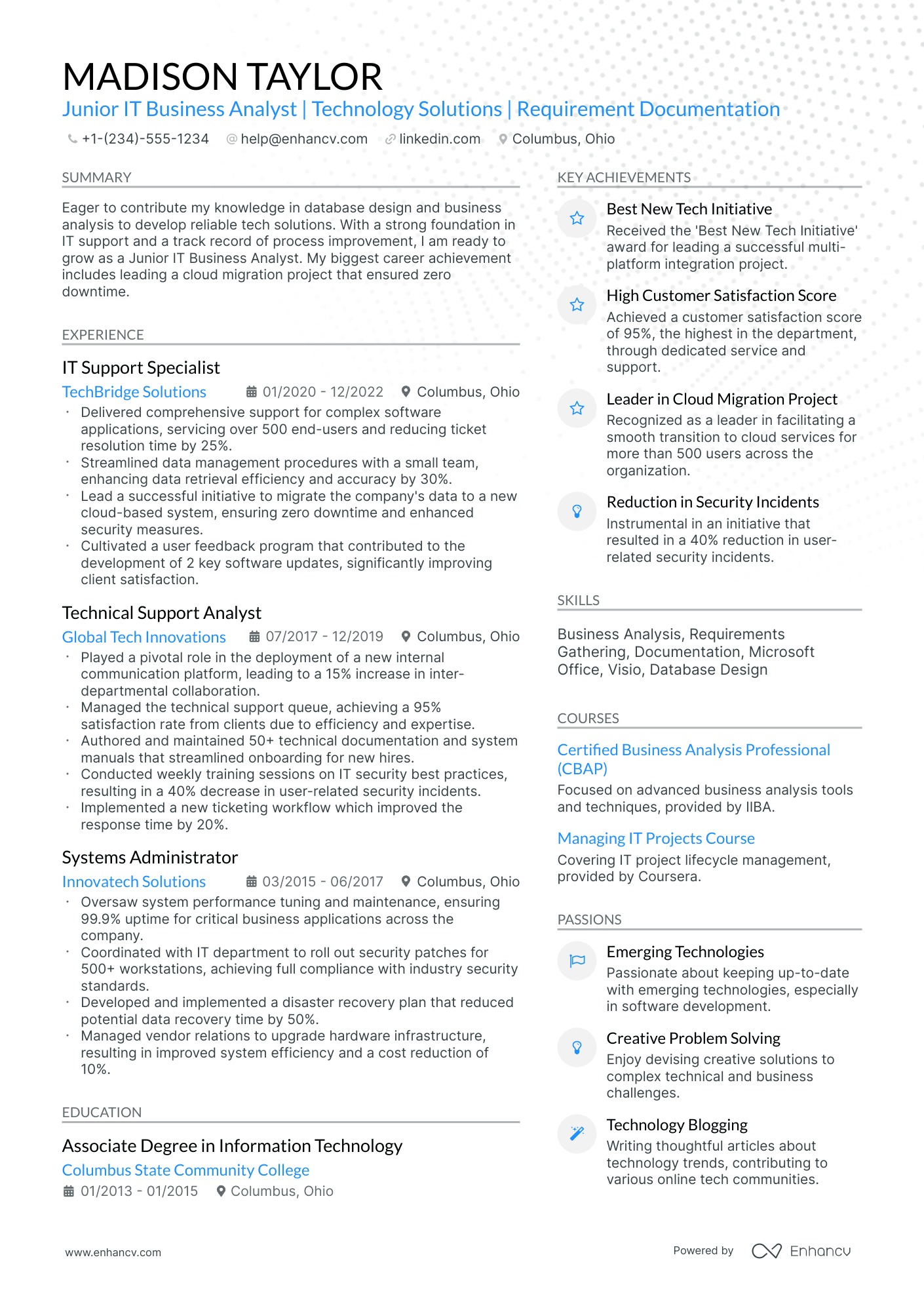
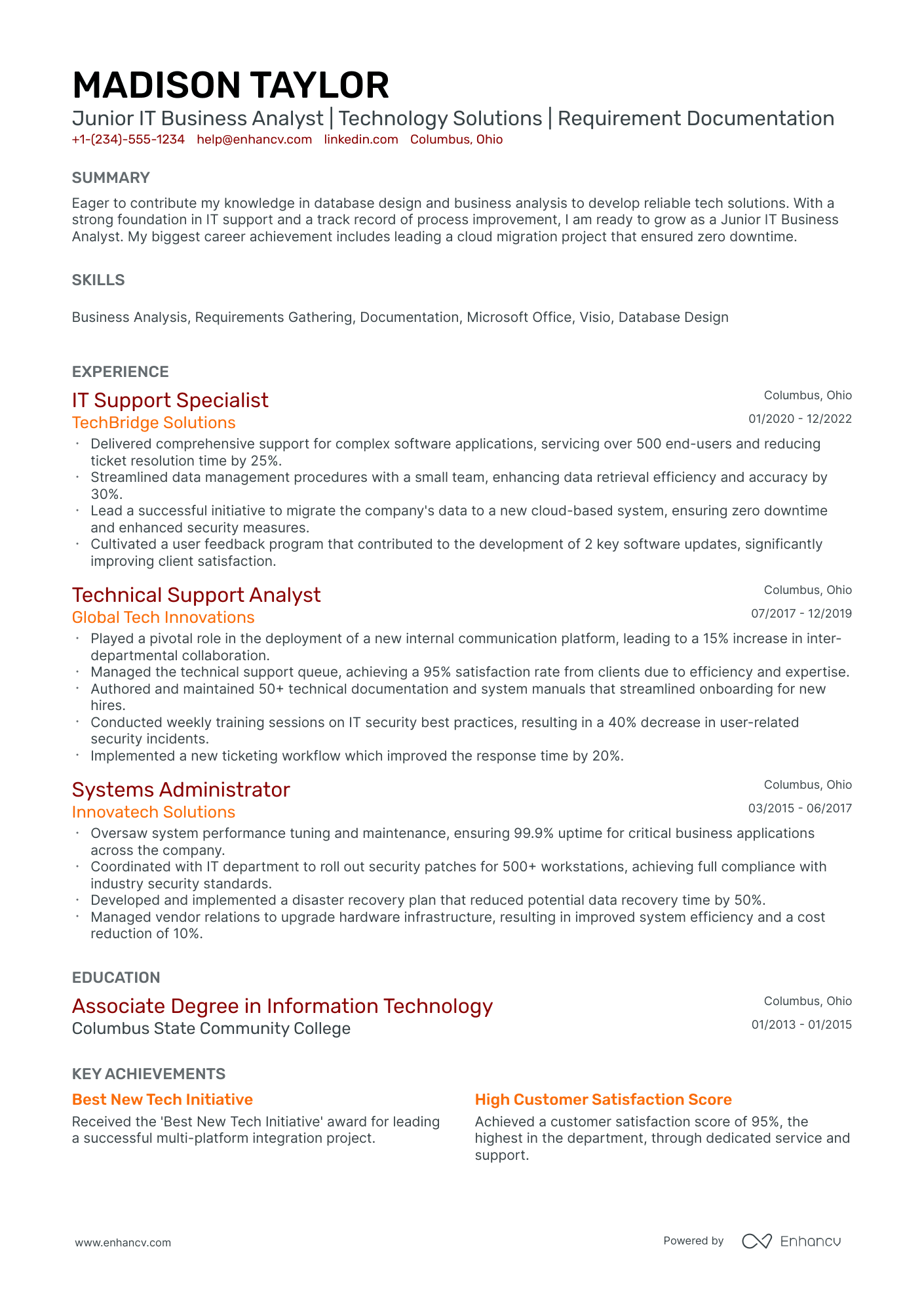
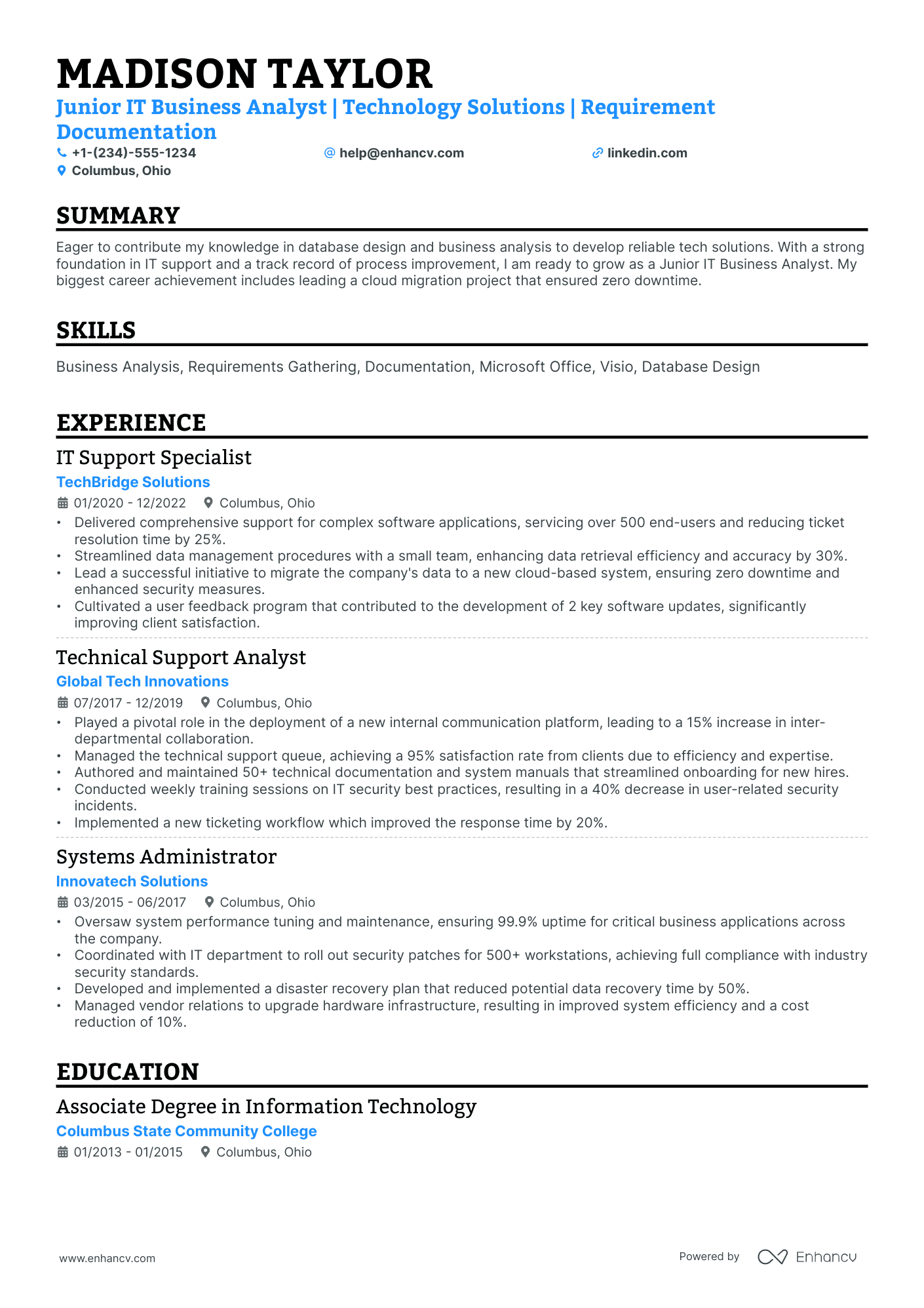
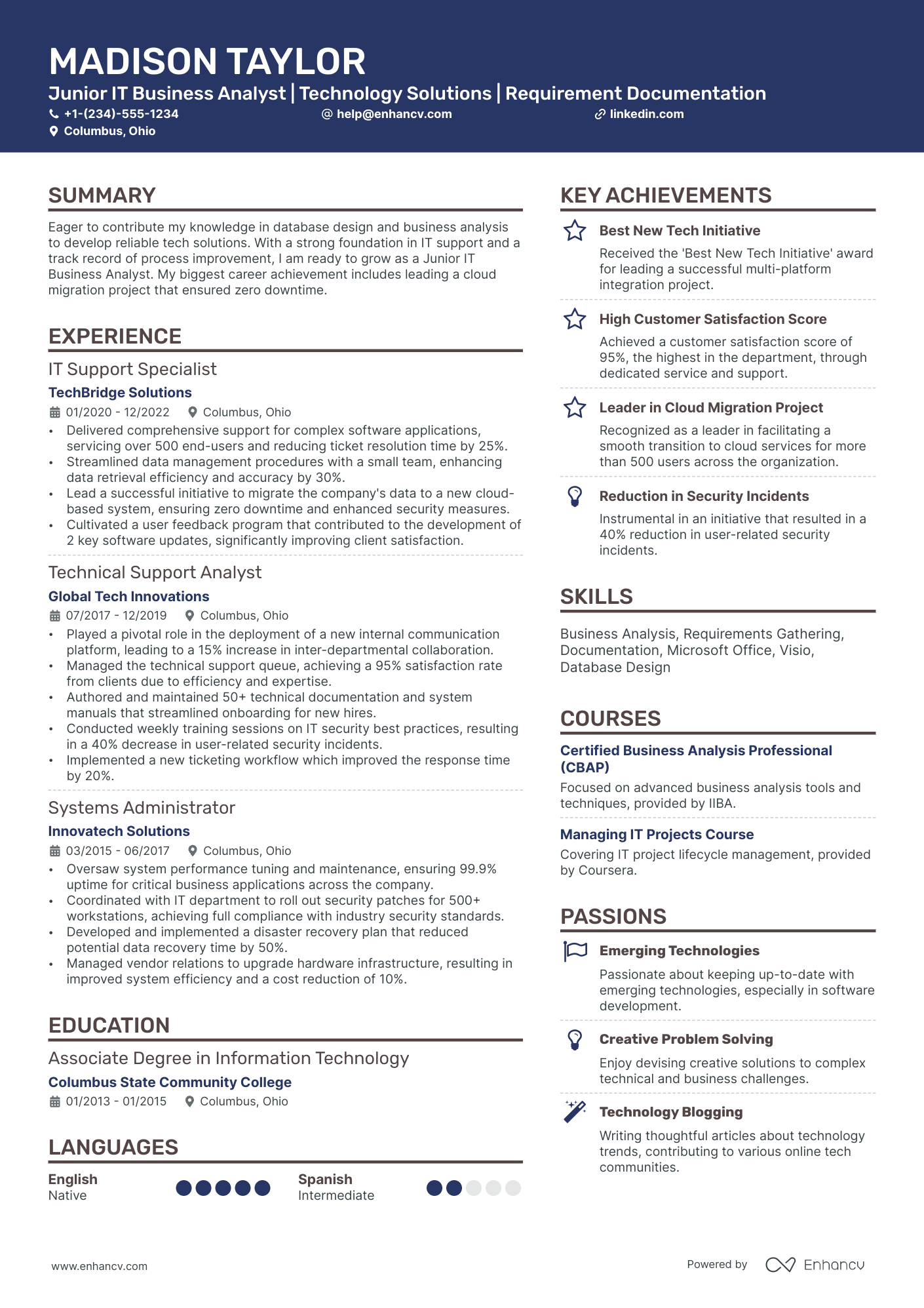
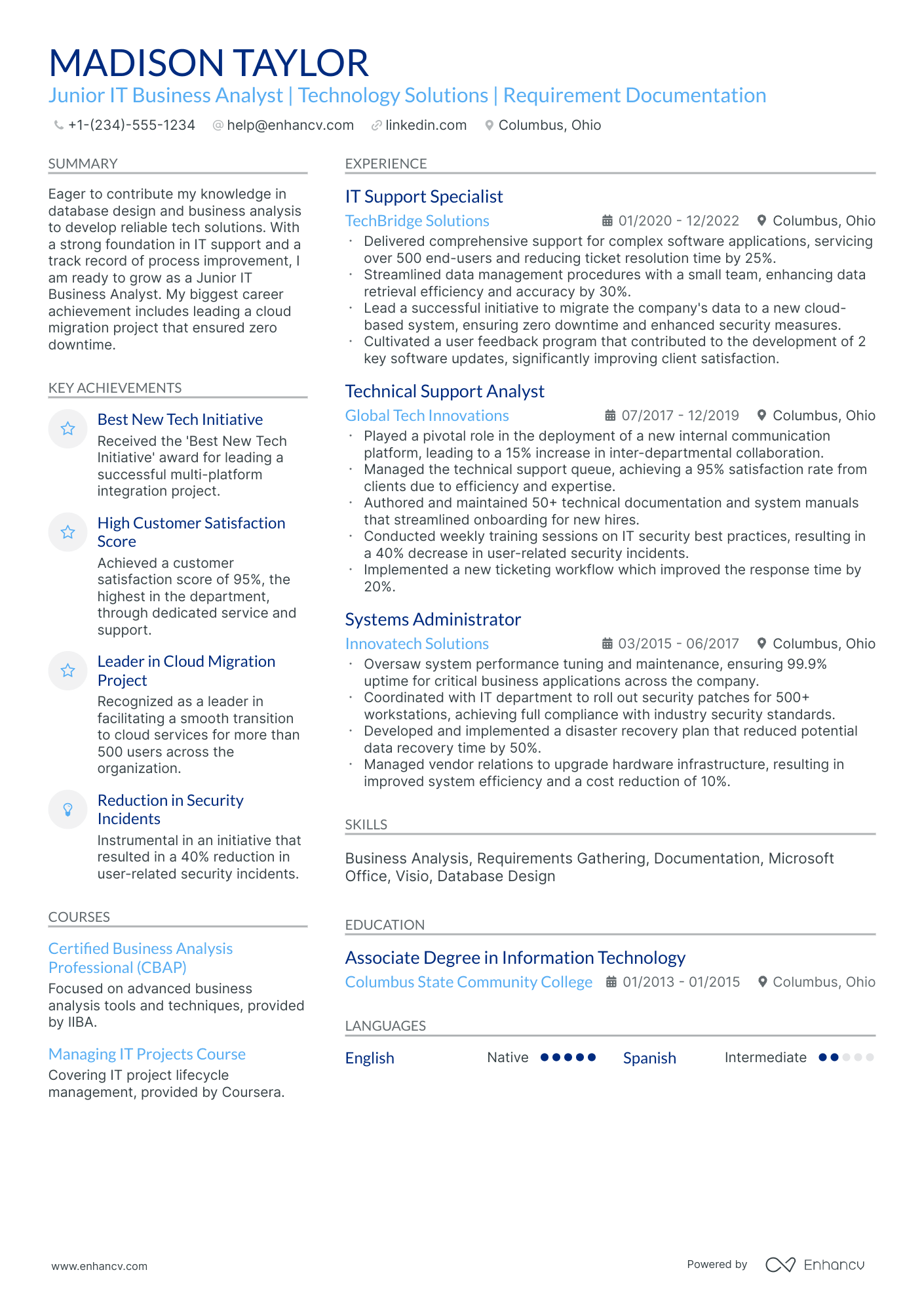
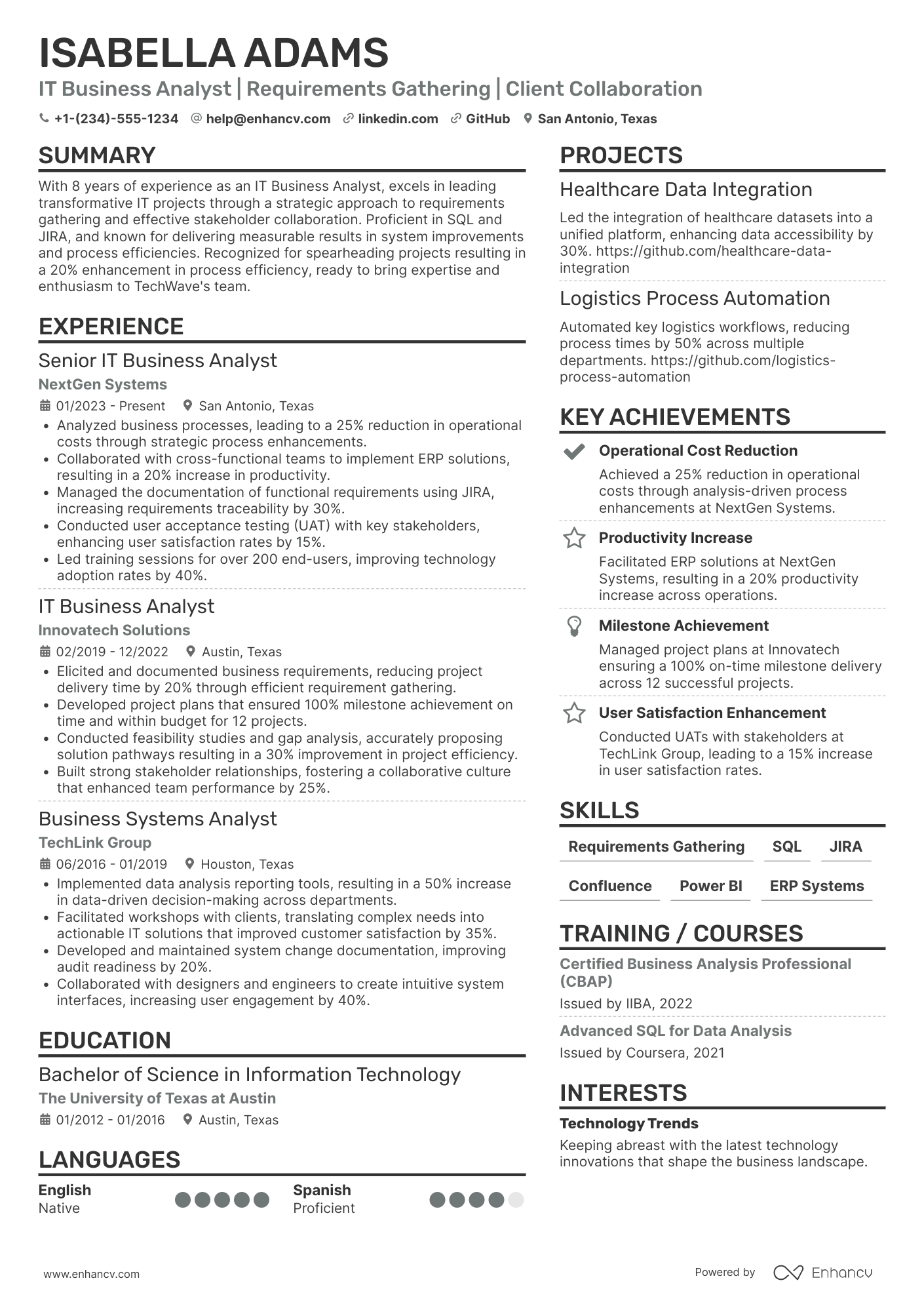
Most IT business analyst resume submissions fail because they read like tool inventories and meeting logs, not decision-ready evidence. That gets filtered by ATS screening and overlooked in fast recruiter scans, especially when competition is high.
A strong resume shows how you improved outcomes, not just what you touched. Knowing how to make your resume stand out means highlighting measurable impact: cycle time reduced, defects prevented, dollars saved, adoption increased, scope delivered, stakeholders aligned, and compliance risks lowered.

Key takeaways
- Quantify outcomes like cycle time, cost savings, and defect reduction in every experience bullet.
- Tailor your resume's language and keywords to match each specific job posting.
- Use reverse-chronological format with experience; use hybrid format without it.
- Anchor every listed skill to a concrete project, deliverable, or measurable result.
- Place certifications like CBAP or PMI-PBA near education to reinforce credibility fast.
- Enhancv's Bullet Point Generator helps turn vague duties into measurable, recruiter-ready bullets.
- Stop using AI once your resume accurately reflects real experience—never inflate claims.
Job market snapshot for IT business analysts
We analyzed 2,687 recent IT business analyst job ads across major US job boards. These numbers help you understand skills in demand, experience requirements, employment type trends at a glance.
What level of experience employers are looking for IT business analysts
| Years of Experience | Percentage found in job ads |
|---|---|
| 1–2 years | 14.9% (400) |
| 3–4 years | 17.4% (467) |
| 5–6 years | 15.0% (402) |
| 7–8 years | 5.0% (134) |
| 9–10 years | 3.1% (82) |
| 10+ years | 4.1% (111) |
| Not specified | 42.8% (1151) |
IT business analyst ads by area of specialization (industry)
| Industry (Area) | Percentage found in job ads |
|---|---|
| Finance & Banking | 62.1% (1668) |
| Healthcare | 19.3% (518) |
| Education | 6.9% (186) |
| Government | 3.4% (91) |
| Professional Services | 2.2% (58) |
| Retail & E-commerce | 1.9% (50) |
| Manufacturing | 1.6% (43) |
| Energy | 1.2% (31) |
| Real Estate & Construction | 0.4% (11) |
| Media & Entertainment | 0.4% (10) |
Top companies hiring IT business analysts
| Company | Percentage found in job ads |
|---|---|
| Molina Healthcare Inc. | 6.7% (179) |
| Schneider Electric | 2.9% (77) |
| Cisco Systems, Inc. | 2.2% (58) |
| Sentara Healthcare | 2.0% (54) |
| Corebridge Financial Inc. | 1.9% (52) |
| TATA Consulting Services | 1.7% (47) |
| Kforce | 1.5% (41) |
| Capital One | 1.3% (36) |
| Stratacuity | 1.3% (35) |
| Infosys LTD | 1.0% (28) |
Role overview stats
These tables show the most common responsibilities and employment types for IT business analyst roles. Use them to align your resume with what employers expect and to understand how the role is structured across the market.
Day-to-day activities and top responsibilities for a IT business analyst
| Responsibility | Percentage found in job ads |
|---|---|
| Agile | 26.8% (719) |
| Excel | 25.8% (692) |
| Sql | 25.0% (673) |
| Business analysis | 19.6% (527) |
| Project management | 13.3% (358) |
| Jira | 13.2% (354) |
| Word | 13.0% (350) |
| Data analysis | 12.7% (340) |
| Power bi | 10.4% (280) |
| Powerpoint | 9.7% (260) |
| Scrum | 9.4% (252) |
| Tableau | 8.9% (238) |
Type of employment (remote vs on-site vs hybrid)
| Employment type | Percentage found in job ads |
|---|---|
| On-site | 54.1% (1453) |
| Hybrid | 26.5% (712) |
| Remote | 19.4% (522) |
How to format a IT business analyst resume
Recruiters hiring IT business analysts prioritize evidence of requirements gathering expertise, stakeholder management, and the ability to translate business needs into technical solutions. Choosing the right resume format ensures these signals surface quickly during both automated screening and the initial human review. A clean, well-structured layout helps both ATS software and recruiters find key qualifications fast.

I have significant experience in this role—which format should I use?
Use a reverse-chronological format to present your IT business analyst experience in a clear, progression-driven timeline. Do:
- Lead each role entry with your scope of ownership—number of stakeholders managed, project budgets, or business units supported.
- Highlight domain-specific tools and methodologies such as SQL, JIRA, Visio, Agile/Scrum, and business process modeling notation (BPMN).
- Quantify outcomes tied to efficiency gains, cost savings, or successful system implementations.
I'm junior or switching into this role—what format works best?
A hybrid format works best, allowing you to feature transferable analytical and technical skills prominently while still showing a concise work history. Do:
- Place a dedicated skills section near the top of the page, covering tools like SQL, Excel, JIRA, and techniques like process mapping and data analysis.
- Include academic projects, internships, or cross-functional assignments where you gathered requirements, documented workflows, or supported system implementations.
- Connect every listed skill or project to a concrete action and a measurable or observable result.
Why not use a functional resume?
A functional format strips away the timeline and context recruiters need to evaluate how you applied analytical and technical skills in real business environments, making it harder to verify your depth of experience. A functional resume may be acceptable if you're pivoting into IT business analysis from a related field like QA, project coordination, or data analysis and lack direct BA job titles—but only if every skill listed is anchored to a specific project, deliverable, or measurable outcome rather than presented as a standalone claim.
Once you've established a clean, scannable layout, the next step is deciding which sections to include and how to organize them for maximum impact.
What sections should go on a IT business analyst resume
Recruiters expect a clean, business-focused resume that shows how you translate requirements into delivered solutions and measurable results. Understanding what to put on a resume helps you prioritize the right content for this role.
Use this structure for maximum clarity:
- Header
- Summary
- Experience
- Skills
- Projects
- Education
- Certifications
- Optional sections: Awards, volunteering, languages
Strong experience bullets should emphasize business impact, delivery outcomes, stakeholder scope, and measurable results tied to requirements, process improvements, and system changes.
Is your resume good enough?
Drop your resume here or choose a file. PDF & DOCX only. Max 2MB file size.
Once you’ve organized your resume with the right section structure, the next step is to fill the work experience section with content that shows your impact as an IT business analyst.
How to write your IT business analyst resume experience
Your work experience section should spotlight the projects you've delivered, the analytical frameworks and tools you've applied, and the measurable business or technical outcomes you've driven as an IT business analyst. Hiring managers prioritize demonstrated impact—requirements that shipped, processes that improved, systems that launched—over descriptive task lists.
Each entry should include:
- Job title
- Company and location (or remote)
- Dates of employment (month and year)
Three to five concise bullet points showing what you owned, how you executed, and what outcomes you delivered:
- Ownership scope: the business processes, IT systems, software platforms, or stakeholder domains you were directly accountable for analyzing, documenting, or improving.
- Execution approach: the requirements-gathering techniques, modeling tools, data analysis methods, or project management frameworks you used to translate business needs into technical solutions.
- Value improved: the changes you drove in system performance, process efficiency, data accuracy, compliance posture, or time-to-delivery that mattered to the organization.
- Collaboration context: how you partnered with developers, QA teams, product owners, vendors, or executive stakeholders to validate requirements, resolve gaps, and align technical solutions with business objectives.
- Impact delivered: the tangible results your work produced—expressed through scope of influence, adoption, cost reduction, risk mitigation, or strategic outcomes rather than a list of activities performed.
Experience bullet formula
A IT business analyst experience example
✅ Right example - modern, quantified, specific.
IT Business Analyst
NorthBridge Health Systems | Remote
2022–Present
Mid-size healthcare technology provider supporting claims and eligibility workflows for two hundred provider groups and one million members.
- Led end-to-end requirements elicitation and process mapping (BPMN in Lucidchart) for claims intake modernization, reducing manual touchpoints by thirty-five percent and cutting average cycle time from five days to three days.
- Authored user stories and acceptance criteria in Jira and Confluence, aligned with Scrum ceremonies, improving sprint throughput by twenty-two percent and reducing rework defects by eighteen percent.
- Built SQL and Power BI dashboards to monitor claim exceptions and service-level agreements, enabling daily operational triage and lowering backlog volume by twenty-seven percent in eight weeks.
- Facilitated stakeholder workshops with product managers, UX designers, and engineering to define API integration requirements (REST, OAuth), decreasing integration defects by twenty percent and accelerating partner onboarding from six weeks to four weeks.
- Executed user acceptance testing plans and defect triage with QA using Azure DevOps, increasing first-pass release acceptance from eighty-two percent to ninety-four percent across four quarterly releases.
Now that you've seen how a strong experience section comes together, let's look at how to adjust those details to match the specific job you're targeting.
How to tailor your IT business analyst resume experience
Recruiters evaluate your IT business analyst resume through both human review and applicant tracking systems. Tailoring your resume to the job description increases your chances of passing both filters.
Ways to tailor your IT business analyst experience:
- Match tools and platforms named in the job description to your experience.
- Mirror the exact terminology used for methodologies like Agile or Waterfall.
- Reflect KPIs or success criteria the posting highlights in your bullets.
- Include domain experience in industries the role specifically requires.
- Emphasize compliance or security work when the posting references those areas.
- Align your collaboration language with cross-functional workflows they describe.
- Reference data analysis techniques or BI tools listed in requirements.
- Highlight requirements gathering methods that match their stated processes.
Tailoring means aligning your real accomplishments with the language and priorities of each job posting, not forcing in keywords where they don't belong.
Resume tailoring examples for IT business analyst
| Job description excerpt | Untailored | Tailored |
|---|---|---|
| "Gather and document business requirements using Agile methodology, collaborate with development teams in Jira, and produce user stories with acceptance criteria for ERP system enhancements." | Worked with teams to gather requirements and support project needs. | Elicited and documented business requirements for SAP ERP enhancements using Agile ceremonies, authoring 200+ user stories with detailed acceptance criteria in Jira across three concurrent sprints. |
| "Perform gap analysis between current-state and future-state processes, create data flow diagrams in Visio, and support UAT for a cloud migration initiative on AWS." | Helped analyze processes and assisted with testing activities. | Conducted gap analysis across 12 current-state workflows to define future-state processes for an AWS cloud migration, built data flow diagrams in Visio, and coordinated UAT with 30 end users—resolving 95% of defects before go-live. |
| "Translate stakeholder needs into functional specifications for SQL-based reporting dashboards, partner with the data warehouse team, and ensure compliance with HIPAA data governance standards." | Created documents for reporting projects and worked with stakeholders. | Translated stakeholder requirements into functional specifications for five SQL-based reporting dashboards, partnering with the data warehouse team to validate query logic and ensuring all deliverables met HIPAA data governance and access-control standards. |
Once you’ve aligned your experience with the role’s priorities, the next step is to quantify your IT business analyst achievements so hiring managers can quickly see the impact behind that fit.
How to quantify your IT business analyst achievements
Quantifying your achievements proves your requirements and analysis drove real outcomes, not just documentation. Focus on delivery speed, defect reduction, adoption, cost savings, and risk reduction across releases, integrations, and process changes.
Quantifying examples for IT business analyst
| Metric | Example |
|---|---|
| Delivery speed | "Cut requirements sign-off time from 12 to seven business days by standardizing Jira workflows and running twice-weekly backlog grooming with five stakeholders." |
| Quality | "Reduced post-release defects by 28% by introducing acceptance criteria checklists and mapping test cases to user stories in Azure DevOps." |
| Cost savings | "Saved $180,000 annually by identifying redundant vendor reports and consolidating three data feeds into one Power BI dataset with IT." |
| Adoption | "Raised new CRM feature adoption from 45% to 72% in eight weeks by rewriting user stories, running two pilot groups, and tracking usage in Salesforce reports." |
| Risk reduction | "Lowered audit findings from nine to two by documenting SOX controls, tightening access requirements, and validating role-based permissions with HR and security." |
Turn vague job duties into measurable, recruiter-ready resume bullets in seconds with Enhancv's Bullet Point Generator.
Once you've crafted strong bullet points for your experience section, you'll want to apply that same precision to presenting your hard and soft skills effectively.
How to list your hard and soft skills on a IT business analyst resume
Your skills section shows you can translate business needs into technical requirements, and recruiters and ATS scan it to confirm role fit fast; aim for a balanced mix of hard skills and job-specific soft skills. IT business analyst roles require a blend of:
- Product strategy and discovery skills.
- Data, analytics, and experimentation skills.
- Delivery, execution, and go-to-market discipline.
- Soft skills.
Your skills section should be:
- Scannable (bullet-style grouping).
- Relevant to the job post.
- Backed by proof in experience bullets.
- Updated with current tools.
Place your skills section:
- Above experience if you're junior or switching careers.
- Below experience if you're mid/senior with strong achievements.

Hard skills
- Requirements elicitation techniques
- User stories, acceptance criteria
- BPMN process mapping
- UML use cases, sequence diagrams
- Jira, Confluence
- SQL querying and joins
- Power BI, Tableau
- Data modeling, ERDs
- API analysis, Postman
- UAT planning and execution
- Agile Scrum, Kanban
- Stakeholder requirements traceability matrix
Soft skills
- Translate business to technical needs
- Facilitate stakeholder workshops
- Align priorities across teams
- Ask clarifying, risk-based questions
- Drive decisions with trade-offs
- Manage scope and change requests
- Negotiate requirements and timelines
- Write clear, testable requirements
- Present findings to executives
- Coordinate across product and engineering
- Follow through on action items
- Resolve conflicts with facts
How to show your IT business analyst skills in context
Skills shouldn't live only in a bulleted list on your resume. Browse examples of effective resume skills presentations to see how top candidates integrate their competencies throughout their documents.
They should be demonstrated in:
- Your summary (high-level professional identity)
- Your experience (proof through outcomes)
Here's what strong, skill-rich entries look like in practice.
Summary example
Senior IT business analyst with 10 years in healthcare IT. Skilled in SQL, JIRA, and stakeholder facilitation. Led a system migration that cut claim-processing time by 34%, improving cross-departmental workflows for 200+ end users.
- Signals senior-level expertise immediately
- Names specific, relevant tools
- Leads with a measurable outcome
- Highlights stakeholder collaboration skills
Experience example
Senior IT Business Analyst
Vantage Health Systems | Remote
March 2019–Present
- Partnered with clinical and engineering teams to redesign the EHR intake workflow in JIRA, reducing data-entry errors by 27%.
- Translated complex requirements into user stories using Confluence, accelerating sprint delivery timelines by 18% across three product squads.
- Facilitated weekly stakeholder workshops with 15+ participants, aligning business needs to technical solutions and cutting project scope creep by 40%.
- Every bullet contains measurable proof
- Skills surface naturally through real outcomes
Once you’ve demonstrated your IT business analyst strengths through specific examples and outcomes, the next step is to apply that same approach to structuring an IT business analyst resume with no experience.
How do I write a IT business analyst resume with no experience
Even without full-time experience, you can demonstrate readiness through building a strong resume without work experience by leveraging projects and transferable skills:
- Business analysis course capstone project
- Internship in IT or operations
- Volunteer requirements documentation for nonprofit
- University systems implementation project
- Personal app backlog and user stories
- Case study with process mapping
- Hackathon product requirements and testing
- Freelance website requirements and acceptance criteria
Focus on:
- Requirements artifacts with clear traceability
- Process maps tied to business outcomes
- Data analysis with documented assumptions
- Tools: Jira, SQL, Visio
Resume format tip for entry-level IT business analyst
Use a hybrid resume format because it highlights projects and skills first, while still showing education and any work history clearly. Do:
- Lead with a Projects section.
- Add a Skills section with tools.
- Include requirements artifacts you created.
- Quantify outcomes with clear metrics.
- Tailor keywords to each posting.
- Built Jira user stories and acceptance criteria for a university scheduling app, mapped five processes in Visio, and cut registration errors by 20% in testing.
Even without direct experience, your education section can demonstrate the analytical foundation and relevant coursework that qualify you for an IT business analyst role.
How to list your education on a IT business analyst resume
Your education section helps hiring teams confirm you have the foundational knowledge needed for IT business analyst work. It validates technical literacy, analytical training, and relevant academic preparation.
Include:
- Degree name
- Institution
- Location
- Graduation year
- Relevant coursework (for juniors or entry-level candidates)
- Honors & GPA (if 3.5 or higher)
Skip month and day details—list the graduation year only.
Here's a strong education entry tailored to the IT business analyst role:
Example education entry
Bachelor of Science in Management Information Systems
George Mason University, Fairfax, VA
Graduated 2021
GPA: 3.7/4.0
- Relevant coursework: Systems Analysis & Design, Database Management, Business Process Modeling, and Requirements Engineering.
- Honors: Magna Cum Laude, Dean's List (six semesters).
How to list your certifications on a IT business analyst resume
Certifications on your resume show your commitment to learning, prove tool proficiency, and signal industry relevance as an IT business analyst, especially across methods, platforms, and compliance needs.
Include:
- Certificate name
- Issuing organization
- Year
- Optional: credential ID or URL
- List certifications below education when your degree is recent and directly tied to IT business analyst work, and certifications are older or secondary.
- List certifications above education when they're recent, highly relevant to your target IT business analyst role, or required by the job posting.
Best certifications for your IT business analyst resume
- Certified Business Analysis Professional (CBAP)
- Certification of Capability in Business Analysis (CCBA)
- PMI Professional in Business Analysis (PMI-PBA)
- Agile Analysis Certification (AAC)
- Professional Scrum Product Owner (PSPO I)
- ITIL 4 Foundation
- Certified ScrumMaster (CSM)
Once you’ve positioned your credentials where hiring managers can spot them quickly, shift to your IT business analyst resume summary to reinforce those qualifications upfront and frame your fit in a few lines.
How to write your IT business analyst resume summary
Your resume summary is the first thing a recruiter reads. A strong one immediately signals you're qualified for the IT business analyst role.
Keep it to three to four lines, with:
- Your title and total years of relevant experience.
- The domain, industry, or product type you've worked in.
- Core tools and technical skills like SQL, JIRA, or business process modeling.
- One or two quantified achievements that show real impact.
- Soft skills tied to outcomes, such as stakeholder communication that reduced requirement gaps.

PRO TIP
At a junior or mid-level, lead with your technical skills, tools, and relevant domain knowledge. Highlight early wins with specific numbers. Avoid vague phrases like "passionate team player" or "motivated self-starter." Instead, connect every detail to something you delivered or improved.
Example summary for a IT business analyst
IT business analyst with three years of experience in financial services. Skilled in SQL, JIRA, and process mapping. Reduced requirement revision cycles by 30% through structured stakeholder workshops.
Optimize your resume summary and objective for ATS
Drop your resume here or choose a file.
PDF & DOCX only. Max 2MB file size.
Now that your summary captures your value as an IT business analyst, make sure your header presents the essential contact and professional details recruiters need to reach you.
What to include in a IT business analyst resume header
Your resume header lists your key contact and professional links, helping IT business analyst candidates boost visibility, credibility, and pass recruiter screening faster.
Essential resume header elements
- Full name
- Tailored job title and headline
- Location
- Phone number
- Professional email
- GitHub link
- Portfolio link
A LinkedIn link helps recruiters verify your experience quickly and supports screening.
Don't include a photo on a IT business analyst resume unless the role is explicitly front-facing or appearance-dependent.
Keep your header on one to two lines, match the job title to the posting, and use links that open to updated, public profiles.
Example
IT business analyst resume header
Jordan Lee
IT business analyst | Requirements gathering, stakeholder management, SQL reporting
Austin, TX
(512) 555-01XX
your.name@enhancv.com
github.com/yourname
yourwebsite.com
linkedin.com/in/yourname
Once your contact details and role branding are clear at the top, add additional sections to strengthen your IT business analyst resume with relevant supporting information.
Additional sections for IT business analyst resumes
When your core sections don't fully capture your qualifications, additional sections help you stand out and build role-specific credibility. For example, listing language skills can be especially valuable if you work with global stakeholders or international teams.
- Languages
- Certifications (CBAP, PMI-PBA, ITIL)
- Technical tools and platforms
- Industry conferences and presentations
- Publications and white papers
- Professional associations
- Volunteer IT consulting projects
Once you've rounded out your resume with the right supplementary sections, pair it with a cover letter to give hiring managers the full picture of your qualifications.
Do IT business analyst resumes need a cover letter
An IT business analyst doesn't always need a cover letter, but it helps in competitive roles or when hiring managers expect one. Understanding what a cover letter is and when to use one can make a difference when your resume needs context, or when the job requires close product and stakeholder alignment.
Use a cover letter when you need to add clarity or proof fast:
- Explain role or team fit by matching your strengths to the team's domain, stakeholders, and delivery model.
- Highlight one or two relevant projects or outcomes, and quantify impact like cycle time, defect reduction, or cost savings.
- Show understanding of the product, users, and business context by naming workflows, constraints, and success metrics you'd improve.
- Address career transitions or non-obvious experience by connecting past work to requirements, documentation, and cross-functional communication.
Drop your resume here or choose a file.
PDF & DOCX only. Max 2MB file size.
Once you’ve decided whether to include a cover letter and what value it adds, the next step is to use AI to strengthen your IT business analyst resume so it aligns more closely with the role.
Using AI to improve your IT business analyst resume
AI can sharpen your resume's clarity, structure, and overall impact. It helps tighten language and highlight measurable results. But overuse creates generic, robotic content. Once your resume is clear and role-aligned, step away from AI. If you're exploring tools, learn which AI is best for writing resumes before committing to one approach.
Here are 10 practical prompts you can copy and paste to strengthen specific sections of your resume:
- Strengthen your summary: "Rewrite my IT business analyst resume summary to emphasize technical expertise, stakeholder collaboration, and measurable business outcomes in under four sentences."
- Quantify experience bullets: "Add specific metrics and measurable results to these IT business analyst experience bullets without inventing data I haven't provided."
- Align skills strategically: "Review this job description and reorder my IT business analyst skills section to prioritize the most relevant technical and analytical competencies."
- Tighten action verbs: "Replace weak or passive verbs in my IT business analyst experience section with strong, precise action verbs that convey ownership."
- Refine project descriptions: "Rewrite this IT business analyst project summary to clearly state the business problem, my role, tools used, and the final outcome."
- Improve requirements language: "Rephrase these IT business analyst experience bullets to better reflect requirements gathering, documentation, and cross-functional coordination work."
- Tailor for ATS: "Identify missing keywords from this job posting and suggest where to naturally integrate them into my IT business analyst resume."
- Clarify certifications context: "Write a brief, impactful description for each certification on my IT business analyst resume explaining its relevance to the target role."
- Enhance education relevance: "Rewrite my education section to highlight coursework, capstone projects, or research directly applicable to an IT business analyst position."
- Eliminate redundant phrasing: "Review my entire IT business analyst resume for filler words, redundancies, and vague claims, then suggest concise replacements."
Stop using AI once your resume sounds accurate, specific, and aligned with real experience. AI should never invent experience or inflate claims—if it didn't happen, it doesn't belong here.
Conclusion
A strong IT business analyst resume proves impact with measurable outcomes, highlights role-specific skills, and follows a clear structure. Use concise bullets, consistent formatting, and targeted keywords. Show results like cycle time reduced, defects prevented, costs saved, or adoption increased.
This approach signals readiness for today’s hiring market and near-future expectations. It helps recruiters scan fast and see fit fast. Keep every line relevant, specific, and easy to verify.