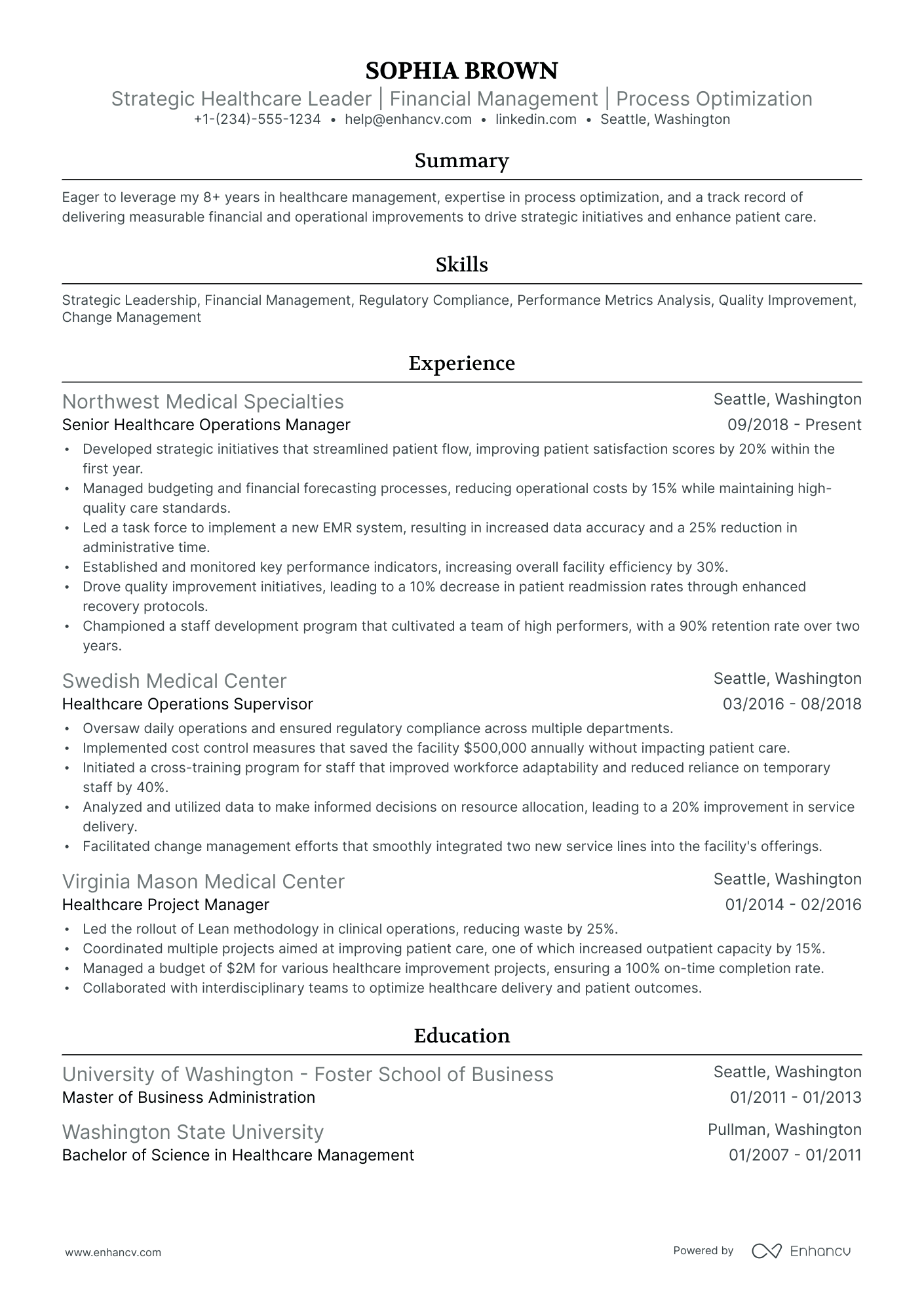
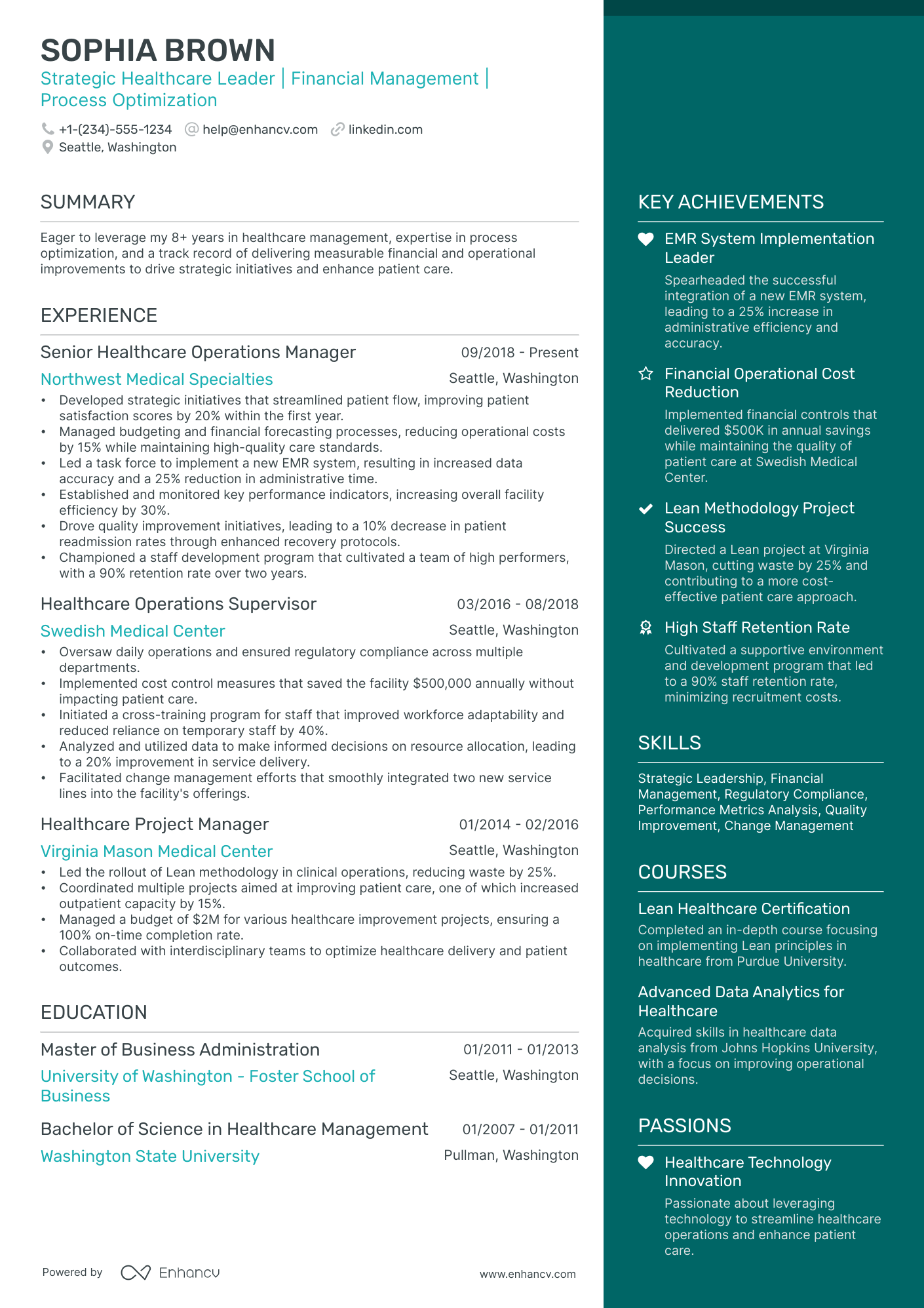
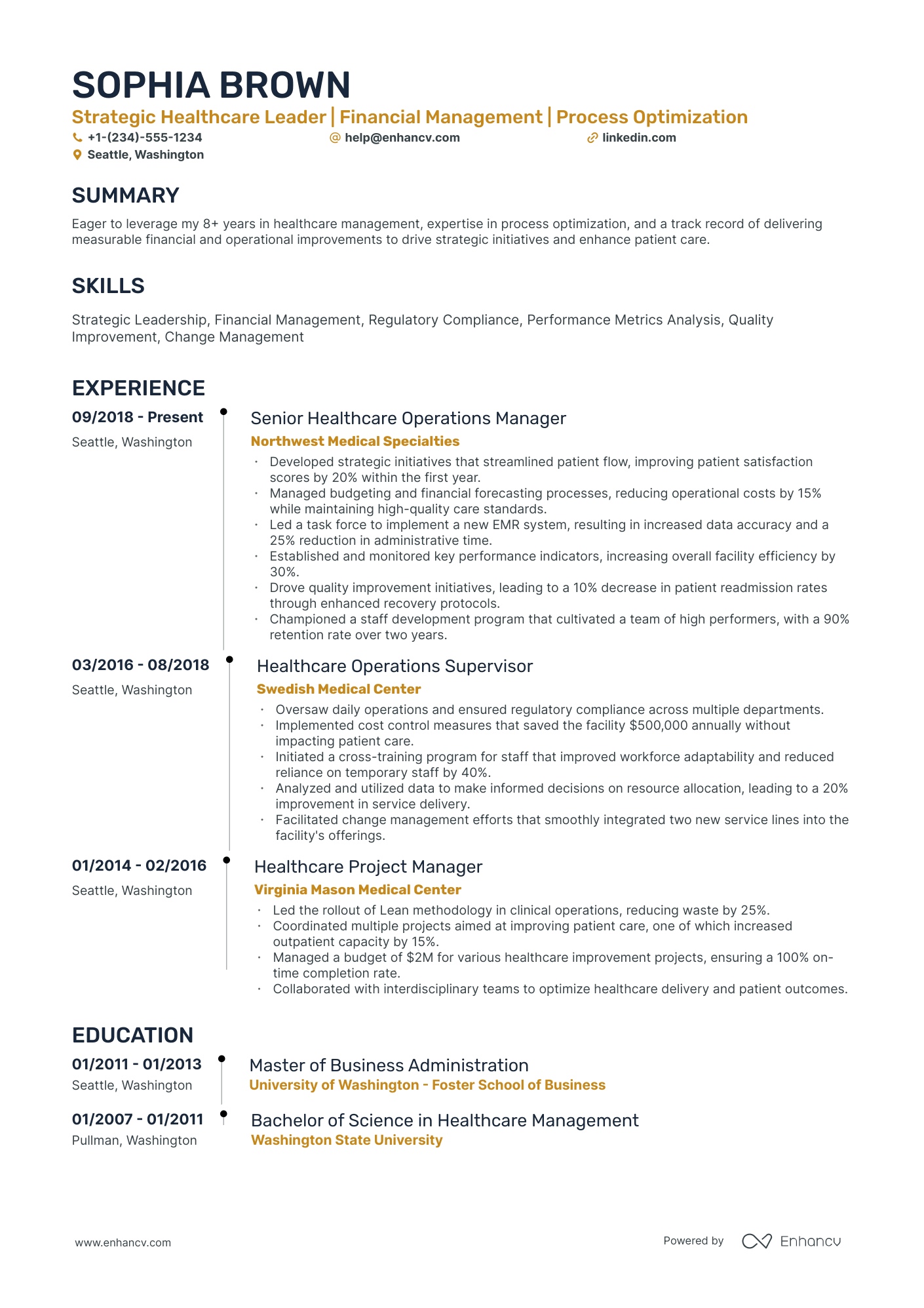
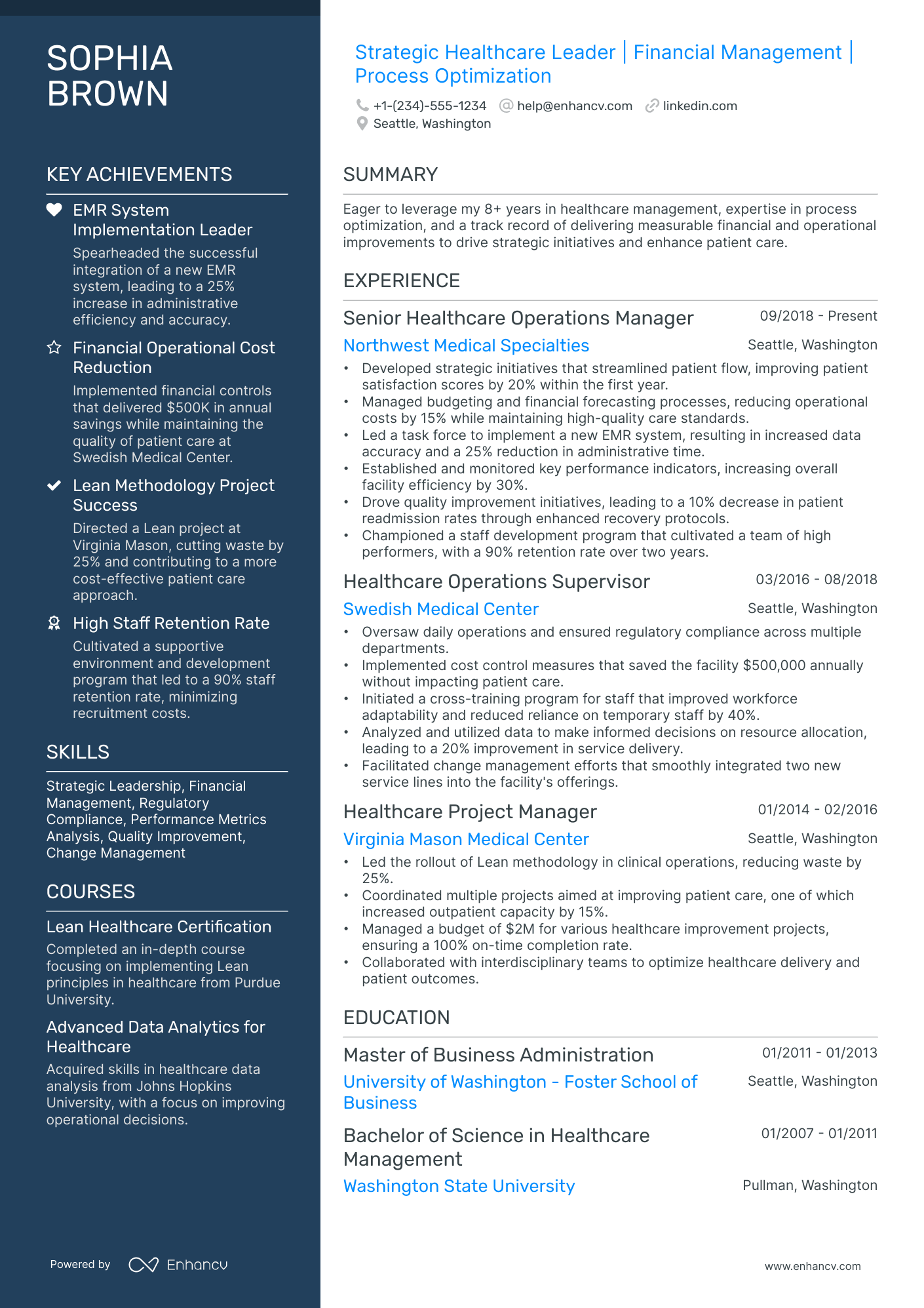
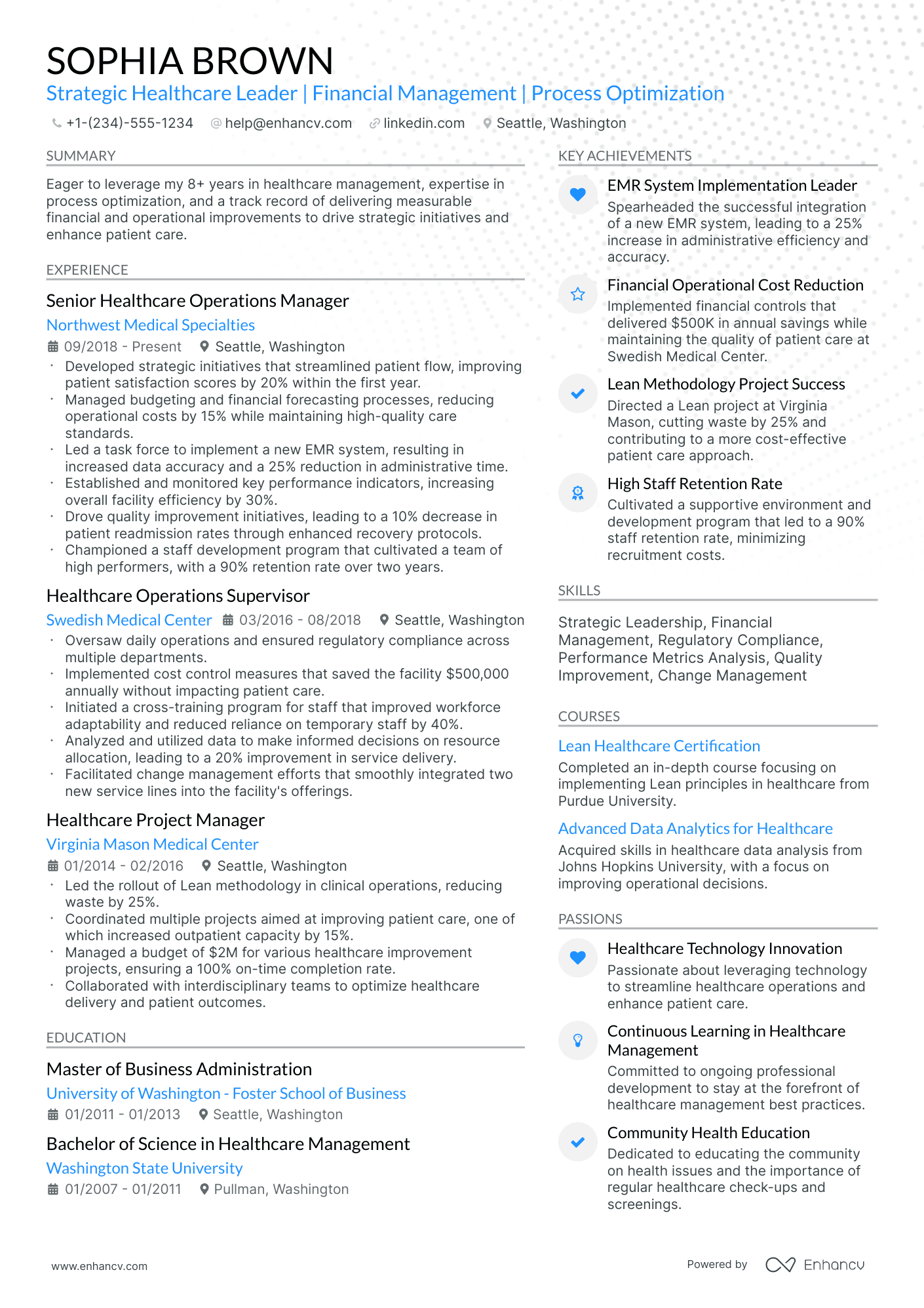
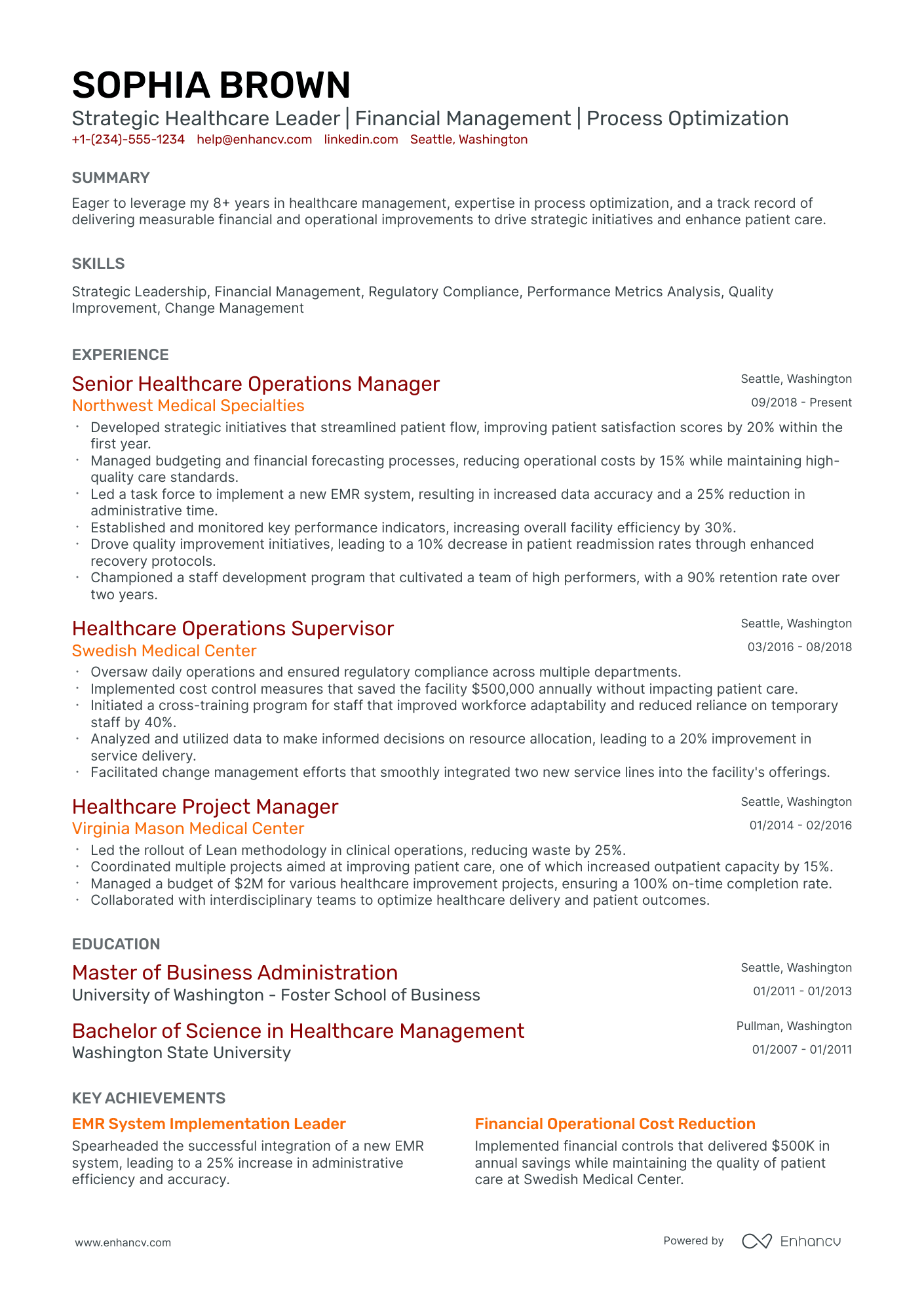

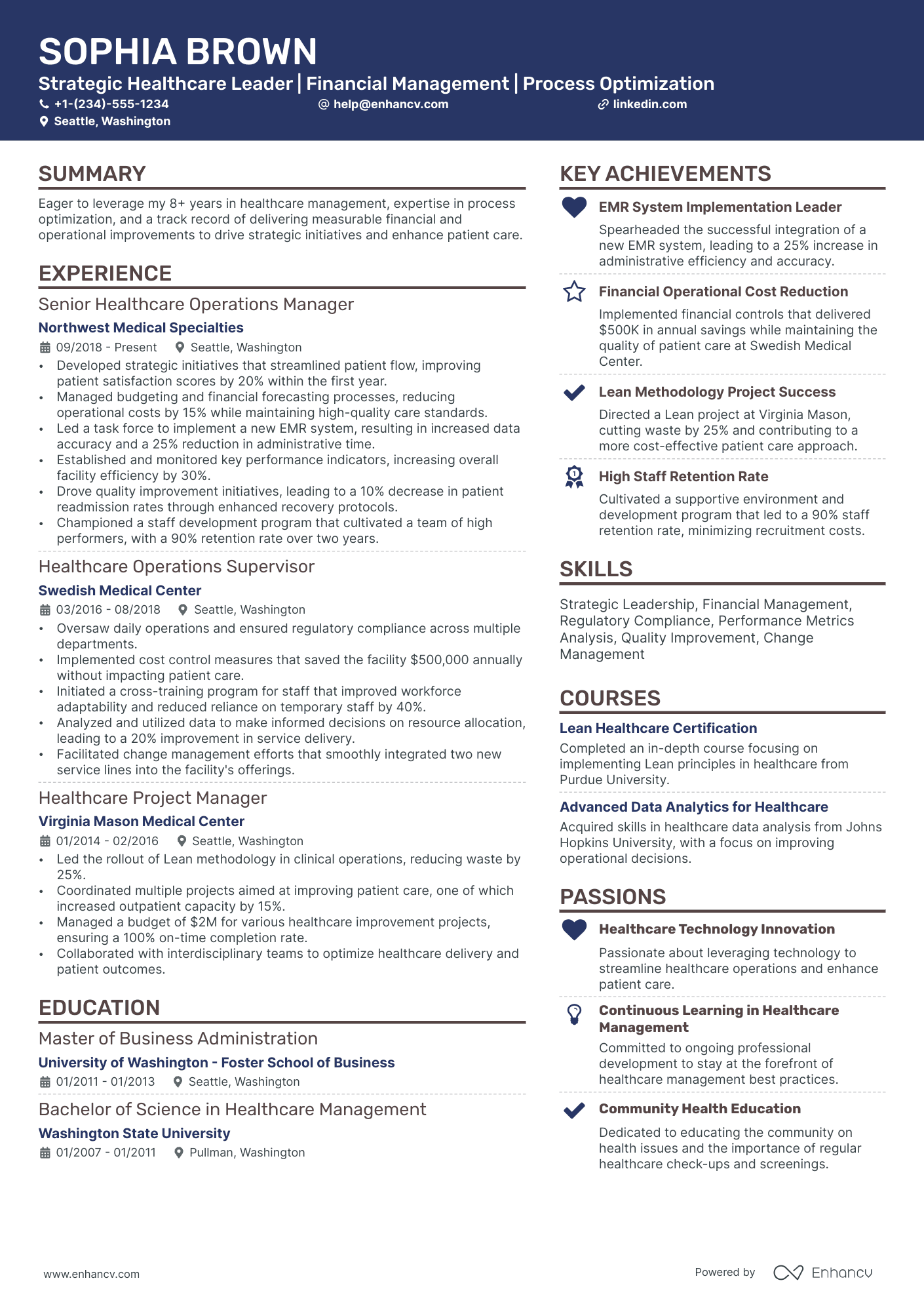
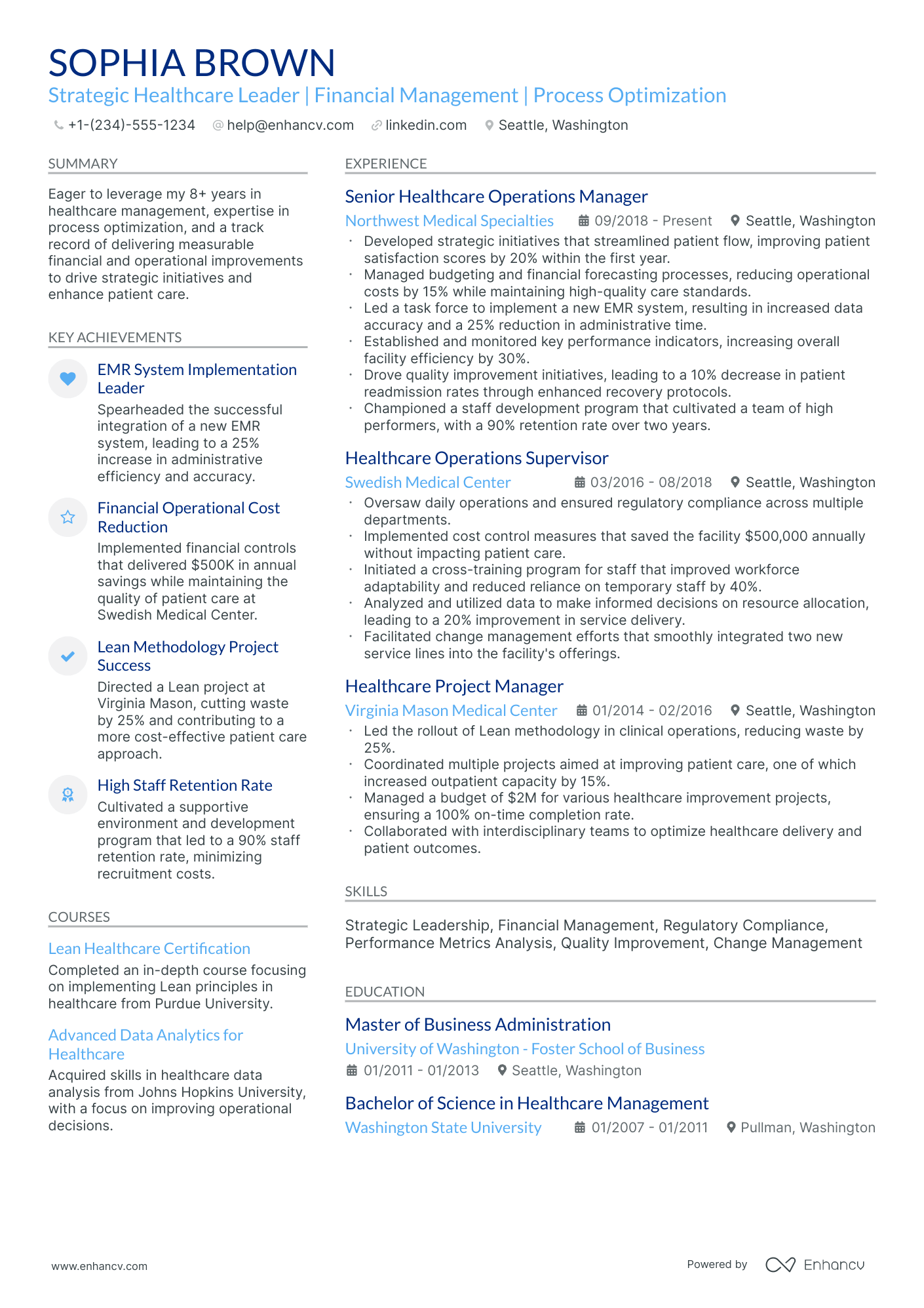
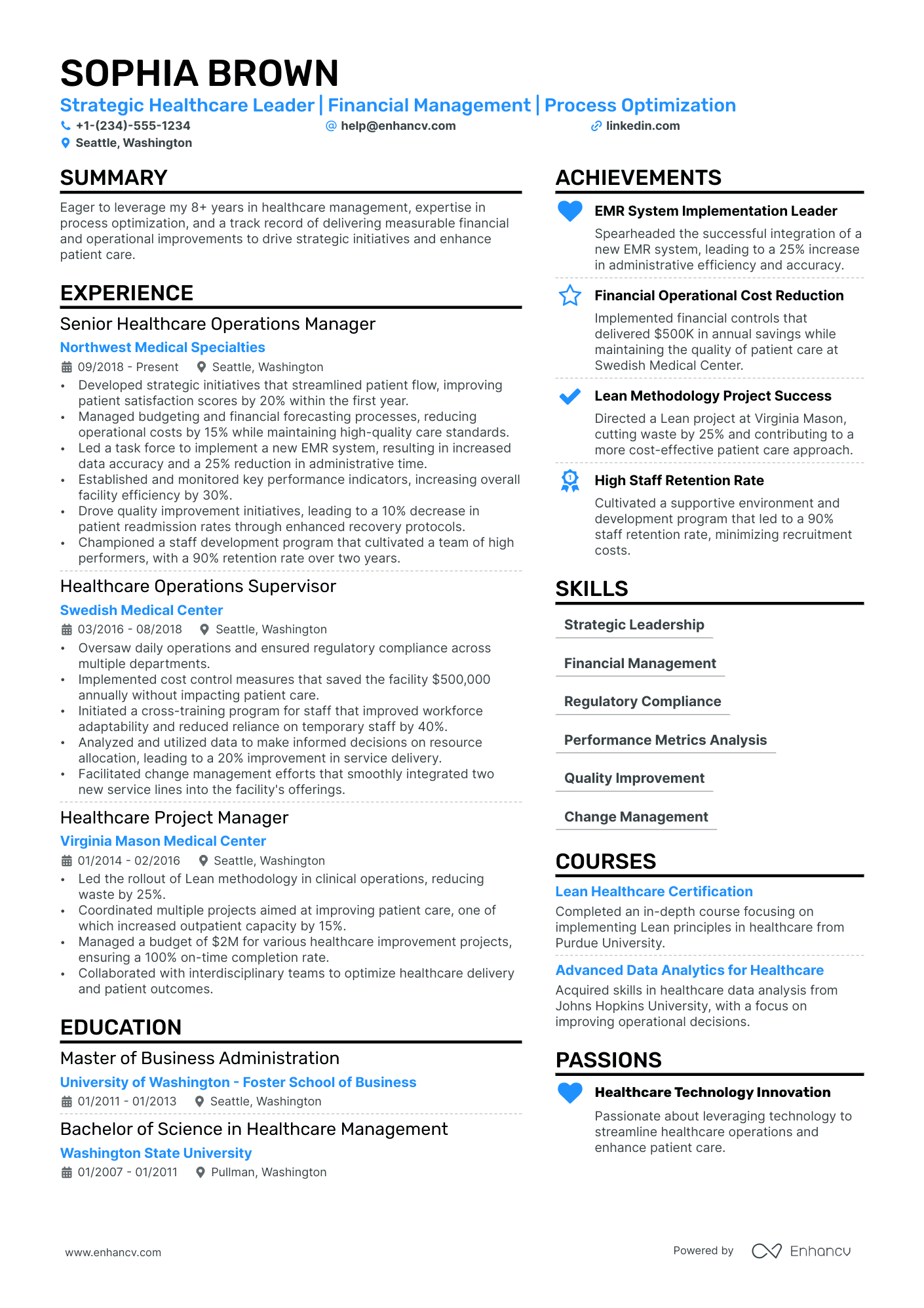
Most healthcare operations manager resume drafts fail because they list duties and tools but don't show measurable operational impact. That hurts in ATS screening and fast recruiter scans, where high competition rewards clear outcomes.
A strong resume proves what you improved and how you delivered it. Understanding how to make your resume stand out starts with highlighting reduced patient wait times, improved throughput across multiple sites, cut denials, strengthened compliance, lowered labor costs, and raised patient experience scores.

Key takeaways
- Quantify every experience bullet with metrics like cost savings, wait times, or throughput gains.
- Use reverse-chronological format if you have progressive healthcare operations experience.
- Tailor your resume to each job posting by mirroring its exact terminology and KPIs.
- Place skills above experience when switching careers, and below it when you're mid-senior level.
- Anchor every listed skill to a specific project, certification, or measurable outcome.
- Lead your summary with operational results and scope, not vague phrases like "results-driven."
- Use Enhancv to turn routine job duties into concise, metric-backed resume bullets.
Job market snapshot for healthcare operations managers
We analyzed 58 recent healthcare operations manager job ads across major US job boards. These numbers help you understand top companies hiring, industry demand, salary landscape at a glance.
What level of experience employers are looking for healthcare operations managers
| Years of Experience | Percentage found in job ads |
|---|---|
| Not specified | 100.0% (58) |
Healthcare operations manager ads by area of specialization (industry)
| Industry (Area) | Percentage found in job ads |
|---|---|
| Finance & Banking | 98.3% (57) |
Top companies hiring healthcare operations managers
| Company | Percentage found in job ads |
|---|---|
| DaVita Inc. | 93.1% (54) |
Role overview stats
These tables show the most common responsibilities and employment types for healthcare operations manager roles. Use them to align your resume with what employers expect and to understand how the role is structured across the market.
Day-to-day activities and top responsibilities for a healthcare operations manager
| Responsibility | Percentage found in job ads |
|---|---|
| Excel | 93.1% (54) |
| Ms word | 89.7% (52) |
| Outlook | 89.7% (52) |
| Powerpoint | 89.7% (52) |
| Cpr certification | 25.9% (15) |
| Analytics | 3.4% (2) |
| Automation | 3.4% (2) |
| Contract drafting | 3.4% (2) |
| Contract execution | 3.4% (2) |
| Data modeling | 3.4% (2) |
| Financial analysis | 3.4% (2) |
| Power bi | 3.4% (2) |
How to format a healthcare operations manager resume
Recruiters evaluating healthcare operations manager candidates prioritize process improvement expertise, cross-functional team leadership, and measurable impact on cost efficiency, patient throughput, or regulatory compliance. Choosing the right resume format ensures these signals surface quickly during both automated screening and the initial human review.

I have significant experience in this role—which format should I use?
Use a reverse-chronological format—it's the strongest choice for showcasing progressive responsibility in healthcare operations. Do:
- Lead with your most recent role and clearly define scope: number of facilities, departments, staff supervised, and budget ownership.
- Highlight domain-specific expertise such as EHR systems (Epic, Cerner), Lean/Six Sigma methodology, Joint Commission accreditation, and supply chain management.
- Quantify operational outcomes tied directly to your decisions—cost reductions, patient satisfaction scores, throughput improvements, or compliance audit results.
I'm junior or switching into this role—what format works best?
A hybrid format works best because it lets you lead with transferable skills while still showing a clear work history. Do:
- Place a dedicated skills section near the top featuring healthcare-relevant competencies like HIPAA compliance, workforce scheduling, budgeting, or process mapping.
- Include project-based experience—such as clinical workflow redesigns, quality improvement initiatives, or EHR implementations—even if completed in adjacent roles or during coursework.
- Connect every action to a measurable result so recruiters can evaluate your operational thinking.
Why not use a functional resume?
A functional format strips away the timeline and context that recruiters need to evaluate how your operational skills were applied in real healthcare settings.
- Career changers from adjacent fields (hospitality operations, military logistics, public health administration) who have relevant transferable skills but no direct healthcare operations title.
- Candidates with resume gaps due to licensure transitions, extended leave, or relocation who still completed relevant projects or certifications during the gap period.
- A functional format is acceptable only when you have no direct healthcare operations work history and are pivoting from another industry—but every listed skill must still be anchored to a specific project, certification, or measurable outcome.
Once you've established a clean, readable format, the next step is deciding which sections to include so each one reinforces your qualifications.
What sections should go on a healthcare operations manager resume
Recruiters expect a clean, results-focused resume that shows you can improve clinical and administrative operations, quality, and cost performance. Knowing what to put on a resume for this role is critical to passing both ATS and human review.
Use this structure for maximum clarity:
- Header
- Summary
- Experience
- Skills
- Projects
- Education
- Certifications
- Optional sections: Awards, Leadership, Volunteering
Strong experience bullets should emphasize measurable outcomes, operational scope, cross-functional leadership, and sustained improvements in patient flow, quality metrics, compliance, and cost control.
Is your resume good enough?
Drop your resume here or choose a file. PDF & DOCX only. Max 2MB file size.
Now that you’ve organized the key parts of your resume, the next step is to write your healthcare operations manager experience section so it supports each one with clear, results-focused detail.
How to write your healthcare operations manager resume experience
Your experience section should present a record of delivered outcomes—operational improvements you led, healthcare systems you optimized, and measurable results you produced using role-relevant tools and methodologies. Hiring managers prioritize demonstrated impact over descriptive task lists, so every bullet point should connect your work to a tangible business or patient-care outcome. Building a targeted resume ensures each entry speaks directly to the role's priorities.
Each entry should include:
- Job title
- Company and location (or remote)
- Dates of employment (month and year)
Three to five concise bullet points showing what you owned, how you executed, and what outcomes you delivered:
- Ownership scope: the clinical departments, operational workflows, facility systems, budgets, or teams you were directly accountable for as a healthcare operations manager.
- Execution approach: the process improvement frameworks, healthcare information systems, regulatory compliance methods, or data analytics tools you used to guide decisions and deliver work.
- Value improved: the changes you drove in patient throughput, care quality, operational efficiency, cost containment, regulatory readiness, or staff retention relevant to healthcare operations.
- Collaboration context: how you partnered with clinical leadership, nursing staff, compliance officers, IT teams, payers, or external vendors to advance operational goals.
- Impact delivered: the outcomes you produced expressed through scale of operations affected, performance benchmarks reached, or strategic objectives met—rather than a list of daily activities.
Experience bullet formula
A healthcare operations manager experience example
✅ Right example - modern, quantified, specific.
Healthcare Operations Manager
Riverside Community Health System | Columbus, OH
2021–Present
Multi-site outpatient network with twelve clinics and two hundred providers serving value-based and fee-for-service populations.
- Led Lean Six Sigma workflow redesign across intake, scheduling, and referrals using Epic, Qlik Sense, and time-motion studies, cutting average patient wait time 22% (from thirty-six to twenty-eight minutes) within two quarters.
- Implemented capacity and staffing model in Excel and Tableau using provider templates, no-show forecasting, and demand smoothing, increasing visit throughput 14% without adding headcount and improving third-next-available from eighteen to twelve days.
- Standardized revenue cycle handoffs with charge capture audits in Epic, denial root-cause analysis, and payer work queues, reducing denial rate from 9.8% to 7.1% and recovering $1.3M in annualized net revenue.
- Partnered with clinical leaders, human resources, and compliance to launch a HIPAA (Health Insurance Portability and Accountability Act) training and access-review cadence in ServiceNow, lowering access exceptions 31% and passing two external audits with zero high-severity findings.
- Built monthly operations scorecard in Power BI integrating Press Ganey, Epic Clarity, and incident reporting, improving patient satisfaction 8 points and reducing medication-related safety events 19% year over year.
Now that you've seen what a strong experience section looks like in practice, let's break down how to customize yours for each specific job posting.
How to tailor your healthcare operations manager resume experience
Recruiters evaluate your healthcare operations manager resume through both applicant tracking systems and manual review. Tailoring your resume to the job description ensures your qualifications align directly with what hiring teams prioritize.
Ways to tailor your healthcare operations manager experience:
- Match specific EHR platforms or health information systems named in the posting.
- Mirror the exact regulatory standards like HIPAA or Joint Commission referenced.
- Use the same terminology for patient throughput or operational efficiency processes.
- Reflect KPIs such as patient satisfaction scores or readmission rates mentioned.
- Highlight experience with Lean or Six Sigma if the listing requires them.
- Include relevant facility types like acute care or ambulatory surgery centers.
- Emphasize compliance or quality improvement initiatives when the role prioritizes them.
- Reference cross-functional collaboration with clinical and administrative teams if noted.
Tailoring means aligning your real accomplishments with the role's stated requirements, not forcing disconnected keywords into your experience bullets.
Resume tailoring examples for healthcare operations manager
| Job description excerpt | Untailored | Tailored |
|---|---|---|
| Oversee daily operations of a 200-bed acute care facility, ensuring compliance with Joint Commission standards and optimizing patient throughput using Lean Six Sigma methodologies. | Managed hospital operations and helped improve processes. | Directed daily operations of a 200-bed acute care facility, maintaining full Joint Commission accreditation across three consecutive survey cycles while applying Lean Six Sigma to reduce average patient throughput time by 18%. |
| Manage departmental budgets totaling $12M+, negotiate vendor contracts for medical supplies and equipment, and lead cost-reduction initiatives using Epic-generated utilization reports. | Responsible for budgets and worked with vendors to save money. | Managed $12.4M in departmental budgets, renegotiated 14 vendor contracts for medical supplies and capital equipment, and used Epic utilization reports to identify redundancies that cut annual supply costs by $1.1M. |
| Recruit, train, and retain a multidisciplinary team of 75+ clinical and administrative staff, driving employee engagement through structured mentorship programs and quarterly performance reviews aligned with CMS quality metrics. | Supervised staff and conducted performance reviews. | Recruited and retained a multidisciplinary team of 80 clinical and administrative staff, launching a structured mentorship program that reduced first-year turnover by 22% and aligning quarterly performance reviews with CMS quality metrics to improve HCAHPS scores by 9 points. |
Once you’ve aligned your experience with the role’s priorities, the next step is to quantify your healthcare operations manager achievements so hiring teams can see the measurable impact behind those responsibilities.
How to quantify your healthcare operations manager achievements
Quantifying your achievements shows how your decisions improved patient flow, compliance, cost, and service quality. Track throughput, cycle time, staffing efficiency, audit results, safety events, and margin impact across clinics, units, or service lines.
Quantifying examples for healthcare operations manager
| Metric | Example |
|---|---|
| Cycle time | "Cut emergency department door-to-bed time from 62 to 44 minutes by redesigning triage and adding a fast-track lane, improving daily throughput by 18 patients." |
| Cost savings | "Reduced supply spend by $420K annually by standardizing procedure kits and renegotiating vendor contracts, tracked in Oracle and validated by finance." |
| Compliance | "Raised Joint Commission documentation compliance from 88% to 97% in eight weeks using weekly chart audits and Epic smart phrases across three units." |
| Safety risk | "Decreased medication administration errors by 31% by implementing barcode scanning checks and monthly competency refreshers for 140 nurses." |
| Staffing efficiency | "Lowered overtime hours by 22% while maintaining coverage by deploying Kronos scheduling rules and cross-training twelve float staff for peak shifts." |
Turn vague job duties into measurable, recruiter-ready resume bullets in seconds with Enhancv's Bullet Point Generator.
With strong bullet points in place, the next step is ensuring your resume highlights the right mix of hard and soft skills that healthcare employers expect from an operations manager.
How to list your hard and soft skills on a healthcare operations manager resume
Your skills section shows you can improve access, quality, and cost across clinical operations, and recruiters and ATS (applicant tracking system) scan this section to confirm role fit fast; aim for a hard-skills-heavy mix with targeted soft skills. Healthcare operations manager roles require a blend of:
- Product strategy and discovery skills.
- Data, analytics, and experimentation skills.
- Delivery, execution, and go-to-market discipline.
- Soft skills.
Your skills section should be:
- Scannable (bullet-style grouping).
- Relevant to the job post.
- Backed by proof in experience bullets.
- Updated with current tools.
Place your skills section:
- Above experience if you're junior or switching careers.
- Below experience if you're mid/senior with strong achievements.

Hard skills
Strong hard skills for this role include:
- Electronic health record workflows, Epic
- Revenue cycle operations, denials management
- Clinical quality programs, HEDIS, STAR
- Lean, Six Sigma, Kaizen
- HIPAA compliance, risk assessments
- Healthcare staffing models, scheduling optimization
- Budgeting, cost variance analysis
- KPI dashboards, Tableau, Power BI
- SQL reporting, Excel pivot tables
- Patient access operations, referral management
- Vendor management, contract negotiation
- Root cause analysis, corrective action plans
Soft skills
Complement those with soft skills such as:
- Cross-functional alignment with clinical leaders
- Escalation management and rapid issue triage
- Data-driven prioritization and trade-off decisions
- Clear executive updates and status reporting
- Change management for frontline adoption
- Process ownership and follow-through
- Stakeholder expectation setting and negotiation
- Coaching supervisors and building accountability
- Patient-first judgment under constraints
- Incident response coordination across teams
How to show your healthcare operations manager skills in context
Skills shouldn't live only in a bulleted list on your resume. Explore examples of resume skills presented in context to see how top candidates integrate them naturally.
They should be demonstrated in:
- Your summary (high-level professional identity)
- Your experience (proof through outcomes)
Here's what that looks like in practice.
Summary example
Healthcare operations manager with 12 years of experience optimizing multi-site clinical workflows using Lean Six Sigma and Epic EHR. Led cross-functional teams to reduce patient wait times by 31% while maintaining Joint Commission compliance.
- Reflects senior-level experience clearly
- Names industry-specific tools and methods
- Quantifies a meaningful patient outcome
- Signals leadership and collaboration strengths
Experience example
Healthcare Operations Manager
Meridian Health Partners | Tampa, FL
June 2019–Present
- Streamlined scheduling workflows in Epic across four clinics, cutting average patient wait times by 24% within eight months.
- Partnered with nursing leadership and IT to implement a Lean Six Sigma initiative that reduced supply waste by $340,000 annually.
- Designed staff performance dashboards in Tableau, helping department heads improve shift coverage accuracy by 18%.
- Every bullet includes measurable proof.
- Skills appear naturally through outcomes.
Once you’ve tied your operational strengths to real outcomes, the next step is learning how to build a healthcare operations manager resume with no experience by using the same evidence-based approach to highlight transferable skills.
How do I write a healthcare operations manager resume with no experience
Even without full-time experience, you can demonstrate readiness through:
- Hospital or clinic internship rotations
- Healthcare operations capstone project
- Quality improvement student initiative
- Medical scheduling and intake volunteering
- Patient flow data analysis project
- Lean Six Sigma coursework project
- Electronic health record sandbox training
- Community health program coordination
If you're building a resume without work experience, focus on:
- Healthcare operations metrics and outcomes
- Process improvement methods and results
- Compliance exposure and documentation
- Cross-functional work with stakeholders
Resume format tip for entry-level healthcare operations manager
Use a combination resume format because it highlights relevant projects and skills while still showing work history, even if it is unrelated. Do:
- Open with a targeted summary and keywords.
- Add a projects section above experience.
- Quantify results using time, cost, throughput.
- List tools: Excel, Tableau, Epic.
- Map each bullet to the job.
- Led a patient flow data analysis project in Excel and Tableau, reducing average clinic wait time by 12 percent across four appointment types.
Even without direct experience, your educational background can demonstrate the foundational knowledge and relevant training that qualify you for a healthcare operations manager role.
How to list your education on a healthcare operations manager resume
Your education section helps hiring teams confirm you hold the foundational knowledge needed for a healthcare operations manager role. It validates your academic background quickly.
Include:
- Degree name
- Institution
- Location
- Graduation year
- Relevant coursework (for juniors or entry-level candidates)
- Honors & GPA (if 3.5 or higher)
Skip month and day details—list the graduation year only.
Here's a strong education entry tailored to the healthcare operations manager role:
Example education entry
Master of Health Administration (MHA)
University of North Carolina at Chapel Hill, Chapel Hill, NC
Graduated 2019
GPA: 3.8/4.0
- Relevant Coursework: Healthcare Financial Management, Operations Strategy, Health Informatics, Quality Improvement in Clinical Systems
- Honors: Dean's List, Beta Gamma Sigma Honor Society
How to list your certifications on a healthcare operations manager resume
Certifications on your resume show your commitment to learning, prove tool proficiency, and confirm industry relevance for a healthcare operations manager. They also help recruiters quickly validate your readiness to manage compliance, quality, and operational performance. Include:
- Certificate name
- Issuing organization
- Year
- Optional: credential ID or URL
- Place certifications below education when your degree is recent and closely aligned with healthcare operations manager requirements.
- Place certifications above education when they are recent, highly relevant, or required for the healthcare operations manager role you target.
Best certifications for your healthcare operations manager resume
- Certified Professional in Healthcare Quality (CPHQ)
- Certified Healthcare Financial Professional (CHFP)
- Lean Six Sigma Green Belt
- Project Management Professional (PMP)
- Certified Professional in Patient Safety (CPPS)
- Certified Medical Practice Executive (CMPE)
- Certified in Healthcare Compliance (CHC)
Once you’ve positioned your credentials where hiring teams can spot them quickly, focus on your healthcare operations manager resume summary to connect those qualifications to the value you deliver.
How to write your healthcare operations manager resume summary
Your resume summary is the first thing a recruiter reads. A strong one immediately signals you're qualified for the healthcare operations manager role.
Keep it to three to four lines, with:
- Your title and total years of healthcare operations experience.
- The domain you specialize in, such as hospital systems, ambulatory care, or health plans.
- Core skills like process improvement, budget management, or regulatory compliance.
- One or two measurable achievements, such as cost reductions or efficiency gains.
- Soft skills tied to real outcomes, like cross-functional collaboration that improved patient throughput.

PRO TIP
At this level, lead with operational results and the scale of teams or budgets you've managed. Quantify improvements in cost, efficiency, or compliance metrics. Avoid vague phrases like "passionate leader" or "results-driven professional." Instead, show ownership of specific outcomes that moved the organization forward.
Example summary for a healthcare operations manager
Healthcare operations manager with eight years optimizing clinical workflows across multi-site hospital networks. Reduced operational costs by 18% while leading a 25-member team and maintaining Joint Commission compliance standards.
Optimize your resume summary and objective for ATS
Drop your resume here or choose a file.
PDF & DOCX only. Max 2MB file size.
Now that your summary captures your healthcare operations expertise, make sure your header presents the essential contact and professional details recruiters need to reach you.
What to include in a healthcare operations manager resume header
A resume header is the contact and identity block at the top of your resume, and it drives visibility, credibility, and fast recruiter screening for a healthcare operations manager.
Essential resume header elements
- Full name
- Tailored job title and headline
- Location
- Phone number
- Professional email
- GitHub link
- Portfolio link
A LinkedIn link helps recruiters verify your experience quickly and supports screening.
Don't include a photo on a healthcare operations manager resume unless the role is explicitly front-facing or appearance-dependent.
Match your headline to the job posting and keep your contact details consistent across your resume and online profiles.
Example
Healthcare operations manager resume header
Jordan M. Taylor
Healthcare Operations Manager | Clinic Operations, Staffing, and Patient Flow
Chicago, IL
(312) 555-01XX
your.name@enhancv.com
github.com/yourname
yourwebsite.com
linkedin.com/in/yourname
Once your contact details and role identifiers are in place, you can strengthen your application with additional sections for healthcare operations manager resumes that provide supporting context.
Additional sections for healthcare operations manager resumes
When your core qualifications match other candidates, well-chosen additional sections can set your healthcare operations manager resume apart with role-specific credibility.
- Language skills
- Professional affiliations and memberships
- Publications and conference presentations
- Certifications in Lean Six Sigma or healthcare quality
- Volunteer experience in healthcare or community health
- Awards and recognitions in operational excellence
- Continuing education and professional development
Once you've strengthened your resume with relevant additional sections, pairing it with a well-crafted cover letter can further set your application apart.
Do healthcare operations manager resumes need a cover letter
A cover letter isn't always required for a healthcare operations manager, but it often helps in competitive searches or systems that expect one. If you're unsure where to start, learning what a cover letter is and how it complements your resume can clarify when one is worth writing. It can make a difference when your resume needs context, or when you want to show fit with a specific team.
Use these tips to decide when and how to write one:
- Explain role and team fit: Connect your experience to the department's priorities, such as throughput, patient access, staffing, or compliance.
- Highlight one or two outcomes: Pick projects with clear results, like reduced wait times, improved charge capture, or better audit performance.
- Show business and user understanding: Reference the patients, clinicians, and front desk teams affected, plus constraints like regulations, payer rules, and budgets.
- Address transitions or non-obvious experience: Clarify moves from clinical, finance, or project roles, and map transferable skills to healthcare operations manager work.
Drop your resume here or choose a file.
PDF & DOCX only. Max 2MB file size.
Once you’ve decided whether to include a cover letter to support your application, the next step is using AI to strengthen your healthcare operations manager resume efficiently and consistently.
Using AI to improve your healthcare operations manager resume
AI can sharpen your resume's clarity, structure, and impact. It helps tighten language and highlight results. But overuse strips authenticity. Once your content is clear and role-aligned, step away from AI. For practical guidance, explore these ChatGPT resume writing prompts tailored to resume improvement.
Here are 10 practical prompts to strengthen specific sections of your healthcare operations manager resume:
Strengthen your summary
Quantify experience bullets
Align skills strategically
Tighten wordy bullets
Improve action verbs
Refine project descriptions
Tailor certification details
Highlight education relevance
Remove filler language
Target a specific posting
Conclusion
A strong healthcare operations manager resume shows measurable outcomes, role-specific skills, and a clear structure. Lead with results like reduced wait times, improved throughput, lower costs, or higher patient satisfaction. Use concise bullets, consistent formatting, and keywords that match the role.
Hiring teams want healthcare operations manager candidates who can run daily operations and deliver steady improvements. Your resume should prove readiness for today’s market and near-future needs. Keep it focused, easy to scan, and grounded in outcomes.