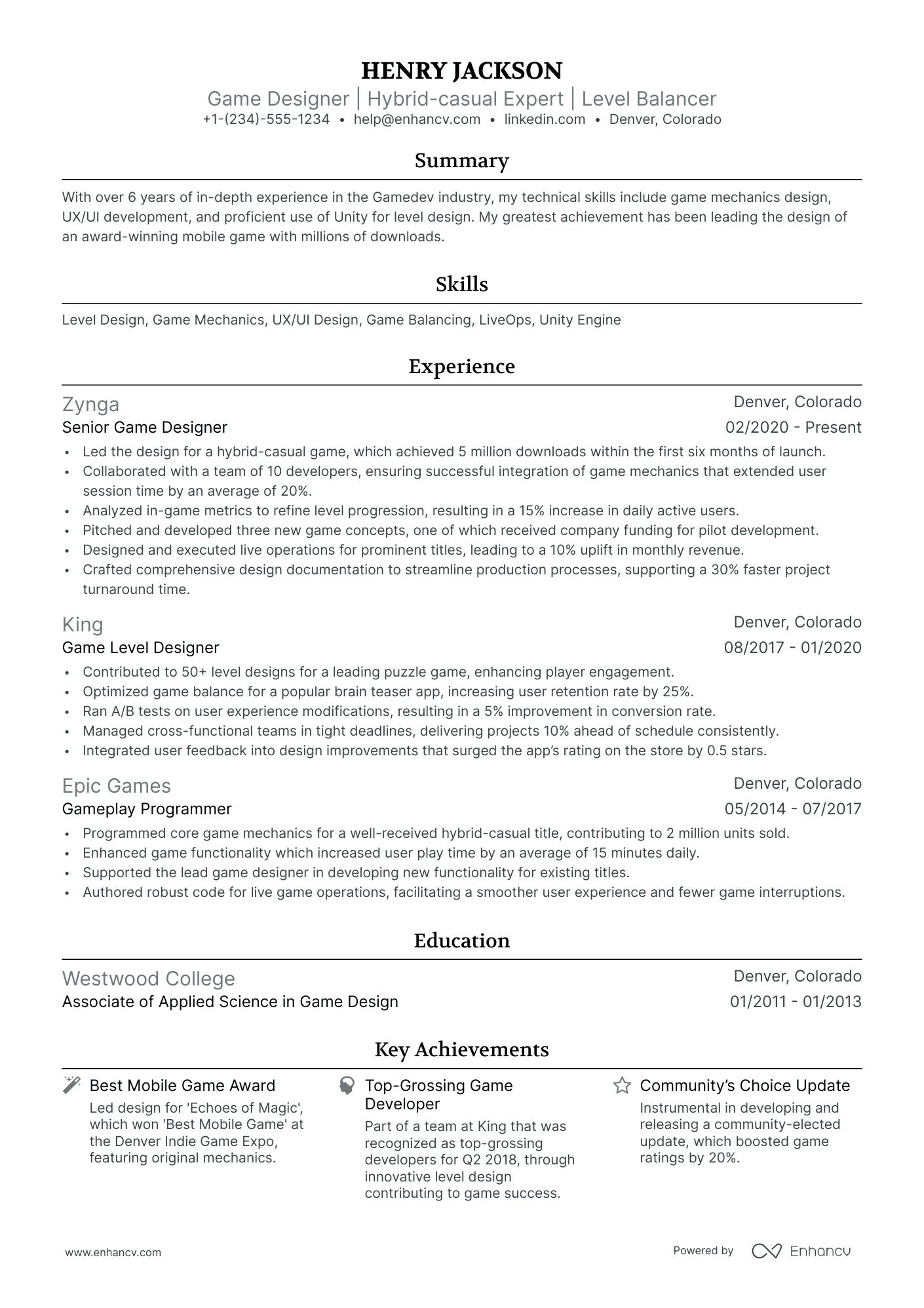
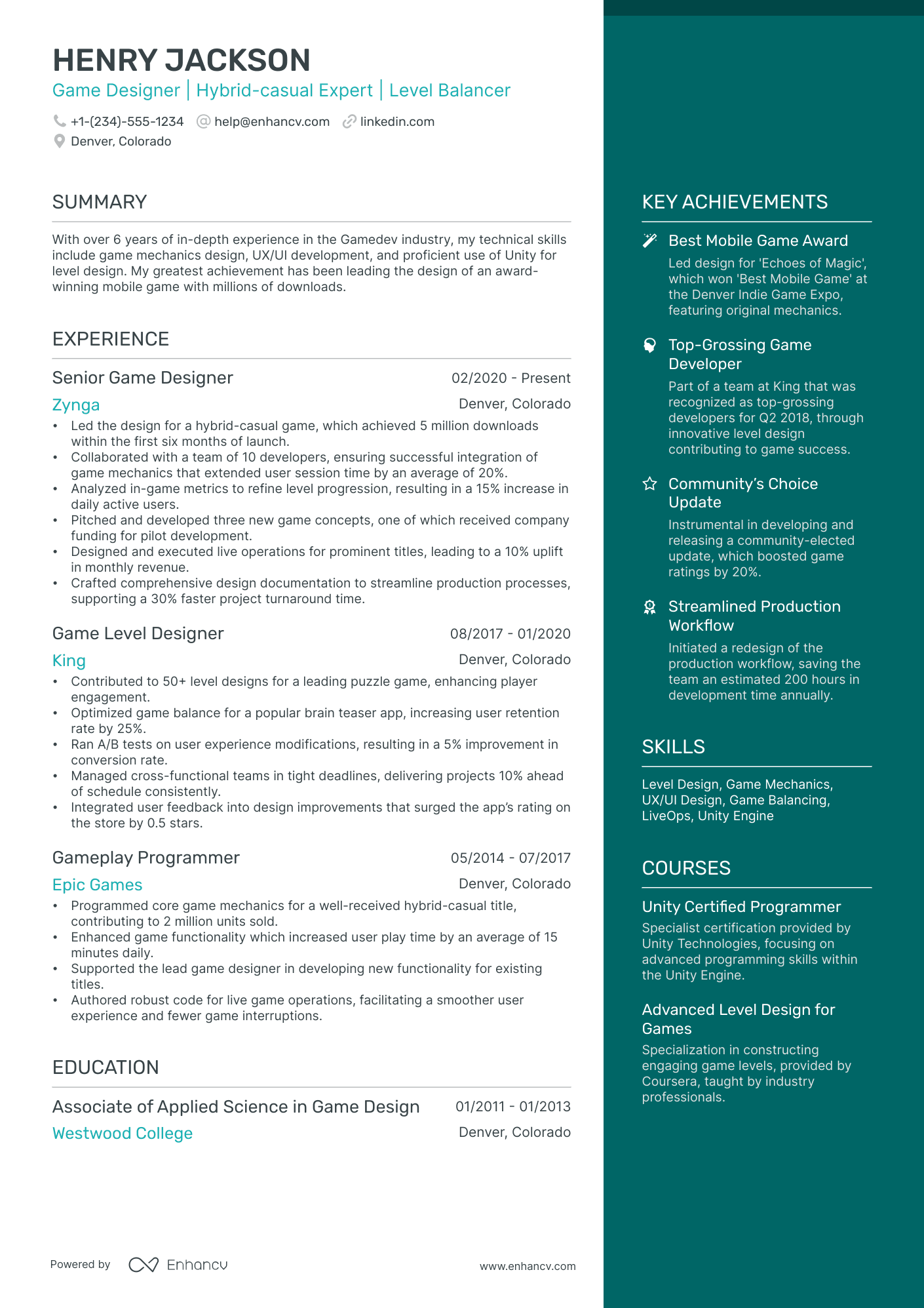
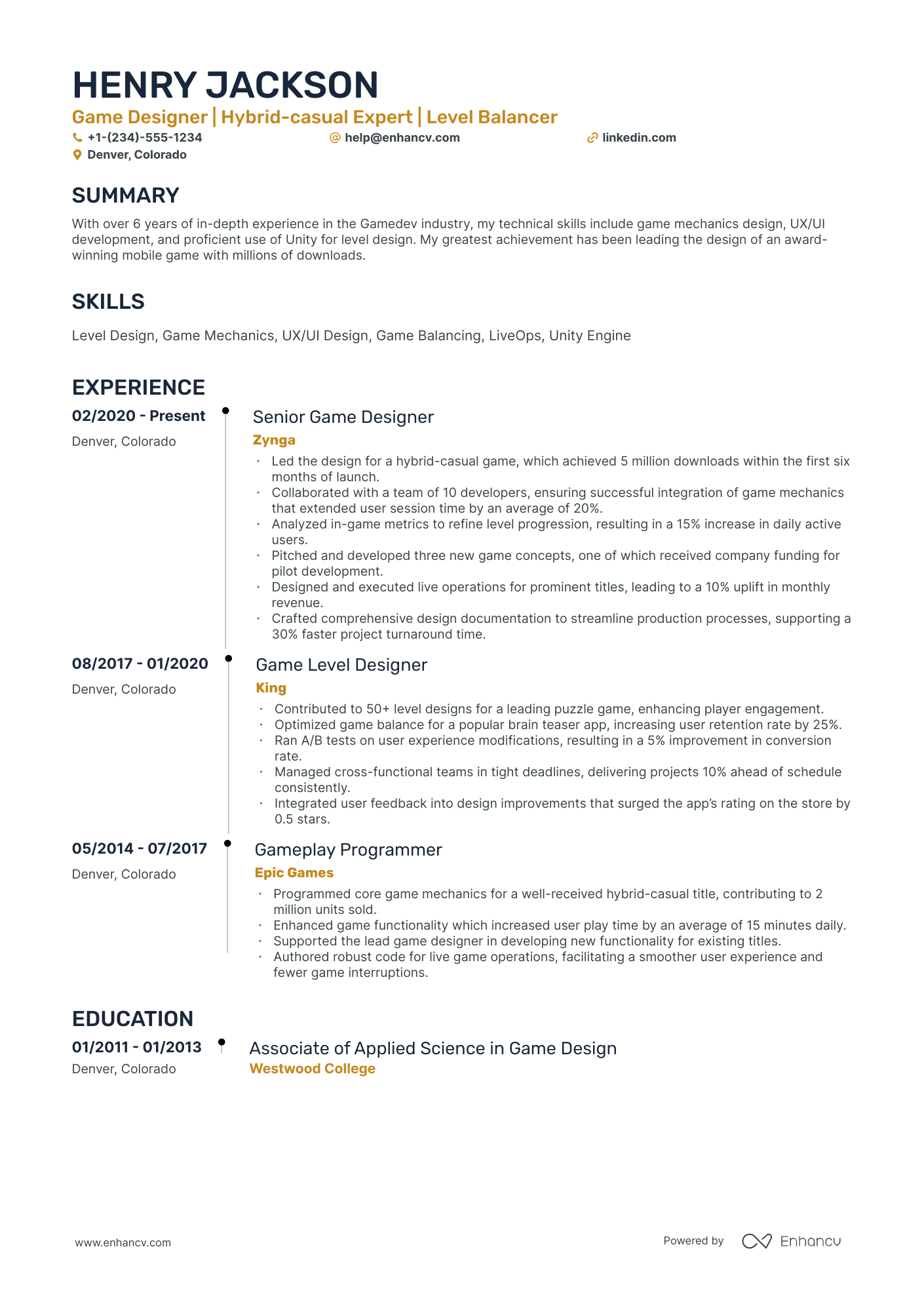
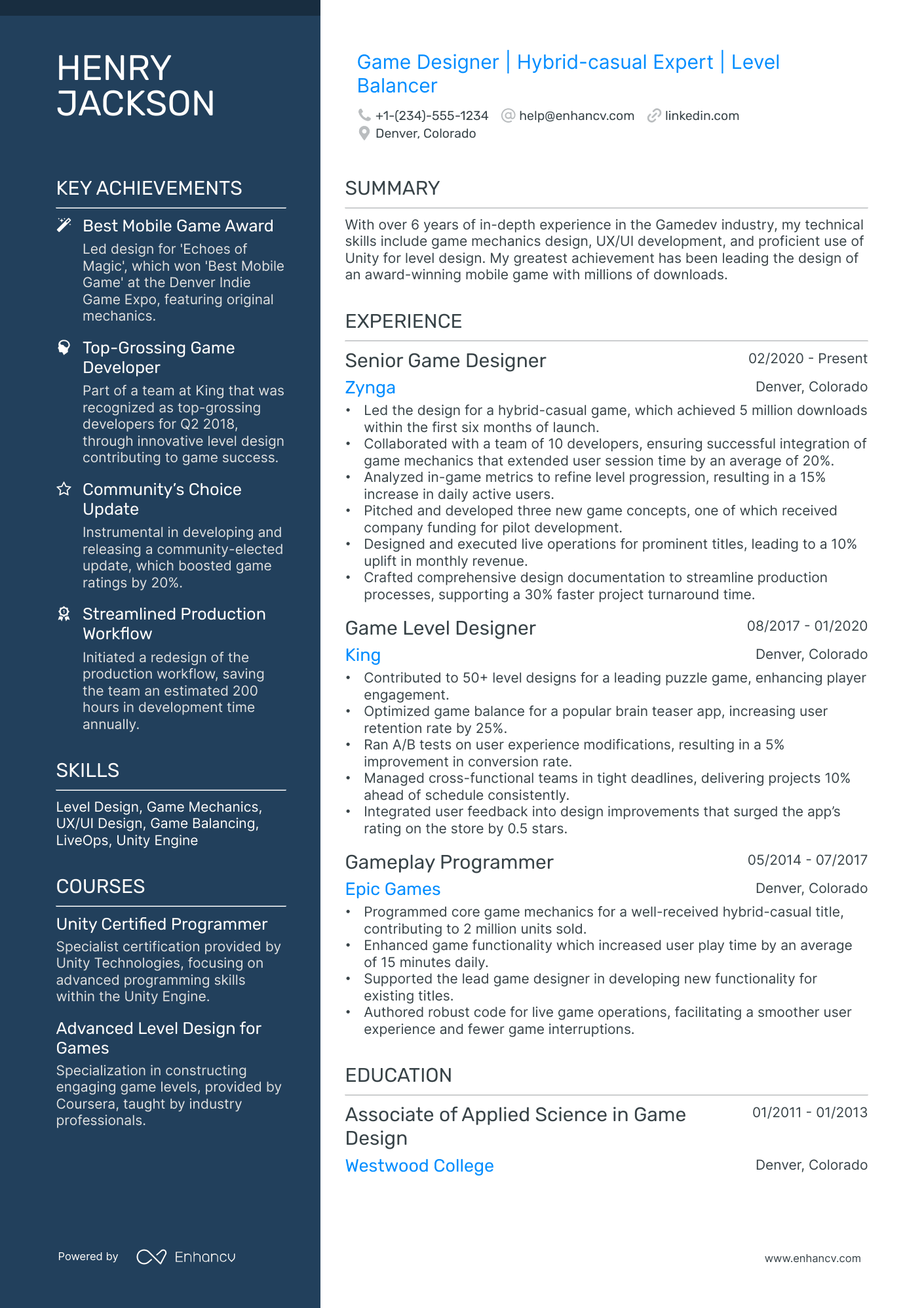
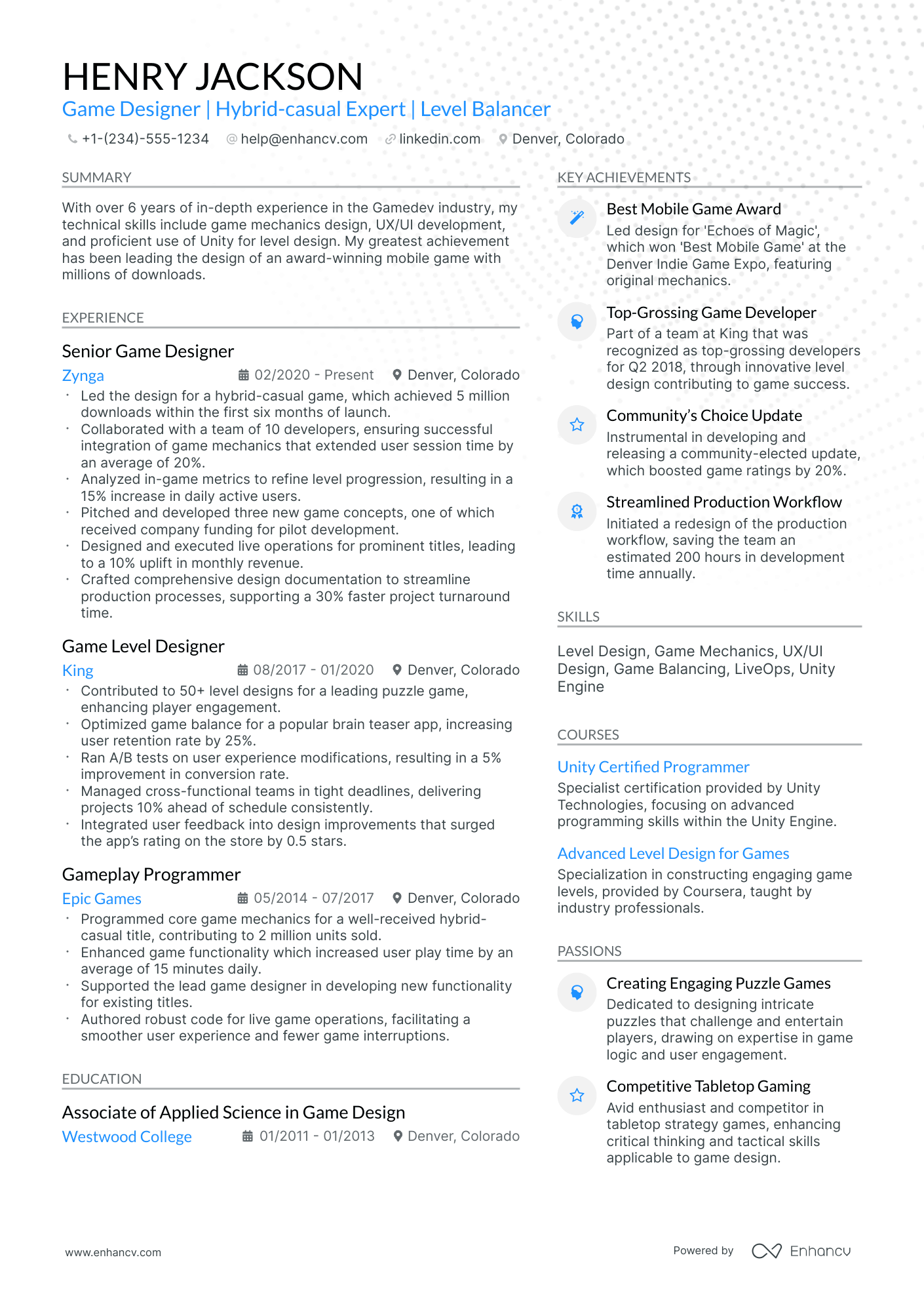
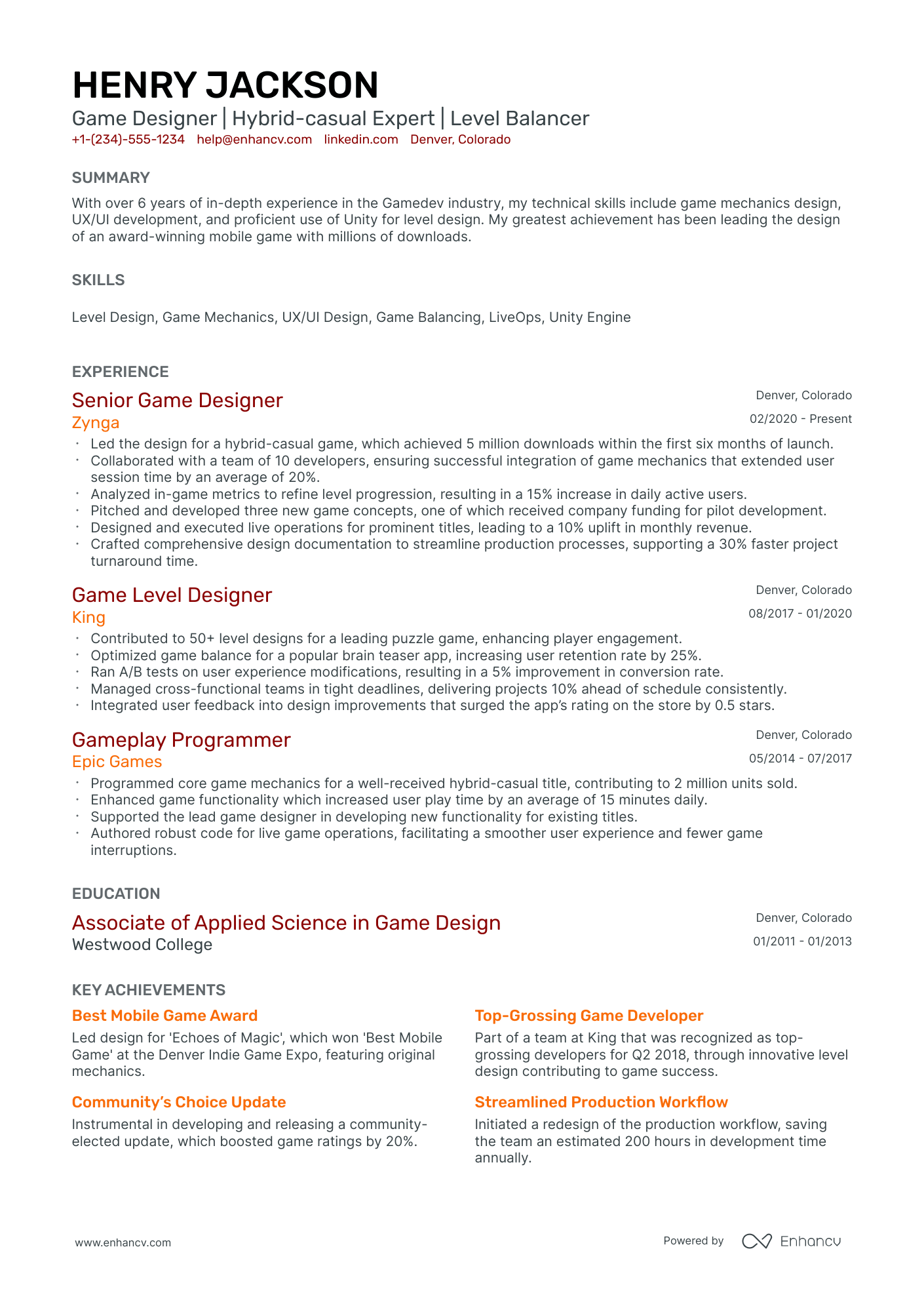
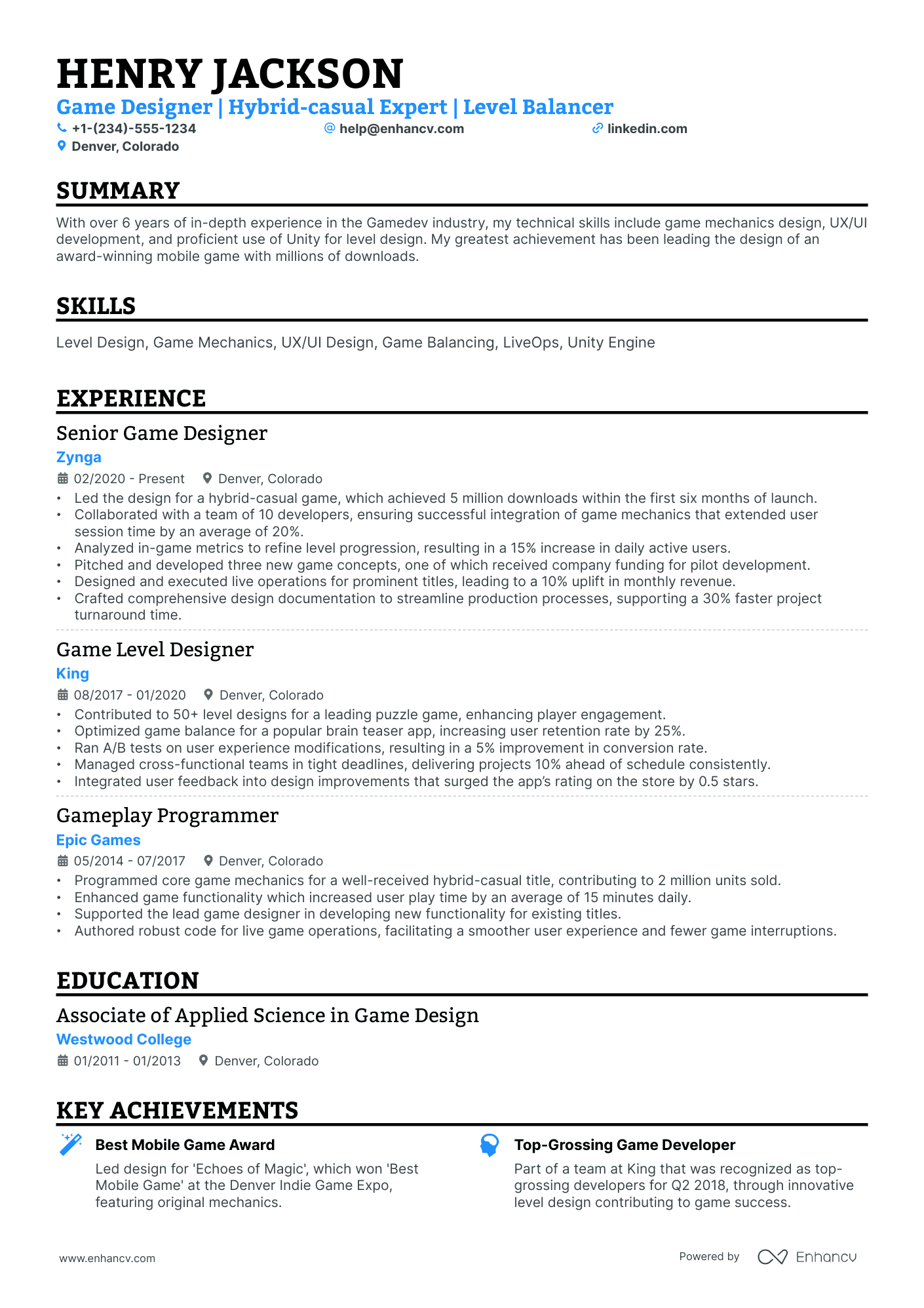
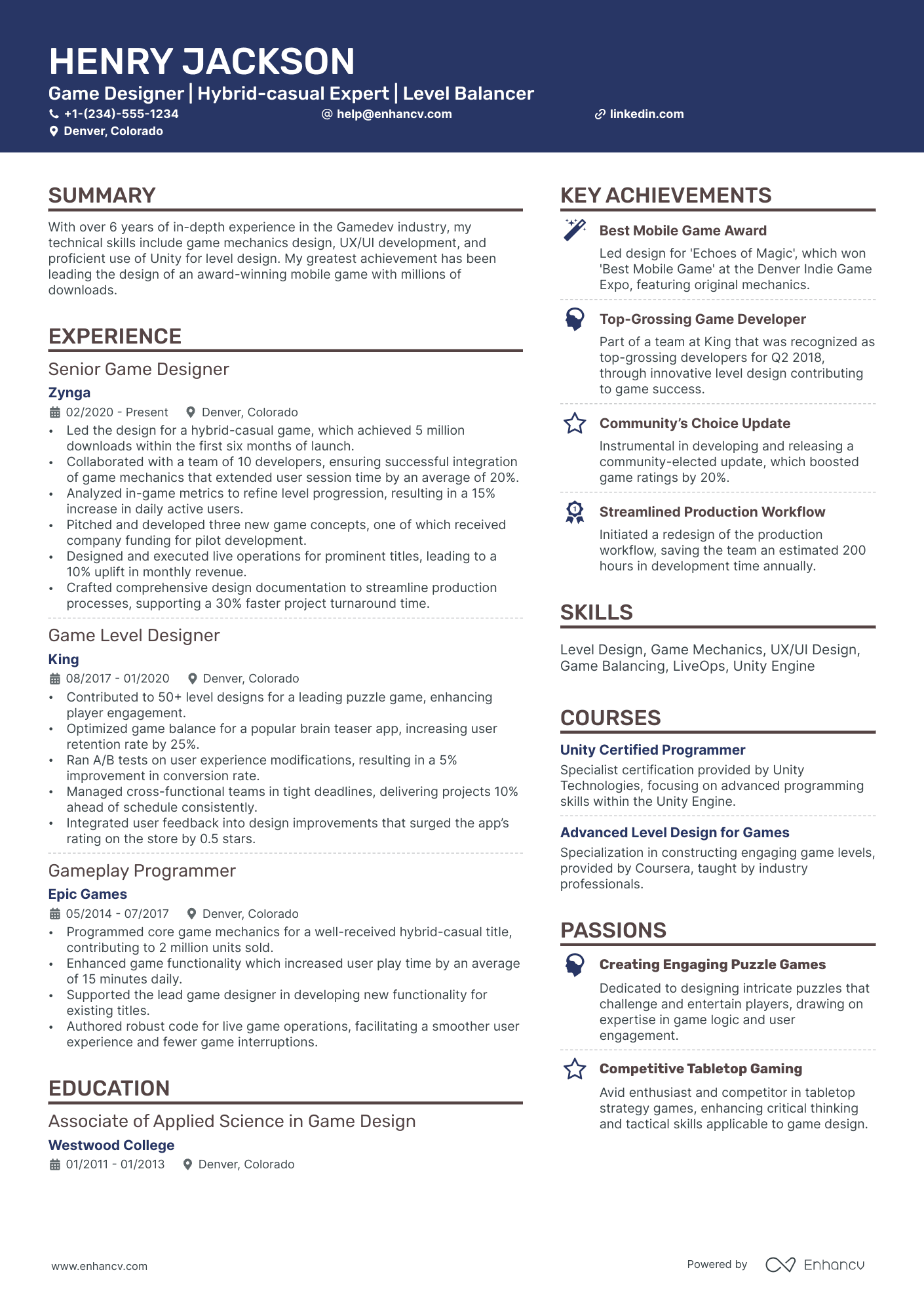
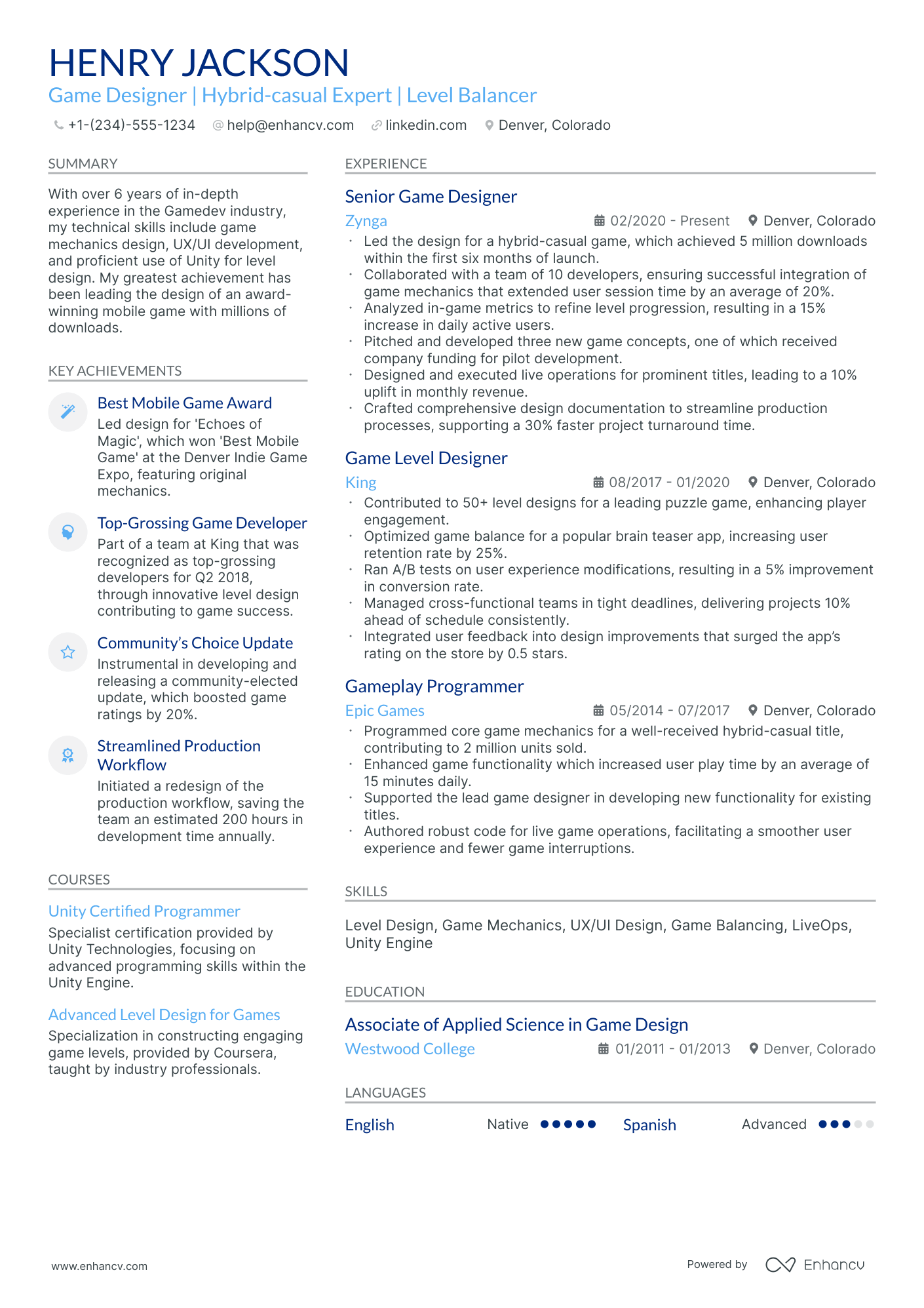
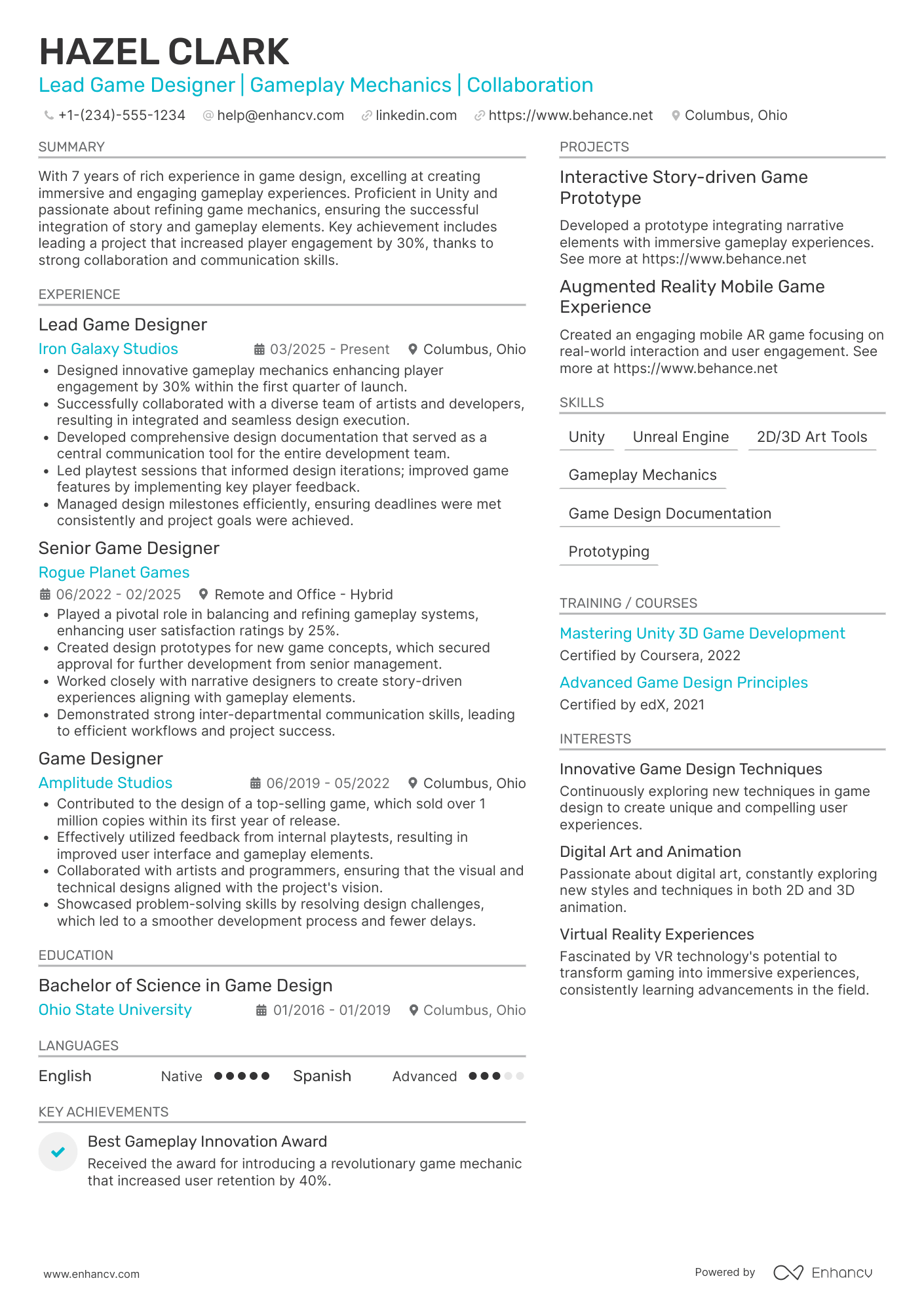
Most game designer resumes fail because they read like feature checklists and bury design decisions, player impact, and cross-functional ownership. This game designer resume guide shows how to pass ATS filters and earn attention in fast recruiter scans. If you need a broader foundation first, learn how to write a resume that communicates value before diving into game-design specifics.
A strong resume proves outcomes, not tools. You'll highlight retention lifts, session length gains, economy balance improvements, shipped levels and systems, fewer bugs from clearer specs, and smoother production through aligned milestones. You'll show measurable impact on players and revenue.

Key takeaways
- Anchor every experience bullet to a measurable outcome like retention, revenue, or delivery speed.
- Use reverse-chronological format if you have shipped titles and professional design experience.
- Mirror the job posting's exact tools, engines, and design terminology throughout your resume.
- Lead with a projects section when you lack full-time game design experience.
- Pair hard skills with proof—name the tool, describe the action, and quantify the result.
- Write a three- to four-line summary stating your title, domain, core tools, and top achievement.
- Use Enhancv to turn vague task descriptions into focused, metric-driven resume bullets.
Job market snapshot for game designers
We analyzed 56 recent game designer job ads across major US job boards. These numbers help you understand top companies hiring, experience requirements, role specialization trends at a glance.
What level of experience employers are looking for game designers
| Years of Experience | Percentage found in job ads |
|---|---|
| 1–2 years | 7.1% (4) |
| 3–4 years | 7.1% (4) |
| 5–6 years | 25.0% (14) |
| 7–8 years | 5.4% (3) |
| Not specified | 55.4% (31) |
Game designer ads by area of specialization (industry)
| Industry (Area) | Percentage found in job ads |
|---|---|
| Finance & Banking | 46.4% (26) |
| Education | 23.2% (13) |
Role overview stats
These tables show the most common responsibilities and employment types for game designer roles. Use them to align your resume with what employers expect and to understand how the role is structured across the market.
Day-to-day activities and top responsibilities for a game designer
| Responsibility | Percentage found in job ads |
|---|---|
| Game design | 30.4% (17) |
| Excel | 28.6% (16) |
| Statistics | 17.9% (10) |
| Combinatorics | 14.3% (8) |
| Probability theory | 14.3% (8) |
| Unity | 14.3% (8) |
| Visual design tools | 12.5% (7) |
| 3d game graphics programming | 10.7% (6) |
| Artificial intelligence | 10.7% (6) |
| C++ | 10.7% (6) |
| Data analysis | 10.7% (6) |
| Digital animation | 10.7% (6) |
Type of employment (remote vs on-site vs hybrid)
| Employment type | Percentage found in job ads |
|---|---|
| On-site | 53.6% (30) |
| Hybrid | 30.4% (17) |
| Remote | 16.1% (9) |
How to format a game designer resume
Recruiters evaluating game designer resumes prioritize a strong portfolio of shipped titles, proficiency with industry-standard tools like Unity or Unreal Engine, and evidence of creative problem-solving within production constraints. A clear, well-structured format ensures these signals surface quickly during the 6–8 seconds a recruiter typically spends on an initial scan and helps your resume pass through an applicant tracking system (ATS) without stripping critical information. Choosing the right resume format is the first step toward making that impression count.

I have significant experience in this role—which format should I use?
Use a reverse-chronological format to lead with your most recent and relevant game design work. Do:
- Highlight the scope of each role—specify team size, project phase ownership (concept, prototyping, production, live ops), and the genres or platforms you designed for.
- List role-specific tools and domains prominently, including engines (Unity, Unreal), scripting languages, level design software, documentation tools like Confluence or JIRA, and specializations such as systems design, narrative design, or economy balancing.
- Anchor every bullet to a measurable outcome or business impact rather than a task description.
I'm junior or switching into this role—what format works best?
Use a hybrid format that leads with a targeted skills section, then supports it with chronological experience or project entries. Do:
- Place a skills section near the top that groups your strongest game design competencies—level design, prototyping, balancing, player psychology—so recruiters and ATS filters catch them immediately.
- Feature game jam entries, personal projects, modding work, or cross-disciplinary experience (such as UX design or software development) as standalone entries with clear descriptions of your design contributions.
- Connect every action you describe to a specific, observable result so hiring managers can evaluate your impact even without traditional industry titles.
Why not use a functional resume?
A functional format groups skills without tying them to specific projects, timelines, or roles, which makes it difficult for recruiters to verify your hands-on design experience and nearly impossible for ATS software to parse your career trajectory accurately. Functional resumes can make sense in a narrow set of circumstances:
- You're transitioning from a related field (such as QA, programming, or UX) and need to reframe transferable skills around game design competencies.
- You have a gap in employment but continued designing through game jams, mods, or personal projects during that period.
- A functional format is acceptable only when you have no professional or substantial project-based game design experience to order chronologically—and even then, every skill listed must be tied to a concrete project, deliverable, or measurable outcome.
Once your layout and formatting choices are in place, the next step is determining which sections to include so each one reinforces your qualifications effectively.
What sections should go on a game designer resume
Recruiters expect a game designer resume to quickly show your shipped work, design strengths, and measurable impact on player experience and game outcomes. Understanding which resume sections to include helps you organize this information for maximum clarity.
Use this structure for maximum clarity:
- Header
- Summary
- Experience
- Skills
- Projects
- Education
- Certifications
- Optional sections: Awards, Leadership, Languages
Strong experience bullets should emphasize shipped titles or milestones, your design ownership, and results such as retention, engagement, monetization, balance, or production efficiency.
Is your resume good enough?
Drop your resume here or choose a file. PDF & DOCX only. Max 2MB file size.
Once you’ve organized your resume with the right core components, the next step is to write the experience section in a way that clearly supports and strengthens each one.
How to write your game designer resume experience
The experience section is where you prove you can ship games—not just talk about them. Hiring managers want to see the systems you designed, the tools and methods you applied, and the measurable outcomes your work produced, because demonstrated impact always outweighs a descriptive task list. Building a targeted resume that aligns each bullet with the role's priorities makes this section even more effective.
Each entry should include:
- Job title
- Company and location (or remote)
- Dates of employment (month and year)
Three to five concise bullet points showing what you owned, how you executed, and what outcomes you delivered:
- Ownership scope: the game systems, mechanics, levels, modes, or feature sets you were directly accountable for, including the platforms, audiences, or project phases they served.
- Execution approach: the design tools, prototyping methods, engines, scripting languages, or frameworks you used to build, test, and iterate on your designs.
- Value improved: the changes your work drove in player engagement, retention, balance, accessibility, performance, or overall game quality.
- Collaboration context: how you partnered with artists, engineers, producers, narrative designers, QA, audio teams, or external partners to move your designs from concept through ship.
- Impact delivered: the results your contributions produced, expressed through player-facing outcomes, project milestones, revenue influence, or studio-level priorities rather than a list of daily activities.
Experience bullet formula
A game designer experience example
✅ Right example - modern, quantified, specific.
Senior Game Designer (Systems & Economy)
Nebula Forge Studios | Austin, TX
2022–Present
Mid-size mobile studio shipping a top-grossing live-service RPG with 2M+ monthly active users.
- Architected progression, currency sinks, and reward loops in Excel and Machinations; improved Day 7 retention by 6.4% and increased average revenue per daily active user by 4.1% after two A/B tests in Unity Remote Config.
- Prototyped and tuned combat abilities and itemization in Unity (C#) using ScriptableObjects; reduced time-to-balance from ten days to four days by partnering with engineering on reusable tuning pipelines.
- Built telemetry specs and dashboards in Amplitude and BigQuery; identified a mid-game difficulty spike and shipped tuning changes that cut level-fail rate by 18% and reduced support tickets by 12%.
- Led cross-functional feature pods with product managers, user experience designers, and engineers to ship a seasonal event cadence; delivered eight events on schedule and lifted monthly active users by 9% during event windows.
- Authored and maintained a living game design document in Confluence and Jira with clear acceptance criteria; lowered rework hours by 15% by aligning stakeholders on scope, edge cases, and success metrics before implementation.
Now that you've seen how a strong experience section looks in practice, let's break down how to customize yours to match the specific job you're targeting.
How to tailor your game designer resume experience
Recruiters evaluate your game designer resume through both human review and applicant tracking systems, so alignment with the job posting matters. Tailoring your resume to the job description ensures your most relevant work surfaces quickly during both screening methods.
Ways to tailor your game designer experience:
- Match specific game engines and design tools named in the posting.
- Mirror the exact terminology used for design methodologies or workflows.
- Reflect metrics or KPIs the employer highlights for player engagement.
- Include genre or platform experience that aligns with the studio's portfolio.
- Emphasize accessibility or UX standards when the role references them.
- Highlight cross-discipline collaboration models the job description specifies.
- Incorporate balancing or systems design language that matches their framework.
- Reference live service or iteration processes if the posting mentions them.
Tailoring means aligning your real accomplishments with what the role demands, not forcing disconnected keywords into your experience bullets.
Resume tailoring examples for game designer
| Job description excerpt | Untailored | Tailored |
|---|---|---|
| "Design and balance gameplay systems for a live-service multiplayer title using Unreal Engine 5, collaborating closely with engineering and QA teams." | Worked on game systems and collaborated with different teams. | Designed and iterated on core gameplay systems for a live-service multiplayer shooter in Unreal Engine 5, partnering with engineering and QA to ship bi-weekly balance patches that reduced player churn by 14%. |
| "Create detailed game design documents (GDDs) for new features, define player progression loops, and use data analytics to validate design decisions." | Wrote design documents and helped plan game features. | Authored comprehensive GDDs for a prestige-based player progression system across 40+ levels, then used Mixpanel analytics to validate loop engagement, increasing average session length from 22 to 31 minutes. |
| "Prototype and playtest narrative-driven quest content in Unity, incorporating player feedback to refine puzzles, pacing, and reward structures." | Helped design quests and made changes based on feedback. | Prototyped 15 narrative-driven quests in Unity, leading weekly playtests with 30+ participants and restructuring puzzle difficulty curves and reward pacing based on qualitative feedback, which lifted quest completion rates by 23%. |
Once you’ve aligned your experience with the role’s priorities, quantify your game designer achievements to show the measurable impact behind those choices.
How to quantify your game designer achievements
Quantifying your achievements proves your designs changed player behavior and shipped reliably. Focus on retention, monetization, balance quality, iteration speed, and live-ops risk, backed by A B tests, telemetry dashboards, and bug tracking data.
Quantifying examples for game designer
| Metric | Example |
|---|---|
| Retention lift | "Improved Day one retention from 34% to 39% by redesigning the tutorial flow using Unity Analytics funnels and five playtests." |
| Monetization rate | "Increased conversion to first purchase from 2.1% to 2.8% by tuning starter bundles and store layout in A B tests with Firebase Remote Config." |
| Balance quality | "Reduced overpowered hero win-rate variance from 18% to 7% by adjusting cooldowns and damage curves, validated across 120,000 ranked matches." |
| Delivery speed | "Cut iteration cycle from nine days to five by standardizing feature specs, Jira templates, and weekly playtest cadences across design and engineering." |
| Live-ops risk | "Lowered post-release critical issues from twelve to four per update by adding pre-launch checklists, telemetry alerts, and bug bash gates in TestRail." |
Turn vague job duties into measurable, recruiter-ready resume bullets in seconds with Enhancv's Bullet Point Generator.
Once your bullet points clearly convey your accomplishments, the next step is ensuring your skills section reinforces that experience with the right mix of hard and soft skills.
How to list your hard and soft skills on a game designer resume
Your skills section shows how you design fun, balanced systems and ship content, and recruiters and ATS scan it for role keywords—aim for a mix weighted toward hard skills, with a smaller set of role-specific soft skills.
game designer roles require a blend of:
- Product strategy and discovery skills
- Data, analytics, and experimentation skills
- Delivery, execution, and go-to-market discipline
- Soft skills
Your skills section should be:
- Scannable (bullet-style grouping).
- Relevant to the job post.
- Backed by proof in experience bullets.
- Updated with current tools.
Place your skills section:
- Above experience if you're junior or switching careers
- Below experience if you're mid/senior with strong achievements

Hard skills
- Game design documentation, design specs
- Core loop and progression design
- Economy and monetization balancing
- Combat, abilities, and tuning
- Level design, encounter scripting
- Unity, Unreal Engine
- Blueprint visual scripting
- C#, C++ basics
- Jira, Confluence
- SQL, Excel, Looker
- A/B testing, feature flags
Soft skills
- Write clear, testable requirements
- Align design goals with product outcomes
- Lead cross-functional feature reviews
- Prioritize scope for on-time delivery
- Use playtest feedback to iterate
- Communicate trade-offs and risks early
- Advocate for player experience with data
- Collaborate with engineering on feasibility
- Partner with art on visual readability
- Own feature quality through release
How to show your game designer skills in context
Skills shouldn't live only in a bulleted skills section. You can explore common resume skills across roles to see how top candidates present theirs.
They should be demonstrated in:
- Your summary (high-level professional identity)
- Your experience (proof through outcomes)
Here's what that looks like in practice.
Summary example
Senior game designer with 10 years crafting narrative-driven RPGs. Skilled in Unreal Engine, systems balancing, and cross-discipline collaboration. Led a combat redesign that boosted player retention by 18% across two live-service titles.
- Signals senior-level expertise immediately
- Names industry-standard tools and methods
- Includes a concrete, measurable metric
- Highlights collaboration as a soft skill
Experience example
Senior Game Designer
Ironpeak Studios | Remote
March 2019–June 2024
- Redesigned the core progression system in Unity, increasing average session length by 22% within three months of launch.
- Partnered with narrative designers and engineers to prototype 12 encounter types, shipping all on schedule using Jira workflows.
- Conducted weekly playtests and analyzed telemetry data to balance difficulty curves, reducing early-stage churn by 15%.
- Every bullet includes measurable proof.
- Skills appear naturally through real outcomes.
Once you’ve tied your design abilities to concrete examples and outcomes, the next step is to apply that approach to writing a game designer resume with no experience so your strengths still come through clearly.
How do I write a game designer resume with no experience
Even without full-time experience, you can demonstrate readiness through projects and self-directed work. Our guide on writing a resume without work experience covers this approach in detail. Consider building:
- Playable prototypes in Unity.
- Game jam team submissions.
- Tabletop rule sets and tests.
- Level blockouts with grayboxing.
- Modding maps or balance patches.
- Usability playtests with reports.
- Design documents with iterations.
- Analytics from playtest telemetry.
Focus on:
- Shipped prototypes with links.
- Clear design goals and constraints.
- Iteration backed by playtest data.
- Systems thinking shown in mechanics.
Resume format tip for entry-level game designer
Use a combination resume format because it highlights projects and skills first, while still showing relevant education and work history. Do:
- Put a Projects section first.
- Link to builds, videos, repos.
- Quantify results from playtests.
- Name tools: Unity, Miro, Jira.
- Show iterations across versions.
- Built a Unity prototype and iterated across five playtests, raising tutorial completion from 62% to 88% using Miro flow fixes and Jira-tracked changes.
Even without professional experience, your education section can demonstrate the foundational knowledge and relevant coursework that qualify you for a game designer role.
How to list your education on a game designer resume
Your education section helps hiring teams confirm you have foundational knowledge in design, programming, or interactive media. It validates your academic preparation for the game designer role.
Include:
- Degree name
- Institution
- Location
- Graduation year
- Relevant coursework (for juniors or entry-level candidates)
- Honors & GPA (if 3.5 or higher)
Skip month and day details—list only the graduation year.
Here's a strong education entry tailored to a game designer resume.
Example education entry
Bachelor of Fine Arts in Game Design
DigiPen Institute of Technology, Redmond, WA
Graduated 2022
GPA: 3.7
- Relevant Coursework: Level Design, Game Mechanics, 3D Modeling, Interactive Storytelling, User Experience for Games
- Honors: Magna Cum Laude, Dean's List (six semesters)
How to list your certifications on a game designer resume
Certifications on your resume show your commitment to learning, confirm tool proficiency, and signal industry relevance as a game designer. They also help hiring teams quickly spot skills that match the role.
Include:
- Certificate name
- Issuing organization
- Year
- Optional: credential ID or URL
- Place certifications below education when they are older, less relevant, or you want your degree and coursework to lead.
- Place certifications above education when they are recent, highly relevant, or they prove critical tools and workflows for a game designer.
Best certifications for your game designer resume
Unity Certified Associate: Game Developer Unity Certified Professional: Programmer Unreal Engine Authorized Instructor Certification Autodesk Certified Professional: Maya ISTQB Certified Tester Foundation Level (CTFL) Certified ScrumMaster (CSM) Adobe Certified Professional: Photoshop
Once your credentials are positioned to reinforce your qualifications, you can write your game designer resume summary to highlight those strengths upfront.
How to write your game designer resume summary
Your resume summary is the first thing a recruiter reads. A sharp, specific opening builds instant credibility for a game designer role.
Keep it to three to four lines, with:
- Your title and total years of game design experience.
- The domain you work in, such as mobile, PC, console, or free-to-play.
- Core tools and skills like Unity, Unreal Engine, or systems design.
- One or two measurable achievements that show your impact.
- Soft skills tied to real outcomes, such as cross-team collaboration that shipped a feature on schedule.

PRO TIP
At a junior level, lead with relevant tools, transferable skills, and any early contributions to shipped projects or game jams. Avoid vague descriptors like "passionate" or "hard-working." Instead, show what you built, what tools you used, and what resulted from your work.
Example summary for a game designer
Game designer with two years of experience designing systems and levels in Unity for mobile titles. Contributed encounter mechanics that improved early-game retention by 14% across two shipped free-to-play projects.
Optimize your resume summary and objective for ATS
Drop your resume here or choose a file.
PDF & DOCX only. Max 2MB file size.
Now that your summary captures your strongest qualifications, make sure your header presents the essential contact and professional details recruiters need to reach you.
What to include in a game designer resume header
A resume header is the top section with your key details, and it boosts visibility, credibility, and recruiter screening for a game designer role.
Essential resume header elements
- Full name
- Tailored job title and headline
- Location
- Phone number
- Professional email
- GitHub link
- Portfolio link
A LinkedIn link helps recruiters verify experience quickly and supports screening.
Don't include a photo on a game designer resume unless the role is explicitly front-facing or appearance-dependent.
Keep the header to two lines, use one job title, and match the wording to the job posting to reduce screening errors.
Example
Game designer resume header
Jordan Lee
Game Designer | Systems and Level Design
Austin, TX
(512) 555-12XX
jordan.lee@enhancv.com github.com/jordanlee jordanlee.games linkedin.com/in/jordanlee
Once your resume header clearly identifies you and your role at a glance, you can strengthen your application with additional sections for game designer resumes that add relevant context and proof of fit.
Additional sections for game designer resumes
When your core qualifications align closely with other applicants, well-chosen additional sections can set your game designer resume apart. For example, listing language skills can be a differentiator when applying to studios with global audiences or localization needs.
- Languages
- Game jams and competitions
- Published game design documents or postmortems
- Hobbies and interests
- Professional affiliations and game industry memberships
- Speaking engagements or panel appearances
- Modding and indie projects
Once you've strengthened your resume with relevant extra sections, pairing it with a cover letter can further set your application apart.
Do game designer resumes need a cover letter
A cover letter isn't required for every game designer role, but it helps in competitive openings or studios that expect one. It can make a difference when your resume needs context, or when the team needs a clear fit signal. If you're unsure where to start, learn what a cover letter is and how it complements your resume.
Use a cover letter when it adds specific, role-relevant information:
- Explain role and team fit by matching your design strengths to the studio's genre, platform, tools, and collaboration style.
- Highlight one or two relevant projects with outcomes, such as retention changes, feature adoption, player feedback trends, or production wins.
- Show you understand the product, users, and business context by referencing the game's audience, constraints, monetization model, or live operations needs.
- Address career transitions or non-obvious experience by connecting prior work to game designer tasks, such as systems design, tuning, or cross-functional delivery.
Drop your resume here or choose a file.
PDF & DOCX only. Max 2MB file size.
Once you’ve decided whether to include a cover letter to add context beyond your resume, the next step is using AI to improve your game designer resume so it communicates your value more clearly and consistently.
Using AI to improve your game designer resume
AI can sharpen your resume's clarity, structure, and overall impact. It helps tighten language, highlight results, and align content with specific roles. But overuse strips authenticity. Once your resume reads clearly and fits the role, step away from AI. For a deeper look at effective prompts and workflows, see our guide on ChatGPT resume writing.
Here are 10 practical prompts you can copy and paste to strengthen each section of your game designer resume:
- Sharpen the summary. "Rewrite my game designer resume summary to highlight my core design strengths and years of experience in under four sentences."
- Quantify experience bullets. "Review my game designer experience bullets and suggest ways to add measurable results like player retention, engagement metrics, or launch outcomes."
- Tighten project descriptions. "Edit my game designer project descriptions to clearly state my role, the tools I used, and the final outcome of each project."
- Align skills strategically. "Compare my game designer skills section against this job posting and recommend which skills to prioritize or remove."
- Strengthen action verbs. "Replace weak or repeated verbs in my game designer experience section with specific, high-impact action verbs."
- Refine education details. "Rewrite the education section of my game designer resume to emphasize relevant coursework, capstone projects, or honors."
- Clarify certification value. "For each certification on my game designer resume, add a brief phrase explaining its practical relevance to game design roles."
- Remove filler language. "Identify and remove vague or redundant phrases throughout my game designer resume without changing the original meaning."
- Tailor to a posting. "Restructure my game designer resume bullets to mirror the priorities and language used in this specific job description."
- Audit for consistency. "Check my game designer resume for inconsistent formatting, tense shifts, or mismatched date formats and suggest corrections."
Stop using AI once your resume sounds accurate, specific, and aligned with real experience. AI should never invent experience or inflate claims—if it didn't happen, it doesn't belong here.
Conclusion
A strong game designer resume highlights measurable outcomes, role-specific skills, and a clear structure. It shows what you shipped, how you improved player experience, and the impact on retention, engagement, or revenue.
Keep each section focused, scannable, and tied to the job. When your game designer resume proves results with clean formatting and relevant skills, you show readiness for today’s hiring market and what’s next.