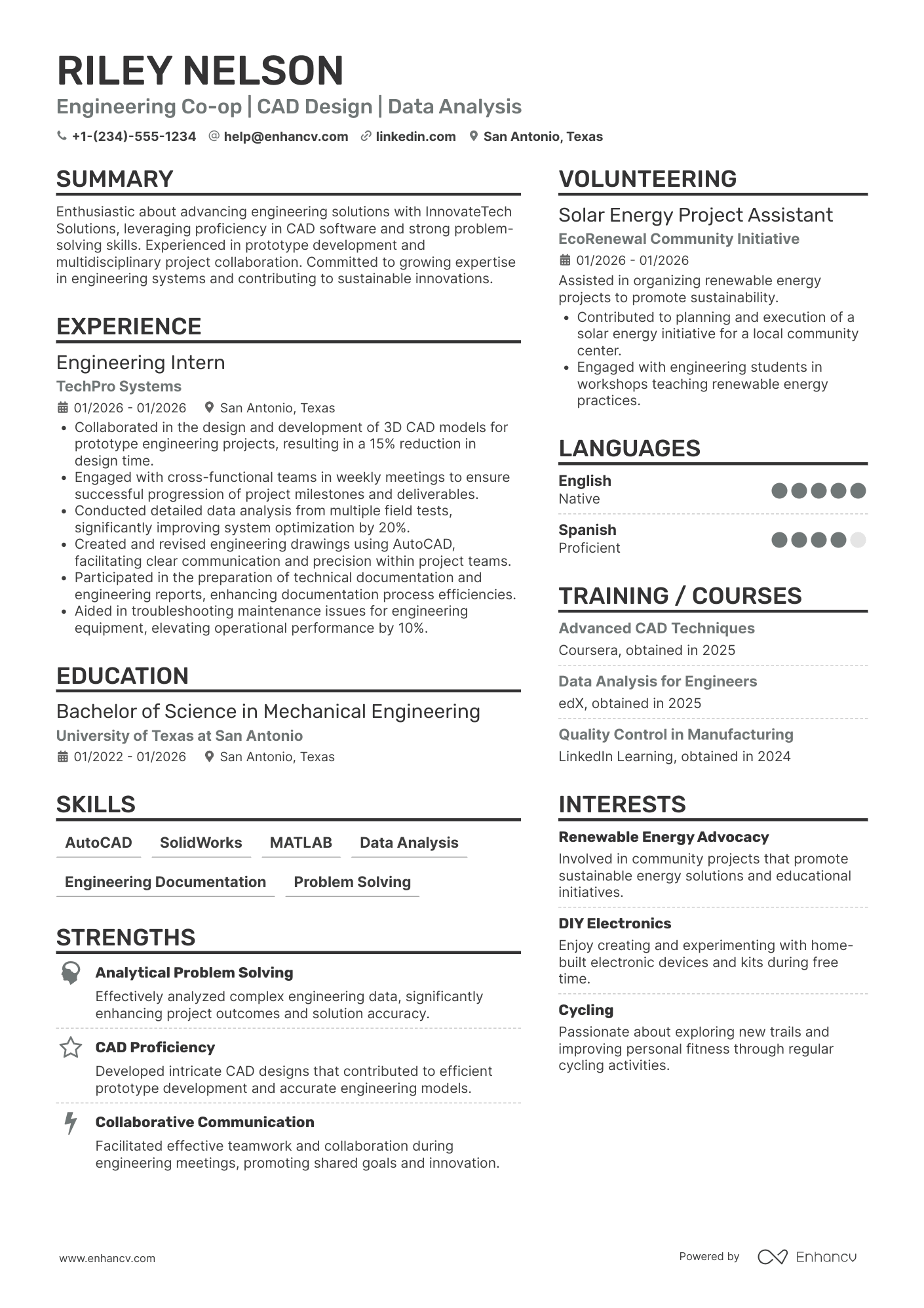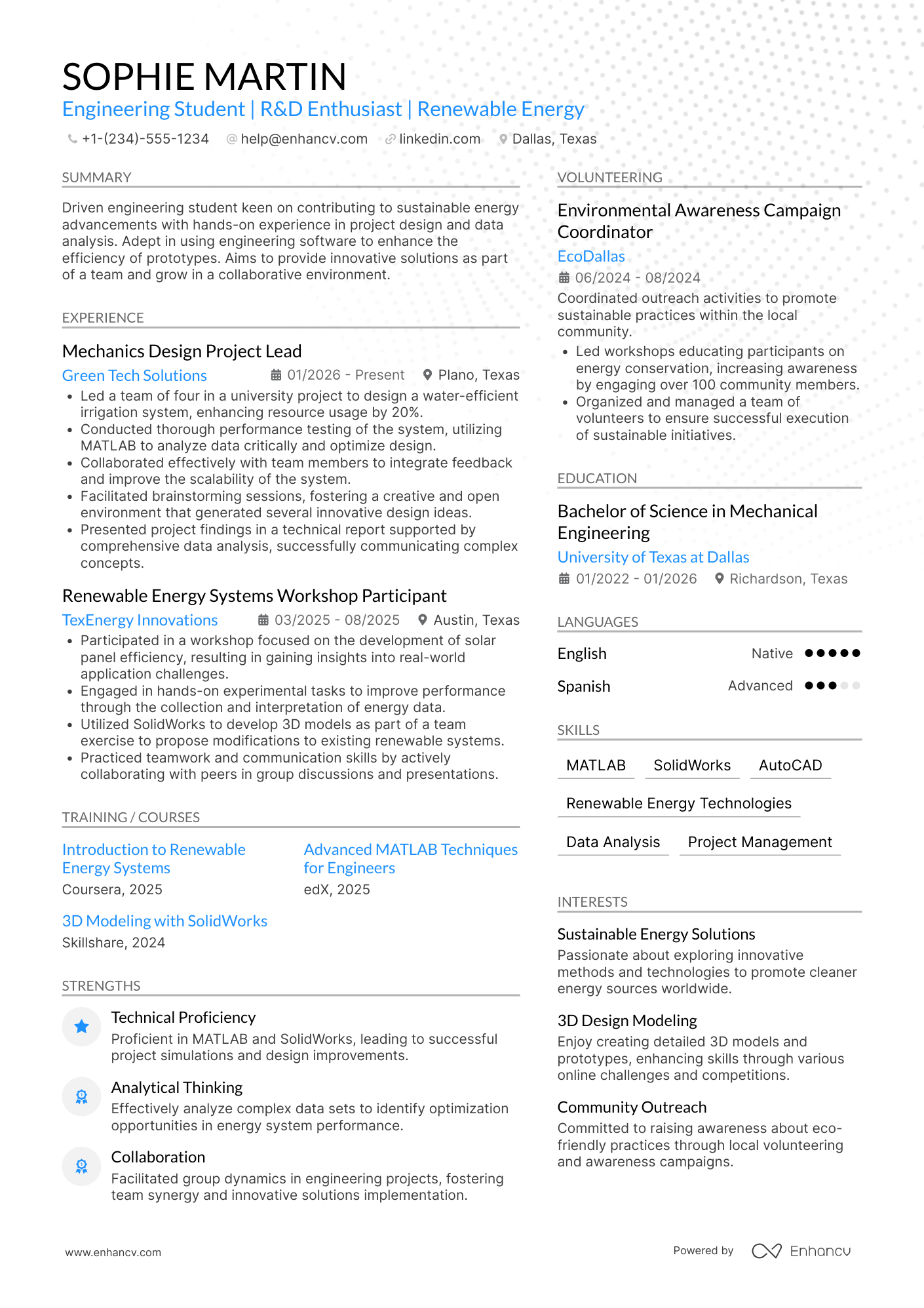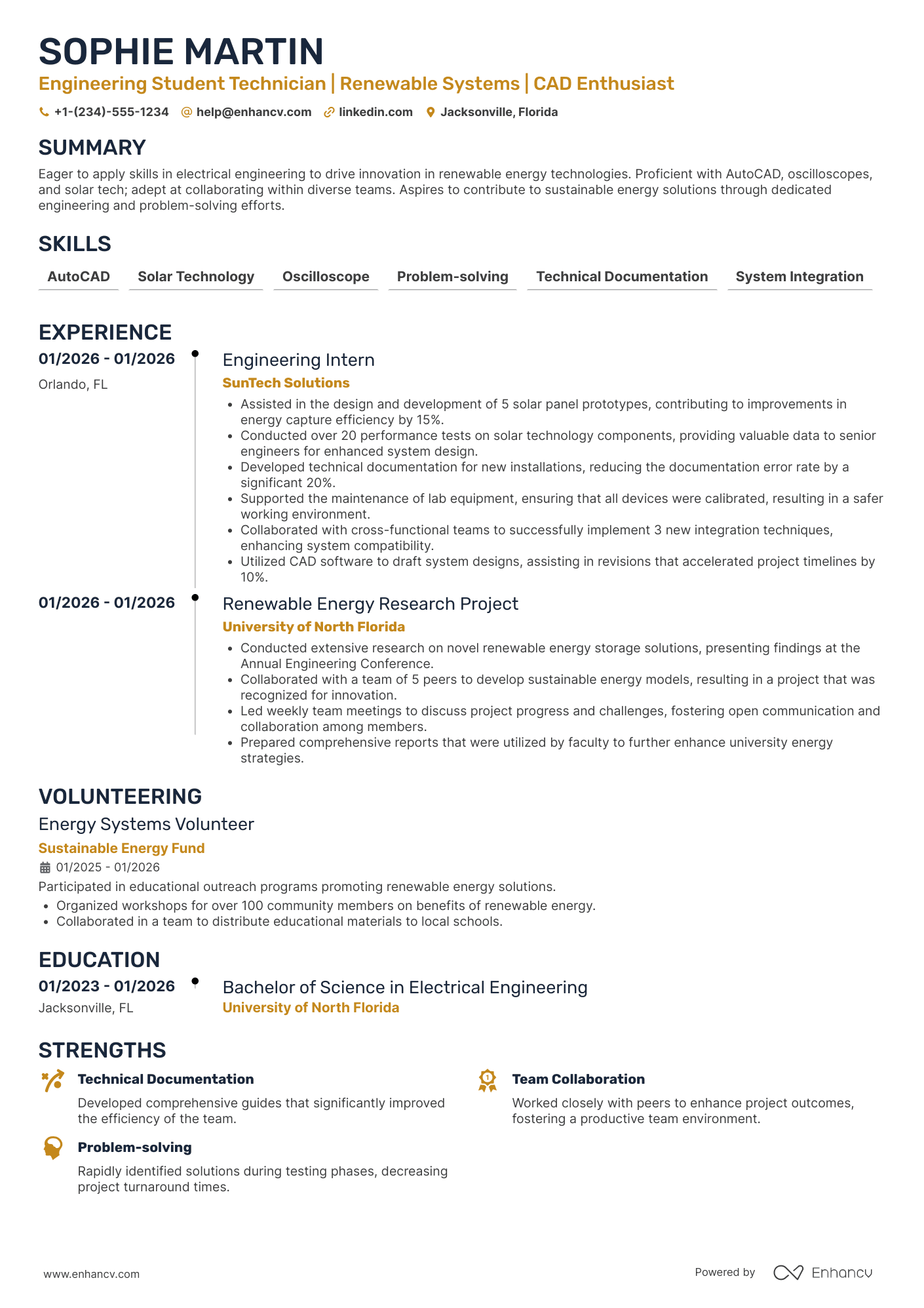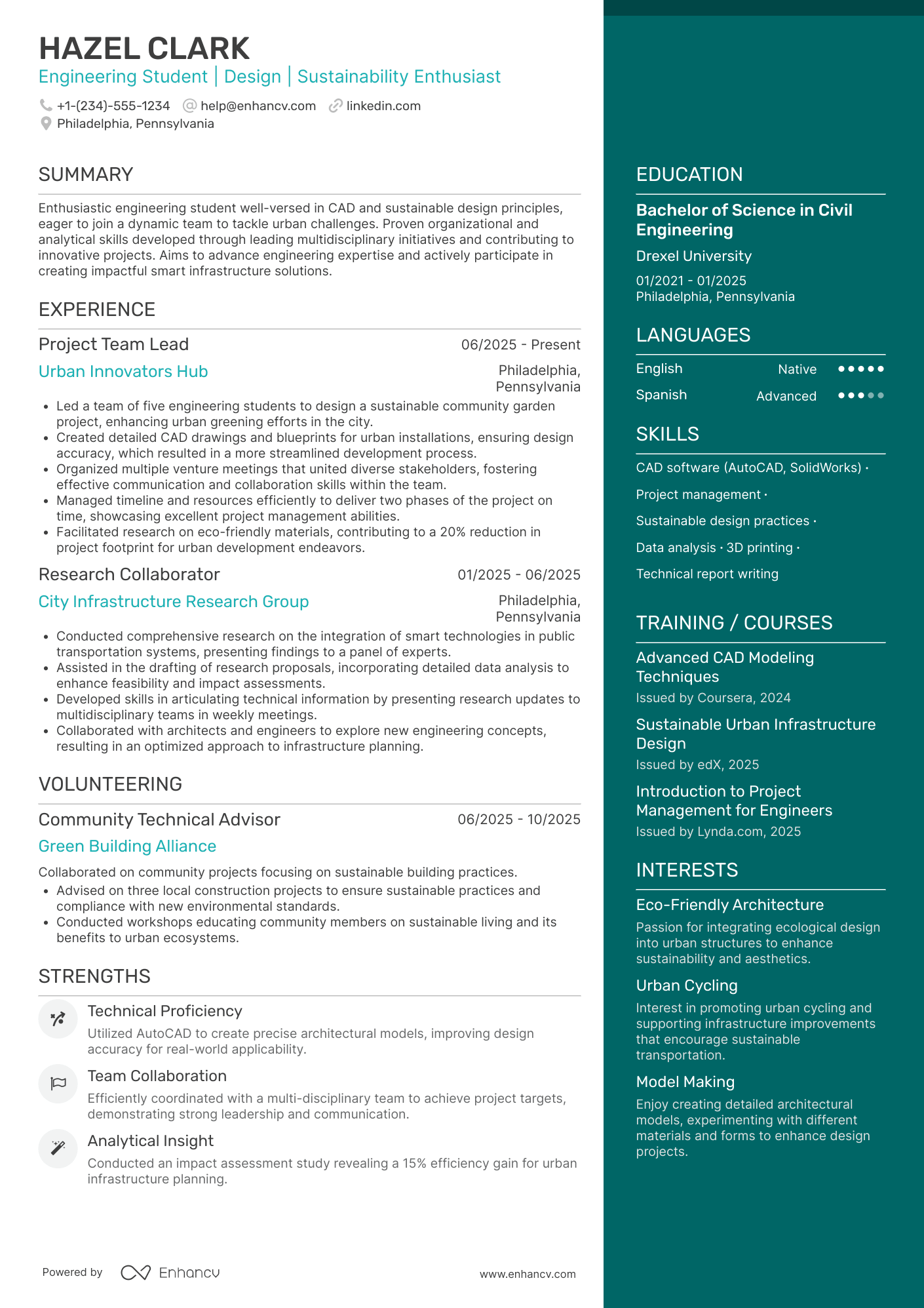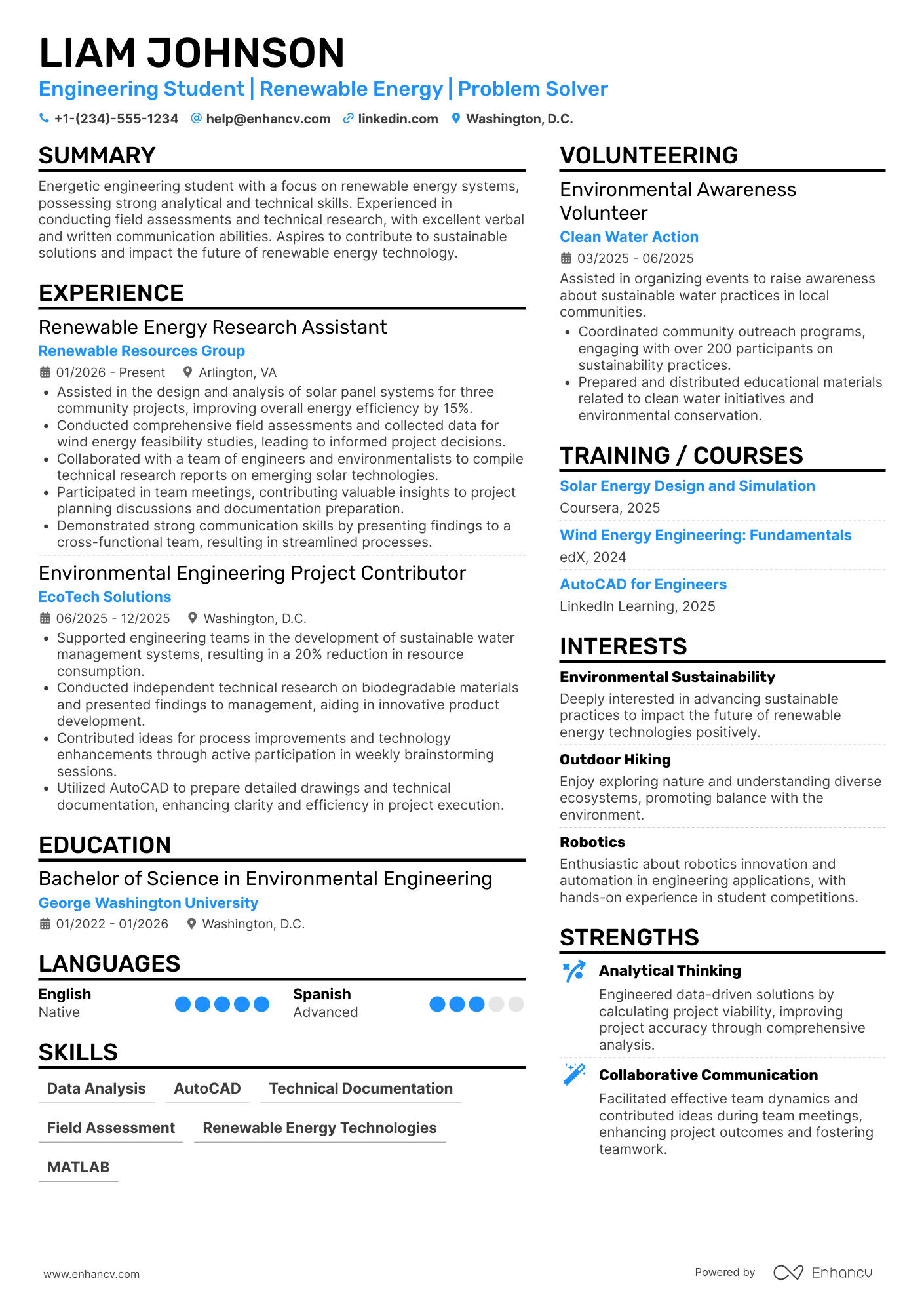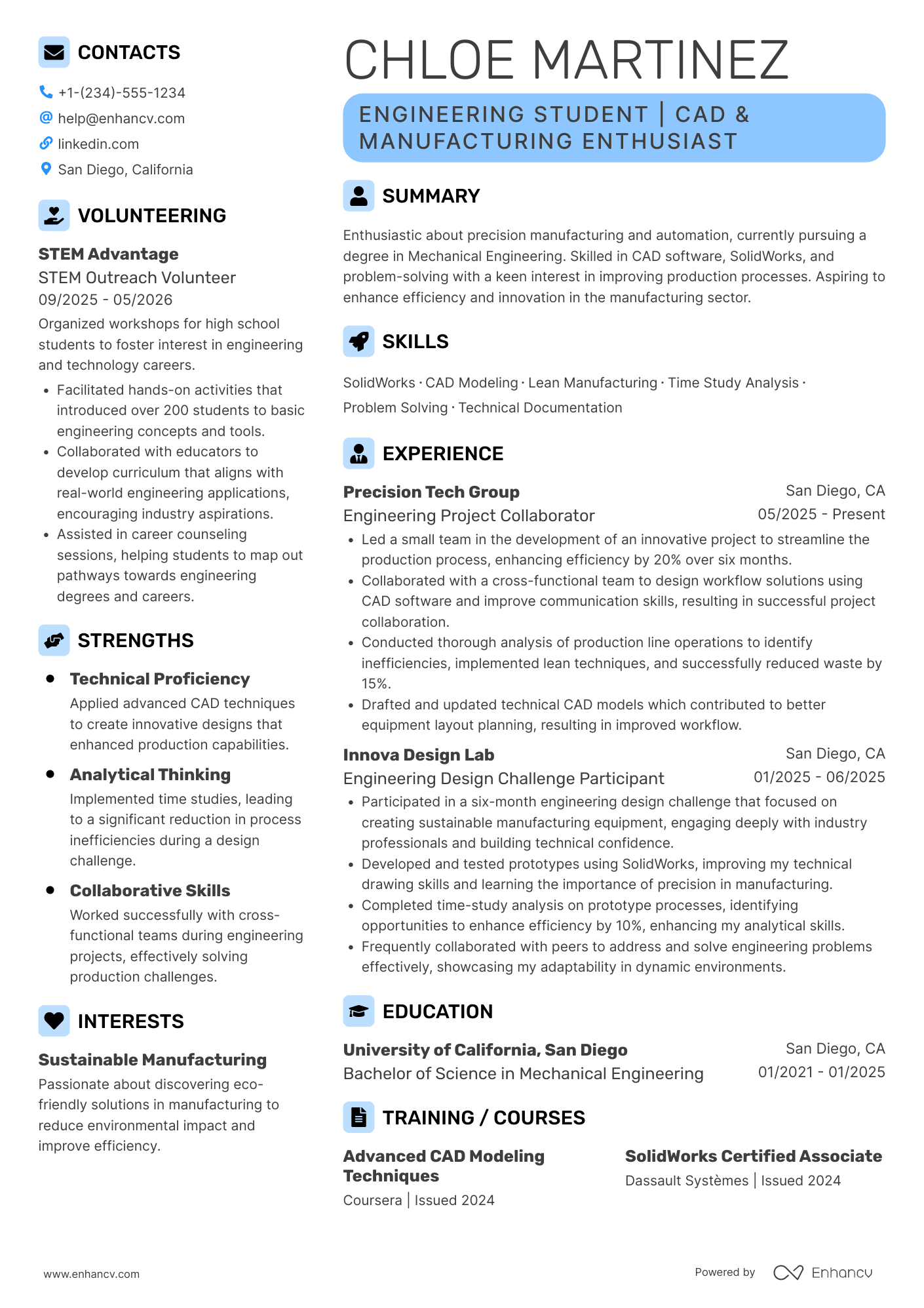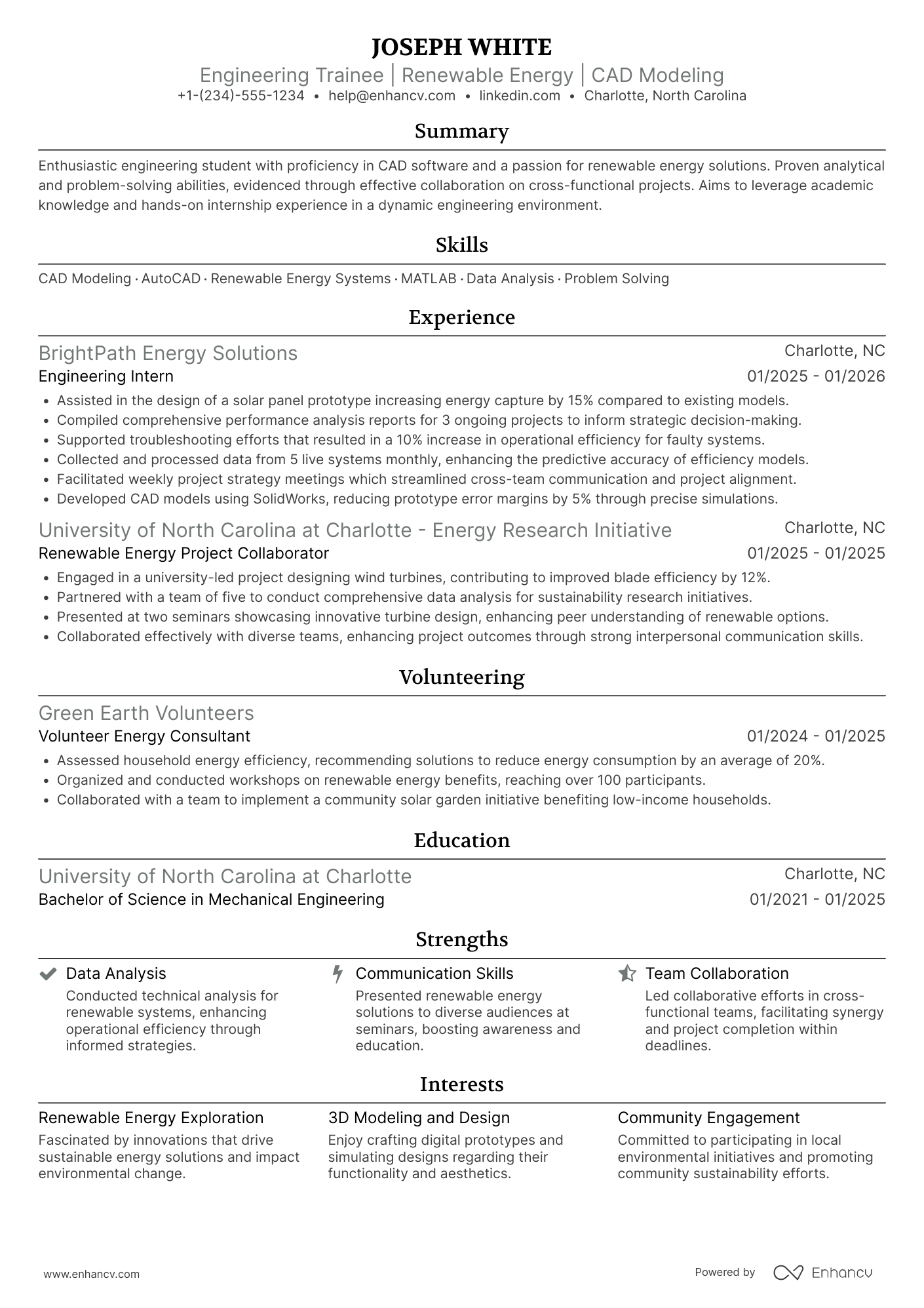
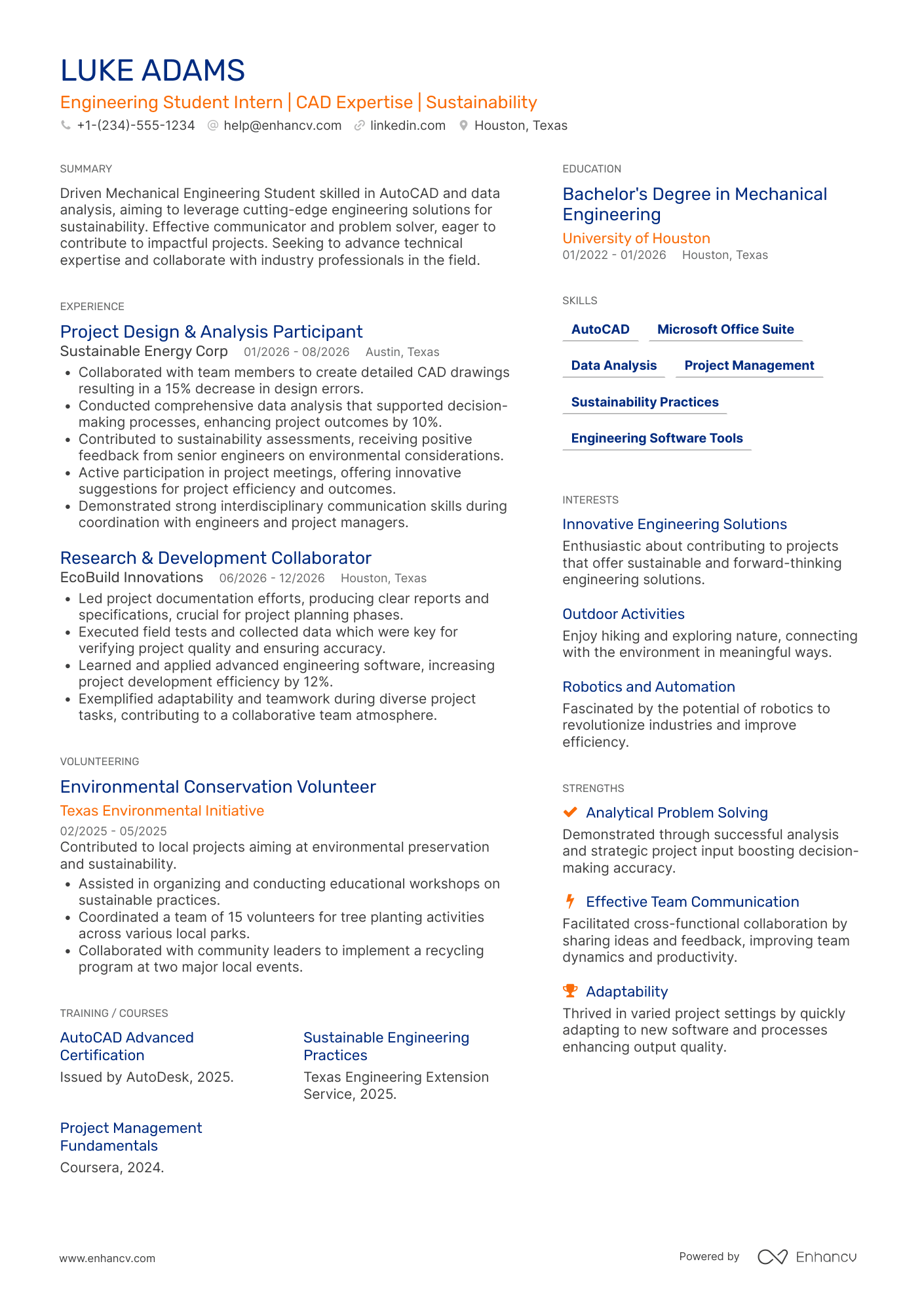
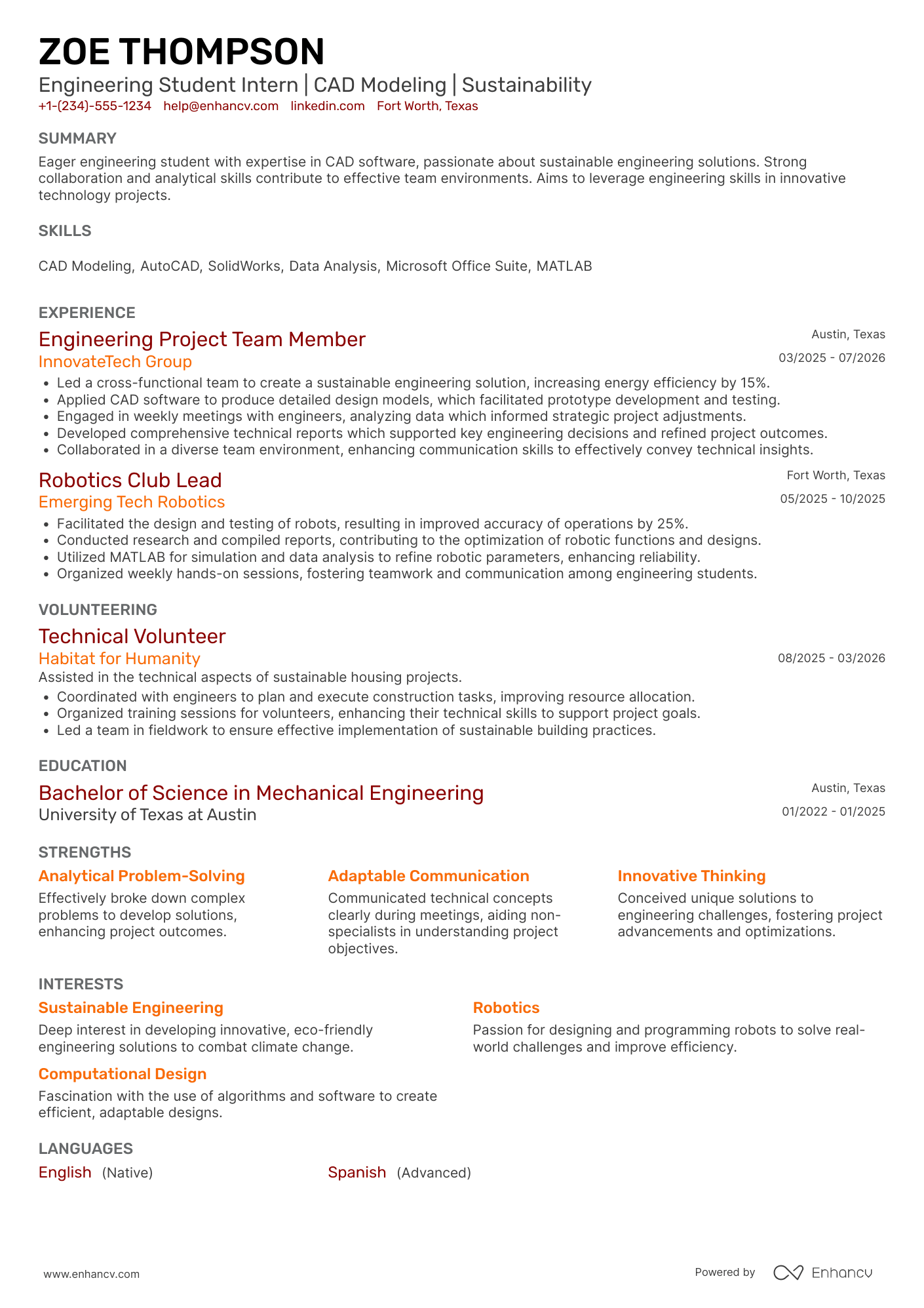
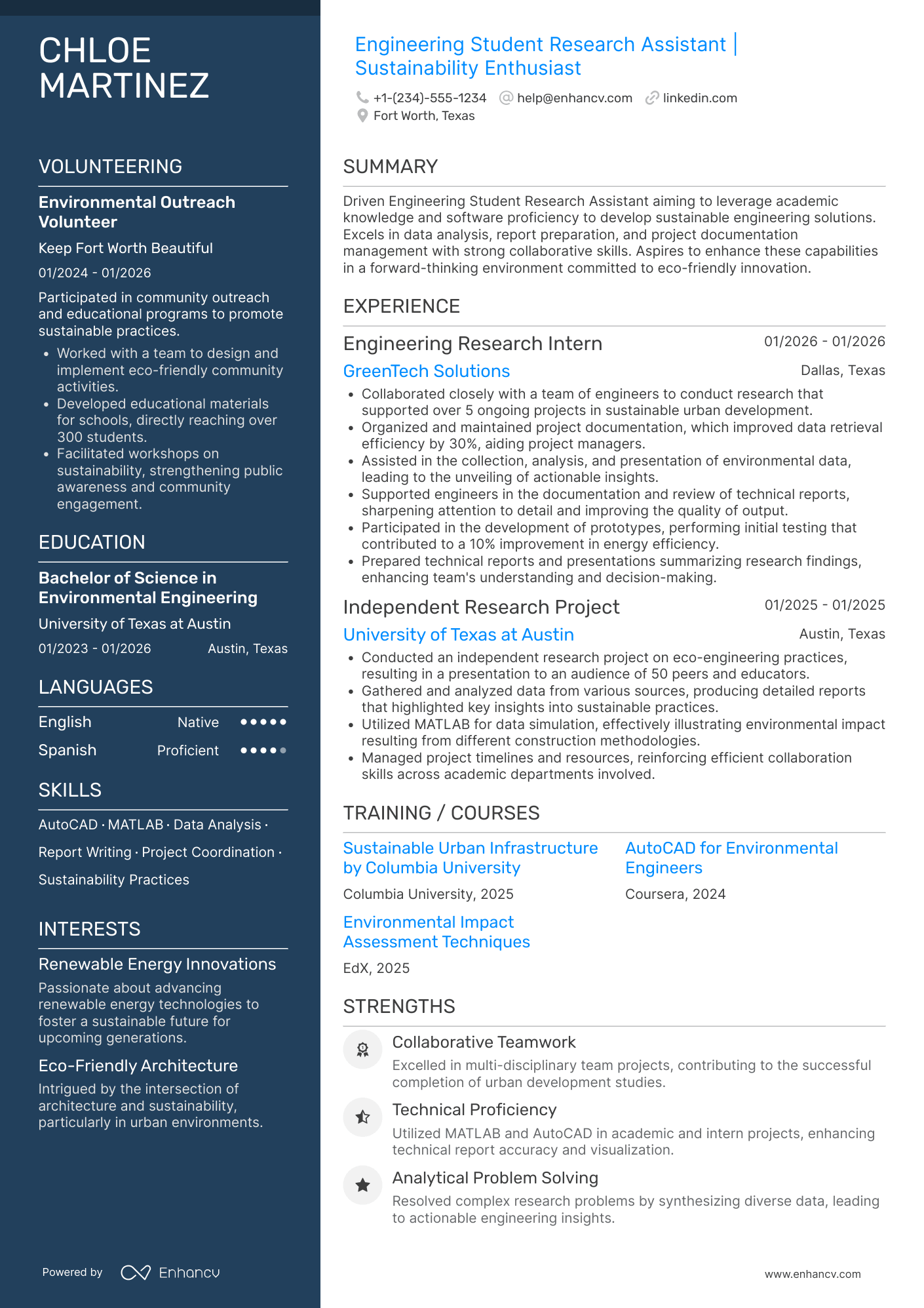
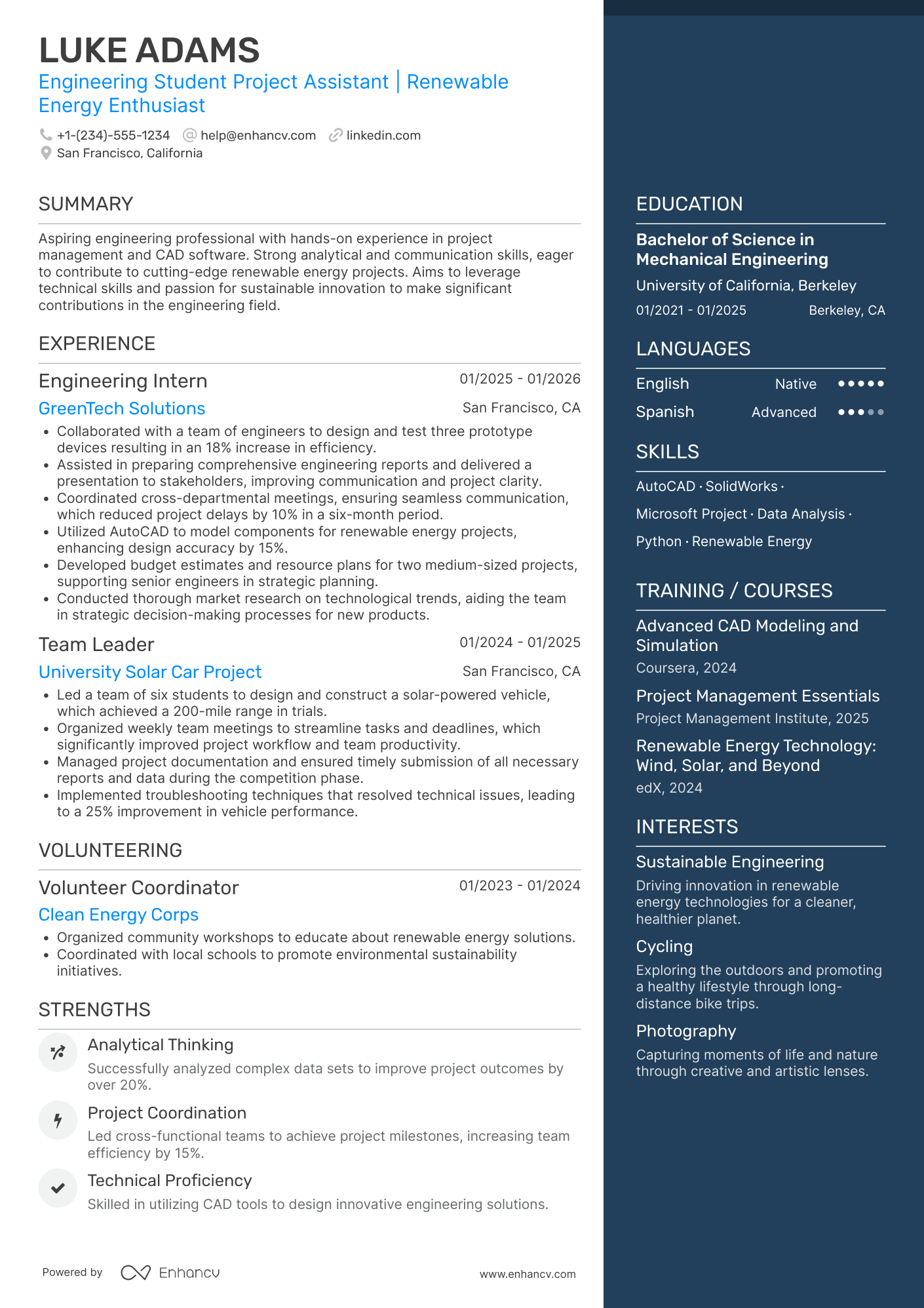
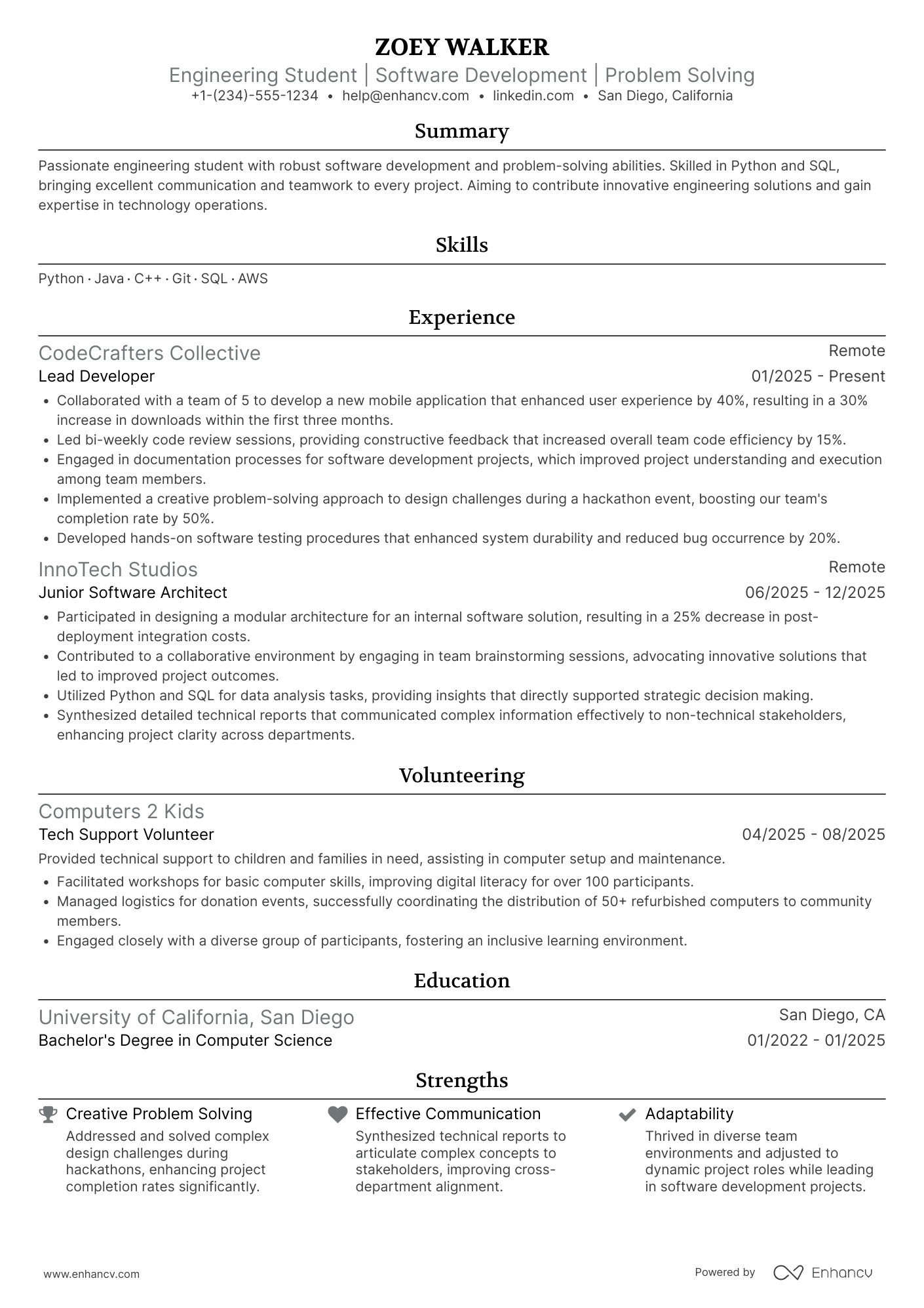
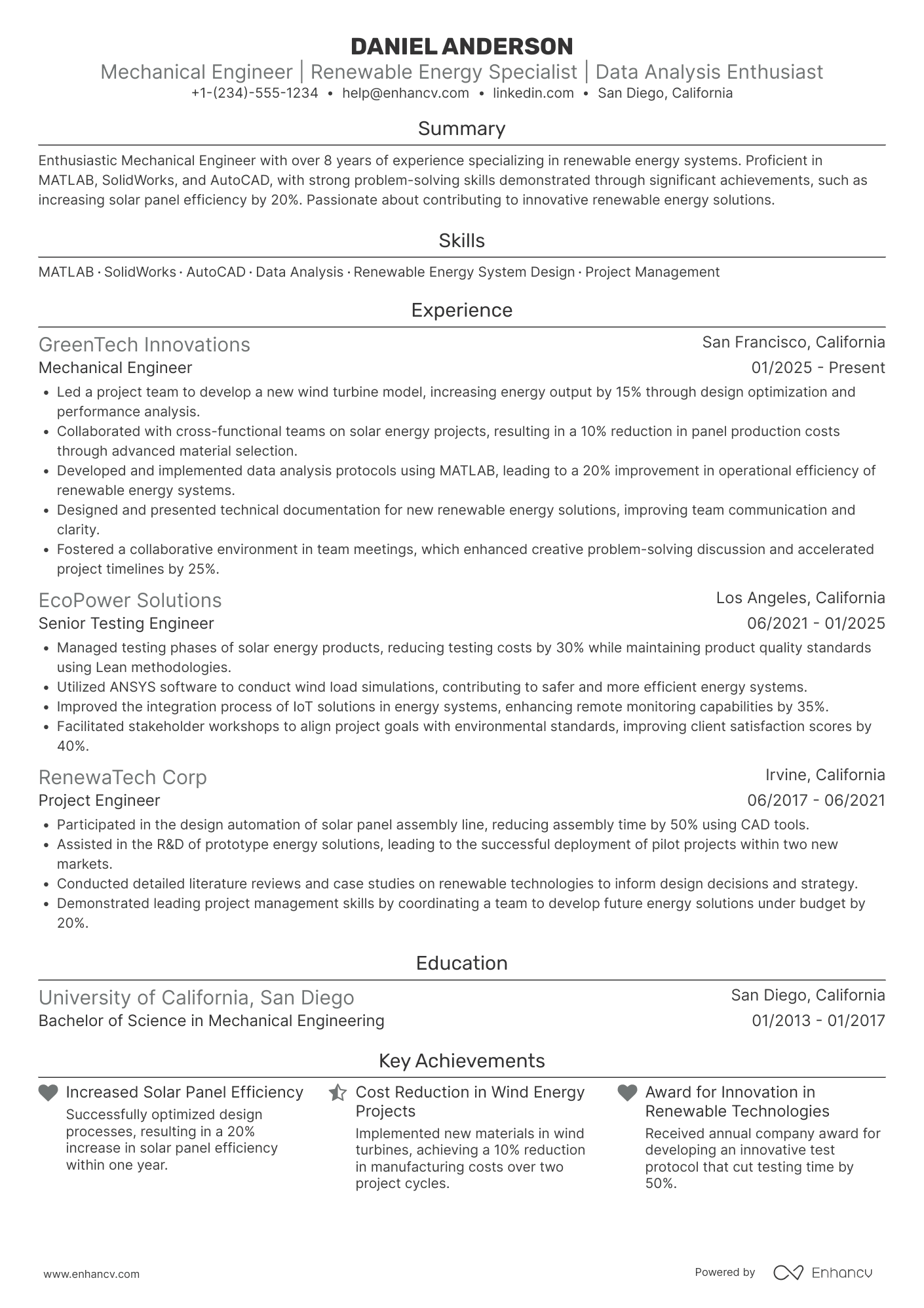
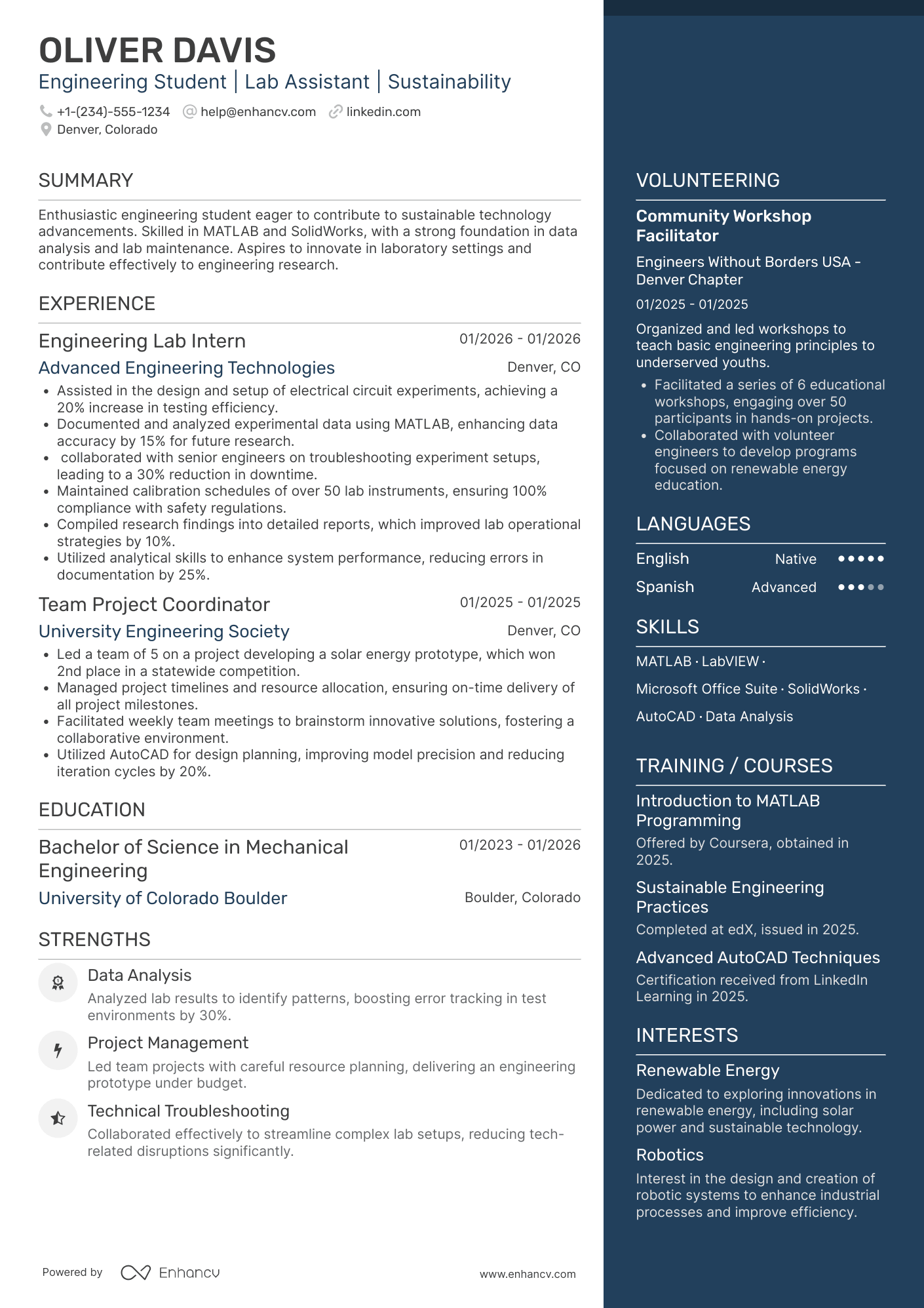
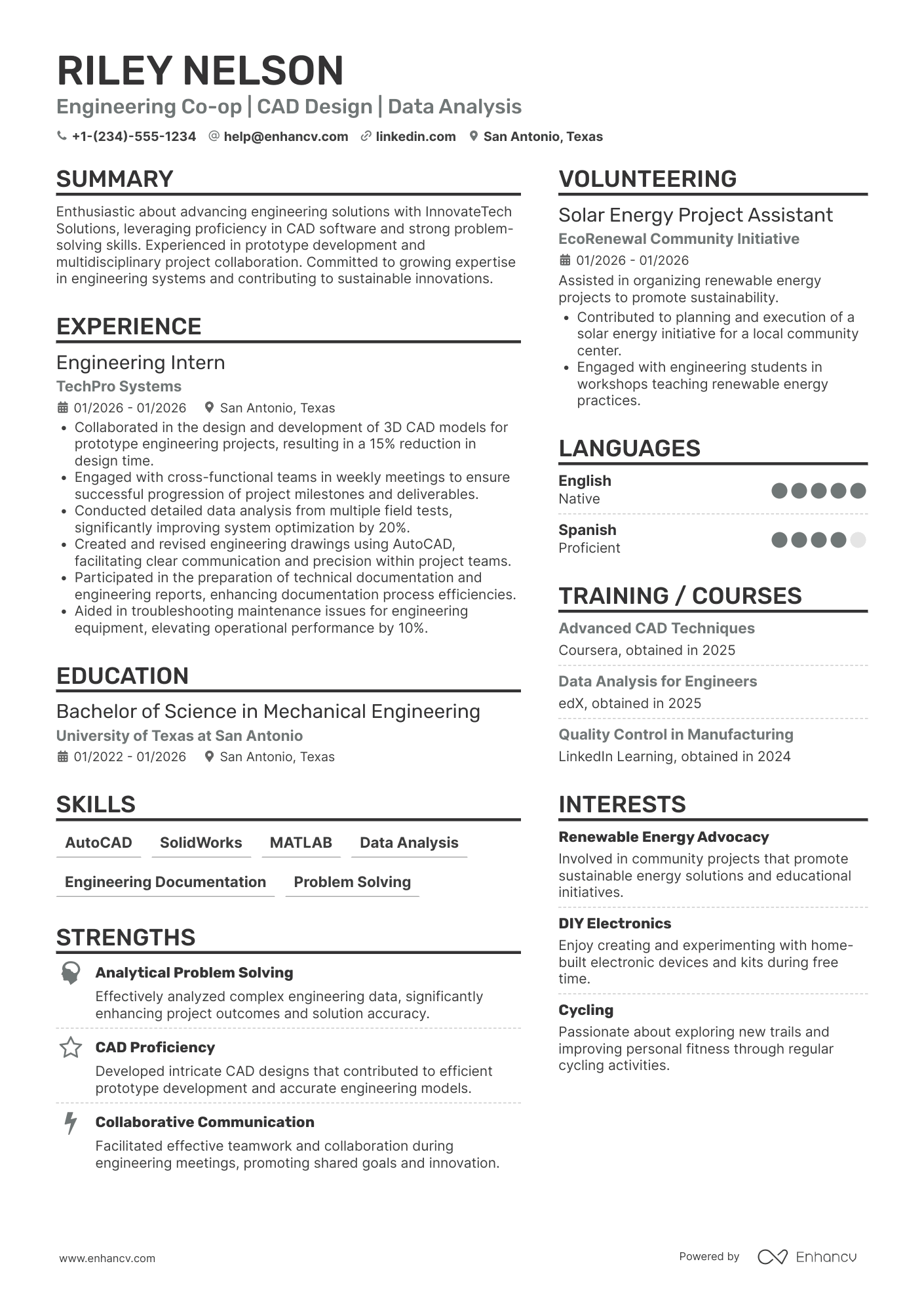
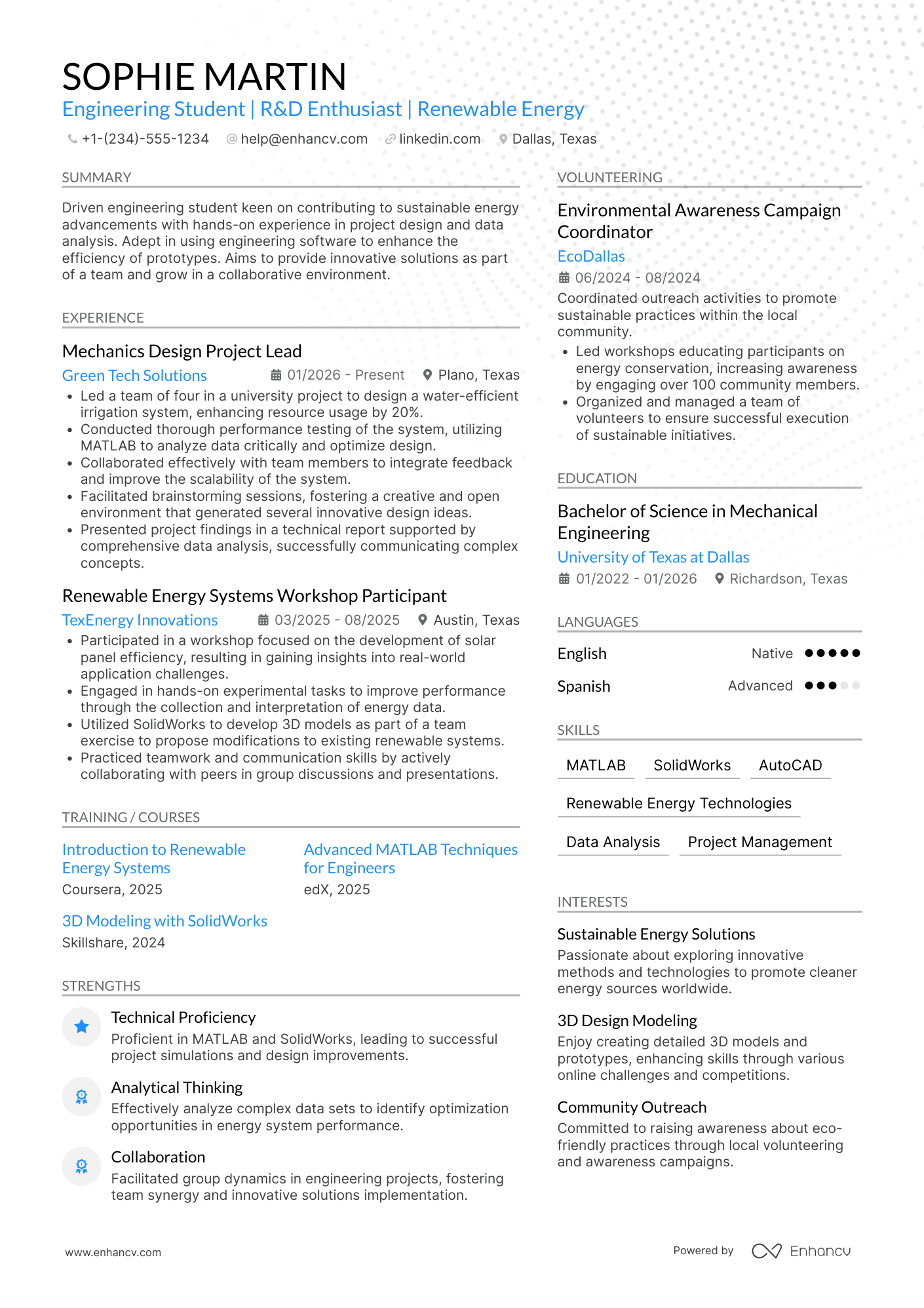
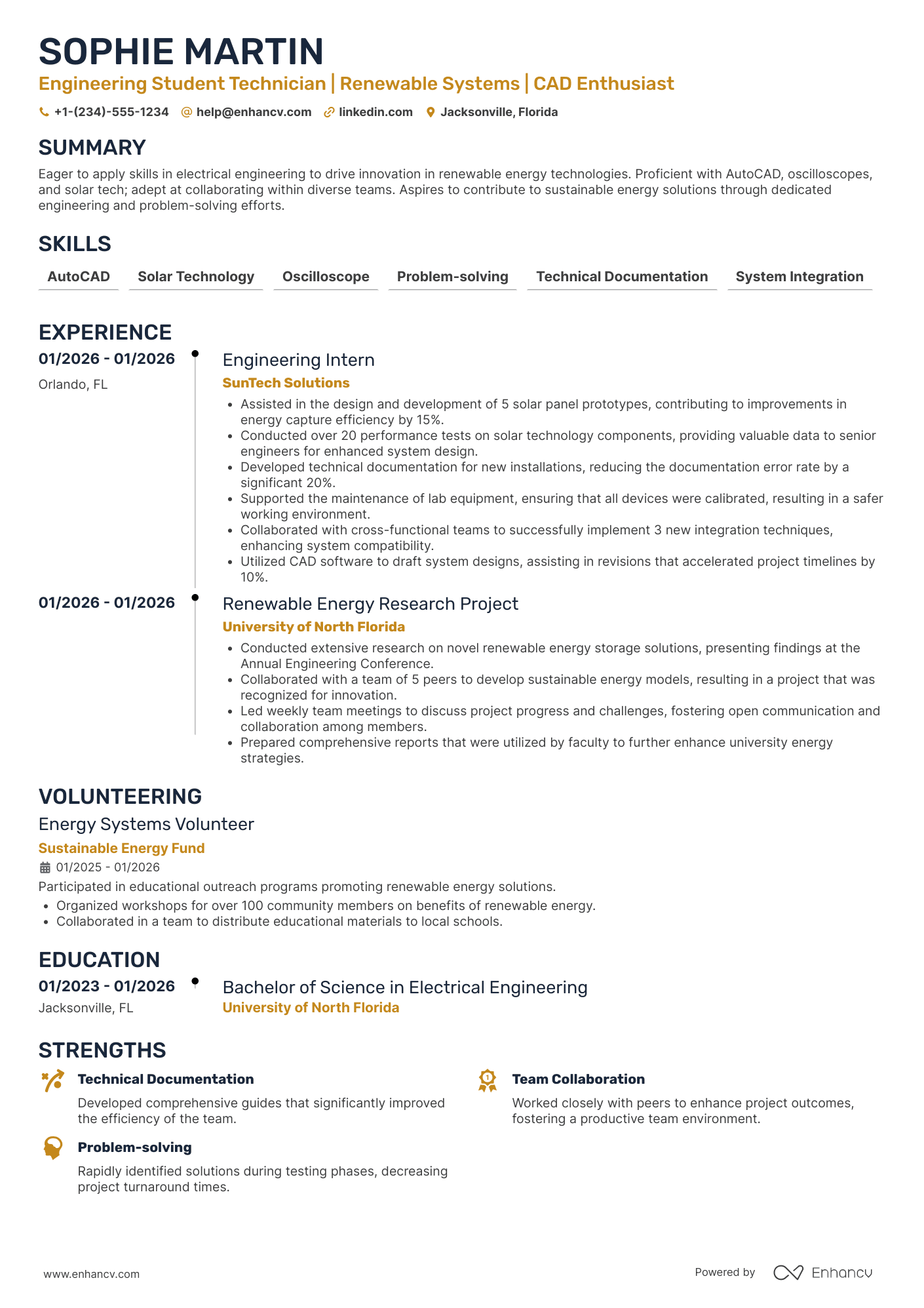
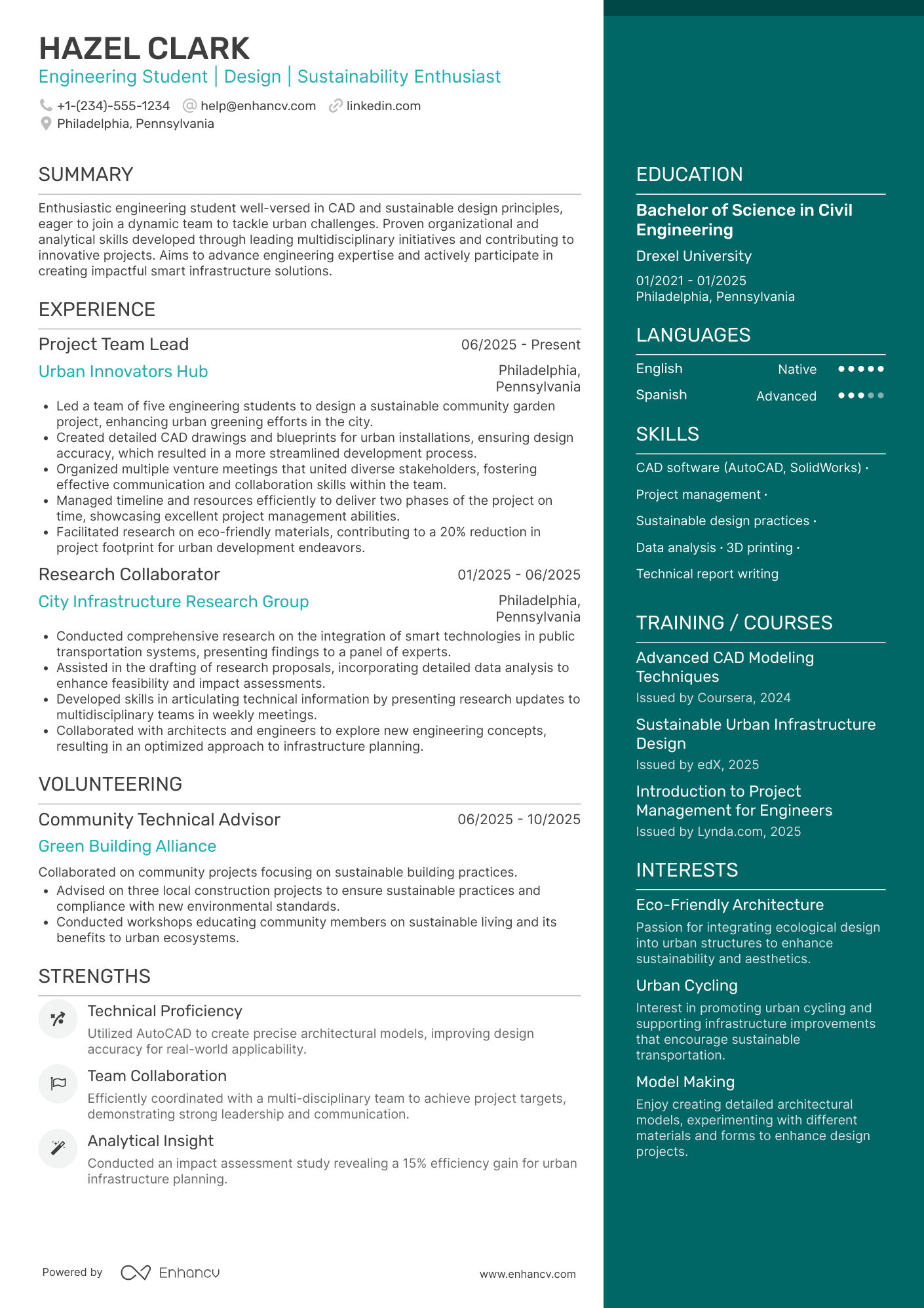
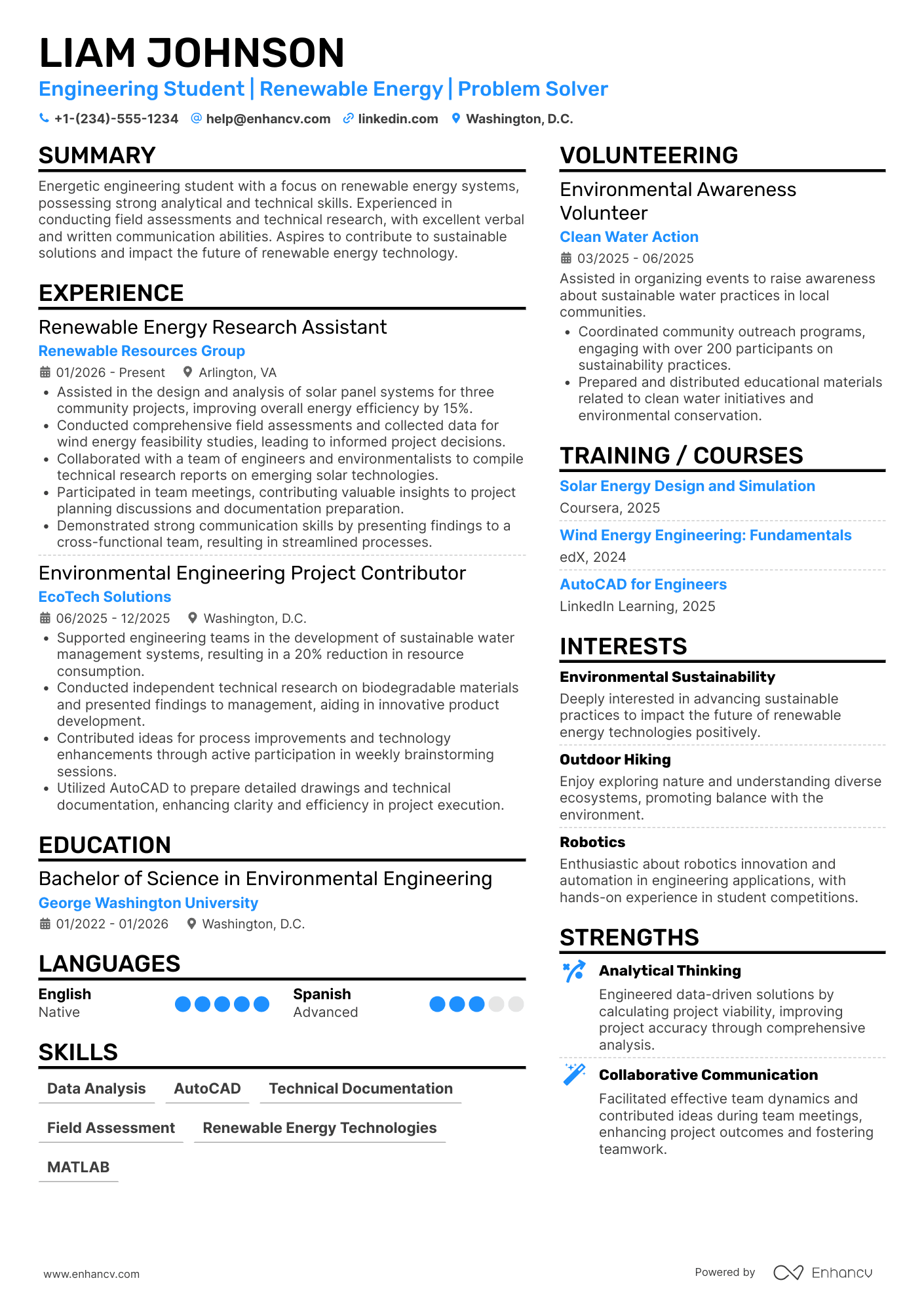
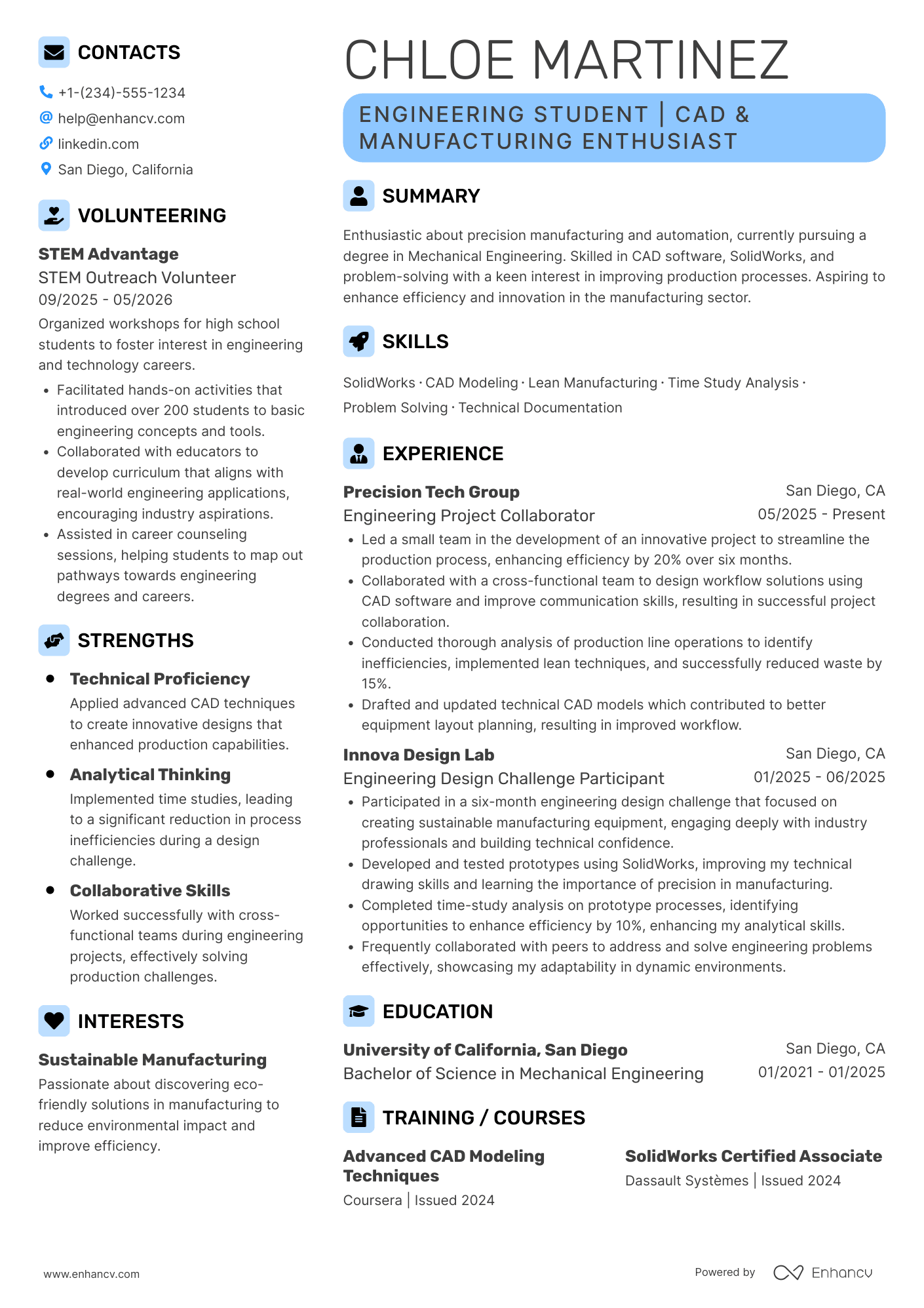
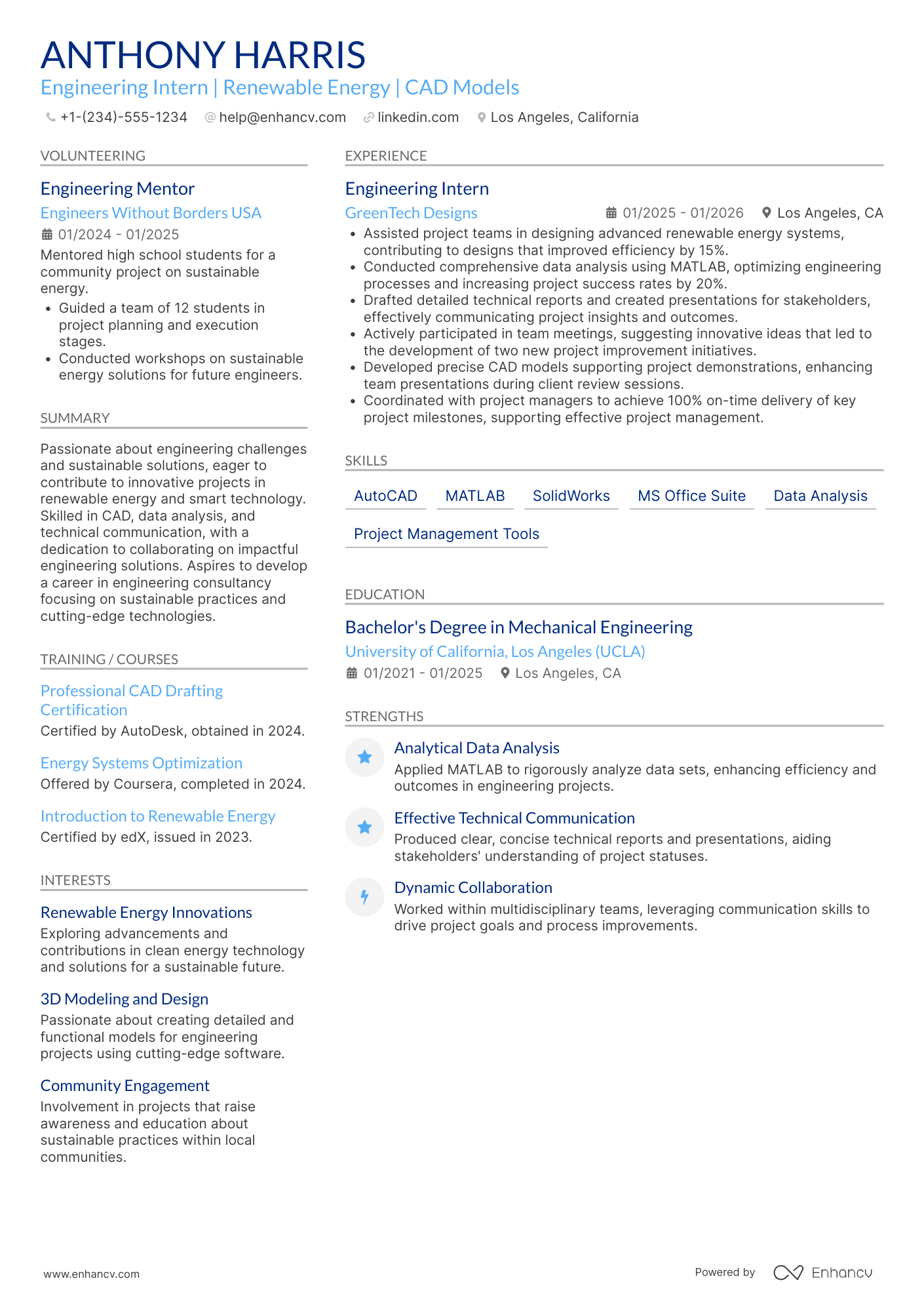
Most engineering student resume drafts fail because they read like coursework logs, not proof of impact. That matters when an applicant tracking system filters keywords and recruiters scan in seconds in a crowded entry-level market.
This guide shows you how to write a resume that highlights outcomes first. You'll quantify results like cutting runtime by 30 percent, shipping a prototype used by 200 users, raising test coverage to 85 percent, or reducing defects after release.

Key takeaways
- Quantify every project bullet with metrics like runtime cuts, cost savings, or error reductions.
- Use a hybrid format if you lack work experience, leading with skills and projects.
- Tailor each resume bullet to mirror the job posting's exact tools and terminology.
- Anchor every listed skill to a specific project, course, or measurable outcome.
- Place certifications near your education section to reinforce technical credibility fast.
- Write a three-to-four-line summary with your tools, domain, and a quantified achievement.
- Use Enhancv to turn vague duties into measurable, recruiter-ready bullet points in seconds.
How to format a engineering student resume
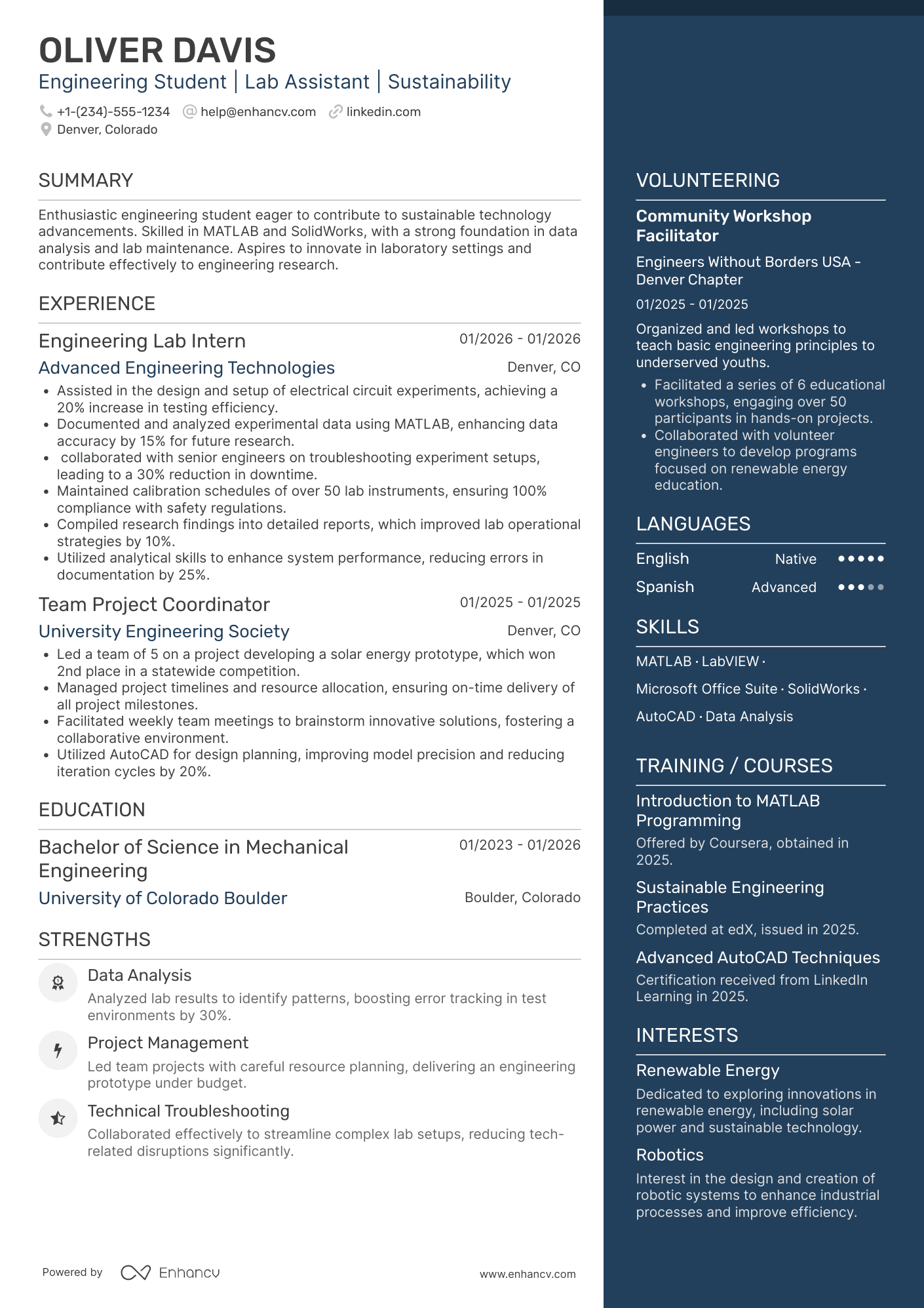
Recruiters reviewing engineering student resumes prioritize relevant coursework, technical skills, and hands-on project experience that demonstrate applied problem-solving ability. A clean, well-structured resume format ensures these signals surface quickly during both automated screening and the initial human scan.

I have significant experience in this role—which format should I use?
Use a reverse-chronological format to lead with your most recent and relevant engineering experience first. Do:
- Highlight the scope and ownership of your projects, internships, or lab work—specify team size, your role, and the engineering domain.
- List role-specific tools, languages, and technical skills (e.g., MATLAB, SolidWorks, Python, CAD, circuit design) in a dedicated skills section near the top.
- Quantify outcomes wherever possible, tying your contributions to measurable results like efficiency gains, cost reductions, or performance improvements.
I'm junior or switching into this role—what format works best?
Use a hybrid format that places a technical skills section at the top, followed by projects and any relevant experience in reverse-chronological order. Do:
- Position your strongest technical skills and relevant coursework prominently so recruiters and applicant tracking systems (ATS) catch them immediately.
- Feature academic projects, hackathons, personal builds, or lab work as standalone experience entries with clear descriptions of your engineering contributions.
- Link every action to a concrete outcome so each bullet demonstrates applied competence, not just participation.
Why not use a functional resume?
A functional format buries the timeline and context of your engineering projects and coursework, making it harder for recruiters to evaluate how recently you applied specific technical skills and whether your experience is progressing.
- Career changers pivoting into engineering: You have transferable analytical or technical skills from another field but no formal engineering job titles yet.
- Limited work history with strong project portfolios: You've completed significant personal, open-source, or academic engineering projects but haven't held internships or co-ops.
- A functional resume is acceptable only when you have no relevant work or internship history and need to foreground technical skills, but each skill must still be anchored to a specific project, course, or outcome rather than listed in isolation.
Now that you've established a clean, readable layout, it's time to fill it with the right sections that highlight your strengths as an engineering student.
What sections should go on a engineering student resume
Recruiters expect you to present engineering skills, hands-on work, and measurable results in a clean, easy-to-scan resume. Understanding what to put on a resume is essential for making every section count.
Use this structure for maximum clarity:
- Header
- Summary
- Experience
- Skills
- Projects
- Education
- Certifications
- Optional sections: Awards, Research, Leadership
Strong experience bullets should emphasize your impact, outcomes, scope, and results using clear metrics where possible.
Is your resume good enough?
Drop your resume here or choose a file. PDF & DOCX only. Max 2MB file size.
Now that you’ve chosen the sections that best showcase your qualifications, the next step is learning how to write your engineering student resume experience so each role and project supports those sections with clear, relevant details.
How to write your engineering student resume experience
The work experience section is where you prove you've shipped or delivered real work—whether through internships, co-ops, research projects, or academic engineering teams—using role-relevant tools, methods, and technologies. Hiring managers prioritize demonstrated impact over descriptive task lists, so every bullet should connect what you did to a measurable outcome.
Each entry should include:
- Job title
- Company and location (or remote)
- Dates of employment (month and year)
Three to five concise bullet points showing what you owned, how you executed, and what outcomes you delivered:
- Ownership scope: the systems, subsystems, prototypes, test rigs, or design components you were directly accountable for as an engineering student.
- Execution approach: the engineering software, simulation tools, analysis frameworks, fabrication methods, or technical standards you applied to solve problems and deliver work.
- Value improved: the changes you drove in design performance, structural reliability, manufacturing efficiency, testing accuracy, or safety compliance relevant to your engineering discipline.
- Collaboration context: how you coordinated with fellow engineers, faculty advisors, lab technicians, suppliers, or cross-functional project teams to advance deliverables.
- Impact delivered: the outcomes your contributions produced—expressed through functional results, project scale, or tangible engineering improvements rather than a list of activities you participated in.
Experience bullet formula
A engineering student experience example
✅ Right example - modern, quantified, specific.
Software Engineering Intern
AeroGrid Robotics | Austin, TX
2024–2024
Built software for autonomous warehouse drones used by mid-market logistics teams to reduce pick-and-pack time.
- Developed a ROS2-based navigation module in C++ and Python, improving route efficiency by 18% across ten test maps and reducing average task completion time by 12%.
- Implemented gRPC telemetry streaming and a PostgreSQL-backed metrics pipeline, cutting incident triage time from forty minutes to twelve minutes by enabling searchable flight logs and dashboards.
- Optimized computer vision inference with TensorRT and OpenCV on NVIDIA Jetson, increasing frame rate from sixteen to twenty-six frames per second while holding accuracy within 1.5%.
- Partnered with a product manager and two hardware engineers to define acceptance criteria and run weekly field tests, reducing blocked deployments by 30% through earlier sensor calibration checks.
- Wrote unit and integration tests in Pytest and GoogleTest and automated CI in GitHub Actions, raising test coverage from 48% to 76% and decreasing regressions by 25% release-over-release.
Now that you've seen how to structure an experience entry, let's look at how to tailor each detail to match the specific engineering role you're targeting.
How to tailor your engineering student resume experience
Recruiters evaluate your resume through applicant tracking systems and manual review, scoring candidates on how closely their experience matches the posting. Tailoring your resume to the job description for each bullet to reflect the posting's language and priorities increases your chances of passing both filters.
Ways to tailor your engineering student experience:
- Match specific software tools and programming languages listed in the posting.
- Mirror the exact terminology used for engineering standards or methodologies.
- Reflect metrics or performance criteria the employer highlights as priorities.
- Include relevant industry or domain experience that fits the role.
- Emphasize quality assurance or compliance work when the posting requires it.
- Highlight team-based collaboration models or workflows the employer references.
- Align your technical project scope with the systems described in the listing.
- Incorporate safety or reliability focus areas when the job description specifies them.
Tailoring means aligning your real coursework, projects, and accomplishments with what the employer values—not forcing disconnected keywords into your bullets.
Resume tailoring examples for engineering student
| Job description excerpt | Untailored | Tailored |
|---|---|---|
| "Assist in designing mechanical components using SolidWorks and perform FEA simulations to validate structural integrity under load conditions." | Helped with design projects and used engineering software for various tasks. | Designed 12 mechanical brackets and housing components in SolidWorks, running FEA simulations that validated structural integrity under 500 N cyclic load conditions. |
| "Support the development of embedded control systems using C/C++ and collaborate with cross-functional teams to integrate sensor modules into IoT prototypes." | Worked on a team project involving programming and electronics for a class assignment. | Programmed embedded control firmware in C++ for an IoT air-quality monitor, integrating three sensor modules and collaborating with a five-person cross-functional team to deliver a working prototype in eight weeks. |
| "Conduct materials testing per ASTM standards, analyze failure modes, and document findings in detailed technical reports for the quality engineering team." | Performed lab tests on materials and wrote up results for a course. | Conducted tensile and hardness testing on steel alloy samples per ASTM E8 and E18 standards, identified two fatigue-related failure modes, and delivered technical reports reviewed by the quality engineering team. |
Once you’ve aligned your experience with the role’s requirements, quantify your engineering student achievements to show the impact of that work.
How to quantify your engineering student achievements
Quantifying your achievements shows what changed because of your work, not just what you built. For engineering students, focus on performance, reliability, quality, delivery speed, and cost or resource use.
Quantifying examples for engineering student
| Metric | Example |
|---|---|
| Performance | "Optimized a C++ pathfinding module by replacing O(n^2) scans with a heap, cutting average runtime from 120 ms to 35 ms on 10,000-node graphs." |
| Reliability | "Added retries, timeouts, and circuit breaking in a Python API client, reducing request failures from 3.8% to 0.6% across 50,000 weekly calls." |
| Quality | "Wrote 120 unit tests in pytest and raised coverage from 42% to 86%, cutting regression bugs from nine to two per release." |
| Delivery speed | "Automated builds with GitHub Actions and Docker, reducing setup time from two hours to fifteen minutes for six teammates and shortening release cadence to weekly." |
| Cost efficiency | "Refactored AWS Lambda memory and batching settings, lowering monthly compute costs from $180 to $95 while keeping p95 latency under 250 ms." |
Turn vague job duties into measurable, recruiter-ready resume bullets in seconds with Enhancv's Bullet Point Generator.
Once you've crafted strong bullet points for your experience section, the next step is ensuring your skills section effectively showcases the technical and interpersonal strengths that engineering employers prioritize.
How to list your hard and soft skills on a engineering student resume
Your skills section shows recruiters and an ATS (applicant tracking system) that you can contribute on day one, so list role-matched keywords they scan for, with a typical balance of mostly hard skills plus a smaller set of execution-focused soft skills. engineering student roles require a blend of:
- Product strategy and discovery skills.
- Data, analytics, and experimentation skills.
- Delivery, execution, and go-to-market discipline.
- Soft skills.
Your skills section should be:
- Scannable (bullet-style grouping).
- Relevant to the job post.
- Backed by proof in experience bullets.
- Updated with current tools.
Place your skills section:
- Above experience if you're junior or switching careers.
- Below experience if you're mid/senior with strong achievements.

Hard skills
- Python, NumPy, pandas
- MATLAB, Simulink
- C, C++
- Git, GitHub
- Linux command line
- SolidWorks, AutoCAD
- Finite element analysis (FEA)
- Circuit design, PCB layout
- Lab instrumentation, oscilloscopes
- Requirements, test plans
- Statistical analysis, Design of Experiments
- Agile, Jira
Soft skills
- Translate requirements into specs
- Ask sharp technical questions
- Communicate tradeoffs clearly
- Document decisions and changes
- Collaborate across disciplines
- Run structured problem-solving
- Prioritize tasks under deadlines
- Own tasks end-to-end
- Seek feedback and iterate fast
- Present results to stakeholders
- Escalate risks early
- Follow safety and quality standards
How to show your engineering student skills in context
Skills shouldn't live only in a dedicated skills list. Explore our resume skills resource to see how top candidates present their abilities effectively.
They should be demonstrated in:
- Your summary (high-level professional identity)
- Your experience (proof through outcomes)
Here's what both look like in practice.
Summary example
Senior mechanical engineering student with four years of CAD modeling and FEA simulation experience. Led a six-person capstone team that reduced prototype weight by 18% using topology optimization in ANSYS. Passionate about sustainable product design.
- Reflects senior-level experience clearly
- Names specific tools and methods
- Includes a measurable design outcome
- Highlights teamwork and leadership
Experience example
Mechanical Engineering Intern
Rydell Manufacturing | Grand Rapids, MI
May 2024–August 2024
- Redesigned three fixture assemblies in SolidWorks, cutting material waste by 12% across one production line.
- Collaborated with a five-person quality team to develop FEA-validated stress tests, reducing part failure rates by 9%.
- Automated tolerance stack-up calculations using Python scripts, saving the engineering department six hours weekly.
- Every bullet contains measurable proof.
- Skills appear naturally through outcomes.
Once you’ve tied your technical strengths to real coursework, projects, and results, the next step is structuring a resume that highlights those same strengths even without formal work experience.
How do I write a engineering student resume with no experience
How do I write a engineering student resume with no experience? Even without full-time experience, you can demonstrate readiness through projects and coursework. If you're starting from scratch, this guide on writing a resume without work experience walks you through every step.
- Capstone design project deliverables
- Course labs with formal reports
- Personal engineering build projects
- Research assistantship and poster session
- Engineering club leadership projects
- Hackathon prototypes and demos
- Open-source engineering code contributions
- Industry-sponsored class project
Focus on:
- Quantified project outcomes and metrics
- Tools, languages, and lab methods
- Design process and documentation
- Testing, validation, and iteration
Resume format tip for entry-level engineering student
Use a skills-first resume format because it highlights projects, tools, and outcomes when you lack full-time roles. Do:
- Lead with a skills and tools section.
- Add two to four project entries.
- Quantify results with clear metrics.
- Use action verbs and technical nouns.
- Match keywords from the job posting.
- Built a MATLAB PID controller for a DC motor in a course lab, reducing steady-state error from eight percent to two percent using step-response tuning.
Now that you've established a framework for building your resume without professional experience, let's focus on your education section—the strongest asset you can leverage as a student.
How to list your education on a engineering student resume
Your education section lets hiring teams confirm you have the technical foundation engineering roles demand. It validates your coursework, skills, and academic commitment at a glance.
Include:
- Degree name
- Institution
- Location
- Graduation year
- Relevant coursework (for juniors or entry-level candidates)
- Honors & GPA (if 3.5 or higher)
Skip month and day details—list the graduation year only for a cleaner look.
Here's a strong education entry tailored for an engineering student resume.
Example education entry
Bachelor of Science in Mechanical Engineering
University of Michigan, Ann Arbor, MI
2025 | GPA: 3.7/4.0
- Relevant Coursework: Thermodynamics, Fluid Mechanics, Finite Element Analysis, Engineering Materials, Control Systems
- Honors: Dean's List (six semesters), Tau Beta Pi Engineering Honor Society
How to list your certifications on a engineering student resume
Certifications on a resume show an engineering student's commitment to learning, proficiency with tools, and alignment with industry needs, even before full-time experience.
Include:
- Certificate name
- Issuing organization
- Year
- Optional: credential ID or URL
- Place certifications below education when they're older or only loosely related to your target role.
- Place certifications above education when they're recent and directly relevant to the role you want.
Best certifications for your engineering student resume
- Fundamentals of Engineering (FE)
- Certified SolidWorks Associate (CSWA)
- Autodesk Certified User: AutoCAD
- Siemens NX Certified Associate
- LabVIEW Certified Associate Developer (CLAD)
- OSHA 10-Hour General Industry
- Lean Six Sigma Yellow Belt
Once you’ve included your credentials in a clear, easy-to-scan format, focus on writing your engineering student resume summary to highlight them in context and set the tone for the rest of your resume.
How to write your engineering student resume summary
Your resume summary is the first thing a recruiter reads. A strong one immediately signals you're a relevant candidate worth interviewing for an engineering student role.
Keep it to three to four lines, with:
- Your title and relevant years of experience, including internships or co-ops.
- The domain or industry you've worked in, such as software, mechanical, or civil engineering.
- Core tools, technologies, or skills you've applied in coursework or projects.
- One or two quantified achievements that show early, measurable impact.
- Soft skills tied to real outcomes, like collaboration that improved a team deliverable.

PRO TIP
At the student or junior level, emphasize technical skills, relevant tools, and any measurable results from projects or internships. Avoid vague phrases like "passionate learner" or "hardworking team player." Replace them with specifics that prove your value.
Example summary for a engineering student
Mechanical engineering student with two internships and SolidWorks proficiency. Redesigned a fixture assembly that reduced production errors by 18%. Strong collaborator across cross-functional prototype teams.
Optimize your resume summary and objective for ATS
Drop your resume here or choose a file.
PDF & DOCX only. Max 2MB file size.
Now that your summary captures your strongest qualifications at a glance, make sure your header presents the essential contact and identification details recruiters need to reach you.
What to include in a engineering student resume header
A resume header lists your key identifying and contact details, and it boosts visibility, credibility, and recruiter screening for a engineering student.
Essential resume header elements
- Full name
- Tailored job title and headline
- Location
- Phone number
- Professional email
- GitHub link
- Portfolio link
A LinkedIn link helps recruiters confirm roles, dates, and projects fast, which speeds up screening.
Do not include photos on a engineering student resume unless the role is explicitly front-facing or appearance-dependent.
Match your header to the job posting by using the same job title and keeping links working, current, and easy to scan.
Engineering student resume header
Jordan Lee
Engineering Student | Mechanical Engineering Intern Candidate
Austin, TX
(512) 555-12XX
your.name@enhancv.com
github.com/yourname
yourwebsite.com
linkedin.com/in/yourname
Once your contact details and key identifiers are set up at the top, you can strengthen the rest of your resume with additional sections that add relevant context and support your candidacy.
Additional sections for engineering student resumes
Extra resume sections help you stand out when your core qualifications match other candidates, especially for competitive internships or co-ops.
Choose sections that reinforce your technical depth and hands-on experience:
- Technical certifications
- Languages
- Publications and research papers
- Professional affiliations and engineering societies
- Hobbies and interests
- Hackathons and design competitions
- Volunteer engineering work
Once your resume sections are complete, pairing them with a well-crafted cover letter can strengthen your application even further.
Do engineering student resumes need a cover letter
A cover letter is rarely required for an engineering student, but it helps in competitive roles or when hiring managers expect one. If you're unsure where to start, learn what a cover letter is and how it complements your resume. It can make a difference when your resume needs context, or when you want to target a specific team.
Use a cover letter to add details your engineering student resume can't show:
- Explain role or team fit by linking your coursework, tools, and interests to the team's stack and problems.
- Highlight one or two relevant projects or outcomes, and quantify impact with metrics like latency, accuracy, cost, or adoption.
- Show understanding of the product, users, or business context by naming a user group, constraint, and tradeoff you considered.
- Address career transitions or non-obvious experience by connecting prior work to engineering student skills, such as testing, debugging, or system thinking.
Drop your resume here or choose a file.
PDF & DOCX only. Max 2MB file size.
Even when you decide a cover letter won’t add value to your application, you can strengthen your engineering student resume further by using AI to improve it.
Using AI to improve your engineering student resume
AI can sharpen your resume's clarity, structure, and impact. It helps refine bullet points, tighten language, and highlight relevant skills. But overuse strips away authenticity. Once your content feels clear and aligned with the role, step away from AI. For specific guidance, check out these ChatGPT resume writing prompts tailored for resume improvement.
Here are 10 practical prompts you can copy and paste to strengthen specific sections of your resume:
- Strengthen summary focus: "Rewrite this engineering student resume summary to emphasize relevant technical skills and career goals in two concise sentences."
- Quantify project results: "Add measurable outcomes to this engineering student resume project description using metrics like efficiency gains, cost savings, or error reduction."
- Tighten experience bullets: "Rewrite these engineering student resume experience bullets using strong action verbs and removing filler words."
- Align skills section: "Compare this engineering student resume skills section against the following job description and flag missing relevant technical skills."
- Clarify project scope: "Rewrite this engineering student resume project entry to clearly state the problem, approach, tools used, and final outcome."
- Improve education details: "Suggest relevant coursework, honors, or academic achievements to highlight in this engineering student resume education section."
- Refine certification entries: "Reformat this engineering student resume certifications section so each entry lists the credential name, issuing body, and date earned."
- Eliminate vague language: "Identify and replace vague phrases like 'assisted with' or 'helped improve' in this engineering student resume with specific contributions."
- Tailor for relevance: "Remove or deprioritize experience bullets on this engineering student resume that don't relate to the target mechanical engineering internship."
- Check consistency: "Review this engineering student resume for inconsistent tense, formatting errors, and mismatched date formats across all sections."
Stop using AI once your resume sounds accurate, specific, and aligned with real experience. AI should never invent experience or inflate claims—if it didn't happen, it doesn't belong here.
Conclusion
A strong engineering student resume highlights measurable outcomes, role-specific skills, and a clear structure. It shows what you built, improved, or analyzed, with numbers that prove impact. It stays focused, easy to scan, and consistent from top to bottom.
This approach signals readiness for today’s hiring market and the roles ahead. It helps recruiters quickly match your skills to the job and trust your results. With clear sections and specific achievements, your engineering student resume does the talking.
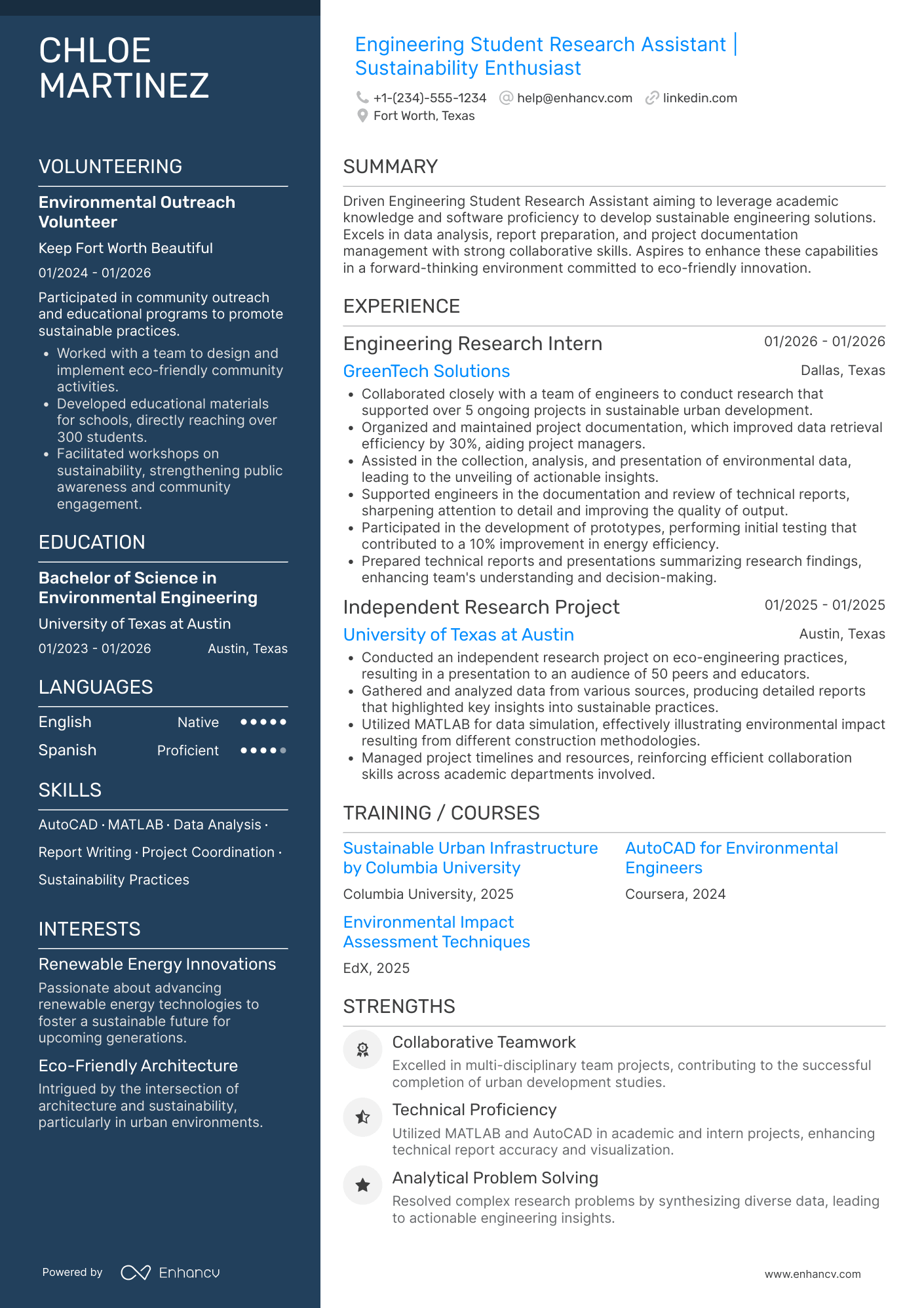
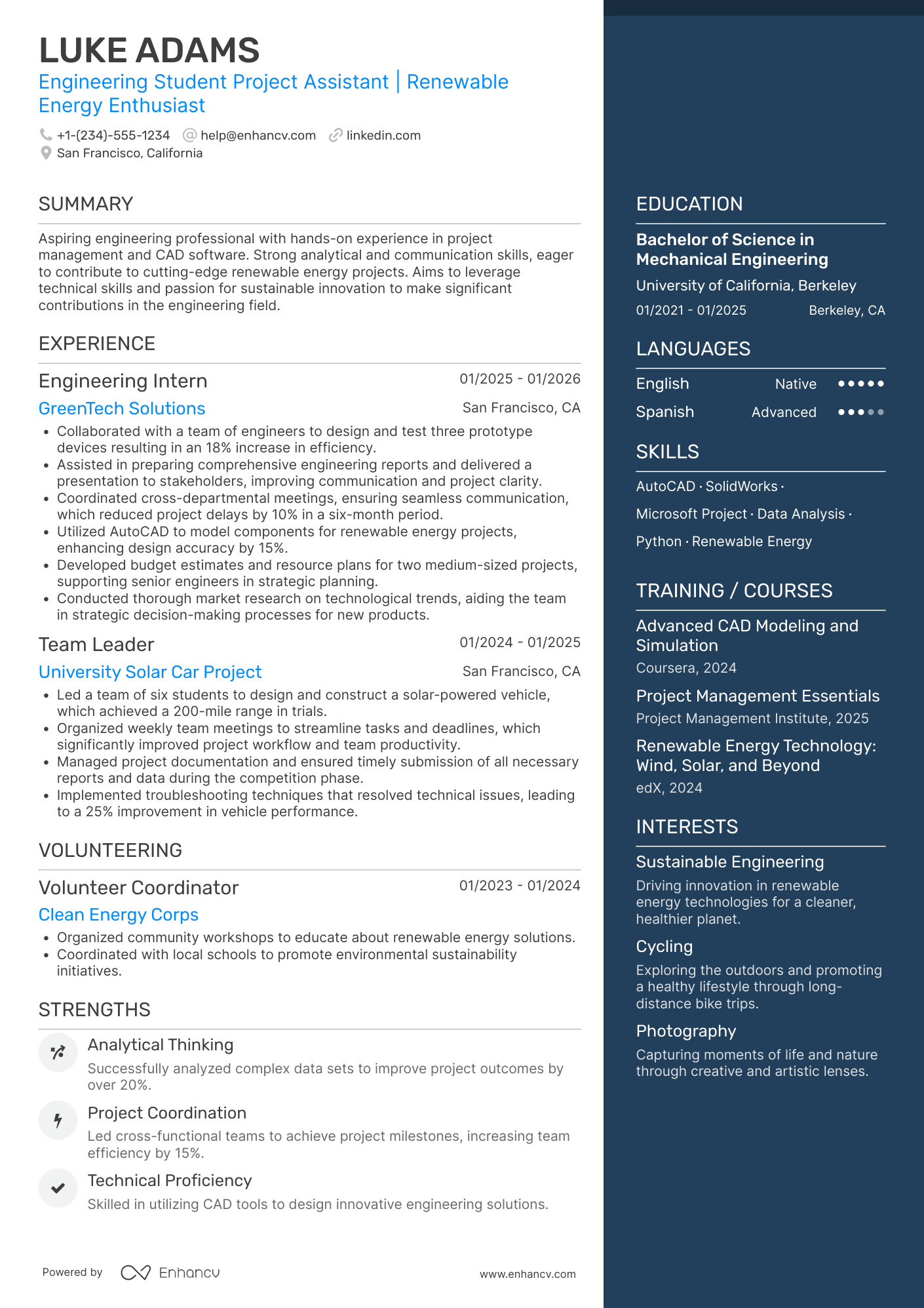
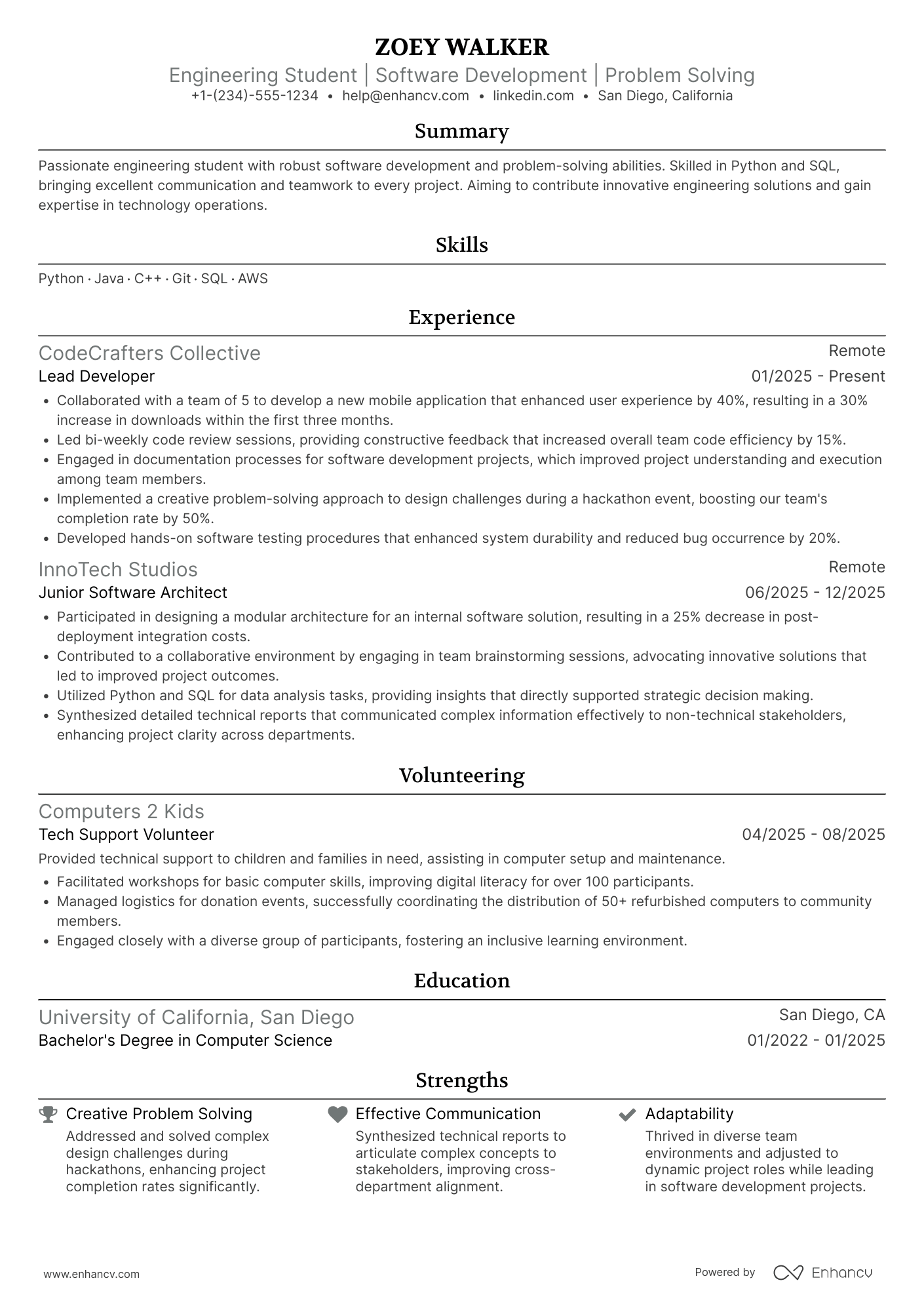
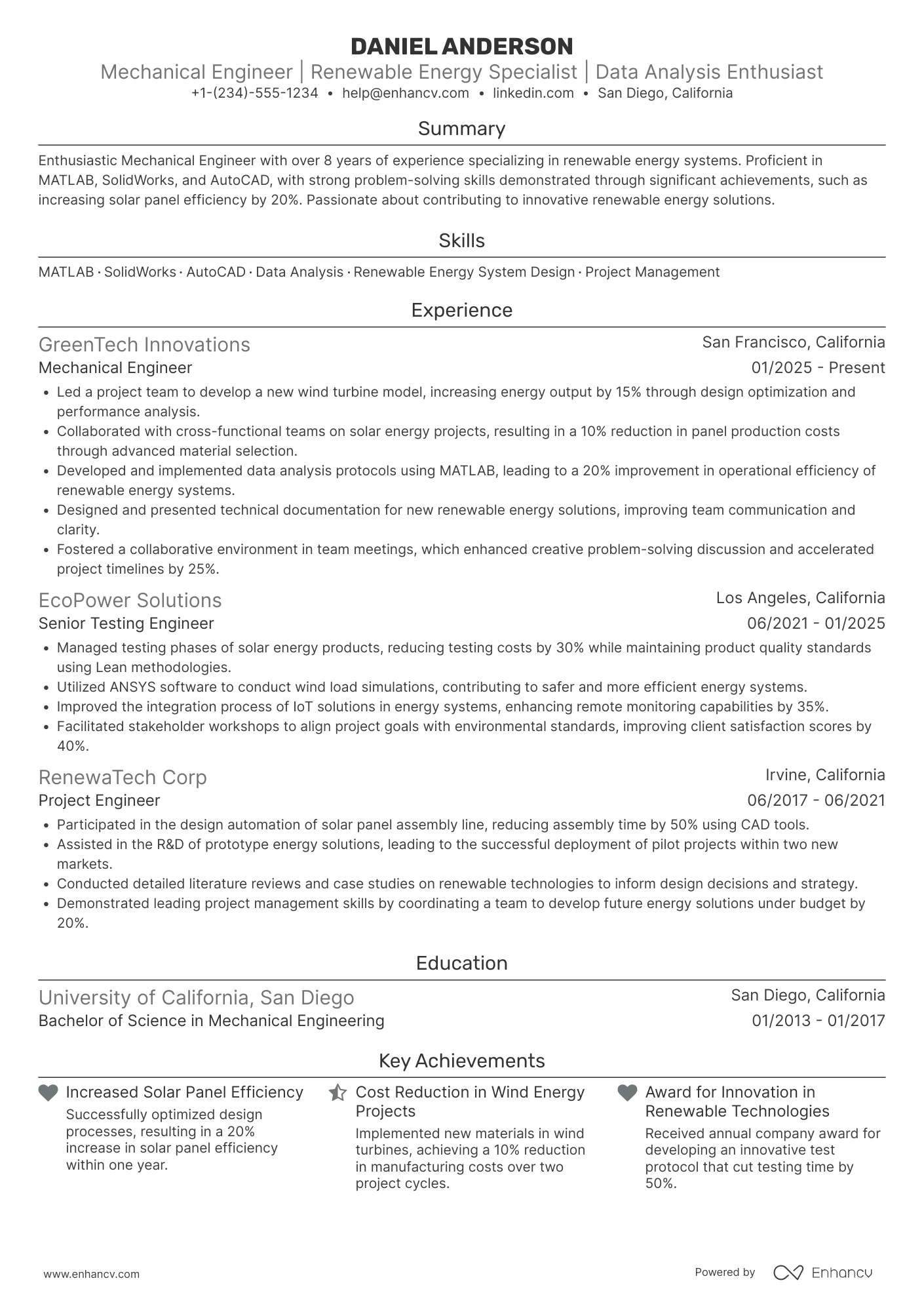
Engineering Student resume examples
By Experience
By Role