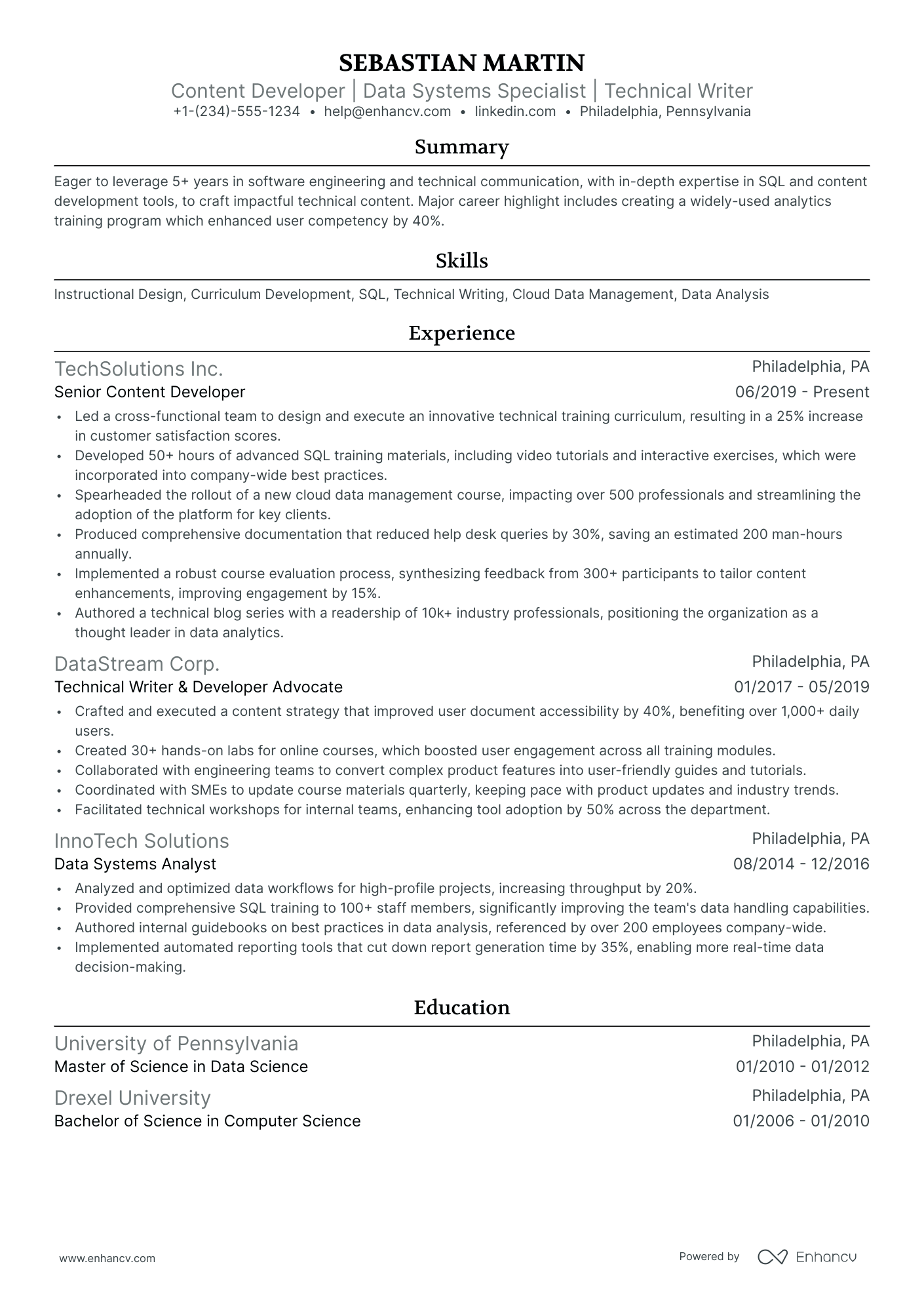
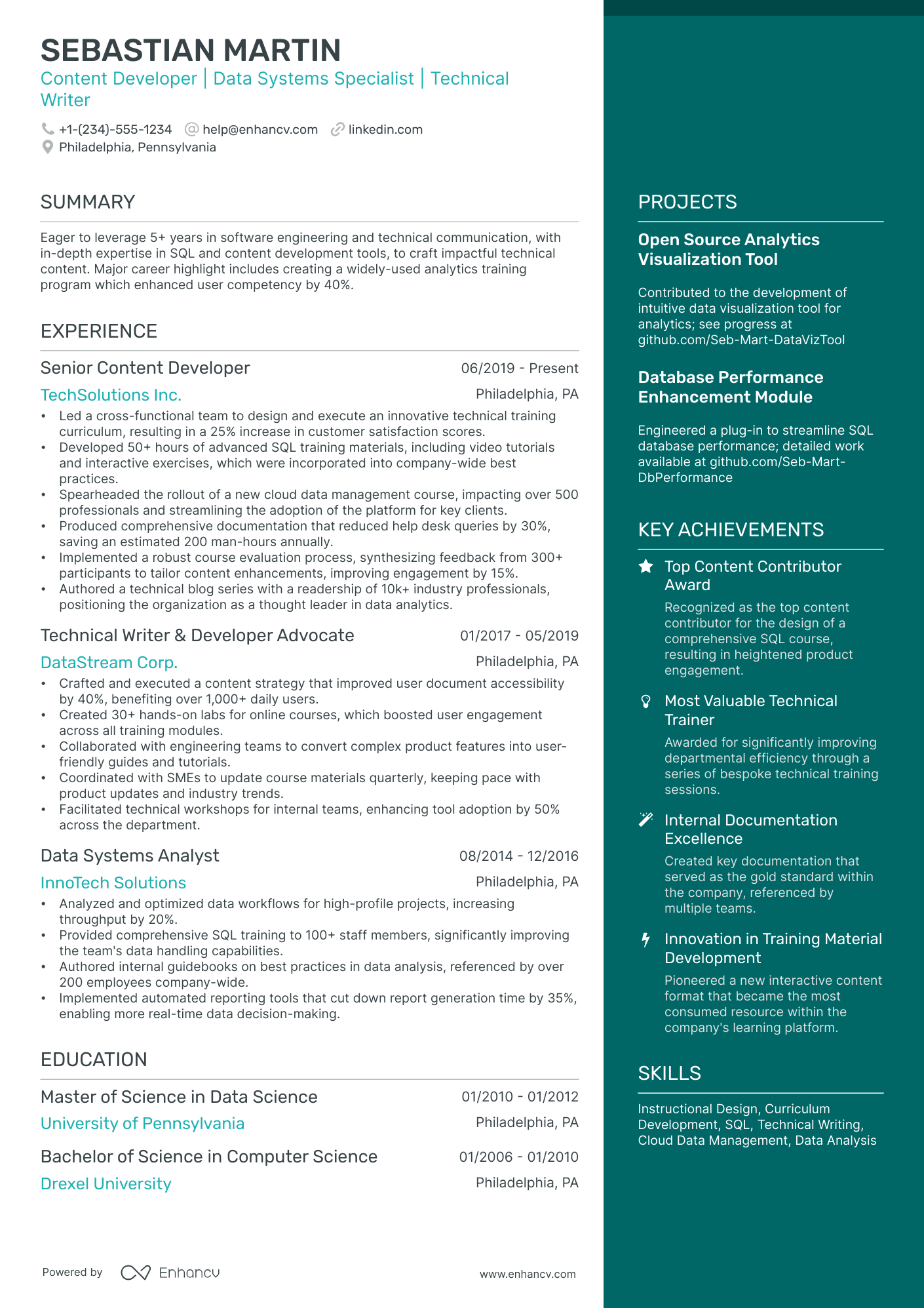
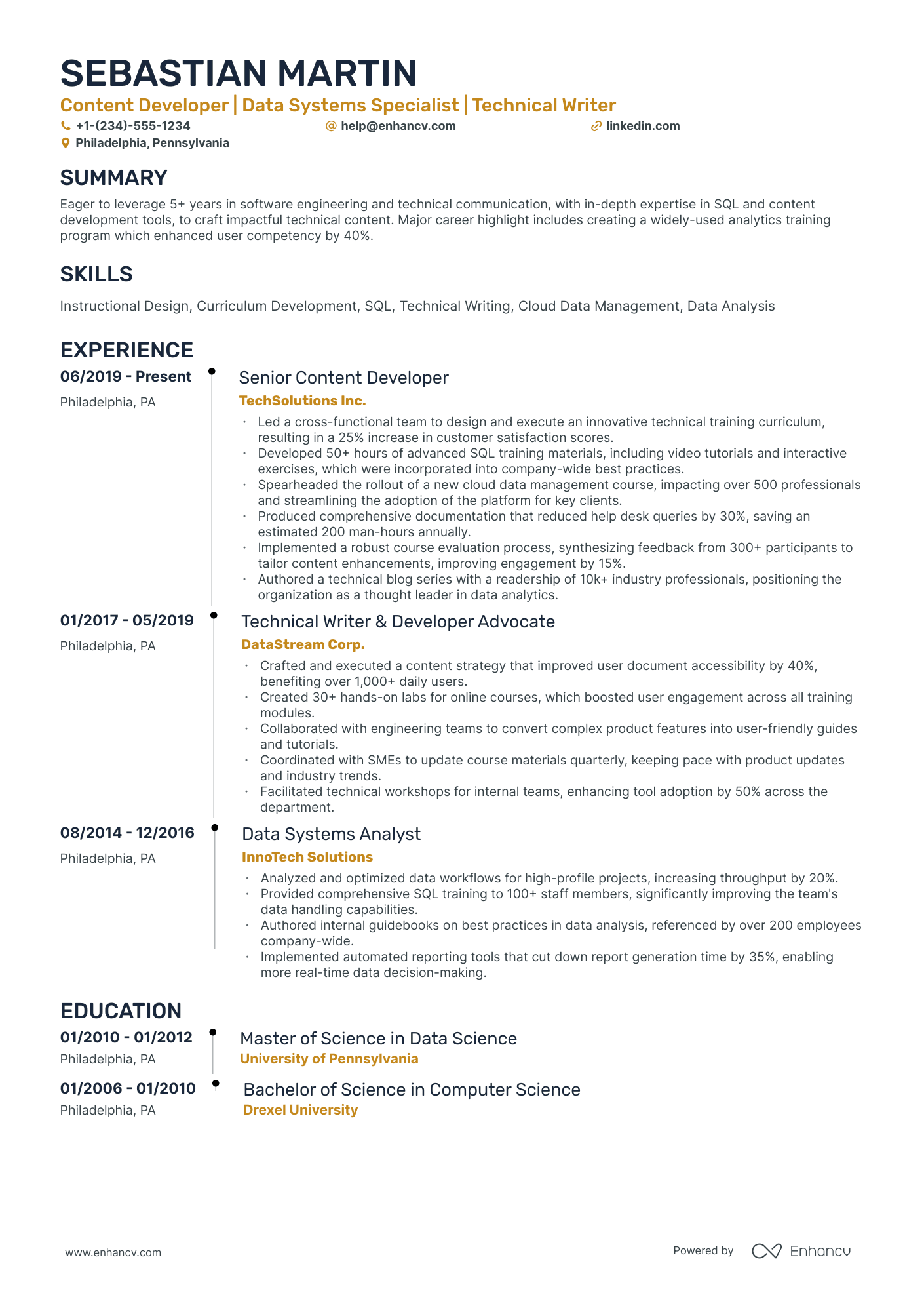
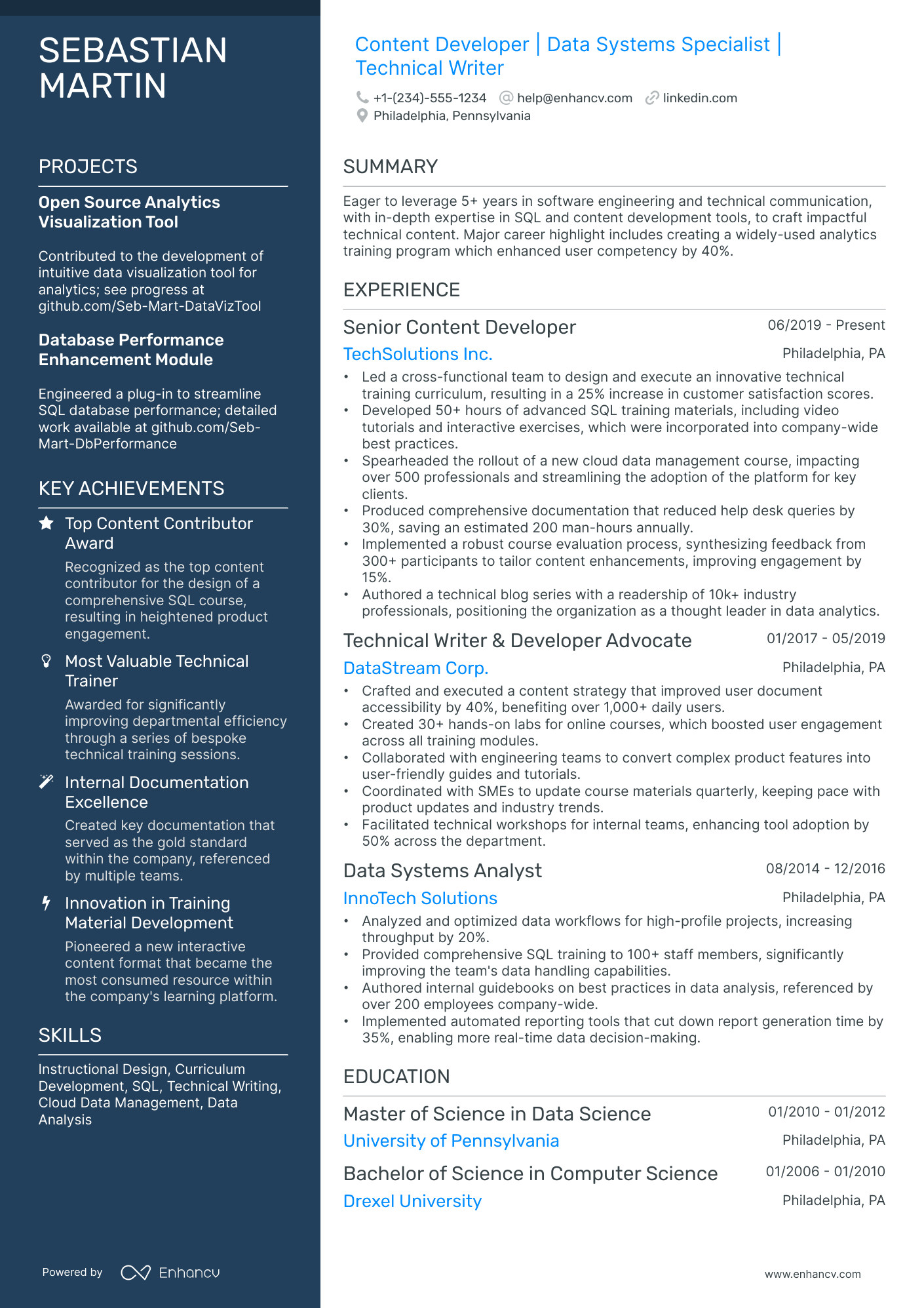
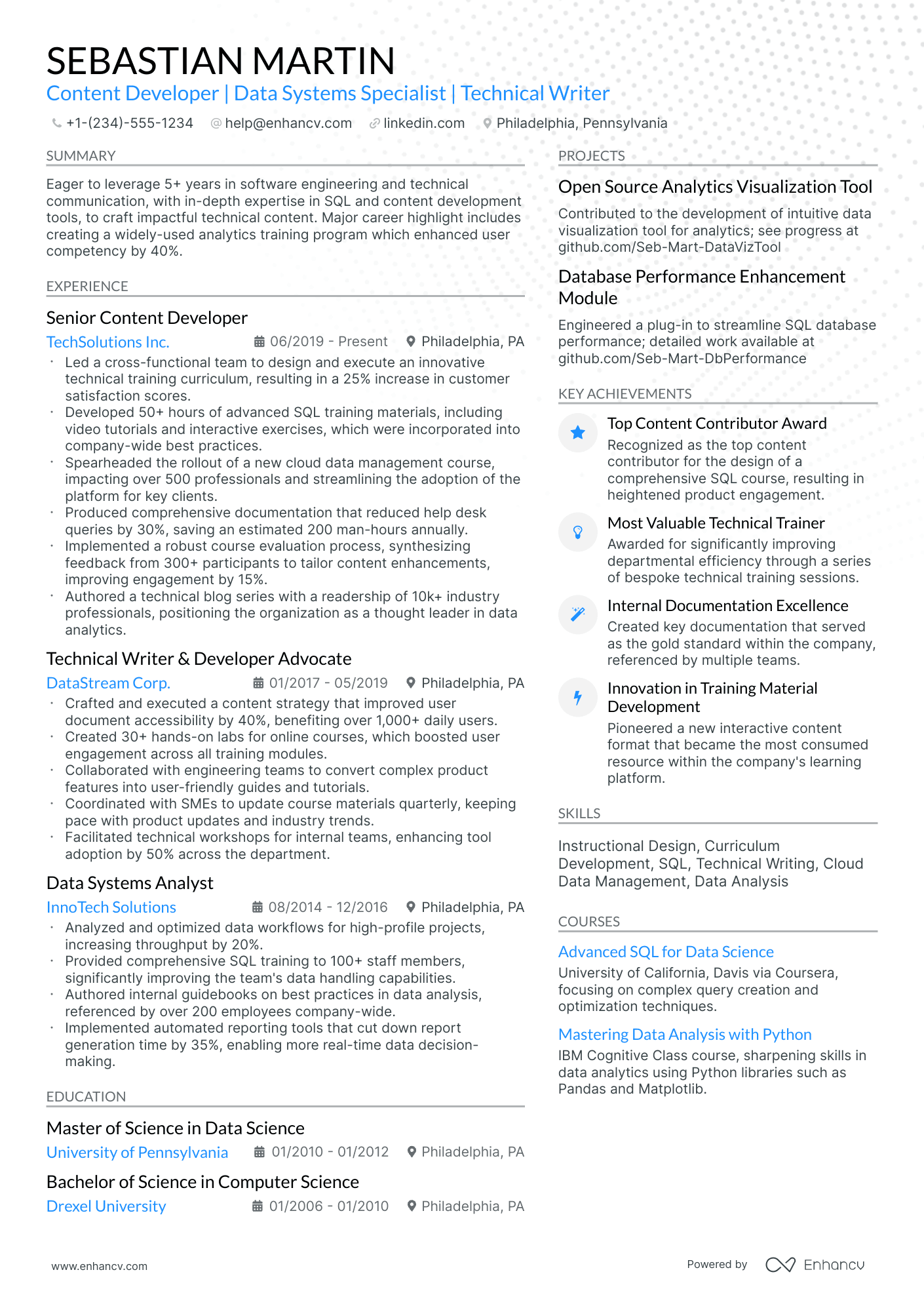
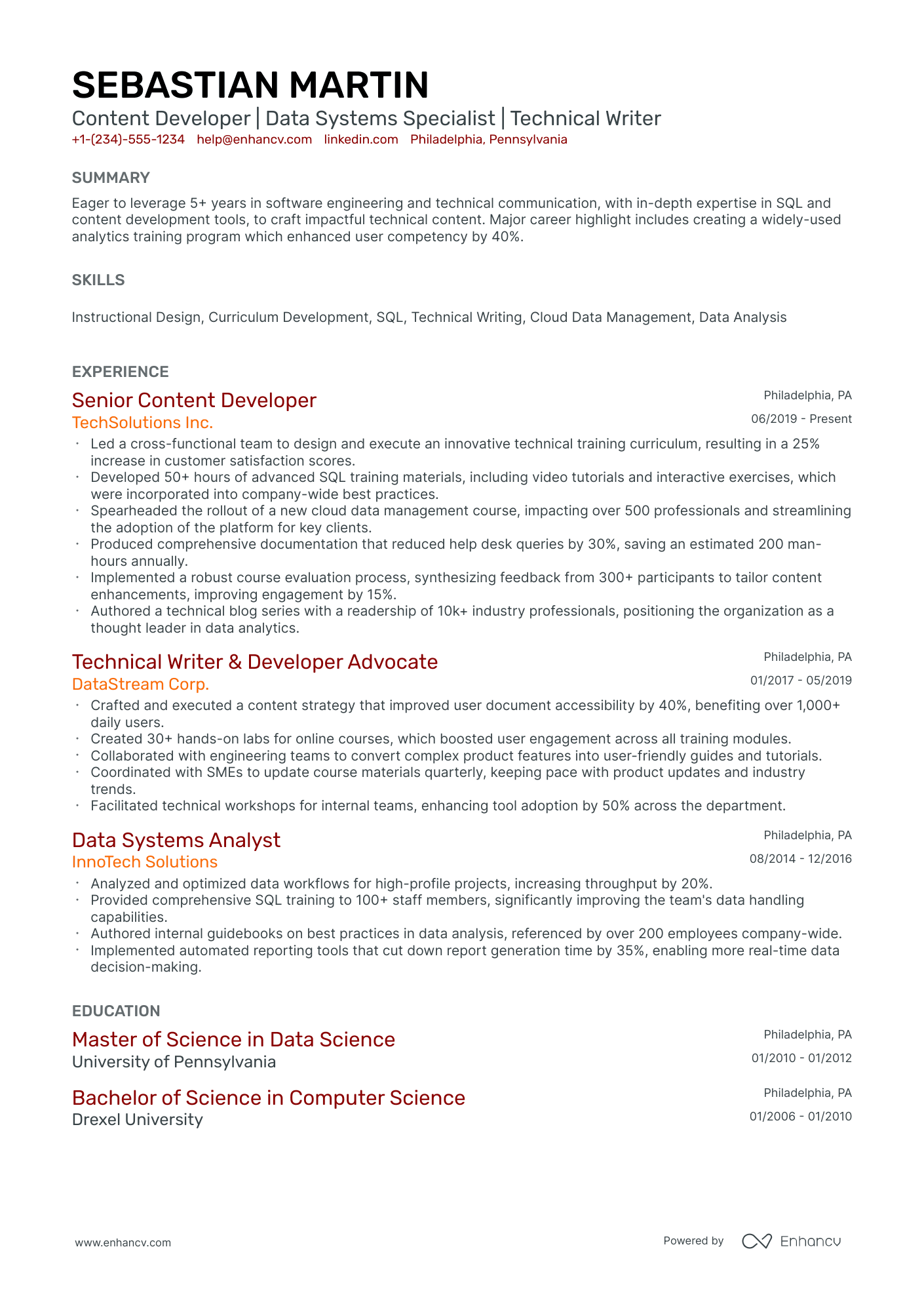
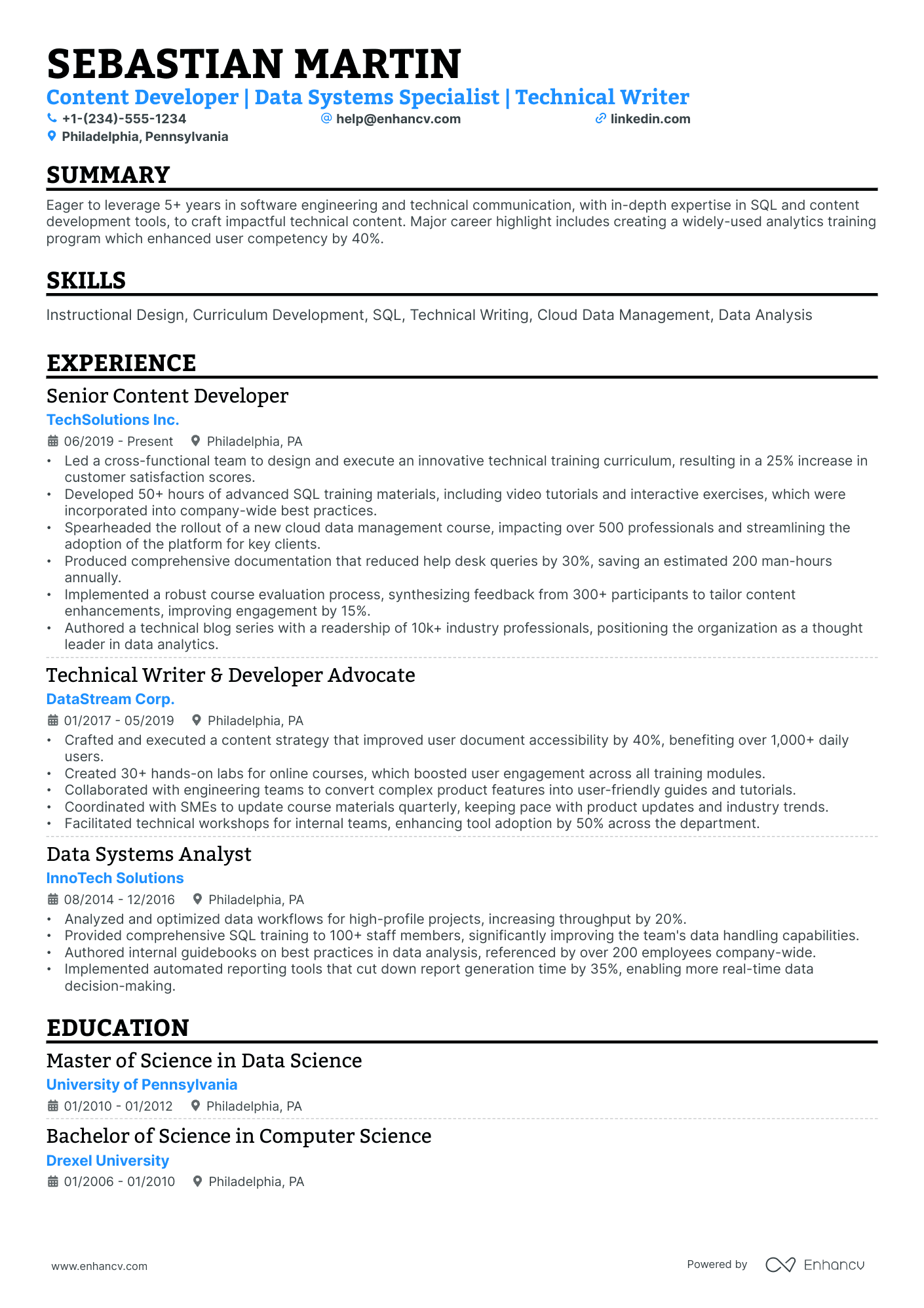
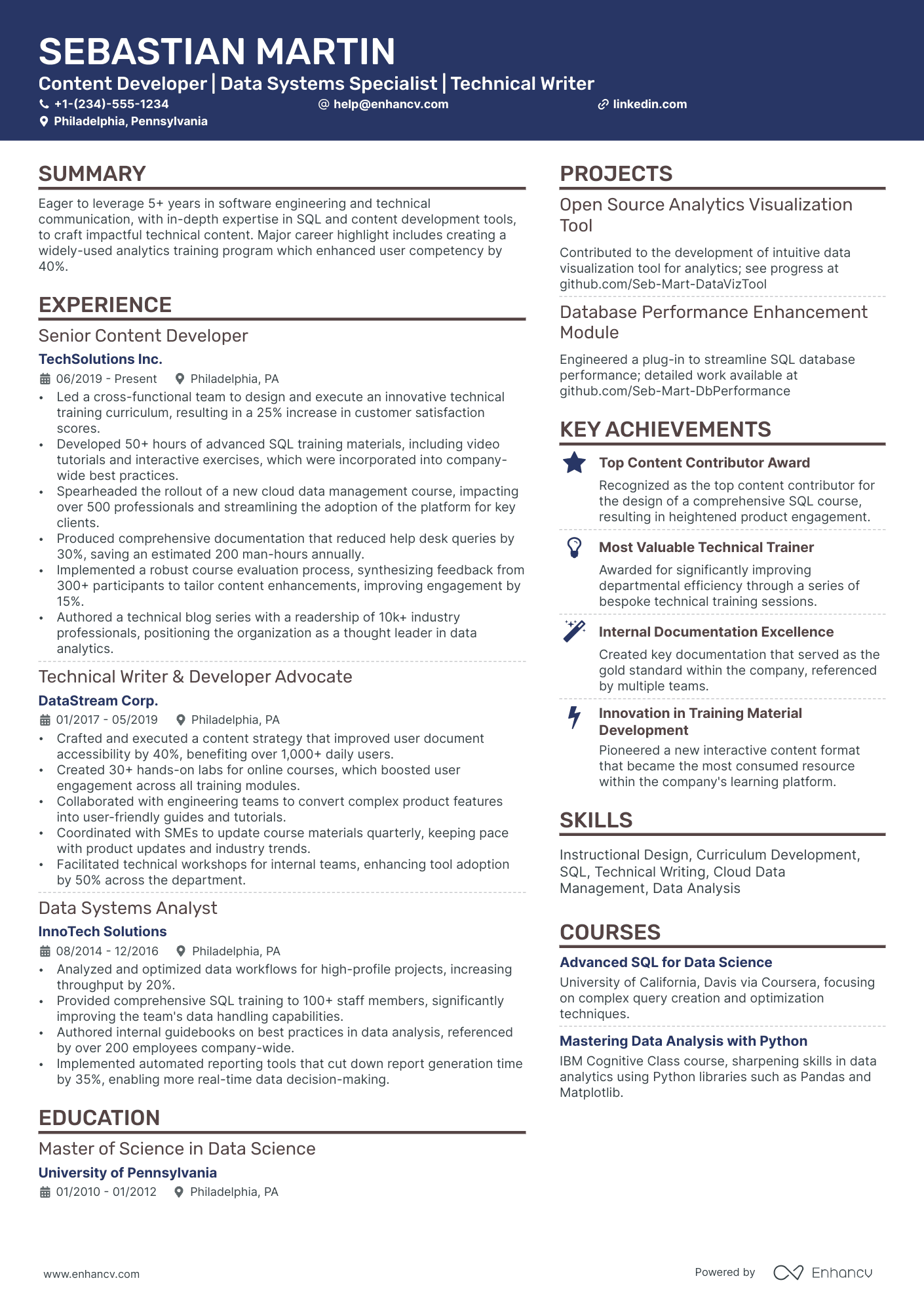
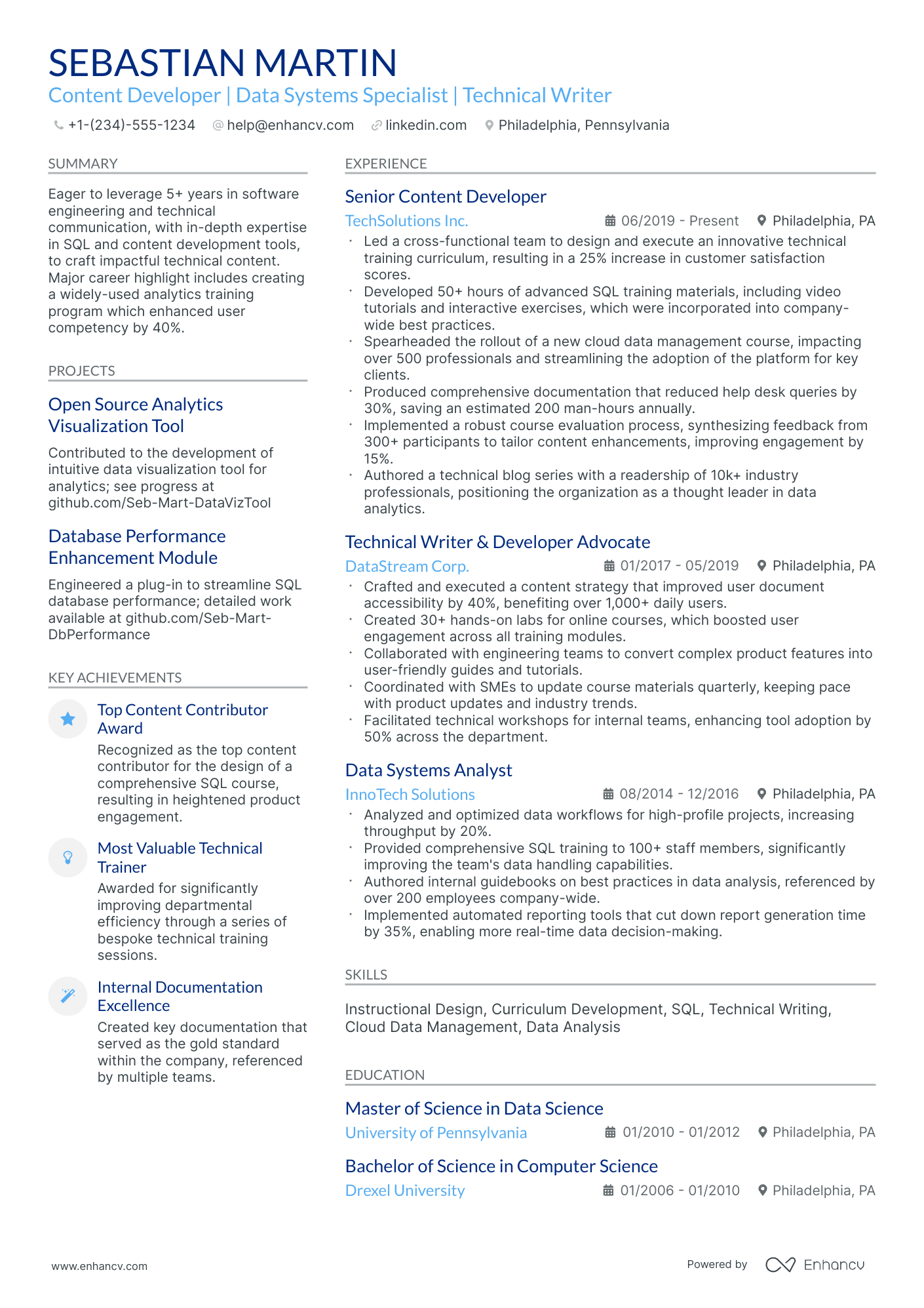
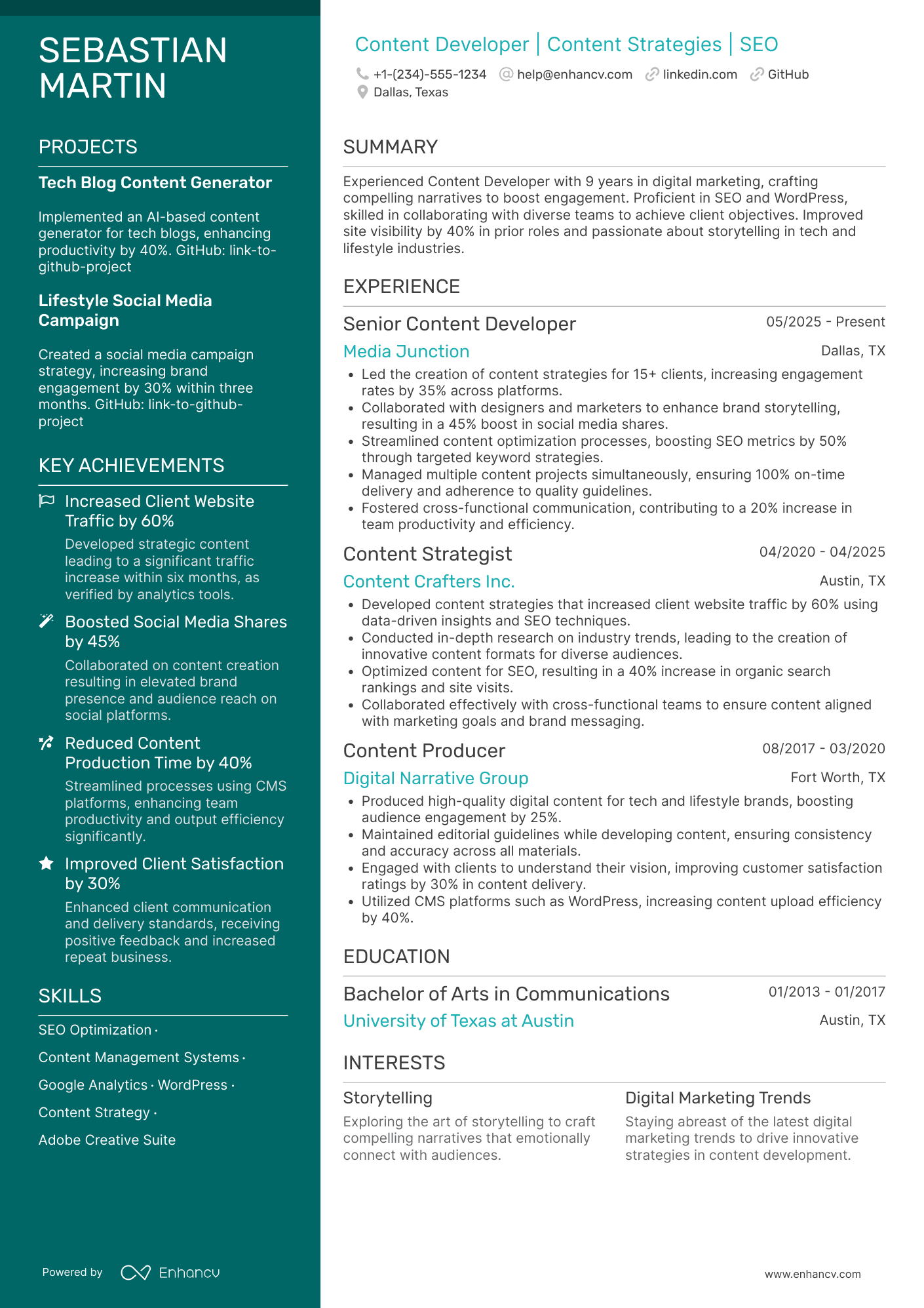
Many content developer resumes fail because they read like task logs and bury measurable impact. This content developer resume guide shows how to surface results fast, which matters when an applicant tracking system filters keywords and recruiters scan in seconds.
A strong resume proves what you improved, shipped, or scaled. You should highlight conversion lifts, reduced support tickets, faster publish cycles, higher content quality scores, broader localization coverage, and clearer onboarding that cuts time to productivity. If you're unsure where to begin, learning how to write a resume from scratch can help you build a solid foundation before diving into role-specific details.

Key takeaways
- Quantify every experience bullet with metrics like traffic growth, support deflection, or cycle time.
- Use reverse-chronological format if you're experienced and hybrid format if you're switching careers.
- Mirror the exact tools, platforms, and terminology from each job posting you target.
- Place skills above experience when junior, and below experience when you have strong achievements.
- Prove skills in context through your summary and experience bullets, not just a standalone list.
- Build your resume faster with Enhancv, then tailor each version to the specific role.
- Stop using AI once your resume accurately reflects real experience—never invent or inflate claims.
Job market snapshot for content developers
We analyzed 63 recent content developer job ads across major US job boards. These numbers help you understand career growth patterns, employer expectations, regional hotspots at a glance.
What level of experience employers are looking for content developers
| Years of Experience | Percentage found in job ads |
|---|---|
| 1–2 years | 3.2% (2) |
| 3–4 years | 14.3% (9) |
| 5–6 years | 15.9% (10) |
| 9–10 years | 1.6% (1) |
| 10+ years | 3.2% (2) |
| Not specified | 63.5% (40) |
Content developer ads by area of specialization (industry)
| Industry (Area) | Percentage found in job ads |
|---|---|
| Finance & Banking | 44.4% (28) |
| Education | 25.4% (16) |
Role overview stats
These tables show the most common responsibilities and employment types for content developer roles. Use them to align your resume with what employers expect and to understand how the role is structured across the market.
Day-to-day activities and top responsibilities for a content developer
| Responsibility | Percentage found in job ads |
|---|---|
| Microsoft office | 15.9% (10) |
| Python | 15.9% (10) |
| Agile | 14.3% (9) |
| Git | 14.3% (9) |
| Microsoft 365 | 12.7% (8) |
| Powerpoint | 12.7% (8) |
| Powershell | 12.7% (8) |
| Regex | 11.1% (7) |
| Ai tools | 9.5% (6) |
| Broadcom | 9.5% (6) |
| Edm | 9.5% (6) |
| Forcepoint | 9.5% (6) |
Type of employment (remote vs on-site vs hybrid)
| Employment type | Percentage found in job ads |
|---|---|
| On-site | 42.9% (27) |
| Hybrid | 30.2% (19) |
| Remote | 27.0% (17) |
How to format a content developer resume
Recruiters evaluating content developer resumes look for a clear mix of content strategy skills, platform proficiency, and measurable audience or engagement outcomes. A clean, well-structured format ensures these signals surface quickly during both automated screening and manual review. Choosing the right resume format is the first step toward making that happen.

I have significant experience in this role—which format should I use?
Use a reverse-chronological format to lead with your most recent and relevant content development roles. Do:
- Highlight the scope and ownership of each role—team size, content volume, channels managed, and editorial accountability.
- Feature role-specific tools and domains such as CMS platforms (WordPress, Drupal), SEO tools (Semrush, Ahrefs), analytics suites (Google Analytics, HubSpot), and content types (long-form, UX copy, multimedia).
- Quantify outcomes tied to business impact, including traffic growth, engagement lift, conversion improvements, or content production efficiency gains.
- Developed and executed a cross-channel content strategy across blog, email, and social that increased organic traffic by 74% and drove a 22% improvement in lead-to-MQL conversion rate within eight months.
I'm junior or switching into this role—what format works best?
A hybrid format works best, letting you lead with relevant skills and immediately support them with experience or project work. Do:
- Place a skills section near the top that highlights content development competencies such as SEO writing, CMS management, editorial planning, and audience research.
- Include freelance projects, portfolio pieces, internships, or coursework that demonstrate hands-on content creation and strategy execution.
- Connect every action to a clear outcome so recruiters can see the value you delivered, even at a smaller scale.
- SEO content writing → researched and published 30+ keyword-targeted blog posts for a startup's resource hub → contributed to a 40% increase in organic sessions over one quarter.
Why not use a functional resume?
A functional format buries the timeline and context of your content work, making it difficult for recruiters and applicant tracking systems to assess where and how you developed your skills. When a functional resume might be acceptable:
- If you're transitioning from a related field (such as journalism, marketing, or UX writing) and have no direct content developer job titles, a functional format can work—but only if every listed skill is tied to a specific project, deliverable, or measurable outcome rather than presented as a standalone claim.
Once your layout and formatting choices are in place, the next step is deciding which sections to include so each one reinforces your qualifications.
What sections should go on a content developer resume
Recruiters expect a content developer resume to show clear ownership of content deliverables, collaboration, and measurable results. Knowing which resume sections to include ensures you don't leave out anything hiring teams look for.
Use this structure for maximum clarity:
- Header
- Summary
- Experience
- Skills
- Projects
- Education
- Certifications
- Optional sections: Publications, Awards, Languages
Strong experience bullets should emphasize shipped content, audience and business impact, cross-functional scope, and measurable outcomes.
Is your resume good enough?
Drop your resume here or choose a file. PDF & DOCX only. Max 2MB file size.
Once you’ve organized your resume with the right core components, the next step is to write your content developer resume experience section so it supports each part with specific, role-relevant impact.
How to write your content developer resume experience
The experience section is where you prove you can ship work that moves the needle—not just describe what you were assigned. Hiring managers scanning content developer resumes prioritize demonstrated impact, role-relevant tools and methods, and measurable outcomes over generic task lists.
Each entry should include:
- Job title
- Company and location (or remote)
- Dates of employment (month and year)
Three to five concise bullet points showing what you owned, how you executed, and what outcomes you delivered:
- Ownership scope: the content systems, editorial calendars, platforms, audience segments, or product lines you were directly accountable for as a content developer.
- Execution approach: the content management systems, SEO tools, style frameworks, analytics platforms, or editorial workflows you used to plan, produce, and optimize content.
- Value improved: the specific gains in content quality, organic performance, publishing efficiency, accessibility compliance, or brand consistency your work drove.
- Collaboration context: how you partnered with designers, product managers, subject-matter experts, marketing teams, or external vendors to align content with broader business goals.
- Impact delivered: the tangible results your content work produced—expressed through reach, engagement lift, conversion improvement, production scale, or reduced time-to-publish rather than a list of activities.
Experience bullet formula
A content developer experience example
✅ Right example - modern, quantified, specific.
Senior Content Developer (UX Content & Knowledge Base)
Nimbus Health | Remote
2022–Present
Built in-product guidance and a multilingual help center for a telehealth platform supporting three million monthly patient visits.
- Led content strategy and information architecture in Confluence and Figma, reducing help-center time-to-answer by 28% and cutting support tickets per one thousand visits by 17%.
- Authored and maintained one hundred fifty-plus UX microcopy strings in a Git-based workflow (GitHub, pull requests), improving release accuracy by 23% through version control and peer reviews with engineers.
- Implemented a structured content model in Contentful and enforced taxonomy standards, increasing self-serve article findability by 31% based on search analytics and click-through rates.
- Partnered with product managers and designers to run A/B tests on onboarding and error messaging (Optimizely), improving activation by 9% and reducing form abandonment by 12%.
- Built a localization pipeline with Smartling and QA checklists, cutting translation turnaround time by 35% while maintaining a 98% linguistic quality score across eight languages.
Now that you've seen how to structure your experience entries, let's look at how to adjust them to match the specific job posting you're targeting.
How to tailor your content developer resume experience
Recruiters evaluate your content developer resume through applicant tracking systems and manual review, scoring how closely your experience matches their posting. Tailoring your resume to the job description by reflecting the posting's specific language and priorities increases your chances of passing both filters.
Ways to tailor your content developer experience:
- Mirror the exact CMS platforms and authoring tools listed in the posting.
- Match the content standards or style guidelines the role specifies.
- Reflect the same terminology for content lifecycle or governance processes.
- Include domain experience in the industry the employer operates within.
- Highlight accessibility or compliance work when the posting references those priorities.
- Align your metrics with the KPIs or success criteria they describe.
- Reference collaboration workflows with the specific teams they name.
- Emphasize structured content methods or taxonomies the role requires.
Tailoring means aligning your real accomplishments with what the employer asks for, not forcing disconnected keywords into your bullets.
Resume tailoring examples for content developer
| Job description excerpt | Untailored | Tailored |
|---|---|---|
| "Manage editorial calendar across blog, email, and social channels using WordPress and HubSpot to drive organic traffic growth." | Helped create content for various marketing channels. | Managed a cross-channel editorial calendar spanning blog, email, and social using WordPress and HubSpot, contributing to a 34% year-over-year increase in organic traffic. |
| "Collaborate with SEO and product teams to develop long-form content that supports product-led growth and ranks for high-intent keywords." | Wrote articles and worked with different teams on content projects. | Partnered with SEO and product teams to produce long-form guides targeting high-intent keywords, directly supporting product-led growth and ranking on page one for 12 priority terms within six months. |
| "Use Google Analytics and Ahrefs to audit existing content, identify gaps, and refresh underperforming pages to improve engagement and conversion rates." | Analyzed content performance and made updates as needed. | Audited 200+ existing pages using Google Analytics and Ahrefs to identify content gaps, then refreshed 45 underperforming articles—lifting average time on page by 28% and conversion rate by 15%. |
Once your experience aligns with the role’s requirements, quantify your content developer achievements to show the impact of that work.
How to quantify your content developer achievements
Quantifying your achievements proves business impact beyond writing quality. For content developers, track speed, accuracy, adoption, and outcomes like reduced support tickets, higher conversions, and fewer compliance issues.
Quantifying examples for content developer
| Metric | Example |
|---|---|
| Cycle time | "Cut article turnaround from eight days to five by standardizing briefs in Notion and using Grammarly, shipping twenty-four help center updates per month." |
| Content quality | "Reduced content defects by 38% by adding a style guide, a QA checklist, and weekly peer reviews across three writers." |
| User adoption | "Increased help center self-serve usage by 22% by restructuring navigation and rewriting top fifty articles based on search queries and heatmaps." |
| Support deflection | "Lowered 'how-to' support tickets by 17% after publishing ten step-by-step guides and embedding short Loom videos in Zendesk macros." |
| Compliance risk | "Achieved 100% on quarterly legal review by adding claim substantiation links and an approval workflow in Google Docs for all product pages." |
Turn vague job duties into measurable, recruiter-ready resume bullets in seconds with Enhancv's Bullet Point Generator.
Once you've crafted strong bullet points to showcase your experience, the next step is highlighting the specific hard and soft skills that reinforce your qualifications as a content developer.
How to list your hard and soft skills on a content developer resume
Your skills section shows recruiters and an ATS (applicant tracking system) you can plan, create, and optimize content at speed, so list role-specific hard skills plus execution-focused soft skills, aiming for a balanced mix that matches the job post. content developer roles require a blend of:
- Product strategy and discovery skills.
- Data, analytics, and experimentation skills.
- Delivery, execution, and go-to-market discipline.
- Soft skills.
Your skills section should be:
- Scannable (bullet-style grouping).
- Relevant to the job post.
- Backed by proof in experience bullets.
- Updated with current tools.
Place your skills section:
- Above experience if you're junior or switching careers.
- Below experience if you're mid/senior with strong achievements.

Hard skills
- Search engine optimization keyword research
- Content strategy and information architecture
- Editorial calendars and content ops
- Style guides and brand voice systems
- Content management systems: WordPress, Contentful
- HTML, CSS, Markdown
- Technical writing and documentation
- Content briefs and outlines
- On-page search engine optimization optimization
- Web analytics: Google Analytics 4, Search Console
- A and B testing, conversion rate optimization
- Accessibility and inclusive content (WCAG)
Soft skills
- Translate stakeholder goals into briefs
- Write clear, decision-ready updates
- Manage scope, timelines, and tradeoffs
- Align cross-functional reviewers fast
- Incorporate feedback without losing intent
- Prioritize high-impact content work
- Ask precise questions in discovery
- Maintain quality under deadlines
- Advocate for users with evidence
- Own revisions through final publish
- Communicate risks early and clearly
- Improve processes after retrospectives
How to show your content developer skills in context
Skills shouldn't live only in a dedicated skills list. You can explore common resume skills across roles to see how other professionals present theirs effectively.
They should be demonstrated in:
- Your summary (high-level professional identity)
- Your experience (proof through outcomes)
Here's what that looks like in practice.
Summary example
Senior content developer with 10 years in B2B SaaS, specializing in structured authoring and DITA-based documentation. Led a content overhaul using MadCap Flare and cross-functional collaboration, reducing support tickets by 34% in one quarter.
- Signals senior-level expertise immediately
- Names industry-standard tools and methods
- Includes a concrete, measurable outcome
- Highlights collaboration as a soft skill
Experience example
Senior Content Developer
Clearpoint Digital | Remote
March 2019–August 2024
- Redesigned the product knowledge base in MadCap Flare, cutting average user search time by 28% within six months.
- Partnered with UX and engineering teams to create in-app guidance content, reducing onboarding drop-off by 19%.
- Built a reusable content model using DITA XML, increasing publishing efficiency by 40% across three product lines.
- Every bullet contains a measurable outcome.
- Skills surface naturally through real work.
Once you’ve demonstrated your content development strengths through real examples, the next step is structuring a resume that communicates those strengths clearly when you don’t have formal experience.
How do I write a content developer resume with no experience
Even without full-time experience, you can demonstrate readiness through building a strong resume without work experience that focuses on transferable skills and tangible projects:
- Portfolio pieces for real brands
- Freelance blog and landing pages
- Open-source documentation contributions
- Campus publications and newsletters
- Internships in marketing or HR
- Content audits and rewrite projects
- SEO briefs and content calendars
- Online course capstone deliverables
Focus on:
- Published links and writing samples
- Clear process from brief to publish
- SEO, research, and editing evidence
- Tools used and measurable results
Resume format tip for entry-level content developer
Use a combination resume format because it highlights skills and projects first, while still showing relevant experience substitutes and education. Do:
- Lead with a projects section.
- Link to a portfolio with three samples.
- Match keywords to each job post.
- Show tools used in each bullet.
- Quantify outcomes with simple metrics.
- Built an SEO content calendar in Google Sheets, wrote five WordPress drafts, and improved average time on page by 18% for a student organization blog.
Even without traditional work experience, your education section can serve as a strong foundation for your content developer resume.
How to list your education on a content developer resume
Your education section helps hiring teams confirm you have foundational knowledge in writing, communication, or digital media relevant to the content developer role.
Include:
- Degree name
- Institution
- Location
- Graduation year
- Relevant coursework (for juniors or entry-level candidates)
- Honors & GPA (if 3.5 or higher)
Skip month and day details—list the graduation year only.
Here's a strong education entry for a content developer resume:
Example education entry
Bachelor of Arts in Digital Media and Communications
University of Oregon, Eugene, OR
Graduated 2021
GPA: 3.7/4.0
- Relevant Coursework: Content Strategy, SEO Writing, Audience Analytics, Digital Storytelling, and UX Writing
- Honors: Magna Cum Laude, Dean's List (six semesters)
How to list your certifications on a content developer resume
Certifications show your commitment to learning, prove tool proficiency, and signal industry relevance for a content developer. They also help recruiters confirm you can apply current standards, platforms, and workflows.
Include:
- Certificate name
- Issuing organization
- Year
- Optional: credential ID or URL
- Put certifications below education when your degree is recent and more relevant than your certifications.
- Put certifications above education when they are recent, role-relevant, or required, and your education is older or less aligned.
Best certifications for your content developer resume
- Certified Professional Technical Communicator (CPTC)
- HubSpot Content Marketing Certification
- Google Analytics Certification
- Google Digital Marketing and E-commerce Professional Certificate
- Adobe Certified Professional: Adobe Experience Manager Sites
- Scrum Alliance Certified ScrumMaster (CSM)
- Content Marketing Institute Content Marketing Certification
Once you’ve positioned your certifications to support your content development expertise, use that credibility to shape a resume summary that quickly communicates your value.
How to write your content developer resume summary
Your resume summary is the first thing a recruiter reads. A strong one instantly signals you're the right fit for a content developer role.
Keep it to three to four lines, with:
- Your title and years of experience in content development.
- The domain, industry, or product type you've worked in most.
- Core tools and skills like CMS platforms, SEO, or instructional design.
- One or two quantified achievements that show real results.
- Soft skills tied to outcomes, such as collaboration that improved workflow speed.

PRO TIP
At a junior or mid-level, lead with relevant skills, tools, and early wins that prove you can deliver. Avoid vague phrases like "passionate self-starter" or "team player." Instead, tie every detail to something measurable or specific. Skip motivational language entirely and focus on clarity and relevance.
Example summary for a content developer
Content developer with three years of experience creating user-facing help documentation and e-learning modules. Managed a CMS migration that cut publishing time by 30%. Skilled in Articulate 360, WordPress, and cross-functional collaboration.
Optimize your resume summary and objective for ATS
Drop your resume here or choose a file.
PDF & DOCX only. Max 2MB file size.
Now that your summary captures the value you bring, make sure the header above it presents your contact details and professional identity correctly.
What to include in a content developer resume header
A resume header lists your key identity and contact details, helping content developer candidates boost visibility, build credibility, and pass recruiter screening faster.
Essential resume header elements
- Full name
- Tailored job title and headline
- Location
- Phone number
- Professional email
- GitHub link
- Portfolio link
A LinkedIn link helps recruiters verify experience quickly and supports screening with consistent dates, titles, and work history.
Don't include a photo on a content developer resume unless the role is explicitly front-facing or appearance-dependent.
Match your headline and links to the job posting, and keep your contact details consistent across every platform.
Content developer resume header
Jordan Rivera
Content developer — Technical documentation, learning content, and API guides
Austin, TX
(512) 555-13XX
your.name@enhancv.com
github.com/yourname
yourwebsite.com
linkedin.com/in/yourname
Once your header clearly identifies you and your role at a glance, use additional sections to add relevant details that strengthen the rest of your resume.
Additional sections for content developer resumes
Extra resume sections help you stand out when they showcase skills or experiences directly relevant to content strategy, digital publishing, or audience engagement.
Consider adding any of these sections to strengthen your content developer resume:
- Languages
- Publications
- Certifications
- Portfolio or content projects
- Speaking engagements
- Professional affiliations
- Hobbies and interests
Once you've rounded out your resume with the right supplementary sections, pairing it with a tailored cover letter gives you the best chance of making a strong first impression.
Do content developer resumes need a cover letter
A cover letter isn't required for a content developer, but it helps in competitive roles or when hiring teams expect one. If you're unsure what a cover letter is and when it adds value, it's worth understanding before deciding to skip one. It can make a difference when your resume needs context, or when the role demands strong collaboration and product thinking.
Use a cover letter when it adds clear, specific value:
- Explain role and team fit by matching your workflow to theirs, such as partnering with design, product, engineering, and research.
- Highlight one or two relevant projects or outcomes, and name the impact, such as reduced support tickets or improved activation.
- Show product, user, and business understanding by referencing their audience, key journeys, and how your content choices support goals.
- Address career transitions or non-obvious experience by connecting past work to content developer skills and responsibilities.
Drop your resume here or choose a file.
PDF & DOCX only. Max 2MB file size.
Even if you decide a cover letter adds value for your application, using AI to improve your content developer resume is the next step because it helps you refine the document hiring teams review first.
Using AI to improve your content developer resume
AI can sharpen your resume's clarity, structure, and overall impact. It helps tighten language and highlight measurable results. But overuse strips away authenticity. Once your content sounds clear and role-aligned, step away from AI. If you're wondering which AI is best for writing resumes, the answer depends on how much control you want over tone and formatting.
Here are 10 practical prompts to strengthen specific sections of your content developer resume:
- Sharpen your summary: "Rewrite my content developer resume summary to highlight my core strengths in content strategy, CMS management, and audience engagement in three concise sentences."
- Quantify experience bullets: "Add specific metrics and measurable outcomes to each experience bullet on my content developer resume, focusing on traffic growth, engagement rates, or production volume."
- Tighten skills section: "Review my content developer skills section and remove vague or redundant entries, keeping only tools and competencies relevant to modern content development roles."
- Strengthen project descriptions: "Rewrite the projects section of my content developer resume to emphasize scope, my direct contributions, and measurable results for each project listed."
- Align with job posting: "Compare my content developer resume experience bullets against this job description and suggest rewording to better match the listed responsibilities and qualifications."
- Improve action verbs: "Replace weak or repetitive action verbs in my content developer experience section with precise, high-impact alternatives that reflect content creation and strategy work."
- Refine education details: "Streamline the education section of my content developer resume to highlight relevant coursework, honors, or projects tied directly to content development."
- Clarify certification value: "Rewrite each certification entry on my content developer resume to briefly explain its relevance to content strategy, SEO, or digital publishing workflows."
- Eliminate filler language: "Identify and remove filler words, clichés, or vague phrases throughout my content developer resume without changing the core meaning of each statement."
- Boost readability flow: "Restructure my content developer resume so each section follows a logical, scannable order with consistent formatting, tense, and parallel sentence structure throughout."
Stop using AI once your resume sounds accurate, specific, and aligned with real experience. AI should never invent experience or inflate claims—if it didn't happen, it doesn't belong here.
Conclusion
A strong content developer resume proves impact with measurable outcomes, role-specific skills, and a clear structure. It shows what you produced, how you improved results, and how you work across teams and tools.
When each section stays focused and easy to scan, hiring teams can connect your experience to current needs. This approach signals you’re ready for today’s hiring market and the changes ahead.