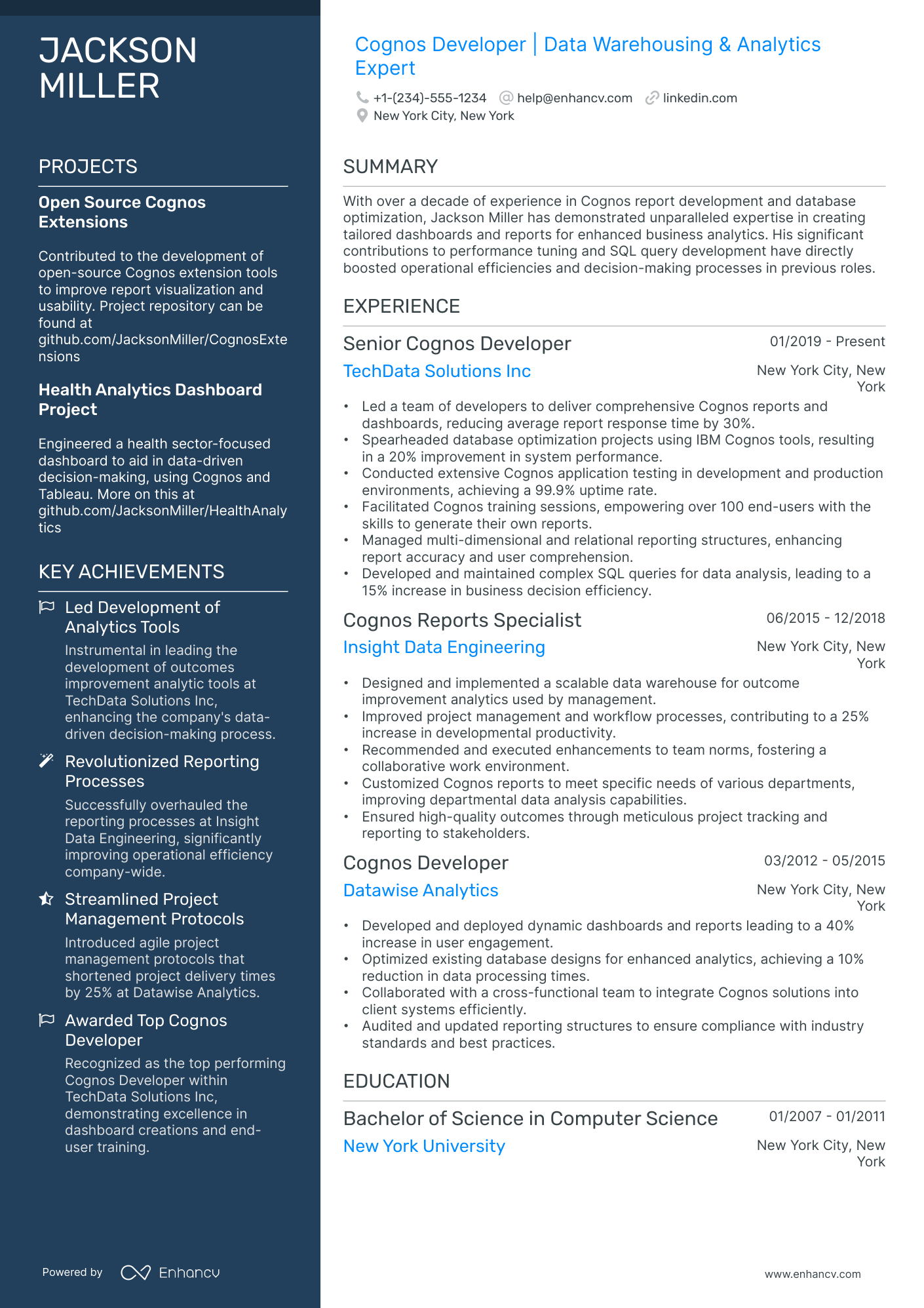
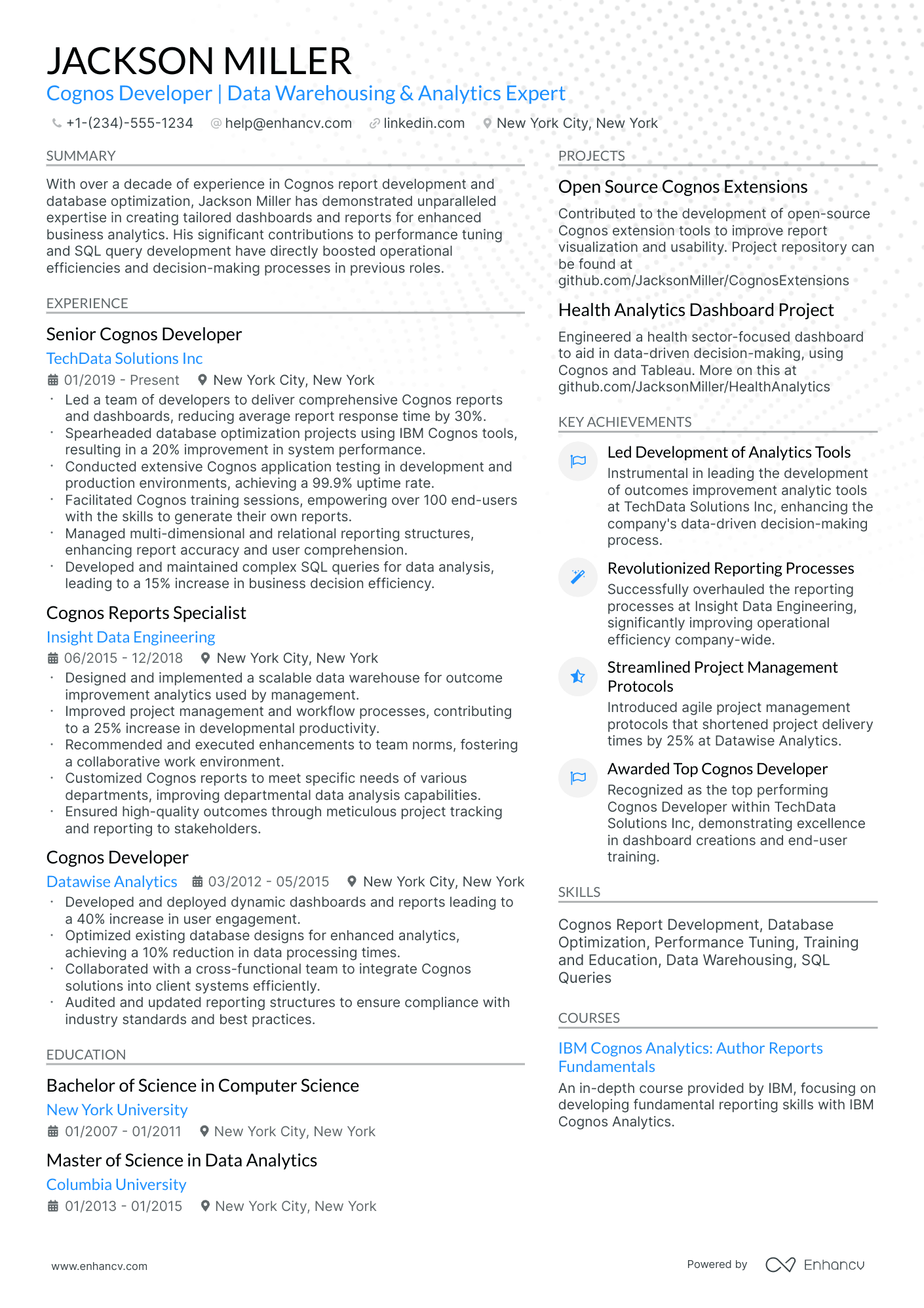
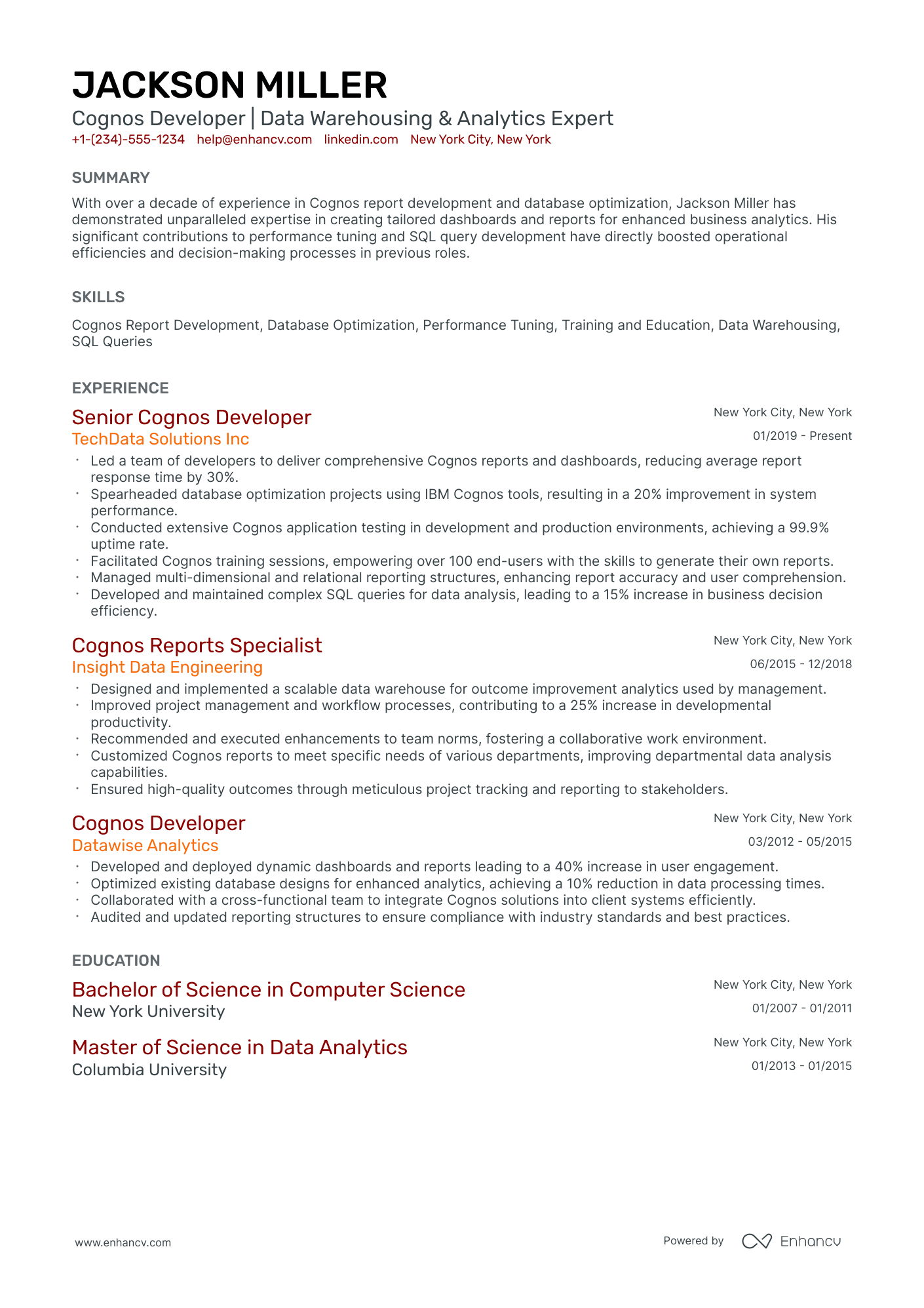
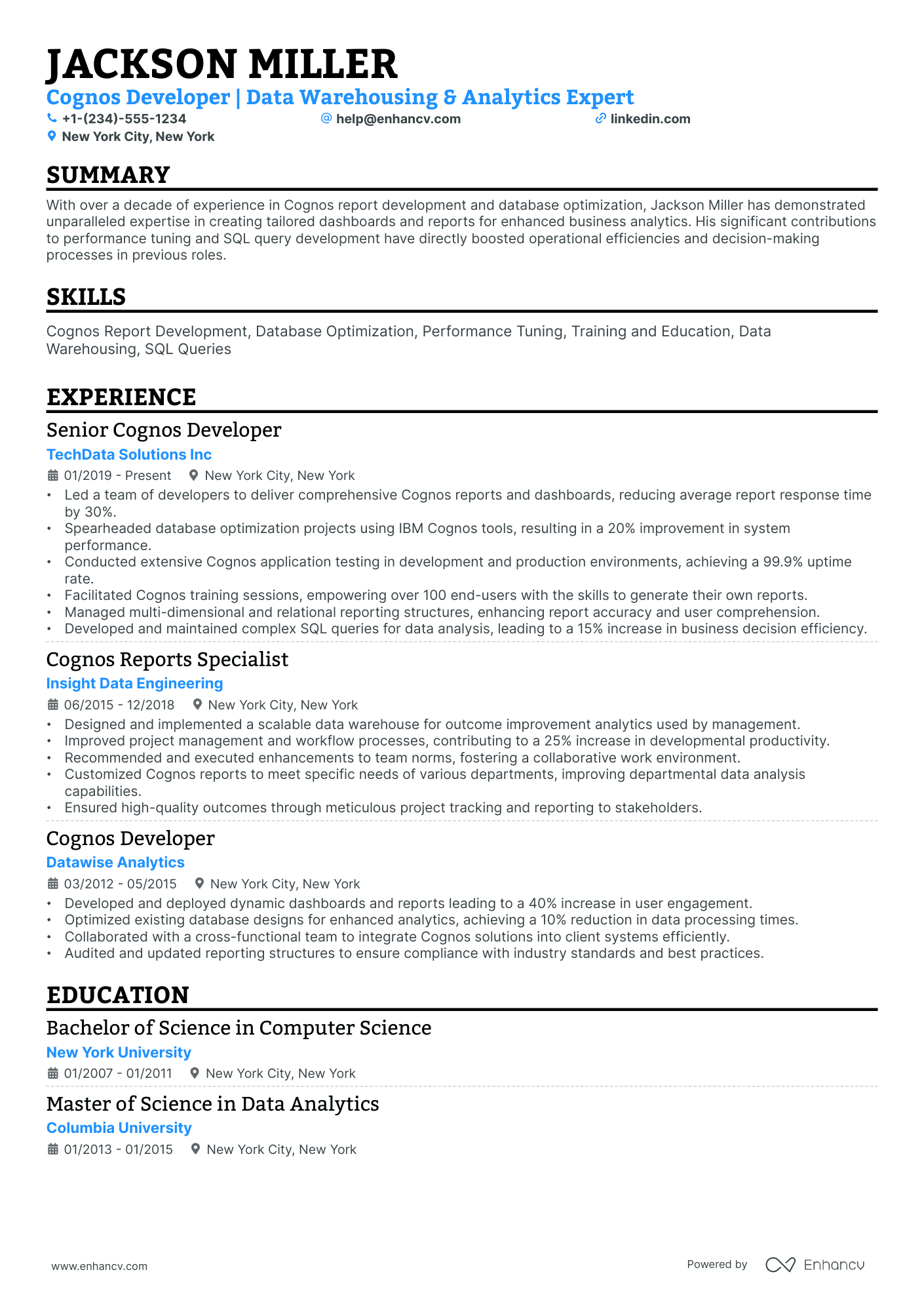
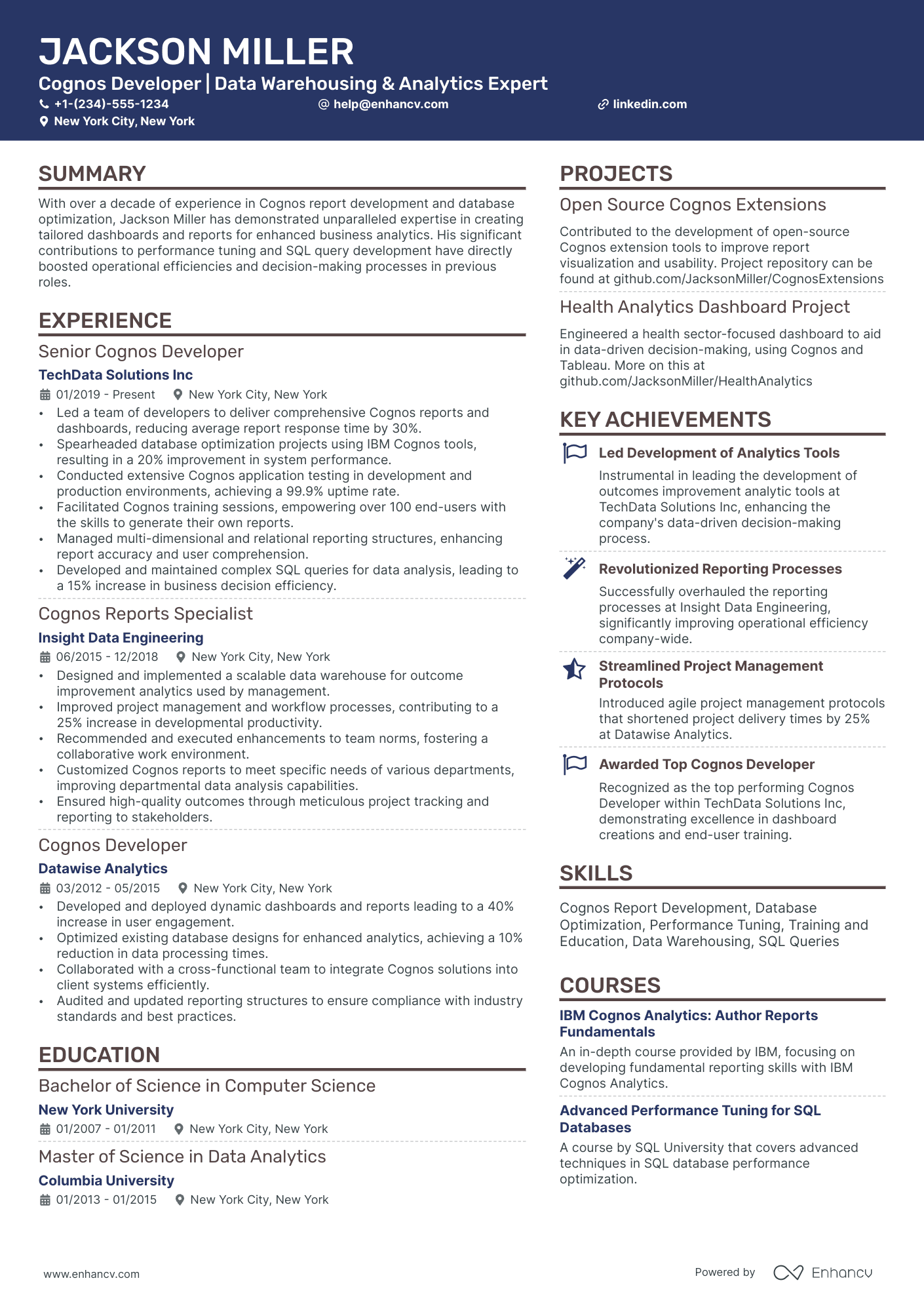
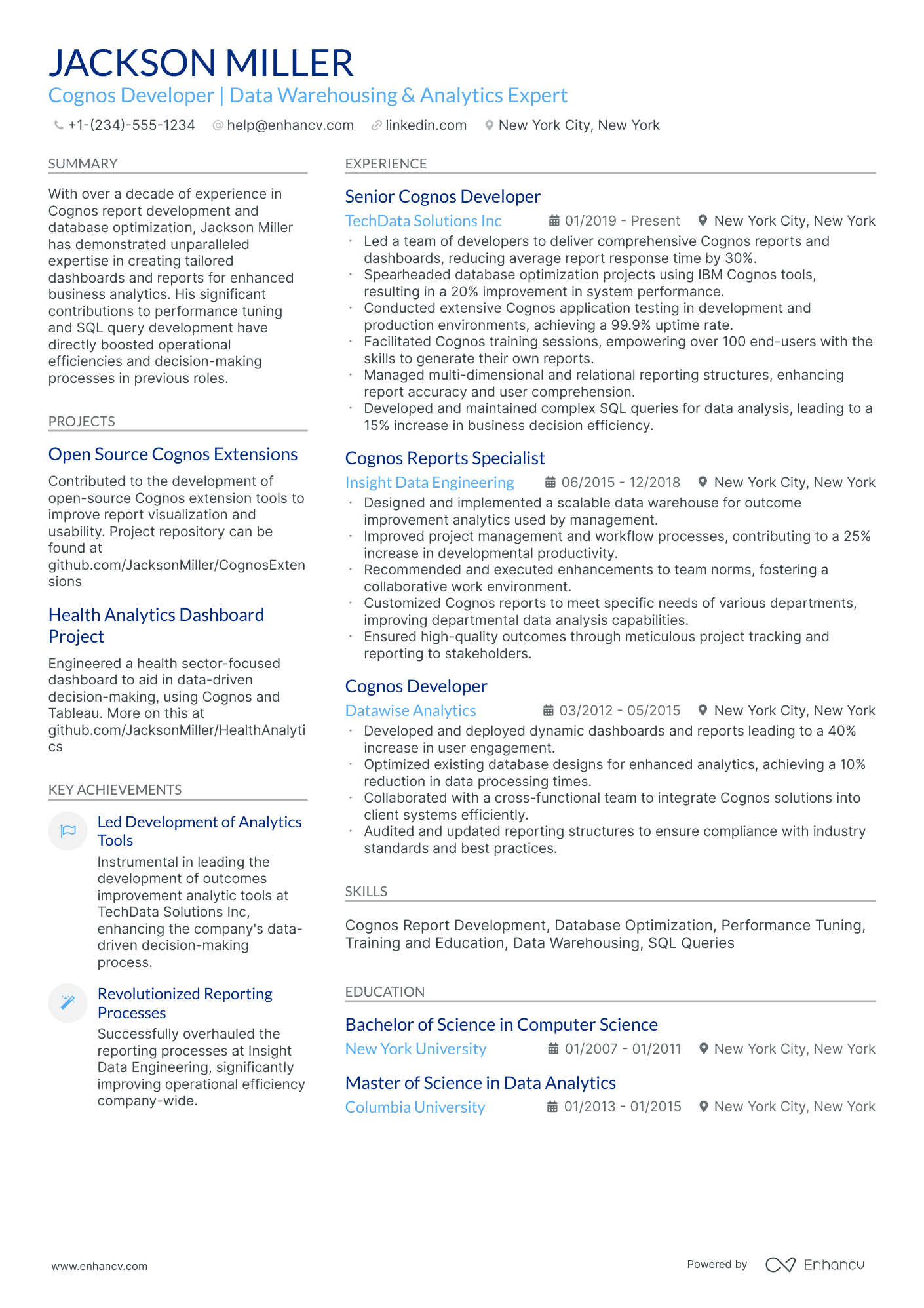
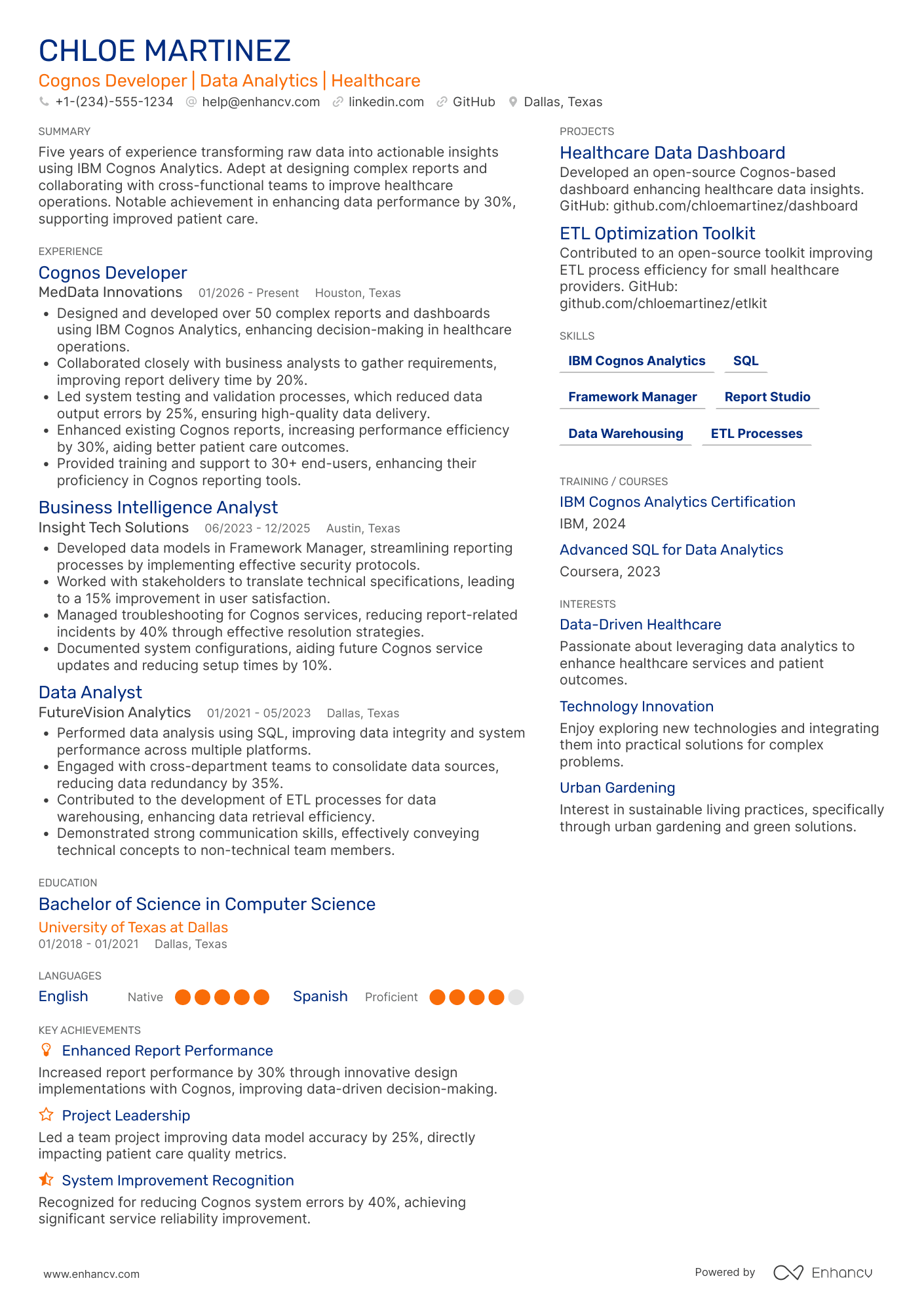
Many Cognos developer resume submissions fail because they list tools and report types without proving business impact. In ATS screening and rapid recruiter scans, that reads generic, and strong candidates get filtered out fast.
A strong resume shows what you delivered and why it mattered. You should highlight performance gains, reduced refresh times, on-time releases, improved data quality, adoption by hundreds of users, and revenue or cost impacts. Quantify scope, stakeholders, and production stability. If you're unsure where to begin, learning how to write a resume that emphasizes measurable results is the first step.

Key takeaways
- Quantify every Cognos bullet with metrics like load time, defect reduction, or user adoption.
- Use reverse-chronological format if you're experienced and hybrid format if you're junior.
- Tailor your resume to each job posting by mirroring its tools, platforms, and KPIs.
- Demonstrate skills through outcome-driven experience bullets, not just a standalone skills list.
- Lead your summary with your title, years of experience, core tools, and a measurable win.
- Include certifications like IBM Cognos Analytics Author to validate technical readiness fast.
- Use Enhancv's Bullet Point Generator to turn vague duties into recruiter-ready, quantified bullets.
How to format a Cognos developer resume
Recruiters hiring Cognos developers prioritize hands-on experience with IBM Cognos Analytics, report development, data modeling, and ETL workflows—along with evidence that you can translate complex data requirements into reliable business intelligence solutions. Choosing the right resume format determines how quickly a hiring manager can identify these technical competencies, trace your project history, and assess the depth of your contributions across reporting environments.

I have significant experience in this role—which format should I use?
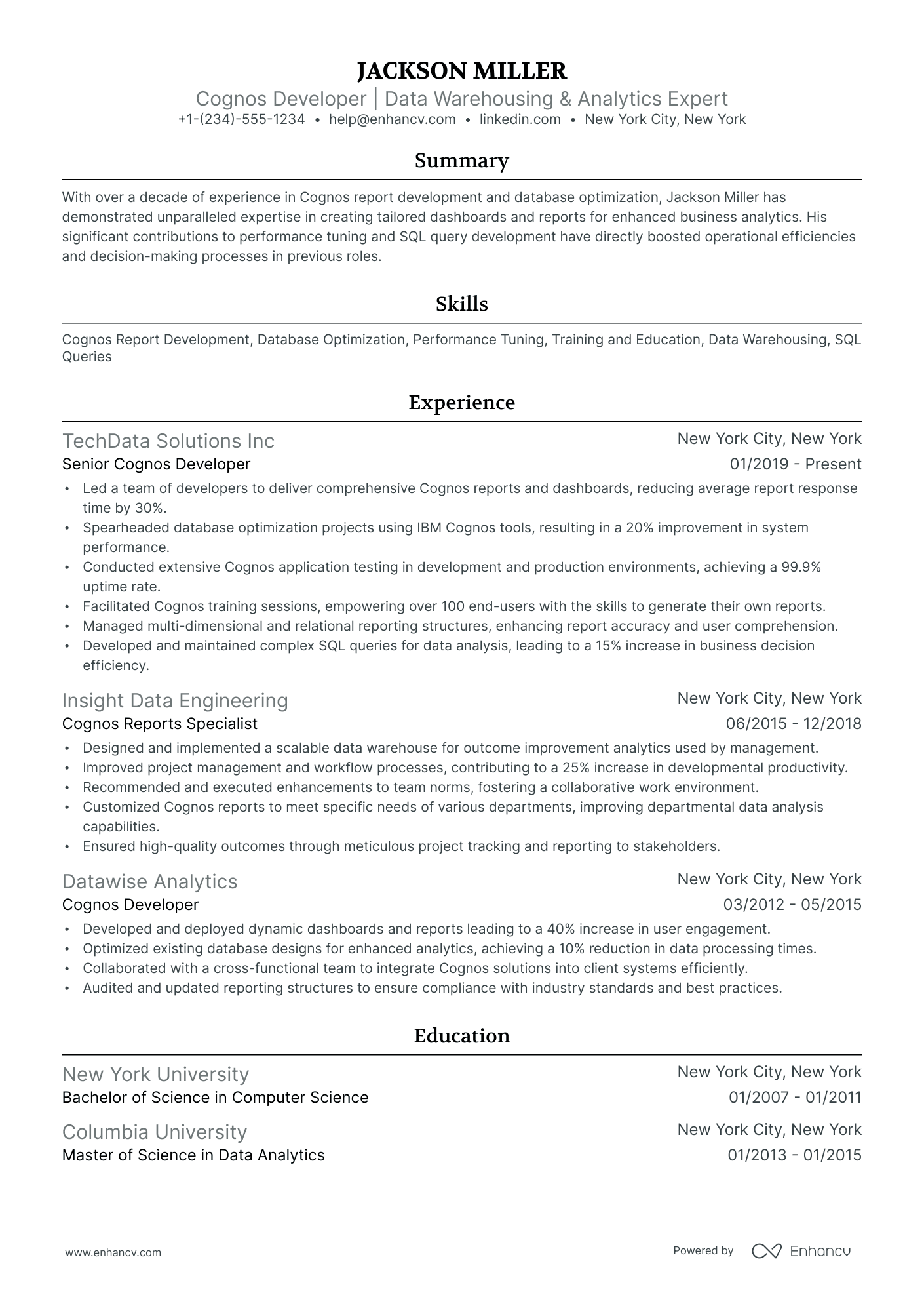
Use a reverse-chronological format—it's the strongest choice for experienced Cognos developers because it lets recruiters immediately trace your progression across increasingly complex BI environments and reporting architectures. Do:
- Lead each role entry with your scope of ownership: number of reports maintained, size of data environments, and cross-functional teams you supported or led.
- Highlight specific Cognos tools and complementary technologies (Report Studio, Analysis Studio, Framework Manager, Transformer, SQL, ETL platforms) within the context of each position.
- Quantify outcomes tied to performance improvements, reporting accuracy, delivery timelines, or cost reductions your work produced.
I'm junior or switching into this role—what format works best?
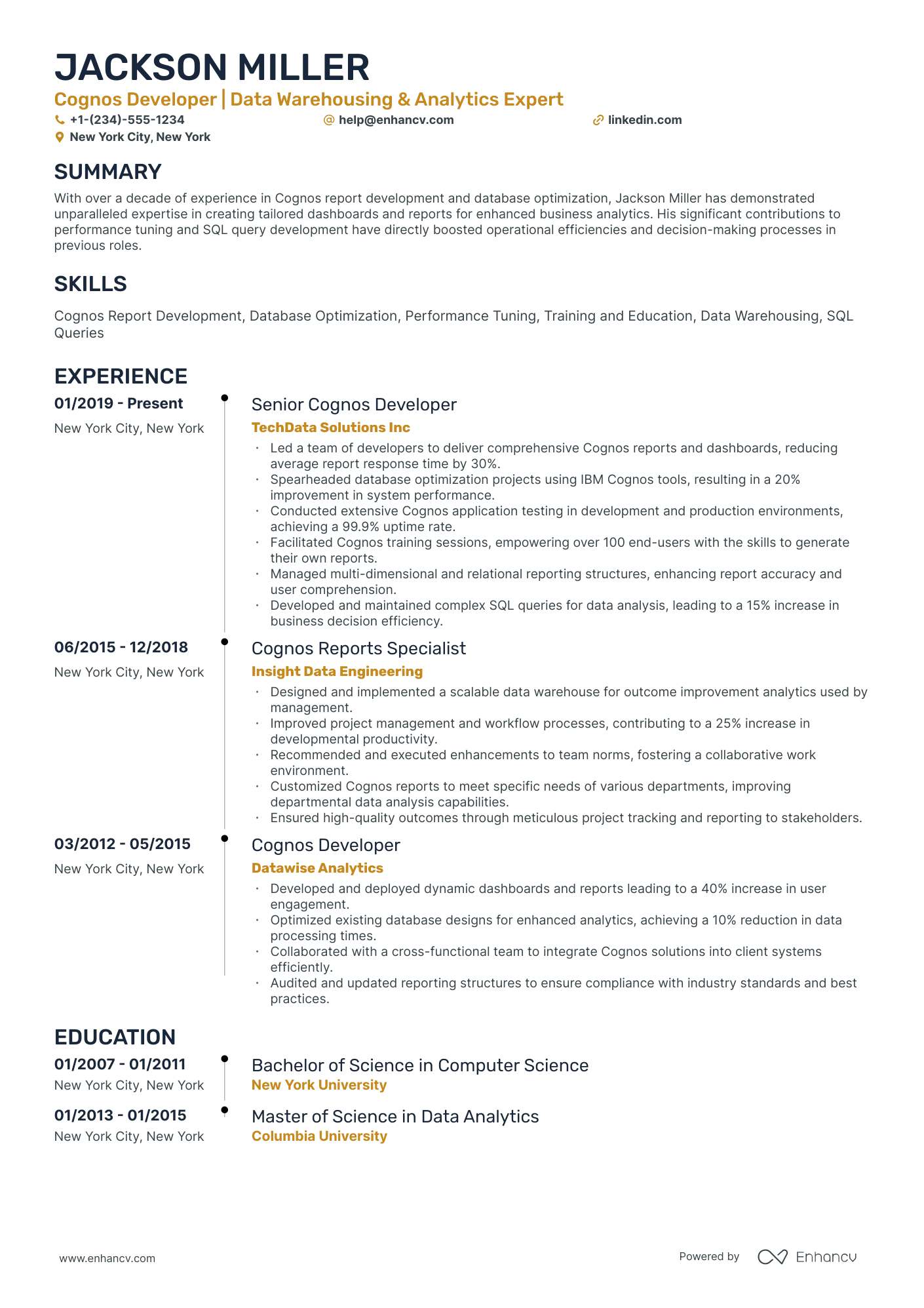
A hybrid format works best because it lets you lead with your Cognos technical skills and BI knowledge while still providing a concise work history that shows how you've applied those skills. Do:
- Place a dedicated skills section near the top of your resume featuring Cognos-specific tools (Report Studio, Query Studio, Framework Manager), SQL proficiency, and any data warehousing or ETL experience.
- Include academic projects, internships, freelance work, or certification labs where you built Cognos reports, designed data models, or worked with BI dashboards—even outside formal employment.
- Connect every listed skill or project to a concrete action and a measurable or observable result.
Why not use a functional resume?
A functional resume strips away the project timelines and role contexts that hiring managers rely on to verify your actual Cognos development experience, making it harder for them to assess the environments you've worked in and the complexity of the reporting solutions you've delivered. A functional format may make sense only in narrow circumstances:
- You're transitioning from a general database or ETL role into dedicated Cognos development and need to foreground transferable BI skills.
- You have a significant employment gap but completed Cognos certifications, independent projects, or contract work during that time.
Once you've established a clean, readable format, the next step is deciding which sections to include and how to organize them for maximum impact.
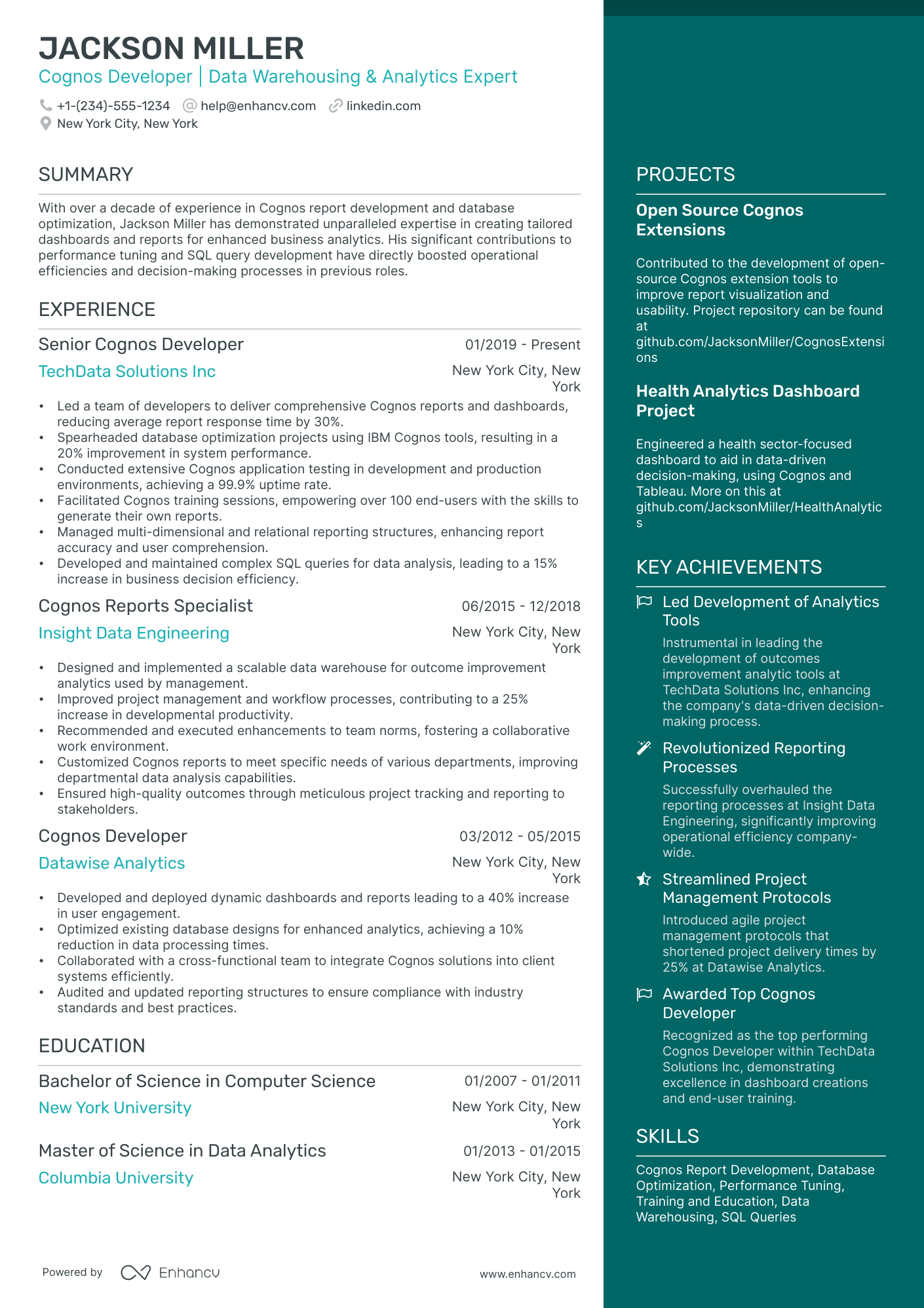
What sections should go on a Cognos developer resume
Recruiters expect a Cognos developer resume to clearly show your business intelligence delivery experience, reporting expertise, and measurable results. Understanding which resume sections to include ensures you present that information effectively.
Use this structure for maximum clarity:
- Header
- Summary
- Experience
- Skills
- Projects
- Education
- Certifications
- Optional sections: Awards, Publications, Languages
Strong experience bullets should emphasize report and dashboard outcomes, performance improvements, data model scope, stakeholder impact, and delivery results.
Is your resume good enough?
Drop your resume here or choose a file. PDF & DOCX only. Max 2MB file size.
With your resume’s key components in place, the next step is to write your Cognos developer resume experience so each role supports that structure with clear, results-focused details.
How to write your Cognos developer resume experience
Your experience section should showcase the reporting solutions, data models, and BI deliverables you've shipped—along with the tools, frameworks, and methods that drove each outcome. Hiring managers prioritize demonstrated impact over descriptive task lists, so every bullet should connect your Cognos work to a measurable business result. Building a targeted resume that aligns each entry with the employer's priorities will strengthen this connection.
Each entry should include:
- Job title
- Company and location (or remote)
- Dates of employment (month and year)
Three to five concise bullet points showing what you owned, how you executed, and what outcomes you delivered:
- Ownership scope: the Cognos reports, dashboards, data packages, cubes, or BI environments you were directly accountable for—including the business units, datasets, or end-user populations they served.
- Execution approach: the specific Cognos components, query techniques, data-modeling methods, ETL processes, or SQL optimization strategies you applied to design, build, and deploy reporting solutions.
- Value improved: the changes you drove in report performance, data accuracy, query efficiency, dashboard load times, or analytical accessibility that strengthened how stakeholders consumed and trusted business intelligence.
- Collaboration context: how you partnered with database administrators, data engineers, business analysts, project managers, or end users to gather requirements, validate data logic, and align Cognos deliverables with organizational priorities.
- Impact delivered: the business outcomes your Cognos work produced—expressed through the scale of adoption, decision-making improvements, time savings, or operational gains rather than a list of completed tasks.
Experience bullet formula
A Cognos developer experience example
✅ Right example - modern, quantified, specific.
Cognos BI Developer
NorthBridge Health Plan | Remote
2021–Present
Regional health insurer supporting 2,000+ internal users with regulated claims, finance, and provider analytics.
- Modernized the IBM Cognos Analytics reporting layer by migrating 140 legacy Report Studio assets to Cognos Analytics, cutting average report build time by 35% and reducing production defects by 28%.
- Optimized Framework Manager models and Oracle SQL queries by redesigning star schemas, adding aggregates, and tuning prompts, improving dashboard load times from 18 seconds to under six seconds for high-traffic finance packs.
- Automated daily refresh and distribution for 60+ burst reports using Cognos schedules, event triggers, and SFTP delivery, saving 12 hours per week for the finance and provider relations teams.
- Implemented row-level security with LDAP groups and Cognos security namespaces, passing two audit cycles with zero access findings and reducing unauthorized data exposure risk by 90%.
- Partnered with product managers, data engineers, and compliance to define certified metrics and data dictionaries, increasing self-serve adoption by 22% and cutting ad hoc request volume by 18%.
Now that you've seen how a strong experience section comes together, let's look at how to align each bullet point with the specific job posting you're targeting.
How to tailor your Cognos developer resume experience
Recruiters evaluate your Cognos developer resume through both human review and applicant tracking systems (ATS). Tailoring your resume to the job description ensures your most relevant skills and accomplishments surface immediately.
Ways to tailor your Cognos developer experience:
- Match the specific Cognos product versions listed in the job description.
- Mirror the exact reporting frameworks or data modeling terms used.
- Align your listed KPIs with the performance metrics the role prioritizes.
- Highlight experience with the same database platforms the employer uses.
- Reference industry or domain expertise when the posting specifies it.
- Emphasize data governance or security practices if the role requires them.
- Include ETL tools or integration workflows mentioned in the requirements.
- Reflect the collaboration structures described such as agile or cross-functional teams.
Tailoring means aligning your real accomplishments with what the employer asks for, not forcing disconnected keywords into your experience.
Resume tailoring examples for Cognos developer
| Job description excerpt | Untailored | Tailored |
|---|---|---|
| Design and develop Cognos reports, dashboards, and cubes using Framework Manager and Report Studio for enterprise financial reporting | Worked on reporting projects and helped create dashboards for the team. | Designed 40+ Cognos reports and interactive dashboards in Report Studio, building Framework Manager models to support enterprise financial reporting across five business units. |
| Optimize Cognos BI environment performance, troubleshoot query bottlenecks, and manage Cognos Analytics 11.x server administration | Handled system issues and made improvements to the reporting platform. | Tuned query performance in Cognos Analytics 11.2 by restructuring dimensional models and resolving server bottlenecks, reducing average report execution time by 35%. |
| Collaborate with business analysts to gather requirements and deliver self-service BI solutions using Cognos Analytics with data modules and explorations | Communicated with stakeholders and delivered data solutions based on their needs. | Partnered with business analysts to translate requirements into self-service BI solutions, configuring Cognos Analytics data modules and explorations that enabled 200+ end users to build ad hoc reports without developer support. |
Once you’ve aligned your Cognos developer experience with the role’s priorities, quantify your Cognos developer achievements to show the measurable impact of that work.
How to quantify your Cognos developer achievements
Quantifying your achievements proves your reports, models, and jobs improved decisions and operations. Focus on query performance, refresh reliability, defect reduction, user adoption, delivery speed, and cost savings across Cognos Analytics, Framework Manager, and your data warehouse.
Quantifying examples for Cognos developer
| Metric | Example |
|---|---|
| Performance | "Cut dashboard load time from 18s to 6s by optimizing Framework Manager joins, adding aggregate tables, and tuning DB2 indexes for a 12-report package." |
| Reliability | "Improved nightly ETL and Cognos schedule success rate from 92% to 99.6% by adding job dependencies, retries, and alerting in Control-M." |
| Quality | "Reduced production report defects by 40% by implementing version control, peer reviews, and automated validation of 120 key KPIs across sales and finance." |
| Delivery speed | "Decreased report turnaround from ten days to four days by standardizing prompt pages, reusable templates, and parameter macros in Cognos Analytics." |
| Adoption | "Increased active users from 150 to 430 by launching role-based dashboards, training five departments, and retiring 25 redundant reports." |
Turn vague job duties into measurable, recruiter-ready resume bullets in seconds with Enhancv's Bullet Point Generator.
With your bullet points clearly articulating your accomplishments, it's equally important to strategically present the hard and soft skills that support them throughout your resume.
How to list your hard and soft skills on a Cognos developer resume
A well-organized skills section matters for Cognos developers because recruiters and an ATS (applicant tracking system) scan them to confirm platform fit, data and reporting depth, and delivery readiness, so aim for a mix heavy on hard skills with targeted collaboration and stakeholder soft skills.
Cognos developer roles require a blend of:
- Product strategy and discovery skills
- Data, analytics, and experimentation skills
- Delivery, execution, and go-to-market discipline
- Soft skills
Your skills section should be:
- Scannable (bullet-style grouping).
- Relevant to the job post.
- Backed by proof in experience bullets.
- Updated with current tools.
Place your skills section:
- Above experience if you're junior or switching careers.
- Below experience if you're mid/senior with strong achievements.

Hard skills
- IBM Cognos Analytics
- Report Studio, Query Studio
- Framework Manager modeling
- Dynamic query mode tuning
- SQL, stored procedures
- Dimensional modeling, star schema
- Data warehouse concepts, ETL
- Oracle, SQL Server, DB2
- Cognos security, row-level security
- Prompting, drill-through, dashboards
- Report bursting, scheduling
- Source control: Git
Soft skills
- Translate requirements into reports
- Clarify definitions and metrics
- Partner with data engineering teams
- Align stakeholders on KPI logic
- Document models and report logic
- Prioritize fixes by business impact
- Debug issues with tight timelines
- Communicate tradeoffs and risks
- Manage scope changes proactively
- Review reports for data accuracy
- Own releases and post-deploy checks
- Train users on self-service reporting
How to show your Cognos developer skills in context
Skills shouldn't live only in a dedicated skills list. Explore how other professionals present their resume skills in context to see what effective integration looks like.
They should be demonstrated in:
- Your summary (high-level professional identity)
- Your experience (proof through outcomes)
Here's what that looks like in practice.
Summary example
Senior Cognos developer with 10+ years in healthcare analytics. Skilled in Report Studio, Framework Manager, and dimensional modeling. Built enterprise dashboards that cut executive reporting time by 35%, partnering with cross-functional teams to align BI outputs with strategic goals.
- Specifies senior experience level clearly
- Names role-relevant Cognos tools
- Includes a measurable outcome
- Highlights collaboration as a soft skill
Experience example
Senior Cognos Developer
Meridian Health Partners | Remote
March 2019–January 2024
- Redesigned 40+ Framework Manager models with clinical data architects, reducing query runtime by 28% across enterprise dashboards.
- Built automated Report Studio packages for compliance teams, cutting monthly reporting effort from five days to one.
- Migrated legacy Cognos 10 environments to Cognos Analytics 11, collaborating with infrastructure engineers to achieve 99.8% uptime post-launch.
- Every bullet includes measurable proof
- Skills appear naturally through real outcomes
Once you’ve demonstrated your Cognos developer abilities through relevant examples and outcomes, the next step is to apply that same approach to a Cognos developer resume when you don’t have professional experience.
How do I write a Cognos developer resume with no experience
Even without full-time experience, you can demonstrate readiness through projects, coursework, and certifications. If you're building a resume without work experience, focus on tangible outputs that prove your Cognos capabilities:
- Cognos Analytics sample dashboards.
- IBM Cognos report portfolio.
- SQL reporting coursework projects.
- Data warehouse schema practice.
- GitHub repository with report specs.
- Volunteer nonprofit reporting support.
- Internship-like freelance BI tasks.
- Certification labs and capstones.
Focus on:
- Cognos developer report samples.
- SQL and data modeling proof.
- Documented requirements-to-delivery work.
- Testing, performance, and governance.
Resume format tip for entry-level Cognos developer
Use a combination resume format because it highlights projects, tools, and results before limited work history. Do:
- Lead with a projects section.
- List Cognos developer tools used.
- Quantify results with clear metrics.
- Include SQL queries and data sources.
- Link to a report portfolio.
- Built five IBM Cognos Analytics reports and one dashboard from a star schema, cutting weekly manual Excel updates by 60% for a mock sales dataset.
Once you've built your resume around transferable skills and relevant projects, presenting your education effectively becomes the next way to reinforce your qualifications.
How to list your education on a Cognos developer resume
Your education section helps hiring teams confirm you have the technical and analytical foundation a Cognos developer needs. It validates your knowledge of databases, reporting, and business intelligence concepts.
Include:
- Degree name
- Institution
- Location
- Graduation year
- Relevant coursework (for juniors or entry-level candidates)
- Honors & GPA (if 3.5 or higher)
Skip month and day details—list the graduation year only.
Here's a strong education entry tailored for a Cognos developer resume:
Example education entry
Bachelor of Science in Information Systems
University of Illinois at Chicago, Chicago, IL
Graduated 2019
GPA: 3.7/4.0
- Relevant Coursework: Database Management, Data Warehousing, Business Intelligence Systems, SQL Programming, Systems Analysis
- Honors: Dean's List, Magna Cum Laude
How to list your certifications on a Cognos developer resume
Certifications on your resume show a Cognos developer's commitment to learning, proficiency with analytics tools, and alignment with current industry expectations, which helps recruiters trust your technical readiness faster. Include:
- Certificate name
- Issuing organization
- Year
- Optional: credential ID or URL
- Place certifications below education when your degree is recent and closely matches the Cognos developer role.
- Place certifications above education when they are recent, highly relevant, or stronger proof of Cognos developer skills than older schooling.
Best certifications for your Cognos developer resume
IBM Cognos Analytics Author V11 IBM Cognos Analytics Administrator V11 IBM Certified Data Engineer – Big Data Microsoft Certified: Power BI Data Analyst Associate Oracle Certified Professional, Oracle Database SQL Developer Tableau Desktop Specialist AWS Certified Data Analytics – Specialty
Once you’ve positioned your credentials to validate your Cognos expertise, shift to your Cognos developer resume summary to highlight that value upfront in a quick, employer-focused snapshot.
How to write your Cognos developer resume summary
Your resume summary is the first thing a recruiter reads, so it must immediately signal relevance. A strong opening positions you as a capable Cognos developer worth interviewing.
Keep it to three to four lines, with:
- Your title and total years of experience in Cognos development.
- The domain or industry where you've applied your expertise.
- Core tools such as Cognos Analytics, Report Studio, Framework Manager, or SQL.
- One or two measurable achievements that prove your impact.
- A soft skill tied to a real outcome, like cross-team collaboration that shortened delivery timelines.

PRO TIP
At a junior level, lead with the specific Cognos tools you know and any early wins from internships or projects. Highlight SQL proficiency, report-building skills, and eagerness shown through results. Avoid vague phrases like "passionate self-starter" or "quick learner." Replace them with concrete details recruiters can verify.
Example summary for a Cognos developer
Cognos developer with two years of experience building Report Studio dashboards for healthcare clients. Reduced monthly reporting cycle time by 30% through optimized SQL queries and automated data models.
Optimize your resume summary and objective for ATS
Drop your resume here or choose a file.
PDF & DOCX only. Max 2MB file size.
Now that your summary captures your strongest qualifications, make sure your header presents the essential contact and professional details recruiters need to reach you.
What to include in a Cognos developer resume header
A resume header lists your key identifiers and contact details, helping Cognos developer candidates improve visibility, credibility, and recruiter screening speed.
Essential resume header elements
- Full name
- Tailored job title and headline
- Location
- Phone number
- Professional email
- GitHub link
- Portfolio link
A LinkedIn link helps recruiters verify your experience quickly and supports screening.
Don't include a photo on a Cognos developer resume unless the role is explicitly front-facing or appearance-dependent.
Keep your header consistent with your application profiles, and include a Cognos developer headline that matches the job posting.
Example
Cognos developer resume header
Jordan Taylor
Cognos developer | IBM Cognos Analytics Reporting and Data Modeling
Austin, TX
(512) 555-13XX
jordan.taylor@enhancv.com github.com/jordantaylor yourwebsite.com linkedin.com/in/jordantaylor
With your top identifying details and contact information set, add targeted additional sections to strengthen your Cognos developer resume and support the header information.
Additional sections for Cognos developer resumes
When your core qualifications closely match other applicants, additional resume sections help you stand out with role-specific credibility and depth. For example, listing language skills can differentiate you when supporting global BI teams or multilingual stakeholders.
- Languages
- Certifications (IBM Cognos Analytics, IBM Data Engineering)
- Publications (BI whitepapers, data reporting case studies)
- Professional affiliations (TDWI, DAMA International)
- Hobbies and interests (data visualization projects, open-source BI contributions)
- Awards and recognitions
- Conference presentations (IBM Think, analytics summits)
Once you've strengthened your resume with relevant additional sections, pairing it with a well-crafted cover letter can further set your application apart.
Do Cognos developer resumes need a cover letter
A cover letter isn't required for a Cognos developer, but it helps in competitive roles or when hiring teams expect one. If you're wondering what a cover letter is and when it adds value, it can make a difference when your resume needs context or when you want to clarify fit fast.
Use a cover letter when it can add details your resume can't:
- Explain role or team fit: Connect your Cognos developer strengths to the team's reporting stack, data sources, and delivery process.
- Highlight one or two outcomes: Point to a Cognos dashboard, model, or performance fix, and include a measurable result.
- Show business context: Describe the users you supported, the decisions the reports enabled, and how you handled requirements and changes.
- Address transitions or gaps: Tie non-obvious experience to Cognos developer work, such as data warehousing, governance, or stakeholder management.
Drop your resume here or choose a file.
PDF & DOCX only. Max 2MB file size.
Even if you decide a cover letter adds little value for your application, you can still strengthen your Cognos developer resume by using AI to refine its content and alignment.
Using AI to improve your Cognos developer resume
AI can sharpen your resume's clarity, structure, and impact. It helps you reframe experience and highlight relevant skills. But overuse makes resumes sound generic. If you're exploring ChatGPT resume writing prompts, use them to refine specific sections rather than generate entire resumes from scratch. Once your content is clear and role-aligned, step away from AI.
Here are 10 practical prompts to strengthen specific sections of your Cognos developer resume:
Strengthen your summary
Quantify experience bullets
Align skills strategically
Tighten project descriptions
Remove filler language
Tailor to job postings
Improve action verbs
Highlight certifications clearly
Refine education details
Clarify technical contributions
Conclusion
A strong Cognos developer resume proves impact with measurable outcomes, like faster report performance, fewer defects, or shorter delivery cycles. It highlights role-specific skills, including IBM Cognos Analytics, SQL, data modeling, and ETL collaboration. It uses a clear structure that makes results easy to scan.
Keep each Cognos developer section focused, consistent, and tied to business needs. When your experience, metrics, and skills align, you look ready for today’s hiring market and near-future demands. This approach helps recruiters trust your fit quickly.