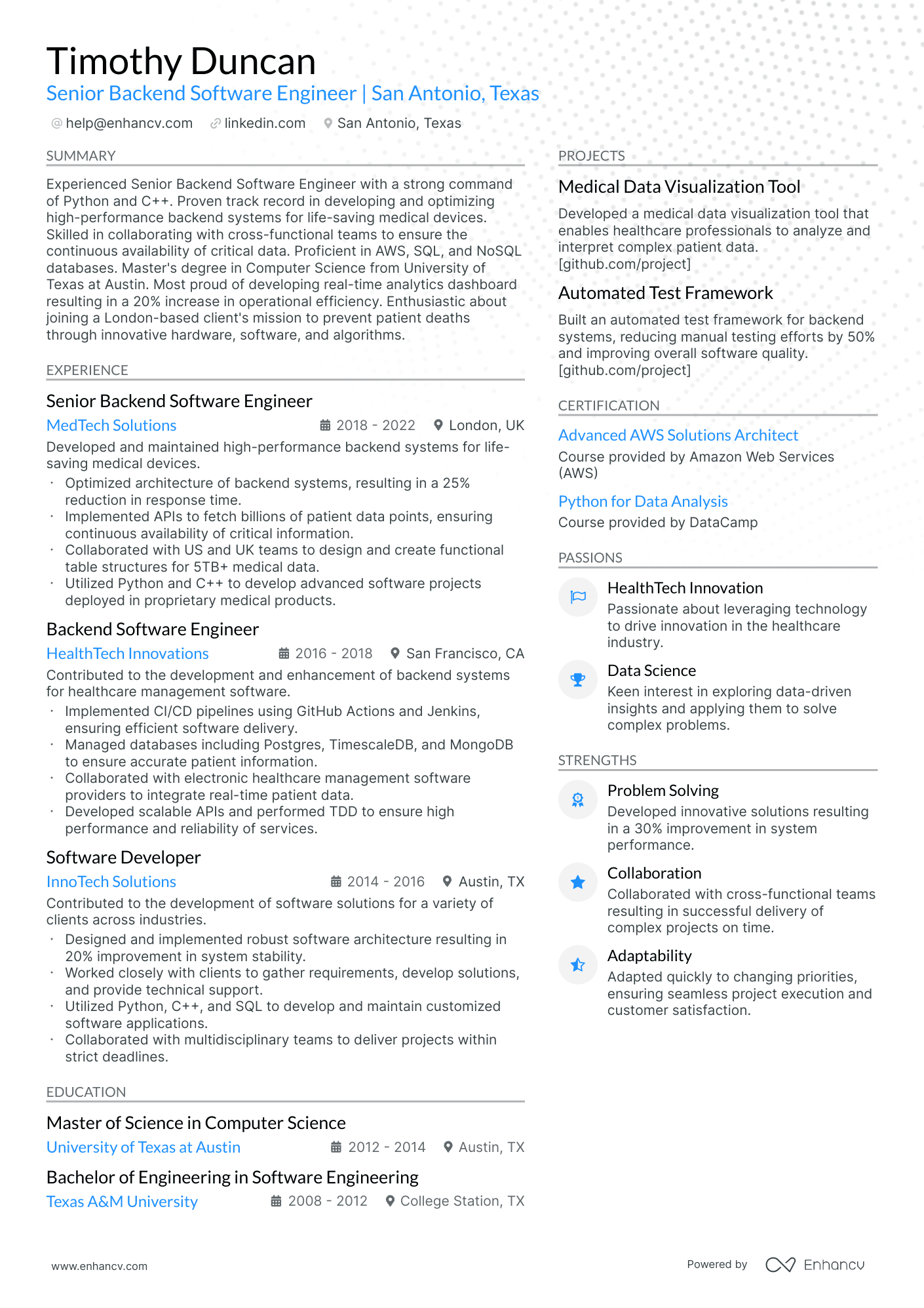
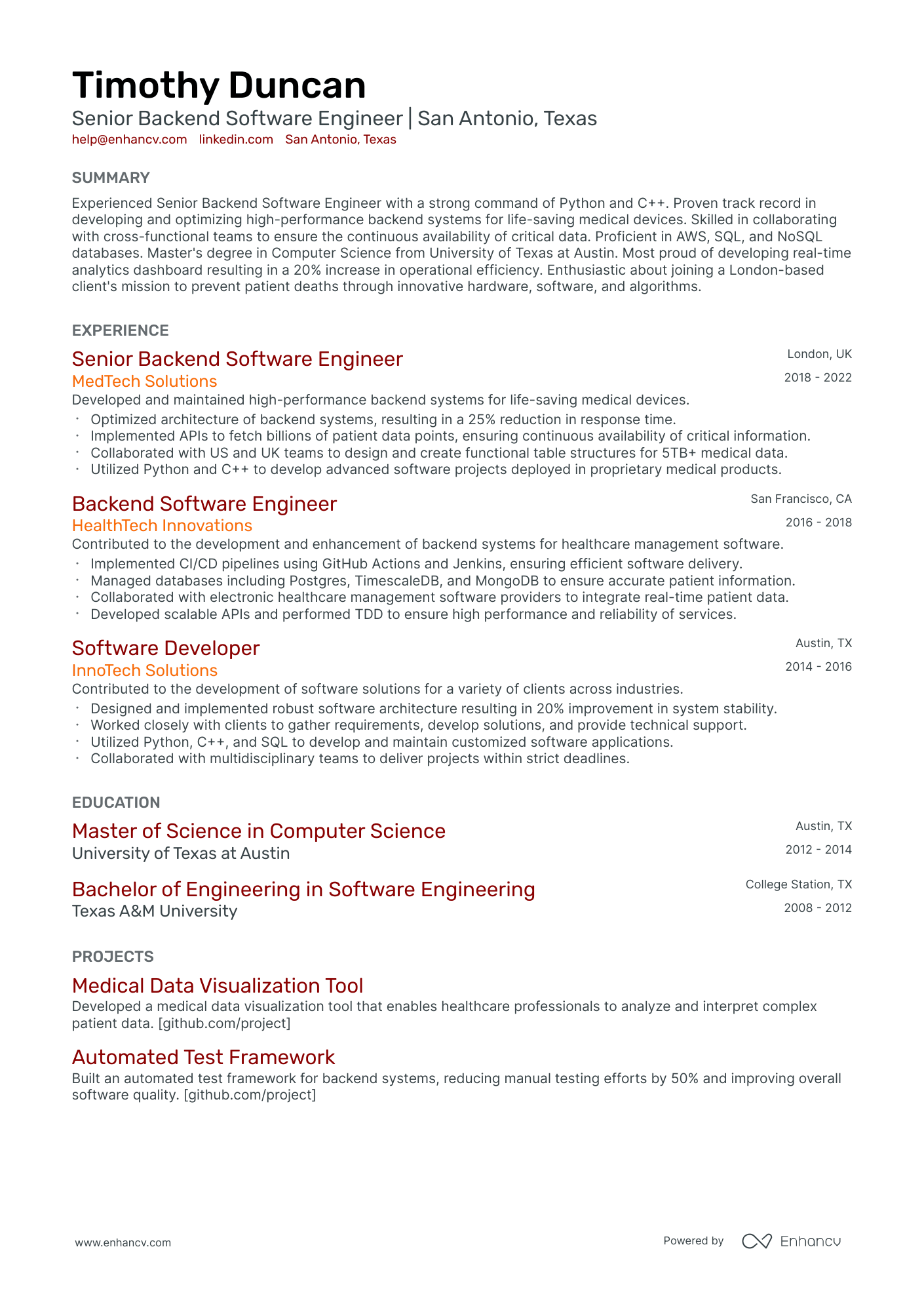
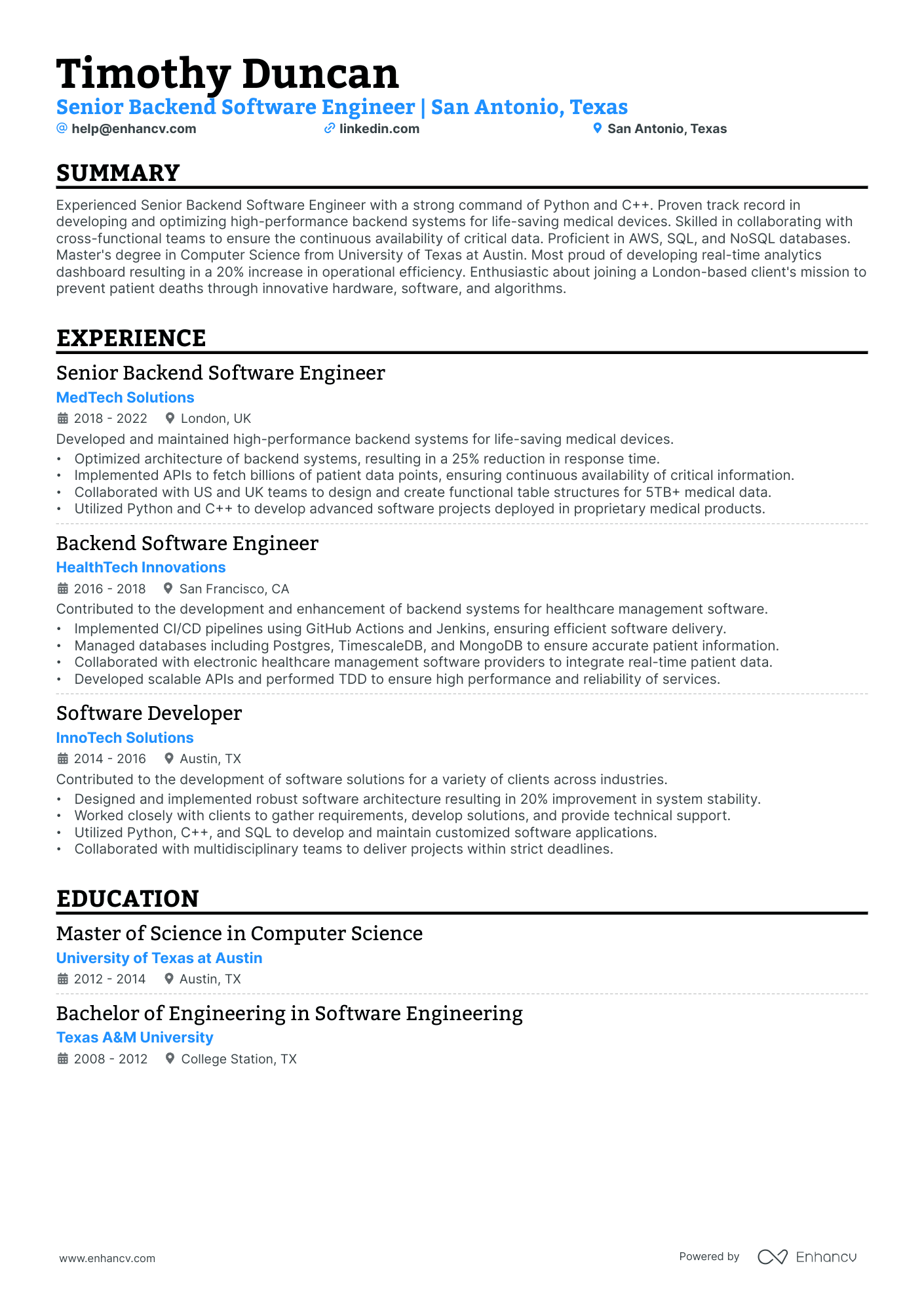
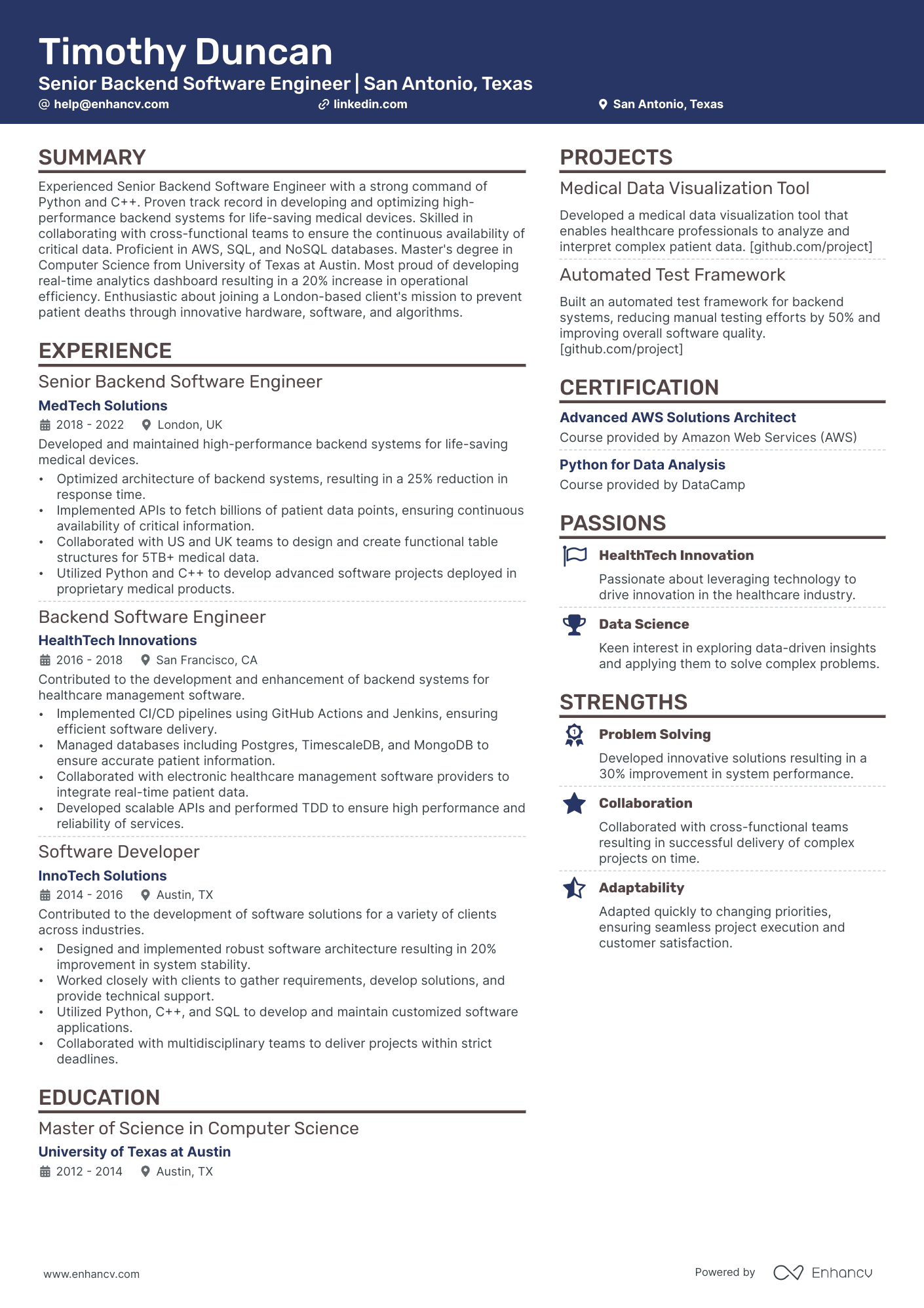
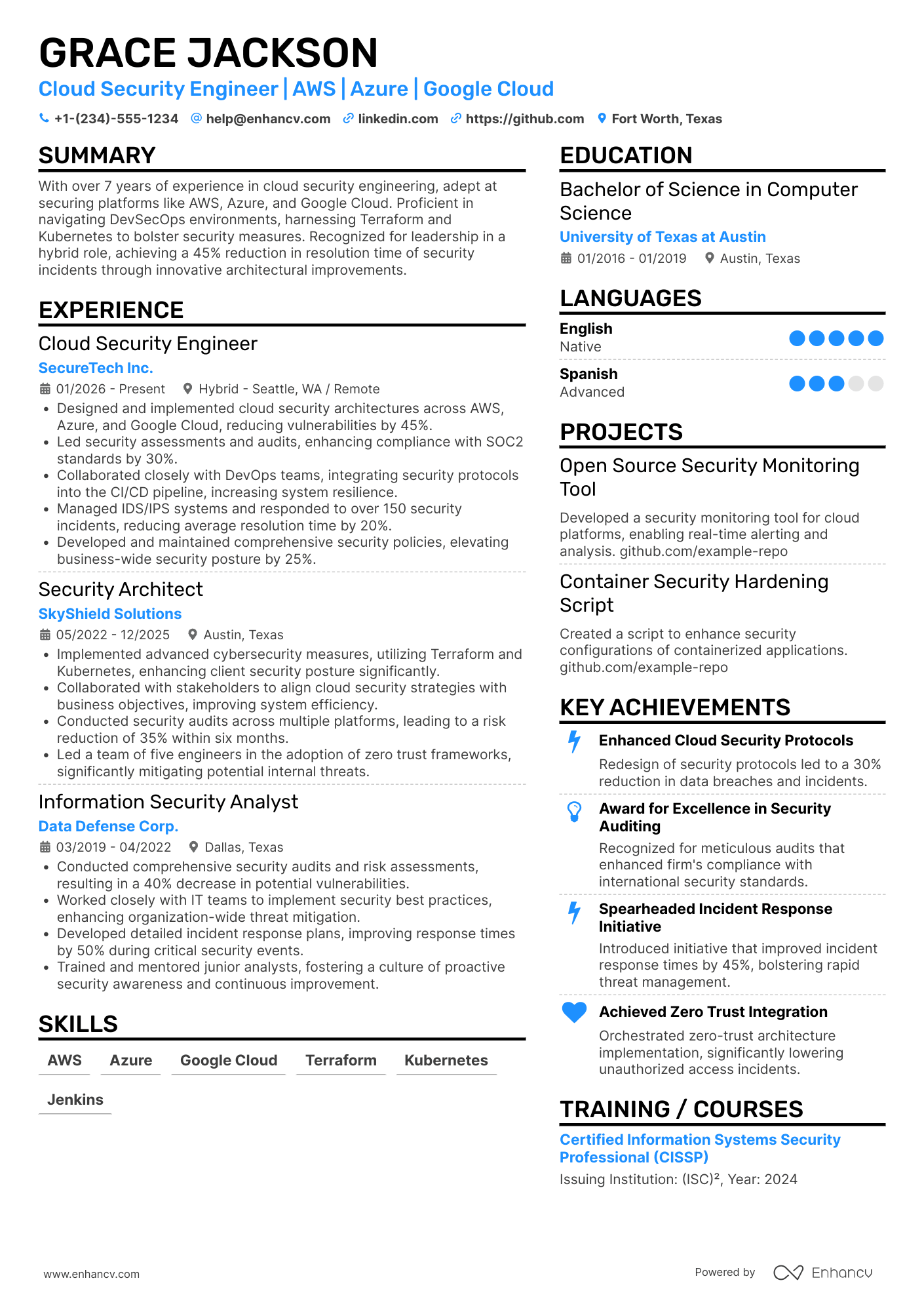
Many cloud security engineer resume submissions fail because they list tools and tasks but don't show risk reduction, control coverage, or cloud-scale impact. That hurts in ATS screening and fast recruiter scans, especially when competition is tight.
A strong resume shows what changed because of your work, not what you touched. Knowing how to make your resume stand out starts with quantifying reduced critical findings, improved detection coverage, shortened mean time to respond, secured multi-account workloads, passed audits, and delivered guardrails that sped up releases without incidents.

Key takeaways
- Quantify risk reduction, detection speed, and compliance outcomes instead of listing tools or tasks.
- Use reverse-chronological format for experienced candidates and hybrid format for career switchers.
- Tailor every experience bullet to mirror the job posting's platforms, frameworks, and tooling.
- Place certifications above education when they're more recent and relevant than your degree.
- Demonstrate skills in context within your summary and experience, not just in a standalone list.
- Showcase home labs, open-source contributions, or capstone projects if you lack full-time experience.
- Use Enhancv's tools to tighten bullet points and align your resume with specific job descriptions.
Job market snapshot for cloud security engineers
We analyzed 85 recent cloud security engineer job ads across major US job boards. These numbers help you understand skills in demand, salary landscape, employer expectations at a glance.
What level of experience employers are looking for cloud security engineers
| Years of Experience | Percentage found in job ads |
|---|---|
| 1–2 years | 2.4% (2) |
| 3–4 years | 15.3% (13) |
| 5–6 years | 29.4% (25) |
| 7–8 years | 7.1% (6) |
| 9–10 years | 1.2% (1) |
| Not specified | 44.7% (38) |
Cloud security engineer ads by area of specialization (industry)
| Industry (Area) | Percentage found in job ads |
|---|---|
| Finance & Banking | 43.5% (37) |
| Healthcare | 30.6% (26) |
| Education | 12.9% (11) |
Role overview stats
These tables show the most common responsibilities and employment types for cloud security engineer roles. Use them to align your resume with what employers expect and to understand how the role is structured across the market.
Day-to-day activities and top responsibilities for a cloud security engineer
| Responsibility | Percentage found in job ads |
|---|---|
| Aws | 68.2% (58) |
| Cloud security | 44.7% (38) |
| Azure | 43.5% (37) |
| Python | 40.0% (34) |
| Ci/cd | 34.1% (29) |
| Terraform | 32.9% (28) |
| Iam | 31.8% (27) |
| Kubernetes | 27.1% (23) |
| Gcp | 24.7% (21) |
| Linux | 21.2% (18) |
| Siem | 21.2% (18) |
| Automation | 17.6% (15) |
Type of employment (remote vs on-site vs hybrid)
| Employment type | Percentage found in job ads |
|---|---|
| Hybrid | 49.4% (42) |
| On-site | 28.2% (24) |
| Remote | 22.4% (19) |
How to format a cloud security engineer resume
Recruiters evaluating cloud security engineers prioritize hands-on expertise with cloud platforms, security frameworks, and infrastructure-as-code tooling—alongside evidence of threat mitigation, compliance work, and cross-team collaboration. A clean, well-structured resume format ensures these technical signals surface quickly during both automated screening and the initial human review.

I have significant experience in this role—which format should I use?
Use a reverse-chronological format to showcase your deepening cloud security expertise and growing scope of responsibility across roles. Do:
- Lead each role entry with your scope of ownership—number of cloud environments secured, team size, or breadth of infrastructure managed.
- Highlight specific platforms, tools, and domains (AWS, Azure, GCP, Terraform, Kubernetes, SIEM, IAM, zero-trust architecture, SOC 2, ISO 27001) within the context of each position.
- Quantify outcomes tied to risk reduction, incident response, cost savings, or compliance milestones.
I'm junior or switching into this role—what format works best?
A hybrid format works best, letting you lead with a focused skills section while still backing up each claim with real experience or project work. Do:
- Place a technical skills section near the top, grouping cloud security competencies (cloud IAM, network segmentation, vulnerability scanning, IaC security) for immediate visibility.
- Include cloud security projects, lab environments, CTF challenges, or open-source contributions—even if they weren't part of paid employment—to demonstrate applied knowledge.
- Connect every listed skill to a concrete action and a measurable or observable result.
Why not use a functional resume?
A functional format strips away the timeline and context that recruiters need to verify where and how you applied your cloud security skills, making it harder to assess real competency. When a functional resume might be acceptable:
- If you're transitioning from a related field (network engineering, systems administration, DevOps) and lack dedicated cloud security job titles, a functional format can work—but only if every skill is anchored to specific projects, certifications, or measurable outcomes rather than listed in isolation.
With your format established, the next step is filling it with the right sections to showcase your qualifications effectively.
What sections should go on a cloud security engineer resume
Recruiters expect a cloud security engineer resume to show clear ownership of securing cloud environments across identity, network, data, and monitoring. Understanding which resume sections to include helps you present this ownership with maximum clarity.
Use this structure for maximum clarity:
- Header
- Summary
- Experience
- Skills
- Projects
- Education
- Certifications
- Optional sections: Open-source work, Publications, Volunteering
Strong experience bullets should emphasize measurable security outcomes, risk reduction, cloud scope and scale, and the impact of your automation and controls.
Is your resume good enough?
Drop your resume here or choose a file. PDF & DOCX only. Max 2MB file size.
Now that you’ve organized the key parts of your resume, focus next on writing your cloud security engineer experience section so each role clearly supports the structure you’ve built.
How to write your cloud security engineer resume experience
Your experience section should highlight cloud security work you've shipped or delivered, the platforms and tools you used, and the measurable outcomes you produced. Hiring managers prioritize demonstrated impact—hardened environments, reduced vulnerabilities, automated compliance—over descriptive task lists. Building a targeted resume ensures each bullet connects directly to what the role demands.
Each entry should include:
- Job title
- Company and location (or remote)
- Dates of employment (month and year)
Three to five concise bullet points showing what you owned, how you executed, and what outcomes you delivered:
- Ownership scope: the cloud environments, security platforms, identity systems, or infrastructure segments you were directly accountable for protecting, monitoring, or architecting.
- Execution approach: the specific tools, frameworks, and methods—such as SIEM platforms, infrastructure-as-code, zero-trust models, or cloud-native security services—you used to assess risk, enforce policy, and deliver secure configurations.
- Value improved: the changes you drove in security posture, incident response time, vulnerability remediation speed, compliance coverage, or system reliability across your cloud footprint.
- Collaboration context: how you partnered with DevOps, platform engineering, compliance, or application development teams to embed security into deployment pipelines, architecture decisions, and organizational processes.
- Impact delivered: the business-level outcomes your work produced, expressed through risk reduction, audit readiness, breach prevention, cost savings, or scale of environments secured rather than through activities performed.
Experience bullet formula
A cloud security engineer experience example
✅ Right example - modern, quantified, specific.
Cloud Security Engineer
Northbridge Health | Remote
2022–Present
Scaled a HIPAA-regulated telehealth platform supporting over two million monthly patient sessions across AWS and Kubernetes.
- Architected and enforced AWS security guardrails using Terraform, AWS Organizations, and Service Control Policies, cutting high-risk misconfigurations by 62% and reducing audit prep time by 40%.
- Implemented container and Kubernetes runtime security with OPA Gatekeeper, Falco, and Amazon Elastic Kubernetes Service admission controls, reducing critical findings in production by 55% while partnering with platform engineers.
- Built automated vulnerability management with Trivy, Snyk, and AWS Security Hub integrated into GitHub Actions, shrinking median remediation time from twelve days to four days across eight engineering teams.
- Led incident response for cloud threats using AWS CloudTrail, Amazon GuardDuty, and Splunk, improving mean time to detect by 47% and coordinating post-incident fixes with engineering managers and product owners.
- Rolled out least-privilege identity access management using AWS Identity and Access Management, AWS Single Sign-On, and role-based access control, reducing standing admin access by 78% and eliminating shared credentials across production accounts.
Now that you've seen how a strong experience section comes together, let's look at how to adjust yours to match the specific job you're targeting.
How to tailor your cloud security engineer resume experience
Recruiters evaluate your cloud security engineer resume through both applicant tracking systems and manual review. Tailoring your resume to the job description ensures your qualifications connect directly with what the hiring team needs.
Ways to tailor your cloud security engineer experience:
- Match cloud platforms like AWS or Azure named in the posting.
- Mirror specific compliance frameworks such as SOC 2 or ISO 27001.
- Use the exact security tooling referenced in the job description.
- Highlight infrastructure as code experience when the role requires it.
- Reflect zero trust or other architecture models the employer specifies.
- Align your incident response language with their stated methodologies.
- Include industry-specific experience when the posting names a sector.
- Emphasize automation of security workflows if the listing prioritizes it.
Tailoring means aligning your real accomplishments with the role's stated requirements—not forcing keywords into places where they don't belong.
Resume tailoring examples for cloud security engineer
| Job description excerpt | Untailored | Tailored |
|---|---|---|
| "Design and implement security controls across AWS environments, including IAM policies, VPC configurations, and GuardDuty alerting." | Helped secure cloud infrastructure and worked on access controls. | Designed and enforced least-privilege IAM policies across 12 AWS accounts, configured VPC segmentation for production workloads, and tuned GuardDuty alerting rules—reducing false positives by 40%. |
| "Conduct cloud security assessments using CIS Benchmarks and remediate misconfigurations in Azure and GCP using Terraform." | Performed security reviews and fixed issues in cloud systems. | Conducted quarterly cloud security assessments against CIS Benchmarks for Azure and GCP, identifying and remediating 200+ misconfigurations through Terraform-managed infrastructure-as-code pipelines. |
| "Lead incident response for cloud-native threats, including container escapes and compromised service accounts, using SIEM tools such as Splunk and Chronicle." | Responded to security incidents and helped improve response processes. | Led incident response for 15+ cloud-native threats—including container escape attempts and compromised GCP service accounts—using Splunk and Chronicle to cut mean detection time from 45 minutes to 12 minutes. |
Once you’ve aligned your experience with the role’s cloud security priorities, the next step is to quantify your cloud security engineer achievements so hiring teams can see the impact of that work.
How to quantify your cloud security engineer achievements
Quantifying your achievements shows how your security work reduces risk while improving uptime, speed, and cost. Focus on incident reduction, mean time to detect and respond, policy coverage, vulnerability exposure windows, compliance pass rates, and cloud spend saved through secure-by-default controls.
Quantifying examples for cloud security engineer
| Metric | Example |
|---|---|
| Risk reduction | "Cut high-severity cloud incidents from 12 per quarter to three by enforcing AWS Organizations service control policies and GuardDuty findings auto-triage." |
| Detection speed | "Reduced mean time to detect from 45 minutes to eight minutes by centralizing logs in Splunk and tuning CloudTrail and VPC Flow Logs alerts." |
| Response time | "Lowered mean time to respond from six hours to 90 minutes by automating containment with AWS Lambda and Systems Manager runbooks." |
| Compliance quality | "Raised CIS benchmark pass rate from 78% to 96% across 60 AWS accounts using Terraform guardrails and AWS Config conformance packs." |
| Cost efficiency | "Saved $180,000 annually by right-sizing security logging, archiving to S3 Glacier, and cutting duplicate SIEM ingestion by 35%." |
Turn vague job duties into measurable, recruiter-ready resume bullets in seconds with Enhancv's Bullet Point Generator.
With your experience clearly articulated through strong bullet points, the next step is ensuring your skills section presents the right mix of hard and soft skills that cloud security engineer roles demand.
How to list your hard and soft skills on a cloud security engineer resume
Your skills section shows you can secure cloud workloads at scale, and recruiters and ATS scan this section to confirm keyword match and role fit—aim for a balance of cloud security hard skills with a smaller set of execution-focused soft skills. cloud security engineer roles require a blend of:
- Product strategy and discovery skills.
- Data, analytics, and experimentation skills.
- Delivery, execution, and go-to-market discipline.
- Soft skills.
Your skills section should be:
- Scannable (bullet-style grouping).
- Relevant to the job post.
- Backed by proof in experience bullets.
- Updated with current tools.
Place your skills section:
- Above experience if you're junior or switching careers.
- Below experience if you're mid/senior with strong achievements.

Hard skills
- AWS, Azure, Google Cloud Platform
- Identity and access management, single sign-on
- Key management service, secrets management
- Cloud network security, segmentation
- Infrastructure as code: Terraform, CloudFormation
- Cloud security posture management
- Kubernetes security, container hardening
- Web application firewall, distributed denial-of-service protection
- Security information and event management, log analytics
- Vulnerability management, patch orchestration
- Threat modeling, risk assessments
- Incident response, forensics triage
Soft skills
- Write clear security requirements
- Partner with platform and DevOps teams
- Prioritize fixes by risk and impact
- Explain tradeoffs to nontechnical stakeholders
- Lead incident coordination under pressure
- Drive security reviews to closure
- Challenge insecure designs with evidence
- Document decisions and runbooks
- Influence without authority across teams
- Communicate findings in concise briefs
- Build consensus on remediation plans
- Own outcomes end to end
How to show your cloud security engineer skills in context
Skills shouldn't live only in a dedicated skills list. Explore resume skills examples to see how top candidates weave competencies throughout their resumes.
They should be demonstrated in:
- Your summary (high-level professional identity)
- Your experience (proof through outcomes)
Here's what strong, contextual skill placement looks like in practice.
Summary example
Senior cloud security engineer with eight years securing AWS and Azure environments in financial services. Skilled in Terraform, SIEM integration, and zero-trust architecture. Reduced cloud misconfigurations by 74% through automated policy enforcement and cross-team security training initiatives.
- Specifies senior-level experience clearly
- Names industry-relevant tools directly
- Quantifies a concrete security outcome
- Signals collaboration and leadership ability
Experience example
Senior Cloud Security Engineer
Ridgeline Financial Technologies | Remote
March 2020–Present
- Architected zero-trust network segmentation across 120+ AWS accounts using Terraform and AWS Organizations, cutting unauthorized access incidents by 63%.
- Partnered with DevOps and engineering teams to embed Prisma Cloud scanning into CI/CD pipelines, reducing container vulnerabilities by 48% before production.
- Designed and deployed centralized SIEM alerting with Splunk, improving mean time to detect threats from 14 hours to under 90 minutes.
- Every bullet includes measurable proof
- Skills appear naturally within achievements
Once you’ve demonstrated your cloud security engineering strengths through relevant examples and outcomes, the next step is structuring a cloud security engineer resume with no experience to highlight that evidence effectively.
How do I write a cloud security engineer resume with no experience
Even without full-time experience, you can demonstrate readiness through projects, labs, and certifications. If you're building a resume without work experience, focus on applied cloud security knowledge that proves you can deliver results from day one.
- Home lab on AWS security
- Cloud security capstone project
- Internship in cloud operations
- Open-source security contributions
- Security-focused hackathon participation
- Volunteer IAM and MFA rollout
- Industry certifications and labs
- Bug bounty cloud misconfigurations
Focus on:
- Cloud security engineer project outcomes
- IAM, least privilege, and MFA
- Logging, monitoring, and alerting
- Infrastructure as code security
Resume format tip for entry-level cloud security engineer
Use a combination resume format because it highlights projects, labs, and certifications first, while still showing relevant coursework and work history. Do:
- Put projects and labs above work history.
- Quantify results with counts, coverage, or time.
- List tools: AWS, Terraform, CloudTrail, GuardDuty.
- Map each bullet to a job requirement.
- Add links to code and reports.
- Built an AWS home lab, enforced least-privilege IAM with Terraform, enabled CloudTrail and GuardDuty, and cut public S3 exposure from five buckets to zero.
Once you've structured your resume around transferable skills and relevant projects, presenting your education effectively becomes the next step in reinforcing your qualifications.
How to list your education on a cloud security engineer resume
Your education section helps hiring teams confirm you have the foundational knowledge needed for a cloud security engineer role. It validates your technical background quickly.
Include:
- Degree name
- Institution
- Location
- Graduation year
- Relevant coursework (for juniors or entry-level candidates)
- Honors & GPA (if 3.5 or higher)
Skip month and day details—list the graduation year only.
Here's a strong education entry tailored for a cloud security engineer resume.
Example education entry
Bachelor of Science in Cybersecurity
Georgia Institute of Technology, Atlanta, GA
Graduated 2021
GPA: 3.7/4.0
- Relevant Coursework: Network Defense, Cloud Computing Architecture, Cryptography, Identity and Access Management, Secure Systems Design
- Honors: Dean's List, Magna Cum Laude
How to list your certifications on a cloud security engineer resume
Certifications on your resume show your commitment to learning, prove tool proficiency, and confirm industry relevance as a cloud security engineer.
Include:
- Certificate name
- Issuing organization
- Year
- Optional: credential ID or URL
- Put certifications below education when your degree is recent and directly aligned with cloud security engineer work.
- Put certifications above education when they are recent, role-relevant, and stronger signals than an older or unrelated degree.
Best certifications for your cloud security engineer resume
- AWS Certified Security—Specialty
- Microsoft Certified: Azure Security Engineer Associate
- Google Professional Cloud Security Engineer
- Certified Cloud Security Professional (CCSP)
- GIAC Cloud Security Automation (GCSA)
- CompTIA Security+
- Certified Information Systems Security Professional (CISSP)
Once you’ve positioned your certifications to validate your cloud security expertise, use your resume summary to quickly connect those qualifications to the role you’re targeting.
How to write your cloud security engineer resume summary
Your resume summary is the first thing a recruiter reads. A strong one instantly signals you have the right skills and experience for a cloud security engineer role.
Keep it to three to four lines, with:
- Your title and relevant years of experience in cloud security or related fields.
- The domain or industry you've worked in, such as SaaS, fintech, or healthcare.
- Core tools and technologies like AWS, Azure, Terraform, or SIEM platforms.
- One or two measurable achievements, such as reduced vulnerabilities or faster incident response.
- Soft skills tied to real outcomes, like cross-team collaboration that improved security adoption.

PRO TIP
At this level, focus on specific tools, certifications, and hands-on contributions. Highlight early wins that show initiative, like automating a scan or resolving misconfigurations. Avoid vague phrases like "passionate about security" or "fast learner." Recruiters want proof, not promises.
Example summary for a cloud security engineer
Cloud security engineer with two years of experience securing AWS environments in fintech. Reduced IAM misconfigurations by 40% using automated policy checks. Skilled in Terraform, GuardDuty, and cross-team vulnerability remediation.
Optimize your resume summary and objective for ATS
Drop your resume here or choose a file.
PDF & DOCX only. Max 2MB file size.
Now that your summary conveys your value at a glance, make sure your header provides the essential contact and professional details recruiters need to actually reach you.
What to include in a cloud security engineer resume header
A resume header lists your key identity and contact details, and it matters for cloud security engineer visibility, credibility, and fast recruiter screening.
Essential resume header elements
- Full name
- Tailored job title and headline
- Location
- Phone number
- Professional email
- GitHub link
- Portfolio link
Including a LinkedIn link lets recruiters verify roles, dates, and recommendations fast, which supports quick screening.
Don't include a photo on a cloud security engineer resume unless the role is explicitly front-facing or appearance-dependent.
Keep the header to one or two lines, use a cloud security engineer title that matches the posting, and ensure every link works.
Example
Cloud security engineer resume header
Jordan Lee
Cloud Security Engineer | AWS & Azure Security, Identity and Access Management, Incident Response
Austin, TX
(512) 555-01XX
jordan.lee@enhancv.com
github.com/jordanlee
jordanlee.com
linkedin.com/in/jordanlee
Once your contact details and role branding are set, add additional sections to highlight relevant strengths that don’t fit in the header.
Additional sections for cloud security engineer resumes
When your core qualifications match other applicants, well-chosen additional sections help you stand out with role-specific credibility.
- Languages
- Security publications and research
- Conference presentations and speaking engagements
- Open source security tool contributions
- Professional memberships (Cloud Security Alliance, ISACA, ISC²)
- Hobbies and interests
- Volunteer work in cybersecurity education
Once you've strengthened your resume with relevant additional sections, the next step is pairing it with a cover letter that adds even more context to your candidacy.
Do cloud security engineer resumes need a cover letter
A cover letter isn't required for a cloud security engineer, but it helps in competitive roles or when hiring teams expect one. If you're unsure where to start, learn what a cover letter is and how it complements your resume. It can make a difference when your resume needs context, or when you want to show direct alignment with the team.
Use a cover letter when it adds clear, specific value:
- Explain role or team fit by matching your strengths to their cloud stack, security model, and collaboration style.
- Highlight one or two relevant projects or outcomes, using metrics like reduced risk, faster incident response, or fewer misconfigurations.
- Show understanding of the product, users, or business context, such as compliance needs, data sensitivity, or uptime requirements.
- Address career transitions or non-obvious experience by connecting prior work to cloud security engineer responsibilities and impact.
Drop your resume here or choose a file.
PDF & DOCX only. Max 2MB file size.
Even if you choose not to submit a cover letter, AI can help you strengthen your cloud security engineer resume by improving clarity, relevance, and impact.
Using AI to improve your cloud security engineer resume
AI can sharpen your resume's clarity, structure, and impact. It helps tighten language and highlight relevant achievements. But overuse strips authenticity. Once your content reads clearly and aligns with the role, step away from AI. If you're exploring AI tools, this guide on which AI is best for writing resumes can help you choose the right one.
Here are 10 practical prompts to strengthen specific sections of your cloud security engineer resume:
- Strengthen your summary. "Rewrite my cloud security engineer resume summary to highlight my top three relevant skills and years of experience in under four sentences."
- Quantify your impact. "Add measurable results to these cloud security engineer experience bullets, focusing on risk reduction, cost savings, or incident response times."
- Tighten bullet points. "Edit these cloud security engineer experience bullets to start with strong action verbs and remove filler words without losing meaning."
- Align with keywords. "Compare my cloud security engineer resume skills section against this job description and identify missing technical keywords I should add."
- Improve project descriptions. "Rewrite this cloud security engineer project section to clearly state the problem, my role, the tools used, and the outcome."
- Refine technical skills. "Organize my cloud security engineer skills section into logical categories like cloud platforms, security tools, compliance frameworks, and scripting languages."
- Clarify certification relevance. "Write one-line descriptions for each certification on my cloud security engineer resume explaining its relevance to the target role."
- Upgrade education details. "Improve the education section of my cloud security engineer resume by highlighting coursework, labs, or research directly tied to cloud security."
- Remove redundant language. "Identify and remove repetitive phrasing across all sections of my cloud security engineer resume while keeping each bullet distinct."
- Tailor for specificity. "Rewrite three generic experience bullets on my cloud security engineer resume to reference specific cloud environments, tools, or security frameworks I used."
Stop using AI once your resume sounds accurate, specific, and aligned with real experience. AI should never invent experience or inflate claims—if it didn't happen, it doesn't belong here.
Conclusion
A strong cloud security engineer resume proves impact with measurable outcomes, role-specific skills, and a clear structure. Highlight risk reduction, incident response improvements, and compliance results with numbers. Pair those wins with cloud platform security, identity and access management, and automation skills.
Keep sections scannable, bullet points tight, and keywords accurate. This approach shows you can protect modern cloud environments and adapt as tools and threats change. It positions you as a cloud security engineer ready for today’s hiring market and what comes next.