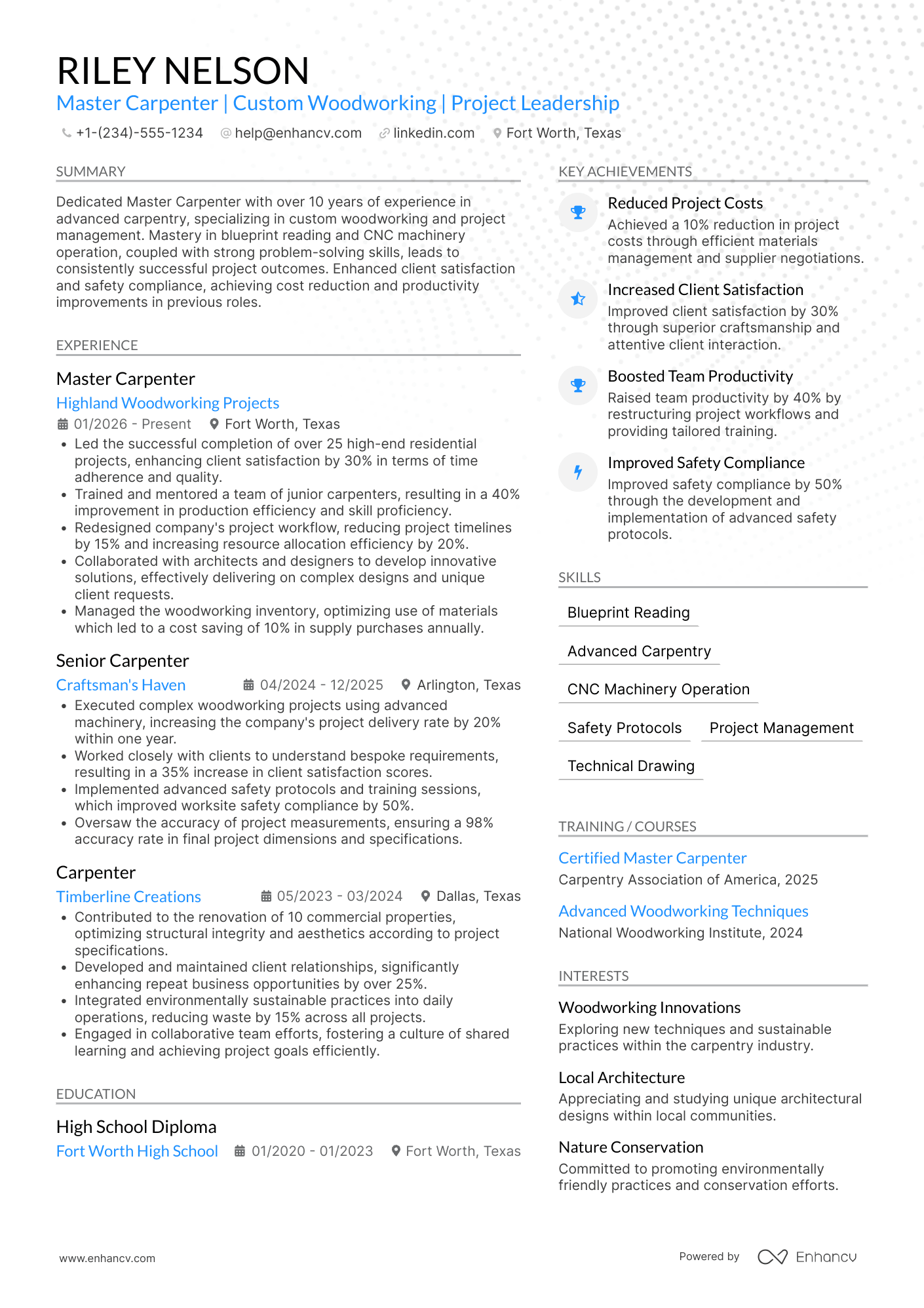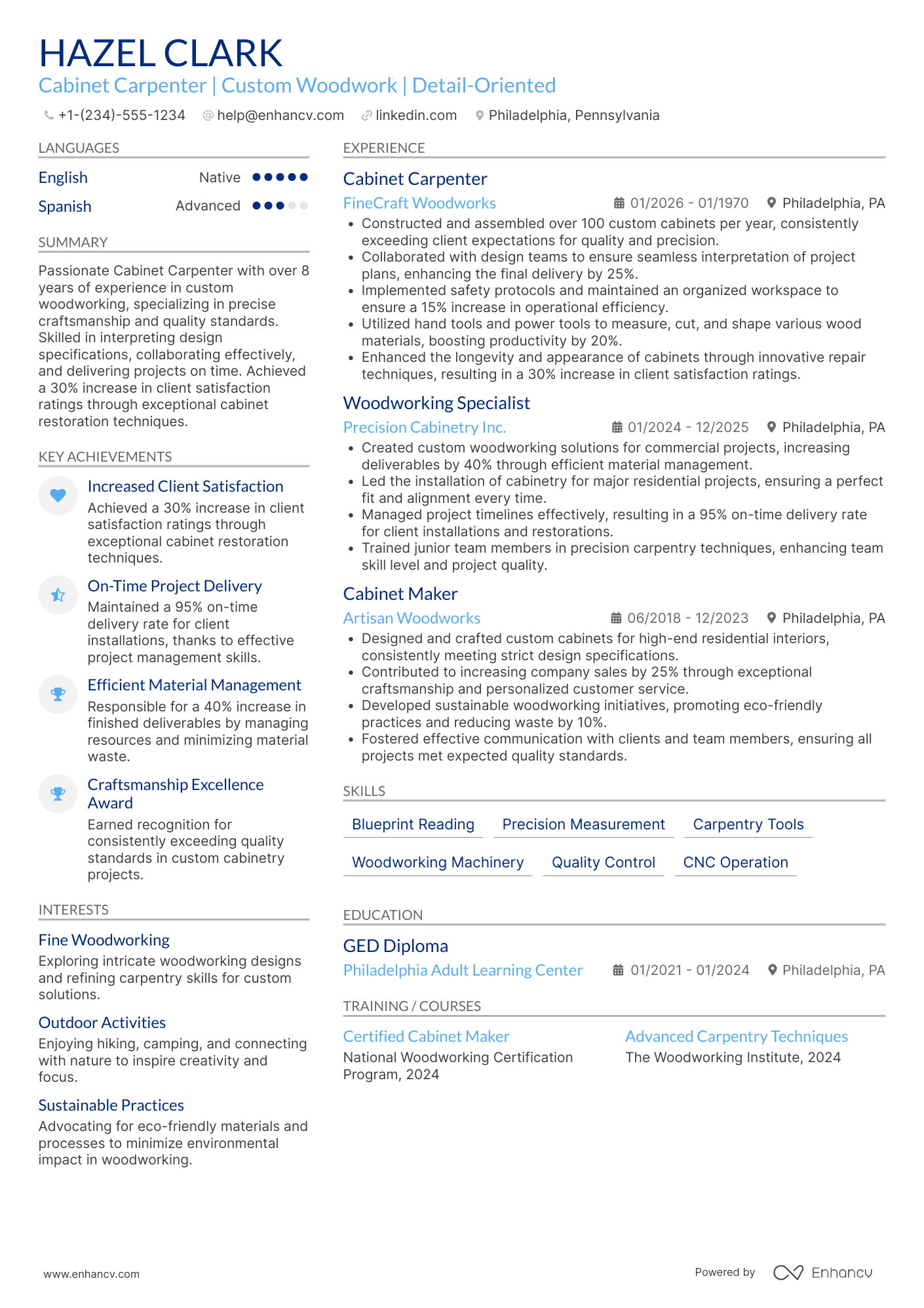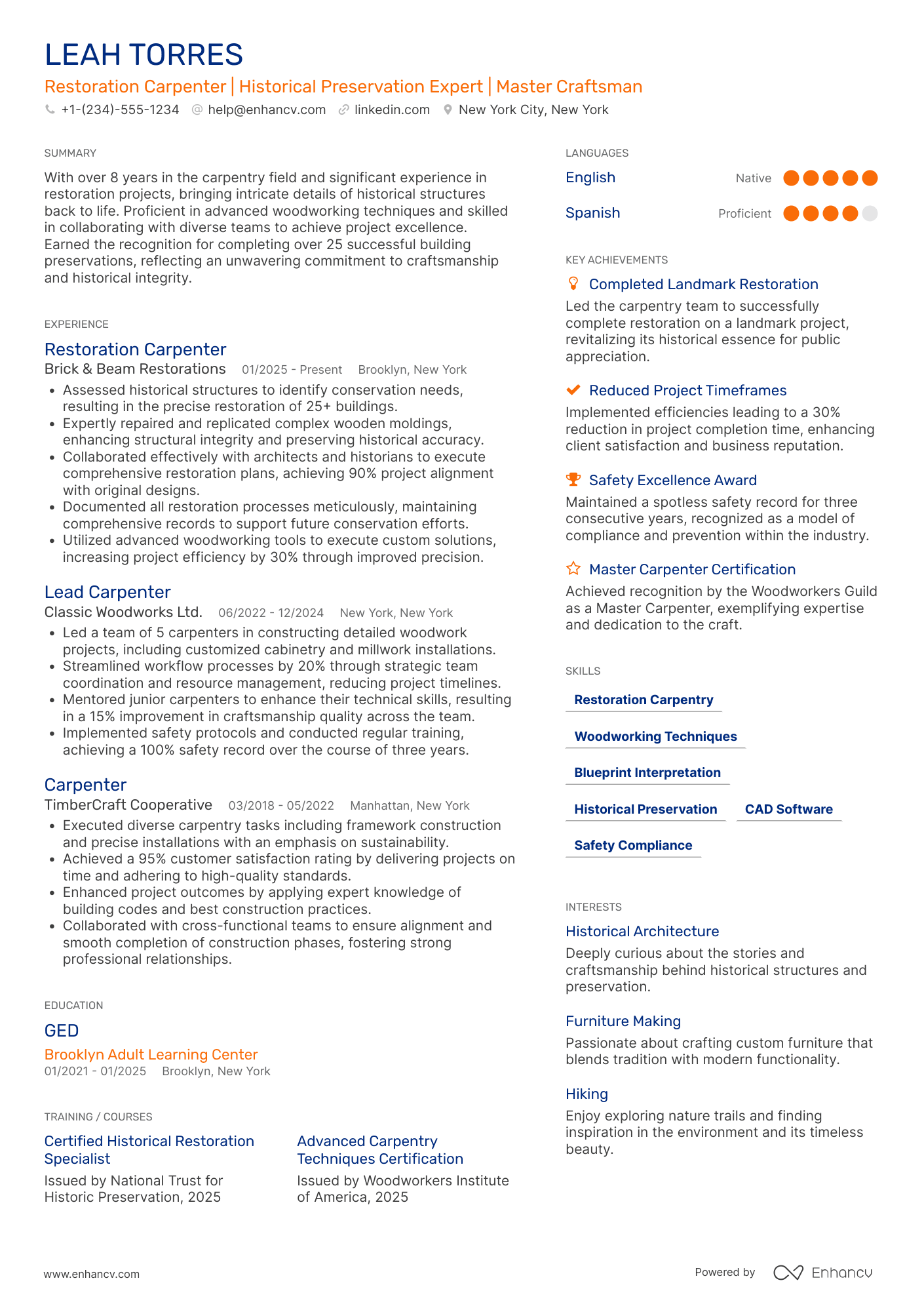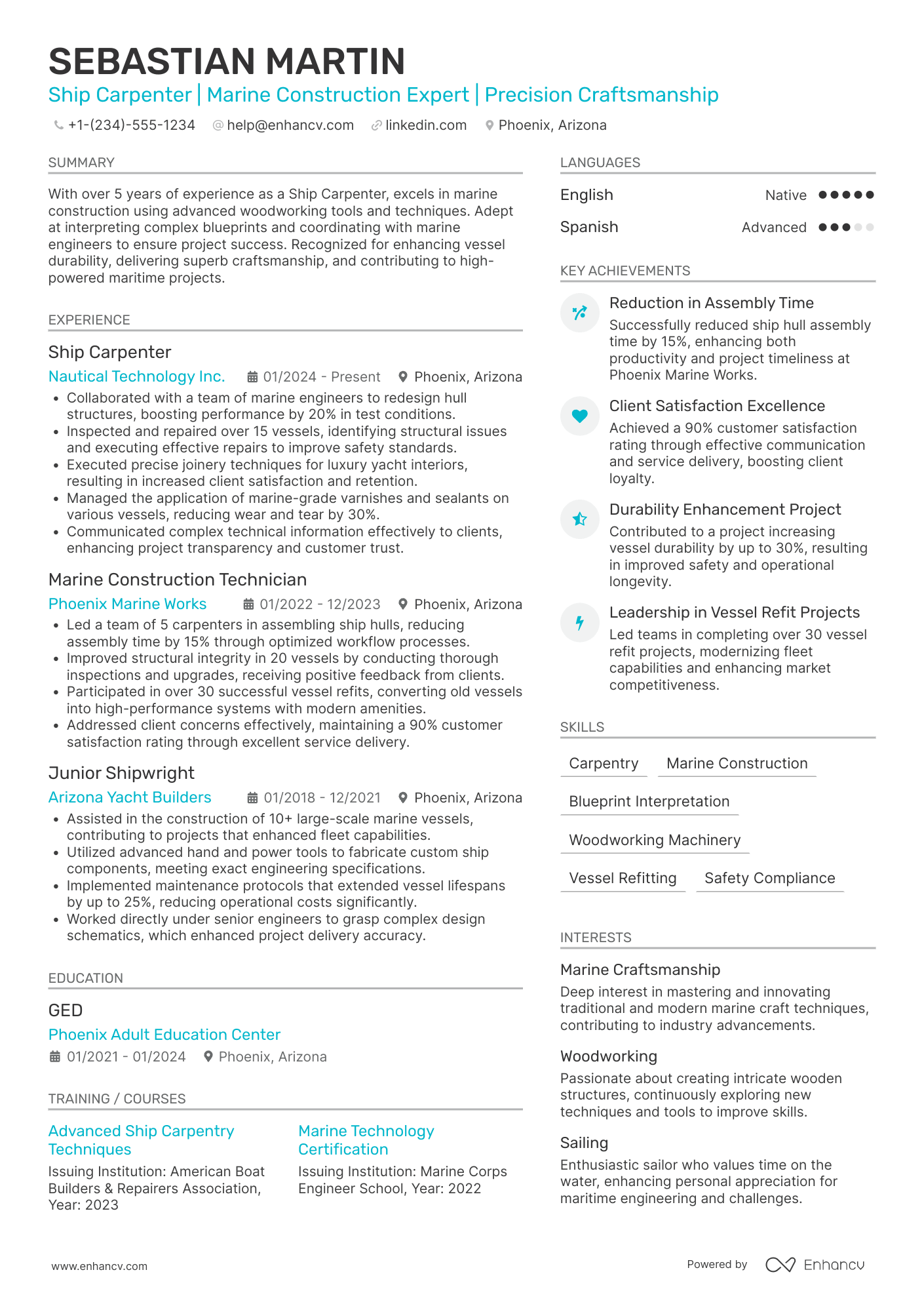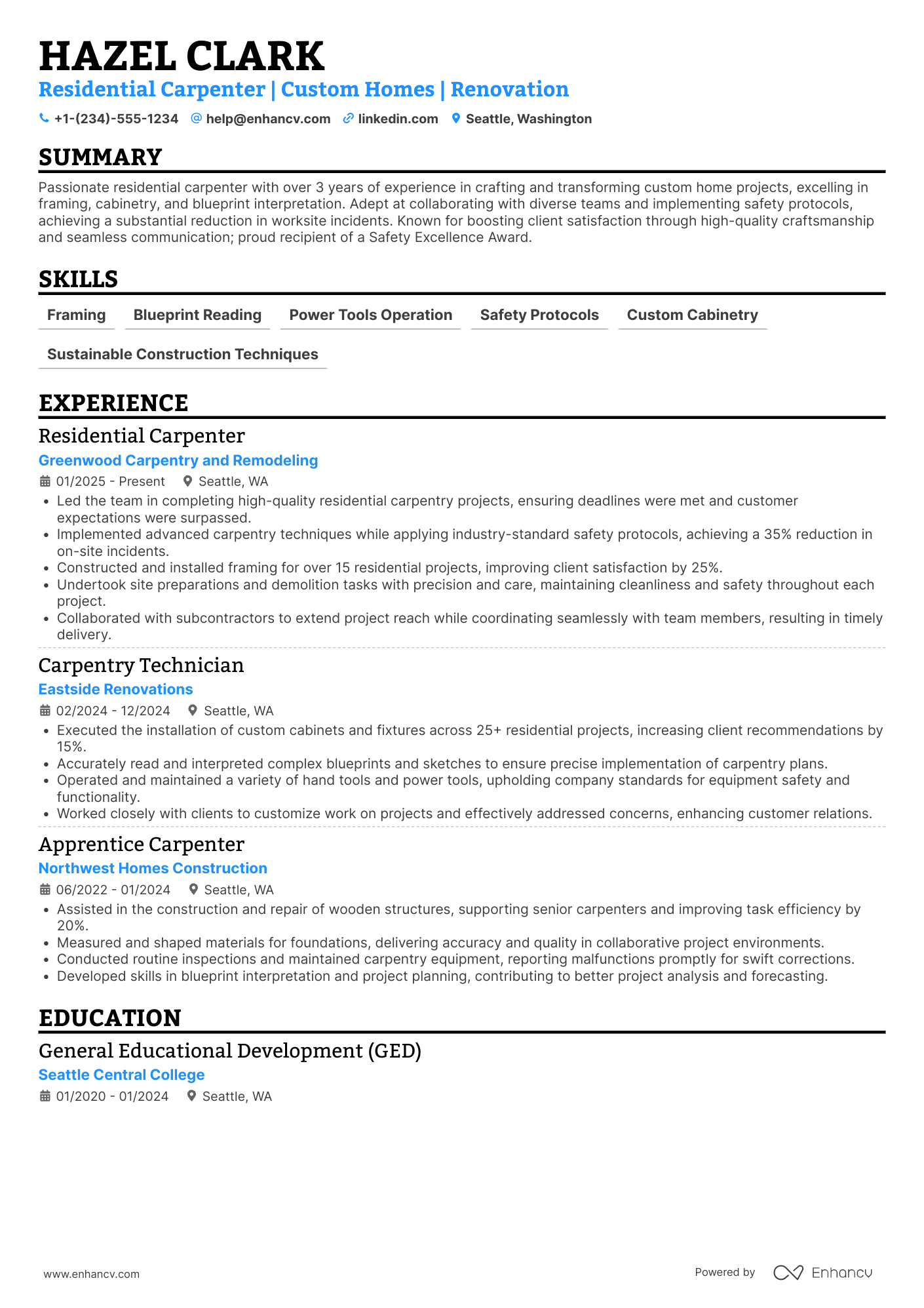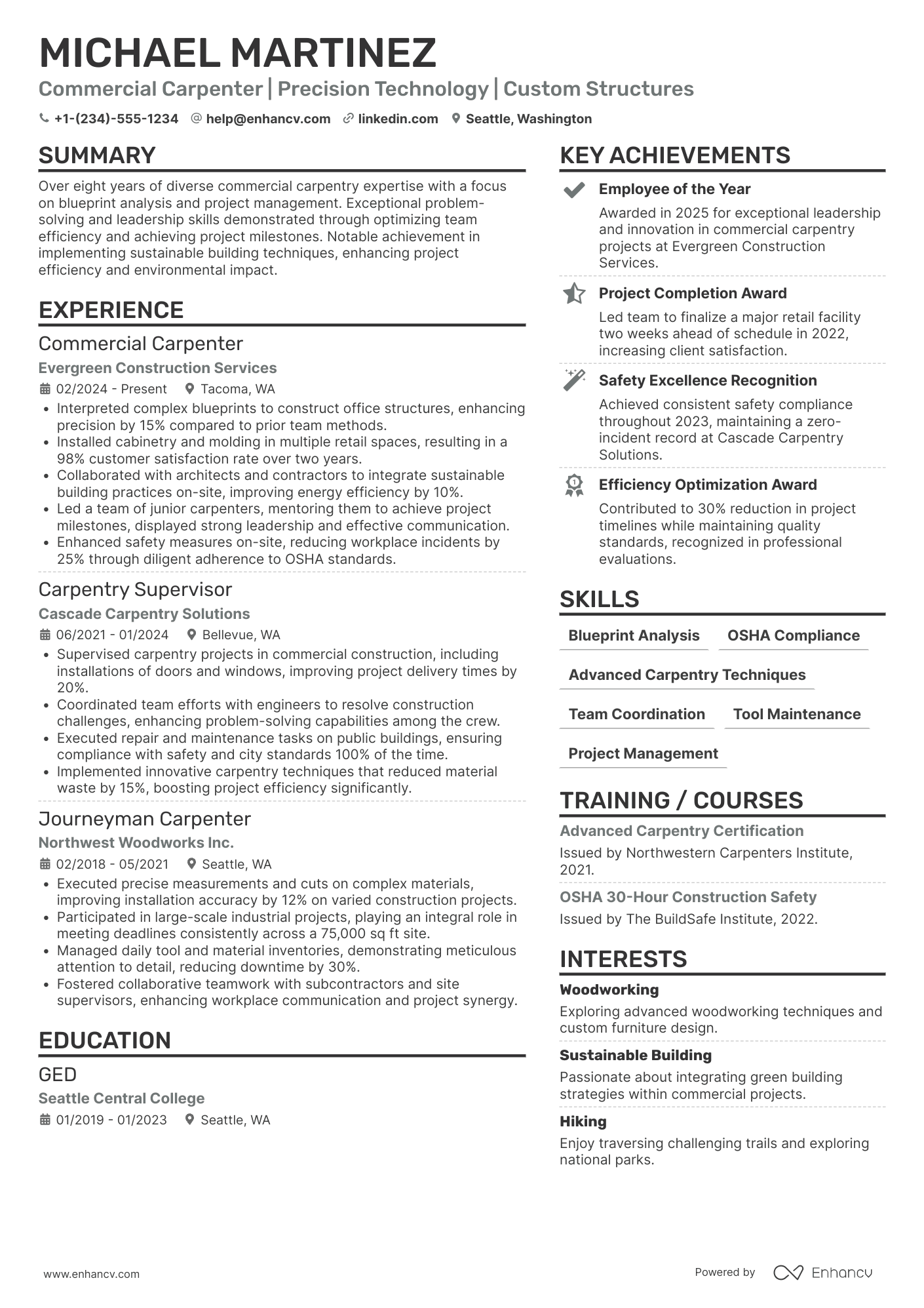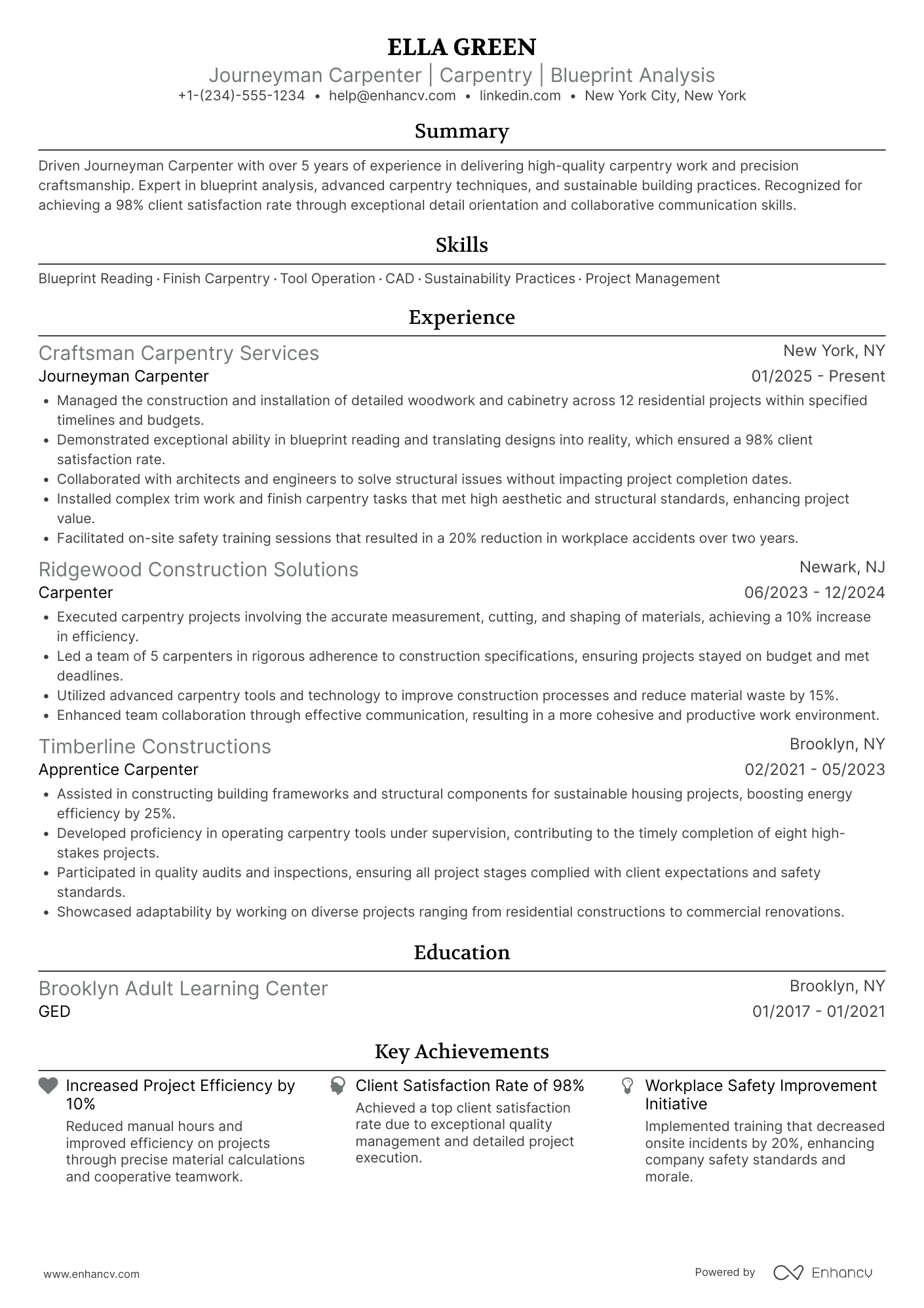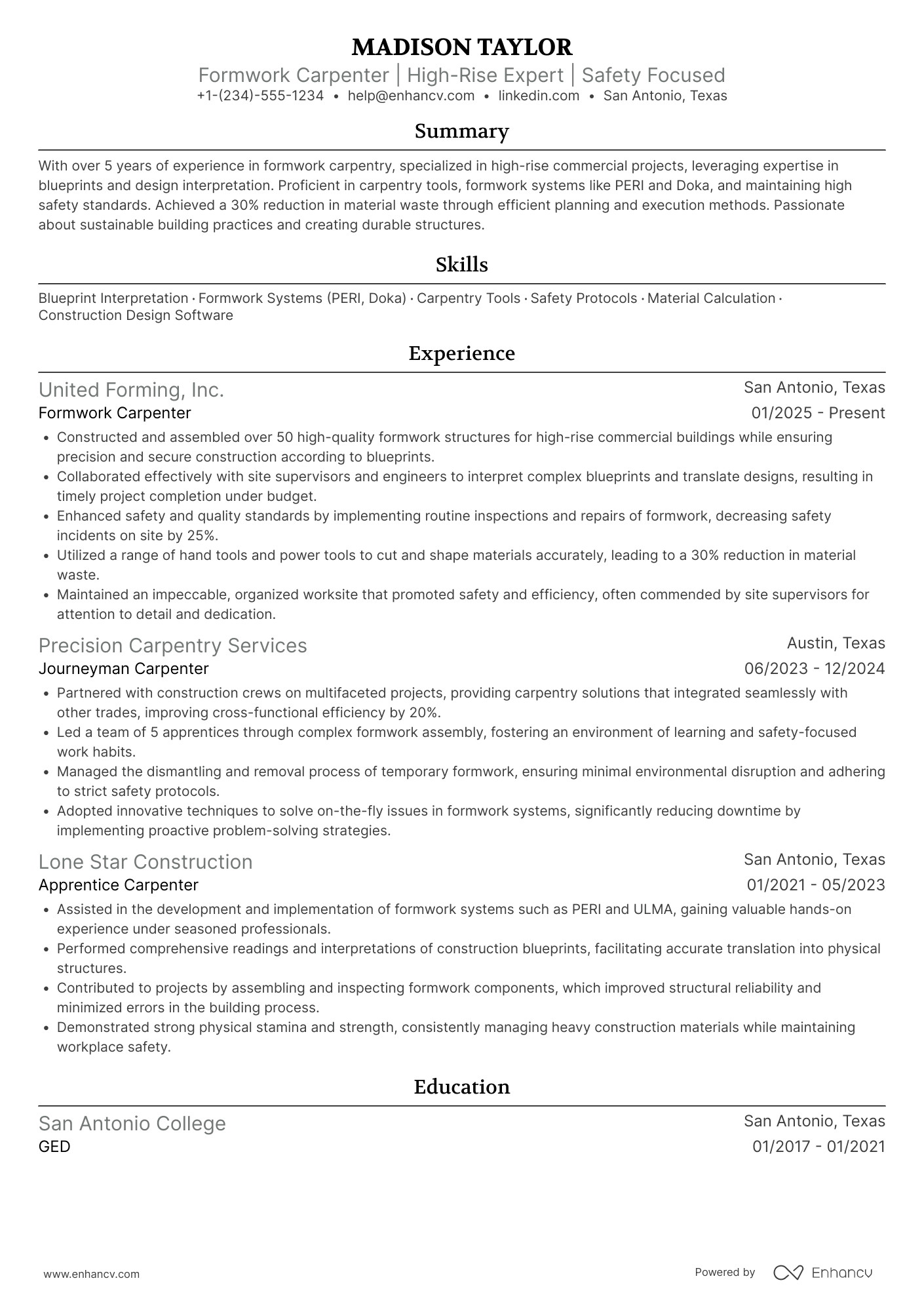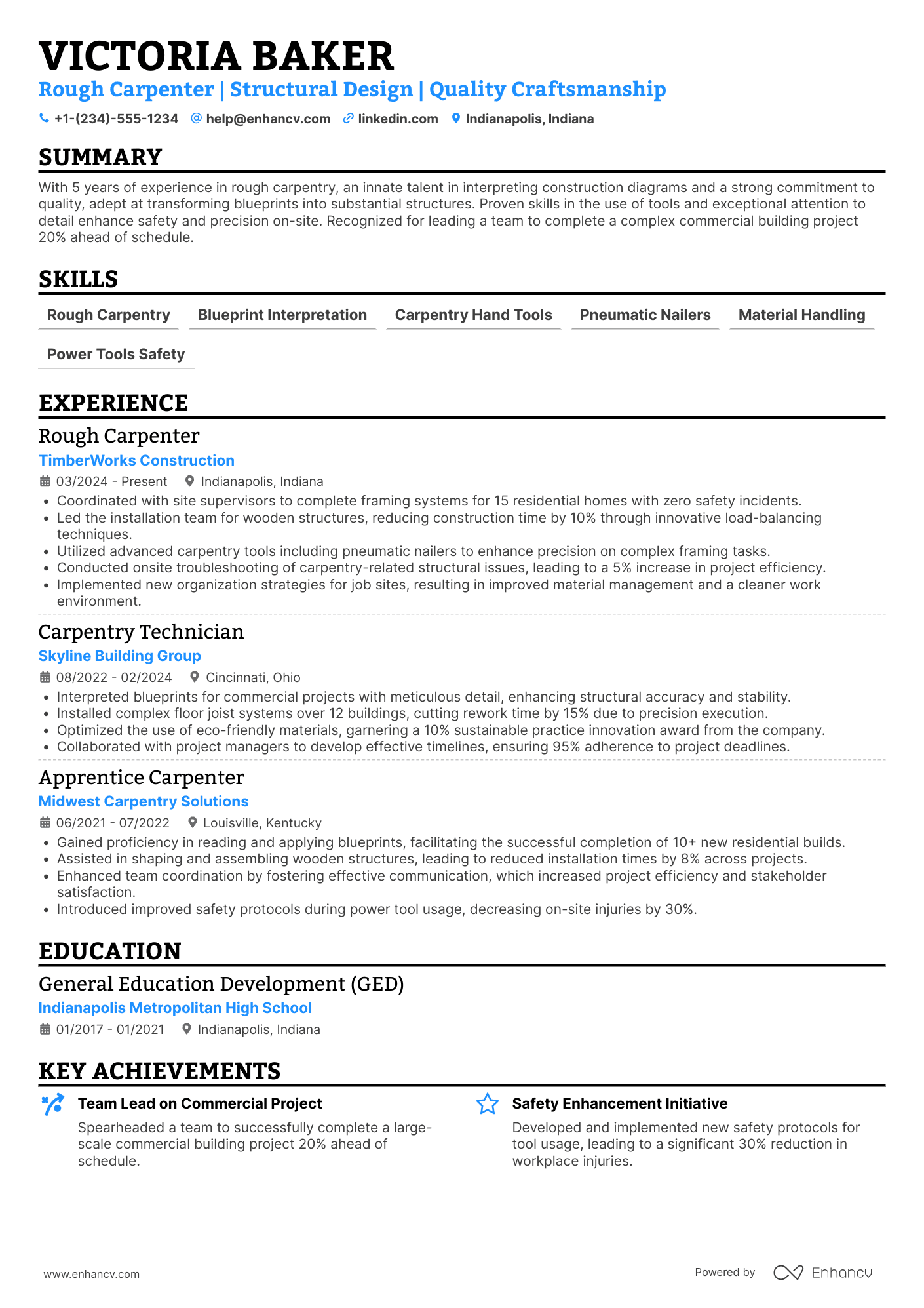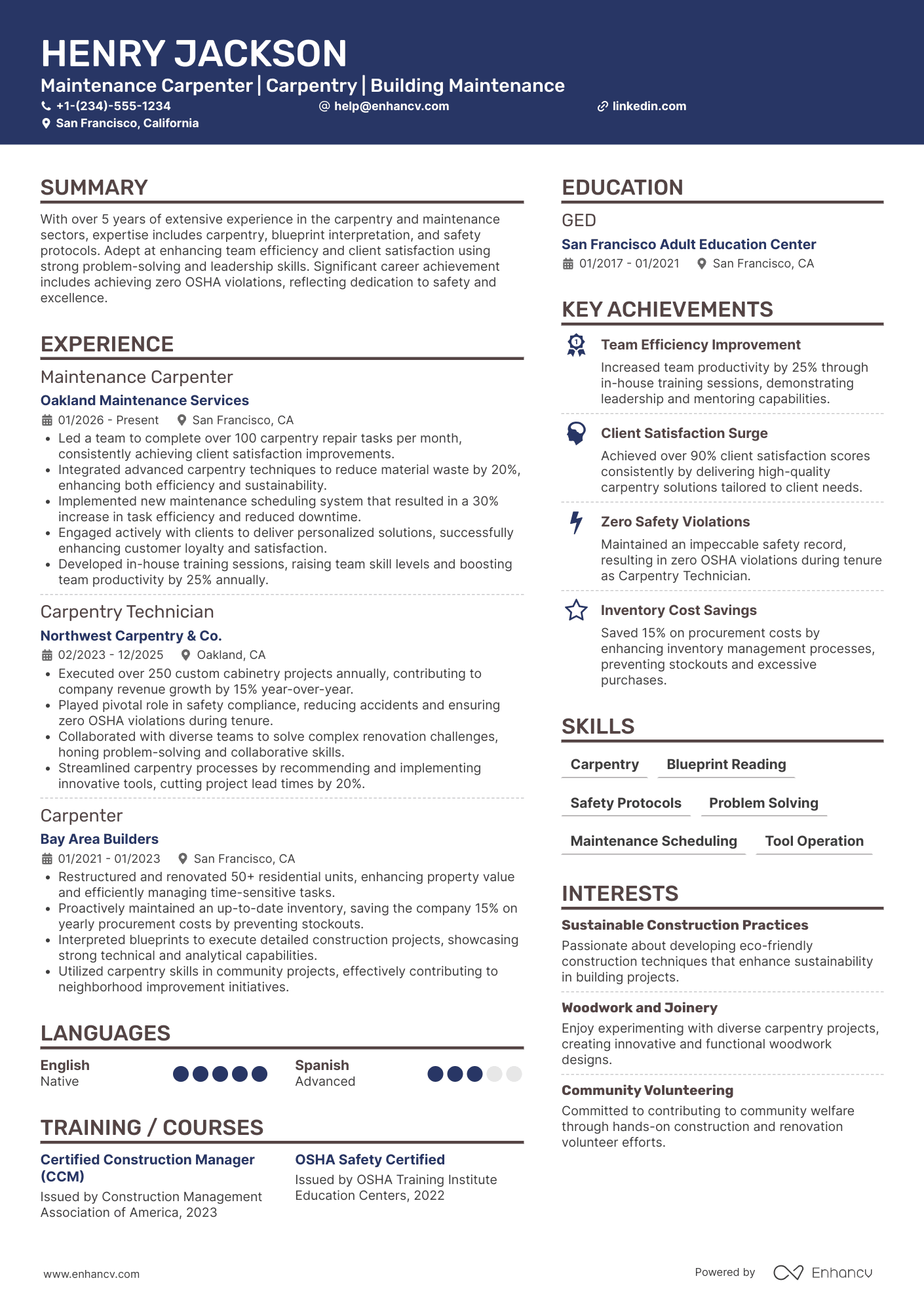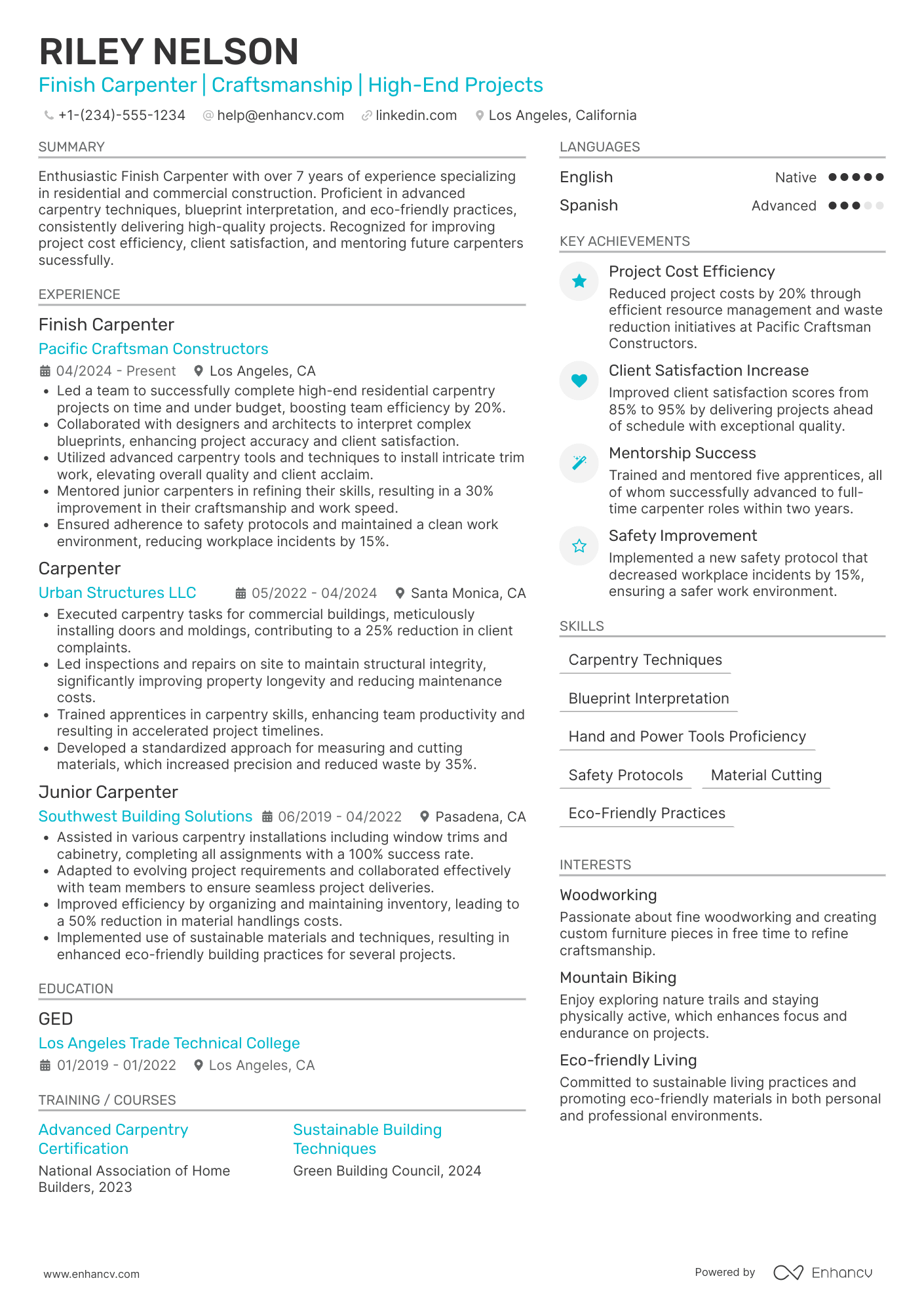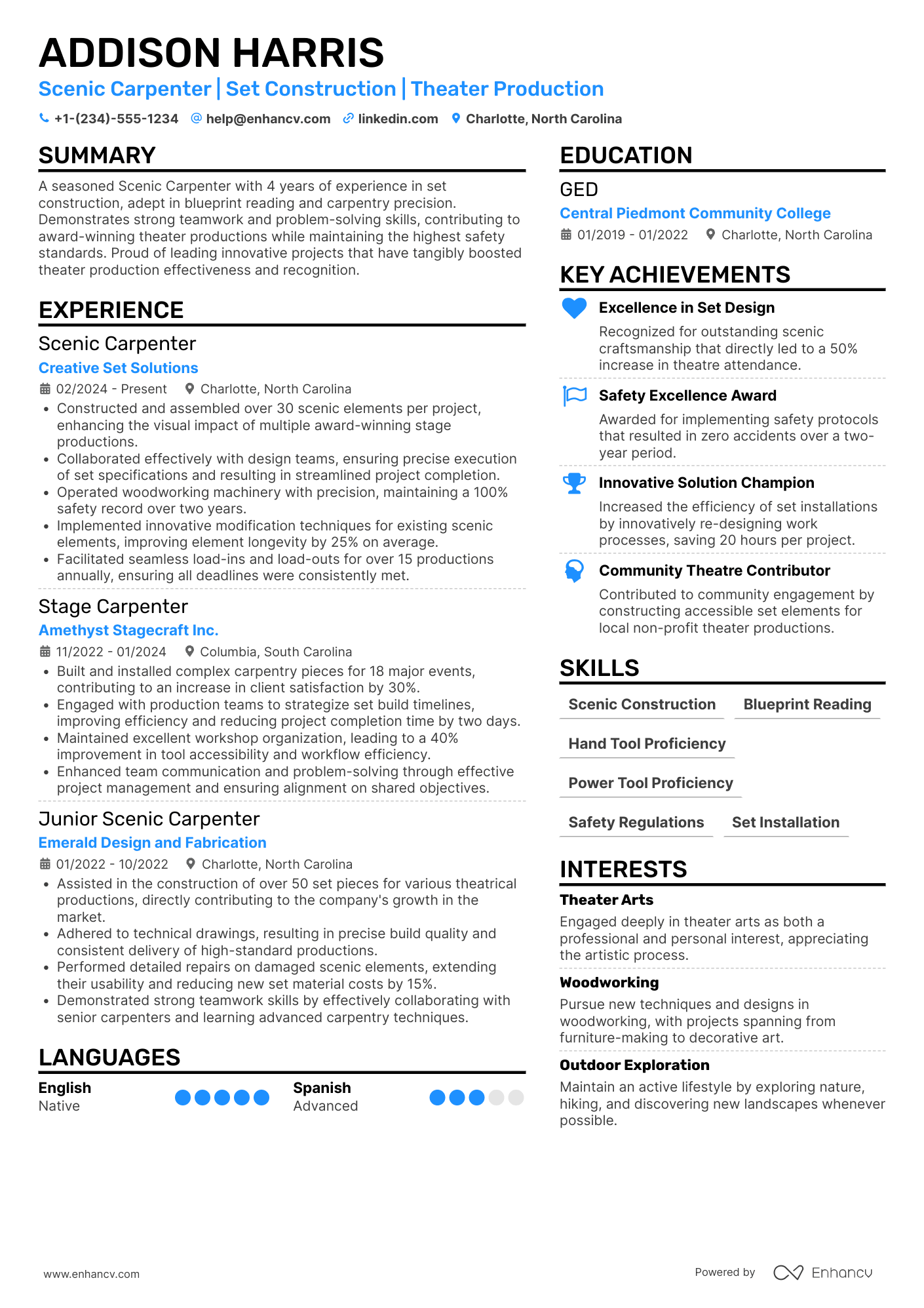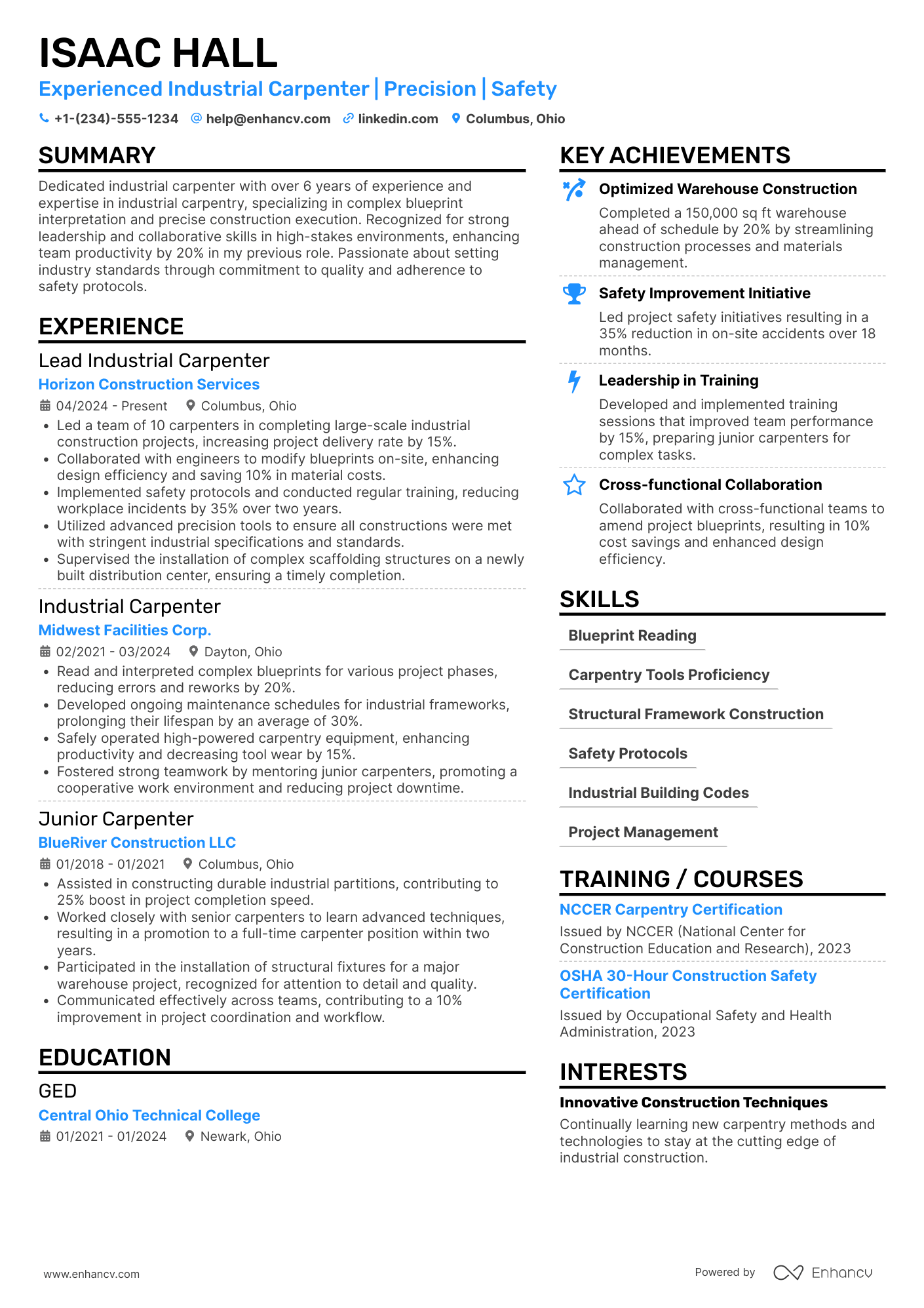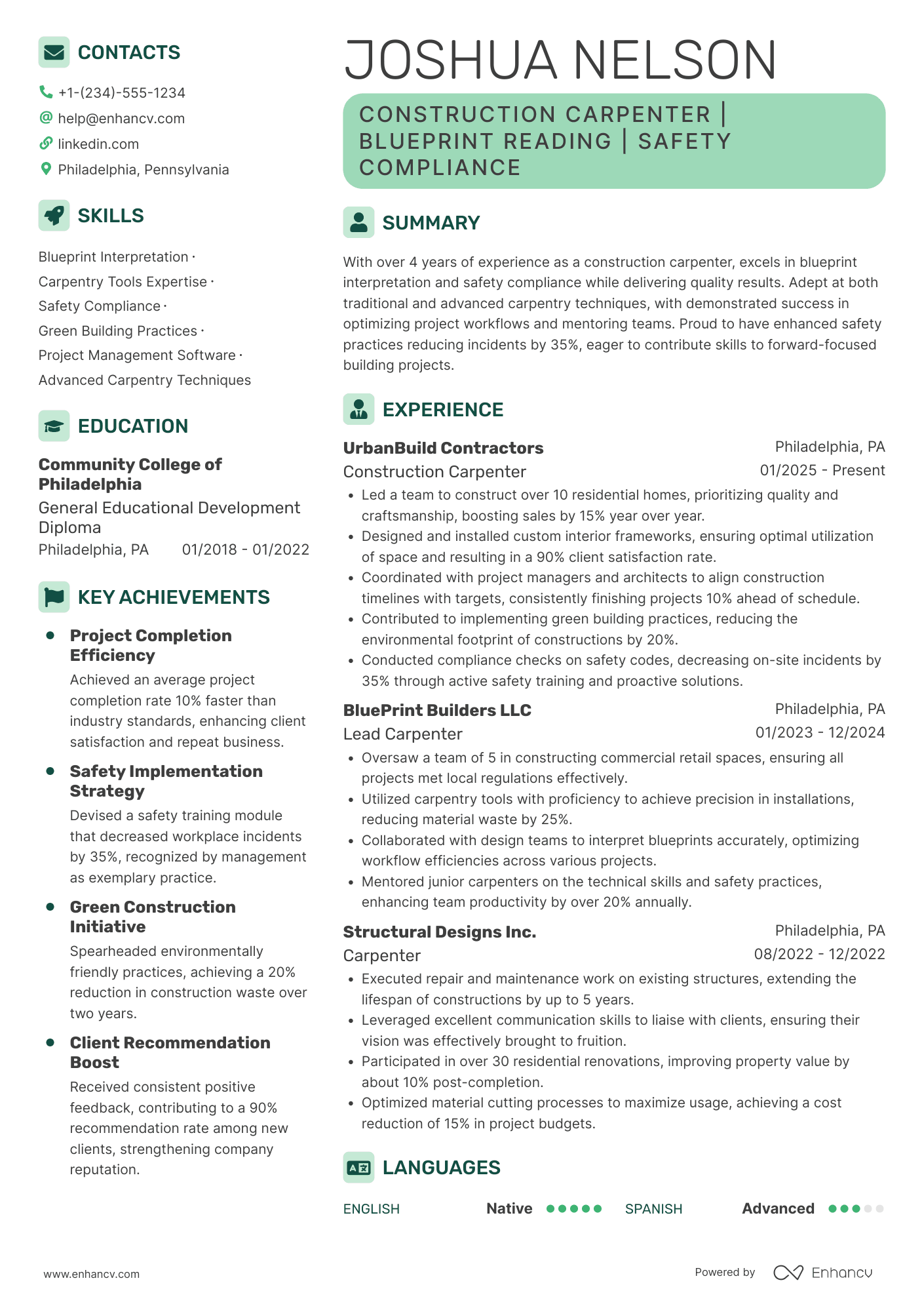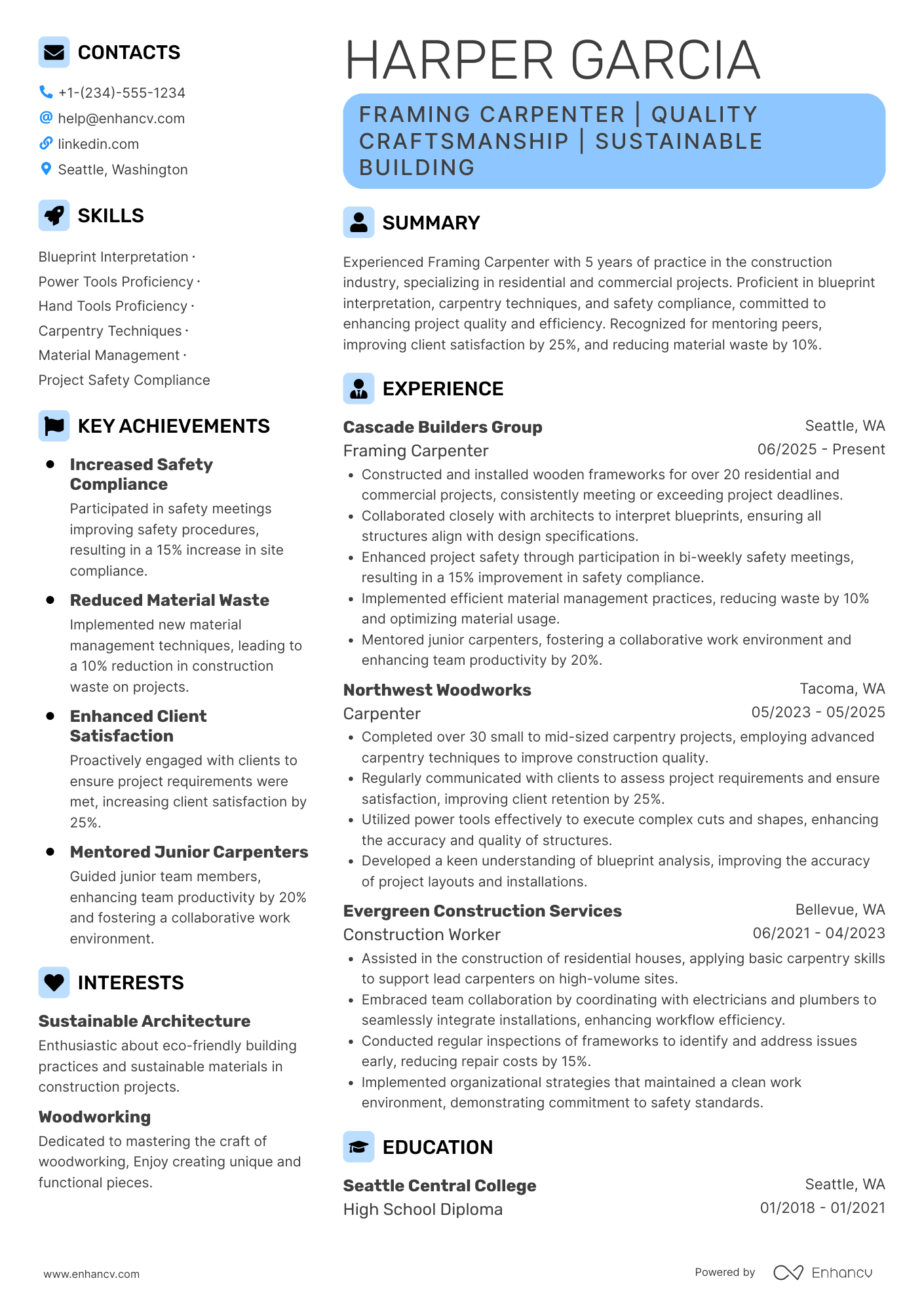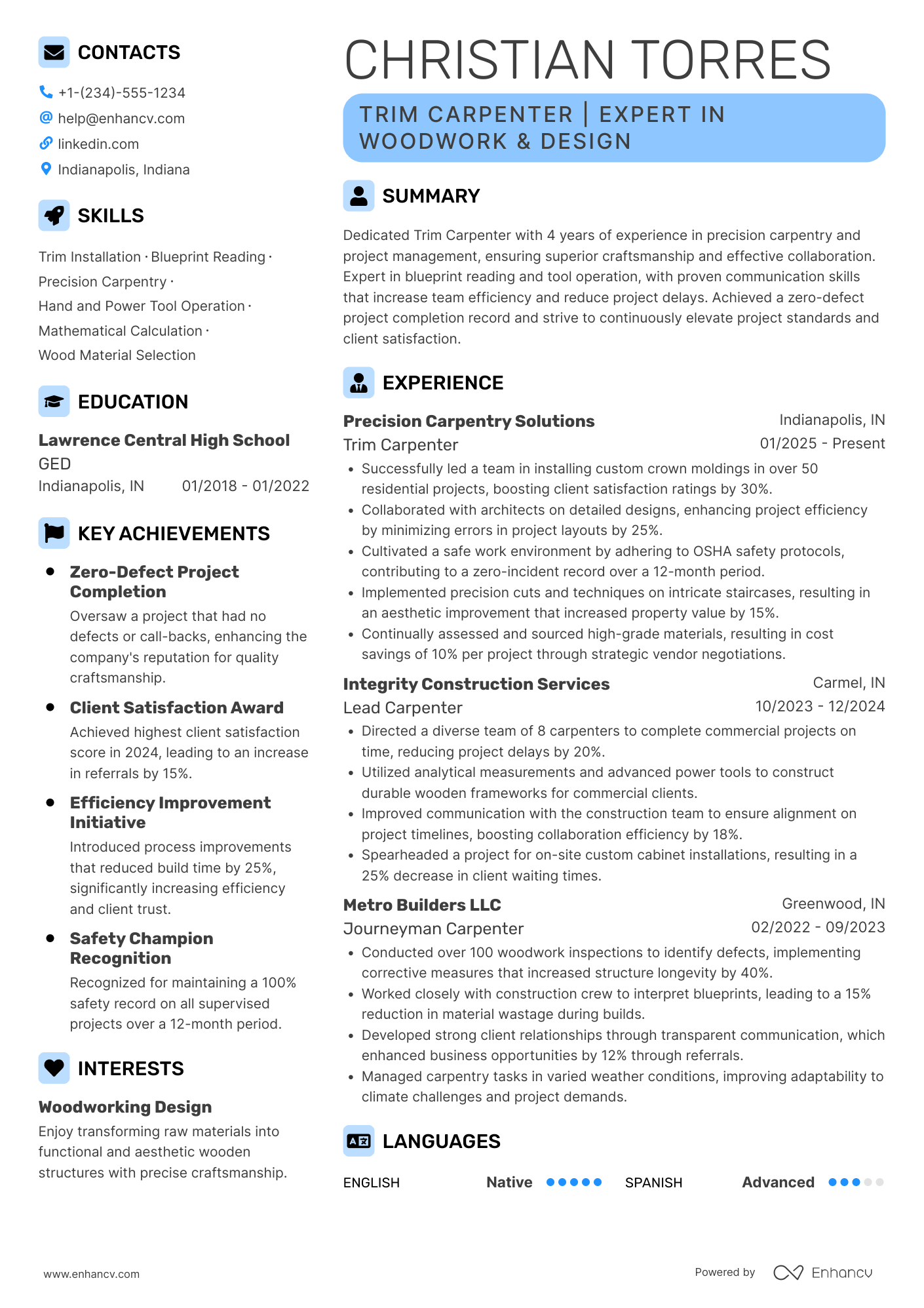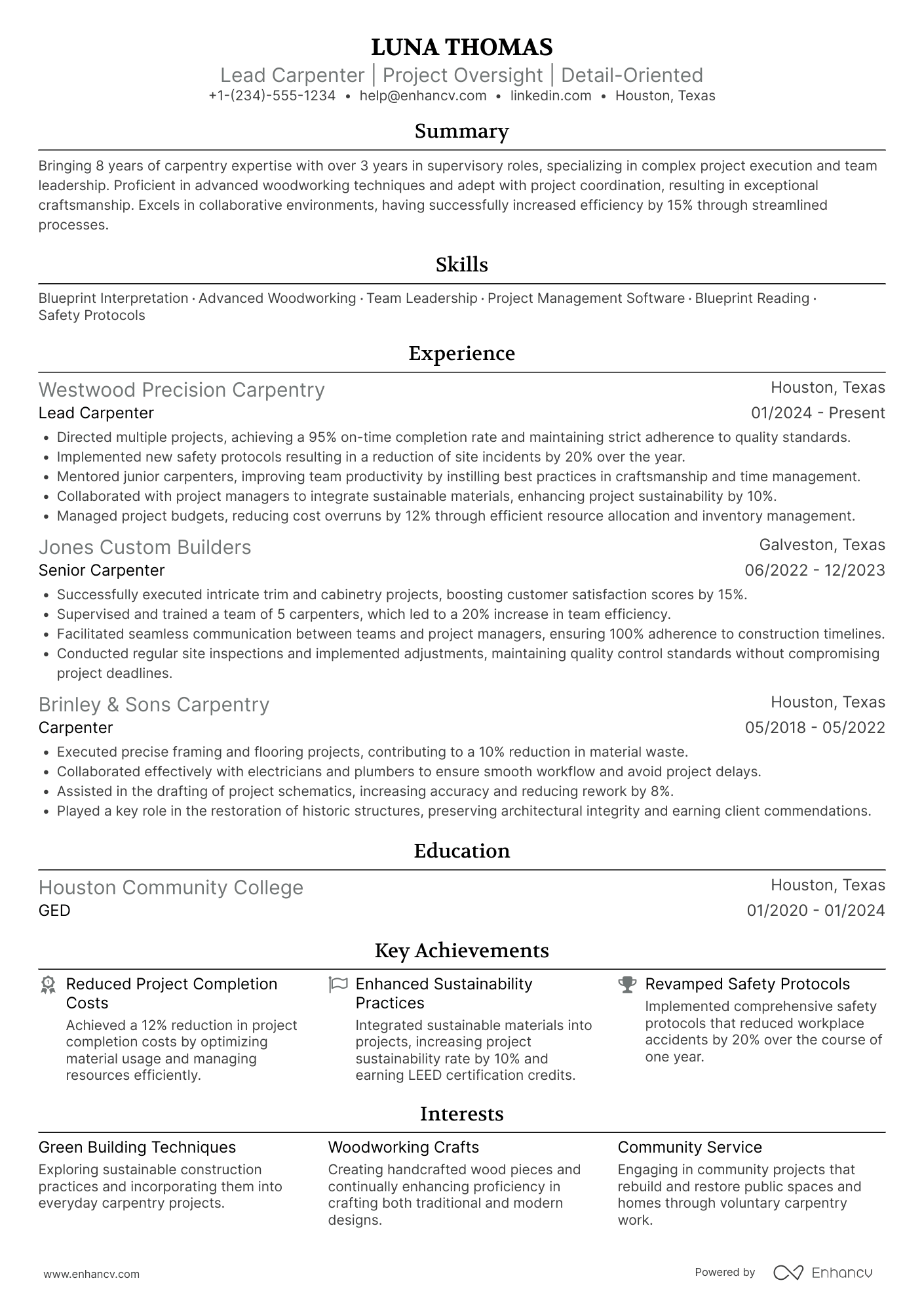
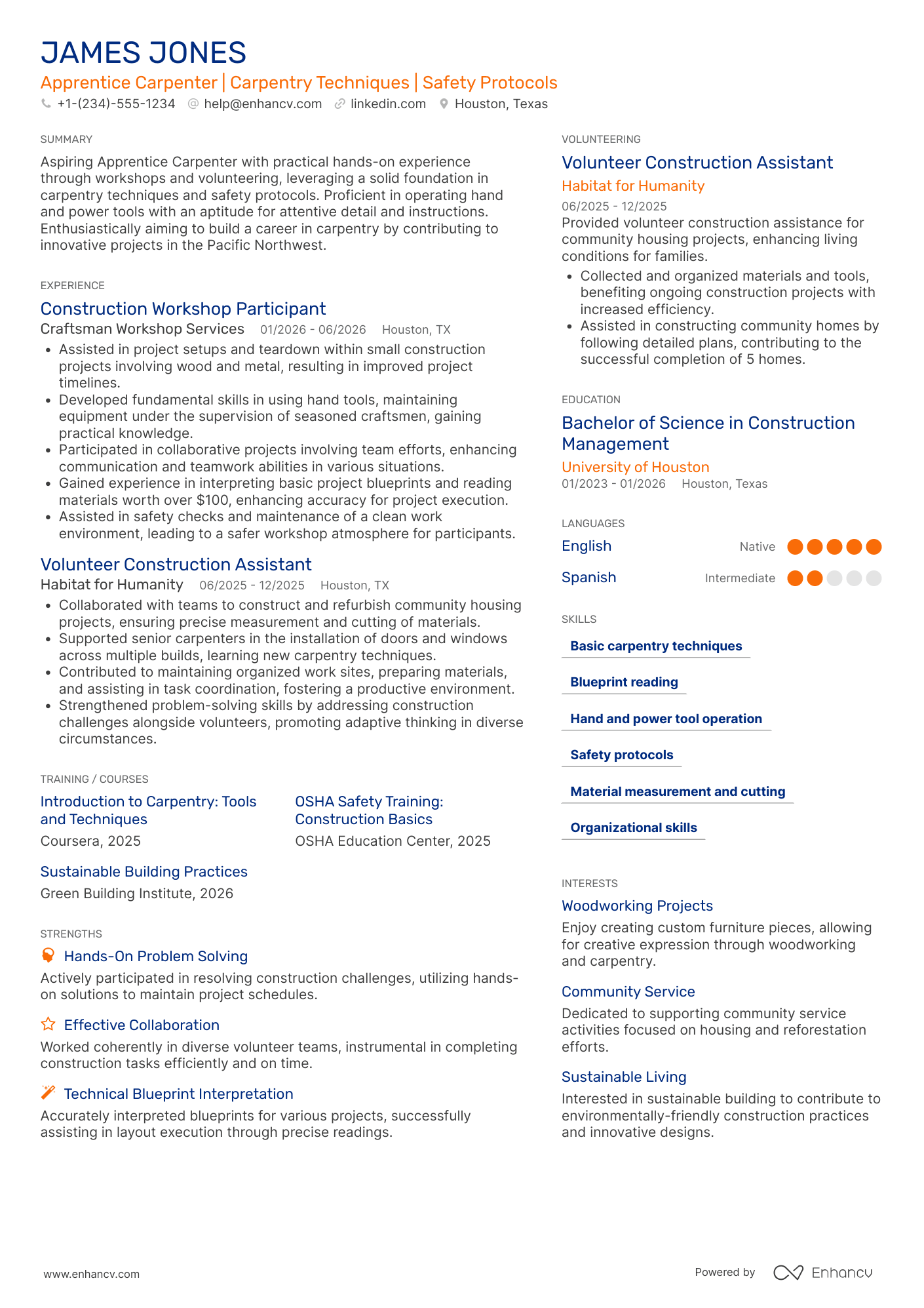
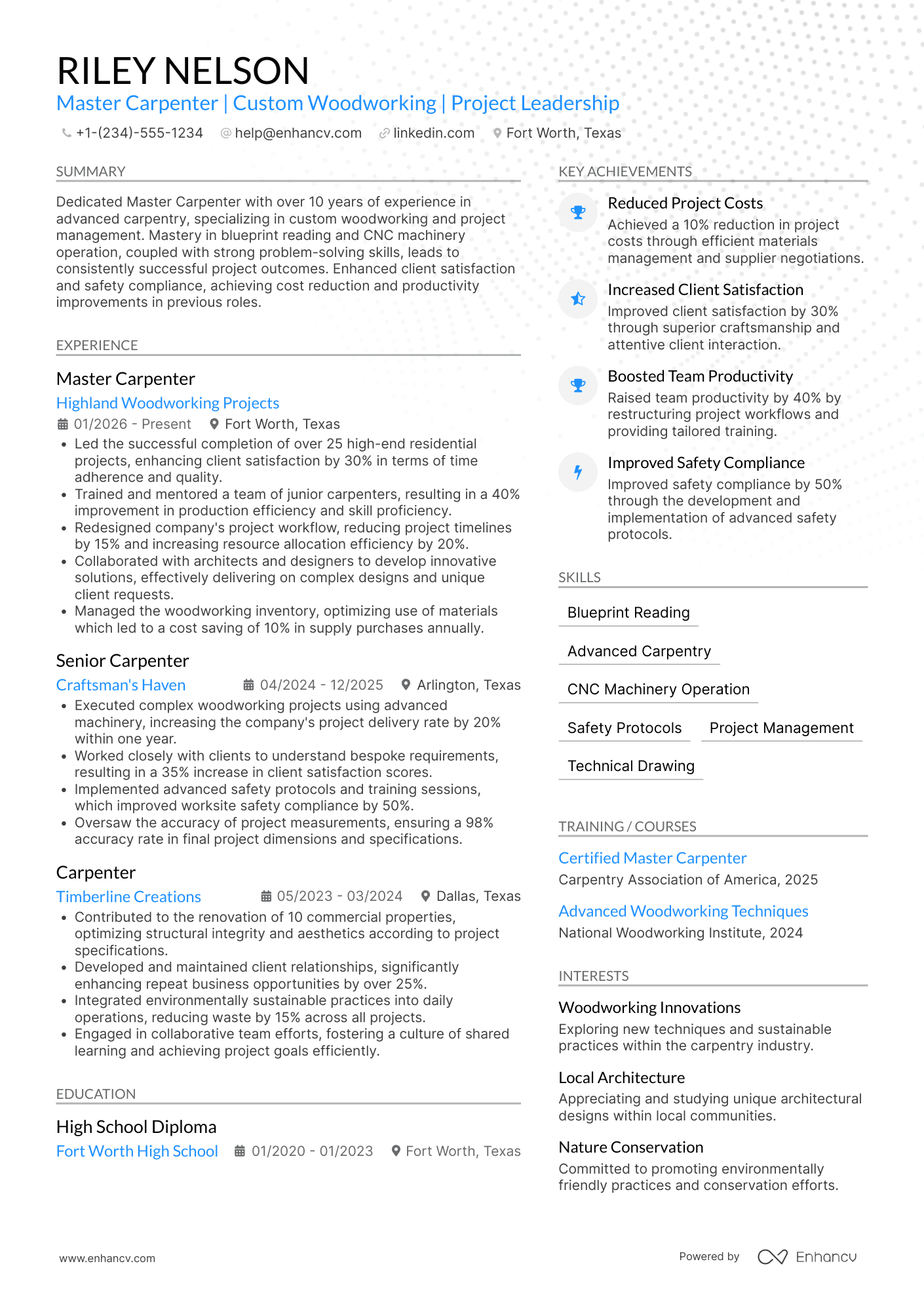
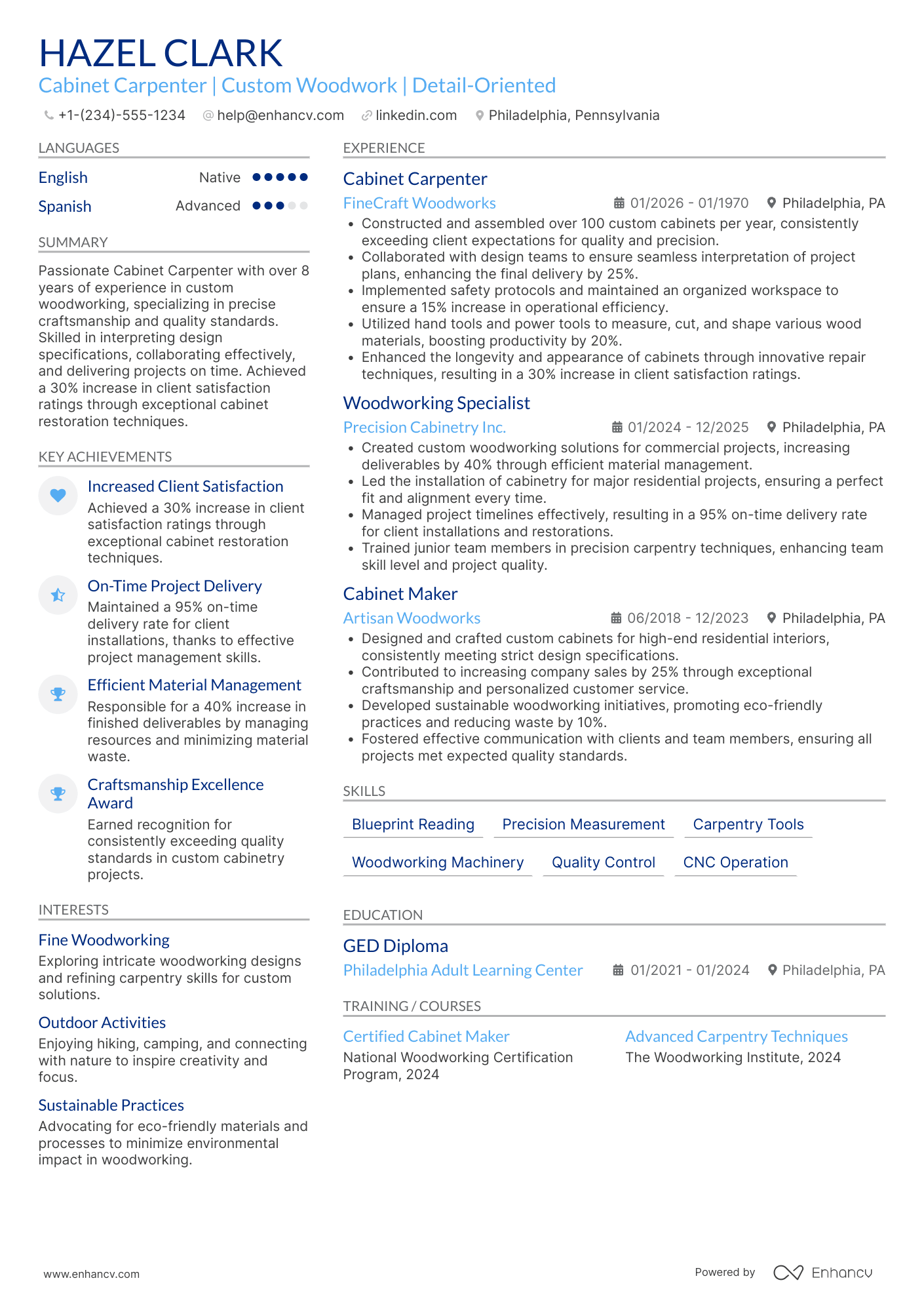
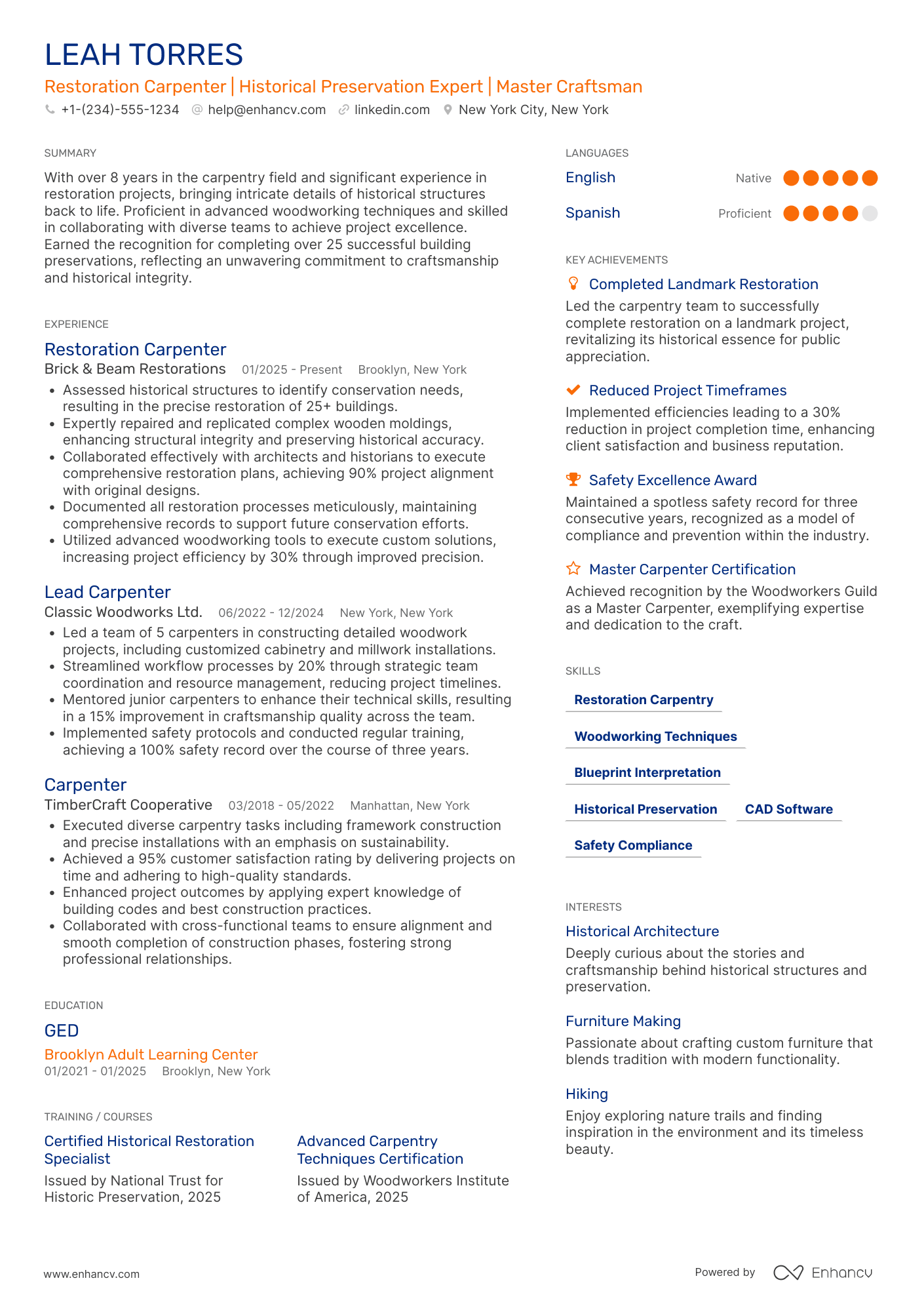
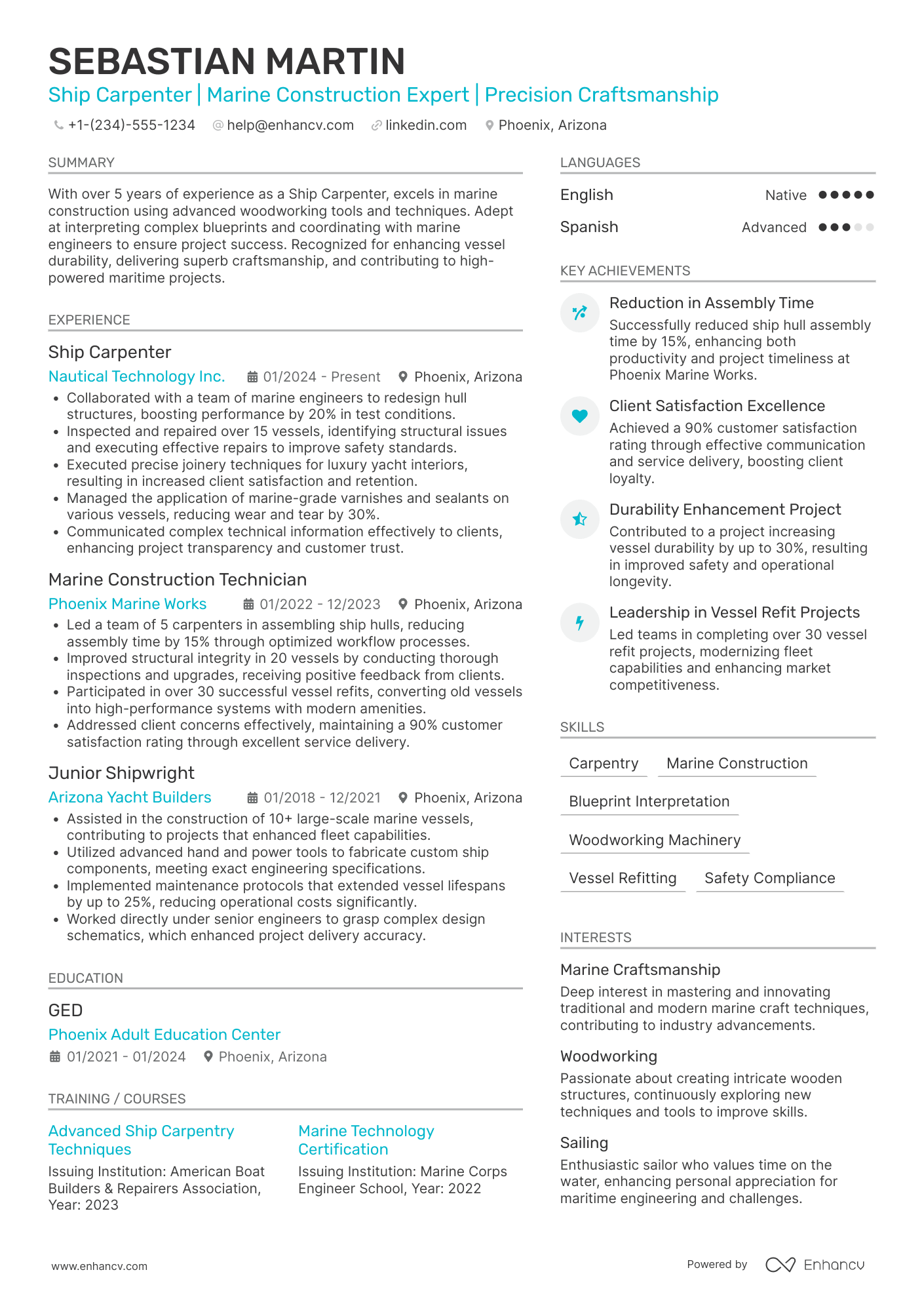
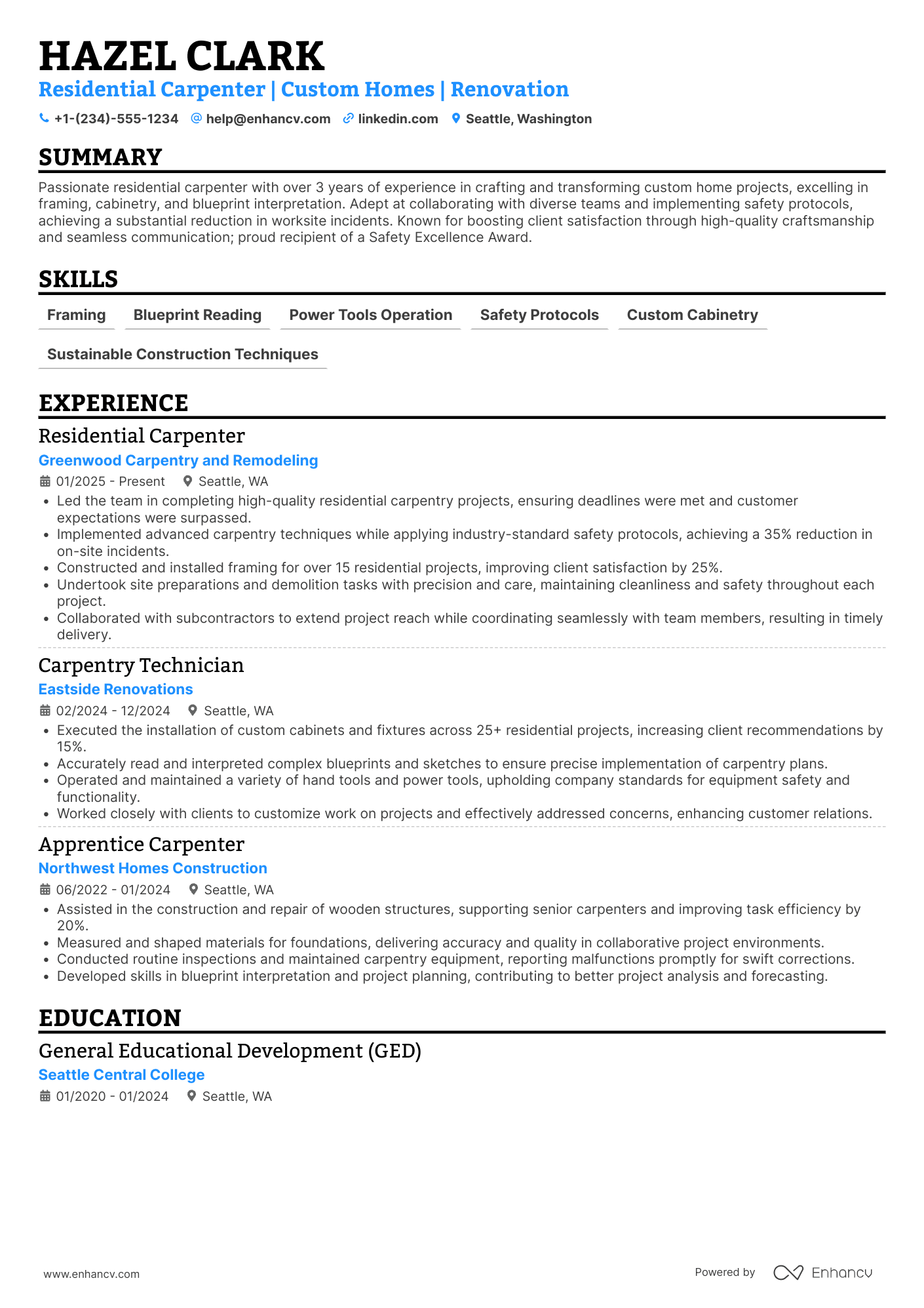
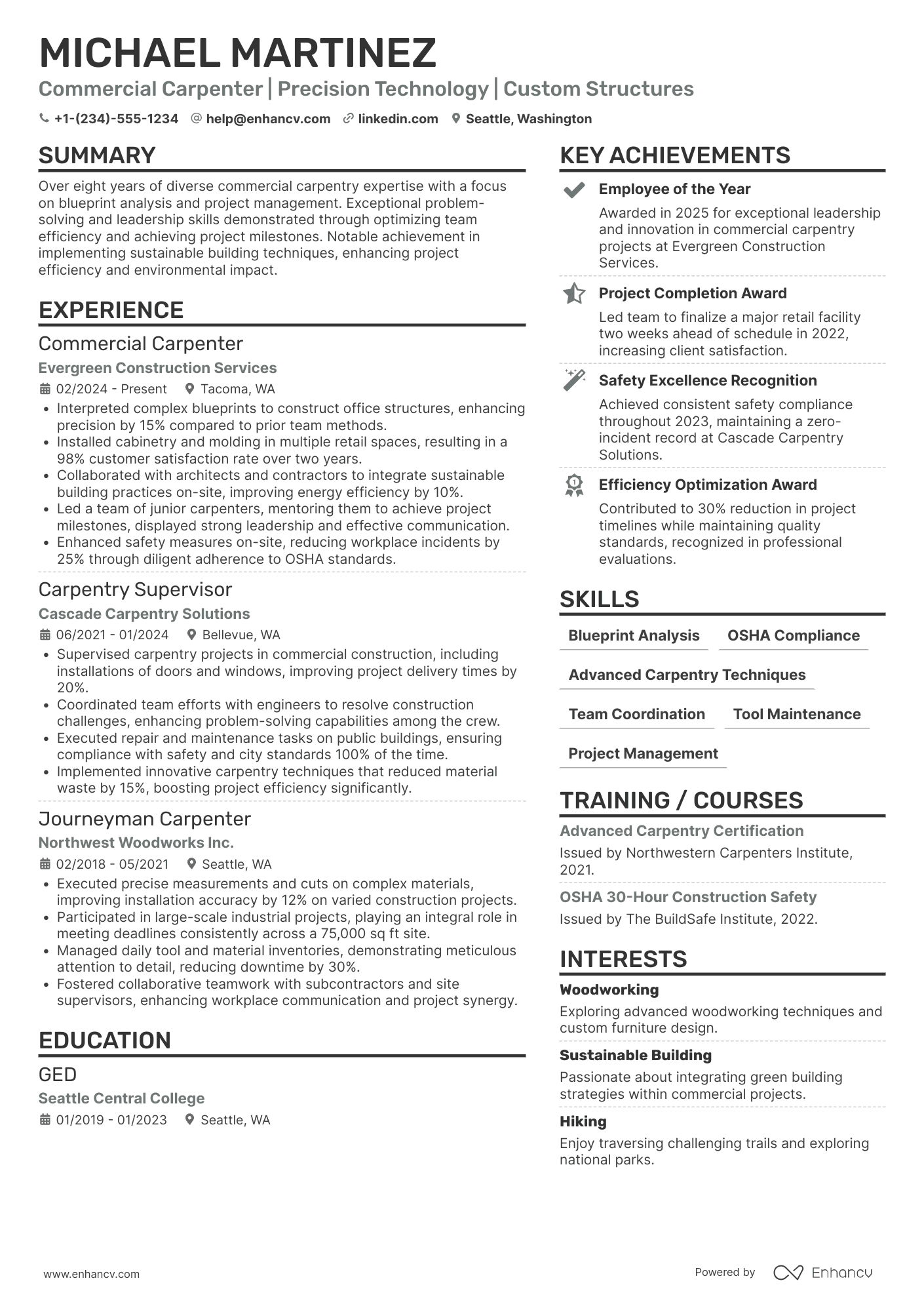
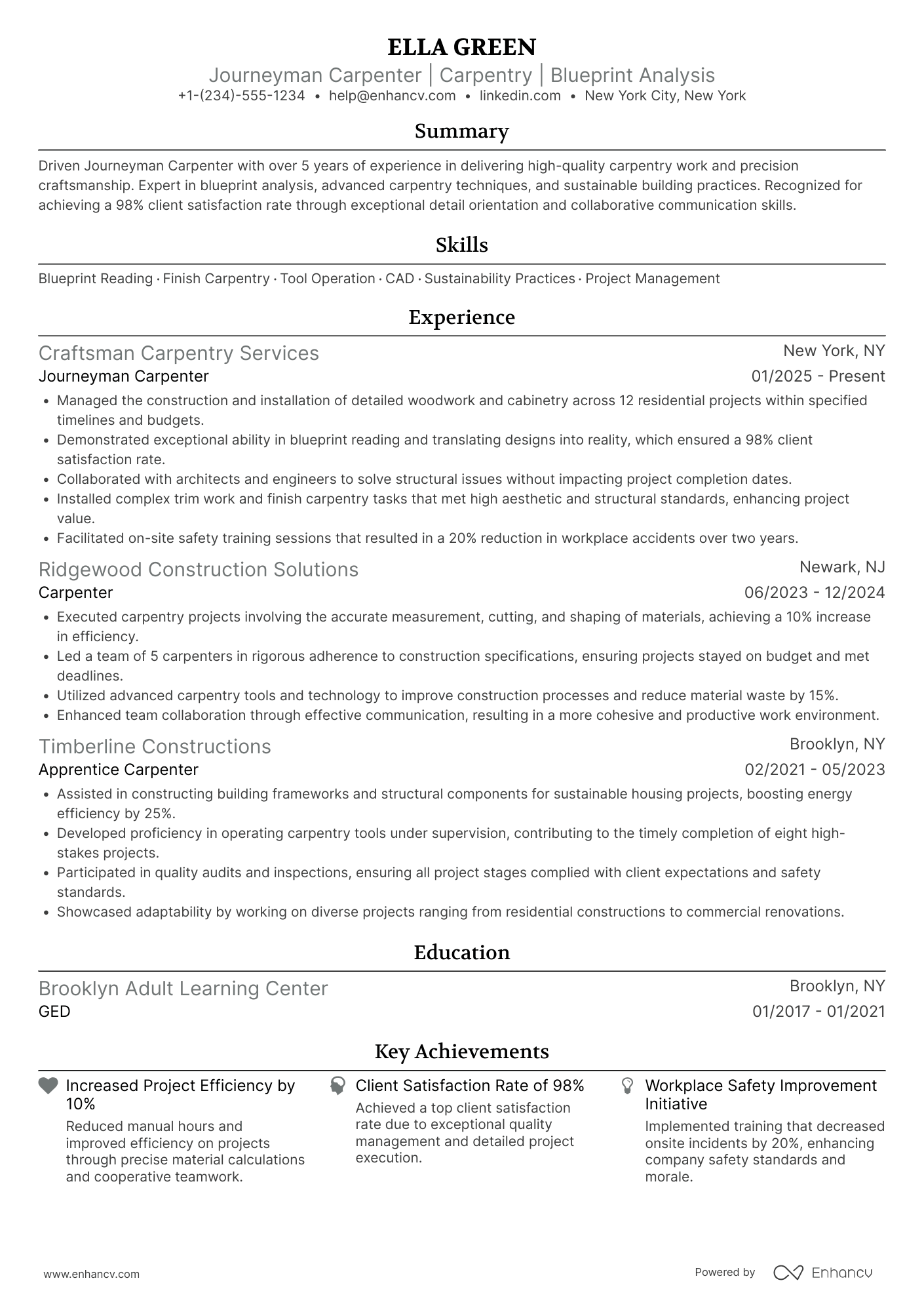
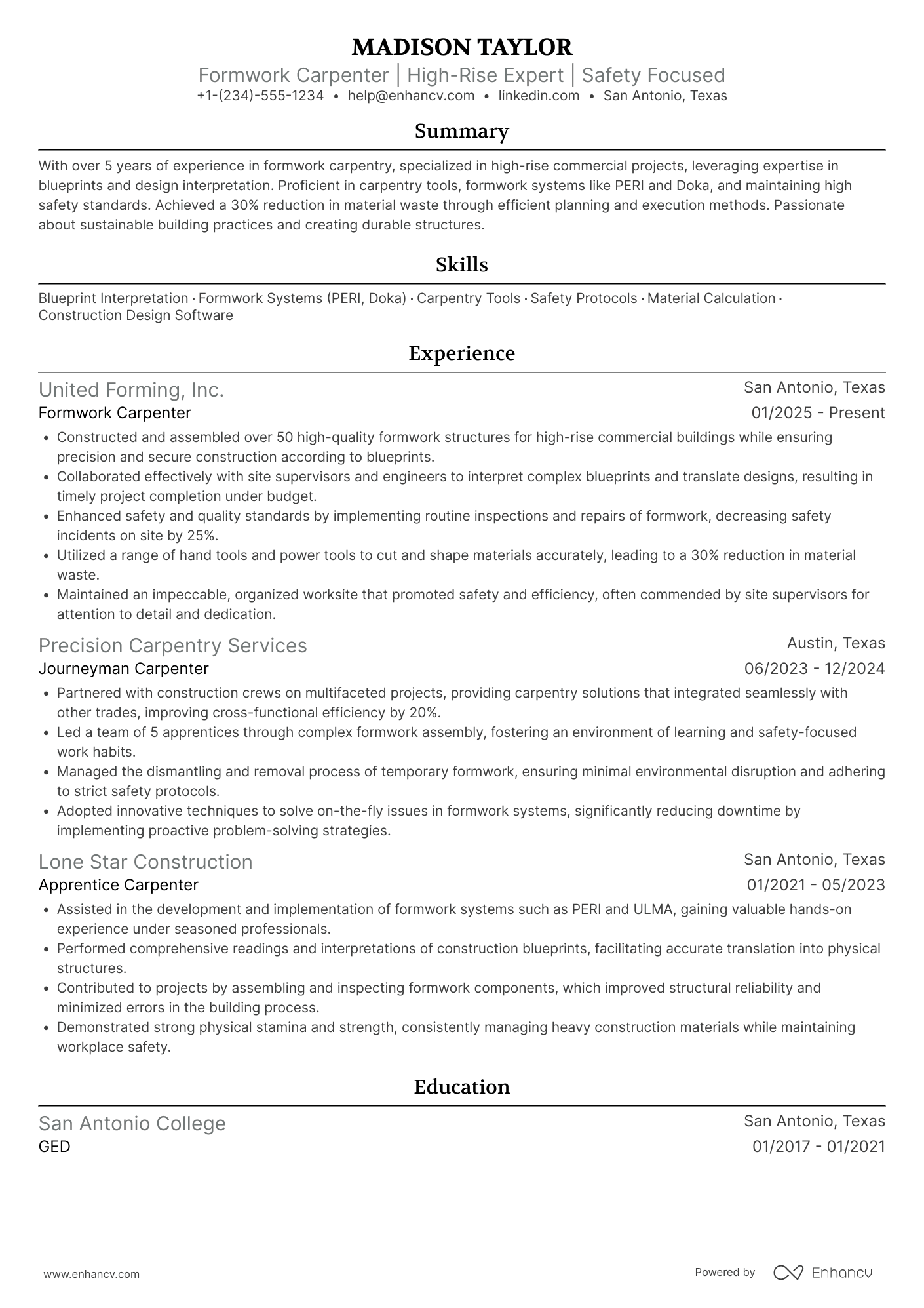
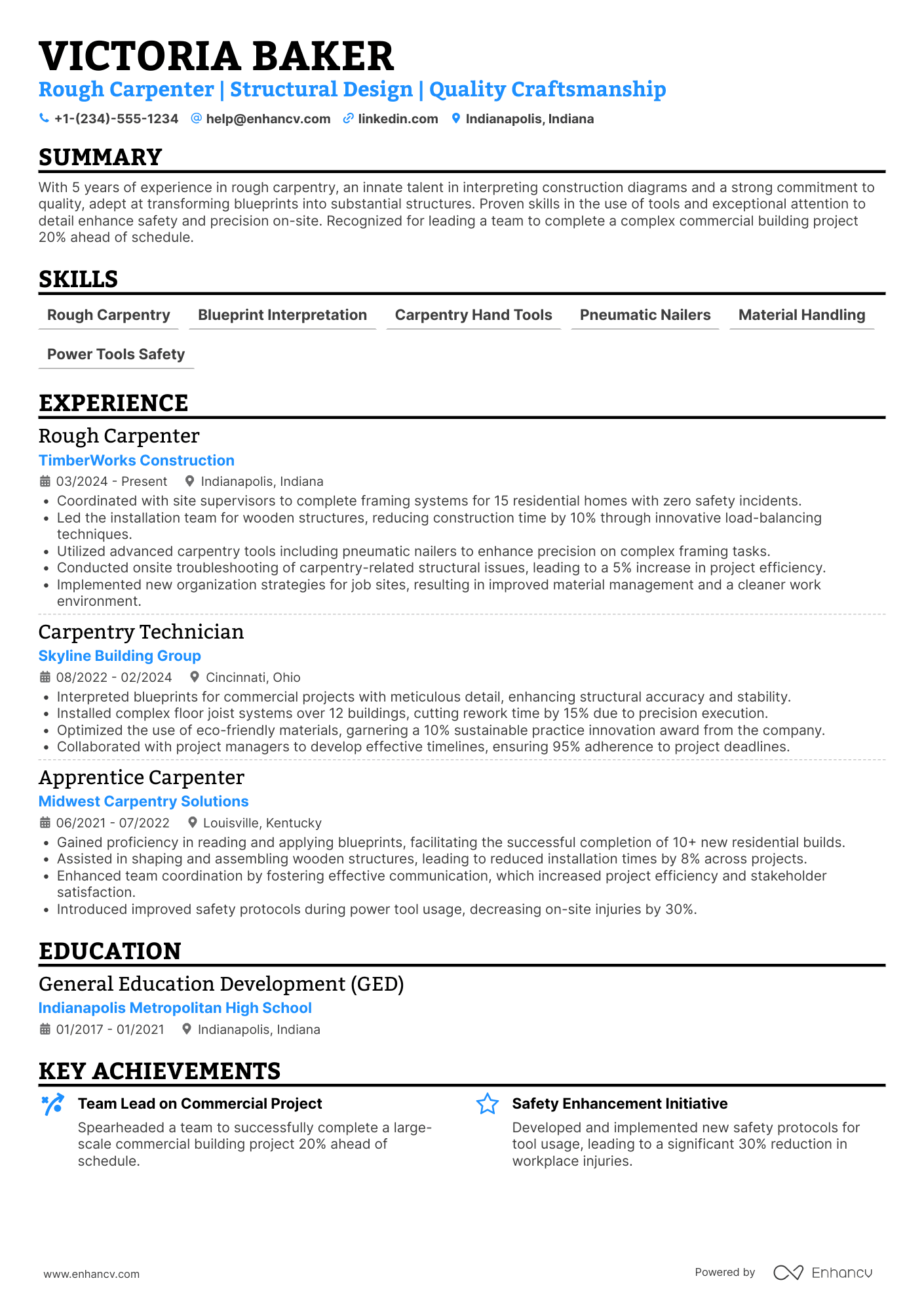
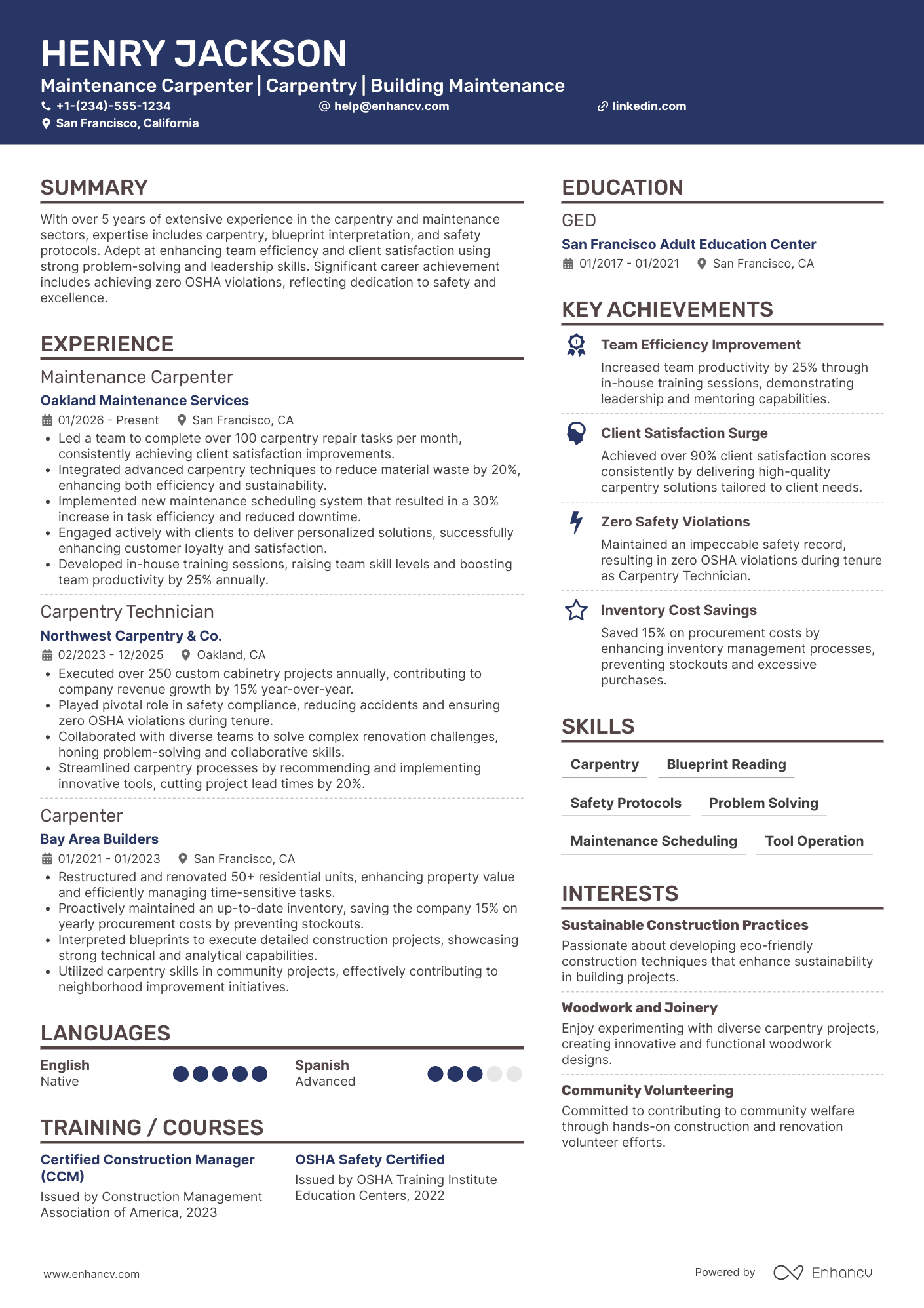
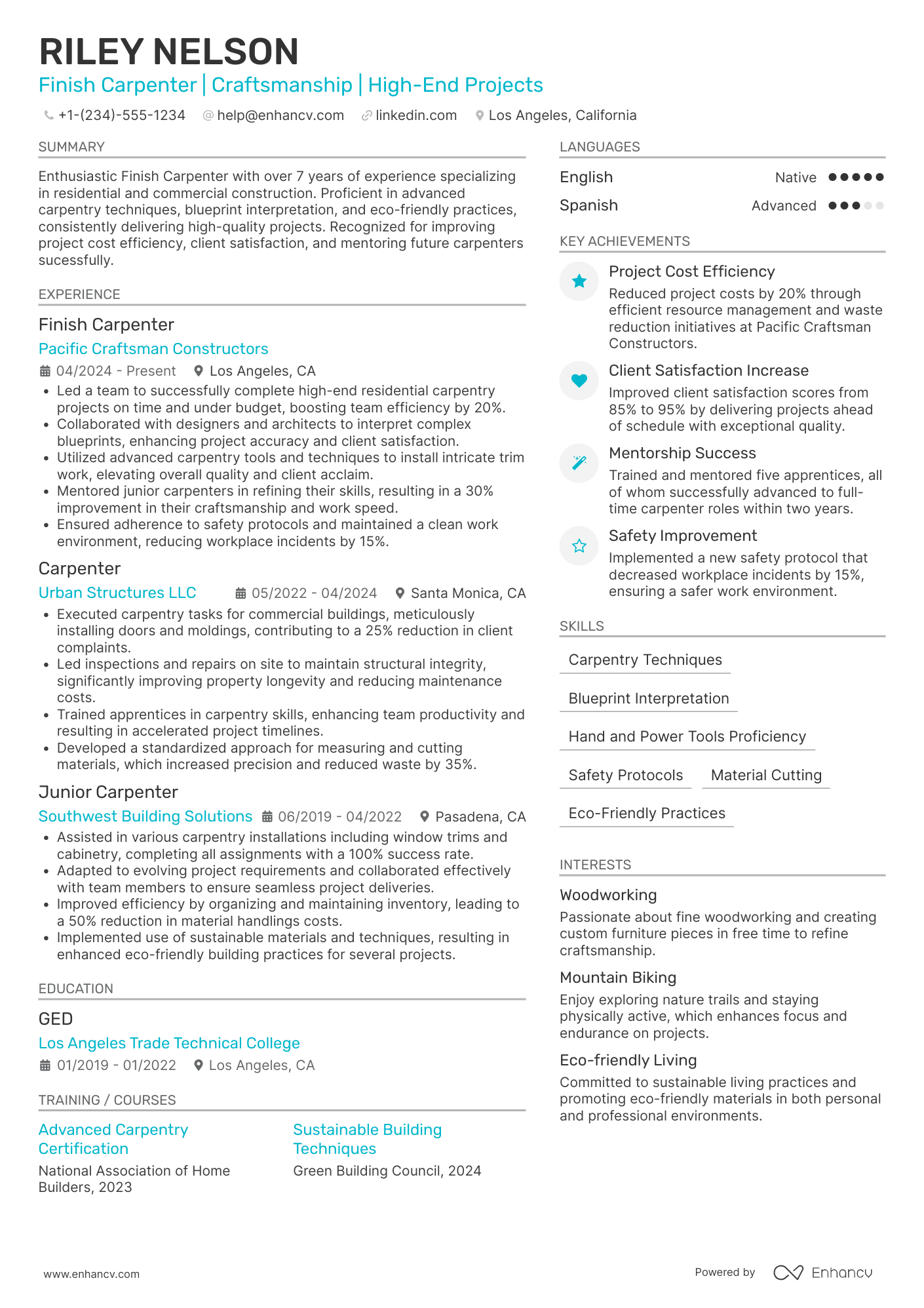
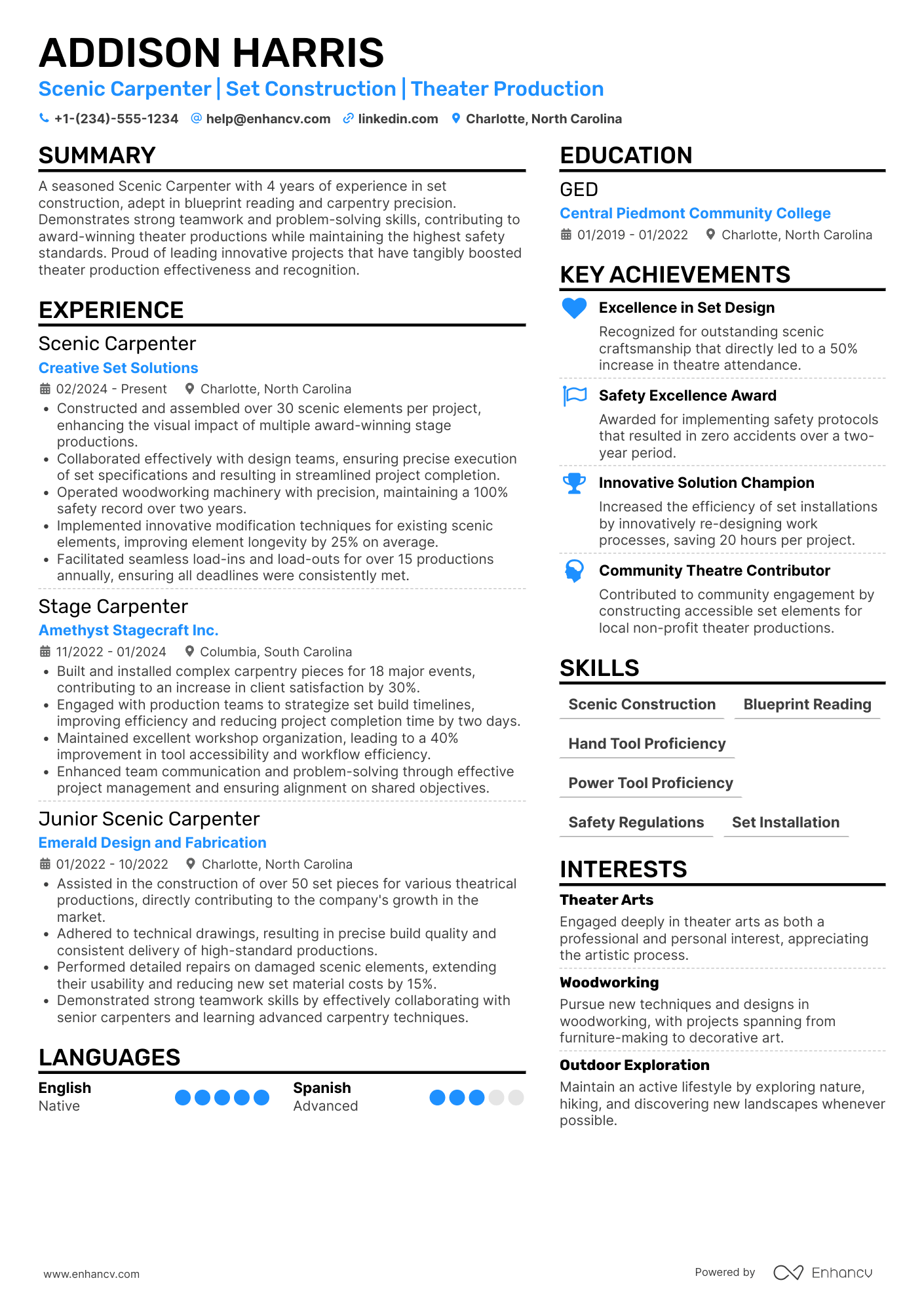
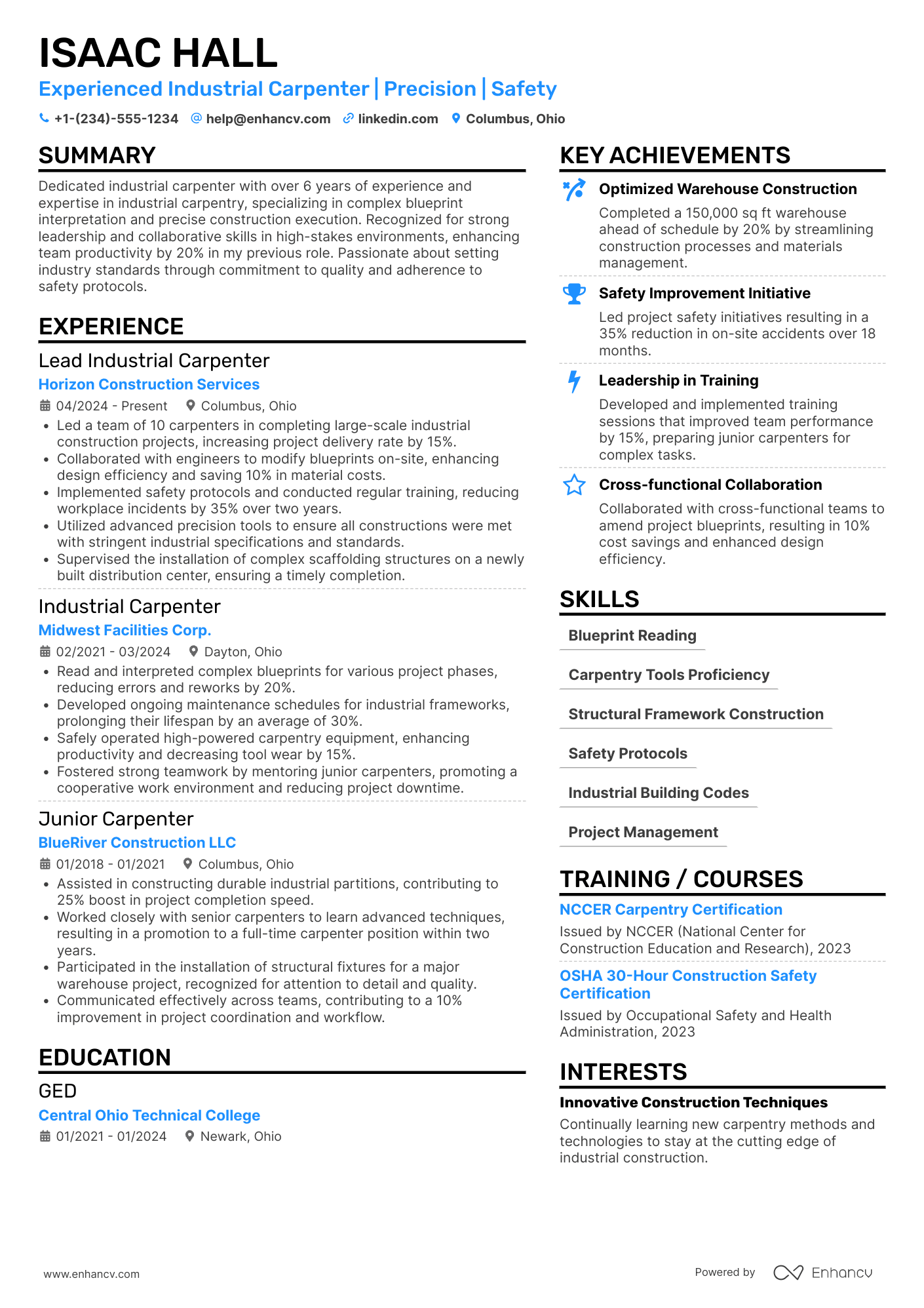
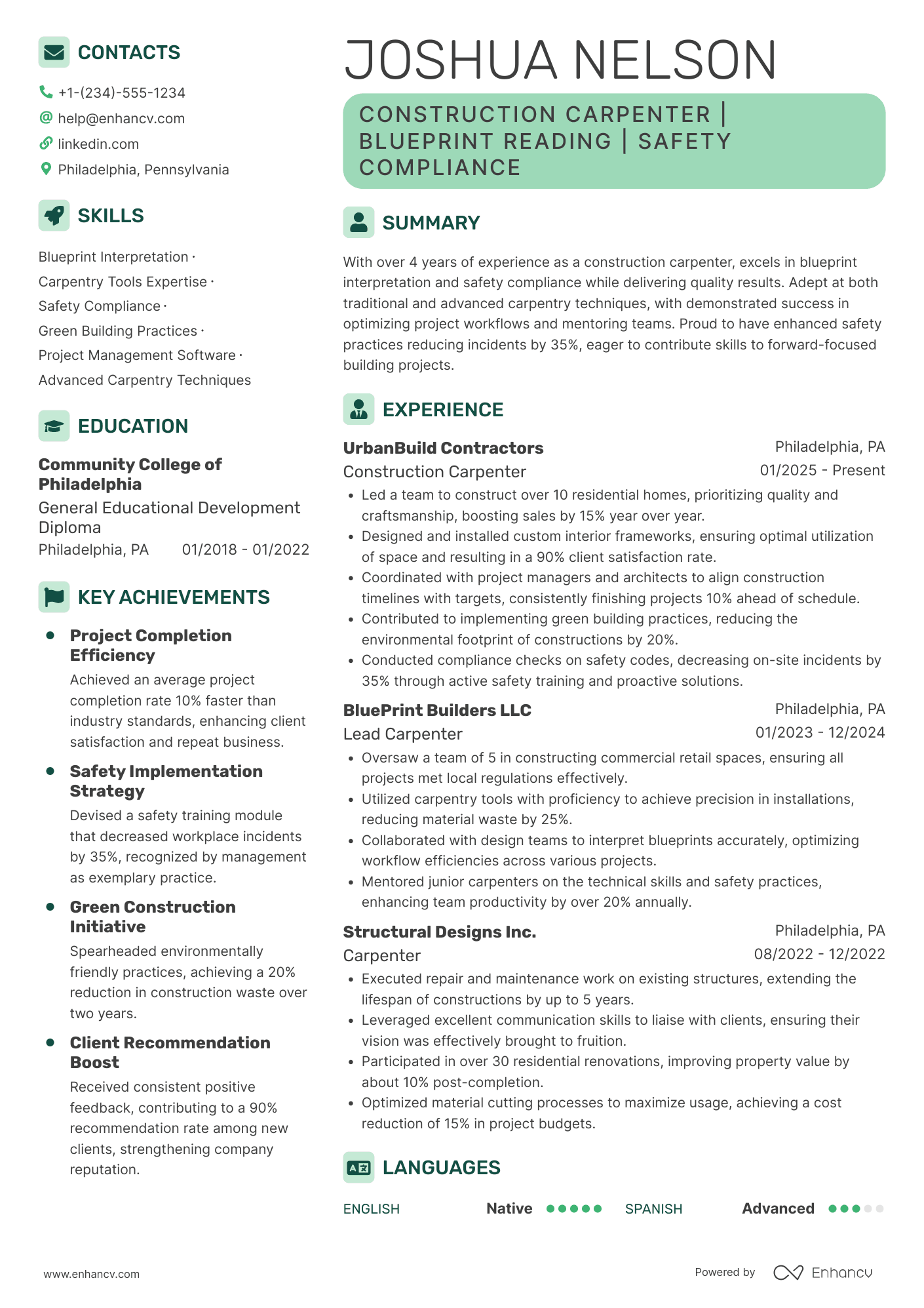
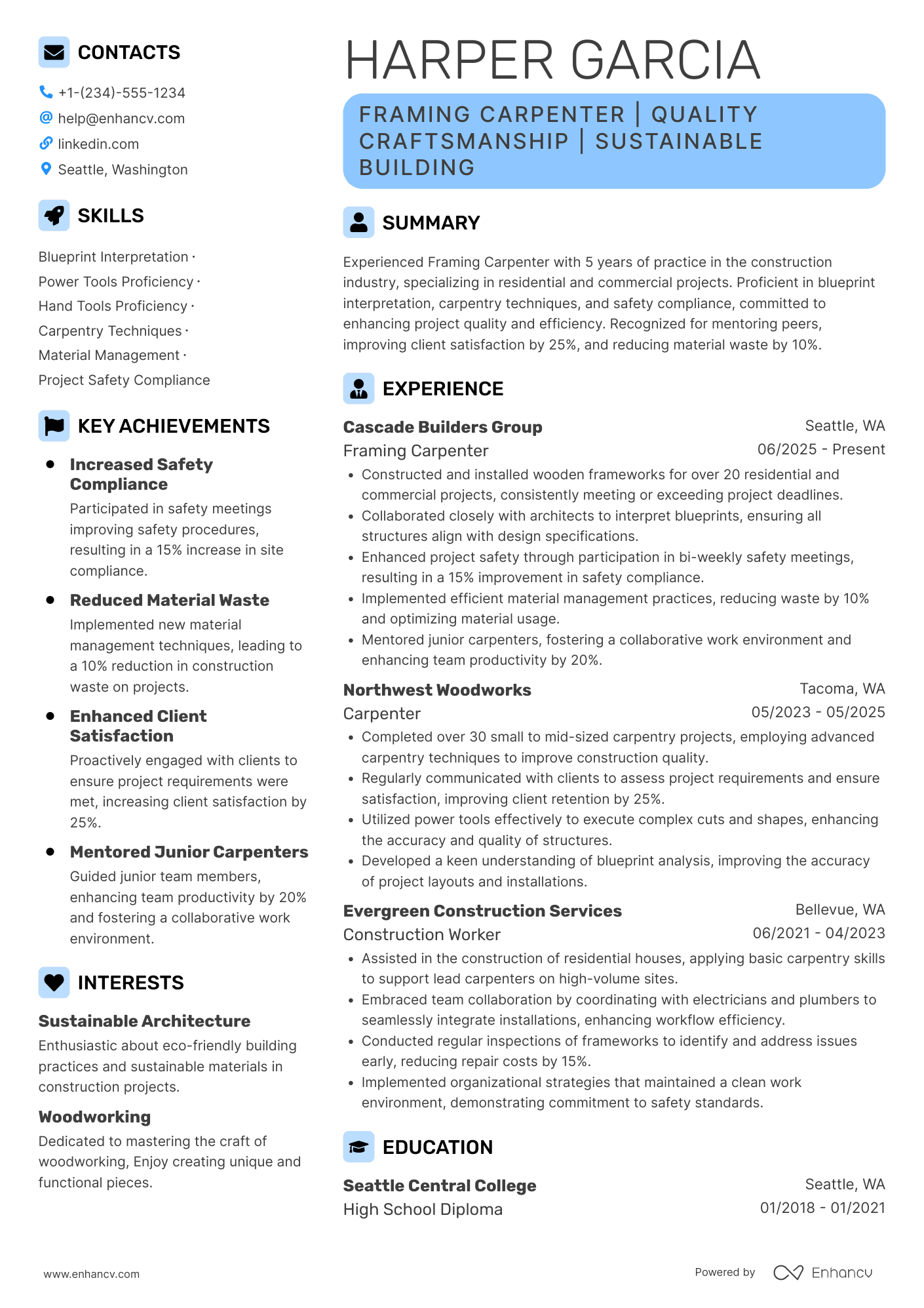
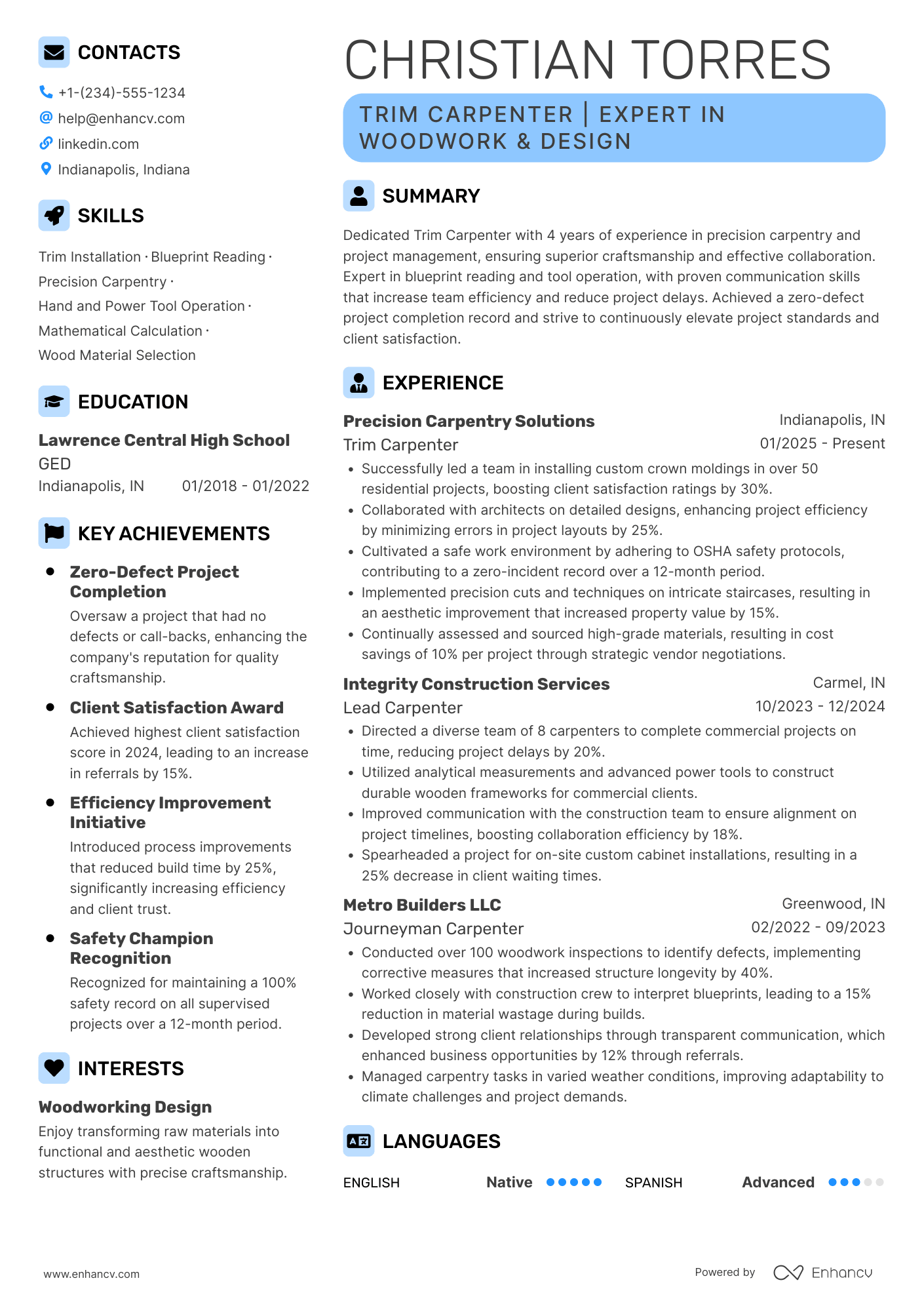
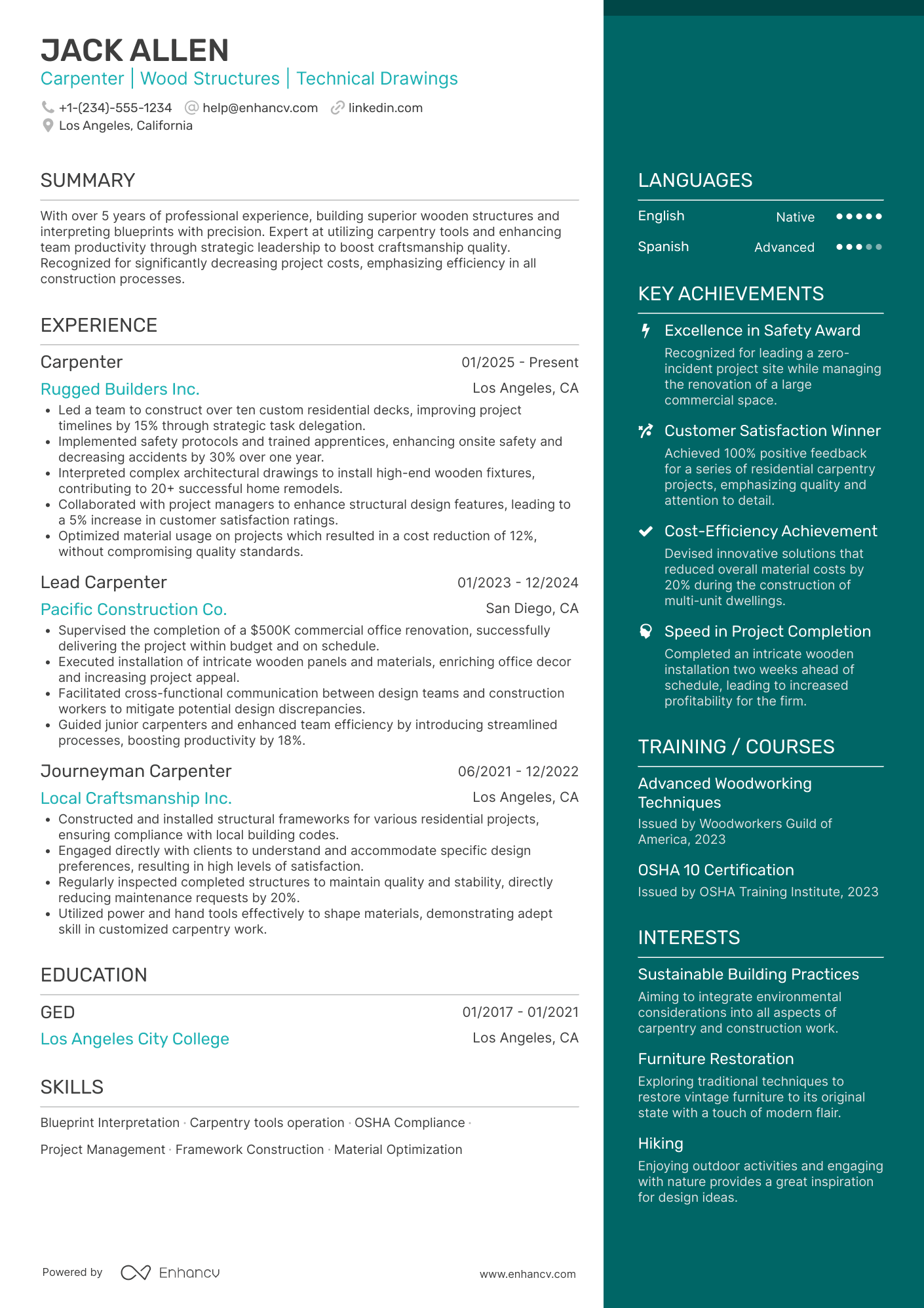
Many carpenter resume submissions fail because they list tasks and tools but skip measurable results, making skills hard to verify fast. That hurts when an ATS filters keywords and recruiters scan in seconds in a crowded market.
A strong resume shows what you delivered and how it performed, not just what you used. Knowing how to make your resume stand out is essential in the trades. You should highlight square footage framed, rework reductions, on-time handoffs, punch-list closeout speed, safety record, budget adherence, and client satisfaction.

Key takeaways
- Quantify carpentry achievements with metrics like square footage, rework rates, and cost savings.
- Use reverse-chronological format for experienced carpenters and hybrid format for career changers.
- Tailor every resume to the job posting's specific tools, methods, and project types.
- Anchor skills to concrete projects and outcomes instead of listing them in isolation.
- Place certifications like OSHA 30 above education when they're recent and role-relevant.
- Write a three- to four-line summary highlighting specialization, tools, and one measurable win.
- Use Enhancv to turn vague task descriptions into sharp, results-driven resume bullets.
Job market snapshot for carpenters
We analyzed 803 recent carpenter job ads across major US job boards. These numbers help you understand skills in demand, salary landscape, employment type trends at a glance.
What level of experience employers are looking for carpenters
| Years of Experience | Percentage found in job ads |
|---|---|
| 1–2 years | 9.2% (74) |
| 3–4 years | 6.7% (54) |
| 5–6 years | 4.1% (33) |
| 7–8 years | 0.5% (4) |
| 9–10 years | 0.1% (1) |
| 10+ years | 2.5% (20) |
| Not specified | 76.3% (613) |
Carpenter ads by area of specialization (industry)
| Industry (Area) | Percentage found in job ads |
|---|---|
| Finance & Banking | 37.5% (301) |
| Education | 18.6% (149) |
| Real Estate & Construction | 15.6% (125) |
| Healthcare | 13.2% (106) |
| Manufacturing | 6.5% (52) |
| Government | 4.7% (38) |
| Retail & E-commerce | 2.7% (22) |
Top companies hiring carpenters
| Company | Percentage found in job ads |
|---|---|
| Cajun Engineering Solutions | 3.5% (28) |
| Brown & Root | 3.4% (27) |
| Brasfield & Gorrie, LLC | 2.4% (19) |
| Great Day Improvements | 2.2% (18) |
| Stier Supply Company | 2.2% (18) |
| Baker Concrete Construction | 2.1% (17) |
| Bechtel | 1.9% (15) |
| MasTec Inc. | 1.7% (14) |
| Hensel Phelps | 1.6% (13) |
| Morton Buildings, Inc. | 1.6% (13) |
Role overview stats
These tables show the most common responsibilities and employment types for carpenter roles. Use them to align your resume with what employers expect and to understand how the role is structured across the market.
Day-to-day activities and top responsibilities for a carpenter
| Responsibility | Percentage found in job ads |
|---|---|
| Carpentry | 58.5% (470) |
| Hand tools | 32.6% (262) |
| Power tools | 31.3% (251) |
| Blueprints | 30.8% (247) |
| Construction | 10.5% (84) |
| Drywall | 8.3% (67) |
| Scaffolding | 8.0% (64) |
| Painting | 7.0% (56) |
| Framing | 6.8% (55) |
| Plumbing | 6.6% (53) |
| Ppe | 5.6% (45) |
| Concrete | 5.5% (44) |
How to format a carpenter resume
Recruiters reviewing carpenter resumes prioritize hands-on trade skills, project scope, and a reliable work history that shows consistent employment in the field. A clear, well-structured resume format ensures these signals—certifications, specializations, and measurable project contributions—are immediately visible to both hiring managers and applicant tracking systems.

I have significant experience as a carpenter—which format should I use?
Use the reverse-chronological format to put your strongest and most recent project experience front and center. Do:
- Lead with your most recent roles, emphasizing the scope of projects you handled (residential, commercial, new construction, or renovation) and any crew coordination or site responsibilities.
- Highlight trade-specific skills and tools—framing, finish carpentry, blueprint reading, CNC routers, OSHA certifications—within each position's context.
- Quantify outcomes wherever possible: square footage completed, budgets managed, timelines met, or waste reduced.
I'm junior or switching into a carpenter role—what format works best?
A hybrid format lets you lead with relevant skills and training while still showing your work history in a concise timeline. Do:
- Place a focused skills section near the top of your resume, listing trade competencies like rough framing, drywall installation, power tool operation, and safety compliance.
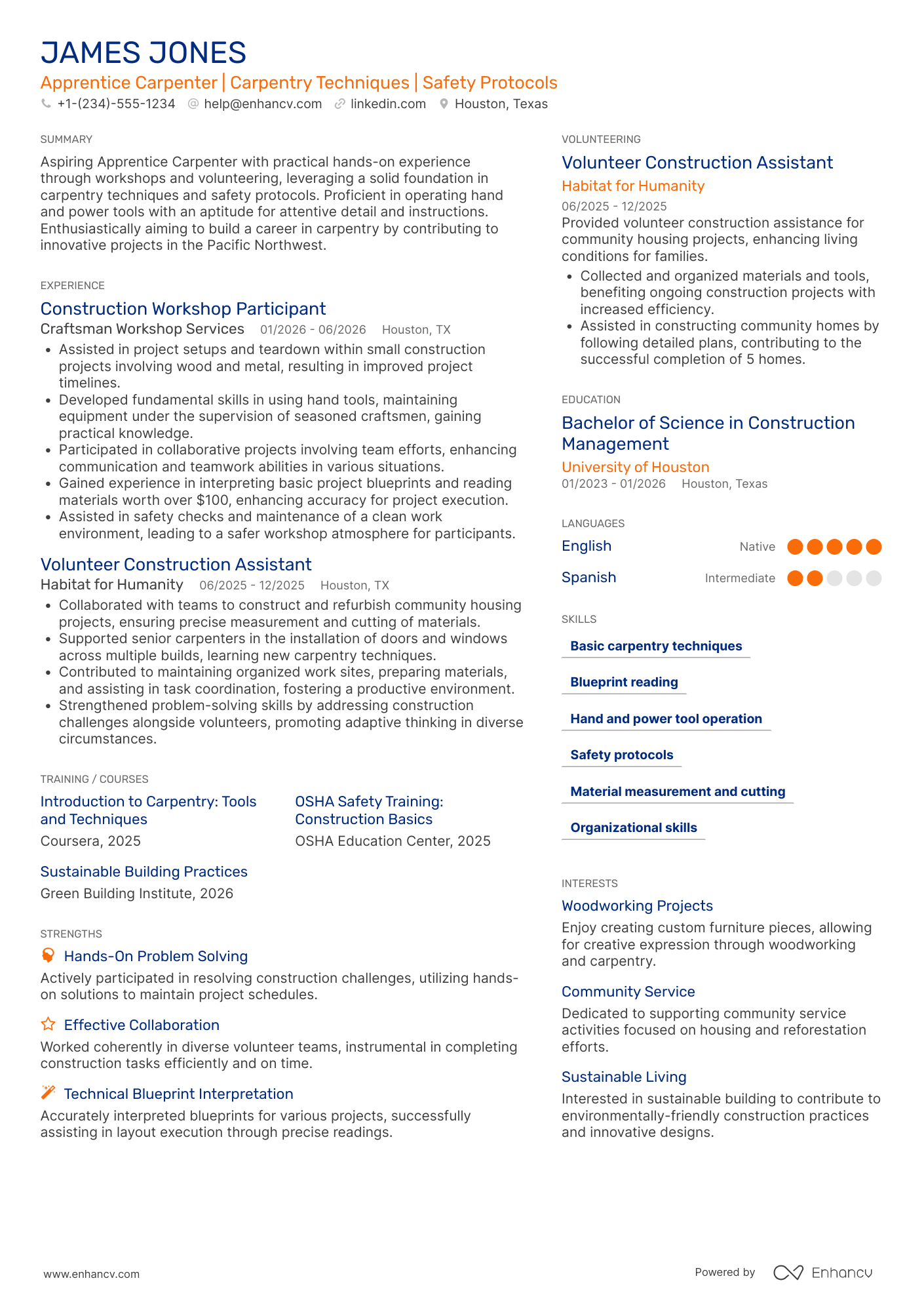
- Include apprenticeships, vocational coursework, volunteer builds, or personal renovation projects to demonstrate hands-on experience even without a long employment record.
- Connect each skill or project to a specific action and a tangible result so recruiters can see what you actually accomplished.
Why not use a functional resume?
A functional format strips away the timeline of your work history, making it harder for recruiters to verify where, when, and how you applied your carpentry skills—something hiring managers in the trades weigh heavily.
- Career changers with transferable hands-on experience: If you're moving from a related trade like general construction, electrical, or furniture making and have no direct carpentry job titles to list.
- Limited formal work history with relevant training: If you've completed a carpentry apprenticeship, vocational program, or significant personal building projects but haven't yet held a paid carpentry position.
- Gaps in employment with continued skill development: If you've been out of the workforce but maintained your skills through side projects, certifications, or community build programs like Habitat for Humanity.
- A functional resume is acceptable only when you lack direct carpentry work history and need to foreground transferable trade skills, but every skill listed should still be tied to a concrete project, training outcome, or measurable result to maintain credibility with hiring managers.
Once your layout and structure are set, the next step is deciding which sections to include so each one works within that format to highlight your qualifications.
What sections should go on a carpenter resume
Recruiters expect to see clear proof you can deliver safe, code-compliant, on-time carpentry work across residential or commercial builds. Choosing the right resume sections ensures maximum clarity:
- Header
- Summary
- Experience
- Skills
- Projects
- Education
- Certifications
- Optional sections: Awards, Leadership, Volunteering
Strong experience bullets should emphasize measurable outcomes, job scope, quality standards, safety performance, and on-time delivery.
Is your resume good enough?
Drop your resume here or choose a file. PDF & DOCX only. Max 2MB file size.
Once you’ve organized the key resume components, the next step is to write your carpenter resume experience so it fits that structure and highlights your impact.
How to write your carpenter resume experience
The experience section of your carpenter resume should spotlight the work you've shipped—framing, finishing, renovations, custom builds—along with the tools and methods you used and the measurable outcomes you delivered. Hiring managers prioritize demonstrated impact over descriptive task lists, so every line should prove you can build to spec, solve problems on-site, and finish projects on time and within budget. Building a targeted resume ensures each bullet connects directly to what the employer needs.
Each entry should include:
- Job title
- Company and location (or remote)
- Dates of employment (month and year)
Three to five concise bullet points showing what you owned, how you executed, and what outcomes you delivered:
- Ownership scope: the types of builds, structures, job sites, or project phases you were directly accountable for as a carpenter—whether residential framing, commercial tenant improvements, cabinetry, formwork, or restoration work.
- Execution approach: the hand tools, power tools, measurement instruments, building codes, blueprint-reading techniques, or construction methods you relied on to plan cuts, assemble structures, and deliver finished work.
- Value improved: the changes you drove in build quality, structural integrity, material efficiency, safety compliance, waste reduction, or project turnaround time through your carpentry skills.
- Collaboration context: how you coordinated with general contractors, electricians, plumbers, architects, inspectors, or clients to sequence tasks, resolve on-site conflicts, and keep projects moving.
- Impact delivered: the results your work produced—expressed through project completions, cost savings, timeline performance, client satisfaction, or scale of construction—rather than a simple list of daily duties.
Experience bullet formula
A carpenter experience example
✅ Right example - modern, quantified, specific.
Lead Finish Carpenter
Redwood Build Co. | Portland, OR
2021–Present
Residential remodeling contractor delivering high-end kitchen, bath, and whole-home renovations across the Portland metro area.
- Led on-site framing and finish carpentry for twelve remodels per year using laser levels, miter saws, and track saws, cutting rework by 22% through tighter layout control and punch-list management.
- Built and installed custom cabinetry and built-ins using a table saw, pocket-hole joinery, and a dust-collection system, reducing install time by eight hours per project while meeting one-sixteenth-inch tolerance targets.
- Coordinated daily with designers and homeowners to value-engineer trim profiles, door hardware, and material selections, saving an average of $3,800 per project without changing the approved look and feel.
- Implemented jobsite safety and quality checks using OSHA-aligned checklists and moisture-meter verification, lowering safety incidents by 40% and preventing three flooring failures tied to high subfloor moisture.
- Managed material takeoffs and procurement in Buildertrend, improving on-time deliveries to 95% and cutting material waste by 12% through accurate cut lists and optimized sheet-goods layouts.
Now that you've seen how a strong experience section looks in practice, let's break down how to customize yours for each specific job posting.
How to tailor your carpenter resume experience
Recruiters evaluate carpenter resumes through both manual review and applicant tracking systems, so your experience section needs to reflect the specific job posting. Tailoring your resume to the job description means aligning your actual work history with the tools, methods, and priorities each employer highlights.
Ways to tailor your carpenter experience:
- Match specific power tools and hand tools named in the posting.
- Mirror the framing or finishing terminology the employer uses.
- Reflect building codes or compliance standards the role requires.
- Include the exact materials or construction methods they reference.
- Highlight blueprint reading or layout skills when the job lists them.
- Emphasize safety protocols or OSHA requirements mentioned in the listing.
- Reference project types like residential or commercial to match their scope.
- Align your workflow language with their team structure or trade coordination.
Tailoring your experience means connecting real accomplishments to what the employer asked for, not forcing keywords where they don't belong.
Resume tailoring examples for carpenter
| Job description excerpt | Untailored | Tailored |
|---|---|---|
| Install and repair structural frameworks, including walls, floors, and doorframes, using hand tools and power tools in compliance with local building codes. | Helped with various construction tasks on job sites. | Installed and repaired structural frameworks—walls, floors, and doorframes—using hand and power tools across 12 residential builds, ensuring full compliance with local building codes. |
| Read and interpret blueprints, shop drawings, and specifications to determine materials, dimensions, and installation procedures for custom cabinetry. | Read project documents and completed assigned work. | Interpreted blueprints, shop drawings, and specifications to determine precise dimensions and materials for custom cabinetry projects, completing over 40 installations with zero rework. |
| Perform concrete formwork, framing, and finishing on commercial construction sites, maintaining strict adherence to OSHA safety standards. | Worked on framing and other building projects safely. | Built and stripped concrete formwork and completed rough framing on three commercial sites, consistently meeting OSHA safety standards and passing all on-site inspections. |
Once you’ve aligned your experience with the role’s requirements, the next step is to quantify your carpenter achievements so employers can see the impact behind that fit.
How to quantify your carpenter achievements
Quantifying your carpentry work proves real impact beyond craftsmanship. Quantifying achievements with numbers tied to on-time delivery, rework rates, material waste, safety incidents, and cost savings across builds, installs, and repairs makes your resume far more compelling.
Quantifying examples for carpenter
| Metric | Example |
|---|---|
| Delivery speed | "Completed a 1,600 sq ft framing package two days early by sequencing wall panels and using a pneumatic nailer and laser level." |
| Quality | "Cut rework from 8% to 2% by standardizing measurements with story poles and verifying plumb and square at each checkpoint." |
| Material waste | "Reduced lumber waste by 12% by optimizing cut lists, reusing offcuts for blocking, and staging material by room." |
| Safety | "Maintained zero recordable incidents across 14 months by enforcing daily tool inspections, fall protection checks, and clean jobsite walkways." |
| Cost savings | "Saved $4,800 on a kitchen remodel by sourcing equivalent-grade hardwood, batching cuts, and finishing on-site with an HVLP sprayer." |
Turn vague job duties into measurable, recruiter-ready resume bullets in seconds with Enhancv's Bullet Point Generator.
Once you've crafted strong bullet points for your experience section, you'll want to apply that same precision to presenting your hard and soft skills.
How to list your hard and soft skills on a carpenter resume
Your skills section shows you can build safely, accurately, and on schedule—recruiters and an ATS (applicant tracking system) scan this section to match you to the job post, so aim for a balance of trade-specific hard skills and job-site soft skills. carpenter roles require a blend of:
- Product strategy and discovery skills.
- Data, analytics, and experimentation skills.
- Delivery, execution, and go-to-market discipline.
- Soft skills.
Your skills section should be:
- Scannable (bullet-style grouping).
- Relevant to the job post.
- Backed by proof in experience bullets.
- Updated with current tools.
Place your skills section:
- Above experience if you're junior or switching careers.
- Below experience if you're mid/senior with strong achievements.

Hard skills
- Blueprint reading, takeoffs
- Framing: walls, roofs
- Finish carpentry, trim work
- Cabinet installation, scribing
- Door and window installation
- Stair layout and installation
- Concrete formwork, shoring
- Drywall hanging, backing
- Tape measures, laser levels
- Circular saws, miter saws, table saws
- Nail guns, compressors
- OSHA safety compliance
Soft skills
- Interpret plans with foremen
- Coordinate with trades on-site
- Communicate change orders clearly
- Flag safety hazards fast
- Maintain clean, organized work areas
- Estimate time and materials accurately
- Prioritize tasks to hit deadlines
- Solve fit and finish issues on-site
- Follow punch lists to completion
- Document work progress daily
- Accept feedback and rework quickly
- Train helpers on safe tool use
How to show your carpenter skills in context
Skills shouldn't live only in a bulleted list on your resume. Explore examples of resume skills shown in context to see how top candidates present their abilities.
They should be demonstrated in:
- Your summary (high-level professional identity)
- Your experience (proof through outcomes)
Here's what that looks like in practice.
Summary example
Senior carpenter with 12 years in commercial construction, skilled in blueprint reading, finish carpentry, and CNC routing. Led crews of up to eight, completing projects 15% under budget while maintaining strict code compliance.
- Reflects senior-level experience clearly
- Names role-relevant tools and methods
- Includes a measurable budget outcome
- Highlights leadership as a soft skill
Experience example
Senior Carpenter
Ridgeline Builders | Denver, CO
March 2018–Present
- Directed framing and finish work on 40+ commercial projects using AutoCAD layouts, reducing material waste by 18% year over year.
- Collaborated with architects and project managers to resolve on-site structural issues, cutting rework time by 25%.
- Trained and mentored six junior carpenters on safe table saw and CNC router operation, lowering incident reports by 30%.
- Every bullet contains measurable proof
- Skills appear naturally within achievements
Once you’ve tied your carpentry abilities to real tasks and results, the next step is to apply that approach when writing a carpenter resume with no experience so you can still show clear value.
How do I write a carpenter resume with no experience
Even without full-time experience, you can demonstrate readiness through:
- Trade school shop projects
- Home renovation helper work
- Volunteer builds with nonprofits
- Apprenticeship or pre-apprenticeship hours
- Paid handyman or gig tasks
- Woodworking portfolio pieces
- Safety training certificates
- Tool maintenance and setup practice
If you're in this situation, learning how to write a resume without work experience will help you structure these alternative qualifications effectively.
Focus on:
- Measurable project outcomes and scope
- Tool list and safe operation
- Blueprint reading and layout accuracy
- Materials, fasteners, and finishes used
Resume format tip for entry-level carpenter
Use a skills-based resume format because it highlights tools, methods, and projects when your work history is limited. Do:
- Start with a "carpenter skills" section.
- Add projects with dates and outcomes.
- List tools you can use safely.
- Include training, OSHA, and CPR.
- Quantify work: cuts, hours, or waste.
- Built two 8-foot shop workbenches using a circular saw, miter saw, and pocket-hole jig, cutting lumber to ±1/16 inch and reducing wobble to zero.
Even without hands-on carpentry work to showcase, your educational background can demonstrate relevant knowledge and training that strengthens your candidacy.
How to list your education on a carpenter resume
Your education section helps hiring teams confirm you have foundational knowledge in construction principles, building codes, and safety standards relevant to the carpenter trade.
Include:
- Degree name
- Institution
- Location
- Graduation year
- Relevant coursework (for juniors or entry-level candidates)
- Honors & GPA (if 3.5 or higher)
Skip month and day details—list the graduation year only.
Here's a strong education entry tailored for a carpenter resume.
Example education entry
Associate of Applied Science in Construction Technology
Spokane Community College, Spokane, WA
Graduated 2021
GPA: 3.7
- Relevant coursework: Blueprint Reading, Framing Systems, Building Codes and Safety, Construction Materials
- Honors: Dean's List, 2020–2021
How to list your certifications on a carpenter resume
Certifications on your resume show your commitment to learning, confirm tool and safety proficiency, and prove your skills match current industry standards for a carpenter.
Include:
- Certificate name
- Issuing organization
- Year
- Optional: credential ID or URL
- Put certifications below education when your education is recent and closely related to carpenter work, and your certifications are older or general.
- Put certifications above education when your certifications are recent, role-relevant, or required for carpenter jobs, especially if your education is older.
Best certifications for your carpenter resume
- OSHA 10-Hour Construction Safety
- OSHA 30-Hour Construction Safety
- NCCER Carpentry Level 1
- NCCER Carpentry Level 2
- EPA Lead-Safe Certified Renovator (RRP)
- Forklift Operator Certification
- First Aid/CPR/AED Certification
Once you’ve placed your credentials where hiring managers can quickly verify them, you can write your carpenter resume summary to highlight those qualifications upfront and set the tone for the rest of your resume.
How to write your carpenter resume summary
Your resume summary is the first thing a recruiter reads. A strong one instantly signals you have the skills and hands-on experience to get the job done.
Keep it to three to four lines, with:
- Your title and total years of carpentry experience.
- The type of work you specialize in, such as residential, commercial, or industrial.
- Core tools and skills like framing, blueprint reading, or finish carpentry.
- One or two measurable achievements, such as projects completed or waste reduced.
- Soft skills tied to real outcomes, like teamwork that improved project timelines.

PRO TIP
At the entry or mid level, focus on relevant technical skills, certifications, and early wins on real job sites. Avoid vague statements like "hard worker" or "passionate about carpentry." Instead, tie every detail to something concrete you built, installed, or improved.
Example summary for a carpenter
Detail-oriented carpenter with three years of residential framing experience. Skilled in blueprint reading, rough and finish carpentry, and power tool operation. Reduced material waste by 15% across six new-build projects.
Optimize your resume summary and objective for ATS
Drop your resume here or choose a file.
PDF & DOCX only. Max 2MB file size.
Now that your summary is ready to hook hiring managers, make sure your header presents your contact details clearly so they can actually reach you.
What to include in a carpenter resume header
Your resume header is the top section with your key contact details, and it boosts visibility, credibility, and recruiter screening for a carpenter role.
Essential resume header elements
- Full name
- Tailored job title and headline
- Location
- Phone number
- Professional email
- GitHub link
- Portfolio link
A LinkedIn link helps recruiters verify experience quickly and supports faster screening decisions.
Do not include a photo on a carpenter resume unless the role is explicitly front-facing or appearance-dependent.
Keep your header on one to two lines, match your job title to the posting, and use links that open to updated, relevant work.
Example
Carpenter resume header
Jordan Miller
Carpenter | Residential Remodels, Framing, Finish Carpentry
Austin, TX
(512) 555-01XX
your.name@enhancv.com
github.com/yourname
yourwebsite.com
linkedin.com/in/yourname
Once your contact details and role focus are clearly established at the top, you can strengthen the rest of your application with additional sections that add relevant context and support your fit.
Additional sections for carpenter resumes
Adding extra sections helps you stand out when your core experience matches other candidates. They showcase unique qualifications that strengthen your credibility.
Consider including these sections on your carpenter resume:
- Certifications and licenses
- Languages
- Volunteer work
- Professional affiliations
- Hobbies and interests
- Awards and recognitions
Once you've rounded out your resume with the right supplementary sections, it's worth pairing it with a strong cover letter to make an even bigger impact.
Do carpenter resumes need a cover letter
A cover letter isn't required for most carpenter roles. If you're unsure what a cover letter is or when it matters, it helps in competitive postings, union shops, or larger contractors with formal hiring steps. It can make a difference when your resume needs context or you want to stand out.
Use a cover letter when it adds details your resume can't show:
- Explain role and team fit: Match your experience to the crew's work, pace, safety standards, and coordination with other trades.
- Highlight one or two outcomes: Name a project, your scope, and measurable results like fewer rework issues, faster installs, or cleaner punch lists.
- Show business context: Mention the build type and end users, such as tenants, homeowners, or facility teams, and how you protect quality and schedules.
- Address career transitions: Clarify gaps, a move from another trade, or informal experience, and connect it to carpenter tasks you can do now.
Drop your resume here or choose a file.
PDF & DOCX only. Max 2MB file size.
Whether you include a cover letter or rely on your resume alone, the next step is using AI to improve your carpenter resume so it matches the role and highlights your experience clearly.
Using AI to improve your carpenter resume
AI can sharpen your resume's clarity, structure, and overall impact. It helps you find stronger phrasing and tighten loose descriptions. But overuse strips authenticity fast. Once your content reads clearly and fits the role, step away from AI. For specific guidance, explore ChatGPT resume writing prompts tailored to different resume sections.
Here are 10 practical prompts you can copy and paste to strengthen specific sections of your carpenter resume:
- Strengthen your summary: "Rewrite my carpenter resume summary to highlight hands-on construction skills, years of experience, and project scope in three concise sentences."
- Quantify experience bullets: "Add measurable results to these carpenter experience bullets, including square footage completed, team size managed, or project timelines met."
- Sharpen skills relevance: "Review my carpenter skills section and remove generic entries. Keep only skills directly relevant to residential and commercial carpentry roles."
- Improve project descriptions: "Rewrite these carpenter project descriptions to emphasize materials used, techniques applied, and final outcomes delivered on each build."
- Align with a job posting: "Compare my carpenter resume experience section against this job description. Identify missing keywords and suggest where to add them naturally."
- Tighten action verbs: "Replace weak or repetitive verbs in my carpenter experience bullets with precise action words specific to construction and woodworking tasks."
- Refine certifications phrasing: "Reformat my carpenter certifications section so each entry clearly states the credential name, issuing organization, and year earned."
- Clarify education details: "Edit my carpenter resume education section to highlight trade school coursework, apprenticeship hours, and relevant safety training completed."
- Remove filler language: "Scan my carpenter resume for vague phrases like 'responsible for' or 'assisted with.' Replace them with direct, outcome-focused statements."
- Tailor for specialization: "Adjust my carpenter resume to emphasize finish carpentry specialization, including cabinetry, trim installation, and custom millwork experience."
Stop using AI once your resume sounds accurate, specific, and aligned with real experience. AI should never invent experience or inflate claims—if it didn't happen, it doesn't belong here.
Conclusion
A strong carpenter resume proves results and reliability. Use measurable outcomes like on-time completion, fewer rework hours, and accurate takeoffs. Highlight role-specific skills, including framing, finish work, blueprint reading, and safe tool use.
Keep the structure clear and easy to scan. Lead with a focused summary, then list skills, experience, and certifications in a consistent format. This approach shows you’re ready for today’s hiring market and the near-future demand.
Carpenter resume examples
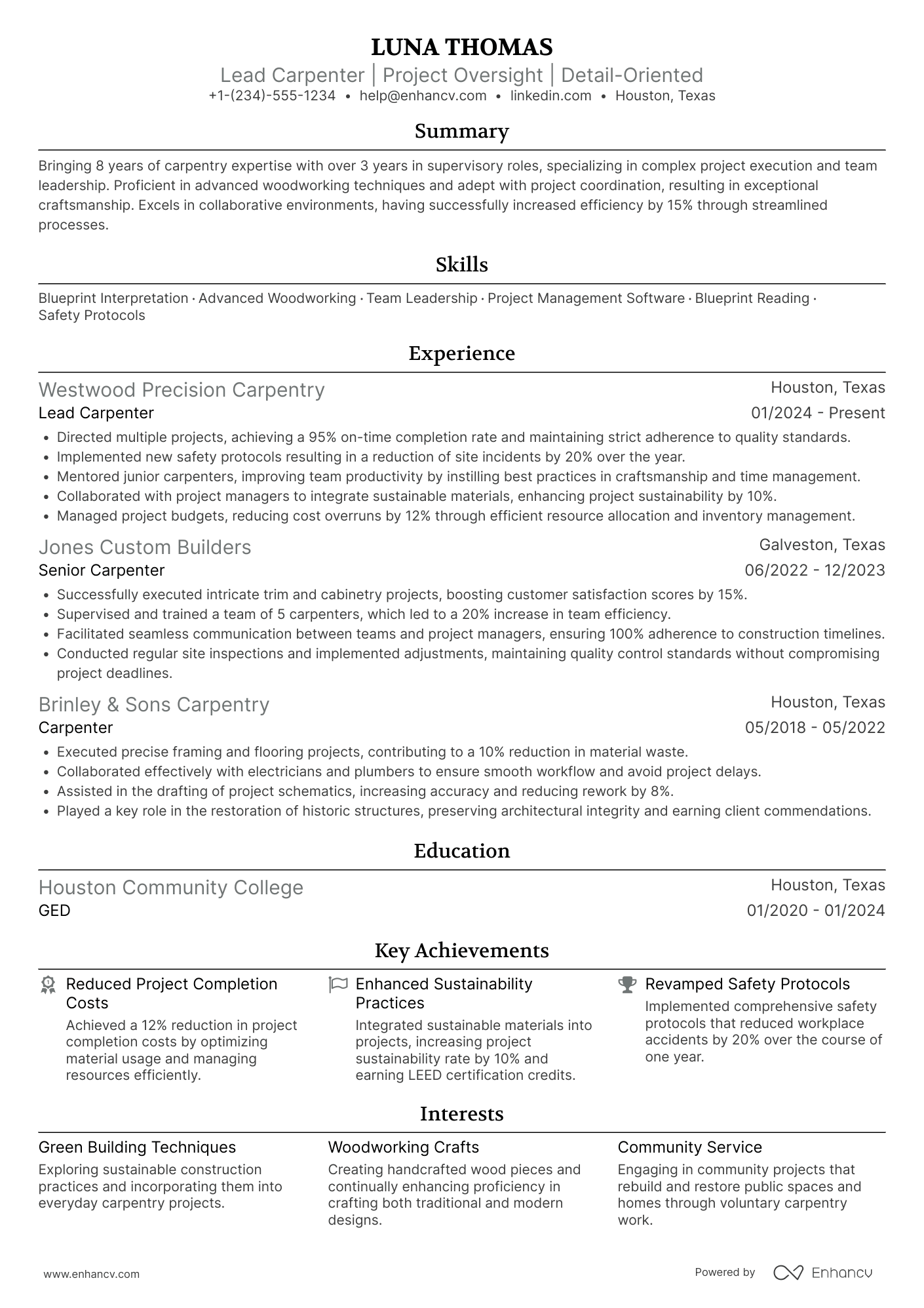
By Role