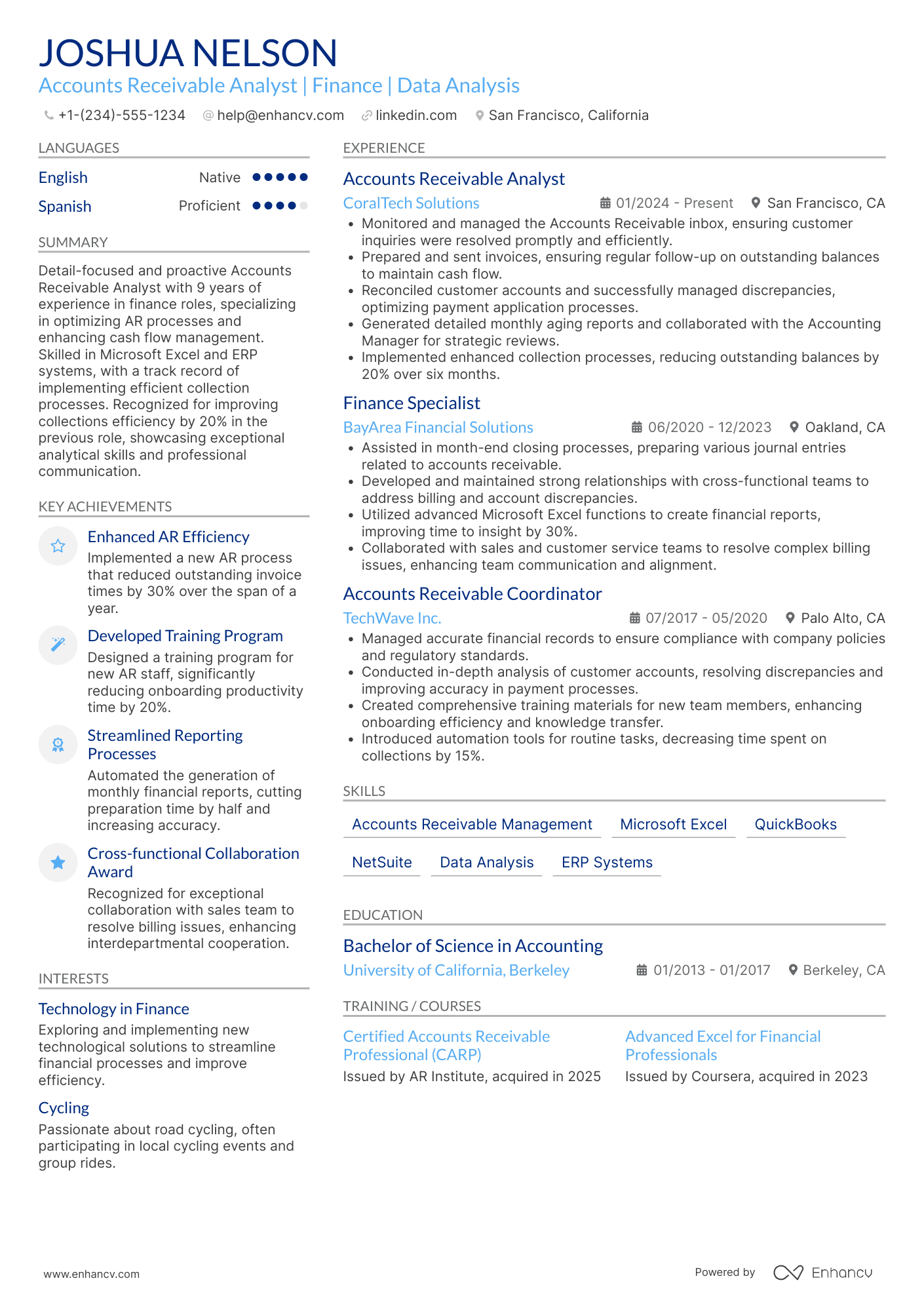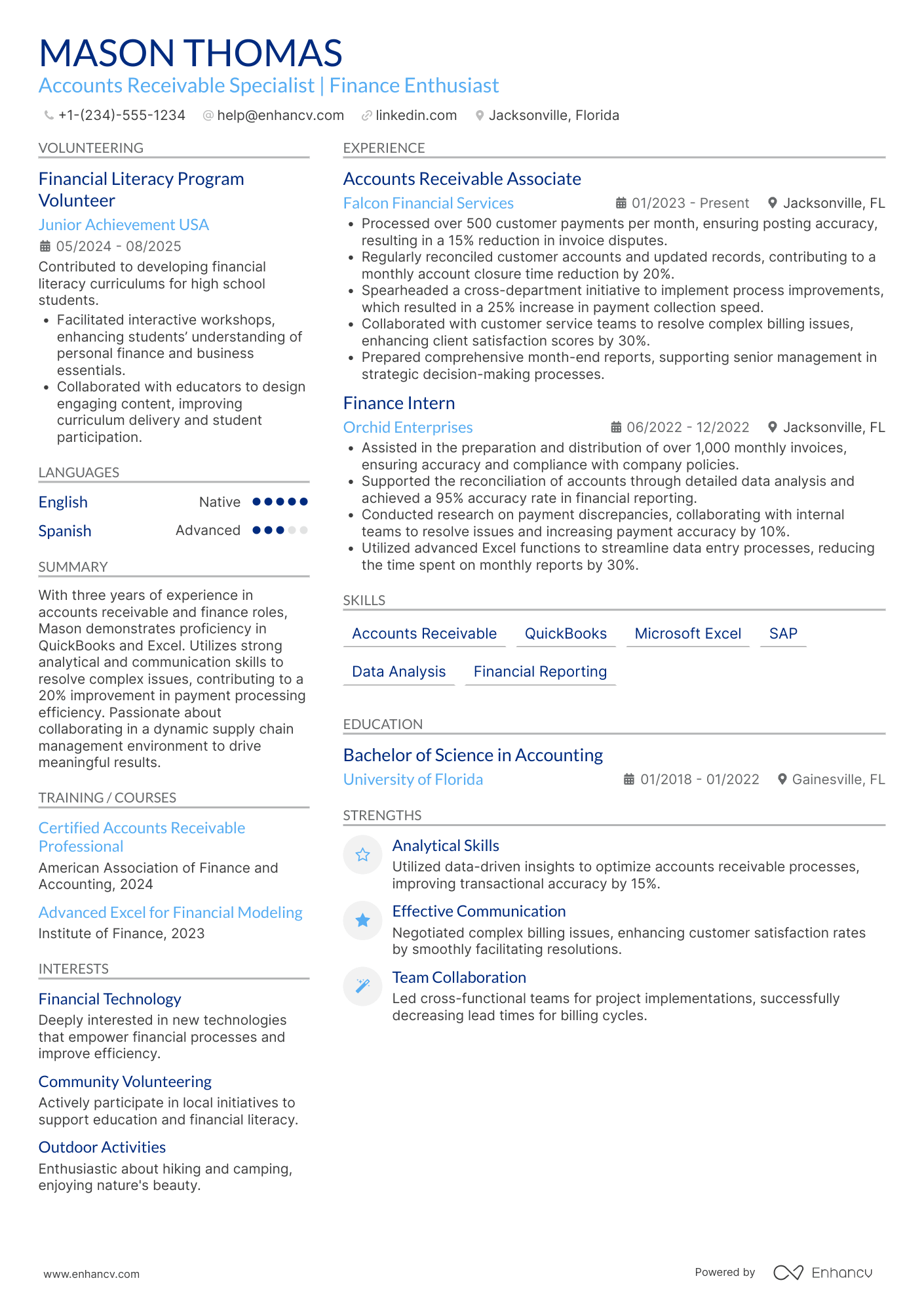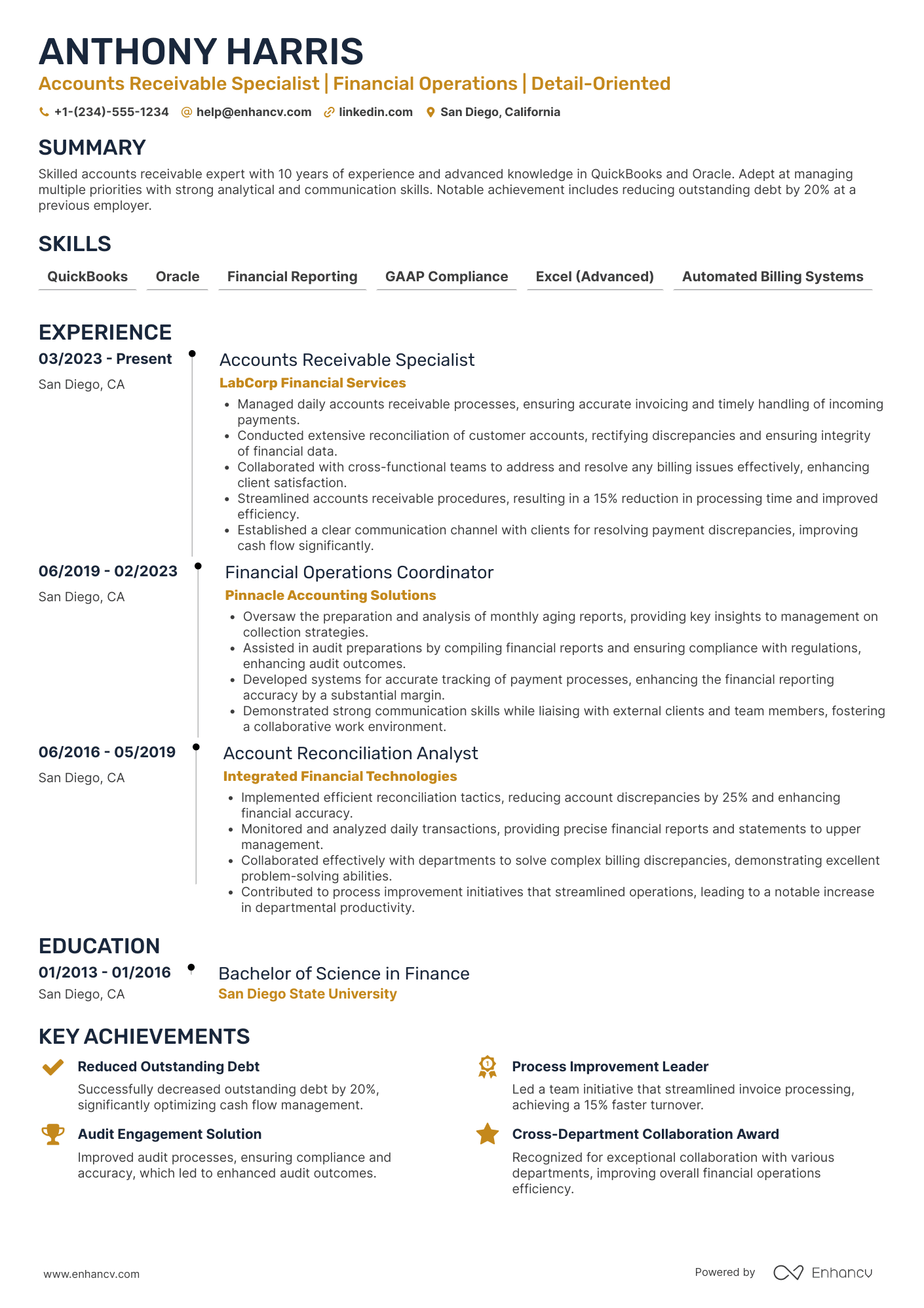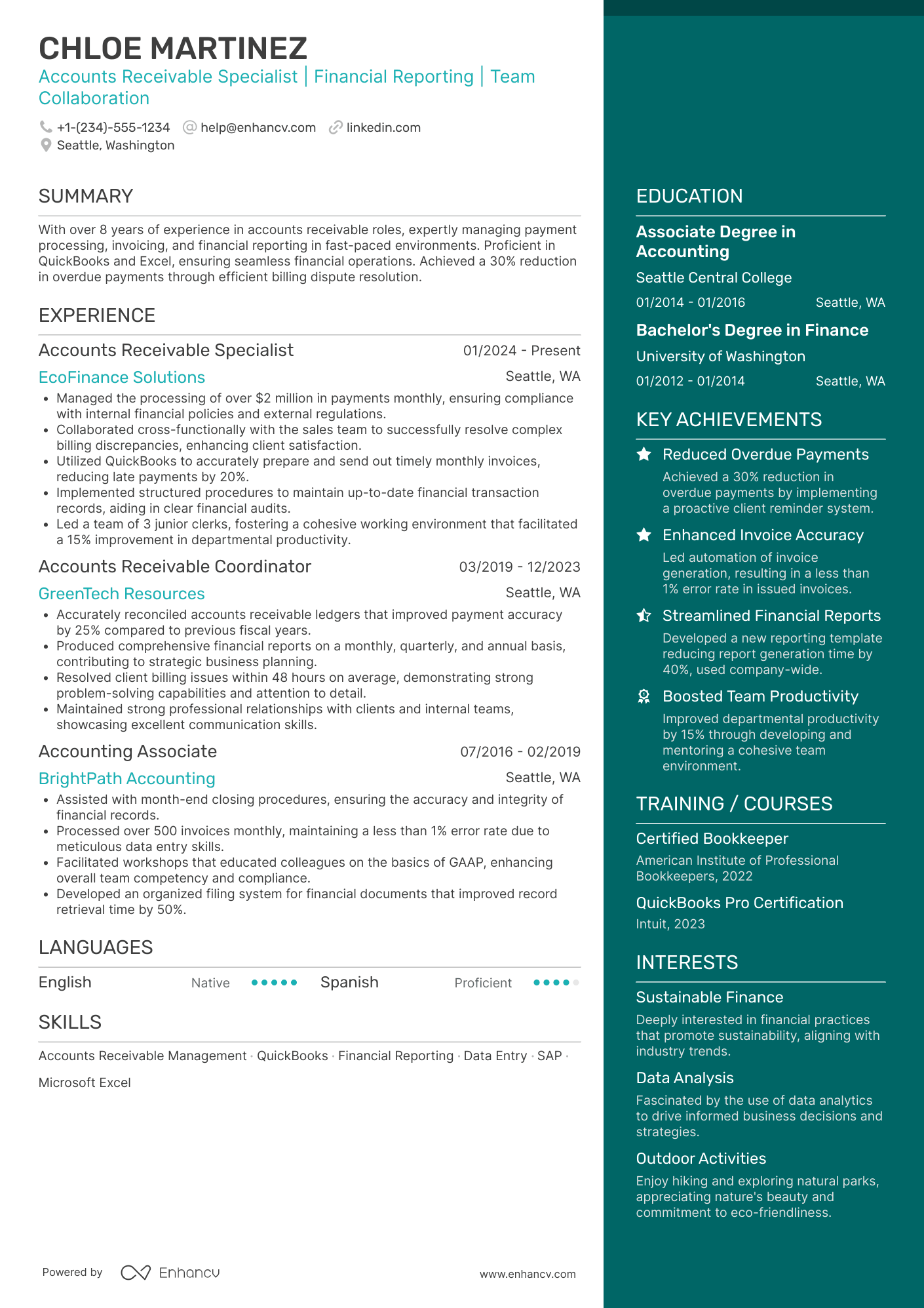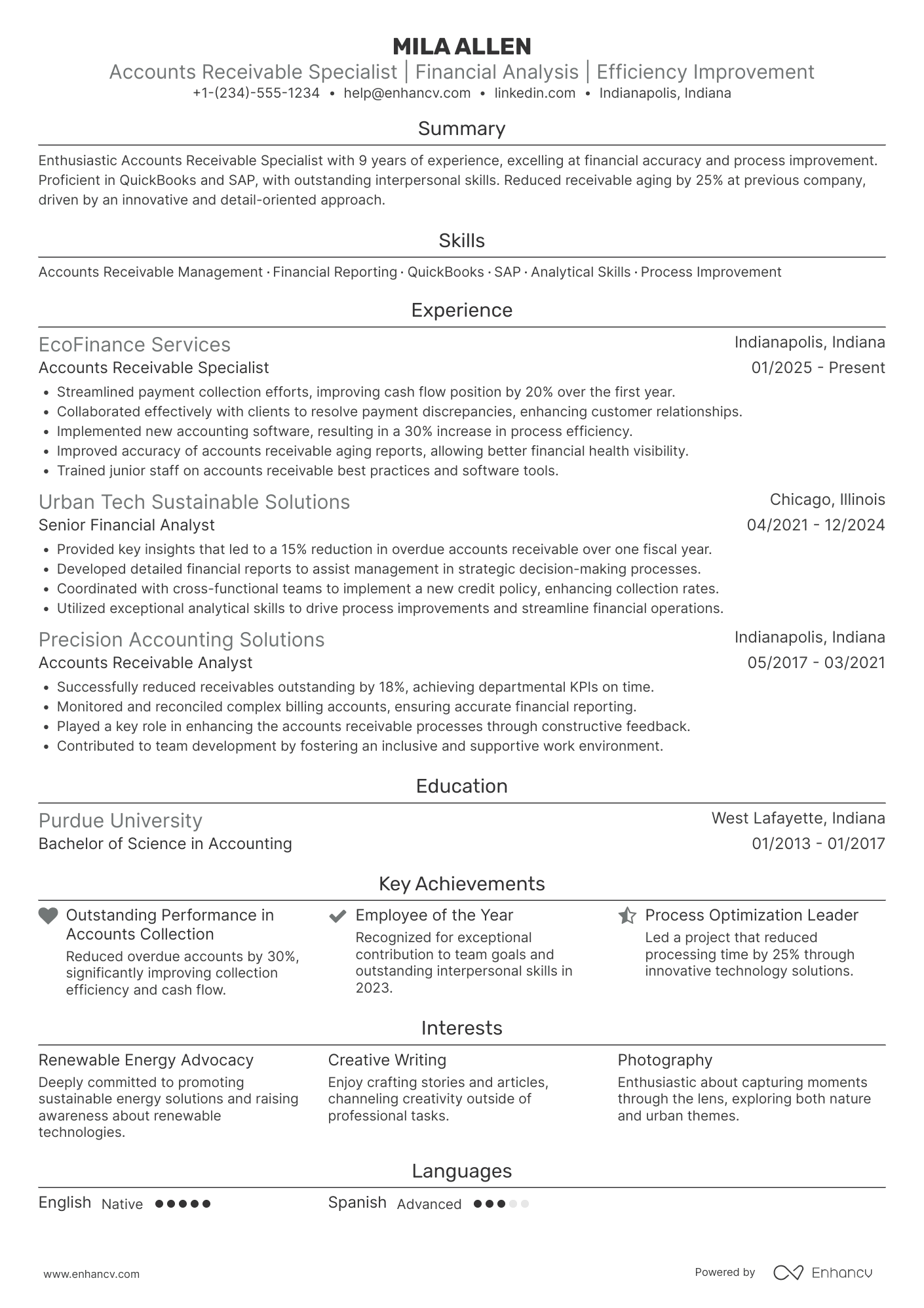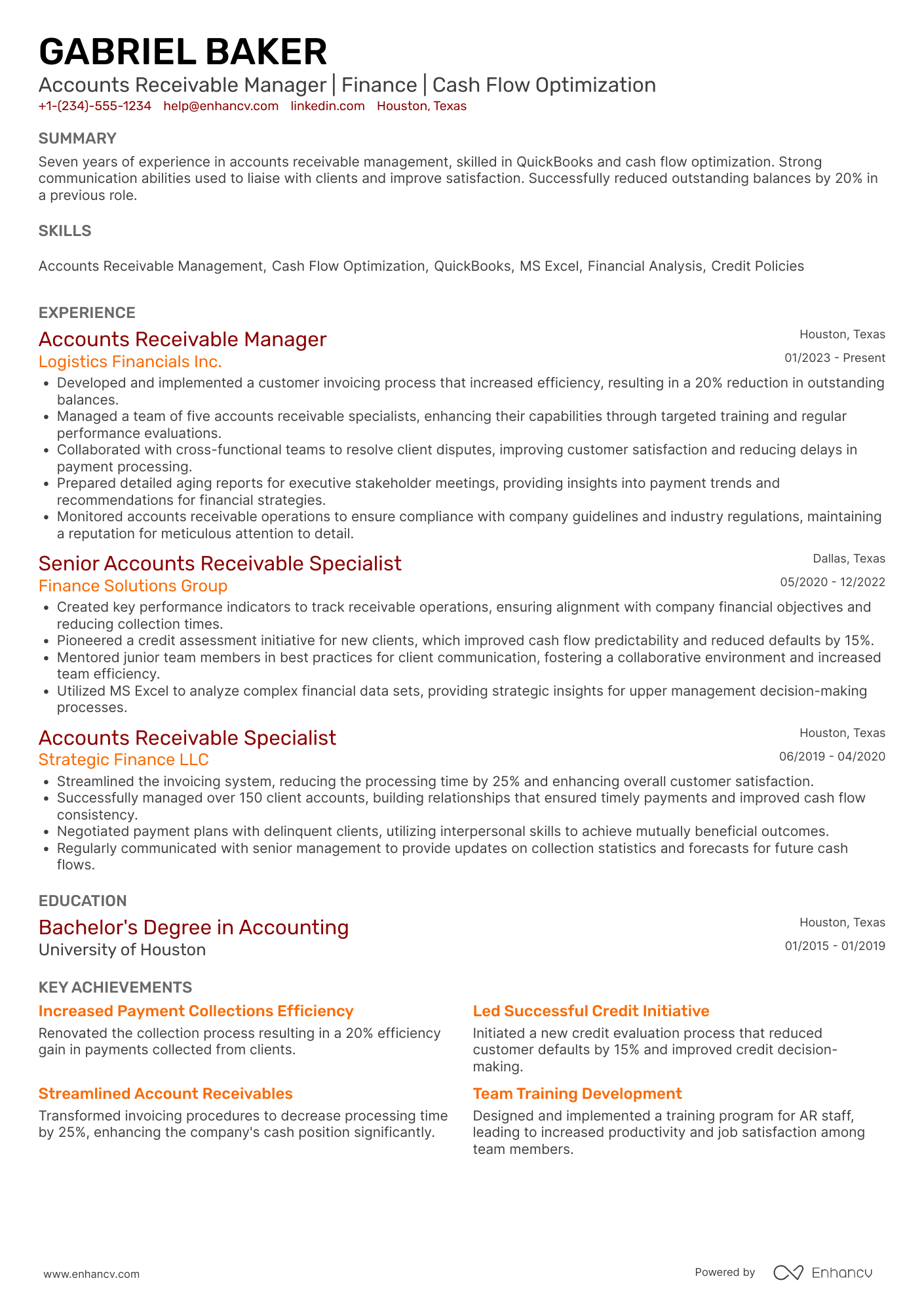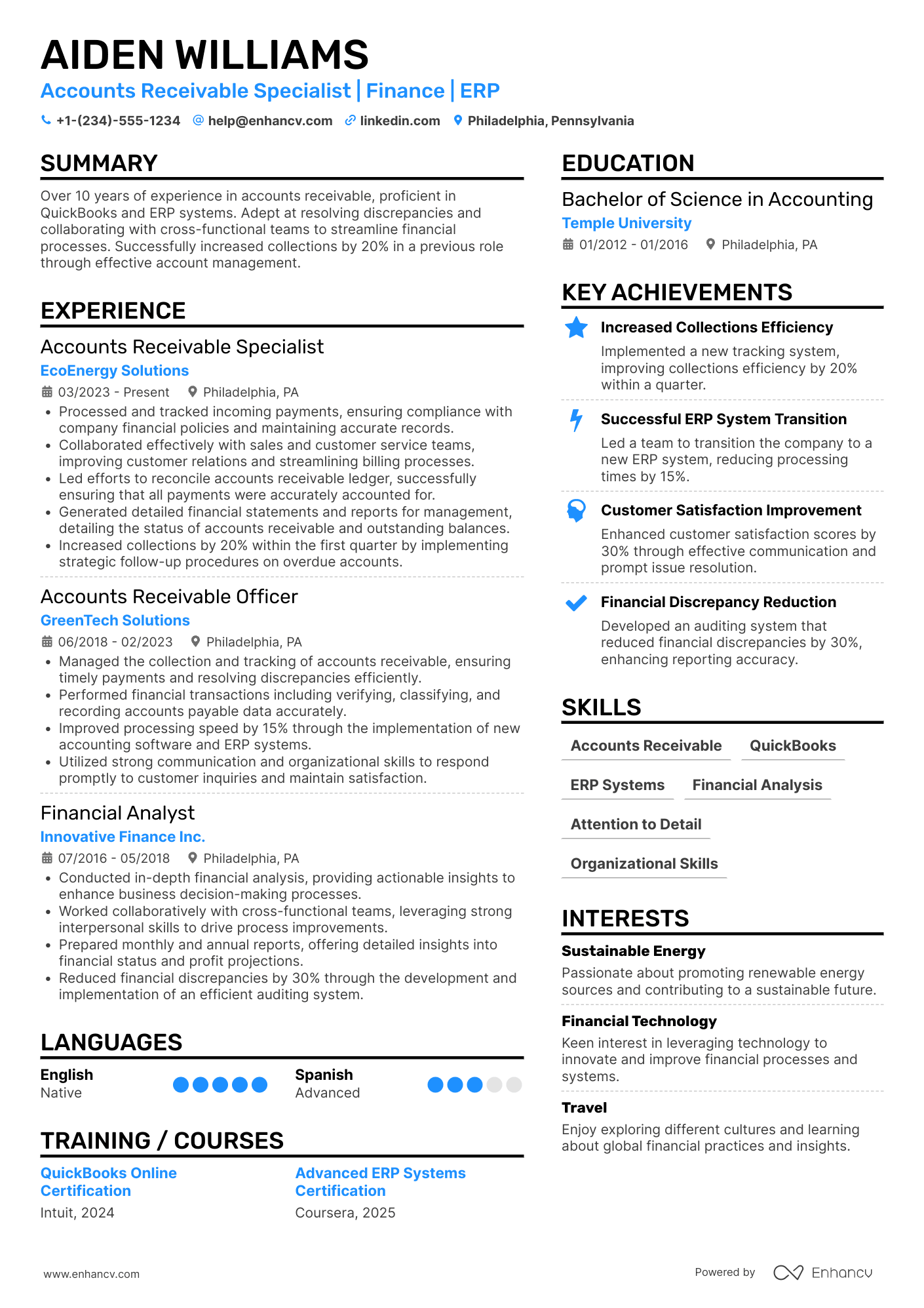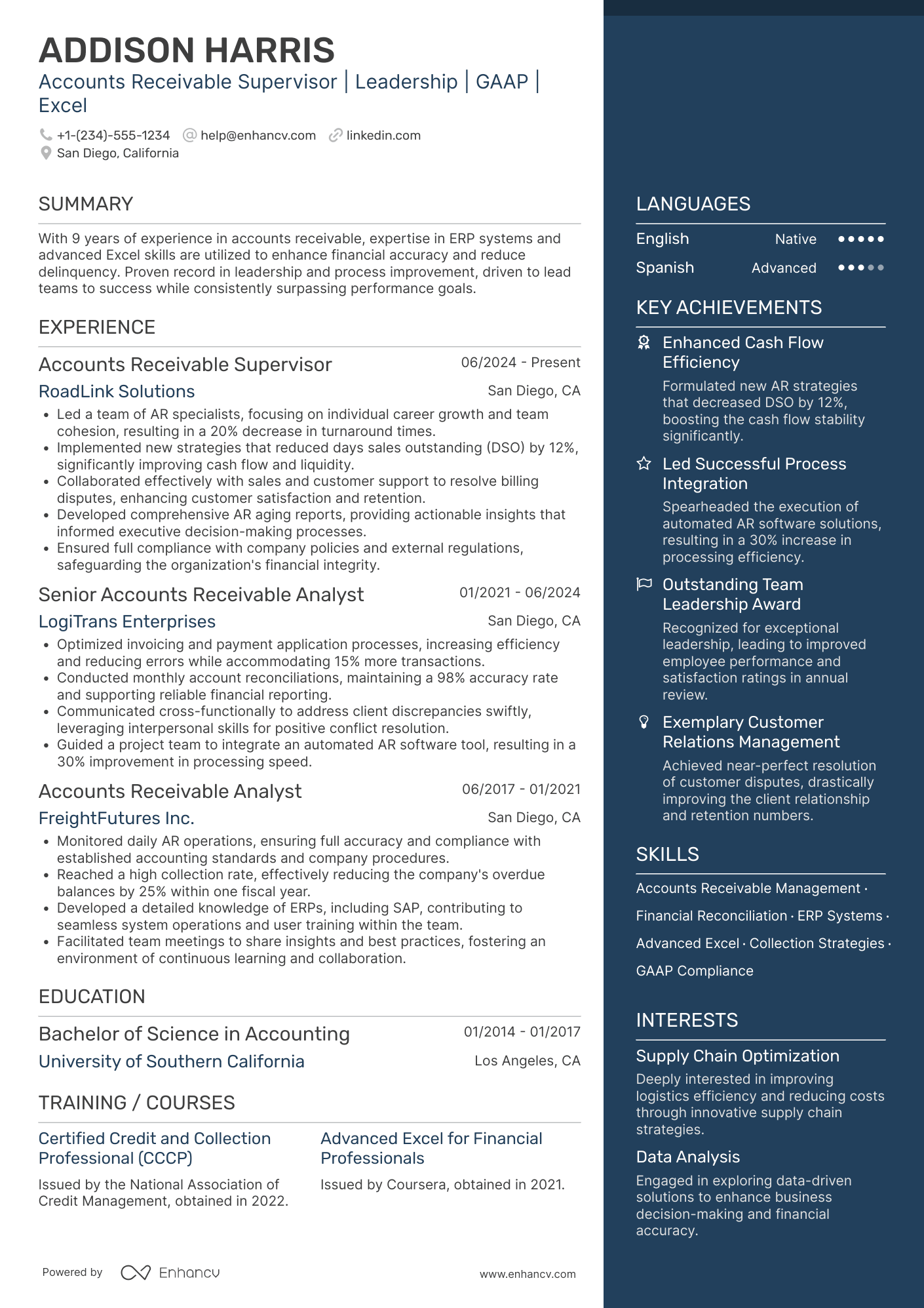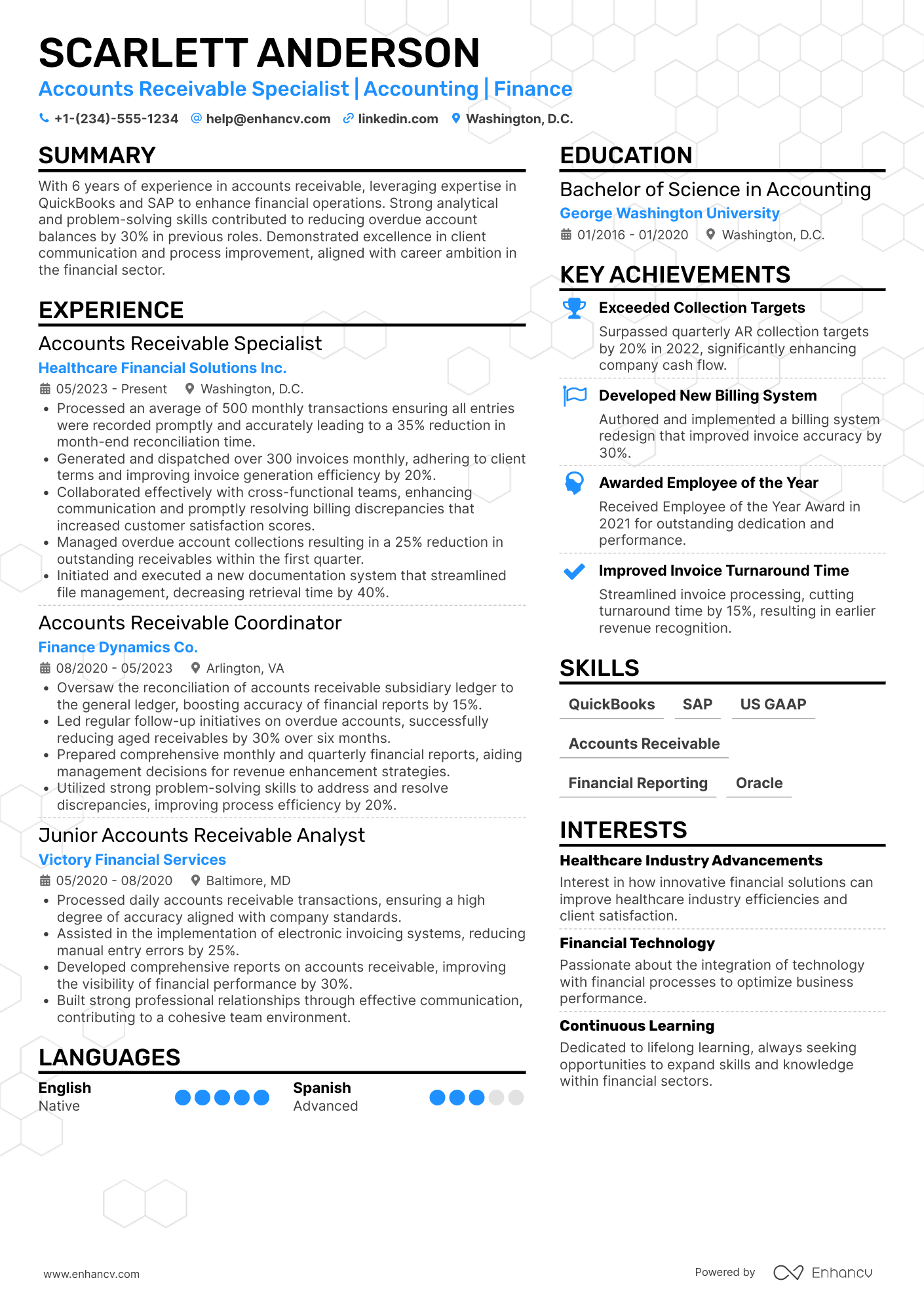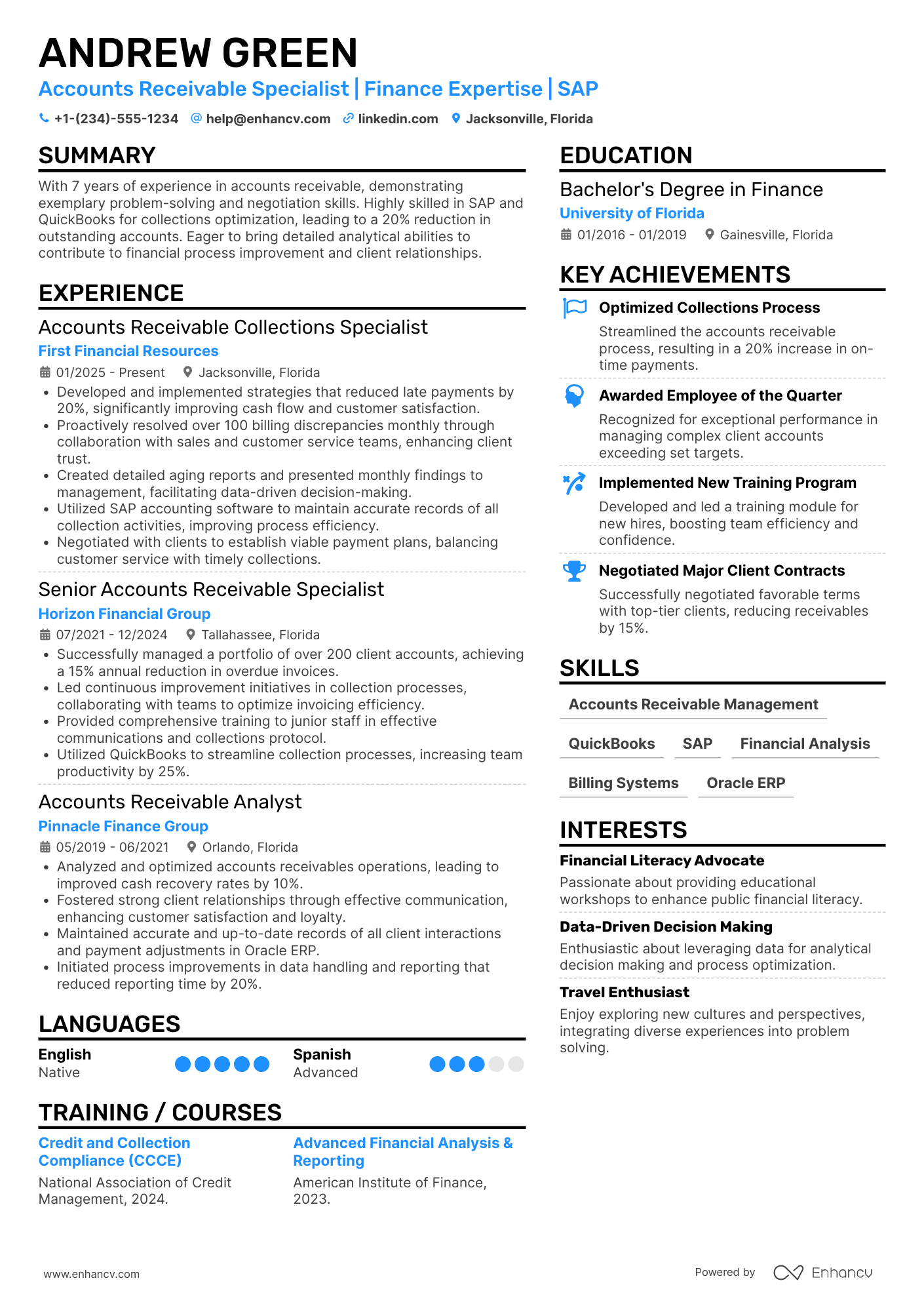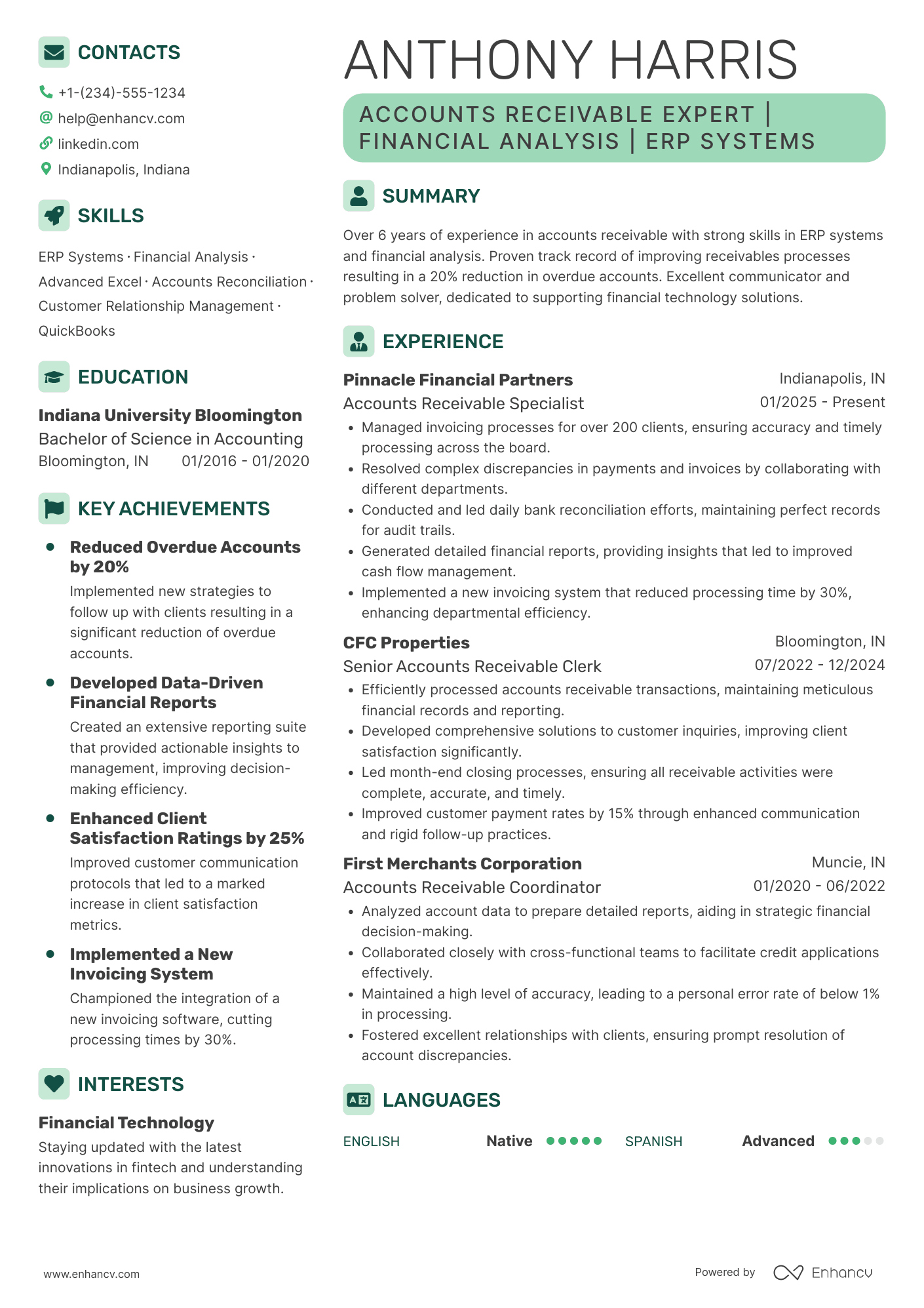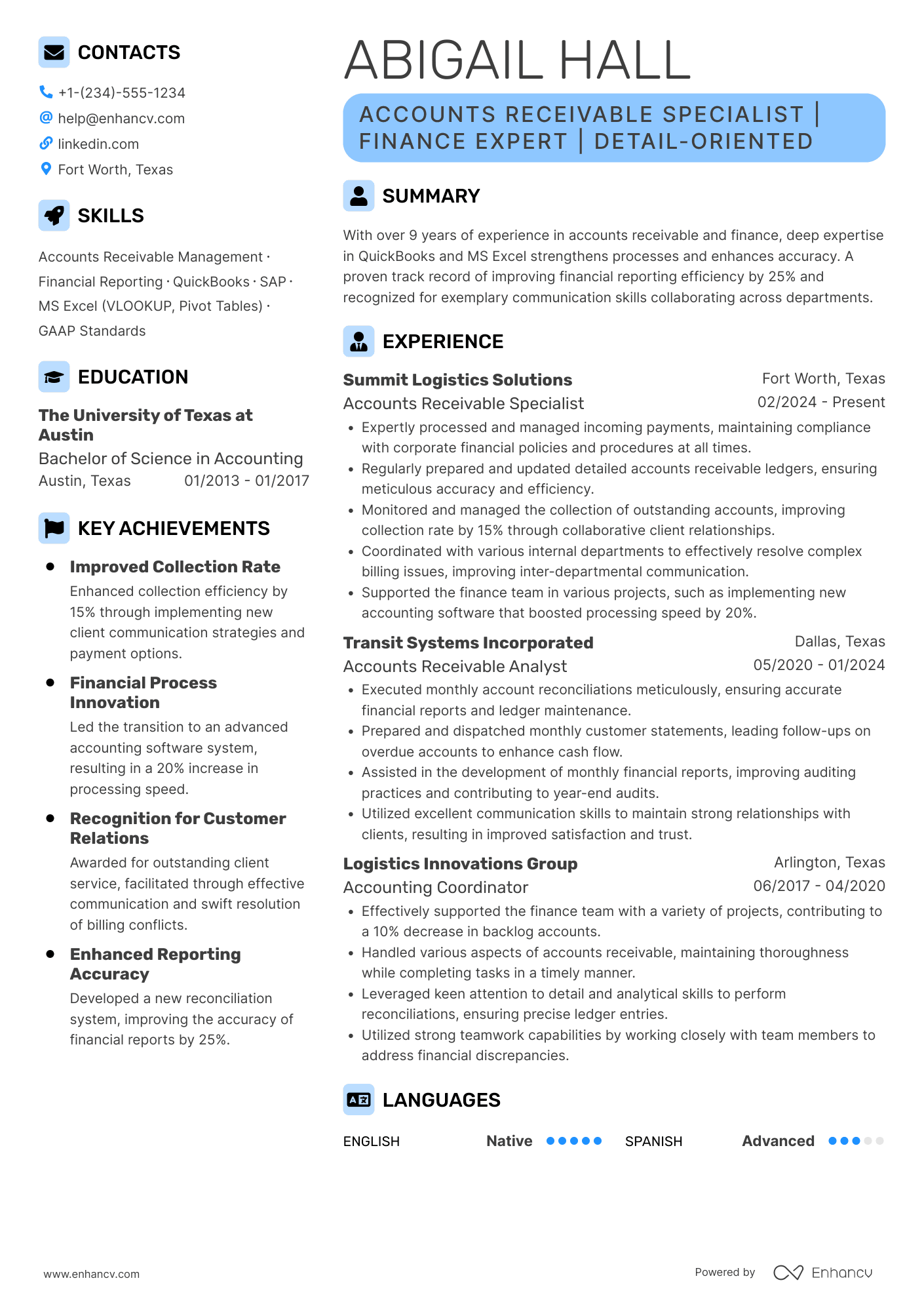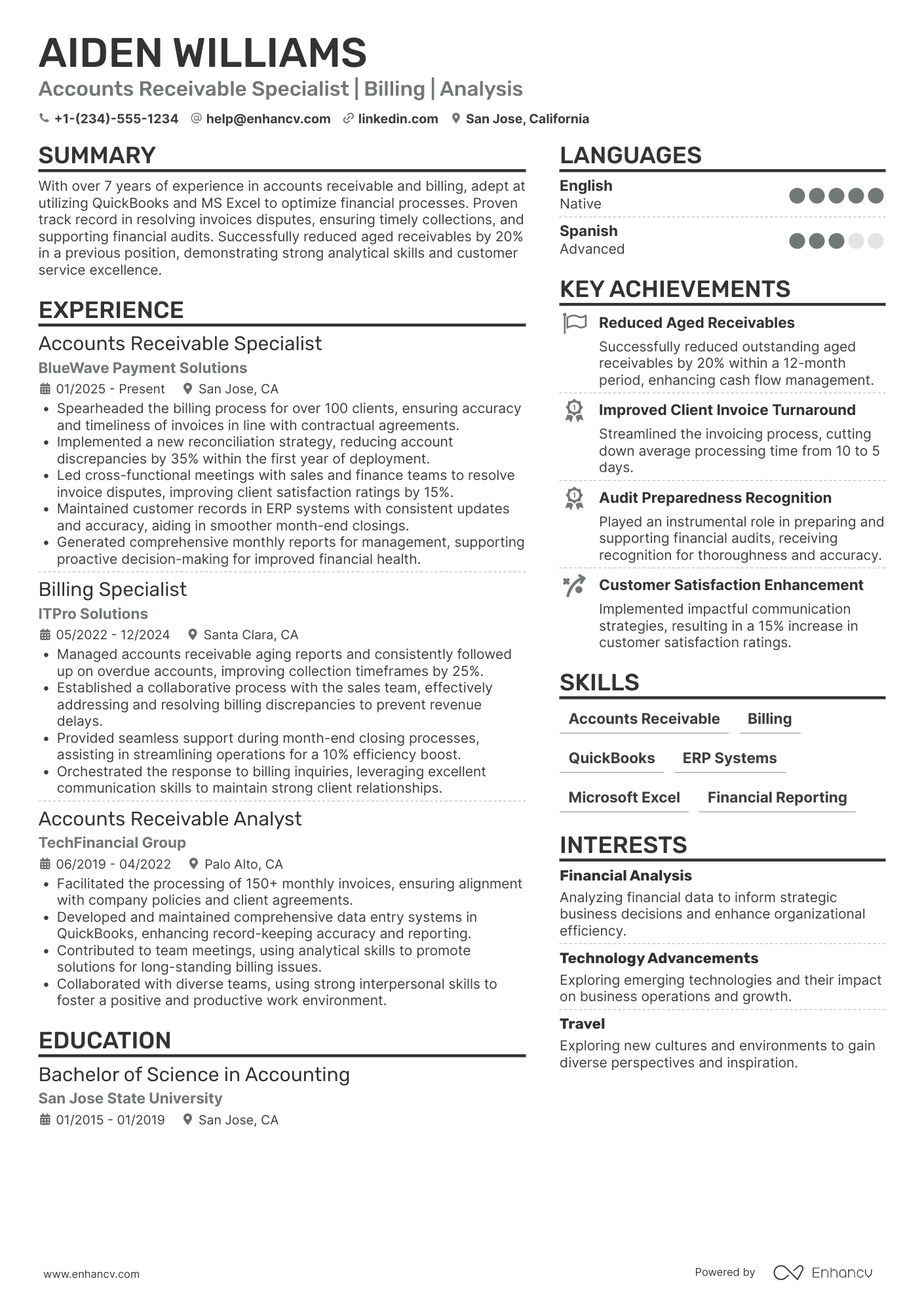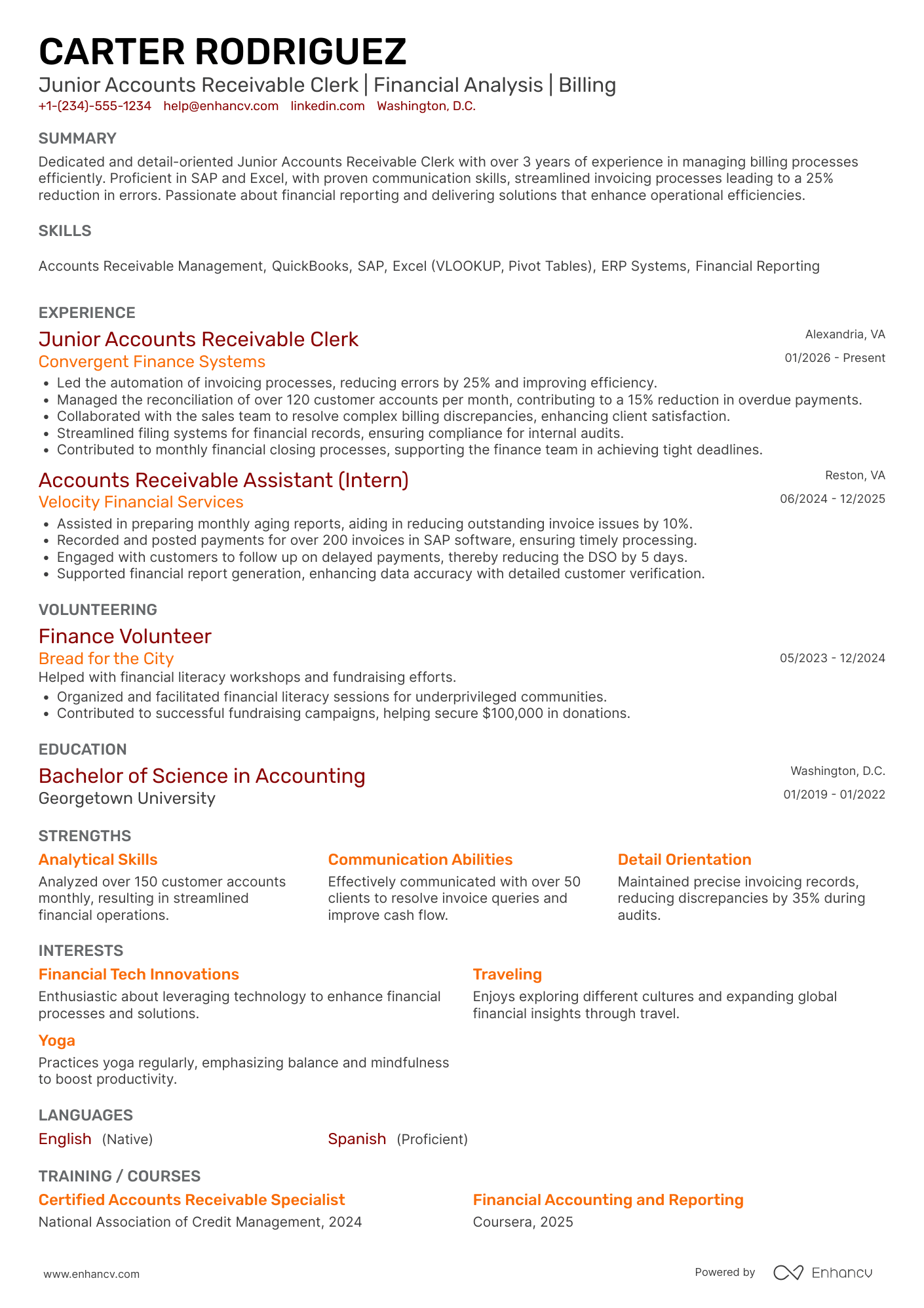
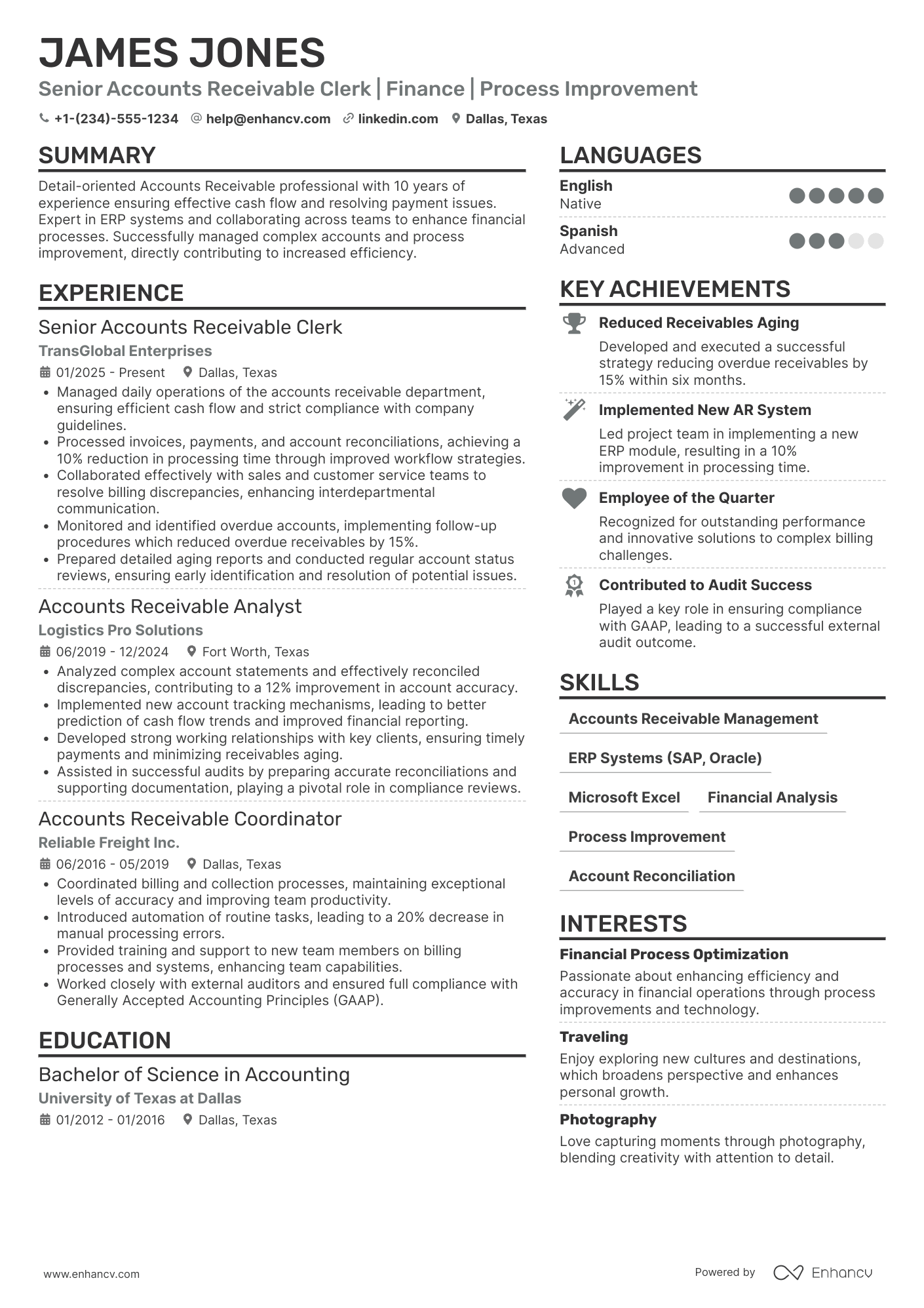
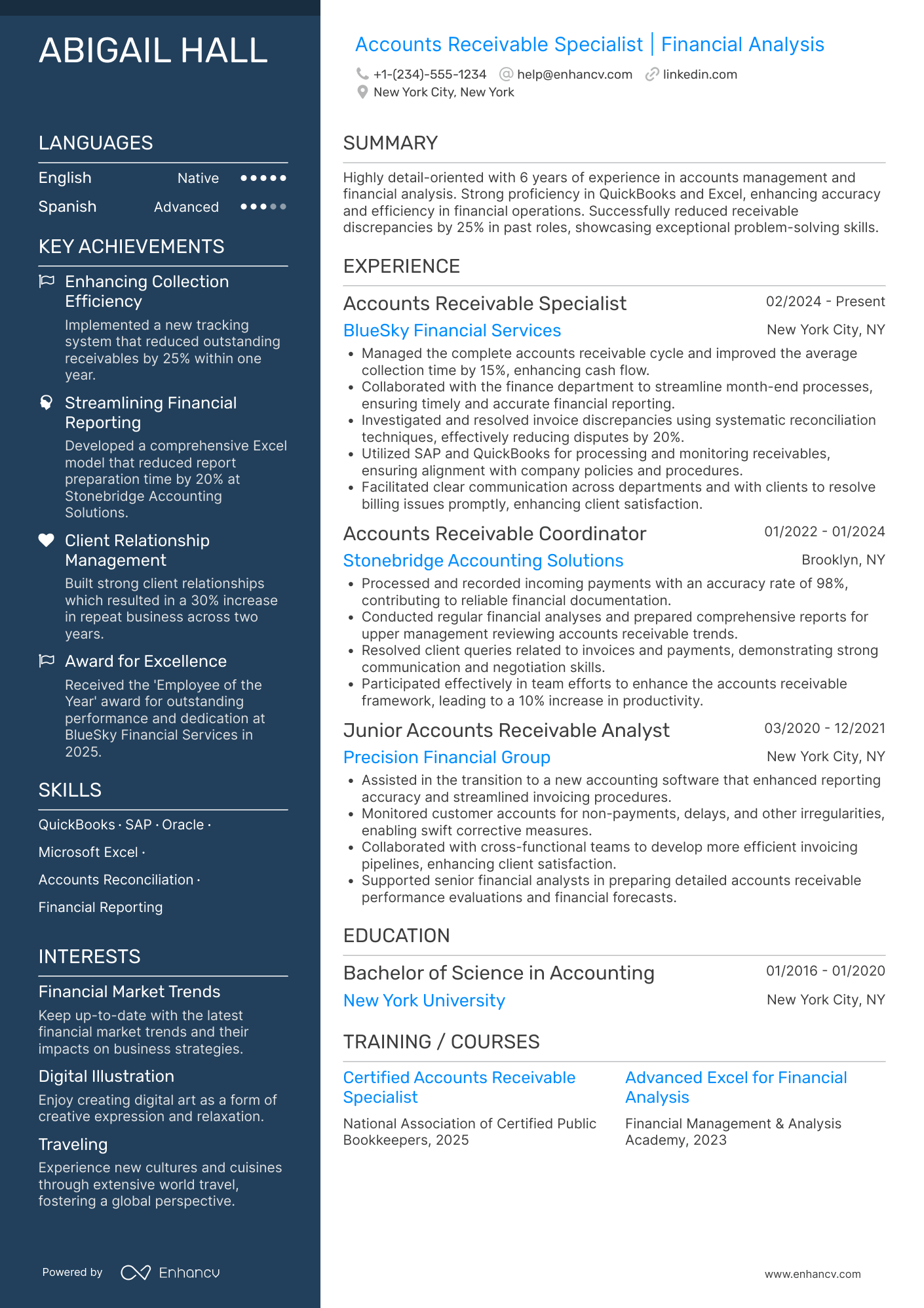
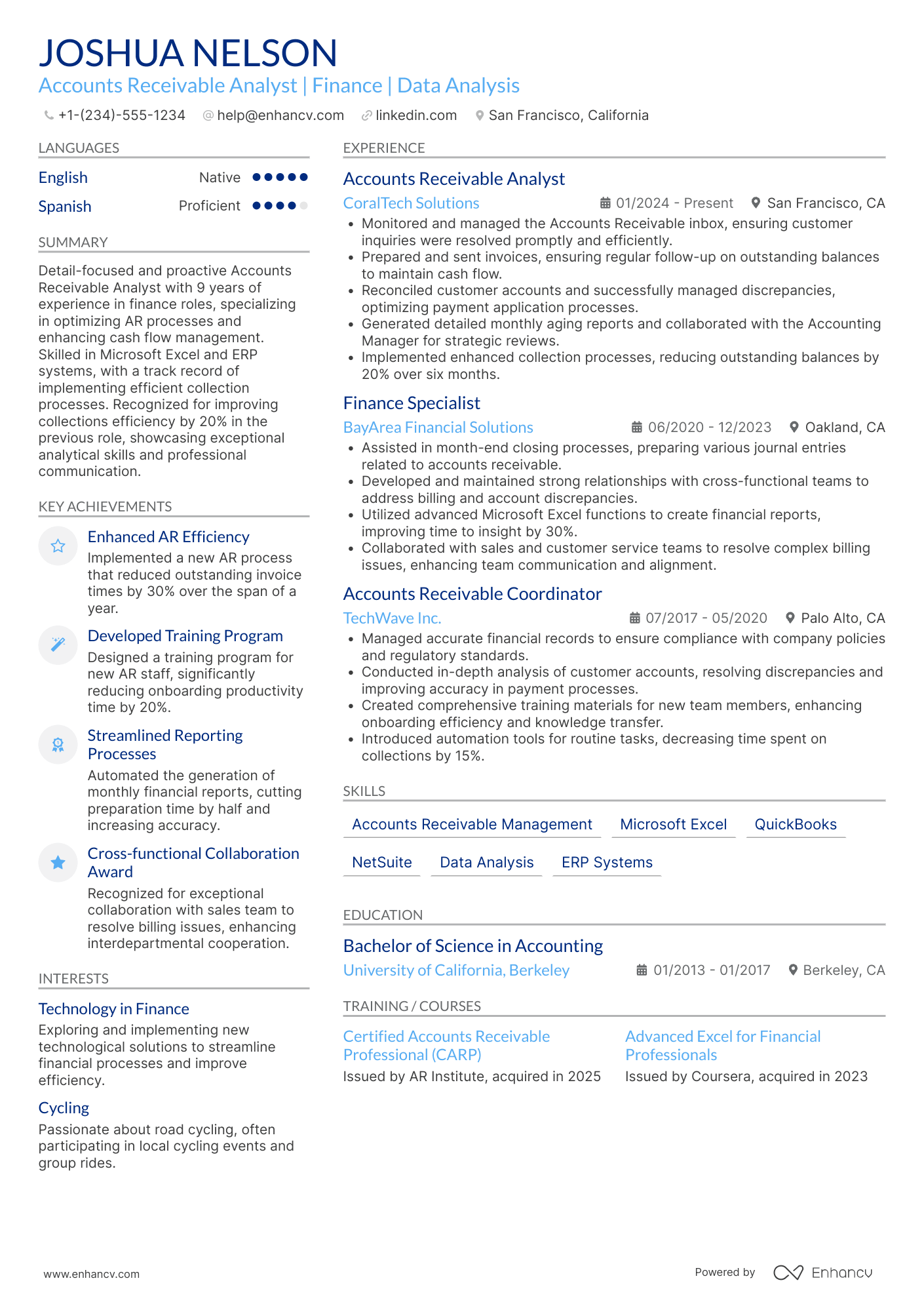
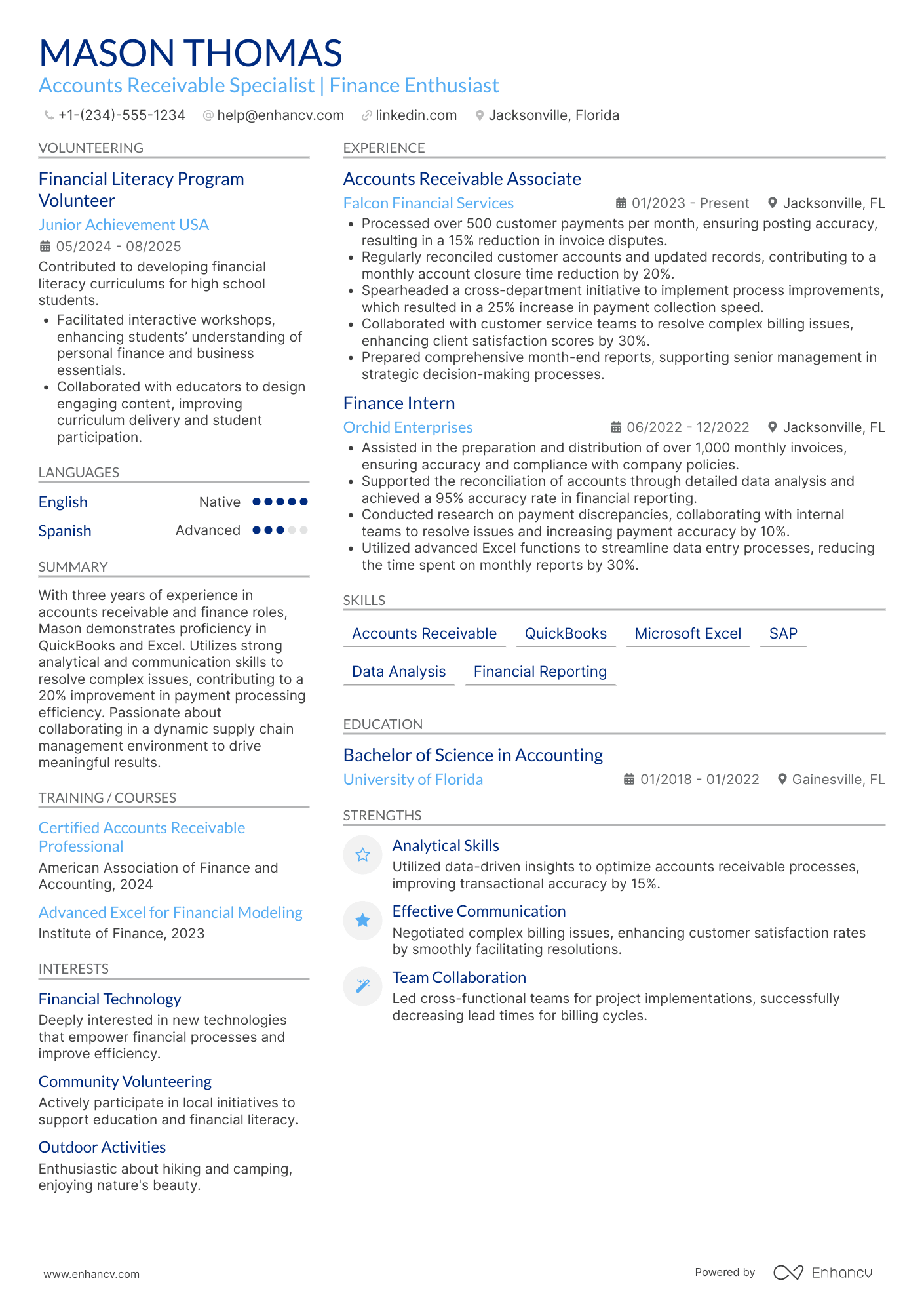
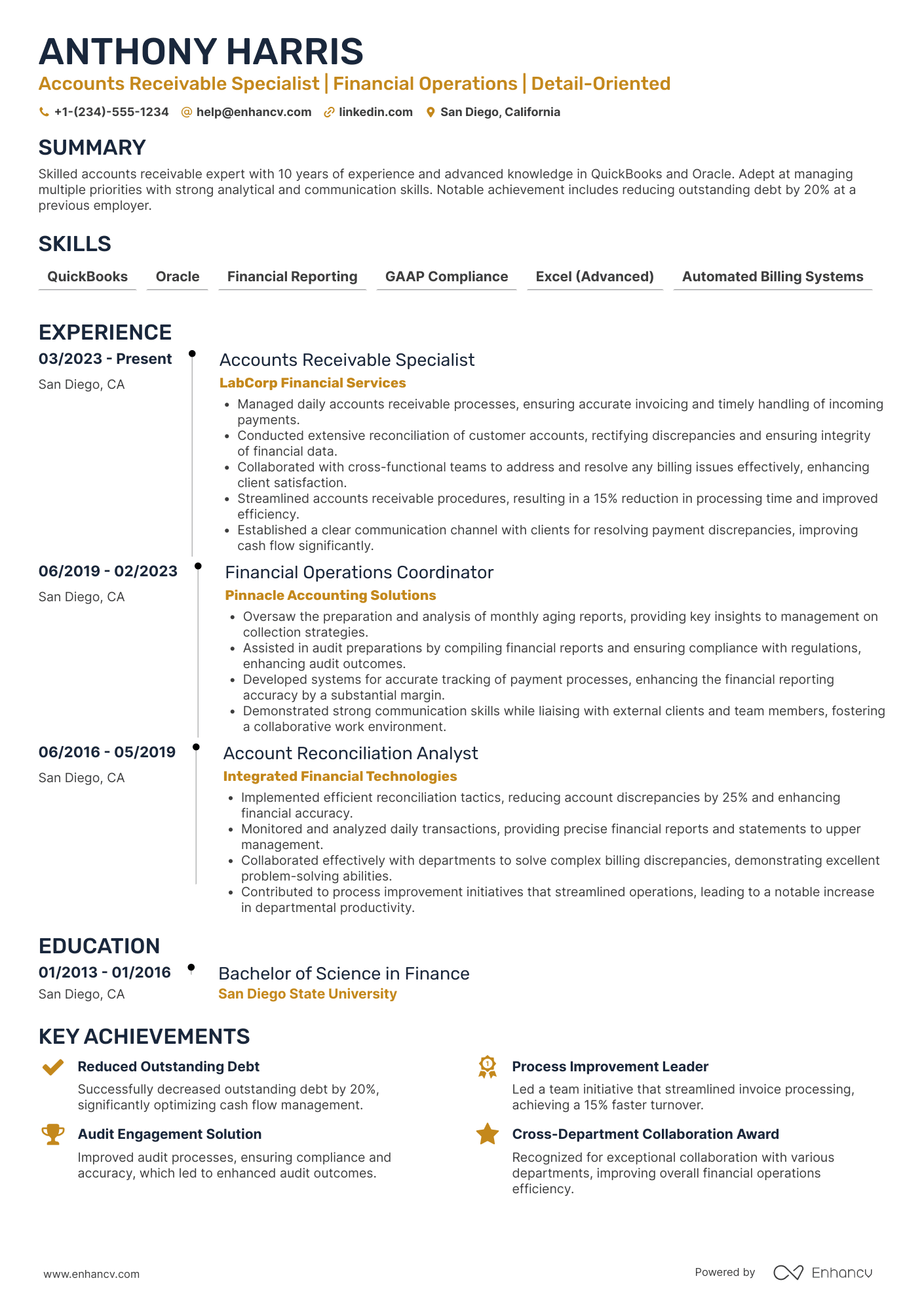
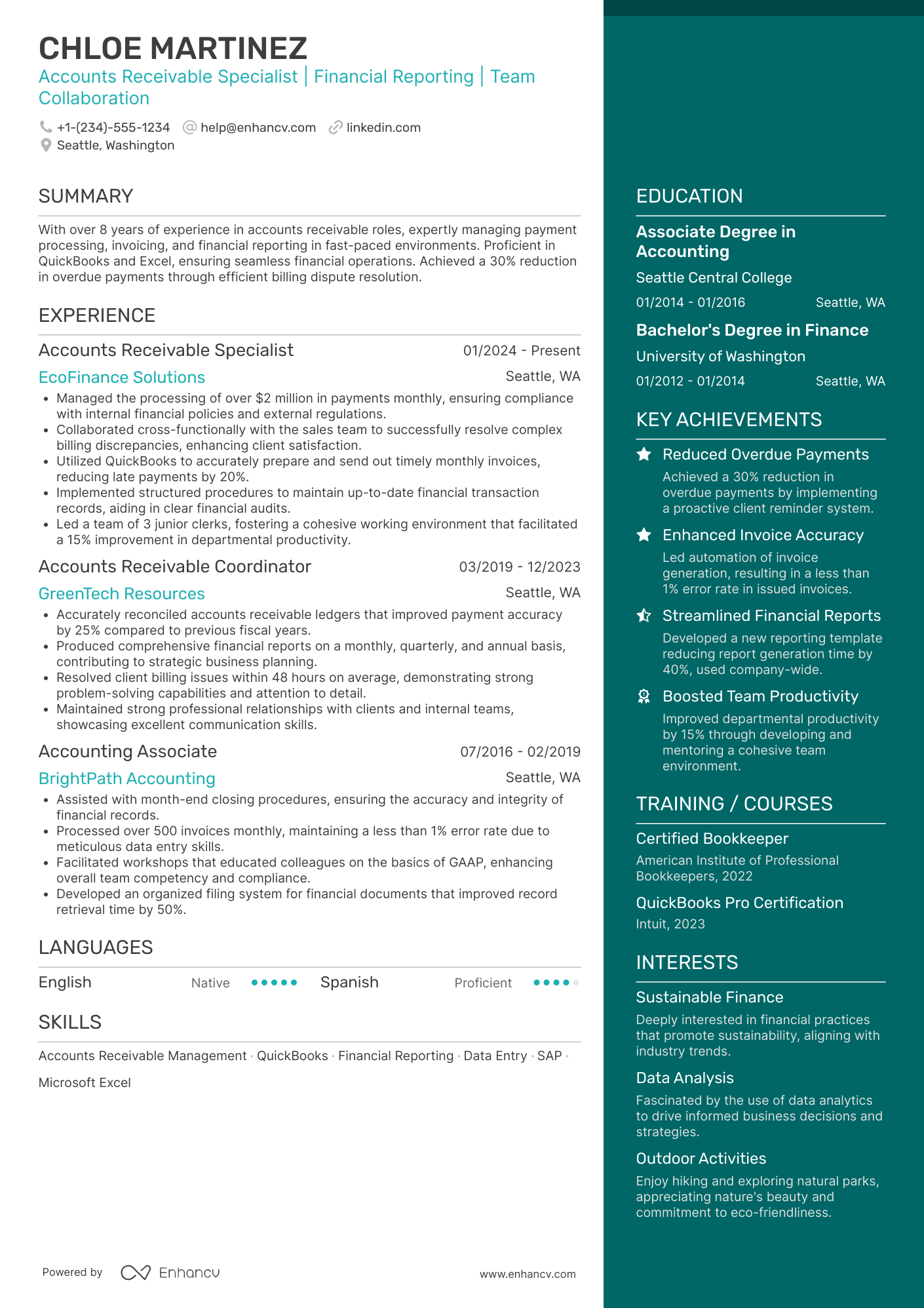
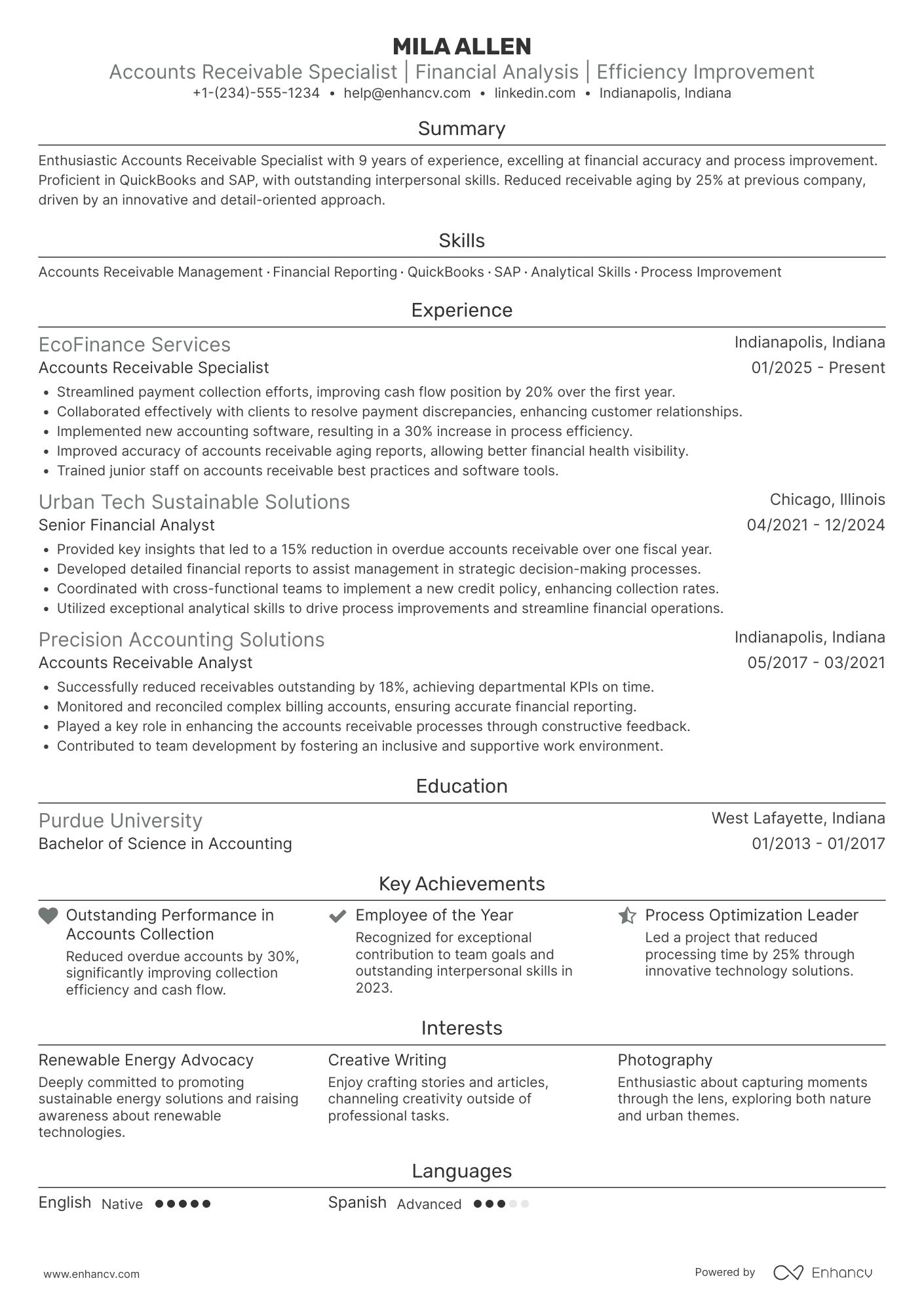
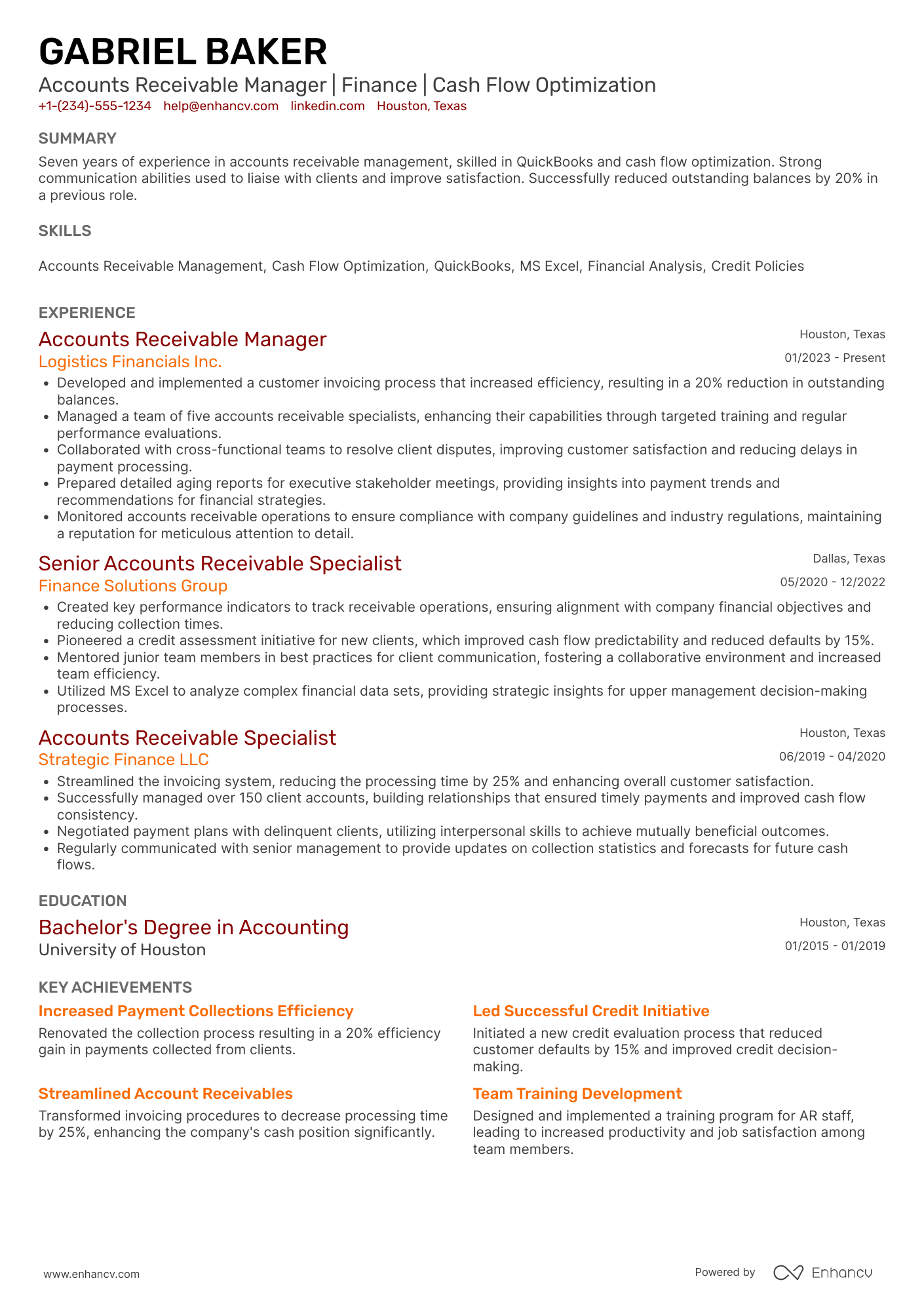
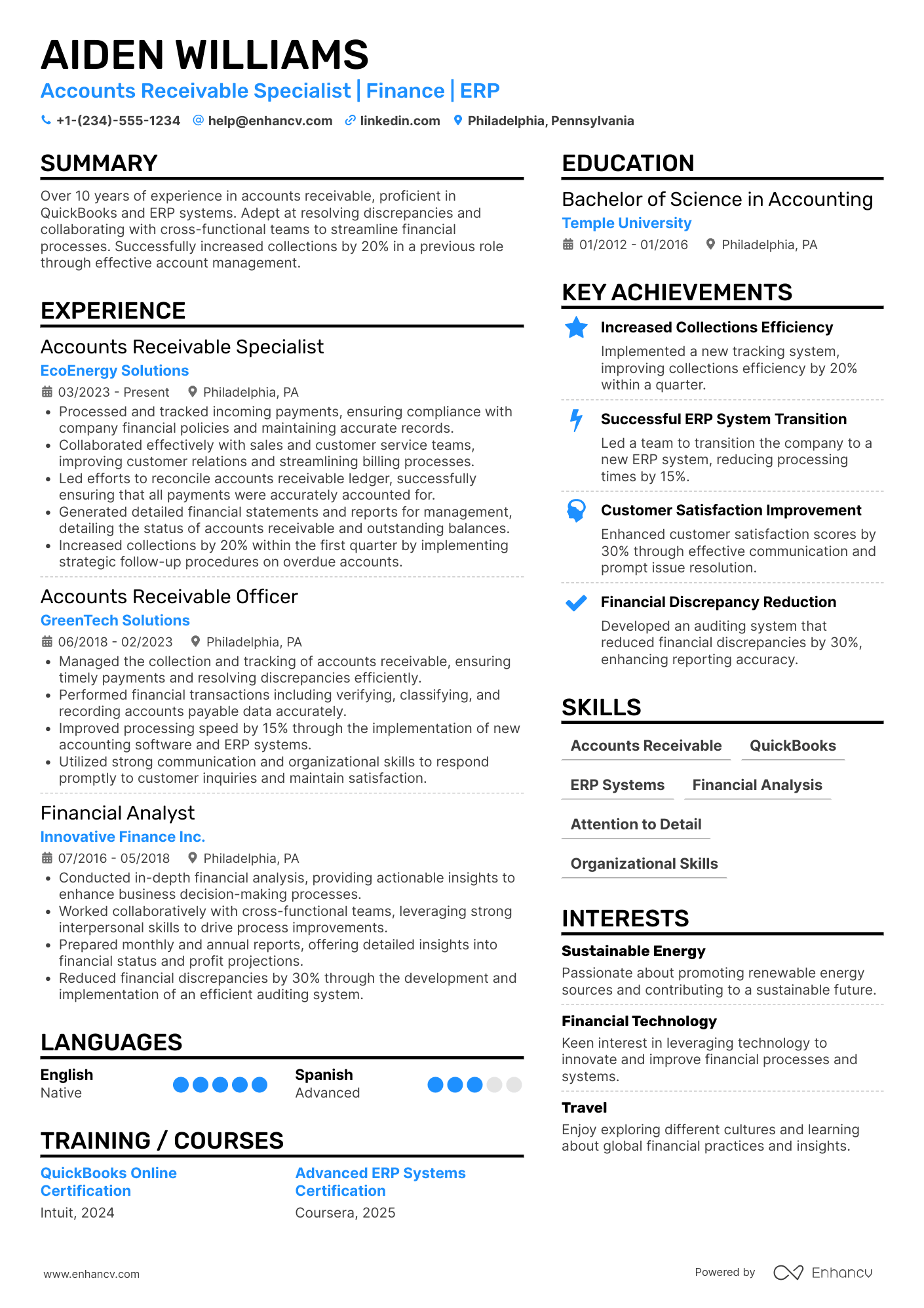
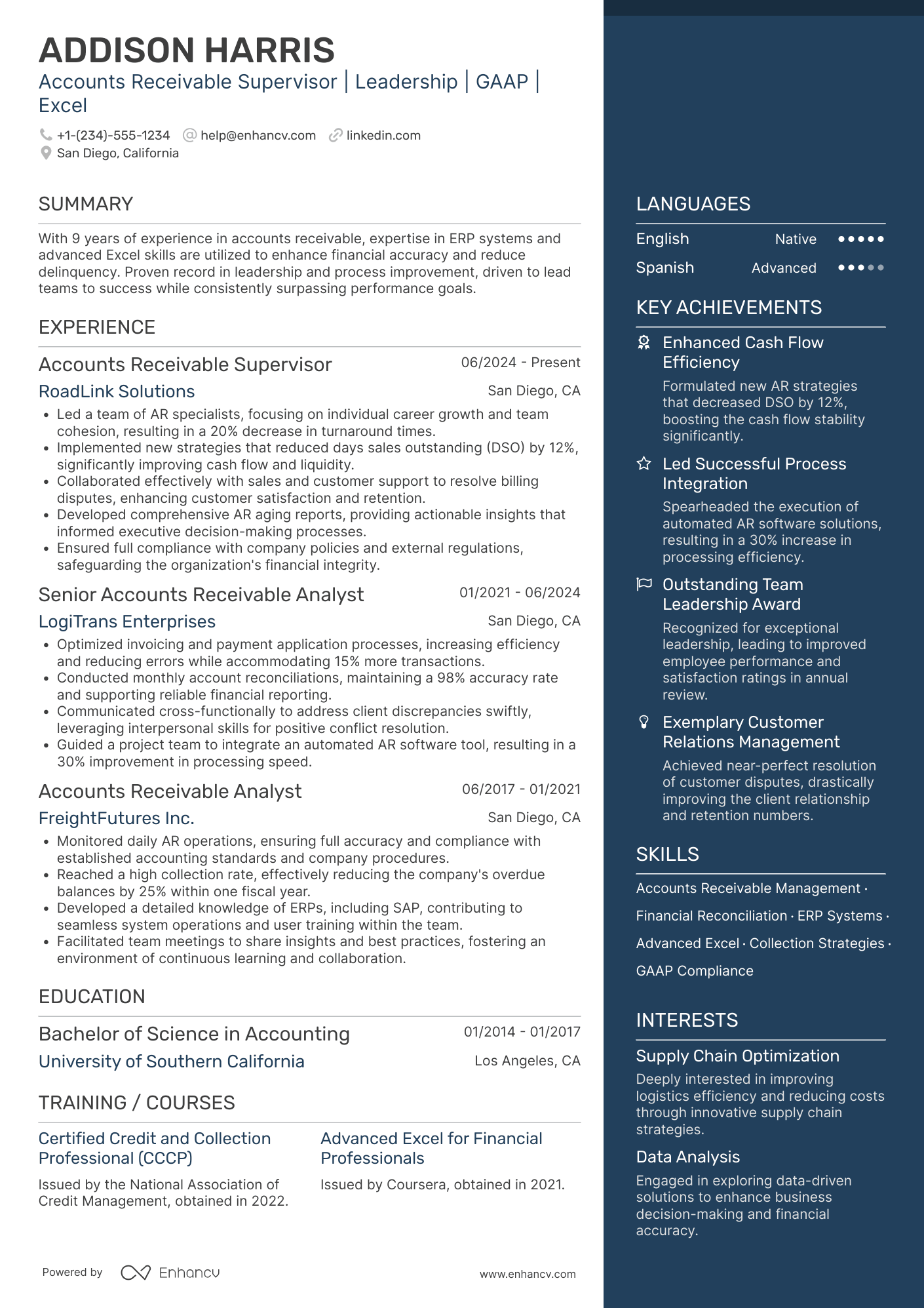
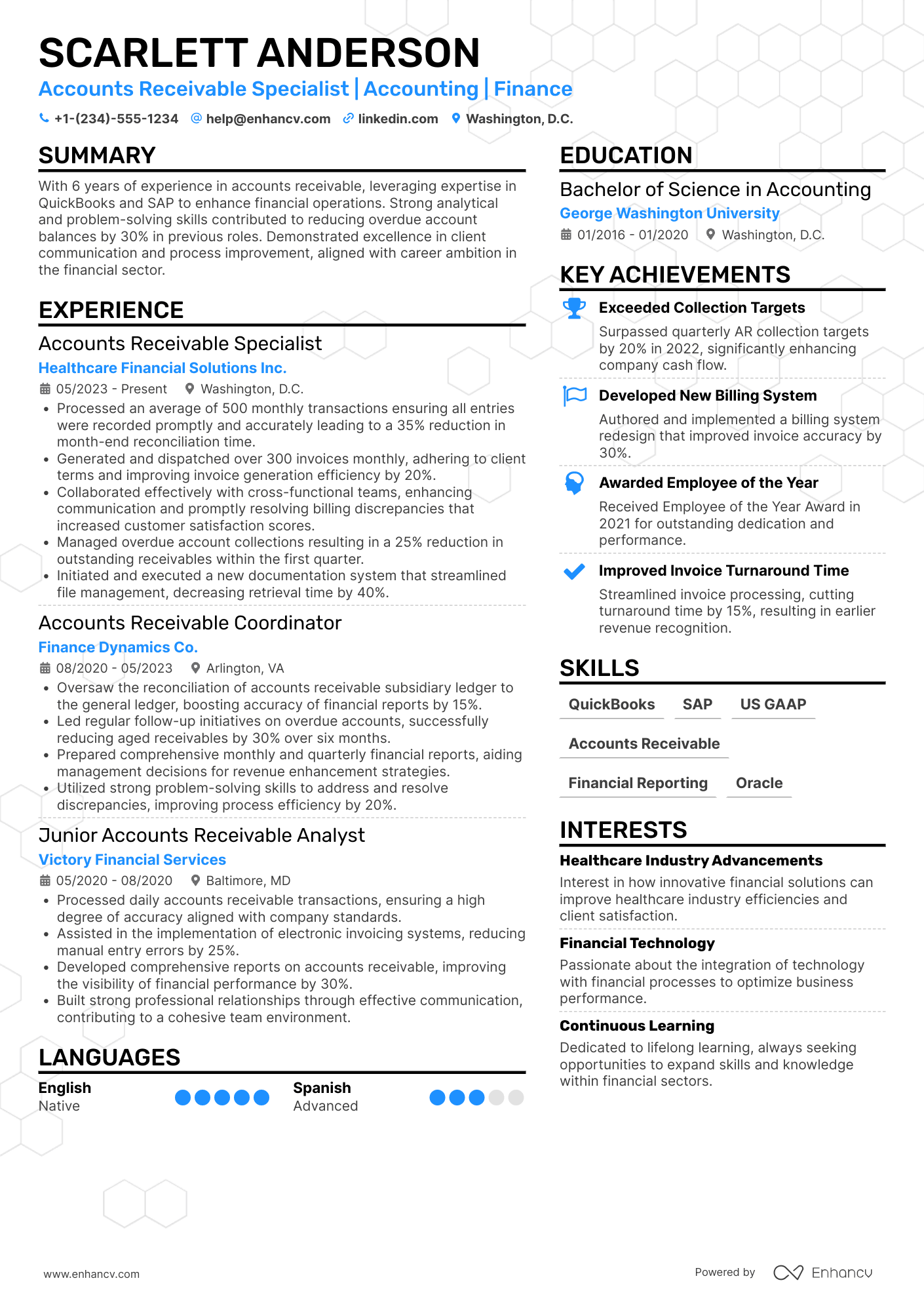
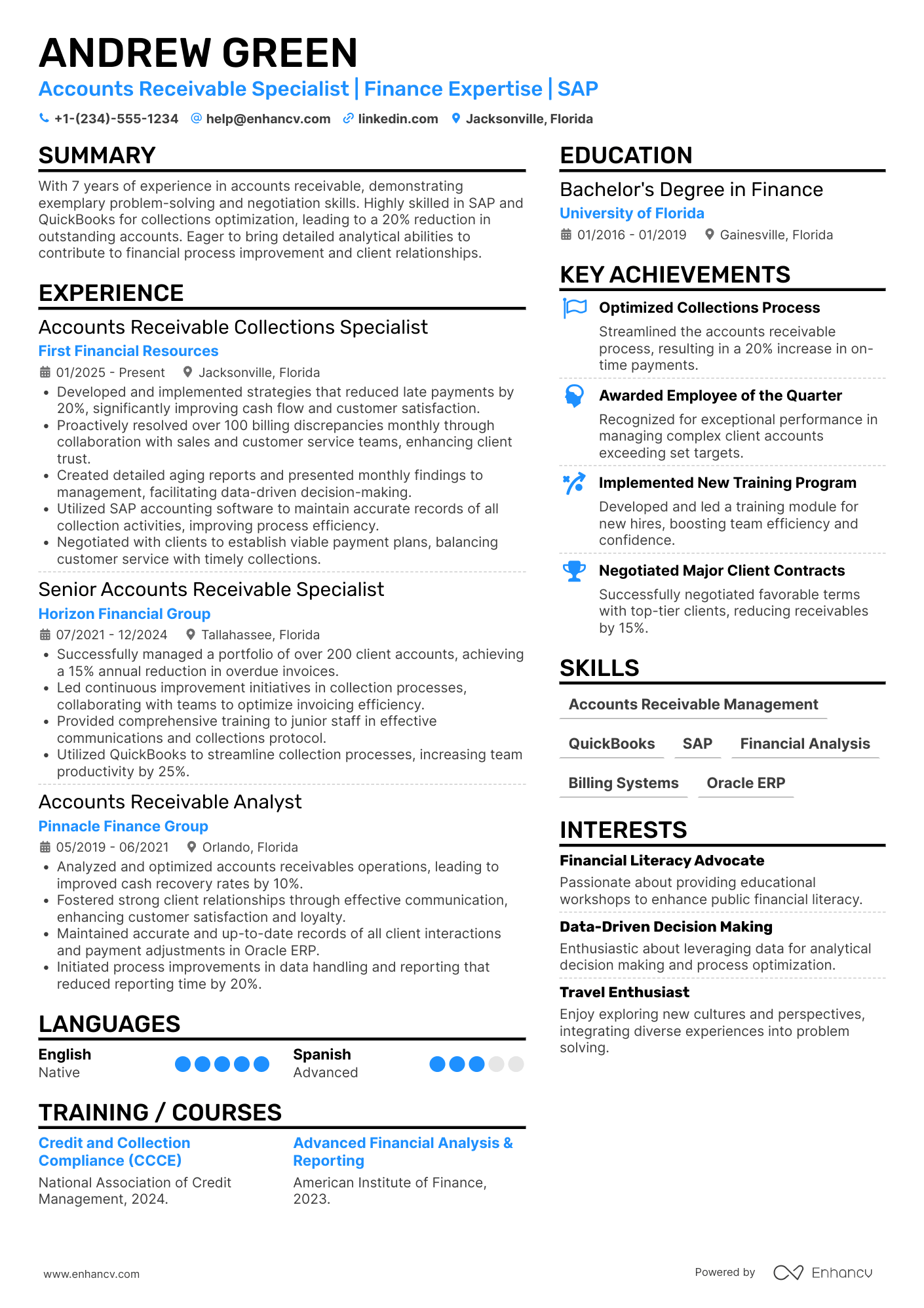
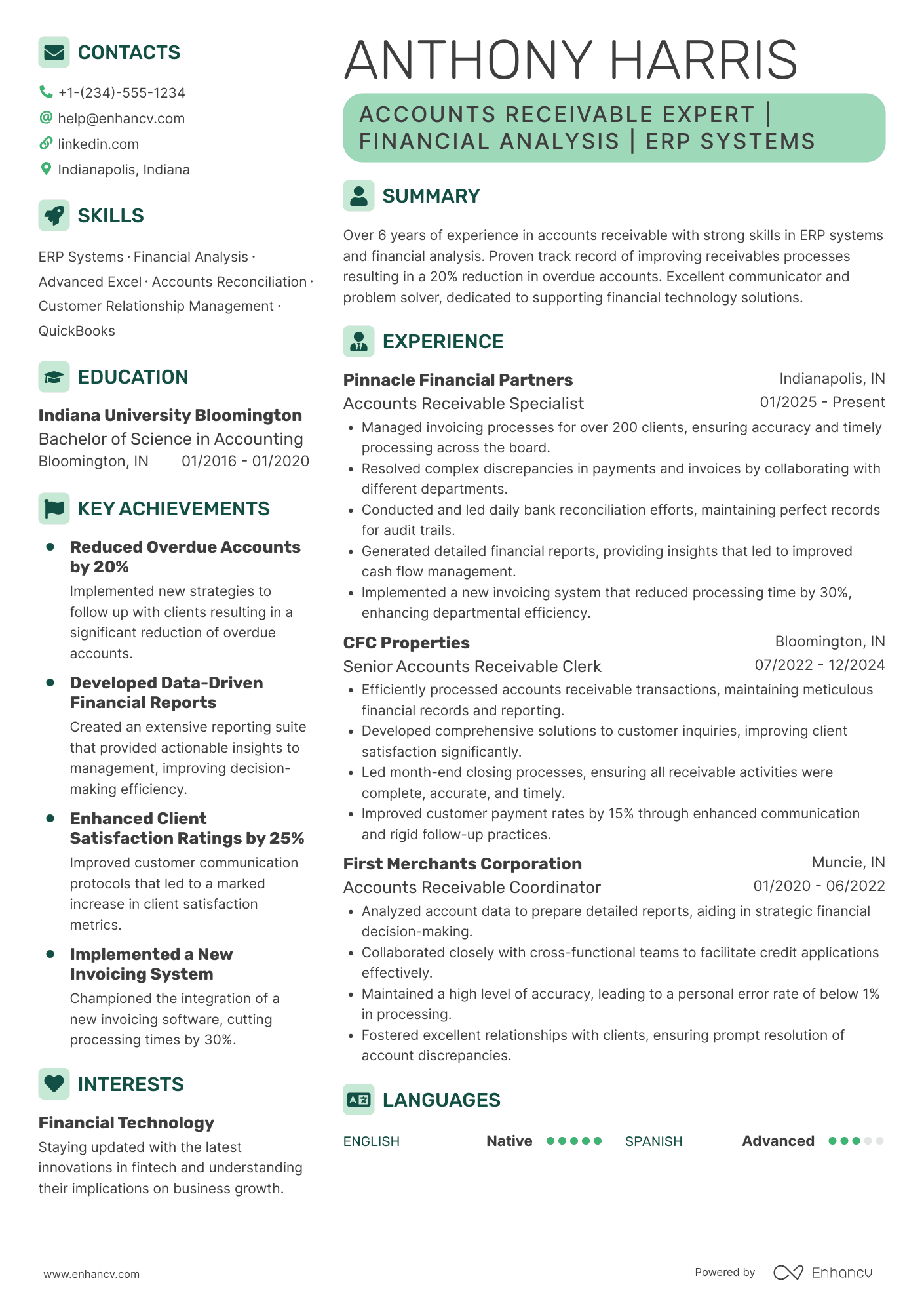
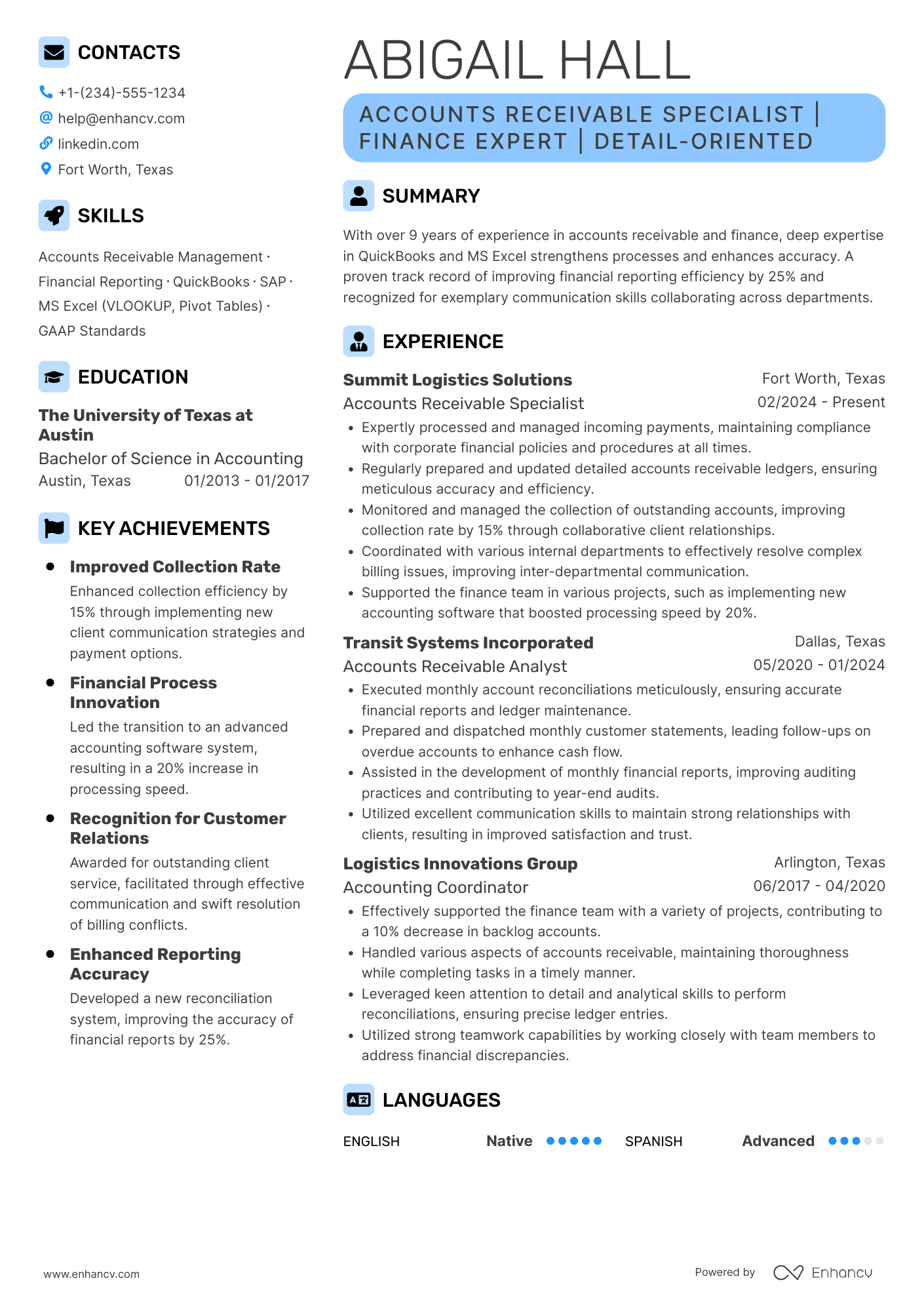
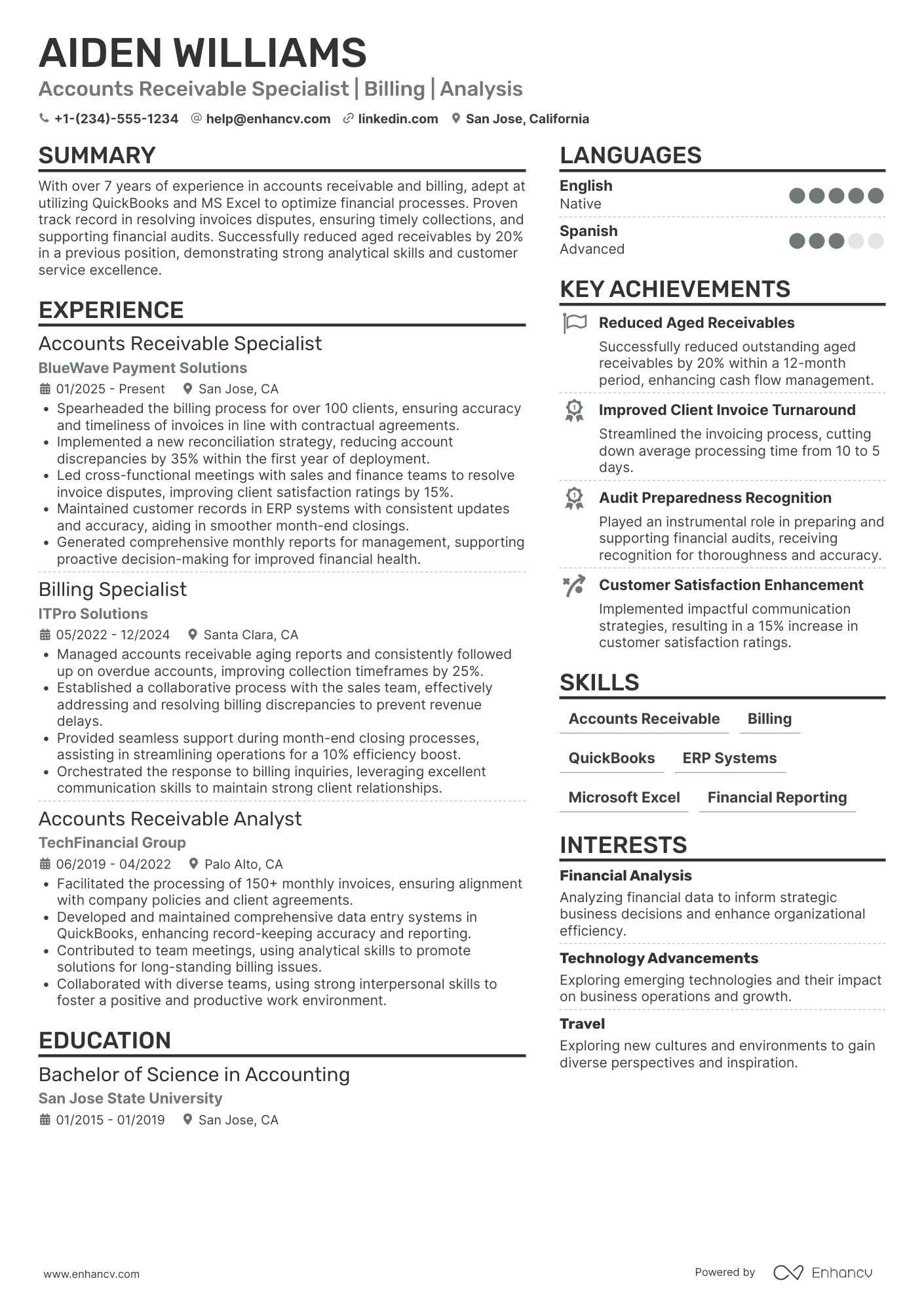
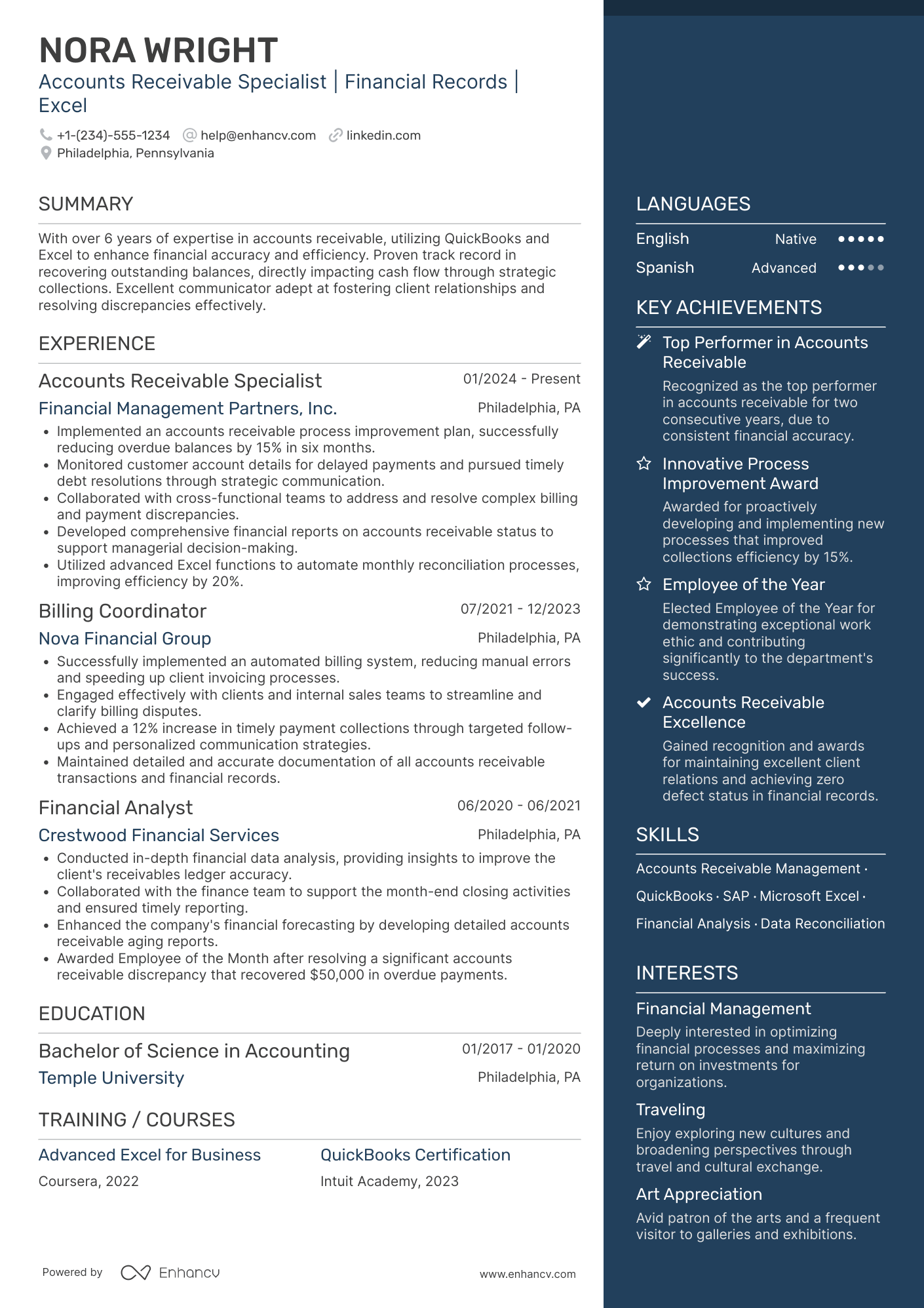
Most accounts receivable resume drafts fail because they bury collections impact under task lists and generic software mentions. That costs you in ATS screening, fast recruiter scans, and tight competition for roles that demand measurable cash flow results.
Building the application packet? Our accounts receivable cover letter examples show how to give a controller the context behind those collections numbers in a single page.
A strong resume shows what you improved and how it moved the business. Understanding how to write a resume that highlights dollars collected, days sales outstanding reduced, dispute backlog cleared, write-offs prevented, invoice accuracy raised, and month-end close accelerated across defined volumes and customer portfolios is what separates top candidates from the rest.

Key takeaways
- Quantify collections impact with metrics like DSO reductions, write-off decreases, and cash application accuracy rates.
- Use reverse-chronological format for experienced candidates and hybrid format for career changers or juniors.
- Tailor every experience bullet to mirror the job posting's exact terminology and software requirements.
- Tie each listed skill to a measurable outcome in your summary or experience section.
- Place certifications above education when they're recent, relevant, or required for the target role.
- Use Enhancv's Bullet Point Generator to turn routine receivable tasks into results-driven resume bullets.
- Stop using AI once your resume accurately reflects real experience—never fabricate or inflate claims.
Job market snapshot for accounts receivables
We analyzed 719 recent accounts receivable job ads across major US job boards. These numbers help you understand skills in demand, employment type trends, experience requirements at a glance.
What level of experience employers are looking for accounts receivables
| Years of Experience | Percentage found in job ads |
|---|---|
| 1–2 years | 17.1% (123) |
| 3–4 years | 12.4% (89) |
| 5–6 years | 6.4% (46) |
| 7–8 years | 0.6% (4) |
| 9–10 years | 0.6% (4) |
| 10+ years | 2.1% (15) |
| Not specified | 60.9% (438) |
Accounts receivable ads by area of specialization (industry)
| Industry (Area) | Percentage found in job ads |
|---|---|
| Finance & Banking | 76.2% (548) |
| Healthcare | 12.4% (89) |
| Education | 5.3% (38) |
| Government | 1.8% (13) |
Top companies hiring accounts receivables
| Company | Percentage found in job ads |
|---|---|
| Uline, Inc. | 3.9% (28) |
| Aqua Finance | 2.1% (15) |
Role overview stats
These tables show the most common responsibilities and employment types for accounts receivable roles. Use them to align your resume with what employers expect and to understand how the role is structured across the market.
Day-to-day activities and top responsibilities for a accounts receivable
| Responsibility | Percentage found in job ads |
|---|---|
| Excel | 29.9% (215) |
| Microsoft excel | 27.5% (198) |
| Accounts receivable | 26.3% (189) |
| Microsoft office | 20.3% (146) |
| Microsoft word | 15.6% (112) |
| Billing | 11.5% (83) |
| Accounting | 11.3% (81) |
| Collections | 10.3% (74) |
| Sap | 10.2% (73) |
| Word | 9.9% (71) |
| Erp | 8.8% (63) |
| Data entry | 6.8% (49) |
Type of employment (remote vs on-site vs hybrid)
| Employment type | Percentage found in job ads |
|---|---|
| On-site | 73.2% (526) |
| Hybrid | 17.7% (127) |
| Remote | 9.2% (66) |
How to format a accounts receivable resume
Recruiters reviewing accounts receivable resumes prioritize accuracy in financial processes, proficiency with accounting software, and a track record of reducing outstanding balances or improving collection cycles. A clean, well-structured resume format ensures these signals surface quickly during both human review and applicant tracking system (ATS) scans.

I have significant experience in this role—which format should I use?
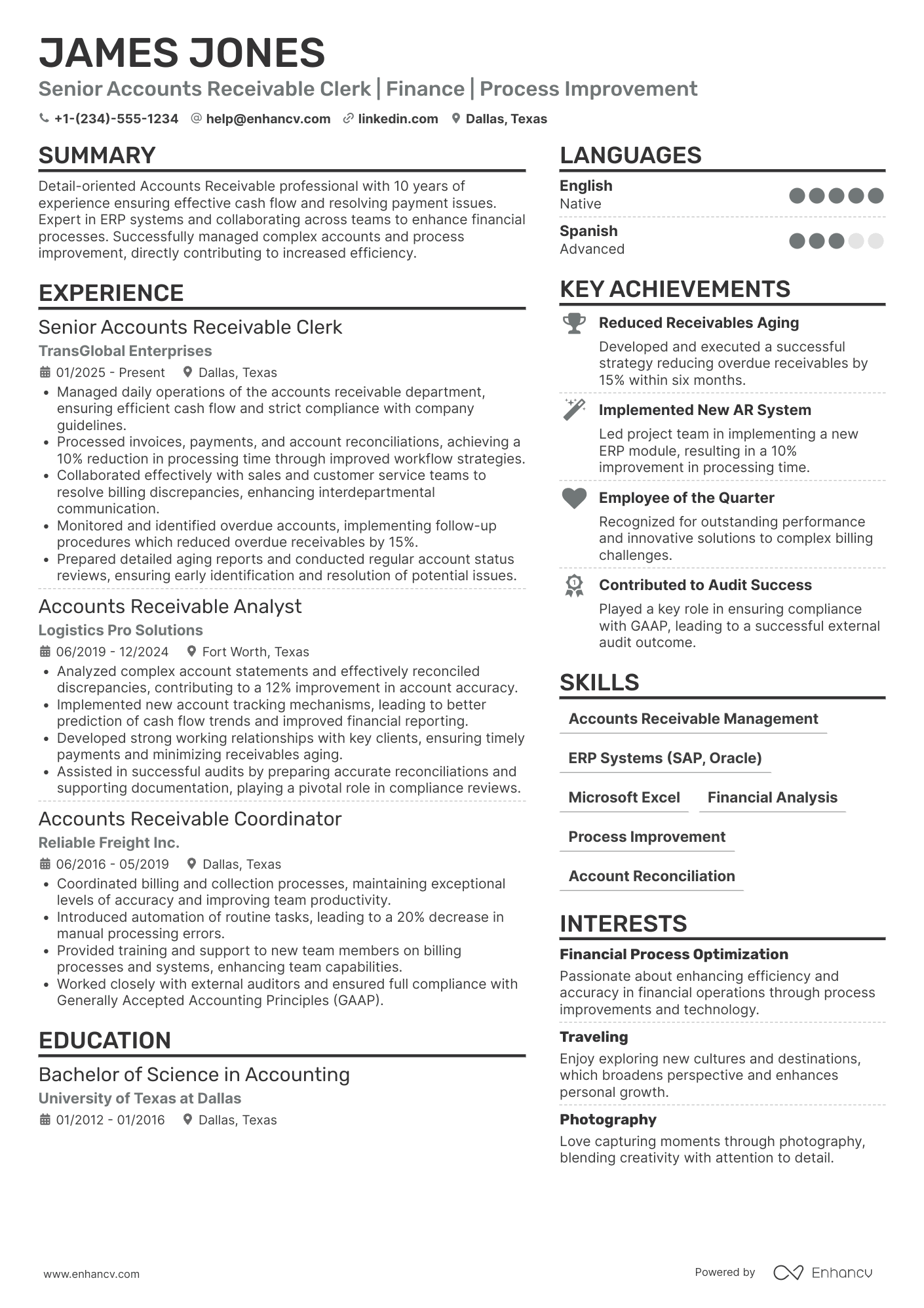
Use a reverse-chronological format to showcase your deepening expertise in collections, reconciliation, and cash application across successive roles. Do:
- Lead with your most recent position and highlight the scope of accounts, portfolios, or ledgers you managed.
- Feature proficiency in role-specific tools such as SAP, Oracle, QuickBooks, or NetSuite alongside knowledge of GAAP and credit analysis.
- Quantify outcomes like reduced days sales outstanding (DSO), improved collection rates, or decreased write-offs.
I'm junior or switching into this role—what format works best?
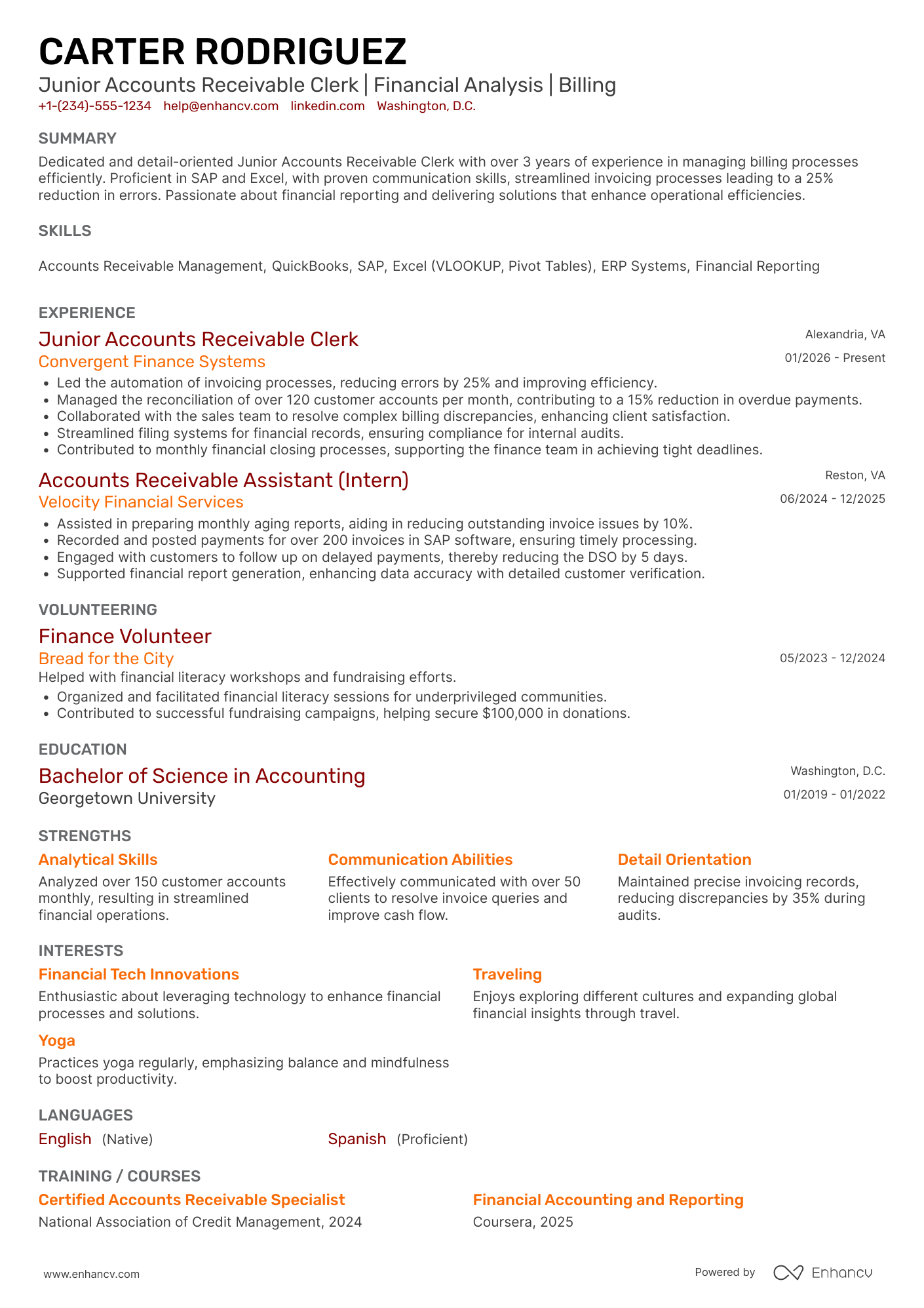
A hybrid format works best because it lets you lead with relevant skills while still providing a chronological work history that gives recruiters context. Do:
- Place a skills section near the top highlighting invoicing, reconciliation, ERP software, and attention to detail.
- Include coursework, internships, freelance bookkeeping, or volunteer treasurer roles that demonstrate hands-on financial experience.
- Connect every action to a clear outcome so recruiters see how your contributions produced results.
Why not use a functional resume?
A functional format buries the timeline of your experience, making it harder for recruiters to verify consistent exposure to invoicing cycles, collections workflows, and reconciliation—core proof points they need to see in accounts receivable candidates. A functional resume may make sense in a narrow set of circumstances:
- You're transitioning from a related role (such as accounts payable or general bookkeeping) and need to foreground transferable skills.
- You have a gap in employment but completed relevant certifications like a Certified Credit and Collection Professional (CCCP) designation during that time.
- Your work history is limited but you have project-based experience managing receivables for a small business or nonprofit.
- A functional format is acceptable only when you're changing careers, re-entering the workforce, or have minimal formal work history—and even then, every listed skill should be tied to a specific project, task, or measurable outcome rather than presented as a standalone claim.
Once your layout and structure are set, the next step is filling your resume with the right sections to showcase your accounts receivable qualifications effectively.
What sections should go on a accounts receivable resume
Recruiters expect to see a clean, role-specific resume that proves you can manage invoicing, collections, cash application, and reconciliation accurately and on time. Knowing what to put on a resume for accounts receivable roles ensures you include the right details from the start.
Use this structure for maximum clarity:
- Header
- Summary
- Experience
- Skills
- Projects
- Education
- Certifications
- Optional sections: Awards, Leadership, Languages
Strong experience bullets should emphasize measurable impact on days sales outstanding, cash collections, aging reductions, dispute resolution, and process improvements across clear volumes, accounts, and timelines.
Is your resume good enough?
Drop your resume here or choose a file. PDF & DOCX only. Max 2MB file size.
Once you’ve organized the essential resume components in a clear order, the next step is to write your accounts receivable resume experience so each role supports that structure with specific, relevant details.
How to write your accounts receivable resume experience
Your experience section should highlight the receivables work you've shipped—collections resolved, aging reduced, payment processes improved—using the tools and methods that define accounts receivable excellence. Hiring managers prioritize demonstrated impact over descriptive task lists, so each bullet should prove you drove measurable outcomes rather than simply listing daily duties. Building a targeted resume for each application ensures your experience section speaks directly to what the employer needs.
Each entry should include:
- Job title
- Company and location (or remote)
- Dates of employment (month and year)
Three to five concise bullet points showing what you owned, how you executed, and what outcomes you delivered:
- Ownership scope: the invoice portfolios, customer accounts, aging buckets, or receivable ledgers you were directly accountable for managing and reconciling.
- Execution approach: the ERP systems, billing platforms, collection workflows, or cash application methods you used to track outstanding balances, resolve disputes, and accelerate payment cycles.
- Value improved: changes to days sales outstanding, write-off rates, cash flow predictability, billing accuracy, or dispute resolution timelines that resulted from your accounts receivable work.
- Collaboration context: how you partnered with sales, finance, credit, customer service, or external clients to align on payment terms, resolve discrepancies, and maintain healthy account relationships.
- Impact delivered: outcomes expressed through reduction in delinquent balances, improvements in collection rates, faster reconciliation turnaround, or stronger audit readiness rather than a summary of routine tasks.
Experience bullet formula
A accounts receivable experience example
✅ Right example - modern, quantified, specific.
Accounts Receivable Specialist
Brightline Medical Supply | Austin, TX
2022–Present
Regional distributor supporting two hundred fifty clinics with recurring orders and net thirty terms.
- Reduced days sales outstanding from fifty-two to forty-one by tightening credit holds, standardizing dispute workflows, and running weekly aging reviews in NetSuite and Salesforce.
- Recovered $620K in past-due balances by launching a structured collections cadence, negotiating payment plans, and documenting outcomes in HighRadius and Microsoft Excel.
- Cut invoice dispute cycle time by thirty percent by partnering with sales and customer success to fix pricing and purchase order mismatches and by implementing root-cause tags in Zendesk.
- Improved cash application accuracy to 99.6 percent by automating bank lockbox imports, reconciling remittances, and applying payments using NetSuite and Kyriba.
- Passed two clean quarterly audits by maintaining Sarbanes-Oxley (SOX) controls, updating write-off approvals, and aligning documentation with finance leadership and external auditors.
Now that you've seen what a strong experience section looks like, let's break down how to customize yours for each specific job posting.
How to tailor your accounts receivable resume experience
Recruiters evaluate your accounts receivable resume through applicant tracking systems and manual review. Tailoring your resume to the job description ensures your qualifications stand out in both screening methods.
Ways to tailor your accounts receivable experience:
- Match ERP and accounting software listed in the job description.
- Mirror the exact terminology used for collection and billing processes.
- Highlight DSO reduction or aging targets the employer prioritizes.
- Include industry experience relevant to the company's sector.
- Emphasize GAAP compliance or audit readiness if the posting mentions them.
- Reflect credit analysis or risk assessment methods the role requires.
- Showcase reconciliation workflows that align with their stated procedures.
- Reference cross-functional collaboration with sales or finance teams when specified.
Tailoring means aligning your real accomplishments with what the employer asks for, not forcing keywords where they don't belong.
Resume tailoring examples for accounts receivable
| Job description excerpt | Untailored | Tailored |
|---|---|---|
| Process high-volume invoices using SAP, reconcile accounts, and resolve discrepancies within 48 hours of identification. | Handled invoicing and account tasks for the company. | Processed 500+ weekly invoices in SAP, reconciled accounts, and resolved billing discrepancies within 24 hours—cutting resolution time by 50%. |
| Manage collections for past-due accounts over 60 days, maintain DSO under 35 days, and coordinate with third-party collection agencies when necessary. | Followed up on overdue payments and helped with collections. | Managed collections for 200+ past-due accounts exceeding 60 days, maintained DSO at 32 days, and coordinated escalations with third-party agencies to recover $1.2M in outstanding receivables annually. |
| Perform monthly account reconciliations in NetSuite, prepare aging reports for leadership, and ensure compliance with ASC 606 revenue recognition standards. | Prepared reports and reconciled accounts at month-end. | Completed monthly reconciliations for 150+ accounts in NetSuite, generated detailed aging reports for senior leadership, and ensured full compliance with ASC 606 revenue recognition standards across all client contracts. |
Once you’ve aligned your accounts receivable experience with the role’s priorities, support those points with measurable results by quantifying your accounts receivable achievements.
How to quantify your accounts receivable achievements
Quantifying your achievements shows how you improved cash flow, reduced risk, and increased accuracy. Focus on days sales outstanding, collection rate, dispute cycle time, unapplied cash, write-offs, and compliance results.
Quantifying examples for accounts receivable
| Metric | Example |
|---|---|
| Days sales outstanding | "Reduced days sales outstanding from 52 to 41 in six months by tightening follow-ups in NetSuite and standardizing dunning schedules." |
| Cash application accuracy | "Cut unapplied cash from $180K to $35K by improving lockbox mapping and reconciling daily in SAP with a two-step validation checklist." |
| Collection effectiveness | "Increased collection rate on 60+ day invoices from 68% to 82% by segmenting accounts and running weekly call campaigns in Salesforce." |
| Dispute cycle time | "Reduced average dispute resolution time from 18 to nine days by adding root-cause codes and a shared tracker with sales and billing." |
| Bad debt risk | "Lowered quarterly write-offs by 22% by updating credit holds, reviewing limits monthly, and escalating high-risk accounts within three business days." |
Turn your everyday tasks into measurable, recruiter-ready resume bullets in seconds with Enhancv's Bullet Point Generator.
Once you've crafted strong, results-driven bullet points, the next step is highlighting the specific hard and soft skills that reinforce your accounts receivable expertise.
How to list your hard and soft skills on a accounts receivable resume
Your skills section shows you can collect cash, resolve disputes, and keep aging under control, and recruiters and ATS scan this section to match keywords fast; aim for a balanced mix of role-specific hard skills and execution-focused soft skills. accounts receivable roles require a blend of:
- Product strategy and discovery skills.
- Data, analytics, and experimentation skills.
- Delivery, execution, and go-to-market discipline.
- Soft skills.
Your skills section should be:
- Scannable (bullet-style grouping).
- Relevant to the job post.
- Backed by proof in experience bullets.
- Updated with current tools.
Place your skills section:
- Above experience if you're junior or switching careers.
- Below experience if you're mid/senior with strong achievements.

Hard skills
- Accounts receivable aging analysis
- Cash application, lockbox processing
- Collections cadence, dunning workflows
- Dispute resolution, chargebacks
- Credit checks, credit limit management
- Billing and invoicing accuracy
- Payment terms, customer onboarding
- Bank reconciliations, cash forecasting
- Journal entries, month-end close
- Microsoft Excel, pivot tables, XLOOKUP
- ERP systems: NetSuite, SAP, Oracle
- Customer portals, electronic invoicing
Soft skills
- Prioritize high-risk accounts
- Negotiate payment commitments
- Communicate past-due status clearly
- De-escalate billing conflicts
- Document collection activity consistently
- Partner with sales on disputes
- Coordinate with customer service
- Escalate issues with context
- Follow up on promised payments
- Protect customer relationships while collecting
- Maintain confidentiality with financial data
- Improve processes through root-cause analysis
How to show your accounts receivable skills in context
Skills shouldn't live only in a dedicated skills list. Explore resume skills examples to see how top candidates weave abilities into every section.
They should be demonstrated in:
- Your summary (high-level professional identity)
- Your experience (proof through outcomes)
Here's what strong accounts receivable entries look like in practice.
Summary example
Senior accounts receivable specialist with eight years in healthcare revenue cycle management. Skilled in SAP, aging report analysis, and cross-departmental dispute resolution. Reduced average DSO by 18 days while maintaining a 97% collection rate across a $12M portfolio.
- Reflects senior-level expertise clearly
- Names specific tools like SAP
- Quantifies collection performance with metrics
- Highlights dispute resolution soft skills
Experience example
Senior Accounts Receivable Specialist
Meridian Health Partners | Charlotte, NC
March 2019–August 2024
- Managed a $9.4M receivables portfolio in NetSuite, reducing write-offs by 22% through proactive aging analysis and early escalation protocols.
- Collaborated with billing and patient services teams to resolve 350+ monthly discrepancies, cutting average dispute resolution time from 14 days to six.
- Designed automated payment reminder workflows that improved on-time collections by 31% and freed 12 weekly staff hours for high-priority accounts.
- Every bullet includes measurable proof
- Skills surface naturally through real outcomes
Once you’ve demonstrated your accounts receivable abilities through specific, results-focused examples, the next step is to apply the same approach to building an accounts receivable resume with no experience by highlighting transferable strengths and relevant coursework or projects.
How do I write a accounts receivable resume with no experience
Even without full-time experience, you can demonstrate readiness through:
- Accounts receivable coursework projects
- Student-run business invoicing
- Volunteer billing and collections
- Internship with invoice processing
- Cash application practice exercises
- QuickBooks Online training assignments
- Excel aging report templates
- Accounts receivable job shadowing
If you're starting out, our guide on building a resume without work experience walks you through how to highlight these alternative qualifications effectively.
Focus on:
- Invoice creation and accuracy
- Cash application and reconciliation
- Aging reports and follow-ups
- Accounts receivable systems exposure
Resume format tip for entry-level accounts receivable
Use a skills-based resume format because it highlights accounts receivable tasks, tools, and results when your work history is limited. Do:
- Add an "Accounts receivable projects" section.
- List tools: Excel, QuickBooks Online.
- Include metrics: dollars, counts, days.
- Use accounts receivable keywords from postings.
- Show reconciliations, aging, and follow-ups.
- Built an Excel accounts receivable aging report and follow-up tracker for a student-run business, cutting overdue invoices by 18% in four weeks.
Since your education section often carries the most weight when you lack professional experience, presenting it effectively is essential.
How to list your education on a accounts receivable resume
Your education section helps hiring teams confirm you have the foundational knowledge needed for accounts receivable. It validates your understanding of accounting principles, financial reporting, and business operations.
Include:
- Degree name
- Institution
- Location
- Graduation year
- Relevant coursework (for juniors or entry-level candidates)
- Honors & GPA (if 3.5 or higher)
Skip month and day details—list the graduation year only.
Here's a strong education entry tailored to an accounts receivable resume.
Example education entry
Bachelor of Science in Accounting
University of North Texas, Denton, TX
Graduated 2021
GPA: 3.7/4.0
- Relevant coursework: Financial Accounting, Business Law, Accounts Receivable Management, and Managerial Accounting.
- Honors: Magna Cum Laude, Dean's List (six semesters).
How to list your certifications on a accounts receivable resume
Certifications on your resume show your commitment to learning, your proficiency with accounts receivable tools, and your relevance to industry standards. They also help employers trust your accuracy, compliance knowledge, and process discipline.
Include:
- Certificate name
- Issuing organization
- Year
- Optional: credential ID or URL
- Place certifications below education when they're older, less relevant to accounts receivable, or when your degree is your strongest qualification.
- Place certifications above education when they're recent, highly relevant to accounts receivable, or required for the role you're targeting.
Best certifications for your accounts receivable resume
- Certified Accounts Receivable Professional (CARP)
- Certified Bookkeeper (CB)
- Certified Public Bookkeeper (CPB)
- Certified Credit Executive (CCE)
- Microsoft Office Specialist: Excel Associate
- QuickBooks Online Certified ProAdvisor
- SAP Certified Application Associate—Financial Accounting (SAP S/4HANA)
Once you’ve positioned your credentials where hiring managers will notice them, use your accounts receivable resume summary to reinforce that value upfront.
How to write your accounts receivable resume summary
Your resume summary is the first thing a recruiter reads. A strong one instantly signals you're qualified for an accounts receivable role.
Keep it to three to four lines, with:
- Your title and total years of accounts receivable experience.
- The industry or domain where you've worked, such as healthcare, retail, or manufacturing.
- Core tools and skills like ERP systems, Excel, QuickBooks, or SAP.
- One or two measurable achievements, such as reduced DSO or improved collection rates.
- Soft skills tied to real outcomes, like communication that resolved disputed invoices faster.

PRO TIP
At a junior level, lead with relevant skills, tools, and any early wins from internships or first roles. Highlight your ability to learn fast and follow processes accurately. Avoid vague phrases like "passionate professional" or "eager self-starter." Recruiters want specifics, not motivation.
Example summary for a accounts receivable
Accounts receivable clerk with two years of experience processing invoices in QuickBooks. Reduced past-due accounts by 18% through consistent follow-up and accurate reconciliation across 200+ client accounts.
Optimize your resume summary and objective for ATS
Drop your resume here or choose a file.
PDF & DOCX only. Max 2MB file size.
Now that your summary showcases your strongest qualifications, make sure recruiters can actually reach you by setting up a clear, complete header.
What to include in a accounts receivable resume header
A resume header is the top section with your key identifying details, and it boosts visibility, credibility, and recruiter screening for accounts receivable roles.
Essential resume header elements
- Full name
- Tailored job title and headline
- Location
- Phone number
- Professional email
- GitHub link
- Portfolio link
Including a LinkedIn link helps recruiters verify experience quickly and supports screening.
Do not include photos on a accounts receivable resume unless the role is explicitly front-facing or appearance-dependent.
Use an accounts receivable-focused headline with your specialty, and keep contact details consistent with your application and LinkedIn profile.
Example
Accounts receivable resume header
Jordan Taylor
Accounts receivable specialist | Cash application, collections, and reconciliations
Dallas, TX
(214) 555-01XX
your.name@enhancv.com
github.com/yourname
yourwebsite.com
linkedin.com/in/yourname
Once your contact details and role identifiers are set at the top, you can strengthen the rest of your application by adding additional sections that support your accounts receivable experience and qualifications.
Additional sections for accounts receivable resumes
When your core qualifications match other candidates, additional sections help you stand out with role-specific credibility and well-rounded expertise.
- Languages
- Certifications (e.g., Certified Credit and Collection Professional)
- Professional affiliations (e.g., American Institute of Professional Bookkeepers)
- Software proficiencies
- Continuing education and training
- Volunteer experience in financial literacy or nonprofit accounting
Once you've strengthened your resume with relevant additional sections, it's worth pairing it with a well-crafted cover letter to make an even stronger impression.
Do accounts receivable resumes need a cover letter
Accounts receivable resumes don't always need a cover letter. It helps when roles draw many applicants or when hiring managers expect one. If you're unsure what a cover letter is or when it adds value, it can make a difference when your experience needs context beyond bullet points.
Use a cover letter to add value in these situations:
- Explain role and team fit: Match your collections style, customer communication approach, and cross-functional habits to the job's priorities.
- Highlight one or two outcomes: Share a specific result, like reducing days sales outstanding, improving cash application accuracy, or resolving billing disputes faster.
- Show business context: Reference the company's product, customer types, billing model, or payment terms, and connect that context to your accounts receivable work.
- Address transitions or non-obvious experience: Clarify a career change, employment gap, or related experience, like customer support or order management.
Drop your resume here or choose a file.
PDF & DOCX only. Max 2MB file size.
Even if you decide a cover letter won’t add value for an accounts receivable role, you can strengthen your application further by using AI to improve your accounts receivable resume.
Using AI to improve your accounts receivable resume
AI can sharpen your resume's clarity, structure, and impact. It helps you find stronger phrasing and tighten loose sentences. But overuse strips authenticity. Once your content is clear and aligned with accounts receivable roles, step away from AI. If you're wondering which AI is best for writing resumes, the key is choosing tools that enhance your real experience rather than replace it.
Here are 10 practical prompts you can copy and paste to strengthen specific sections of your resume:
- Strengthen your summary: "Rewrite my accounts receivable resume summary to highlight relevant experience, key skills, and measurable results in two concise sentences."
- Quantify experience bullets: "Add specific metrics like dollar amounts, percentages, or timeframes to these accounts receivable experience bullet points."
- Tighten action verbs: "Replace weak or passive verbs in my accounts receivable experience section with strong, industry-specific action verbs."
- Align skills to job postings: "Compare my skills section against this accounts receivable job description and suggest missing keywords I should add."
- Improve certification descriptions: "Rewrite the descriptions under my certifications to show how each one applies directly to accounts receivable responsibilities."
- Clarify education relevance: "Edit my education section to emphasize coursework and achievements most relevant to an accounts receivable career."
- Refine project descriptions: "Rewrite this project description to clearly show my accounts receivable contributions, tools used, and measurable outcomes."
- Remove redundant phrasing: "Identify and remove any repetitive or filler language across my entire accounts receivable resume."
- Tailor for seniority level: "Adjust the tone and detail of my accounts receivable resume to match a senior-level collections or billing role."
- Check for consistency: "Review my accounts receivable resume for inconsistent formatting, tense shifts, or mismatched date ranges throughout all sections."
Stop using AI once your resume sounds accurate, specific, and aligned with real experience. AI should never invent experience or inflate claims—if it didn't happen, it doesn't belong here.
Conclusion
A strong accounts receivable resume proves impact with measurable outcomes, like days sales outstanding reductions, higher on-time payments, and fewer disputes. It highlights role-specific skills, including invoicing, collections, cash application, reconciliation, and customer communication.
Keep the structure clear and scannable, with focused sections and consistent formatting. This approach shows you’re ready for today’s accounts receivable hiring market and supports confidence in your next role.
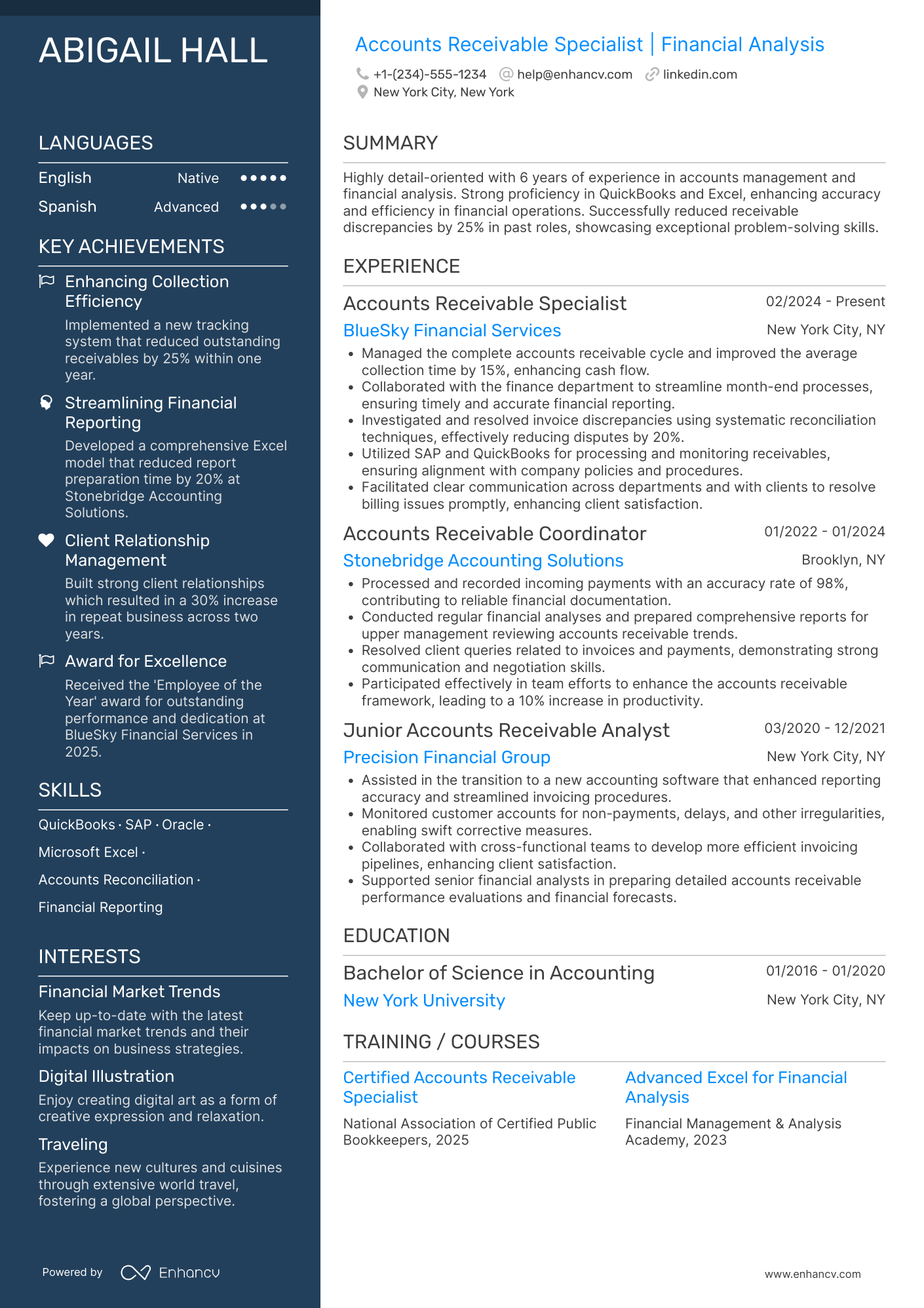
Accounts Receivable resume examples
By Experience
By Role