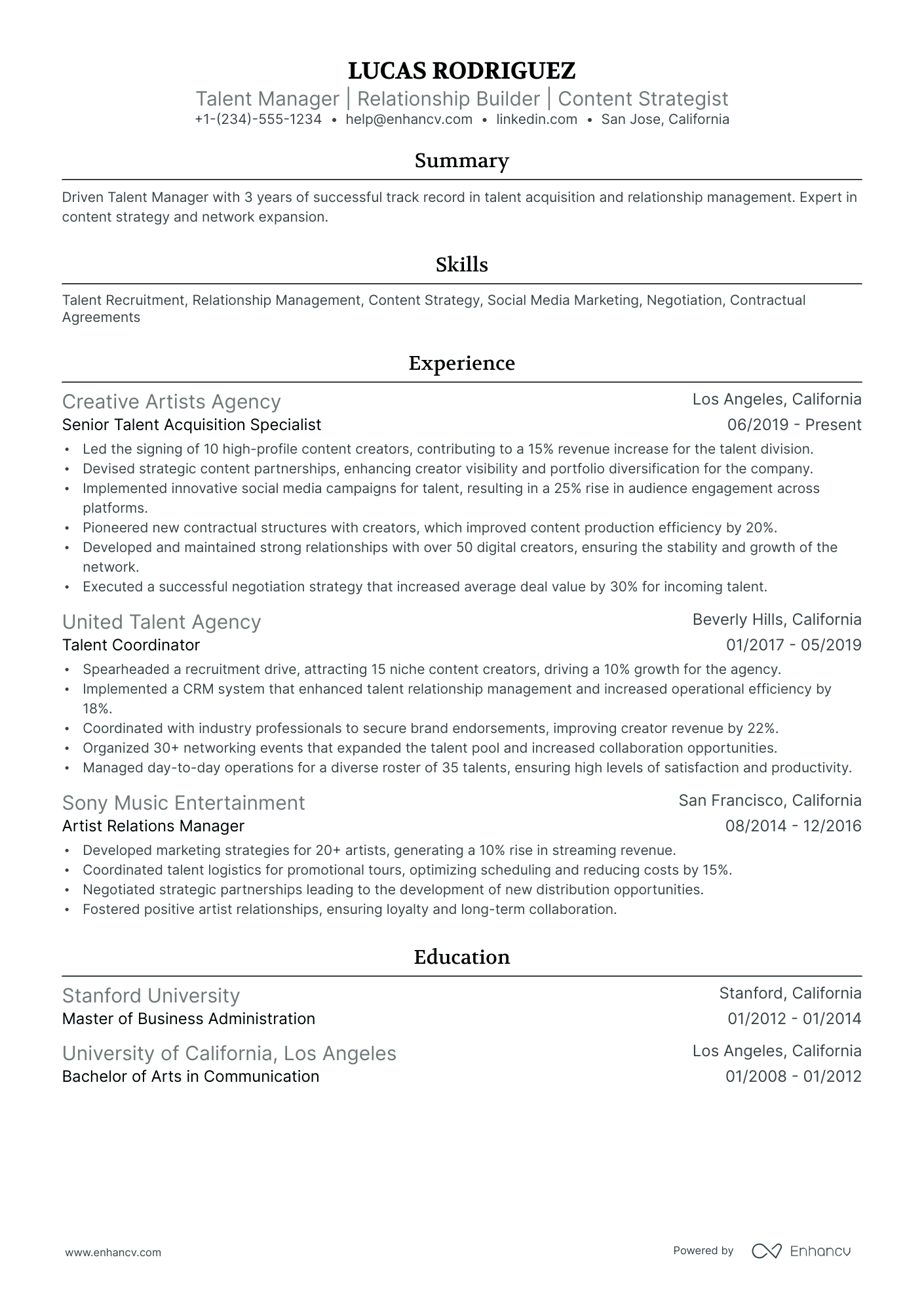
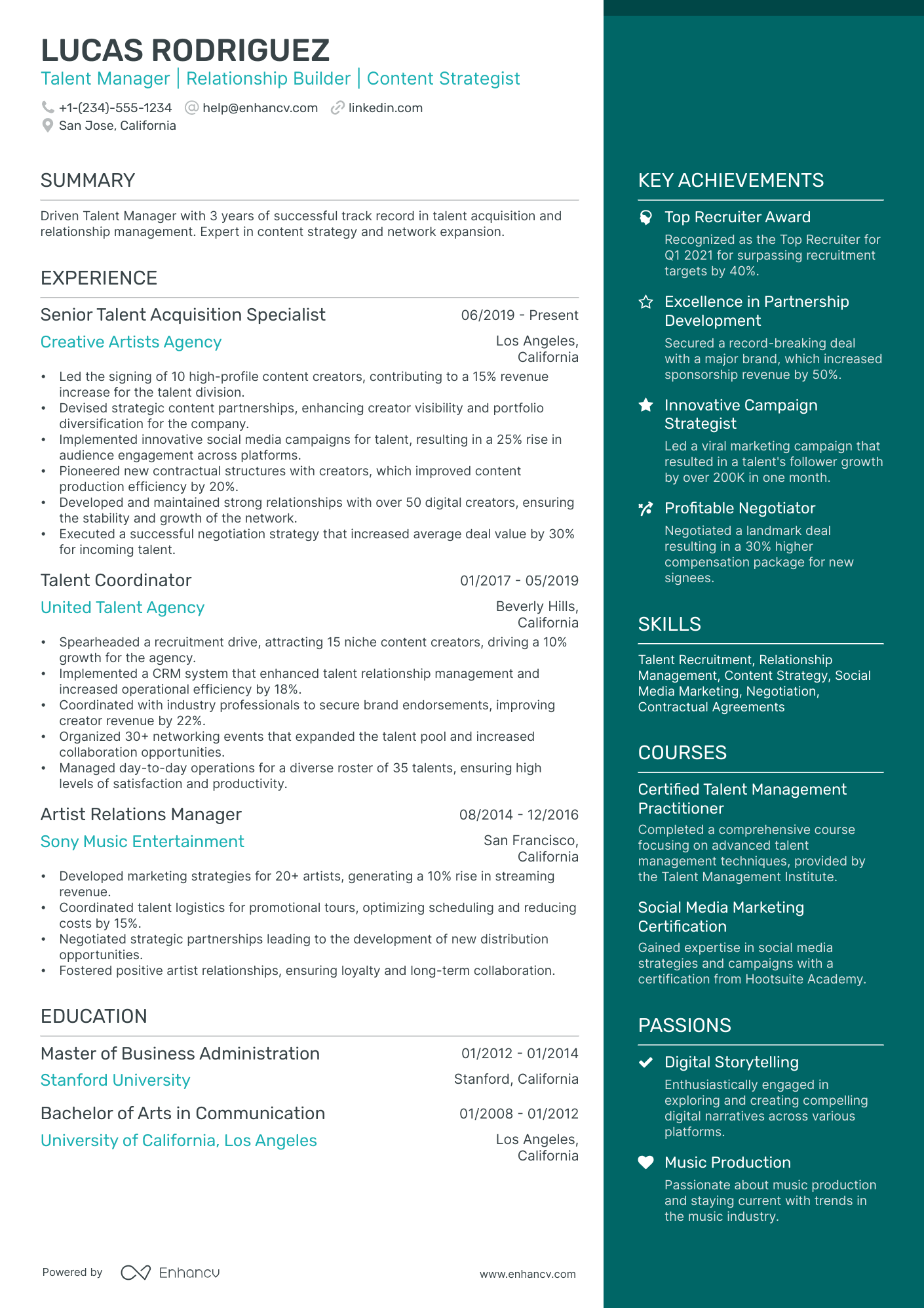
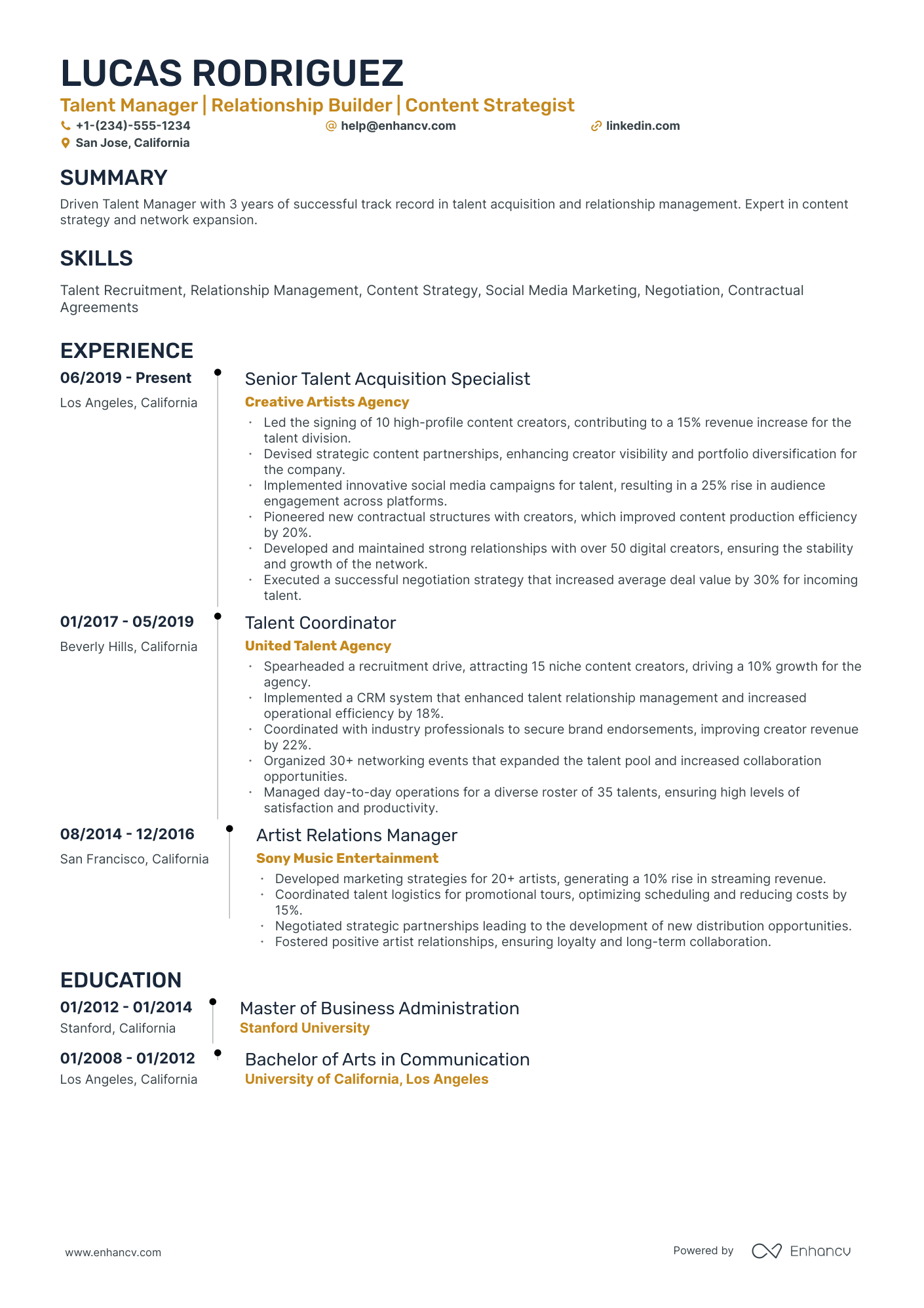
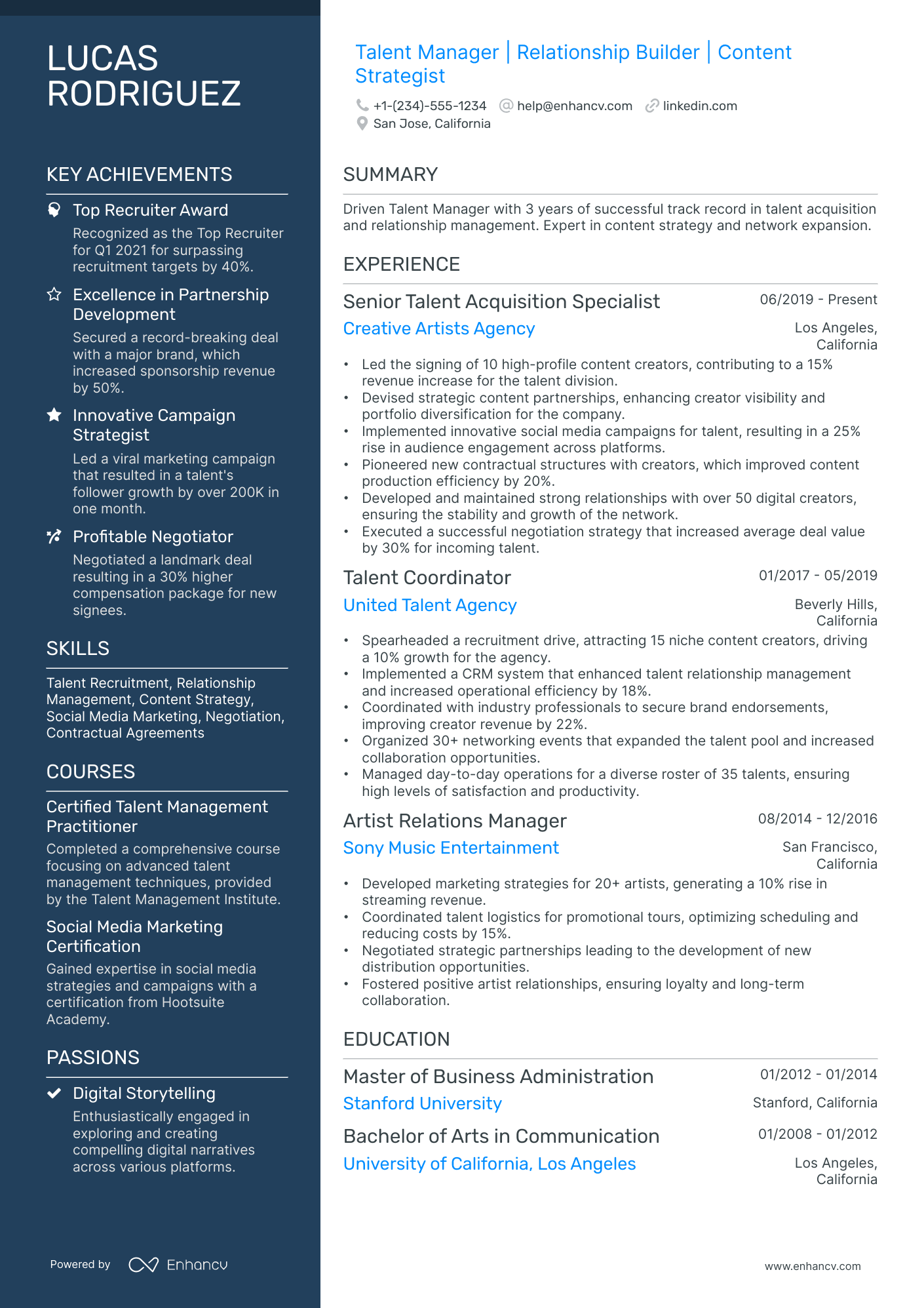
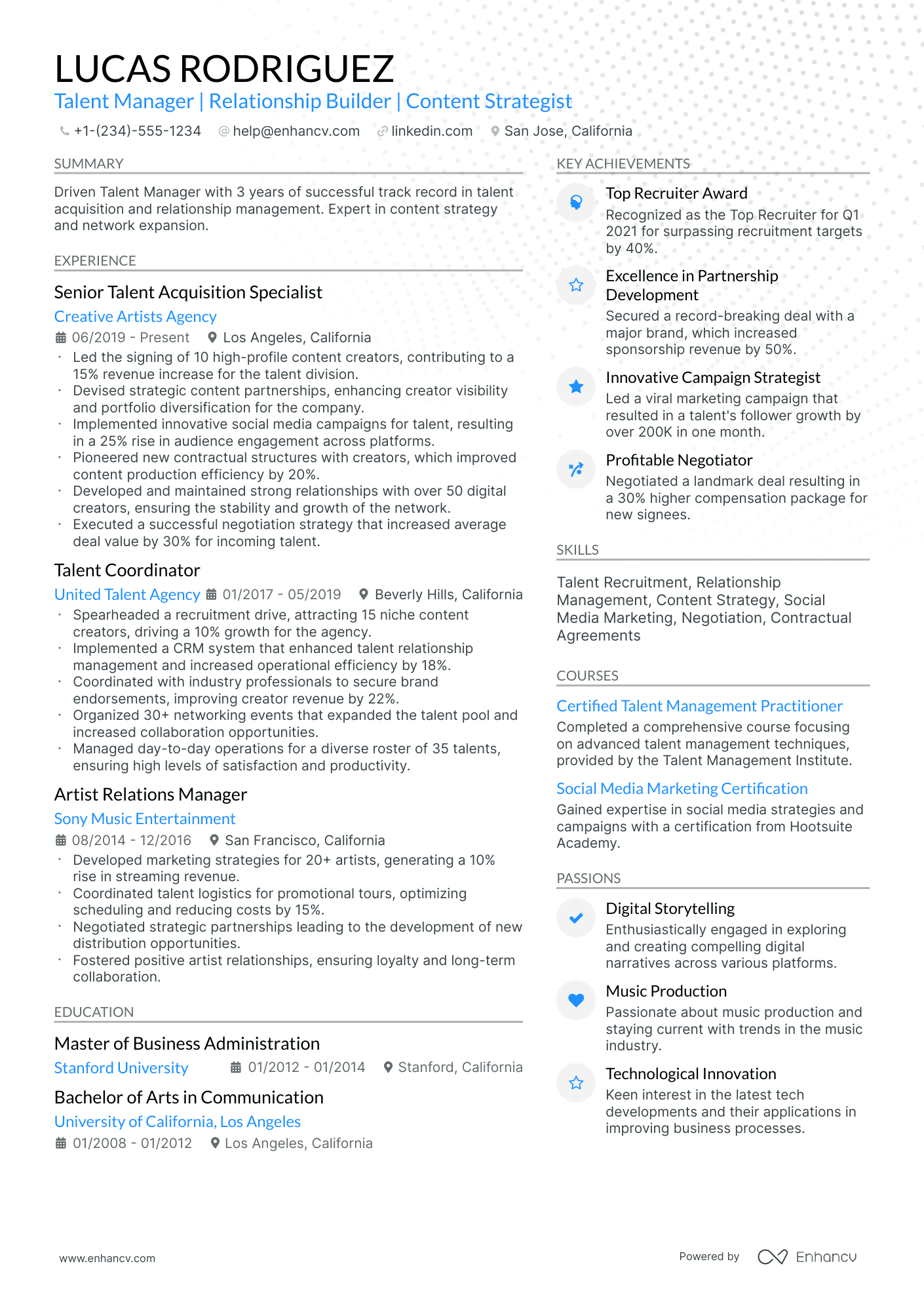
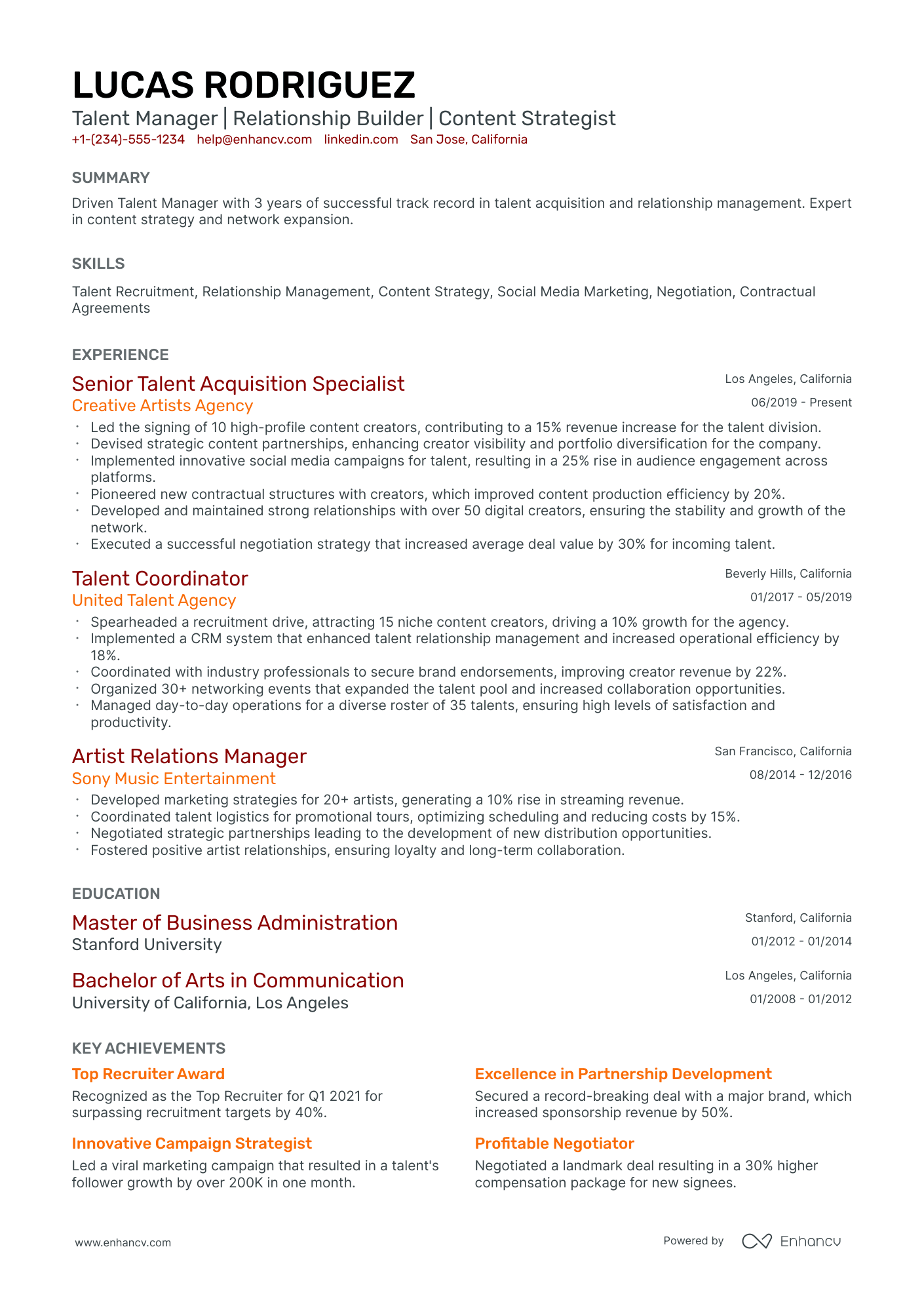
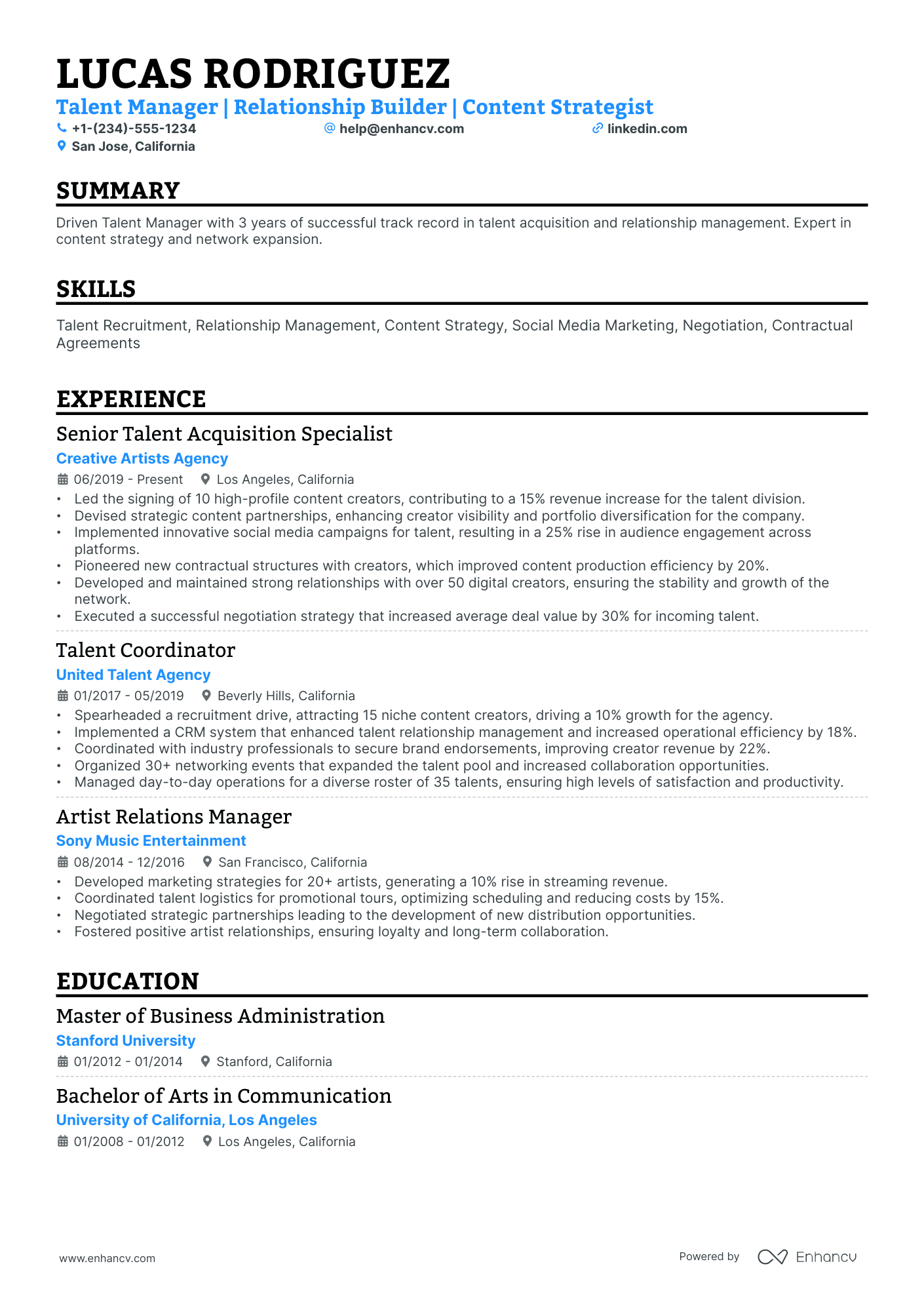
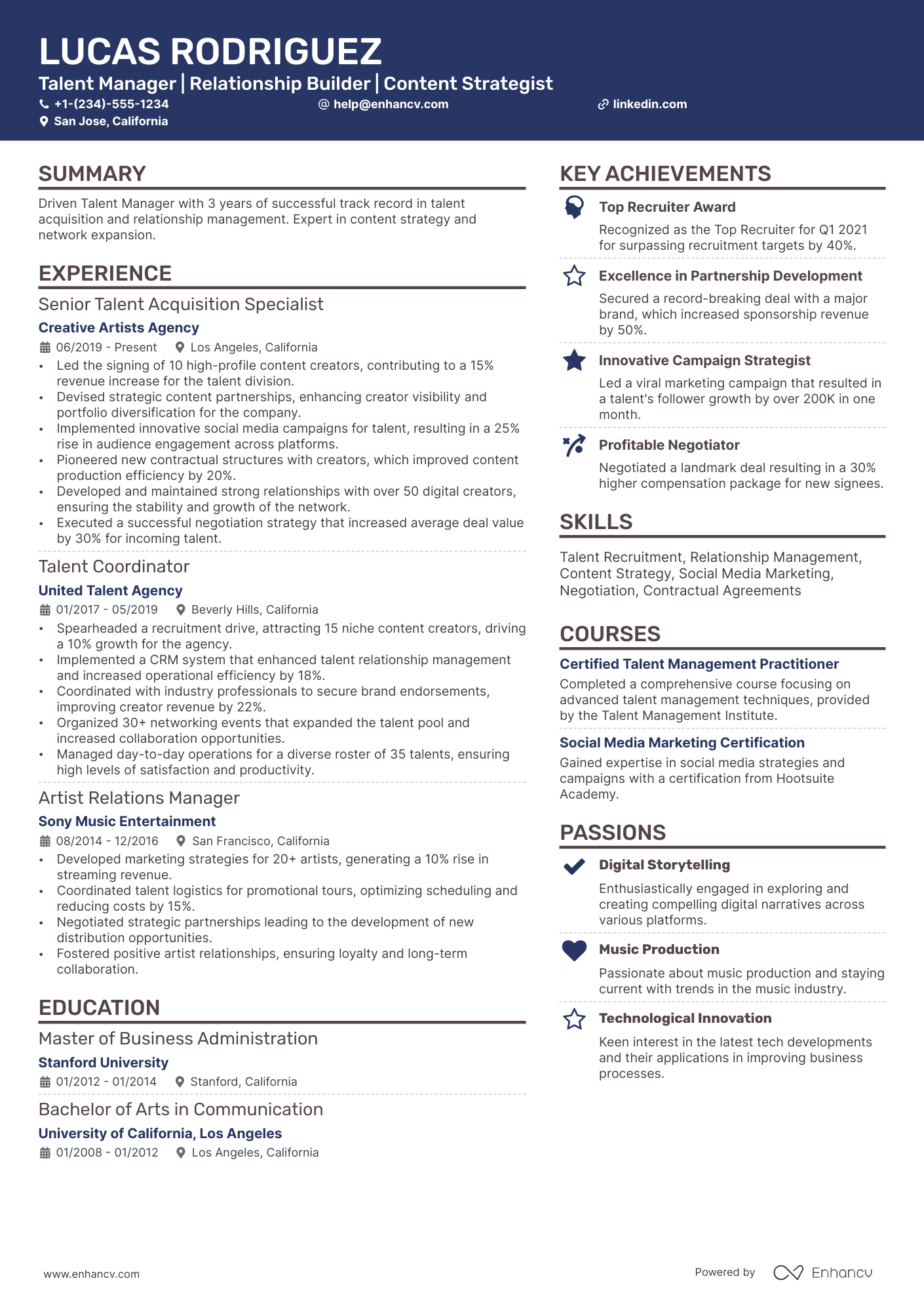
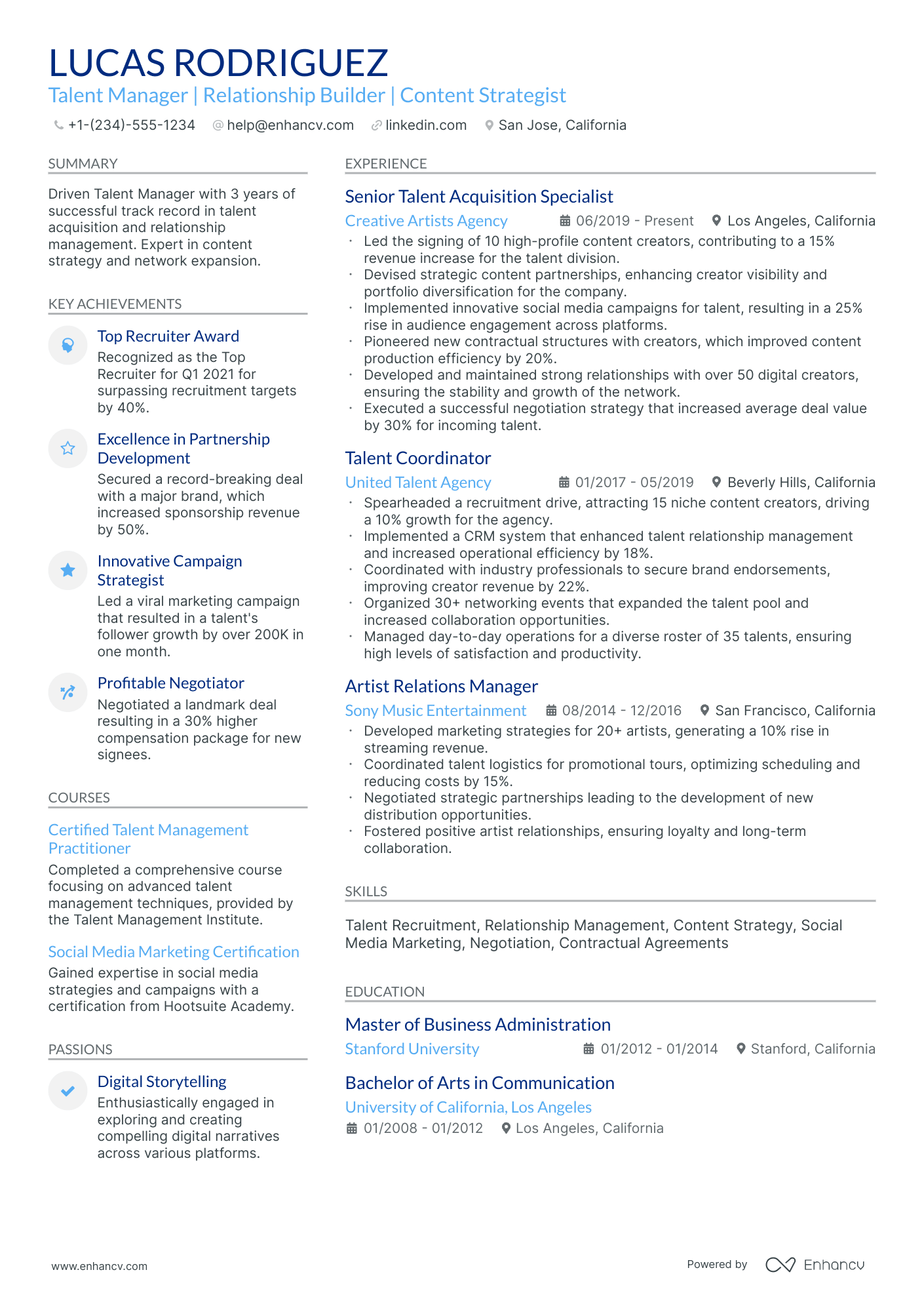
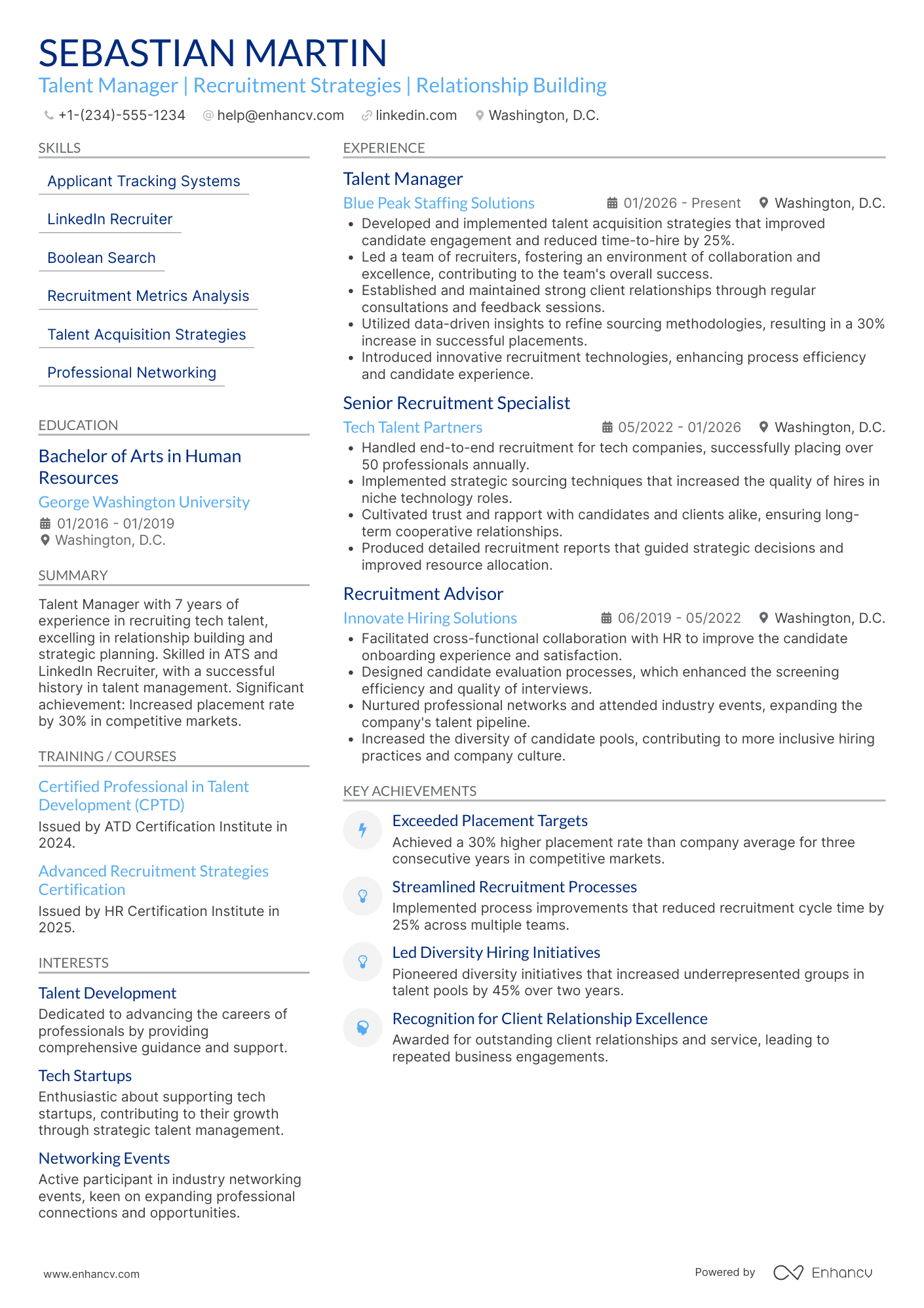
Most talent manager resume drafts fail because they read like task lists, not proof of hiring impact. A talent manager resume that lacks measurable outcomes gets filtered by ATS rules and skimmed past in seconds. If you're unsure where to begin, understanding how to write a resume that leads with results is the essential first step.
This guide shows you how to lead with results: reduced time-to-fill, improved offer acceptance, higher quality-of-hire, stronger retention, and better hiring manager satisfaction. You'll quantify hiring volume, role complexity, pipeline conversion, and the business impact of your talent strategy.

Key takeaways
- Lead every experience bullet with a measurable outcome, not a task description.
- Use reverse-chronological format to showcase career progression and expanding client scope.
- Tailor resume language to mirror each job posting's exact tools, platforms, and terminology.
- Quantify achievements using metrics like time-to-fill, retention rates, and offer acceptance.
- Demonstrate skills through experience bullets and your summary, not just a standalone list.
- Anchor entry-level resumes in projects, internships, and trackable results like booking rates.
- Use Enhancv's tools to refine bullet points and align your resume with role-specific expectations.
Job market snapshot for talent managers
We analyzed 200 recent talent manager job ads across major US job boards. These numbers help you understand salary landscape, employer expectations, career growth patterns at a glance.
What level of experience employers are looking for talent managers
| Years of Experience | Percentage found in job ads |
|---|---|
| 1–2 years | 5.5% (11) |
| 3–4 years | 4.0% (8) |
| 5–6 years | 25.5% (51) |
| 7–8 years | 9.0% (18) |
| 9–10 years | 1.5% (3) |
| 10+ years | 3.5% (7) |
| Not specified | 52.0% (104) |
Talent manager ads by area of specialization (industry)
| Industry (Area) | Percentage found in job ads |
|---|---|
| Finance & Banking | 45.0% (90) |
| Healthcare | 35.5% (71) |
| Education | 9.5% (19) |
Top companies hiring talent managers
| Company | Percentage found in job ads |
|---|---|
| Accenture | 21.5% (43) |
| Robert Half International | 9.0% (18) |
Role overview stats
These tables show the most common responsibilities and employment types for talent manager roles. Use them to align your resume with what employers expect and to understand how the role is structured across the market.
Day-to-day activities and top responsibilities for a talent manager
| Responsibility | Percentage found in job ads |
|---|---|
| Talent management | 32.0% (64) |
| Project management | 16.5% (33) |
| Oracle hcm cloud talent management | 16.0% (32) |
| Excel | 14.5% (29) |
| Redwood pages | 14.5% (29) |
| Vbs | 14.5% (29) |
| Succession planning | 14.0% (28) |
| Ai | 12.0% (24) |
| Oracle hcm | 11.5% (23) |
| Performance management | 11.0% (22) |
| Microsoft office | 10.5% (21) |
| Powerpoint | 10.5% (21) |
Type of employment (remote vs on-site vs hybrid)
| Employment type | Percentage found in job ads |
|---|---|
| On-site | 76.5% (153) |
| Hybrid | 17.0% (34) |
| Remote | 6.5% (13) |
How to format a talent manager resume
Recruiters evaluating talent managers prioritize evidence of artist or client roster growth, deal negotiation, strategic career development, and revenue generation. A clean, progression-focused resume format ensures these signals surface immediately—both for human reviewers scanning for leadership scope and for applicant tracking systems parsing your work history.

I have significant experience in this role—which format should I use?
Use a reverse-chronological format—it's the strongest choice for experienced talent managers because it foregrounds your career trajectory and expanding scope of client management. Do:
- Lead with your most senior role and clearly outline the size and caliber of the talent roster you managed, including cross-functional coordination with agents, publicists, and brand partners.
- Highlight industry-specific tools and domains such as contract negotiation, entertainment law fluency, touring logistics, brand partnership strategy, and platforms like Casting Networks, IMDbPro, or proprietary CRM systems.
- Quantify business impact in every role—tie your actions to revenue growth, deal value, audience reach, or client career milestones.
Why hybrid and functional resumes don't work for senior roles
Hybrid formats fragment your leadership narrative by pulling key skills out of the roles where you actually exercised them, making it harder for recruiters to assess the scope and accountability you carried at each stage. Functional formats are worse—they obscure career progression entirely, strip context from deal sizes and roster growth, and reduce your decision-making authority to a generic skills list that could belong to any experience level. Avoid both formats entirely if you have five or more years of progressive talent management experience, as they'll dilute the very signals—escalating responsibility, client outcomes, and strategic ownership—that hiring teams need to see.
- A functional format may be acceptable only if you're transitioning into talent management from a related field such as entertainment law, artist relations, or booking agency work, and you lack linear job titles in talent management—but even then, every skill listed must be anchored to a specific project, deal, or measurable client outcome.
Once you've established a clean, readable format, the next step is deciding which sections to include so each one serves a clear purpose on your resume.
What sections should go on a talent manager resume
Recruiters expect a talent manager resume to show clear ownership of talent strategy, stakeholder management, and measurable hiring and retention results. Knowing exactly what to put on a resume ensures every section earns its place. Use this structure for maximum clarity:
- Header
- Summary
- Experience
- Skills
- Projects
- Education
- Certifications
- Optional sections: Awards, Leadership, Languages
Your experience bullets should emphasize business impact, quantified outcomes, scope of roles supported, and results across hiring, development, performance, and retention.
Is your resume good enough?
Drop your resume here or choose a file. PDF & DOCX only. Max 2MB file size.
Now that you’ve organized the key resume components, focus on writing your talent manager resume experience section to show how you’ve applied those elements in your work history.
How to write your talent manager resume experience
Your work experience section should prove you've delivered measurable results in talent acquisition, employee development, and workforce planning—not just list daily responsibilities. Hiring managers prioritize demonstrated impact, so every bullet should connect your actions to outcomes using role-relevant tools, strategies, and concrete results.
Each entry should include:
- Job title
- Company and location (or remote)
- Dates of employment (month and year)
Three to five concise bullet points showing what you owned, how you executed, and what outcomes you delivered:
- Ownership scope: the talent programs, recruitment pipelines, workforce planning initiatives, employer branding efforts, or teams you were directly accountable for as a talent manager.
- Execution approach: the tools, frameworks, and methods you used to drive decisions—such as applicant tracking systems, performance management platforms, competency models, succession planning frameworks, or data-driven hiring strategies.
- Value improved: the specific improvements you drove in areas like time-to-fill, retention rates, employee engagement, onboarding effectiveness, internal mobility, or compliance risk reduction.
- Collaboration context: how you partnered with hiring managers, senior leadership, HR business partners, external recruiting agencies, or department heads to align talent strategy with organizational goals.
- Impact delivered: the business outcomes your work produced, expressed through retention improvements, pipeline growth, workforce readiness, cost savings, or organizational capability gains rather than routine activity descriptions.
Experience bullet formula
A talent manager experience example
✅ Right example - modern, quantified, specific.
Talent Manager
BrightWave Studios | Los Angeles, CA
2022–Present
Talent management team supporting a two-hundred-person digital production studio delivering campaigns for Fortune 500 clients.
- Built and maintained a skills-based talent pipeline in Greenhouse ATS (applicant tracking system) and Airtable, cutting time-to-fill from fifty-eight to forty-one days (twenty-nine percent) across creative, production, and strategy roles.
- Negotiated and executed sixty-plus talent agreements per year using DocuSign and Ironclad, reducing contract cycle time by thirty-five percent while holding rate variance within three percent of budget targets.
- Launched quarterly performance and feedback cycles in Lattice and Culture Amp, increasing on-time review completion from seventy-two to ninety-four percent and improving retention of top performers by eight percent year over year.
- Partnered with producers, account leads, and finance to forecast staffing in Float and Google Sheets, improving utilization from seventy-six to eighty-four percent and reducing last-minute freelancer spend by twelve percent.
- Implemented structured interview scorecards and calibration with hiring managers and team leads, increasing offer acceptance from seventy-eight to eighty-six percent and reducing first-year regretted attrition by five percent.
Now that you've seen how a strong experience section comes together, let's look at how to adjust those details to match the specific role you're targeting.
How to tailor your talent manager resume experience
Recruiters evaluate talent manager resumes through a combination of human review and applicant tracking systems (ATS). Tailoring your resume to the job description increases your chances of passing both screenings.
Ways to tailor your talent manager experience:
- Mirror the exact talent development platforms named in the posting.
- Match succession planning frameworks the employer references in requirements.
- Use the same terminology for performance management cycles described.
- Reflect specific employee engagement KPIs the role prioritizes.
- Highlight retention strategy experience when the posting emphasizes turnover reduction.
- Include workforce planning methods that align with stated organizational goals.
- Emphasize DEI program leadership if the job description mentions inclusion initiatives.
- Reference stakeholder collaboration models the employer outlines for cross-functional work.
Tailoring means aligning your real accomplishments with what the role demands, not forcing disconnected keywords into your experience.
Resume tailoring examples for talent manager
| Job description excerpt | Untailored | Tailored |
|---|---|---|
| "Manage a roster of 20+ actors and musicians, negotiate contracts with studios and labels, and drive brand partnership deals." | Helped clients with their career opportunities and managed various tasks. | Managed a diverse roster of 23 actors and musicians, negotiating contracts with major studios and securing 12 brand partnership deals worth over $1.5M in combined revenue. |
| "Use Casting Networks and Backstage to identify audition opportunities, coordinate self-tape submissions, and track booking rates across all clients." | Assisted talent with auditions and kept track of their progress. | Sourced audition opportunities through Casting Networks and Backstage, coordinated over 300 self-tape submissions annually, and maintained a client booking rate 18% above agency average. |
| "Develop long-term career strategies for emerging talent, build relationships with casting directors, and grow client social media presence to attract endorsement deals." | Supported talent development and worked on building industry connections. | Built career development plans for nine emerging talent clients, cultivated relationships with 15+ casting directors across network television, and grew client social media followings by an average of 40%—directly leading to three new endorsement deals. |
Once you’ve aligned your experience with the role’s priorities, quantify your talent manager achievements to show the measurable impact of that work.
How to quantify your talent manager achievements
Quantifying your achievements shows how your talent programs improved hiring speed, retention, compliance, and stakeholder satisfaction. Focus on time-to-fill, offer acceptance, retention, pipeline conversion, and workload volume across roles, regions, and hiring managers.
Quantifying examples for talent manager
| Metric | Example |
|---|---|
| Time-to-fill | "Cut time-to-fill from forty-eight to thirty-two days for sales and customer success roles by redesigning intake meetings and using Greenhouse scorecards." |
| Offer acceptance | "Raised offer acceptance from seventy-two percent to eighty-four percent across fifty hires by standardizing compensation ranges and improving candidate closing scripts." |
| Retention | "Improved twelve-month new-hire retention from eighty-one percent to eighty-eight percent for frontline teams by launching a ninety-day onboarding plan and manager check-ins." |
| Compliance accuracy | "Reduced audit findings to zero in two quarterly reviews by enforcing right-to-work verification and updating documentation workflows in Workday." |
| Hiring volume | "Managed one hundred twenty requisitions per quarter across three regions while maintaining weekly hiring manager updates and a forty-eight-hour feedback service level agreement." |
Turn vague job duties into measurable, recruiter-ready resume bullets in seconds with Enhancv's Bullet Point Generator.
With strong bullet points in place, the next step is ensuring your skills section highlights the right mix of hard and soft skills that talent management roles demand.
How to list your hard and soft skills on a talent manager resume
Your skills section shows how you source, assess, and close talent, and recruiters and applicant tracking systems (ATS) scan this section for role keywords and tool match—aim for a mix of hard skills and soft skills, with hard skills slightly leading. talent manager roles require a blend of:
- Product strategy and discovery skills
- Data, analytics, and experimentation skills
- Delivery, execution, and go-to-market discipline
- Soft skills
Your skills section should be:
- Scannable (bullet-style grouping).
- Relevant to the job post.
- Backed by proof in experience bullets.
- Updated with current tools.
Place your skills section:
- Above experience if you're junior or switching careers.
- Below experience if you're mid/senior with strong achievements.

Hard skills
- Applicant tracking systems (Greenhouse, Lever)
- LinkedIn Recruiter, SeekOut
- Boolean search, X-ray sourcing
- Structured interviews, scorecards
- Competency-based assessments
- Workforce planning, headcount modeling
- Compensation benchmarking
- Offer strategy, negotiation
- Candidate pipeline reporting
- Diversity recruiting metrics
- Employment law basics
- Employer branding programs
Soft skills
- Stakeholder alignment with hiring managers
- Intake meetings that clarify priorities
- Candidate communication and follow-through
- Structured decision-making under deadlines
- Conflict resolution on candidate slates
- Negotiation that protects relationships
- Clear, concise written updates
- Executive-ready verbal briefings
- Ownership of requisition outcomes
- Process improvement through feedback loops
- Judgment on role-fit tradeoffs
- Coaching interviewers for consistency
How to show your talent manager skills in context
Skills shouldn't live only in a dedicated skills list. Browse examples of resume skills organized by role to see how top candidates present their abilities.
They should be demonstrated in:
- Your summary (high-level professional identity)
- Your experience (proof through outcomes)
Here's how that looks in practice.
Summary example
Talent manager with 10+ years in tech, specializing in workforce planning, succession strategies, and Workday HCM. Built leadership pipelines across four business units, reducing external senior hires by 35%. Known for bridging talent analytics with empathetic stakeholder coaching.
- Reflects senior-level career depth
- Names specific platforms and methods
- Leads with a measurable hiring outcome
- Highlights coaching as a soft skill
Experience example
Senior Talent Manager
BrightPath Solutions | Remote
March 2019–August 2024
- Partnered with department heads to redesign succession planning using Visier analytics, cutting leadership vacancies by 40% over three years.
- Launched a mentorship framework with L&D and HR business partners, boosting internal promotion rates by 28% across engineering teams.
- Standardized talent review cycles in Workday, reducing calibration session prep time by six hours per quarter for 12 people managers.
- Every bullet includes a measurable outcome.
- Skills surface naturally through real achievements.
Once you’ve demonstrated your talent manager strengths through specific, results-focused examples, the next step is applying that same approach to writing a talent manager resume when you have no experience.
How do I write a talent manager resume with no experience
Even without full-time experience, you can demonstrate readiness through:
- Campus recruiting event coordination
- Volunteer talent manager for artists
- Internship in HR or recruiting
- Casting calls and audition scheduling
- Social media talent outreach campaigns
- Contract negotiation practice projects
- Talent database and tracking setup
- Client intake and briefing notes
If you're starting out, our guide on building a resume without work experience walks you through how to highlight these types of activities effectively.
Focus on:
- Talent sourcing channels and outreach
- Scheduling, coordination, and follow-ups
- Contract basics and compliance awareness
- Metrics: response rates, bookings, time
Resume format tip for entry-level talent manager
Use a combination resume format because it highlights relevant skills and projects while still showing transferable experience and education. Do:
- Add a "Relevant Projects" section.
- List tools: applicant tracking system, spreadsheets.
- Quantify results: bookings, response rates.
- Show process: sourcing, screening, scheduling.
- Tailor keywords to each posting.
- Built a talent tracking spreadsheet and outreach log, contacted sixty local performers, and booked eight auditions within two weeks using email templates and follow-up rules.
Even without direct experience, your educational background can strengthen your talent manager resume—here's how to present it effectively.
How to list your education on a talent manager resume
Your education section helps hiring teams confirm you have the foundational knowledge needed for a talent manager role. It validates relevant training in management, communications, or human resources.
Include:
- Degree name
- Institution
- Location
- Graduation year
- Relevant coursework (for juniors or entry-level candidates)
- Honors & GPA (if 3.5 or higher)
Skip month and day details—list the graduation year only.
Here's a strong education entry tailored to a talent manager resume:
Example education entry
Bachelor of Arts in Communications
University of Southern California, Los Angeles, CA
Graduated 2021
GPA: 3.7/4.0
- Relevant Coursework: Organizational Behavior, Talent Development Strategies, Media Relations, Negotiation and Conflict Resolution
- Honors: Magna Cum Laude, Dean's List (six consecutive semesters)
How to list your certifications on a talent manager resume
Certifications on a resume show a talent manager's commitment to learning, proficiency with hiring tools, and alignment with industry standards, which helps employers trust your judgment and process.
Include:
- Certificate name
- Issuing organization
- Year
- Optional: credential ID or URL
- Place certifications below education when they're older, general, or less relevant than your degree and core talent manager experience.
- Place certifications above education when they're recent, highly relevant, or required for the talent manager role you target.
Best certifications for your talent manager resume
- SHRM Certified Professional (SHRM-CP)
- SHRM Senior Certified Professional (SHRM-SCP)
- Professional in Human Resources (PHR)
- Senior Professional in Human Resources (SPHR)
- LinkedIn Certified Professional–Recruiter
- AIRS Certified Internet Recruiter (CIR)
- Diversity, Equity, and Inclusion in the Workplace Certificate (Cornell University)
Once you’ve placed your credentials where they support your qualifications, you can write your talent manager resume summary to highlight them alongside your most relevant strengths.
How to write your talent manager resume summary
Your resume summary is the first thing a recruiter reads, so it needs to earn their attention fast. A strong opening frames you as a capable talent manager before the rest of your resume does the heavy lifting.
Keep it to three to four lines, with:
- Your title and total years of experience in talent management.
- The industry or domain you specialize in, such as entertainment, media, or sports.
- Core skills like contract negotiation, client development, or brand partnerships.
- One or two measurable achievements that prove your impact.
- Soft skills tied to real outcomes, such as relationship building that improved client retention.

PRO TIP
At the mid-level, focus on the specific skills and tools you bring to the role. Highlight early wins with numbers whenever possible. Avoid vague descriptors like "passionate" or "hardworking"—recruiters want evidence, not enthusiasm.
Example summary for a talent manager
Talent manager with four years of experience in entertainment and media. Skilled in contract negotiation, brand partnerships, and client scheduling. Grew client roster by 35% in one year through targeted outreach and relationship management.
Optimize your resume summary and objective for ATS
Drop your resume here or choose a file.
PDF & DOCX only. Max 2MB file size.
Now that your summary is crafted to highlight your strongest qualifications, make sure the header above it presents your contact details clearly so recruiters can actually reach you.
What to include in a talent manager resume header
A resume header is the top section with your identifying details, and it boosts visibility, credibility, and fast recruiter screening for a talent manager.
Essential resume header elements
- Full name
- Tailored job title and headline
- Location
- Phone number
- Professional email
- GitHub link
- Portfolio link
A LinkedIn link helps recruiters verify your experience quickly and supports screening.
Don't include a photo on a talent manager resume unless the role is explicitly front-facing or appearance-dependent.
Match your header title and headline to the exact talent manager role and keywords in the job posting to pass quick scans.
Example
Talent manager resume header
Jordan Taylor
Talent Manager | Artist Relations, Contract Negotiation, Roster Development
Los Angeles, CA
(323) 555-01XX
jordan.taylor@enhancv.com
github.com/jordantaylor
jordantaylor.com
linkedin.com/in/jordantaylor
Once your contact details and role identifiers are clear at the top, add the following optional sections to reinforce your qualifications and round out the resume.
Additional sections for talent manager resumes
Extra resume sections help you stand out when your core experience doesn't fully capture your industry connections, specialized knowledge, or unique qualifications.
Consider adding these sections to strengthen your talent manager resume:
- Languages
- Industry certifications
- Professional affiliations and memberships
- Speaking engagements and panels
- Publications
- Volunteer experience in entertainment, sports, or media
- Awards and honors
Once you've strengthened your resume with relevant additional sections, the next step is pairing it with a cover letter that adds even more context to your candidacy.
Do talent manager resumes need a cover letter
A cover letter isn't required for a talent manager, but it helps in competitive searches or when hiring teams expect one. It can make a difference when your resume doesn't clearly show fit, scope, or impact. If you're unfamiliar with the format, start by learning what a cover letter is and how it complements your resume.
Use a cover letter to add context your resume can't:
- Explain role or team fit by connecting your recruiting strengths to the talent manager's priorities and the team's current gaps.
- Highlight one or two relevant projects or outcomes, including the problem, your approach, and a measurable result.
- Show understanding of the product, users, or business context by tying hiring needs to growth goals, customer segments, or delivery timelines.
- Address career transitions or non-obvious experience by mapping transferable skills to talent manager responsibilities and expected metrics.
Drop your resume here or choose a file.
PDF & DOCX only. Max 2MB file size.
Even if you decide to include a cover letter to add context beyond your resume, using AI to improve your talent manager resume helps you strengthen the resume itself with faster, more targeted edits.
Using AI to improve your talent manager resume
AI can sharpen your resume's clarity, structure, and overall impact. It helps you refine language and highlight measurable results. But overuse strips authenticity. Once your content feels clear and role-aligned, step away from AI. For practical prompt ideas, explore our guide on ChatGPT resume writing prompts.
Here are 10 practical prompts to strengthen specific sections of your talent manager resume:
- Sharpen your summary: "Rewrite my talent manager resume summary to highlight leadership scope, talent pipeline results, and strategic workforce contributions in three concise sentences."
- Quantify experience bullets: "Add specific metrics to these talent manager experience bullets, focusing on retention rates, time-to-fill, and employee engagement improvements."
- Align skills section: "Review this talent manager skills section and remove outdated terms. Suggest relevant replacements based on current talent management job descriptions."
- Strengthen action verbs: "Replace weak or repetitive verbs in my talent manager experience section with stronger alternatives that convey leadership, strategy, and execution."
- Tailor to a posting: "Compare my talent manager resume against this job description. Identify missing keywords and suggest where to add them naturally."
- Clarify project contributions: "Rewrite this talent manager project description to clearly define my role, the challenge addressed, and the measurable outcome delivered."
- Tighten education details: "Trim my talent manager education section to only include details relevant to human resources, organizational development, or leadership credentials."
- Highlight certifications: "Reorganize my talent manager certifications section by relevance. Briefly note how each credential supports talent strategy or workforce planning expertise."
- Remove redundant phrasing: "Scan my talent manager resume for filler words, redundant phrases, and clichés. Suggest concise alternatives that preserve meaning."
- Improve readability flow: "Restructure my talent manager resume bullets so each one leads with an action verb, states the task clearly, and ends with a result."
Stop using AI once your resume sounds accurate, specific, and aligned with real experience. AI should never invent experience or inflate claims—if it didn't happen, it doesn't belong here.
Conclusion
A strong talent manager resume proves impact with measurable outcomes, highlights role-specific skills, and uses a clear structure that’s easy to scan. It connects your experience to hiring goals through precise scope, results, and relevant tools.
This approach shows you’re ready for today’s hiring market and the near-future shift toward faster, data-informed decisions. Keep each section focused, consistent, and results-driven, and your talent manager resume will stand up in any review.