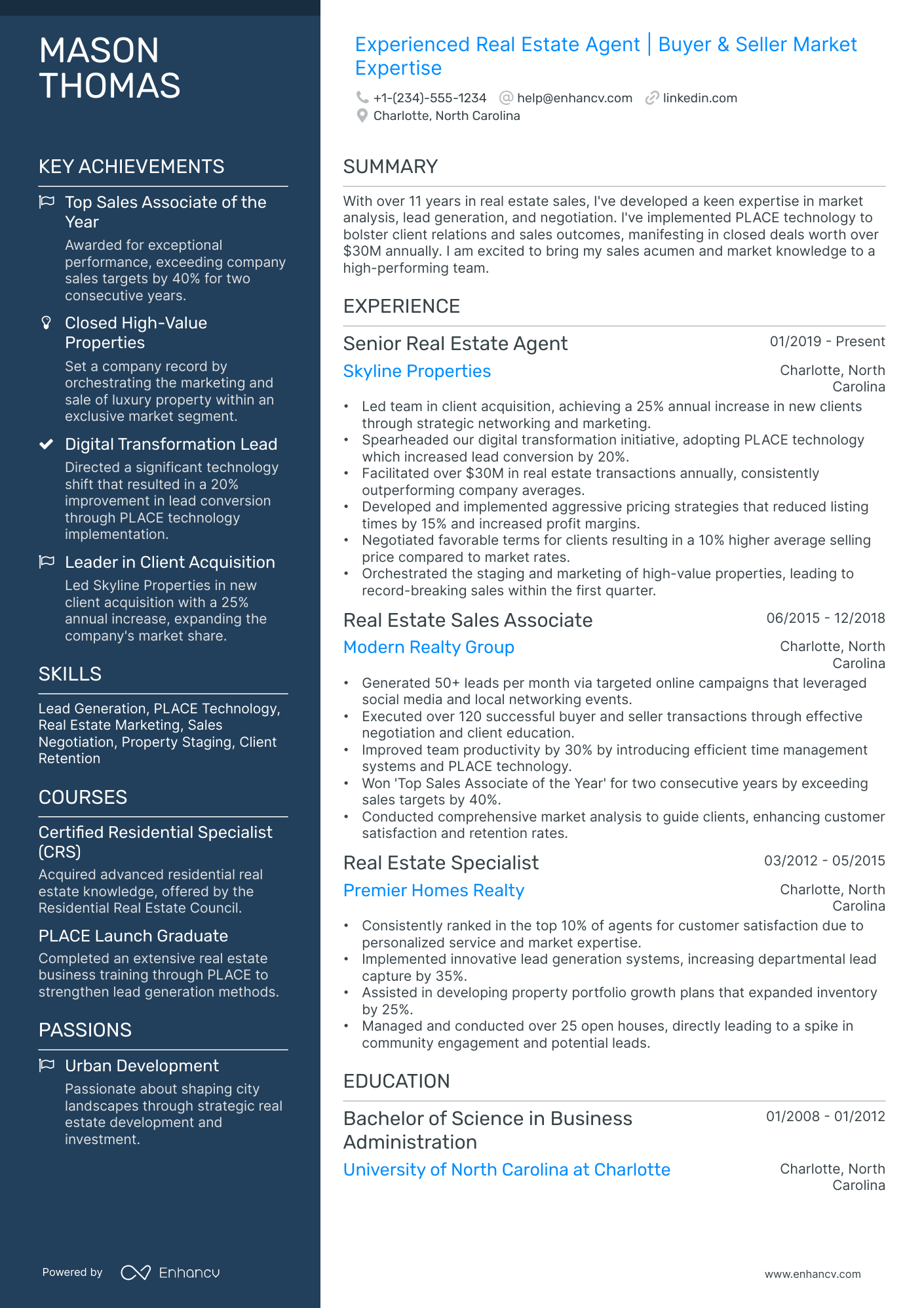
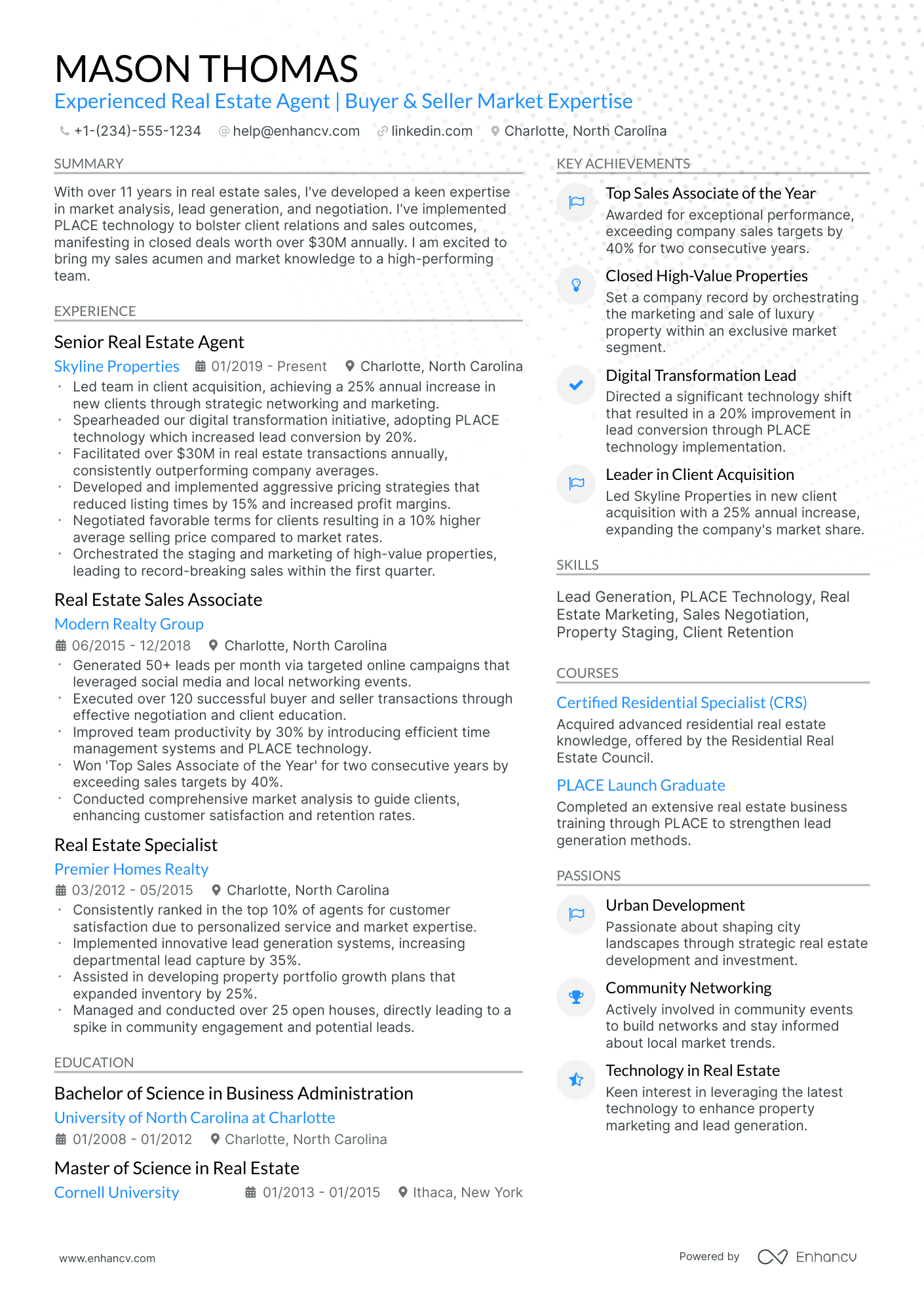
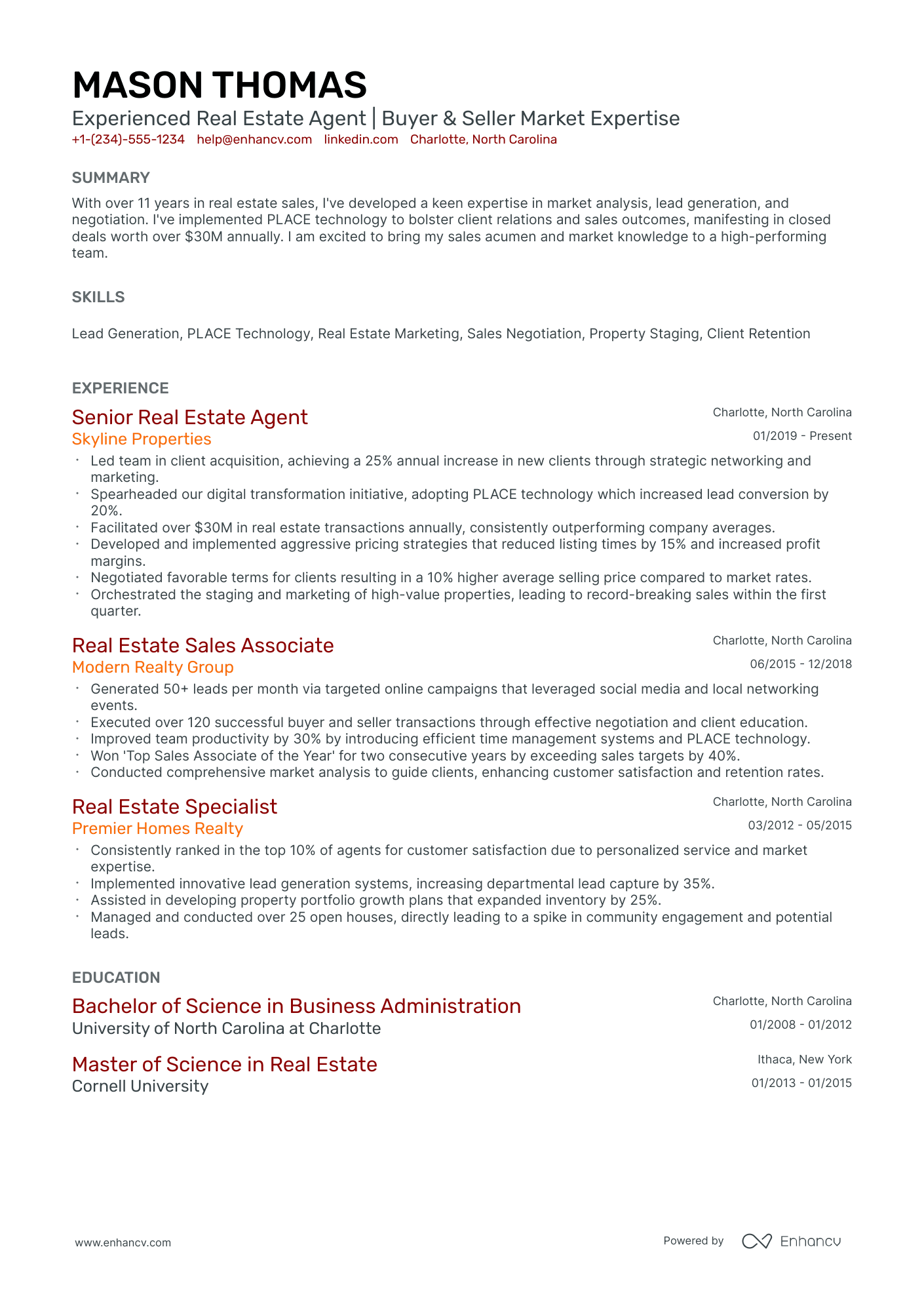
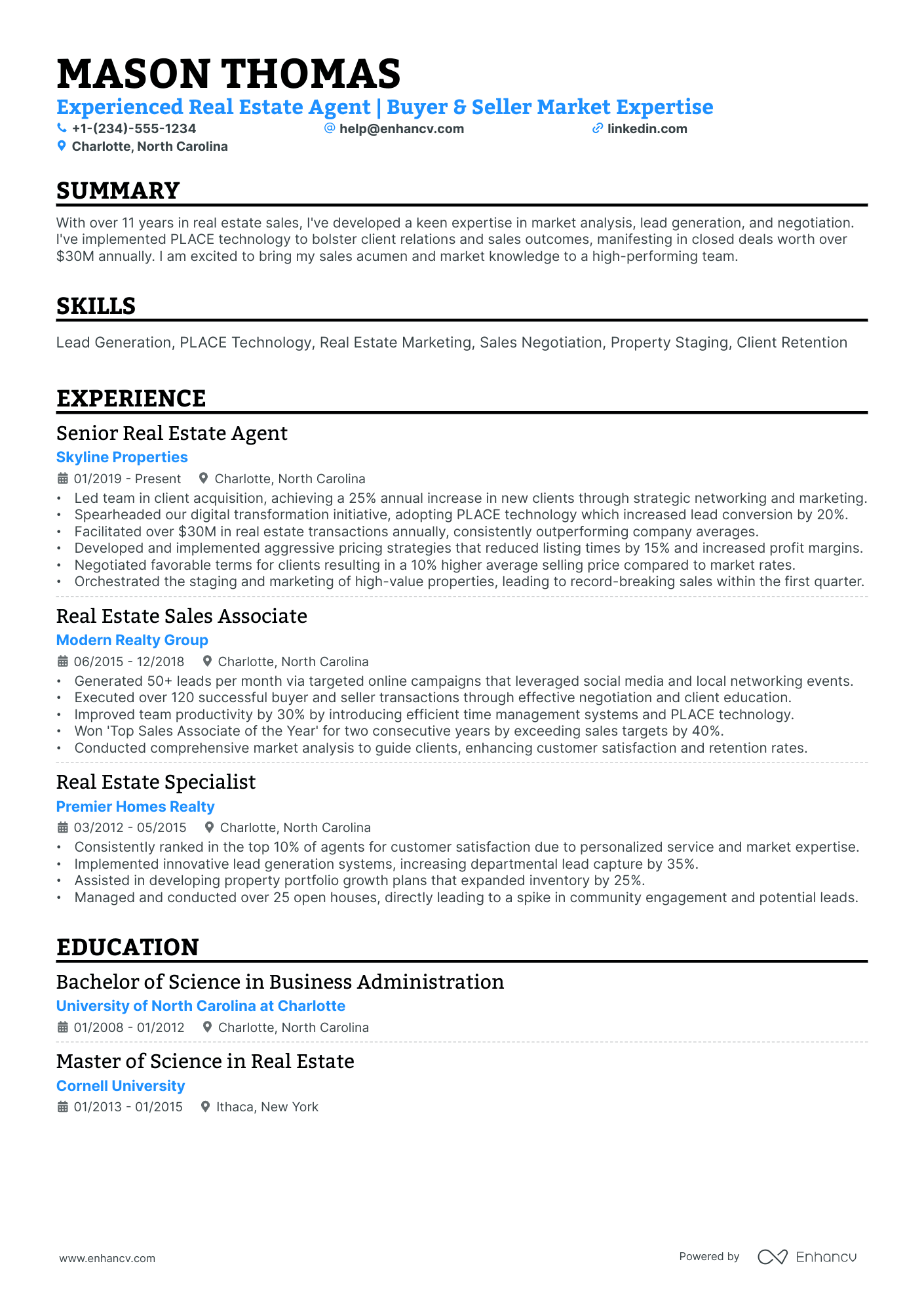
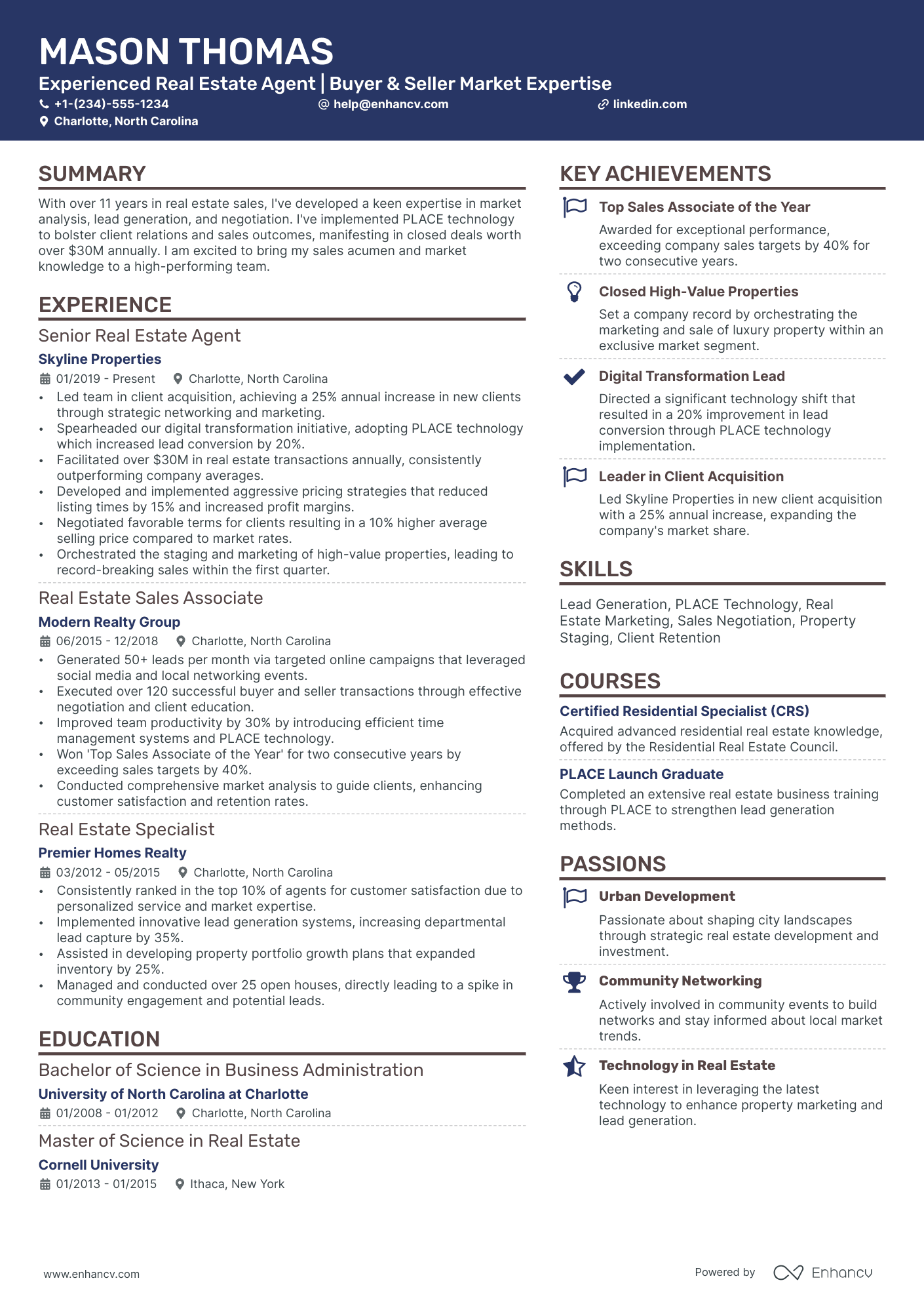
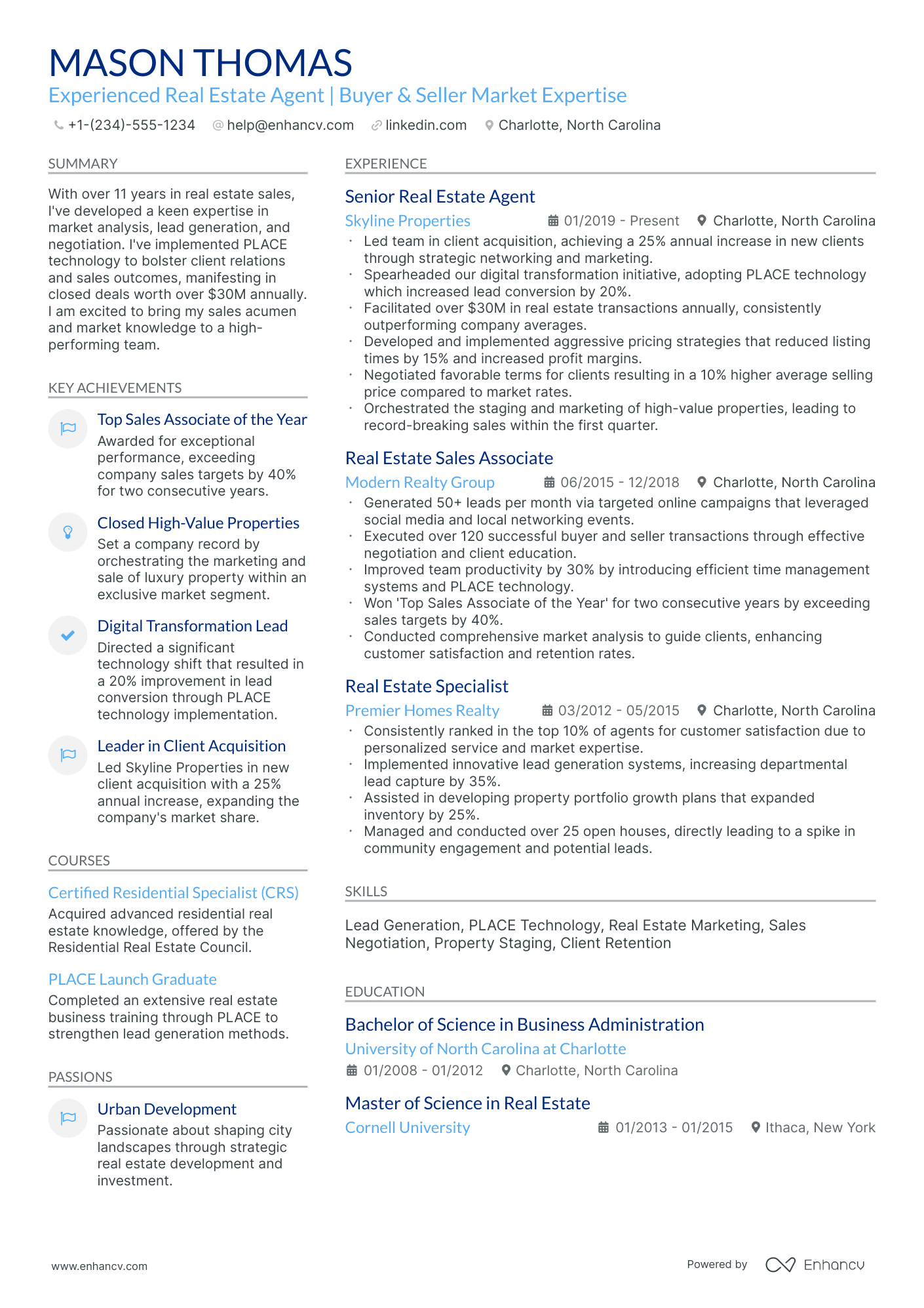
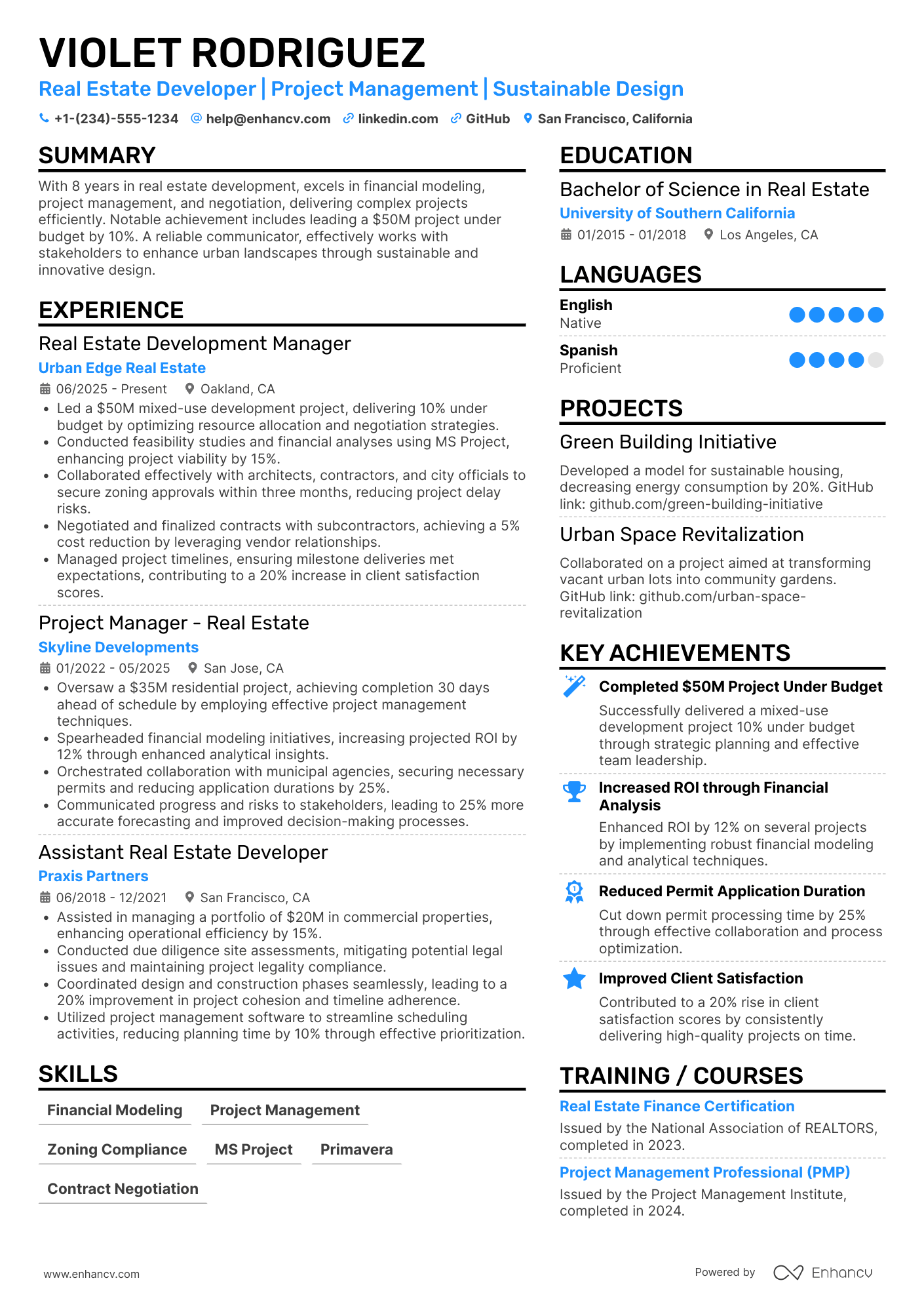
Most real estate developer resume drafts fail because they don't connect deals to measurable results, so they read like project logs. That hurts when an ATS (applicant tracking system) filters fast and recruiters scan in seconds amid heavy competition.
A strong resume shows what you delivered and why it mattered. Knowing how to make your resume stand out is critical in this competitive field. You'll highlight entitlement wins, capital raised, total project value, units delivered, schedule acceleration, cost savings, lease-up speed, and return targets achieved. You'll tie decisions to risk reduction, stakeholder alignment, and repeatable execution.

Key takeaways
- Quantify every achievement with project value, budget variance, timeline gains, or leasing velocity.
- Use reverse-chronological format if you have progressive, direct real estate development experience.
- Tailor each resume to the job posting's asset classes, tools, and entitlement terminology.
- Anchor skills in measurable project outcomes rather than listing them in isolation.
- Lead your summary with title, years of experience, and one concrete development result.
- Place certifications like CCIM or LEED AP near education to signal specialized, current expertise.
- Use Enhancv's tools to sharpen bullet points and align content with each target role.
How to format a real estate developer resume
Recruiters evaluating real estate developer candidates prioritize deal history, project scope, financial acumen, and a clear track record of bringing developments from acquisition through completion. A well-chosen resume format ensures these signals—especially progression from smaller projects to larger, more complex portfolios—are immediately visible to both hiring managers and applicant tracking systems.

I have significant experience in this role—which format should I use?
Use a reverse-chronological format to showcase your growing responsibility across increasingly complex development projects. Do:
- Lead each role with the scope and ownership you held—asset class, deal size, number of units, and entitlement or zoning responsibilities.
- Highlight domain-specific expertise such as pro forma modeling, site acquisition, capital stack structuring, municipal approvals, and construction oversight.
- Quantify outcomes tied to financial performance, timeline delivery, and portfolio growth.
I'm junior or switching into this role—what format works best?
A hybrid format works best, allowing you to front-load relevant skills and project knowledge while still demonstrating a clear employment timeline. Do:
- Place a skills section near the top that highlights competencies such as financial modeling, market analysis, site due diligence, and entitlement processes.
- Feature academic projects, internships, or cross-industry experience that involved feasibility studies, land use planning, construction coordination, or investor reporting.
- Connect every action to a result, even at a small scale, to demonstrate analytical and executional thinking.
Why not use a functional resume?
A functional resume strips away the project-by-project context that hiring managers rely on to evaluate a real estate developer's deal experience, progression across asset types, and ability to manage increasingly complex timelines and budgets.
- Career changers entering real estate development from adjacent fields like construction management, commercial brokerage, or urban planning, where transferable skills need prominent framing.
- Recent graduates with capstone projects, internships, or certifications (such as a Master of Real Estate Development) but limited full-time development experience.
- Candidates with resume gaps caused by market cycles, project-based employment, or extended entitlement timelines that create misleading gaps in a chronological layout.
With your layout and formatting decisions in place, the next step is determining which sections to include so each one serves a clear purpose on your resume.
What sections should go on a real estate developer resume
Recruiters expect to see a clear snapshot of your development track record, deal experience, and measurable project outcomes. Understanding what to put on a resume helps you prioritize the right content for this competitive field.
Use this structure for maximum clarity:
- Header
- Summary
- Experience
- Skills
- Projects
- Education
- Certifications
- Optional sections: Awards, Leadership, Languages
Strong experience bullets should emphasize project scope, capital stack and budget ownership, entitlement and delivery milestones, stakeholder management, and results such as returns, cost savings, and schedule gains.
Is your resume good enough?
Drop your resume here or choose a file. PDF & DOCX only. Max 2MB file size.
Once you’ve organized the key resume components, focus next on writing your real estate developer experience section to show how those details translate into results.
How to write your real estate developer resume experience
The experience section is where you prove you've delivered tangible results across real estate projects—from site acquisition and entitlements through construction and lease-up—using industry-relevant tools, financial models, and development methods. Building a targeted resume ensures hiring managers see demonstrated impact on timelines, budgets, and asset performance over descriptive task lists that simply catalog daily duties.
Each entry should include:
- Job title
- Company and location (or remote)
- Dates of employment (month and year)
Three to five concise bullet points showing what you owned, how you executed, and what outcomes you delivered:
- Ownership scope: the development projects, asset classes, land portfolios, joint ventures, or internal teams you were directly accountable for as a real estate developer.
- Execution approach: the financial modeling tools, pro forma analyses, zoning and entitlement strategies, construction management platforms, or market feasibility methods you used to guide development decisions and move projects forward.
- Value improved: changes to project timelines, construction costs, lease-up velocity, asset valuation, regulatory compliance, or risk mitigation that resulted from your work on a development.
- Collaboration context: how you coordinated with architects, general contractors, municipal agencies, capital partners, brokers, legal counsel, or community stakeholders to advance each phase of the development lifecycle.
- Impact delivered: outcomes framed around completed developments, capital deployed, portfolio growth, return thresholds met, or community and market positioning rather than a list of activities performed.
Experience bullet formula
A real estate developer experience example
✅ Right example - modern, quantified, specific.
Real estate development manager
Crescent Ridge Development | Austin, TX
2021–Present
Mid-size multifamily and mixed-use developer delivering ground-up projects across Central Texas.
- Led end-to-end development for a 312-unit Class A multifamily project ($96M total project cost) using Argus Enterprise and Excel cash flows; closed construction financing at 5.65% and delivered a 14.8% levered internal rate of return.
- Negotiated land acquisition and entitlement strategy with brokers, attorneys, and city staff; secured zoning and site plan approvals in nine months (three months ahead of baseline) and reduced entitlement spend by 12% through scope and consultant rebids.
- Managed design and preconstruction with architects, civil engineers, and general contractor using Bluebeam Revu, Procore, and Primavera P6; cut drawing review cycles by 30% and reduced change orders to 1.9% of hard costs (from 3.4% portfolio average).
- Implemented value engineering and procurement plan across structural, façade, and mechanical scopes; saved $2.1M in guaranteed maximum price while maintaining energy code compliance and improving projected net operating income by 4.5%.
- Directed leasing and stabilization with property management and marketing partners; achieved 93% occupancy within five months of certificate of occupancy and increased effective rents by 6% versus underwriting through unit mix and concession strategy.
Now that you've seen how a strong experience section comes together, let's look at how to adjust yours to match the specific role you're targeting.
How to tailor your real estate developer resume experience
Recruiters evaluate your real estate developer resume through both human review and applicant tracking systems. Tailoring your resume to the job description increases your chances of passing both screenings.
Ways to tailor your real estate developer experience:
- Match development software like Argus or CoStar named in the posting.
- Mirror the exact zoning and entitlement terminology the listing uses.
- Reflect project scale metrics such as square footage or unit counts.
- Include specific asset classes like multifamily or mixed-use when relevant.
- Highlight feasibility analysis methods referenced in the job description.
- Emphasize regulatory compliance processes the employer prioritizes.
- Align your experience with stated public-private partnership frameworks.
- Reference capital stack structuring or financing models the role requires.
Tailoring means aligning your real achievements with what the employer specifically asks for, not forcing keywords where they don't belong.
Resume tailoring examples for real estate developer
| Job description excerpt | Untailored | Tailored |
|---|---|---|
| Lead site acquisition and due diligence for mixed-use developments valued at $50M+, including zoning analysis and environmental assessments. | Helped with property research and supported the team on various projects. | Led site acquisition and due diligence for three mixed-use developments totaling $175M, conducting zoning analysis and coordinating Phase I and Phase II environmental assessments to secure entitlements within 12 months. |
| Manage project budgets and timelines using Procore and Argus Enterprise, ensuring delivery within 5% of pro forma targets across ground-up multifamily projects. | Tracked budgets and schedules for construction projects. | Managed $60M in project budgets for ground-up multifamily developments using Procore and Argus Enterprise, delivering all four projects within 3% of pro forma targets and ahead of schedule by an average of six weeks. |
| Build and maintain relationships with municipal planning departments, community stakeholders, and joint venture partners to advance entitlement and permitting processes. | Communicated with different groups involved in development projects. | Cultivated relationships with three municipal planning departments and two joint venture partners, streamlining the entitlement and permitting process and reducing average approval timelines by 20% across a portfolio of eight residential and commercial projects. |
Once you’ve aligned your experience with the role’s priorities, the next step is to quantify your real estate developer achievements so hiring managers can quickly see the impact behind each example.
How to quantify your real estate developer achievements
Quantifying achievements shows lenders, partners, and hiring teams how you drive returns and reduce risk. Focus on development timeline, budget variance, leasing velocity, net operating income growth, and entitlement or safety compliance outcomes.
Quantifying examples for real estate developer
| Metric | Example |
|---|---|
| Schedule speed | "Delivered a 220-unit mixed-use project eight weeks early by resequencing trades in Procore and tightening weekly look-ahead planning." |
| Budget control | "Cut hard costs by 3.8% ($2.1M) through value engineering and rebidding steel and facade packages while holding design intent constant." |
| Leasing velocity | "Reached 92% occupancy within six months of certificate of occupancy by coordinating tenant improvement delivery and broker incentives across thirty-five leases." |
| Revenue growth | "Increased net operating income by $1.4M annually by adding reserved parking, storage rentals, and rent resets tied to market comps." |
| Risk reduction | "Secured zoning and permits with zero rework cycles by standardizing entitlement checklists and closing twenty-seven agency comments in one submission." |
Turn your everyday tasks into strong, measurable resume bullets that recruiters notice with Enhancv's Bullet Point Generator.
Once you've crafted strong bullet points for your experience section, pair them with a well-balanced mix of hard and soft skills to give hiring managers a complete picture of your qualifications.
How to list your hard and soft skills on a real estate developer resume
Your skills section shows you can source, underwrite, entitle, finance, and deliver projects, and recruiters and an ATS (applicant tracking system) scan this section to confirm fit fast—aim for a hard skills-heavy mix with targeted soft skills tied to execution. real estate developer roles require a blend of:
- Product strategy and discovery skills.
- Data, analytics, and experimentation skills.
- Delivery, execution, and go-to-market discipline.
- Soft skills.
Your skills section should be:
- Scannable (bullet-style grouping).
- Relevant to the job post.
- Backed by proof in experience bullets.
- Updated with current tools.
Place your skills section:
- Above experience if you're junior or switching careers.
- Below experience if you're mid/senior with strong achievements.

Hard skills
- Real estate underwriting
- Pro forma modeling, Excel
- Discounted cash flow analysis
- Argus Enterprise
- Market and rent comps analysis
- Land acquisition due diligence
- Entitlement and permitting
- Zoning code analysis
- Construction budgeting and GMPs
- Project scheduling, MS Project
- Debt and equity structuring
- Investment memos and IC decks
Soft skills
- Lead cross-functional deal teams
- Negotiate purchase and sale agreements
- Align stakeholders on scope and returns
- Present deals to investment committees
- Manage lender and investor communications
- Resolve entitlement and community objections
- Drive decisions with incomplete data
- Hold architects and consultants accountable
- Prioritize risks across the schedule
- Coordinate handoffs from design to build
- Run weekly project and OAC meetings
- Escalate issues early with options
How to show your real estate developer skills in context
Skills shouldn't live only in a bulleted list on your resume. Explore resume skills examples to see how developers effectively weave competencies throughout their applications.
They should be demonstrated in:
- Your summary (high-level professional identity)
- Your experience (proof through outcomes)
Here's what that looks like in practice.
Summary example
Senior real estate developer with 12 years of experience in mixed-use and multifamily projects. Skilled in pro forma modeling, zoning negotiation, and cross-functional team leadership. Delivered a 140-unit transit-oriented development 9% under budget.
- Reflects senior-level career scope
- Names role-specific tools and methods
- Includes a concrete financial metric
- Signals leadership and collaboration ability
Experience example
Senior Real Estate Developer
Bridgepoint Development Group | Denver, CO
March 2018–Present
- Managed entitlement and due diligence for seven commercial projects using ARGUS Enterprise, generating $48M in combined asset value.
- Partnered with architects, city planners, and contractors to rezone a 12-acre parcel, accelerating project approval timelines by 30%.
- Structured joint venture agreements and conducted pro forma analyses that improved projected returns by 14% across three multifamily developments.
- Every bullet includes measurable proof
- Skills surface naturally through real outcomes
Once you’ve positioned your real estate developer strengths through relevant examples and outcomes, the next step is learning how to build a real estate developer resume with no experience by applying the same approach to projects, coursework, and transferable responsibilities.
How do I write a real estate developer resume with no experience
Even without full-time experience, you can demonstrate readiness through projects, coursework, and transferable responsibilities. If you're building a resume without work experience, focus on showcasing relevant skills through these avenues:
- Real estate development capstone project
- Pro forma and underwriting coursework
- Zoning and permitting research project
- Construction estimating class assignments
- Argus Enterprise (ARGUS) training models
- Internship in property management
- Deal analysis case competition results
- Volunteer work with housing nonprofit
Focus on:
- Deal underwriting with clear assumptions
- Zoning, permitting, and entitlement research
- Financial modeling outputs and metrics
- Project documentation and stakeholder notes
Resume format tip for entry-level real estate developer
Use a skills-based resume format because it highlights underwriting, zoning research, and project work before limited work history. Do:
- Lead with a "Projects" section.
- Quantify results: returns, costs, timelines.
- List tools: Excel, Argus Enterprise.
- Add a one-line deal thesis.
- Attach assumptions in bullet notes.
- Built an Excel underwriting model for a 24-unit value-add acquisition, testing three rent-growth scenarios and achieving a 15.2% levered internal rate of return.
Even without direct experience, your educational background can demonstrate the foundational knowledge and relevant coursework that qualify you for a real estate developer role.
How to list your education on a real estate developer resume
Your education section helps hiring teams confirm you have the foundational knowledge needed for a real estate developer role. It validates relevant training in finance, planning, or development.
Include:
- Degree name
- Institution
- Location
- Graduation year
- Relevant coursework (for juniors or entry-level candidates)
- Honors & GPA (if 3.5 or higher)
Skip month and day details—list the graduation year only.
Here's a strong education entry tailored for a real estate developer resume.
Example education entry
Bachelor of Science in Real Estate Development
University of Southern California, Los Angeles, CA
Graduated 2020
GPA: 3.7/4.0
- Relevant coursework: Urban Land Economics, Real Estate Finance, Commercial Property Development, Site Feasibility Analysis
- Honors: Dean's List, Magna Cum Laude
How to list your certifications on a real estate developer resume
Certifications on a resume show a real estate developer's commitment to learning, proficiency with essential tools, and alignment with current industry standards and regulations.
Include:
- Certificate name
- Issuing organization
- Year
- Optional: credential ID or URL
- Place certifications below education when they're older, less relevant, or mainly confirm baseline knowledge for a real estate developer role.
- Place certifications above education when they're recent, highly relevant, or required for the real estate developer job you're targeting.
Best certifications for your real estate developer resume
- Certified Commercial Investment Member (CCIM)
- Real Property Administrator (RPA)
- Leadership in Energy and Environmental Design Accredited Professional (LEED AP)
- Project Management Professional (PMP)
- Chartered Financial Analyst (CFA)
- Certified Construction Manager (CCM)
- OSHA 30-Hour Construction Safety
Once your credentials are clearly presented and easy to verify, use that foundation to write a real estate developer resume summary that quickly ties your qualifications to the role.
How to write your real estate developer resume summary
Your resume summary is the first thing a recruiter reads. A sharp, specific opening sets the tone and decides whether the rest of your resume gets attention.
Keep it to three to four lines, with:
- Your title and total years of experience in real estate development.
- Property types or sectors you specialize in, such as mixed-use, commercial, or residential.
- Core skills like site acquisition, financial modeling, zoning, or entitlement processes.
- One or two measurable achievements, such as project value delivered or units completed.
- Soft skills tied to real outcomes, like stakeholder negotiation or cross-functional coordination.

PRO TIP
At this level, focus on relevant coursework, internships, or early project contributions that show tangible skills. Highlight tools like Argus, Excel, or GIS if you've used them. Avoid vague descriptors like "passionate" or "motivated self-starter." Recruiters want proof of what you can do, not personality claims.
Example summary for a real estate developer
Real estate developer with two years of experience in residential acquisitions and entitlements. Supported due diligence on a 120-unit project valued at $34M using Argus and financial modeling.
Optimize your resume summary and objective for ATS
Drop your resume here or choose a file.
PDF & DOCX only. Max 2MB file size.
Now that your summary is ready to hook recruiters with a snapshot of your value, make sure the header above it presents your contact details clearly and professionally.
What to include in a real estate developer resume header
A resume header is the top section with your identity and contact details, and it drives visibility, credibility, and recruiter screening for a real estate developer role.
Essential resume header elements
- Full name
- Tailored job title and headline
- Location
- Phone number
- Professional email
- GitHub link
- Portfolio link
A LinkedIn link lets recruiters verify roles, dates, and projects fast, which supports quick screening.
Don't include a photo on a real estate developer resume unless the role is explicitly front-facing or appearance-dependent.
Match your header job title to the posting and keep all links short, readable, and consistent across your resume and profiles.
Example
Real estate developer resume header
Jordan Taylor
Real estate developer | Ground-up multifamily and mixed-use development
Austin, TX
(512) 555-01XX
your.name@enhancv.com
github.com/yourname
yourwebsite.com
linkedin.com/in/yourname
Once your contact details and role-specific identifiers are set at the top, add supporting sections to provide the additional context employers expect in a real estate developer resume.
Additional sections for real estate developer resumes
Beyond core qualifications, additional sections help you stand out by showcasing specialized expertise, industry involvement, and personal strengths relevant to development work. For example, listing language skills can be a differentiator when working with diverse communities or international partners.
- Languages
- Professional affiliations and memberships
- Publications and industry presentations
- Certifications and licenses
- Volunteering and community development involvement
- Awards and recognitions
- Hobbies and interests
Once you've rounded out your resume with the right supplementary sections, it's worth pairing it with a strong cover letter to make an even greater impact.
Do real estate developer resumes need a cover letter
A cover letter isn't required for a real estate developer, but it often helps in competitive searches or when hiring managers expect one. Understanding what a cover letter is and how to use it strategically can make a difference when your resume needs context, or when the role demands clear stakeholder and project alignment.
Use a cover letter to add context your resume can't show:
- Explain role and team fit by connecting your experience to the firm's asset types, markets, and decision-making style.
- Highlight one or two relevant projects or outcomes, including deal size, timeline, approvals, budget control, or returns.
- Show you understand the product and users by referencing tenant needs, community impact, and the business model behind the development plan.
- Address career transitions or non-obvious experience by mapping transferable skills to underwriting, entitlements, design coordination, or construction management.
Drop your resume here or choose a file.
PDF & DOCX only. Max 2MB file size.
Even if you skip the cover letter and rely on your resume to carry the application, using AI to improve your real estate developer resume helps you sharpen its impact and relevance.
Using AI to improve your real estate developer resume
AI can sharpen your resume's clarity, structure, and impact. It helps refine bullet points and align content with real estate developer roles. If you're wondering which AI is best for writing resumes, the key is using it as a refinement tool rather than a replacement. But overuse strips authenticity. Once your resume feels clear and role-aligned, step away from AI.
Here are 10 practical prompts to strengthen specific sections of your real estate developer resume:
- Sharpen your summary. "Rewrite my real estate developer resume summary to highlight leadership in ground-up development, entitlements, and project delivery under 50 words."
- Quantify project impact. "Add measurable outcomes to these real estate developer experience bullets, focusing on project size, budget, timeline, and ROI."
- Strengthen action verbs. "Replace weak verbs in my real estate developer experience section with strong, industry-specific action verbs."
- Align skills strategically. "Compare my skills section against this real estate developer job description and suggest missing hard skills to add."
- Refine project descriptions. "Rewrite my real estate developer project entries to emphasize scope, asset class, square footage, and total investment."
- Tighten education relevance. "Edit my education section to highlight coursework and achievements most relevant to a real estate developer career."
- Spotlight certifications clearly. "Reorganize my certifications section so the most valuable credentials for a real estate developer appear first with context."
- Remove redundant phrasing. "Identify and remove filler words or redundant phrases throughout my real estate developer resume without losing meaning."
- Tailor for ATS. "Integrate keywords from this real estate developer job posting naturally into my experience and skills sections."
- Improve bullet consistency. "Standardize the format, tense, and structure of all experience bullets across my real estate developer resume."
Stop using AI once your resume sounds accurate, specific, and aligned with real experience. AI should never invent experience or inflate claims—if it didn't happen, it doesn't belong here.
Conclusion
A strong real estate developer resume proves impact with measurable outcomes, role-specific skills, and a clear structure. Lead with results like project value, cost savings, schedule gains, and leasing performance. Support them with underwriting, entitlements, capital raising, and stakeholder management.
Today’s hiring market rewards focus and clarity. Keep each section easy to scan, align keywords with the role, and show consistent progression across projects. With solid metrics and clean formatting, your real estate developer resume signals readiness now and next.