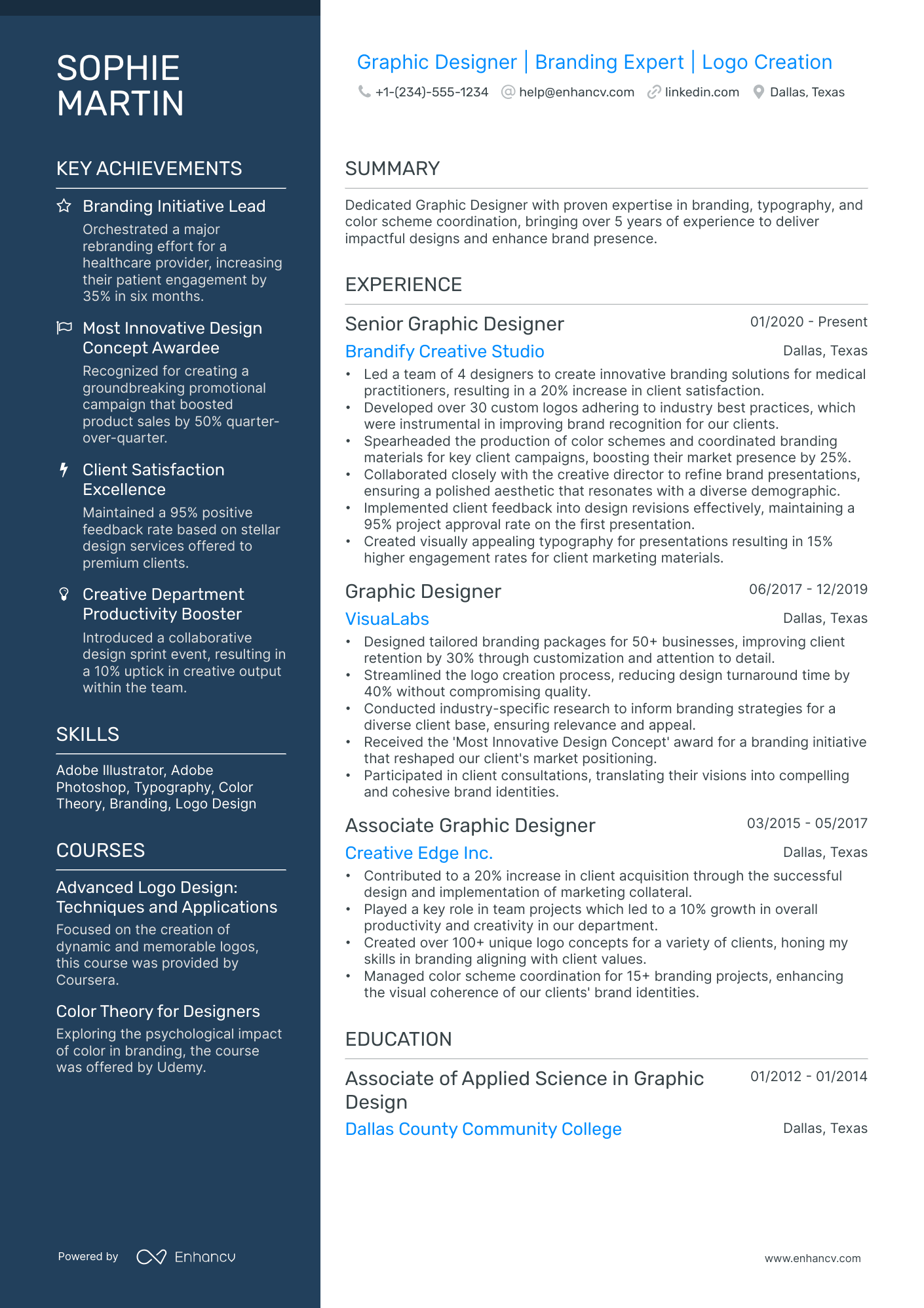
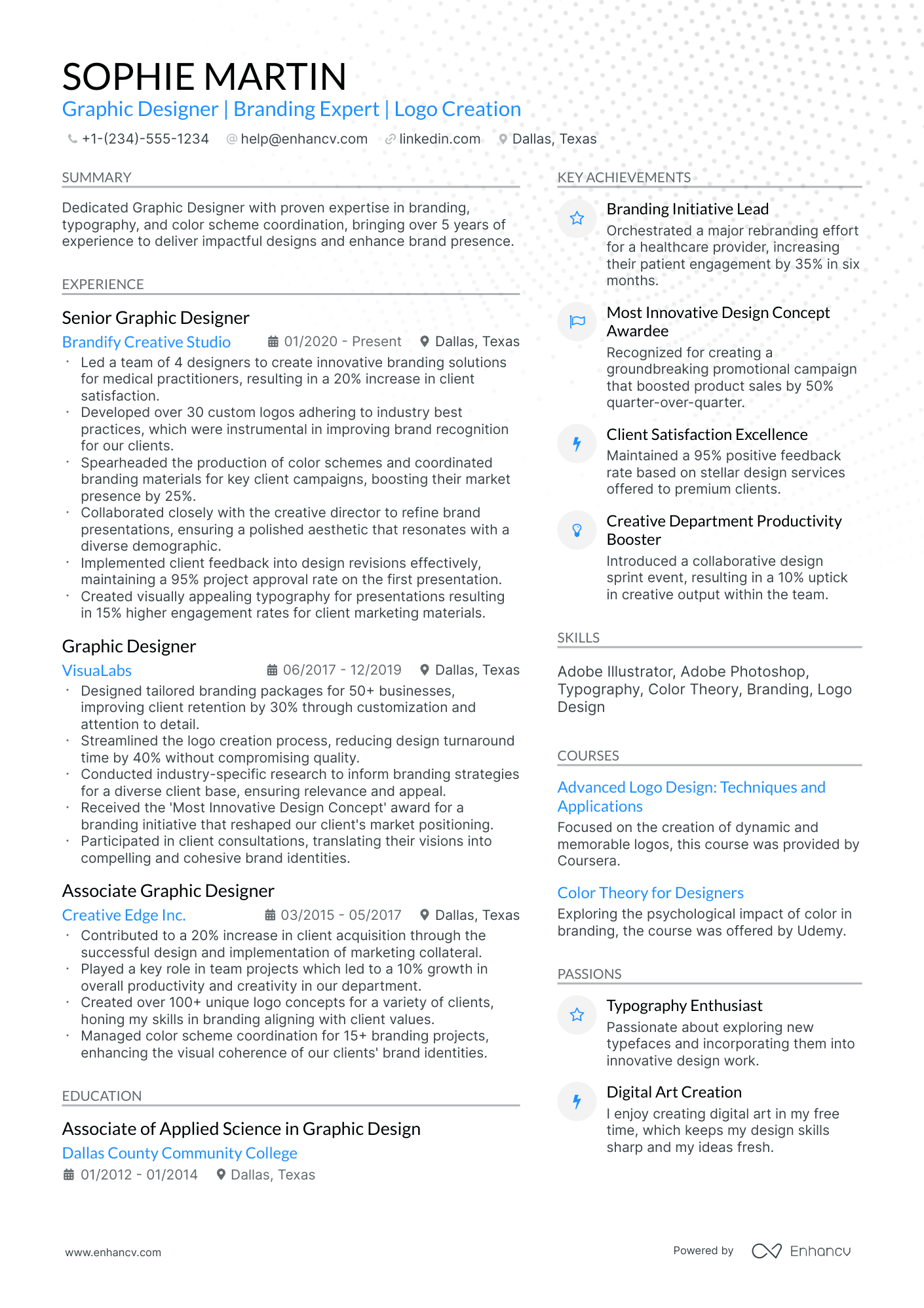
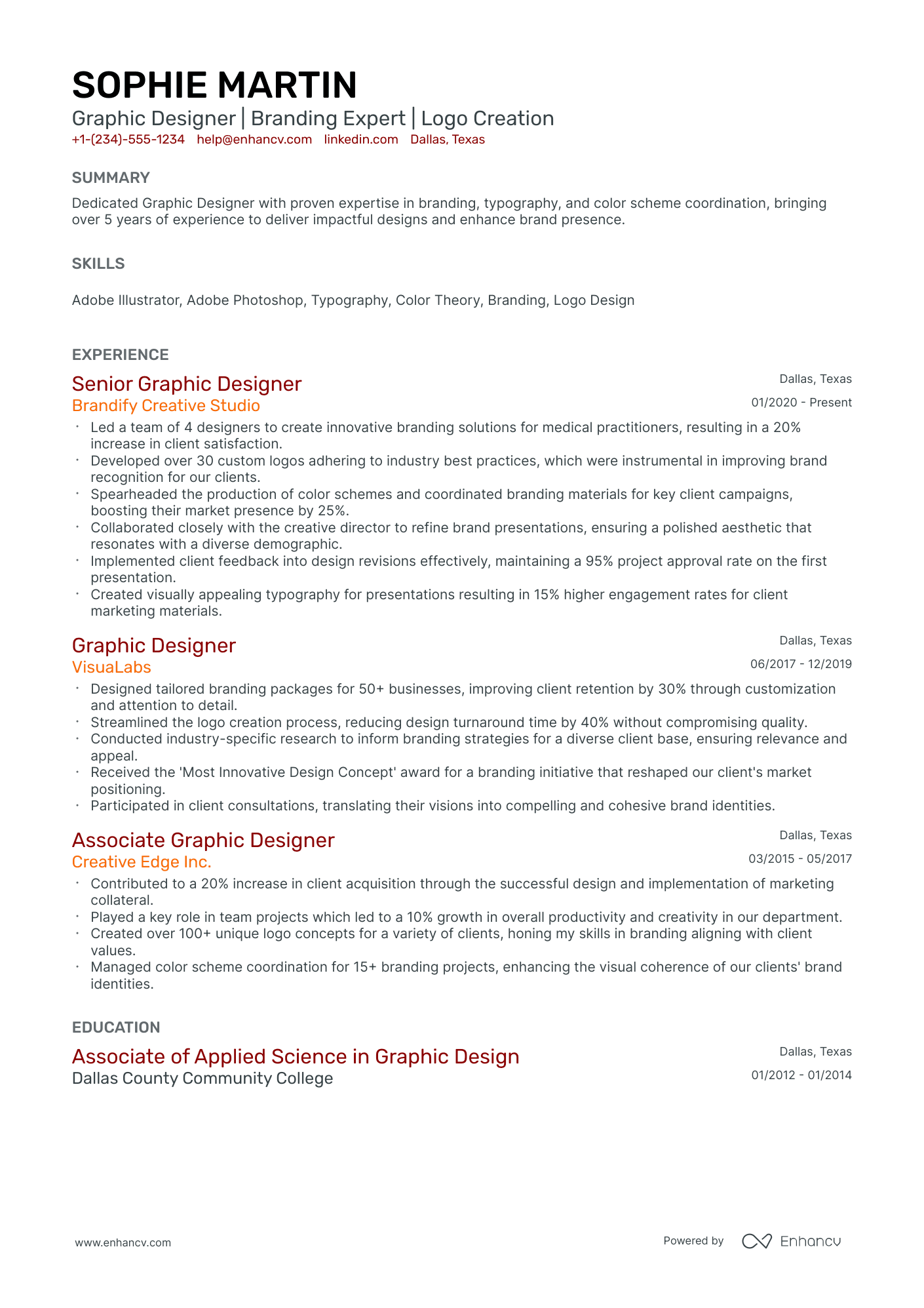
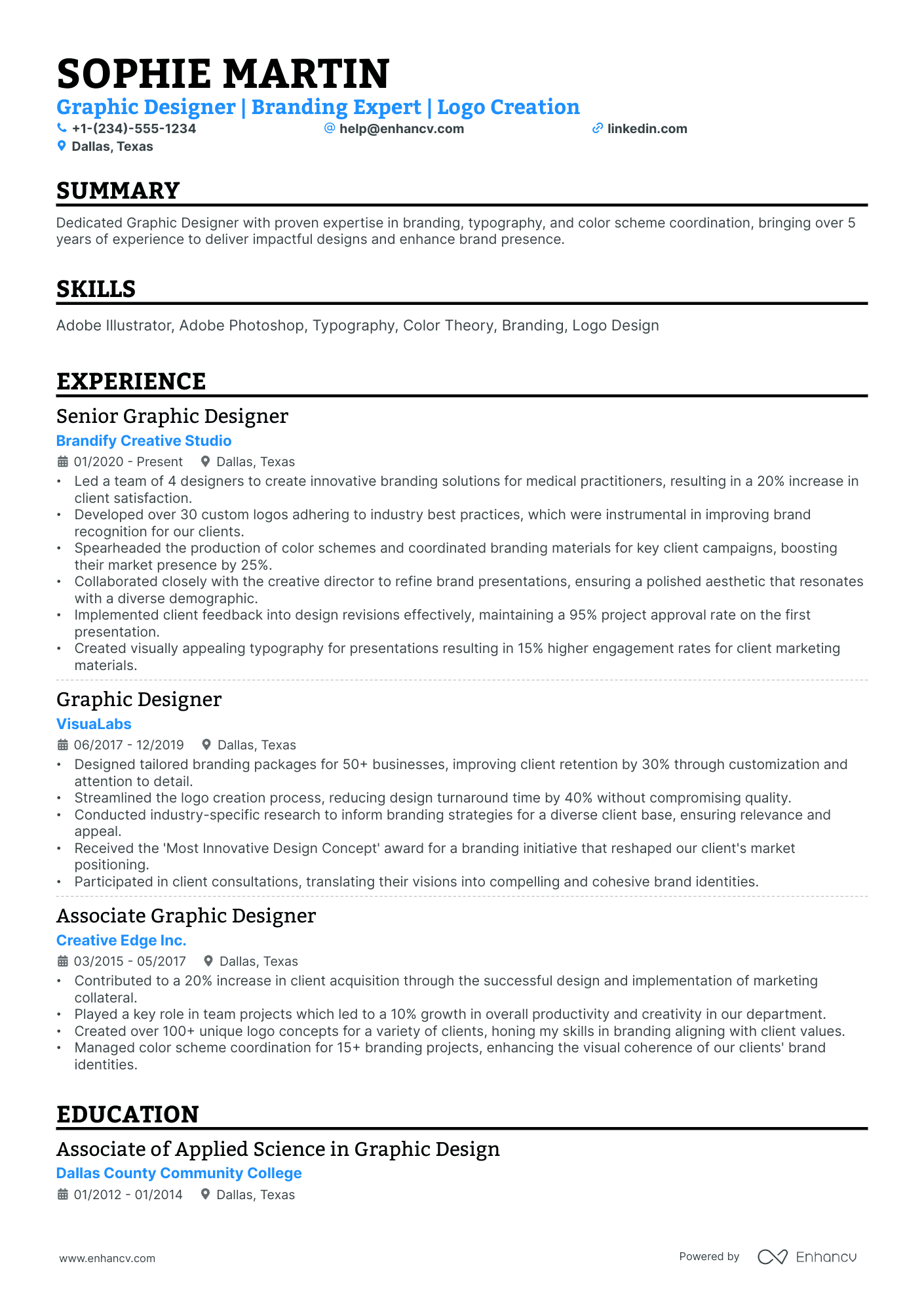
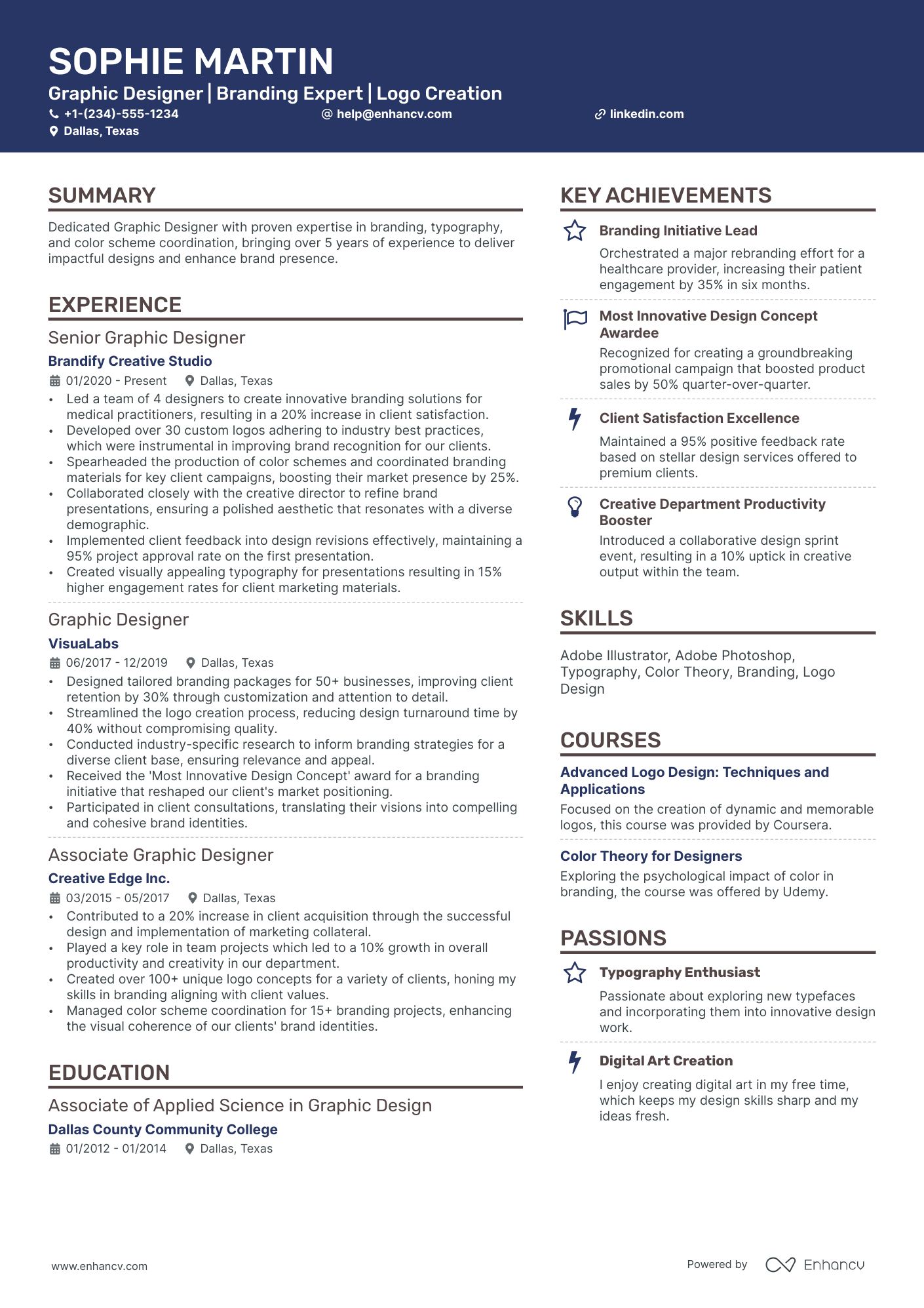
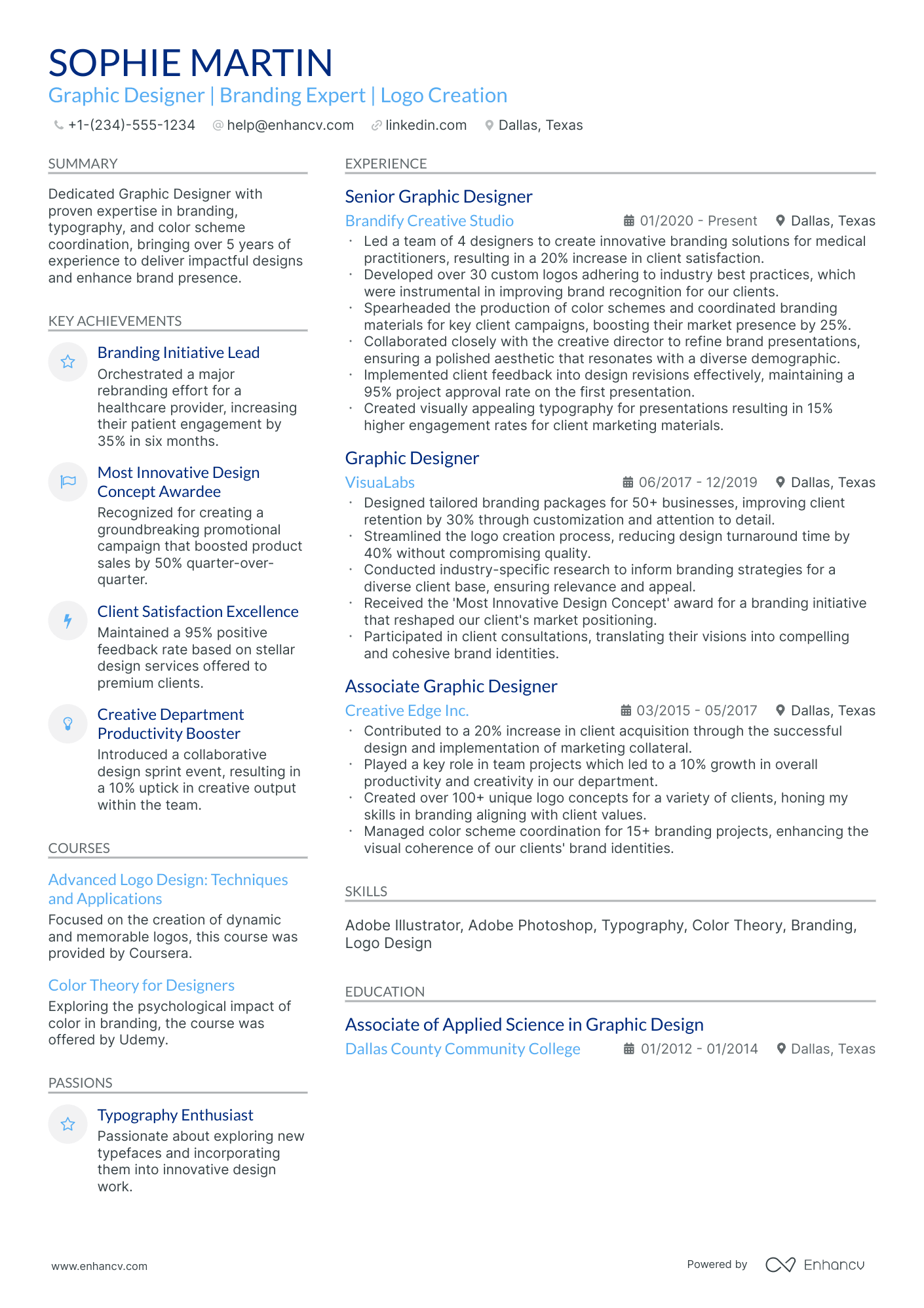
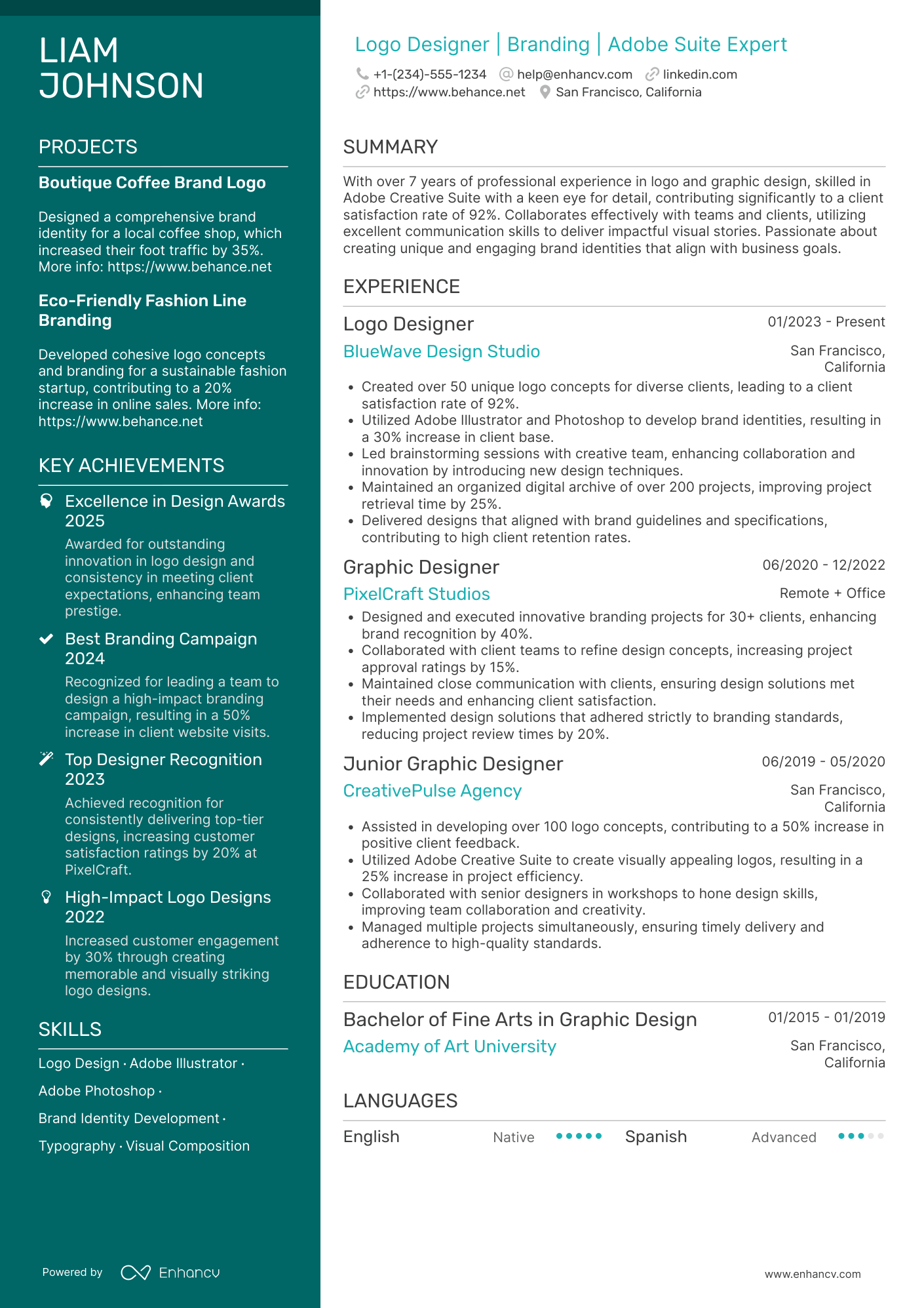
Most logo designer resumes fail because they show attractive visuals but hide measurable impact in dense layouts that ATS software can't parse. That costs you in fast recruiter scans and crowded pipelines.
A strong resume shows what changed because of your work. You should highlight lift in brand recognition, faster approvals, higher conversion on key pages, consistent system rollout across teams, fewer revisions, and on-time delivery. Understanding how to make your resume stand out is especially critical in a creative field where dozens of applicants may have similar portfolios.

Key takeaways
- Quantify logo design outcomes like approval speed, conversion lift, and rework reduction in every bullet.
- Use reverse-chronological format for experienced designers and hybrid format for career changers.
- Tailor each resume to the job posting's tools, terminology, and deliverable types.
- Lead with hard skills like Adobe Illustrator and Figma, backed by proof in experience bullets.
- Include a portfolio link with case studies that show your creative process and results.
- Write a three- to four-line summary naming your domain, tools, and one measurable achievement.
- Use Enhancv to turn vague duties into focused, results-driven resume bullets faster.
How to format a logo designer resume
Recruiters evaluating logo designer resumes prioritize a strong visual portfolio, proficiency in industry-standard design tools, and evidence of creative problem-solving tied to client or brand outcomes. Your resume format determines how quickly a hiring manager can locate these signals, so choosing the right structure ensures your strongest qualifications aren't buried.

I have significant experience in this role—which format should I use?
Use a reverse-chronological format to lead with your most recent and relevant logo design work. Do:
- Emphasize the scope and ownership of your projects—freelance client rosters, in-house brand teams, or agency accounts you managed end to end.
- Highlight proficiency in role-specific tools and domains such as Adobe Illustrator, Figma, brand identity systems, vector illustration, and typography.
- Quantify outcomes wherever possible, including project volume, client retention, revenue impact, or brand engagement metrics.
I'm junior or switching into this role—what format works best?
A hybrid format works best, allowing you to lead with a focused skills section while still showing relevant experience or projects in chronological order. Do:
- Place core design skills—Adobe Illustrator, brand identity, color theory, typography—near the top of your resume so recruiters and applicant tracking systems catch them immediately.
- Feature freelance projects, spec work, bootcamp capstones, or personal branding case studies as legitimate experience entries.
- Link every action to a clear result, even on smaller-scale projects, to demonstrate professional thinking.
Why not use a functional resume?
A functional format strips away the timeline and context recruiters need to evaluate how your design skills have been applied in real projects, making it harder to verify your abilities and easier for applicant tracking systems to misparse your resume.
- Edge-case exception: A functional resume may be acceptable if you're transitioning from a related field (such as graphic design or illustration), have limited professional work history, or are addressing a significant resume gap—but only if every listed skill is tied directly to a specific project, client deliverable, or measurable outcome.
Now that your resume's layout is set, it's time to decide which sections to include so each one works within that structure.
What sections should go on a logo designer resume
Recruiters expect to see your logo design work history, core design skills, and a portfolio-backed record of brand outcomes. Knowing what to put on a resume helps you prioritize the sections that matter most for creative roles.
Use this structure for maximum clarity:
- Header
- Summary
- Experience
- Skills
- Projects
- Education
- Certifications
- Optional sections: Awards, Publications, Volunteering
Strong experience bullets should emphasize measurable brand impact, clear outcomes, project scope, and results tied to client or business goals.
Is your resume good enough?
Drop your resume here or choose a file. PDF & DOCX only. Max 2MB file size.
Once you’ve organized the essential resume components, the next step is to write your logo designer resume experience section so it supports each part with clear, relevant proof.
How to write your logo designer resume experience
The experience section is where you prove you've shipped logo work that moved the needle—whether that means delivered brand identities, refined visual systems using specific tools and methods, or produced measurable results like increased brand recognition or client retention. Hiring managers prioritize demonstrated impact over descriptive task lists, so every line should connect what you did to a tangible outcome.
Each entry should include:
- Job title
- Company and location (or remote)
- Dates of employment (month and year)
Three to five concise bullet points showing what you owned, how you executed, and what outcomes you delivered:
- Ownership scope: the brand identities, logo systems, client accounts, visual guidelines, or design deliverables you were directly accountable for as a logo designer.
- Execution approach: the design tools, creative frameworks, research methods, or revision processes you used to develop and refine logo concepts—from initial discovery through final delivery.
- Value improved: changes to brand consistency, design turnaround speed, client satisfaction, asset scalability, or visual accessibility that resulted from your logo design work.
- Collaboration context: how you partnered with art directors, marketing teams, copywriters, brand strategists, developers, or clients to align logo direction with broader brand and business goals.
- Impact delivered: outcomes expressed through results such as successful brand launches, expanded client portfolios, improved brand perception, or repeat engagements—rather than a list of tasks performed.
Experience bullet formula
A logo designer experience example
✅ Right example - modern, quantified, specific.
Senior Logo Designer
Northstar Fintech | Remote
2022–Present
Designed brand identities for a consumer finance app serving over two million users across the United States.
- Led logo redesign in Adobe Illustrator and Figma, delivering a responsive mark system for app, web, and print that improved brand recall by 18% in post-launch user surveys.
- Built a scalable vector logo library (SVG, PDF, EPS) and brand kit in Zeroheight, cutting asset-request turnaround time by 35% for marketing and product teams.
- Ran stakeholder workshops and competitive audits, translating insights into three tested creative directions; secured executive approval in two review cycles instead of four.
- Partnered with product designers and engineers to validate accessibility and legibility (contrast checks, small-size rendering), reducing icon and logo-related QA defects by 28% across iOS and Android releases.
- Standardized export specs and naming conventions via Figma components and Adobe Libraries, reducing rework from incorrect files by 40% and accelerating campaign launches by one week on average.
Now that you've seen how a strong experience section looks in practice, let's break down how to customize yours for each specific job posting.
How to tailor your logo designer resume experience
Recruiters evaluate your logo designer resume through both human review and applicant tracking systems, so tailoring your resume to the job description is essential. Tailoring ensures the specific tools, design methods, and outcomes you highlight match what the employer actually needs.
Ways to tailor your logo designer experience:
- Match design software like Illustrator or Figma listed in the posting.
- Mirror the exact brand identity terminology the job description uses.
- Highlight vector illustration skills when the role specifies them.
- Include industry experience relevant to the employer's market or sector.
- Emphasize scalability and accessibility standards if the posting mentions them.
- Reference collaborative workflows with marketing or product teams when noted.
- Align your revision and feedback process with their stated design methodology.
- Showcase versatility across digital and print logo deliverables when requested.
Tailoring means aligning your real accomplishments with the role's stated requirements, not forcing keywords where they don't belong.
Resume tailoring examples for logo designer
| Job description excerpt | Untailored | Tailored |
|---|---|---|
| "Design scalable logo systems in Adobe Illustrator for SaaS clients, ensuring brand consistency across digital and print applications." | Created logos for various companies using design software. | Designed scalable logo systems in Adobe Illustrator for 12 SaaS clients, delivering vector assets optimized for digital platforms, print collateral, and favicon use while maintaining brand consistency across 30+ touchpoints. |
| "Collaborate with marketing teams to develop logomarks that perform well at small sizes for mobile app icons and social media avatars." | Worked with teams to make logos that look good in different places. | Partnered with marketing teams to develop simplified logomarks tested at 16×16px through 512×512px, improving visual clarity for mobile app icons and social media avatars across iOS, Android, and seven social platforms. |
| "Lead client discovery sessions to translate brand strategy into distinctive wordmarks and lettermarks for early-stage startups in the fintech space." | Talked to clients about what they wanted and designed logos based on their feedback. | Led 20+ client discovery sessions for early-stage fintech startups, translating brand positioning and competitive analysis into distinctive wordmarks and lettermarks—achieving first-round approval on 85% of logo concepts presented. |
Once you’ve aligned your experience with the role’s needs, quantify your logo designer achievements to show the impact of that work with measurable results.
How to quantify your logo designer achievements
Quantifying your achievements proves business impact, not just aesthetics. Track turnaround time, approval speed, conversion lift, rework reduction, and brand consistency across deliverables, channels, and teams.
Quantifying examples for logo designer
| Metric | Example |
|---|---|
| Turnaround time | "Cut logo concept-to-first-review time from five days to two by standardizing briefs and building Figma component libraries." |
| Approval speed | "Reduced stakeholder approval rounds from four to two by running one thirty-minute alignment workshop and sharing a decision-ready comparison deck." |
| Conversion lift | "Improved landing-page sign-up conversion by 6.8% after testing two logo lockups and updating hero visuals in Webflow and Google Optimize." |
| Rework reduction | "Lowered revision requests by 35% by delivering a one-page brand rationale and accessibility checks for contrast and legibility." |
| Brand consistency | "Raised brand compliance from 72% to 93% across forty-two assets by shipping a logo usage guide and exporting templates for Adobe Illustrator." |
Turn vague job duties into measurable, recruiter-ready resume bullets in seconds with Enhancv's Bullet Point Generator.
Once your bullet points clearly showcase your achievements, it's equally important to highlight the specific hard and soft skills that reinforce your expertise as a logo designer.
How to list your hard and soft skills on a logo designer resume
Your skills section shows you can translate brand strategy into usable identity assets, and recruiters and an ATS (applicant tracking system) scan this section for job-match keywords—aim for a mostly hard-skills mix with a smaller set of role-specific soft skills. Logo designer roles require a blend of:
- Product strategy and discovery skills.
- Data, analytics, and experimentation skills.
- Delivery, execution, and go-to-market discipline.
- Soft skills.
Your skills section should be:
- Scannable (bullet-style grouping).
- Relevant to the job post.
- Backed by proof in experience bullets.
- Updated with current tools.
Place your skills section:
- Above experience if you're junior or switching careers.
- Below experience if you're mid/senior with strong achievements.

Hard skills
Your hard skills demonstrate the technical proficiency hiring managers look for:
- Adobe Illustrator, Photoshop
- Figma, FigJam
- Logo grid systems
- Typography and kerning
- Color theory and contrast
- Vector illustration, SVG
- Brand identity systems
- Iconography and symbol design
- Logo lockups and variants
- Brand guidelines creation
- File prep for print and digital
- Accessibility checks (WCAG)
Soft skills
Your soft skills show how you collaborate and deliver in real design environments:
- Translate briefs into concepts
- Present rationale to stakeholders
- Run structured design critiques
- Incorporate feedback without dilution
- Collaborate with marketing and product
- Manage scope and revisions
- Prioritize deadlines and quality
- Document decisions and standards
- Ask clarifying discovery questions
- Align on approval criteria
- Maintain brand consistency across teams
- Own handoff to developers and printers
How to show your logo designer skills in context
Skills shouldn't live only in a bulleted list on your resume. Explore resume skills examples to see how designers present their abilities effectively.
They should be demonstrated in:
- Your summary (high-level professional identity)
- Your experience (proof through outcomes)
Here's what that looks like in practice.
Summary example
Senior logo designer with 10+ years crafting brand identities for SaaS and fintech companies. Skilled in Adobe Illustrator, brand strategy, and client discovery workshops. Redesigned identity systems that boosted brand recognition scores by 35%.
- Signals senior-level expertise immediately
- Names industry-standard tools directly
- Quantifies brand impact with metrics
- Highlights client collaboration skills
Experience example
Senior Logo Designer
BrightMark Studio | Remote
March 2019–Present
- Designed 60+ logo systems in Illustrator and Figma, increasing average client brand recall by 28% across post-launch surveys.
- Collaborated with marketing strategists and copywriters to deliver cohesive identity packages, cutting revision rounds by 40%.
- Led competitive audit workshops using moodboarding and typographic analysis, shortening concept approval timelines by three weeks.
- Every bullet includes measurable proof
- Skills surface naturally through real outcomes
Once you’ve demonstrated your logo design strengths through real examples and outcomes, the next step is to translate that evidence into a resume even if you don’t have formal experience.
How do I write a logo designer resume with no experience
Even without full-time experience, you can build a compelling resume without work experience by demonstrating readiness through:
- Self-initiated brand identity projects
- Volunteer logos for local nonprofits
- Freelance gigs for small businesses
- Design challenges with published briefs
- Class capstone logo redesigns
- Personal portfolio case studies
- Internship or apprenticeship assignments
- Logo system work for startups
Focus on:
- Portfolio links with case studies
- Consistent logo systems and variants
- Tool proficiency: Adobe Illustrator, Figma
- Measurable outcomes and constraints met
Resume format tip for entry-level logo designer
Use a combination resume format because it highlights skills and projects first, while still showing work history, even if it's unrelated. Do:
- Link to a curated portfolio.
- Write two to three project bullets.
- Name tools used in each project.
- Quantify results, constraints, and scope.
- Match keywords to the job post.
- Created a volunteer logo system in Adobe Illustrator for a local nonprofit, delivering six lockups and a one-page style guide, cutting turnaround time by 30%.
Even without formal work history, your education section can demonstrate the foundational design knowledge and technical training that make you a strong candidate.
How to list your education on a logo designer resume
Your education section helps hiring teams verify foundational design knowledge. It confirms you've studied principles like typography, color theory, and composition—core skills every logo designer needs.
Include:
- Degree name
- Institution
- Location
- Graduation year
- Relevant coursework (for juniors or entry-level candidates)
- Honors & GPA (if 3.5 or higher)
Skip month and day details—list the graduation year only.
Here's a strong education entry tailored for a logo designer resume.
Example education entry
Bachelor of Fine Arts in Graphic Design
Savannah College of Art and Design, Savannah, GA
Graduated 2021
GPA: 3.7
- Relevant Coursework: Logo & Brand Identity Design, Typography Systems, Vector Illustration, Color Theory, Visual Communication
- Honors: Dean's List (six consecutive quarters), SCAD Achievement in Design Award
How to list your certifications on a logo designer resume
Certifications on your resume show your commitment to learning, confirm tool proficiency, and signal industry relevance as a logo designer. They also help hiring teams trust your skills beyond your portfolio.
Include:
- Certificate name
- Issuing organization
- Year
- Optional: credential ID or URL
- List certifications below education when your degree is recent and directly related to design or visual communication.
- List certifications above education when they are recent, highly relevant to logo designer work, or your education is older or unrelated.
Best certifications for your logo designer resume
- Adobe Certified Professional in Graphic Design & Illustration Using Adobe Illustrator
- Adobe Certified Professional in Visual Design Using Adobe Photoshop
- Google UX Design Professional Certificate
- Nielsen Norman Group UX Certification
- Certified Brand Strategist (CBS)
- HubSpot Content Marketing Certification
- LinkedIn Learning Certificate of Completion: Logo Design
Once you’ve shown your credentials in a way that supports the role, shift to your logo designer resume summary to tie them to your value and set the tone for the rest of your resume.
How to write your logo designer resume summary
Your resume summary is the first thing a recruiter reads. A strong one immediately signals you have the design skills and creative problem-solving the role demands.
Keep it to three to four lines, with:
- Your title and total years of logo and brand identity design experience.
- The domain you work in, such as tech startups, consumer brands, or agencies.
- Core tools like Adobe Illustrator, Figma, or Affinity Designer.
- One or two measurable achievements, such as projects completed or client retention rates.
- Soft skills tied to real outcomes, like clear client communication that reduced revision rounds.

PRO TIP
At a junior level, lead with your strongest technical skills and relevant tools. Highlight early wins, even from freelance or academic projects. Avoid vague phrases like "passionate creative" or "hard worker." Instead, show what you actually built and the results it produced.
Example summary for a logo designer
Junior logo designer with two years of experience creating brand identities for e-commerce startups. Skilled in Adobe Illustrator and Figma. Delivered 30+ logos with a 95% client approval rate on first revision.
Optimize your resume summary and objective for ATS
Drop your resume here or choose a file.
PDF & DOCX only. Max 2MB file size.
Now that your summary captures your design expertise at a glance, make sure your header presents the essential contact and professional details recruiters need to reach you.
What to include in a logo designer resume header
Your resume header is the top section with your key identifiers, and it boosts visibility, credibility, and fast recruiter screening for a logo designer.
Essential resume header elements
- Full name
- Tailored job title and headline
- Location
- Phone number
- Professional email
- GitHub link
- Portfolio link
A LinkedIn link helps recruiters verify experience quickly and supports screening.
Don't include a photo on a logo designer resume unless the role is explicitly front-facing or appearance-dependent.
Keep the header on one to two lines, match your job title to the posting, and make every link clickable and easy to scan.
Logo designer resume header
Jordan Lee
Logo Designer | Brand Identity and Visual Systems
Austin, TX
(512) 555-01XX jordan.lee@enhancv.com github.com/jordanlee jordanlee.com linkedin.com/in/jordanlee
Once your contact details and role branding are clear at the top, add optional sections to highlight supporting qualifications that strengthen your logo designer resume.
Additional sections for logo designer resumes
Adding extra sections helps you stand out when your core experience alone doesn't fully capture your creative expertise or industry credibility. For example, listing language skills can be a differentiator if you work with international clients or global brand teams.
- Languages
- Design competitions and awards
- Hobbies and interests
- Publications and featured work
- Professional memberships and design associations
- Volunteer design projects
Once you've strengthened your resume with relevant additional sections, the next step is pairing it with a cover letter that gives your application even more impact.
Do logo designer resumes need a cover letter
A cover letter isn't required for a logo designer, but it helps in competitive roles or when hiring managers expect one. If you're unsure where to start, understanding what a cover letter is and how it complements your resume can clarify when it's worth including one. It can make a difference when your resume needs context, or when your portfolio alone won't explain your decisions.
Use a cover letter when it adds clear, specific context:
- Explain role or team fit by naming the type of stakeholders you partner with and how you work through feedback and approvals.
- Highlight one or two relevant projects or outcomes, including measurable results like conversion lifts, retention gains, or faster production timelines.
- Show understanding of the product, users, or business context by referencing the audience, brand positioning, and constraints you designed for.
- Address career transitions or non-obvious experience by connecting past work to logo designer requirements and explaining any gaps briefly.
Drop your resume here or choose a file.
PDF & DOCX only. Max 2MB file size.
Once you’ve decided whether to include a cover letter based on the role and employer expectations, the next step is using AI to improve your logo designer resume so it aligns with those requirements faster and more accurately.
Using AI to improve your logo designer resume
AI can sharpen your resume's clarity, structure, and overall impact. It helps tighten language and highlight results. But overuse strips away authenticity. Once your content feels clear and aligned with the logo designer role, step away from AI. If you're wondering which AI is best for writing resumes, start with tools that let you stay in control of your content.
Here are 10 practical prompts to strengthen specific sections of your logo designer resume:
- Strengthen your summary. "Rewrite my logo designer resume summary to highlight my core design strengths and years of experience in under four sentences."
- Quantify your impact. "Add measurable results to these logo designer experience bullets, focusing on client outcomes, project volume, or turnaround time."
- Tighten bullet points. "Shorten each of my logo designer experience bullets to one concise line that leads with a strong action verb."
- Align with jobs. "Compare my logo designer resume skills section against this job description and suggest missing relevant keywords."
- Improve project descriptions. "Rewrite my logo designer portfolio project descriptions to emphasize the creative brief, process, and final deliverables."
- Refine technical skills. "Organize my logo designer skills list into clear categories like software proficiency, design techniques, and branding knowledge."
- Elevate education details. "Rewrite my education section to highlight coursework and achievements most relevant to a logo designer role."
- Showcase certifications. "Rewrite my certifications section to clarify how each credential supports my qualifications as a logo designer."
- Remove filler language. "Identify and remove vague or redundant phrases across my entire logo designer resume without changing the core meaning."
- Tailor for industry. "Adjust my logo designer resume experience section to better target opportunities in the [specific industry] sector."
Stop using AI once your resume sounds accurate, specific, and aligned with real experience. AI should never invent experience or inflate claims—if it didn't happen, it doesn't belong here.
Conclusion
A strong logo designer resume shows measurable outcomes, role-specific skills, and clean structure. Use clear sections, targeted bullets, and a focused portfolio link. Highlight results like faster approvals, higher conversion rates, and consistent brand use across channels.
Hiring teams want proof you can solve problems, collaborate, and deliver on time. Keep your experience easy to scan, your skills relevant, and your impact specific. With that approach, your logo designer resume fits today’s market and stays ready for what comes next.