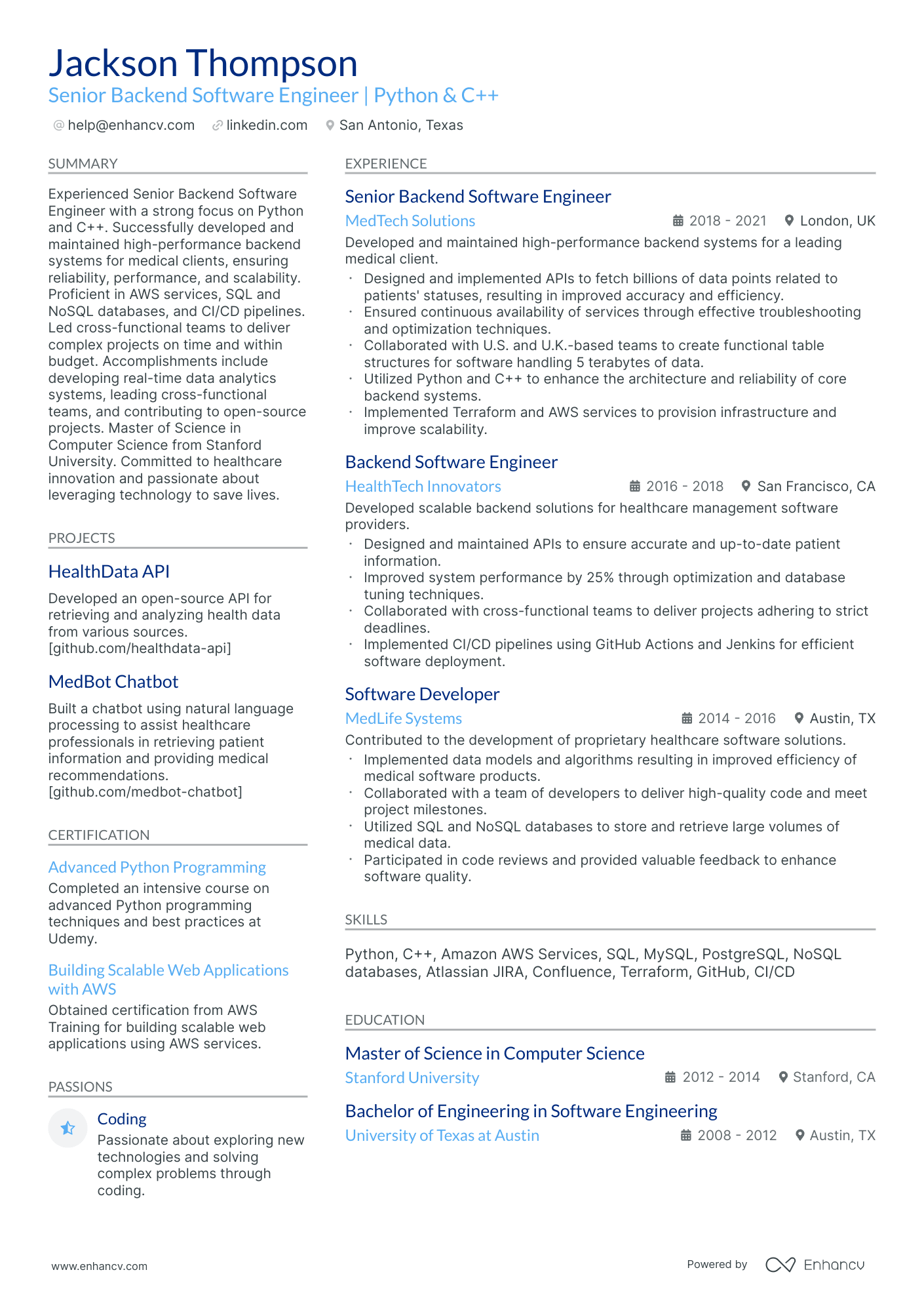
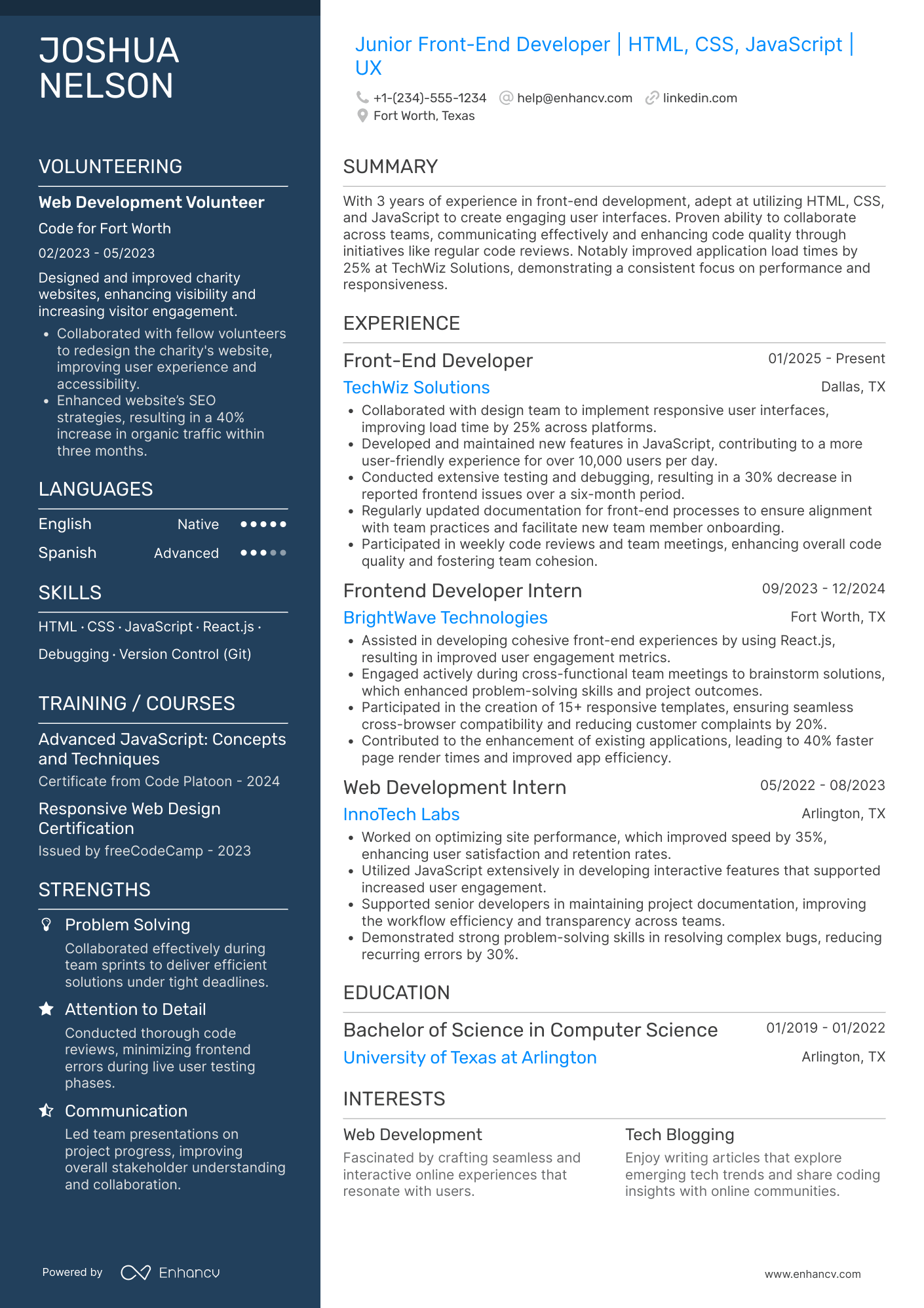
Many junior Front-End developer resume drafts fail because they list tools and coursework but don't show shipped work or measurable impact. That hurts when a junior Front-End developer resume gets filtered by an ATS and scanned in seconds.
A strong resume shows what you delivered and improved, not just what you used. Understanding how to make your resume stand out means you'll highlight faster load times, accessible components shipped, bugs reduced, features released on schedule, and user flows that increased sign-ups or cut drop-offs.

Key takeaways
- Quantify front-end impact with metrics like load time, accessibility scores, and bug reduction.
- Use a hybrid resume format to lead with technical skills when professional experience is limited.
- Tailor every experience bullet to match the specific job posting's tools and terminology.
- Replace task descriptions with outcome-driven bullets showing what you shipped and improved.
- Include portfolio projects with live links, tech stacks, and measurable results as experience entries.
- Place certifications near education to validate skills your work history can't yet prove.
- Use Enhancv's tools to refine bullet points and align your resume with role-specific keywords.
How to format a junior Front-End developer resume
Recruiters screening junior front-end developer resumes prioritize technical skills (HTML, CSS, JavaScript, and framework familiarity), portfolio projects, and evidence that you can translate learned skills into tangible outcomes. Choosing the right resume format determines how quickly a recruiter can locate these signals—and whether an applicant tracking system (ATS) can parse them correctly.

I have significant experience in this role—which format should I use?
Use a reverse-chronological format to place your strongest and most recent front-end work at the top. Do:
- Lead with your most recent role and clarify your scope—team size, product type, and ownership level within the front-end stack.
- Highlight specific tools and domains: JavaScript frameworks (React, Vue, Angular), CSS methodologies, accessibility standards, and performance optimization.
- Quantify outcomes tied to user experience, performance, or business metrics.
I'm junior or switching into this role—what format works best?
Use a hybrid format that leads with a focused skills section, then supports it with project or work experience listed in reverse-chronological order. Do:
- Place a technical skills section near the top, grouping proficiencies by category (languages, frameworks, tools) so recruiters and ATS software can identify them immediately.
- Include portfolio projects, bootcamp capstones, or open-source contributions as experience entries—each with a title, tech stack, and brief description of what you built.
- Connect every action to a result, even if the result is qualitative (improved usability, passed accessibility audit, reduced bug count).
When does a functional resume make sense?
A functional format can work in a narrow set of circumstances for junior front-end developers:
- You're switching careers from a non-technical field and have no professional front-end experience, but you've completed substantial coursework, certifications, or personal projects.
- You have a gap of one year or more in your work history and need to foreground recently acquired skills over your timeline.
- Your prior roles are entirely unrelated to development, and listing them chronologically would push relevant skills below the fold.
With your format set, the next step is deciding which sections to include and how to arrange them to best highlight your qualifications.
What sections should go on a junior Front-End developer resume
Recruiters expect you to show clear front-end fundamentals, real project work, and evidence you can ship polished, accessible interfaces. Knowing what to put on a resume helps you prioritize the right content for this role.
Use this structure for maximum clarity:
- Header
- Summary
- Experience
- Skills
- Projects
- Education
- Certifications
- Optional sections: Open-source work, volunteering, languages
Strong experience bullets should emphasize measurable impact, shipped features, performance or accessibility improvements, and the scope of your contribution.
Is your resume good enough?
Drop your resume here or choose a file. PDF & DOCX only. Max 2MB file size.
Once you’ve organized your resume with the right components, the next step is writing your experience section so it supports each part with clear, relevant proof.
How to write your junior Front-End developer resume experience
Your work experience section should highlight front-end work you've shipped or contributed to, the frameworks and tools you used, and any measurable outcomes you helped produce. Hiring managers prioritize demonstrated impact—pages built, bugs resolved, performance gains—over descriptive task lists that only catalog daily duties.
Each entry should include:
- Job title
- Company and location (or remote)
- Dates of employment (month and year)
Three to five concise bullet points showing what you owned, how you executed, and what outcomes you delivered:
- Ownership scope: the specific components, pages, features, or UI modules you were responsible for building or maintaining as a junior front-end developer.
- Execution approach: the languages, libraries, frameworks, and workflows—such as HTML, CSS, JavaScript, React, Git, or design-to-code handoff tools—you used to complete your work.
- Value improved: the changes you drove in page load speed, responsiveness, cross-browser compatibility, accessibility compliance, code quality, or visual consistency across the product.
- Collaboration context: how you coordinated with designers, back-end developers, QA engineers, or product managers to translate requirements into functional, polished interfaces.
- Impact delivered: the tangible results your front-end contributions produced, expressed through user-facing improvements, project delivery milestones, or reductions in defects rather than routine activity descriptions.
Experience bullet formula
A junior Front-End developer experience example
✅ Right example - modern, quantified, specific.
Junior Front-End Developer
LumenCart | Remote
2023–2025
E-commerce platform serving 200,000+ monthly shoppers across small and mid-sized retailers.
- Built and shipped responsive React and TypeScript components from Figma using Storybook and CSS Modules, reducing design-to-dev handoff rework by 25% with designers and a product manager.
- Improved Core Web Vitals by optimizing images (next-gen formats, lazy loading), code splitting, and memoization, cutting median Largest Contentful Paint from 3.1 seconds to 2.2 seconds on key landing pages.
- Implemented unit and integration tests with Jest and React Testing Library and added GitHub Actions checks, lowering production regressions by 30% and increasing pull request confidence for the team.
- Refactored a legacy checkout flow to React Hook Form and reusable validation utilities, reducing form-related support tickets by 18% and improving checkout completion by 6%.
- Partnered with back-end engineers to integrate REST endpoints and typed clients, adding caching and error states that reduced repeat API calls by 20% and improved perceived load time for returning users.
Now that you've seen how a strong entry-level experience section comes together, let's look at how to adjust yours to match the specific job you're applying for.
How to tailor your junior Front-End developer resume experience
Recruiters evaluate your junior Front-End developer resume through both human review and applicant tracking systems. Tailoring your resume to the job description ensures your skills and accomplishments pass both screenings.
Ways to tailor your junior Front-End developer experience:
- Match the JavaScript frameworks and libraries named in the job description.
- Mirror the exact CSS methodologies or preprocessors the posting specifies.
- Use the same terminology for version control workflows referenced.
- Highlight responsive design or mobile-first development if mentioned.
- Emphasize web accessibility standards and WCAG compliance when relevant.
- Include experience with the specific testing tools or practices listed.
- Reference agile or scrum collaboration models the team uses.
- Align your performance optimization work with stated page speed goals.
Tailoring means aligning your real accomplishments with the role's requirements, not forcing keywords where they don't belong.
Resume tailoring examples for junior Front-End developer
| Job description excerpt | Untailored | Tailored |
|---|---|---|
| Build responsive UIs using React and TypeScript within an agile team; collaborate with UX designers to implement Figma mockups. | Worked on front-end projects and helped build user interfaces for web applications. | Translated Figma mockups into responsive React components with TypeScript, shipping pixel-perfect UIs across 12 sprint cycles in an agile team of eight. |
| Write clean, accessible HTML/CSS and optimize page performance using Lighthouse audits; support ADA compliance across customer-facing pages. | Updated website code and fixed bugs to improve the user experience. | Wrote semantic HTML and modular CSS for five customer-facing pages, raising Lighthouse accessibility scores from 74 to 96 and meeting WCAG 2.1 AA compliance standards. |
| Maintain and extend a Vue.js component library; write unit tests with Jest and participate in code reviews via GitHub pull requests. | Assisted with JavaScript development tasks and contributed to team projects. | Extended a shared Vue.js component library with 15 reusable components, wrote Jest unit tests covering 85% of new code, and reviewed 40+ GitHub pull requests over six months. |
Once your experience aligns with the role’s requirements, quantify your junior front-end developer achievements to show the impact behind those responsibilities.
How to quantify your junior Front-End developer achievements
Quantifying your achievements proves you improved real outcomes, not just shipped code. For junior front-end developers, focus on performance, quality, delivery speed, reliability, and user behavior changes tied to specific releases.
Quantifying examples for junior Front-End developer
| Metric | Example |
|---|---|
| Performance | "Improved Largest Contentful Paint from 3.2 seconds to 2.1 seconds by code-splitting routes and optimizing images with Next.js and ImageMagick." |
| Quality | "Reduced production JavaScript errors by 28% by adding TypeScript types and writing twenty-five Jest and React Testing Library tests for critical components." |
| Delivery speed | "Cut PR review-to-merge time from 2.5 days to 1.6 days by standardizing Storybook examples and adding a reusable component checklist." |
| Reliability | "Lowered failed deployments from 3 per month to 1 per month by fixing flaky end-to-end tests in Cypress and tightening GitHub Actions steps." |
| User conversion | "Increased sign-up completion rate by 4.3% by improving form validation, adding inline error messages, and tracking funnels in Google Analytics." |
Turn your everyday tasks into measurable, recruiter-ready resume bullets in seconds with Enhancv's Bullet Point Generator.
With your experience clearly articulated, it's time to ensure your skills section showcases the right mix of technical and interpersonal strengths employers expect from a junior front-end developer.
How to list your hard and soft skills on a junior Front-End developer resume
Your skills section shows you can build, test, and ship user interfaces, and recruiters and an ATS (applicant tracking system) scan this section for role keywords; aim for a balanced mix of hard skills and job-relevant soft skills. junior Front-End developer roles require a blend of:
- Product strategy and discovery skills.
- Data, analytics, and experimentation skills.
- Delivery, execution, and go-to-market discipline.
- Soft skills.
Your skills section should be:
- Scannable (bullet-style grouping).
- Relevant to the job post.
- Backed by proof in experience bullets.
- Updated with current tools.
Place your skills section:
- Above experience if you're junior or switching careers.
- Below experience if you're mid/senior with strong achievements.

Hard skills
- HTML5, semantic markup
- CSS3, responsive layouts
- Flexbox, CSS Grid
- JavaScript (ES6+)
- TypeScript
- React, Next.js
- State management: Redux, Zustand
- REST APIs, JSON
- Git, GitHub pull requests
- Testing: Jest, React Testing Library
- Web performance optimization
- Accessibility: WCAG, ARIA
Soft skills
- Break down tickets into tasks
- Ask clear technical questions
- Communicate tradeoffs early
- Write concise status updates
- Collaborate with designers in Figma
- Take feedback and iterate fast
- Document decisions in pull requests
- Debug issues methodically
- Prioritize fixes by user impact
- Coordinate handoffs with back-end teammates
- Manage scope to hit deadlines
- Follow code review standards consistently
How to show your junior Front-End developer skills in context
Skills shouldn't live only in a dedicated skills list. Browse examples of effective resume skills to see how top candidates present their abilities.
They should be demonstrated in:
- Your summary (high-level professional identity)
- Your experience (proof through outcomes)
Here's what that looks like in practice.
Summary example
Junior front-end developer with two years of experience building responsive interfaces in React and TypeScript for e-commerce platforms. Improved page load speed by 34% through component optimization. Collaborative team player skilled in Agile workflows and cross-functional communication.
- Specifies experience level and domain
- Names role-relevant tools directly
- Includes a measurable performance outcome
- Highlights collaboration as a soft skill
Experience example
Junior Front-End Developer
Bridgeline Digital | Remote
June 2023–Present
- Rebuilt a client dashboard UI in React, reducing average load time by 28% across three product pages.
- Partnered with UX designers and back-end engineers to implement accessible components meeting WCAG 2.1 AA standards.
- Wrote unit tests in Jest that increased front-end code coverage from 45% to 78% within one quarter.
- Every bullet includes measurable proof.
- Skills appear naturally within real outcomes.
Once you’ve demonstrated your junior front-end developer skills through specific examples and outcomes, the next step is to apply that same approach to writing a junior front-end developer resume with no experience so your strengths still come through clearly.
How do I write a junior Front-End developer resume with no experience
Even without full-time experience, you can demonstrate readiness through:
- Personal portfolio site builds
- GitHub contributions and pull requests
- Open-source documentation fixes
- Freelance landing page projects
- Frontend Mentor challenge solutions
- Hackathon web app prototypes
- Volunteer nonprofit website updates
- Coursework capstone web projects
If you're building a resume without work experience, focus on:
- Shipped projects with live links
- JavaScript, HTML, and CSS depth
- Git workflow and code reviews
- Accessibility and performance results
Resume format tip for entry-level junior Front-End developer
Use a skills-based resume format because it puts projects, technical skills, and measurable results above limited work history. Do:
- Lead with projects, then technical skills.
- Link to GitHub and live demos.
- Add metrics: load time, Lighthouse, bugs.
- List tools: React, TypeScript, Git.
- Match keywords from the job post.
- Built a responsive React portfolio site, improved Lighthouse performance score from 62 to 92, and deployed via GitHub Pages with automated builds.
When you lack professional experience, your education section becomes one of the strongest ways to demonstrate relevant qualifications—here's how to present it effectively.
How to list your education on a junior Front-End developer resume
Your education section helps hiring teams confirm you have foundational knowledge in web development, programming, and design. It validates your readiness for a junior Front-End developer role.
Include:
- Degree name
- Institution
- Location
- Graduation year
- Relevant coursework (for juniors or entry-level candidates)
- Honors & GPA (if 3.5 or higher)
Skip month and day details—list the graduation year only.
Here's a strong education entry for a junior Front-End developer resume:
Example education entry
Bachelor of Science in Computer Science
University of North Carolina at Charlotte, Charlotte, NC
Graduated 2024
GPA: 3.7/4.0
- Relevant Coursework: Web Development, JavaScript Programming, User Interface Design, Data Structures, Responsive Design Principles
- Honors: Dean's List (six semesters), Magna Cum Laude
How to list your certifications on a junior Front-End developer resume
Certifications on your resume show your commitment to learning, prove tool proficiency, and signal industry relevance. For a junior Front-End developer, they help validate skills when your professional experience is still growing. Include:
- Certificate name
- Issuing organization
- Year
- Optional: credential ID or URL
- Put certifications below education when your degree is recent and closely aligned with junior Front-End developer work.
- Put certifications above education when they are recent, highly relevant, or your education is older or unrelated.
Best certifications for your junior Front-End developer resume
- Meta Front-End Developer Professional Certificate
- Google UX Design Professional Certificate
- freeCodeCamp Responsive Web Design Certification
- freeCodeCamp JavaScript Algorithms and Data Structures Certification
- Microsoft Certified: Azure Fundamentals
- AWS Certified Cloud Practitioner
- Scrum Alliance Certified ScrumMaster (CSM)
Once you’ve positioned your certifications to reinforce your technical foundation, shift to your junior Front-End developer resume summary to connect those qualifications to the role you’re targeting.
How to write your junior Front-End developer resume summary
Your resume summary is the first thing a recruiter reads. A sharp, relevant opening signals you understand the role and deserve a closer look.
Keep it to three to four lines, with:
- Your title and relevant years of experience in front-end development.
- The type of products, domains, or industries you've worked in.
- Core tools and technologies such as HTML, CSS, JavaScript, React, or Git.
- One or two quantified achievements that show early impact.
- Soft skills tied to real outcomes, like collaboration or attention to detail.

PRO TIP
At the junior level, emphasize technical skills, relevant tools, and any measurable contributions—even from internships or projects. Avoid vague traits like "passionate" or "hard-working." Skip motivational statements. Recruiters want proof you can build things, ship code, and work within a team.
Example summary for a junior Front-End developer
Junior front-end developer with one year of experience building responsive interfaces using React, JavaScript, and CSS. Reduced page load time by 30% during an internship. Collaborative team contributor with strong attention to accessible design.
Optimize your resume summary and objective for ATS
Drop your resume here or choose a file.
PDF & DOCX only. Max 2MB file size.
Before your summary can make an impact, recruiters need to find your contact details easily—which is exactly why your resume header deserves just as much attention.
What to include in a junior Front-End developer resume header
A resume header is the top section with your key details, and it boosts visibility, credibility, and recruiter screening for a junior Front-End developer.
Essential resume header elements
- Full name
- Tailored job title and headline
- Location
- Phone number
- Professional email
- GitHub link
- Portfolio link
A LinkedIn link helps recruiters verify experience quickly and supports screening.
Do not include photos on a junior Front-End developer resume unless the role is explicitly front-facing or appearance-dependent.
Keep your header to one or two lines, match the job title to the posting, and use working links with consistent naming.
Example
Junior Front-End developer resume header
Jordan Lee
Junior Front-End developer | React, TypeScript, Accessible UI
Austin, TX | (512) 555-01XX | your.name@enhancv.com
github.com/yourname yourwebsite.com linkedin.com/in/yourname
Once your contact details and professional links are easy to find at a glance, add additional sections to highlight relevant strengths that don’t fit in the header.
Additional sections for junior Front-End developer resumes
When your work experience is limited, additional sections help you stand out by showcasing relevant skills, interests, and credibility specific to front-end development.
- Languages
- Hobbies and interests
- Open source contributions
- Hackathons and coding competitions
- Front-end publications or blog posts
- Online courses and certifications
- Community involvement and tech meetups
Beyond strengthening your resume with targeted sections, pairing it with a well-crafted cover letter can further set your application apart.
Do junior Front-End developer resumes need a cover letter
A cover letter isn't required for a junior Front-End developer, but it often helps in competitive roles or teams that expect one. If you're unsure what a cover letter is or when to use one, it can make a difference when your resume needs context, or when the job post asks for it.
Use a cover letter to add details your resume can't:
- Explain role or team fit: Connect your strengths to the stack, workflow, and collaboration style the junior Front-End developer role needs.
- Highlight one or two relevant projects or outcomes: Name the project, your contribution, and a measurable result, like improved load time or fewer support tickets.
- Show understanding of the product, users, or business context: Reference a feature, user group, or metric, and explain how you'd support it through front-end work.
- Address career transitions or non-obvious experience: Clarify how prior roles, coursework, or freelance work maps to junior Front-End developer responsibilities.
Drop your resume here or choose a file.
PDF & DOCX only. Max 2MB file size.
Once you’ve decided whether to include a cover letter based on the role and application requirements, using AI to improve your junior Front-End developer resume helps you refine and tailor what the hiring team sees first.
Using AI to improve your junior Front-End developer resume
AI can sharpen your resume's clarity, structure, and impact. It helps refine wording and highlight relevant skills effectively. But overuse strips authenticity. Once your content reads clearly and fits the role, step away from AI. For practical prompt ideas, explore these ChatGPT resume writing prompts.
Here are 10 practical prompts to strengthen specific sections of your junior Front-End developer resume:
Sharpen your summary
Quantify experience bullets
Improve action verbs
Tailor skills section
Strengthen project descriptions
Align with job posting
Tighten education section
Refine certification entries
Cut filler language
Check overall consistency
Conclusion
A strong junior Front-End developer resume shows measurable outcomes, role-specific skills, and a clear structure. Lead with impact, such as faster load times, higher accessibility scores, or fewer bugs. Keep sections easy to scan, and match keywords to the job posting.
When your projects prove you can ship clean, responsive interfaces, you look ready for today’s hiring market. When they also show testing, performance, and accessibility habits, you look ready for what teams will need next. Keep it focused, consistent, and results-driven.