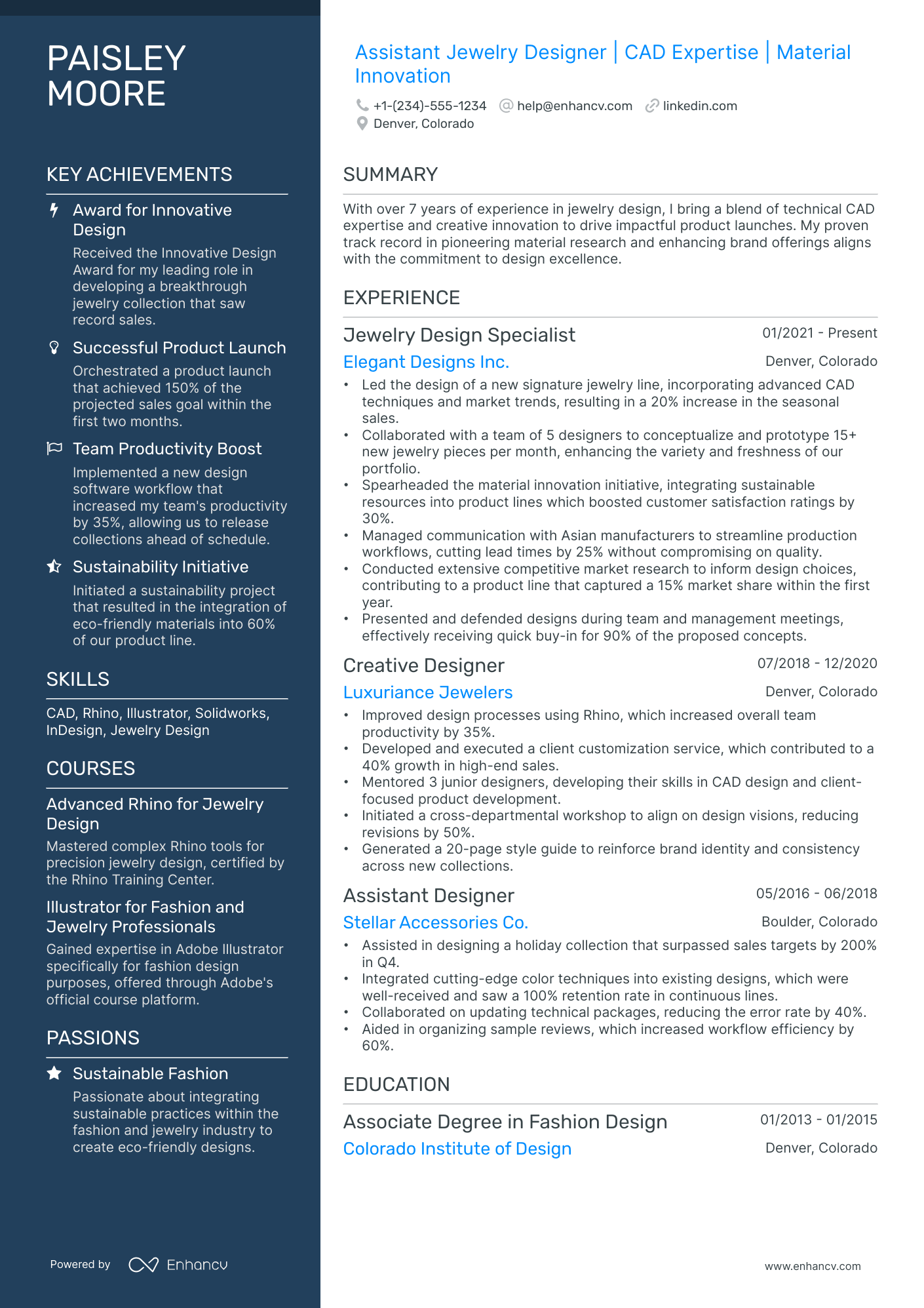
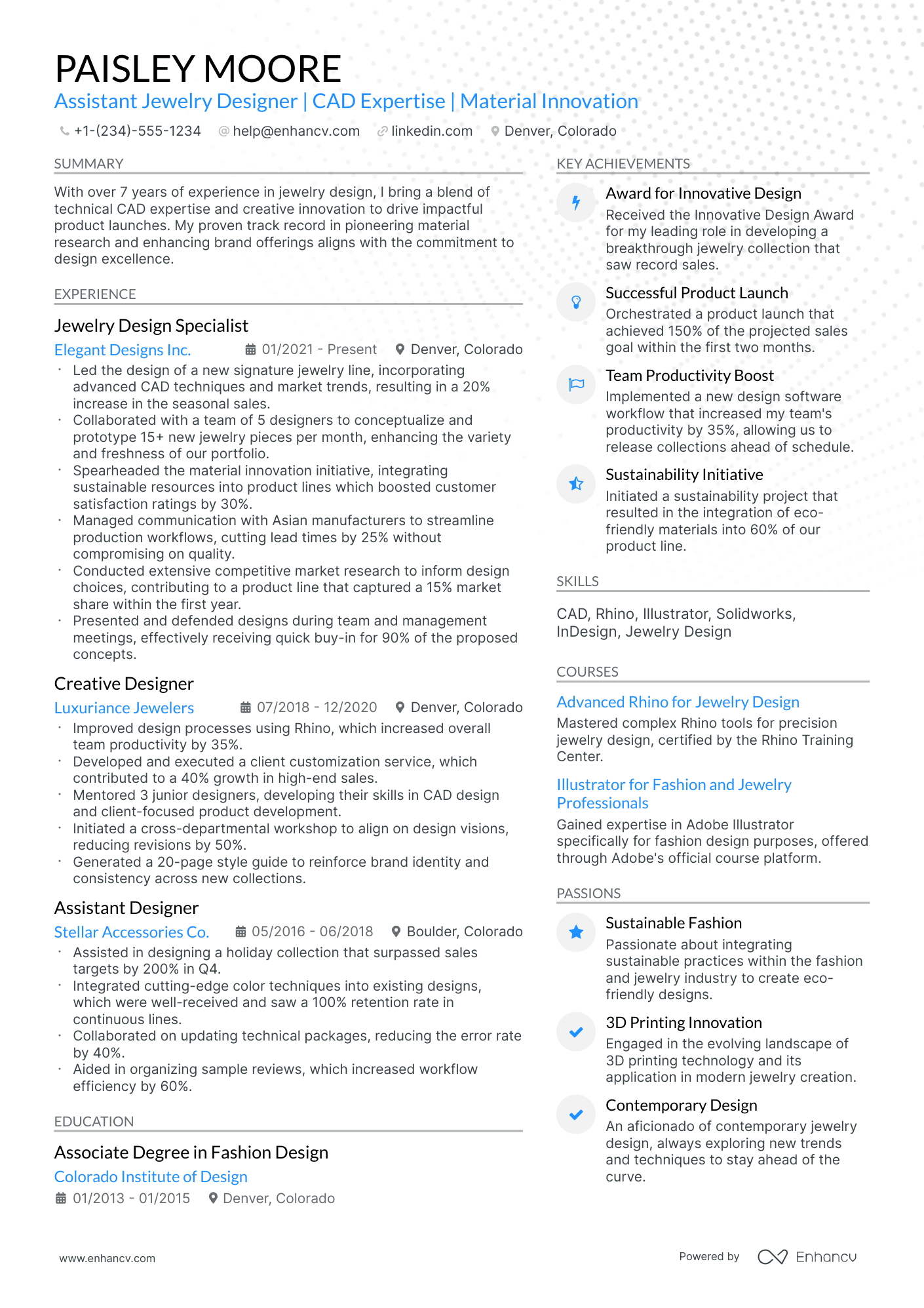
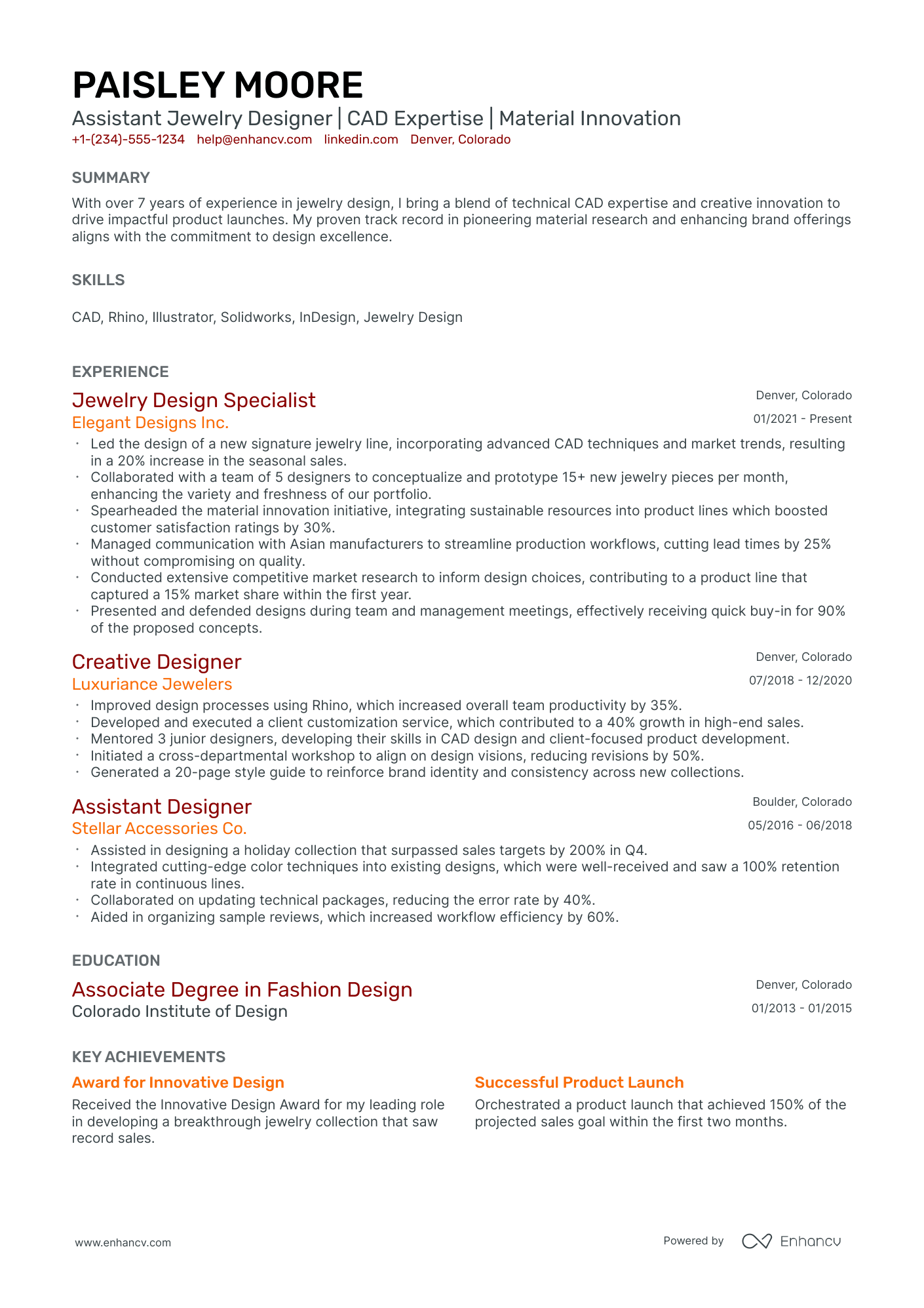
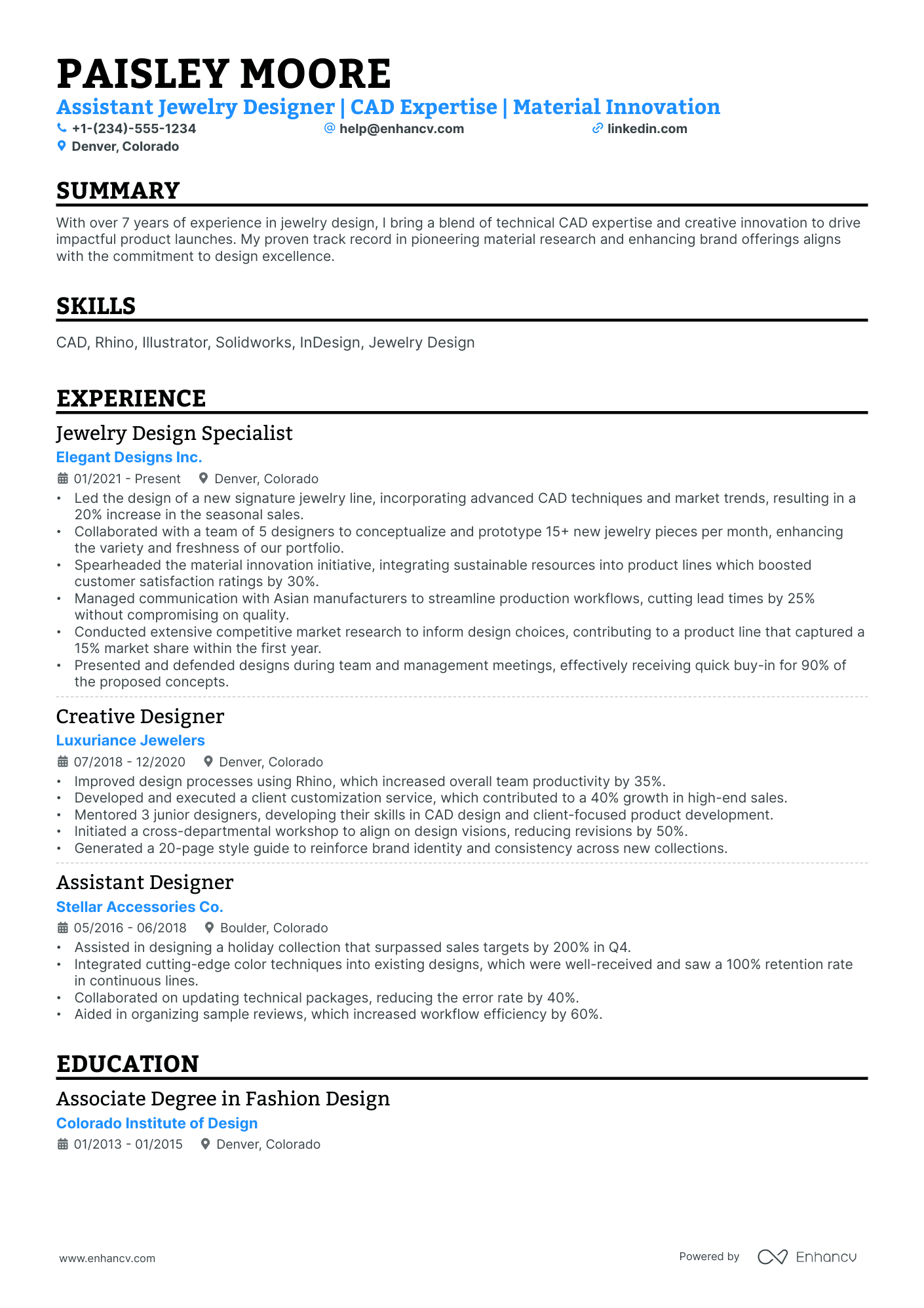
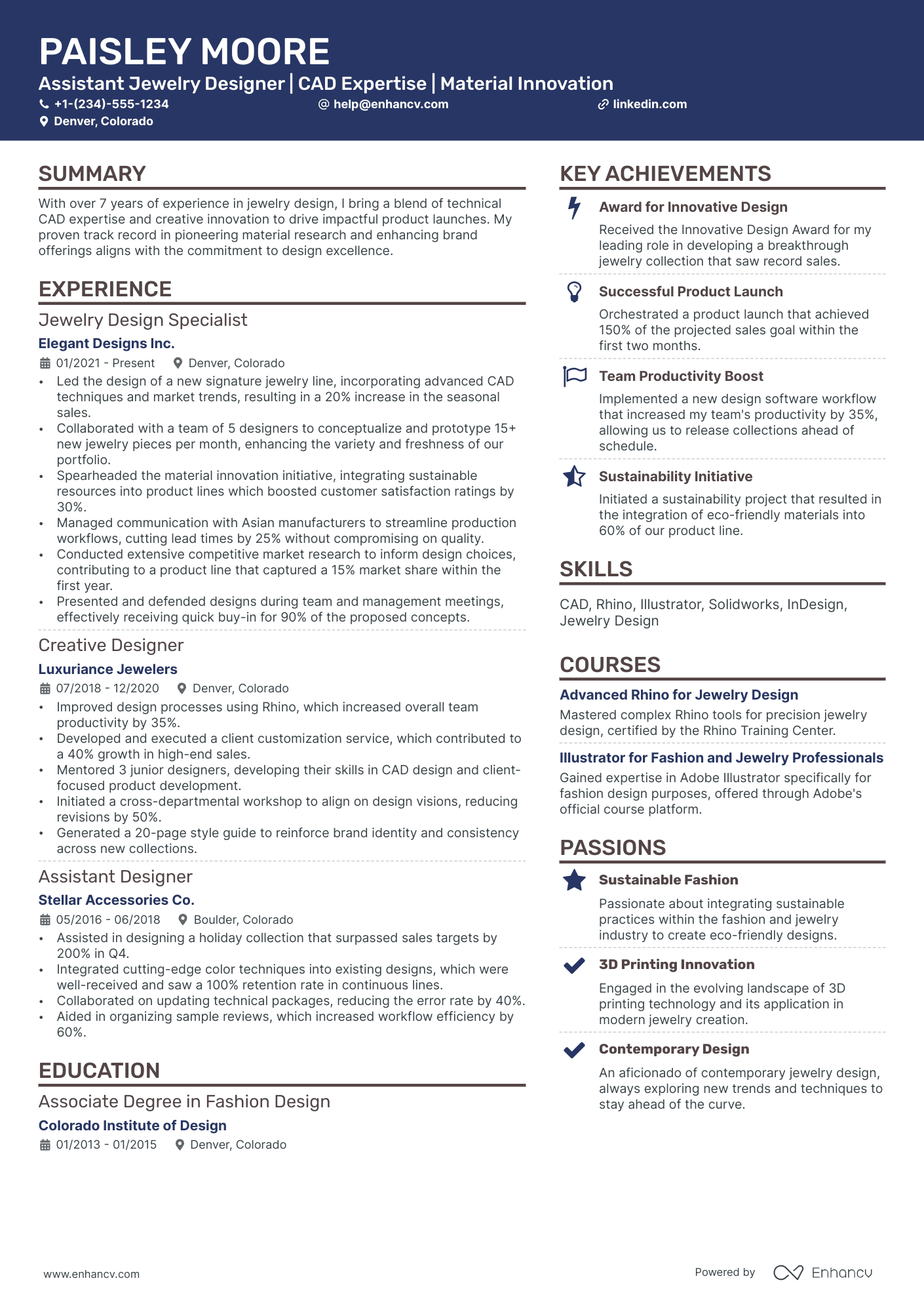
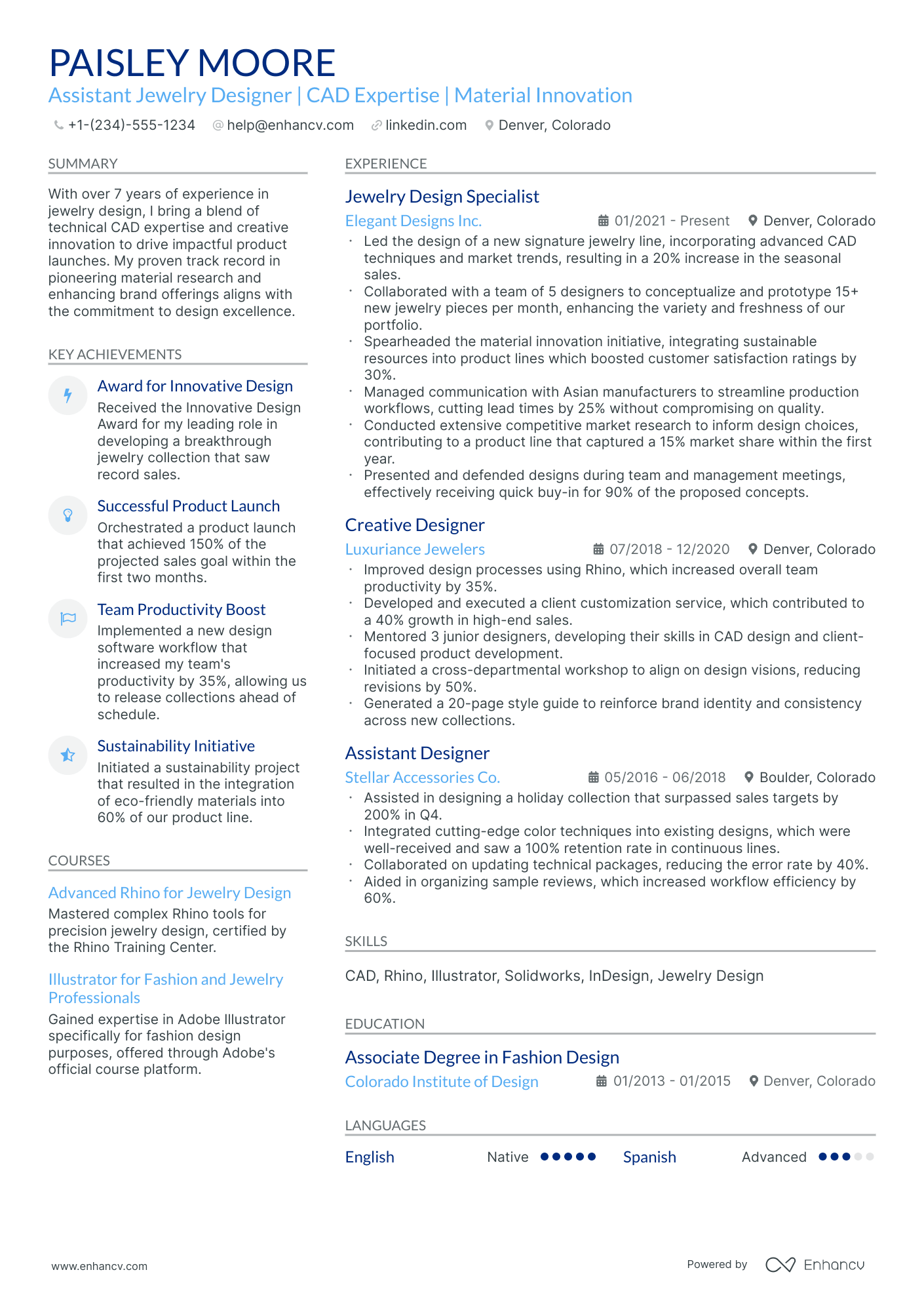
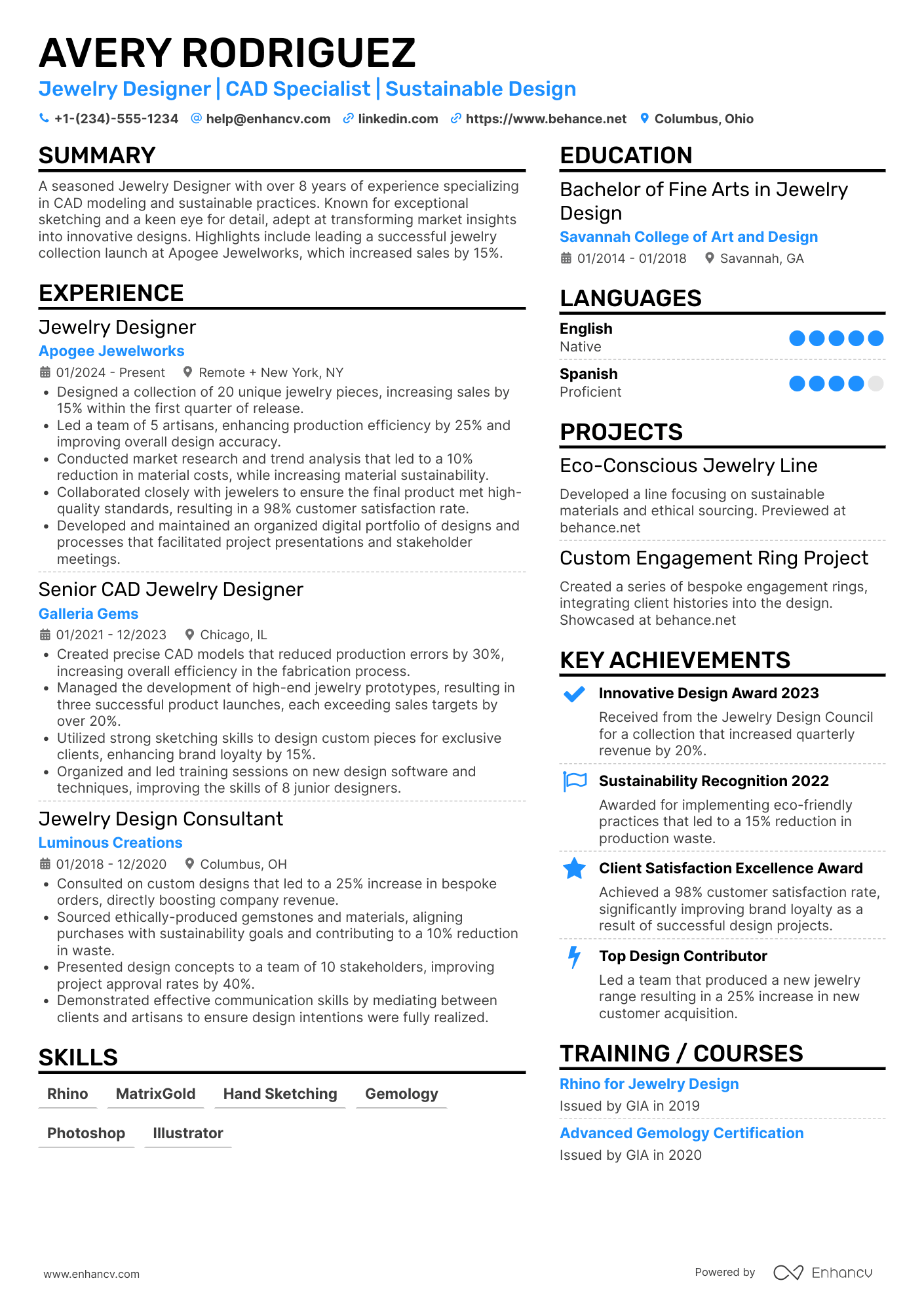
Many jewelry designer resume drafts fail because they read like portfolios, listing materials and techniques without tying work to results. That costs you in ATS screening and fast recruiter scans, where competition is high. If you're unsure where to begin, understanding how to write a resume that balances creativity with measurable impact is the first step.
A strong resume shows what your designs achieved and how you delivered. You should highlight revenue lift from a collection, on-time launches, defect reductions, repeat orders, production scale, and stronger customer reviews. Quantify pieces produced, sell-through, margins, and lead times.

Key takeaways
- Tie every design bullet to a measurable result like revenue, sell-through, or defect reduction.
- Use reverse-chronological format for senior roles and hybrid format for career changers.
- Mirror the exact CAD tools, metals, and techniques named in the job posting.
- Place a portfolio link in your header so recruiters can verify your work immediately.
- Show skills in context through experience bullets, not only in a standalone list.
- Quantify achievements with specific numbers for production volume, cost savings, and turnaround time.
- Use Enhancv to turn vague duties into focused, metric-driven resume bullets faster.
How to format a jewelry designer resume
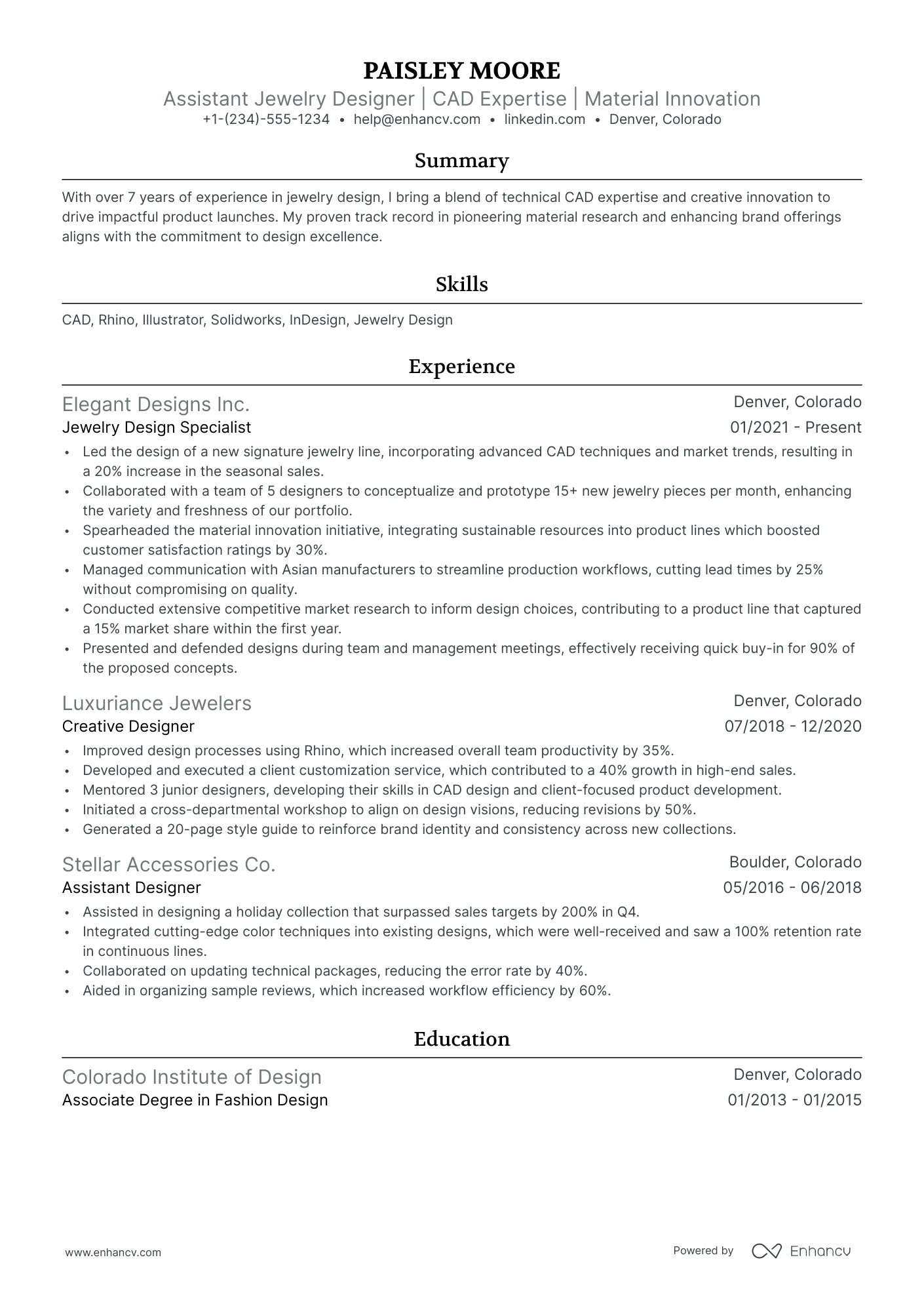
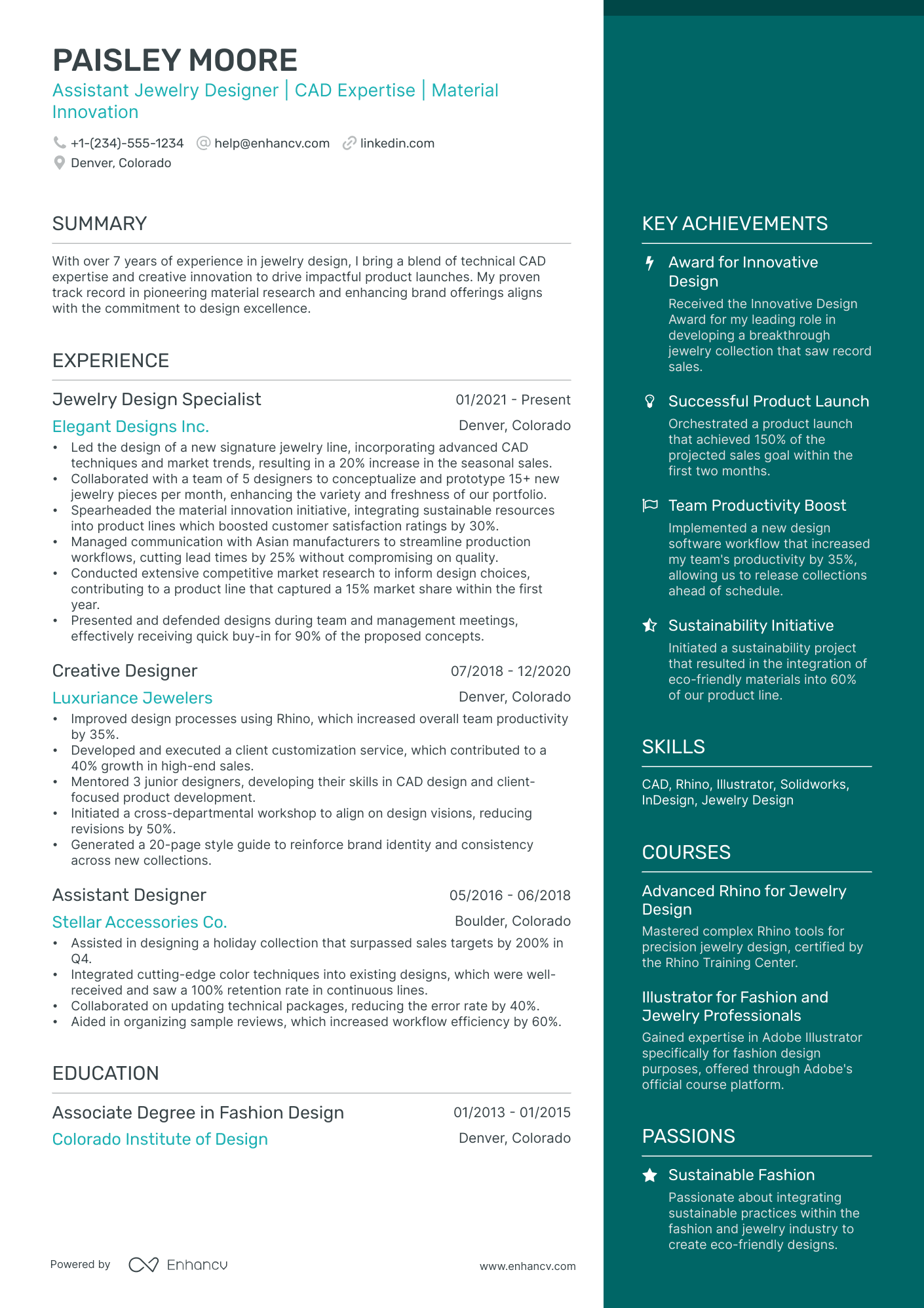
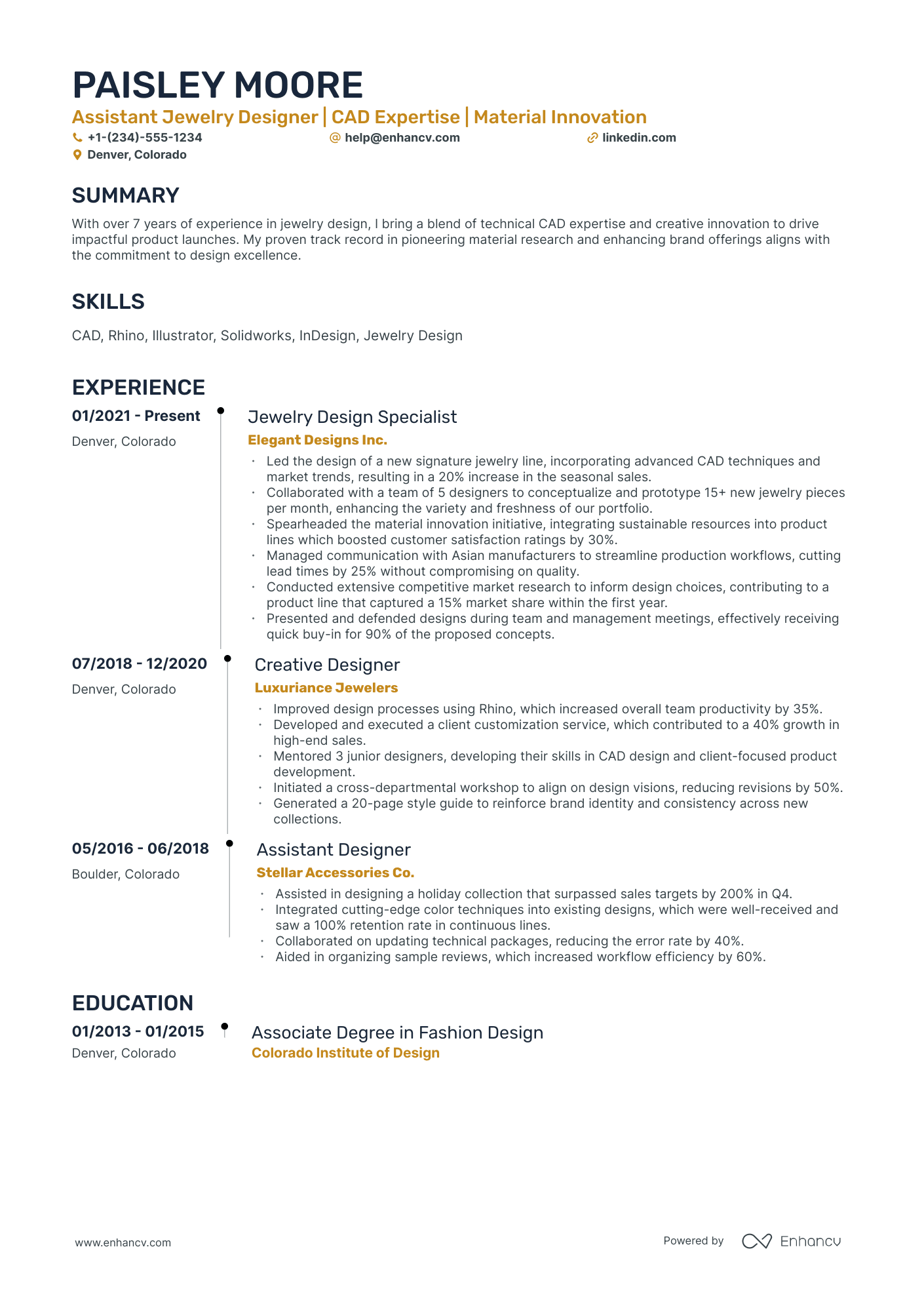
Recruiters evaluating jewelry designer resumes prioritize a strong portfolio of design work, proficiency with industry-specific tools like CAD and hand-fabrication techniques, and measurable contributions to product lines or sales. A clean, well-structured resume format ensures these signals surface quickly during both human review and applicant tracking system (ATS) scans. Paying attention to your resume layout is equally important for keeping your document visually organized and easy to navigate.

I have significant experience in this role—which format should I use?
Use a reverse-chronological format to present your deepest and most relevant jewelry design experience first. Do:
- Lead each role entry with the scope of your design responsibilities, such as managing full collections, overseeing production workflows, or directing vendor relationships.
- Highlight proficiency in role-specific tools and domains—CAD software (Rhino, Matrix), hand fabrication, stone setting, casting methods, and materials sourcing.
- Quantify outcomes tied to your design work, including revenue generated, units produced, production cost reductions, or retail placement milestones.
I'm junior or switching into this role—what format works best?
A hybrid format works best because it lets you lead with relevant design skills and tools while still showing a clear work history. Do:
- Place a dedicated skills section near the top of your resume featuring core competencies like CAD modeling, gemstone identification, metalsmithing, and rendering.
- Include academic projects, freelance commissions, apprenticeships, or personal collections that demonstrate hands-on jewelry design experience.
- Connect each action to a tangible result so recruiters can see how your skills translate to real output.
Why not use a functional resume?
A functional resume strips away the timeline and context recruiters need to evaluate how your jewelry design skills were applied in real work or project settings, making it harder to verify your capabilities. A functional format may be acceptable if you're transitioning from a related field (such as industrial design or fine arts), have limited formal work history but strong project-based output, or are re-entering the workforce after a gap—but only if every listed skill is tied directly to a specific project, collection, or measurable outcome rather than presented as a standalone claim.
Once your format establishes a clean, readable structure, the next step is filling it with the right sections to showcase your qualifications effectively.
What sections should go on a jewelry designer resume
Recruiters expect to see a clear snapshot of your design strengths, production experience, and measurable results in jewelry design. Knowing which resume sections to include and how to order them ensures hiring managers find what they need fast.
Use this structure for maximum clarity:
- Header
- Summary
- Experience
- Skills
- Projects
- Education
- Certifications
- Optional sections: Awards, Publications, Languages
Strong experience bullets should emphasize your design impact, production outcomes, scope of collections, and results like sales growth, reduced production time, or improved quality.
Is your resume good enough?
Drop your resume here or choose a file. PDF & DOCX only. Max 2MB file size.
With your resume’s key components in place, the next step is to show how to write your jewelry designer resume experience so each role supports those sections with specific, relevant results.
How to write your jewelry designer resume experience
The experience section of your jewelry designer resume should spotlight work you've shipped—finished collections, custom commissions, production runs—using the specific tools, techniques, and materials that define your craft, paired with measurable outcomes such as sales growth, production efficiency, or client retention. Hiring managers prioritize demonstrated impact over descriptive task lists, so every bullet you write needs to prove you moved a project from concept to completion and generated a tangible result.
Each entry should include:
- Job title
- Company and location (or remote)
- Dates of employment (month and year)
Three to five concise bullet points showing what you owned, how you executed, and what outcomes you delivered:
- Ownership scope: the collections, product lines, custom design programs, material sourcing pipelines, or studio teams you were directly accountable for as a jewelry designer.
- Execution approach: the CAD software, hand-fabrication techniques, casting methods, gemstone-setting processes, or prototyping workflows you used to make design decisions and deliver finished pieces.
- Value improved: changes to product quality, production turnaround, material waste reduction, design consistency, wearability, or compliance with hallmarking and safety standards relevant to jewelry production.
- Collaboration context: how you worked with gemologists, bench jewelers, retail buyers, marketing teams, suppliers, or clients to align design intent with commercial and technical requirements.
- Impact delivered: outcomes expressed through revenue contribution, sell-through performance, collection expansion, client acquisition, or brand positioning rather than a simple list of daily tasks.
Experience bullet formula
A jewelry designer experience example
✅ Right example - modern, quantified, specific.
Jewelry Designer
Aurum & Co. | New York, NY
2022–Present
Direct-to-consumer fine jewelry brand producing small-batch, recycled-gold collections with a rapid seasonal launch cadence.
- Designed and launched twelve SKU capsule collection in 14k recycled gold using Rhino 3D and KeyShot, driving a 22% quarter-over-quarter increase in online revenue and a 15% lift in conversion on product detail pages.
- Built CAD-ready spec packages in Adobe Illustrator and Excel—stone maps, tolerances, and BOMs—reducing vendor clarification cycles by 30% and cutting average sampling time from six weeks to four weeks.
- Partnered with product manager, merchandising, and supply chain to optimize gemstone sourcing and setting styles, lowering unit cost by 9% while maintaining a sub-1.5% return rate for fit and comfort issues.
- Implemented a QA checklist and in-process inspection workflow with manufacturers—prong alignment, polish grade, and clasp pull-test standards—reducing defect rate from 4.2% to 1.8% across three production partners.
- Collaborated with marketing and photo studio to refine styling and on-model shots, using A/B-tested design notes to improve average order value by 11% for ring stacks and layered necklace sets.
Now that you've seen how a strong experience section comes together, let's look at how to adjust those details to match a specific job posting.
How to tailor your jewelry designer resume experience
Recruiters evaluate your jewelry designer resume through both human review and applicant tracking systems, so tailoring your resume to the job description is essential. Tailoring ensures the skills, tools, and achievements you highlight directly match what the employer is looking for.
Ways to tailor your jewelry designer experience:
- Match CAD software and rendering tools named in the job description.
- Mirror the exact gemstone setting or metalworking techniques listed.
- Use the same terminology for design processes and production workflows.
- Highlight experience with specific precious metals or stones mentioned.
- Emphasize quality control standards referenced in the posting.
- Include retail or luxury brand experience when the role requires it.
- Reflect collaboration with manufacturers or sales teams if noted.
- Align your portfolio outcomes with the success criteria they describe.
Tailoring means connecting your real accomplishments to what the role demands, not forcing keywords where they don't belong.
Resume tailoring examples for jewelry designer
| Job description excerpt | Untailored | Tailored |
|---|---|---|
| "Design and produce custom fine jewelry pieces using CAD software (Rhino/Matrix), oversee lost-wax casting process, and collaborate with gemologists on stone selection for high-end clientele." | Designed jewelry and worked with team members on various projects. | Designed 40+ custom fine jewelry pieces per quarter using Rhino and Matrix, directed lost-wax casting production, and partnered with gemologists to source and set ethically graded gemstones for clients with budgets exceeding $10,000. |
| "Hand-fabricate sterling silver and brass jewelry collections, manage Etsy and wholesale accounts, and photograph finished pieces for e-commerce listings." | Made jewelry and helped with online sales. | Hand-fabricated two seasonal collections (60+ SKUs) in sterling silver and brass, grew Etsy shop revenue by 35% year over year, and styled and photographed each piece to maintain a cohesive e-commerce brand across wholesale and direct-to-consumer channels. |
| "Repair and restore vintage and antique jewelry, perform stone resetting and prong retipping, and communicate repair timelines and cost estimates directly to customers." | Fixed jewelry and talked to customers about their needs. | Completed 15–20 weekly repair and restoration jobs on vintage and antique pieces—including stone resetting, prong retipping, and clasp replacement—while providing customers with accurate cost estimates and turnaround timelines that maintained a 98% satisfaction rate. |
Once you’ve aligned your experience with the role’s priorities, the next step is to quantify your jewelry designer achievements so hiring managers can quickly see the impact behind those choices.
How to quantify your jewelry designer achievements
Quantifying your achievements shows how your designs performed in sales, production, and quality. Focus on revenue, conversion, turnaround time, defect rates, material cost, and on-time delivery across collections and custom orders.
Quantifying examples for jewelry designer
| Metric | Example |
|---|---|
| Revenue impact | "Designed a twelve-piece bridal collection that generated $185K in six months and lifted average order value by 14% in the flagship store." |
| Conversion rate | "Created in-store display sets and product cards that increased try-on-to-purchase conversion from 9% to 12% across three monthly trunk shows." |
| Cycle time | "Reduced custom design turnaround from fourteen to nine days by standardizing CAD templates in Rhino and tightening client approval checkpoints." |
| Quality defects | "Cut casting and stone-setting rework from 6.2% to 3.1% by revising tolerances, updating wax models, and adding a two-step inspection checklist." |
| Cost efficiency | "Lowered gold scrap cost by 11% by optimizing nesting in CAD and coordinating melt returns with the bench jeweler on a weekly schedule." |
Turn vague job duties into measurable, recruiter-ready resume bullets in seconds with Enhancv's Bullet Point Generator.
Once you've crafted strong bullet points for your experience section, you'll want to apply that same precision to presenting your hard and soft skills throughout your jewelry designer resume.
How to list your hard and soft skills on a jewelry designer resume
Your skills section shows you can design wearable, manufacturable pieces, and recruiters and applicant tracking systems (ATS) scan this section to match you to the job, so aim for a mix of hard skills like CAD proficiency and production knowledge with role-specific soft skills such as client communication and vendor collaboration.
jewelry designer roles require a blend of:
- Product strategy and discovery skills.
- Data, analytics, and experimentation skills.
- Delivery, execution, and go-to-market discipline.
- Soft skills.
Your skills section should be:
- Scannable (bullet-style grouping).
- Relevant to the job post.
- Backed by proof in experience bullets.
- Updated with current tools.
Place your skills section:
- Above experience if you're junior or switching careers.
- Below experience if you're mid/senior with strong achievements.

Hard skills
- CAD: Rhino, MatrixGold
- Adobe Illustrator technical flats
- Hand sketching and rendering
- Stone setting specifications
- Gemstone grading basics (GIA)
- Metal fabrication: soldering, casting
- Wax carving, lost-wax casting
- 3D printing for prototyping
- Vendor tech packs and line sheets
- Costing, bill of materials
- Quality control: tolerances, finishing
- Production handoff and revisions
Soft skills
- Translate briefs into design directions
- Run client design consultations
- Present concepts and revisions clearly
- Align with production on constraints
- Negotiate timelines with vendors
- Prioritize designs by margin and demand
- Make fast trade-offs on materials
- Document decisions and approvals
- Manage revisions without scope creep
- Own samples through final approval
- Collaborate with photographers and stylists
- Resolve quality issues with manufacturers
How to show your jewelry designer skills in context
Skills shouldn't live only in a dedicated skills list. Browse examples of resume skills presented in context to see how top candidates weave them into summaries and experience bullets.
They should be demonstrated in:
- Your summary (high-level professional identity)
- Your experience (proof through outcomes)
Here's how that looks in practice.
Summary example
Senior jewelry designer with 12 years crafting fine and commercial collections using CAD (Rhino, Matrix) and lost-wax casting. Led a 15-piece capsule line that drove a 28% revenue increase for a luxury retail partner.
- Reflects senior-level expertise immediately
- Names industry-standard design tools
- Quantifies a clear business outcome
- Signals client collaboration and leadership
Experience example
Senior Jewelry Designer
Lune & Bower Fine Jewelry | Brooklyn, NY
March 2019–Present
- Designed 40+ production-ready pieces annually in Rhino and Matrix, reducing prototype revision cycles by 35% through precise 3D modeling.
- Collaborated with gemologists and bench jewelers to source ethically certified stones, cutting material costs by 18% without compromising quality.
- Directed trend research and presented seasonal concepts to the creative director, contributing to a 22% year-over-year growth in direct-to-consumer sales.
- Every bullet includes measurable proof
- Skills surface naturally through real outcomes
Once you’ve grounded your abilities in real examples, the next step is to translate that evidence into a jewelry designer resume when you have no experience.
How do I write a jewelry designer resume with no experience
Even without full-time experience, you can demonstrate readiness through:
- CAD jewelry design coursework projects
- Bench jewelry fabrication class assignments
- Personal collection design and build
- Freelance custom commission pieces
- Portfolio from design challenges
- Internship or studio shadowing hours
- Jewelry repairs and resizing practice
- Craft fair or online shop sales
Our guide on building a resume without work experience covers more strategies for turning projects and training into compelling resume content.
Focus on:
- Portfolio with CAD and sketches
- Process notes from concept to finish
- Production-ready specs and tolerances
- Materials knowledge with cost estimates
Resume format tip for entry-level jewelry designer
Use a combination resume format to highlight projects, tools, and training first, since your work samples carry more weight than job titles. Do:
- Put a portfolio link in the header.
- List tools: Rhino, MatrixGold, Adobe Illustrator.
- Write project bullets with measurements and outcomes.
- Add materials, stones, and sourcing details.
- Include production files: renders and tech packs.
- Designed three-ring capsule in Rhino and MatrixGold, produced eight prototypes in sterling silver, and reduced material waste by twelve percent through weight optimization.
Even without formal work experience, your education section can demonstrate the foundational knowledge and training that qualifies you for a jewelry designer role.
How to list your education on a jewelry designer resume
Your education section helps hiring teams confirm you have foundational training in design, metalwork, or gemology. It validates the technical knowledge a jewelry designer needs daily.
Include:
- Degree name
- Institution
- Location
- Graduation year
- Relevant coursework (for juniors or entry-level candidates)
- Honors & GPA (if 3.5 or higher)
Skip month and day details—list only the graduation year.
Here's a strong education entry tailored to a jewelry designer resume.
Example education entry
Bachelor of Fine Arts in Jewelry and Metalsmithing
Rhode Island School of Design, Providence, RI
Graduated 2021
GPA: 3.7
- Relevant Coursework: Advanced Stone Setting, CAD for Jewelry Design, Precious Metal Fabrication, Gemology Fundamentals
- Honors: Dean's List, four consecutive semesters
How to list your certifications on a jewelry designer resume
Certifications on your resume show your commitment to learning, proficiency with jewelry tools and materials, and alignment with industry standards for a jewelry designer.
Include:
- Certificate name
- Issuing organization
- Year
- Optional: credential ID or URL
- Place certifications below education when your degree is recent and your certifications support it without adding stronger, role-specific value.
- Place certifications above education when they are recent, highly relevant, or required, and they strengthen your fit more than schooling details.
Best certifications for your jewelry designer resume
- Graduate Gemologist (GG)
- Accredited Jewelry Professional (AJP)
- Certified Diamond Grader
- Certified Jewelry Appraiser
- Rhino Level 1 Certification
- MatrixGold Certification
- Jewelry CAD Design Certification
Once you’ve positioned your credentials to support your expertise, use that same value to shape a jewelry designer resume summary that clearly highlights what you bring to the role.
How to write your jewelry designer resume summary
Your resume summary is the first thing a recruiter reads. A sharp, specific opening sets the tone and decides whether the rest of your resume gets attention.
Keep it to three to four lines, with:
- Your title and total years of jewelry design experience.
- The domain you work in, such as fine jewelry, fashion, or artisan production.
- Core tools and skills like CAD, Rhino, hand fabrication, or gemstone setting.
- One or two measurable achievements that show your impact.
- Soft skills tied to real outcomes, such as collaboration that shortened production timelines.

PRO TIP
At this level, focus on relevant skills, tools, and early wins that prove you can contribute. Highlight specific software, techniques, and any measurable results from internships or first roles. Avoid vague phrases like "passionate creative" or "motivated self-starter." Recruiters want proof, not personality pitches.
Example summary for a jewelry designer
Junior jewelry designer with two years of experience in fine jewelry production. Proficient in Rhino and wax carving. Reduced prototype revision cycles by 30% through improved CAD modeling accuracy.
Optimize your resume summary and objective for ATS
Drop your resume here or choose a file.
PDF & DOCX only. Max 2MB file size.
Now that your summary captures your design expertise and career highlights, make sure the header framing it presents your contact details correctly so recruiters can actually reach you.
What to include in a jewelry designer resume header
A resume header is the top section with your key contact details, and it boosts visibility, credibility, and recruiter screening for a jewelry designer role.
Essential resume header elements
- Full name
- Tailored job title and headline
- Location
- Phone number
- Professional email
- GitHub link
- Portfolio link
A LinkedIn link helps recruiters verify experience quickly and supports screening.
Do not include photos on a jewelry designer resume unless the role is explicitly front-facing or appearance-dependent.
Keep your header consistent with your portfolio name and use one line for links to prevent scanning errors.
Example
Jewelry designer resume header
Avery Morgan
Jewelry Designer | Fine Jewelry, CAD, and Hand Fabrication
New York, NY
(212) 555-01XX
avery.morgan@enhancv.com
github.com/averymorgan
averymorgan.com
linkedin.com/in/averymorgan
Once your name and key contact details are in place, add relevant optional sections to strengthen your jewelry designer resume and provide hiring managers with more context.
Additional sections for jewelry designer resumes
Extra resume sections help you stand out when your core experience doesn't fully capture your creative range or industry credibility.
Consider adding these sections to strengthen your jewelry designer resume:
- Languages
- Exhibitions and shows
- Professional affiliations (such as the Society of North American Goldsmiths)
- Awards and competitions
- Publications and features
- Hobbies and interests
- Certifications and specialized training
Once you've rounded out your resume with relevant additional sections, the next step is pairing it with a strong cover letter to make your application complete.
Do jewelry designer resumes need a cover letter
A cover letter isn't required for every jewelry designer role, but it helps in competitive openings or when hiring teams expect one. If you're unsure about the basics, our guide on what a cover letter is explains when and why to include one. It can make a difference when your resume or portfolio needs context, or when you're changing roles.
Use a cover letter when it adds specific, useful detail:
- Explain role and team fit by matching your design process, collaboration style, and production experience to the job's priorities.
- Highlight one or two relevant projects with outcomes: improved sell-through, reduced production issues, faster sampling, or stronger margin.
- Show understanding of the product and users by referencing the brand's materials, price point, customer, and channel, and how you'd design for them.
- Address career transitions or non-obvious experience by connecting past work to jewelry designer responsibilities, tools, and constraints.
Drop your resume here or choose a file.
PDF & DOCX only. Max 2MB file size.
Even when a cover letter isn’t required, you can use AI to improve your jewelry designer resume so it carries more of your value upfront and stays tailored to the role.
Using AI to improve your jewelry designer resume
AI can sharpen your resume's clarity, structure, and overall impact. It helps tighten language and highlight relevant achievements. But overuse strips authenticity. Once your content reads clearly and aligns with the role, step away from AI. For specific prompt ideas, check out our guide on ChatGPT resume writing to get started.
Here are 10 practical prompts to strengthen specific sections of your jewelry designer resume:
- Sharpen your summary. "Rewrite my jewelry designer resume summary to emphasize hands-on design expertise and measurable career achievements in under four sentences."
- Quantify experience bullets. "Add specific metrics—like production volumes or sales increases—to each experience bullet on my jewelry designer resume."
- Align skills precisely. "Compare my jewelry designer skills section against this job description and remove irrelevant entries while suggesting missing ones."
- Strengthen action verbs. "Replace weak or repetitive verbs in my jewelry designer experience section with strong, industry-specific action verbs."
- Refine project descriptions. "Rewrite my jewelry designer project entries to clearly state design challenges, techniques used, and final outcomes."
- Tighten education details. "Edit my jewelry designer education section to highlight only coursework, honors, or training directly relevant to jewelry design roles."
- Improve certification clarity. "Reformat my jewelry designer certifications section so each entry states the credential, issuing body, and year earned."
- Eliminate redundant phrasing. "Remove filler words and redundant phrases from every section of my jewelry designer resume without losing meaning."
- Tailor to job posting. "Adjust my jewelry designer resume experience bullets to mirror the priorities and language in this specific job listing."
- Polish final readability. "Review my entire jewelry designer resume for inconsistent formatting, passive voice, and sentences longer than twenty words."
Stop using AI once your resume sounds accurate, specific, and aligned with real experience. AI should never invent experience or inflate claims—if it didn't happen, it doesn't belong here.
Conclusion
A strong jewelry designer resume shows measurable outcomes, role-specific skills, and a clear structure. It highlights design process, materials knowledge, production readiness, and collaboration, backed by numbers like sales growth, on-time delivery, and reduced waste.
Keep each section easy to scan, with focused bullet points and consistent formatting. This approach signals a jewelry designer who’s ready for today’s hiring market and the near-future demand for efficient, adaptable design work.