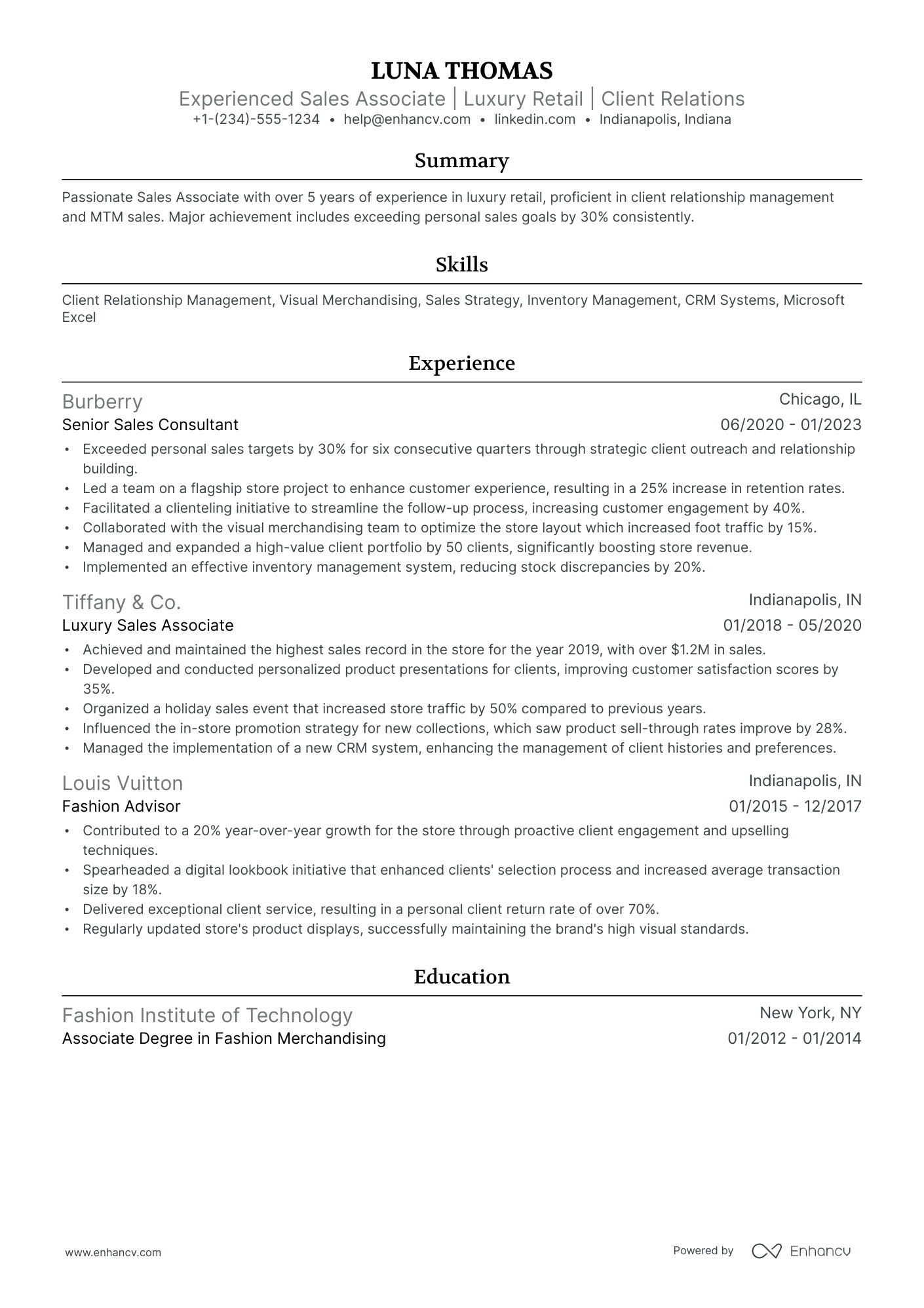
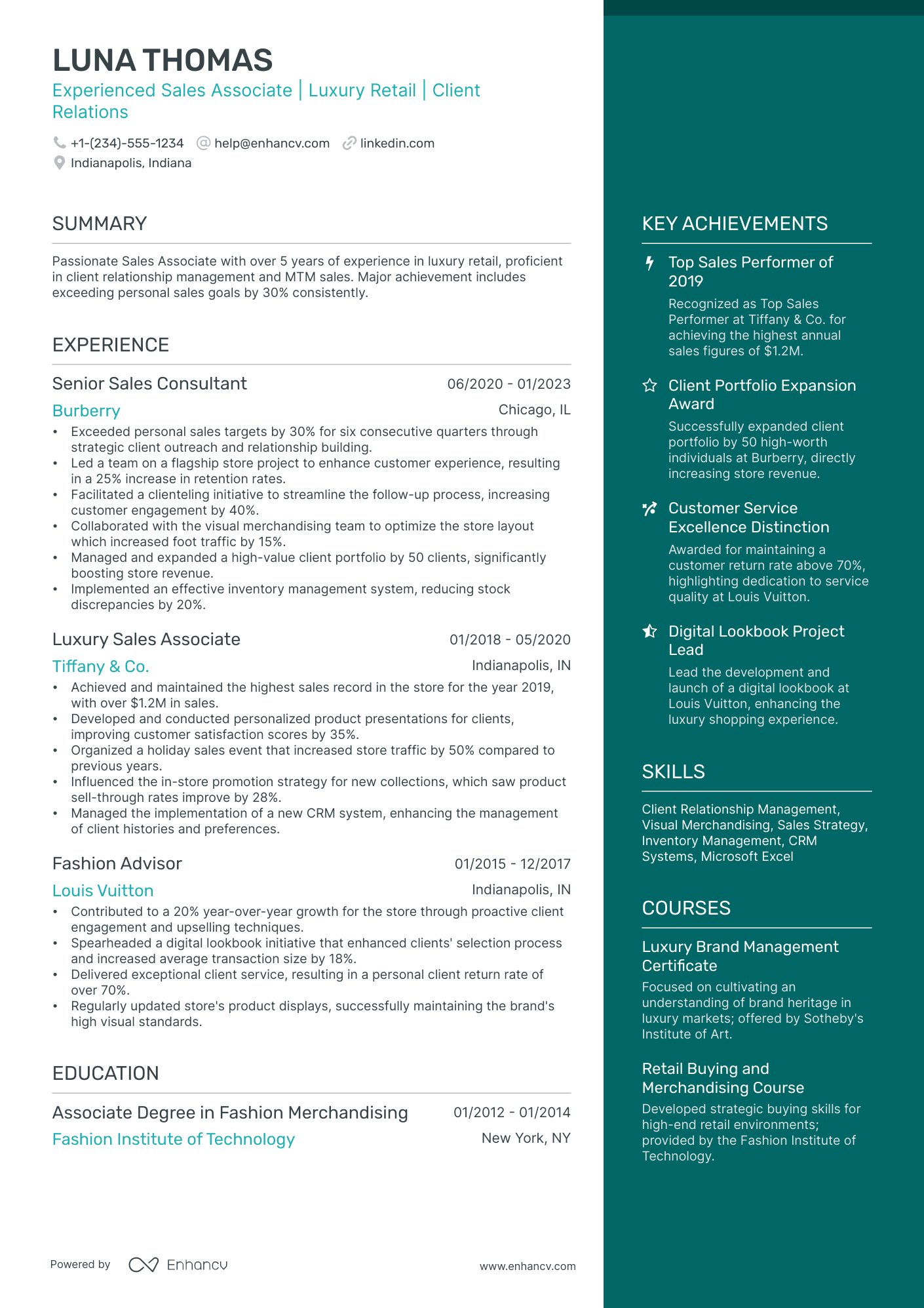
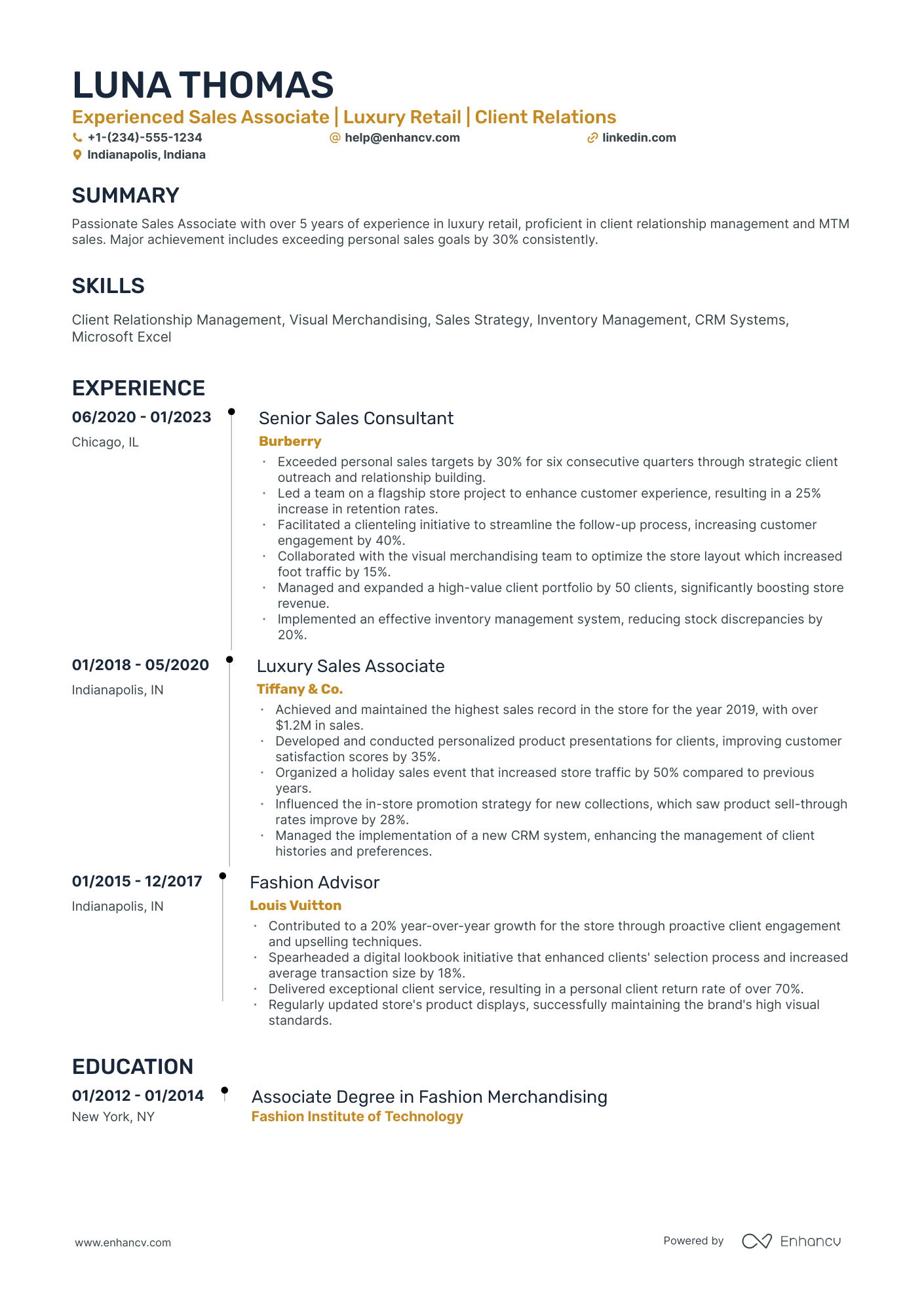
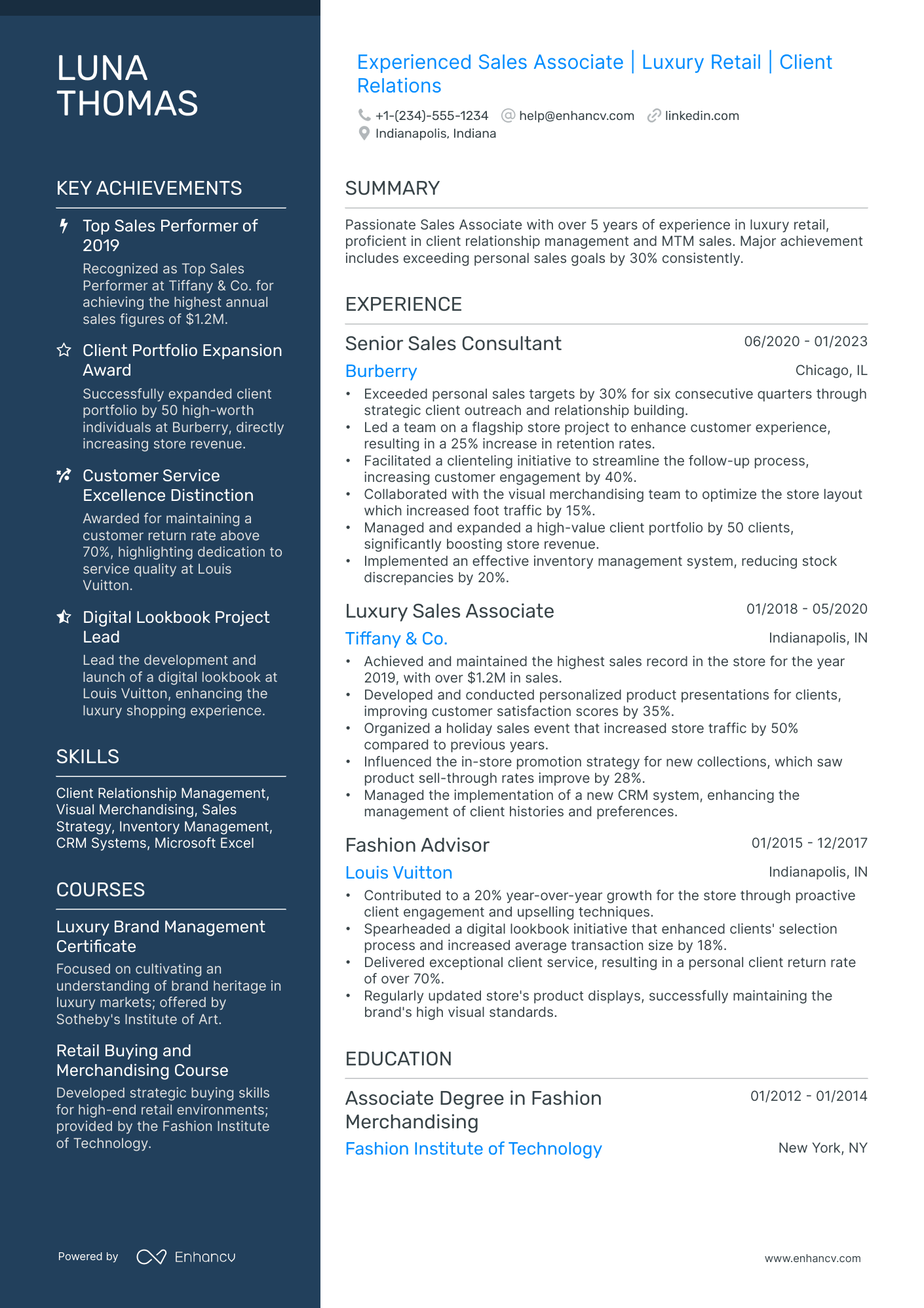
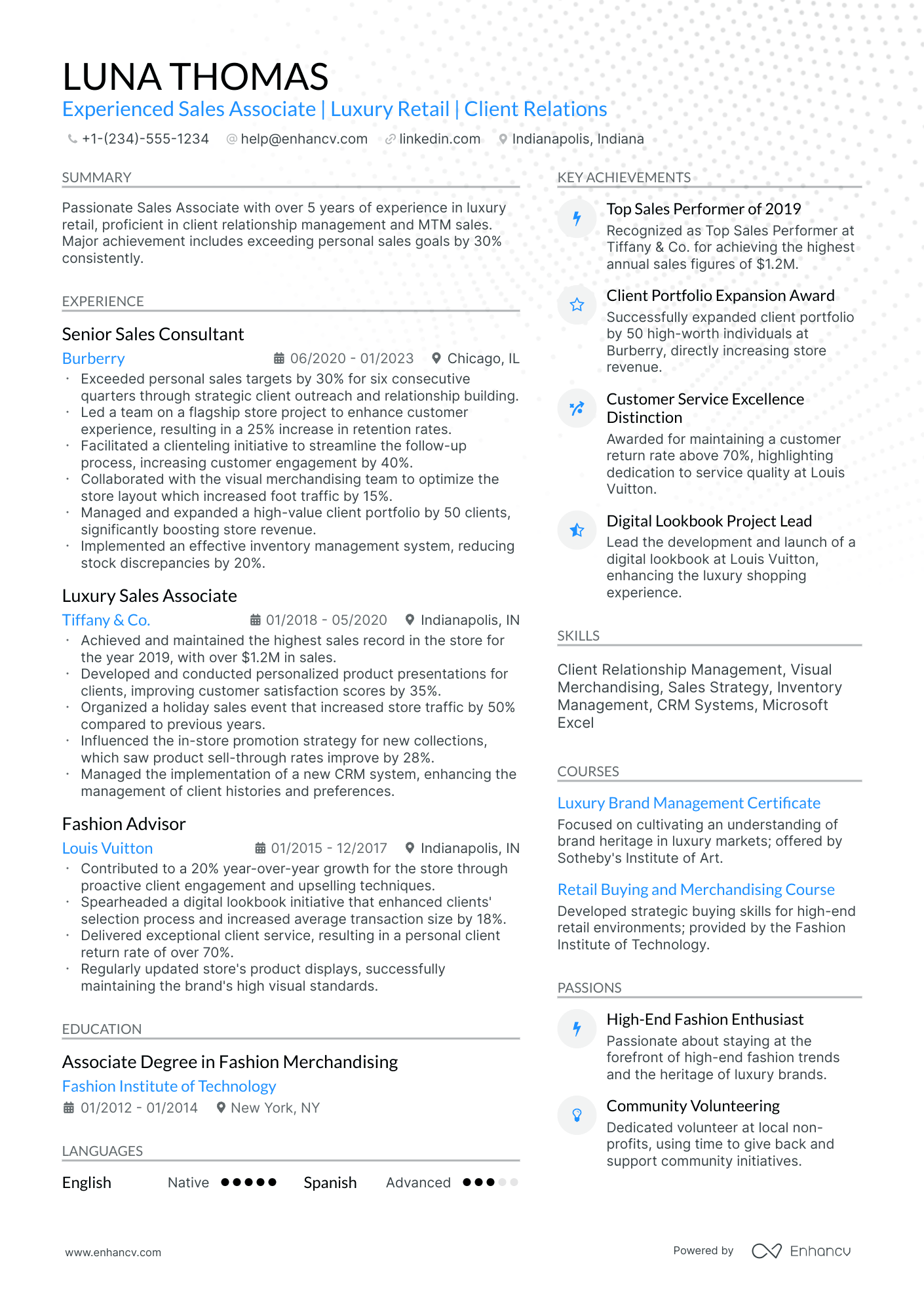
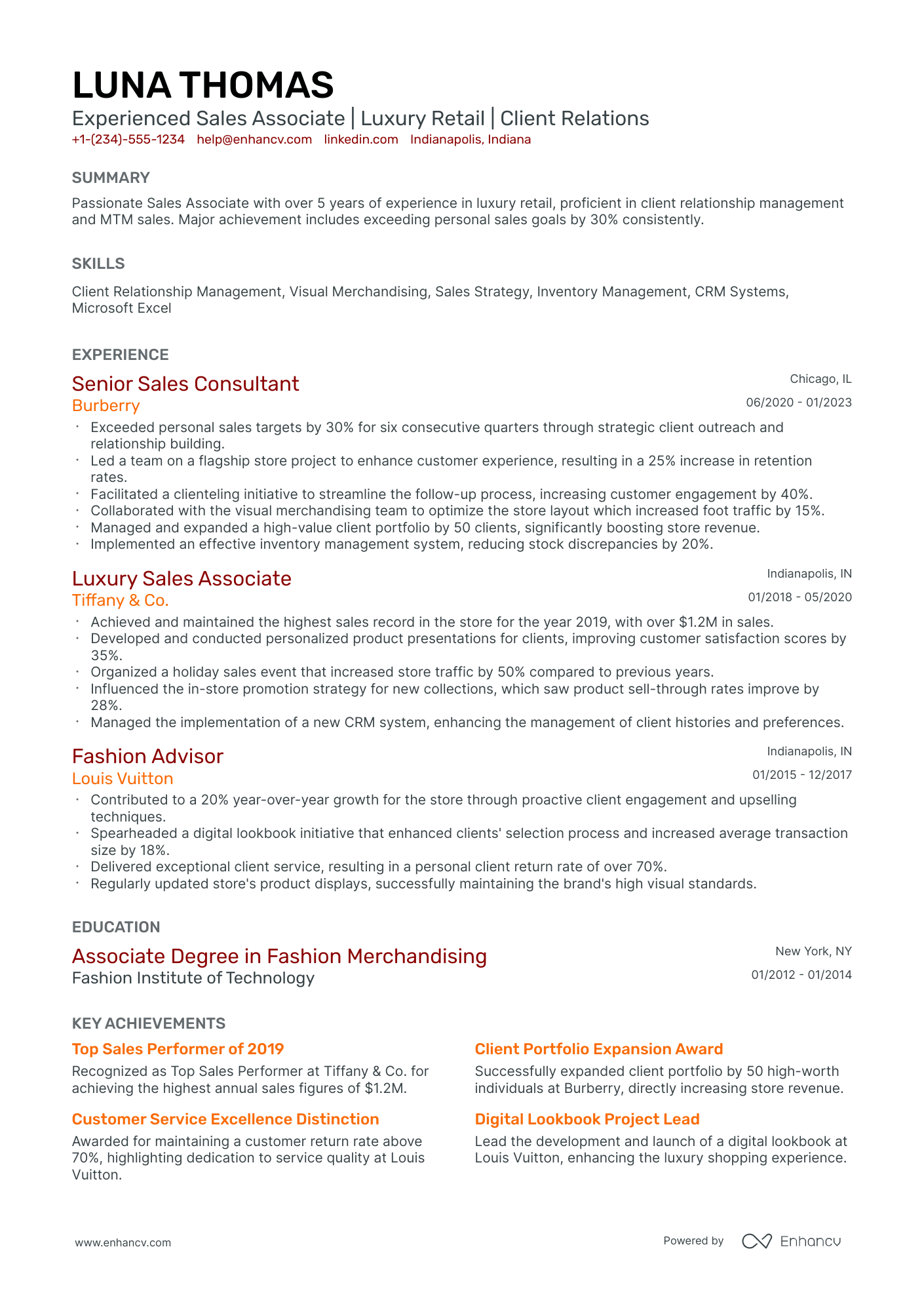
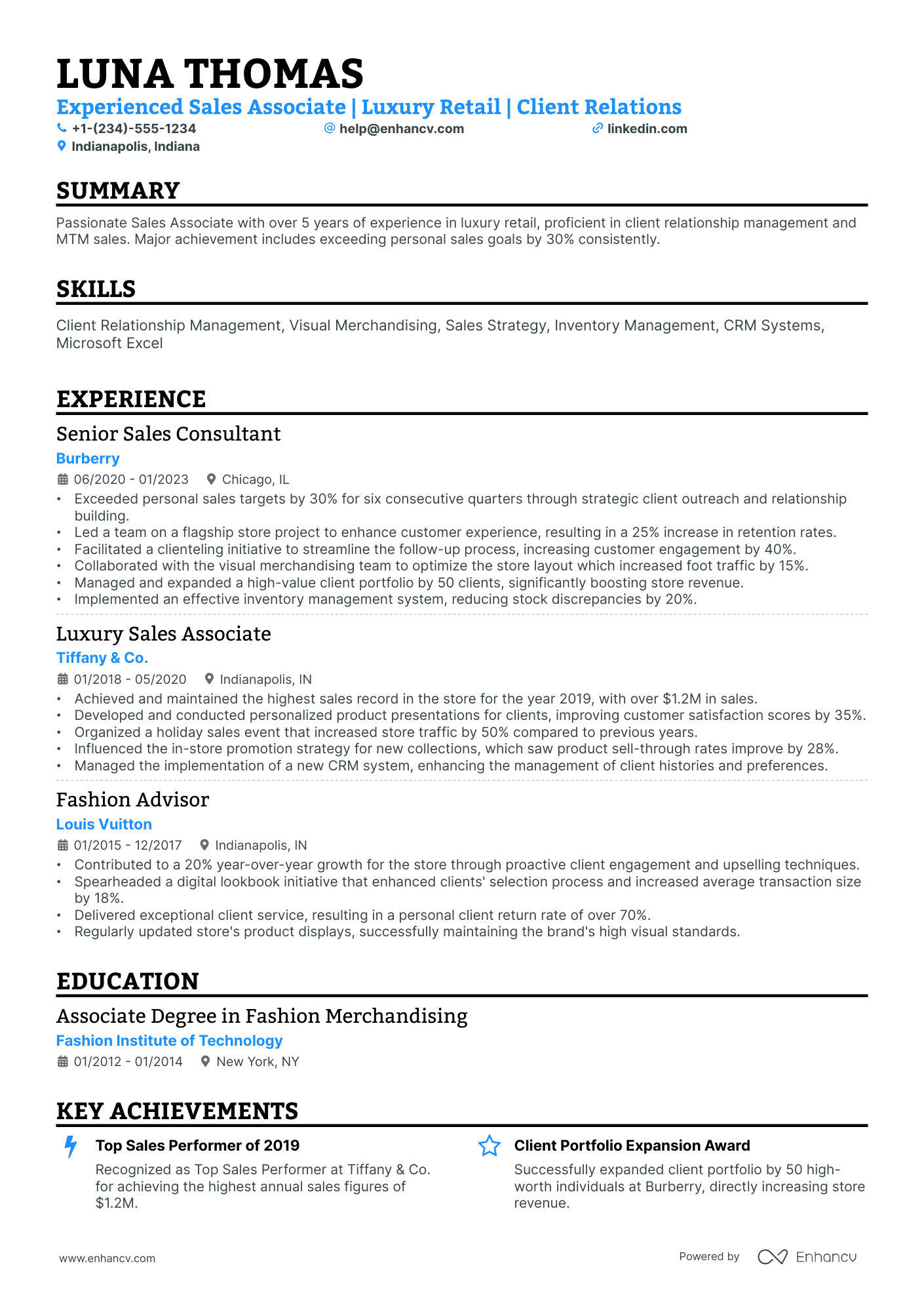
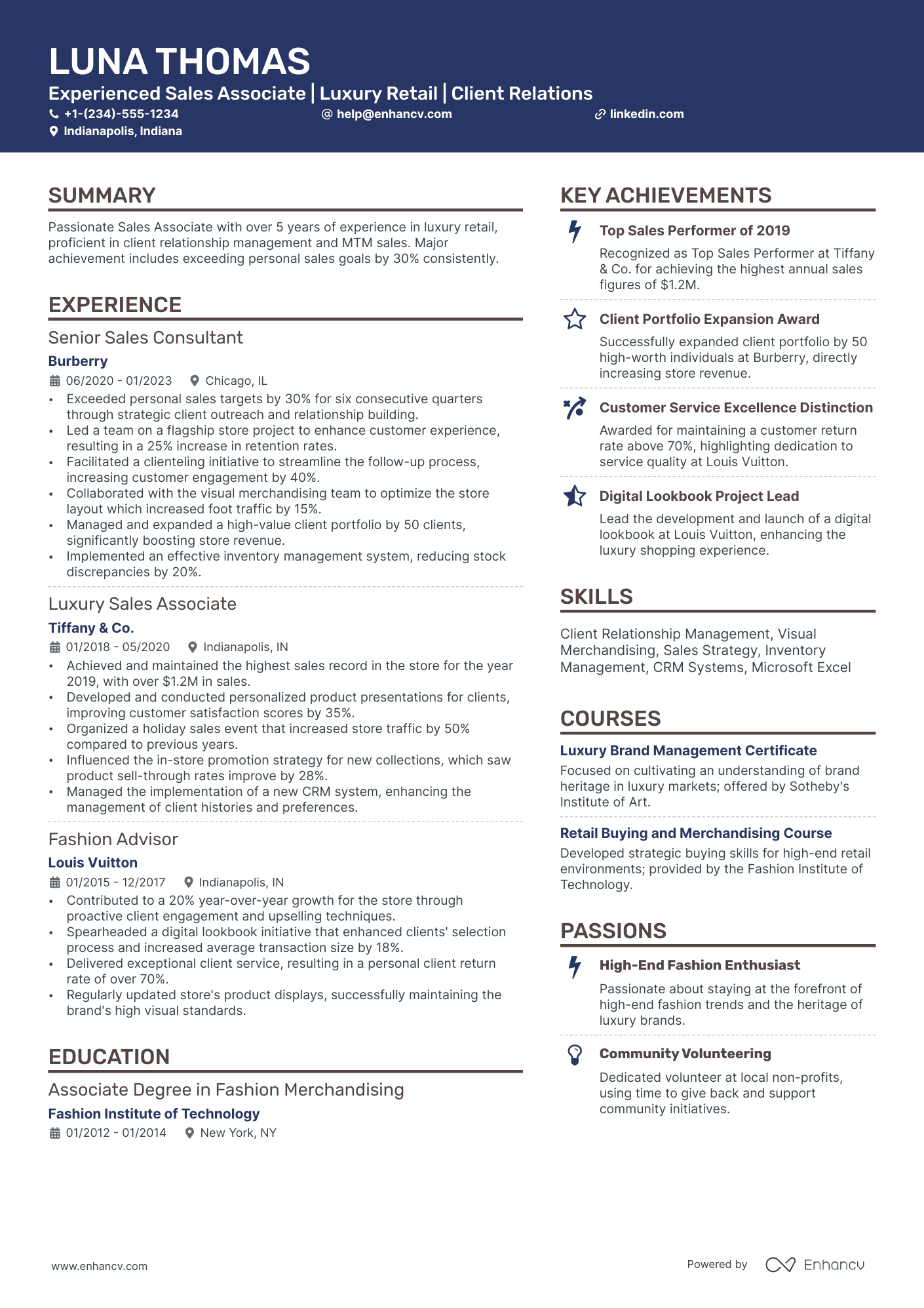
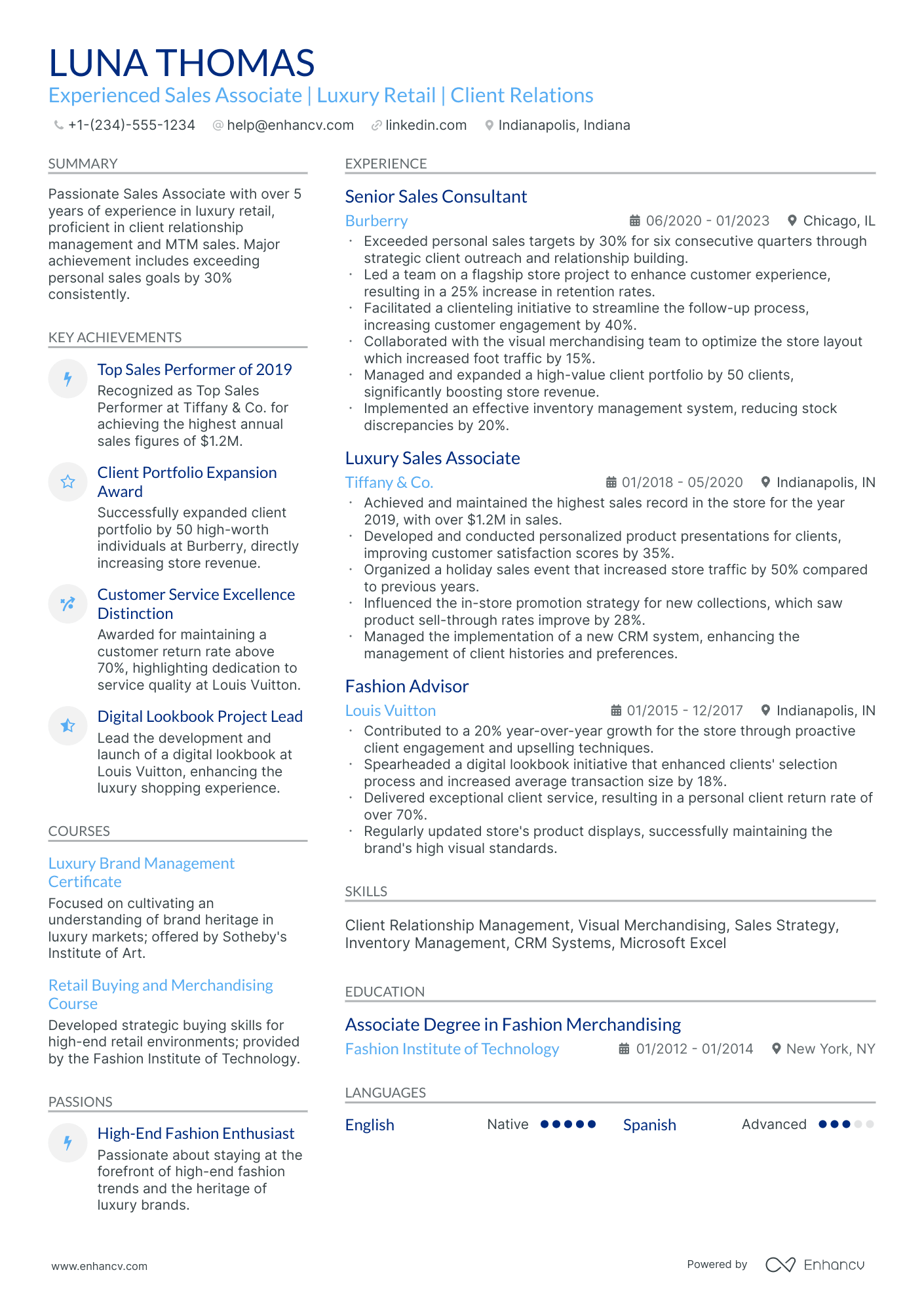
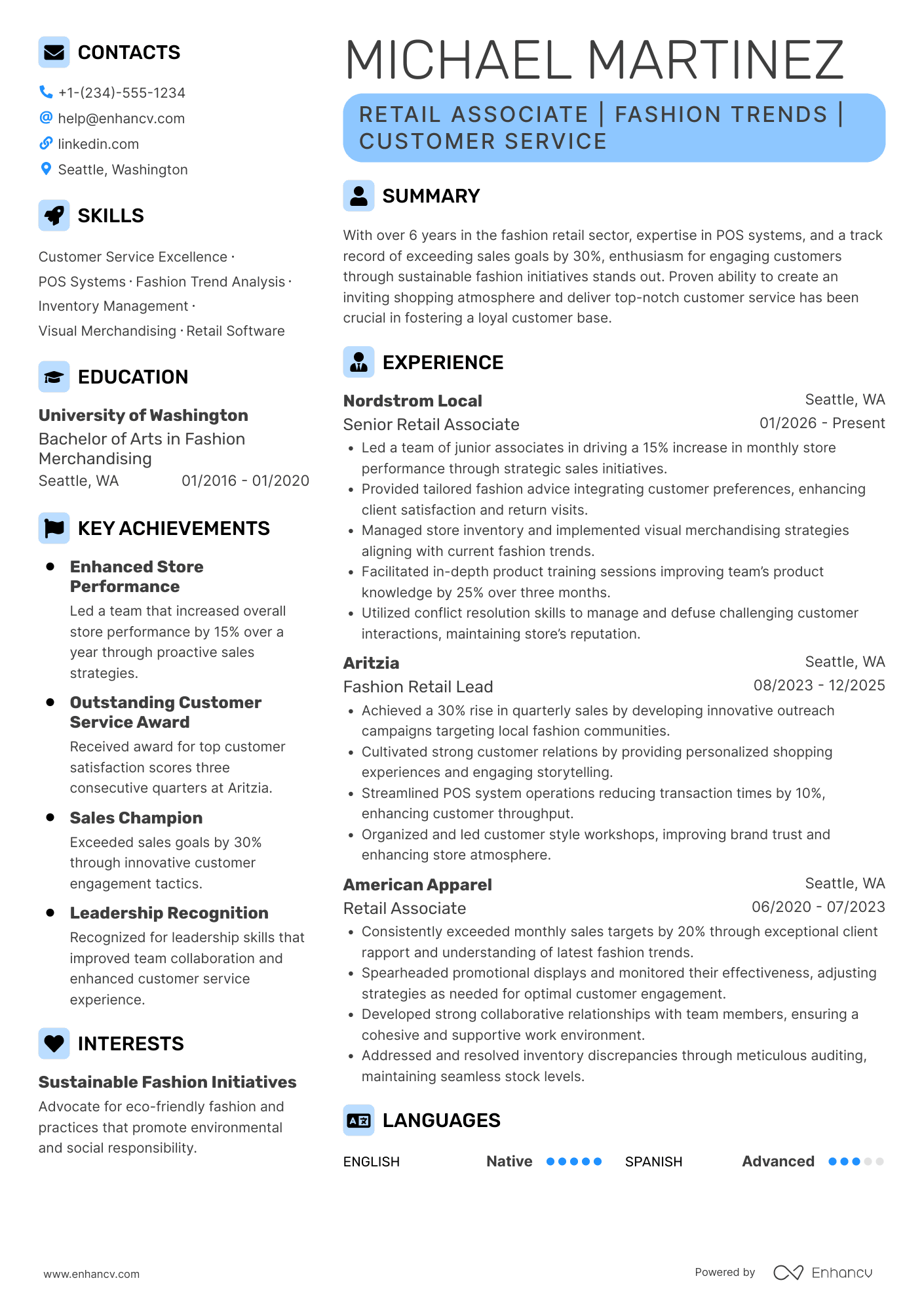
Many fashion retail resumes fail because they list duties and brand names instead of measurable sales impact and service results. That hurts in ATS screening and fast recruiter scans, where high competition rewards clear, quantified evidence.
A strong resume shows what you improved and delivered. Knowing how to make your resume stand out means highlighting revenue growth, conversion rate lifts, average transaction value gains, shrink reduction, loyalty sign-ups, and stronger customer satisfaction scores. Include store volume, team size, and how your actions changed results.

Key takeaways
- Quantify sales impact, conversion rates, and shrink reduction instead of listing daily duties.
- Use reverse-chronological format for experienced candidates and hybrid format for career switchers.
- Mirror the job posting's exact tools, KPIs, and terminology in your experience bullets.
- Place skills above experience if you're junior; below experience if you're senior.
- Tie every listed skill to a measurable outcome in your summary or experience section.
- Use AI to tighten phrasing and add metrics, but stop before it invents experience.
- Build your resume faster with Enhancv to keep formatting clean and content role-aligned.
How to format a fashion retail resume
Recruiters reviewing fashion retail resumes prioritize customer engagement skills, visual merchandising knowledge, sales performance, and product awareness. A clean, well-structured resume format ensures these signals surface quickly during both ATS parsing and the initial six-to-ten-second human scan.

I have significant experience in this role—which format should I use?
Use a reverse-chronological format to lead with your strongest and most recent fashion retail accomplishments. Do:
- Highlight the scope of your responsibilities, such as floor sections managed, team size, or inventory categories you owned.
- Feature role-specific skills like point-of-sale systems, clienteling platforms, visual merchandising standards, and brand knowledge.
- Quantify outcomes tied to revenue, conversion rates, average transaction value, or customer retention.
I'm junior or switching into this role—what format works best?
A hybrid format works best because it lets you lead with transferable skills while still showing a clear work timeline. Do:
- Place a skills section near the top featuring customer service, styling knowledge, retail technology, and trend awareness.
- Include relevant projects, internships, or freelance work—such as personal styling, pop-up events, or fashion-related coursework—to demonstrate industry alignment.
- Connect every action to an outcome so hiring managers see your potential impact, not just your duties.
Why not use a functional resume?
A functional format strips away the timeline context that fashion retail hiring managers rely on to verify sales consistency, seasonal performance, and brand tenure. A functional resume might make sense if you're entering fashion retail from a different customer-facing field, have limited formal work history, or are returning after a career gap—but only if every listed skill is tied to a specific project, interaction, or measurable outcome rather than presented in isolation.
Now that your resume's format is set, it's time to fill each part with the right content—starting with knowing exactly which sections to include.
What sections should go on a fashion retail resume
Recruiters expect a fashion retail resume to show clear customer-facing experience, sales performance, and store-operations capability at a glance. Knowing what to put on a resume helps you prioritize the right details. Use this structure for maximum clarity:
- Header
- Summary
- Experience
- Skills
- Projects
- Education
- Certifications
- Optional sections: Awards, Leadership, Languages
Strong experience bullets should emphasize measurable sales impact, customer outcomes, operational scope, and results you drove in-store.
Is your resume good enough?
Drop your resume here or choose a file. PDF & DOCX only. Max 2MB file size.
Once you’ve organized your resume with the right components, the next step is writing your fashion retail experience section so those details clearly show your impact.
How to write your fashion retail resume experience
Your work experience section should highlight what you delivered in fashion retail settings—whether that's visual merchandising execution, sales floor management, or customer styling outcomes using role-relevant tools and methods. Hiring managers prioritize demonstrated impact over descriptive task lists, so focus on results you drove rather than duties you performed.
Each entry should include:
- Job title
- Company and location (or remote)
- Dates of employment (month and year)
Three to five concise bullet points showing what you owned, how you executed, and what outcomes you delivered:
- Ownership scope: the product categories, sales floor sections, client portfolios, inventory systems, or styling teams you were directly accountable for in a fashion retail environment.
- Execution approach: the visual merchandising techniques, point-of-sale platforms, clienteling tools, inventory management systems, or trend forecasting methods you used to inform decisions and deliver results.
- Value improved: changes to sell-through rates, customer satisfaction, shrinkage reduction, styling accuracy, floor conversion, or brand consistency that your work directly influenced.
- Collaboration context: how you partnered with buyers, store leadership, visual teams, brand representatives, or regional managers to align on seasonal launches, promotions, or customer experience standards.
- Impact delivered: outcomes expressed through business results—such as revenue growth, client retention, inventory efficiency, or store performance rankings—rather than a list of daily activities.
Experience bullet formula
A fashion retail experience example
✅ Right example - modern, quantified, specific.
Ecommerce Merchandising Manager
Luna & Loom | New York, NY
2022–Present
Direct-to-consumer womenswear brand with a 300+ style catalog and weekly drops across web and mobile.
- Owned product merchandising in Shopify Plus and Google Analytics 4, lifting conversion rate from 2.4% to 2.9% and adding $1.1M in annualized revenue through collection logic, onsite search tuning, and PDP optimization.
- Launched a drop calendar and allocation workflow in Airtable integrated with NetSuite, reducing stockouts by 18% and improving full-price sell-through by 9% by aligning demand forecasts with buying and planning.
- Partnered with design, product, and creative to run weekly A/B tests in Optimizely on PDP imagery, size guidance, and badges, increasing add-to-cart rate by 12% and cutting returns by 6% for top five categories.
- Built a merchandising dashboard in Looker using Shopify, Klaviyo, and NetSuite data, saving eight hours per week in reporting and improving decision speed for pricing, promotions, and replenishment.
- Coordinated with engineers to improve site performance using Lighthouse and New Relic, reducing median mobile page load time by 0.8 seconds and increasing organic revenue by 7% over two quarters.
Now that you've seen how a strong fashion retail experience section comes together, let's break down how to tailor each element to match the specific role you're targeting.
How to tailor your fashion retail resume experience
Recruiters evaluate your fashion retail resume through both applicant tracking systems and manual review. Tailoring your resume to the job description ensures your qualifications stand out in both screenings.
Ways to tailor your fashion retail experience:
- Match point-of-sale systems or retail platforms named in the posting.
- Mirror the exact visual merchandising standards the employer references.
- Use the same terminology for clienteling or customer engagement processes.
- Reflect sales KPIs or conversion metrics the job description prioritizes.
- Highlight experience with inventory management workflows they specify.
- Include relevant luxury or fast-fashion segment knowledge when requested.
- Emphasize loss prevention or compliance protocols if the role requires them.
- Reference omnichannel retail strategies or tools the posting describes.
Tailoring means aligning your genuine accomplishments with what the employer values, not forcing disconnected keywords into your experience bullets.
Resume tailoring examples for fashion retail
| Job description excerpt | Untailored | Tailored |
|---|---|---|
| "Drive sell-through by executing seasonal visual merchandising plans across all store zones using Shopify POS analytics to identify underperforming categories." | Helped with store displays and product placement. | Executed seasonal visual merchandising plans across five store zones, using Shopify POS analytics to identify and reposition underperforming categories—improving sell-through rates by 18% quarter over quarter. |
| "Deliver personalized styling consultations that increase average transaction value (ATV) and support clienteling efforts through Tulip Retail CRM." | Assisted customers with finding products and making purchases. | Delivered one-on-one styling consultations that raised average transaction value by $35 per client, logging preferences and follow-ups in Tulip Retail CRM to build a 200+ active client book. |
| "Manage weekly inventory cycle counts and coordinate replenishment with the distribution center to maintain 95%+ in-stock rates on core denim and essentials." | Kept track of inventory and restocked shelves when needed. | Managed weekly inventory cycle counts for core denim and essentials, coordinating replenishment with the distribution center to sustain a 96.2% in-stock rate across 1,400 SKUs. |
Once you’ve aligned your experience with the role’s priorities, the next step is to quantify your fashion retail achievements so employers can see the impact behind each contribution.
How to quantify your fashion retail achievements
Quantifying your achievements shows the business impact behind your customer service and merchandising. Focus on sales lift, conversion, units per transaction, shrink reduction, inventory accuracy, and speed-to-floor improvements tied to store goals.
Quantifying examples for fashion retail
| Metric | Example |
|---|---|
| Sales revenue | "Increased weekly sales by 12% ($9.4K to $10.5K) by rebuilding denim outfitting tables and coaching add-on scripting for five associates." |
| Conversion rate | "Raised fitting-room conversion from 28% to 35% by tracking try-on outcomes in a daily log and pre-pulling sizes for top ten styles." |
| Shrink reduction | "Reduced shrink by 0.4 points (1.8% to 1.4%) by tightening receipt checks, auditing high-risk SKUs weekly, and logging exceptions for the manager." |
| Inventory accuracy | "Improved cycle count accuracy from 92% to 98% by scanning with Zebra handhelds, reconciling variances same-day, and retagging 120 mispriced items." |
| Speed to floor | "Cut replenishment time from 45 to 30 minutes per delivery by zoning backstock, batching by department, and using a two-person putaway checklist." |
Turn vague job duties into measurable, recruiter-ready resume bullets in seconds with Enhancv's Bullet Point Generator.
Once you've crafted strong bullet points that highlight your achievements, the next step is ensuring your resume also showcases the right combination of hard and soft skills that fashion retail employers look for.
How to list your hard and soft skills on a fashion retail resume
Your skills section shows you can drive sales, protect brand standards, and run the floor efficiently; recruiters and an ATS (applicant tracking system) scan this section for job-match keywords, so aim for a mix of role-specific hard skills and job-ready soft skills. fashion retail roles require a blend of:
- Product strategy and discovery skills
- Data, analytics, and experimentation skills
- Delivery, execution, and go-to-market discipline
- Soft skills
Your skills section should be:
- Scannable (bullet-style grouping).
- Relevant to the job post.
- Backed by proof in experience bullets.
- Updated with current tools.
Place your skills section:
- Above experience if you're junior or switching careers.
- Below experience if you're mid/senior with strong achievements.

Hard skills
- Point-of-sale systems
- Shopify, Magento, Salesforce Commerce Cloud
- Inventory management systems
- RFID inventory tracking
- Omnichannel fulfillment (BOPIS)
- Visual merchandising standards
- Planograms and floor sets
- Size, fit, and fabrication knowledge
- Shrink prevention procedures
- Sales reporting and KPI tracking
- Returns and exchanges processing
- Clienteling tools and CRM
Soft skills
- Consultative selling conversations
- Objection handling at checkout
- Upselling and cross-selling execution
- Customer de-escalation and recovery
- Clear handoffs across shifts
- Prioritizing tasks during peak traffic
- Coaching peers on the floor
- Fast, accurate decision-making
- Ownership of daily sales goals
- Product storytelling for brand fit
- Coordinating with stockroom partners
- Following SOPs under pressure
How to show your fashion retail skills in context
Skills shouldn't live only in a dedicated skills list. You can explore common resume skills to identify which ones best match fashion retail roles.
They should be demonstrated in:
- Your summary (high-level professional identity)
- Your experience (proof through outcomes)
Here's what strong, skills-rich entries look like in practice.
Summary example
Senior fashion retail manager with 10+ years driving omnichannel growth for premium brands. Skilled in visual merchandising, Shopify Plus, and clienteling strategies. Increased flagship store revenue by 34% while mentoring cross-functional teams of 15+.
- Reflects senior-level expertise immediately
- Names role-relevant tools and methods
- Leads with a measurable revenue outcome
- Highlights mentoring as a soft skill
Experience example
Senior Retail Manager
Luma & Thread | Chicago, IL
March 2019–August 2024
- Redesigned visual merchandising strategy using planogram software, lifting average transaction value by 22% across three locations.
- Partnered with the e-commerce team to unify in-store and online inventory through Shopify Plus, reducing stockouts by 17%.
- Trained and coached a team of 12 associates on clienteling techniques, improving customer retention rates by 28% year over year.
- Every bullet contains measurable proof.
- Skills surface naturally through real outcomes.
Once you’ve tied your relevant strengths to real-world retail scenarios, the next step is translating those same strengths into a fashion retail resume when you don’t have direct experience.
How do I write a fashion retail resume with no experience
Even without full-time experience, you can demonstrate readiness through:
- Pop-up shop or market booth
- School store or fundraiser sales
- Retail-adjacent volunteer cashiering
- Social media product styling posts
- Inventory counts for club events
- Customer service in food service
- Personal resale shop on Depop
- Visual merchandising class projects
If you're building a resume without work experience, focus on:
- Sales results with clear numbers
- POS systems and cash handling
- Inventory accuracy and stock routines
- Styling, merchandising, and brand fit
Resume format tip for entry-level fashion retail
Use a hybrid resume format because it highlights retail skills and measurable projects first, while still showing work history and reliability. Do:
- Put a Skills section above Experience.
- Add two to four project bullets.
- Name POS systems you used.
- Quantify sales, units, or accuracy.
- Match keywords from the job post.
- Ran a two-day pop-up shop, processed 65 POS transactions, and increased average order value by 12% by bundling accessories at checkout.
Even without direct work experience, your education section can demonstrate relevant knowledge and skills that make you a strong candidate—here's how to present it effectively.
How to list your education on a fashion retail resume
Your education section helps hiring teams confirm foundational knowledge. It validates skills in merchandising, consumer behavior, and design principles relevant to fashion retail roles.
Include:
- Degree name
- Institution
- Location
- Graduation year
- Relevant coursework (for juniors or entry-level candidates)
- Honors & GPA (if 3.5 or higher)
Skip month and day details—list the graduation year only.
Here's a strong education entry tailored to fashion retail:
Example education entry
Bachelor of Science in Fashion Merchandising
Kent State University, Kent, OH
Graduated 2022
GPA: 3.7/4.0
- Relevant Coursework: Visual Merchandising, Retail Buying, Trend Forecasting, Consumer Behavior, Textile Science
- Honors: Dean's List (six semesters), Magna Cum Laude
How to list your certifications on a fashion retail resume
Certifications on your resume show your commitment to learning, prove tool proficiency, and signal industry relevance in fashion retail, especially for customer service, merchandising, and operations roles. Include:
- Certificate name
- Issuing organization
- Year
- Optional: credential ID or URL
- Place certifications below education when your education is recent and more relevant than the credential.
- Place certifications above education when the credential is recent and directly supports the fashion retail role you want.
Best certifications for your fashion retail resume
- NRF Customer Service and Sales Certification
- NRF Retail Industry Fundamentals
- Adobe Certified Professional in Photoshop
- Adobe Certified Professional in Illustrator
- Microsoft Office Specialist: Excel Associate
- Shopify POS Certification
- Google Analytics Certification
Once you’ve positioned your credentials where hiring managers can spot them quickly, use your fashion retail resume summary to connect those qualifications to the value you’ll bring in the role.
How to write your fashion retail resume summary
Your resume summary is the first thing a recruiter reads. A strong opening instantly connects your experience to the fashion retail role.
Keep it to three to four lines, with:
- Your current title and years of fashion retail experience.
- The retail segment you know best, such as luxury, fast fashion, or activewear.
- Core skills like visual merchandising, POS systems, or inventory management.
- One or two measurable wins, such as sales targets exceeded or shrinkage reduced.
- Soft skills tied to results, like customer rapport that drove repeat business.

PRO TIP
At the entry level, focus on relevant skills, product knowledge, and early contributions that show initiative. Highlight specific tools you've used and results you helped deliver. Avoid vague phrases like "passionate team player" or "fashion enthusiast." Recruiters want proof, not personality statements.
Example summary for a fashion retail
Fashion retail associate with two years of experience in fast-fashion environments. Skilled in visual merchandising, clienteling, and Shopify POS. Helped increase accessory attachment rates by 18% through targeted upselling.
Optimize your resume summary and objective for ATS
Drop your resume here or choose a file.
PDF & DOCX only. Max 2MB file size.
Now that your summary captures your strongest qualifications at a glance, make sure your header presents your contact details correctly so recruiters can actually reach you.
What to include in a fashion retail resume header
A resume header lists your key contact details and role focus, improving visibility, credibility, and recruiter screening for fashion retail roles.
Essential resume header elements
- Full name
- Tailored job title and headline
- Location
- Phone number
- Professional email
- GitHub link
- Portfolio link
A LinkedIn link lets recruiters verify your experience fast and supports screening decisions.
Don't include a photo on a fashion retail resume unless the role is explicitly front-facing or appearance-dependent.
Keep your header consistent with your target fashion retail role, and place it at the top so it's easy to find at a glance.
Fashion retail resume header
Jordan Taylor
Fashion retail sales associate | Customer service, merchandising, POS
Chicago, IL
(312) 555-01XX
your.name@enhancv.com
github.com/yourname
yourwebsite.com
linkedin.com/in/yourname
Once your contact details and role focus are clear at the top, you can strengthen the rest of your application by adding relevant additional sections for fashion retail resumes.
Additional sections for fashion retail resumes
Extra resume sections help you stand out when your core qualifications match other candidates. They showcase unique strengths that prove your fit for fashion retail.
- Languages
- Hobbies and interests
- Awards and achievements
- Certifications
- Volunteer experience
- Professional memberships
- Visual merchandising portfolio
Once you've rounded out your resume with these supplementary sections, the next step is pairing it with a strong cover letter to complete your application.
Do fashion retail resumes need a cover letter
A cover letter isn't required for most fashion retail roles, but it helps in competitive openings or when hiring managers expect one. It can make a difference when your resume needs context, or when you want to show clear fit fast.
Use a cover letter to add details your fashion retail resume can't:
- Explain role and team fit by matching your strengths to the store's priorities, such as clienteling, visual standards, and conversion.
- Highlight one or two relevant projects or outcomes, such as improving units per transaction, reducing returns, or raising loyalty sign-ups.
- Show you understand the product, users, and business context by referencing the brand's customer, price point, and selling approach.
- Address career transitions or non-obvious experience by connecting past work to fashion retail tasks, tools, and performance metrics.
Drop your resume here or choose a file.
PDF & DOCX only. Max 2MB file size.
Even if you skip an extra document and let your resume carry the application, AI can help you strengthen it faster and more precisely in the next section.
Using AI to improve your fashion retail resume
AI can sharpen your resume's clarity, structure, and impact. It helps you find stronger words and tighter phrasing. But overuse strips authenticity fast. Once your content feels clear and role-aligned, step away from AI entirely. If you're curious about which AI is best for writing resumes, start with tools that focus on structure and metrics rather than generating content from scratch.
Here are 10 practical prompts to strengthen specific sections of your fashion retail resume:
- Strengthen your summary. "Rewrite my fashion retail resume summary to highlight my strongest customer service and visual merchandising skills in three sentences."
- Quantify your results. "Add measurable results to these fashion retail experience bullets using sales figures, conversion rates, or customer satisfaction metrics."
- Sharpen action verbs. "Replace weak verbs in my fashion retail experience section with strong, specific action verbs that show direct contribution."
- Tailor to the role. "Align my fashion retail resume skills section with this job description. Remove irrelevant skills and suggest missing ones."
- Refine project descriptions. "Rewrite this fashion retail project entry to clearly state my role, actions taken, and the measurable outcome achieved."
- Trim wordiness. "Shorten each fashion retail experience bullet to one concise line without losing key details or measurable impact."
- Upgrade your skills. "Organize my fashion retail skills into hard and soft categories. Remove vague entries and suggest industry-specific replacements."
- Improve education entries. "Rewrite my education section to emphasize coursework, honors, or projects directly relevant to fashion retail careers."
- Highlight certifications. "Format my fashion retail certifications section for clarity. Include issuing organizations, dates earned, and relevance to the role."
- Fix inconsistent formatting. "Standardize tense, punctuation, and structure across all fashion retail resume sections for a polished, professional appearance."
Stop using AI once your resume sounds accurate, specific, and aligned with real experience. AI should never invent experience or inflate claims—if it didn't happen, it doesn't belong here.
Conclusion
A strong fashion retail resume proves results with numbers, highlights role-specific skills, and stays easy to scan. Show measurable outcomes like sales growth, conversion rate, units per transaction, and shrink reduction, supported by customer service, merchandising, and inventory accuracy.
Keep a clear structure so hiring teams find your experience fast and trust your impact. This approach matches today’s fashion retail hiring market and stays relevant as stores lean harder on data, service quality, and operational consistency.