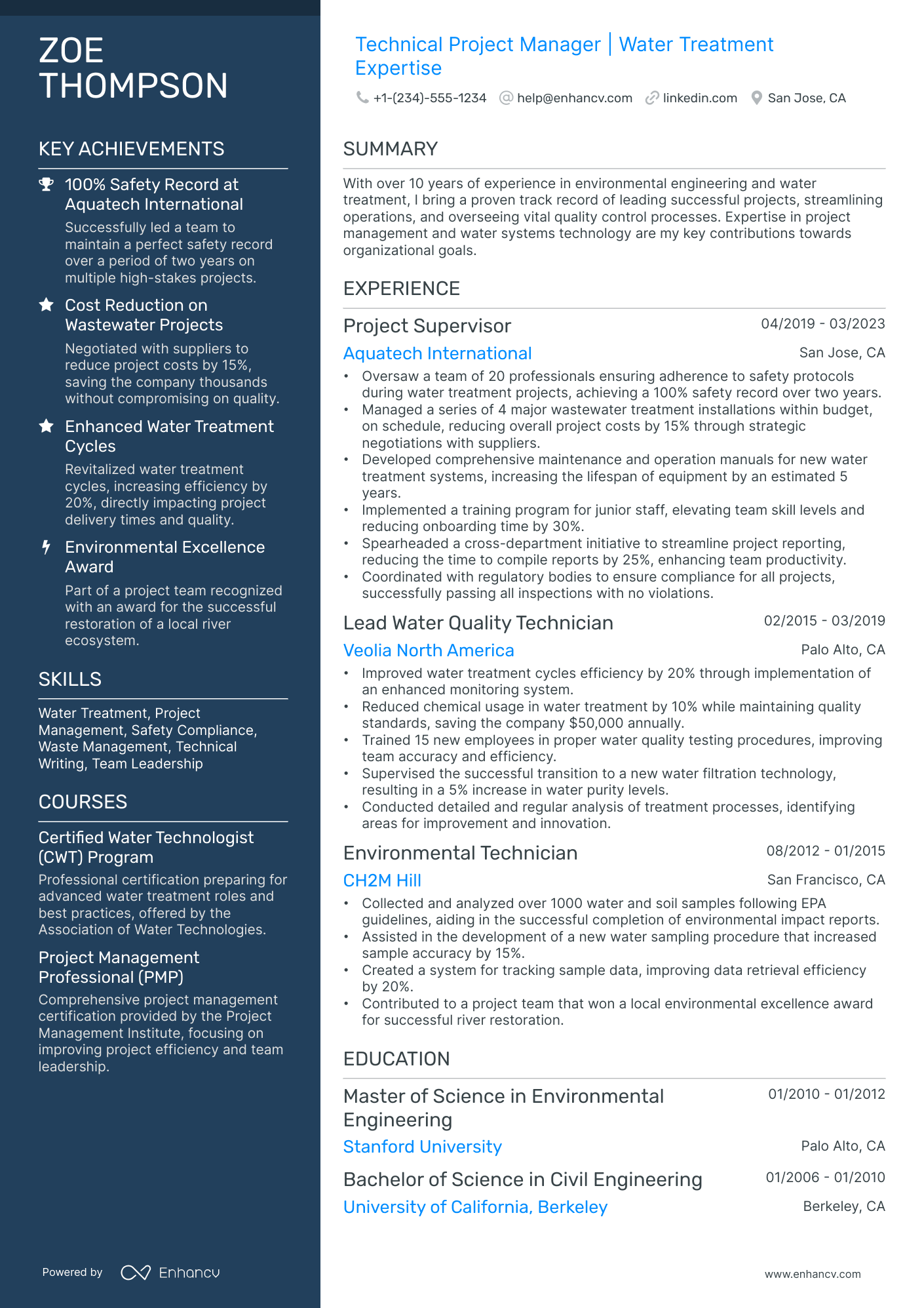
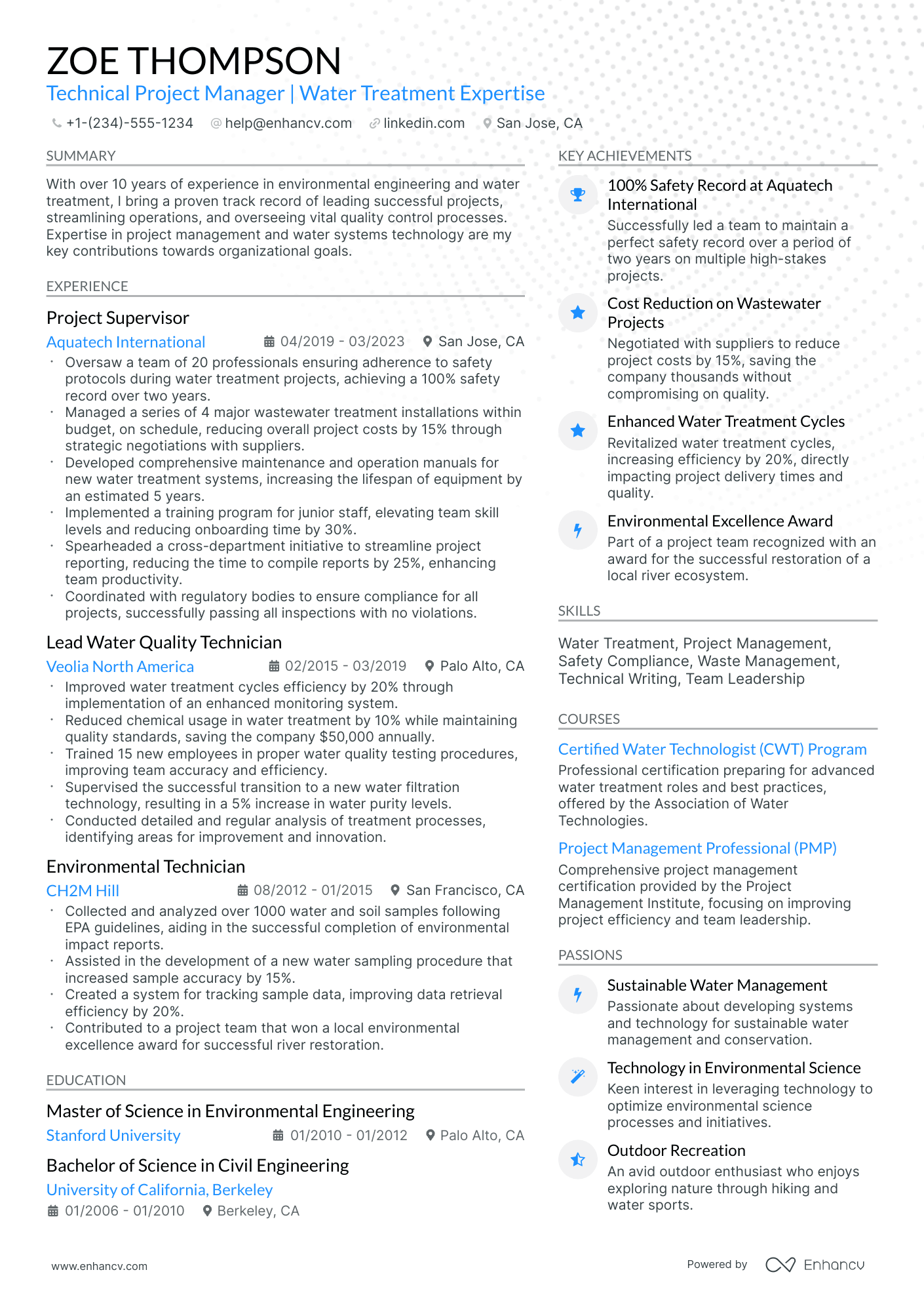
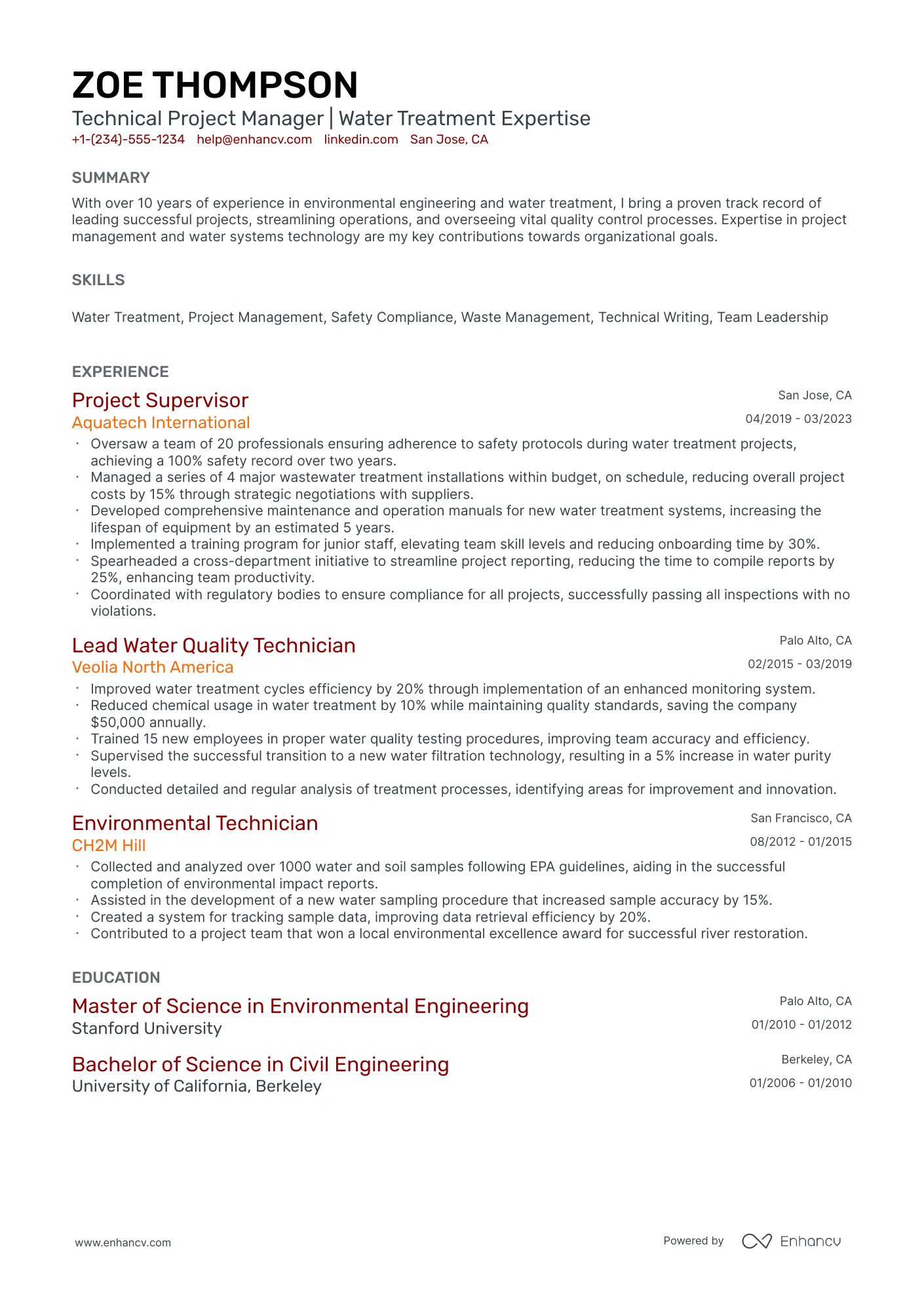
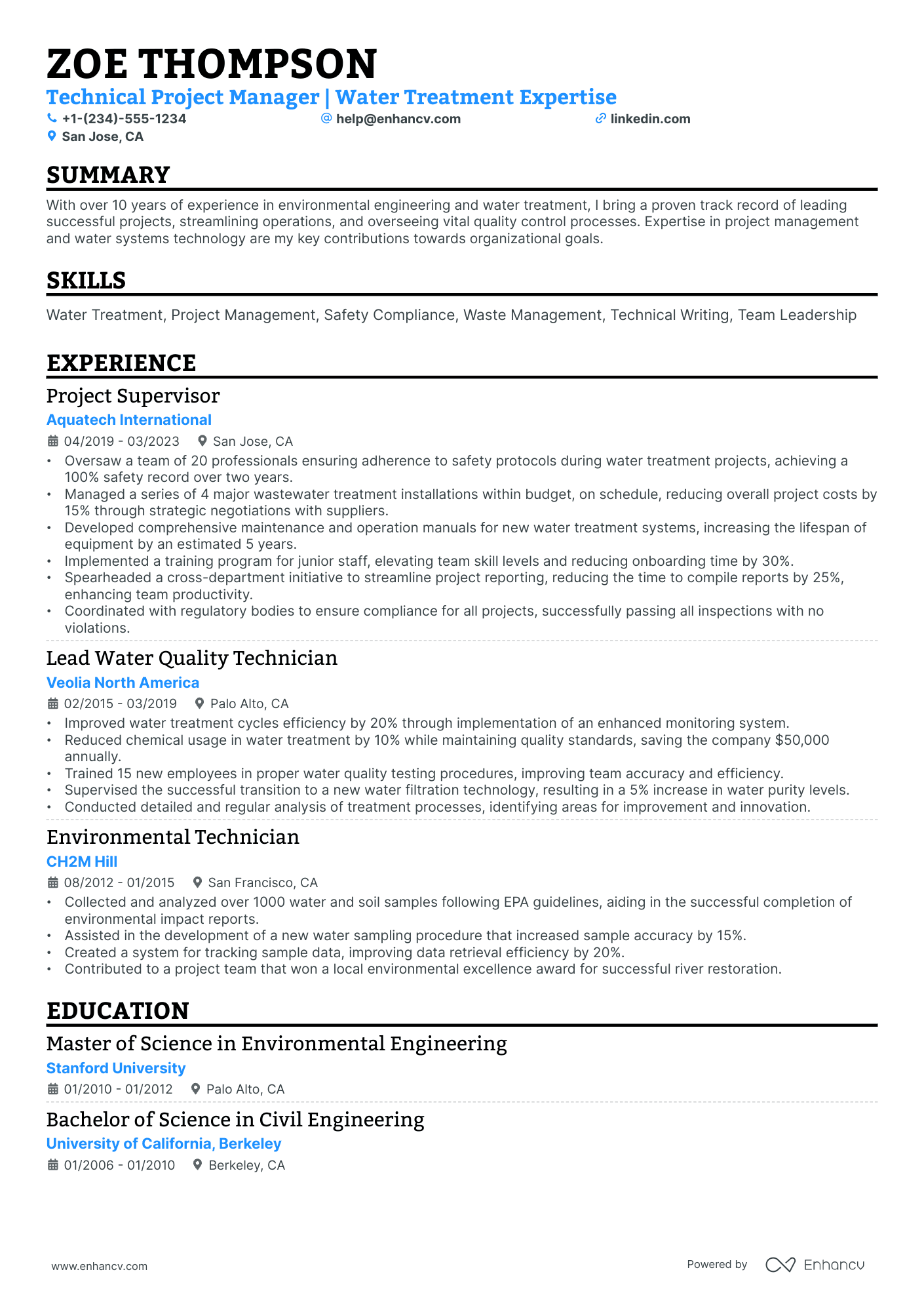
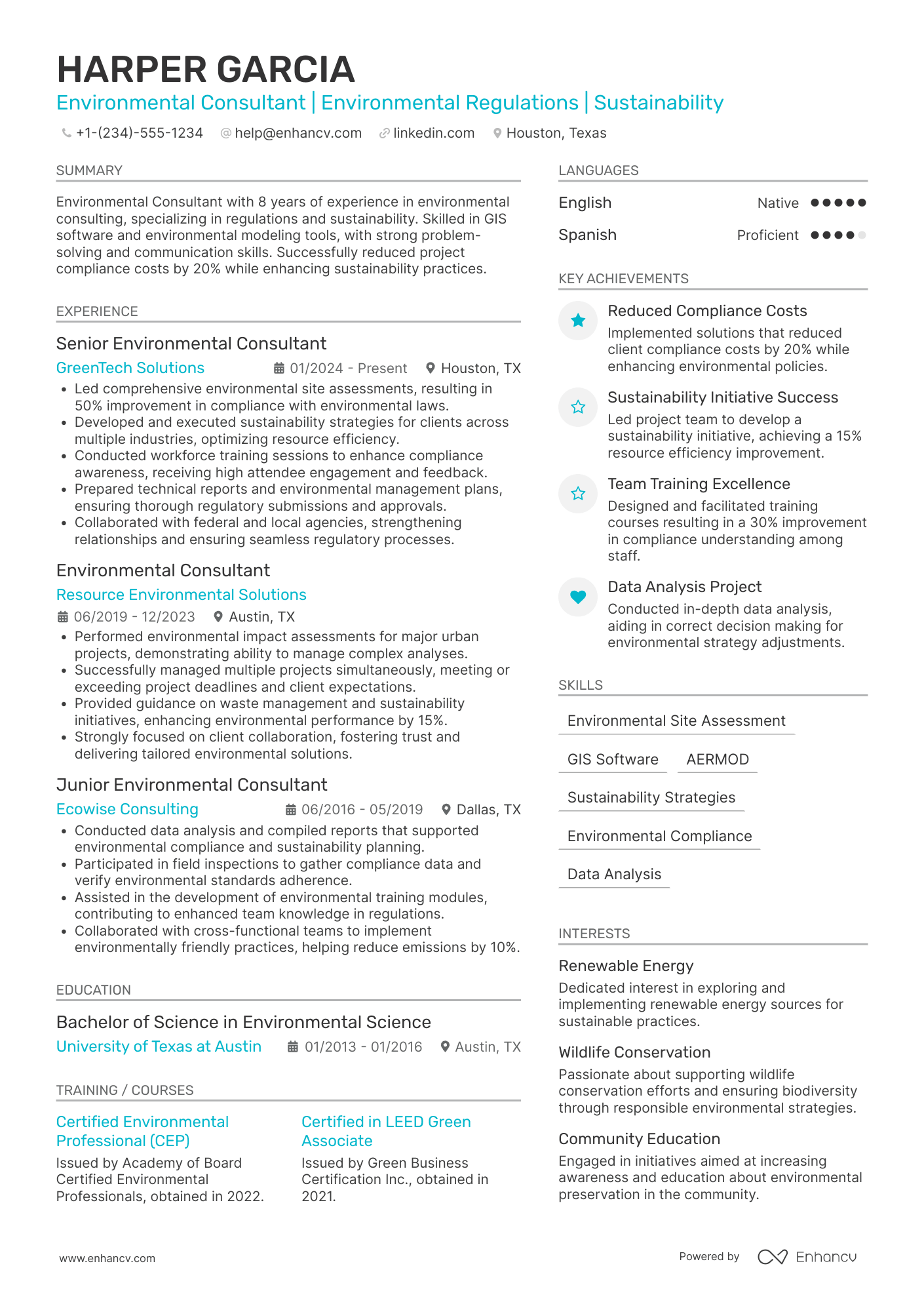
Many environmental consultant resume drafts fail because they bury measurable project outcomes under generic compliance tasks and tool lists. That stalls ATS matching and gets missed in rapid recruiter scans, especially when competition is high.
A strong resume shows what you delivered and why it mattered. Knowing how to make your resume stand out starts with highlighting permit approvals accelerated, contamination reduced, audit findings closed, budgets managed, sites remediated, and schedules protected across multi-site programs. Quantify scope, timelines, and risk reduction.

Key takeaways
- Quantify environmental project outcomes like cost savings, remediation timelines, and compliance rates in every bullet.
- Use reverse-chronological format for experienced consultants and hybrid format for career changers or juniors.
- Tailor experience bullets to each job posting's regulatory frameworks, tools, and deliverables.
- List certifications like CEP, HAZWOPER, or CHMM near education to reinforce specialized credentials.
- Tie skills to measurable results in your experience section rather than listing them in isolation.
- Enhancv's Bullet Point Generator helps turn vague duties into recruiter-ready, quantified resume bullets.
- Stop using AI once your resume accurately reflects real experience—never fabricate or inflate claims.
How to format a environmental consultant resume
Recruiters hiring environmental consultants prioritize regulatory knowledge, project management capability, and measurable outcomes tied to compliance, remediation, or sustainability initiatives. A clean, well-structured resume format ensures these signals surface quickly during both ATS parsing and manual review.

I have significant experience in this role—which format should I use?
Use a reverse-chronological format to present your environmental consulting career in a clear, progression-driven timeline. Do:
- Lead each role entry with scope indicators—team size managed, number of sites overseen, budgets controlled, and regulatory agencies coordinated with.
- Highlight domain-specific expertise such as NEPA compliance, Phase I/II ESAs, GIS analysis, stormwater management, or EIS preparation within each position's context.
- Quantify business and environmental impact using metrics like cost savings, contamination reduction percentages, permit approval timelines, or acres remediated.
I'm junior or switching into this role—what format works best?
A hybrid format works best, letting you lead with relevant environmental skills while still showing a concise work history. Do:
- Place a skills section near the top featuring core competencies like environmental impact assessment, regulatory compliance (EPA, state DEQs), sampling protocols, and report writing.
- Include academic projects, internships, or volunteer fieldwork—such as wetland delineations, water quality monitoring, or sustainability audits—as supporting experience entries.
- Connect each entry to a clear outcome so hiring managers see practical application, not just coursework or theory.
Why not use a functional resume?
A functional resume strips away the project timelines and employer context that environmental consulting recruiters rely on to verify your hands-on field and regulatory experience.
- Career changers from adjacent fields (e.g., geology, civil engineering, or public health) who completed relevant certifications or environmental project work but lack formal consulting job titles.
- Recent graduates with gaps between education and first employment who conducted fieldwork, research, or volunteer environmental monitoring.
- Professionals re-entering the workforce after an extended break who completed continuing education in environmental regulations or earned credentials like the Certified Environmental Professional (CEP) designation.
Now that you've established a clean, readable layout, it's time to fill it with the right sections that highlight your qualifications as an environmental consultant.
What sections should go on a environmental consultant resume
Recruiters expect a clean, compliance-focused resume that shows your environmental consulting scope, client outcomes, and project results. Understanding which resume sections to include helps you organize your qualifications for maximum impact.
Use this structure for maximum clarity:
- Header
- Summary
- Experience
- Skills
- Projects
- Education
- Certifications
- Optional sections: Publications, Research, Volunteering
Your experience bullets should emphasize measurable impact, regulatory outcomes, project scope, budgets, timelines, and risk reduction.
Is your resume good enough?
Drop your resume here or choose a file. PDF & DOCX only. Max 2MB file size.
Once you’ve organized your resume with the right components, the next step is to write your environmental consultant experience section so it aligns with that structure and shows your impact clearly.
How to write your environmental consultant resume experience
Your experience section proves you can deliver meaningful environmental outcomes—not just list responsibilities. Hiring managers reviewing environmental consultant resumes prioritize demonstrated impact through site assessments completed, regulatory compliance achieved, remediation projects delivered, and measurable improvements to environmental quality over generic task descriptions. Building a targeted resume ensures every bullet speaks directly to the role you're pursuing.
Each entry should include:
- Job title
- Company and location (or remote)
- Dates of employment (month and year)
Three to five concise bullet points showing what you owned, how you executed, and what outcomes you delivered:
- Ownership scope: the environmental projects, site assessments, compliance programs, remediation efforts, or client portfolios you were directly accountable for managing or leading.
- Execution approach: the regulatory frameworks, environmental modeling software, sampling methodologies, risk assessment protocols, or analytical tools you applied to investigate conditions, interpret data, and guide project decisions.
- Value improved: the changes you drove in environmental quality, regulatory compliance rates, contamination reduction, project turnaround time, reporting accuracy, or risk mitigation for clients or affected communities.
- Collaboration context: how you coordinated with regulatory agencies, engineering teams, legal counsel, property developers, laboratory partners, or community stakeholders to advance environmental objectives and secure approvals.
- Impact delivered: the project outcomes, compliance milestones, remediation completions, cost efficiencies, or policy improvements you produced—framed through results and scale rather than descriptions of daily activities.
Experience bullet formula
A environmental consultant experience example
✅ Right example - modern, quantified, specific.
Environmental Consultant
EcoSphere Consulting Group | Denver, CO
2021–Present
Environmental and sustainability consultancy supporting energy, manufacturing, and public-sector clients across the Mountain West.
- Led Phase I and Phase II Environmental Site Assessments (ASTM E1527-21) across thirty-two properties; identified recognized environmental conditions on nine sites and reduced client acquisition risk by 28% through early mitigation planning.
- Built a GIS (geographic information system) screening workflow in ArcGIS Pro and Python to map wetlands, floodplains, and sensitive receptors; cut desktop review time by 35% and improved siting recommendations for twelve capital projects.
- Prepared air permitting applications and emissions inventories using AERMOD and Excel-based calculations; secured five permits with zero agency rework and shortened approval cycles by an average of six weeks.
- Managed remediation projects under state voluntary cleanup programs; coordinated field teams and laboratories using EPA analytical methods (SW-846) and EQuIS reporting to achieve 96% first-pass data validation and prevent schedule slips.
- Partnered with client engineering, legal, and operations stakeholders to develop spill prevention and stormwater compliance programs (SPCC and SWPPP); reduced reportable incidents by 22% year over year across three facilities.
Now that you've seen how to structure your experience entries, let's focus on adapting them to match the specific requirements of each job posting.
How to tailor your environmental consultant resume experience
Recruiters evaluate your environmental consultant resume through both applicant tracking systems and human review. Tailoring your resume to the job description ensures your qualifications align directly with what the employer needs.
Ways to tailor your environmental consultant experience:
- Match specific regulatory frameworks like NEPA or CERCLA from the posting.
- Use the exact terminology for site assessment methods the employer lists.
- Mirror environmental compliance standards referenced in the job description.
- Highlight relevant industry experience such as energy or construction sectors.
- Incorporate remediation technologies or modeling software the role requires.
- Reflect quality assurance or data validation workflows the posting emphasizes.
- Include stakeholder collaboration or cross-functional coordination if mentioned.
- Align your bullet points with the KPIs or deliverables the role prioritizes.
Tailoring means framing your real accomplishments to reflect the language and priorities of the job posting, not forcing in keywords where they don't belong.
Resume tailoring examples for environmental consultant
| Job description excerpt | Untailored | Tailored |
|---|---|---|
| Conduct Phase I and Phase II Environmental Site Assessments (ESAs) in accordance with ASTM standards for commercial and industrial properties. | Performed environmental assessments for various clients across multiple sectors. | Conducted over 40 Phase I and Phase II ESAs annually for commercial and industrial properties, following ASTM E1527-21 and E1903-19 standards, identifying recognized environmental conditions in 30% of assessed sites. |
| Develop and implement remediation plans for contaminated sites, including soil and groundwater treatment using in-situ technologies such as chemical oxidation and bioremediation. | Helped with cleanup projects and supported environmental remediation efforts as needed. | Designed and oversaw remediation plans for three contaminated industrial sites, deploying in-situ chemical oxidation and bioremediation to reduce soil and groundwater contaminant levels below state action thresholds within 18 months. |
| Prepare NEPA documentation, including Environmental Impact Statements (EIS) and Environmental Assessments (EA), coordinating with federal and state agencies for regulatory compliance. | Prepared environmental reports and documentation for project approvals. | Authored NEPA-compliant Environmental Assessments and Environmental Impact Statements for five federally funded infrastructure projects, coordinating reviews with the EPA and U.S. Army Corps of Engineers to secure regulatory approval ahead of schedule. |
Once you’ve aligned your experience with the role’s needs, the next step is to quantify your achievements so employers can see the measurable impact of your work.
How to quantify your environmental consultant achievements
Quantifying your work proves you reduced risk, improved compliance, and delivered projects on time and budget. Quantifying your achievements with metrics like permit cycle time, sampling volume, exceedance rates, cost savings, and hazard reduction across sites and programs makes your impact undeniable.
Quantifying examples for environmental consultant
| Metric | Example |
|---|---|
| Compliance rate | "Achieved 100% on-time submittals for eight air and stormwater permits, with zero agency findings, using a standardized compliance calendar and SharePoint tracker." |
| Sampling throughput | "Collected and managed 320 soil and groundwater samples across twelve sites in six weeks, coordinating two labs and maintaining full chain-of-custody documentation." |
| Exceedance reduction | "Reduced groundwater exceedances from nine to two analytes over three quarters by refining the monitoring plan and optimizing treatment system setpoints." |
| Cost savings | "Cut disposal and hauling costs by $185,000 by reclassifying 1,400 tons of soil through additional characterization and profiling with the receiving facility." |
| Risk mitigation | "Lowered worker exposure risk by 60% by implementing a site-specific health and safety plan, upgrading controls, and completing forty-two tailgate trainings." |
Turn vague job duties into measurable, recruiter-ready resume bullets in seconds with Enhancv's Bullet Point Generator.
Once you've crafted strong bullet points for your experience section, the next step is ensuring your resume also highlights the right combination of hard and soft skills that environmental consulting employers prioritize.
How to list your hard and soft skills on a environmental consultant resume
Your skills section shows you can assess environmental risk, meet regulatory requirements, and deliver defensible recommendations—recruiters and applicant tracking systems scan this section for role keywords, then validate them in experience. Aim for a balanced mix of technical hard skills and job-critical soft skills. environmental consultant roles require a blend of:
- Product strategy and discovery skills.
- Data, analytics, and experimentation skills.
- Delivery, execution, and go-to-market discipline.
- Soft skills.
Your skills section should be:
- Scannable (bullet-style grouping).
- Relevant to the job post.
- Backed by proof in experience bullets.
- Updated with current tools.
Place your skills section:
- Above experience if you're junior or switching careers.
- Below experience if you're mid/senior with strong achievements.

Hard skills
- Phase I Environmental Site Assessments (ESA)
- Phase II subsurface investigations
- ASTM E1527, E1903
- Soil, groundwater sampling
- Vapor intrusion assessment
- Risk assessment, risk screening
- NEPA documentation support
- Wetlands delineation, permitting
- SPCC, SWPPP development
- EPA ECHO, TRI reporting
- GIS mapping: ArcGIS, QGIS
- Data analysis: Excel, R
Soft skills
- Translate regulations into actions
- Write defensible technical reports
- Lead fieldwork logistics and safety
- Coordinate with labs and subcontractors
- Manage client expectations and scope
- Present findings to nontechnical audiences
- Document decisions and assumptions
- Prioritize tasks under deadlines
- Resolve permit and compliance issues
- Collaborate with regulators and stakeholders
- Escalate risks early and clearly
- Own deliverables end-to-end
How to show your environmental consultant skills in context
Skills shouldn't live only in a bulleted list on your resume. Explore resume skills examples to see how top candidates weave competencies into real achievements.
They should be demonstrated in:
- Your summary (high-level professional identity)
- Your experience (proof through outcomes)
Here's what strong, skills-rich entries look like in practice.
Summary example
Environmental consultant with 12 years in remediation and compliance, skilled in Phase I/II ESAs, GIS mapping, and NEPA documentation. Led site assessments across 40+ projects, cutting client remediation costs by 18% through strategic risk prioritization.
- Reflects senior-level expertise immediately
- Names industry-standard tools and methods
- Includes a concrete, measurable outcome
- Signals leadership and strategic thinking
Experience example
Senior Environmental Consultant
Terracon Consultants | Portland, OR
March 2018–Present
- Directed Phase II ESAs for 25+ contaminated sites using GIS and EPA frameworks, reducing average assessment timelines by 22%.
- Partnered with civil engineers and regulatory agencies to develop remediation plans that achieved compliance approval on first submission for 90% of projects.
- Conducted NEPA environmental impact reviews and trained junior staff on sampling protocols, improving data accuracy rates by 15%.
- Every bullet includes measurable proof.
- Skills appear naturally within achievements.
Once you’ve tied your environmental consulting strengths to real outcomes and situations, the next step is to apply that approach to building an environmental consultant resume when you don’t have formal experience.
How do I write a environmental consultant resume with no experience
Even without full-time experience, you can demonstrate readiness through relevant projects and training. Our guide on writing a resume without work experience shows you how to position these effectively:
- Environmental site assessment class project
- GIS mapping and spatial analysis lab
- Stormwater sampling field practicum
- Environmental compliance audit simulation
- Volunteer watershed cleanup data logging
- Undergraduate research on soil contamination
- Internship in sustainability reporting
- Hazardous waste handling training certificate
Focus on:
- Clear methods, tools, and outputs
- Regulations knowledge tied to projects
- Data quality, sampling, and documentation
- Measurable results and deliverables
Resume format tip for entry-level environmental consultant
Use a combination resume format to spotlight projects and technical skills first, while still listing education and any work history. Do:
- Put projects above work experience.
- Add tools used in each bullet.
- Name standards you followed, when applicable.
- Quantify samples, maps, or findings.
- Link each project to a deliverable.
- Conducted a stormwater sampling field practicum using YSI ProDSS and chain-of-custody logs, collecting 24 samples and reducing documentation errors by 15%.
Even without hands-on experience, your academic background can demonstrate relevant knowledge and skills—making how you present your education section especially important.
How to list your education on a environmental consultant resume
Your education section helps hiring teams confirm you have the scientific and regulatory foundation essential for an environmental consultant role. It quickly validates your academic qualifications.
Include:
- Degree name
- Institution
- Location
- Graduation year
- Relevant coursework (for juniors or entry-level candidates)
- Honors & GPA (if 3.5 or higher)
Skip month and day details—list the graduation year only.
Here's a strong education entry tailored for an environmental consultant resume.
Example education entry
Bachelor of Science in Environmental Science
University of Oregon, Eugene, OR
Graduated 2021
GPA: 3.7/4.0
- Relevant Coursework: Environmental Impact Assessment, Soil & Groundwater Remediation, GIS for Environmental Analysis, Environmental Policy & Law
- Honors: Magna Cum Laude, Dean's List (six consecutive semesters)
How to list your certifications on a environmental consultant resume
Certifications on your resume show an environmental consultant's commitment to learning, proficiency with field tools, and alignment with current regulations and client expectations.
Include:
- Certificate name
- Issuing organization
- Year
- Optional: credential ID or URL
- Place certifications below education when they are older, general, or less relevant than your degree and recent project work.
- Place certifications above education when they are recent, required for target roles, or directly tied to core environmental consultant services.
Best certifications for your environmental consultant resume
- Certified Environmental Professional (CEP)
- OSHA HAZWOPER 40-Hour Certification
- Certified Hazardous Materials Manager (CHMM)
- Leadership in Energy and Environmental Design (LEED) Green Associate
- ISO 14001 Lead Auditor
- Certified Professional in Erosion and Sediment Control (CPESC)
- Certified Wetland Delineator (CWD)
Once you’ve positioned your credentials where recruiters can find them fast, focus on writing your environmental consultant resume summary to tie those qualifications to the role you’re targeting.
How to write your environmental consultant resume summary
Your resume summary is the first thing a recruiter reads. A strong one instantly signals you're qualified for the environmental consultant role.
Keep it to three to four lines, with:
- Your title and total years of experience in environmental consulting.
- Domain focus such as site remediation, compliance auditing, or impact assessment.
- Core tools and skills like Phase I/II ESAs, GIS, NEPA regulations, or risk modeling.
- One or two quantified achievements that show measurable project outcomes.
- Soft skills tied to real results, such as client communication that shortened approval timelines.

PRO TIP
At this level, emphasize technical skills, relevant coursework, and early project contributions. Highlight specific tools and regulations you've worked with. Avoid vague phrases like "passionate about the environment" or "hard-working team player." Recruiters want evidence of what you can do, not motivation statements.
Example summary for a environmental consultant
Environmental consultant with three years of experience in Phase I/II ESAs and NEPA compliance. Conducted site assessments across 15 commercial properties, reducing client remediation costs by 20% through early contamination identification.
Optimize your resume summary and objective for ATS
Drop your resume here or choose a file.
PDF & DOCX only. Max 2MB file size.
Now that your summary effectively communicates your expertise and value, make sure the header above it presents your contact details correctly so recruiters can actually reach you.
What to include in a environmental consultant resume header
A resume header lists your key contact and professional links, which boosts visibility, builds credibility, and speeds recruiter screening for a environmental consultant.
Essential resume header elements
- Full name
- Tailored job title and headline
- Location
- Phone number
- Professional email
- GitHub link
- Portfolio link
A LinkedIn link helps recruiters confirm roles, dates, and credentials fast, which supports quick screening decisions.
Do not include a photo on a environmental consultant resume unless the role is explicitly front-facing or appearance-dependent.
Match your header title to the posting and include a compliance-focused headline that fits the environmental consultant role you want.
Example
Environmental consultant resume header
Jordan Rivera
Environmental Consultant | Phase I and II ESA, NEPA Support, and Regulatory Compliance
Denver, CO
(303) 555-01XX
jordan.rivera@enhancv.com
github.com/jordanrivera
jordanrivera.com
linkedin.com/in/jordanrivera
Once your contact details and professional identifiers are clear and easy to scan, add targeted additional sections to round out your environmental consultant resume with relevant supporting information.
Additional sections for environmental consultant resumes
Standing out as an environmental consultant often means showcasing specialized credentials that go beyond standard work experience and education sections. For example, listing language skills can demonstrate your ability to work with diverse communities and international regulatory bodies.
- Certifications and licenses
- Publications and research
- Professional affiliations
- Languages
- Conference presentations
- Fieldwork and technical training
- Volunteer conservation work
Once you've strengthened your resume with well-chosen additional sections, the next step is pairing it with a cover letter that adds even more context to your candidacy.
Do environmental consultant resumes need a cover letter
An environmental consultant cover letter isn't required for every application, but it often helps. If you're unsure what a cover letter is and when it adds value, it can make a difference in competitive roles or when employers expect a clear, client-ready writing sample.
Use a cover letter when you need to add context beyond your resume:
- Explain role or team fit by linking your strengths to the project type, clients, and collaboration style the environmental consultant role requires.
- Highlight one or two relevant projects with outcomes, including permitting wins, risk reductions, audit results, or measurable schedule and cost impacts.
- Show understanding of the business context by referencing the employer's services, key regulations, and the users you'll support, such as site managers or regulators.
- Address career transitions or non-obvious experience by mapping prior work to environmental consultant tasks, tools, and compliance responsibilities.
Drop your resume here or choose a file.
PDF & DOCX only. Max 2MB file size.
Whether you include a cover letter or not, the next step is using AI to improve your environmental consultant resume so it communicates your qualifications clearly and efficiently.
Using AI to improve your environmental consultant resume
AI can sharpen your resume's clarity, structure, and impact. It helps refine language and highlight measurable results. However, overusing it risks making your resume sound generic. Once your content is clear and role-aligned, step away from AI. If you're wondering which AI is best for writing resumes, focus on tools that help you edit and refine rather than generate from scratch.
Here are 10 practical prompts to strengthen specific sections of your environmental consultant resume:
- Strengthen your summary. "Rewrite my environmental consultant resume summary to highlight my top skills, years of experience, and key industry focus areas in three sentences."
- Quantify project results. "Add measurable outcomes to these environmental consultant experience bullets, focusing on cost savings, compliance rates, or remediation timelines."
- Sharpen skills relevance. "Review my skills section and remove any entries not directly relevant to an environmental consultant role. Suggest replacements."
- Improve action verbs. "Replace weak or repetitive verbs in my environmental consultant experience bullets with stronger, more specific alternatives."
- Tailor to a job posting. "Compare my environmental consultant resume to this job description. Identify missing keywords and suggest where to add them."
- Clarify certifications. "Reformat my certifications section so each entry clearly states the credential name, issuing body, and relevance to environmental consultant work."
- Refine education details. "Rewrite my education section to emphasize coursework and research directly applicable to an environmental consultant position."
- Tighten project descriptions. "Condense these environmental consultant project descriptions into two-line bullets that emphasize scope, methods, and outcomes."
- Remove filler language. "Identify and remove vague or redundant phrases from my environmental consultant resume. Keep every sentence specific and direct."
- Align bullet structure. "Restructure my environmental consultant experience bullets into consistent 'Action + Task + Result' format with parallel construction throughout."
Stop using AI once your resume sounds accurate, specific, and aligned with real experience. AI should never invent experience or inflate claims—if it didn't happen, it doesn't belong here.
Conclusion
A strong environmental consultant resume shows measurable outcomes, role-specific skills, and a clear structure. It highlights results like reduced compliance risks, faster permitting timelines, and audit-ready documentation. It uses concise bullets, consistent formatting, and targeted keywords that match the job.
This approach signals readiness for today’s hiring market and near-future needs. It shows you can manage regulations, fieldwork, stakeholder communication, and reporting with accuracy. It also makes your impact easy to scan, compare, and trust.