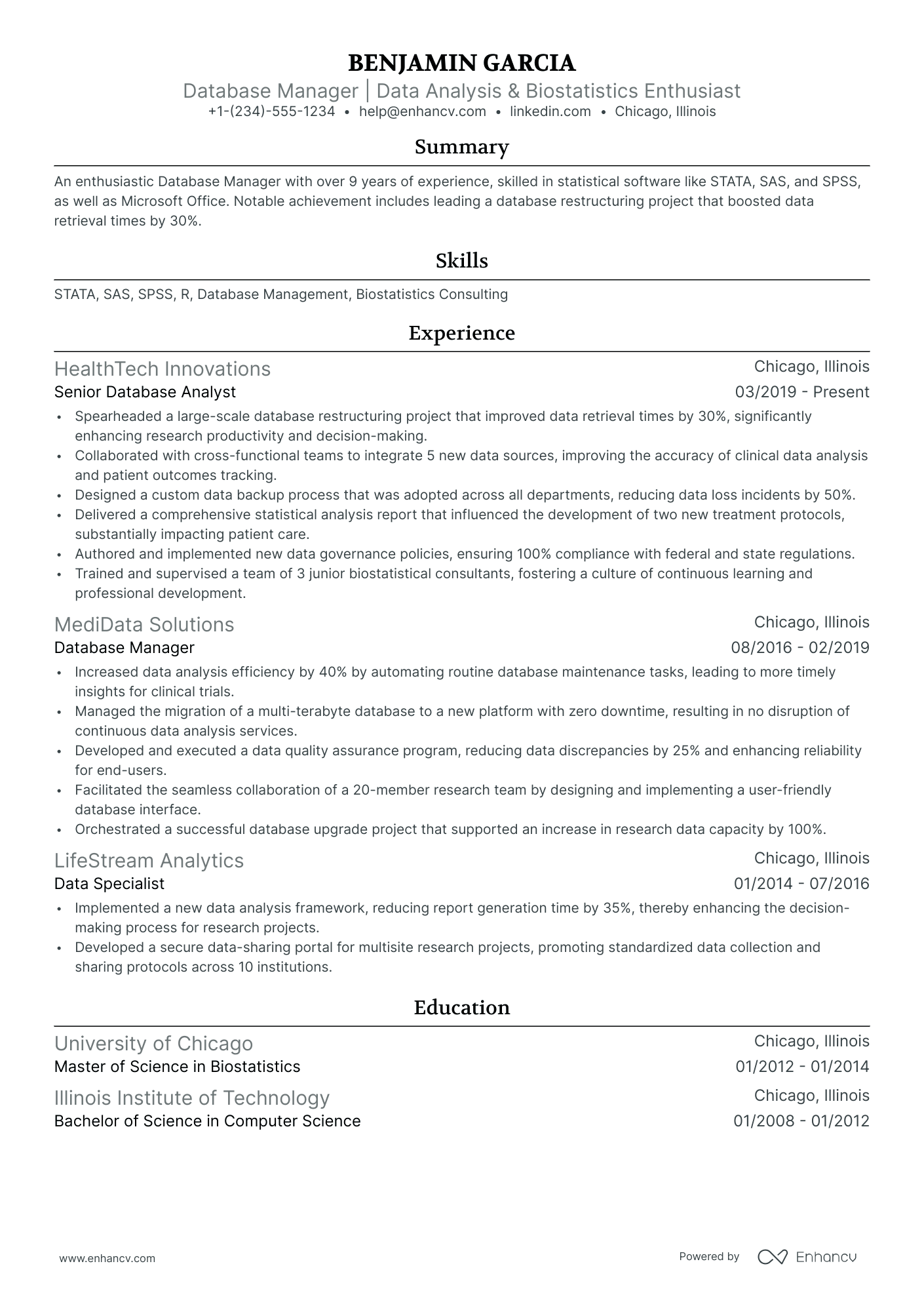
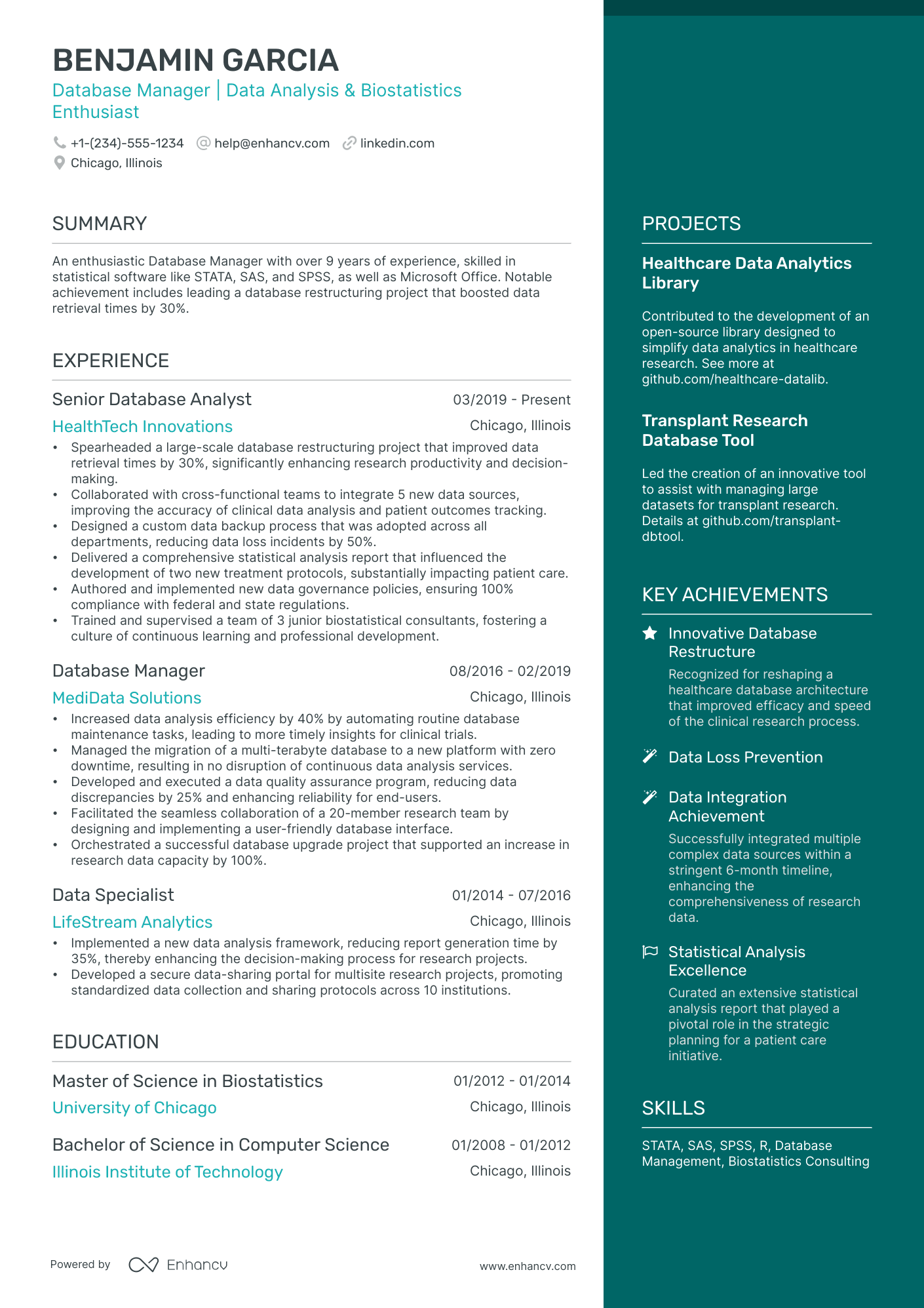
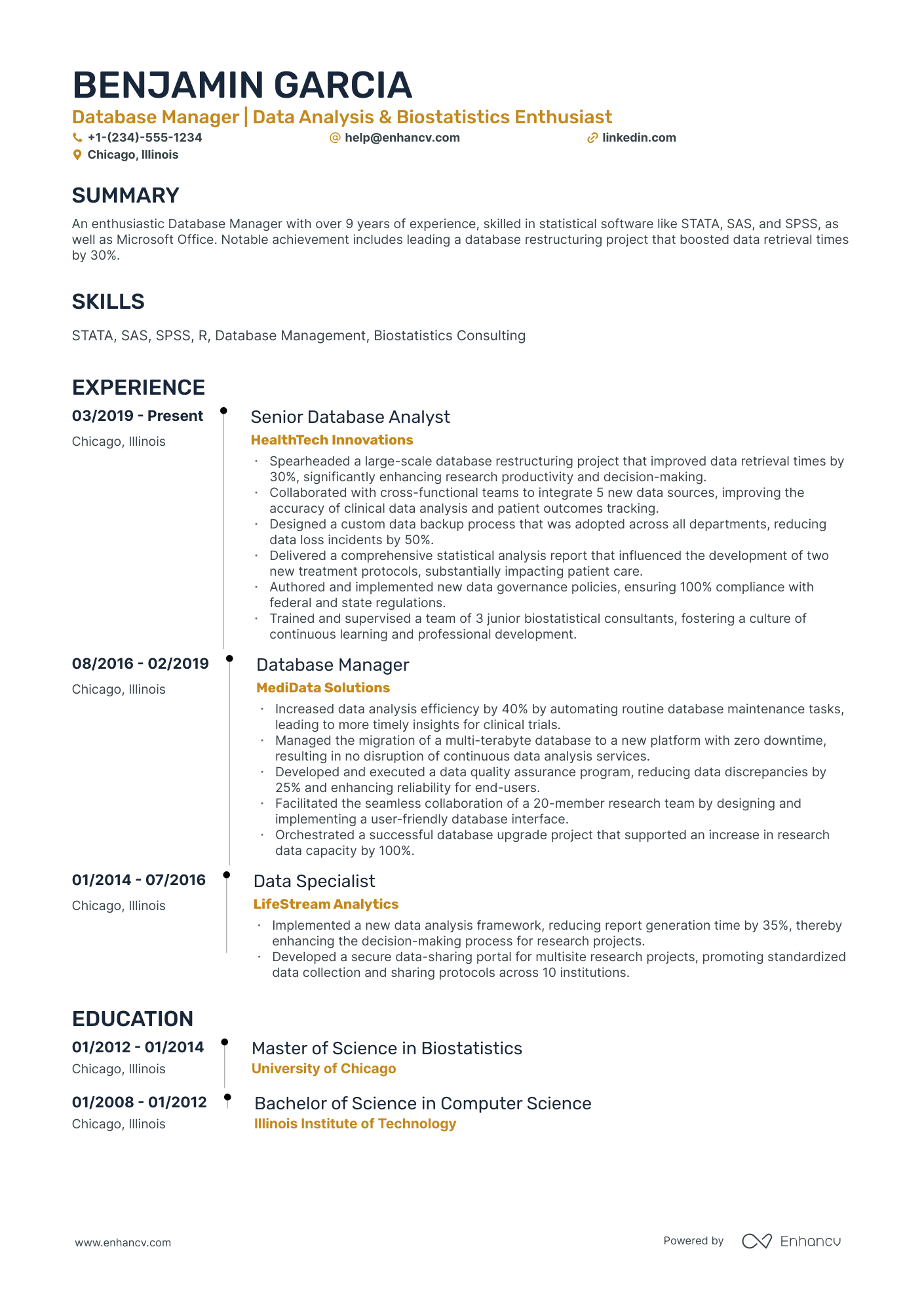
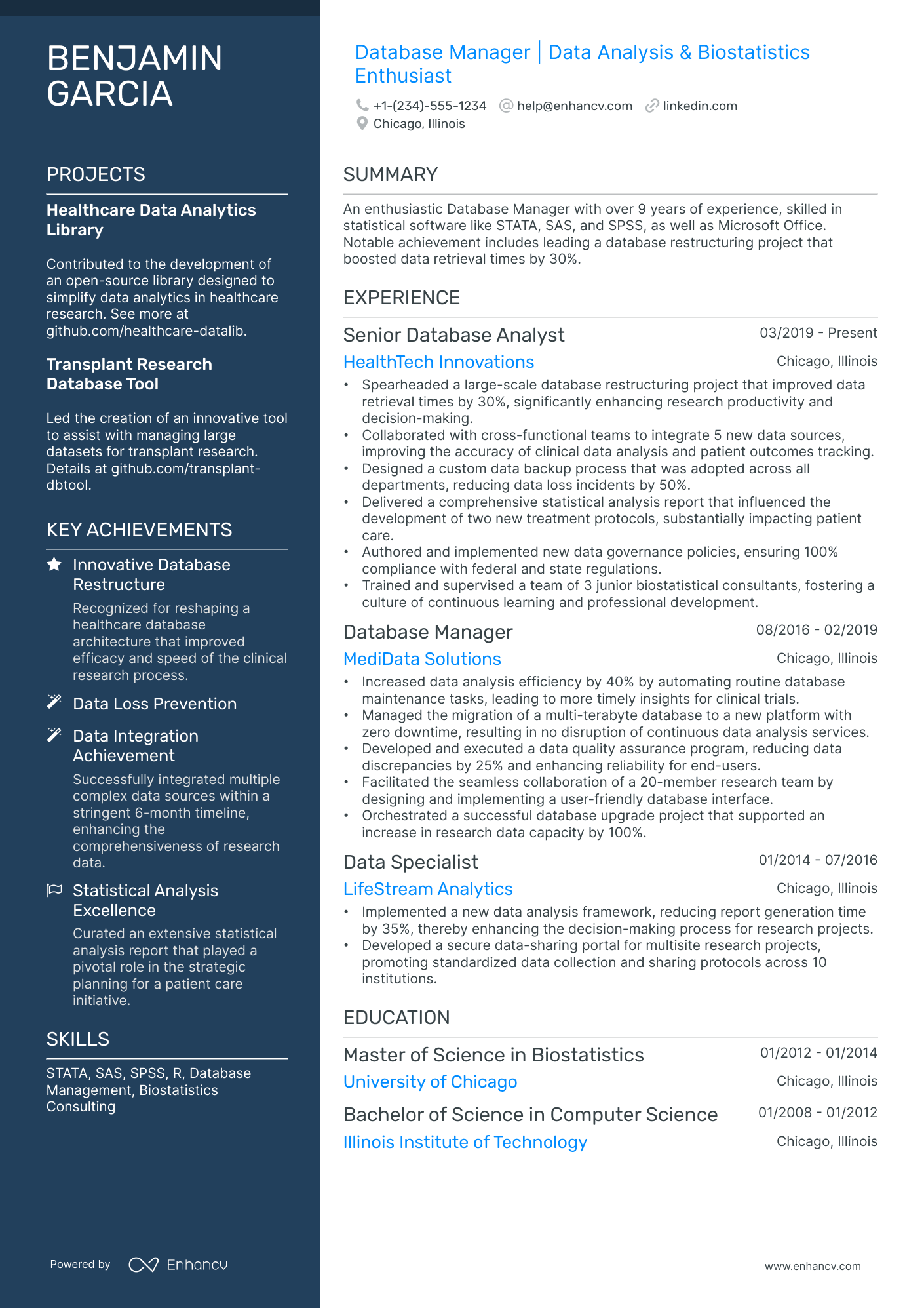
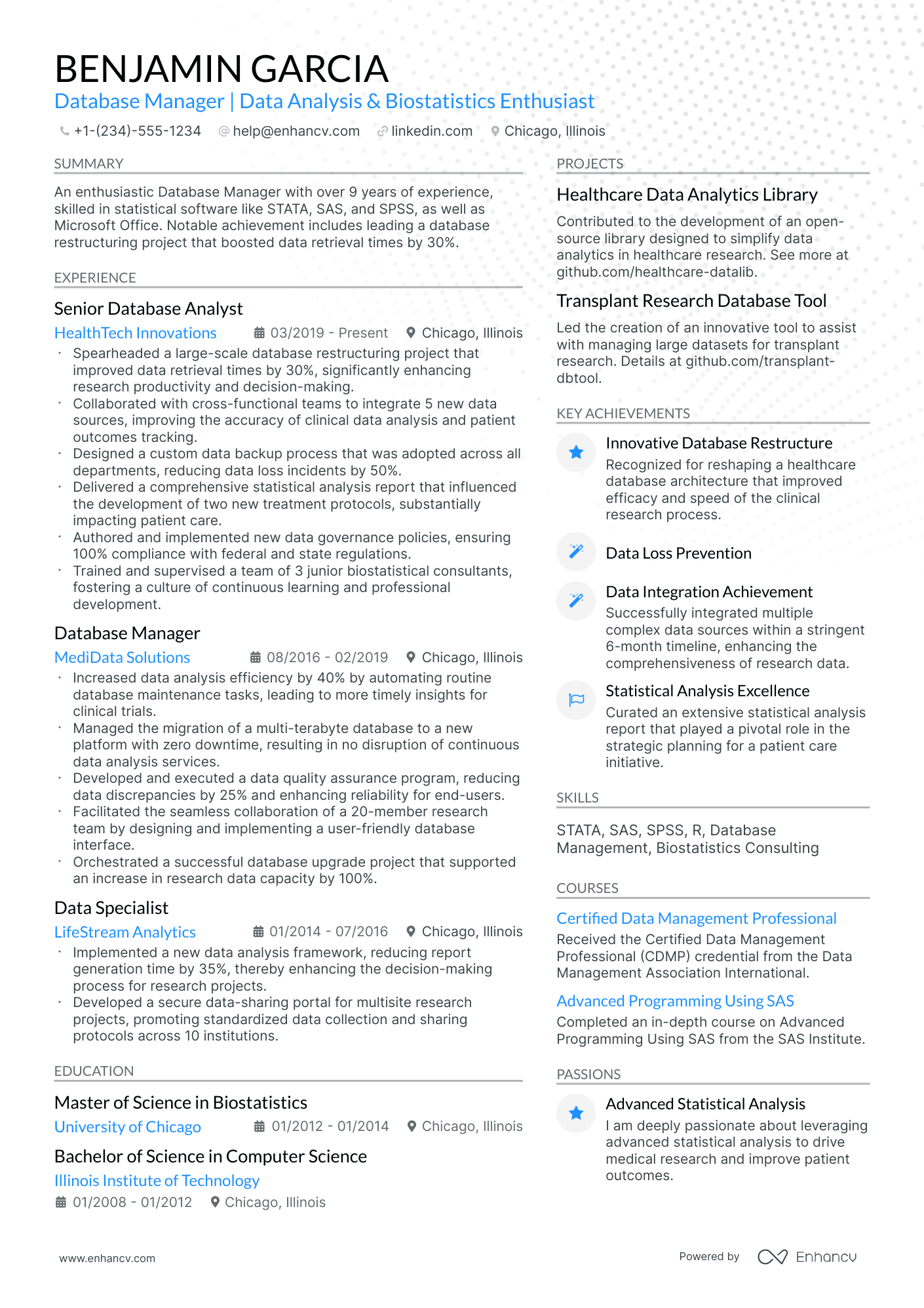
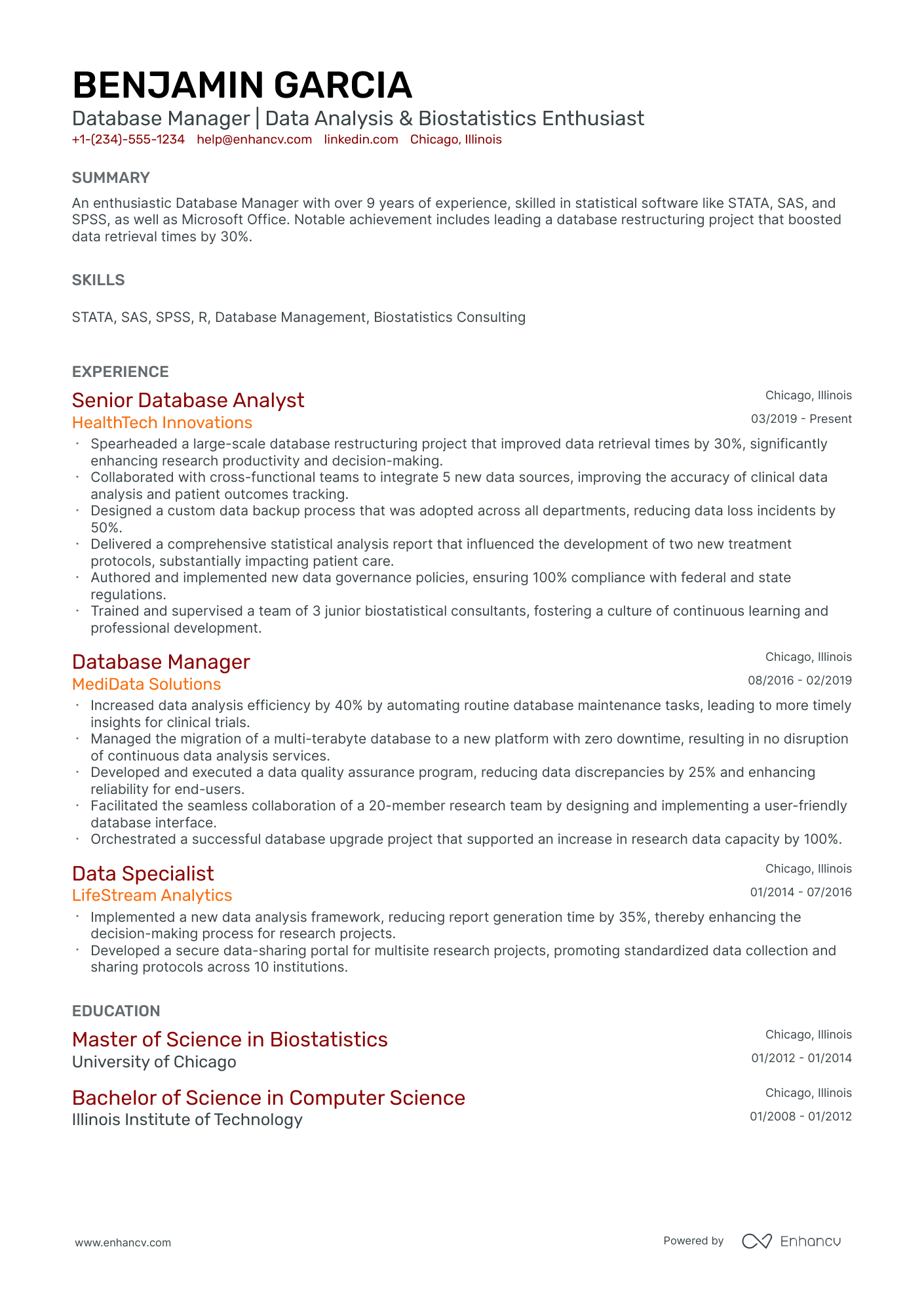
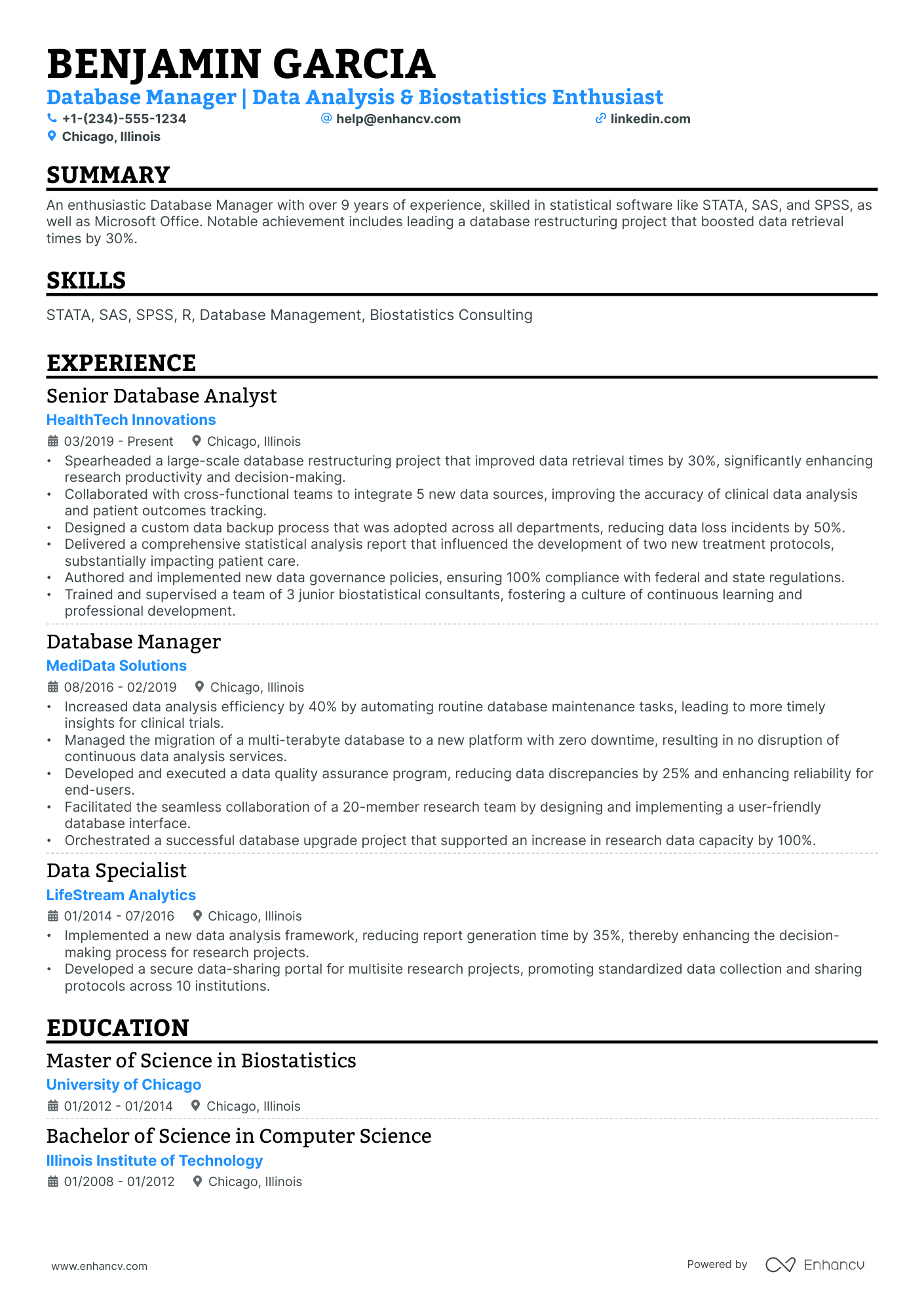
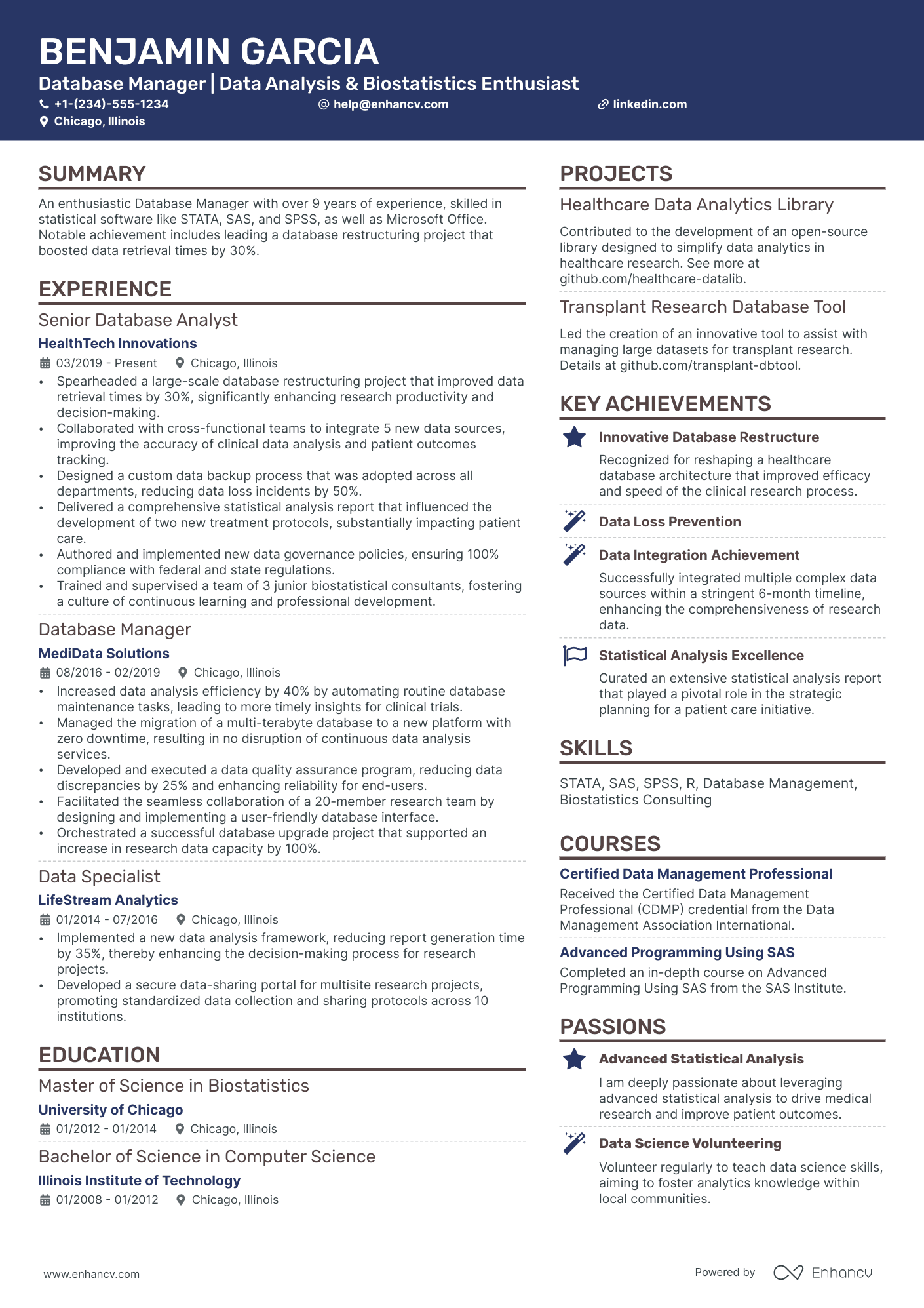
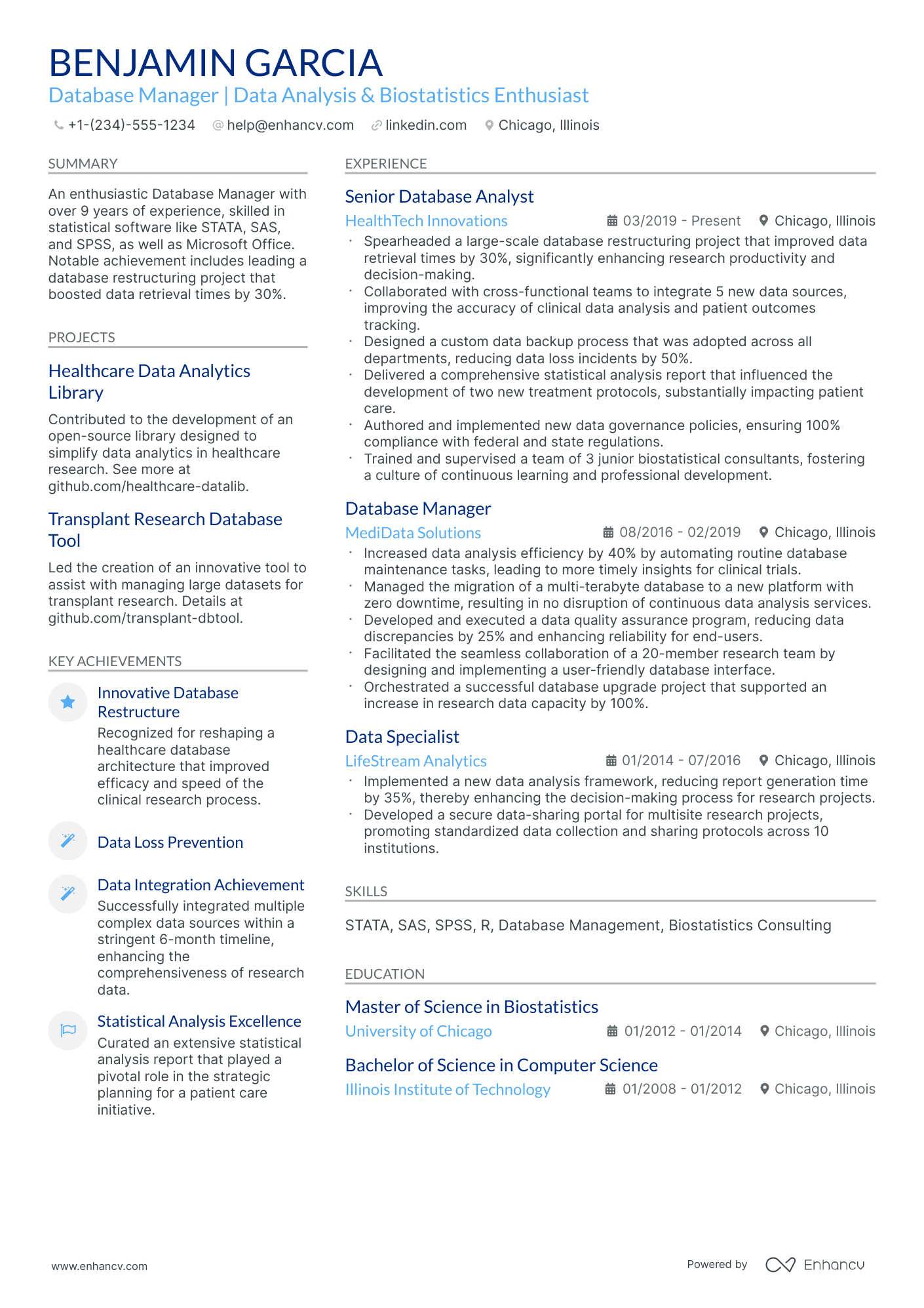
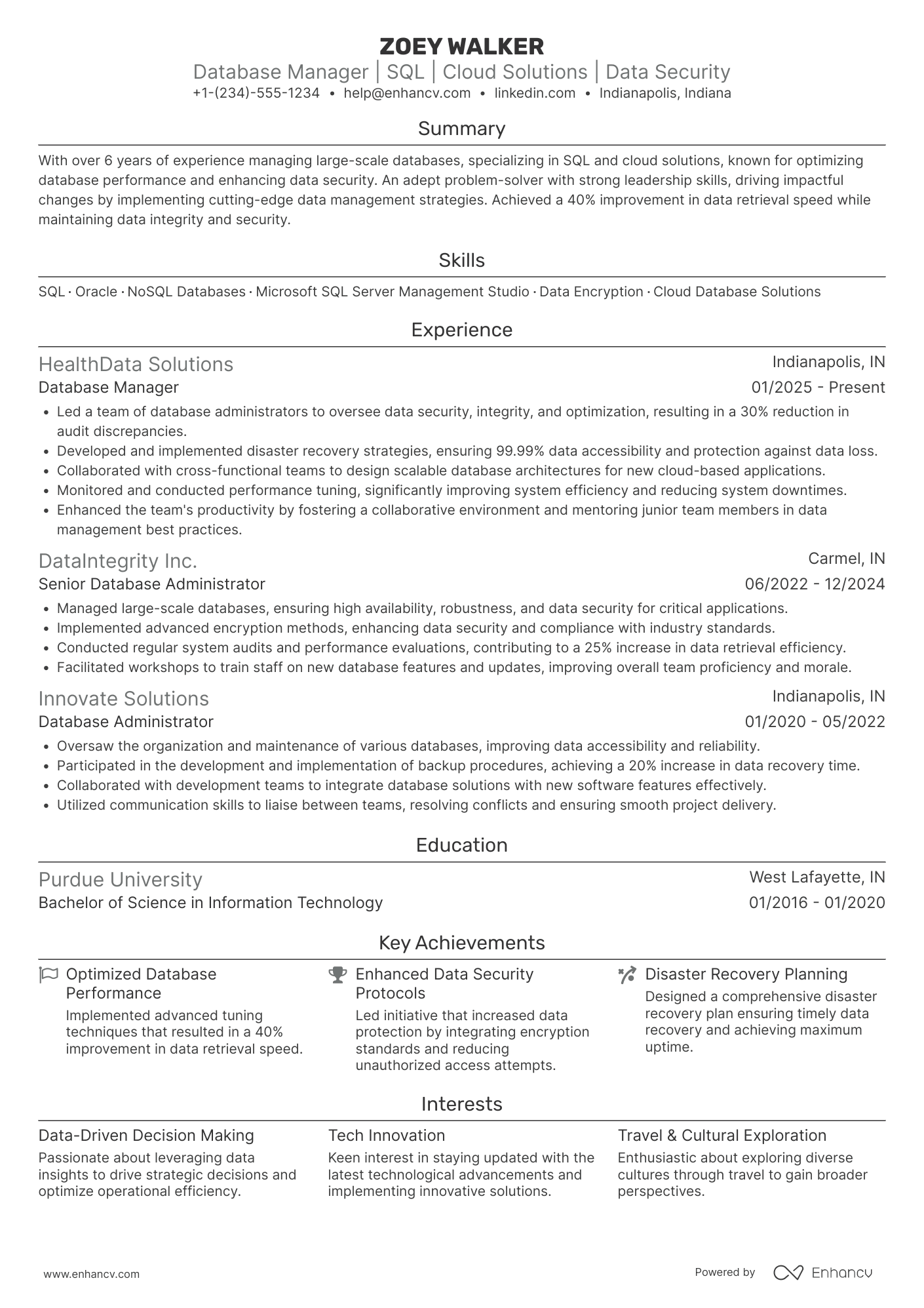
Most database manager resume drafts fail because they read like tool inventories and task lists, not evidence of governance and reliability. That format gets filtered by ATS rules and skimmed in seconds by recruiters facing heavy applicant volume.
A strong resume shows how you improved stability, security, and delivery. If you're unsure where to begin, learning how to write a resume that highlights impact is the essential first step. You should highlight uptime gains, query latency reductions, backup recovery times, cost savings, audit pass rates, and migrations delivered on schedule with minimal incidents.

Key takeaways
- Quantify uptime, query latency, cost savings, and recovery times in every experience bullet.
- Use reverse-chronological format for senior roles and hybrid format for career changers.
- Tailor resume language to match the exact tools, platforms, and standards in each job posting.
- Anchor every listed skill to a measurable outcome in your experience or project sections.
- Place certifications above education when they're recent and directly relevant to the target role.
- Write a three- to four-line summary featuring your title, core tools, and a top achievement.
- Use Enhancv to turn vague duties into focused, results-driven bullet points faster.
Job market snapshot for database managers
We analyzed 55 recent database manager job ads across major US job boards. These numbers help you understand salary landscape, employment type trends, role specialization trends at a glance.
What level of experience employers are looking for database managers
| Years of Experience | Percentage found in job ads |
|---|---|
| 3–4 years | 3.6% (2) |
| 5–6 years | 1.8% (1) |
| 7–8 years | 3.6% (2) |
| 9–10 years | 43.6% (24) |
| 10+ years | 43.6% (24) |
| Not specified | 45.5% (25) |
Database manager ads by area of specialization (industry)
| Industry (Area) | Percentage found in job ads |
|---|---|
| Finance & Banking | 65.5% (36) |
Top companies hiring database managers
| Company | Percentage found in job ads |
|---|---|
| US Bank | 41.8% (23) |
Role overview stats
These tables show the most common responsibilities and employment types for database manager roles. Use them to align your resume with what employers expect and to understand how the role is structured across the market.
Day-to-day activities and top responsibilities for a database manager
| Responsibility | Percentage found in job ads |
|---|---|
| Sql | 65.5% (36) |
| Stored procedures | 43.6% (24) |
| Bmc ami ops | 41.8% (23) |
| Functions | 40.0% (22) |
| Data modeling | 38.2% (21) |
| Mainframe db2 | 38.2% (21) |
| Bmc software | 36.4% (20) |
| Database design | 32.7% (18) |
| Servicenow | 29.1% (16) |
| Ims | 27.3% (15) |
| Database objects | 25.5% (14) |
| Project management | 20.0% (11) |
Type of employment (remote vs on-site vs hybrid)
| Employment type | Percentage found in job ads |
|---|---|
| Hybrid | 47.3% (26) |
| On-site | 43.6% (24) |
| Remote | 9.1% (5) |
How to format a database manager resume
Recruiters reviewing database manager resumes prioritize hands-on technical proficiency—database administration, query optimization, security protocols—alongside evidence of project ownership and measurable operational impact. A clean, well-structured resume format ensures these signals surface quickly during both automated applicant tracking system (ATS) parsing and the initial human scan. Choosing the right resume layout is equally important for readability and visual clarity.

I have significant experience in this role—which format should I use?
Use a reverse-chronological format to present your database management career in a clear, linear progression of increasing responsibility and technical scope. Do:
- Lead each role entry with your scope of ownership: number of databases managed, team size, environments overseen (on-premises, cloud, hybrid), and uptime or availability targets you were accountable for.
- Highlight role-specific tools and domains—SQL Server, Oracle, PostgreSQL, MongoDB, AWS RDS, backup and disaster recovery planning, performance tuning, and data governance frameworks—within the context of each position.
- Quantify outcomes tied to business impact: cost savings from migration projects, reduction in downtime, improvement in query performance, or compliance milestones achieved.
I'm junior or switching into this role—what format works best?
A hybrid format works best, letting you lead with a focused skills section while still showing relevant work or project history in chronological order. Do:
- Place core technical skills—SQL, database design, backup and recovery, ETL processes, cloud platforms—in a dedicated section near the top of the resume so ATS software and recruiters identify your qualifications immediately.
- Include academic projects, lab work, freelance database builds, or transitional experience (such as data analysis or systems administration roles) that demonstrate applied database knowledge.
- Connect every listed action to a concrete result so hiring managers can see the throughline from skill to execution to impact.
Why not use a functional resume?
A functional resume strips away the timeline and context recruiters need to evaluate how your database skills were applied in real working environments, making it harder to verify hands-on experience and growth.
- A functional format may be acceptable if you're entering database management from a related field (such as systems administration or data analysis), have limited formal work history, or are addressing a significant resume gap—but only if every listed skill is anchored to a specific project, certification lab, or measurable outcome rather than presented as a standalone claim.
Once your resume's format establishes a clean, readable structure, the next step is filling it with the right sections to showcase your qualifications effectively.
What sections should go on a database manager resume
Recruiters expect you to present a clear record of database ownership, reliability, security, and performance outcomes. Understanding what to put on a resume for this role ensures you don't overlook critical sections.
Use this structure for maximum clarity:
- Header
- Summary
- Experience
- Skills
- Projects
- Education
- Certifications
- Optional sections: Awards, Publications, Open-source work
Strong experience bullets should emphasize measurable impact, availability and performance gains, security and compliance outcomes, scale and complexity, and the scope of systems you owned.
Is your resume good enough?
Drop your resume here or choose a file. PDF & DOCX only. Max 2MB file size.
Once you’ve organized the key resume components, the next step is to write your database manager experience section so it fits that structure and supports each part with relevant, results-focused detail.
How to write your database manager resume experience
Your experience section should spotlight the database systems you've built, migrated, optimized, or maintained—along with the tools you used and the measurable outcomes you produced. Hiring managers prioritize demonstrated impact over descriptive task lists, so every bullet should prove you delivered results, not just performed duties. Building a targeted resume for each application ensures your experience aligns with what each employer values most.
Each entry should include:
- Job title
- Company and location (or remote)
- Dates of employment (month and year)
Three to five concise bullet points showing what you owned, how you executed, and what outcomes you delivered:
- Ownership scope: the database environments, platforms, architectures, or data pipelines you were directly accountable for, including the scale of data, number of users served, or criticality of the systems under your management.
- Execution approach: the database technologies, query languages, automation scripts, monitoring tools, backup strategies, or optimization frameworks you applied to maintain performance, ensure integrity, and support organizational data needs.
- Value improved: the changes you drove in query performance, uptime, storage efficiency, data accuracy, disaster recovery readiness, or security posture that strengthened the reliability and accessibility of your organization's database infrastructure.
- Collaboration context: how you partnered with application developers, data engineers, security teams, infrastructure architects, or business analysts to align database design and capacity planning with broader technical and organizational goals.
- Impact delivered: the tangible outcomes your work produced—expressed through improvements in system availability, reduced incident response times, faster data retrieval, lower infrastructure costs, or enhanced compliance—framed as results rather than activities.
Experience bullet formula
A database manager experience example
✅ Right example - modern, quantified, specific.
Database Manager
LumenCart | Austin, TX
2021–Present
High-volume e-commerce marketplace supporting 3M+ monthly users and 15+ internal product teams.
- Led PostgreSQL and SQL Server performance tuning (indexes, partitioning, query plans), cutting p95 checkout query latency from 420 ms to 170 ms and reducing compute spend 18%.
- Implemented high availability and disaster recovery using Always On Availability Groups and streaming replication, achieving 99.98% database uptime and reducing recovery time objective from 60 minutes to 10 minutes.
- Automated backups, patching, and schema migrations with Terraform, Ansible, and Flyway in a continuous integration and continuous delivery pipeline, shrinking release windows from two hours to 20 minutes with zero rollback incidents in twelve months.
- Established data governance and access controls with role-based access control, encryption at rest, and audit logging, passing two SOC 2 audits with zero high-severity findings and reducing privileged access requests 35%.
- Partnered with product managers and engineers to redesign order and inventory schemas and add Redis caching, improving inventory sync throughput 2.4x and reducing stockout-related support tickets 22%.
Now that you've seen how to structure a strong experience entry, let's focus on aligning it with the specific job posting you're targeting.
How to tailor your database manager resume experience
Recruiters evaluate your database manager resume through both applicant tracking systems and manual review, so alignment with the job posting matters. Tailoring your resume to the job description ensures the tools, systems, and responsibilities you list directly reflect what the employer prioritizes.
Ways to tailor your database manager experience:
- Match the specific database platforms and versions named in the posting.
- Mirror the exact terminology used for backup and recovery procedures.
- Reflect compliance standards like HIPAA or GDPR when the role requires them.
- Highlight performance tuning methods that align with stated optimization goals.
- Include industry experience when the posting specifies a particular domain.
- Reference the same monitoring or automation tools listed in the requirements.
- Emphasize high availability or disaster recovery if the job description prioritizes uptime.
- Align your collaboration references with the cross-functional workflows they describe.
Tailoring means connecting your real accomplishments to the language and priorities in the job description, not forcing in keywords where they don't belong.
Resume tailoring examples for database manager
| Job description excerpt | Untailored | Tailored |
|---|---|---|
| "Manage and optimize large-scale Oracle and SQL Server databases to ensure 99.9% uptime across production environments." | Managed databases and performed regular maintenance tasks. | Managed 15+ Oracle and SQL Server production databases, implementing automated monitoring and index optimization that maintained 99.95% uptime across a 12TB environment. |
| "Design and enforce backup, recovery, and disaster recovery procedures using RMAN and Always On availability groups." | Handled backup and recovery operations for the team. | Designed and enforced disaster recovery procedures using Oracle RMAN and SQL Server Always On availability groups, reducing recovery time from four hours to 38 minutes during failover testing. |
| "Collaborate with application development teams to tune query performance and support data migration projects on AWS RDS." | Worked with other departments to improve system performance. | Partnered with three application development teams to tune over 200 underperforming queries and led a 5TB data migration from on-premises SQL Server to AWS RDS, cutting average query response time by 40%. |
Once you’ve aligned your experience with the role’s priorities, quantify your achievements to show the measurable impact of that work.
How to quantify your database manager achievements
Quantifying your achievements proves your databases run faster, safer, and cheaper at scale. Focus on query latency, uptime, incident rates, backup and recovery outcomes, infrastructure cost, and secure delivery speed.
Quantifying examples for database manager
| Metric | Example |
|---|---|
| Performance | "Cut p95 query latency from 420 ms to 120 ms by adding targeted indexes and tuning PostgreSQL autovacuum for ten high-traffic tables." |
| Reliability | "Improved database uptime from 99.85% to 99.98% by implementing Patroni failover and quarterly disaster recovery drills with a 15-minute recovery time objective." |
| Cost efficiency | "Reduced Amazon Web Services Relational Database Service spend by 28% ($9.6K monthly) by right-sizing instances, optimizing storage, and retiring three unused read replicas." |
| Security risk | "Lowered critical security findings from twelve to zero by enforcing least-privilege roles, rotating credentials in HashiCorp Vault, and enabling audit logging." |
| Delivery speed | "Cut schema change lead time from five days to one day by introducing Liquibase migrations, peer review, and automated rollout checks in GitHub Actions." |
Turn vague job duties into measurable, recruiter-ready resume bullets in seconds with Enhancv's Bullet Point Generator.
Once you've crafted strong bullet points to showcase your experience, the next step is ensuring your resume also highlights the right hard and soft skills employers expect from a database manager.
How to list your hard and soft skills on a database manager resume
Your skills section shows you can design, secure, and scale data systems, and recruiters and an ATS (applicant tracking system) scan this section to match job keywords; aim for mostly hard skills with a smaller set of role-specific soft skills. database manager roles require a blend of:
- Product strategy and discovery skills.
- Data, analytics, and experimentation skills.
- Delivery, execution, and go-to-market discipline.
- Soft skills.
Your skills section should be:
- Scannable (bullet-style grouping).
- Relevant to the job post.
- Backed by proof in experience bullets.
- Updated with current tools.
Place your skills section:
- Above experience if you're junior or switching careers.
- Below experience if you're mid/senior with strong achievements.

Hard skills
- SQL (T-SQL, PL/SQL)
- PostgreSQL, SQL Server, Oracle
- Database schema design
- Indexing and query tuning
- Stored procedures, triggers
- Backup, restore, recovery
- High availability, replication
- Database security, RBAC
- Data modeling, ERDs
- ETL pipelines, SSIS, Informatica
- Monitoring, alerting, Grafana
- Cloud databases, AWS RDS, Azure SQL
Soft skills
- Translate requirements into data designs
- Partner with engineering and analytics
- Prioritize reliability over new features
- Run incident triage and postmortems
- Communicate risk and tradeoffs clearly
- Align stakeholders on data definitions
- Enforce standards and governance
- Document decisions and runbooks
- Mentor developers on SQL patterns
- Manage vendors and licensing decisions
- Lead change control and releases
- Negotiate timelines and scope
How to show your database manager skills in context
Skills shouldn't live only in a dedicated skills list. Explore common resume skills by role to see how other database professionals present their technical abilities.
They should be demonstrated in:
- Your summary (high-level professional identity)
- Your experience (proof through outcomes)
Here's what strong, skills-rich resume entries look like in practice.
Summary example
Senior database manager with 10+ years in healthcare data infrastructure. Skilled in SQL Server, PostgreSQL, and disaster recovery planning. Led a migration that cut query response times by 40% across enterprise systems.
- Signals senior-level expertise immediately
- Names specific, in-demand tools
- Leads with a measurable outcome
- Highlights strategic planning ability
Experience example
Senior Database Manager
Vantage Health Systems | Remote
March 2019–Present
- Redesigned indexing strategies in PostgreSQL, reducing average query execution time by 35% across three production databases.
- Partnered with DevOps engineers to automate backup workflows using Python and AWS RDS, cutting recovery time by 50%.
- Led a cross-functional team through a full Oracle-to-PostgreSQL migration, completing the project two months ahead of schedule.
- Every bullet includes measurable proof.
- Skills surface naturally through real accomplishments.
Once you’ve tied your database management abilities to measurable outcomes and real-world examples, the next step is applying that approach to a database manager resume when you don’t have formal experience.
How do I write a database manager resume with no experience
Even without full-time experience, you can demonstrate readiness through:
- Database coursework with graded projects
- Capstone database management project
- Internship supporting data operations
- Volunteer database administration for nonprofit
- Personal SQL portfolio on GitHub
- Freelance data cleanup and migration
- Certification labs in SQL Server
- Open-source database documentation contributions
If you're starting out, our guide on writing a resume without work experience covers strategies that apply directly to entry-level database manager candidates.
Focus on:
- SQL performance tuning examples
- Backup, restore, and recovery
- Data modeling and normalization
- Security roles and permissions
Resume format tip for entry-level database manager
Use a skills-based resume format because it highlights tools, projects, and training when work history is limited. Do:
- Put database manager skills first.
- List tools with version numbers.
- Add project bullets with metrics.
- Include backup and security tasks.
- Link to a SQL portfolio.
- Built and managed a PostgreSQL capstone database, normalized eight tables, added indexes, and cut query time by 42% using EXPLAIN ANALYZE.
Even without direct experience, your educational background can serve as strong evidence of your database management qualifications—so presenting it effectively is essential.
How to list your education on a database manager resume
Your education section helps hiring teams confirm you have the foundational knowledge needed for a database manager role. It validates your technical training and academic background quickly.
Include:
- Degree name
- Institution
- Location
- Graduation year
- Relevant coursework (for juniors or entry-level candidates)
- Honors & GPA (if 3.5 or higher)
Avoid listing specific months or days. Use the graduation year only to keep this section clean.
Here's a strong education entry tailored for a database manager resume.
Example education entry
Bachelor of Science in Computer Science
University of Wisconsin–Madison, Madison, WI
Graduated 2021
GPA: 3.7/4.0
- Relevant Coursework: Database Systems, Data Modeling, SQL Programming, Information Security, Systems Administration
- Honors: Dean's List (six semesters), Magna Cum Laude
How to list your certifications on a database manager resume
Certifications on your resume show your commitment to learning, prove tool proficiency, and confirm industry relevance as a database manager. They also help validate specialized skills beyond your work history.
Include:
- Certificate name
- Issuing organization
- Year
- Optional: credential ID or URL
- Place certifications below education when they're older, less relevant, or supplemental to your core database manager skills.
- Place certifications above education when they're recent, highly relevant, or required for the database manager roles you target.
Best certifications for your database manager resume
- Microsoft Certified: Azure Database Administrator Associate
- Oracle Certified Professional, Oracle Database Administrator
- AWS Certified Database - Specialty
- Google Cloud Professional Data Engineer
- IBM Certified Database Administrator
- SnowPro Core Certification
- ISACA Certified Information Systems Auditor (CISA)
Once you’ve highlighted the credentials that validate your expertise, the next step is to write your database manager resume summary so employers see that value immediately.
How to write your database manager resume summary
Your resume summary is the first thing a recruiter reads. A strong one immediately signals you're qualified for the database manager role.
Keep it to three to four lines, with:
- Your title and total years of experience in database management.
- The domain or industry where you've worked, such as finance, healthcare, or e-commerce.
- Core tools and technologies like SQL Server, Oracle, PostgreSQL, or MongoDB.
- One or two quantified achievements that prove your impact on performance or reliability.
- Soft skills tied to real outcomes, such as cross-team collaboration that reduced downtime.

PRO TIP
At a mid-level database manager position, emphasize technical depth and measurable contributions. Highlight specific platforms you've managed and real results you've delivered. Avoid vague phrases like "passionate team player" or "results-driven professional." Recruiters want concrete skills and numbers, not motivational filler.
Example summary for a database manager
Database manager with five years of experience optimizing SQL Server and PostgreSQL environments in healthcare. Reduced query response times by 38% and led a migration that cut infrastructure costs by $120K annually.
Optimize your resume summary and objective for ATS
Drop your resume here or choose a file.
PDF & DOCX only. Max 2MB file size.
Now that your summary is ready to showcase your qualifications, make sure the header framing it presents your contact details correctly so recruiters can actually reach you.
What to include in a database manager resume header
A well-crafted resume header lists your key identification and contact details, helping database managers boost visibility, build credibility, and pass recruiter screening fast.
Essential resume header elements
- Full name
- Tailored job title and headline
- Location
- Phone number
- Professional email
- GitHub link
- Portfolio link
A LinkedIn link helps recruiters verify experience quickly and supports screening.
Do not include photos on a database manager resume unless the role is explicitly front-facing or appearance-dependent.
Match your header title to the job posting and keep links short, accurate, and easy to scan.
Example
Database manager resume header
Jordan Lee
Database manager | SQL Server, PostgreSQL, Data Governance
Austin, TX
(512) 555-01XX
jordan.lee@enhancv.com
github.com/jordanlee
jordanlee.com
linkedin.com/in/jordanlee
Once your contact details and role identifiers are clear and easy to scan, add optional sections that reinforce your fit and complete the resume.
Additional sections for database manager resumes
When your core qualifications match other candidates, additional sections can set you apart by showcasing role-specific credibility and depth. For example, listing language skills can be a differentiator if you support global database teams or work with international stakeholders.
- Languages
- Certifications and professional development
- Publications and technical writing
- Industry conferences and speaking engagements
- Open-source contributions and database projects
- Professional affiliations and memberships
- Awards and recognitions
Once you've rounded out your resume with the right supplementary sections, it's worth turning your attention to the cover letter—a separate document that can reinforce and contextualize everything your resume presents.
Do database manager resumes need a cover letter
A cover letter isn't required for a database manager, but it helps in competitive searches or when hiring managers expect one. If you're unsure where to start, understanding what a cover letter is and how it complements your resume can clarify when it's worth writing one. It can make a difference when your resume needs context, or when the role demands close cross-functional work.
Use a cover letter to add context your resume can't show:
- Explain role and team fit: connect your database manager strengths to the team's stack, workflows, and priorities.
- Highlight one or two outcomes: name a project, your scope, and a measurable result, such as reduced query latency or improved recovery time.
- Show business context: reference the product, users, and data needs, and how you balance reliability, security, and performance.
- Address transitions or non-obvious experience: clarify a title change, industry shift, contract work, or gaps, and tie it to database manager responsibilities.
Drop your resume here or choose a file.
PDF & DOCX only. Max 2MB file size.
Even if you decide to include a cover letter to add context beyond your resume, AI can help you strengthen the resume itself by improving clarity, structure, and keyword alignment.
Using AI to improve your database manager resume
AI can sharpen your resume's clarity, structure, and impact. It helps refine phrasing and highlight results. But overuse strips authenticity. Once your content feels clear and role-aligned, step away from AI entirely. For practical prompt ideas, check out our guide on ChatGPT resume writing tailored to job seekers.
Here are 10 practical prompts to strengthen specific sections of your database manager resume:
- Strengthen your summary. "Rewrite my database manager resume summary to highlight core technical skills and measurable career achievements in under four sentences."
- Quantify experience bullets. "Add specific metrics and outcomes to each experience bullet on my database manager resume without inventing any new information."
- Refine skills relevance. "Review my database manager skills section and remove anything generic, keeping only tools and technologies relevant to the role."
- Tighten project descriptions. "Rewrite my database manager project descriptions to emphasize scope, tools used, and measurable business results clearly."
- Align with job postings. "Compare my database manager resume experience section to this job description and flag missing keywords or qualifications."
- Improve action verbs. "Replace weak or repeated verbs in my database manager experience bullets with stronger, more specific alternatives."
- Clarify certification value. "Rewrite my database manager certifications section to briefly explain each credential's relevance to enterprise data environments."
- Simplify technical jargon. "Simplify overly technical language in my database manager resume so hiring managers and recruiters can understand it quickly."
- Sharpen education details. "Edit my database manager education section to highlight relevant coursework, honors, or capstone projects tied to data management."
- Cut redundant content. "Identify and remove duplicate or overlapping points across all sections of my database manager resume."
Stop using AI once your resume sounds accurate, specific, and aligned with real experience. AI should never invent experience or inflate claims—if it didn't happen, it doesn't belong here.
Conclusion
A strong database manager resume proves impact with measurable outcomes, like improved uptime, faster queries, lower costs, and fewer incidents. It highlights role-specific skills in performance tuning, backups, security, monitoring, and automation. It stays easy to scan with clear sections and consistent formatting.
Today’s hiring market rewards database managers who show reliable delivery and strong ownership. A clean structure, targeted keywords, and quantified results help you match current needs and near-future expectations. Keep it focused, accurate, and ready for quick review.