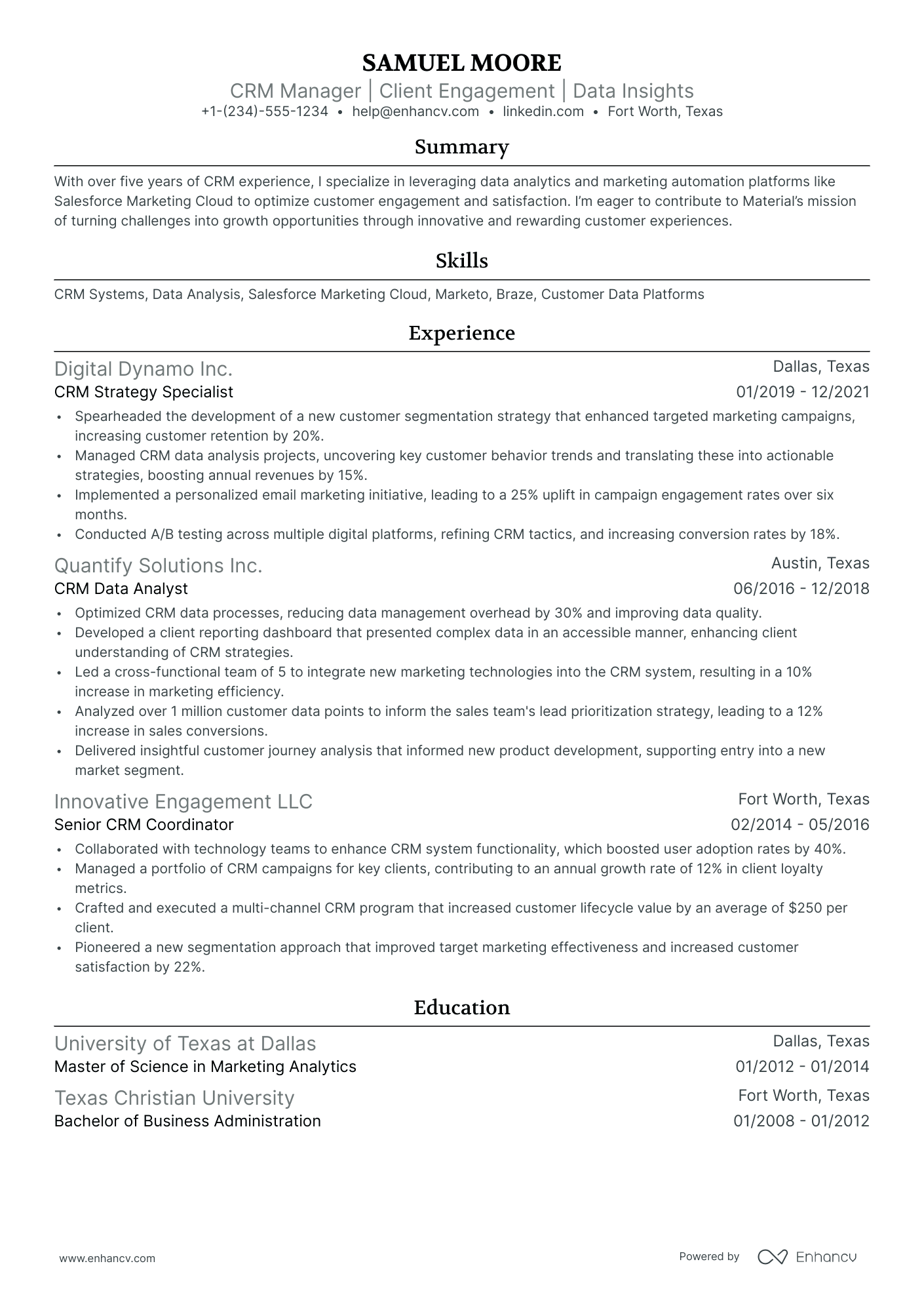
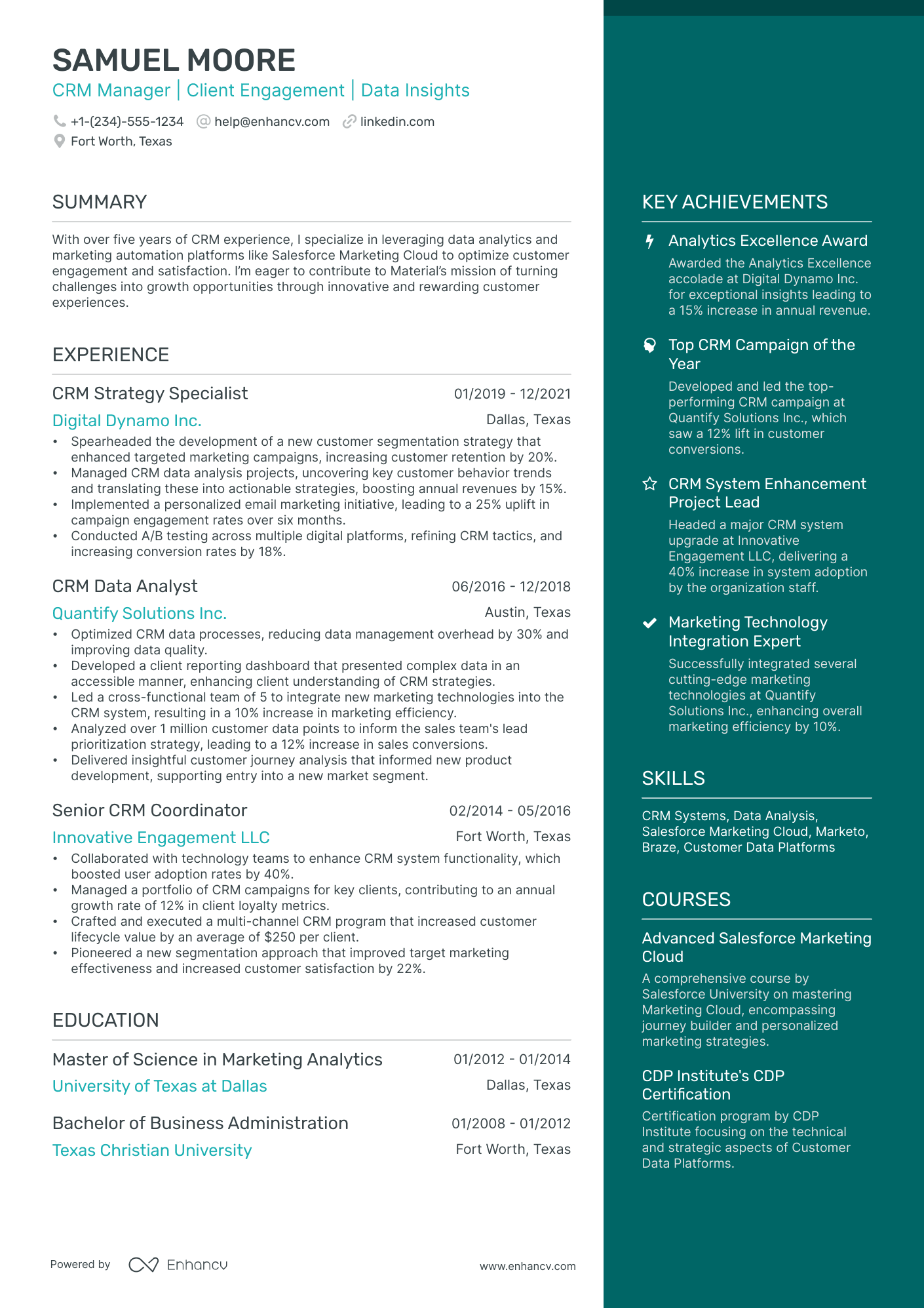
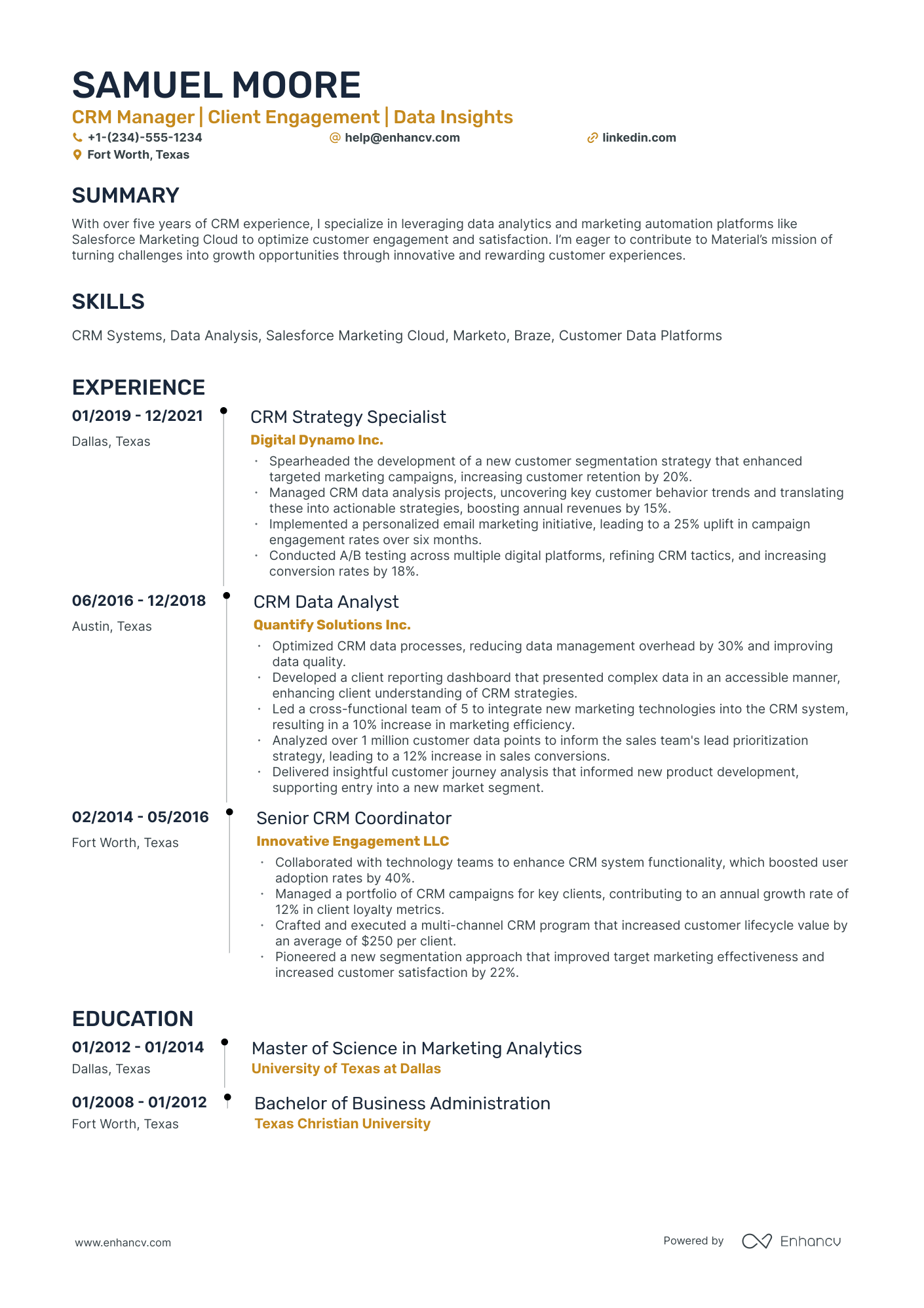
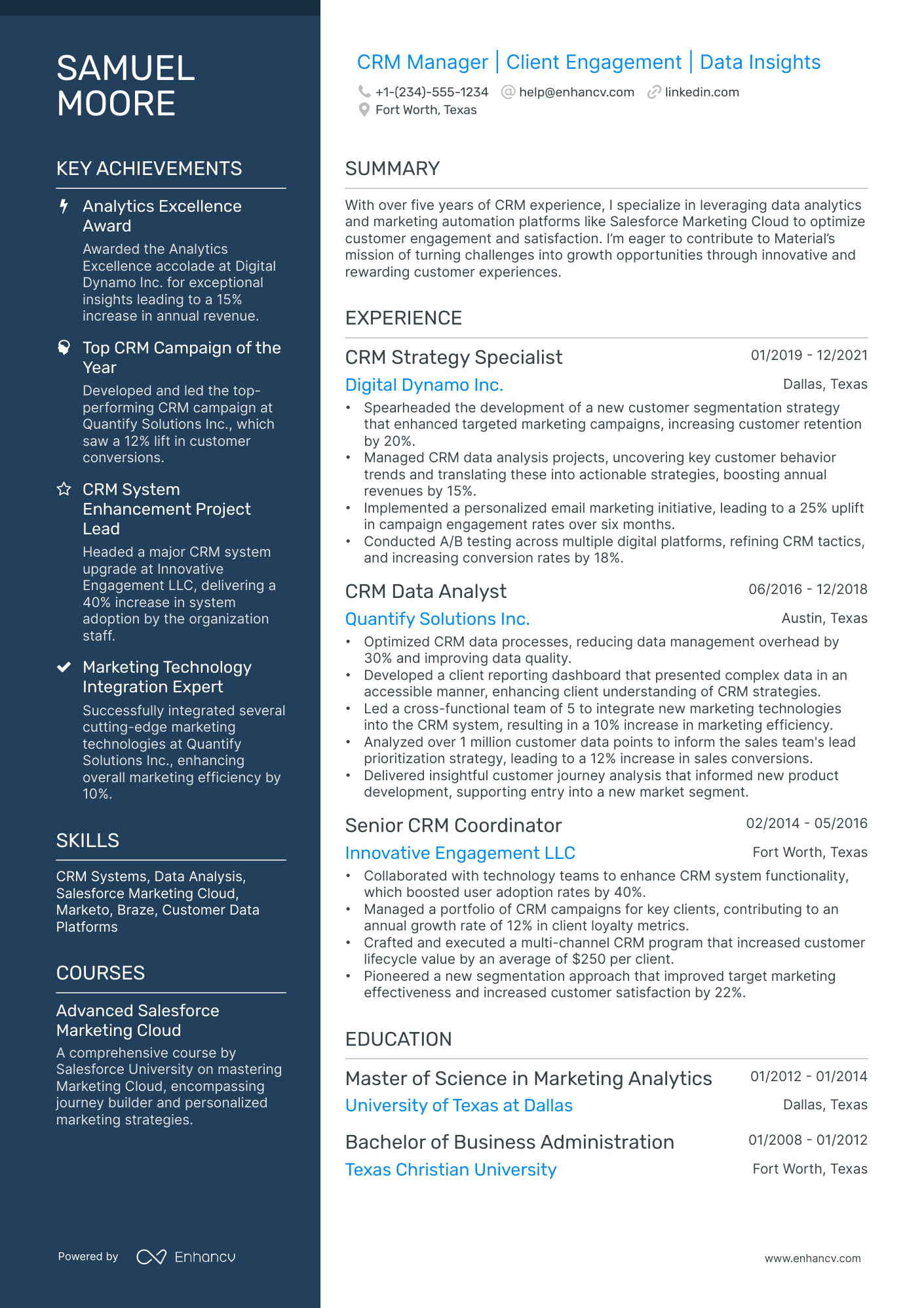
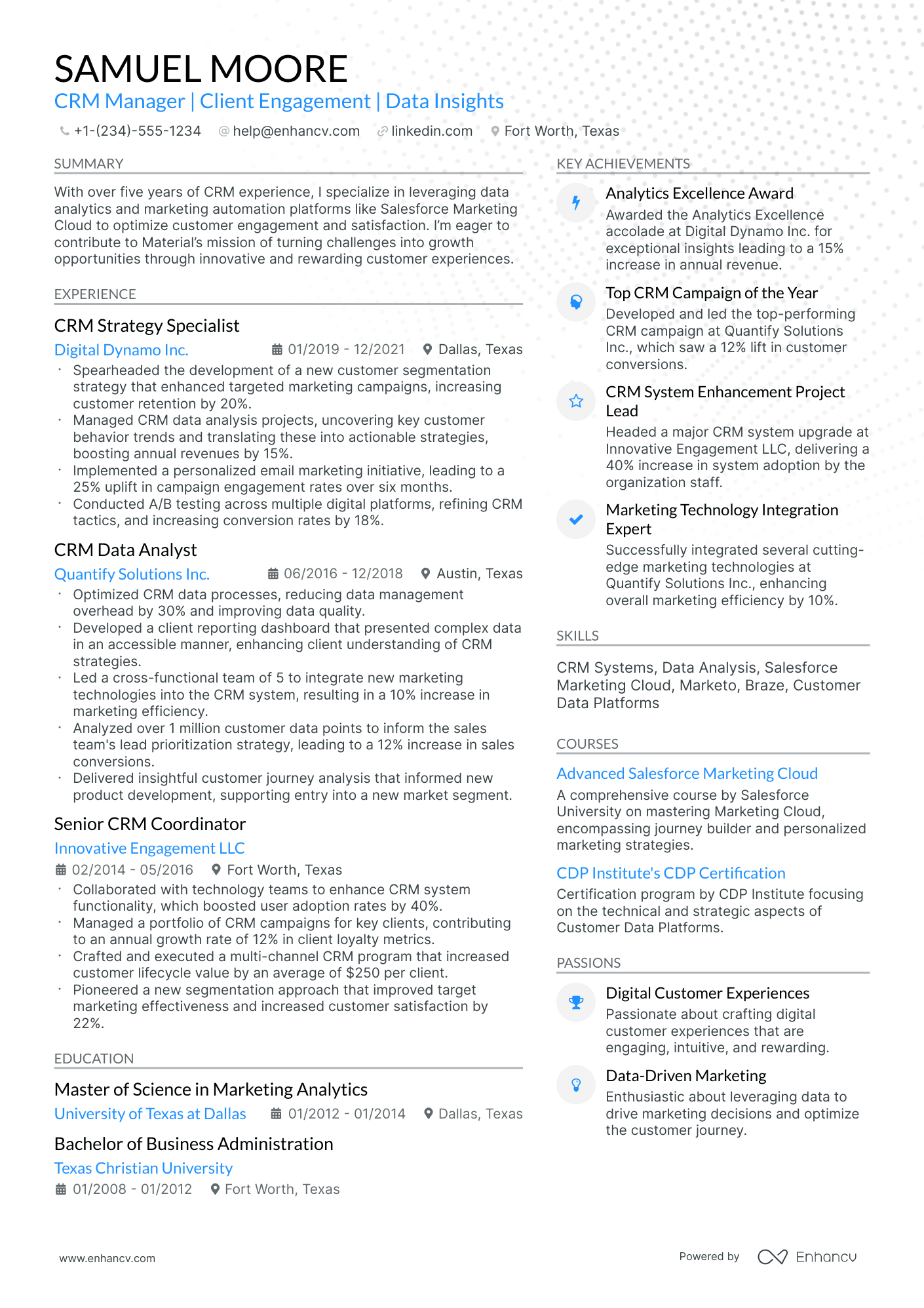
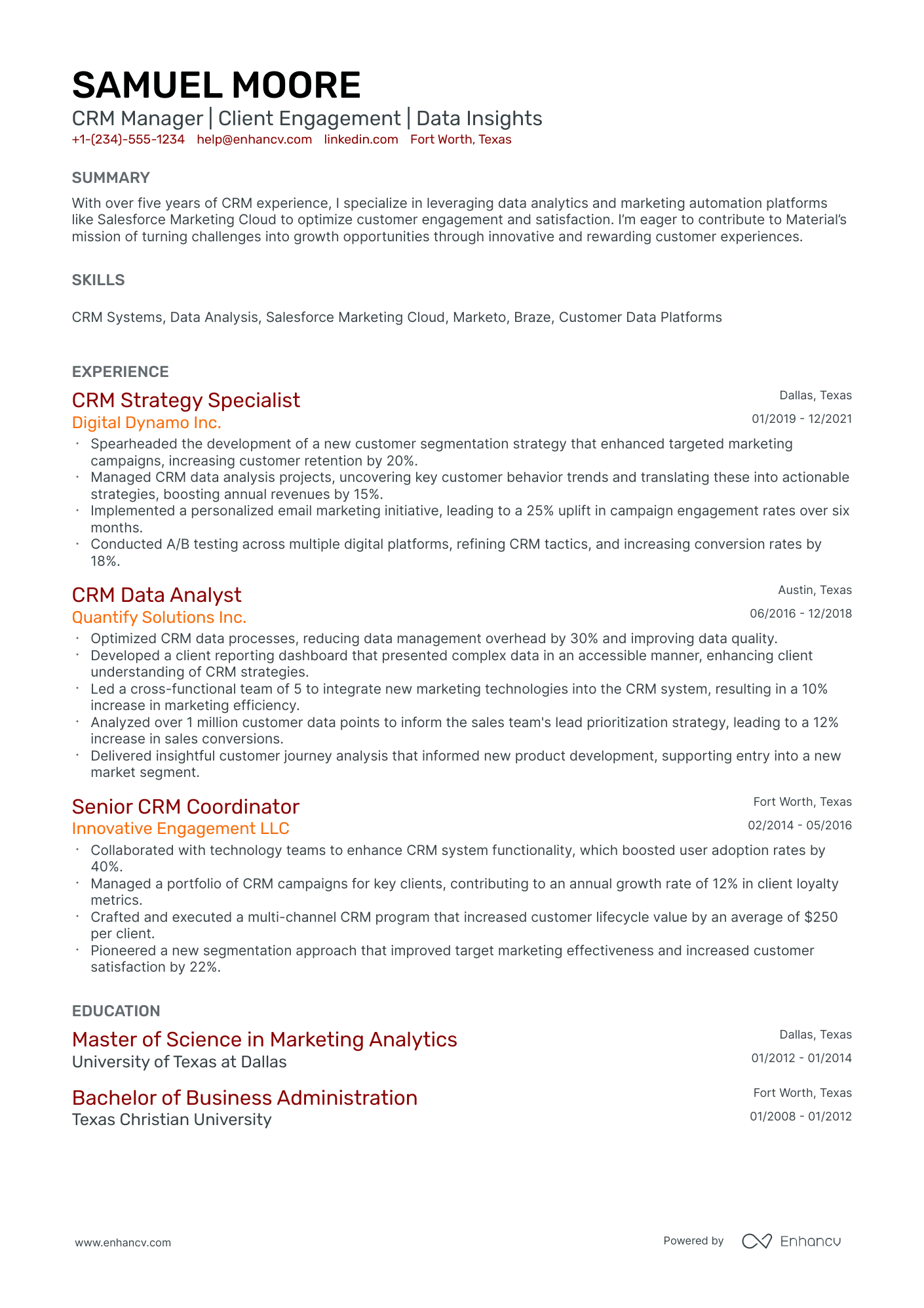
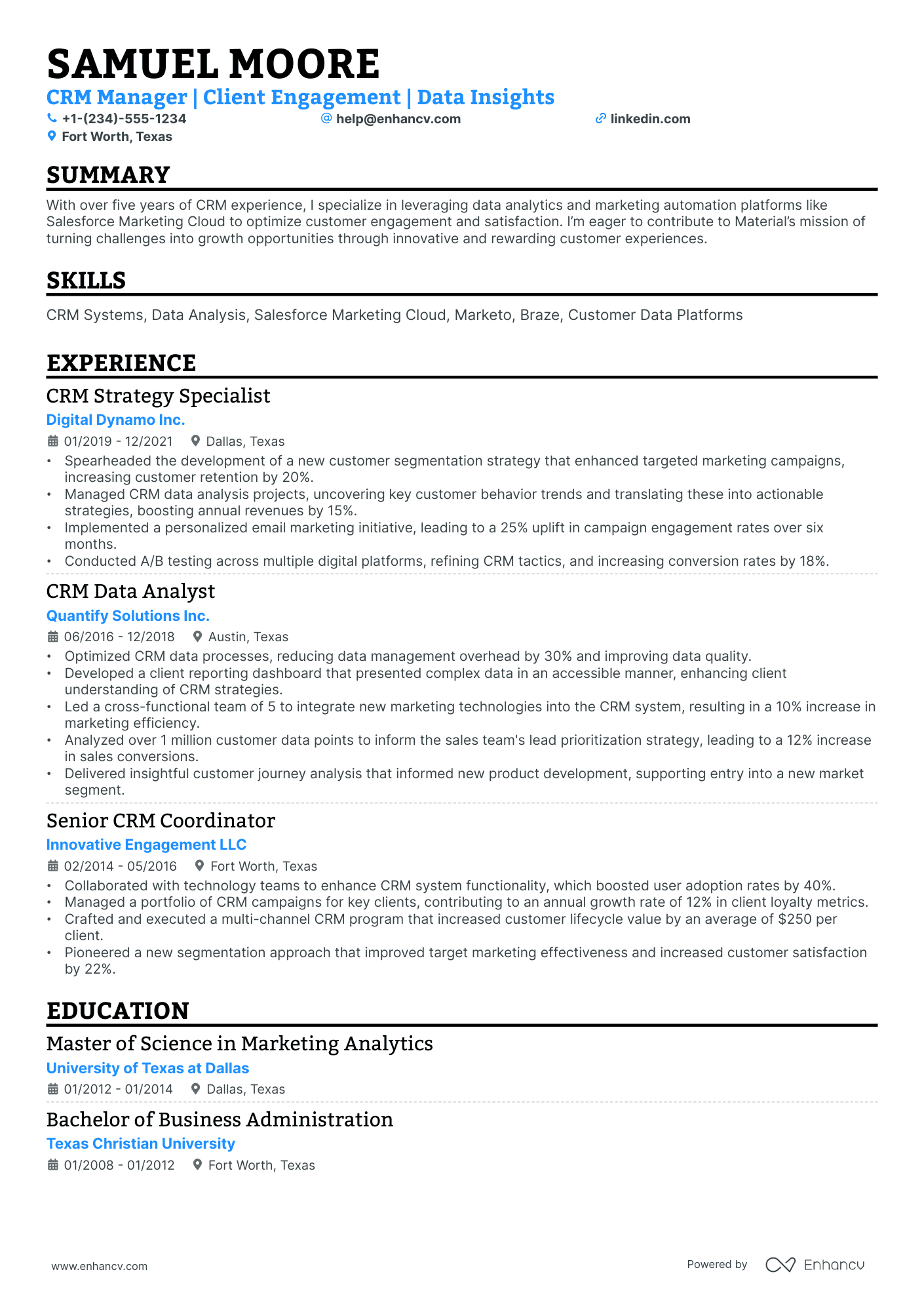
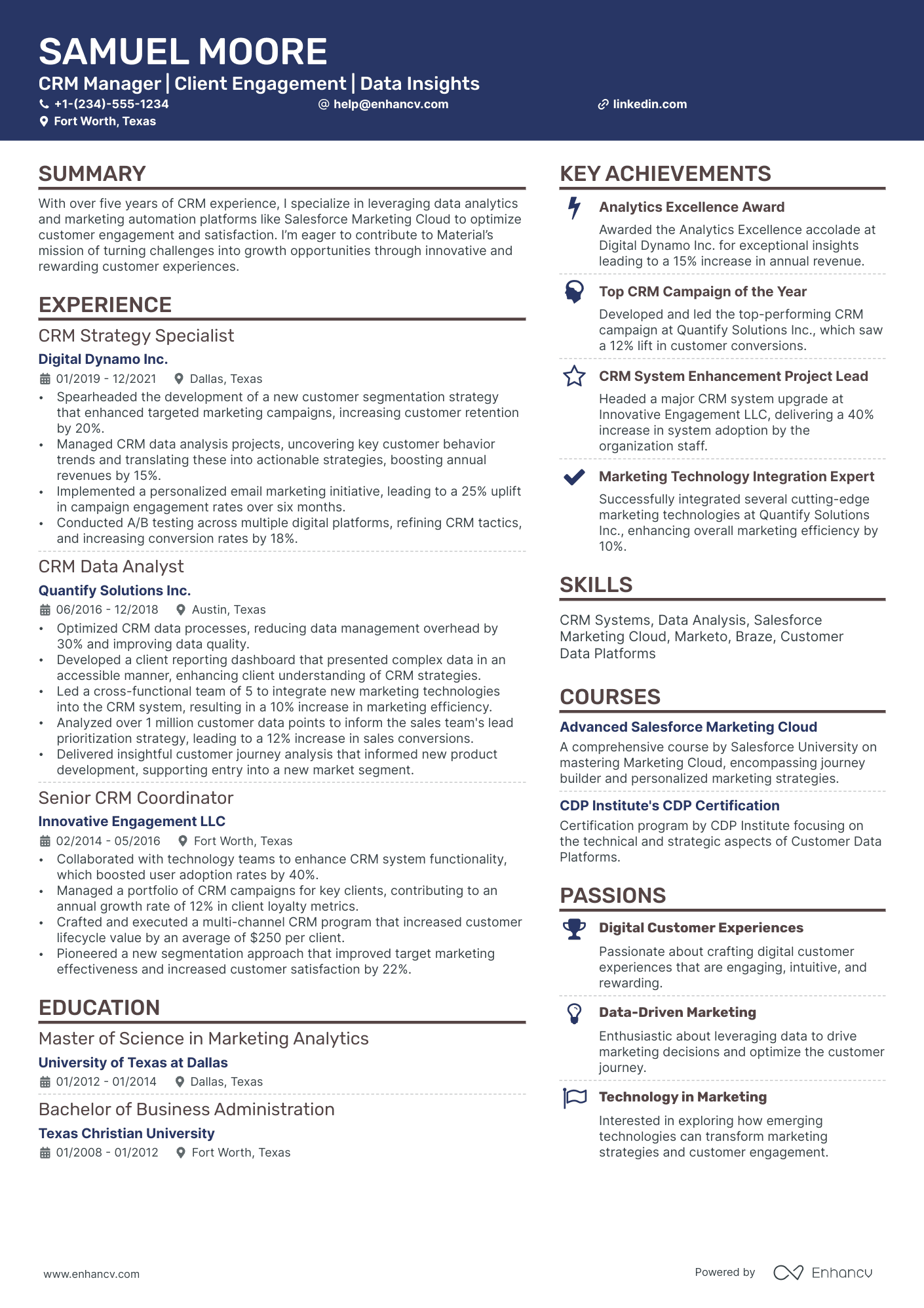
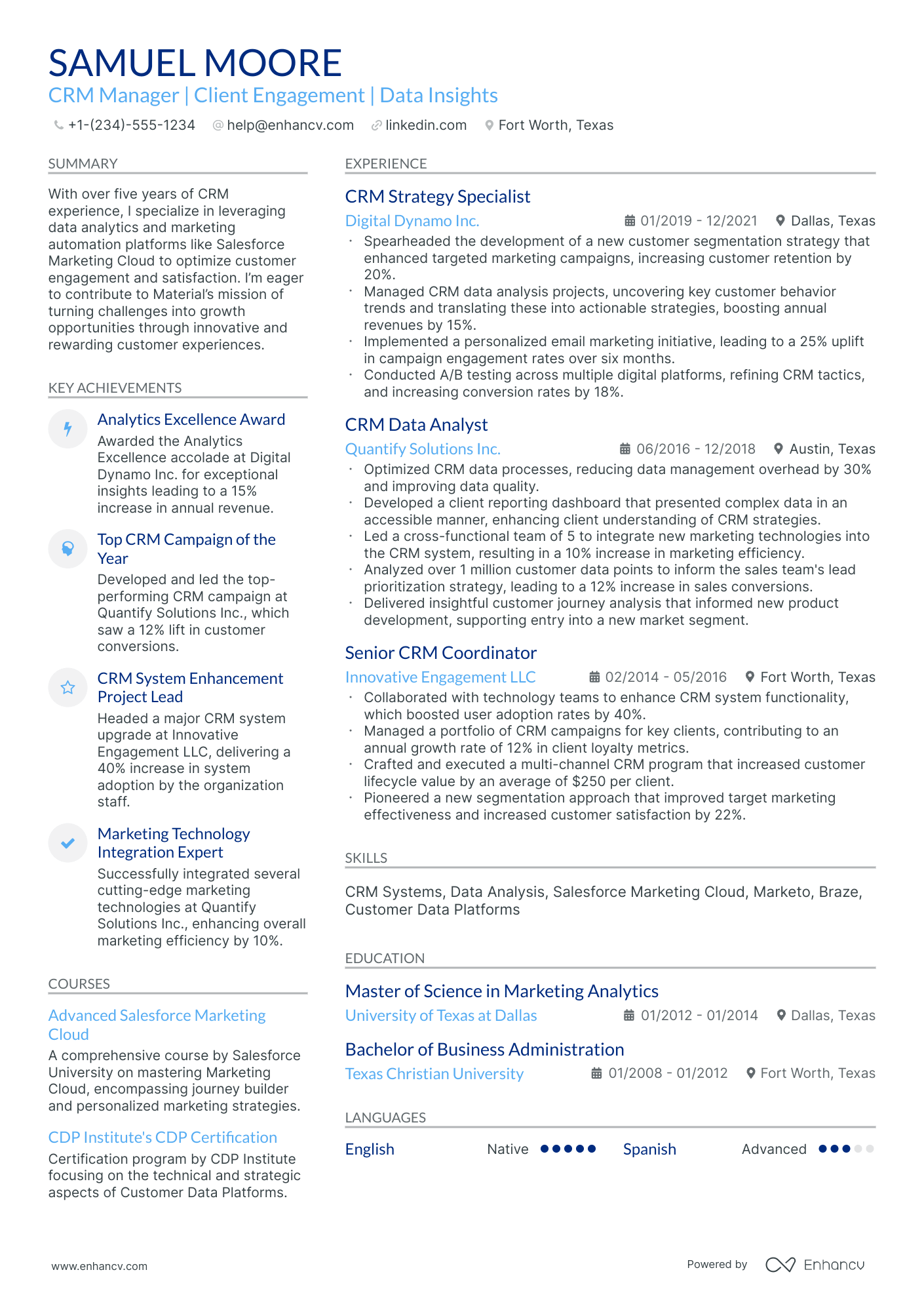
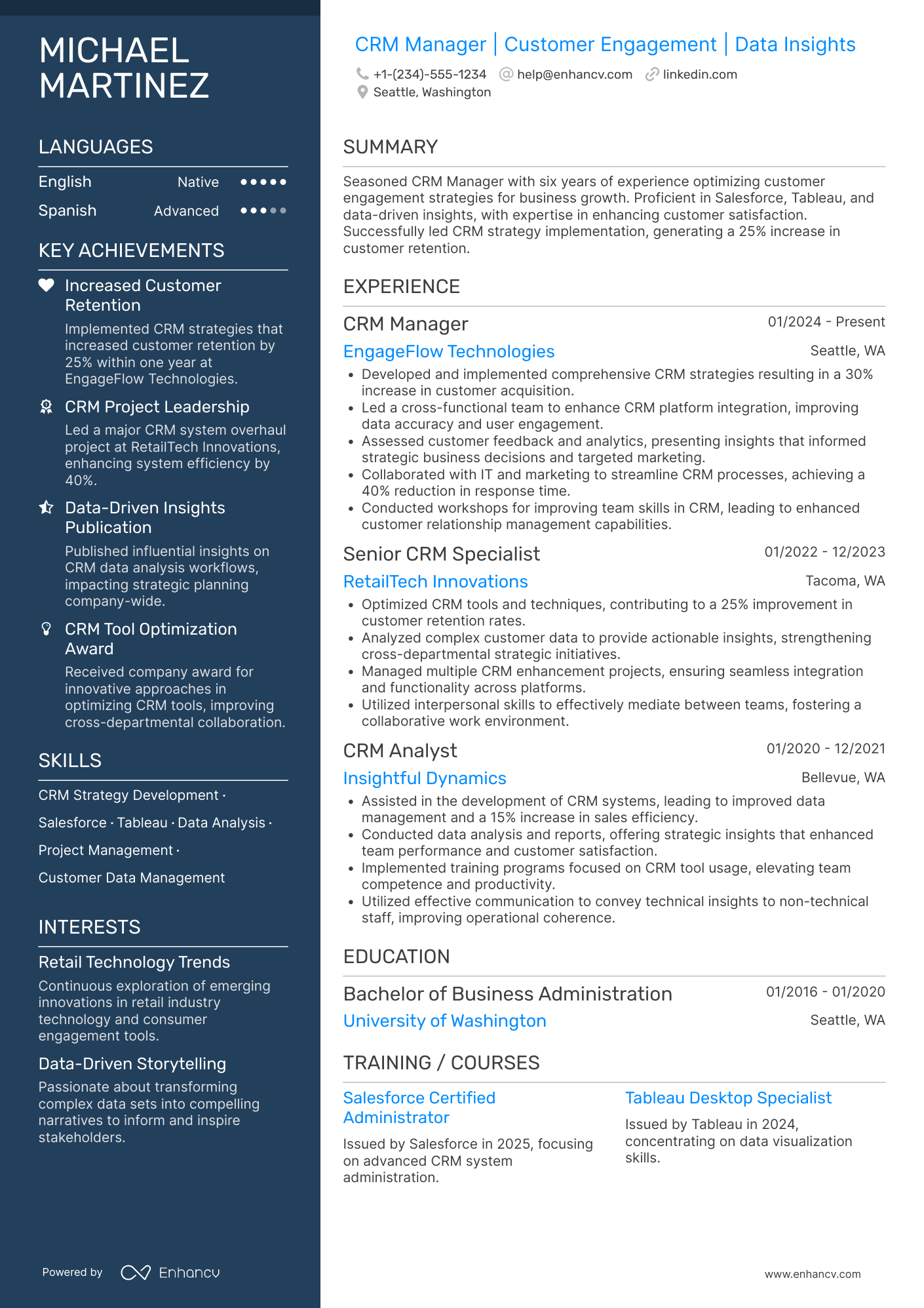
Most CRM manager resume drafts fail because they list platforms and tasks but don't show how customer data drove revenue, retention, or lifecycle performance. That gap gets you filtered by ATS screening and missed in rapid recruiter scans.
A resume that quantifies retention and revenue is half the application; a matching CRM manager cover letter is where you walk the hiring lead through how those numbers were earned and the segmentation thinking behind them.
A strong resume proves business impact and strategic ownership. Knowing how to make your resume stand out means highlighting outcomes like increased conversion rate, reduced churn, improved campaign response, faster lead routing, higher data quality, and measurable pipeline influenced across regions or segments.

Key takeaways
- Quantify CRM outcomes like retention lift, churn reduction, and revenue impact in every experience bullet.
- Use reverse-chronological format for seasoned CRM managers and hybrid format for career switchers.
- Tailor platform names, lifecycle terminology, and KPIs to match each job posting directly.
- Demonstrate skills through measurable results in your summary and experience—not just a skills list.
- Place certifications above education when they're recent and directly relevant to the role.
- Write a cover letter when you need to explain career transitions or highlight specific project outcomes.
- Use Enhancv's tools to tighten bullet points and align your resume with real business impact.
How to format a CRM manager resume
Recruiters evaluating CRM manager resumes look for hands-on platform expertise, campaign performance metrics, and the ability to translate customer data into retention and revenue strategies. A clean, well-structured resume format ensures these signals surface quickly during both human review and applicant tracking system (ATS) parsing.

I have significant experience in this role—which format should I use?
Use a reverse-chronological format to present your CRM career progression, platform depth, and measurable business impact in a clear, linear narrative. Do:
- Lead each role entry with your scope of ownership—team size, customer segments managed, number of markets or business units supported, and budget responsibility.
- Highlight proficiency with role-specific platforms and domains such as Salesforce, HubSpot, Marketo, customer segmentation modeling, lifecycle automation, and data governance.
- Quantify outcomes tied directly to retention, revenue, or efficiency—churn reduction, customer lifetime value growth, campaign ROI, or pipeline contribution.
I'm junior or switching into this role—what format works best?
A hybrid format works best, allowing you to lead with a focused CRM skills section while still backing those skills with concrete experience entries. Do:
- Place a dedicated skills section near the top that highlights CRM platforms, marketing automation tools, SQL or data analysis capabilities, and segmentation frameworks.
- Include relevant projects, internships, or cross-functional work—such as building a lead scoring model, managing a migration between CRM platforms, or running A/B tests on lifecycle campaigns—even if they came from an adjacent role.
- Connect every listed skill to a specific action and a measurable or observable result so recruiters can assess real capability, not just keyword familiarity.
Why not use a functional resume?
A functional format strips CRM experience away from the employer and timeline context that recruiters need to evaluate how you applied your skills in real business environments.
- Career changers moving into CRM: You have transferable experience in marketing analytics, email marketing, or sales operations but no CRM-specific job title yet.
- Limited CRM work history: You completed a CRM certification, bootcamp, or freelance project but haven't held a full-time CRM role.
- Resume gaps: You're re-entering the workforce after a break and need to foreground current, relevant skills over a non-linear timeline.
Once your layout and structure are in place, the next step is deciding which sections to include so each one reinforces your qualifications.
What sections should go on a CRM manager resume
Recruiters expect a CRM manager resume to show clear ownership of CRM strategy, lifecycle programs, and measurable revenue or retention impact. Understanding what to put on a resume helps you prioritize the right content. Use this structure for maximum clarity:
- Header
- Summary
- Experience
- Skills
- Projects
- Education
- Certifications
- Optional sections: Awards, Leadership, Languages
Strong experience bullets should emphasize quantified outcomes, program scope, cross-functional execution, and improvements to retention, conversion, and revenue.
Is your resume good enough?
Drop your resume here or choose a file. PDF & DOCX only. Max 2MB file size.
Once you’ve organized your resume with the right components in place, the next step is to write your CRM manager resume experience in a way that fits that structure and shows impact.
How to write your CRM manager resume experience
The experience section is where you prove you've actually shipped CRM strategies, managed platforms end to end, and driven measurable improvements in customer engagement, retention, or lifetime value. Hiring managers prioritize demonstrated impact—campaign results, system implementations, lifecycle optimizations—over descriptive task lists that only outline responsibilities.
Each entry should include:
- Job title
- Company and location (or remote)
- Dates of employment (month and year)
Three to five concise bullet points showing what you owned, how you executed, and what outcomes you delivered:
- Ownership scope: the CRM platforms, customer databases, lifecycle programs, audience segments, or retention initiatives you were directly accountable for as a CRM manager.
- Execution approach: the tools, automation workflows, segmentation frameworks, A/B testing methodologies, or data analysis techniques you used to inform decisions and deliver CRM campaigns.
- Value improved: changes to customer retention rates, email deliverability, campaign performance, data hygiene, personalization accuracy, or churn reduction that resulted from your work.
- Collaboration context: how you partnered with marketing, sales, product, engineering, data analytics, or external vendors to align CRM strategy with broader business objectives.
- Impact delivered: outcomes framed as business results—growth in customer lifetime value, expansion of engaged audiences, acceleration of sales pipeline, or improvements in cross-channel conversion—rather than activities performed.
Experience bullet formula
A CRM manager experience example
✅ Right example - modern, quantified, specific.
CRM Manager
BrightCart | Austin, TX
2022–Present
B2C ecommerce retailer serving two million customers across North America with a loyalty-first growth strategy.
- Led lifecycle strategy in Salesforce Marketing Cloud and Salesforce Sales Cloud, rebuilding segmentation and journeys to increase email-attributed revenue by 22% and lift repeat purchase rate by 9%.
- Implemented a customer data platform (CDP) event schema with engineers and analytics in Segment and Snowflake, improving identity resolution by 18% and reducing audience build time from two days to two hours.
- Launched multi-channel retention programs (email, short message service, and push) using Braze, driving a 14% increase in ninety-day retention and cutting churn among loyalty members by 6%.
- Optimized deliverability with SendGrid and Google Postmaster Tools—authentication, list hygiene, and suppression logic—raising inbox placement from 86% to 94% and reducing spam complaints by 31%.
- Partnered with product managers and designers to run A/B and multivariate tests in Optimizely and Tableau, improving onboarding conversion by 11% and saving forty hours per month through automated reporting.
Now that you've seen how a strong experience section comes together, let's look at how to adjust yours to match the specific role you're applying for.
How to tailor your CRM manager resume experience
Recruiters evaluate your CRM manager resume through both human review and applicant tracking systems. Tailoring your resume to the job description increases your chances of advancing past both.
Ways to tailor your CRM manager experience:
- Match CRM platforms and marketing automation tools named in the job description.
- Mirror the exact terminology used for customer lifecycle stages or segmentation models.
- Reflect retention or engagement KPIs the posting highlights as success criteria.
- Include industry experience relevant to the company's sector or customer base.
- Emphasize data privacy and compliance standards referenced in the listing.
- Highlight cross-functional collaboration with sales or marketing teams when requested.
- Align your workflow descriptions with the CRM methodologies the role specifies.
- Reference campaign orchestration or journey mapping frameworks the posting mentions.
Tailoring means aligning your real accomplishments with what the role demands, not forcing keywords where they don't belong.
Resume tailoring examples for CRM manager
| Job description excerpt | Untailored | Tailored |
|---|---|---|
| "Manage end-to-end lifecycle campaigns in Salesforce Marketing Cloud to improve customer retention across segments." | Handled email campaigns and helped retain customers. | Built and managed end-to-end lifecycle campaigns in Salesforce Marketing Cloud, improving customer retention by 18% across three key segments over six months. |
| "Analyze CRM data to identify churn risks and develop automated re-engagement workflows using HubSpot." | Looked at customer data and created workflows to bring back inactive users. | Analyzed CRM churn signals in HubSpot to identify at-risk accounts, then designed automated re-engagement workflows that recovered 12% of lapsed customers within 90 days. |
| "Collaborate with product and marketing teams to build personalized customer journeys that increase LTV." | Worked with other teams to improve the customer experience. | Partnered with product and marketing to design personalized customer journeys in Braze, increasing average customer lifetime value by 22% year over year. |
Once you’ve aligned your experience with the role’s priorities, the next step is to quantify your CRM manager achievements to prove the impact of that work.
How to quantify your CRM manager achievements
Quantifying your achievements shows how your CRM work changed revenue, retention, campaign efficiency, and data quality. Focus on conversion lift, churn reduction, segmentation accuracy, automation time saved, and deliverability or compliance improvements.
Quantifying examples for CRM manager
| Metric | Example |
|---|---|
| Revenue lift | "Increased email-to-purchase conversion from 2.1% to 2.7% in six months by rebuilding lifecycle journeys in Salesforce Marketing Cloud and A/B testing subject lines." |
| Retention | "Reduced churn by 1.8 points for a 120,000-customer segment by launching win-back automations and suppressing high-risk contacts based on RFM scoring." |
| Data quality | "Cut duplicate records by 34% and raised valid email rate from 92% to 97% by implementing Salesforce dedupe rules and weekly data hygiene audits." |
| Efficiency | "Reduced campaign build time from eight hours to three hours by creating reusable templates, dynamic content blocks, and standardized QA checklists across fifteen journeys." |
| Deliverability | "Improved inbox placement from 86% to 93% by tightening list hygiene, setting up DMARC, and adjusting send cadence for five high-volume programs." |
Turn vague job duties into measurable, recruiter-ready resume bullets in seconds with Enhancv's Bullet Point Generator.
With strong bullet points in place, the next step is ensuring your skills section presents the right mix of hard and soft skills that CRM manager roles demand.
How to list your hard and soft skills on a CRM manager resume
Your skills section shows you can drive lifecycle growth, retention, and revenue, and recruiters and an ATS (applicant tracking system) scan this section to confirm you match the job post—aim for a hard-skill heavy mix supported by role-specific soft skills. CRM manager roles require a blend of:
- Product strategy and discovery skills.
- Data, analytics, and experimentation skills.
- Delivery, execution, and go-to-market discipline.
- Soft skills.
Your skills section should be:
- Scannable (bullet-style grouping).
- Relevant to the job post.
- Backed by proof in experience bullets.
- Updated with current tools.
Place your skills section:
- Above experience if you're junior or switching careers.
- Below experience if you're mid/senior with strong achievements.

Hard skills
- Salesforce Marketing Cloud
- HubSpot CRM, Marketo
- Braze, Iterable
- Customer segmentation
- Lifecycle journey mapping
- Email, SMS automation
- Triggered campaigns
- A/B testing, holdouts
- SQL, data extraction
- Google Analytics 4
- Tableau, Looker dashboards
- GDPR, CAN-SPAM compliance
These are examples of hard skills that demonstrate your technical proficiency with CRM platforms, data tools, and compliance frameworks.
Soft skills
- Cross-functional stakeholder alignment
- Clear campaign briefs
- Prioritization and roadmap ownership
- Data-informed decision-making
- Hypothesis-driven planning
- Marketing and sales partnership
- Vendor and agency management
- Timeline and dependency management
- Risk and issue escalation
- Executive-ready reporting
- Customer-first messaging judgment
- Process documentation and handoffs
These soft skills reflect the interpersonal and organizational strengths that CRM managers need to lead cross-functional initiatives effectively.
How to show your CRM manager skills in context
Skills shouldn't live only in a dedicated skills list. Explore how other professionals present their resume skills for inspiration on integrating them throughout your document.
They should be demonstrated in:
- Your summary (high-level professional identity)
- Your experience (proof through outcomes)
Here's what that looks like in practice.
Summary example
CRM manager with eight years in e-commerce, skilled in Salesforce, lifecycle marketing, and cross-functional collaboration. Built automated nurture programs that boosted customer retention by 34% and drove $2.1M in incremental annual revenue.
- Signals senior-level experience immediately
- Names specific platforms and methods
- Leads with a measurable retention metric
- Highlights collaboration as a soft skill
Experience example
Senior CRM Manager
Vantage Commerce | Remote
June 2019–Present
- Redesigned Salesforce lead-scoring workflows with the data science team, increasing qualified pipeline volume by 28% within two quarters.
- Launched a HubSpot-driven segmentation strategy across four markets, improving email click-through rates by 41% year over year.
- Partnered with product and UX teams to build in-app engagement triggers, reducing monthly churn by 17% among mid-tier subscribers.
- Every bullet contains measurable proof.
- Skills surface naturally through outcomes.
Once you’ve demonstrated your CRM manager capabilities through results and real examples, the next step is applying that same approach to a CRM manager resume when you don’t have direct experience.
How do I write a CRM manager resume with no experience
Even without full-time experience, you can demonstrate readiness through:
- CRM certification capstone project.
- Internship in email marketing operations.
- Volunteer donor database cleanup.
- Student club member segmentation.
- Freelance HubSpot CRM setup.
- Sales pipeline reporting in spreadsheets.
- Customer support ticket tagging rules.
- Data enrichment and deduplication project.
If you're building a resume without work experience, focus on:
- CRM platform proficiency with proof.
- Segmentation, lifecycle, and automation examples.
- Data hygiene, governance, and accuracy.
- Reporting dashboards with business impact.
Resume format tip for entry-level CRM manager
Use a combination resume format because it highlights CRM manager skills and projects first, while still showing a clear timeline of related experience. Do:
- Lead with a CRM manager skills section.
- Add two to three project bullets.
- Name tools: HubSpot, Salesforce, SQL.
- Quantify outcomes: lift, accuracy, time.
- Tailor keywords to the job post.
- Built a HubSpot CRM lifecycle workflow and segmented lists for a student club, increasing event email click-through rate by 18% in six weeks.
Even without direct experience, your educational background can demonstrate the foundational knowledge and relevant skills that qualify you for a CRM manager role.
How to list your education on a CRM manager resume
Your education section helps hiring teams confirm you have the foundational knowledge needed for a CRM manager role. It validates expertise in marketing, data analysis, and business strategy.
Include:
- Degree name
- Institution
- Location
- Graduation year
- Relevant coursework (for juniors or entry-level candidates)
- Honors & GPA (if 3.5 or higher)
Skip month and day details—list the graduation year only.
Here's a strong education entry tailored to a CRM manager resume:
Example education entry
Bachelor of Science in Marketing
University of Michigan, Ann Arbor, MI
Graduated 2019
GPA: 3.7/4.0
- Relevant coursework: Customer Analytics, Database Marketing, Consumer Behavior, Digital Marketing Strategy
- Honors: Dean's List, Magna Cum Laude
How to list your certifications on a CRM manager resume
Certifications on your resume show a CRM manager's commitment to learning, proficiency with key tools, and alignment with current industry practices. They also help validate specialized skills when your experience spans multiple platforms or teams.
Include:
- Certificate name
- Issuing organization
- Year
- Optional: credential ID or URL
- Place certifications below education when they are older, less relevant to your current CRM manager focus, or secondary to your degree.
- Place certifications above education when they are recent, highly relevant to the CRM manager role, or required for the job.
Best certifications for your CRM manager resume
- Salesforce Certified Administrator
- Salesforce Certified Marketing Cloud Administrator
- HubSpot Marketing Software Certification
- HubSpot Sales Software Certification
- Microsoft Dynamics 365 Fundamentals (CRM)
- Google Analytics Certification
- Professional Scrum Master I (PSM I)
Once you’ve positioned your credentials where recruiters will see them, you’re ready to write your CRM manager resume summary to frame those qualifications in a clear, high-impact snapshot.
How to write your CRM manager resume summary
Your resume summary is the first thing a recruiter reads, so it needs to earn their attention fast. A strong CRM manager summary signals relevant expertise and measurable impact within seconds.
Keep it to three to four lines, with:
- Your title and total years of CRM or marketing operations experience.
- The industry or domain where you've worked, such as e-commerce, SaaS, or retail.
- Core tools you've used, like Salesforce, HubSpot, Braze, or Klaviyo.
- One or two quantified achievements, such as retention lifts or revenue growth.
- Soft skills tied to real outcomes, like cross-functional collaboration or stakeholder management.

PRO TIP
At the mid-level CRM manager stage, emphasize hands-on platform expertise and campaign results you directly owned. Highlight specific metrics—retention rates, engagement lifts, or revenue attributed to your CRM programs. Avoid vague descriptors like "passionate" or "results-driven" that add no proof. Let numbers and tools speak for your credibility instead.
Example summary for a CRM manager
CRM manager with five years of experience in e-commerce, specializing in Salesforce and Klaviyo. Built lifecycle campaigns that boosted customer retention by 22% and drove $1.3M in annual repeat revenue through segmentation strategies.
Optimize your resume summary and objective for ATS
Drop your resume here or choose a file.
PDF & DOCX only. Max 2MB file size.
Now that your summary is crafted to highlight your CRM expertise and value, make sure the header above it presents your contact details clearly so recruiters can reach you without any friction.
What to include in a CRM manager resume header
A resume header lists your key identifying and contact details, helping a CRM manager stand out, build credibility, and pass recruiter screening fast.
Essential resume header elements
- Full name
- Tailored job title and headline
- Location
- Phone number
- Professional email
- GitHub link
- Portfolio link
A LinkedIn link helps recruiters verify your experience quickly and supports screening.
Don't include a photo on a CRM manager resume unless the role is explicitly front-facing or appearance-dependent.
Align your job title and headline with the posting, and keep every detail consistent across your resume and online profiles.
CRM manager resume header
Jordan Lee
CRM manager | Lifecycle campaigns, segmentation, and reporting
Austin, TX
(512) 555-01XX
your.name@enhancv.com
github.com/yourname
yourwebsite.com
linkedin.com/in/yourname
Once you’ve set a clear, complete top section that makes your role and contact details easy to find, add additional sections for CRM manager resumes to reinforce your qualifications with relevant supporting information.
Additional sections for CRM manager resumes
Adding extra sections helps you stand out when your core qualifications match other candidates and you need to showcase unique, role-specific credibility.
- Languages
- Certifications
- Industry conferences and speaking engagements
- Publications
- Professional affiliations
- Volunteer experience in data-driven or customer-focused initiatives
- Awards and recognitions
Once you've rounded out your resume with the right supplementary sections, it's worth turning your attention to the document that accompanies it—your cover letter.
Do CRM manager resumes need a cover letter
A cover letter isn't required for a CRM manager, but it helps in competitive searches or when hiring teams expect one. If you're unsure what a cover letter is or when to use one, it can make a difference when your resume needs context, or when fit and communication matter.
Use a cover letter to add context your resume can't:
- Explain role and team fit by linking your CRM manager strengths to the company's lifecycle goals and cross-functional workflow.
- Highlight one or two relevant projects or outcomes, including a clear baseline, what you changed, and the measurable result.
- Show you understand the product, users, and business context by referencing key segments, channels, and lifecycle moments you'd prioritize.
- Address career transitions or non-obvious experience by mapping transferable skills to CRM manager responsibilities and tools.
Drop your resume here or choose a file.
PDF & DOCX only. Max 2MB file size.
Even if you choose to include a cover letter to add context beyond your resume, the next step is using AI to improve your CRM manager resume so it communicates that value more clearly and consistently.
Using AI to improve your CRM manager resume
AI can sharpen your resume's clarity, structure, and impact. It helps you find stronger phrasing and tighten wordy bullets. But overuse risks making your resume sound generic. Once your content is clear and role-aligned, step away from AI. If you're exploring this approach, learn more about ChatGPT resume writing prompts to get started with effective inputs.
Here are 10 practical prompts to strengthen specific sections of your CRM manager resume:
Strengthen your summary
Quantify experience bullets
Tighten wordy bullets
Align skills strategically
Refine project descriptions
Improve certification relevance
Tailor education details
Eliminate vague language
Match job descriptions
Fix inconsistent formatting
Conclusion
A strong CRM manager resume highlights measurable outcomes, like revenue lift, retention gains, and improved lifecycle performance. It pairs role-specific skills—segmentation, automation, analytics, testing, and cross-functional delivery—with a clear, scannable structure.
Keep each section focused and easy to verify, so your impact stands out fast. This approach shows you’re ready for today’s hiring market and the near-future focus on accountable growth and customer value.